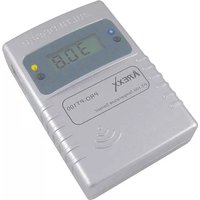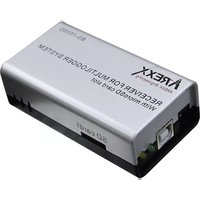
BS-750SD - Measuring equipment AREXX - Free user manual and instructions
Find the device manual for free BS-750SD AREXX in PDF.


| Product type | USB Multilogger Receiver with micro SD card recording |
| Brand | AREXX |
| Model | BS-750SD |
| Radio technology | 433 MHz (ISM band) |
| USB interface | USB 2.0 |
| Power supply | 5 - 7.5 V DC / 100 mA (USB or mains adapter) |
| RTC clock battery | CR2032 3 V (battery life ~5 years) |
| Memory card type | Micro SD (SD, SDHC) |
| Internal memory | 2 MB (data-flash, approximately 9 days for 10 sensors) |
| Software compatibility | Windows XP and later (32/64 bit), Multilogger software (Templogger) |
| SD card storage | CSV files in the 'log' folder, one file per sensor per month |
| Visual indicators | Green LED (data reception) and orange LED (recording to internal memory or SD card) |
| Operating conditions | Indoor only, protected from moisture and water |
| Safety precautions | Check power polarity; do not use in humid conditions; do not touch internal components |
| Maintenance | Keep dry; replace RTC battery if clock does not synchronize |
| Spare parts / repairability | Replaceable CR2032 battery; removable SD card; no other user-serviceable parts |
| Software download | www.arexx.com |
Frequently Asked Questions - BS-750SD AREXX
User questions about BS-750SD AREXX
0 question about this device. Answer the ones you know or ask your own.
Ask a new question about this device
Download the instructions for your Measuring equipment in PDF format for free! Find your manual BS-750SD - AREXX and take your electronic device back in hand. On this page are published all the documents necessary for the use of your device. BS-750SD by AREXX.
USER MANUAL BS-750SD AREXX
-
Transmission losses
-
Communication test
Technical specifications 20

natural_image
Simple black circular icon with the letter 'i' inside, no additional text or symbols.| Impressum©2013 AREXX EngineeringNervistraat 168013 RS ZwolleThe NetherlandsTel.: +31 (0) 38 454 2028Fax.: +31 (0) 38 452 4482E-Mail: Info@arexx.nl | This manual is protected by laws of Copyright. Any full or partial reproduction of the contents are forbidden without prior written authorization by the European importer.Product specifications and delivery contents are subject to changes. The manual is subject to changes without prior notice.You can find free updates of this manual onhttp://www.arexx.com/ |
| “TL-ALU9 and Multilogger” are registered trademarks of AREXX Engineering.All other trademarks are the property of their owners. We are not responsible for the contents of external web pages that are mentioned in this manual! | |
| Information about limited warranty and responsibilityThe warranty granted by AREXX Engineering is limited to the replacement or repair of the BS-750SD and its accessories within the legal warranty period if the default has arisen from production errors such as mechanical damage or missing or wrong assembly of electronic components except for all components that are connected via plugs/sockets.The warranty does not apply directly or indirectly to damages due to the use of the BS-750SD. This excludes claims that fall under the legal prescription of product responsibility.The warranty does not apply in case of irreversible changes (such as soldering of other components, drilling of holes, etc.) of the BS-750SD or its accessories or if the BS-750SD is damaged due to the disrespect of this manual.The warranty is not applicable in case of disrespect of this manual! In addition, AREXX Engineering is not responsible for damages of all kinds resulting from the disrespect of this manual! Please adhere above all to the „Safety recommendations” in the BS-750SD manual.Please note the relevant license agreements on the CD-ROM!IMPORTANTPrior to using this BS-750SD receiver for the first time, please read this manua thoroughly up to the end. it explains the correct use and inform you about potential dangers. Moreover it contains important information that might not be obvious for all users.Important safety recommendationThis module is equipped with highly sensitive components. Electronic components are very sensitive to static electricity discharge. Only touch the module by the edges and avoid direct contact with the components on the circuit board. | |
| SymbolsThis manual provides the following symbols: | |
 | The "Attention!" Symbol is used to mark important details. Neglecting these precautions may damage or destroy the module and/or additional components and additionally you may risk your own health or the health of other persons! |
 | The "Information" Symbol is used to mark useful tips and tricks or background information. In this case the information is to be considered as "useful, but not necessary". |
| Safety recommendations- Check the polarity of the power supply.- Keep all products dry, when the product gets wet remove the power directly.- Remove the power when you are not using the product for a longer period.- Before taking the module into operation, always check it and its cables for damage.- If you have reason to believe that the device can no longer be operated safely, disconnect it immediately and make sure it is not unintentionally operated.- Consult an expert if you are unsure about the function, safety or connection to the module.- Do not operate the module in unfavourable conditions.- This module is equipped with highly sensitive components. Electronic components are very sensitive to static electricity discharge. Only touch the module by the edges and avoid direct contact with the components on the circuit board. | |
| Normal useThis product was developed as an receiver for the AREXX Multilogger system. It will only work together with other AREXX Multilogger sensors and products. With the BS-750SD you can receive and store the sensor data.It may be used indoors only. The product must not get damped or wet. Also be careful with condense when you take it from a cold to an warm room, give it time to adapt to the new conditions before you use it.Any use other than that described above can lead to damage to the product and may involve additional risks such as short circuits, fire, electrical shock etc.Please read all the safety instructions of this manual. | |
AREXX BS-750SD Manual
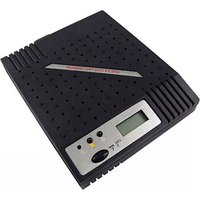
The BS-750SD is a USB Multilogger receiver with a micro-SD card slot. The module receives measurement data from the Multilogger sensors wirelessly and prepares these data for further processing via a USB-entry at a PC.
The BS-750SD system provides us with an internal memory data-storage for measurement data during offline-periods at which the PC is disconnected.
Additionally you can insert a micro-SD memory card on which the system stores received measurement data. These data will only be accessible for reading and further processing with an SD card reader.
Further processing of data may be performed by external software tools such as Excel.
Application sample for the BS-750SD
Let us assume you already installed the Multilogger software at your PC and also inserted the batteries into your sensors.
Now use the included USB-cable to connect the BS-750SD device to your PC.
The very first connection the PC will ask you to install is the USB-driver for the BS-750SD (RF_USB).
In a next step the module will transfer the sensors' measurement data to your PC. The Multilogger software will display this process at the window for the sensors' list, which lists the most recent data for all sensors.
In case the driver software has been installed correctly and the BS-750SD has been connected, the Multilogger software window will display a 'Ready' message and the firmware's module version at the left lower corner of the window.
The module will process incoming sensor data as long as it is connected to a power supply. If the PC is disconnected or switched off, the system will store data in the internal data-flash memory.
As soon as the PC-connection has been reactivated, the Multilogger software will resume the data transfer from the flash memory to the PC. This concept allows a continuous measurement data flow – even if the PC is offline from time to time.
The module also can be operated in a stand-alone mode (without being supplied from the USB-connector at a deactivated PC). In this case however, the BS-750SD must be connected to an external power supply (5 up to 7.5 Volts, minimal 500mA, e.g. a universal mains power adapter).
Optionally the BS-750SD allows you to insert a micro-SD memory card. If this card is installed the module will also transfer all incoming data to the SD-card. For each sensor and each month the system will generate data files containing measurement data in plain-text format (csv). For further details please study the section titled 'SD card'.
The module signals its status by one green and one orange LED. The green LED will shortly flash as soon as the BS-750SD receives a message from a sensor. The orange LED will be activated as soon as data is recorded in the internal data-flash memory, which also indicates a disconnected PC.
The orange indicator will be switched off as soon as the PC-connection has been reactivated.
If an SD-card has been installed, a deactivated orange LED will shortly flash if data is being transferred to the SD-CARD. An orange LED which already had been activated because the PC-connection is missing, will shortly be interrupted if data is being transferred to the SD-CARD.
Radio
Sensor data will be received at the 433MHz (ISM band) radio band. The module has been equipped with an internal antenna for reception of the radio signals. In order to enable an undisturbed and reliable radio transmission the module must be installed at an optimal location by excluding deteriorating conditions such as:
– metallic walls,
- armed concrete, (building) concrete with steel bars, mesh, etc.,
- armed glass, e.g. with a metallic mesh or grid
– other equipment operating in the range of a 433MHz radio-band
Radio interference may also cause a display of unknown sensors. Unexpected sensor data may be suppressed by activating the sensor filter option in the software.
USB
USB-implementations may vary from PC to PC, which mostly seems to cause some problems at connecting and disconnecting (respectively switching on and switching off) the computer. Sometimes even the disconnected PC will still provide the USB-connector with the standard amount of specified DC-power. Under such conditions the BS-750SD will operate without the need for an external power supply. In other cases, in which the USB-connector does not provide DC-power, an external power supply will be needed to allow the BS-750SD to collect measurement data during the offline-periods of the PC.
External power supply
The module will operate in stand-alone mode as long as an external power supply delivers the required DC-power. Data will be stored in the internal data-flash memory and on the SD-card (if an SD-card has been installed). As soon as the DC-power is being removed and the module switches off, a tiny set of the most recent data records may be missing in the internal data-flash memory. This effect is caused by a data-cache (intermediate storage) method, in which data is being collected before writing a complete record set to the flash memory. These losses will not occur in data sets, which have been recorded on the SD-card, in which each measurement data set is being recorded individually.
Internal real-time clock
The BS-750SD module uses an internal clock (RTC) to supply measurement data with a time-stamp. With the help of a small battery (a button cell type: CR2032) this clock will also be operating uninterruptedly in a switched-off module.
The clock will be synchronized by the Multilogger software as soon as a data link has been established. If the clock restarts – for instance to be caused by an empty button cell – the missing time-stamp prevents the system to record new data. The error will cause both indicator LEDs to flash simultaneously. The error status may be removed by connecting the module to the PC in order to synchronize the module with the Multilogger software. The software will synchronize the clocks, which allows the Multilogger process to restart further logging.
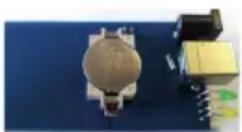
It is easy to replace the button cell battery. The button cell can be found at the printed circuit board, which is made accessible by opening both halves of the BS-750SD compartment.
SD card
Initially the SD card must be formatted. Often cards which already have been formatted are delivered, but if needed you can also format a card by PC-software. In using SD-cards for the BS-750SD it is important to create a directory 'log' at the SD-card (if no such directory already exists) as a location to store the logging files. At the log-directory the system will generate a text file for each sensor and each month.
The naming convention for the log-files is:
m
in which
id: the id-number of the sensor in hexadecimal format (4/8 bytes).
year: the year in 4 decimals
month: the month in 2 decimals
All data which refers to the file-name's criteria will be added to the relevant data-file.
A data file starts with a file header, followed by individual lines for each data-record for one measurement data set.
in which
time-stamp: yyyy-mm-dd hh:mm:ss (UTC)
value: measurement data value in floating point format.
Delivered from an SD-card these data sets can also be imported to a PC and processed with e.g. Excel-software. The SD-cards' data however also can be imported to the logger software. Import from the SD-cards to the logger software can be controlled by the import function – see menu: file --> import.
SOFTWARE
The Multilogger software (Templogger software) has been designed for Windows XP (and also for subsequent Windows versions) and is available
for 32 bits and 64 bits systems. The software has been equipped with 4 languages. You can download the most recent software versions from http://www.arexx.com.
The software package for the logger application also includes the USB-driver, the messenger and a great number of extra tools.
The website also provides users with detailed information to the Multilogger series of products.
If you are unable to receive any sensor data please check the "active"-box for the sensor filter list and deactivate the sensor filter list altogether.
1. Transmission losses
Sometimes transmission losses may arise, indicated by missing temperature data in the sensor's curve display.
Data losses may be caused by:
- Problems inside the USB-receiver
- Problems in the temperature sensor module
- Problems in the signal transfer between temperature sensor module and USB-receiver
1.1. Problems inside the USB-receiver
The receiver does not register a single data signal, even if the sense is located at a minimum distance to the receiver.
Potential problems:
- USB-cable between receiver and computer is missing or defec
- Improper installation of the USB-module
- Unknown software problem in the computer system
- Internal battery BS-510 is empty (replace the battery)
Suggested solutions:
- Check the display window in the temperature logger display for a field in the lower left area. The field is to display the value 'ready' continuously. If the display intermittently displays 'RF_USB-Communication failure', the Windows operating system failed to find the USB-module.
- Remove the USB-cable, wait about ten seconds and reconnect the cable.
- Deinstall the temperature logger application software and reinstall it again.
Please check the internal BS-510 clock battery (Type CR2032) The lifetime of the BS-510 battery is about 5 years!
1.2. Problems in the temperature sensor module
The receiver receives signals from sensors, but fails to register signals from one sensor in particular.
Potential problems:
- Batteries are missing or are at a low charging level
- Reversed polarity of the sensor's batteries
- The sensor's location is outside of the receiver's reception range
- Damage to the sensor (by corroded battery contacts, moisture or battery leakage)
- Problems in the radio signal communication
Suggested solutions:
- Insert fully charged batteries in the sensor and repeat the communication test (please check the polarisation of the batteries before inserting!!)
- Check the battery contacts and remove all corrosion and moisture effects.
Technical details
Type: BS750-SD
Radio: ISM 433MHz, Multilogger RF-protocol.
USB: USB 2.0, Multilogger USB-protocol.
Supply: - 7.5V DC / 100mA
RTC battery: CR2032 3V
SD card: micro SD (SD, SDHC)
Internal memory: 2MB data-flash (about 9 days for 10 sensors, 18 days for 5 sensors, etc.)
Software: http://www.arexx.com
Extra information and possible updates can be found on www.arexx.com
Further questions can also be put on our forum, see www.arexx.com
1.3. Radio signal transfer problems
The receiver system is missing signals from one or more sensors, or only receiving a limited number of signals.
Potential problems:
- Walls or ceilings between sensor and receiver may contain metallic constructions.
- Sensors and/or receiver may be located on a metallic surface
- Sensor or receiver are situated in locations with high humidity
- Windows between sensor and receiver may contain several layers of glass or shielding materials or may be covered by humid moisture.
- Other 433MHz systems may be working within the 20m operating range
- Interference or jamming signals from radio or TV transmitters
- Electronic or electrical equipment (eg. computer equipment or magnetrons), operating within the 2-5m operating range
- Low power level of the sensor's batteries (see 2)
Suggested solutions:
- Modify the locations of the sensor and/or the receiver
- Remove the interfering equipment
2. Communication test
A simple test will check the communication channel between sensor and receiver:
- Remove the batteries from the sensor
- If an entry already exists: remove the sensor from the temperatur logger application (using the right mouse button)
- Locate the sensor at ca. 1 m distance to the receiver
- Insert the batteries in the sensor
- A correctly working system will add the according sensor entry to the sensor list within 5 seconds.
SD card: micro SD (SD, SDHC)
Internal memory: 2MB data-flash (about 9 days for 10 sensors, 18 days for 5 sensors etc)
Software: http://www.arexx.com