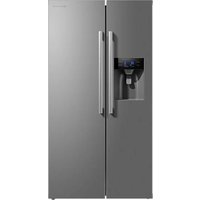
USER MANUAL EMSS179AX1 EAS Electric
natural_image
Simple line drawing of a refrigerator with two vertical bars on the front and bottom (no text or symbols)
EMSS179AX1
natural_image
Simple line drawing of a plug with a cable, no text or symbols present

natural_image
Simple line drawing of a computer monitor with an attached device, no text or symbols present
natural_image
Simple line drawing of a refrigerator with a mounted appliance and a 'no' symbol (no text or labels)
natural_image
Simple line drawing of a refrigerator with tools and a crossed-out circle symbol (no text or labels)
natural_image
Simple line drawing of a hand holding a book with a starburst effect, no text or symbols present
natural_image
Simple line drawing of a child sitting inside a shelving unit with no text or symbols
natural_image
Simple line drawing of a cabinet with boxes and a sad face, accompanied by an 'X' symbol and a warning sign (no text or labels)
natural_image
Simple line drawing of a trash bin with crossed lines indicating no waste or discharge (no text or symbols)
natural_image
Simple line drawing of a person pushing a large box (no text or symbols)
natural_image
Simple line drawing of a refrigerator with sun and a potted plant, no text or symbols present

natural_image
Simple line drawing of a refrigerator and a cabinet (no text or symbols)
natural_image
Simple line drawing of a smiling refrigerator with closed eyes and a small electrical outlet (no text or symbols)
natural_image
Line drawing of two hands holding a rectangular object with arrows indicating direction (no text or symbols)
3 Warning
6 Meanings of safety warning symbols
6 Electricity related warnings
7 Warnings for using
7 Warnings for placement
8 Warnings for energy
8 Warnings for disposal
9 PROPER USE OF THE REFRIGERATOR
9 Placement
10 Levelling the feet
10 Levelling door
11 Changing the light
11 Starting to use
11 Energy saving tips
12 STRUCTURE AND FUNCTIONS
12 Key components
14 Functions
16 Fetching water and ice
18 MAINTENANCE AND CARE
18 Overall cleaning
18 Cleaning the glass shelves
19 Defrosting
19 Out of operation
20 TROUBLE SHOOTING
22 WARRANTY
1 SAFETY WARNING
1.1 Warning
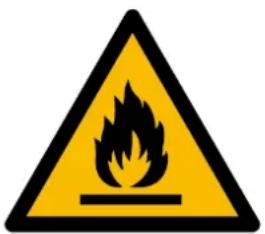
Warning: risk of fire / flammable materials
This appliance is intended to be used in household and similar applications such as staff kitchen areas in shops, offices and other working environments; farm houses and by clients in hotels, motels and other residential type environments; bed and breakfast type environments; catering and similar non-retail applications.
If the supply cord is damaged, it must be replaced by the manufacturer, its service agent or similarly qualified persons in order to avoid a hazard.
Do not store explosive substances such as aerosol cans with a flammable propellant in this appliance.
The appliance has to be unplugged after use and before carrying out user maintenance on the appliance.
WARNING: Keep ventilation openings, in the appliance enclosure or in the built-in structure, clear of obstruction.
WARNING: Do not use mechanical devices or other means to accelerate the defrosting process, other than those recommended by the manufacturer.
WARNING: Do not damage the refrigerant circuit.
WARNING: Do not use electrical appliances inside the food storage compartments of the appliance, unless they are of the type recommended by the manufacturer.
WARNING: Please abandon the refrigerator according to local regulators for it uses flammable blowing gas and refrigerant.
WARNING: When positioning the appliance, ensure the supply cord is not trapped or damaged.
WARNING: Do not locate multiple portable socket-outlets or portable power supplies at the rear of the appliance. Do not use extension cords or ungrounded (two prong) adapters.
DANGER: Risk of child entrapment. Before you throw away your old refrigerator or freezer:
-Take off the doors.
-Leave the shelves in place so that children may not easily climb inside.
The refrigerator must be disconnected from the source of electrical supply before attempting the installation of accessory.
Refrigerant and cyclopentane foaming material used for the refrigerator are flammable. Therefore, when the refrigerator is scrapped, it shall be kept away from any fire source and be recovered by a special recovering company with corresponding qualification other than be disposed by combustion, so as to prevent damage to the environment or any other harm.
For EN standard: This appliance can be used by children aged from 8 years and above and persons with reduce physical sensory or mental capabilities or lack of experience and knowledge if they have been given supervision or instruction concerning use of the appliance in a safe way and understand the hazards involved. Children shall not play with the appliance. Cleaning and user maintenance shall not be made by children without supervision. Children aged from 3 to 8 years are allowed to load and unload refrigerating appliances.
For IEC standard: This appliance is not intended for use by persons (including children) with reduced physical, sensory or mental capabilities, or lack of experience and knowledge, unless they have been given supervision or instruction concerning use of the appliance by a person responsible for their safety.)
Children should be supervised to ensure that they do not play with the appliance.
To avoid contamination of food, please respect the following instructions:
- Opening the door for long periods can cause a significant increase of the temperature in the compartments of the appliance.
- Clean regularly surfaces that can come in contact with food and accessible drainage systems.
- Clean water tanks if they have not been used for 48 h; flush the water system connected to a water supply if water has not been drawn for 5 days. (note 1)
- Store raw meat and fish in suitable containers in the refrigerator, so that it is not in contact with or drip onto other food.
■ Two-star frozen-food compartments are suitable for storing pre-frozen food, storing and making ice-cream and making ice cubes. (note 2)
- One, two and three-star compartments are not suitable for the freezing of fresh food. (note 3)
- Appliances without 4-star compartment are not suitable for freezing fresh food.
- If the refrigerating appliance is left empty for long periods, switch off, defrost, clean, dry, and leave the door open to prevent mould developing within the appliance.
Note 1, 2, 3, 4: Please confirm whether it is applicable according to your product compartment type.
For free-standing appliances: this fridge is not designed to be used as a built-in appliance
Any replacement or repair of the LED lights must be carried out by the manufacturer, its technical service or an equally qualified professional.
To avoid hazards due to instability of the fixture, it must be installed according to the operating instructions.
WARNING: Connect only to the potable water supply (for appliances with ice maker).
To prevent children from being trapped inside, keep the appliance out of their reach (for products with door lock).
1.2 Meaning of safety warning symbols

Prohibition symbol
This is a prohibition symbol.
Any incompliance with instructions marked with this symbol may result in damage to the product or endanger the personal safety of the user.

Warning symbol
This is a warning symbol.
It is required to operate in strict observance of instructions marked with this symbol; or otherwise damage to the product or personal injury may be caused.

Note symbol
This is a cautioning symbol.
Instructions marked with this symbol require special caution. Insufficient caution may result in slight or moderate injury, or damage to the product.
This manual contains lots of important safety information which shall be observed by the users.


natural_image
Simple line drawing of a plug with a cable, no text or symbols present

natural_image
Simple line drawing of a computer monitor mounted on a wall, with an exclamation mark in the corner (no text or symbols on the device itself)
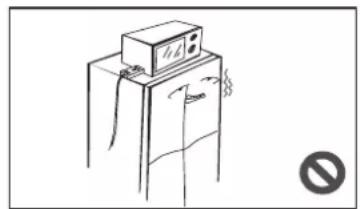
natural_image
Simple line drawing of a refrigerator with a mounted appliance and a 'no' symbol (no text or labels)
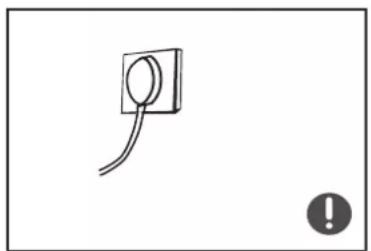
Do not pull the power cord when pulling the power plug of the refrigerator. Please firmly grasp the plug and pull out it from the socket directly.
To ensure safe use, do not damage the power cord or use the power cord when it is damaged or worn.
Please use a dedicated power socket and the power socket shall not be shared with other electrical appliances. The power plug should be firmly contacted with the socket or else fires might be caused.
Please ensure that the grounding electrode of the power socket is equipped with a reliable grounding line.
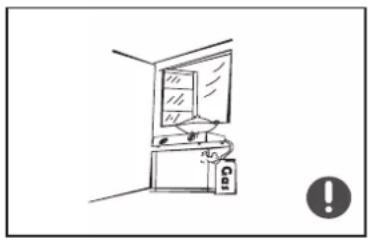
Please turn off the valve of the leaking gas and then open the doors and windows in case of leakage of gas and other flammable gases. Do not unplug the refrigerator and other electrical appliances considering that spark may cause a fire.
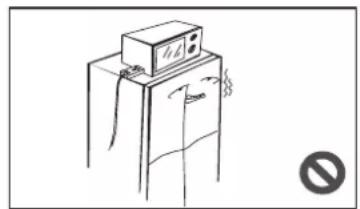
Do not use electrical appliances on the top of the appliance, unless they are of the type recommended by the manufacturer.
1.4 Warnings for using

natural_image
Simple line drawing of a refrigerator with tools and a crossed-out bulb symbol (no text or labels)
Do not arbitrarily disassemble or reconstruct the refrigerator, nor damage the refrigerant circuit; maintenance of the appliance must be conducted by a specialist.
Damaged power cord must be replaced by the manufacturer, its maintenance department or related professionals in order to avoid danger.
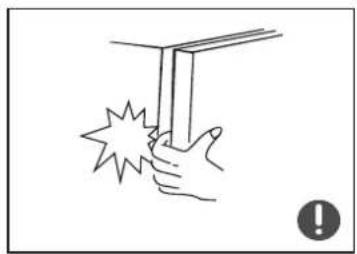
natural_image
Simple line drawing of a hand holding a book with a starburst effect and an exclamation mark (no text or symbols)
The gaps between refrigerator doors and between doors and refrigerator body are small, be noted not to put your hand in these areas to prevent from squeezing the finger. Please be gentle when closing the refrigerator door to avoid falling articles.
Do not pick foods or containers with wet hands in the freezing chamber when the refrigerator is running, especially metal containers in order to avoid frostbite.
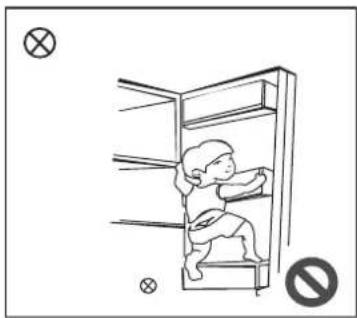
natural_image
Simple line drawing of a child climbing a shelf inside a cabinet, with no text or symbols present.
Do not allow any child to get into or climb the refrigerator; otherwise suffocation or falling injury of the child may be caused.
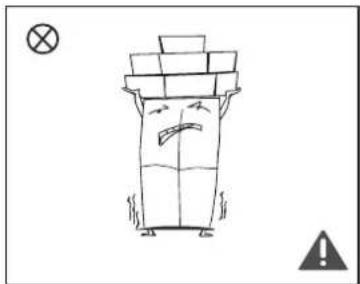
natural_image
Simple line drawing of a cabinet with boxes on top and a warning symbol (no text or labels)
Do not place heavy objects on the top of the refrigerator considering that objectives may fall when you close or open the door, and accidental injuries might be caused.
Please pull out the plug in case of power failure or cleaning. Do not connect the freezer to power supply within five minutes to prevent damages to the compressor due to successive starts.
1.5 Warnings for placement

Do not put flammable, explosive, volatile and highly corrosive items in the refrigerator to prevent damages to the product or fire accidents.
Do not place flammable items near the refrigerator to avoid fires.
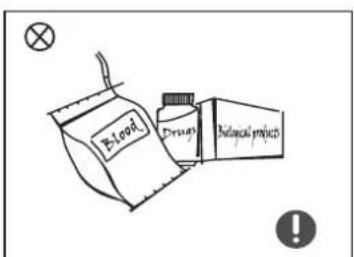
The refrigerator is intended for household use, such as storage of foods; it shall not be used for other purposes, such as storage of blood, drugs or biological products, etc.
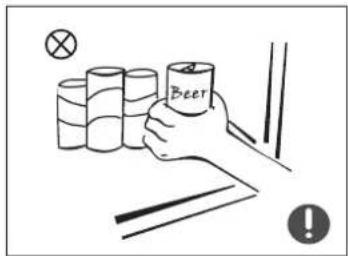
Do not store beer, beverage or other fluid contained in bottles or enclosed containers in the freezing chamber of the refrigerator; otherwise the bottles or enclosed containers may crack due to freezing to cause damages.
1.6 Warnings for energy
- Refrigerating appliances might not operate consistently (possibility of defrosting of contents or temperature becoming too warm in the frozen food compartment) when sited for an extended period of time below the cold end of the range of temperatures for which the refrigerating appliance is designed.
- The fact that effervescent drinks should not be stored in food freezer compartments or cabinets or in low-temperature compartments or cabinets, and that some products such as water ices should not be consumed too cold;
- The need to not exceed the storage time(s) recommended by the food manufacturers for any kind of food and particularly for commercially quick-frozen food in food-freezer and frozen-food storage compartments or cabinets;
- The precautions necessary to prevent an undue rise in the temperature of the frozen food while defrosting the refrigerating appliance, such as wrapping the frozen food in several layers of newspaper.
- The fact that a rise in temperature of the frozen food during manual defrosting, maintenance or cleaning could shorten the storage life.
1.7 Warnings for disposal
Refrigerant and cyclopentane foaming material used for the refrigerator are flammable. Therefore, when the refrigerator is scraped, it shall be kept away from any fire source and be recovered by a special recovering company with corresponding qualification other than be disposed by combustion, so as to prevent damage to the environment or any other harm.
When the refrigerator is scrapped, disassemble the doors, and remove gasket of door and shelves; put the doors and shelves in a proper place, so as to prevent trapping of any child.

natural_image
Symbol of a trash bin crossed with no text or labels, accompanied by a black rectangular block below (no text or symbols present)
DISPOSAL: Do not dispose this product as unsorted municipal waste. Collection of such waste separately for special treatment is necessary.
The european directive 2012/19 /UE on wasted electrical and electronic equipments (WEEE), requires that household electrical appliances must not be disposed of in the normal unsorted municipal waste stream. appliances must be collected separately in order to optimize the recovery and recycling of the materials they contain, and reduce the impact on human health and the environment.
Thecrossed out “wheeled bin” symbol on the product reminds you of your obligation, that when you disposed of the appliances, it must be separately collected. Consumers should contact their local authority or retailer for information concerning the correct disposal of their old appliance.
2. Proper use of refrigerators
2.1 Placement

natural_image
Simple line drawing of a person pushing a large box (no text or symbols)
Before use, remove all packing materials, including bottom cushions, foam pads and tapes inside of the refrigerator; tear off the protective film on the doors and the refrigerator body.
natural_image
Simple line drawing of a refrigerator with a sun and a potted plant nearby (no text or symbols)
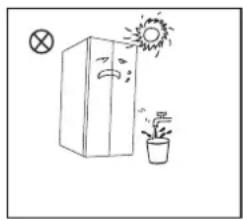
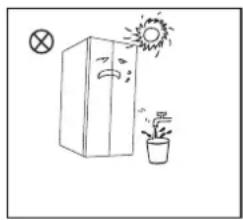
Keep away from heat and avoid direct sunlight. Do not place the freezer in moist or watery places to prevent rust or reduction of insulating effect.
natural_image
Simple line drawing of a refrigerator and a cabinet (no text or symbols)
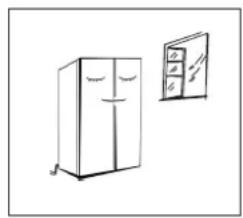
Do not spray or wash the refrigerator; do not put the refrigerator in moist places easy to be splashed with water so as not to affect the electrical insulation properties of the refrigerator.

The refrigerator is placed in a well-ventilated indoor place; the ground shall be flat and sturdy.
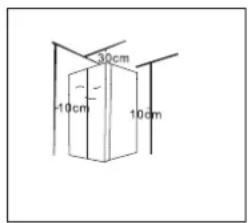
The top space of the refrigerator shall be greater than 30cm, and the refrigerator should be placed against a wall with a free distance more than 10cm to facilitate heat dissipation.
Precautions before installation:
Information in the Instruction Manual is only for reference. The physical product may differ. Before installation and adjusting of accessories, it shall be ensured that the refrigerator is disconnected from power.
2.2 Levelling feet
Schematic diagram of the leveling feet
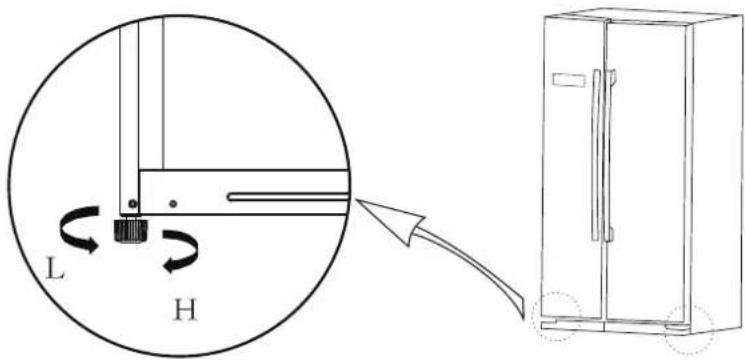
(The picture above is only for reference. The actual configuration will depend on the physical product or statement by the distributor)
Adjusting procedures:
a. Turn the feet clockwise to raise the refrigerator;
b. Turn the feet counterclockwise to lower the refrigerator;
c. Adjust the right and left feet based on the procedures above to a horizontal level.
2.3 Door Right-Left Change
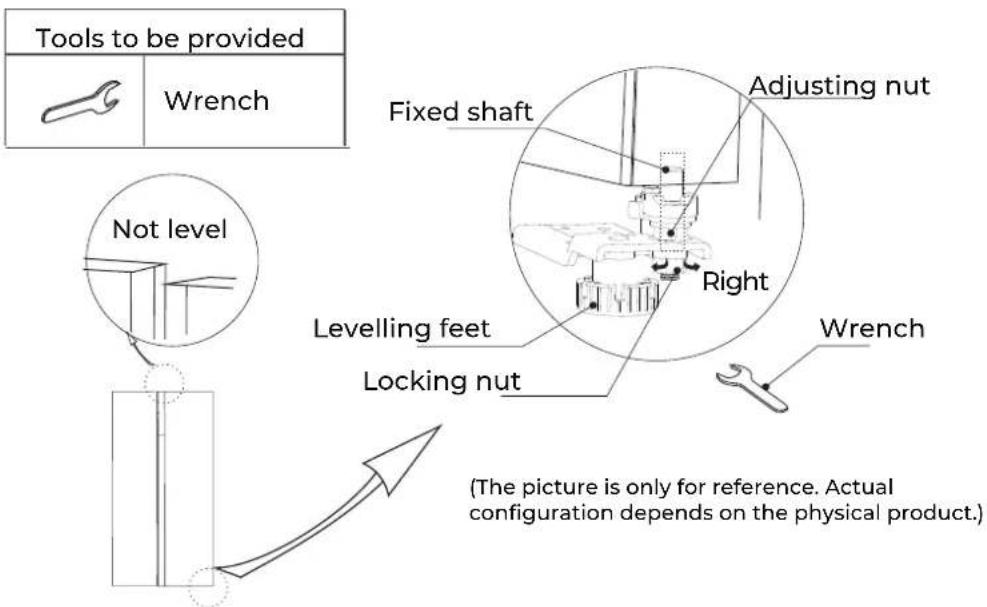
When the fridge door is low:
Open the door, use a wrench to loosen the locking nut and to rotate the adjusting nut anti-clockwise to raise the height of the door. Once the doors are aligned, then tighten the locking nut by rotating it anticlockwise.
When the fridge door is high:
Open the door and turn the adjusting nut clockwise to lower the door and when aligned, tighten the locking nut counterclockwise.
2.4. Changing the light
Any repair or maintenance of LED bulbs must be carried out by the manufacturer, its technical service or another equally qualified technical professional.
2.5 Starting to use

natural_image
Simple line drawing of a smiling refrigerator with eyes closed, connected to a power outlet (no text or symbols)
Before initial start, keep the refrigerator still for half an hour before connecting it to power supply.
Before putting any fresh or frozen foods, the refrigerator shall have run for 2-3 hours, or for above 4 hours in summer when the ambient temperature is high.
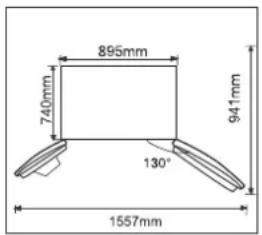
Spare enough space for convenient opening of the doors and drawers or statement by the distributor.
2.6 Energy saving tips
- The appliance should be located in the coolest area of the room, away from heat producing appliances or heating ducts, and out of the direct sunlight.
- Let hot foods cool to room temperature before placing in the appliance. Overloading the appliance forces the compressor to run longer. Foods that freeze too slowly may lose quality, or spoil.
- Be sure to wrap foods properly, and wipe containers dry before placing them in the appliance. This cuts down on frost build-up inside the appliance.
- Appliance storage bin should not be lined with aluminum foil, wax paper, or paper toweling. Liners interfere with cold air circulation, making the appliance less efficient.
- Organize and label food to reduce door openings and extended searches. Remove as many items as needed at one time, and close the door as soon as possible.
3. STRUCTURE AND FUNCTIONS
3.1 Key components

(Filter internal)
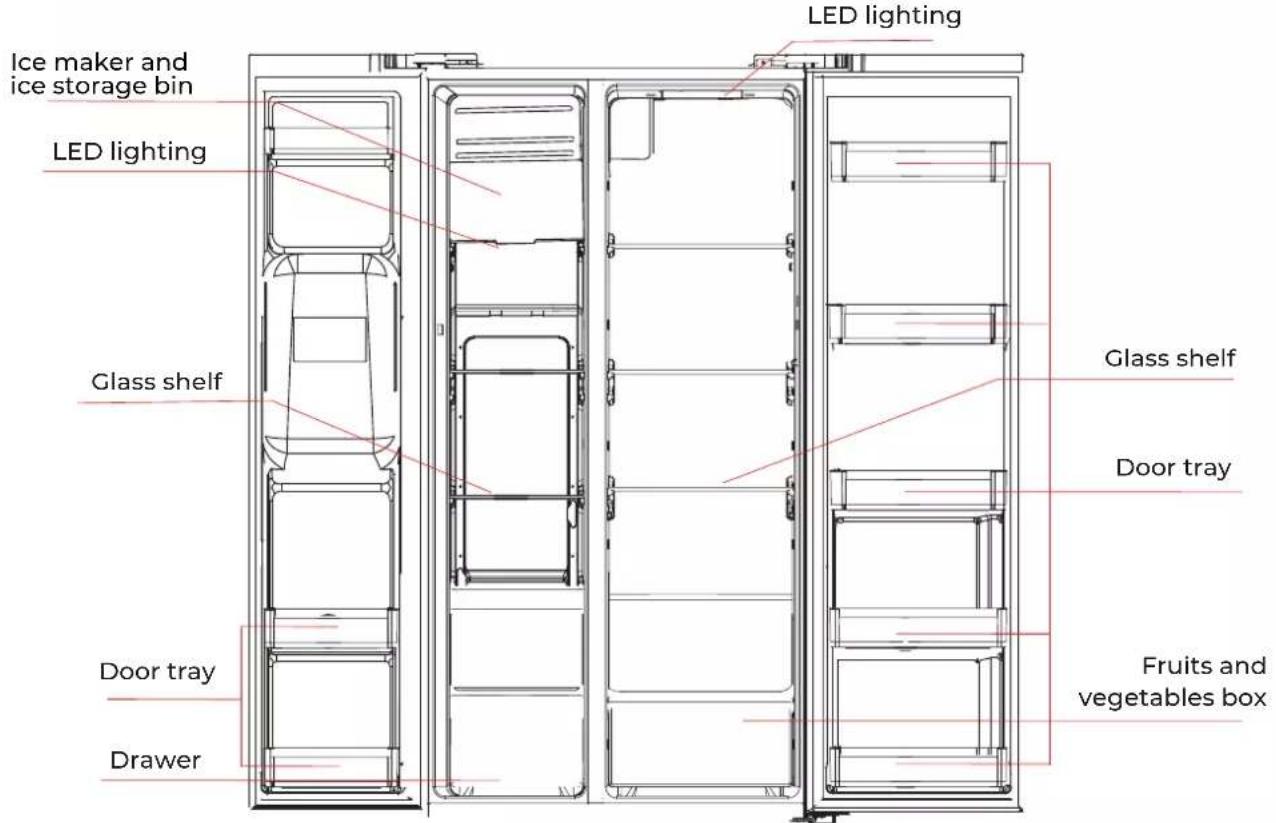
(Filter external)
The picture above is only for reference. The actual configuration will depend on the physical product or statement by the distributor.
Refrigerating chamber
- The Refrigerating Chamber is suitable for storage of a variety of fruits, vegetables, beverages and other food consumed in the short term. Suggested storage time: 3 to 5 days.
- Cooking foods shall not be put in the refrigerating chamber until cooled to room temperature.
- Foods are recommended to be sealed up before putting into the refrigerator.
- The glass shelves can be adjusted up or down for a reasonable amount of storage space and easy use.
Freezing chamber
- The low temperature freezing chamber may keep food fresh for a long time and it is mainly used to store frozen foods and making ice.
- The freezing chamber is suitable for storage of meat, fish, rice balls and other foods not to be consumed in short term.
- Chunks of meat are preferably to be divided into small pieces for easy access. Please be noted food shall be consumed within the shelf time.
- The maximum amount of food that can be frozen in 24 hours is specified on the rating plate of the appliance.
Drawers, food boxes, etc. placed according to the position in the picture above are the most energy efficient.
3.2 FUNCTIONS

(The picture above is only for reference. The actual configuration will depend on the physical product or statement by the distributor)
Display screen
- Freezer temperature indicator
- InstantCool fast cooling icon
- InstantFreeze quick freeze icon
- Fridge temperature indicator
- Holiday mode icon
- Water filter
- Ice dispenser deactivated
- Ice dispenser
- Crushed ice dispenser
- Cold water dispenser
- Lock/unlock icon
A. Freezer temperature setting
B. Refrigerator temperature setting
C. Mode setting
D. Ice Dispenser On/Off
E. Water/Ice Dispenser/Filter Reset
F. Lock button
Display
When power is first applied to the refrigerator, the entire panel will light up for 3 seconds and then the normal status will be displayed, with the default temperature of 5^ C/-18°C respectively. If an error occurs, the display will show the corresponding error code (see table on next page). During normal operation, the display panel shows the setpoint temperature of the refrigerator and freezer. If no operation is performed and the door is not opened within 30 seconds, the display panel will lock, and after another 30 seconds, the display will turn off.
Lock/Unlock
In the unlocked state, press and hold the LOCK/UNLOCK button for 3 seconds to activate the lock.
In the locked state, press and hold the LOCK/UNLOCK button for 3 seconds to deactivate the lock.
All the settings below must be made when the refrigerator is in the unlocked state.
Mode setting
Press the MODE button to select a different operating mode.
Holiday Mode
Press the MODE button to enter Holiday mode. The 5 icon will be illuminated and the mode will start when the display goes off. Press the FRZ.TEMP or REF.TEMP buttons to exit the Holiday mode.
InstantCool mode
Press the MODE button to enter the InstantCool mode. The icon 2 will light up and the mode will start when the display turns off. This mode ends automatically after 2.5 hours. Press the REF.TEMP button to exit the InstantCool mode.
InstantFreeze mode
Press the MODE button to enter the fast cooling mode. The 3 icon will illuminate and the mode will start when the display turns off. This mode ends automatically after 26 hours. Press the REF.TEMP button to exit the InstantFreeze mode.
Refrigerator compartment temperature setting
Press the REF.TEMP temperature setting button. The cooling temperature figure will flash. Press the REF.TEMP. button again to adjust the temperature. It will beep with each press and will change by 1°C, within the range of 2°C to 8°C. After adjustment, the temperature will flash for 5 seconds and the new temperature setting will be in effect when the display goes off.
Freezer compartment temperature setting
Press the temperature setting button FRZ.TEMP. The freezing temperature figure will flash. Press the FRZ.TEMP. button again to adjust the temperature. It will beep with each press and will change by 1°C, within the range of -16°C to -24°C. After adjustment, the temperature will flash for 5 seconds and the new temperature setting will start when the display turns off.
Recommended setting: Refrigerator compartment 4°C, freezer compartment -18°C
InstantFreeze mode time setting
With the InstantFreeze mode active, press and hold the FRZ.TEMP button for 3 seconds. The temperature zone of the refrigerator will display the current time of the quick freeze mode. Press the FRZ.TEMP button to set it: with each press it will change sequentially between 26-48-26-48.... Let the display turn off or press and hold FRZ.TEMP for 3 seconds to exit the InstantFreeze mode settings. The 48 hour mode is mainly used for laboratory testing and is not recommended for end-user use.
Deactivating the ice dispenser
Press the ICE OFF button, the icon 7 will light up when the mode is activated or turn off when the mode is deactivated.
Dispenser
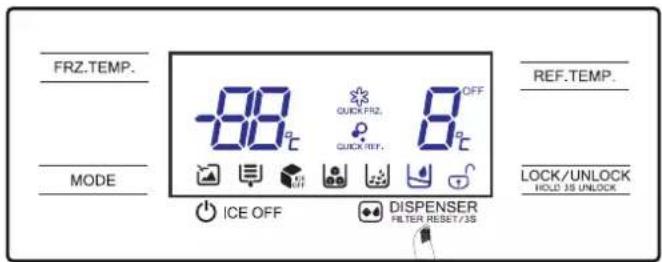
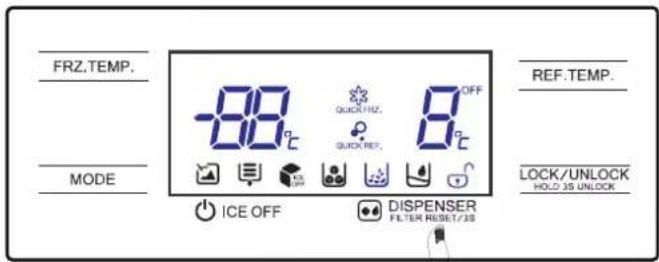
Press the DISPENSER button to access the water or ice dispensing selection which will change according to the sequence "Ice cube dispenser/Crushed ice dispenser/Water dispenser/None". The corresponding icon will illuminate on the panel. When the refrigerator is running, the filter usage time is accumulated. Icon 6 will illuminate after 150 days and will flash after 180 days. Please note that the filter change warning time is approximate and should be adjusted to your actual water consumption. The filter has a 1136 litre capacity and it is advisable to change it every 6 to 12 months. After the filter has been changed, press and hold DISPENSER for 3 seconds to reset the water filter service time.
Memory function in case of power failure
In the event of a power failure, the operating mode will be stored and will be restarted when power is restored.
Door opening alert
When the door is opened, a buzzer will sound, and if the door is not closed within 2 minutes, an alert will sound once per second until the door is closed.
Error Codes
The display may show one of the following codes to indicate an appliance fault. Although the refrigerator may continue to cool despite displaying these errors, the user should call for service to ensure optimal operation of the refrigerator.
E0: Icemaker error
E1: Refrigerator temperature sensor failure
E2: Freezer temperature sensor failure
E5: Error in the defrost sensor detection circuit
E6: Communication error
E7: Error in the room temperature probe
EE: Icemaker sensor circuit error
EH: Humidity sensor error
3.3 Ice and Water Dispenser
During the production of ice cubes and crushed ice, with the flow of water into the ice compartment and the ice crusher, noises may occur, the water valve will emit a vibrating sound. These sounds are normal.
When the ice is removed, it may squeak if it accumulates and sticks together. In this case, remove the ice container and separate the ice that has clumped together by pressing it with a wooden or plastic spoon.
To prevent the ice machine motor from overheating, do not scoop ice for more than 1 minute at a time and wait a few moments for the motor to cool down, or scoop ice directly from the bin if a large quantity is required. The Cleaning the Ice Bin section explains how to remove the ice bin. If there is not enough ice in the dispenser, you will not remove any; wait for it to make more ice.
To prevent the ice from tasting or smelling bad, clean the ice bin frequently.
The ice and water dispenser can only be used with the freezer door closed. If the process is running and the door is opened, it will automatically stop.
Minimum and maximum inlet pressure: 0.8-0.15MPa.
1) Cold water dispenser
Press the DISPENSER button until the 10 icon is illuminated. Press the container on the water dispenser actuator to dispense water, and pull it apart to finish.

2) Crushed ice dispenser
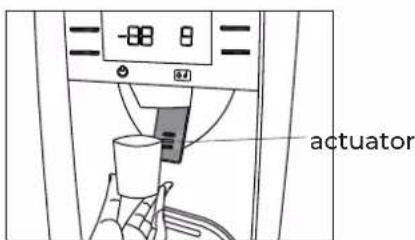
Press the DISPENSER button until icon 9 is illuminated. Keep the container close to the mouth of the dispenser to prevent the ice from spilling out to the sides. Press the actuator with the container until it is full and pull it apart to finish.
3) Ice Cube Dispenser
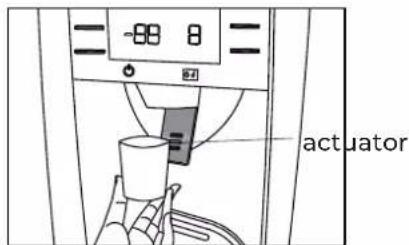
Press the DISPENSER button until the 8 icon is illuminated. Press the actuator with the container until it is filled with ice cubes and remove it to finish.

4) Deactivating the ice making function
If you are not going to use the dispenser function for a long time, you can deactivate the ice making by pressing the ICE OFF button. The icon 7 will illuminate.
4. Maintenance and care of the appliance
4.1 Overall cleaning
Dusts behind the refrigerator and on the ground shall be timely cleaned to improve the cooling effect and energy saving.
Check the door gasket regularly to make sure there are no debris. Clean the door gasket with a soft cloth dampened with soapy water or diluted detergent.
The interior of the refrigerator should be cleaned regularly to avoid odor.
Please turn off the power before cleaning interior, remove all foods, drinks, shelves, drawers, etc.
Use a soft cloth or sponge to clean the inside of the refrigerator, with two tablespoons of baking soda and a quart of warm water. Then rinse with water and wipe clean. After cleaning, open the door and let it dry naturally before turning on the power.
For areas that are difficult to clean in the refrigerator (such as narrow sandwiches, gaps or corners), it is recommended to wipe them regularly with a soft rag, soft brush, etc. and when necessary, combined with some auxiliary tools (such as thin sticks) to ensure no contaminants or bacterial accumulation in these areas.
Do not use soap, detergent, scrub powder, spray cleaner, etc., as these may cause odors in the interior of the refrigerator or contaminated food.
Clean the bottle frame, shelves and drawers with a soft cloth dampened with soapy water or diluted detergent. Dry with a soft cloth or dry naturally.
Wipe the outer surface of the refrigerator with a soft cloth dampened with soapy water, detergent, etc., and then wipe dry.
Do not use hard brushes, clean steel balls, wire brushes, abrasives (such as toothpastes), organic solvents (such as alcohol, acetone, banana oil, etc.), boiling water, acid or alkaline items, which may damage the fridge surface and interior.
Boiling water and organic solvents such as benzene may deform or damage plastic parts.
Do not rinse directly with water or other liquids during cleaning to avoid short circuits or affect electrical insulation after immersion.

(⚠️ Please unplug the refrigerator for defrost and cleaning.)
4.2 Cleaning the door shelves
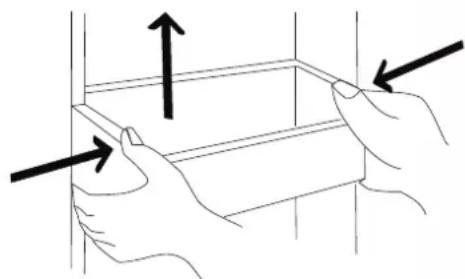
- Press the shelf according to the arrows in the picture and pull it upwards to remove it.
- Wash the shelf and reinstall it at the required height.
natural_image
Illustration of two hands holding a rectangular object with arrows indicating direction (no text or symbols)
4.3 Cleaning the ice bin
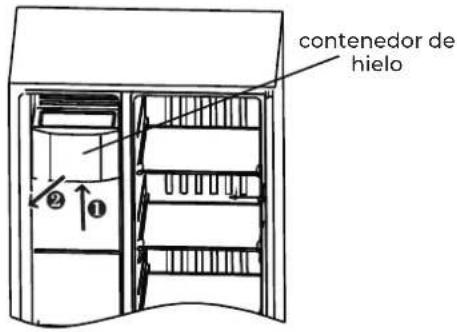
If ice accumulates in the ice bin, it can clog up and block the outlet. In this case you should clean the ice bin and remove the ice.
1) Press the ICE OFF button to cancel ice making and turn off the refrigerator. Holding the bin components with both hands, pull them upwards and outwards to remove them.
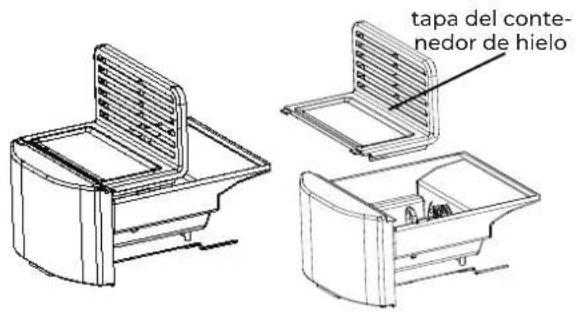
2) Remove the lid and clean the bin with neutral detergents, a clean cloth and water. Follow the steps in reverse to reassemble.
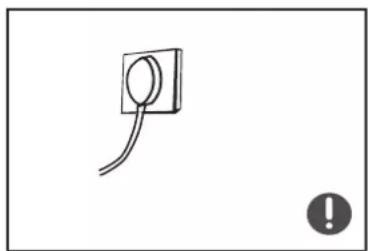
3) Close the door, plug in the power plug and press the ICE OFF button to activate ice making.
4.4 Cleaning the glass shelf
As the back of the refrigerator that contacts the shelf has a stop, the shelf must first be lifted out before it can be removed.
Adjust and clean the shelf as needed.

4.5 Cleaning of the ice lattice and water pipes
If the ice making function has not been used for a long time, before using it again, empty the container completely, then allow half a container of ice to be made (about 24 hours) and empty it again.
Similarly, before using the water dispenser again after a long time, empty 2 litres of water and then you can use it normally.
4.6 Defrosting
The refrigerator is designed on an air-cooling principle and therefore has an automatic defrosting function. If some frost forms due to seasonal or temperature changes, it can be removed manually by disconnecting the appliance from the power supply or with a dry cloth.
4.7 Prolonged periods of disuse
Power failure: In the event of a power failure, the food inside the appliance can be preserved for several hours, even in summer. During a power failure, reduce the opening times of the door and do not put any more food in the refrigerator.
If the appliance is not to be used for a long time: The appliance should be unplugged and then cleaned and the doors should be left open to prevent odours from forming.
Moving: Before moving the refrigerator, remove all objects inside, tape down the glass shelves, vegetable drawer, freezer drawers, etc., and tighten the levelling feet. Close the doors and secure them with adhesive tape. When moving the appliance, it must not be placed upside down or horizontally, and any jolting must be avoided. The inclination during movement must not exceed 45°.
The appliance shall run continuously once it is started. Generally, the operation of the appliance shall not be interrupted, otherwise the service life may be impaired.

5. Trouble shooting
You may try to solve the following simple problems by yourself. If they cannot be solved, please contact the after-sales department.
| Failed operation | Check whether the appliance is connected to power or whether the plug is in well contactCheck whether the voltage is too lowCheck whether there is a power failure or partial circuits have tripped |
| Smell | Odorous foods shall be tightly wrappedCheck whether there is any rotten foodClean the inside of the refrigerator |
| Long-time operation of the compressor | Long operation of the refrigerator is normal in summer when the ambient temperature is highIt is not suggestible having too much food in the appliance at the same timeFood shall get cool before being put into the applianceThe doors are opened too frequently |
| Light fails to get lit | Check whether the refrigerator is connected to power supply and whether the illuminating light is damagedHave the light replaced by a specialist |
| Doors cannot be properly closed | The door is stuck by food packagesThe refrigerator is tilted |
| Loud noise | Check whether the floor is level and whether the refrigerator is placed stably. Check whether accessories are placed at proper locations |
| Door seal fails to be tight | Remove foreign matters on the door sealHeat the door seal and then cool it for restoration (or blow it with an electrical drier or use a hot towel for heating) |
| Water pan overflows | There is too much food in the chamber or food stored contains too much water, resulting in heavy defrosting.The doors are not closed properly, resulting in frosting due to entry of air and increased water due to defrosting |
| Hot housing | Heat dissipation of the built-in condenser via the housing, which is normal. When housing becomes hot due to high ambient temperature and storage of too much food, it is recommended to provide sound ventilation to facilitate heat dissipation. |
| Surface condensation | Condensation on the exterior surface and door seals of the refrigerator is normal when the ambient humidity is too high. Just wipe the condensate with a clean towel. |
| Abnormal noise | Buzz: The compressor may produce buzzes during operation, and the buzzes are loud particularly upon start or stop. This is normal.Creak: Refrigerant flowing inside of the appliance may produce creak, which is normal. |
Table 1 Climate classes
| Class Symbol | | Ambient temperature range (°C) |
| Extended temperate | SN | +10 to +32 |
| Temperate | N | +16 to +32 |
| Subtropical | ST | +16 to +38 |
| Tropical | T | +16 to +43 |
Extended temperate: 'this refrigerating appliance is intended to be used at ambient temperatures ranging from 10 °C to 32 °C';
temperate: 'this refrigerating appliance is intended to be used at ambient temperatures ranging from 16 °C to 32 °C';
Subtropical: 'this refrigerating appliance is intended to be used at ambient temperatures ranging from 16 °C to 38 °C';
Tropical: 'this refrigerating appliance is intended to be used at ambient temperatures ranging from 16 °C to 43 °C';
Special for new European standard:
The ordered parts in the following table can be acquired from our after sales service:
| Ordered Part | Provided by | Minimum Time Required for Provision |
| thermostats | Professional maintenance personnel | At least 7 years after the last model is launched on the market |
| temperature sensors | Professional maintenance personnel | At least 7 years after the last model is launched on the market |
| printed circuit boards | Professional maintenance personnel | At least 7 years after the last model is launched on the market |
| light sources | Professional maintenance personnel | At least 7 years after the last model is launched on the market |
| door handles | Professional repairers and final users | At least 7 years after the last model is launched on the market |
| door hinges | Professional repairers and final users | At least 7 years after the last model is launched on the market |
| trays | Professional repairers and final users | At least 7 years after the last model is launched on the market |
| baskets | Professional repairers and final users | At least 7 years after the last model is launched on the market |
| door gaskets | Professional repairers and final users | At least 10 years after the last model is launched on the market |
Dear customer
- If you want to return or replace the product, please contact the store where you buy. (Remember to bring the purchase invoice)
- If your product breaks down which needs to repair, please contact after-sales service provider.
WARRANTY CONDITIONS
This appliance is guaranteed for three years from the date of sale against all manufacturing defects, including labour and spare parts. In order to justify the date of purchase, it will be compulsory to present the invoice or purchase receipt. The conditions of this warranty apply only to Spain and Portugal. If you have purchased this product in another country, please consult your distributor for the applicable conditions.
WARRANTY EXCLUSIONS
-
Remote controls, drain intake rubbers, dockings and door seals, weather stripping.
-
Damage to enamels, paints, nickel plating, chrome plating, oxidation or other types of aesthetic parts or components that do not affect the internal functioning of the appliance.
-
Damage to wear parts due to use, corrosion or oxidation, whether caused by normal use of the appliance or accelerated deterioration due to unfavorable environmental or climatic circumstances. Not suitable for outdoor use.
-
Damage to fragile pieces of glass, glass ceramic, plastics, handles, baskets, doors or light bulbs when their failure or breakage is not attributable to a manufacturing defect.
-
Faults produced by fortuitous causes or accidents of force majeure, or as a consequence of abnormal, negligent or inappropriate use of the device.
-
Civil liabilities of any nature.
-
Consequential damage to the appliance as long as it has not been caused by an internal malfunction.
-
Maintenance or upkeep of the appliance: periodic reviews, adjustments and greases.
-
Faults that accessories and complements, adapters, external cables, bags, spare parts of all kinds, lamps, as well as any part considered consumable by the manufacturer, may suffer.
-
Faults caused by incorrect or illegal installation, inadequate ventilation, lack of grounding in the home, power disturbances, inappropriate modifications or use of non-original spare parts.
-
Appliances used in industrial applications or for commercial purposes.
-
Appliances with illegible or altered serial number.
-
Defects or breakdowns produced as a result of fixes, repairs, modifications, or disassembly of the installation of the device by the user or by a technician not authorized by the manufacturer, or as a result of manifest non-compliance with the manufacturer's instructions for use and maintenance.
-
During the warranty period it is essential to keep all manuals together with the equipment. If the equipment is sold, donated or given away, the manual and all related documents must be given to the new user. If any of these are lost, their replacement cannot be claimed.
-
Faults that have their origin or are a direct or indirect consequence of: contact with liquids, chemicals and other substances, as well as conditions derived from the climate or the environment: earthquakes, fires, floods, excessive heat or any other external force, such as insects, rodents and other animals that may have access to the interior of the machine or its connection points.
-
Damages derived from terrorism, riot or popular tumult, legal or illegal demonstrations and strikes; facts of actions of the Armed Forces or the State Security Forces in times of peace; armed conflicts and acts of war (declared or not); nuclear reaction or radiation or radioactive contamination; vice or defect of the goods; facts classified by the Government of the Nation as "national catastrophe or calamity".
Design and specifications are subject to change without notice for product improvement. Any changes to the manual will be updated on our website, you can check the latest version.

www.easelectric.es
Contenido
AVERTISSEMENTS DE SÉCURITÉ
12 STRUCTURE ET FONCTIONS
natural_image
Simple line drawing of a plug with a cable, no text or symbols present

natural_image
Simple line drawing of a computer monitor with an attached device, no text or symbols present

natural_image
Simple line drawing of a refrigerator with a mounted appliance and a prohibition symbol (no text or labels)
natural_image
Simple line drawing of a refrigerator with tools and a crossed-out bulb (no text or symbols)
natural_image
Simple line drawing of a hand holding a book with a starburst effect and an exclamation mark (no text or symbols)
natural_image
Simple line drawing of a child climbing a ladder inside a refrigerator (no text or symbols)
natural_image
Simple line drawing of a distressed, anthropomorphic object with a cross and warning symbol (no text or labels)
natural_image
Simple line drawing of a smiling refrigerator with closed eyes and a small electrical outlet (no text or symbols)

natural_image
Illustration of various household items including a glass, alcohol spray bottle, and a kettle (no text or symbols)

natural_image
Illustration of two hands holding a rectangular object with arrows indicating direction (no text or symbols)
CONDITIONS DE LA GARANTIE
EXCLUSIONS DE LA GARANTIE

natural_image
Simple line drawing of a plug with a cable, no text or symbols present
natural_image
Simple line drawing of a computer monitor with a mouse and control panel, no text or symbols present

natural_image
Simple line drawing of a refrigerator with a mounted appliance and a 'no' symbol (no text or labels)
natural_image
Simple line drawing of a refrigerator with tools and a crossed-out bulb (no text or symbols)
natural_image
Simple line drawing of a hand holding a book with a starburst effect and an exclamation mark (no text or symbols)
natural_image
Simple line drawing of a child climbing a ladder inside a cabinet, with no text or symbols present.
natural_image
Simple line drawing of a cabinet with boxes and a sad face, accompanied by an 'X' symbol and a warning sign (no text or labels)
natural_image
Symbol of a trash bin crossed with diagonal lines, no text or numbers present
natural_image
Simple line drawing of a person pushing a large box (no text or symbols)
Antes de usar, remova todas as embalagens, incluindo rolhas e fitas adesivas, de dentro do frigorífico e remova a película protetora das portas e paredes.

natural_image
Simple line drawing of a refrigerator with a sun and a potted plant nearby (no text or symbols)
natural_image
Simple line drawing of a cabinet and a framed cabinet (no text or symbols)
natural_image
Simple line drawing of a smiling refrigerator with closed eyes and a small electrical outlet (no text or symbols)
natural_image
Illustration of various alcohol and beverage items including a gas can, alcohol lamp, and kettle (no text or symbols)

natural_image
Illustration of two hands holding a rectangular object with arrows indicating direction (no text or symbols)
4.3 Limpeza do recipiente de gelo
Scan for manual in other languages and further updates: