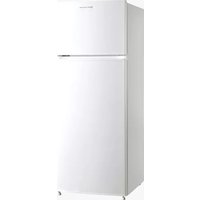
EMF161 - Refrigerator EAS Electric - Free user manual and instructions
Find the device manual for free EMF161 EAS Electric in PDF.



| Product type | Refrigerator |
| Brand | EAS Electric |
| Model | EMF161 |
| Climate class | SN, N, ST, T (up to 43°C) |
| Thermostat setting | OFF, MIN, MED, MAX |
| Reversible door | Yes, can be reversed |
| Interior light | Bulb replaceable by a professional |
| Interior accessories | Glass shelves, vegetable drawer, door bins |
| Leveling feet | 2 adjustable feet at front |
| Estimated capacity | Approximately 120 L |
| Dimensions (H x W x D) | Approximately 850 x 500 x 550 mm |
| Net weight | Approximately 25 kg |
| Supply voltage | 220-240 V, 50 Hz |
| Energy consumption | Approximately 0.5 kWh/24h (class F) |
| Refrigerant | Flammable (type not specified) |
| Cleaning | Baking soda and warm water |
| Defrosting | Manual |
| Child safety | Door lock (not specified) |
| Spare parts available | Thermostat, sensors, board, lights, handles, hinges, shelves, baskets, door gaskets (7-10 years) |
| Warranty | 3 years |
Frequently Asked Questions - EMF161 EAS Electric
User questions about EMF161 EAS Electric
0 question about this device. Answer the ones you know or ask your own.
Ask a new question about this device
Download the instructions for your Refrigerator in PDF format for free! Find your manual EMF161 - EAS Electric and take your electronic device back in hand. On this page are published all the documents necessary for the use of your device. EMF161 by EAS Electric.
USER MANUAL EMF161 EAS Electric
natural_image
Abstract arrangement of gray and white triangular shapes arranged in a row (no text or symbols)FRIGORÍFICO
FRIDGE
RÉFRIGÉRATEUR
FRIGORIFICO
natural_image
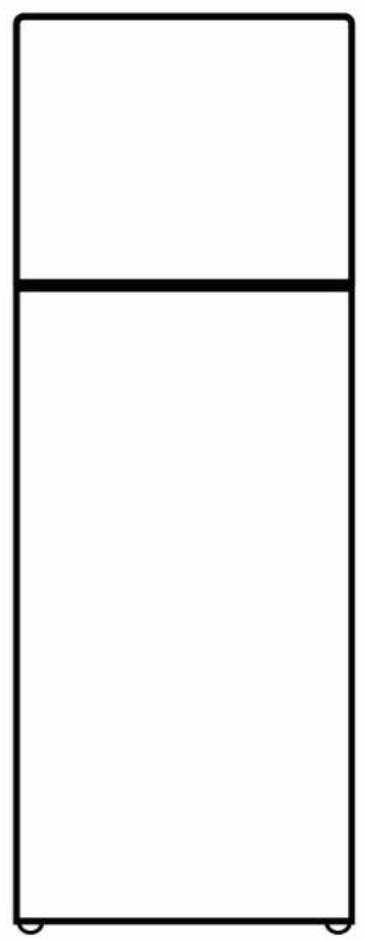
Simple line drawing of a rectangular box with a horizontal line inside, no text or symbols present.EMF161
Escanee para ver este manual en otros idiomas y actualizaciones Scan for manual in other languages and further updates Manuel dans d'autres langues et mis à jour Manual em outras línguas e actualizações
Contenido
natural_image
3D mechanical part diagram showing a component being processed into a final assembled part (no text or symbols)natural_image
Diagram showing a device being processed from a black plastic panel, with no visible text or symbols.natural_image
3D rendering of a mechanical component with two oval features and a metallic edge (no text or symbols visible)natural_image
Pure diagram of a mechanical component with curved arrows indicating motion or force direction (no text or symbols)natural_image
3D CAD model of a mechanical assembly with green base and black curved component (no text or symbols)natural_image
Diagram of a kitchen appliance with a green indicator lights and curved arrows indicating motion or movement (no text or symbols)natural_image
Two colored rectangular blocks, one orange and one olive-green, with no visible text or symbols.natural_image
3D rendering of a rectangular box with a curved top panel and mounting brackets (no text or symbols visible)natural_image
Abstract color block composition with pink, olive, and red sections (no text or symbols)natural_image
Diagram of a mechanical component with layered structure and curved cutouts (no text or symbols)3. DIAGRAMA DEL PRODUCTO
3 SAFETY WARNING
3 Warning
6 INSTALLATION
6 Location
6 Door space requirements
6 Levelling the unit
6 Cleaning before use
7 Before using the unit
7 Interior accessories
7 Changing the opening direction of the door
12 PRODUCT OVERVIEW
13 OPERATION
13 Switching on your unit
13 Food preservation tips
14 CLEANING
14 Cleaning the interior and exterior of the unit
14 Cleaning tips
15 MAINTENANCE
15 Replacement of the interior bulb
15 Transport of the unit
15 Repair and servicing
15 Long periods of non-use
15 TIPS
15 ENERGY SAVING
16 TROUBLESHOOTING
19 WARRANTY
1 SAFETY WARNING
1.1 Warning
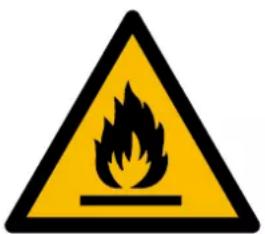
Warning: risk of fire / flammable materials
This appliance is intended to be used in household and similar applications such as staff kitchen areas in shops, offices and other working environments; farm houses and by clients in hotels, motels and other residential type environments; bed and breakfast type environments; catering and similar non-retail applications.
If the supply cord is damaged, it must be replaced by the manufacturer, its service agent or similarly qualified persons in order to avoid a hazard.
Do not store explosive substances such as aerosol cans with a flammable propellant in this appliance.
The appliance has to be unplugged after use and before carrying out user maintenance on the appliance.
WARNING: Keep ventilation openings, in the appliance enclosure or in the built-in structure, clear of obstruction.
WARNING: Do not use mechanical devices or other means to accelerate the defrosting process, other than those recommended by the manufacturer.
WARNING: Do not damage the refrigerant circuit.
WARNING: Do not use electrical appliances inside the food storage compartments of the appliance, unless they are of the type recommended by the manufacturer.
WARNING: Please abandon the refrigerator according to local regulators for it uses flammable blowing gas and refrigerant.
WARNING: When positioning the appliance, ensure the supply cord is not trapped or damaged.
WARNING: Do not locate multiple portable socket-outlets or portable power supplies at the rear of the appliance. Do not use extension cords or ungrounded (two prong) adapters.
DANGER: Risk of child entrapment. Before you throw away your old refrigerator or freezer:
-Take off the doors.
-Leave the shelves in place so that children may not easily climb inside.
The refrigerator must be disconnected from the source of electrical supply before attempting the installation of accessory.
Refrigerant and cyclopentane foaming material used for the refrigerator are flammable. Therefore, when the refrigerator is scrapped, it shall be kept away from any fire source and be recovered by a special recovering company with corresponding qualification other than be disposed by combustion, so as to prevent damage to the environment or any other harm.
For EN standard: This appliance can be used by children aged from 8 years and above and persons with reduce physical sensory or mental capabilities or lack of experience and knowledge if they have been given supervision or instruction concerning use of the appliance in a safe way and understand the hazards involved. Children shall not play with the appliance. Cleaning and user maintenance shall not be made by children without supervision. Children aged from 3 to 8 years are allowed to load and unload refrigerating appliances.
For IEC standard: This appliance is not intended for use by persons (including children) with reduced physical, sensory or mental capabilities, or lack of experience and knowledge, unless they have been given supervision or instruction concerning use of the appliance by a person responsible for their safety.)
Children should be supervised to ensure that they do not play with the appliance.
To avoid contamination of food, please respect the following instructions:
- Opening the door for long periods can cause a significant increase of the temperature in the compartments of the appliance.
- Clean regularly surfaces that can come in contact with food and accessible drainage systems.
- Clean water tanks if they have not been used for 48 h; flush the water system connected to a water supply if water has not been drawn for 5 days. (note 1)
- Store raw meat and fish in suitable containers in the refrigerator, so that it is not in contact with or drip onto other food.
■ Two-star frozen-food compartments are suitable for storing pre-frozen food, storing and making ice-cream and making ice cubes. (note 2)
■ One, two and three-star compartments are not suitable for the freezing of fresh food. (note 3)
- For appliances without a 4-star compartment, this refrigerating appliance is not suitable for freezing foodstuffs. (note 4)
- If the refrigerating appliance is left empty for long periods, switch off, defrost, clean, dry, and leave the door open to prevent mould developing within the appliance.
Note 1, 2, 3, 4: Please confirm whether it is applicable according to your product compartment type.
Any replacement or maintenance of the LED lamps is intended to be made by the manufacturer, its service agent or similar qualified person.
2. INSTALLATION
2.1 Location
When selecting a position for your unit you should make sure the floor is flat and firm, and the room is well ventilated. Avoid locating your unit near a heat source, e.g. cooker, boiler or radiator. Also avoid direct sunlight as it may increase the electrical consumption. Extreme cold ambient temperatures may also cause the unit not to perform properly. The unit is not designed for use in a garage or outdoor installation. Do not drape the unit with any covering.
When installing the unit, ensure that 10cm of free space is left at both sides, 10 cm at the rear and 30 cm at the top of the unit. This will allow cold air to circulate around the wine cooler and improve the efficiency of the cooling process.
2.2 Door space requirements
The door of the unit must be able to open fully as shown:
$$ W \times D \geq 9 0 2 \times 1 0 5 2 m m $$

2.3 Levelling the unit
Use the two adjustable feet located on the front to level the unit. If the refrigerator is not level, the door and magnetic latches will not close properly. Check that the feet touch the floor before use. Adjust them clockwise to loosen or counterclockwise to tighten as necessary.

2.4 Cleaning before use
Clean the inside of the refrigerator with a mild baking soda solution and rinse with warm water and a well wrung out cloth or sponge. Clean the shelves and vegetable drawer with hot soapy water and dry thoroughly before replacing them inside the refrigerator. Wipe the outside of the unit with a damp cloth. For more information, please refer to the Cleaning section.
2.5 Before using the unit
-
Do not damage the power cord under any circumstances to ensure safe use, and do not use the unit if the power cord is damaged or if the plug is worn.
-
Do not place any flammable, explosive, volatile or highly corrosive items in the refrigerator to avoid damage to the product or fire.
-
Do not place flammable items near the refrigerator to avoid fire.
-
This product is designed for household use and is for food storage only. According to national standards, domestic refrigerators should not be used to store blood, medicines or biological substances.
-
Do not place bottles or sealed liquid containers such as beer and beverage bottles in the freezer to prevent them from bursting and causing damage.
-
Before placing food in the refrigerator, turn it on and wait 24 hours to ensure that it is working properly and allow it to reach the correct temperature. Do not overload the refrigerator.

Before plugging in the appliance
Check that your domestic power socket is compatible with the plug supplied with the unit.
Before switching on the appliance
Do not switch on the refrigerator until 2 hours after it has been moved.
2.6 Interior accessories
Several glass or plastic shelves are included with your refrigerator, in different combinations depending on the product model.
You should always place one of the full-size shelves on the lower runners above the fruit and vegetable drawers and keep it in this position.
To remove it, pull the shelf forward until you can lift it up or down to remove it. Do the same operation in reverse to insert the shelf at a different height.
2.7 Changing the opening direction of the door
1) Remove the protective cover from the upper hinge.
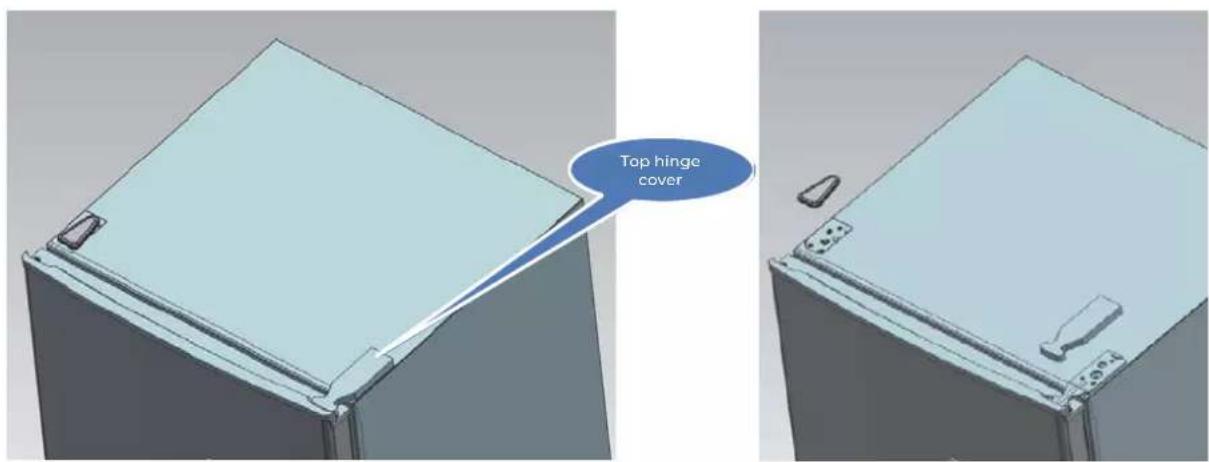
2) Remove the screws that fix the top hinge with cross-slot screwdriver.

3) Replace the top-hinge and the top-door limit block and the door bearing bush to the other side.
A. Remove the nut with sleeve. Take off the washer then remove the axes to the other side and fix.

natural_image
3D mechanical part diagram showing a component being processed into a final assembled part (no text or symbols)B. Remove the door limit block

natural_image
Diagram showing a device being processed from a screen to a tablet, with no visible text or symbols.C. Take another door limit block and mount to the door with screws.

natural_image
3D rendering of a mechanical component with two oval features and a metallic end (no text or symbols visible)4) Disassemble the screws fixed the bottom-hinge with cross-slot screwdriver.

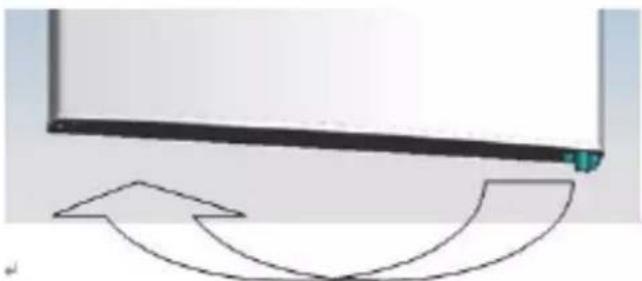
Note: The refrigerator must not be tilted at an angle of more than 45^ during this process.
5) Replace the bottom door bearing bush and the limit block.
natural_image
Pure diagram of a mechanical component with curved arrows indicating motion or force direction (no text or symbols)6) Replace the bottom hinge to the other side then fix it with screws.

natural_image
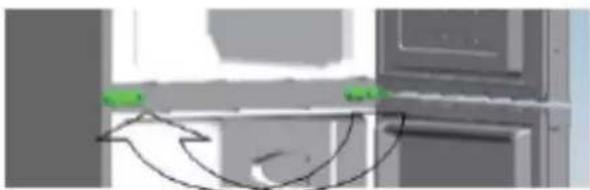
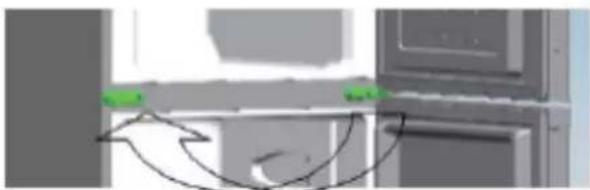
3D CAD model of a mechanical assembly with green base plate and black internal component (no text or symbols visible)7) Replace the mid-hinge
natural_image
Diagram of a kitchen appliance with a green indicator lights and curved arrows indicating motion or movement (no text or symbols)8) Set the bottom door right position, fix the mid-hinge.
natural_image
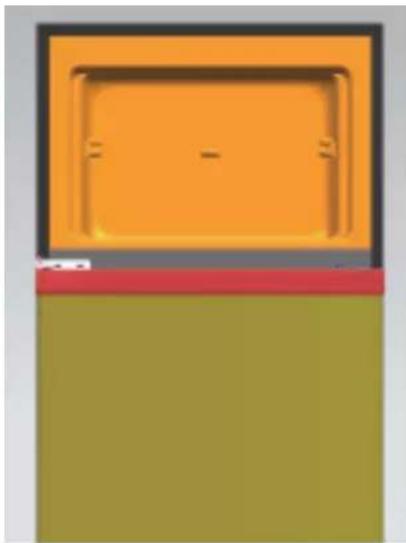
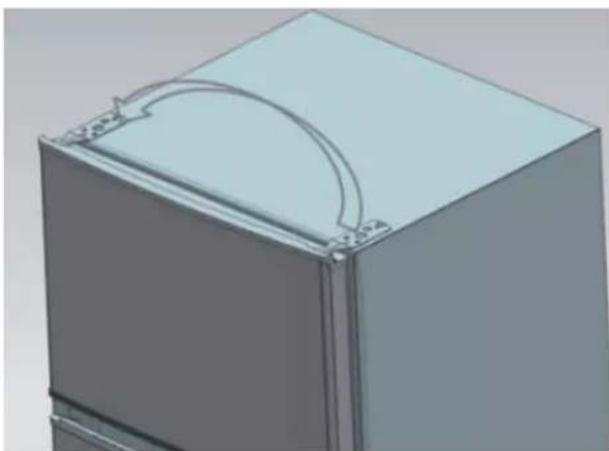
Two colored rectangular blocks, one orange and one olive-green, with no visible text or symbols.9) Replace the top-hinge.

natural_image
3D rendering of a rectangular box with a curved top panel and mounting brackets (no text or symbols visible)10) Set the top door right position, fix the top-hinge and the cover.
natural_image
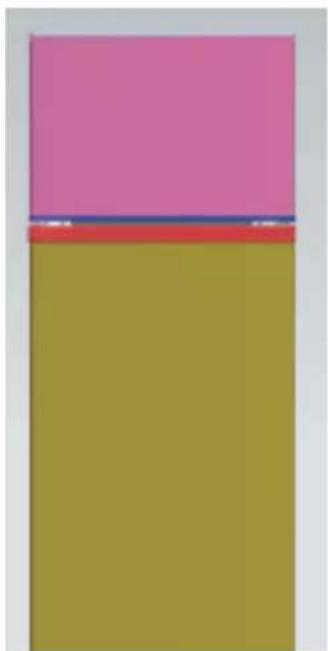
Abstract color block composition with pink, olive, and red sections (no text or symbols)11) Install the four screw caps and two catches to corresponding position.
- Ensure the appliance is unplugged and empty.
- Adjust the two leveling feet to their highest position.
■ We recommend to have someone to assist you.
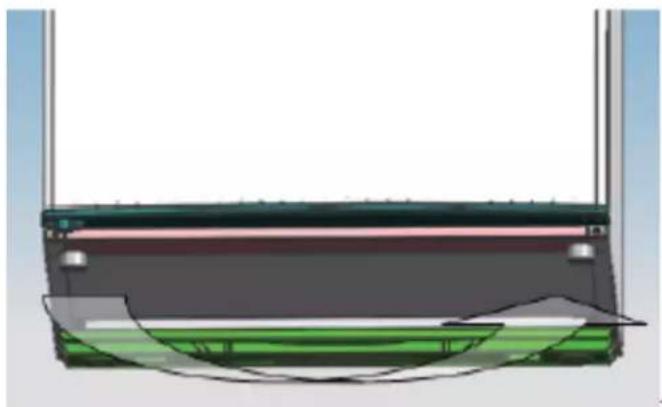
12) Replace the leveler to the other side and adjust it to make sure the cabinet is level.
natural_image
Diagram of a mechanical component with layered structure and curved cutouts (no text or symbols)Note: Images shown are for reference only. Actual configuration depends on the physical product or distributor's declaration.
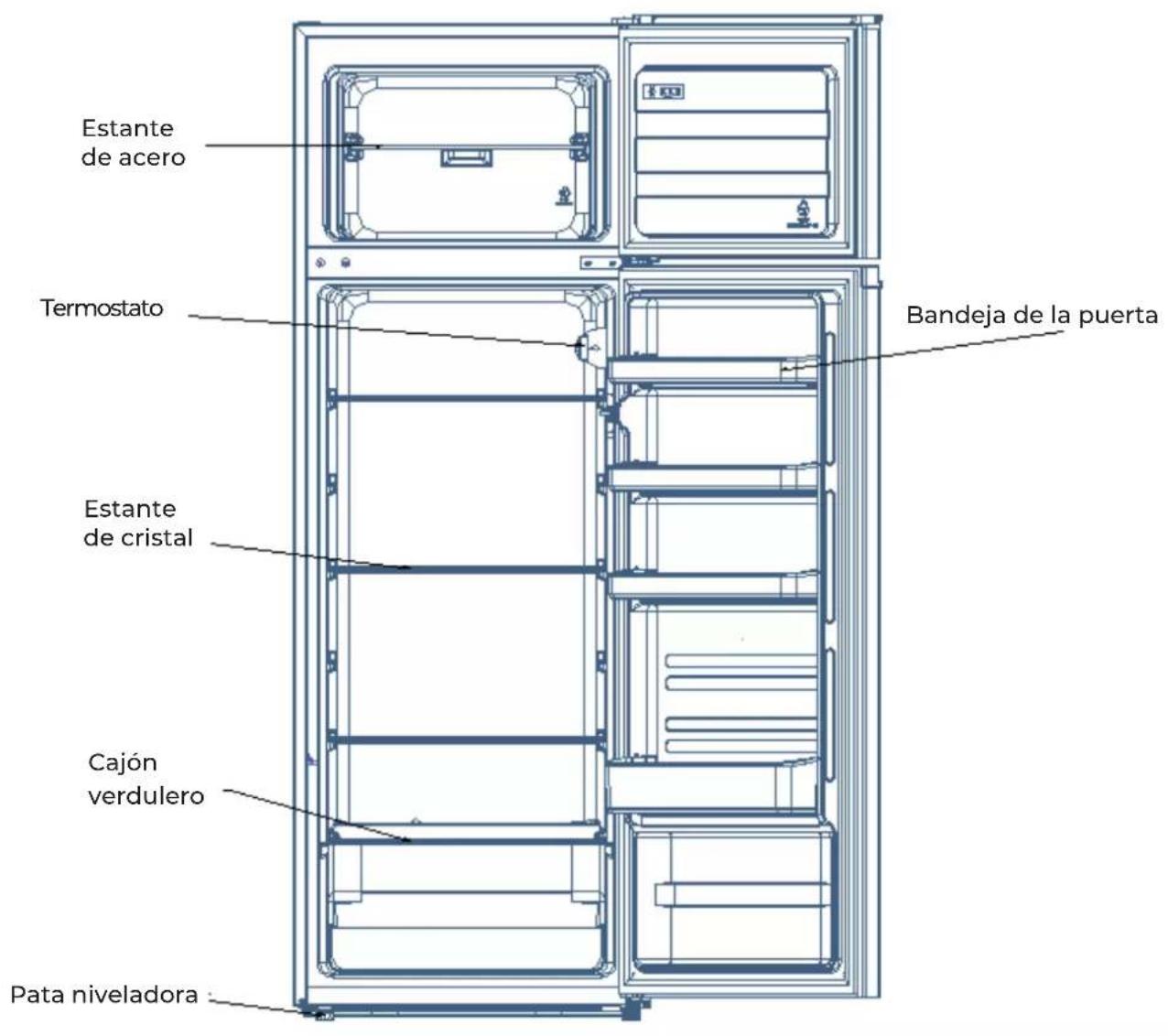
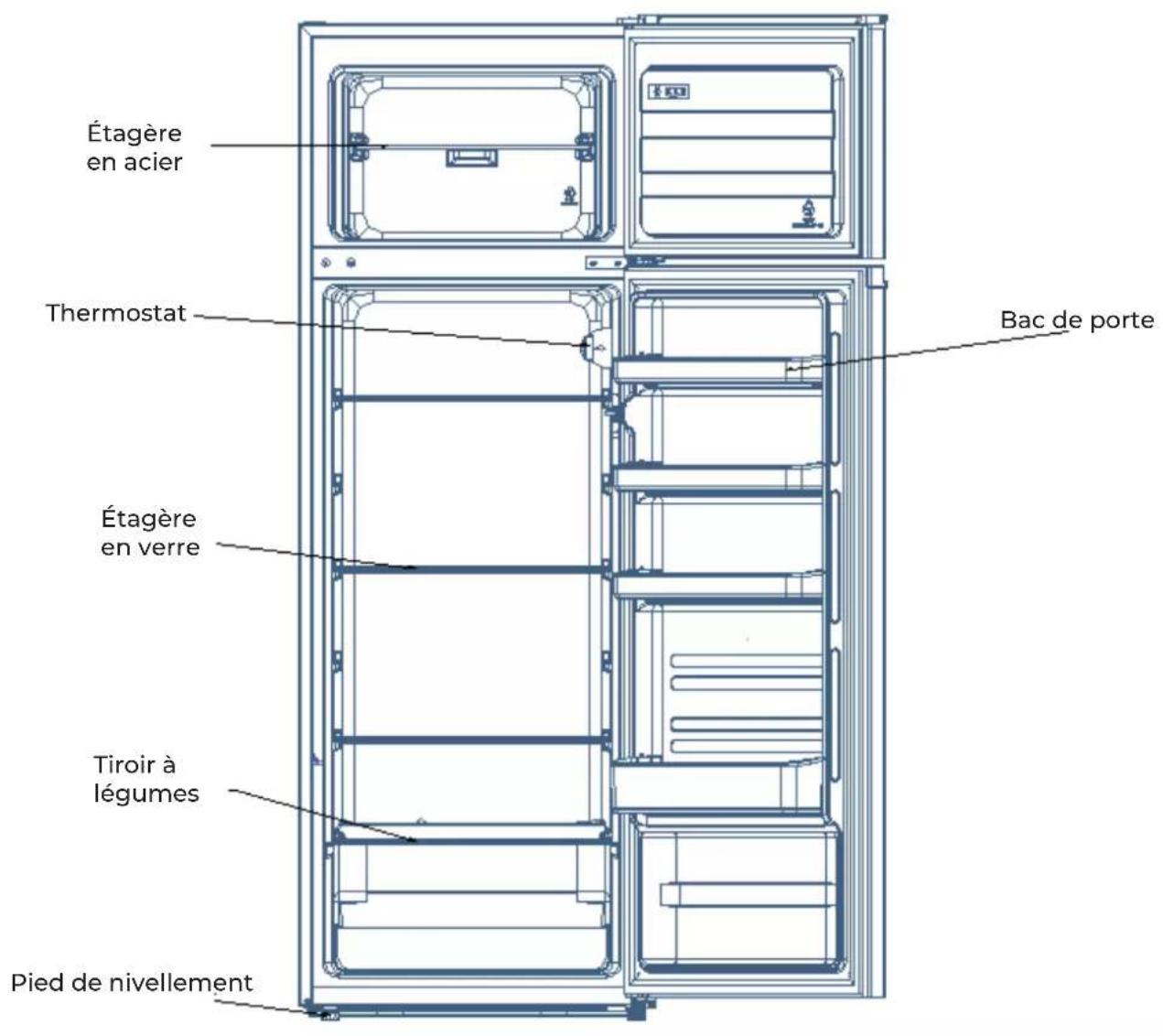
3. PRODUCT OVERVIEW
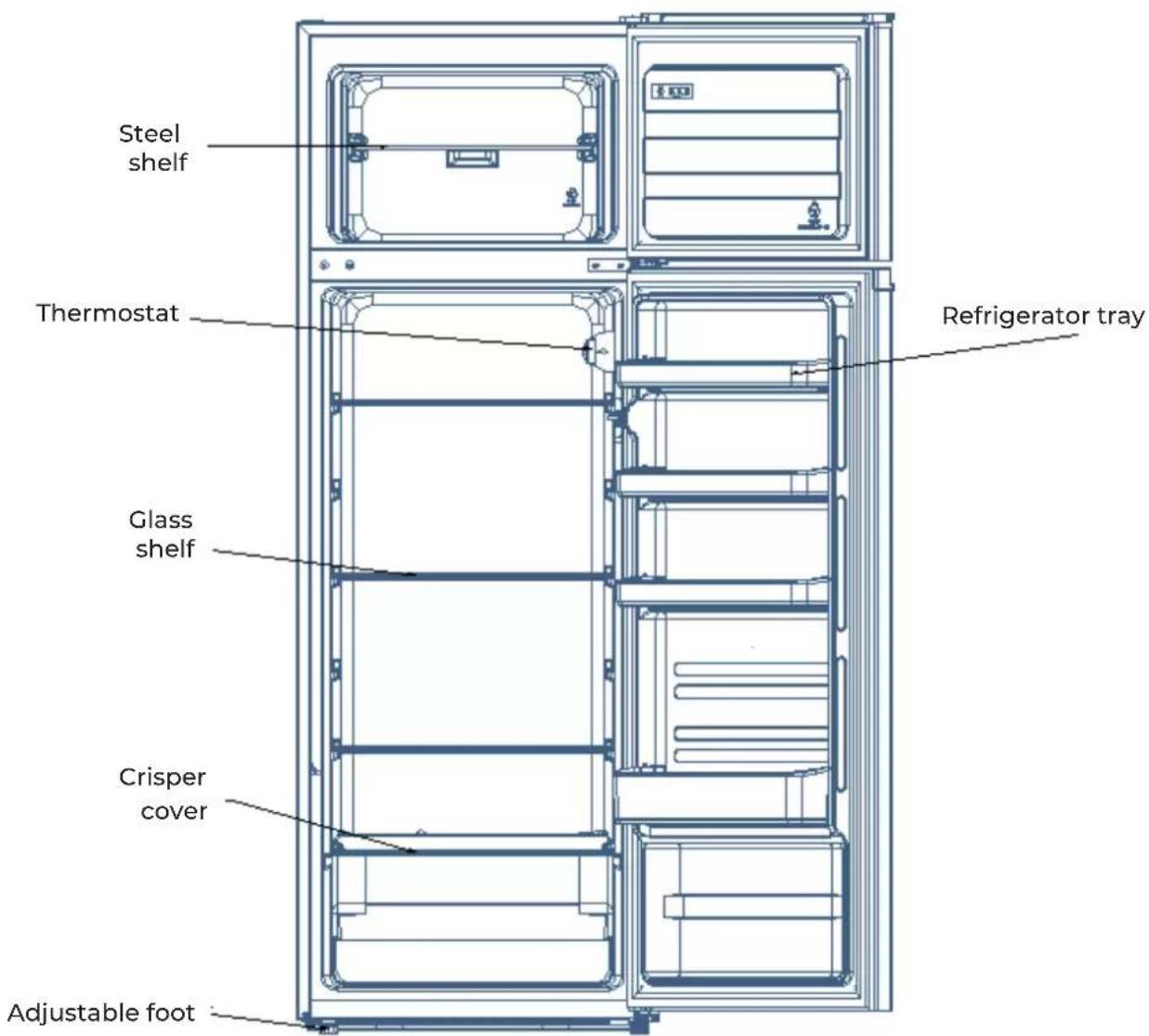
* Drawers, food containers, shelves, etc. placed according to the position of the picture above are the most energy efficient.
* All images in this instruction manual are for reference only, the appearance of the actual product prevails.
4. OPERATION
4.1 Switching on your unit
■ OFF setting: Unit off
■ MIN setting: Lower cooling temperature
■ MED setting: Normal temperature (suitable for most situations)
On high ambient temperature days, for example in summer, it may be necessary to set the thermostat to the coldest setting (MAX position). This may cause the compressor to run continuously to maintain a low temperature in the refrigerator.
The first time you start the refrigerator, set the thermostat to MED. The thermostat knob controls the temperature: when it is in the OFF position, the refrigerator will not be running.
Allow the refrigerator to cool down completely before putting food in it. It is best to wait 24 hours.
4.2 Food preservation tips
- Cooked meat and fish should always be stored on a shelf away from raw meat and fish to avoid possible transfer of bacteria. Store raw meat and fish in a container large enough to catch any juices that may be released and cover it properly. Place the container on the bottom shelf.
- Leave space around the food and allow air to circulate inside the unit. Check that all parts of the unit are well ventilated.
- To prevent flavour transfer or food from drying out, store or cover food separately.
- Always allow cooked food to cool to room temperature before placing in the refrigerator. This will help to maintain the internal temperature of the unit.
- To prevent cold air from escaping from inside the unit, try to limit the number of times the door is opened. We recommend that the door is only opened when food needs to be taken in or out.
5. CLEANING
5.1 Cleaning the interior and exterior of the unit
- Remove all the shelves and the salad bin. To remove the salad bin first remove the lower door shelf.
- Wipe the inside of the unit with a weak solution of bicarbonate soda and then rinse with warm water using a "wrung-out" sponge or cloth. Wipe completely dry before replacing the shelves and salad bin.
- Use a damp cloth to clean the exterior, and then wipe with a standard furniture polish. Make sure that the door is closed to avoid the polish getting on the magnetic door seal or inside the unit.
- The grille of the condenser at the back of the unit and the adjacent components can be vacuumed using a soft brush attachment.
5.1 Cleaning the interior and exterior of the unit
- Dust behind the refrigerator and the floor should be cleaned regularly to improve the cooling effect and save energy.
- Check the door rubber regularly to make sure that there is no debris or dirt left on the door. Wipe it with a damp cloth of soap and water or diluted detergent.
- The inside of the refrigerator should be cleaned often to avoid odours.
- Disconnect the refrigerator from the power supply before cleaning the interior, and remove all food, beverages, shelves and drawers, etc....
- Use a soft cloth or sponge to wipe the inside of the refrigerator with a solution of warm water and two tablespoons of baking soda. Then rinse and wipe it with a cloth. After cleaning, open the door and allow it to air dry before plugging it back in.
- For areas that are more difficult to clean (such as narrow slots, corners or nooks and crannies), it is advisable to clean them often with a soft cloth or brush and, if necessary, using other tools (such as a toothpick) to ensure that contaminants and bacteria do not build up.
- Do not use soap, detergent, powders or sprays as these may cause odours inside the refrigerator or contaminate food.
- Clean the bottle rack frame, shelves and drawers with a soft cloth dampened with soap and water or diluted detergent. Wipe dry with a soft cloth or allow to air dry.
- Clean the outside surface of the refrigerator with a soft cloth dampened with soap and water or detergent, then wipe dry with a cloth.
- Do not use hard brushes, aluminium scouring pads, metal brushes, abrasives (such as toothpaste), organic solvents (such as alcohol, acetone, etc.), boiling water, acid or alkaline solutions, or anything else that may damage the exterior or interior surface of the refrigerator. Boiling water or organic solvents such as benzene may deform or damage plastic parts.
- Do not rinse directly with water or other liquids during cleaning to avoid short circuits or affecting the electrical insulation by immersion.
6. MAINTENANCE
6.1 Replacement of the interior bulb
Bulb replacements should only be carried out by professionals.
6.2 Transport of the unit
Hold the unit by the sides or base to move it. Under no circumstances should it be lifted while being held by the edges of the top surface.
6.3 Repair and servicing
The unit should only be repaired by an authorised technician, using only genuine spare parts. Under no circumstances should you attempt to repair the unit yourself, as repairs carried out by inexperienced persons may cause serious injury or breakdown. Always contact a qualified professional.
6.4 Long periods of non-use
When the unit is not to be used for a long time, disconnect it from the mains, empty all its contents and clean it, leaving the door ajar to avoid odours.
7. TIPS
The surface of the refrigerator may emit heat during operation, especially in summer. This is caused by radiation from the condenser and is a normal phenomenon.
Condensation: This may be detected on the outside surface and door seals of the freezer when the ambient humidity is very high, this is normal and can be removed with a dry cloth.
Buzzing: May be generated by the compressor during operation, especially during start-up and shut-down.
8. ENERGY SAVING
1) Refrigeration appliances may not operate consistently (contents may thaw or the temperature may rise in the freezer compartment) when they are located for a long period of time below the minimum temperature of the operating temperature range for which the appliance is designed.
2) Carbonated beverages should not be stored in the freezer or low temperature compartment, and some products such as slushies should not be consumed very cold.
3) The storage time in the refrigerator or freezer recommended by manufacturers for any type of food should not be exceeded, especially for commercially frozen food.
4) Take precautions to prevent the temperature of frozen food from rising while the refrigerator is defrosting, such as wrapping the food in several layers of newspaper. If the temperature of these foods rises during defrosting, maintenance or cleaning, it may reduce their shelf life.
9. Troubleshooting
You can try to solve these problems yourself. If they are not solved, please contact the official service centre.
| Non operation | Check whether the appliance is connected to the mains and whether the plug makes proper contact.Check if the voltage is too low.Check if there is a power failure or if a circuit has failed. |
| Smell | Wrap foods with strong odours tightly.Check for spoiled food.Clean the inside of the refrigerator. |
| Compressor is running for a long time | This is normal in summer, when the ambient temperature is higher.It is not recommended that the refrigerator is too full.Let the food cool down before putting it in.Doors are opened too often. |
| The light does not turn on | Check if the refrigerator is connected to the power supply, and if the refrigerator bulb is damaged. If so, have it replaced by a professional. |
| Doors do not close properly | Door may be blocked by food. The refrigerator is tilted. |
| Loud noise | Check that the floor is level and that the refrigerator is stable. Check that the accessories are correctly positioned. |
Retired units may have residual value and should be disposed of in such a way that the raw materials can be reused. The refrigerant and insulation materials in this unit require special recycling procedures. Check that the tubing at the rear of the unit is not damaged before disposal, and disable any latches or locks and remove the door as a precaution.


DISPOSAL: Do not dispose of this product as unsorted municipal waste. It is necessary to collect this waste separately for special treatment.
Based on the European directive 2012/19/EU on waste electrical and electronic equipment (WEEE), household appliances cannot be disposed of in the usual municipal bins; they have to be collected separately in order to optimise the recovery and recycling of their constituent components and materials and to reduce the impact on human health and the environment.
The crossed-out wheeled bin symbol is marked on all products to remind the consumer of the obligation to separate them for separate collection. The consumer should contact the local authority or the retailer for information regarding the correct disposal of their appliance.
Table 1 Climate classes
| Class Symbol | Ambient temperature range (°C) | |
| Extended temperate | SN | +10 to +32 |
| Temperate | N | +16 to +32 |
| Subtropical | ST | +16 to +38 |
| Tropical | T | +16 to +43 |
Extended temperate: 'this refrigerating appliance is intended to be used at ambient temperatures ranging from 10 °C to 32 °C';
Temperate: 'this refrigerating appliance is intended to be used at ambient temperatures ranging from 16 °C to 32 °C';
Subtropical: 'this refrigerating appliance is intended to be used at ambient temperatures ranging from 16 °C to 38 °C';
Tropical: 'this refrigerating appliance is intended to be used at ambient temperatures ranging from 16 °C to 43 °C';
Special for new European standard:
The ordered parts in the following table can be acquired from our after sales service:
| Ordered Part | Provided by | Minimum Time Required for Provision |
| thermostats | Professional maintenance personnel | At least 7 years after the last model is launched on the market |
| temperature sensors | Professional maintenance personnel | At least 7 years after the last model is launched on the market |
| printed circuit boards | Professional maintenance personnel | At least 7 years after the last model is launched on the market |
| light sources | Professional maintenance personnel | At least 7 years after the last model is launched on the market |
| door handles | Professional repairers and final users | At least 7 years after the last model is launched on the market |
| door hinges | Professional repairers and final users | At least 7 years after the last model is launched on the market |
| trays | Professional repairers and final users | At least 7 years after the last model is launched on the market |
| baskets | Professional repairers and final users | At least 7 years after the last model is launched on the market |
| door gaskets | Professional repairers and final users | At least 10 years after the last model is launched on the market |
Dear customer
- If you want to return or replace the product, please contact the store where you buy. (Remember to bring the purchase invoice)
- If your product breaks down which needs to repair, please contact after-sales service provider.
WARRANTY CONDITIONS
This appliance is guaranteed for three years from the date of sale against all manufacturing defects, including labour and spare parts. In order to justify the date of purchase, it will be compulsory to present the invoice or purchase receipt. The conditions of this warranty apply only to Spain and Portugal. If you have purchased this product in another country, please consult your distributor for the applicable conditions.
WARRANTY EXCLUSIONS
- Remote controls, drain intake rubbers, dockings and door seals, weather stripping.
- Damage to enamels, paints, nickel plating, chrome plating, oxidation or other types of aesthetic parts or components that do not affect the internal functioning of the appliance.
- Damage to wear parts due to use, corrosion or oxidation, whether caused by normal use of the appliance or accelerated deterioration due to unfavorable environmental or climatic circumstances. Not suitable for outdoor use.
- Damage to fragile pieces of glass, glass ceramic, plastics, handles, baskets, doors or light bulbs when their failure or breakage is not attributable to a manufacturing defect.
- Faults produced by fortuitous causes or accidents of force majeure, or as a consequence of abnormal, negligent or inappropriate use of the device.
- Civil liabilities of any nature.
- Consequential damage to the appliance as long as it has not been caused by an internal malfunction.
- Maintenance or upkeep of the appliance: periodic reviews, adjustments and greases.
- Faults that accessories and complements, adapters, external cables, bags, spare parts of all kinds, lamps, as well as any part considered consumable by the manufacturer, may suffer.
- Faults caused by incorrect or illegal installation, inadequate ventilation, lack of ground-ting in the home, power disturbances, inappropriate modifications or use of non-original spare parts.
- Appliances used in industrial applications or for commercial purposes.
- Appliances with illegible or altered serial number.
- Defects or breakdowns produced as a result of fixes, repairs, modifications, or disassembly of the installation of the device by the user or by a technician not authorized by the manufacturer, or as a result of manifest non-compliance with the manufacturer's instructions for use and maintenance.
- During the warranty period it is essential to keep all manuals together with the equipment. If the equipment is sold, donated or given away, the manual and all related documents must be given to the new user. If any of these are lost, their replacement cannot be claimed.
- Faults that have their origin or are a direct or indirect consequence of: contact with liquids, chemicals and other substances, as well as conditions derived from the climate or the environment: earthquakes, fires, floods, excessive heat or any other external force, such as insects, rodents and other animals that may have access to the interior of the machine or its connection points.
- Damages derived from terrorism, riot or popular tumult, legal or illegal demonstrations and strikes; facts of actions of the Armed Forces or the State Security Forces in times of peace; armed conflicts and acts of war (declared or not); nuclear reaction or radiation or radioactive contamination; vice or defect of the goods; facts classified by the Government of the Nation as "national catastrophe or calamity".
Design and specifications are subject to change without notice for product improvement. Any changes to the manual will be updated on our website, you can check the latest version.

EAS ELECTRIC
SMART TECHNOLOGY
www.easelectric.es

natural_image
3D mechanical part diagram showing a component being processed into a final assembled part (no text or symbols)natural_image
Diagram showing a device being processed from a black plastic panel, with no visible text or symbols.natural_image
3D rendering of a mechanical component with two oval cutouts and a flat base (no text or symbols visible)natural_image
Pure diagram of a mechanical component with curved arrows indicating motion or force direction (no text or symbols)natural_image
3D CAD model of a rectangular electronic component with internal structure and mounting holes (no text or symbols visible)natural_image
Diagram of a kitchen appliance with a curved arrow indicating motion or movement (no text or symbols)natural_image
Two colored rectangular panels: an orange frame with black border and a green block with red border (no text or symbols)natural_image
3D rendering of a rectangular box with a curved top panel and mounting brackets (no text or symbols visible)natural_image
Abstract color block composition with pink, olive, and red sections (no text or symbols)natural_image
Diagram of a computer monitor with a green screen and paper clip, no text or symbols present3. DIAGRAMME DU PRODUIT
CONDITIONS DE LA GARANTIE
EXCLUSIONS DE LA GARANTIE
natural_image
3D mechanical part diagram showing a component being processed into a final assembled part (no text or symbols)natural_image
Diagram showing a device being processed from a black plastic panel, with no visible text or symbols.natural_image
3D rendering of a mechanical component with two oval cutouts and a flat base (no text or symbols visible)natural_image
Pure diagram of a mechanical component with curved arrows indicating motion or force direction (no text or symbols)natural_image
3D CAD model of a rectangular electronic component with internal structure and mounting holes (no text or symbols visible)7) Substituir a dobradiça intermédia de lado.
natural_image
Diagram of a kitchen appliance with a green indicator lights and curved arrows indicating motion or movement (no text or symbols)natural_image
Two colored rectangular blocks, one orange and one olive-green, with no visible text or symbols.9) Substituir a dobradiça superior.
natural_image
3D rendering of a rectangular box with a curved top panel and mounting brackets (no text or symbols visible)natural_image
Abstract color block composition with pink, olive, and red sections (no text or symbols)natural_image
Diagram of a mechanical component with layered structure and curved cutouts (no text or symbols)natural_image
Simple line drawing of a trash bin with crossed lines indicating no waste or discharge (no text or symbols)Scan for manual in other languages and further updates:
- FRIGORÍFICO
- Contenido
- DIAGRAMA DEL PRODUCTO
- SAFETY WARNING
- Warning
- INSTALLATION
- Location
- Door space requirements
- Levelling the unit
- Cleaning before use
- Before using the unit
- Interior accessories
- Changing the opening direction of the door
- PRODUCT OVERVIEW
- OPERATION
- Switching on your unit
- Food preservation tips
- CLEANING
- MAINTENANCE
- Replacement of the interior bulb
- Transport of the unit
- Repair and servicing
- Long periods of non-use
- TIPS
- ENERGY SAVING
- Troubleshooting
- Dear customer
- WARRANTY CONDITIONS
- WARRANTY EXCLUSIONS
- DIAGRAMME DU PRODUIT
- CONDITIONS DE LA GARANTIE
- EXCLUSIONS DE LA GARANTIE
Brand : EAS Electric
Model : EMF161
Category : Refrigerator