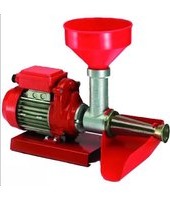
9008 NE - Food Processor Reber - Free user manual and instructions
Find the device manual for free 9008 NE Reber in PDF.



| Product type | Multifunction food processor |
| Brand | Reber |
| Model | 9008 NE |
| Power supply | 230 V / 50 Hz (EU version); 240 V / 50 Hz or 115 V / 60 Hz depending on version |
| Motor | Single-phase asynchronous electric motor, continuous duty |
| Noise level | Less than 60 dBA |
| Motor protection rating | IP X5 |
| Gearbox | Long-life oil bath axial gearbox (never change the oil) |
| Included accessories | Tomato press, meat grinder, grater, dough kneader, pasta extruder (depending on version) |
| Main materials | Epoxy-coated cast iron body, 18/10 stainless steel, food-grade plastic |
| Safety | Safety switch on the dough kneader; motor stop and mandatory unplugging before any handling |
| Food contact parts maintenance | Wash with hot water; some parts are dishwasher safe (lid and bowl of the dough kneader, mixer) |
| Warranty | 2 years for consumers (1 year for professionals) from date of purchase |
| Gearbox oil | Long-life type, compliant with accidental food contact, does not evaporate |
| Functions | Press tomatoes, grind meat, grate, knead, extrude pasta |
| Country of origin | EU (manufactured by Reber Snc) |
Frequently Asked Questions - 9008 NE Reber
User questions about 9008 NE Reber
0 question about this device. Answer the ones you know or ask your own.
Ask a new question about this device
Download the instructions for your Food Processor in PDF format for free! Find your manual 9008 NE - Reber and take your electronic device back in hand. On this page are published all the documents necessary for the use of your device. 9008 NE by Reber.
USER MANUAL 9008 NE Reber
Read all instructions and save for future reference
ART. 8310 N : 9208 N - V 230/50 Hz : 9228 N - V 115/60 Hz: 9229 N - V 240/50 Hz
ART. 8300 N : 9204N - V 230/50 Hz : 9224 N - V 115/60 Hz: 9225 N - V 240/50 Hz
ART. 9200N - V 230/50 Hz : 9220 N - V 115/60 Hz: 9221 N - V 240/50 Hz
ART. 9200 NP - V 230/50 Hz : 9220 NP - V 115/60 Hz: 9221 NP - V 240/50 Hz

ART. 8410 N : 9040 N - V 230/50 Hz : 9041 N - V 240/50 Hz : 9666 N - V 115/60 Hz
ART. 8400 N : 9050 N - V 230/50 Hz : 9042 N - V 240/50 Hz : 9665 N - V 115/60 Hz
ART. 9060 N - V 230/50 Hz : 9043 N - V 240/50 Hz : 9667 N - V 115/60 Hz
ART. 9070 N - V 230/50 Hz : 9045 N - V 240/50 Hz : 9044 N - V 115/60 Hz
Reber is in a continuos development of its products to improve technical, safety, ecological and commercial features; products could be different from this data sheet due to this non stop evolution.
IMPORTANT SAFEGUARDS
When using electrical appliances, basic safety precautions should always be followed including the following:
a) Read all instructions.
b) To protect against risks of electrical shock do not put in water or other liquid.
c) Close supervision is necessary when any appliance is used by or near children.
d) Unplug from outlet When not in use, before putting on or taking off parts and before cleaning.
e) Avoid contacting moving parts.
f) Do not operate any appliance with a damaged cord or plug or after the appliance malfunction, or is dropped or damaged in any manner. Return appliance to the nearest autorized service facility for examination, repair or electrical or mechanical adjustment.
g) The use of attachments not recommended or sold by the manufacturer may cause fire, electric shock or injury.
h) Do not use outdoors.
i) Do not let cord hang over edge of table or counter.
j) Never feed food or dough by hand. Always use food pusher.
k) Blades are sharp. Handly carefully.
I) Do not use fingers to scrape food away from discharge disc while appliance is operating. Cut type injury may result.
m) Household use only.
n) This appliance is not intended for use by persons (including children) with reduced physical, sensory or mental capabilities, or lack of experience and knowledge, unless they have been given supervision or instruction concerning use of the appliance by a person responsible for their safety.
o) Acoustic level less than 60 dBA.
SAVE THESE INSTRUCTION
Electric Motor legend
1) Electric motor
2) Reduction gear flange
3) Small gear
4) Twin gear
5) Gear with hub
5a) Reduction gear cap
6) Reduction gear cover
14) Reduction gear cover oil seal
14a) Reduction gear internal seal
15) Base
Tomato squezeer legend
1) Multiplier cover
2) Graphitized gear
3) Multiplier small gear
4) Grater pin
5) Multiplier flange
6) Grater cap nut
7) Grater handle
8) Grater casing
9) Toothed roller
10) Nylon cover
11) Nylon cover screw
12) Collection drawer
Dough mixer legend
7) Cap
8) Tank
9) Mixer
10) Conical transmission tank
11) Conical Transmission tank oil seal
12) Mixer Socket
13) Accessories start key
16) Tow pin
17) Reduction conical gear
18) Conical transmission gear
19) Trasmission tow
20) Cover Conical transmission tank
21) Fixing screws for Cover Conical transmission tank
22) Cable for Security switch
23) Security switch
24) Security switch box
25) Cover for Security switch box
26) Fixing screws for Cover for Security switch box
7) Casing
8) Screw
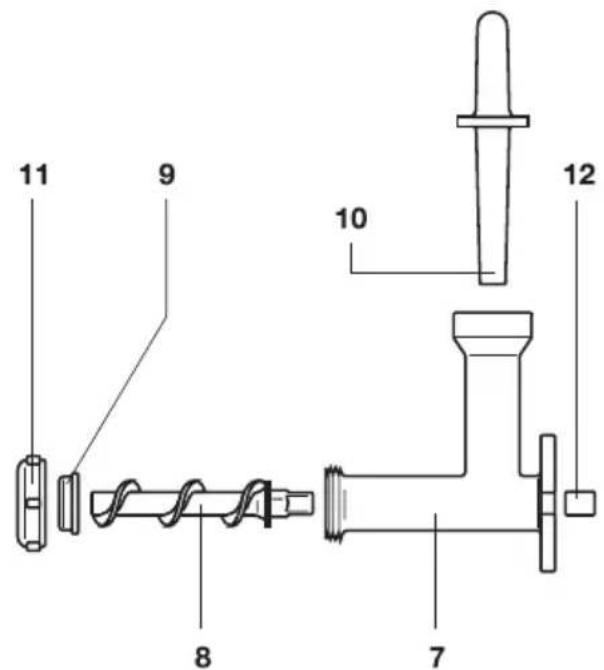
9) Die plate
10) Pestle
11) Ring nut
12) Reduction gear (only model N.5)
TECHNICAL DATA
ART. 9600 N - V 230/50 Hz : 9650 N - V 240/50 Hz : 9651 N - V 115/60 Hz
Single-phase asynchronous electric motor for continuous service 400 E.. Fan cover cap, switch/capacitor box and cooling fan made in plastic material. Watertight IP X5 motorization. Axial reduction gear in oil bath with nylon gears inserted on bronze self-lubricating bush. Long-life oil suitable for occasional food contact.
TECHNICAL DATA
ART. 9601 N – V 230/50 Hz : 9653 N – V 240/50 Hz : 9654 N - V 115/60 Hz
Single-phase asynchronous electric motor for continuous service 500 E.. Fan cover cap, switch/capacitor box and cooling fan made in plastic material. Watertight IP X5 motorization. Axial reduction gear in oil bath. Long-life oil suitable for occasional food contact.
TECHNICAL DATA
ART. 9602 N – V 230/50 Hz : 9656 N – V 240/50 Hz : 9657 N - V 115/60 Hz
Single-phase asynchronous electric motor for continuous service 600 W. Gear switch forward/reverse to use only in case of block of the meat mincer attachment; do not use reverse function with other attachments to avoid risks of injury. Fan cover cap, switch/capacitor box and cooling fan made in plastic material. Watertight IP X5 motorization. Axial reduction gear in oil bath. Long-life oil suitable for occasional food contact.
TECHNICAL DATA
ART. 9603 N – V 230/50 Hz : 9659 N – V 240/50 Hz : 9658 N - V 115/60 Hz
Single-phase asynchronous electric motor for continuous service 1200 W. Gear switch forward/reverse to use only in case of block of the meat mincer attachment; do not use reverse function with other attachments to avoid risks of injury (no forward/reverse for 9658N UL-CSA model). Fan cover cap, switch/capacitor box and cooling fan made in plastic material. Watertight IP X5 motorization. Axial reduction gear in oil bath. Long-life oil suitable for occasional food contact.
USING THE APPLIANCE
Before operating the machine, the user must remove the red cap (5A) from the reduction gear and replace it with the cap with bleed and seal, located in a bag, taking care that the bleed hole is turned upward. The machine must definitely not be started without replacing the red cap with the bleeder cap. The geared motor is supplied as standard with the right amount of oil necessary for its proper operation. It is a long-life oil suitable for occasional food contact, it is not subject to deterioration or consumption due to machine operation, and must NOT be replaced. Any topping up should only be done with the same type of oil if there has been visible and substantial leakage. The reduction gear contains 40 grams (only art. 9600 N – V 230/50 Hz : 9650 N – V 240/50 Hz : 9651 N - V 115/60 Hz) other models 80 grams of oil and any excess after topping up will be expelled from the bleed hole during operation.
To operate, the appliance must be connected to a power point that is always easily accessible during use. All operations not specified in this manual must be done by a qualified operator. The machine must be located on a plain surface and positions which can produce the falling of the machine must be avoided.
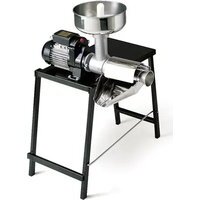
Tomato squeezer propeller made in acetal resin suitable for food contact, body in cast iron tested for foodstuffs and treated with epoxy paint for foodstuffs. Nylon tow pin inserted on tin-plated steel. Filter cone, funnel and drip pan are entirely made of 18/10 stainless steel.
USING THE ELECTRIC TOMATO SQUEEZER
For space requirements, the machine is partially disassembled in the packing; it is necessary to insert the tow pin with the spring into the hole in the cast iron body (9). Insert the propeller (10) into the cast iron body fitting it onto the square of the tow pin. Then put the filter cone (11) onto the propeller pressing and turning it anticlockwise to fit the tabs of the ring nut into the niches in the cast iron body. Screw the funnel (8) onto the threaded neck of the cast iron body and hook the drip pan (12) onto the filter cone and onto the cast iron casing by means of the clips.
The machine is then ready for use: the machine must definitely not be run dry (with no tomato).
If the propeller (10) jams, before taking any further action on the machine put the switch onto the “OFF” (-0-) position and unplug from the power point. When the work is finished, unscrew the funnel (8), unhook the drip pan (12), turn the filter cone (11) clockwise to remove the propeller (10) and the tow pin with the spring. Remove the cast iron casing (9) from the reduction gear cover (6), then wash, carefully dry and eventually grease all the parts that have come into contact with the food. Before replacing the appliance it is advisable to put the red cap back on in the place of the cap with bleed.
MEAT MINCER UNIT
Body and ring nut are made in alluminium for ART. 8820 N : 9502 N V 230/50 Hz : 9556 N – V 240/50 Hz : 9557 N – V 115/60 Hz, other models Body, ring nut and propeller are made of tin-plated cast iron ( or Stainless Steel Alsi 304), plate and self-sharpening knife in hardened steel, pestle in moplen, dish in 18/10 stainless steel. On request there are crown for fitting and funnels for bagging in moplen ,plates with holes of different sizes according to need.
USING THE ELECTRIC MEAT MINCER
Before operate, wash with boiling water and carefully dry all the parts that have come into contact with the food. On first utilization, grind for 5 min. some meat scrap to eliminate all possible processing residues.
Screw the ring nut and never remove during the functioning of the meat mincer. When the work is finished, to dismantle the meat chopper, turn the ring nut (11) an-
ticlockwise, remove the knife (10), the plate (9) and the propeller (8). Remove the cast iron body (7) from the reduction gear cover (6), then wash, carefully dry and eventually grease all the parts that have come into contact with the meat. Before replacing the appliance it is advisable to put the red cap back on in the place of the cap with bleed. “Reber” electric meat choppers are fitted for operation with plates having holes of diameter from 3 mm to 12 mm. Reber snc decline all liability concerning damage or accidents deriving from using plates having holes of diameter greater than 12 mm.
GRATER UNIT
Body and handle in aluminium, roller in tin-plated steel and collection drawer in a plastic material for foodstuffs. The grater is inserted onto the geared motor by means of an axial revolution multiplier with nylon gears supplied in the package.
USING THE GRATER
Before operate, wash with boiling water and carefully dry all the parts that have come into contact with the food. When the work is finished, undo the screws (11) and remove the nylon cover (10) to take out the toothed roller (9) to which are fixed the pin (4) and the small gear (3). Wash, carefully dry and eventually grease all the parts that have come into contact with the food. Before replacing the appliance it is advisable to put the red cap back on in the place of the cap with bleed.
DOUGH MIXER UNIT
Dough mixer base in die-cast aluminium alloy; steel bevel reduction gear; mixing shaft in precision-cast stainless steel AISI 316; mixer container and cover in highly resistant semitransparent polycarbonate, detachable for easy cleaning (even in dishwasher). Safety switch preventing the mixer shaft from operating when the cover is open. Suitable for any kind of dough: pasta, bread, pizza, cakes.
The unit is delivered ready for use, efore operate, wash and carefully dry all the parts that have come into contact with the food
The conical transmission of the dough mixer is lubricated with specific grease of Long Life type which doesn't have to be changed or added.
The Accessories start key (13) must be used to let the motor start using the accessories of the motor other than the dough mixer..
Make sure that the switch is in the position OFF before changing the accessories and before introducing the blocking of the safety switch.
When changing the accessories, please follow carefully the installation instructions supplied with the machine.
The machine is prepared for putting into practice:
-Remove the cap (7) rotating it counterclockwise.
-Fill in the tank (8) according to the quantities and ingredients mentioned in the pa-
ragraph called Recipes and Advice for Usage.
-Place the cap (7) on the tank (8) (rotate the cap in such a way in order to fasten it, and rotate clockwise and block it at the end in order to allow the putting into practice of the machine.
-During the functioning, if necessary, liquid or flour may be added through the slots of the cap (7) without turning off the machine.
-After a period of functioning of approximately 2,5/3 min., if the dough is well mixed (if it isn't you may continue with the functioning) turn off the dough machine, rotate the cap (7) counterclockwise in order to dismantle it and remove the dough. If you have observed the dosages mentioned in the Recipes and Advice for Usage paragraph, the dough must be compact and can be easily removed from the tank (8). The dough may be at this point manipulated in order to give it a specific form or it may be cut in order to be used in cutter for Reber pasta which you can assemble on the same engine by replacing the dough machine in order to make spaghetti or one of the 11 types of pasta.
-Once you have finished the job, rotate de mixer (9) counterclockwise in order to remove it from the base, rotate the tank in the same direction (8) and dismantle it from the base, wash and perfectly dry all the accessories.
-The cap (7) and the tank (8) are made of food grade plastic material and they can be washed in the dish-washer taking into account the fact that very aggressive detergents or very high cleaning temperatures may damage the esthetic features of the product, but not their technical features.
-The mixer (9) is made of corrosion proof steel AISI 316 and may be washed in the dish-washer taking into account the fact that very aggressive detergents or very high cleaning temperatures may damage the esthetic features of the product, but not their technical features.
-Once you have cleaned the components, fit on the tank (8) on the base (rotate the cap in order to fit it on ), rotating clockwise and block it until the end (the first times the tank shall be swung over in order to fix it properly), place the mixer at the end (9) and block it on the drive pin slots rotating it clockwise, secure the cap on the tank (rotate the cap in order to secure it ), rotate clockwise. We advise you not to block it until the end of the fitting in order to avoid damaging the safety switch .
Recipes and Advices for Usage
- The type of mixture which best fits for the usage of the Reber pasta cutter in order to prepare spaghetti, macaroni or other types of pasta consists of: 1.000 gr. of flour type 0 or 00 and of 430 gr. of liquid (water and/or eggs according to the local tastes and traditions). If you use only eggs the dough will become very compact, which is a good thing when using the Reber pasta cutter.
- The type of mixture for the preparation of bread or pizza consists of: 1.000 gr. of flour type 0 or 00 and of 580 gr. of liquid (water, oil and/or eggs and baking powder according to the local tastes and traditions).
- The type of mixture for preparing the tender dough for cakes or biscuits consists of: 500 gr. of flour type 00, 250 gr. of butter at room temperature, 250 gr. of sugar, 1 full egg and 2 yolks of egg.
Advertisements:
1 -The liquid quantity and the weight of the mixture can be changed according to the degree of humidity and type of flour that is being used.
2 -The full corn flours and/or of other cereals have a different kind of adhesion capacity versus the refined corn flour. The result can be a less flexible and less compact mixture; as a consequence we advise you to reduce the total quantity of dough in order to avoid damaging the dough-machine.
3 -Too much liquid can produce the sticking of the mixture on the mixer (9) and on the tank (8) – If you add flour through the slots of the cap, (7) an improvement of the mixture will be obtained, but the remains that stuck to the mixer or to the tank may remain attached and you will have to remove them by hand when doing the cleaning of the accessories.
4 -Less liquid can restrain the adhesion of the dough. – Add liquid through the slots of the cap () until obtaining a satisfying mixture. We advice you to add liquid little by little in order to avoid the problems mentioned at point 3.
5 -Check the total volume of the mixture and avoid filling in the tank (8) with more than 1,6 l of flour and liquid. Overcharging can damage the tank (8) and the cap (7).
6 -Dismantle and clean the cap (7), the mixer (9) and the tank (8) at the end of each dough kneading in order to avoid any accidental outflow of liquid which can damage the machine.
PASTA PRESS UNIT
Aluminium body, screw and die plates in highly resistant acetal resin. Materials for food use. Supplied with 10 die plates to obtain different kinds of pasta (spaghetti, tagliatelle, macaroni, pappardelle, etc.).
USING PASTA PRESS
DOUGH
The dough for the correct use of the Press is indicatively composed by Kg. 2,0 of floor and Kg. 0,750 of a blend of eggs and water in the proportion you more like it. DRAWING
Prepare the dough and form lumps as big as a nut. Check that the ring nut (11) is locked and the die plate (9) is mounted correctly. Introduce the lumps into the press top until it is completely full. Switch on the motor: pasta will start coming out of the press. Cut it with a knife at the desired length. Introduce additional lumps into the press.
Switch off the motor as soon as no more dough is available.
REPLACING THE DIE PLATE
Switch off the motor and disconnect the plug from the socket. Unscrew the ring nut (11) by rotating it in counterclockwise direction. Extract the die plate (9) and replace it with a new one.
Lock the unit by screwing the ring nut (11) in clockwise direction. Before putting away the replaced die plate, clean it and remove dough residuals (if any) from the holes.
DISASSEMBLYING AND CLEANING THE PRESS
After every drawing operation disassemble the press and clean all its parts carefully. Switch off the motor and disconnect the plug from the socket. Unscrew the two stop nuts securing the press to the geared motor cover (6) and remove it. Remove the reduction gear (12) (only for model N.5).
Unscrew the ring nut (11) by rotating it in counterclockwise direction. Extract the die plate (9) and the screw (8) from the front of the casing (7). Wash, clean and dry all parts carefully.
ASSEMBLYING THE PRESS
Switch off the motor and disconnect the plug from the socket. Introduce the screw (8) into the casing (7), making sure that its square part goes out of the rear hole of the casing. Insert the reduction gear (12) into the square part of the screw (8) (only in model N.5). Insert the die plate (9) so that the larger base goes into the casing (7) mouth. Screw the ring nut (11) on the casing (7) mouth by rotating it in clockwise direction as long as it is locked. Couple the press to the geared motor having the screw square part inserted in the square seat of the geared motor. Tighten the stop nuts.
WARNINGS
- Before carrying out assembly, disassembly, die plate replacement and cleaning operations, switch off the motor and disconnect the cable with plug, to avoid risks of electric shock.
- Do not press the dough into the unit with your hands; use the specially-supplied pestle.
- After every use disassemble, wash and dry all press parts carefully.
- Clean the die plates by putting them in a warm water bath immediately after use.
- Before use, warm the die plates in warm water (cold die plates produce irregularly-shaped pasta)
- The pasta obtained can show a darker or lighter colour, according to the amount of pressure applied when coming out of the unit. When pressure is lower, lighter pasta will be produced (this happens, for example, when the dough is introduced into the press too slowly compared with the capacity of the unit). This does not alter pasta quality and features.
- In case of blockage of the press, disconnect the plug cable from the socket immediately to avoid risks of damage the machine.
- Close supervision is required when this product is used near children.
ASSISTANCE AND WARRANTY CONDITIONS
GARANTIE UND SERVICEBEDINGUNGEN
CONDICIONES DEL SERVICIO POSVENTA Y GARANTÍA
CONDIÇÕES DO SERVIÇO APÓS VENDA E GARANTIA
Assistance and warranty service informations on web site www.reber-snc.it
Assistance and warranty service Canada www.auroraimporting.com
Assistance and warranty service Australia and New Zealand www.foodquip.com.au
CONDITIONS DE GARANTIE
All Reber products are covered against manufacturing defects by a 24 month guarantee for private users and 12 month guarantee for professionals users. The warranty runs from the date of purchase. The purchasing date shall be that indicated on the receipt issued when the dealer delivers the machine. The manufacturer undertakes to repair free of charges those parts showing manufacturing defects within the warranty period, or to replace these free of charge. Defects not clearly attributable to materials or manufacture shall be examined by our technical assistance center or in our plant and shall be charges according to the outcome of the examination. The guarantee shall not cover: accidental damage, caused by transport, neglect or inadequate treatment, incorrect or improper use and installation failing to comply with the indications in the instruction manual or in any case resulting from causes that do not depend on normal operation use of the machine. The warranty becomes void when the machine has been repaired or rishandled by unauthorized third parties. The warranty shall not cover replacement of the machine or extension of the guarantee resulting from a breakdown. The machine shall reach us (or our authorized assistance center) carriage free, i.e. with transport expenses at user's charge. The warranty shall not cover any cleaning operations to which the operative components may be subjected.
CONDICIONES DE GARANTÍA
Disposal of Waste Equipment by Users in Private Households in the European Union. This symbol on the product or on its packaging indicates that this product must not be disposed of with your other household waste. Instead, it is your responsibility to dispose of your waste equipment by handing it over to a designated collection point for the recycling of waste electrical and electronic equipment. The separate collection and recycling of your waste equipment at the time of disposal will help to conserve natural resources and ensure that it is recycled in a manner that protects human health and the environment. For more information about where you can drop off your waste equipment for recycling, please contact your local city office, your household waste disposal service or the shop where you purchased the product.


- IMPORTANT SAFEGUARDS
- SAVE THESE INSTRUCTION
- ELECTRIC MOTOR LEGEND
- TOMATO SQUEZEER LEGEND
- DOUGH MIXER LEGEND
- TECHNICAL DATA
- USING THE APPLIANCE
- USING THE ELECTRIC TOMATO SQUEEZER
- MEAT MINCER UNIT
- USING THE ELECTRIC MEAT MINCER
- GRATER UNIT
- USING THE GRATER
- DOUGH MIXER UNIT
- RECIPES AND ADVICES FOR USAGE
- ADVERTISEMENTS
- PASTA PRESS UNIT
- USING PASTA PRESS
- DOUGH
- REPLACING THE DIE PLATE
- DISASSEMBLYING AND CLEANING THE PRESS
- ASSEMBLYING THE PRESS
- WARNINGS
- ASSISTANCE AND WARRANTY CONDITIONS
- GARANTIE UND SERVICEBEDINGUNGEN
- CONDICIONES DEL SERVICIO POSVENTA Y GARANTÍA
- CONDIÇÕES DO SERVIÇO APÓS VENDA E GARANTIA
- CONDITIONS DE GARANTIE
- CONDICIONES DE GARANTÍA
Brand : Reber
Model : 9008 NE
Category : Food Processor