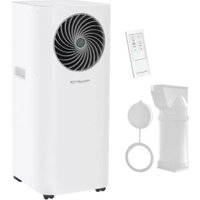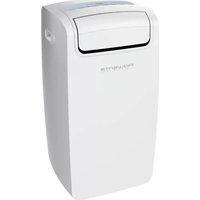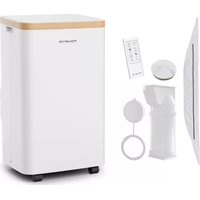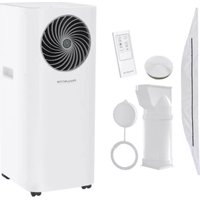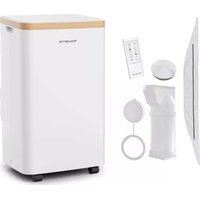
Turbo Eco Sense AU5610 - Air-conditioner CALOR - Free user manual and instructions
Find the device manual for free Turbo Eco Sense AU5610 CALOR in PDF.



| Product type | Mobile monobloc air conditioner |
| Brand | Calor |
| Model | Turbo Eco Sense AU5610 (AU5610F0) |
| Nominal cooling capacity | 3.0 kW |
| Energy efficiency class | A |
| Nominal EER | 2.6 |
| Refrigerant type | R290 (propane) |
| Refrigerant quantity | 246 g |
| Global warming potential (GWP) | 3 kg CO2 eq |
| Minimum recommended area | 12 m² (height > 2 m) |
| Electrical supply | 220-240 V ~ 50 Hz |
| Nominal power input (cooling) | 1.1 kW |
| Standby power consumption | 0.5 W |
| Sound power level | 65 dB(A) |
| Dimensions (W x H x D) | 415 x 736 x 345 mm |
| Net weight | 32.5 kg |
| Operating modes | Cooling, Dehumidification, Fan |
| Economy function (ECO) | Yes - adjusts target temperature by -3°C |
| Temperature setting | 16 to 32 °C (cooling mode) |
| Fan speeds | 3 speeds (Low, Medium, High) |
| Oscillation | Yes - motorized flap |
| Timer | 1 to 24 hours (auto stop or start) |
| Remote control | Yes (2 AAA batteries not included) |
| Full tank indicator | Yes - \"FULL\" indicator light |
| Air filter maintenance | Clean every 100 hours of use |
| Filter type | Washable air filter |
| Installation | Exhaust to outside via included flexible hose |
| Window sealing kit | Included (ref. XD6620F0 optional) |
| Safety | Automatic stop on full tank; fault protection |
Frequently Asked Questions - Turbo Eco Sense AU5610 CALOR
User questions about Turbo Eco Sense AU5610 CALOR
0 question about this device. Answer the ones you know or ask your own.
Ask a new question about this device
Download the instructions for your Air-conditioner in PDF format for free! Find your manual Turbo Eco Sense AU5610 - CALOR and take your electronic device back in hand. On this page are published all the documents necessary for the use of your device. Turbo Eco Sense AU5610 by CALOR.
USER MANUAL Turbo Eco Sense AU5610 CALOR
natural_image
Technical line drawing of a mechanical device with a base and spring, no visible text or symbolsSchéma 1
- NETTOYAGE ET ENTRETIEN
natural_image
Diagram of a refrigerator with a grid panel and directional arrow indicating airflow (no text or symbols)Schéma 2
MODE D'EMPLOI
text_image
Technical diagram of an air conditioning unit with numbered components for identificationInstallation 1 - Installation mobile
natural_image
Diagram showing a curved pipe or duct with a black arrow pointing downward, next to a grid-patterned structure (no text or symbols)Schéma 3
natural_image
Illustration of three kitchen appliances in an indoor setting, showing exterior and interior views (no text or symbols)Schéma 4
Installation semi-permanente
Commande Oscillation (F)
Please read the instruction manual and safety instructions carefully before using the appliance and keep the instruction manual for reference.
For your safety, this appliance complies with all applicable standards and regulations (Low Voltage, Electromagnetic Compatibility, Environmental directives, etc.).
| WARNING(Risk of fire) | This unit uses a flammable refrigerant.If refrigerant leaks and comes in contact with fire or heating part, it will create harmful gas and there is risk of fire. | |
| Read the OPERATING INSTRUCTIONS carefully before operation | ||
| Service personnel are required to carefully read the OPERATING INSTRUCTIONS and INSTALLATION MANUAL before operation | ||
| Further information is available in the OPERATING INSTRUCTIONS,INSTALLATION MANUAL, and the like | ||
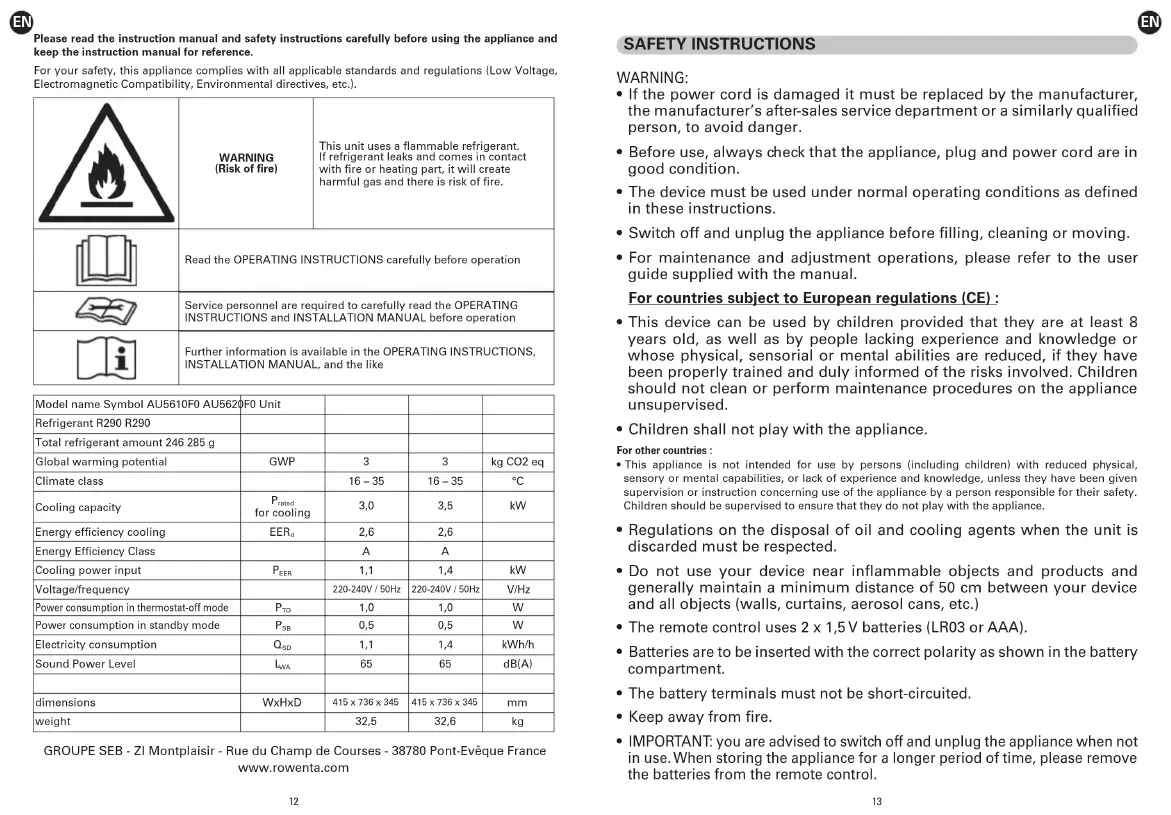
| Model name Symbol AU5610F0 AU5620F0 Unit | ||||
| Refrigerant R290 R290 | ||||
| Total refrigerant amount 246 285 g | ||||
| Global warming potential | GWP | 3 | 3 | kg CO2 eq |
| Climate class | 16 – 35 | 16 – 35 | °C | |
| Cooling capacity | P_rms for cooling | 3,0 | 3,5 | kW |
| Energy efficiency cooling | EER_J | 2,6 | 2,6 | |
| Energy Efficiency Class | A | A | ||
| Cooling power input | P_EER | 1,1 | 1,4 | kW |
| Voltage/frequency | 220-240V / 50Hz | 220-240V / 50Hz | V/Hz | |
| Power consumption in thermostat-off mode | P_TG | 1,0 | 1,0 | W |
| Power consumption in standby mode | P_SSH | 0,5 | 0,5 | W |
| Electricity consumption | Q_SD | 1,1 | 1,4 | kWh/h |
| Sound Power Level | L_WA | 65 | 65 | dB(A) |
| dimensions | WxHxD | 415 x 736 x 345 | 415 x 736 x 345 | mm |
| weight | 32,5 | 32,6 | kg | |
- If the power cord is damaged it must be replaced by the manufacturer, the manufacturer's after-sales service department or a similarly qualified person, to avoid danger.
- Before use, always check that the appliance, plug and power cord are in good condition.
- The device must be used under normal operating conditions as defined in these instructions.
- Switch off and unplug the appliance before filling, cleaning or moving.
- For maintenance and adjustment operations, please refer to the user guide supplied with the manual.
For countries subject to European regulations (CE) :
- This device can be used by children provided that they are at least 8 years old, as well as by people lacking experience and knowledge or whose physical, sensorial or mental abilities are reduced, if they have been properly trained and duly informed of the risks involved. Children should not clean or perform maintenance procedures on the appliance unsupervised.
- Children shall not play with the appliance.
For other countries :
- This appliance is not intended for use by persons (including children) with reduced physical, sensory or mental capabilities, or lack of experience and knowledge, unless they have been given supervision or instruction concerning use of the appliance by a person responsible for their safety. Children should be supervised to ensure that they do not play with the appliance.
- Regulations on the disposal of oil and cooling agents when the unit is discarded must be respected.
- Do not use your device near inflammable objects and products and generally maintain a minimum distance of 50 cm between your device and all objects (walls, curtains, aerosol cans, etc.)
- The remote control uses 2 × 1,5 ~V batteries (LR03 or AAA).
- Batteries are to be inserted with the correct polarity as shown in the battery compartment.
- The battery terminals must not be short-circuited.
- Keep away from fire.
-
IMPORTANT: you are advised to switch off and unplug the appliance when not in use. When storing the appliance for a longer period of time, please remove the batteries from the remote control.
-
Put the device in standby mode and unplug the device from the mains prior to replacing the battery.
- Follow the battery manufacturer's instructions when installing new batteries.
- Please find more information in the User Guide document to activate the battery.
Specific instructions regarding appliances with R290 gas
• The appliance AU5610F0 contains approximately 0,246 kg of refrigerant gas.
• The appliance AU5620F0 contains approximately 0,285 kg of refrigerant gas.
- The maximum refrigerant charge amount is 0.3 kg; R290 refrigerant gas complies with European environmental directives.
• The minimum rated airflow is 300 m³/h;
- A surface area greater than 12m^2 for AU5610F0 and 14m^2 for AU5620F0 (with ceiling height >2m ) is necessary for the installation, use and storage of the appliance
- Stagnation of possible leaks of refrigerant gas in unventilated rooms could lead to fire or an explosion hazard should the refrigerant come in contact with electric heaters, stoves or other sources of ignition.
- Use care when storing the appliance to prevent mechanical faults.
- Only persons authorized by an accredited agency certifying their competence to handle refrigerants in compliance with sector legislation should work on refrigerant circuits.
- Maintenance and repairs requiring the assistance of other qualified personnel must be carried out under the supervision of specialists in the use of inflammable refrigerants.
- Do not use means to accelerate the defrosting process or to clean, other than those recommended by the manufacturer.
- The appliance shall be stored in a room without continuously operating ignition sources (for example: open flames, an operating gas appliance or an operating electric heater)
- Do not pierce or burn.
- Be aware that refrigerants may not contain an odour.
PRECAUTIONS OF USE
This appliance is designed for household use only. It should not be used for industrial applications. The appliance must be installed in accordance with the regulations in force in your country. The working temperature is between 16°C and 35°C.
Do not pull on the power cord or the appliance, even when unplugging it from a wall socket.
Always unroll the power cord completely before use.
Do not use the appliance in a dusty room or a location where there is a risk of fire.
Never put objects inside the appliance (e.g. needles, etc.).
Do not use an extension lead
Never use the appliance in an inclined or horizontal position. Place the appliance on a flat stable surface.
Do not place heavy items or children on top of the appliance.
Do not cover the appliance.
Do not cover the air inlet and/or outlet grills.
Do not touch the appliance with wet hands.
Stop your appliance by using the (A) button before unplugging it.
Do not use the appliance outdoors.
The warranty will be invalidated if damage occurs due to incorrect use.
-TRANSPORTATION
- Caution: your device includes a refrigerating compressor; laying the device flat could lead to malfunctions.
• After transportation, do not turn on the appliance for at least one hour before starting it.
- STORAGE
- If you do not use the device, it must be placed in a well-ventilated area where the room corresponds to the room area as specified for operation and away from humidity.
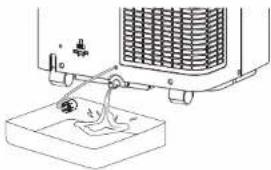
- Before storage, be sure to pull out the water outlet drain underside (#9), and allow the water to drain out in a basin. (fig. 1) Run the unit in fan mode only for a few hours to dry any moisture on the internal cold exchangers to prevent mold.
natural_image
Technical line drawing of a mechanical device with a base and spring, no visible text or symbolsFig.1
- CLEANING & MAINTENANCE
Before cleaning or maintenance, turn the appliance off and always unplug the appliance.
Cleaning: Wipe with a soft dry cloth. Never wash the air conditioner with water. Never use volatile substance such as gasoline or polishing powder to clean the appliance.
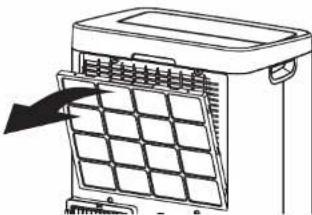
Air filter maintenance: It is necessary to clean the air filter after using it for about 100 hours. Stop the appliance and then pull back the air filter. (fig.2) Use a vaccum cleaner, water or a soft dry cloth to clean the filter, and then reinstall it. Do not use the appliance without the filter.
natural_image
Line drawing of a refrigerator with a grid-patterned panel and an arrow pointing to the front panel (no text or symbols)Fig.2
OPERATING INSTRUCTIONS
The electrical facilities of the room, as well as the installation and use of the appliance must comply with the standards in force in your country.
Before first use, ensure that the voltage, frequency and power of your appliance are suitable for your electrical supply.
Your device must operate with an earthed power socket. It is a class I appliance. Before switching on your appliance, ensure that:
• The appliance is positioned in accordance with the instructions in this manual;
• The air intake and outlet grills are completely unobstructed;
• The appliance is placed on a stable horizontal surface;
- Do not place under a clothesline or any other object likely to cause water to fall in the product.
N.B.: You are advised to unplug the appliance when not in use.

INSTRUCTIONS D'INSTALLATION
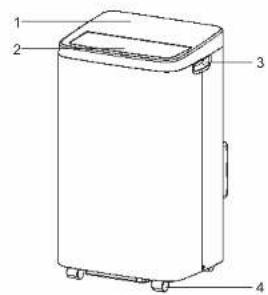
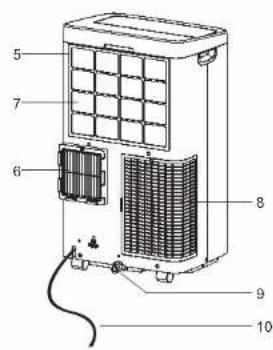
text_image
1 2 3 41/ Control Panel
2/ Air Outlet
3/ Handle
4/ Caster
5/ Air Filter
6/ Air outlet (Heat exchange)
7/ Air intake (Evaporator)
8/ Air intake (Condenser)
9/ Water outlet drain
Note: please ensure if the water outlet drain is
well installed before use
10/ Power supply cord
text_image
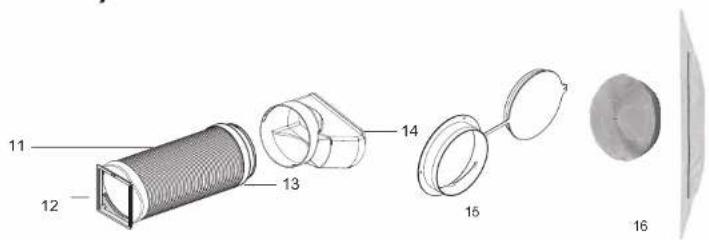
Technical diagram of an air conditioning unit with numbered components for identification- Exhaust hose
12&13. Exhausted connectors
-
Exhaust nozzle
-
Wall flange accessory and cap
-
Window seal kit
text_image
11 12 13 14 15 1616
Installation 1 - mobile installation
1/ Click the exhausted nozzle (#14) to the exhausted connector
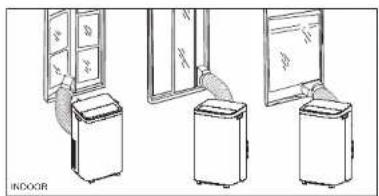
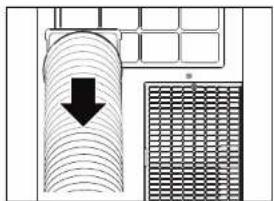
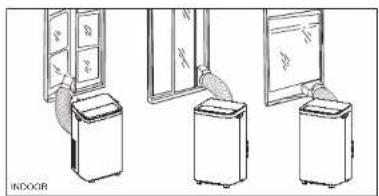
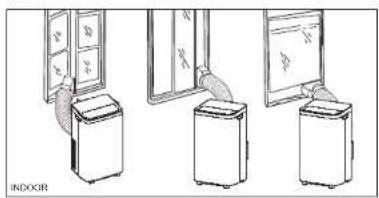
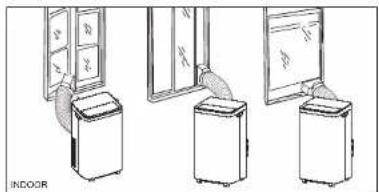
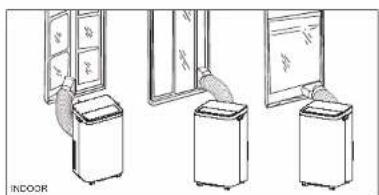
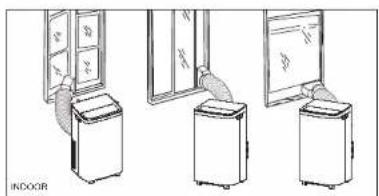
2/ Slide the other exhausted connector (#12) to the air outlet (#6) on the rear of the unit (Fig 3) Extend hose (#11) to desired length and position the exhausted nozzle (#14) through an open window as shown on fig.4.
natural_image
Diagram showing a curved structure with a downward arrow and grid pattern, no text or symbols presentFig. 3
natural_image
Illustration of three kitchen appliances in an indoor setting, showing exterior and interior views (no text or symbols)Fig. 4
Semi-permanently installation
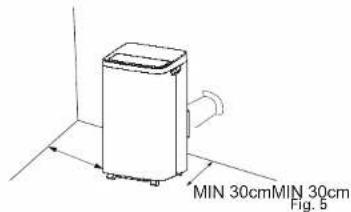
If required, your appliance can also be installed semi permanently (Fig. 5)
Proceed as follows:
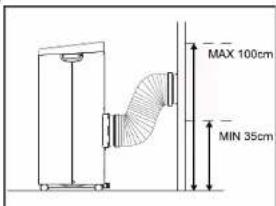
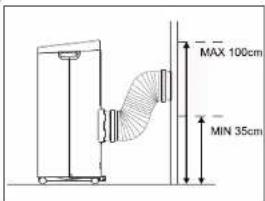
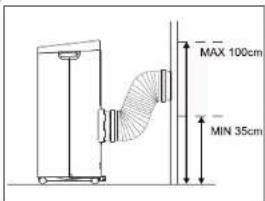
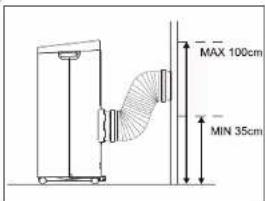
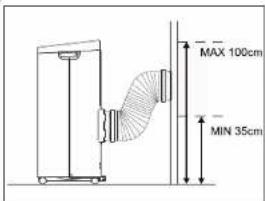
- Drill a hole in an outside wall or through a window pane. Ensure the MIN / MAX dimensions for the hole size and its position are adhered to (Fig.6 and 7).
- Fit the wall flange accessory (#15) provided in the hole.
- Insert another end of the hose assembly to the fixture previously fit on the wall a shown in (Fig. 6) When the hose is not in use, place the cap (#15) on connector to cover the hole on the wall.
NOTE: When installing the air conditioner semi permanently, to maintain the balance of air pressure between indoors and outdoors always leave an internal door slightly open.
text_image
MIN 30cmMIN 30cm Fig. 517


text_image
MAX 100cm MIN 35cm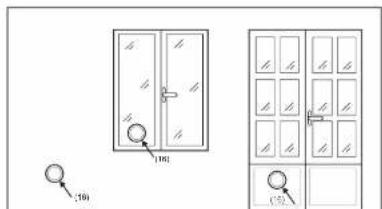
text_image
(10) (2)Fig. 6&7
HOW TO INSTALL THE WINDOW SEAL KIT
The window seal kit is included in the reference AU5610F0/AU5620F0. It can be bought as a Rowenta accessory with reference XD6620F0 (#16). Before installation, check that the adhesive gripping tape do not damage your window.
 | 1. Open the window and clean the surfaces to remove dust and grease on the window frame and casement. Stick the strip to the frame. Do not stick it to the contact surface of the window seal (you must be able to close the window). |
 | 2. Stick the strip to the outside or inside of the window casement (handle side) Ensure that the window can be closed. Before sticking together, make sure the sticky surface does not damage the window frame. |
 | 3. Leave the window open. First stick the wide side of the window form (zip closed) from the center to the right and left hand sides or to the top and bottom to the window frame. |
 | 4. Close the window and make sure that it does not clamp the window form. Stick the narrow side of the window form (zip closed) from the center to the right and left hand sides or to the top and bottom to the casement. |
 | 5. Open the window slightly to have the exhaust hose into the window form by using the zipper. |
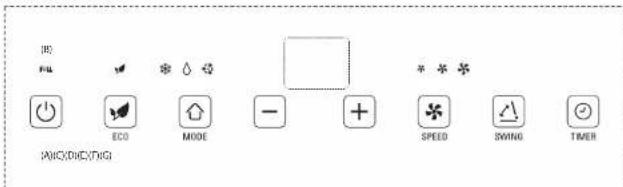
CONTROL PANEL
text_image
(0) FU ECO MODE - + SPEED SWING TIMERPower Control (A)
The power control turns the unit on and off. After switching the air conditioner off, you must wait 3 minutes before switching it back on again.
Warning Light "FULL" (B)
Condensed water may accumulate in the unit.
If the internal tank becomes full, the warning light will come on and the unit will stop operating until the unit has been drained (evacuation #9). To drain the unit, refer to PRECAUTIONS OF USE (storage) page 14.
Eco mode (C)
Operation only in the 2 modes below by pressing the ECO button.
- Cooling mode * : in this mode, the target temperature is automatically set to -3°C from the room temperature to save energy. The speed is set automatically. After 3 seconds, the display will return to the room temperature.
When the target temperature is reached, the compressor stops but the ventilation continues at speed 1 in order to circulate the air in the room
- Fan mode ^1 ; the fan speed is automatically adjusted according to the temperature. Speed 3 if the room temperature is above 28°C. Speed 2 if the room temperature is between 25°C and 28°C. Speed 1 if the room temperature is below 25°C.
Mode Control (D)
The mode control has three settings. A light indicates which mode is currently being used.
- Cooling mode ✦: During the cooling mode the air is cooled and hot air is expelled through the heat exhaust hose (#11). Adjust fan speed and air temperature to suit your desired comfort level. Use the buttons (-) and (+) to set the desired temperature between 16 and 32°C. After 10 seconds the display will revert to room temperature. Note: the air exchange hose must vent outside the room when using cooling mode.
- Dehumidify mode: Air is dehumidified as it passes through the unit, without being in full cooling mode. In this mode, If temperature is higher than 25°C, fan speed can be adjusted; otherwise, fan speed is fixed to "low". In this mode, do not connect the exhaust hose and let the warm air return to the room. You will need to drain the unit to evacuate the water: refer to PRECAUTIONS OF USE (storage) page 14.
- Fan mode: air is circulated throughout the room with no cooling. The air exchange hose does not need to be installed in this mode. Adjust fan speed to suit your desired comfort level.


Fan Speed Control (E)
The fan speed control has three settings: High, Medium and Low.
The choice of speed 1, 2 or 3 (* * *) allows you to adjust the amount of air cooled by the air conditioner while maintaining a similar noise level: +40m3/h between each speed, which is equivalent to an additional «cooling» of the amount of air in a room of about 16m² (room height 2.5m) in 1 hour.
Oscillation (F)
Swing Control: The SWING button moves the grille flap, evenly distributing the air into the room. When the SWING button is pressed, the flap will begin to move forwards and backwards alternatively. If pressed again, the flap will be locked into its current position. When the button is next pressed, the flap will start to move forwards and backwards again.
Note: in order to avoid damaging the internal mechanisms, the flap must not be moved manually. Note: after switching the air conditioner off, you must wait 3 minutes before switching it back.
Timer (G)
Auto turn OFF: with the machine in running mode, press the timer button. Then set the desired working time in hours before shut down by pressing the "+" or "-" buttons.
Auto turn ON: With the machine in OFF mode, press the timer button. Then set the desired time delay ON in hours by pressing the "+" or "-" buttons before the unit automatically starts running in the latest used mode.
The time is adjustable between 1 to 24 hours
Remote control
The remote control uses 2 x AAA or LR03 1.5V batteries which are not included.
To change the remote's battery, remove the cover on the back of the remote controller and insert batteries with the (+) and (-) poles pointing in the proper direction.
Remove the batteries if the remote control is not used for a month or longer.
Remote control operations are identical to the functions on the control panel. Please take care not to scratch or damage the transmitter (LED) located on the end of the remote control as this will impair its proper operation.
TROUBLESHOOTING
| Trouble Analysis | |
| The appliance does not start | - Please wait 3 minutes and start again, protector device may be preventing unit from working.- The plug is not properly plugged. |
| The appliance stops running during operation | - Set temperature is too high.- Air outlets are blocked by obstacles or hose is obstructed.- Air inlets (filter) are blocked by dust. |
| The appliance does not run and water full indicator is lit | - Water needs to be drained : please refer to paragraph “control panel - B”.- Drainage hose is obstructed or twisted. |
| LEDs display “E1” or “E2” - Please refer to a specific Approved Service Centre. | |

SHOULD A PROBLEM ARISE
Never dismantle the appliance yourself because R290 gas requires specific agreement for repairing. A poorly repaired appliance may be dangerous for the user.
Do not use the appliance and contact a specific Approved Service Centre if:
• The appliance has broken.
- Unit or its power cord is damaged,
• If your appliance does not work properly.
You can find a list of specific Approved Service Centres on Rowenta website.
HELP PROTECT THE ENVIRONMENT!

Your appliance contains valuable materials which can be recovered or recycled.
Leave it at a waste collection point or an approved service centre so that it can be disposed of correctly.
Do not throw away the batteries with your household waste: instead, bring them to anyone of the special battery collection points.
These instructions can also be found on our internet site www.rowenta.com
natural_image
Diagram of a mechanical device with a spring and base, showing no text or symbolsAbb. 1
natural_image
Diagram of a refrigerator with a grid panel and directional arrow (no text or symbols)Abb. 2
BEDIENUNGSANLEITUNG
text_image
Technical diagram of an air conditioning unit with numbered components for identification- Abluftschlauch
Installation 1 – mobile Installation
natural_image
Diagram showing a curved structure with a downward arrow and a grid-patterned rectangle, no text or symbols present.Abb. 3
natural_image
Illustration of three kitchen appliances in an indoor setting, showing hand positioning and cleaning steps (no text or symbols)Abb. 4
Halbpermanente Installation
natural_image
Diagram of a mechanical device with a spring and base, showing no text or symbolsFig. 1
- LIMPIEZA Y MANTENIMIENTO
natural_image
Diagram of a refrigerator with airflow direction indicated by arrows (no text or symbols)Fig. 2.
text_image
Technical diagram of an air conditioning unit with numbered components for identification- Tubo de descarga
natural_image
Diagram showing airflow or heat transfer between a curved duct and a grid-patterned structure (no text or symbols)Fig. 3
natural_image
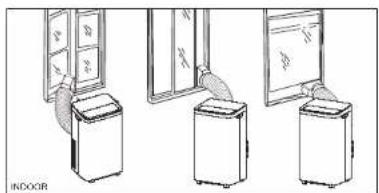
Illustration of three kitchen appliances in an indoor setting, showing exterior and interior views (no text or symbols)Fig. 4
text_image
MIN 30cm MIN 30cm Fig.537
ES
text_image
MAX 100cm MIN 35cm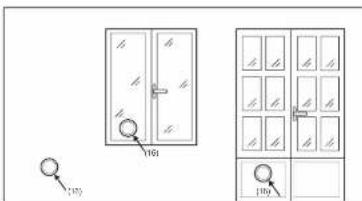
text_image
100 110Fig. 6 y 7
natural_image
Line drawing of a mechanical device with a spring and base plate (no text or symbols)Fig. 1
natural_image
Diagram of a refrigerator with airflow direction indicated by arrows (no text or symbols)Fig. 2.
natural_image
Diagram showing airflow or heat transfer between a curved duct and a grid-patterned structure (no text or symbols)Fig. 3
natural_image
Line drawing of three kitchen appliances in an indoor setting, showing front and side views (no text or symbols)Fig. 4
text_image
MIN 30cm F/MIN 30cm47


text_image
MAX 100cm MIN 35cm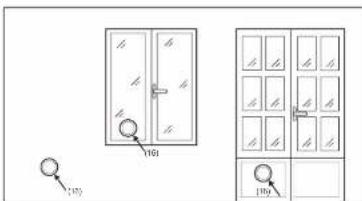
text_image
Diagram showing two door compartments with labeled fixtures and magnified views of the front panel.Fig. 6 y 7
natural_image
Diagram of a mechanical device with a spring and base plate, showing no text or symbolsFig. 1
natural_image
Diagram of a refrigerator with a grid panel and airflow direction arrow (no text or symbols)Fig. 2.
text_image
Technical diagram of an air conditioning unit with numbered components labeled 5 to 10- Tubo di scarico
natural_image
Diagram showing a curved pipe or duct with a downward arrow, next to a grid-patterned structure (no text or symbols)Fig. 3
natural_image
Line drawing of three kitchen appliances in indoor setting, no text or symbols presentFig. 4
text_image
MIN 30cm MIN 30cm57


text_image
MAX 100cm MIN 35cm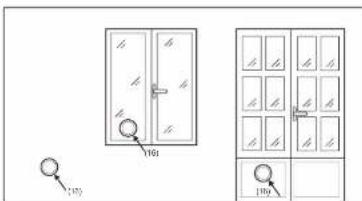
text_image
Technical diagram showing two door frame layouts with labeled fixtures and magnified viewsFig. 6 e 7
natural_image
Diagram of a mechanical device with a spring and base, showing no text or symbolsFig. 1
- REINIGING EN ONDERHOUD
natural_image
Diagram of a refrigerated air conditioner unit with cooling fins and airflow direction arrow (no text or symbols)Fig. 2.
BEDIENINGSINSTRUCTIES
text_image
Technical diagram of an air conditioning unit with numbered components labeled 5 through 10- Uitlaatslang
text_image
Technical diagram of a mechanical component with numbered parts, likely illustrating a cross-section or assembly.66
natural_image
Diagram showing airflow or ventilation through a curved duct and grid-patterned structure (no text or symbols)Fig. 3
natural_image
Illustration of three kitchen appliances in an indoor setting, showing exterior and interior views (no text or symbols)Fig. 4
Semipermanente installatie
text_image
MIN 30cm MIN 30cm Fig.567


text_image
MAX 100cm MIN 35cm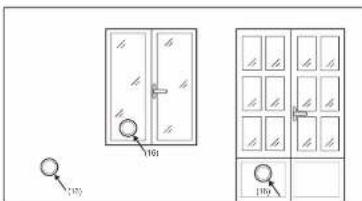
text_image
100 110Fig. 6 & 7