1499511 - Garden hose Toolcraft - Free user manual and instructions
Find the device manual for free 1499511 Toolcraft in PDF.
Questions des utilisateurs sur 1499511 Toolcraft
0 question sur cet appareil. Repondez a celles que vous connaissez ou posez la votre.
Poser une nouvelle question sur cet appareil
Download the instructions for your Garden hose in PDF format for free! Find your manual 1499511 - Toolcraft and take your electronic device back in hand. On this page are published all the documents necessary for the use of your device. 1499511 by Toolcraft.
USER MANUAL 1499511 Toolcraft
Dear customer, Thank you for purchasing this product. This product complies with statutory national and European regulations. For safety reasons, always follow the instructions in this manual. These operating instructions are part of this product. They contain important information on setting up and using the product. Never give the product to a third party without these instructions, and keep them in a safe place for reference. If there are any technical questions, please contact: International: www.conrad.com/contact United Kingdom: www.conrad-electronic.co.uk/contact
2. Explanation of symbols
The symbol with the lightning in the triangle is used if there is a risk to your health, e.g. due to an electric shock. This symbol is used to highlight important information in these operating instructions. Always read this information carefully. This symbol indicates special information and advice on how to use the product. The product must only be installed and used in dry, indoor locations. It must not become damp or wet, as this may result in a fatal electric shock! This symbol reminds you to read the operating instructions included with the product.14
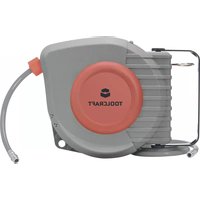
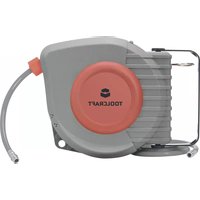
The compressed air hose reel is exclusively intended for use with compressed air. It is not designed for use in areas containing explosive substances. The appliance can be mounted on suitable vertical or horizontal surfaces. It is intended for indoor use only. Do not use it outdoors. Contact with moisture, e.g. in bathrooms, must be avoided under all circumstances. For safety purposes, you must not rebuild and/or modify this product. Using the product for purposes other than those described above may damage the product. In addition, improper use may create safety hazards. Read the instructions carefully and store them in a safe place. Make this product available to third parties only together with its operating instructions. All company and product names are trademarks of their respective owners. All rights reserved.
- Compressed air hose reel
- Operating instructions Up-to-date operating instructions Download the latest operating instructions at www.conrad.com/downloads or scan the QR code on this page. Follow the instructions on the website.
5. Features and functions
- Adjustable hose locking mechanism
- Automatic hose guide
- Rotates up to 180°15
6. Safety information
Read the operating instructions and safety information carefully. If you do not follow the safety instructions and information on proper handling in this manual, we assume no liability for any resulting personal injury or damage to property. Such cases will invalidate the warranty/guarantee. a) General information
- This product is not a toy. Keep it out of the reach of children and pets.
- Do not leave packaging material lying around carelessly, as this may become dangerous playing material for children.
- Protect the product from extreme temperatures, direct sunlight, strong jolts, high humidity, moisture, ammable gases, vapours and solvents.
- Do not place the product under any mechanical stress.
- If it is no longer possible to operate the product safely, stop using it and prevent unauthorized use. Safe operation can no longer be guaranteed if the product: - is visibly damaged, - is no longer working properly, - has been stored for extended periods in poor ambient conditions or - has been subjected to any serious transport-related stress.
- Always handle the product carefully. Jolts, impacts or a fall even from a low height may damage the product.
- Always observe the safety and operating instructions of any other devices which are connected to the product.
- Consult a technician if you are not sure how to use or connect the product.
- Maintenance, modications and repairs must be done by a technician or an authorized repair centre.
- If you have questions which remain unanswered by these operating instructions, contact our technical support service or other technical personnel. b) Persons and product
- Always use appropriate protective equipment (such as protective goggles, ear defenders and protective footwear) when using compressed air devices.
- The product must not be used without such protective equipment. The equipment must not be dismantled or removed.
- Never use tools that are not designed to be connected to the product.
- Never leave the compressed air hose reel unattended, especially when children are in the vicinity.
- Do not use the product until it has been installed properly in accordance with these instructions.
- Never operate the product at a pressure higher than the maximum allowable pressure (see 'Technical data' for details).16
- Ensure that the product is located near to a suitable source of compressed air.
- Health and injury risks can be minimized by observing the safety information in these instructions. The product must be properly serviced and maintained. If possible, the product should always be used by trained personnel. Always follow these operating instructions when using the product.
1 Mounting bracket 2 Compressed air feeder hose 3 Compressed air outlet hose 4 Hose stop ring 5 Hose drum 6 Mounting bolts (top/bottom)
8. Preparation for mounting
Pay attention to the "Safety instructions" section. Follow the instructions below to determine a suitable location to mount the hose reel:
- The compressed air hose reel must not be installed in areas containing explosive substances, e.g. in storage rooms containing solvents.
- Mount the product near to a compressed air device approximately 1 m above the ground. The compressed air feeder hose (2) must be connected to the compressed air source.
- The mounting surface must be able to bear the load of the product.17
- Connect a suitable compressed air source to the compressed air feeder hose (2) using the 1/4" connection. Use a suitable sealing material (e.g. PTFE tape) to seal the threads on the connector to the hose.
- When connecting a compressed air nozzle or other similar device (e.g. spray gun), use a quick connection system with a 1/4" screw connection (not included). Use appropriate sealing material to seal the threads.
Read the information in the "Preparation for mounting" section. Ensure that no existing cables or pipes (including water pipes) are damaged when drilling mounting holes or securing screws. a) Wall or ceiling installation
The compressed air hose reel can be mounted on walls, columns, oors or ceilings using the mounting bracket (1). It can be mounted to a wide variety of surfaces such as brick or concrete walls, steel constructions in workshops, or wooden structures with a sufcient load capacity. When drilling holes, ensure that you do not weaken structural components such as props.
- Ensure that you mark the position of the screw holes correctly.
- To do this, remove the mounting bracket from the hose drum (5). Loosen and remove the mounting bolts with a suitable screwdriver.
- Pull the two short mounting bolts (6) out of the mounting bracket and remove the mounting bracket from the hose drum (5).
- Use the mounting bracket as a drilling template. Place the mounting bracket directly onto the mounting surface, ensuring that it is aligned correctly (use a spirit level). Draw the outlines of the screw holes onto the mounting surface using a pencil, and then mark the centre point of each hole.
- Each screw should touch the top of the keyhole on the mounting bracket, therefore the distance between the top of the keyhole and the centre point should be equal to the radius of the screw.
- Drill the holes with a drill and a suitably sized drill bit. Use carbide drill bits when drilling on mineral surfaces and metal drill bits for metal or wooden surfaces.
- Use dowels when drilling on stone walls. You do not need to use dowels when drilling on wooden surfaces. However, you should still drill holes before inserting the screws. The width of the drilled holes should be smaller than the screw to ensure that the screw does not become loose.
- For metal surfaces, drill clearance holes and use machine screws and nuts. If this is not possible, drill blind holes and cut a thread.
- If dowels are required, insert the dowels into the holes and then insert suitably sized screws to screw the mounting bracket in place. Use a suitable tool (e.g. screwdriver or spanner) to tighten the screws.18
- Use the washers to cover the elongated holes on the mounting bracket. This helps to spread the force from the screws over a sufciently large area.
- The screws, spring washers and nuts required to mount the hose reel are included with the product. Purchase suitable screws (e.g. machine or self-tapping screws) before mounting the product on metal surfaces. Use screws with a sufcient length and a diameter of least 8 mm (M8). For metal surfaces (normally structural steel), use machine screws with a length of approximately 25 mm. When placing screws into clearance holes, ensure that the screw protrudes enough to allow the nut to be screwed onto the thread. If the nut is only screwed to a few threads it may become loose.
- Hang the compressed air hose reel on the mounting bracket and ensure that it clicks into place on the two mounting bolts (6). If necessary, ask someone to help you lift the hose reel.
- Secure the mounting bolts in place by tightening the locking screws with a suitable screwdriver. b) Connecting the compressed air supply
- Once you have mounted the product, connect the compressed air feeder hose (2) to a suitably sized source of compressed air.
- Ensure that there is a shut-off valve so that the supply of compressed air can be turned off when you are not using the product, or when you carry out maintenance work.
- Use a suitable sealing material (e.g. PTFE tape) to seal the threads on the connector to the hose.
a) Unrolling the hose
- Unroll the hose to the desired length and then allow it to move backwards slightly until it clicks into place.
- If it does not click into place, unroll the hose a bit more and try again. Repeat this step until the hose is in the desired position. Do not continue to pull on the hose when it has been fully unrolled, otherwise the hose may come off the hose drum and cause injuries. b) Rolling the hose
- For best results, roll the hose when it is in an unpressurised state.
- Pull the hose slightly until it clicks out of place. Slowly guide the hose onto the hose drum until it is fully rolled. Do not let go of the hose when it is rolling onto the hose drum, otherwise it may spring back quickly and cause injuries or damage to property. Always hold the hose tightly and guide it carefully onto the hose drum.19 c) Changing the hose length Always disconnect the product from the compressed air supply before carrying out any maintenance or repair work.
- You can change the length of the hose using the hose stop ring.
- Carefully loosen the two screws on the hose stop ring (4) using a suitable screwdriver. Pull the hose out of the roll and slide the hose stop ring to the desired pull-out length.
- Tighten both screws again. The hose can only be rolled back as far as the hose stop.
- The product is low-maintenance and only contains a few parts that require maintenance. Repair work must be done by a specialist technician.
- The spring force of the hose reel may drop over time. If this occurs, contact a technician to adjust the spring force. This requires the left half of the hose reel housing to be removed and the spring mechanism to be rotated in a clockwise direction.
- Keep the hose clean to ensure that the product works properly.
- Remove any dirt that accumulates on the connecting parts. Regularly check the valves to ensure that there are no loose connections, leaks, cracks or other signs of damage.
- Check the mounting components from time to time to ensure that there are no loose connections or signs of damage.20
Always disconnect the product from the compressed air supply before carrying out any maintenance or repair work. Fault Possible cause Solution The hose does not wind back onto the drum fully.
- The hose was rolled too quickly.
- The hose was not rolled evenly.
- The spring force is too low.
- The replacement hose is too heavy.
- The hose stop ring (4) was adjusted.
- Roll the hose slowly.
- Roll the hose evenly.
- Increase the spring force or insert a new spring.
- Use a replacement hose with a suitable weight.
- Move the hose stop to the correct position. The hose doesn't click into place.
- The hose reel was not installed correctly.
- The hose was released too quickly.
- The locking mechanism may be faulty.
- See section 9 ("Installation") to check that the product was mounted correctly.
- Hold the hose in your hand and slowly guide it back onto the hose drum.
- Replace the locking mechanism. Air escapes from an unsealed part.
- The hose is damaged.
- The seal on the hose drum may be worn.
- The hose clamp is not properly secured.
- Replace the hose clamp or secure it in place.
- Contact a technician to replace the seal on the hose drum.
13. Care and cleaning
Never use aggressive detergents, rubbing alcohol or other chemical solutions, as these could damage the housing or even impair the functioning of the product.
- Only use mild detergents to clean the compressed air hose.
- Use a dry, lint-free cloth to clean the frames and hose drum.21
At the end of its service life, dispose of the product according to the relevant statutory regulations. You thus full your statutory obligations and contribute to the protection of the environment.
- De veerspanning is te gering.
EasyManual