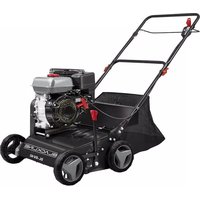
BL-BV 40 - Lawn mower BlackLine - Free user manual and instructions
Find the device manual for free BL-BV 40 BlackLine in PDF.


| Product Type | Gasoline scarifier (lawn mower) |
| Brand | BlackLine |
| Model | BL-BV 40 |
| Engine Type | 4-stroke, single cylinder |
| Displacement | 118 cc |
| Max. Power | 2.2 kW / 3 HP |
| Working Speed | 3600 rpm |
| Fuel | Unleaded gasoline |
| Tank Capacity | Approximately 2.5 L |
| Engine Oil | Approximately 0.4 L |
| Spark Plug | LG F6TC |
| Number of Blades | 18 |
| Blade Diameter | 163 mm |
| Depth Adjustment | -15 to +5 mm |
| Working Width | 400 mm |
| Sound Pressure Level (LpA) | 85.4 dB(A) |
| Sound Power Level (LWA) | 98 dB(A) |
| Vibration (ahw) | 6.74 m/s² |
| Weight | 31 kg |
| Power Source | Unleaded gasoline |
| Main Functions | Lawn scarification, aeration and removal of moss and weeds |
| Maintenance and Cleaning | Clean after each use, annual oil change, check air filter every 50 hours |
| Safety | Engine brake, engine stops if lever is released, protection against blade contact |
| Spare parts and repairability | Wear parts: spark plug, air filter, belt, blade. Repairs by authorized service center. |
| General Information | Intended use: scarification of lawn surfaces. Not suitable for professional use. |
Frequently Asked Questions - BL-BV 40 BlackLine
User questions about BL-BV 40 BlackLine
0 question about this device. Answer the ones you know or ask your own.
Ask a new question about this device
Download the instructions for your Lawn mower in PDF format for free! Find your manual BL-BV 40 - BlackLine and take your electronic device back in hand. On this page are published all the documents necessary for the use of your device. BL-BV 40 by BlackLine.
USER MANUAL BL-BV 40 BlackLine
natural_image
Exterior view of a lawn mower with visible blades and wheels (no text or symbols)
BL-BV 40
Art-Nr: 6424810
GB Translation of the original instructions
Petrol scarifier
-2-
natural_image
Close-up of two black cable wires with connectors and a labeled connection point '11' (no text or symbols beyond label)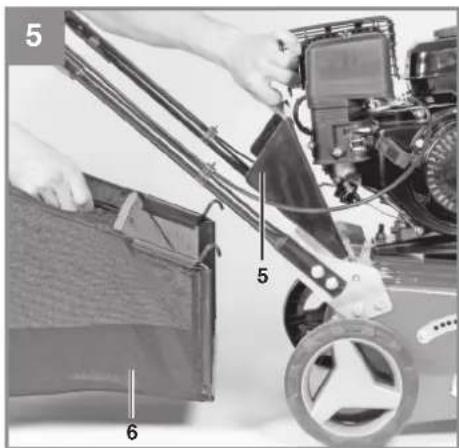
natural_image
Mechanical assembly diagram showing a motor with labeled parts and directional arrows (no readable text or symbols)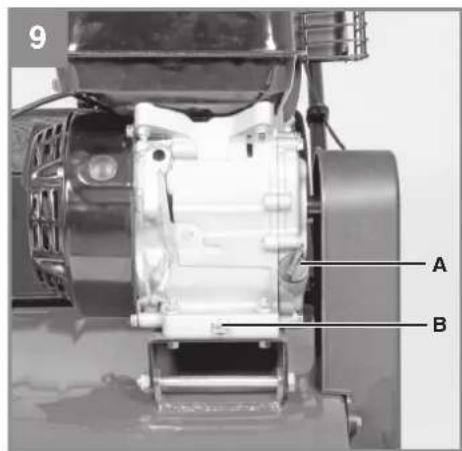
natural_image
Close-up of a motorcycle front panel with a mounted box and rack, showing no visible text or symbols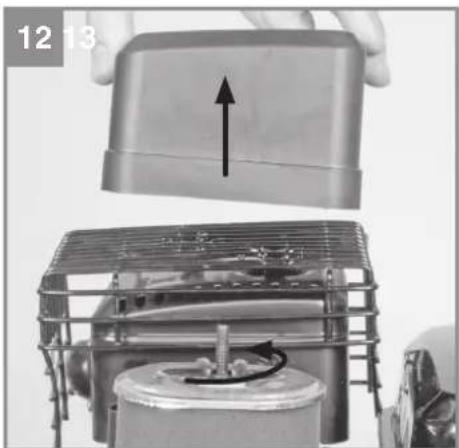
natural_image
Close-up of a mechanical device with an upward arrow indicating motion, showing internal components and assembly (no text or symbols visible)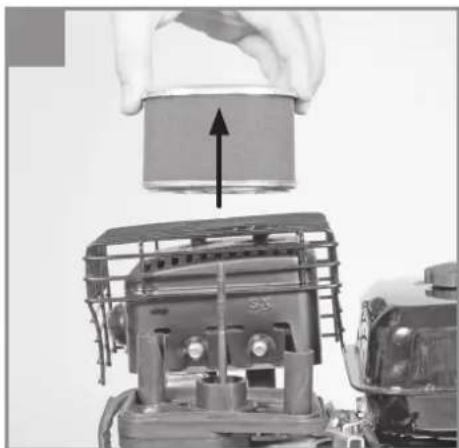
natural_image
Close-up of a robotic device with a hand holding a cylindrical component and an arrow pointing upward (no visible text or symbols)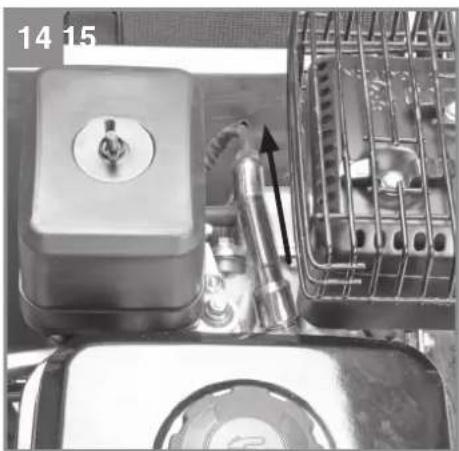
natural_image
Close-up of a mechanical device with a mounted sensor and fan, no visible text or symbols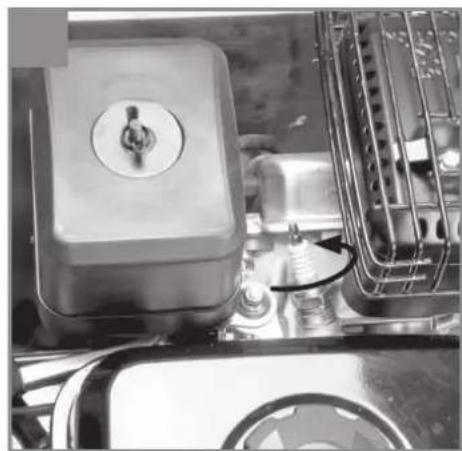
natural_image
Close-up of a gas stove burner with a mounted knob and cooling unit (no visible text or symbols)16
8
D
Inhaltsverzeichnis
- Safety regulations
- Layout and items supplied
- Proper use
- Technical data
- Before starting the equipment
- Operation
- Cleaning, maintenance, storage, transport and ordering of spare parts
- Cleaning, maintenance and ordering of spare parts
- Troubleshooting guide
- EC Declaration of Conformity
GB
Danger!
When using the equipment, a few safety precautions must be observed to avoid injuries and damage. Please read the complete operating instructions and safety regulations with due care. Keep this manual in a safe place, so that the information is available at all times. If you give the equipment to any other person, hand over these operating instructions and safety regulations as well. We cannot accept any liability for damage or accidents which arise due to a failure to follow these instructions and the safety instructions.
1. Safety regulations
The corresponding safety information can be found in the enclosed booklet.
Danger!
Read all safety regulations and instructions.
Any errors made in following the safety regulations and instructions may result in an electric shock, fire and/or serious injury.
Keep all safety regulations and instructions in a safe place for future use.
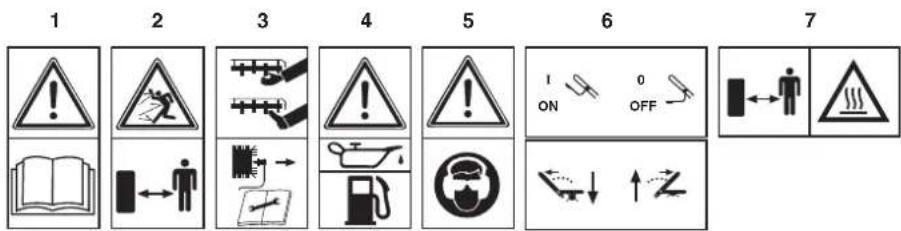
Explanation of the warning signs on the equipment (Fig. 16)
- Important. Read the instructions before using for the first time.
- Keep other persons (and animals) away from the danger zone.
- Sharp tools – do not cut your fingers or toes – remove the spark plug before starting any maintenance work.
- Fill with oil and fuel before starting
- Wear goggles and ear muff s.
- Engine start / Engine stop lever (I = Engine On / 0 = Engine Off)
- Important. Hot parts.
- Scarifi er roller depth adjustment
2. Layout and items supplied
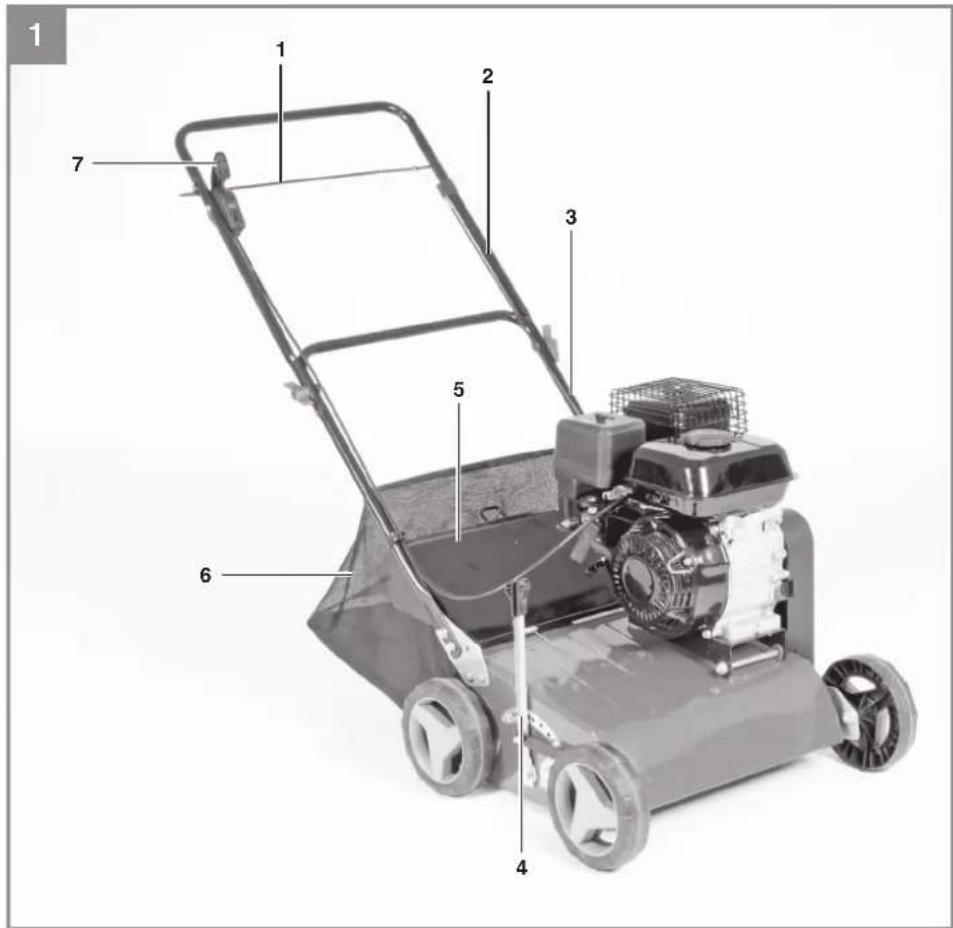
2.1 Layout (Fig. 1/2)
- Engine start/stop lever – engine brake
- Top push bar
- Bottom push bar
- Scarifying depth
- Ejector fl ap
- Grass basket
-
Throttle lever
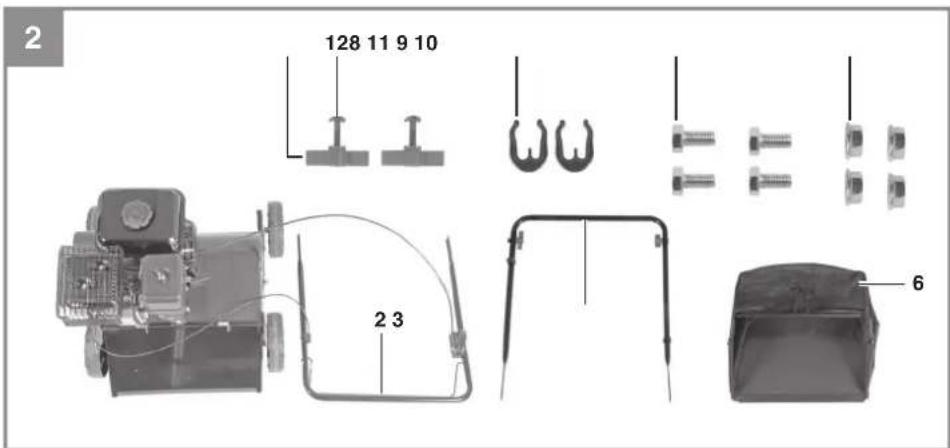
-
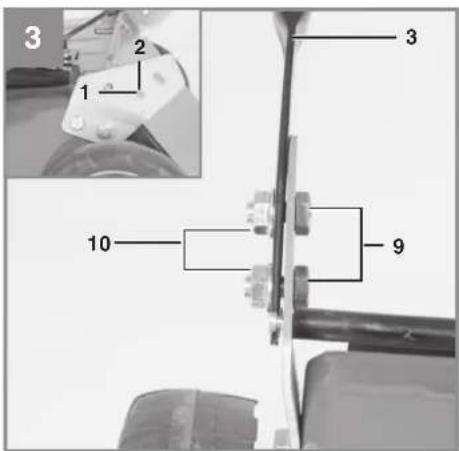
2 fastening nuts for top push bar
- 4 fastening screws for bottom push bar
- 4 fastening nuts for bottom push bar
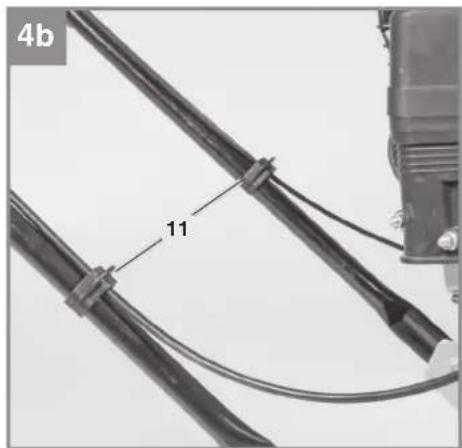
- 2 cable securing clips
- 2 fastening screws for top push bar
2.2 Items supplied
Please check that the article is complete as specified in the scope of delivery. If parts are missing, please contact our service center or the sales outlet where you made your purchase at the latest within 5 working days after purchasing the product and upon presentation of a valid bill of purchase. Also, refer to the warranty table in the service information at the end of the operating instructions.
- Open the packaging and take out the equipment with care.
- Remove the packaging material and any packaging and/or transportation braces (if available).
• Check to see if all items are supplied. - Inspect the equipment and accessories for transport damage.
- If possible, please keep the packaging until the end of the guarantee period.
Danger!
The equipment and packaging material are not toys. Do not let children play with plastic bags, foils or small parts. There is a danger of swallowing or suffocating!
• Original operating instructions
- Safetyinstructions
3. Proper use
The equipment is designed for scarifying lawned areas. The scarifying process is designed for ripping moss and weeds - complete with their roots - out of the soil and for loosening the soil. As a result your lawn can absorb nutrients better and is cleaned. We recommend you to scarify your lawn in the spring (April) and autumn (October).
GB
Important! Due to the high risk of bodily injury to the user, the equipment may not be used to grind up branch or hedge clippings. Moreover, the equipment may not be used as a power cultivator to level out high areas such as mole hills. For safety reasons, the equipment may not be used as a drive unit for other work tools or tool sets of any kind.
The equipment is to be used only for its prescribed purpose. Any other use is deemed to be a case of misuse. The user / operator and not the manufacturer will be liable for any damage or injuries of any kind caused as a result of this.
Please note that our equipment has not been designed for use in commercial, trade or industrial applications. Our warranty will be voided if the machine is used in commercial, trade or industrial businesses or for equivalent purposes.
4. Technical data
Engine type: 1 cylinder, 4-stroke
Displacement 118 cc
Max. engine output ......2.2 kW / 3 hp
Working speed 3,600 rpm
Fuel: Unleaded petrol
Tank capacity: .... approx. 2.5 l
Engine oil: .... approx. 0.4 l
Spark plug: ....LG F6TC
Blades (number) 18
Blade diameter 163 mm
Depth setting -15 - +5 mm
Working width: 400 mm
LpA sound pressure level 85,4 dB(A), K = 2dB (A)
LWA sound power level 98 dB(A)
Vibration ahw 6,74 m/s², K = 1,5 m/s²
Weight: 31 kg
5. Before starting the equipment
The equipment is delivered unassembled. The grass basket and the complete push bar must be assembled and mounted before using the equipment. Follow the operating instructions step-by-step and use the pictures provided as a visual guide to easily assemble the equipment.
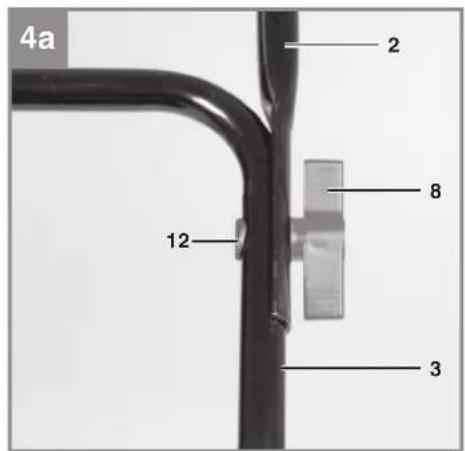
Fitting the top push bar holder (Fig. 4a)
Position the upper push bar (Fig. 4a / Item 2) such that its holes line up with the holes of the lower bar. Screw the tubes together, using the screws (Fig. 4a / Item 12) and nuts (Fig. 4a / Item 8) supplied. Use the supplied cable clips (Fig. 4b / Item 11) to secure the throttle cable and the engine Start / Stop cable to the lower push bar.
Fitting the debris box (Fig. 5)
Lift the ejector flap (Fig. 5 / Item 5) with one hand and attach the debris box (Fig. 5/Item 6) to the handle from above using your other hand.
Important: Before you attach the debris box you must ensure that the engine is switched off and the roller is not rotating.
6. Operation
Important!
The engine does not come with oil in it. Therefore, be sure to add oil before starting the engine. The oil level in the engine must be checked each time before carrying out any work.
Starting the equipment (Fig. 6 - 7)
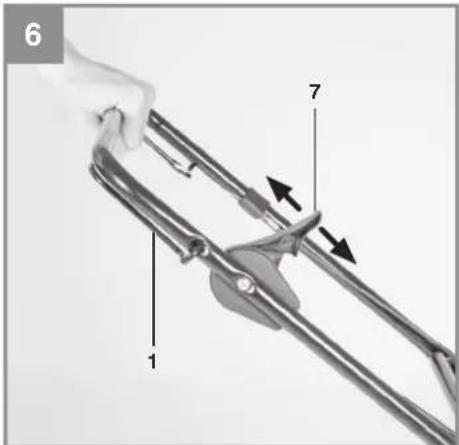
In order to avoid any unintentional start-ups of the engine, it comes equipped with an engine brake (Fig. 6/Item 1) which must be pressed at all times whilst the device is in use, otherwise the engine will stop.
Important: When the engine brake lever is released it must return to its initial position and the engine must stop. If this is not the case, do not use the equipment again.
GB
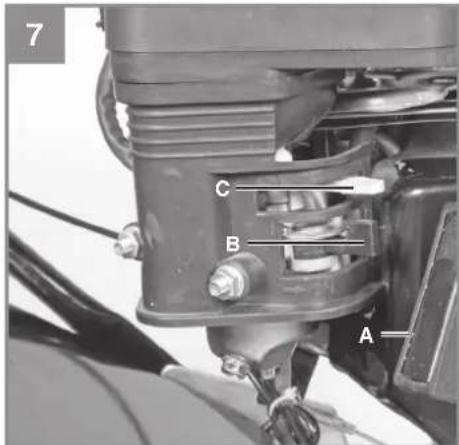
- Open the petrol cock (Fig. 7 / Item B). Set the cock to "ON" for this purpose.
- Set the choke lever (Fig. 7/Item C) to the "Choke" position.
Note: Normally the choke is not required to restart a warm engine.
- Move the throttle lever (Fig. 1 / Item 7) to the center position.
- Press the engine brake lever (Fig. 6 / Item 1) and pull the starter cable (Fig. 7 / Item A) forcefully until the engine starts.
- Allow the engine to warm up briefly and then set the choke lever (Fig. 7 / Item B) to the "RUN" Position.
- The speed of the cutter unit can be controlled using the throttle lever (Fig. 6 / Item 7) (tortoise = slow / rabbit = fast).
Important: Always pull the starter cable slowly until you feel the initial resistance before you then pull it quickly to start the engine. Do not allow the starter cable to whip back of its own accord.
Important: The scarifier roller begins to rotate as soon as the engine is started.
Important! Never open the ejector flap when the motor is running. A rotating cutting unit can cause injuries.
Always fasten the ejector flap carefully. The flap flips back to the "Closed" position by the tension springs!
Always ensure that a safe distance (provided by the long handles) is maintained between the user and the housing. Be especially careful when scarifying and changing direction on slopes and inclines. Maintain a solid footing and wear sturdy, non-slip footwear and long trousers. Always scarify along the incline (not up and down).
For safety reasons, the scarifi er may not be used to scarify inclines whose gradient exceeds 15 degrees.
Use special caution when backing up and pulling the scarifier (tripping hazard)!
Adjusting the working depth (Fig. 8)
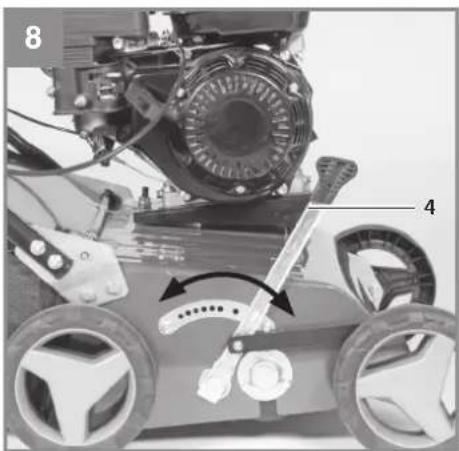
To set the working depth, push the lever for setting the depth (Fig. 8 / Item 4) gently away from the device, set the required depth and then lock the lever back into position.
Important. For transport move the lever for setting the depth to the highest position.
Tips for proper working
It is recommended that you overlap scarifying paths a little. Try to scarify in straight lines for a nice, clean look. Insodoing, the aeration swaths should always overlap each other by a few centimeters in order to avoid bare strips.
As soon as grass clippings start to trail the scarifier, it is time to empty the grass basket.
Important! Before taking off the grass basket, switch off the motor and wait until the roller has come to a stop.
To remove the grass basket, lift up the ejector flap with one hand, while unhooking the basket with the other.
How frequently you should scarify your lawn is determined primarily by the speed at which the grass grows and the hardness of the soil. Keep the underside of the equipment clean and remove soil and grass build-up. Deposits make it more difficult to start the aerator and decrease the quality of the scarifying.
Always scarify along inclines (not up and down). Switch off the motor before doing any checks on the roller.
Important!
The roller rotates for a few seconds after the motor is switched off. Never attempt to stop the roller. In the event that the rotating roller strikes an object, immediately switch off the equipment and wait for the roller to come to a complete stop. Then inspect the condition of the roller. Replace any parts that are damaged.
7. Cleaning, maintenance, storage, transport and ordering of spare parts
Important:
Never work on or touch conducting parts on the ignition unit with the engine running. Always pull the spark plug boot from the spark plug before starting any work of care or maintenance. Never perform any work on the machine while it is running. Any work not described in these Operating Instructions must be performed by an authorized service workshop only.
GB
7.1 Cleaning
The scarifi er should be cleaned thoroughly every time after it has been used. This particularly applies to its underside and the blades. To do so tip the scarifi er slightly on to its side and remove the dirt.
Important. Before you tip the equipment, the petrol tank must be emptied to prevent petrol leaking out. Ideally you should use a conventional petrol extraction pump for this purpose.
7.2 Servicing
Checking the oil level
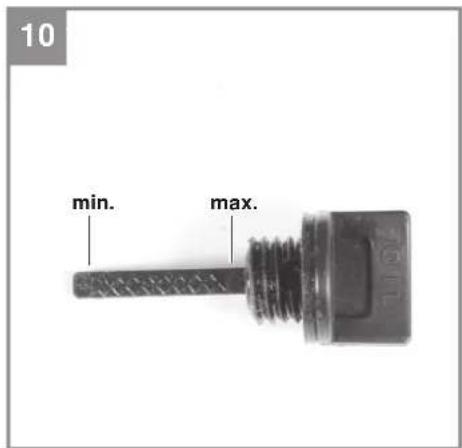
Set the equipment down on a flat, level surface. Unscrew the oil dipstick by turning it anti-clockwise. The oil level must be as shown in Figure 10.
Important: Never run the engine with no or too little oil. This can cause serious damage to the engine.
Changing the oil
- Change the engine oil every year before the start of the season (in addition to the information in the petrol service manual) when the engine is warm.
• Use only recommended engine oil. - Place a suitable oil drip tray beneath the oil drain screw.
- Remove the oil filler screw (Fig. 9 / Item A).
- Undo the oil drain screw (Fig. 9 / Item B) and drain the oil into a suitable container.
- Close the drain screw again when all the used oil has been drained.
- Pour engine oil into the equipment as shown in Figure 10.
- Dispose of the used oil in accordance with applicable regulations.
Care and adjustment of the cables
Oil the cables at regular intervals and check that they move easily.
Servicing the air fi Iter
Soiled air filters reduce the engine output by supply too little air to the carburetor.
Regular checks are therefore essential. The air fi liter should be checked after every 50 hours of use and cleaned if necessary. If the air contains a lot of dust, the air fi liter should be checked more frequently.
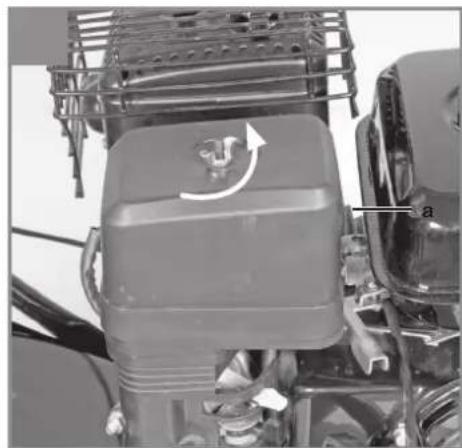
- Remove the air filter as shown in Fig. 11-13.
- Clean the air filter only with compressed air or by tapping it.
• Assemble in reverse order
Important: Never clean the air filter with petrol or infl ammable solvents.
Servicing/Replacing the spark plug
Check the spark plug for dirt and grime after 10 hours of operation and if necessary clean it with a copper wire brush. Thereafter service the spark plug after every 50 hours of operation.
• Pull off the spark plug boot (Fig. 14) with a twist.
- Remove the spark plug using a spark plug wrench (Fig. 15).
• Assemble in reverse order.
7.3 Preparing the equipment for storage
Caution: Do not empty the petrol tank in enclosed areas, near fi re or when smoking. Petrol fumes can cause explosions and fi re.
- Empty the petrol tank with a petrol suction pump.
- Start the engine and let it run until any remaining petrol has been used up.
- Change the oil at the end of every season. To do so, remove the used engine oil from a warm engine and refi ll with fresh oil.
- Remove the spark plug from the cylinder head. Fill the cylinder with approx. 20 ml of oil from an oil can. Slowly pull back the starter handle, which will bathe the cylinder wall with oil. Screw the spark plug back in.
- Clean the cooling fins of the cylinder and the housing.
- Be sure to clean the entire machine to protect the paint.
- Store the machine in a well-ventilated place.
7.4 Preparing the device for transport
- Drain the petrol tank using a petrol extraction pump.
- Always let the engine run until it has used up the remainder of petrol in the tank.
- Empty the engine oil from the warm engine.
- Remove the spark plug boot from the spark plug.
- Clean the cooling fins of the cylinder and the housing.
- Remove the push bars if necessary. Ensure that the cables are not kinked.
GB
7.5 Ordering replacement parts
Please quote the following data when ordering replacement parts:
• Type of machine
• Article number of the machine
• Identification number of the machine
• Replacement part number of the part required
Current prices and information are available on request at your Hornbach store.
8. Cleaning, maintenance and ordering of spare parts
The unit is supplied in packaging to prevent its being damaged in transit. This packaging is raw material and can therefore be reused or can be returned to the raw material system.
The unit and its accessories are made of various types of material, such as metal and plastic. Defective components must be disposed of as special waste. Ask your dealer or your local council.
GB
9. Troubleshooting guide
| Fault Possible causes Remedy | ||
| The motor does not start | - Engine brake lever not pressed- Spark plug defective- Fuel tank empty- Petrol cock closed | - Press the engine brake lever- Replace spark plug- Top up fuel- Open petrol cock |
| Engine does not run smoothly | -Airfi lter dirty- Spark plug worn- Choke open | - Clean the air fi lter- Clean/Replace the spark plug- Set choke lever to “Run” position |
| Theequipment does not operate smoothly and vibrates intensively | - Blades imbalanced - Have the blades replaced by a customer service workshop. | |
| Motorisrunning, roller is not rotating | - V-belt torn - Have the V-belt replaced by a customer service workshop. | |
The reprinting or reproduction by any other means, in whole or in part, of documentation and papers accompanying products is permitted only with the express consent of the iSC GmbH.
Subject to technical changes
GB
10. EC Declaration of Conformity
Declaration of Conformity

declare, that the product described
in Technical Data :

Petrol scarifier BL-BV 40
Manufactured for:
Hornbach Baumarkt AG
Hornbachstraße 11
76879 Bornheim / Germany
is in conformity with the following directives:
Machinery Directive 2006/42/EC
EMC Directive 2014/30/EU
Emissions Directive 2012/46/EU
Emissions No.: e24*97/68SA*2012/46*0188*01 (II)
Directive relating to the noise emission in the environment by equipment for use outdoors 2000/14/EC
(amended by Directive 2005/88 (EC)
and in accordance to the following applicable harmonized standards:
EN ISO 13684:2004+A3
EN ISO 14982-1:2009
The conformity with the Noise Emission of Outdoor Equipment Directive is verified by the adherence to the following emissions values:
Measured sound power level: 96,1 dB (A)
Guaranteed sound power level: 98 dB (A)

Andrew Jack
Andreas Back
Head of Quality Management &
Person authorised to compile the technical file
We have competent service partners in all countries named on the guarantee certificate whose contact details can also be found on the guarantee certificate. These partners will help you with all service requests such as repairs, spare and wearing part orders or the purchase of consumables.
Please note that the following parts of this product are subject to normal or natural wear and that the following parts are therefore also required for use as consumables.
| Category Example | |
| Wear parts* | Spark plug, air filter, V-belt, petrol filter, blade (roller) |
| Consumables* | |
| Missing parts |
* Not necessarily included in the scope of delivery!
In the effect of defects or faults, please register the problem on the internet at www.isc-gmbh.info. Please ensure that you provide a precise description of the problem and answer the following questions in all cases:
- Did the equipment work at all or was it defective from the beginning?
• Did you notice anything (symptom or defect) prior to the failure?
• What malfunction does the equipment have in your opinion (main symptom)?
Describe this malfunction.
EH 11/2017 (01)