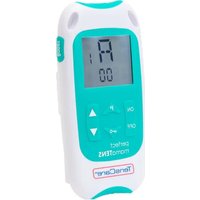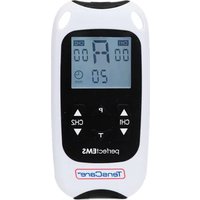
Perfect EMS - Electronic muscle stimulator TensCare - Free user manual and instructions
Find the device manual for free Perfect EMS TensCare in PDF.



| Product Type | EMS and TENS Electronic Muscle Stimulator |
| Dimensions | 120 x 60 x 20 mm |
| Weight | 75 g (without batteries) |
| Power Supply | 2 AA alkaline batteries 1.5 V |
| Channels | Dual channel (2 independent outputs) |
| Number of Electrodes Included | 4 self-adhesive electrodes 50x50 mm |
| Preset Programs | 6 EMS programs (Warm-up, Endurance, Power, Volume, etc.) |
| Manual Programs | 2 EMS (G, H) and 2 TENS (S, T) |
| EMS Frequency Range | 1 to 80 Hz |
| TENS Frequency Range | 1 to 120 Hz |
| Pulse Width (EMS) | 50 to 350 µs |
| Pulse Width (TENS) | 50 to 250 µs |
| Maximum Intensity | 90 mA (90 levels) |
| Treatment Duration | 10, 20, 30, 45, 60, 90 minutes or continuous |
| Special Functions | Keyboard lock, open circuit detection, memory (program, number of uses, time) |
| Display | LCD screen with backlight |
| Included Accessories | 2 cables, 4 electrodes, 2 AA batteries, belt clip, storage pouch, manual |
| Care and Cleaning | Wipe with a damp cloth and mild soap; do not immerse |
| Protection Rating | IP22 (protected against finger access and dripping water when tilted up to 15°) |
| Safety Classification | Class IIa medical device, type BF applied part |
| Warranty (Device) | 2 years (excluding batteries, cables, and electrodes) |
| Battery Life | Approximately 15 to 18 hours of continuous use |
| Operating Temperature | 5 °C to 40 °C |
| Operating Humidity | 15% to 93% RH non-condensing |
Frequently Asked Questions - Perfect EMS TensCare
User questions about Perfect EMS TensCare
0 question about this device. Answer the ones you know or ask your own.
Ask a new question about this device
Download the instructions for your Electronic muscle stimulator in PDF format for free! Find your manual Perfect EMS - TensCare and take your electronic device back in hand. On this page are published all the documents necessary for the use of your device. Perfect EMS by TensCare.
USER MANUAL Perfect EMS TensCare
natural_image
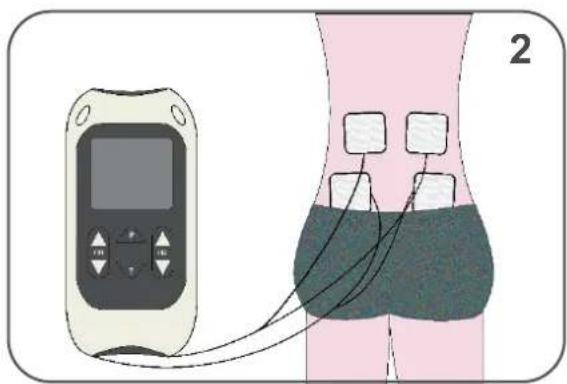
Illustration of a handheld electronic device connected to four labeled square sensors (no text or symbols on the device itself)Connect the unit with the electrode pads Verbinden Sie das Gerät mit den Elektroden Connectez l'appareil aux électrodes Conecte el dispositivo a los parches
text_image
Diagram showing a blood glucose meter connected to a human leg with four electrodes inserted, labeled with number 2.text_image
4 Button P 20 G11 G92 TThank you for choosing perfect EMS. TensCare stands for high-quality, thoroughly tested products for the applications in the areas of gentle electrotherapy, muscle toning, continence management and pain relief during labour.
Please read these instructions for use carefully and keep them for later use, be sure to make them accessible to other users and observe the information they contain.
Best regards,
Your TensCare Team

CONTENTS
- INTRODUCTION 5
- INTENDED USE 5
- PERFECT EMS FEATURES .... 5
- HOW 'EMS' WORKS 6
- HOW 'TENS' WORKS 7
- CONTRAINDICATIONS, WARNINGS & CAUTIONS 8
- INFORMATION ABOUT THE PROGRAMME SETTINGS .... 11
- PROGRAMMES 12
8.1. PROGRAMME SETTINGS 12
8.2. PRESET PROGRAMMES.... 13
8.3. MANUAL PROGRAMMES....14
8.4. USING THE PROGRAMMES 15
- ELECTRODE PADS 16
9.1. PAD POSITIONING 16
9.2. PAD ADVICE 17
9.3. EMS ELECTRODE PLACEMENT....19
- CONTENT 21
- UNIT INFORMATION....22
11.1. CONTROLS & DISPLAY 22
11.2. OPERATING INSTRUCTIONS....23
- SETTING UP AND USING THE PERFECT EMS 25
12.1. INSTALLATION OF BATTERIES....25
12.2. CONNECTING LEAD WIRES.... 26
12.3. PREPARING FOR SESSION 26
12.4. TRAINING SESSION.... 26
12.5. AFTER YOUR TRAINING SESSION....27
- CLEANING & STORAGE 27
-
EMC 27
-
DISPOSAL OF WASTE ELECTRICAL AND ELECTRONIC PRODUCTS (WEEE) 28
-
ACCESSORIES 28
- WARRANTY 28
- TROUBLESHOOTING 30
- GENERAL SPECIFICATION....31
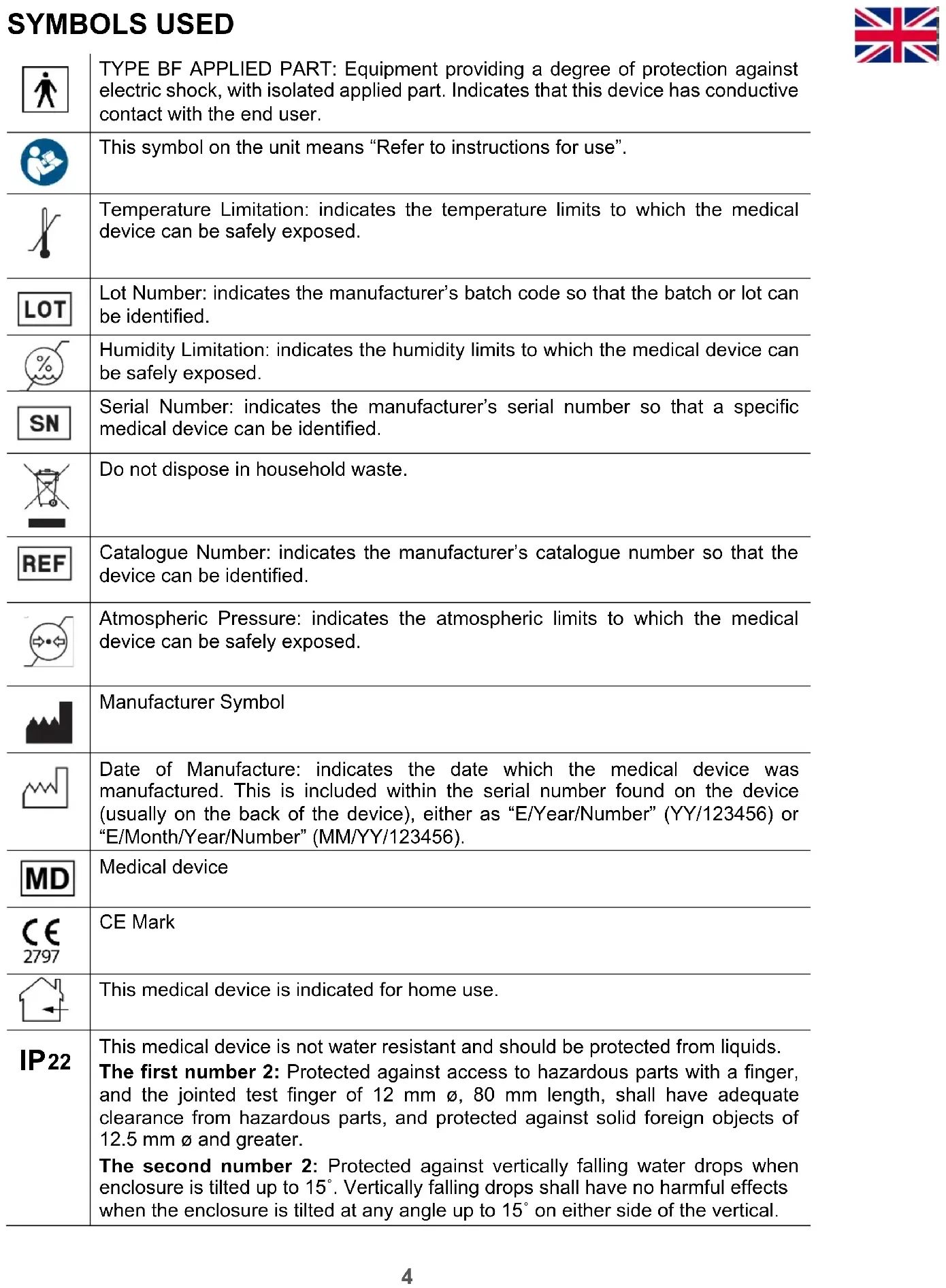
SYMBOLS USED
 | TYPE BF APPLIED PART: Equipment providing a degree of protection against electric shock, with isolated applied part. Indicates that this device has conductive contact with the end user. |
 | This symbol on the unit means “Refer to instructions for use”. |
 | Temperature Limitation: indicates the temperature limits to which the medical device can be safely exposed. |
 | Lot Number: indicates the manufacturer's batch code so that the batch or lot can be identified. |
 | Humidity Limitation: indicates the humidity limits to which the medical device can be safely exposed. |
 | Serial Number: indicates the manufacturer's serial number so that a specific medical device can be identified. |
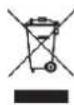 | Do not dispose in household waste. |
 | Catalogue Number: indicates the manufacturer's catalogue number so that the device can be identified. |
| [WAS6] | Atmospheric Pressure: indicates the atmospheric limits to which the medical device can be safely exposed. |
 | Manufacturer Symbol |
 | Date of Manufacture: indicates the date which the medical device was manufactured. This is included within the serial number found on the device (usually on the back of the device), either as “E/Year/Number” (YY/123456) or “E/Month/Year/Number” (MM/YY/123456). |
 | Medical device |
 | CE Mark |
 | This medical device is indicated for home use. |
 | This medical device is not water resistant and should be protected from liquids.The first number 2: Protected against access to hazardous parts with a finger, and the jointed test finger of 12 mm ø, 80 mm length, shall have adequate clearance from hazardous parts, and protected against solid foreign objects of 12.5 mm ø and greater.The second number 2: Protected against vertically falling water drops when enclosure is tilted up to 15°. Vertically falling drops shall have no harmful effects when the enclosure is tilted at any angle up to 15° on either side of the vertical. |
1. INTRODUCTION
Device Description & Principles of Design
The perfect EMS unit provides muscle toning, shaping and rehabilitation through EMS, with additional pain relief programmes using TENS to relieve pain from injuries and muscle strain.
It sends a small and gentle stimulation (similar to your natural nerve impulses) to the muscles being treated via two or four auto-adhesive electrode pads, in order to help you to firm and tone your body.
Muscle wastage: neuromuscular facilitation, muscle re-education, muscle training, prevention/slowing of atrophy/hypotrophy and reduction of spasticity.
Sports training: warm up, strength, speed, power, resistance, endurance and recovery.
2. INTENDED USE
Perfect EMS is a medical device designed to be used in the home healthcare environment to improve muscle tone and bulk, as well as provide symptomatic relief and management of acute or chronic localised pain and muscle pain. It is suitable for use by all who can control the device and understand the instructions.
Do not use the device for any purpose other than this intended use.

Warning: Not suitable for use in children without medical supervision.
3. PERFECT EMS FEATURES
- Dual Channel
Two independent channels with four electrode pads to treat two areas at the same time.
• Comfortable Stimulation
Gentle stimulation with 90 small steps of intensity provides fine yet powerful performance.
- 6 Preset Programmes
Including Warm Up, Endurance, Power and Bulk.
- Manual TENS and EMS Programmes
Enables the user to easily adjust and save settings to suit personal needs.
- Treatment Timer
Enables the user to set the session duration (between 10-90 mins) and select manual parameters.
- Memory
Features 3 functions: programme retention (automatically starts in the last programme used), number of uses and time of usage.
- Open Circuit Detection
Automatically resets the strength to zero if the electrode pads are not correctly applied.
• Automatic Keypad Lock
Automatic keypad locking prevents any accidental changes in settings.
- Detachable Belt Clip
Enables the user to clip the unit onto a belt.
- Large LCD Screen
Clearly shows the operation of the unit and the parameters being used.

Note: The electrode pads need to be applied directly to the skin before the intensity increase buttons will operate. If the perfect EMS detects the unit is not properly connected to you (for example if the electrode pads or leads come loose) then the unit switches the intensity to zero. This safety feature prevents any unpleasant changes in output.
4. HOW 'EMS' WORKS
E.M.S. stands for Electrical Muscle Stimulation and has successfully been used in medical rehabilitation and training in competitive sports. EMS produces intensive and effective muscular contraction.
EMS is a complement to other physical therapy and should always be combined with active mobility, strength, coordination and functional training.
In training, the technology for electrotherapy is used for all kinds of muscular exercise - warm-up, strength, speed, power, resistance, endurance, recovery and also for rehabilitation. EMS is well known and works as an excellent complement to regular training.
Advantages of EMS
Use of EMS will help to tone and shape the body by contracting the selected muscle group. It is particularly convenient for areas that are famous for losing their shape and hard to exercise such as the upper arms and the face.
Successful athletes all over the world have discovered the advantages of electrical muscle stimulation, such as an increase of the local circulation and the size of the muscle fibres.
How EMS Works
Muscular activity is produced by the central and peripheral nervous systems transmitting electrical stimuli to the muscles of our body. EMS uses external electrical impulses that work through the skin to stimulate the nerves supplying a specific muscle group.
This current then passes into the nerve fibres controlling that part of the muscle stimulating it to contract. So, electrical stimulation (EMS) artificially activates a muscle for you enabling to exercise the muscles and, as with any kind of exercise if performed regularly, build strength and tone.
Different frequencies have different effects; low frequencies (1-10 Hz) coupled with long impulse times, for example, have a purifying and relaxing effect through individual contractions, whereby the circulation in the treated muscle is simultaneously improved and removal of metabolic end products is supported (lymphatic drainage).
In contrast, by means of a rapid succession of contractions (fibrillation),

medium frequencies (20-50 Hz) can put a high level of strain on the muscle, thus promoting the muscular structure.
5. HOW 'TENS' WORKS
T.E.N.S. stands for Transcutaneous Electrical Nerve Stimulation. T.E.N.S. stimulates your body's own natural defences against pain, namely the release of endorphins. TENS is totally safe and has been used successfully by thousands of pain sufferers.
TENS sends a gentle stimulation through the skin which works in TWO ways:
Pain Gate
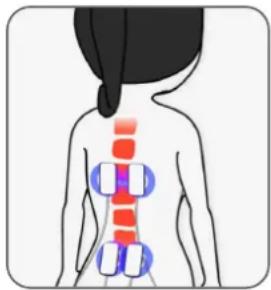
It stimulates the sensory nerves, which carry touch and temperature signals. These nerves go to the same connections in the spine as the
natural_image
Illustration of a human back with colored segments and labels (no text or symbols present)nerves carrying pain. A strong sensory signal will block the pain signal travelling up the spine to the brain. This is known as closing the "Pain Gate" and takes effect quite quickly after the unit is switched on. When the gate is open, pain messages get through to the brain and we feel pain. When the gate is closed, these pain messages are blocked and we do not feel pain.
Evidence suggests that TENS produce pain relief in a similar way to ‘rubbing the pain better’. The pain gate can be closed by activation of mechanoreceptors through ‘rubbing the skin’.
Scientifically, the pain gate works by the release of a chemical in the synapse at spinal level that inhibits transmission of pain signal.
Endorphin Release
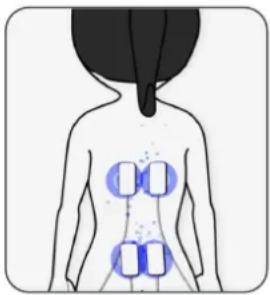
At low frequency settings, and slightly stronger outputs, TENS drives the motor nerves to produce a small repetitive muscle
natural_image
Human back with four purple rectangular markers on the back, indicating areas of interest or emphasis (no text or symbols present)contraction. This is seen by the brain as exercise, and this promotes the release of endorphins - your body's own natural pain killer. The relief builds up and normally takes about 40 minutes to reach a maximum level which can last for hours after the machine is switched off.
By using TENS, you can expect to achieve a significant reduction in pain - if not complete relief from pain.
- TENS is effective for pain from a very wide range of causes.
- TENS machines can be used to help reduce pain from problems in muscles, joints and nerves.
- It can be also used for people with musculoskeletal pain such as long-term (chronic) back pain or knee joint arthritis. They are also often used for pain relief in the early stages of labour (see perfect mamaTENS), particularly whilst a pregnant woman remains at home.
- TENS may also be used to treat many types of pain, such as migraine headaches, period pain and endometriosis (see Ova+), cystitis,
sports injuries, fibromyalgia and neuralgia, plantar fasciitis, post-operative pain, TMJ disorder, diabetic neuropathy, osteo-arthritis and sometimes non-painful conditions such as travel sickness.
- You can use low frequency (<10 Hz) programmes on acupuncture points, to achieve similar effects to acupuncture.
- With neurogenic pain (caused by inflamed nerves) such as shingles and neuralgia, TENS may start by increasing the pain. We recommend that you only use TENS for these conditions under medical supervision.
You can safely use TENS as long as it gives you pain relief. The effect may wear off after a few hours (this is called "accommodation"). If this happens, take a break of an hour or so before trying again. If you use settings that cause muscle movement for more than 40 minutes, you may experience aching muscles a few hours later.
6. CONTRAINDICATIONS, WARNINGS & CAUTIONS

In this manual:

Warning is used when failure to follow the instructions may in serious injury or death.

A Caution is used when failure to follow the instructions may in a minor or moderate injury, or due to the device or other property.

Notes are used to provide clarification or recommendation.
CONTRAINDICATIONS:
Do NOT use if you have a pacemaker (or if you have a heart rhythm problem) or with any electronic medical devices. Using this unit with electronic medical devices may cause erroneous operation of the device. Stimulation in the direct vicinity of an implanted device may affect some models. Stimulation on the front of the neck can affect your heart rate. Very strong stimulation across the chest may cause an extra heartbeat and/or rhythm disturbances to your heart, which could be lethal.
Do NOT use during the first three months of pregnancy. It is not known whether TENS and EMS may affect foetal development.
Do NOT use on the abdomen in the later stages of pregnancy. Stop using immediately if you experience unexpected contractions.
Do NOT use if you have a cardiac pacemaker, implanted defibrillator, or other implanted metallic or electronic

device. Such use could cause electric shock, burns, electrical interference, or death.

WARNINGS:
Do NOT use when driving, operating machinery, or similar actions needing muscular control. Loose electrode pads, damaged leads, or sudden changes in contact may cause brief involuntary muscle movements.
Do NOT use to mask or relieve undiagnosed pain. This may delay diagnosis of a progressive condition.
Do NOT use if you have, in the area being treated: active or suspected cancer or undiagnosed pain with a history of cancer. Stimulation directly through a confirmed or suspected malignancy should be avoided as it may stimulate growth and promote spread of cancer cells.
Do NOT use simultaneously with high frequency hospital
diagnostic/therapeutic equipment. Doing so may result in burns at the site of the electrodes and possible damage to device.
Do NOT apply near the thorax because the introduction of electrical current may increase the risk of cardiac fibrillation.
Stimulation should not be applied across or through the head, directly on the eyes, covering the mouth, on the front of the neck (especially the carotid sinus), or from electrodes placed on the upper back or crossing over the heart.

CAUTIONS:
Caution should be used if you have a bleeding disorder as stimulation may increase blood flow to the stimulated region.
Caution should be used if you have suspected or diagnosed epilepsy as electrical stimulation may affect seizure threshold.
Caution should be observed when using the device at the same time as being connected to monitoring equipment with body worn electrode pads. It may interfere with the signals being monitored.
Caution should be used following recent surgical procedures. Stimulation may disrupt the healing process.
Caution Strong electromagnetic fields (electro-surgery/ microwave cookers/ mobile phones) may affect the correct operation of this unit. If it appears to behave unusually, move it away from these devices.
Caution Do not permit use by children unable to understand the instructions or persons with cognitive disabilities, i.e.; Alzheimer's disease or dementia.
Caution Keep away from children under 5 years of age, pets and pests. Long cord - risk of strangulation in infants.
Caution: should be observed when using the Perfect EMS at high strength settings. Perfect EMS has a Yellow LED light on output socket which means the output will exceed 10 mA (R.M.S) or 10 V (R.M.S) averaged over any period of 1 sec. Prolonged use at high settings may cause muscle injury or tissue inflammation.
Caution Not intended for use in an oxygen rich environment.
Caution Not intended for use in conjunction with flammable anaesthetics or flammable agents.
Caution The patient is an intended operator.
Caution Do not service and maintain the device while in use with a patient
Caution Maintenance and all repairs should only be carried out by an authorized agency. The manufacturer will not be held responsible for the results of maintenance or repairs by unauthorized persons.
If necessary, we will provide circuit diagrams, component part lists or other information that will assist authorized service personnel to repair the device.
Caution The operator should not touch the patient at the same time when touching the battery output.
Caution There are no user serviceable parts. No modification of this equipment is allowed.
DO NOT PLACE ELECTRODE PADS:
- On skin, which does not have normal sensation. If the skin is numb too great a strength may be used, which could result in skin inflammation.
- On broken skin. The electrode pads could encourage infection.
- On the front of the neck. This could cause the airway to close, giving breathing problems. May cause sudden drop in blood pressure (vasovagal response).
• Over the eyes. May affect eyesight or cause headaches. - Across the front of the head. Effect on patients who have had strokes or seizures is not known. May affect your sense of balance. The effects of
stimulation on the brain are unknown.

ELECTRODE PADS CAUTION:
Caution: Do not ignore any allergic reaction to the electrode pads: If a skin irritation develops, stop using the device, as this type of electrodes may not be suitable for you. Alternative electrode pads specially made for sensitive skin are available (see E-696-SS).
Caution: Do not use this device with leads or electrode pads other than those recommended by the manufacturer. Performance may vary from specification. Electrodes with smaller surface area may cause tissue irritation.
Caution: Do not use high intensity settings if electrodes are smaller than 50x50mm.

Note: Electrode pads supplied have no measurable latex content.
TO KEEP YOUR DEVICE IN GOOD WORKING ORDER, OBSERVE THE FOLLOWING ADDITIONAL CAUTIONS:
Caution: Do not immerse your device in water or place it close to excessive heat such as a fireplace or radiant heater or sources of high humidity such as a nebulizer or kettle as this may cause it to cease to operate correctly.
Caution: Keep the device away from sunlight, as long-term exposure to sunlight may affect the rubber causing it to become less elastic and crack.
Caution: Keep the device away from lint and dust, as long-term exposure to

lint or dust may affect the sockets or cause the battery connector to develop a bad contact.
Caution: Temperature & Relative Humidity of storage:
-25°C to +70°C, up to 93% R.H. Temperature & Relative Humidity of transportation: -25°C to +70°C, up to 93% R.H.
Caution: Do not attempt to open or modify the unit. This may affect the safe operation of the unit and will invalidate the warranty.

Note: There are no known side effects to use and long-term use is not harmful. However, the device works your muscles and unaccustomed amounts of exercise may produce muscle ache. If this happens, simply reduce the strength of the machine or allow your muscles to rest until the aching disappears.
7. INFORMATION ABOUT THE PROGRAMME SETTINGS
Each programme has its own combination of Frequency and Pulse Width settings which allow for different muscle groups to be exercised and toned through the electrode pads.
- Frequency (measured in Hz - pulses per second)
For EMS programmes:
Low frequencies (1-10 Hz) have a purifying and relaxing effect through individual contractions.
Medium frequencies (20-50 Hz) can put a high level of strain on the muscle, thus promoting the muscular structure.
For TENS programmes:
Pain gate: A high frequency of 110 Hz is good at blocking pain signals.
Endorphine release: A low frequency of 4 or 10 Hz allows for the release of endorphins, the body's natural morphine-like substances.
- Pulse Width (measured in s - millionths of a second)
The perfect EMS unit has pulse widths of 50 to 350 s. Generally speaking, the higher the pulse width, the more "aggressive" the stimulation feels, if the pulse width is set high enough, it will usually elicit a muscle contraction, which is required for an effective toning of the muscle group selected.
For the TENS programmes (pain relief), it is not desired to elicit a muscle contraction, however Pulse Rate is important because different frequency settings target different nerve groups and the setting will determine if the "Gate Theory" or "Endorphin Theory" of TENS will be used.
- Work/Rest
All the EMS programmes (see A to H) are intermittent.
Once you have reached a comfortable level, 5 seconds after you stop pressing the button, the intermittent Work/Rest phase will start.
For each programme, the unit will go through a stimulation phase (Work) for 1-40 seconds, followed by a phase without stimulation (Rest) for a similar time.
This is to allow your muscles to recover from exercise and avoid fatigue.
During the Work period (W), the unit will generate contractions, try to contract the muscle voluntarily at the time to get the best possible results.
This cycle Work/Rest will continue for the duration of the programme selected.
W and R are displayed on the screen.
- Ramp
RAMP is the time in seconds taken to move up and down between zero and the set stimulation strength (i.e. the time taken to move between the Work stimulation and the Rest period). The perfect EMS offers Ramp periods from 0 to 5 seconds.
- Constant and Burst Modes
Constant mode is when the sensation is continuous versus Burst mode when the sensation, as its name implies, is one of on and off. Constant mode is often used for acute pain via Pain Gate effect whereas Burst mode is useful in chronic pain relief. Burst gives a combination of Pain Gate and Endorphin Release, but the squeezing feeling may not be as comfortable. The stimulation intensity will need to be relatively high. In Constant mode, the sensation is continuous and is more of a tingling pins and needles type. See programmes S and T.

8. PROGRAMMES
8.1. PROGRAMME SETTINGS
| Prog | Muscle group | Description | Special Feature |
| A Preset EMSAll | Warm up: Helps preparing the muscles before an active training by stimulating the surface muscle fibres. | For all users | |
| B | Preset EMSLarge (e.g.: Abdominal, Buttocks & Hips, Thighs, Bust/Pectorals*) | Endurance: Firming up muscles working mainly on slow-twitch fibres. | For all users |
| C Preset EMSLarge (e.g.: Abdominal, Buttocks & Hips, Thighs, Bust/Pectorals*) | Power: Toning up working mainly on fast-twitch fibres. | For all users | |
| D Preset EMSLarge (e.g.: Abdominal, Buttocks & Hips, | Definition and Bulk: Defining muscles in the selected area working mainly on explosive fibres. Grows muscles size. | For advanced users wanting to improve results | |

| Thighs, Bust/Pectorals*) | |||
| E Preset EMS Small (e.g.: Arms, Calves) | Endurance: Firming up muscles working mainly on slow-twitch fibres. | For all users exercising small muscles.To start exercise of weak or atrophied large muscles. | |
| F Preset EMS Small (e.g.: Arms, Calves) | Power: Toning up working mainly on fast-twitch fibres. | For all users exercising small muscles.To start exercise of weak or atrophied large muscles. | |
| G Manual EMS | Manual programme for Muscle Toning | ||
| H Manual EMS | Manual programme for Muscle Toning | ||
| S | Manual TENS | Manual programme for Pain Relief | Constant mode - Recommended for acute pain |
| T Manual TENS | Manual programme for Pain Relief | Burst mode - Recommended for chronic pain | |
* Specifically designed breast electrode pads (see E-CMR60130) are available.

Note: These programmes must be used in combination with a healthy diet and regular active exercises.
| Prog | Frequency (Hz) | Pulse Width (μs) | Work (s) | Rest (s) | Ramp (s) |
| A | 10 | 300 | Constant | ||
| B | 20 | 250 | 5 | 10 | 1 |
| C 50 | 250 3 6 2 | ||||
| D | 75 | 250 | 5 | 10 | 1 |
| E | 20 100 5 15 | 1 | |||
| F | 50 100 3 6 | 1 | |||
| G | Select 1-80 | Select 50-350 | Select 1-40 | Select 0-40 | Select 0-5 |
| H | Select 1-80 | Select 50-350 | Select 1-40 | Select 0-40 | Select 0-5 |
| S | Select 1-120 | Select 50-250 | Constant | ||
| T | Select 1-120 | Select 50-250 | 2 Hz Burst | ||
8.2. PRESET PROGRAMMES
Perfect EMS has six different, specially developed EMS programmes (A to F), two manual EMS programmes (G and
H) and two manual TENS programmes (S and T).
To choose the programme that suits your needs, please see section 8.1., for
the electrode pads positioning, please see section 9.3.
This will depend greatly on what you are looking to achieve and on the selected muscle group.
8.3. MANUAL PROGRAMMES
In the EMS manual programmes (G and H) you can select and change the following parameters using the T timer button:
Parameter to Change Display Symbol Flashes
Frequency Hz
Pulse Width μs
Ramp Time (seconds)
Work Time (seconds) W
Rest Time (seconds) R
Treatment Timer (minutes) min

In the TENS manual programmes (S and T) you can select and change the following parameters using the T timer button:
Parameter to Change Display Symbol Flashes
Frequency Hz
Pulse Width μs
Constant / Burst C/B
Treatment Timer (minutes) min
-
Press the P key until you reach programme G, H, S or T.
-
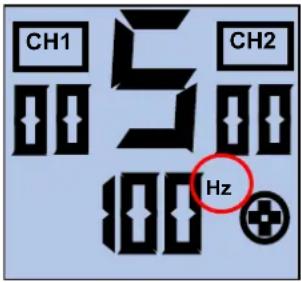
Press the T key. The Hz symbol will flash next to the number at the bottom centre of the screen.
text_image
CH1 5 CH2 Hz
- Press CH1▲ or CH1▼ to adjust the setting.
You can select a frequency from 1 to 80 Hz in programmes G and H, and 1 to 120 Hz in programmes S and T.
- Press the T key again to save your change and advance to the next setting s .
You can select a pulse width from 50 to 350 s in programmes G and H, and 50 to 250 s in programmes S and T.
- Press the T key to select Ramp.
You can select a ramp from 0 to 5 s in programmes G and H only.
-
Press the T key to select Work Time. You can select a work time from 1 to 40 s in programmes G and H only.
-
Press the T key to select Rest Time. You can select a rest time from 0 to 40 s in programmes G and H only.
-
Press the T key to select C or B.
C = Constant B = Burst in programmes S and T only.
-
Finally, you can select the Treatment Timer. Continuous, 10, 20, 30, 45, 60 or 90 minutes.
-
Press T once more to return to start using.
See section 7 for more information on the choice of settings.
8.4. USING THE PROGRAMMES
• TENS PROGRAMMES
There is not one programme for a particular condition, and the best choice varies from one person to another, even if they have the same type of pain.

Each user needs to select both the programme and the positioning of the electrode pads that is best for them. You may need to try a few positions/programmes before finding the one that suits you.
TENS can be used for as long as it is necessary. Continuous treatment is fine, but the electrode pads should be repositioned regularly (at least every 12 hours) to allow the skin to be exposed to the air.
The Endorphin Release works better when the strength is high enough to cause small muscle contractions. Best results are achieved with a session duration between 20 and 40 minutes. Longer use may cause muscle ache.
• EMS PROGRAMMES
Abs, hip, thigh:
EMS can help improving body toning and body shaping by generating passive muscle contractions in the selected area.
It may improve your general fitness levels as well as achieving a thinner silhouette by building up the muscles.
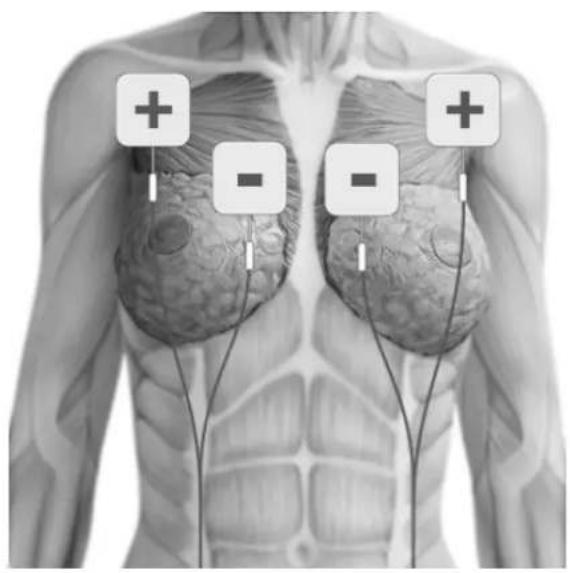
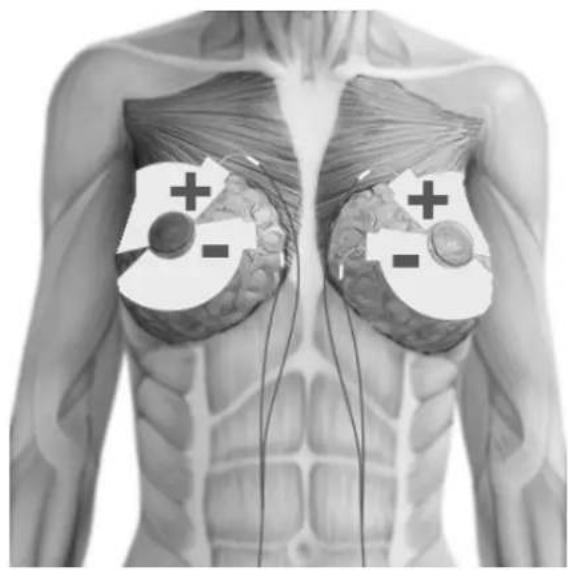
Bust:
Electrical Stimulation can build, strengthen, and firm the pectoral muscles giving bulk and lift.
- Exercise and massage therapy to enhance the size and shape of your breasts
- Natural method to enhance your all-natural body
Note: For improved comfort, use this programme with the breast electrode pads* (see E-CMR60130).
*Sold separately.
Arm:
The upper arms often get saggy and flabby especially in women with the triceps (back of the upper arm). It is commonly referred to as "Bingo Wings" or "Bat Wings". It is tricky to tone this muscle group and some women find this area ungraceful or even embarrassing.
Perfect EMS helps to tone, firm and lift the triceps and the biceps as it allows you to generate contractions in this specific muscle group.
Calf:
Most people are aiming for thin but muscly legs with a harmonious balance between the size of the thighs and the size of the calves. Often, the calves are either too skinny with only little muscle mass or too big with a long muscle mass especially around the ankle.
The aim is to tone, shape and lift the calves' muscles to achieve slender legs with improved definition of the muscles as well as a slimming effect on the ankles
Recommended use:
Generally, 3 sessions per week, over a period of 4 to 6 weeks, gives good initial results depending on the body shaping, toning, sports training or rehabilitation and recovery needs.
GENERAL ADVICE:
Ideally, use perfect EMS once every two days for each muscle with a day of rest in between. It is possible to work on pairs of muscles, for example thighs and abdominal muscles, treating one set one day and the other the next day.

Warning: Working on too many muscles at the same time is not recommended.
Increase the intensity until you feel a very smooth tensing under the pads, there should be little visible movement.
Use a low intensity for the first session to help you to understand how the machine works.
During the programme and over the next few days the intensity should be increased gradually to produce marked, but not painful muscle contractions.
Once good results have been obtained the sessions may be reduced to once or twice a week until the user feels that optimum body shaping has been achieved.

Note: The stimulation should remain comfortable and relaxing at all times.
9. ELECTRODE PADS
9.1. PAD POSITIONING
The electrode pads must always be used in pairs (two electrode pads on each channel), so that the signal can flow in a circuit.
Electrode placement for TENS:
- TENS works one vertebra at a time. You need to stimulate the sensory nerves that enter the spine at the same level as the nerve carrying your pain. Since you don't know exactly where your nerves are, the easiest way is to apply the electrode pads around/near the source of the pain.
- TENS activates the nerves best if it travels along the nerve rather than across it. So place one pad further from the spine than the source of the pain, and one closer.
- The nerves wrap around the limbs and torso, so you may have to try a few positions before you get the best effect.
- If the pain is in, or close to, your spine you can place one pad either side of the spine.
- You may feel more sensation in one pad than the other. This is normal – it depends on where the electrode pads are in relation to your nerves.

Note: See examples of positioning in the instructions enclosed with your electrode
pads.

Electrode placement for EMS is very important for obtaining the best results:
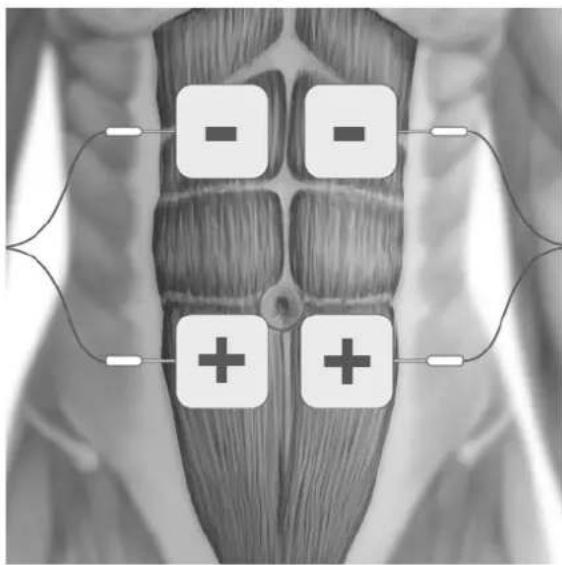
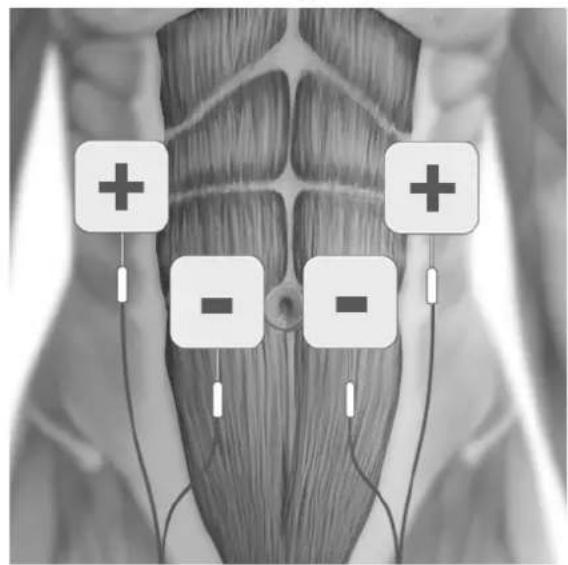
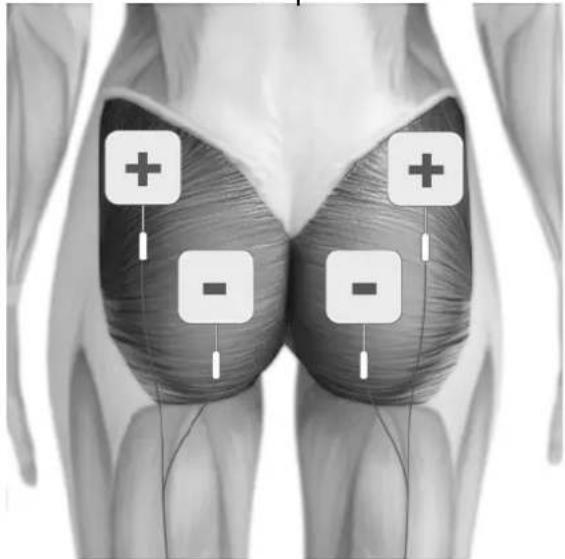
Place two electrode pads over the bulk of the muscle, with one electrode over the muscle's motor point. The motor point is the area on the skin that is located closest to the motor nerve's entry into the muscle – about 1/3 of the way down the muscle from the spine. Here, it is easiest to trigger a contraction by electrical stimulation.
Experiment by moving the electrode pads across the skin until you locate the point over the muscle that gives the cleanest contraction. In the examples in section 9.3., the electrode pads are marked +ve (red) and -ve (black) to match the red and black leads. One of the electrode pads should be positioned over the motor point.
Large muscle groups may require stimulation with two channels, that is, four electrodes simultaneously.
When exercising smaller muscles, take care to adjust the intensity level slowly as the motor nerves may be more sensitive and using smaller electrode pads increases the current density.
You may feel more sensation in one pad than the other. This is normal – it depends on where the electrode pads are in relation to your nerves.
Use the square electrode pads (see E-CM5050) for all areas.
For the bust area, it is recommended to use the optional breast electrode pads for improved comfort (see E-CMR60130 ^* ).
*Sold separately.
Always check that the unit is OFF before attaching or removing electrode pads.
Perfect EMS resets strength to zero if the pad or lead is disconnected from your body. This is to prevent sudden changes in sensation when the pad is re-connected.
9.2. PAD ADVICE
- The electrode pads supplied are reusable but for single patient use. The adhesive is a peelable hydrogel (water based).
- In order to obtain the best conductivity through the electrode pads always ensure that they are in good condition and tacky.
- Before use make sure your skin is clean and dry.
- Peel the electrode pads from their protective plastic shield by holding and lifting one corner of the pad and pulling. Do not pull on the pigtail wire of the pad.
- After use always replace the electrode pads on the plastic liner and replace them in the re-sealable plastic bag.
- If the electrode pads dry out, then it is best to buy a replacement pack. In an emergency, it may be possible to restore some of the tackiness of the pad by adding a tiny drop of water on each pad and spreading around. If too much water is added, the electrode pad will become too soft. If that happens then it is suggested in order to try and re-establish some adhesiveness, to place them sticky side up in a refrigerator for a few hours.
- In very hot weather the gel on the electrode pads may become soft. In
such cases place them, still on their plastic liners and in their pouch into a fridge until they return to their normal condition.
- The electrode pads provided are latex-free.
- Replace the electrode pads when they lose their stickiness.
Poor connection may cause discomfort and skin irritation.
- Storage life of an unopened pack of electrode pads is 2 years. This may be affected by very high temperatures or very low humidity.

The electrode pads placement is specific to the area being treated. Please refer to the placement guidelines below.

Note: The + electrode pad needs to be plugged in to the red lead wire connector, the – refers to the one for the black lead wire connector.
ABS – Pad placement 1
text_image
Medical diagram showing a human head with four labeled buttons (−, −, +, +) connected to corresponding markers on the muscle.OR
ABS - Pad placement 2
text_image
Medical diagram showing a human torso with four marked electrical or diagnostic symbols (+, -, -) connected to electrodes.HIP – Pads placement
text_image
Anatomical diagram of human upper body with marked electrical or diagnostic symbols (+, -, +) indicating positive and negative measurements.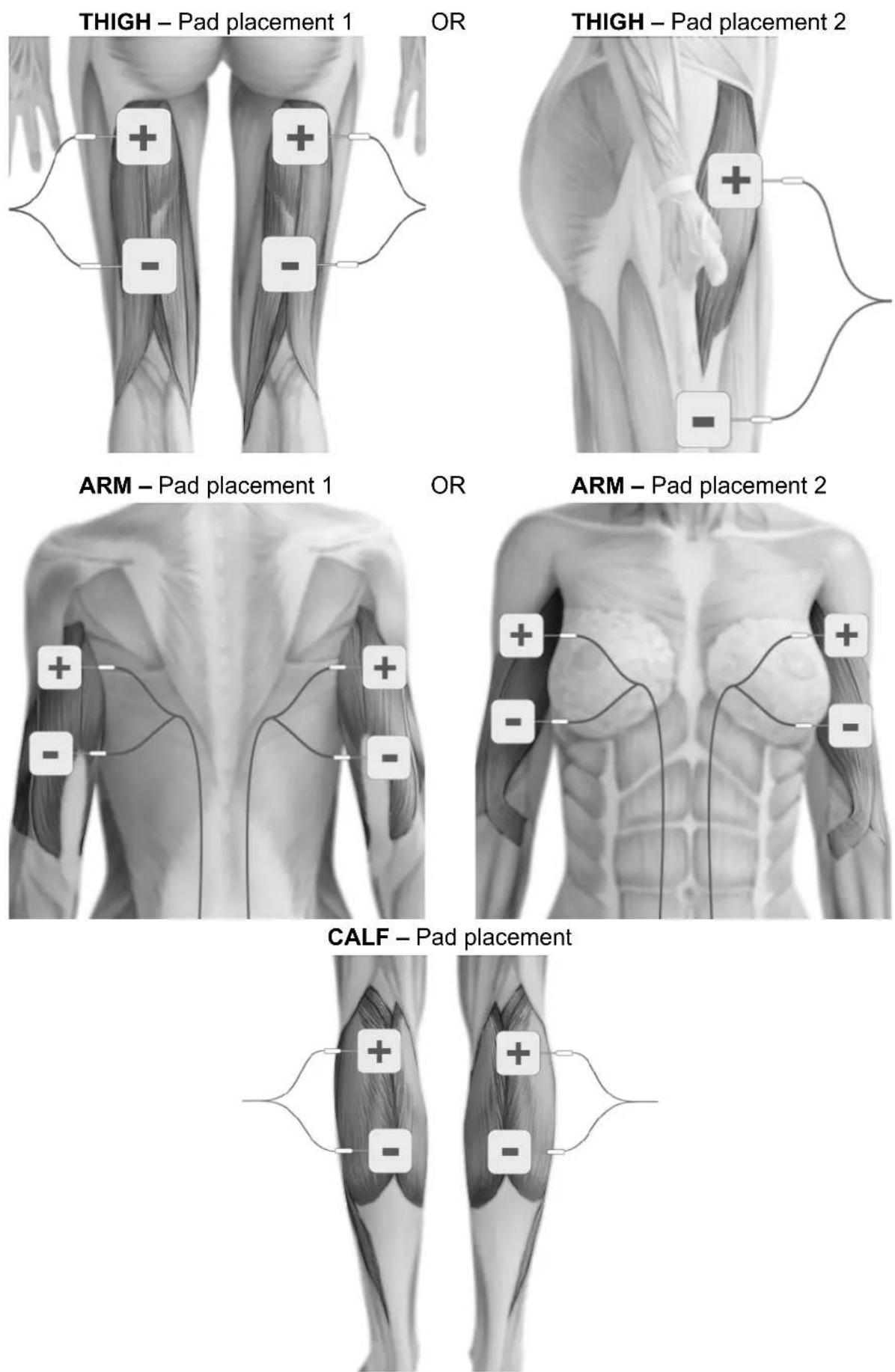

BUST – Pad placement 1
natural_image
Anatomical illustration of human thorax with medical electrodes and a plus/minus signs (no text or labels)BUST – Pad placement 2 with the optional breast electrode pads (E-CMR60130)
natural_image
Anatomical illustration of human thorax with marked areas (no text or symbols present)10. CONTENT
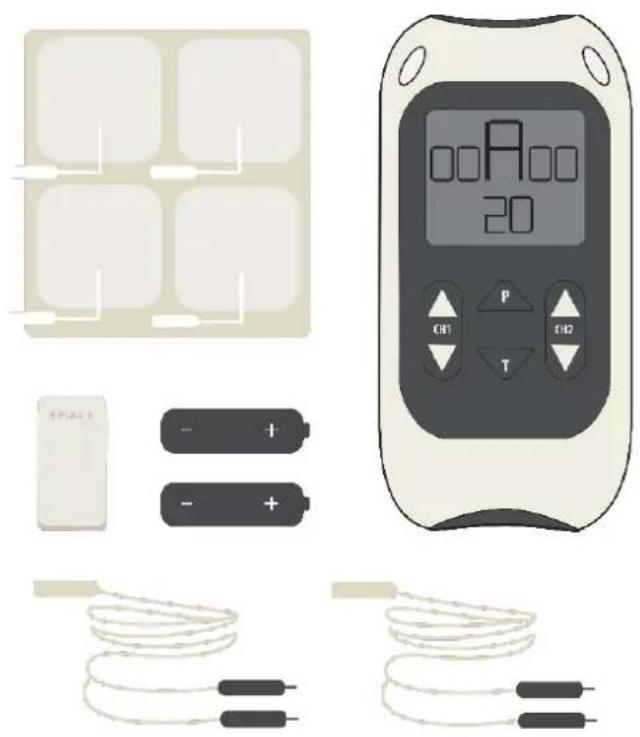
The pack contains:
• 1 x Perfect EMS pain relief and body toner
- 2 x Lead wires (L-CPT)
- 4 x 50x50 mm electrode pads (E-CM5050)
• 2 x AA 1.5V alkaline batteries
- 1 x Detachable belt clip
- 1 x Storage pouch
- 1 x Instructions for use
natural_image
Illustration of a digital blood glucose meter with battery, charging case, and coiled cable (no text or symbols)11.1. CONTROLS & DISPLAY
text_image
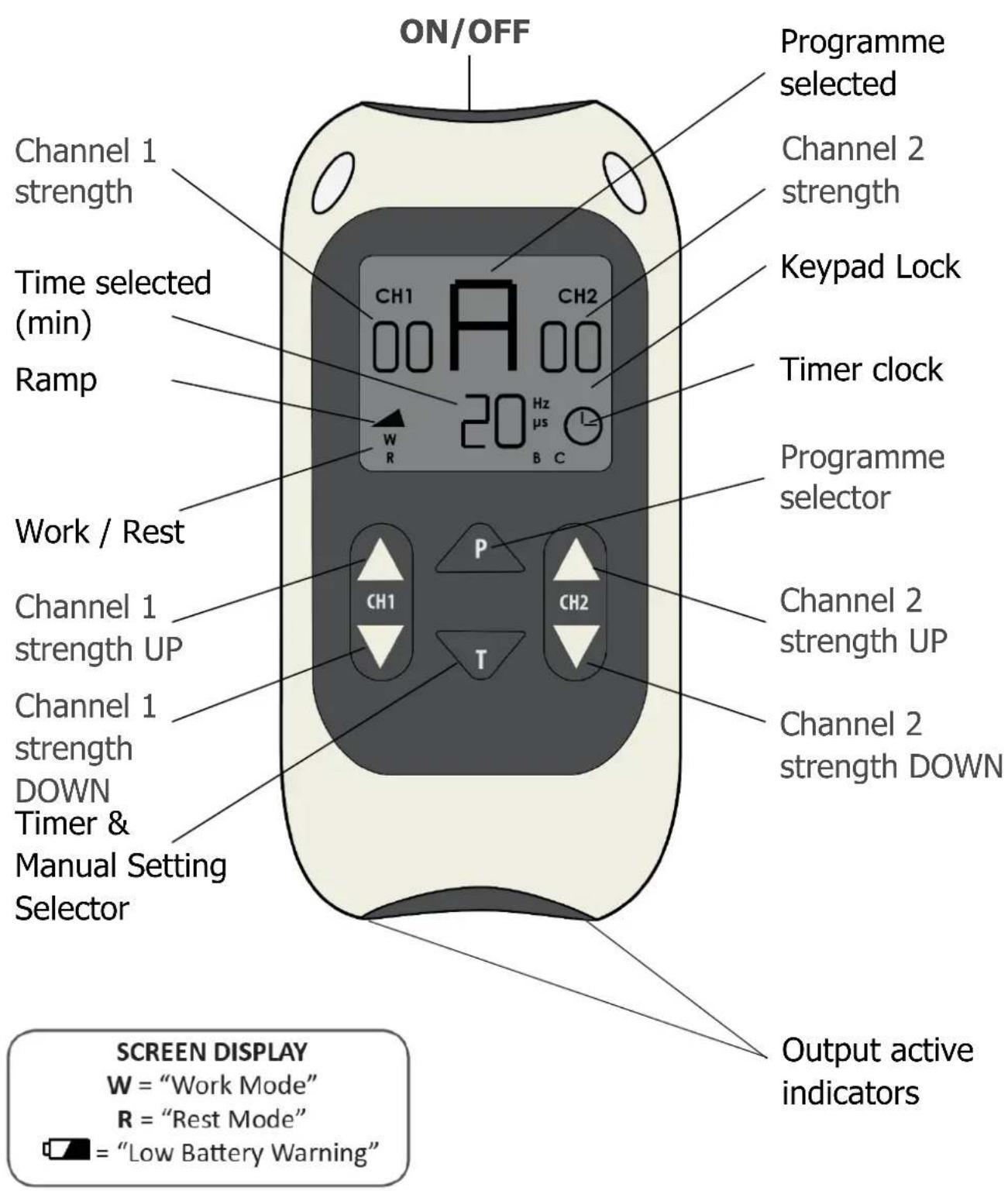
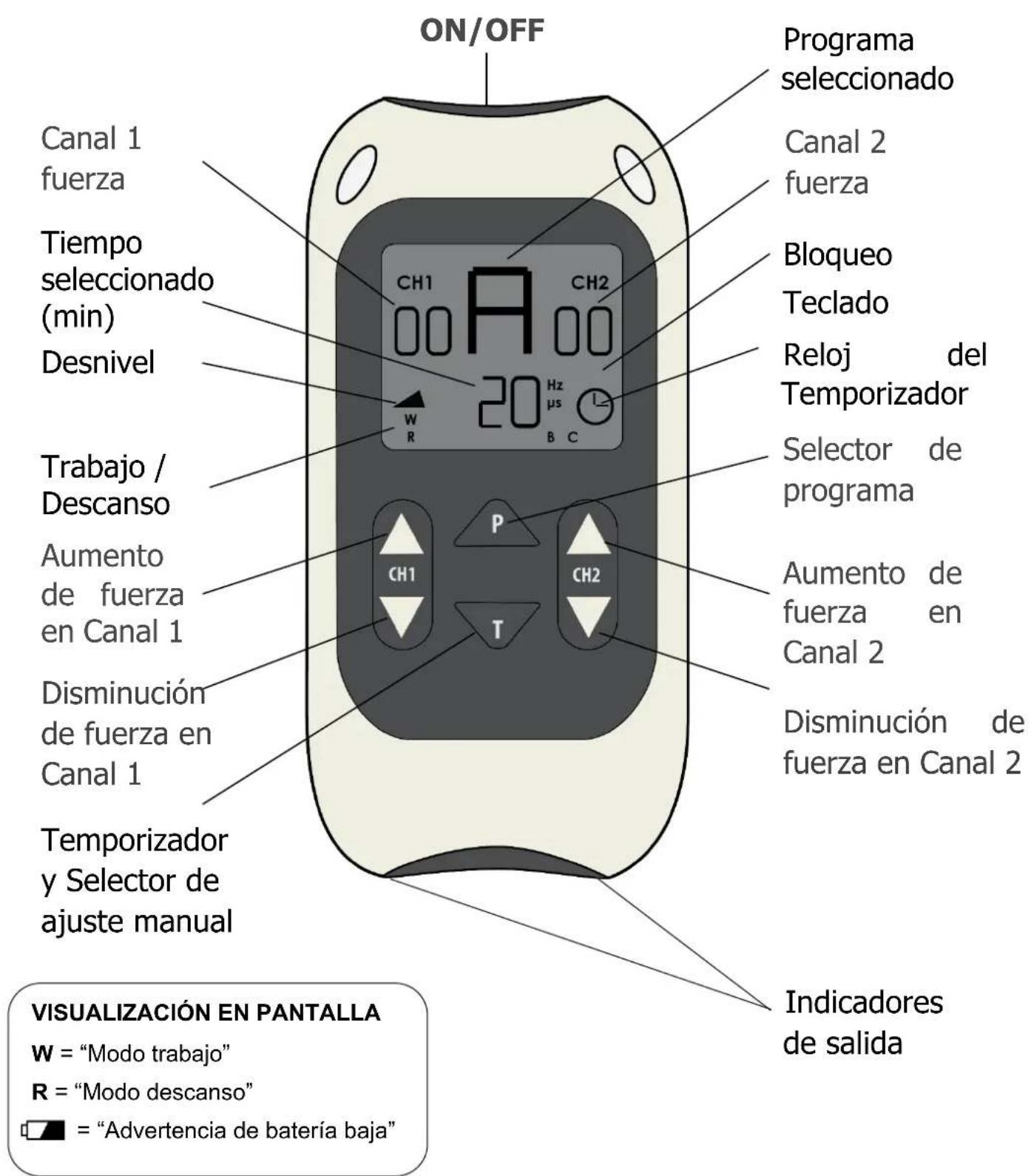
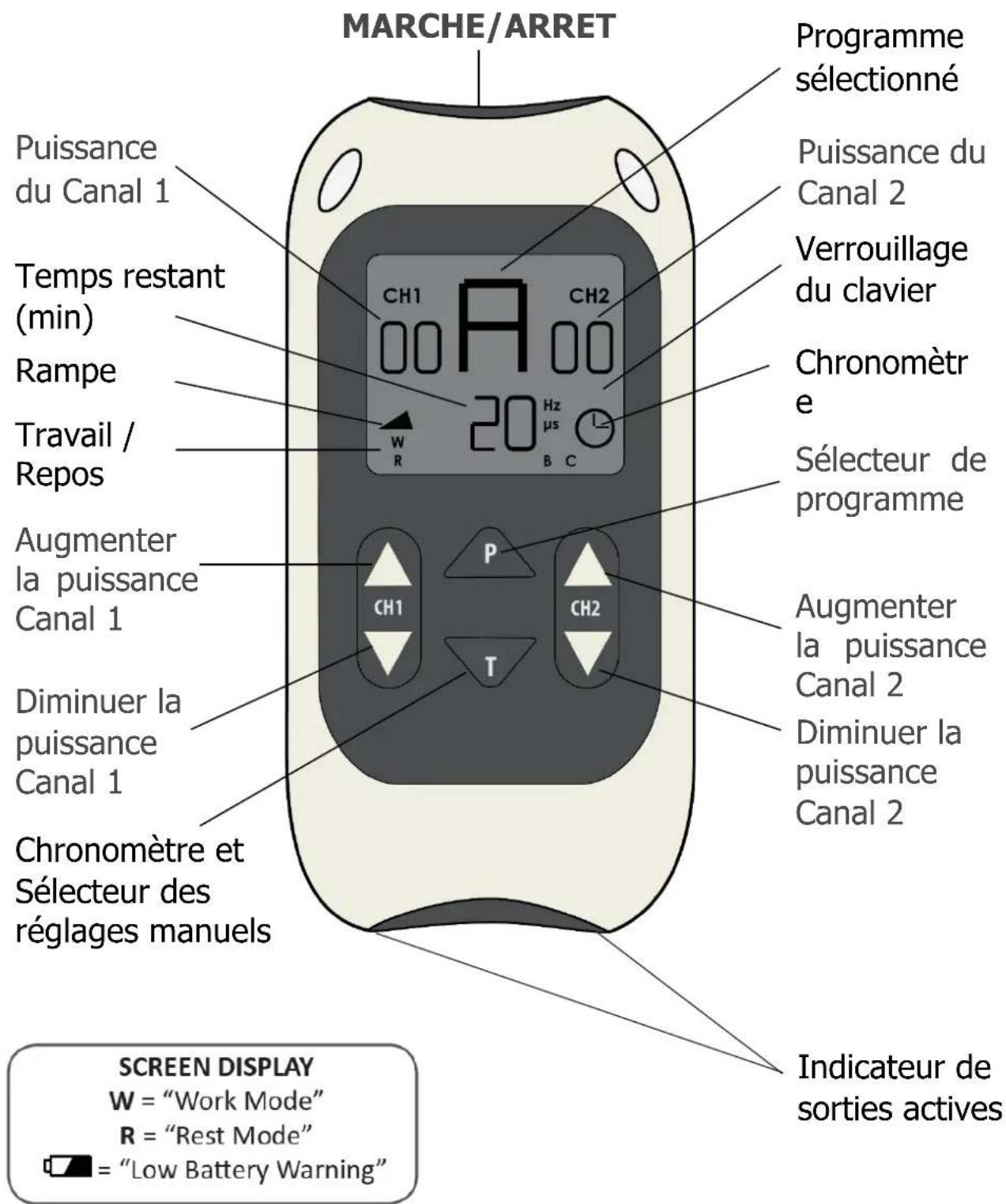
ON/OFF Channel 1 strength Time selected (min) Ramp Work / Rest Channel 1 strength UP Channel 1 strength DOWN Timer & Manual Setting Selector CH1 CH2 20 Hz μs L W R B C P CH1 CH2 T Programme selected Channel 2 strength Keypad Lock Timer clock Programme selector Channel 2 strength UP Channel 2 strength DOWN Output active indicators SCREEN DISPLAY W = "Work Mode" R = "Rest Mode" = "Low Battery Warning"
ON/OFF
To turn the unit ON, press the ON/OFF button on the top of the unit and hold for 3 to 5 seconds until the display shows.
To turn the unit OFF, press the ON/OFF button on the top of the unit and hold for 3 to 5 seconds until the display stops
The unit will turn OFF automatically:
- When the Timer reaches zero
- If it is left at zero strength for more than 5 minutes.
The unit will start with the programme you used last.
At first use, or after changing batteries, the display shows that the unit is automatically set in programme A at zero strength.

Note: Always check unit is OFF before applying or removing electrode pads.
The backlight will turn off 10 seconds after the last button press.
On the front of the unit there are six buttons:
STRENGTH CONTROLS
The buttons marked CH1▲, CH1▼, CH2▲, CH2▼ are the strength controls.
The left-hand buttons change strength in the left-hand lead, CH1, and the right-hand buttons change the right-hand lead, CH2.
To increase strength in steps of 1 mA, press and release the top part of the channel buttons, CH1▲ and CH2▲.
The strength levels are shown on the LCD.
The strength control buttons will not operate until the unit is properly connected to you. If the perfect EMS detects a disconnection in either channel it will automatically return the strength to zero in that channel and flash '00'.
The unit has 90 levels of strength.
If you hold down the strength controls for 3 to 5 seconds, the strength will start increasing continuously.
You may feel nothing over the first few presses. Continue pressing until the sensation is strong but comfortable. At each phase of the programme the intensity automatically adjusts to give a comfortable stimulation, however further increases during use may be necessary if your body becomes used to the sensation. To decrease the strength, press and release the lower part of the buttons marked CH1▼ and CH2▼.
The yellow LED on the output socket indicates that there is an active output which can be high enough to be harmful if not used correctly. The display will remain on for 5 seconds after the plug is removed.
PROGRAMME CONTROL
The button marked P is the programme control. The perfect EMS has six different, specially developed preset EMS programmes (A to F), two manual EMS programmes (G
and H) and two manual TENS programmes (S and T).
Each time you press and release the P button, the programme changes and is shown on the LCD.
Each time you change the programme, the strength level reverts back to zero. This is a safety feature to alleviate any sudden feeling of a surge, as each programme gives a different sensation.
TREATMENT TIMER
The button marked T can be used to set the session duration and to select manual parameters for adjustment.
When you switch the unit on, it is automatically set at 20 minutes in all preset programmes.
When you press the T button, the min symbol will flash.
You can set session times of C (Continuous) or 10, 20, 30, 45, 60 or 90 minutes with the CH1▲ and CH1▼ buttons.
Press T again to save your selection.
The LCD shows the session duration next to the clock symbol. The unit automatically counts down the minutes set and switches off when it reaches 0.
LOW BATTERY
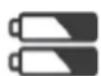
An empty battery symbol will show when you need to change the batteries. The unit will shut down about 2 minutes after this.
KEYPAD LOCK

If you do not press any keys for 30 seconds, the keypad will lock so that only the keys marked
CH1▼ or CH2▼ will work. This is to avoid accidental changes in setting. To unlock, press either CH1▼ or CH2▼ keys.
OPEN CIRCUIT CUTOUT
If the perfect EMS is not correctly connected to your body, the strength in the channel which is not properly connected will automatically reset to zero. This is to prevent sudden changes if a broken connection is re-made.
MEMORY
The perfect EMS has a Memory with three functions:
1) Programme Retention. When you switch the unit on, it will automatically start in the programme which was being used when it was switched off.
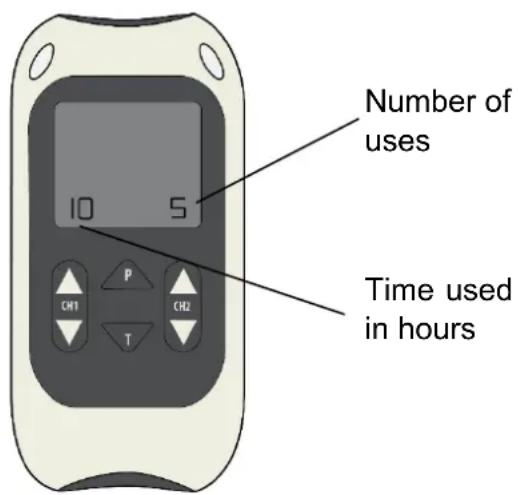
2) Usage. Press T and CH2▼ together and hold down for 3 to 5 seconds. The display will show the number of times used and duration in hours used.
Press the same buttons again to return to normal controls.
3) Memory Reset. To reset memory to zero, hold down the T and CH1▼ buttons together for 3 to 5 seconds.
text_image
Number of uses 10 5 P CH1 CH2 T Time used in hours

12. SETTING UP AND USING THE PERFECT EMS
12.1. INSTALLATION OF BATTERIES
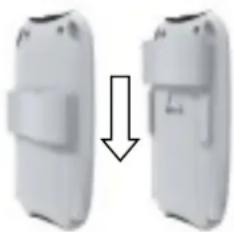
1) Remove belt clip by sliding down.
natural_image
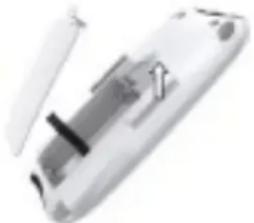
Two white electronic devices with a downward arrow indicating transformation or change (no text or symbols visible)2) Remove battery cover by pulling on tag.
natural_image
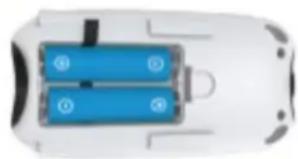
Close-up of a transparent electronic device with internal components (no visible text or symbols)3) Insert batteries.
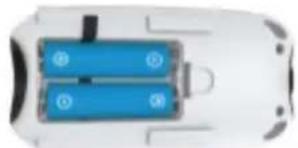
natural_image
Top-down view of a white car with two blue battery modules (no text or symbols visible)Ensure that the batteries are inserted the right way as shown in battery compartment and that the ribbon is behind them.
4) Replace battery cover and belt clip.

When the batteries are running low, a low battery indicator will show on the screen and it is important to change the batteries as soon as possible.
Rechargeable batteries
The unit will work with rechargeable batteries, but the display may appear dim.
Storage
Remove batteries from your perfect EMS if the unit is unlikely to be used for a long period. Some types of batteries may leak corrosive fluid.
Battery Life
Batteries should last at least 15 hours at 50 mA, 300 s, 50 Hz.
Unused batteries have a nominal shelf life of 1 year, but will usually last longer than this.

Battery Warnings
Do NOT pierce, open, disassemble, or use in a humid and/or corrosive environment.
Do NOT expose to temperatures over 60°C(140F).
Do NOT put, store or leave near sources of heat, in direct strong sunlight, in a high temperature location, in a pressurized container or in a microwave oven.
Do NOT immerse in water, or get wet.
Do NOT short-circuit.
Do NOT connect the device unless the battery cover is in place.
If battery leakage occurs and comes in contact with the skin or eyes, wash thoroughly with lots of water and immediately seek medical attention.
Keep batteries out of the reach of small children.

Caution NEVER attempt to recharge an alkaline battery. Risk of explosion.

Caution Do not mix old, new or different types of batteries as this may lead to battery
leakage or low battery indication.
Disposal: Always dispose of batteries and device responsibly according to local government guidelines. Do not throw batteries onto a fire. Risk of explosion.
12.2. CONNECTING LEAD WIRES
Insert the lead wire plug into the base of the unit.
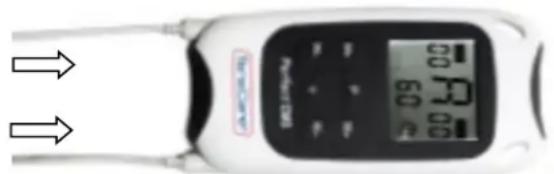
text_image
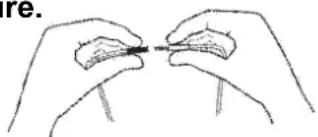
AVOCAR 80 50 60 20Attaching the electrode pads to the lead wire.
natural_image
Illustration of two hands holding a small object, possibly a tool or device, with no visible text or symbols.Push the pin ends firmly into the pigtail ends of the electrode pads.
The lead wires may be damaged by rough handling, and should be treated with care.
Lead wire colour coding.
The ends of the lead wires are coloured red or black. One of the electrode pads should be positioned over the motor point (see 9.3.).
12.3. PREPARING FOR SESSION
1) Before use make sure your skin is clean and dry.
2) Place the electrode pads on the skin, see section 9.
3) If you are using your perfect EMS while moving, you can attach the unit to your belt using the belt clip or hang it around your neck using a neck cord (not included). For safety, use thread or wool that will snap easily if the unit snags on something.
4) You can safely lean on the electrode pads. The sensation might change.

Warning: Ensure the perfect EMS is switched OFF before applying the electrode pads on
the skin.
12.4. TRAINING SESSION
1) Press and hold the ON button on the control unit for 3 to 5 seconds to switch the control unit on.
2) When switched on for the first time, the perfect EMS will automatically select the programme A. Next time, it will automatically select the programme you were using the last time it was switched off.
3) You can select from the 10 programmes (6 preset and 4 manual programmes). Details in section 8


will help you identify the best programme to suit you.
4) Identify the correct pads positioning for the selected area and apply the electrode pads as described in section 9.3. for EMS and as described on the electrode pads insert for TENS.
5) Once the electrode pads are correctly positioned, adjust the intensity as described in 8.4. with the buttons CH1▼, CH1▲, CH2▼ and CH2▲. The LCD display shows the strength of intensity used for each channel.

Note: If the sensation becomes uncomfortable, reduce the intensity.
12.5. AFTER YOUR TRAINING SESSION
When the timer reaches zero, your session is complete, and the unit turns off.
1) Check that the control unit is OFF. If it is not, hold down the OFF button to switch off then remove the electrode pads from your skin by holding the electrode pad itself and gently pulling. Be careful not to pull the wires as this may damage them.
2) Replace the electrode pads to their protective plastic shield and return them to the re-sealable plastic bag.

Note: When removing the electrode pads, DO NOT PULL ON LEAD WIRES.
13. CLEANING & STORAGE
Clean the case and lead wires at least once a week by wiping with a damp cloth and a solution of mild soap and water. Wipe dry.
- Do not immerse your perfect EMS unit in water.
- Do not use any other cleaning solution than soap and water.
Storage life
- Storage life of an unopened pack of self-adhesive electrode pads is 2 years. This may be affected by very high temperatures or very low humidity.
- The unit has no fixed shelf life.
14. EMC
Wireless communications equipment such as wireless home network devices, mobile phones, cordless telephones and their base stations, walkie-talkies can affect this equipment and should be kept at least a distance d = 3,3 m away from the equipment.
(Note. As indicated in Table 6 of IEC 60601-1-2:2007 for ME EQUIPMENT, a typical cell phone with a maximum output power of 2 W yields d = 3,3 m at an IMMUNITY LEVEL of 3 V/m).

Note: For hospital use, full EMC advice tables are available on request.
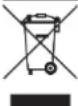
15. DISPOSAL OF WASTE ELECTRICAL AND ELECTRONIC PRODUCTS (WEEE)
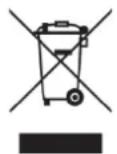
One of the provisions of the European Directive 2002/96/CE is that anything electrical or electronic should not be treated as domestic waste and simply thrown away. To remind you of this Directive all affected products are now being marked with a crossed-out wheelie bin symbol, as depicted below.
To comply with the Directive, you can return your old electro-therapy unit to us for disposal. Simply print a postage-paid PACKETPOST RETURNS label from our website www.tenscare.co.uk, attach this to an envelope or padded bag with the unit enclosed, and post it back to us. Upon receipt, we will process your old device for components recovery and recycling to help conserve the world's resources and minimise adverse effects on the environment.
16. ACCESSORIES
Expected Service Life
- The machine will often last for more than 5 years, but is warranted for 2 years. Accessories (lead wires, electrode pads, and batteries) are not covered by the warranty.
- Lead life depends greatly on use. Always handle the leads with care. We recommend to replace the lead
wires regularly (about every 6 months).
- Electrode pads should last 12 to 20 applications, depending on skin condition and humidity.
- AA alkaline batteries should last about 18 hours of continuous use.
Replacement electrode pads, new batteries and lead wires are available from your supplier or distributor (see back cover for contact details), by mail order from TensCare, by telephone using a credit or debit card, or through the TensCare website.
The following replacement parts may be ordered from TensCare at www.tenscare.co.uk or +44(0) 1372 723434.
E-CMR60130 Breast electrode pads
Pack of 4
(2 pairs)
E-CM5050 Square electrode pads Pack of 4
E-CM50100 Large electrode pads Pack of 4
E-696-SS Square hypoallergenic electrode pads Pack of 4
L-CPT Lead wire
B-AA 1.5V AA batteries
X- BC-PT Replacement belt clip
X- BL-PTT Replacement battery cover
17. WARRANTY
This warranty refers to the unit only. It does not cover, electrode pads, battery, or the lead wires.

PRODUCT INFORMATION
WARRANTY
This product is warranted to be free from manufacturing defects for 2 years from date of purchase.
This warranty is void if the product is modified or altered, is subject to misuse or abuse; damaged in transit; lack of responsible care; is dropped; if incorrect battery has been fitted; if the unit has been immersed in water; if damage occurs by reason of failure to follow the written instruction booklet enclosed; or if product repairs are carried out without authority from TensCare Ltd.
We will repair, or at our option replace free of charge, any parts necessary to correct material or workmanship, or replace the entire unit and return to you during the period of the warranty. Otherwise, we will quote for any repair which will be carried out on acceptance of our quotation. The benefits conferred by this warranty are in addition to all other rights and remedies in respect of the product, which the consumer has under the Consumer Protection Act 1987.
Our goods come with guarantees that cannot be excluded under the UK consumer Law. You are entitled to have the goods repaired or replaced if the goods fail to be of acceptable quality.
Before you send your unit for service
Before sending in your unit for service, please take a few minutes to do the following:
Read your manual and make sure you follow all the instructions.
Returning your unit for service
Should repair be needed within the warranty period, enclose the tear off section of the warranty card (see page 33) and your proof of purchase receipt. Please ensure all relevant details are completed before sending your unit in for service. Please ensure your contact details are still current and include a brief description of the problem you are experiencing together with your purchase receipt.
For hygiene reasons, please do not include used electrode pads. Send only the unit and lead wires.
Please return the unit and warranty card (see page 32) at your cost to:
TensCare Ltd
PainAway House,
9 Blenheim Road,
Longmead Business Park,
Epsom, Surrey
KT19 9BE, UK
Should you require any further information please do not hesitate to contact us by calling our number:
+44 (0) 1372 723 434.
If your perfect EMS is not working properly, please check the following:
| Problem | Possible causes | Solution |
| No display | Flat batteries. | Replace batteries. |
| Batteries inserted incorrectly. | Remove plastic wrap.Check + / - . | |
| Damaged springs in battery compartment. | Contact supplier. | |
| Low battery display | Low batteries. Replace batteries. | |
| No sensation | Intensity is not strong enough. | Increase strength.Most users will feel something at a setting below 20 mA. |
| Output will not increase above zero | Open circuit cut-out operating.Lead not connected to body or faulty/damaged. | Ensure machine is attached to your body correctly.Try using the second lead wire.Purchase replacement if necessary. |
| (Lead wires can break at the bend where they leave the machine giving no, or intermittent, output). | ||
| Sudden change in sensation | If you disconnect and re-connect a few minutes later, the signal will feel quite a lot stronger. | Always return strength to zero after disconnecting the leads or electrode pads. |
If the above review has failed to resolve your problem, or to report unexpected operation or events, call TensCare or your local supplier or distributor (address on back cover) for advice.
Contact TensCare customer service on +44 (0) 1372 723 434. Our staff are trained to assist you with most issues you may have experienced, without the need to send your product in for service.
European Medical Device Regulation requires that any serious incident that has occurred in relation to this device should be reported to the manufacturer and the competent authority in your country. This can be found at: https://ec.europa.eu/docsroom/documents/3683/attachments/1/translations/en/renditions/pdf
19. GENERAL SPECIFICATION
| Waveform | Asymmetrical Bi-Phasic |
| Amplitude (over 1 kOhm load) | 90 mA zero to peak +ve in 90 steps +/- 10% |
| Output plug Fully shielded: touch proof | |
| Channels Dual channel | |
| Batteries | 2 x AA alkaline (two AA batteries) |
| Weight | 75 g without batteries |
| Dimensions 120 x 60 x 20 mm | |
| Safety Classification Internal power source. Designed for continuous use. No special moisture protection. | |
| Environmental specifications: | |
| Operating: | Temperature range: 5 to 40°C |
| Humidity: 15 to 93% RH non-condensing | |
| Atmospheric pressure: 700 hPa to 1060 hPa | |
| Temperature range: -25 to +70°C | |
| Humidity: Up to 93% RH non-condensing | |
| Atmospheric pressure: 700 hPa to 1060 hPa | |
| TYPE BF APPLIED PART | Equipment providing a degree of protection against electric shock, with isolated applied part. |
| This symbol on the unit means “Refer to Instructions for use”. | |
| IP22 | The unit is not water resistant, and should be protected from liquids. |
Complies with EU WEEE regulations

Note: The electrical specifications are nominal and subject to variation from the listed values due to normal production tolerances of at least 5%.
RETURN THIS PORTION ONLY WHEN YOU RETURN YOUR PRODUCT FOR REPAIR UNDER WARRANTY.

NAME:
ADDRESS:
POSTCODE:
DAYTIME TELEPHONE: ____
E-MAIL:
MODEL:
DATE OF PURCHASE: ____
ATTACH PROOF OF PURCHASE DO NOT SEND IN ELECTRODE PADS
RETAILER'S NAME:
RETAILER'S ADDRESS:
RETAILER'S POSTCODE: ____
BRIEF DESCRIPTION OF PROBLEM YOU ARE EXPERIENCING: ____
WARRANTY IS VOID UNLESS THE ABOVE INFORMATION IS COMPLETED AND CORRECT.

Estimado cliente
natural_image
Illustration of a human back with colored rectangular markers on the spine (no text or symbols)natural_image
Human back with purple rectangular markers on the spine (no text or symbols)Para programas TENS:
text_image
Anatomical diagram of human musculature with four labeled regions marked by negative and positive signs, likely indicating muscle or neural activity states.text_image
Medical diagram showing a human torso with four marked electrical or diagnostic symbols: plus, minus, and -.text_image
Anatomical diagram of human upper body with marked electrical or diagnostic symbols indicating positive and negative values.
text_image
Anatomical diagram of human leg muscles with positive and negative signs indicating muscle activation or movement, surrounded by force vectors.O
text_image
Anatomical diagram of human musculature with labeled regions marked + and -, connected by a wire or cable.natural_image
Anatomical diagram of human musculature with marked muscle regions and electrical activity markers (no text or labels)O
text_image
Medical diagram showing breast anatomy with labeled regions marked by plus and minus signs, likely indicating surgical or diagnostic zones.text_image
Anatomical diagram of human leg muscles with labeled regions marked as + and -, likely indicating muscle areas or regions of interest.natural_image
Anatomical illustration of human torso showing breast and thoracic structures with medical electrodes (no text or labels)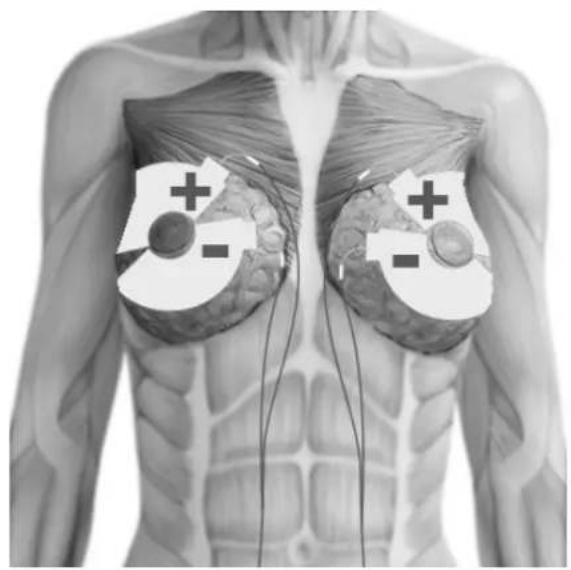
natural_image
Anatomical illustration of human thorax showing lungs, heart, and brain structures with medical markers (no text or labels)10. CONTENIDO
natural_image
Illustration of a digital resistance meter with display, battery, and coiled cable components (no text or symbols)11.1. CONTROLES E INTERFAZ
natural_image
Two white electronic devices with a downward arrow indicating transformation or change (no text or symbols visible)natural_image
Close-up of a white electronic device casing with internal components and a partially visible lid (no text or symbols)natural_image
Top-down view of a white car with two blue battery cells (no text or symbols visible)natural_image
Line drawing of two hands holding a small object, possibly a tool or component (no text or symbols)Longmead Business Park,
Epsom, Surrey
KT19 9BE, UK
https://ec.europa.eu/docsroom/documents/36683/attachments/1/translations/en/renditions/pdf
natural_image
Illustration of a human back with colored anatomical markers (no text or symbols)natural_image
Human back with four blue rectangular markers on the spine (no text or symbols)- Travail/Repos (Work/Rest) :
In the TENS manual programmes (S and T) you can select and change the following parameters using the T timer button:
text_image
Medical diagram showing a human torso with four labeled buttons (−, −, +, +) connected to electrical wireages.text_image
Medical diagram showing a human torso with four marked electrical or diagnostic symbols: plus, minus, and -.text_image
Anatomical diagram of human upper body with labeled muscle regions marked by plus and minus signstext_image
Anatomical diagram of human leg muscles with positive and negative signs indicating muscle activation or movement, surrounded by force arrows.OU
text_image
Anatomical diagram of human lower back with labeled electrical connections (+ and -)natural_image
Anatomical diagram of human upper back showing muscle and tendon structures with no visible text or labelsOR
text_image
Medical diagram of human thorax with labeled anatomical points and measurement indicatorstext_image
Anatomical diagram of human leg muscles with labeled regions marked by plus and minus signsnatural_image
Anatomical illustration of human thorax with medical electrodes and a plus/minus signs (no text or labels)natural_image
Anatomical illustration of human thorax showing lungs, heart, and rib cage (no text or labels)10. CONTENU
natural_image
Illustration of a medical or electrical device with battery, coiled cables, and a digital display showing 20A/20A time (no text or symbols on main components)11.1. COMMANDES & AFFICHAGE
natural_image
Two white electronic devices with internal compartments, one showing a downward arrow (no text or symbols visible)natural_image
Close-up of a transparent electronic device casing with internal components (no visible text or symbols)3) Insérer les piles.
natural_image
Top-down view of a white car with two blue battery modules (no text or symbols visible)natural_image
Line drawing of two hands holding a small object, possibly a tool or component (no text or symbols present)INFORMATIONS SUR LA GARANTIE PRODUIT
Longmead Business Park,
Epsom, Surrey
https://ec.europa.eu/docsroom/documents/36683/attachments/1/translations/en/renditions/pdf
19. CARACTERISTIQUES TECHNIQUES
natural_image
Illustration of a human back with colored anatomical markers (no text or symbols)zu denselben
natural_image
Human back with four purple rectangular markers on the spine (no text or symbols)text_image
Medical diagram showing a human torso with four labeled buttons (−, −, +, +) connected to electrical wire points.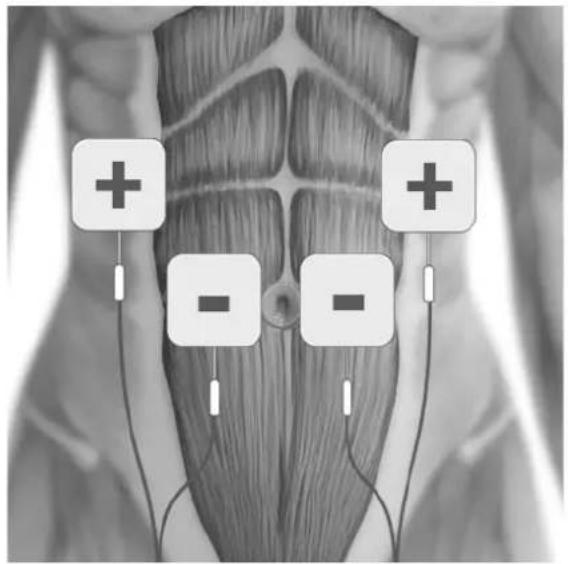
text_image
Medical diagram showing a human torso with four marked electrical or diagnostic symbols: plus, minus, and minus signs.text_image
Anatomical diagram of human upper body with labeled regions marked by plus and minus signs, likely indicating muscle or neural activity zones.
text_image
Anatomical diagram of human leg muscles with positive and negative signs indicating muscle activation or movement, surrounded by force vectors.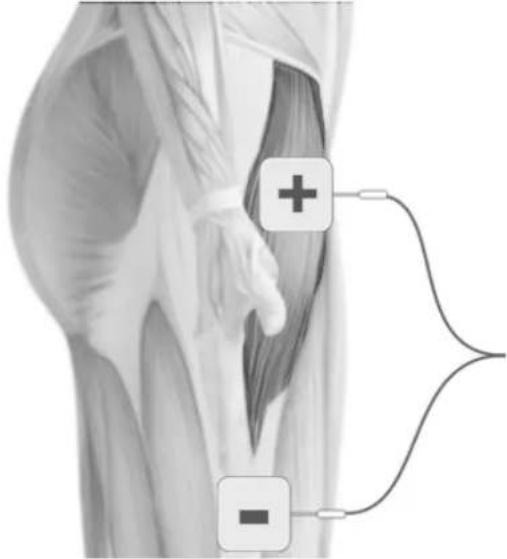
text_image
Anatomical diagram of human lower back with labeled regions marked by plus and minus signs, connected by a wire.natural_image
Anatomical diagram of human musculature with marked muscle regions and directional indicators (no text or labels)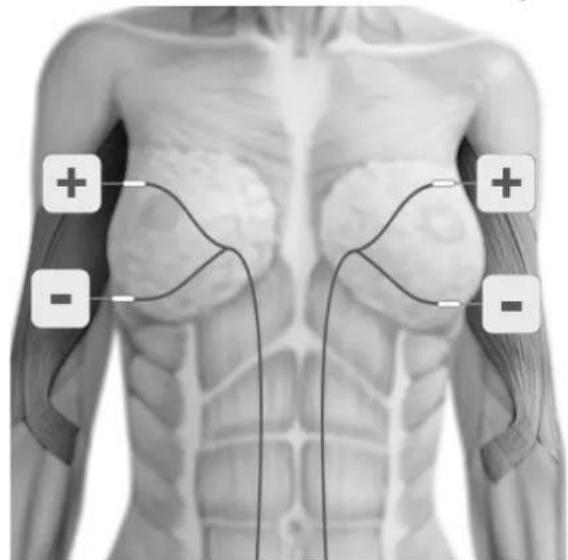
text_image
Medical diagram showing breast anatomy with labeled regions marked by plus and minus signs, likely indicating surgical or diagnostic zones.text_image
Anatomical diagram of human leg muscles with labeled regions marked as + and -, likely indicating muscle areas or regions of interest.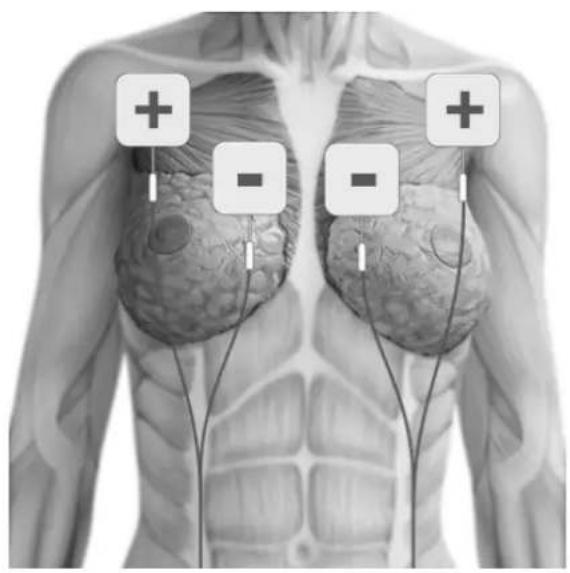
text_image
Medical illustration of human thorax with labeled anatomical markers (+, -) and medical electrodes on chest tissue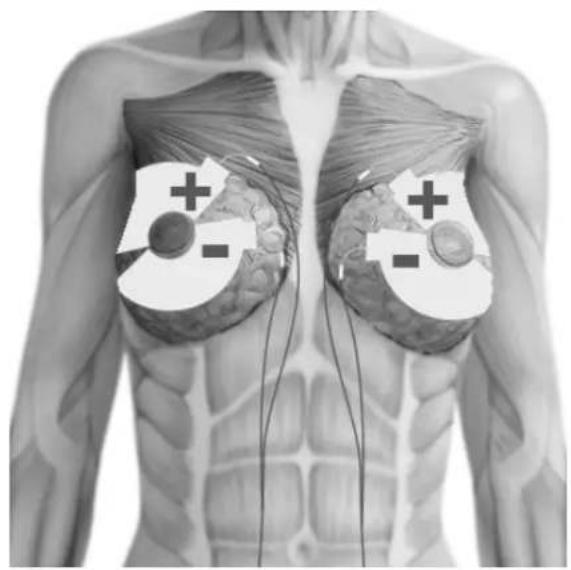
natural_image
Anatomical illustration of human thorax showing lungs, heart, and brain structures with medical markers (no text or labels)10. INHALT
natural_image
Illustration of a digital blood glucose meter with battery, charging case, and coiled cable (no text or symbols)The perfect EMS has a Memory with three functions:
natural_image
Two white electronic devices with a downward arrow indicating transformation or change (no text or symbols visible)natural_image
Close-up of a transparent plastic electronic device with visible internal components (no text or symbols)natural_image
Top-down view of a white car with two blue battery modules (labeled ①, ②, ④) and no visible text or symbols.natural_image
Line drawing of two hands holding a small object, possibly a tool or component (no text or symbols present)INFORMATIONEN ZUR PRODUKTGARANTIE
Longmead Business Park,
Epsom, Surrey
KT19 9BE, UK
https://ec.europa.eu/docsroom/documents/36683/attachments/1/translations/en/renditions/pdf
19. ALLGEMEINE SPEZIFIKATIONEN

TensCare aim to give you the best possible product and service. We listen to your suggestions and are constantly trying to improve our products. We also want to learn about the way our products are used, and the benefits they give. If you have anything you would like to share with us, please get in touch.
www.tenscare.co.uk
Follow us:

TensCare Ltd

@TensCareLtd

TensCare Limited

@tenscareltd
CE
2797
EC Declaration of Conformity
TensCare Ltd hereby declare that an examination of the production quality assurance system has been carried out following the requirements of the UK national legislation according to Annex V of the Directive 93/42/EEC on medical devices. We certify that the production quality system conforms with the relevant provisions of the aforementioned legislation, and the result entitles the organization to use the CE 2797 marking on this product.
Distributed by:

TensCare Ltd
9 Blenheim Road, Epsom,
Surrey, KT19 9BE, UK
Tel: +44(0) 1372 723434
www.tenscare.co.uk

Advena Ltd
Tower Business Centre
2nd Flr, Tower Street
Swatar, BKR 4013, Malta