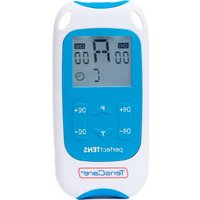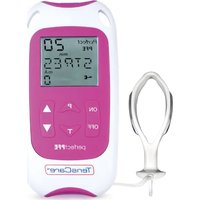
Perfect PFE - Electronic muscle stimulator TensCare - Free user manual and instructions
Find the device manual for free Perfect PFE TensCare in PDF.



| Product type | Electronic pelvic floor muscle stimulator |
| Brand | TensCare |
| Model | Perfect PFE |
| Dimensions | 120 x 60 x 20 mm |
| Weight | 75 g (without batteries) |
| Power supply | 2 AA alkaline batteries or 2 AA NiMH batteries |
| Preset programs | 5 (STRES, URGE, MIXED, TONE, PAIN) |
| Maximum intensity | 99 mA (at 500 Ω load) |
| Waveform | Asymmetric rectangular |
| Pulse frequency | 4 to 50 Hz depending on program |
| Treatment duration | 10, 20, 30, 45, 60, 90 min or continuous |
| Main functions | Memory (program, number of uses, time), key lock, open circuit detection, backlight |
| Maintenance and cleaning | Clean the probe with an alcohol-free antibacterial wipe or with warm soapy water after each use. Clean the unit and cable once a week. |
| Safety | Contraindicated in pregnancy, pacemaker, active infection, pelvic injuries, cancer. Warning: do not use while driving or with other medical devices. |
| Spare parts and repairability | Liberty Loop vaginal probe (X-VPL), anal probe (X-PR13), cable (L-CPT), self-adhesive electrodes (E-CM5050). No user-serviceable parts. 2-year warranty on the device. |
| General information | Class IIa medical device. Home use. Battery life: approximately 15 hours at 50 mA. Probe replacement recommended every 6 months. |
Frequently Asked Questions - Perfect PFE TensCare
User questions about Perfect PFE TensCare
0 question about this device. Answer the ones you know or ask your own.
Ask a new question about this device
Download the instructions for your Electronic muscle stimulator in PDF format for free! Find your manual Perfect PFE - TensCare and take your electronic device back in hand. On this page are published all the documents necessary for the use of your device. Perfect PFE by TensCare.
USER MANUAL Perfect PFE TensCare
natural_image
Abstract purple line drawing resembling a stylized letter 'P' with a looped shape (no text or symbols)perfect
PFE
text_image
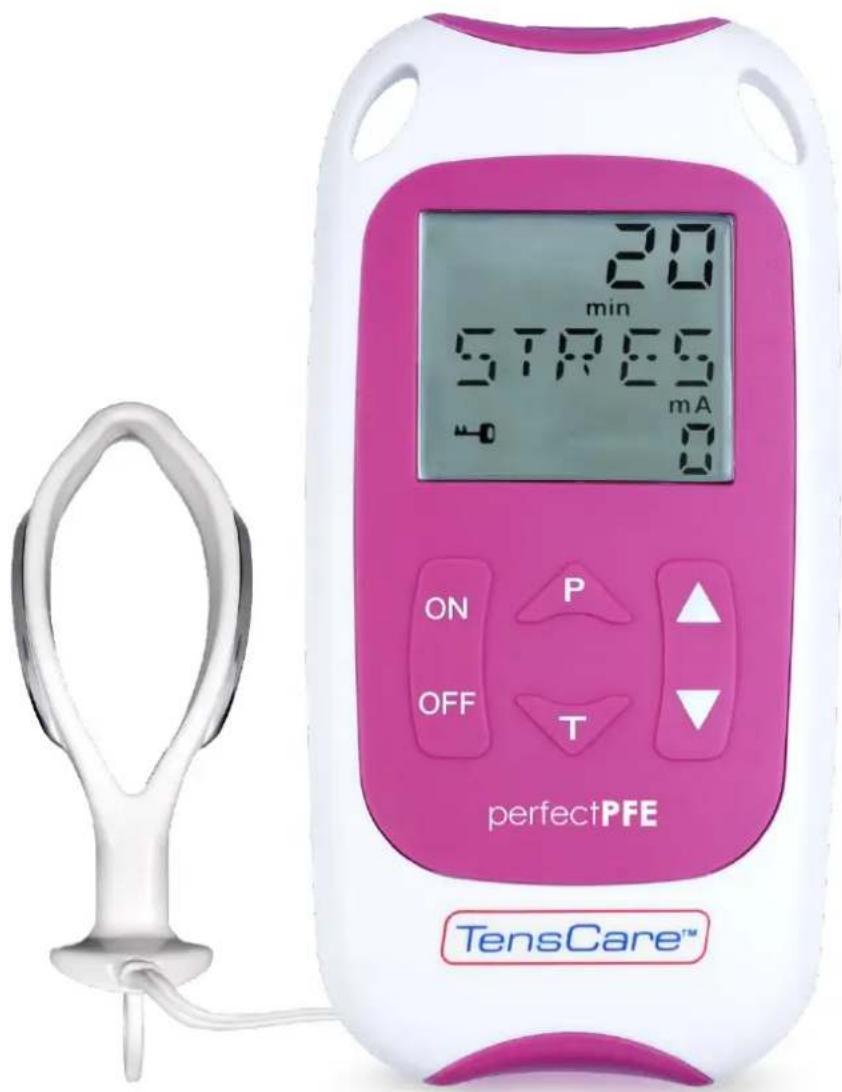
20 min STRES mA 0 0 ON P OFF T perfectPFE TensCare™QUICKSTART GUIDE
natural_image
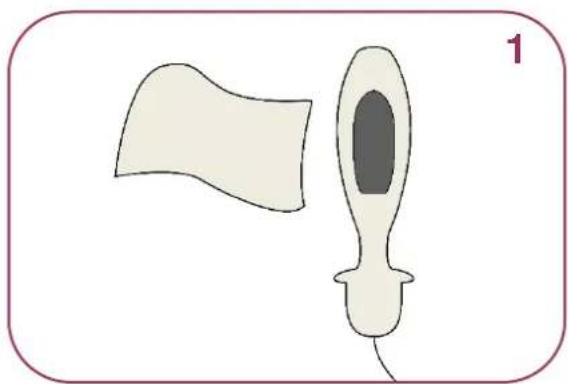
Simple line drawing of a flag and a stylized object with a dark oval shape, no text or symbols present.Clean the probe with an alcohol-free anti-bacterial wipe or with warm soapy water
Regulate the output intensity with ▲ and ▼
Connect the unit with the vaginal probe and insert the probe
Select the programme by pressing the button P
Thank you for choosing perfect PFE. TensCare stands for high-quality, thoroughly tested products for the applications in the areas of gentle electrotherapy, muscle toning, continence management and pain relief during labour.
Please read these instructions for use carefully and keep them for later use and observe the information they contain.
Best regards,
Your TensCare Team

CONTENTS
- INTRODUCTION....5
- INTENDED USE....5
- PERFECT PFE FEATURES....5
- PELVIC FLOOR EXERCISES 6
4.1. PELVIC FLOOR MUSCLES 6
4.2. PERFORMING PELVIC FLOOR EXERCISES 7
- TYPES OF INCONTINENCE 8
- HOW 'EMS' WORKS....9
- HOW 'TENS' WORKS....10
- CONTRAINDICATIONS, WARNINGS & CAUTIONS...... 11
- INFORMATION ABOUT THE PROGRAMME SETTINGS 14
- PROGRAMMES 15
10.1. PROGRAMME SETTINGS 15
10.2. PRESET PROGRAMMES 15
- CONTENT 16
- UNIT INFORMATION.... 17
12.1. CONTROLS & DISPLAY 17
12.2. OPERATING INSTRUCTIONS.... 18
- SETTING UP AND USING THE PERFECT PFE 20
13.1. INSTALLATION OF BATTERIES....20
13.2. CONNECTING LEAD WIRE 21
13.3. PREPARING FOR SESSION 21
13.4. TRAINING SESSION....22
13.5. AFTER YOUR TRAINING SESSION 24
- ANAL PROBE 24
14.1. CONDITIONS THAT MAY BE TREATED....24
14.2. HOW TO INSERT THE ANAL PROBE 25
- CLEANING 26
- EMC 26
- DISPOSAL OF WASTE ELECTRICAL AND ELECTRONIC PRODUCTS (WEEE) 26
- ACCESSORIES 27
- WARRANTY....27
- TROUBLESHOOTING 29
- GENERAL SPECIFICATION....31
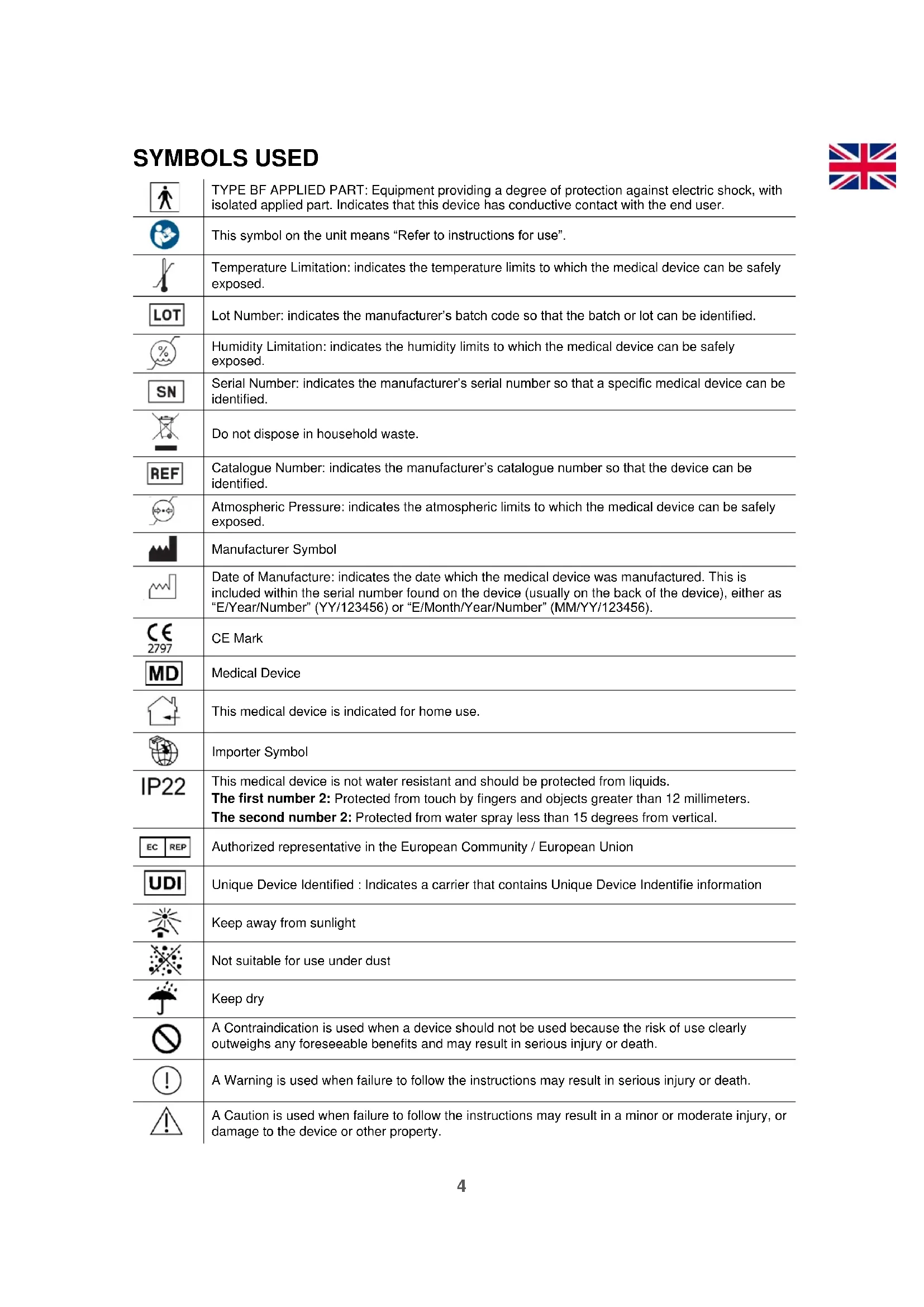
SYMBOLS USED
| TYPE BF APPLIED PART: Equipment providing a degree of protection against electric shock, with isolated applied part. Indicates that this device has conductive contact with the end user. | |
| This symbol on the unit means “Refer to instructions for use”. | |
| Temperature Limitation: indicates the temperature limits to which the medical device can be safely exposed. | |
| Lot Number: indicates the manufacturer's batch code so that the batch or lot can be identified. | |
| Humidity Limitation: indicates the humidity limits to which the medical device can be safely exposed. | |
| Serial Number: indicates the manufacturer's serial number so that a specific medical device can be identified. | |
| Do not dispose in household waste. | |
| Catalogue Number: indicates the manufacturer's catalogue number so that the device can be identified. | |
| Atmospheric Pressure: indicates the atmospheric limits to which the medical device can be safely exposed. | |
| Manufacturer Symbol | |
| Date of Manufacture: indicates the date which the medical device was manufactured. This is included within the serial number found on the device (usually on the back of the device), either as “E/Year/Number” (YY/123456) or “E/Month/Year/Number” (MM/YY/123456). | |
| CE Mark | |
| Medical Device | |
| This medical device is indicated for home use. | |
| Importer Symbol | |
| IP22 | This medical device is not water resistant and should be protected from liquids.The first number 2: Protected from touch by fingers and objects greater than 12 millimeters.The second number 2: Protected from water spray less than 15 degrees from vertical. |
| Authorized representative in the European Community / European Union | |
| Unique Device Identified : Indicates a carrier that contains Unique Device Indentifie information | |
| Keep away from sunlight | |
| Not suitable for use under dust | |
| Keep dry | |
| A Contraindication is used when a device should not be used because the risk of use clearly outweighs any foreseeable benefits and may result in serious injury or death. | |
| A Warning is used when failure to follow the instructions may result in serious injury or death. | |
| A Caution is used when failure to follow the instructions may result in a minor or moderate injury, or damage to the device or other property. |

1. INTRODUCTION
Device Description & Principles of Design
Bladder leakage and incontinence are common problems for both women and men, affecting their long-term health. Exercising the pelvic floor muscles is recognised as the way of preventing and treating symptoms of incontinence and pelvic floor weakness.
The perfect PFE is a powered muscle stimulator used for strengthening the pelvic floor muscles.
It sends a gentle stimulation (similar to your natural nerve impulses) direct to your pelvic floor muscles through a vaginal probe with stainless steel electrodes. These signals make your pelvic floor muscles contract. If you have forgotten how to contract them, are having trouble getting muscle response, or simply want to bring back the condition of your pelvic floor muscles, the perfect PFE can work them for you to build up their strength and help you to develop your own muscle control. It perfectly complements pelvic floor exercises. The perfect PFE is very easy to use, with four clearly labelled preset training programmes, a fifth programme for chronic pelvic pain and a simple push button control.
Clinical Benefit
Clinical benefits of using the Perfect PFE include:
- Improvement in quality of life in relation to urinary incontinence.
- Improvement in frequency of stress urge and mixed incontinence, urine leakage and urgency episodes.
- Pain reduction of chronic pelvic pain.
2. INTENDED USE

Perfect PFE is a medical device designed to be used in the home healthcare environment to treat symptoms of urinary incontinence.
Perfect PFE may help to relieve symptoms of chronic pelvic pain.
Perfect PFE is suitable for use by adults (18 years+) who can control the device and understand the instructions.
Do not use the device for any purpose other than this intended use.
3. PERFECT FEATURES
PFE
- Single Channel
Single channel unit to treat symptoms of urinary incontinence via a probe with biofeedback pointer.
• Comfortable Stimulation
Gentle stimulation with fine tune adjustment settings for different levels of intensity, 1 mA per step.
- 5 Preset Programmes
EMS programmes including STRES, URGE, MIXED and TONE aftercare; and additional TENS programme providing relief from pelvic pain.
- Memory
Features 3 functions: programme retention (automatically starts in the last programme used), number of uses and time of usage.
- Treatment Timer
Unit defaults to 20 minutes' treatment to ensure the pelvic floor muscles are not over-worked. The user can manually reset this (Continuous, 10, 20, 30, 45, 60 or 90 mins).
- Open Circuit Detection
Automatically resets the strength to zero and flashes 'LEADS' if the connection comes loose.
• Automatic Keypad Lock
Automatic keypad lock prevents any accidental changes in settings.
• Large LCD Screen
Clearly shows the operation of the unit and the programme and intensity being used.
4. PELVIC FLOOR EXERCISES
4.1. PELVIC FLOOR MUSCLES
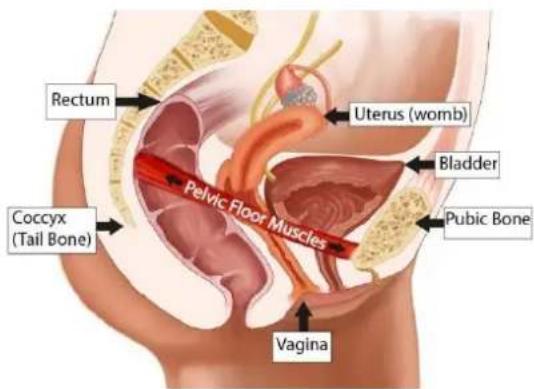
The “FLOOR” of your pelvis is made up of layers of muscles that support the bowel, bladder, urethra and uterus. These muscles are like a hammock, or the bottom and sides of a bowl, in shape. They run from the pubic bone in the front to the end of the spinal column (or tail bone) in the back.
text_image
Rectum Uterus (womb) Coccyx (Tail Bone) Pelvic Floor Muscles Bladder Pubic Bone Vagina
The pelvic floor muscles:
- Assist in supporting the abdominal and pelvic organs.
- Work with the abdominal and back muscles to stabilise and support the spine.
• In women, also
o provide support for the baby during pregnancy and
- assist in the birthing process
Pelvic floor muscles are also important for sexual function.
- In women, voluntary contractions (squeezing) of the pelvic floor contribute to sexual sensation and arousal.
However pelvic floor muscles may become weak. If your pelvic floor muscles become stretched or weakened, your pelvic organs may no longer be fully supported and you may lose control of your bladder or bowel movements.
For some women, the pelvic floor muscles can also become too tight. This condition is less common, but it can lead to pelvic pain and make it difficult for you to empty your bladder or bowel completely.

Common signs that can indicate a pelvic floor problem include:
- Accidentally leaking urine when you exercise, laugh, cough or sneeze
- Needing to get to the toilet in a hurry or not making it there in time
- Constantly needing to go to the toilet
• Finding it difficult to empty the bladder or bowel - Accidentally losing control of the bladder or bowel
- Accidentally passing wind
- Pain in your pelvic area
- Painful sex, or
- A prolapse
In women, this may be felt as a bulge in the vagina or a feeling of heaviness, discomfort, pulling, dragging or dropping. This occurs when one or more of the pelvic organs (bladder, bowel or uterus) become displaced and sag down into the vagina. It is very common in the United Kingdom and occurs in about 40% of women. Symptoms tend to become exacerbated towards the end of each day and if left untreated, they will generally worsen over time.
In men, this may be felt as a bulge in the rectum or a feeling of needing to use the bowel but not actually needing to go.
Like other muscles in your body, the pelvic floor can be strengthened with regular exercise. Building pelvic floor strength enables the muscles to better support your pelvic organs, improves your bladder and bowel control and can stop accidental urine, faeces or wind leakage.
It can also reduce your risk of prolapse, improve your recovery from childbirth and gynaecological surgery, and increase your sexual pleasure. A continence therapist can help you learn how to exercise your pelvic floor.
Doing just a few pelvic floor exercises every day will help to treat bladder weakness or prolapse symptoms, and will help to prevent problems later on.
4.2. PERFORMING PELVIC FLOOR EXERCISES
It is recommended to make Pelvic Floor Exercises (sometimes called Kegel Exercises) part of your daily life.
1) Kegel exercises can be done at any time and are very discreet so you can do them almost anywhere; lying in bed, sitting at the computer or waiting for a bus. It is a good idea to try and develop a routine which you can repeat each day.
2) First, it is important to find your pelvic floor muscles and feel them working. So here are a couple of techniques which might help:
Try inserting one or two clean fingers into your vagina and then squeezing the surrounding muscles, lifting up and towards your belly button – a squeezing and lifting sensation.
Another way is to try and stop the flow of urine during urination. If you are successful, then you know you are exercising the correct muscles.
Note: These techniques are just to help you confirm that you are using the correct muscles. It is important to have an empty bladder before starting the exercises.
3) Try to remember the lifting and squeezing sensation and when you are ready try to recreate it just using the muscles you identified earlier; don't tense the muscles in your legs, stomach or buttocks and remember to breathe normally.
4) Aim to hold each squeeze or 'contraction' for three to five seconds, then release and relax. You should feel a 'letting go' of the muscles. Rest for five seconds and then repeat.
5) Try and do about ten squeezes in this way.
6) Repeat the whole process three or four times a day.
7) Over a period of time try to increase the muscle contractions up to about ten seconds, but remember to rest in between each squeeze for longer periods.
Note: It is important to aim for quality contractions, not quantity, so a few good hard squeezes are better than a series of weak ones.
Do not worry if you find holding for 3 seconds difficult at first. Just squeeze for as long as you feel comfortable to do so. The more exercise you do, the stronger the muscles will become and the longer you will be able to squeeze.
8) Using your perfect PFE pelvic floor stimulator in conjunction with Kegel exercises will give you a better understanding of how they work and how to get the greatest benefit from them.
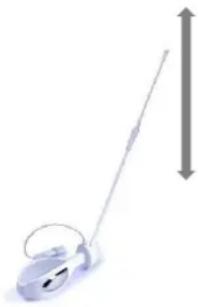
Use the pointer as an indication of how well you are performing the Kegel exercises.
- When performed correctly, the pointer will move downwards.
- When performed incorrectly, the pointer will move upwards.
natural_image
Illustration of a handheld vacuum cleaner with a vertical arrow indicating motion (no text or symbols)
5. TYPES OF INCONTINENCE
There are three types of incontinence: Stress, Urge, and Mixed
Stress Incontinence
If you leak urine when you cough, sneeze, laugh, strain or make sudden movements, this is called Stress Incontinence.
It is particularly common in women who have had a natural childbirth and occurs when the bladder neck and the other mechanisms that act to hold urine in the bladder are not working properly. The most common cause is a weak pelvic floor.
Urge Incontinence
Describes an overactive bladder. A person may experience a strong and sudden urge to go to the toilet but are not always able to hold on, or must go so frequently that it becomes inconvenient.
Mixed Incontinence
Is a combination of both Stress and Urge Incontinence.
Chronic Pelvic Pain
Pelvic pain can be due to several causes such as:
Vulvodynia, Symphysis Pubis, or Interstitial Cystitis.
6. HOW 'EMS' WORKS
E.M.S. stands for Electrical Muscle Stimulation and has successfully been used in medical rehabilitation and training in competitive sports. EMS produces intensive and effective muscular contraction.
In rehabilitation, EMS is a well-established method for treatment of a broad field of musculoskeletal diagnoses as well as pelvic floor weakness. Electrical stimulation of an intact peripheral nervous system may create motor responses in patients with impaired or lost ability for voluntary muscle activity.
EMS is a complement to other physical therapy and should always be combined with active training such as Kegel exercises (see section 4.2.).
Advantages of EMS
Use of EMS may lead to faster progress in the patient's treatment programme. The method is simple and appropriate for treatment in the clinical setting as well as for self-treatment at home.
How EMS Works
Electrical Muscle Stimulators can play a vital role in educating women and men about their pelvic floor and the sensation they should feel when doing pelvic floor exercises. Electrical Pelvic Floor Exercisers (PFE) offer a non-invasive method of producing contraction of muscles via a gentle stimulation to the pelvic floor through a discreet probe or electrode pads when they are placed close to the nerve that controls the pelvic floor muscles. This current then passes into the nerve fibres controlling that part of the muscle stimulating it to contract. So, electrical stimulation (EMS) artificially activates a muscle for you enabling you to develop your own muscle control. These contractions exercise the muscles and, as with any kind of exercise if performed regularly, build strength and tone.
In urge incontinence, pelvic floor exercisers work in a slightly different way. The electrical stimulation is designed to soothe your bladder muscles rather than exercise your pelvic floor. Perfect PFE uses a gentler, low frequency setting which promotes release of endorphins and reduces involuntary contractions of the bladder (detrusor) muscle.
Different frequencies have different effects; low frequencies (1-10 Hz) coupled with long impulse times, for example, have a purifying and relaxing effect through individual contractions, whereby the circulation in the treated muscle is simultaneously improved and removal of metabolic end products is supported (lymphatic drainage).
In contrast, by means of a rapid succession of contractions (fibrillation), medium frequencies (20-50 Hz) can put a high level of strain on the muscle, thus promoting the muscular structure.
Each preset programme has a specific frequency and pulse width that will offer the best results for the type of incontinence treated.
7. HOW 'TENS' WORKS
T.E.N.S. stands for Transcutaneous Electrical Nerve Stimulation. T.E.N.S. stimulates your body's own natural defences against pain, namely the release of endorphins. TENS is totally safe and has been used successfully by thousands of pain sufferers.
TENS sends a gentle stimulation through the skin which works in TWO ways:
Pain Gate
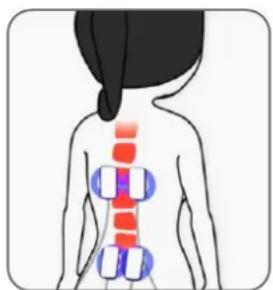
It stimulates the sensory nerves, which carry touch and temperature signals. These nerves go to the same connections in the spine as the nerves carrying pain. A strong sensory signal will block the pain
natural_image
Illustration of a human back with colored anatomical markers (no text or symbols)signal travelling up the spine to the brain. This is known as closing the "Pain Gate" and takes effect quite quickly after the unit is switched on. When the gate is open, pain messages get through to the brain and we feel pain. When the gate is closed, these pain messages are blocked and we do not feel pain.
Evidence suggests that TENS produce pain relief in a similar way to ‘rubbing the pain better’. The pain gate can be closed by activation of mechanoreceptors through ‘rubbing the skin’.
Scientifically, the pain gate works by release of chemical in the synapse at spinal level that inhibits transmission of pain signal.
Endorphin Release
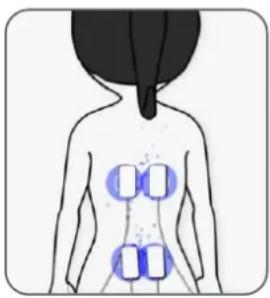
At low frequency settings, and slightly stronger outputs, TENS drives the motor nerves to produce a small repetitive muscle
natural_image
Human back with four blue rectangular markers on the back, indicating areas of interest or emphasis (no text or symbols present)contraction. This is seen by the brain as exercise, and this promotes the release of endorphins - your body's own natural pain killer. The relief builds up and normally takes about 40 minutes to reach a maximum level which can last for hours after the machine is switched off.
By using TENS, you can expect to achieve a significant reduction in pain - if not complete relief from pain.
- TENS is effective for pain from a very wide range of causes.
- TENS machines can be used to help reduce pain from problems in muscles, joints and nerves.
- It can be also used for people with musculoskeletal pain such as long-term (chronic) back pain or knee joint arthritis. They are also often used for pain relief in the early stages of labour (see perfect mamaTENS), particularly whilst a pregnant woman remains at home.


- TENS may also be used to treat many types of pain, such as period pain and endometriosis (see Ova+), cystitis, sports injuries, fibromyalgia and neuralgia, plantar fasciitis, post-operative pain, TMJ disorder, diabetic neuropathy, osteo-arthritis and sometimes non-painful conditions such as travel sickness.
- You can use low frequency (<10 Hz) programmes on acupuncture points, to achieve similar effects to acupuncture.
- With neurogenic pain (caused by inflamed nerves) such as neuralgia, TENS may start by increasing the pain. We recommend that you only use TENS for these conditions under medical supervision.
- You can safely use TENS as long as it gives you pain relief. The effect may wear off after a few hours (this is called “accommodation”). If this happens, take a break of an hour or so before trying again. If you use settings that cause muscle movement for more than 40 minutes, you may experience aching muscles a few hours later.
8. CONTRAINDICATIONS, WARNINGS & CAUTIONS

CONTRAINDICATIONS:
Do NOT use if you are or may be pregnant. It is not known whether TENS may affect foetal development.
Do NOT use with optional electrode pads if you have a pacemaker (or if you have a heart rhythm problem) or with any electronic medical devices. Using this unit with electronic medical devices may cause erroneous operation of the device. Stimulation in the direct vicinity of an implanted device may affect some models.
Do NOT use in the first 6 weeks following a pelvic surgery or vaginal childbirth. Stimulation may disrupt the healing process.
Do NOT use if you have symptoms of active urinary tract infection, vaginal infections, or localized lesions. Introducing the probe may irritate sensitive tissue.
Do NOT use if you have poor sensation in the pelvic region. You may not be able to control the intensity of stimulation safely.

WARNINGS:
Do NOT use if you are unable to properly insert the vaginal or anal probe. If you have a severe prolapse, or if any discomfort occurs when inserting the probe, consult your healthcare professional before use.
Do NOT use when driving, operating machinery, or similar actions needing muscular control. Loose electrode pads, damaged leads, or sudden changes in contact may cause brief involuntary muscle movements.
Do NOT use to mask or relieve undiagnosed pain. This may delay diagnosis of a progressive condition.
Do NOT use if you have, in the area being treated: active or suspected


cancer or undiagnosed pain with a history of cancer. Stimulation directly through a confirmed or suspected malignancy should be avoided as it may stimulate growth and promote spread of cancer cells.
Do NOT use optional electrodes on the front of the neck. Stimulation on the front of the neck can affect your heart rate or cause contraction of the throat.
Do NOT use optional electrodes across the chest. Very strong stimulation across the chest may cause an extra heartbeat and/or rhythm disturbances to your heart, which could be lethal.
Do NOT use perfect PFE while simultaneously connected to high frequency surgical equipment as it may result in burns at the site of stimulator electrodes and possible damage to the stimulator.
Do NOT use perfect PFE in close proximity (e.g. 1 m) to a shortwave or microwave as this may produce instability in the stimulator output.
Do NOT use electrodes near the thorax as this may increase the risk of cardiac fibrillation.
Do NOT use optional electrodes if they have lost their adhesion. Treatment effectiveness may be reduced.

CAUTIONS:
Caution should be used if you have a bleeding disorder as stimulation may increase blood flow to the stimulated region.
Caution should be used if you have suspected or diagnosed epilepsy as electrical stimulation may affect seizure threshold.
Caution should be observed when using the device at the same time as being connected to monitoring equipment with body worn electrode pads. It may interfere with the signals being monitored.
Caution Do not permit use by persons unable to understand the instructions or persons with cognitive disabilities, i.e.; Alzheimer's disease or dementia.
Caution: Insertion of the vaginal or anal electrode makes it unsuitable for use in children without clinical supervision
Caution: Keep away from children under 5 years of age. Long lead wire - risk of strangulation in infants.
Caution should be observed when using the perfect PFE at high strength settings. Prolonged use at high settings may cause muscle injury or tissue inflammation.
Caution Not intended for use in an oxygen rich environment.
Caution Not intended for use in conjunction with flammable anaesthetics or flammable agents.
Caution The patient is an intended operator.
Caution Do not service and maintain the device while in use.
Caution Maintenance and all repairs should only be carried out by an authorized agency. The manufacturer will not be held responsible for the results of maintenance or repairs by unauthorized persons.
If necessary, we will provide circuit diagrams, component part lists or other information that will assist authorized service personnel to repair the device.
Caution The operator should not touch the patient at the same time when touching the battery output.
Caution Keep away from pets and pests
Caution: should be observed when using the Perfect PFE at high strength settings. Perfect PFE has a Yellow LED light on output socket which means the output will exceed 10 mA (R.M.S) or 10 V (R.M.S) averaged over any period of 1 sec. Prolonged use at high settings may cause muscle injury or tissue inflammation.
Note: No serious or long term adverse effects have been reported. Mild adverse reactions are very rarely reported, but these have included muscular pain and cramps, vaginal tenderness, irritation and bleeding, mild or short term urge incontinence, and tingling sensation in legs. If you experience any of these, stop use. When symptoms have gone, try resuming at a lower intensity setting.
PROBE CAUTIONS:
Caution: The perfect PFE vaginal probe is intended for single patient use only. Do not share your perfect PFE probe with anyone else. Improper treatment or cross-infection may occur.
Caution: It is important that the vaginal probe is cleaned after each use. Ineffective cleaning may lead to irritation or infection.
Caution: Never insert or remove vaginal probe unless the control unit is powered OFF as insertion or removal when stimulation is active may cause discomfort or tissue irritation.
Caution: If tissue irritation occurs, discontinue treatment immediately. Ask your healthcare professional for advice before continuing further treatment to prevent injury.
Caution: Do not use a silicone based lubricant on the metal plates of the probe as it may decrease the effectiveness of perfect PFE's muscle stimulation.
Caution: Do not use this device with vaginal probe or anal probe other than those recommended by the manufacturer in section 18. Electrodes with smaller surface area may cause tissue irritation.
Caution: The probe should be replaced every 6 months to ensure hygiene. Do not use if broken, damaged or showing signs of degradation.
DO NOT PLACE OPTIONAL ELECTRODE PADS:
- On skin, which does not have normal sensation. If the skin is numb too great a strength may be used, which could result in skin inflammation.
- On broken skin. The electrode pads could encourage infection.
ELECTRODE PADS CAUTION:
Caution: Do not ignore any allergic reaction to the electrode pads: If a skin irritation develops, stop using TENS, as this type of electrodes may not be suitable for you. Alternative electrode pads specially made for sensitive skin are available (see E-696-SS).
Caution: Do not use this device with leads or electrode pads other than those recommended by the
manufacturer. Performance may vary from specification. Electrodes with smaller surface area may cause tissue irritation.
Caution: Do not use high intensity settings if electrodes are smaller than 50x50mm.
TO KEEP YOUR DEVICE IN GOOD WORKING ORDER, OBSERVE THE FOLLOWING ADDITIONAL CAUTIONS:
Caution: Do not immerse your device in water or place it close to excessive heat such as a fireplace or radiant heater or sources of high humidity such as a nebulizer or kettle as this may cause it to cease to operate correctly.
Caution: Keep the device away from sunlight, as long-term exposure to sunlight may affect the rubber causing it to become less elastic and crack.
Caution: Keep the device away from lint and dust, as long-term exposure to lint or dust may affect the sockets or cause the battery connector to develop a bad contact.
Caution: Temperature & Relative Humidity of storage: -10^-+60^ , 15%--75% R.H. Temperature & Relative Humidity of transportation: -10^-+60^ , 15%--75% R.H.
Caution: There are no user serviceable parts. Do not attempt to open or modify the TENS unit. This may affect the safe operation of the unit and will invalidate the warranty.
Note: The Perfect PFE has no essential performance characteristics. Device failure will not cause unacceptable clinical risk for the user.
9. INFORMATION ABOUT THE PROGRAMME SETTINGS

Each programme has its own combination of Frequency and Pulse Width settings which allow for different sensations through the probe or optional electrode pads and help treating the different types of incontinence.
- Frequency (measured in Hz - pulses per second)
Low frequencies (1-10 Hz) have a purifying and relaxing effect through individual contractions.
Medium frequencies (20-50 Hz) can put a high level of strain on the muscle, thus promoting the muscular structure
Endorphin release (programme PAIN only): A low frequency of 4 or 10 Hz allows for the release of endorphins, the body's natural morphine-like substances.
- Pulse Width (measured in s - millionths of a second)
The perfect PFE unit has pulse widths of 200 to 300 s. Generally speaking, the higher the pulse width, the more "aggressive" the stimulation feels, if the pulse width is set high enough, it will usually elicit a muscle contraction, which is required for an effective toning of the pelvic floor muscles.
10. PROGRAMMES
10.1. PROGRAMME SETTINGS
| Prog | STRES | TONE | MIXED | URGE | PAIN |
| Freq. (Hz) | 50 | 35 | 10 / 50 | 10 | 4 |
| Pulse width (μs) | 300 | 250 | 200 / 300 | 200 | 200 |
| Ramp Up & Down (s) | 1 | 2 | Constant | Constant | |
| Plateau (s) | 5 | 3 | |||
| Rest (s) | 10 | 6 | |||
| Default duration (min) | 20 | 20 | 20 | Continuous | Continuous |
10.2. PRESET PROGRAMMES
The perfect PFE has five preset programmes. One for each type of incontinence (stress, urge and mixed), one for toning the pelvic floor muscles (TONE), and one for chronic pelvic pain (PAIN).
STRESS INCONTINENCE:
Shown on the screen as: STRES
The STRES incontinence programme strengthens the muscles of the pelvic floor using gentle stimulation. Once these muscles are stronger they are better able to resist urinary leakage caused by external pressure being applied to the bladder such as with a cough, sneeze or physical exertion.
The stimulation causes the muscles to contract and work. This builds their strength. Like other fitness training,
successful treatment requires stimulation once a day for one to three months. Improvement starts becoming apparent after about four weeks.
The sensation is like a strong drawing in of the muscles of the vagina, pulling up the pelvic floor. Your natural reaction will be to pull your muscles in and up, and this exercises and strengthens them.
URGE INCONTINENCE:
Shown on the screen as: URGE
The URGE programme works in a different way to the STRES programme. The gentle continuous stimulation soothes the bladder (detrusor) muscle, reducing its involuntary contractions. This prevents the unwanted and unexpected emptying of the bladder.
Successful treatment requires stimulation once a day and improvements can sometimes be seen in as little as two weeks.
The sensation is a softer, vibrating, stimulation. Nevertheless, when the programme finishes, and your pelvic floor relaxes, it will become apparent how much your pelvic floor has been exercised.
MIXED INCONTINENCE:
Shown on the screen as: MIXED
This programme is perfect if you are suffering from both Stress and Urge incontinence. It is a combination of the STRES and URGE programmes.
The first 10 minutes uses the URGE programme to reduce sensitivity, then in the second 10 minutes, the STRES programme exercises the pelvic floor muscles. You may need to increase the strength to feel the muscle contraction when the STRES programme starts.
TONE:
Shown on the screen as: TONE
Once the pelvic floor muscles have been strengthened with perfect PFE, continue to exercise them.
Regular use of this programme, about twice a week, will ensure that your muscles remain fit and toned.
The TONE programme may also be used as an alternative treatment for stress incontinence.
The sensation when using the TONE programme is a mixture of a strong drawing in of the muscles and then releasing.
A strong and fit pelvic floor may increase sexual health and enjoyment.
PAIN:
Shown on the screen as: PAIN
The PAIN programme can be used to alleviate chronic pelvic pain from many causes. As with all TENS, it does not treat the underlying condition and you should obtain a professional diagnosis of the cause before starting use. It gives a constant soothing tingling sensation. Use with the Liberty Loop vaginal probe or with optional electrode pads (positioned on your lower back just below the knicker line) for at least 40
minutes two or three times a week. Set the strength as high as you can while remaining comfortable.
11. CONTENT
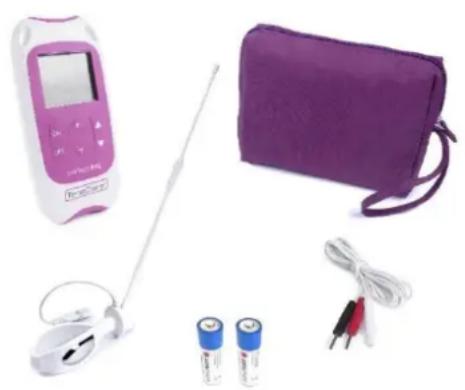
The pack contains:
• 1 x Perfect PFE continence stimulator unit
- 1 x Lead wire (L-CPT)
- 1 x Liberty Loop vaginal probe with detachable pointer (X-VPL)
• 2 x AA 1.5V alkaline batteries
- 1 x Detachable belt clip
- 1 x Storage pouch
- 1 x Manual instruction
natural_image
Product display of a handheld electronic device with a pink and purple package, two battery cells, and a coiled cable (no visible text or symbols)
12. UNIT INFORMATION
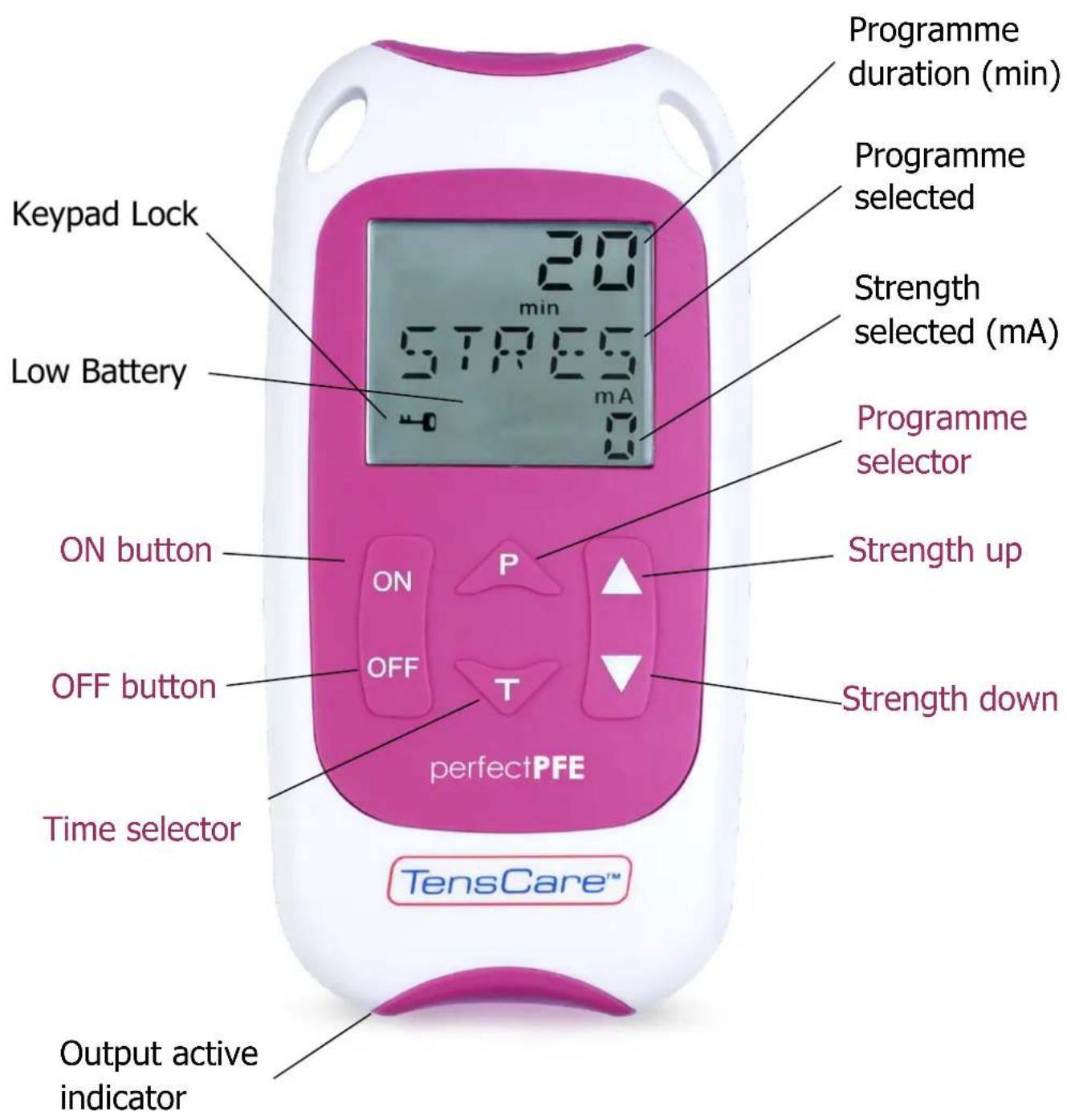
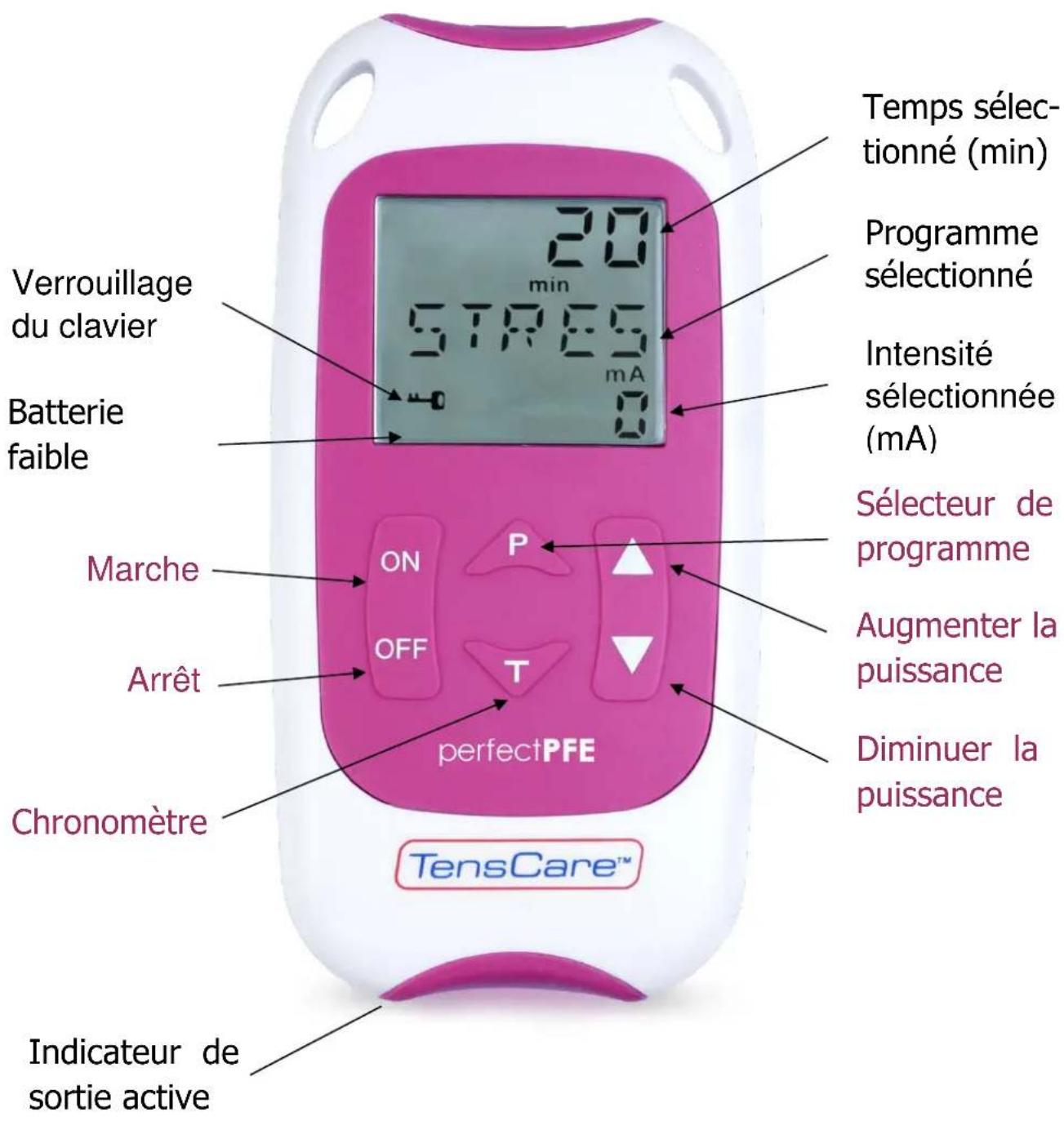
12.1. CONTROLS & DISPLAY
text_image
Keypad Lock Low Battery ON button OFF button Time selector Output active indicator 20 min STRESS mA 40 Programme duration (min) Programme selected Strength selected (mA) Programme selector Strength up Strength down perfectPFE TensCare™12.2. OPERATING INSTRUCTIONS
ON/OFF
To turn the unit on, press the ON button and hold for 3 to 5 seconds until the display shows.
To turn the unit off, press ▼ button to remove keypad lock and press the OFF button and hold for 3 to 5 seconds until the display stops.
At first use, or after changing batteries, the display shows that the unit is automatically set in programme STRES at zero strength.
When switched on the unit will automatically start in the programme which was being used when it was last switched off.
The unit will turn off automatically:
- When the Timer reaches zero,
- If it is left at zero strength for more than 5 minutes.
Note: Always check unit is OFF before applying or removing probe or pads.
The backlight will turn off 10 seconds after the last button press.

STRENGTH CONTROLS
The buttons marked ▲ and ▼ are the strength controls.
To increase strength, press and hold down the button ▲ until required strength is
achieved.
To decrease the strength, press and release the button ▼.
To increase strength in steps of 1 mA, press and release the button ▲.
The unit will remain in the WORK part of the cycle for 5 seconds while intensity is being adjusted.
The strength levels are shown on the LCD.
The strength control buttons will not operate until the unit is properly connected to you (probe inserted correctly). Perfect PFE detects a disconnection and automatically returns the strength to zero.
The unit has 99 levels of strength. If you hold down the button ▲ for 3 to 5 seconds, the strength will start scrolling.
You may feel nothing over the first few presses. Continue pressing until the sensation is strong but comfortable. Further increases during use may be necessary if your body becomes used to the sensation.
The yellow LED on the output socket indicates that there is an active output. The display will remain on for 5 seconds after the plug is removed.
PROGRAMME CONTROL

The button marked P is the programme control. The
perfect PFE has five preset programmes. At first use, the unit automatically goes to programme STRES. Next time it is switched on, it will default to the programme used last.
Each time you press and release the P button, the programme changes and is shown on the LCD.


Each time you change the programme, the strength level reverts back to zero. This is a safety feature to alleviate any sudden feeling of a surge, as each programme gives a different sensation.
TREATMENT TIMER
The button marked T can be used to set the session duration. When you switch the unit on, it is automatically set at 20 min or Continuous, (displayed as C) depending on the programme chosen.
To set a different time, set the strength to zero and press T. The min display will flash.
You can set session times of C (Continuous) or 10, 20, 30, 45, 60 or 90 minutes with the buttons ▲ and ▼.
Press T again to save your selection.
The LCD shows the session duration next to the clock symbol. The unit automatically counts down the minutes set and switches off when it reaches 0.
LOW BATTERY

An empty battery symbol will show when you need to change the batteries. The unit will shut down about 2 minutes after this.
KEYPAD LOCK

If you do not press any keys for 30 seconds, the keypad will lock. This is to avoid accidental changes in setting.
To unlock, press and hold the strength down control (button ▼).
LEADS ALARM
The perfect PFE monitors the connection and the contact between you and the probe, or the pads. This is to prevent sudden changes if a broken connection is re-made. If poor connection is detected, the display will flash “LEADS” and the intensity will revert to zero.
Check the lead and if necessary, lubricate the probe with a water based lubricant such as TensCare Go Gel (see K-GO). Please see section 20 for more troubleshooting tips.
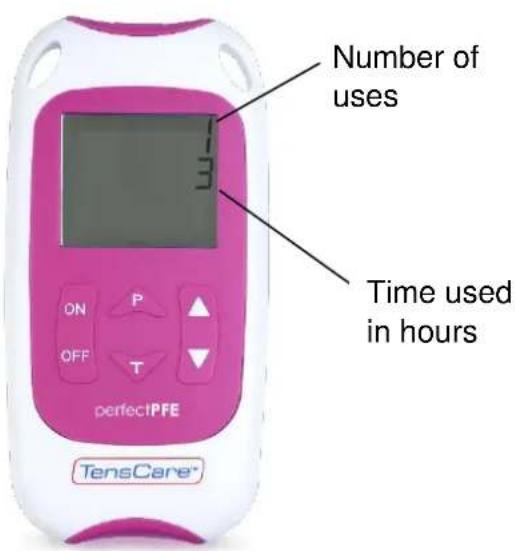
MEMORY
The perfect PFE has a Memory with three functions:
1) Programme Retention. When you switch the unit on, it will automatically start in the programme which was being used when it was switched off.
2) Usage. Press T and ▼ together and hold down for 3 to 5 seconds. The display will show the number of times the unit has been used and the duration of use in hours.
Press the same buttons again to return to normal controls.
3) Memory Reset. To reset memory to zero, hold down the T and OFF buttons together for 3 to 5 seconds.
text_image
Number of uses 3 ON P OFF T Time used in hours perfectIPFE TensCare®13. SETTING UP AND USING THE PERFECT PFE
13.1. INSTALLATION OF BATTERIES
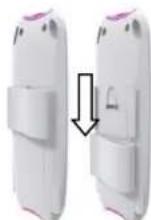
1) Remove belt clip by sliding down.
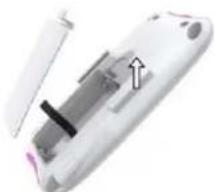
2) Remove battery cover by pulling on tag.
natural_image
Close-up of a transparent electronic device with internal components and an arrow indicating a specific area (no text or symbols visible)3) Insert batteries.
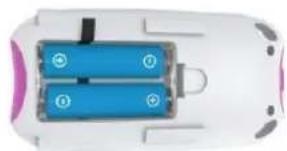
natural_image
Top-down view of a white electronic device with two blue battery modules and a black cable (no text or symbols visible)Ensure that the batteries are inserted the right way as shown in battery compartment and that the ribbon is behind them.
4) Replace battery cover and belt clip.

When the batteries are running low, a low battery indicator will show on the screen and it is important to change the batteries as soon as possible.
Rechargeable batteries
The unit will work with rechargeable batteries, but the display may appear dim.

Caution: Remove batteries from your perfect PFE if the unit is unlikely to be used for a long period. Some types of batteries may leak corrosive fluid.
Battery Life
Batteries should last at least 15 hours at 50 mA, 300 s, 50 Hz.
Unused batteries have a nominal shelf life of 3 years, but will usually last longer than this.

Battery Warnings
Do NOT pierce, open, disassemble, or use in a humid and/or corrosive environment.
Do NOT expose to temperatures over 60°C(140F).
Do NOT put, store or leave near sources of heat, in direct

strong sunlight, in a high temperature location, in a pressurized container or in a microwave oven.
Do NOT immerse in water or sea water, or get wet.
Do NOT short-circuit.
Do NOT connect the device unless the battery cover is in place.
If battery leakage occurs and comes in contact with the skin or eyes, wash thoroughly with lots of water and immediately seek medical attention.

Warning: Keep batteries out of the reach of children to prevent
them from swallowing them by mistake. If swallowed by child, contact doctor immediately.

Caution NEVER attempt to recharge an alkaline battery.
Risk of explosion.

Caution Do not mix old, new or different types of batteries as
this may lead to battery leakage or low battery indication.
Disposal: Always dispose of batteries and device responsibly according to local government guidelines. Do not throw batteries onto a fire. Risk of explosion.
13.2. CONNECTING WIRE
LEAD
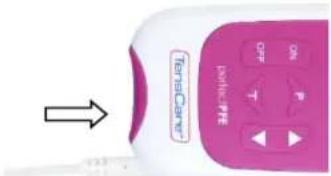
Insert the lead wire plug into the base of the unit.
text_image
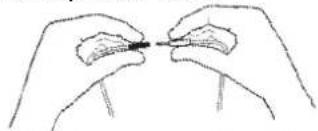
TetraCherry Control buttonsConnect the lead from the base of the unit to the lead in the probe.
Push the pin ends firmly into the pigtail ends of the probe lead.
natural_image
Line drawing of two hands holding a small object, possibly a tool or component (no text or symbols present)The lead wires may be damaged by rough handling, and should be treated with care.
Lead wire colour coding.
The ends of the lead wire are coloured black or red. This coding is provided for some professional uses. For most purposes, the orientation makes no difference, and you can ignore this colour coding.
13.3. PREPARING SESSION
FOR
1) Before using perfect PFE you will need to visit the toilet.
2) Lubricate the metal electrode surfaces and probe tip with a water-based lubricant, such as TensCare Go Gel or water.

Caution: Do not use a silicone based lubricant on the
stimulation contacts as it may decrease the effectiveness of the perfect PFE's muscle stimulation.
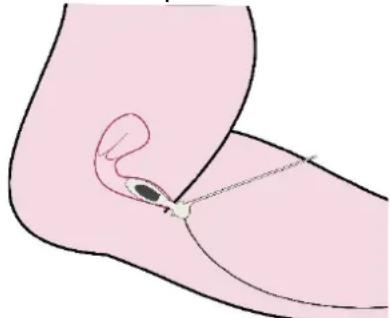
3) Choose a comfortable position, such as lying down on your bed on your side with your knees raised.
Warning: Ensure the perfect PFE is switched OFF before inserting the probe.
4) After the wire is securely connected, insert the probe into your vagina, in the same way as you would a tampon, until only the plastic rim at the base of the probe is visible.
natural_image
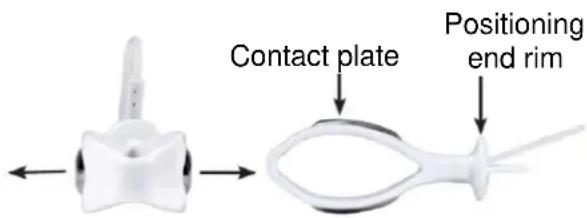
Anatomical illustration of a human abdomen with a catheter and internal structure (no text or labels)5) The metal parts conduct the electrical pulse and should be in contact with the main part of the muscle at all times. The tissues close to the entrance are more sensitive, so you should avoid stimulating them.
Ensure that the probe is aligned so that the contact plates are to the sides and the longer sides of the positioning end rim are vertical.
text_image
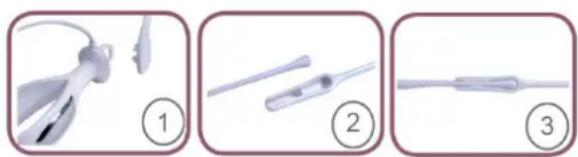
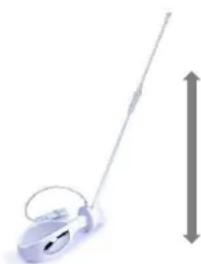
Contact plate Positioning end rim6) The Liberty Loop probe has a pointer attachment which enables you to visually monitor the successfulness of your pelvic floor contractions (the probe can be used without the pointer).
The pointer demonstrates the strength and duration of each
contraction, whether caused by stimulation or performed manually. For example, weak contractions are defined by little or no movement in the pointer.
Assemble the pointer and attach to the probe as follows:
natural_image
Three-step medical procedure illustration showing a tool being held, with steps numbered 1, 2, and 3 (no text or symbols on the devices themselves)- When performed correctly, the pointer will move downwards.
- When performed incorrectly, the pointer will move upwards.
natural_image
Illustration of a handheld electronic device with a curved arm and a vertical arrow indicating direction (no text or symbols)13.4. TRAINING SESSION
1) Press and hold the ON button on the control unit for 3 to 5 seconds to switch the control unit on.
2) You can select from the five preset programmes. Details in section 10 will help you identify the best programme to suit you.
To change between the programmes, press the programme selector, which is labelled P, in the centre of the control unit keypad.
3) With the required programme selected, you can adjust the intensity of the muscle stimulation until you reach a comfortable level. Once you have reached a comfortable level, 5 seconds after you stop pressing the button, the intermittent work/rest phase will start. The machine will take itself to 0 mA for a rest period and then take itself back up to the level of intensity you chose, to work

the muscle. This cycle will continue for the 20 minutes of the programme.
Note: The strength required varies widely between users - some will use the perfect PFE at full power – 99 mA. The perfect PFE strength will go up at 1 mA increments.
Initially the sensation through the probe may be limited but will improve during treatment. Take care not to use too much strength and thereby over stimulate the muscles until normal sensation is restored. The sensation may not be even as it may vary depending on the sensitivity of the nerves.
The LCD display shows the strength of intensity used. The aim is to increase this over a few days. But remember there is no hurry, so only increase the strength of the stimulation as and when you are comfortable and ready to progress.
Note: If the sensation becomes uncomfortable, reduce the intensity using the button ▼.
When switched on, in STRES and TONE programmes the unit will go through an exercise programme for 4-5 seconds, followed by a rest period of 8-10 seconds. The perfect PFE causes a sensation which feels like a strong drawing in of the vagina and pulling up of the pelvic floor. The natural reaction will be to pull in and up with the muscles.
At lower strength settings, you may not feel any sensation at all, this depends very much on the individual and any pre-existing physical conditions, so slowly increase the intensity by repeatedly pressing the ▲ button until you begin to feel the muscles around your vagina contract.
For best results in these programmes try to contract the pelvic floor muscles along with the perfect PFE, and to sustain the contraction into the rest interval. If possible, link the contraction to your breathing to get into a gentle rhythm.
Increase the strength as high as it is comfortable, and then take it back down one step.
The strength display on the control unit will reduce to 0 and flash during the rest period.
The URGE and PAIN programmes work differently. There is no need to have a contraction. The strength should be comfortable, but always remain noticeable. You may need to increase it over the course of the treatment.
The length of each session is automatically set to 20 minutes. The length of each session for muscle strengthening will also depend on your ability to contract and your resistance to fatigue. Be careful not to overuse early on, as the resulting aches may not be felt until the next day.
Note: If you experience cramping, switch the unit off until the symptoms go away then continue the session with the intensity set at a lower level.
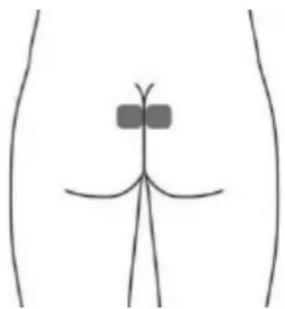
Optional skin surface electrode placement for URGE
An alternative method to a vaginal probe is to stimulate areas of the skin that are close to the nerves that go to the bladder and urethra. These come from the parts of the spinal cord segment called S2-S3.
The electrodes are placed on the skin between the anus and the genitals, or at the very bottom of the spine near your coccyx or "tail". See electrode placement pictures below.
natural_image
Simple line drawing of a human torso with a rectangular object on the chest (no text or symbols)The stimulation should be strong enough to make your anus contract slightly.
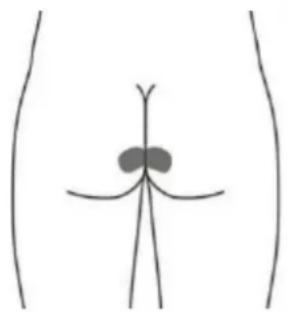
Optional skin surface electrode placement for STRESS (this may not be as effective as the stimulation with the vaginal probe)
The electrodes are placed on the skin between the anus and the genitals. See electrode placement picture below.
The stimulation should be strong enough to make your anus contract slightly.
natural_image
Simple line drawing of a human torso with a small dark oval object on the chest (no text or symbols)13.5. AFTER YOUR TRAINING SESSION
When the timer reaches zero, your session is complete and the unit turns off.
1) Check that the control unit is off. If it is not, hold down the OFF button to switch off then remove the probe from your vagina by holding the positioning end rim and gently pulling outwards.
If you are using the pointer, detach this first before removing the probe.
2) Wash and thoroughly dry the probe and return it to the storage pouch.
3) The perfect PFE will not only improve your pelvic floor muscles but also help you to recognise the correct sensation you need to feel when doing your Kegel exercises (explained in section 4.2.).
Note: When removing the probe, DO NOT PULL ON THE LEAD WIRE.
14. ANAL PROBE
14.1. CONDITIONS THAT MAY BE TREATED
An anal probe such as TensCare X-PR13 can be purchased. This probe can be used for urinary and faecal incontinence in both males and females.
This anal probe may be used to treat Urinary and Faecal Incontinence in a similar way to the vaginal probe. Because the stimulation cannot be restricted to one muscle group, and the mucosal tissue has different electrical

characteristics, anal stimulation is less comfortable than vaginal.
Faecal Incontinence
Faecal incontinence can be the result of weakened or poorly functioning anal sphincter muscles or damage to the nerves controlling them. The purpose is to re-educate the anal sphincter and other muscles of the pelvic floor to contract. The treatments aim to progress towards graduated active exercises, in order to improve pelvic floor muscles' strength and endurance and to regain function.
You may benefit from the using the X-PR13 anal probe with the perfect PFE if you either have no active anal sphincter contraction, or a weak or poorly sustained contraction. Use the STRES or TONE programmes. Intensity should be as strong as possible without being painful. When possible, try to contract the muscles at the same time as the perfect PFE.
Post Prostatectomy Urinary Incontinence
Electrical stimulation has been found to help urinary incontinence in men after radical prostatectomy in some trials. Use the X-PR13 anal probe and the same programmes as for vaginal stimulation. Increase intensity in STRES, MIXED, or TONE programmes to the highest tolerable.
14.2. HOW TO INSERT THE ANAL PROBE
1) Before using perfect PFE you will need to visit the toilet.
2) Lubricate the metal electrode surfaces and probe tip with a water-based lubricant, such as TensCare Go Gel or water.

Caution: Do not use a silicone based lubricant on the stimulation contacts as it may decrease the effectiveness of the perfect PFE's muscle stimulation.
3) Choose a comfortable position, such as lying down on your bed on your side with your knees raised.

Warning: Ensure the perfect PFE is switched OFF before inserting the probe.
4) After wires are securely connected, insert the probe into the anus whilst 'bearing down' (as in the action of passing stool) to a comfortable limit until the base of the flange on the probe touches the anus. The metal parts conduct the electrical pulse and should be in contact with the main part of the muscle at all times. The tissues close to the entrance are more sensitive, so you should avoid stimulating them. It is recommended that the probe is inserted past the sphincter muscles of the anus, unless directed otherwise by a healthcare professional.
5) Anal probes with long electrodes (the metal part) that run up and down the length of the attachment should
always be inserted with the metal parts facing hip-to-hip. Anal probes with circular electrodes (the metal part) should be inserted simply to the desired depth.
Note: Sometimes the wearing of tight fitting undergarments or a tight pair of jeans will help to keep the probe in place and maintain correct contact during the programme.
For Faecal incontinence, the aim is to stimulate the external sphincter and/or pubo-rectal muscle, so circular electrodes should be placed so that the external ring is just inside the sphincter.
For Urinary Stress incontinence the aim is to stimulate the levator muscles and the probe should be inserted deeper.
15. CLEANING
It is important that the probe is cleaned before using for the first time and after each use. Clean with either an alcohol-free antibacterial wipe such as TensCare Wipes (see X-WIPES) or by washing with warm soapy water. Rinse in clean water and dry thoroughly and return the unit to the storage pouch. Do not immerse the probe in a liquid.
Clean the case of the unit and lead wire at least once a week using the same method.
- Do not immerse your perfect PFE unit in water.
- Do not use any other cleaning solution.
16. EMC
Wireless communications equipment such as wireless home network devices, mobile phones, cordless telephones and their base stations, walkie-talkies can affect this equipment and should be used no closer than 30 cm (12 inches) to any part of the device.
(Note. As indicated in 5.2.1.1(f) of IEC 60601-1-2 for ME EQUIPMENT).
Note: For hospital use, full EMC advice tables are available on request.
17. DISPOSAL OF WASTE ELECTRICAL AND ELECTRONIC PRODUCTS (WEEE)
One of the provisions of the European Directive 2002/96/CE is that anything electrical or electronic should not be treated as domestic waste and simply thrown away. To remind you of this Directive all affected products are now being marked with a crossed-out wheelie bin symbol, as depicted below.
To comply with the Directive, you can return your old electro-therapy unit to us for disposal. Simply print a postage-paid PACKETPOST RETURNS label from our website www.tenscare.co.uk, attach this to an envelope or padded bag with the unit enclosed, and post it back to us. Upon receipt, we will process your old device for components recovery and recycling to help conserve the world's resources and minimise adverse effects on the environment.


18. ACCESSORIES
Expected Service Life
- The machine will often last for more than 5 years, but is warranted for 2 years. Accessories (lead wire, probe, and batteries) are not covered by the warranty.
- Lead life depends greatly on use. Always handle the leads with care. We recommend to replace the lead wires regularly (about every 6 months).
- Replace the probe every 6 months to ensure hygiene.
- Optional electrode pads should last 12-20 applications, depending on skin condition and humidity.
- AA alkaline batteries should last at least 15 hours at 50 mA, 300 μs, 50 Hz.
Replacement electrode pads, new batteries and lead wires are available from your supplier or distributor (see back cover for contact details), by mail order from TensCare, by telephone using a credit or debit card, or through the TensCare website.
The following replacement parts may be ordered from TensCare at www.tenscare.co.uk or +44(0) 1372 723434.
| X-VPL | Liberty Loop Vaginal Probe (32 mm dia.) |
| X-VP | Liberty Vaginal Probe (28 mm dia.) |
| X-VPM | Liberty Plus Vaginal Probe (32 mm dia.) |
| L-CPT | Replacement lead wire, 1.25 m length |
| X-PR13 | Anal probe (19.6 mm dia.) |
| E-CM5050 | Pack of 4 electrode pads (50x50 mm) |
| K-GO | Go Gel Personal Water-based Lubricant |
| B-AA | 1.5V AA batteries |
| X- BC-PT | Replacement belt clip |
| X- BL-PTT | Replacement battery cover |
| X-WIPES | Pack of 30 wipes |
Caution: You should only use the probe supplied with the unit or the replacements above as performance may vary with other electrodes.
Warning: Do NOT use silicone based or hybrid (mixed water and silicone) lubricants.
19. WARRANTY
This warranty refers to the unit only. It does not cover, electrode pads, battery, or the lead wires.
PRODUCT WARRANTY INFORMATION
This product is warranted to be free from manufacturing defects for 2 years from date of purchase.
This warranty is void if the product is modified or altered, is subject to misuse or abuse; damaged in transit; lack of responsible care; is dropped; if incorrect battery has been fitted; if the unit has been immersed in water; if damage occurs by reason of failure to follow the written instruction booklet enclosed; or if product repairs are
carried out without authority from TensCare Ltd.
We will repair, or at our option replace free of charge, any parts necessary to correct material or workmanship, or replace the entire unit and return to you during the period of the warranty. Otherwise, we will quote for any repair which will be carried out on acceptance of our quotation. The benefits conferred by this warranty are in addition to all other rights and remedies in respect of the product, which the consumer has under the Consumer Protection Act 1987.
If necessary, we will provide circuit diagrams, component part lists or other information that will assist authorized service personnel to repair the device.
Our goods come with guarantees that cannot be excluded under the UK consumer Law. You are entitled to have the goods repaired or replaced if the goods fail to be of acceptable quality.
Before you send your unit for service
Before sending in your unit for service, please take a few minutes to do the following:
Read your manual and make sure you follow all the instructions.
Returning your unit for service
Should repair be needed within the warranty period, enclose the tear off section of the warranty card (see page 32) and your proof of purchase receipt. Please ensure all relevant details are completed before sending your unit in
for service. Please ensure your contact details are still current and include a brief description of the problem you are experiencing together with your purchase receipt.
For hygiene reasons, please do not include used probe or electrode pads. Send only the unit and the lead wire.
Please return the unit and warranty card (see page 32):
TensCare Ltd
PainAway House,
9 Blenheim Road,
Longmead Business Park,
Epsom, Surrey
KT19 9BE, UK
Should you require any further information please do not hesitate to contact us by calling our number:
+44 (0) 1372 723 434.

If your perfect PFE is not working properly, please check the following:
| Problem | Possible causes | Solution |
| No display | Flat batteries. | Replace batteries. |
| Batteries inserted incorrectly. | Remove plastic wrapCheck + / - . | |
| Damaged springs in battery compartment. | Contact supplier. | |
| Low battery display | Low batteries. | Replace batteries. |
| Controls won't work | Keypad is locked. | If LOCK is shown on display, press and hold the▼button.If no LOCK is showing, remove and replace the batteries. |
| No sensation and LEADS alarm showing | The perfect PFE has a safety feature which will not allow the intensity to pass 20 mA if the machine detects a connection error. If a connection error is detected the intensity will return to 0 mA and the screen will flash LEADS. This safety feature will prevent the machine from giving any uncomfortable stimulation should the contact break between the machine and your skin. This will also prevent anyone from increasing the intensity to a high level without firm contact between the machine and the skin.A connection error can occur if: | |
| 1. A break has developed within one of the two lead wires. | If this happens, you can try to test the unit by holding the probe in your hand:i) Dampen your hand with water and a little table sal Squeeze the probe firmly and make sure your skin is covering the metal parts of the probe and carefully increase strength until you can feel something. Most people will start to feel the stimulation in their hand at around 25 mA.ii) If the LEADS alarm shows and the unit will not allow you to pass 20 mA. The lead wires need to be replaced. | |
| If you have tried the test above and DO have sensation when the probe is in your hand, then it may be that:2. The skin is dry, meaning poor conductivity between the metal plates on the probe and your skin. | If this happens, you can try the below solutions:i) Using a water-based lubricant such as TensCare Go Gel (see K-GO), which will improve conduction.ii) Crossing your legs and squeezing to increase pressure on the probe, which should improve the connection. If this enables you to use the unit, you should find that in a few weeks of stimulation the contact improves. If it does not, this unit may not be suitable for you. You may need to contact your healthcare professional to discuss other suitable options.iii) The probe supplied with the unit has a 28 mm diameter. An optional 32 mm probe, part no. X-VPM, is available. | |
| No sensation and no LEADS alarm showing | Intensity level is not high enough and/or reduced sensitivity in the area being treated. | i) Please make sure you are increasing the intensity high enough. Most people will start to feel the stimulation in their hand at around 25 mA and with the probe inserted you will need to increase the intensity higher to around 40 mA – 60 mA. Max power is 99 mA. Everyone is different so just keep increasing the intensity until you can feel it. The intensity increases in very small steps of 1 mA. ii) You may have reduced sensitivity due to previously damaged or desensitised pudendal nerves (this can happen in childbirth or some surgical procedures). Please consult your healthcare professional. |
| No sensation on one side of the probe (or electrode) | Position is not optimal – needs adjusting. | The current flows from one side of the probe to the other, so it is not possible to have one side “no working”. However, the strength of the sensation depends on how close to the nerve the current flows and also in which direction it flows relative to the nerve. You can try slightly adjusting the position on the probe, or exchanging the connection of the wires in the probe. |
| Sudden change in sensation | If you disconnect and re-connect a few minutes later, the signal wi feel quite a lot stronger. | Always return strength to zero after disconnecting the lead or the probe. |

The patient is an intended operator. There are no user-serviceable parts inside the unit, and no calibration is required.
If the above review has failed to resolve your problem, to report unexpected operation or events, or to provide feedback call TensCare or your local dealer (address on back cover) for advice.
Contact TensCare customer service on +44 (0) 1372 723 434. Our staff are trained to assist you with most issues you may have experienced, without the need to send your product in for service.
European Medical Device Regulation requires that any serious incident that has occurred in relation to this device should be reported to the manufacturer and the competent authority in your country. This can be found at:
https://ec.europa.eu/docsroom/documents/36683/attachments/1/translations/en/renditions/pdf
21. GENERAL SPECIFICATION
| Waveform | Asymmetrical rectangular |
| Amplitude(over 500 Ohm load) | 99.0 mA+/- 10% |
| Max intensity | 50V zero to peak across 500 ΩConstant voltage over 500-2000 Ohm |
| Output plug | Fully shielded |
| Channels | Single channel |
| Batteries | 2 x AA alkaline (two AA batteries) or 2 x AA NiMH |
| Weight | 75 g without batteries |
| Dimensions | 120 x 60 x 20 mm |
| Safety Classification | Internal power source. |
| Environmental Specifications: | |
| Operating: | Temperature range: 5 to 40°CHumidity: 15 to 90% RH non-condensingAtmospheric pressure: 700hPa to 1060hPa |
| Storage: | Temperature range: -10-+60°CHumidity: 15 to 75% RH non-condensingAtmospheric pressure: 700hPa to 1060hPa |
TYPE BFAPPLIED PART  | Equipment providing a degree of protection against electric shock, with isolated applied part.Designed for continuous use. |
| Applied Part | Vaginal and anal electrodes. Optional skin surface electrode pads. See section 18. |
Contact duration: At least 10 minutes.
Note: The electrical specifications are nominal and subject to variation from the listed values due to normal production tolerances of at least 5%.
PLEASE RETAIN THIS WARRANTY CARD.
RETURN THIS PORTION ONLY WHEN YOU RETURN YOUR PRODUCT FOR REPAIR UNDER WARRANTY.

NAME:
ADDRESS:
POSTCODE:
DAYTIME TELEPHONE: ____
E-MAIL:
MODEL:
DATE OF PURCHASE: ____
ATTACH PROOF OF PURCHASE
DO NOT SEND IN PROBE, LEADS OR ELECTRODE PADS
RETAILERS NAME: ____
RETAILERS ADDRESS: ____
RETAILERS POSTCODE:
BRIEF DESCRIPTION OF PROBLEM YOU ARE EXPERIENCING: ____
WARRANTY IS VOID UNLESS THE ABOVE INFORMATION IS COMPLETED AND CORRECT.

Estimado cliente
natural_image
Illustration of a handheld vacuum cleaner with a vertical measurement arrow (no text or symbols)5. TIPOS DE INCONTINENCIA
natural_image
Illustration of a human back with colored anatomical markers (no text or symbols)natural_image
Human back with four rectangular buttons placed on the back area, no text or symbols presentnatural_image
Product display of a medical or diagnostic tool with earphones, a purple bandage, and two battery packs (no visible text or symbols)natural_image
Two white plastic devices with purple connectors, one showing a downward arrow (no text or symbols visible)natural_image
Close-up of a white electronic device with an open lid and internal components, no visible text or symbolsnatural_image
Top-down view of a white car with two blue battery modules and a power cord (no text or symbols visible)text_image
Tensory OFF ON T Pnatural_image
Line drawing of two hands holding a small object, possibly a tool or component (no text or symbols present)natural_image
Anatomical illustration of a human abdomen with a marked catheter or device, showing no text or labels.natural_image
Illustration of a handheld device with a vertical arrow indicating measurement or direction (no text or symbols)apuntador se
moverá hacia arriba

natural_image
Simple line drawing of a human figure with no text or symbolsnatural_image
Simple line drawing of a human torso with a small dark object on the chest (no text or symbols)Longmead Business Park,
Epsom, Surrey
KT19 9BE, UK
https://ec.europa.eu/docsroom/documents/36683/attachments/1/translations/en/renditions/pdf
natural_image
Illustration of a human back with colored anatomical markers (no text or symbols)les nerfs qui
natural_image
Human back with four blue rectangular overlays on the chest area, no text or symbols presentnatural_image
Product display of a medical device and medical kit with labeled components (no visible text or symbols)12.1. COMMANDES & AFFICHAGE
natural_image
Line drawing of two hands holding a small object, possibly a tool or component (no text or symbols present)natural_image
Anatomical illustration of a human abdomen with a marked catheter or device, showing internal structure without any text or labels.natural_image
Illustration of a handheld device with a curved handle and a vertical arrow indicating upward motion (no text or symbols)13.4. SESSION D'EXERCICES
natural_image
Simple line drawing of a human figure with no text or symbolsnatural_image
Simple line drawing of a human torso with a small dark oval object on the chest (no text or symbols)13.5. APRES LA SESSION D'EXERCICES
INFORMATIONS SUR LA GARANTIE PRODUIT
Longmead Business Park,
Epsom, Surrey
https://ec.europa.eu/docsroom/documents/36683/attachments/1/translations/en/renditions/pdf
21. CARACTERISTIQUES TECHNIQUES
natural_image
Illustration of a person's back with colored rectangular overlays (no text or symbols)natural_image
Human back with four purple rectangular markers on the back, indicating areas of interest or emphasis (no text or symbols present)natural_image
Product display of a medical or scientific device with earphones, a pen, and two battery packs (no visible text or symbols)
12. GERÄTEINFORMATION
natural_image
Two white electronic devices with pink connectors, one showing a downward arrow (no text or symbols visible)natural_image
Close-up of a white electronic device with a metallic internal component and an arrow indicating a feature (no text or symbols visible)natural_image
Top-down view of a white electronic device with two blue battery modules and a black cable (no text or symbols visible)natural_image
Line drawing of two hands holding a thin object, possibly a tool or wire (no text or symbols)natural_image
Anatomical illustration of a human abdomen with a catheter and arrow indicating a specific area (no text or labels present)natural_image
Simple line drawing of a human torso with a rectangular object on the chest (no text or symbols)natural_image
Simple line drawing of a human torso with a small shaded anatomical region inside (no text or symbols)INFORMATIONEN ZUR PRODUKTGARANTIE
Longmead Business Park,
Epsom, Surrey
KT19 9BE, UK
https://ec.europa.eu/docsroom/documents/36683/attachments/1/translations/en/renditions/pdf
21. ALLGEMEINE SPEZIFIKATIONEN

Wireless communications equipment such as wireless home network devices, mobile phones, cordless telephones and their base stations, walkie-talkies can affect this equipment and should be used no closer than 30cm (12 inches) to any part of the device.
(Note. As indicated in 5.2.1.1(f) of IEC 60601-1-2:2014 for ME EQUIPMENT).
Use special precautions regarding EMC according to the information provided below.
Other portable and mobile RF communications equipment can affect performance.
Do not use when adjacent to or stacked with other electrical equipment.
Use of leads or electrodes other than those listed in this manual may affect EMC performance.
1* WARNING: Use of this equipment adjacent to or stacked with other equipment should be avoided because it could result in improper operation. If such use is necessary, this equipment and the other equipment should be observed to verify that they are operating normally."
2* WARNING: Use of accessories, transducers and cables other than those specified or provided by the manufacturer of this equipment could result in increased electromagnetic emissions or decreased electromagnetic immunity of this equipment and result in improper operation."
3* WARNING: Portable RF communications equipment (including peripherals such as antenna cables and external antennas) should be used no closer than 30 cm (12 inches) to any part of the ME equipment, including cables specified by the manufacturer. Otherwise, degradation of the performance of this equipment could result."
Table 1
| Declaration - Electromagnetic Emission | |
| Emissions test | Compliance |
| RF emissionsCISPR 11 | Group 1 |
| RF emissionsCISPR 11 | Class B |
| Harmonic emissionsIEC 61000-3-2 | Not applicable |
| Voltage fluctuations/flicker emissionsIEC 61000-3-3 | Not applicable |
Table 2
| Declaration - Electromagnetic Immunity | ||
| Immunity test | IEC 60601 test level | Compliance level |
| Electrostatic discharge (ESD)IEC 61000-4-2 | ±8 kV contact±2 kV, ±4 kV, ±8 kV, ±15 kV air | ±8 kV contact±2 kV, ±4 kV, ±8 kV, ±15 kV air |
| Electrical fast transient/burstIEC 61000-4-4 | ±2 kV for power supply lines±1 kV for input/output lines | Not applicable |
| SurgeIEC 61000-4-5 | ±0.5kV, ±1 kV line(s) to lines±0.5kV, ±1 kV, ±2 kV line(s) to earth | Not applicable |
| Voltage dips, short interruptions and voltage variations on power supply input linesIEC 61000-4-11 | 0 % UT; 0.5 cycle At 0°, 45°, 90°, 135°, 180°, 225°, 270°and 315°0 % UT; 1 cycle and 70 % UT; 25/30 cyclesSingle phase: at 0°0 % UT; 250/300 cycles | Not applicable |
| Power frequency(50/60 Hz)magnetic field | 30 A/m | 30 A/m |
| IEC 61000-4-8 | ||
| NOTE: UT is the a.c. mains voltage prior to application of the test level. | ||
Table 3
| Declaration - Electromagnetic Immunity | ||
| Immunity test | IEC 60601 test level | Compliance level |
| Conducted RFIEC 61000-4-6 | 3 V0.15 MHz to 80 MHz6 V in ISM bands between 0.15 MHz and 80 MHz | Not applicable |
| Radiated RFIEC 61000-4-3 | 10V/m80 MHz to 2.7 GHz | 10V/m |
Table 4
| Declaration - IMMUNITY to proximity fields from RF wireless communications equipment | |||||
| Immunity test | IEC60601 test level | Compliance level | |||
| Test frequency | Modulation | Maximum power | Immunity level | ||
| Radiated RF IEC 61000-4-3 | 385 MHz | **Pulse Modulation: 18Hz | 1.8W | 27 V/m | 27 V/m |
| 450 MHz | *FM+ 5Hz deviation: 1kHz sine | 2 W | 28 V/m | 28 V/m | |
| 710 MHz 745 MHz | **Pulse Modulation: 217Hz | 0.2 W | 9 V/m | 9 V/m | |
| 780MHz | |||||
| 810MHz870MHz930MHz | **Pulse Modulation: 18Hz | 2 W | 28 V/m | 28 V/m | |
| 1720MHz1845MHz1970MHz | **Pulse Modulation: 217Hz | 2 W | 28 V/m | 28 V/m | |
| 2450MHz | **Pulse Modulation: 217Hz | 2 W | 28 V/m | 28 V/m | |
| 5240MHz5500MHz5785MHz | **Pulse Modulation: 217Hz | 0.2 W | 9 V/m | 9 V/m | |
| Note* - As an alternative to FM modulation, 50 % pulse modulation at 18 Hz may be used because while it does not represent actual modulation, it would be worst case. Note** - The carrier shall be modulated using a 50 % duty cycle square wave signal. | |||||
TensCare aim to give you the best possible product and service. We listen to your suggestions and are constantly trying to improve our products. We also want to learn about the way our products are used, and the benefits they give. If you have anything you would like to share with us, please get in touch.
www.tenscare.co.uk
Follow us:

TensCare Ltd

@TensCareLtd

TensCare Limited

@tenscareltd
CE
2797
EC Declaration of Conformity
Tenscare Ltd herewith declare that the product meets the provisions of REGULATION (EU) 2017/745 which apply to it. The medical device has been assigned to class IIa according to Annex IV of the REGULATION (EU) 2017/745. The product concerned has been designed and manufactured under a quality management system according to Annex IX, of REGULATION (EU) 2017/745. This EU declaration of conformity is issued under the sole responsibility of the manufacturer. No “Common Specification” is applicable.
Distributed by:

TensCare Ltd
9 Blenheim Road, Epsom,
Surrey, KT19 9BE, UK
Tel: +44(0) 1372 723434
www.tenscare.co.uk

Advena Ltd
Tower Business Centre,
2 ^nd Flr, Tower Street,
Swatar, BKR 4013, Malta

TensCare Europe BV
I-PPFE-ML [UK,ES,FR,DE] Rev 4.3 06/24
C€
2797
TensCare™