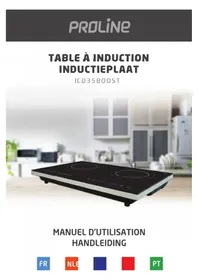
ICD35BOOST - Cooker PROLINE - Free user manual and instructions
Find the device manual for free ICD35BOOST PROLINE in PDF.



| Brand | Proline |
| Model | ICD35BOOST |
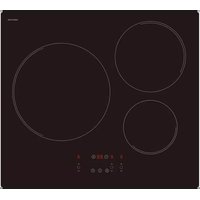
| Product type | 2-zone induction hob |
| Dimensions (L x W x H) | 545 x 360 x 65 mm |
| Net weight | 5.2 kg |
| Power supply | 220-240 V~ 50-60 Hz |
| Total nominal power | 3500 W |
| Number of cooking zones | 2 |
| Power per zone (max) | 1500 W (left zone) / 2000 W (right zone) |
| Cooking zone diameter | 19 cm |
| Power levels | 8 levels + Booster function |
| Control type | Touch |
| Timer function | Yes, up to 3 hours |
| Key lock | Yes |
| Auto shut-off | Yes (60 seconds without action) |
| Pan detection | Yes |
| Residual heat indicator | Yes (display H) |
| Cooling fan | Yes (built-in) |
| Surface material | Ceramic glass |
| Cleaning and maintenance | Wipe with a soft, damp cloth; do not use abrasive products; clean the air openings with a soft brush |
| Child safety | Yes (key lock) |
| Overheat protection | Yes (temperature sensor) |
| Cookware compatibility | Ferromagnetic cookware (cast iron, enameled steel); diameter 14-22 cm |
| Energy consumption (EC) | 188.6 Wh/kg |
| Country of manufacture | PRC (China) |
Frequently Asked Questions - ICD35BOOST PROLINE
User questions about ICD35BOOST PROLINE
0 question about this device. Answer the ones you know or ask your own.
Ask a new question about this device
Download the instructions for your Cooker in PDF format for free! Find your manual ICD35BOOST - PROLINE and take your electronic device back in hand. On this page are published all the documents necessary for the use of your device. ICD35BOOST by PROLINE.
USER MANUAL ICD35BOOST PROLINE
natural_image
Modern kitchen appliance with three circular burners on a black electrical stove, blurred background of appliances and kitchen fixtures (no visible text or symbols)MANUEL D'UTILISATION HANDLEIDING
TABLE DES MATIÈRES
MISES EN GARDE IMPORTANTES ...... p. 02
PRÉCAUTIONS ...... p. 04
DESCRIPTION DU PRODUIT ...... p. 07
CHOISIR LE BON USTENSILE DE CUISSON ...... p. 09
FONCTIONNEMENT ...... p. 11
CONSEILS DE CUISSON ...... p. 16
GUIDE DE DÉPANNAGE ...... p. 18
NETTOYAGE ET ENTRETIEN ...... p. 20
FICHE DE DONNÉES TECHNIQUES...... p. 21
MISE AU REBUT p. 22

MISES EN GARDE IMPORTANTES
MERCI DE BIEN VOULOIR LIRE LES CONSIGNES DE SÉCURITÉ ATTENTIVEMENT AVANT D'UTILISER L'APPAREIL ET CONSERVER POUR RÉFÉRENCE ULTÉRIEURE.
Attention
natural_image
Simple line drawing of three coiled springs inside a rounded rectangle (no text or symbols)natural_image
Simple line drawing of a cooking pot with crossed-out X marks (no text or symbols)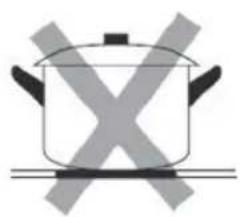
natural_image
Simple line drawing of a cooking pot with crossed X marks (no text or symbols)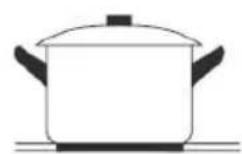
natural_image
Four identical cooking pots with crossed-out X marks, shown in sequence (no text or symbols)
FONCTIONNEMENT
Remarques
natural_image
Abstract geometric shape resembling a stylized letter H (no text or symbols)Hotline Darty France
PROBLEEMOPLOSSING p. 40
REINIGING EN ONDERHOUD ...... p. 42
TECHNISCH GEGEVENSBLAD p. 43
VERWIJDERING p. 44

BELANGRIJKE VEILIGHEIDSINSTRUCTIES
LEES DE VOLGENDE VEILIGHEIDSWAARSCHUWINGEN EN DE INSTRUCTIES AANDACHTIG DOOR VOORDAT U HET APPARAAT GEBRUIKT EN BEWAAR ZE VOOR LATERE RAADPLEGING.
Waarschuwingen

BESCHRIJVING VAN HET PRODUCT
natural_image
Simple line drawing of three coiled springs inside a rounded rectangle (no text or symbols)natural_image
Simple line drawing of a cooking pot with crossed X marks (no text or symbols)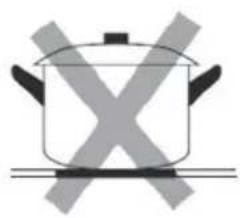
natural_image
Simple line drawing of a cooking pot with crossed X marks (no text or symbols)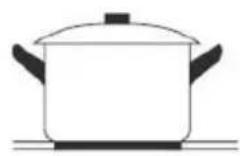
natural_image
Four identical cooking pots with crossed-out X symbols, no text or labels present
GEBRUIK
Opmerkingen
natural_image
Abstract geometric shape resembling a stylized letter H, composed of black hexagonal and diamond shapes (no text or symbols)IMPORTANT SAFETY INSTRUCTIONS
PLEASE READ THE FOLLOWING SAFETY WARNINGS AND THE INSTRUCTIONS CAREFULLY BEFORE USING THE APPLIANCE AND KEEP FOR FUTURE REFERENCE.
Warnings
- This appliance is intended to be used in household and similar applications such as:
- staff kitchen areas in shops, offices and other working environments;
- farm houses;
- by clients in hotels, motels and other residential type environments;
- bed and breakfast type environments.
- If the supply cord is damaged, it must be replaced by the manufacturer, its service agent or similarly qualified persons in order to avoid a hazard.
- This appliance can be used by children aged from 8 years and above and persons with reduced physical, sensory or mental capabilities or lack of experience and knowledge if they have been given supervision or instruction concerning use of the appliance in a safe way and understand the hazards involved.
• Children shall not play with the appliance.
- Cleaning and user maintenance shall not be made by children unless they are older than 8 and supervised.
- Keep the appliance and its cord out of reach of children less than 8 years.
- The appliance is not intended to be operated by means of an external timer or separate remote-control system.
- The temperature of accessible surfaces may be high when the appliance is operating.
- Regarding the instructions for cleaning surfaces in contact with food, refer to the section "Cleaning and Maintenance" on page 64 of the manual.
- The outer surface may get hot when the appliance is operating.
- WARNING: If the surface is cracked, switch off the appliance to avoid the possibility of electric shock.
- Metallic objects such as knives, forks, spoons and lids should not be placed on the hotplate since they can get hot.
• Caution, hot Surface The surfaces are liable to get hot during use. - A steam cleaner is not to be used.
- WARNING: The appliance and its accessible parts become hot during use.
- Care should be taken to avoid touching heating elements. Children less than 8 years of age shall be kept away unless continuously supervised.
- After use, switch off the hob element by its control and do not rely on the pan detector.
- WARNING: Unattended cooking on a hob with fat or oil can be dangerous and may result in fire. NEVER try to extinguish a fire with water, but switch off the appliance and then cover flame e.g. with a lid or a fire blanket.
- CAUTION: The cooking process has to be supervised. A short term cooking process has to be supervised continuously.
- WARNING: Danger of fire: do not store items on the cooking surface.
- WARNING: Use only hob guards designed by the manufacturer of the cooking appliance or indicated by the manufacturer of the appliance in the instructions for use as suitable or hob guards incorporated in the appliance. The use of inappropriate guards can cause accidents.
- Do not place the appliance in or near hot gas or electric burner, or permit to touch a heated oven or mini oven.

PRECAUTIONS
- Turn off and unplug the appliance from the mains socket when not in use and before cleaning. Allow it to cool before moving or cleaning.
- Unplug the power cord by holding the plug, never by pulling the cord.
- Do not use outdoors.
- Do not let cord hang over edge of a table or counter, or touch hot surfaces.
- The power cord must never be close to or in contact with hot parts of the appliance, close to sources of heat or resting on sharp edges.
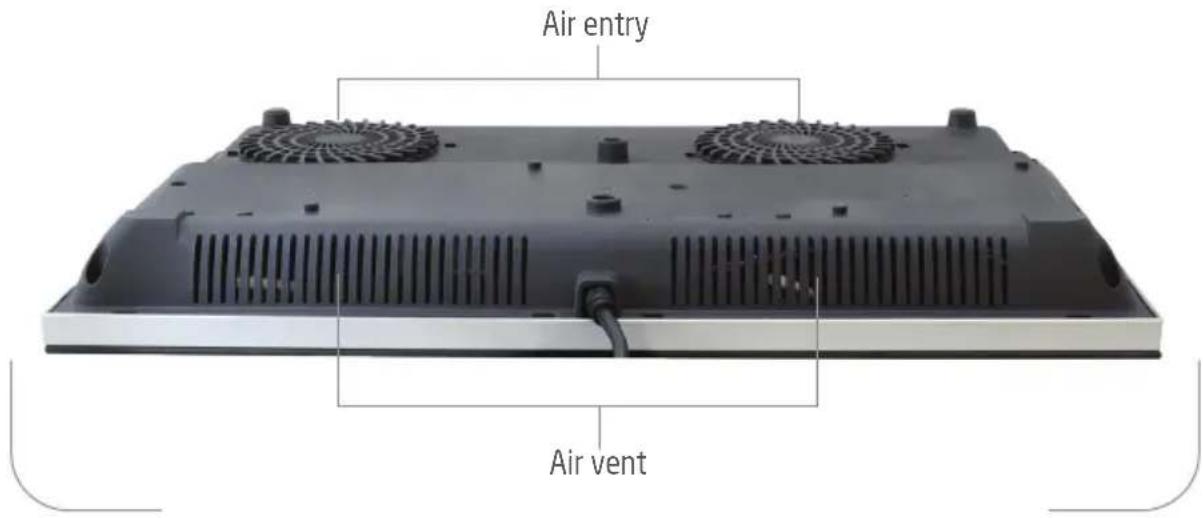
- Maintain a gap of at least 10 cm on all sides of the appliance to ensure adequate ventilation.
- To avoid danger, do not block or insert any foreign object into the air ventilation opening or air entry port.
- Do not move the appliance whilst in operation.
- Never move the hob by pulling the power cord.
- Do not leave the appliance unattended whilst in operation.
- Do not use the appliance for anything other than intended use.
- Never heat food in sealed containers, such as compressed products, cans, or coffee pots, to avoid explosion caused by heat expansion.
- Never place or use the appliance below or close to easily inflammable objects (e.g. curtains, etc.).
- People with pacemakers or similar medical devices should use care when standing near this induction hob while it is in operation. The electromagnetic field may affect pacemakers or similar devices. Consult your doctor or the manufacturer of the pacemaker or similar medical device for additional information regarding the possible effects of electromagnetic fields emitted by induction hobs.
-
Keep the appliance clean. Protect it from bugs, dust and humidity. When not in use for a long period, please properly store it after cleaning.
-
Do not directly rinse this appliance under water. Do not spill water into the internal parts of the appliance.
- To avoid accidents, do not use the appliance on a gas stove (the magnetic lines can heat the metal parts of the gas stove).
- Do not heat iron items, other than iron cookware, on the cooktop to avoid danger caused by high temperatures.
- To avoid danger, do not place paper, aluminium foil, cloth, or other unsuitable articles onto the appliance heating plate for indirect heating.
- Do not touch the appliance surface with sharp tools, to avoid cracking or damaging the surface. If the appliance surface is cracked, turn off the appliance to avoid electrical shock.
- Do not use the appliance on a carpet, tablecloth, or thin paper, to avoid blocking the air inlet or outlet opening, which could result in overheating.
- Do not overload the appliance. Overloading the appliance may damage the appliance surface.
- When operating the appliance or after moving the cookware, the cooking area remains hot for a period of time. Do not touch it and be careful of scalding caused by the high temperature.
- Never use the appliance without food in the cookware.

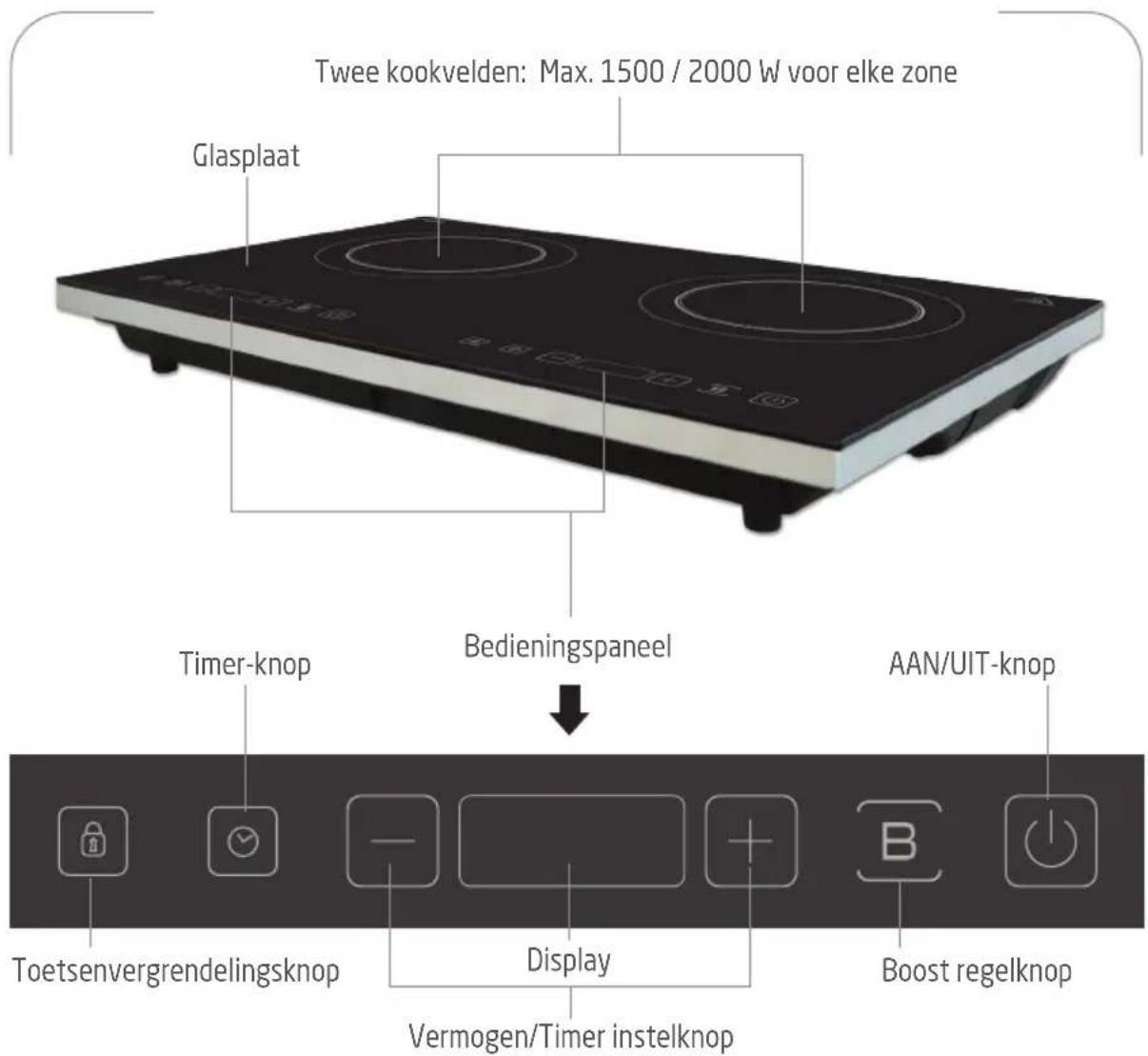
PRODUCT OVERVIEW
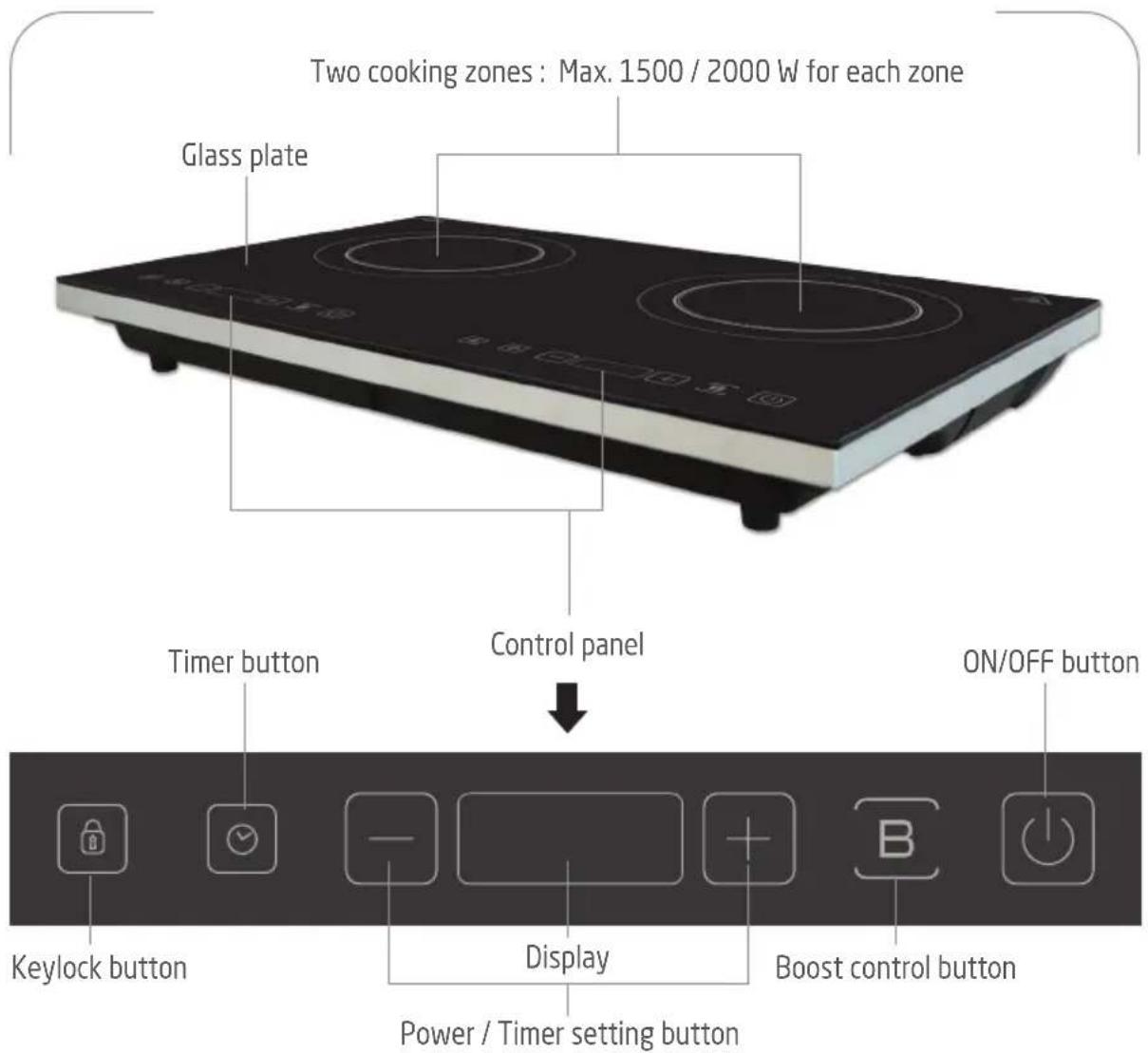
Bottom of the induction hob
FR
NL
EN
ES
PT
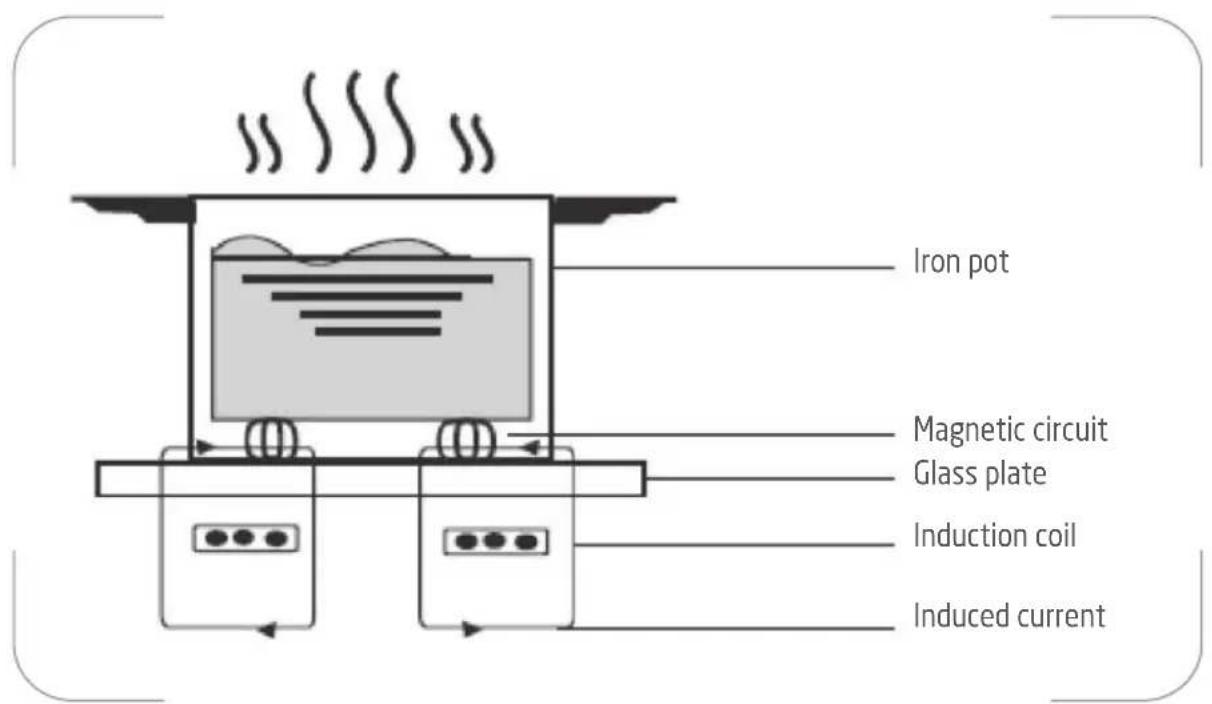
About induction cooking
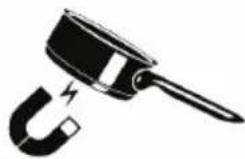
Induction cooking is a safe, advanced, efficient, and economical cooking technology. It works by electromagnetic vibrations generating heat directly in the pan, rather than indirectly through heating the glass surface. The glass becomes hot only because the pan eventually warms it up.

CHOOSING THE RIGHT COOKWARE
natural_image
Simple line drawing of three coiled springs inside a rounded square (no text or symbols)Only use cookware with a base suitable for induction cooking. Look for the induction symbol on the packaging or on the bottom of the pan.
Suitable cookware
Diameter from 14 to 22 ~cm
Cast iron pan
Iron plate
Iron pot
natural_image
Illustration of a hammer and sprocher with a lightning bolt, no text or symbols present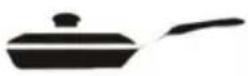
Deep frying pan
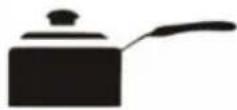
Deep frying pan
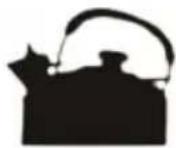
Iron or enamel kettle
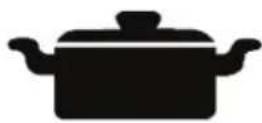
Stainless steel pot
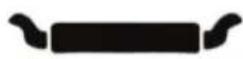
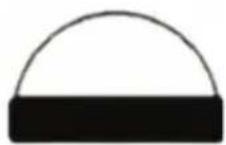
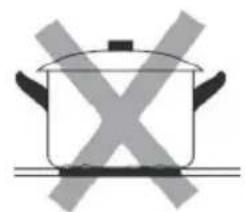
Cookware made from the following materials are not suitable for induction: pure stainless steel, aluminium or copper without a magnetic base, glass, wood, porcelain, ceramic, and earthenware.
Do not use cookware with jagged edges or a curved base.
natural_image
Simple line drawing of a cooking pot with crossed X marks (no text or symbols)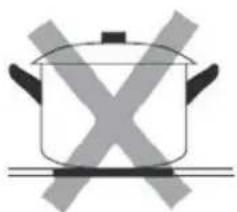
natural_image
Simple line drawing of a cooking pot with crossed X marks (no text or symbols)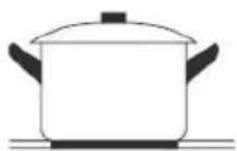
FR
NL
EN
ES
PT
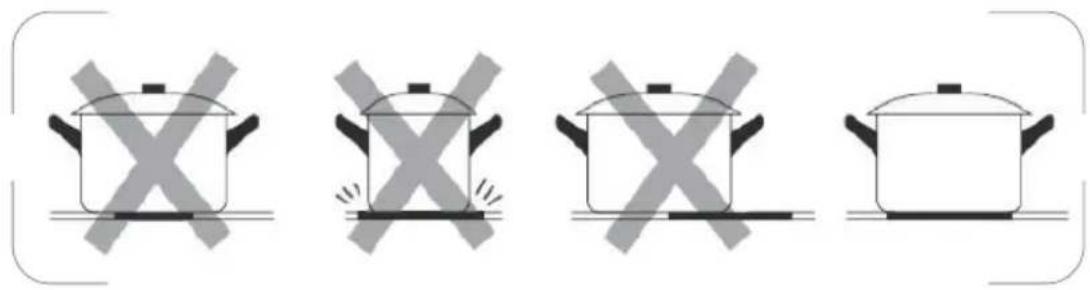
Make sure the base of the pan is smooth, sits flat against the glass and is the same size as the cooking zone. Use pans with a diameter as large as the graphic of the zone selected. Using a pot slightly wider will result in the energy used at its maximum efficiency. If you use a smaller pot the efficiency could be less than expected.
Pots less than 140 mm in diameter could be undetected by the hob. Always centre your pan on the cooking zone.
natural_image
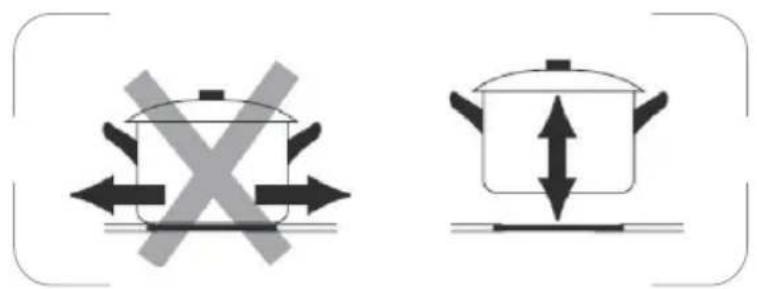
Four identical cooking pots with X-shaped marks, shown in sequence (no text or symbols)Always lift pans off the induction hob - do not slide as they may scratch the glass.

OPERATION
Notes
- Before using your appliance for the first time - Remove any packing materials and protective film from your appliance.
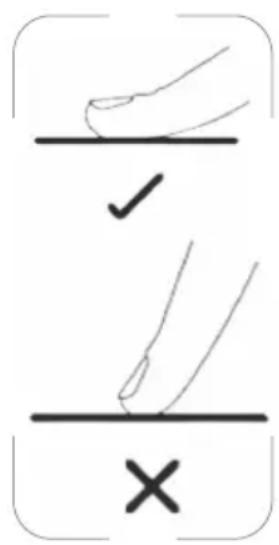
- The controls respond to touch. You don't need to apply any pressure.
- Use the ball of your finger, not the tip.
- A beep sounds each time a touch is registered.
- Make sure that the controls are clean, dry, and that there is no object, such as a utensil or a cloth, covering them.
- Even a thin film of water may make the controls difficult to operate.
To start cooking
- Place your hob on a flat, heat resistant surface.
- Plug in your hob.
- A beep will be heard.
- Touch and hold 🏠 for about 2 seconds to switch on the hob.
- The indicator light above this button will flash.
- Place the appropriate cookware (see "CHOOSING THE RIGHT COOKWARE") on the desired cooking zone.
- Make sure the bottom of the cookware and the surface of the cooking zone are clean and dry.
- Repeatedly touch — or to select the desired power level.
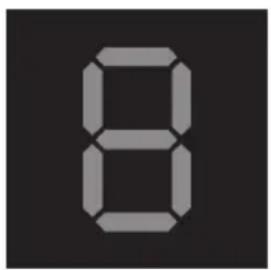
8 Power Levels
The higher the power level, the faster your food will cook.
| Power level | Low Medium High | ||||
| 1-233-45-67-8, Booster | |||||
| Suitable for | Delicate warming for small amounts of foodMelting chocolate, butter, and foods that burn quicklyGentle simmeringSlow warming | ReheatingRapid simmeringCooking rice | Pancakes | SautéingPasta | Stir-fryingSearingBringing soup to the boilBoiling water |
- You can modify the power level at any time during cooking.
- If no button is touched within 60 seconds, the hob will automatically switch off.
Your hob will beep under the following circumstances :
- You have not placed a cookware on the correct cooking zone;
- The cookware you're using is not suitable for induction cooking;
- The cookware is too small or not properly centred on the cooking zone.
When you have finished cooking
Touch ⏻ to turn off the hob.
natural_image
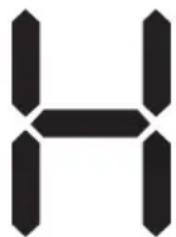
Abstract geometric shape resembling a stylized letter H, composed of black hexagonal and rectangular segments (no text or symbols)The symbol "H will flash on the display to remind you of beware of hot surfaces.
It will disappear when the surface has cooled down to a safe temperature.
It can also be used as an energy saving function if you want to heat further cookware, use the hotplate that is still hot.
Using the boost function
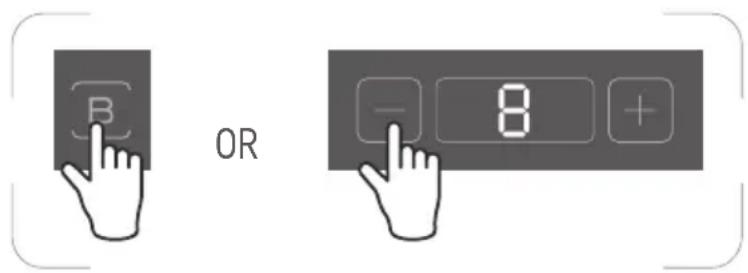
To activate this function, touch B. The display will show "b." and the power reaches max (2000W).
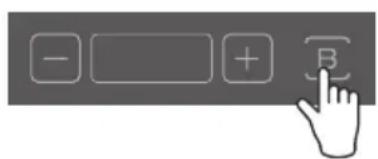
To deactivate this function, touch B again. The cooking zone will return to its original setting.
OR
Touch ☐ and then the cooking zone will return to the power level 8.
NOTE :
- The cooking zone returns to its original setting after 5 minutes.
- When the boost function for the first cooking zone is activated, the second cooking zone is limited up to 1500W automatically and vice versa.
Setting the timer
The timer can be set up to 3 hours (3:00).
- Touch 📋 to enter timer mode.
- The indicator light above this button 📧 will illuminate.
- Repeatedly touch — or to set the timer.
- Each touching of - or + will increase or decrease the cooking time by 1 minute. - Touching and holding - or + will increase or decrease the cooking time by 10 minutes.
-
When you finish setting the timer, the display will show the time for a few seconds and then return to the set power level. The hob will start counting down. The display will show the remaining cooking time and the current operating power level, alternately.
-
When the time has elapsed, the cooking zone will switch off.
To deactivate the timer
Touch and hold 📞 for about 2 seconds. OR
Touch ☑ once and then repeatedly touch □ until the display shows "0:00". The time will flash for a few seconds and then the timer is deactivated.
The indicator light above this button will go out.
Locking / unlocking your hob
- You can lock the controls to prevent unintended use.
- When the controls are locked, all the controls except the ON/OFF control are disabled.
- In the event of an emergency, you can always turn the hob off by touching
- To lock the controls, touch and the display will show "Loc".
- To unlock the control, touch and hold 📄 for about 2 seconds. "Loc" will disappear from the display.

COOKING GUIDELINES

Take care when frying as the oil and fat heat up very quickly, particularly if you're using Boost function. At extremely high temperatures oil and fat will ignite spontaneously and this presents a serious fire risk.
- When food comes to the boil, reduce the temperature setting.
- Using a lid will reduce cooking times and save energy by retaining the heat.
- Minimize the amount of liquid or fat to reduce cooking times.
- Start cooking on a high setting and reduce the setting when the food has heated through.
Simmering
- Simmering occurs below boiling point, at around 85°C, when bubbles are just rising occasionally to the surface of the cooking liquid. It is the key to delicious soups and tender stews because the flavours develop without overcooking the food. You should also cook egg-based and flour thickened sauces below boiling point.
- Some tasks, including cooking rice by the absorption method, may require a setting higher than the lowest setting to ensure the food is cooked properly in the time recommended.
Searing steak
To cook juicy flavoursome steaks:
- Stand the meat at room temperature for about 20 minutes before cooking.
- Heat up a heavy-based frying pan.
- Brush both sides of the steak with oil. Drizzle a small amount of oil into the hot pan and then lower the meat onto the hot pan.
- Turn the steak only once during cooking. The exact cooking time will depend on the thickness of the steak and how cooked you want it. Times may vary from about 2-8 minutes per side. Press the steak to gauge how cooked it is - the firmer it feels the more 'well done' it will be.
- Leave the steak to rest on a warm plate for a few minutes to allow it to relax and become tender before serving.
Stir-frying
- Choose an induction compatible flat-based wok or a large frying pan.
- Have all the ingredients and equipment ready. Stir-frying should be quick. If cooking large quantities, cook the food in several smaller batches.
- Preheat the pan briefly and add two tablespoons of oil.
- Cook any meat first, put it aside and keep warm.
- Stir-fry the vegetables. When they are hot but still crisp, turn the cooking zone to a lower setting, return the meat to the pan and add your sauce.
- Stir the ingredients gently to make sure they are heated through.
- Serve immediately.
Detection of small articles
When an unsuitable size or non-magnetic pan (e.g. aluminium), or small items (e.g. knife, fork, key) has been left on the hob, the hob will automatically go on to standby in 1 minute. The fan will keep cooking down the induction hob for a further 1 minute.

TROUBLESHOOTING
| Problem Possible cause | Solution | |
| The induction hob cannot be turned on. | No power. | Make sure the induction hob is connected to the power supply and that it is switched on.Check whether there is a power outage in your home or area. If you've checked everything and the problem persists, contact a qualified technician. |
| The touch controls are unresponsive. | The controls are locked. | Unlock the controls. See section 'Locking/unlocking your hob' for instructions. |
| The touch controls are difficult to operate. | There may be a slight film of water over the controls or you may be using the tip of your finger when touching the controls. | Make sure the touch control area is dry and use the ball of your finger when touching the controls. |
| The glass is being scratched. | Rough-edged cookware.Unsuitable, abrasive scourer or cleaning | Use cookware with flat and smooth bases. See 'Choosing the right cookware'.See 'Cleaning and maintenance'. |
| Some pans make crackling or clicking noises. | This may be caused by the construction of your cookware (layers of different metals vibrating differently). | This is normal for cookware and does not indicate a fault. |
| The induction hob makes a low humming noise when used on a high heat setting. | This is caused by the technology of induction cooking. | This is normal, but the noise should quieten down or disappear completely when you decrease the heat setting. |
| Fan noise coming from the induction hob. | A cooling fan built into your induction hob has come on to prevent the electronics from overheating. It may continue to run even after you've turned the induction hob off. | This is normal and needs no action.Do not switch the power to the induction hob off at the wall while the fan is running. |
| Pans do not become hot and appears in the display. | The induction hob cannot detect the pan because it is not suitable for induction cooking. The induction hob cannot detect the pan because it is too small for the cooking zone or not properly centred on it. | Use cookware suitable for induction cooking.See section 'Choosing the right cookware'. Centre the pan and make sure that its base matches the size of the cooking zone. |
| The induction hob or a cooking zone has turned itself off unexpectedly, a tone sounds and a failure code is displayed. | Technical fault. | Please note down the failure codes, switch the power to the induction hob off at the wall, and contact a qualified technician. |
| Failure code | Problem Solution | |
| E1 | Glass plate temperature sensor failure - open circuit | Please contact the customer service. |
| E2 | Glass plate temperature sensor failure - short circuit | |
| E3 | The temperature sensor of glass plate detects the high temperature. | Please touch ⏻ to restart after the induction hob cools down. |
| E4 | Temperature sensor of the IGBT failure - open circuit | Please contact the customer service. |
| E5 | Temperature sensor of the IGBT failure - short circuit | |
| E6 | High temperature of IGBT thermistor. | Please touch ⏻ to restart after the induction hob cools down. |
| E7 | Supply voltage is below the rated voltage. | Connect the induction hob to a suitable power source as indicated on the rating label. |
| E8 | Supply voltage is above the rated voltage. | |
| EB | Glass plate temperature sensor failure - invalid (F5 for 1#, F8 for2#) | Please contact the customer service. |
IGBT : Insulated Gate Bipolar Transistor
Specific failure and solution
| Failure Problem Solution | ||
| The LED does not come on when the hob is plugged in. | No power supplied. | Check to see if plug is secured tightly in outlet and that outlet is working. |
| The accessorial power board and the display board connected failure. Check the connection. | ||
| The accessorial power board is damaged. | Replace the accessorial power board. | |
| Some buttons don't work, or the LED display is not working normally. | The display board is damaged. Replace the display board. | |
| The cooking mode indicator comes on, but heating does not start. | High temperature of the hob. | Ambient temperature may be too high. Air intake or air vent may be blocked. |
| There is something wrong with the fan. | Check whether the fan runs smoothly. If not, replace the fan. | |
| The power board is damaged. Replace the power board. | ||
| Heating suddenly stops during operation and hear a beep every second. | Pan type is incorrect. | Use a correct pan (refer to ‘Choosing the right cookware’). Pan detection circuit is damaged, replace the power board. |
| Pot diameter is too small. | ||
| The thermal link is broken. Replace the thermal link. | ||
| Fan motor sounds abnormal. The fan motor is damaged. Replace the fan. | ||

CLEANING AND MAINTENANCE
- Always switch off and unplug the hob and allow the hob to cool down completely before cleaning.
- Clean the hob after each use.
- Never immerse the hob or power cord in water.
- Wipe the hob cooking surface with a soft, slightly damp cloth.
- Regularly clean the air intakes and ventilation openings using a soft brush (not supplied).
- For coarse redidues on the hob cooking surface, wipe with a soft damp cloth using mild detergent until no residues remain.
- Never use abrasive or chemical cleaning agents.

TECHNICAL DATA SHEET
Below is the sheet of household induction hob according to EU regulation No. 66 / 2014.
| Symbole Valeur Unité | |||
| Model identification | ICD35B00ST | ||
| Type of hob | Induction hob | ||
| Number of cooking zones and/or areas | 2 | ||
| Heating technology (induction cooking zones and cooking areas, radiant cooking zones, solid plates) | Induction cooking zone | ||
| For circular cooking zones or area: diameter of useful surface area per electric heated cooking zone, rounded to the nearest 5 mm | ∅ 19,0 cm | ||
| Energy consumption per cooking zone or area calculated per kg | EC electric cooking | Left : 189,3Right : 187,9 | Wh / kg |
| Energy consumption for the hob calculated per kg | EC electric hob 188,6 | Wh / kg | |
Note: Ecodesign requirements according to EU regulation No. 66 / 2014
| Measured value (Wh/kg) Requirement Verdict | ||
| 188.6 | From 1 year after entry into force(20 February 2015) EC electric hob < 210 | Pass |
| From 3 years after entry into force(20 February 2017) EC electric hob < 200 | Pass | |
| From 5 years after entry into force(20 February 2019) EC electric hob < 195 | Pass | |
| Brand | Proline |
| Reference | ICD35B00ST |
| Category | 2-zone induction hob |
| Voltage/frequency V / Hz | 220V - 240V ~ 50 - 60Hz |
| Rated - Total power (W) | 3500W |
| Product Size (mm)(L*W*H) | 545 x 360 x 65 mm |
| Product Net weight (kg) | 5,2 kg |
| Made in | PRC |
DISPOSAL
As a responsible company we care about the environment. As such we urge you to follow the correct disposal procedure for the appliance and packaging materials. This will help conserve natural resources and ensure that it is recycled in a manner that protects health and the environment.
You must dispose of this appliance and its packaging according to local laws and regulations.
Because this appliance contains electronic components, the appliance and its accessories must be disposed of separately from household waste when the appliance reaches its end of life.
Contact your local authority to learn about disposal and recycling.
The appliance should be taken to your local collection point for recycling. Some collection points accept appliance free of charge.
We apologise for any inconvenience caused by minor inconsistencies in these instructions, which may occur as a result of product improvement and development.
natural_image
Simple line drawing of three coiled springs inside a rounded rectangle (no text or symbols)natural_image
Simple line drawing of a cooking pot with crossed X marks (no text or symbols)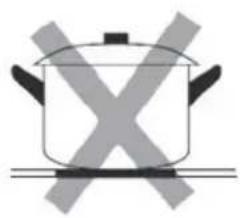
natural_image
Simple line drawing of a cooking pot with crossed X marks (no text or symbols)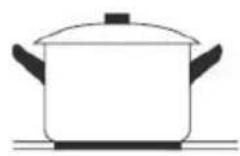
natural_image
Four identical cooking pots with crossed-out X marks, shown in sequence (no text or symbols)natural_image
Pure diagram of a cooking pot with crossed arrows indicating direction (no text or symbols)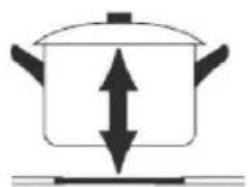
natural_image
Simple line drawing of a cooking pot with upward and downward arrows indicating direction (no text or symbols)FR
NL
EN
ES
PT

MODO DE EMPLEO
Notas
natural_image
Abstract geometric shape resembling a stylized letter H (no text or symbols)natural_image
Simple line drawing of three coiled loops inside a rounded square (no text or symbols)natural_image
Simple line drawing of a cooking pot with crossed X marks (no text or symbols)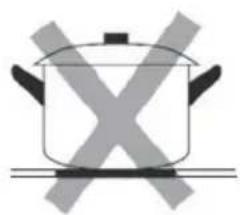
natural_image
Simple line drawing of a cooking pot with crossed X marks (no text or symbols)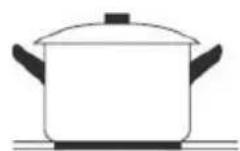
natural_image
Four identical cooking pots with crossed-out X marks, shown in sequence (no text or symbols)
FUNCIONAMENTO
Notas
natural_image
Abstract geometric shape resembling the letter H, composed of black hexagonal and diamond shapes (no text or symbols)
- MANUEL D'UTILISATION HANDLEIDING
- TABLE DES MATIÈRES
- MISES EN GARDE IMPORTANTES
- MERCI DE BIEN VOULOIR LIRE LES CONSIGNES DE SÉCURITÉ ATTENTIVEMENT AVANT D'UTILISER L'APPAREIL ET CONSERVER POUR RÉFÉRENCE ULTÉRIEURE.
- Attention
- FONCTIONNEMENT
- Remarques
- Hotline Darty France
- BELANGRIJKE VEILIGHEIDSINSTRUCTIES
- LEES DE VOLGENDE VEILIGHEIDSWAARSCHUWINGEN EN DE INSTRUCTIES AANDACHTIG DOOR VOORDAT U HET APPARAAT GEBRUIKT EN BEWAAR ZE VOOR LATERE RAADPLEGING.
- Waarschuwingen
- GEBRUIK
- Opmerkingen
- IMPORTANT SAFETY INSTRUCTIONS
- PLEASE READ THE FOLLOWING SAFETY WARNINGS AND THE INSTRUCTIONS CAREFULLY BEFORE USING THE APPLIANCE AND KEEP FOR FUTURE REFERENCE.
- Warnings
- PRECAUTIONS
- About induction cooking
- CHOOSING THE RIGHT COOKWARE
- Suitable cookware
- OPERATION
- Notes
- To start cooking
- Power Levels
- Your hob will beep under the following circumstances :
- When you have finished cooking
- Using the boost function
- NOTE :
- Setting the timer
- To deactivate the timer
- Locking / unlocking your hob
- COOKING GUIDELINES
- Simmering
- Searing steak
- Stir-frying
- Detection of small articles
- TROUBLESHOOTING
- CLEANING AND MAINTENANCE
- TECHNICAL DATA SHEET
- DISPOSAL
- MODO DE EMPLEO
- Notas
- FUNCIONAMENTO
Brand : PROLINE
Model : ICD35BOOST
Category : Cooker