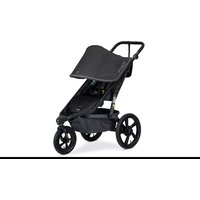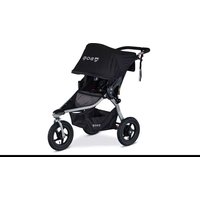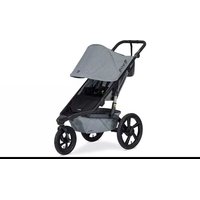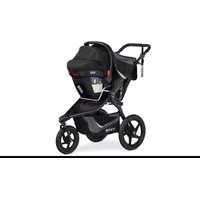
Wayfinder - Stroller BOB Gear - Free user manual and instructions
Find the device manual for free Wayfinder BOB Gear in PDF.


User questions about Wayfinder BOB Gear
0 question about this device. Answer the ones you know or ask your own.
Ask a new question about this device
Download the instructions for your Stroller in PDF format for free! Find your manual Wayfinder - BOB Gear and take your electronic device back in hand. On this page are published all the documents necessary for the use of your device. Wayfinder by BOB Gear.
USER MANUAL Wayfinder BOB Gear
natural_image
Line drawing of a two-wheeled baby stroller with decorative wings and wheels (no text or symbols)WAYFINDER™
USER GUIDE
GUIDE DE L'UTILISATEUR
GUÍA DEL USUARIO
IMPORTANT
THIS USER GUIDE CONTAINS A MANDATORY ARBITRATION CLAUSE AND CLASS ACTION WAIVER ("ARBITRATION AGREEMENT") THAT AFFECTS YOUR LEGAL RIGHTS, REQUIRES YOU TO ARBITRATE DISPUTES, AND LIMITS THE MANNER IN WHICH YOU CAN SEEK RELIEF.
IMPORTANT
LE PRÉSENT GUIDE D'UTILISATION CONTIENT UNE CLAUSE D'ARBITRAGE OBLIGATOIRE ET UNE RENONCIATION AU RECOURS COLLECTIF (« CONVENTION D'ARBITRAGE ») QUI A UNE INCIDENCE SUR VOS DROITS LÉGAUX, VOUS OBLIGE À ARBITRER LES LITIGES ET LIMITE LA FAÇON DONT VOUS POUVEZ DEMANDER UN REDRESSEMENT.
IMPORTANTE
BOB ^® , BOB Gear ^® , BRITAX ^® , and Wayfinder ^™ are trademarks owned by Britax. ©2022 All Rights Reserved. This product and its components are subject to change without notice.
natural_image
Abstract shield-shaped logo with mountain and river design (no text or symbols)WELCOME TO BOB GEAR
BOB Gear ^® recommends that you register your stroller at bobgear.com/registration. This will allow us to notify you directly if there are any product recalls.
For updates to this user guide, warranty and other recent product notifications, please visit bobgear.com periodically or any time before making approved changes or adding approved equipment to your stroller.
Safety Information......2
WARNINGS....2
NOTES....3
Stroller Features......4
Usage Guidelines....5
WALK OR JOG MODE 5
Stroller Assembly 6
UNPACKING THE STROLLER....6
STROLLER WHEELS....6
Stroller Operation....9
UNFOLDING AND FOLDING 9
CHECKING TIRE PRESSURE 10
ADJUSTING THE TRACKING 10
FINE TUNING THE TRACKING....11
Care and Maintenance....15
CLEANING....15
REGULAR INSPECTIONS....15
Stroller Accessories .... 15
Warranty 16
Arbitration Agreement.... 17
WARNING!
Failure to follow all warnings and instructions could result in SERIOUS INJURY OR DEATH.
Read these instructions carefully before using this product. To ensure proper use, store this user guide in a convenient place so it can be consulted often.
- Never leave child unattended.
- Avoid serious injury from falling or sliding out. Always use seat harness.
- Avoid finger entrapment or injury. Always ensure any child occupants or bystanders are away from the stroller while folding or unfolding.
- Do not use stroller with a child taller than 44 inches (112 cm).
- Do not use stroller with a child who weighs more than 65 lbs (29.5 kg). Exceeding this limit may cause stroller to become unstable.
- Do not overload the cargo basket. Maximum weight is 10 lbs (4.5 kg). Overloading the basket may cause the stroller to become unstable and tip over.
- Do not overload cup holder and storage pocket. Maximum weight for cup holder and storage pocket is 1 lb (0.5 kg). Overloading may cause the stroller to become unstable and tip over.
- Do not attach parcels or bags to the handlebar or frame of stroller except those recommended by BOB Gear by Britax, as stroller can become unstable and tip over.
- Always make certain that the stroller is fully open and locked before use.
- Assembly of this stroller must be performed by an adult.
- Do not allow children to climb on or play with the stroller.
- FALL HAZARD from tip over - Before running, jogging, or walking fast, LOCK the front wheel from swiveling.
- Do not park on inclines. The parking brake is intended to park the stroller on flat surfaces only. Parking on inclines may result in tip over or runaway stroller.
- The parking brake is not designed as a stopping brake. The parking brake should not be used to slow or stop the stroller because doing so could cause the stroller to stop abruptly, resulting in loss of control.
-
Always set the parking brake when stroller is not moving. Never load or unload the stroller without the parking brake set.
-
Never use with low tire pressure or deflated tires as this could result in loss of control. Inflating tires above the maximum inflation pressure embossed on the tire can damage the rim and/or tire, resulting in loss of control and injury.
- Use extreme caution when using stroller on uneven and/or unpaved, wet, or slick surfaces, as these conditions create additional hazards and can lead to a loss of stability, resulting in serious injury.
- Do not use stroller on stairs, escalators, moving vehicles, or steep inclines. Stroller can tip over.
- Do not wear roller skates or inline skates while pushing stroller.
- Do not run or jog when using infant car seat adapter with infant car seat.
- Always jog with the stroller seat in the fully upright position. Jogging with the seat in reclined positions may result in a loss of stability.
- When seat is fully reclined, backward tip-over is more likely, and may result in injury to stroller occupant.
• Always use wrist strap to prevent being separated from stroller. - Do not modify the stroller or any labels. Doing so voids the warranty and could lead to a dangerous condition.
- Failure to regularly inspect this product and its components to make sure they are in good condition and good working order can result in injury, Discontinue use of stroller if damaged or any parts are missing.
- All infant car seats MUST be installed rear facing.
- Always remove the infant car seat receivers when not in use. Failure to do so may result in injury. (Sold separately)
NOTES
- Before and during use, always make sure the child's hands and feet are away from wheels.
- Never pull stroller backward up stairs. Doing so could damage the suspension system, leading to frame failure.
- Protect stroller when transporting or shipping to prevent damage to stroller and stroller components. Check closely for damage after transporting or shipping.
- Discontinue using stroller if damaged or if any parts are missing.
- It is best to store your stroller indoors when it is not in use. Extended exposure to rain or the sun's ultraviolet rays can fade and damage the fabric, tires, and plastic parts.
- Do not fold the stroller when wet or damp. Always make sure that the stroller is dry before storing.
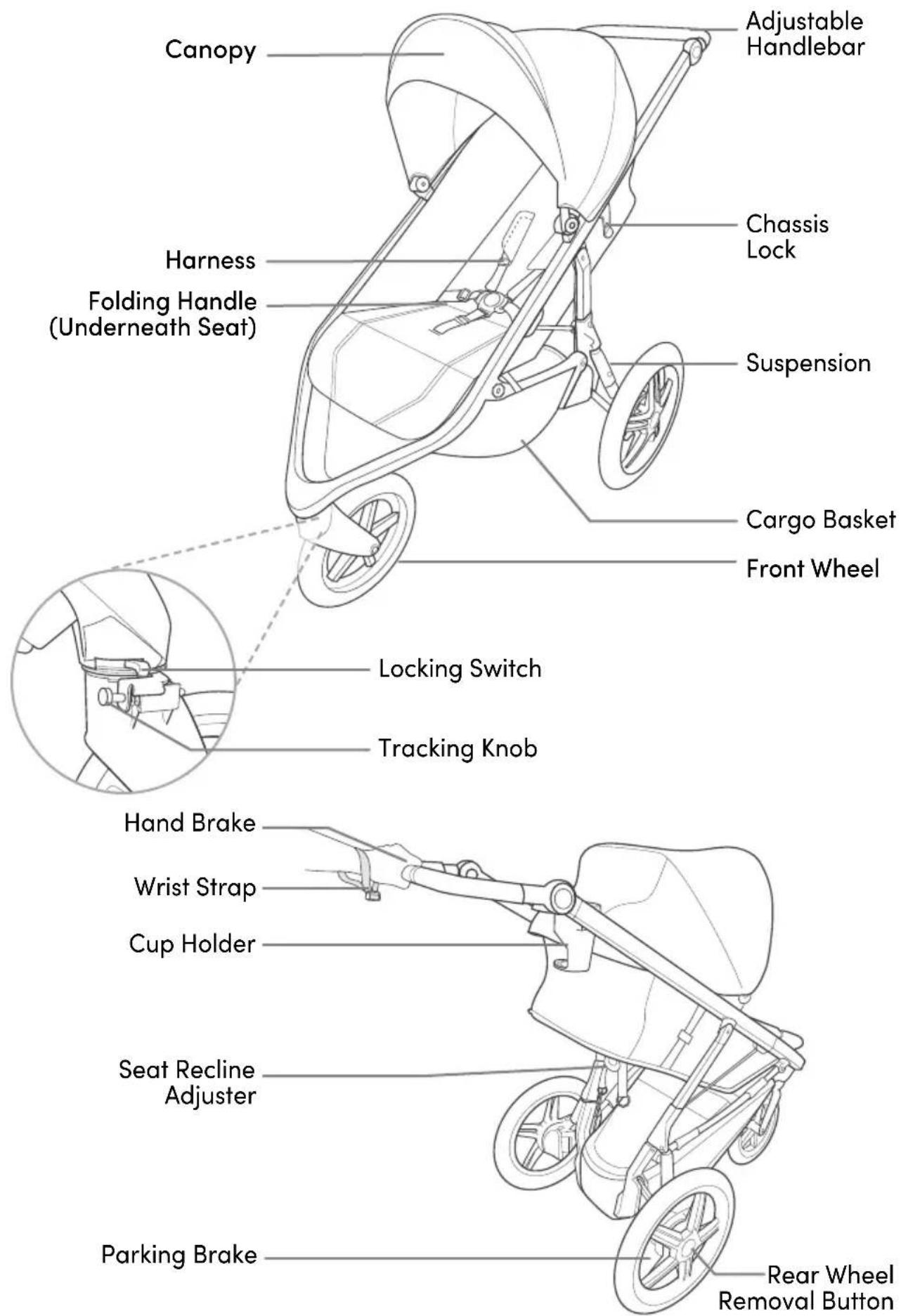
Stroller Features
text_image
Canopy Adjustable Handlebar Harness Chassis Lock Folding Handle (Underneath Seat) Suspension Cargo Basket Front Wheel Locking Switch Tracking Knob Hand Brake Wrist Strap Cup Holder Seat Recline Adjuster Parking Brake Rear Wheel Removal ButtonActual product may vary from images
WARNING!
FALL HAZARD from tip over - Before running, jogging, or walking fast, LOCK the front wheel from swiveling.
WARNING!
Use only with an infant car seat until child has sufficient head and neck control.
Do NOT jog or walk fast with a child that does not have head and neck control.
WARNING!
Do NOT jog or walk fast with the stroller in swivel mode.
text_image
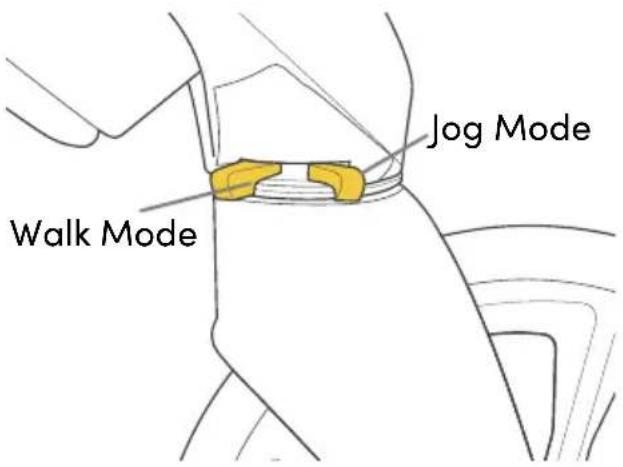
Jog Mode Walk ModeUsage Guidelines
WALK OR JOG MODE
Walk Mode
Flip locking switch in towards the back of the stroller. Fork will now rotate 360 degrees.
NOTE: Stroller is shipped in walk mode.
Jog Mode (Jogging/Walking Fast)
Flip the locking switch towards the front of the stroller. Rotate fork/wheel until it snaps into rear position.
If the front fork is in jog mode, it will be locked and will not swivel left or right as it does in walk mode.
Stroller Assembly
Remove all packaging materials and discard to avoid choking and suffocation hazards.
STROLLER WHEELS
REAR WHEEL INSTALLATION
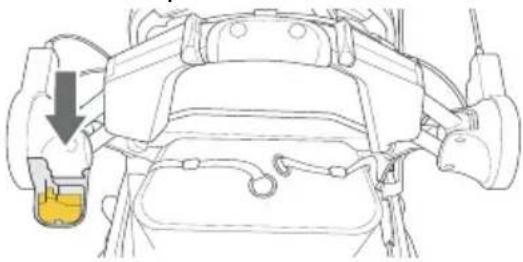
1. Unlock Parking Brake
Prior to installing the rear wheels, position the parking brake in the unlocked position.
natural_image
Technical line drawing of a vehicle's internal components, showing a yellow liquid container and a black arrow pointing to a component (no text or symbols present)2. Insert Rear Wheel Stub Axle
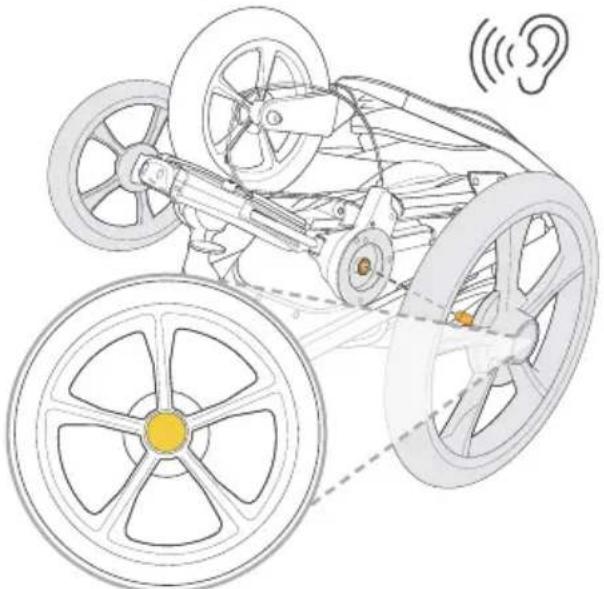
Insert the rear wheel's stub axle into the hole in the rear dropout while pressing the button until a "click" is heard. Repeat for other side.
natural_image
Diagram of a car's wheel assembly with a sensor emitting sound waves (no text or labels)NOTE: If no click is heard, the wheel may not be secure in the attachment bracket and may detach during operation. Pull on wheel to ensure proper installation.
REAR WHEEL REMOVAL
1. Unlock Parking Brake
Before removing the rear wheels, position the parking brake in the unlocked position.
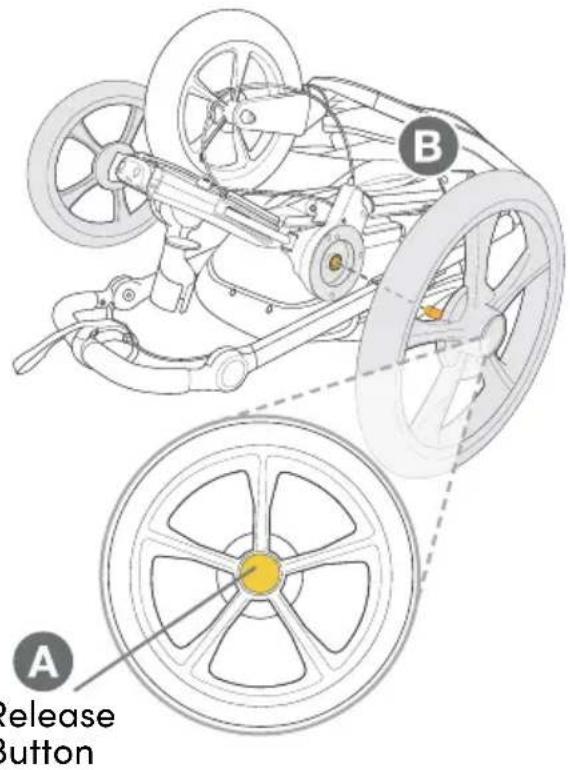
2. Remove Wheel
Raise the wheel a few inches off the ground, (A) push the release button, and (B) pull the wheel out of the rear wheel attachment bracket. Repeat for the other side.
text_image
A Release Button BFRONT WHEEL INSTALLATION
1. Remove Through Axle
From Front Wheel
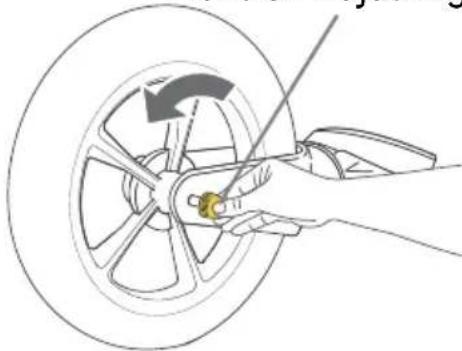
Unscrew the tension adjusting nut from the through axle from the front wheel.
Tension Adjusting Nut
natural_image
Illustration of a hand using a tool to adjust the wheel rim and wheel rim (no text or symbols present)2. Lock Front Fork
Rotate the front fork until it locks. See page 5.
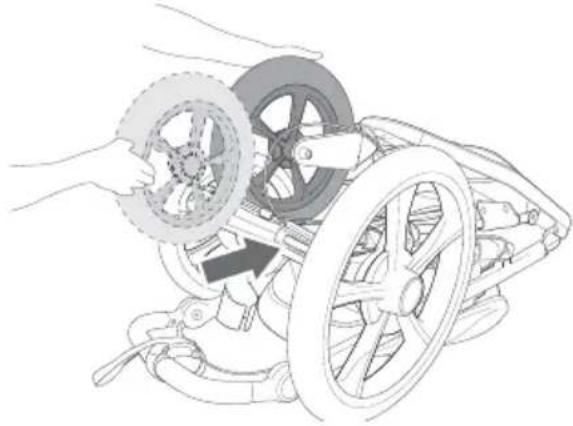
natural_image
Mechanical assembly diagram showing a hand operating a motor with gears and wheels (no text or symbols)3. Insert Front Wheel
When facing the front of the stroller, insert the wheel between the fork and align the wheel hub with holes in the fork blades.
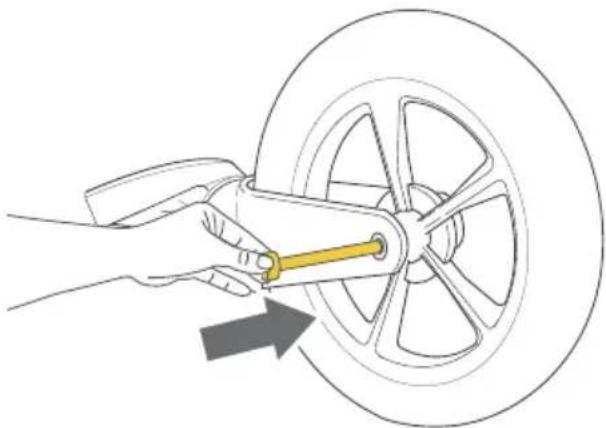
natural_image
Illustration of a hand using a tool to adjust the wheel rim (no text or symbols present)4. Insert Through Axle
Insert the through axle into the fork and through the wheel hub, then install the tension adjusting nut to the opposite side.
5. Tighten Tension Adjusting Nut
Tighten the tension adjusting nut until secure using the hex key.
Tension Adjusting Nut
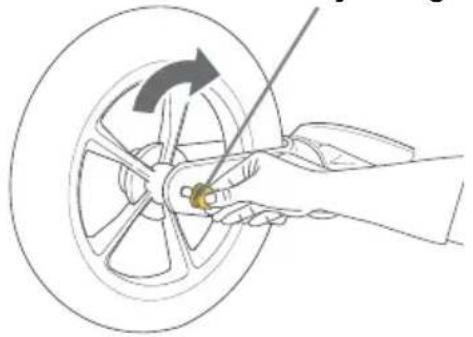
natural_image
Illustration of a hand using a tool to adjust or install a car wheel rim (no text or symbols present)FRONT WHEEL REMOVAL
1. Remove Through Axle
Loosen the tension adjusting nut using the hex key and remove the through axle from the front wheel and fork.
2. Remove Front Wheel
Pull the front wheel out of the fork assembly.
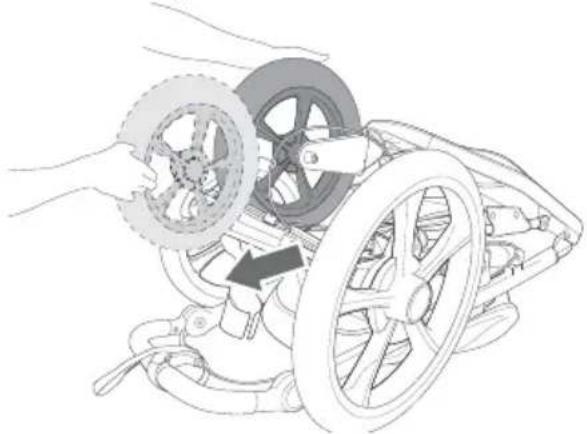
natural_image
Mechanical assembly diagram showing hands operating a wheel and gear mechanism (no text or labels)STROLLER CANOPY
CANOPY INSTALLATION
natural_image
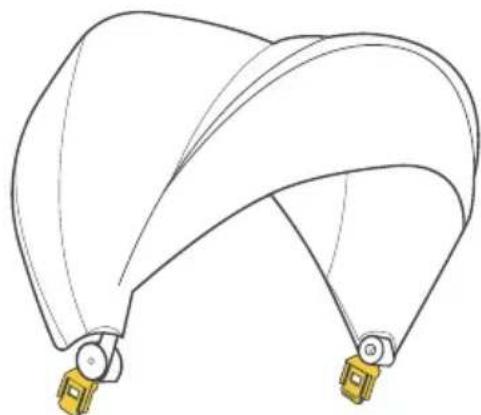
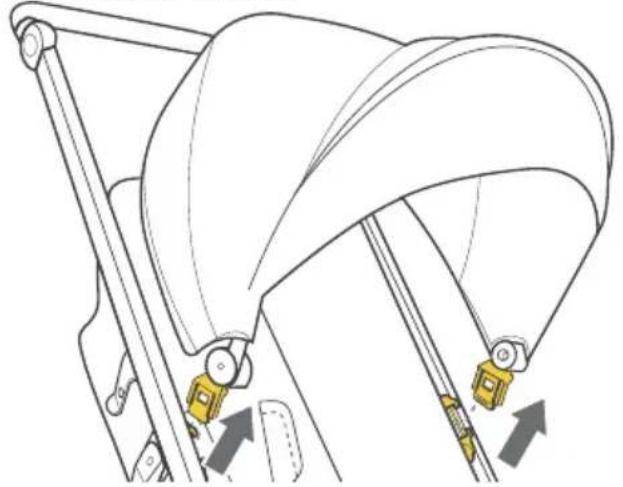
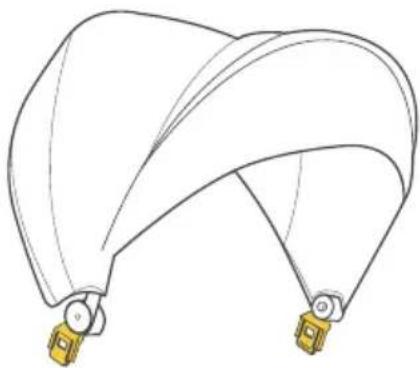
Line drawing of a mechanical device with two yellow components and curved blades (no text or symbols)1. Connect Canopy to Stroller Frame
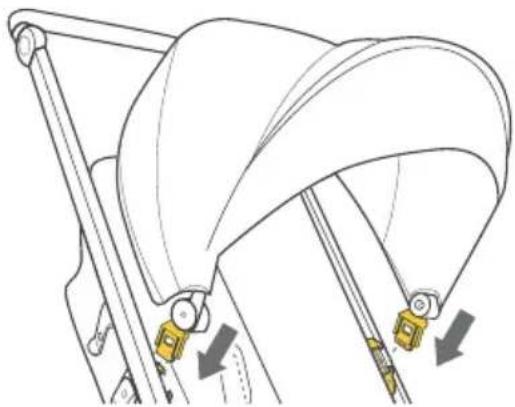
Lower canopy connectors onto the stroller frame mount, then push to connect.
natural_image
Technical line drawing of a mechanical device with no visible text or symbols2. Attach Canopy Flap
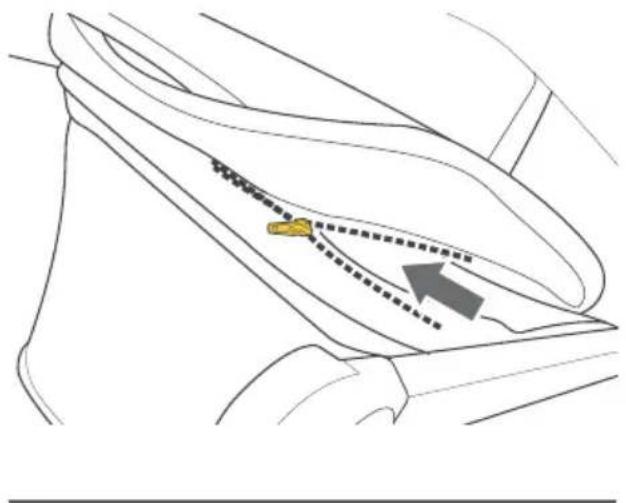
Connect the zipper under the canopy flap to the back of the stroller frame.
natural_image
Diagram of a car's side arm and neck showing a dotted line with an arrow indicating direction (no text or symbols)CANOPY REMOVAL
1. Detach Canopy Flap
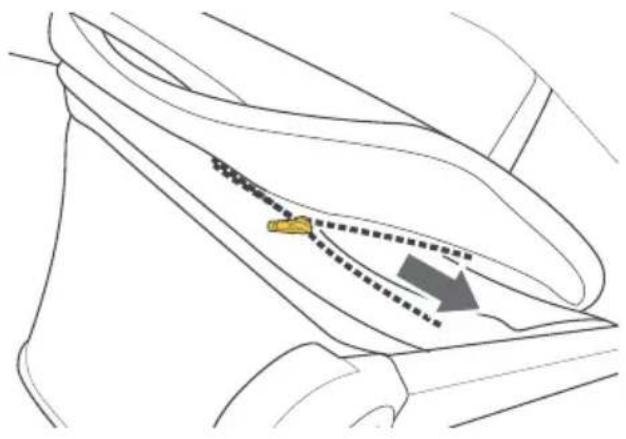
Locate zipper under canopy flap between stroller handlebars, then unzip.
natural_image
Diagram of a car interior showing a dotted line indicating direction and an arrow pointing to a yellow object (no text or symbols present)2. Unlock Canopy From Stroller Frame
Pull in tabs and pull up on canopy connectors to lift canopy off stroller frame.
natural_image
Technical line drawing of a mechanical assembly with no visible text or symbolsCUP HOLDER
CUP HOLDER INSTALLATION
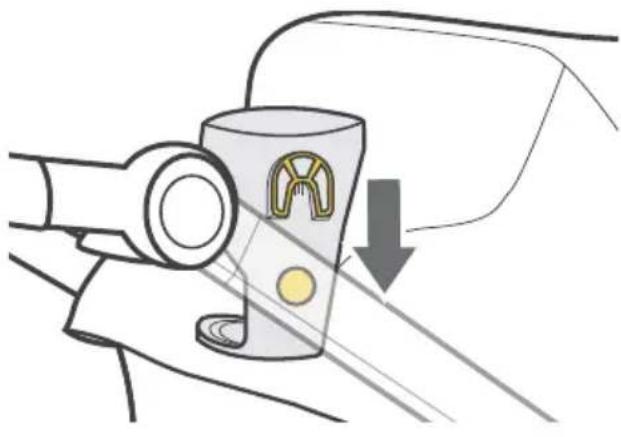
1. Attach Cup Holder
Push cup holder onto holding pin on stroller handle.
natural_image
Diagram of a mechanical device with a handle and clasp, showing a downward force arrow (no text or symbols present)CUP HOLDER REMOVAL
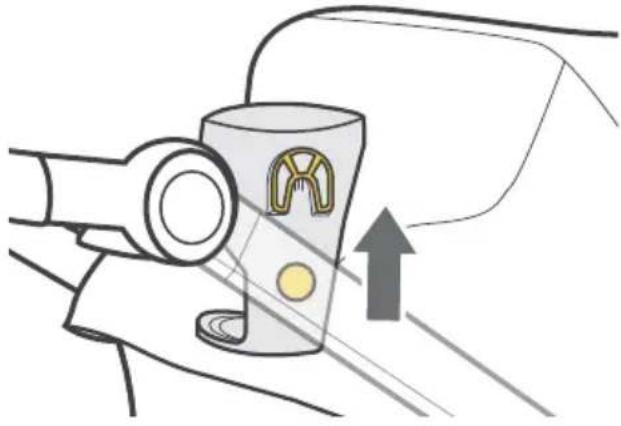
1. Remove Cup Holder
Pull up on cup holder to remove from holding pin on stroller handle.
natural_image
Diagram of a mechanical device with a handle and internal components, showing an upward arrow (no text or symbols present)Stroller Operation
UNFOLDING AND FOLDING
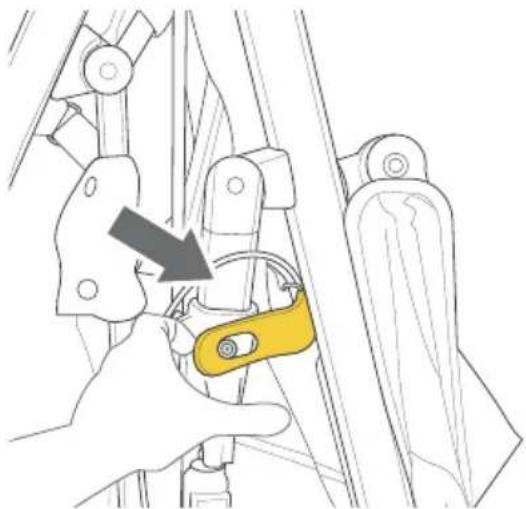
1. Unlock Chassis Lock Lever
Push frame together and pull tab to separate chassis lock.
natural_image
Illustration of a hand using a yellow tool to adjust or install a mechanical component, with no visible text or symbols.2. Open Stroller Frame
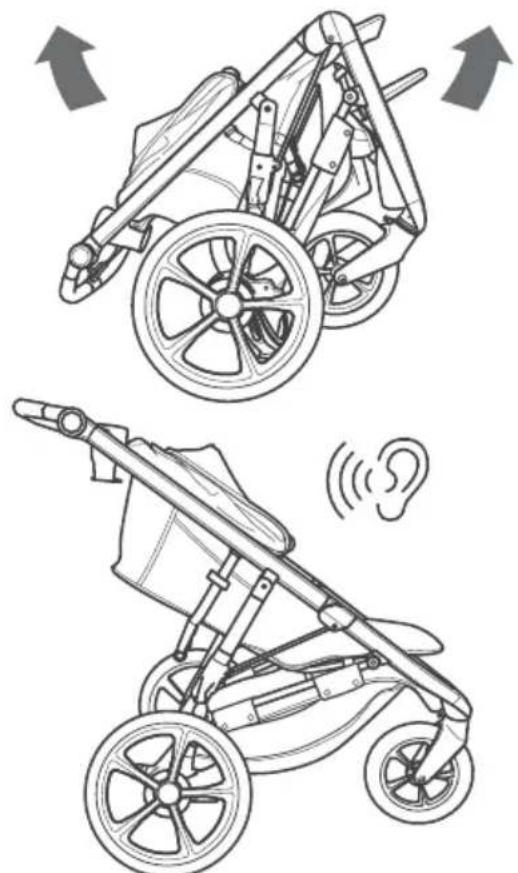
Pull apart top and bottom of the frame until it opens. Push down on stroller seat until a click is heard.
natural_image
Line drawings of a two-wheeled stroller with side-mounted wheels and a separate ear, showing mechanical components and motion arrows (no text or symbols)Locked Position
1. Lock Parking Brake
Set parking brake in locked position.
2. Empty Stroller
Remove child and all contents from cargo basket and cup holder.
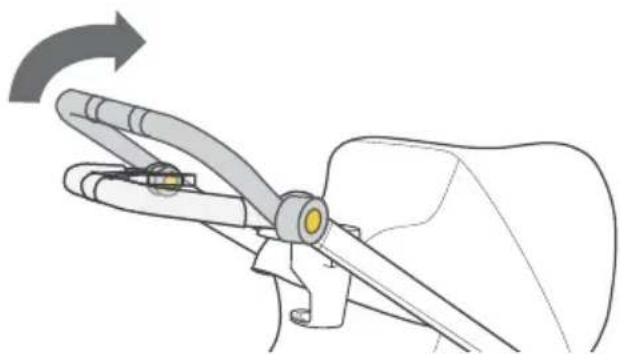
3. Rotate Handlebar
Squeeze both handlebar release buttons simultaneously. Rotate handlebar and position so that it is inline with stroller frame. This will allow stroller to stand on its own when folded.
natural_image
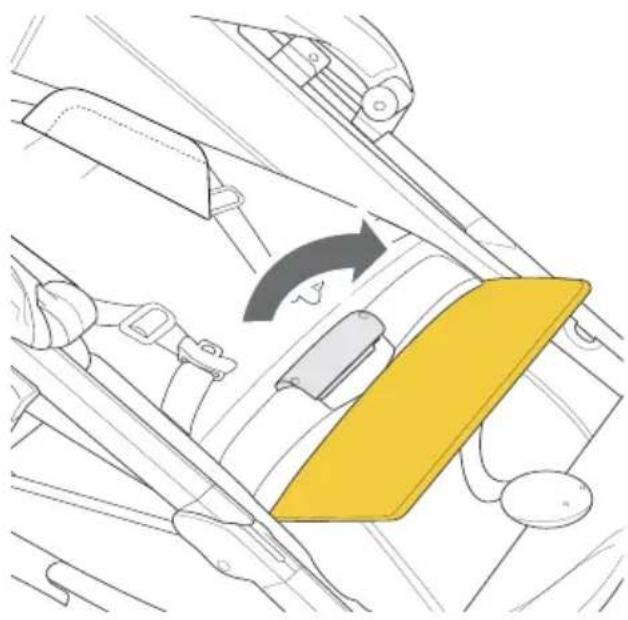
Diagram of a mechanical device with a curved arrow indicating rotation or movement (no text or symbols present)4. Pull the Seat Flap Forward
This will reveal the folding handle.
natural_image
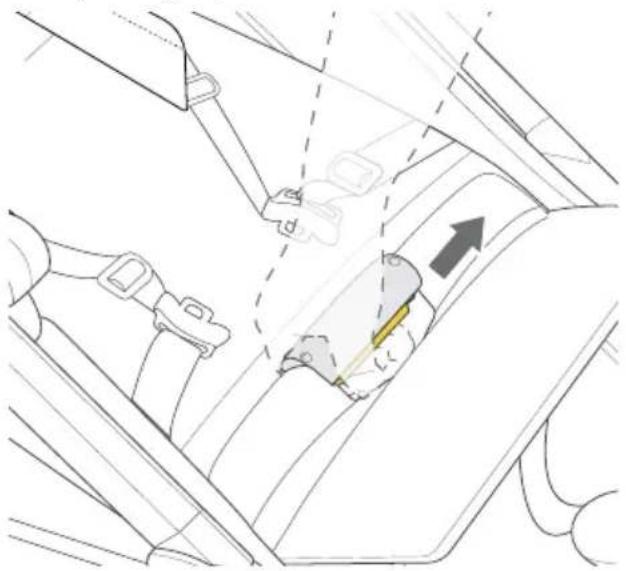
Diagram of a car interior showing seatbelt and dashboard with directional arrow (no text or symbols)5. Activate Folding Handle
Slide the lever to the side while pulling up on the stroller handle.
natural_image
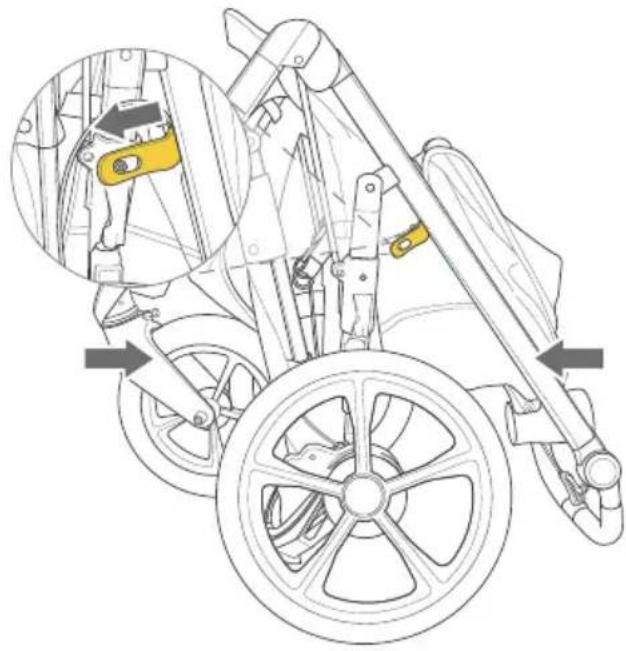
Diagram of a car's seatbelt mechanism showing hand positioning and directional arrow (no text or symbols)6. Lock Stroller In Folded Position
Push frame together allowing chassis lock lever to engage with chassis lock knob.
NOTE: Stroller should be freestanding on handlebar bumper and wheels with handle adjusted to correct position for balance.
natural_image
Technical line drawing of a vehicle chassis with wheels and suspension components (no text or symbols)CHECKING TIRE PRESSURE
Plastic wheels are rated to a maximum tire inflation pressure of 30 pounds per square inch (psi). The maximum inflation pressure is embossed on the wheel next to the valve stem and on the tire itself.
ADJUSTING THE TRACKING
If stroller pulls left or right when the front wheel is in jog mode and stroller is on flat terrain, adjust tracking as outlined in the following steps.
WARNING!
Do not test with a child or any occupant in the stroller.
1. Empty Stroller
Remove child and all contents from cargo basket and pockets.
2. Check Tire Pressure
3. Set Stroller to Jog Mode
Flip the locking switch towards the front of the stroller. Rotate fork/wheel until it snaps into rear position. See Choosing Walk or Jog Mode on page 5.
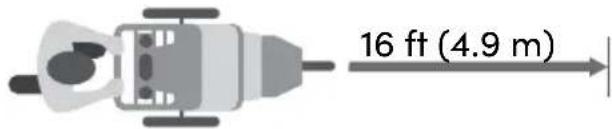
4. Place Stroller On Level Ground
Find a stretch of level ground about 16 feet (4.9 m) long.
text_image
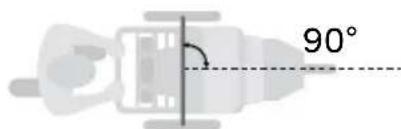
16 ft (4.9 m)5. Align Rear Wheel Axles
Align stroller so rear wheel axles are perpendicular to a straight line.
text_image
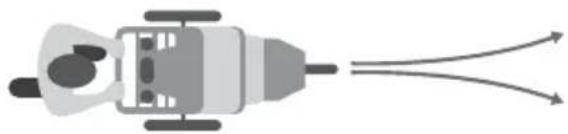
90°6. Test Alignment
Push stroller straight forward and release to see if stroller veers right or left. Repeat push test several times.
natural_image
Diagram of a spacecraft with two outgoing arrows indicating flow or signal (no text or symbols)NOTE: If stroller consistently pulls to left or right, see Fine Tuning the Tracking.
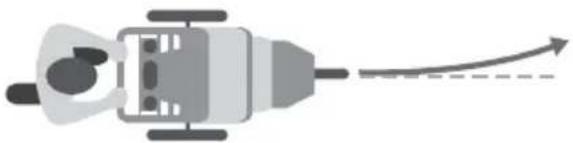
FINE TUNING THE TRACKING If Stroller Pulls LEFT
natural_image
Diagram of a spacecraft with an arrow indicating direction (no text or symbols)If your stroller pulls LEFT, turn tracking knob clockwise up to one half turn.
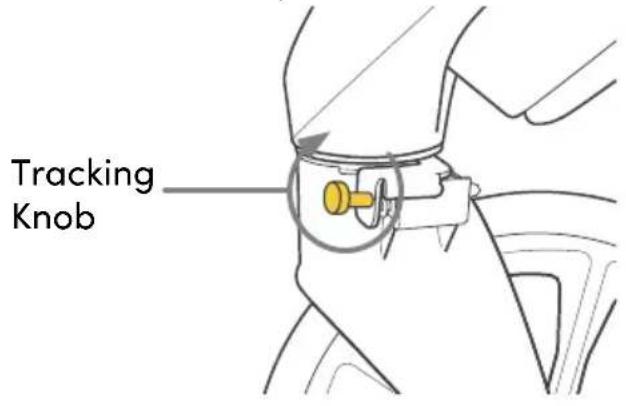
text_image
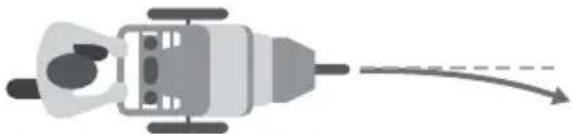
Tracking KnobIf Stroller Pulls RIGHT
natural_image
Diagram of a spacecraft with a curved trajectory arrow, no text or symbols presentIf your stroller pulls RIGHT, turn tracking knob counterclockwise up to one half turn.
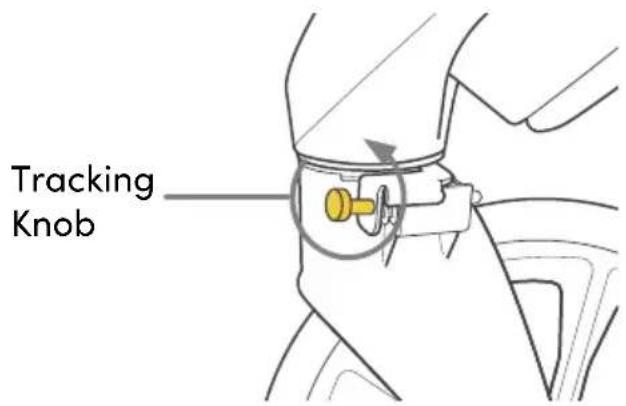
text_image
Tracking KnobREPEAT alignment test and adjust as needed until stroller rolls straight.
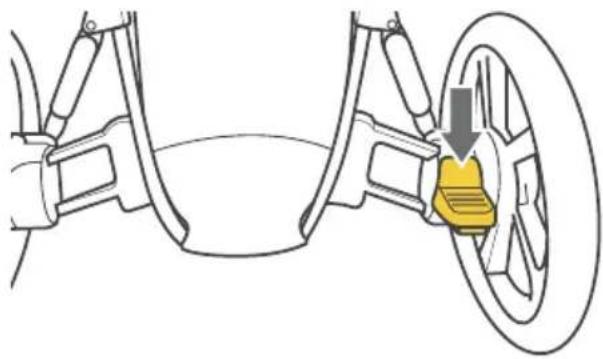
The parking brake prevents the stroller from moving while loading and unloading. The parking brake is not designed as a stopping brake.
Locked Position
To set the parking brake, press down on the foot pedal – making sure the locking pin fully engages the locking disk.
natural_image
Diagram of a car wheel assembly with a yellow component inserted, showing structural components and a directional arrow (no text or labels)NOTE: Pressing the brake locks both rear wheels.
NOTE: To ensure the brake is set properly, attempt to roll the stroller forward and backward after setting the brake. If the stroller will not roll, the brake is set properly.
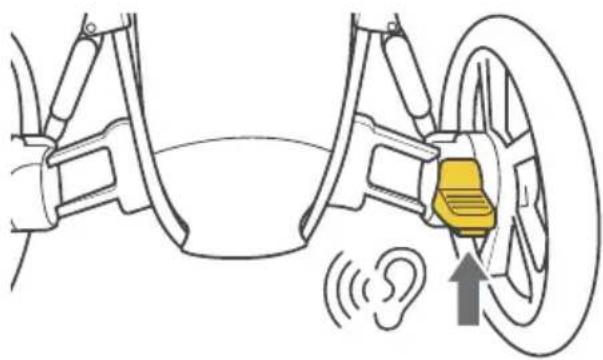
Unlocked Position
To release the parking brake, lift up on the foot pedal with your foot until a click is heard and the pedal is fully in the unlocked position.
text_image
Diagram illustrating car wheel and ear components with a highlighted yellow component and sound waves, likely illustrating a mechanical or diagnostic concept.USING THE WRIST STRAP
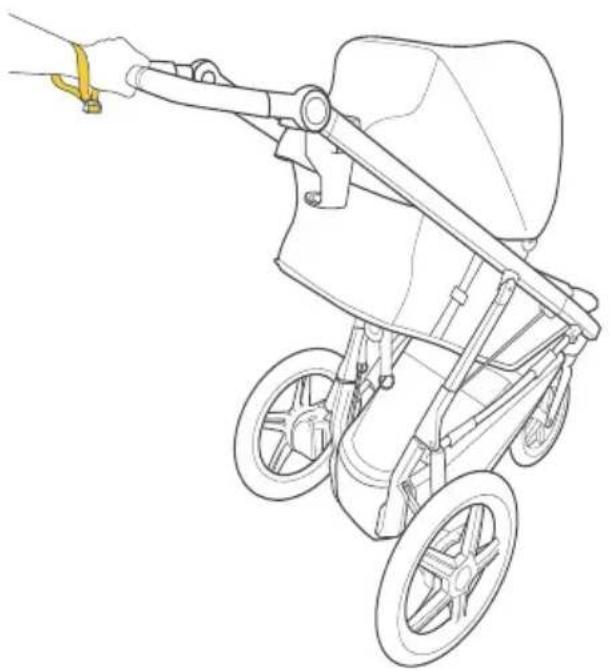
Slip Loop of Strap Securely Onto Wrist
The wrist strap is designed to help prevent the stroller from rolling away should you lose your grip on the stroller. When using the stroller, make sure the strap is securely looped over your wrist.
natural_image
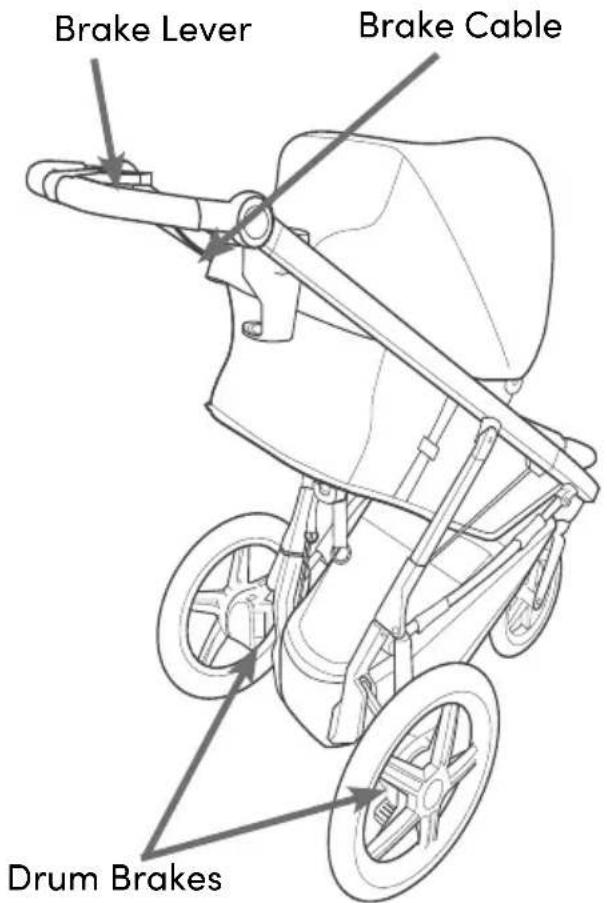
Line drawing of a baby stroller with handle and wheels, no text or symbols present- The hand brake system is connected to drum brakes in the rear wheels and may be used to help slow the stroller. The hand brake system is not a parking brake.
• To use the hand brake system, depress the hand brake lever. Apply pressure to decelerate the stroller.
text_image
Brake Lever Brake Cable Drum BrakesRECLINING THE SEAT
WARNING!
When seat is fully reclined, backward tip-over is more likely and may result in injury to stroller occupant.
NOTE: Set parking brake before making any seat adjustments.
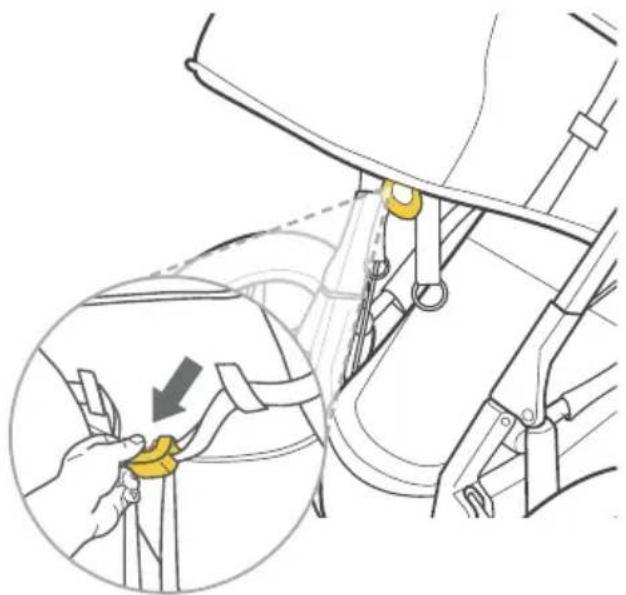
1. Recline Seat
Squeeze the recline button and pull the seat back down into the desired position.
natural_image
Mechanical assembly diagram showing a hand adjusting a component with a magnified inset highlighting the mechanism (no text or symbols present)2. Return To Upright Position
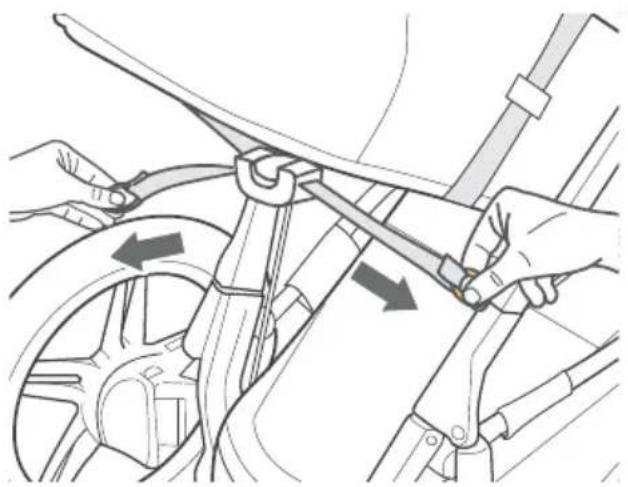
Grab the rings on either side of the recline button and pull the straps out to the sides to raise the seat.
natural_image
Diagram of a car steering wheel with arrows indicating force or movement (no text or symbols present)POSITIONING THE CANOPY
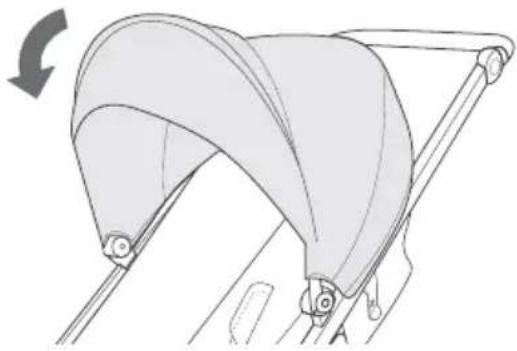
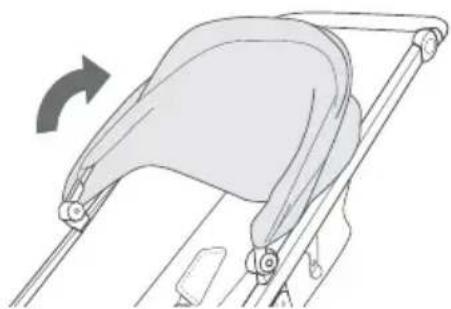
1. Extend Canopy
Rotate canopy away from handlebar for additional shade. Flip out canopy visor for additional shade.
natural_image
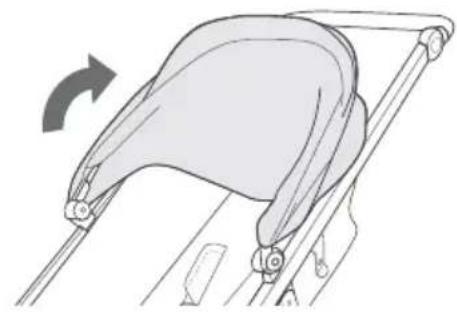
Diagram of a mechanical device with a curved component and directional arrow (no text or symbols)2. Retract Canopy
Push canopy toward handlebar.
natural_image
Illustration of a chicken seatbelt with an arrow indicating rotation (no text or symbols)ADJUSTING HANDLE POSITION
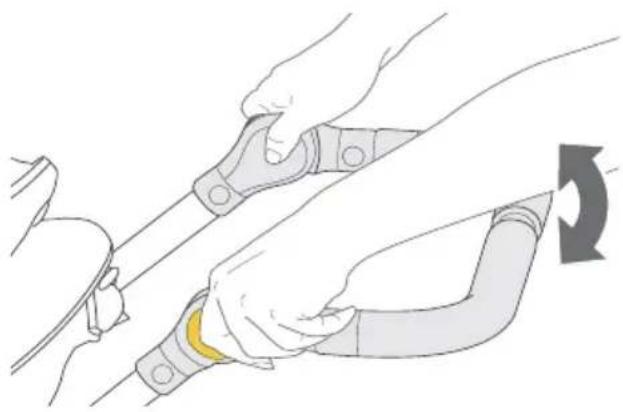
To adjust the handle position, depress and hold the two release buttons on the outside of the handle assembly while raising or lowering the handle to one of the individual positions.
natural_image
Illustration of hands using a tool to lift a cable or cable, with a curved arrow indicating motion (no text or symbols present)SECURING THE CHILD IN THE SEAT
1. Set Parking Brake
Press parking brake down into locked position.
NOTE: Rear wheels should not rotate when parking brake is set.
2. Place Child In Seat
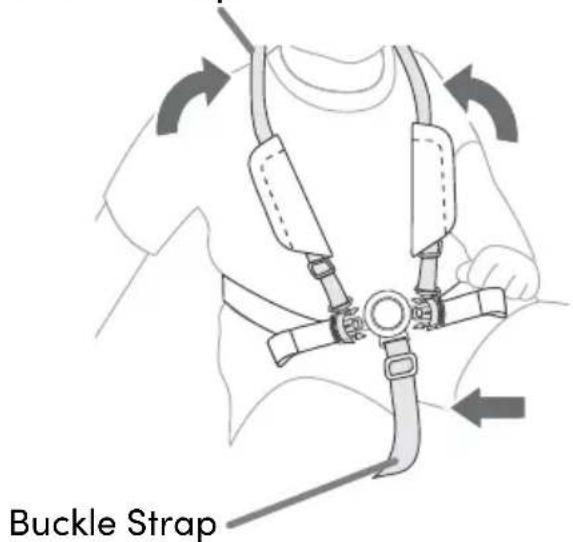
Slip one shoulder strap over each shoulder. Position buckle strap between legs.
Shoulder Strap
text_image
Buckle Strap3. Fasten Shoulder Straps
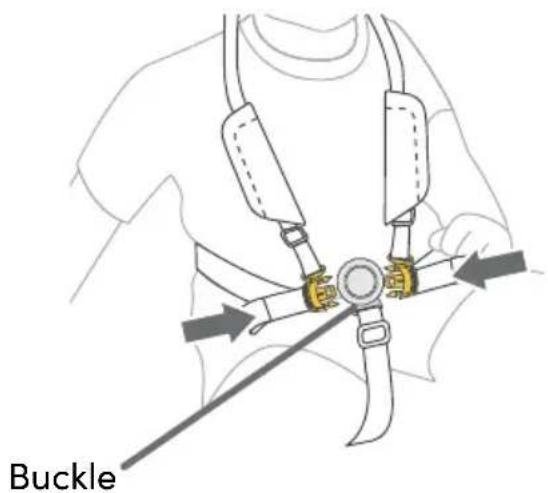
Insert both shoulder strap tongues into the buckle.
text_image
Buckle4. Adjust the Buckle
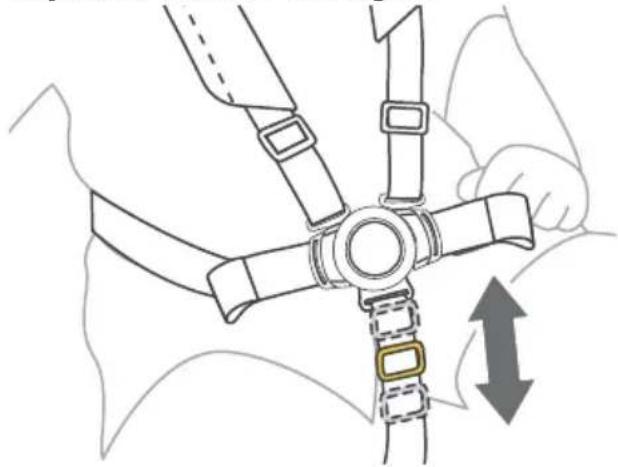
Slide the buckle adjuster up to lengthen or down to shorten.
NOTE: Buckle strap length should be adjusted to have a snug fit.
natural_image
Diagram of a seatbelt buckle assembly with arrows indicating rotation (no text or symbols)5. Adjust Shoulder Strap Height
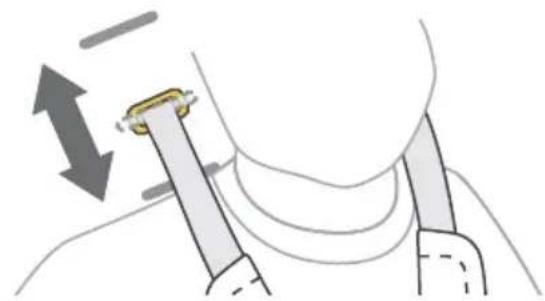
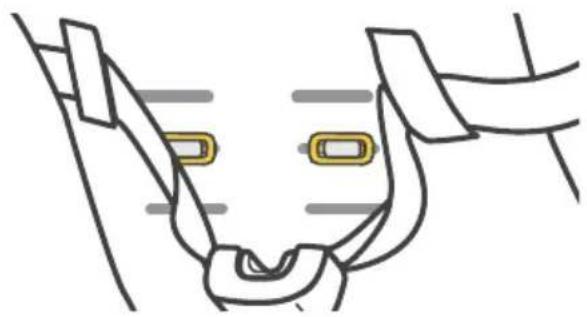
Adjust height of shoulder strap from the back of the stroller to fit just above child shoulder height.
natural_image
Medical illustration showing a surgical tool inserted into a patient's neck area, with no text or symbols present.NOTE: Ensure shoulder strap is not twisted and retainer clip is fully pushed through the back of the stroller.
natural_image
Line drawing of a mechanical component with no visible text or symbols6. Adjust Shoulder Strap Length
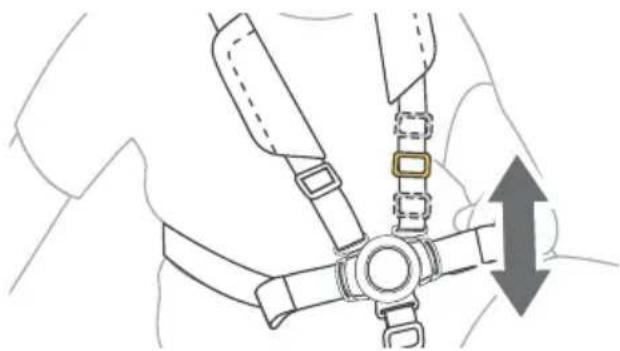
Slide the pads out of the way. Slide adjuster up or down to adjust straps. Seat harness should fit snug and be comfortable.
natural_image
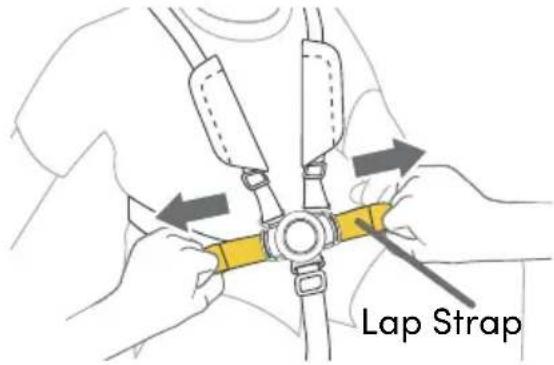
Line drawing of a person's seatbelt buckle with a belt buckle, showing no text or symbols7. Tighten Lap Strap
Adjust lap strap to fit snug and be comfortable.
text_image
Lap StrapCare and Maintenance
WARNING!
Check tire pressure before every use.
CLEANING
- Use a sponge with a solution of mild soap and cold water (maximum temperature of 100^ F / 38^ C ).
- Rinse thoroughly with clean water to remove soap, then air dry.
- Do not use detergent or abrasive cleansers.
- Do not pressure wash.
- Do not fold the stroller when wet or damp. Always make sure that the stroller is dry before storing.
REGULAR INSPECTIONS
We recommend inspecting your stroller before every use.
- Verify tire pressure.
- Verify all screws, attachment points and fasteners are tight.
- Check all wheels to be sure they are securely clamped.
- Check for tears or excessive wear in the fabric.
- Check that parking brake works properly and locks both wheels securely.
Stroller Accessories
BOB Gear® offers a complete line of accessories for your stroller. Visit our website bobgear.com for full details.
Warranty
This child restraint was manufactured by Britax Child Safety, Inc. ("Britax"). To the extent allowed by law, Britax warrants this product to the original retail purchaser as follows:
LIMITED WARRANTY
The frame is warranted for five years. Components and fabric are warranted for one year. Tires and tubes are NOT covered under this limited warranty. Warranties are only valid from date of original purchase. Proof of purchase is required for any warranty claims. Your exclusive remedy for this warranty is that Britax will, at its option, provide repair or replacement components to the original purchaser of this product. Britax reserves the right to discontinue or change fabrics, parts, models or products, or to make substitutions.
This warranty does not cover damages that arise from negligence, misuse or use not in accordance with the product instruction. Additionally, Britax products purchased from unauthorized retailers, online auction sites, or as second hand items are not covered under this warranty.
The use of non-Britax covers, inserts, toys, accessories, or tightening devices is not approved by Britax. Their use could cause this stroller to fail safety standards. Their use also may void the Britax warranty.
To make a claim under this warranty, you must contact Britax Consumer Services at 1-888-427-4829 or 1-704-409-1699, or write to us using the address on the back cover of this User Guide.
DISCLAIMER OF WARRANTIES
The following disclaimer shall apply to you to the maximum extent permitted by applicable law. THE LIMITED WARRANTY SET FORTH ABOVE IS THE EXCLUSIVE WARRANTY MADE BY BRITAX. ALL OTHER WARRANTIES, WHETHER EXPRESS, IMPLIED, OR STATUTORY, INCLUDING WITHOUT LIMITATION THE IMPLIED WARRANTIES OF MERCHANTABILITY AND FITNESS FOR A PARTICULAR PURPOSE, ARE DISCLAIMED. Some states do not allow certain exclusions or limitations on warranties, so the above may not apply to you. This warranty gives you specific legal rights, and you may have other rights, which vary from state to state. Neither Britax, nor the retailer selling this product, authorizes any person to create for it any other warranty, obligation, or liability in connection with this product.
LIMITATION OF DAMAGES
The following limitation of damages shall apply to you to the maximum extent permitted by applicable law. THE REMEDIES CONTAINED IN THE LIMITED WARRANTY SET FORTH ABOVE ARE THE EXCLUSIVE REMEDIES PROVIDED BY BRITAX. IN NO EVENT SHALL BRITAX BE LIABLE TO YOU FOR ANY INCIDENTAL, SPECIAL, PUNITIVE, EXEMPLARY, OR CONSEQUENTIAL DAMAGESARISING OUT OF OR RELATING IN ANY WAY TO THE RELATIONSHIP BETWEEN YOU AND BRITAX (INCLUDING DISPUTES RELATED TO THE MARKETING OR SALE OF BRITAX PRODUCTS), ANY PROVISIONS IN THIS USER GUIDE, AND/OR YOUR PURCHASE OR USE OF ANY PRODUCTS DESIGNED, MANUFACTURED, DISTRIBUTED, MARKETED, OR SOLD BY BRITAX.
PLEASE COMPLETE AND MAIL THE OWNER REGISTRATION CARD WITHIN (30) DAYS OF PURCHASE
You may also register online at bobgear.com/registration.
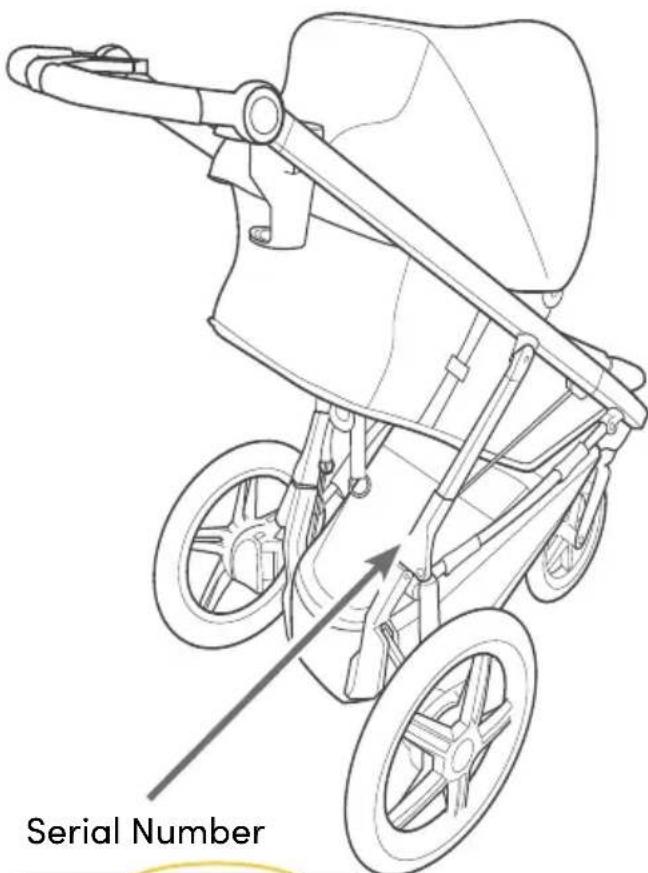
SERIAL NUMBER
Open the stroller. From the back of stroller, look on the inside of the right swing arm.
text_image
Serial Number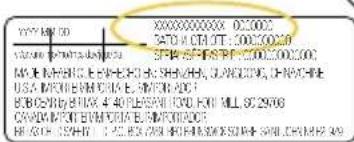
text_image
YYY M130 VOLUME OF WORKS XXXXXXX 0200C SATO A DTA: 100.0000 SPR-SPR-SPR-SPR-SPR-SPR-SPR-SPR-SPR-SPR-SPR-SPR-SPR-SPR-SPR-SPR-SPR-SPR-SPR-SPR-SPR-SPR-SPR-SPR-SPR-SPR-SPR-SPR-SPR-SPR-SPR-SPR-SPR-SPR-SC MILK NATHG E ELEHIC P S KSHEN J LAKING, Q HANCHIE USA MTNIE EMN COE E MTRN AC BROZHY BLOX 4 40 PEERI T OOL KII MILL 872900 CAWAL MOYA EMN CORA E MTRN AC BROZHY BLOX 4 40 PEERI T OOL KII MILL 872900 CAWAL MOYA EMN CORA E MTRN ACArbitration Agreement
MANDATORY ARBITRATION & CLASS ACTION
WAIVER ("ARBITRATION AGREEMENT")
PLEASE READ THIS SECTION CAREFULLY BECAUSE IT AFFECTS YOUR LEGAL RIGHTS, REQUIRES YOU TO ARBITRATE DISPUTES, AND LIMITS THE MANNER IN WHICH YOU CAN SEEK RELIEF.
Arbitration is a process in which persons with a dispute waive their rights to file a lawsuit and proceed in court and to have a jury trial to resolve their disputes and, instead, agree to submit their disputes to a neutral third person (an "arbitrator") for a decision. Each party to the dispute has an opportunity to present some evidence to the arbitrator. Pre-arbitration discovery may be limited. Arbitration proceedings are private and less formal than court trials. The arbitrator will issue a final and binding decision resolving the dispute, which may be enforced as a court judgment. A court rarely overturns an arbitrator's decision.
YOU AND BRITAX AGREE THAT ANY DISPUTE BETWEEN US, WHETHER BASED IN CONTRACT, TORT, STATUTE OR OTHERWISE, SHALL BE RESOLVED IN BINDING INDIVIDUAL ARBITRATION. For purposes of this Arbitration Agreement, the word "dispute" and "disputes" are given the broadest possible meaning and include, without limitation, all claims, disputes, and/or controversies arising out of or relating in any way to the relationship between you and Britax (including disputes related to the marketing or sale of Britax products), any provisions in this User Guide or this Arbitration Agreement (including the interpretation and scope of this Arbitration Agreement and the arbitrability of any dispute), and/or your purchase or use of any products designed, manufactured, distributed, marketed, or sold by Britax. The Federal Arbitration Act ("FAA") and federal arbitration law apply to this Arbitration Agreement. Notwithstanding the foregoing, you and Britax each agree that you and Britax shall retain the rights to bring an individual suit in small claims court for disputes within the scope of such court's jurisdiction and/or to bring an individual suit in court to enjoin infringement or other misuse of intellectual property rights. In no way shall the foregoing sentence allow for an action to be brought on a class or collective basis.
YOU HAVE THE RIGHT TO OPT OUT OF THIS ARBITRATION AGREEMENT, BUT YOU MUST EXERCISE THIS RIGHT WITHIN THIRTY (30) DAYS OF YOUR PURCHASE OF A BRITAX PRODUCT. If you do not wish to be bound by this Arbitration Agreement, you must notify Britax by mailing or e-mailing a written opt-out notice, postmarked or electronically delivered within thirty (30) days of your purchase of a Britax product, to: ATTN: Legal Department, 4140 Pleasant Road, Fort Mill, South Carolina 29708. Your opt-out notice must include your full name, address and/or e-mail address, the model and serial numbers of the purchased product, a copy of your proof of purchase, and a statement that you intend to opt out of this Arbitration Agreement. If you do not opt out within thirty (30) days of your purchase, then this Arbitration Agreement will apply and you understand and agree that you are waiving your right to maintain other available resolution processes, such as a court action or administrative proceeding, to resolve your dispute with Britax.
The arbitration will be conducted confidentially by a single arbitrator and administered by the American Arbitration Association ("AAA") under its Consumer Arbitration Rules most recently in effect to the extent such rules and procedures do not contradict the express terms of this Arbitration Agreement. To learn more about the rules and how to begin an arbitration, you may call any AAA office or go to www.adr.org. If you demand arbitration, then at your request Britax will advance your portion of the expenses associated with the arbitration, including the filing, administrative, hearing and arbitrator's fees ("Arbitration Fees") to the extent such Arbitration Fees exceed \200. If Britax demands arbitration, then at your request Britax will advance your portion of the Arbitration Fees. For claims of \10,000 or less, you can choose whether you would like the arbitration carried out based only on documents submitted to the arbitrator or by a hearing in person or by telephone. The arbitration hearing will be conducted in the county of your residence, within 30 miles of such county, or in such place as shall be ordered by the arbitrator. Throughout the arbitration, each party shall bear his, her or its own attorneys' fees and expenses, including any witness and expert witness fees. The arbitrator shall apply applicable substantive law consistent with the FAA, shall apply statutes of limitation, and shall honor claims of privilege recognized at law. The arbitrator shall decide, with or without a hearing, any motion that is substantially similar to a motion to dismiss for failure to state a claim or a motion for summary judgment. In conducting the arbitration proceeding, the arbitrator shall not apply any federal or state rules of civil procedure or evidence. The arbitrator shall not consolidate the claims of multiple parties unless you and Britax agree to do so. At the timely request of any party, the arbitrator shall provide a written explanation for the award. The arbitrator's award may be filed with any court having jurisdiction.
THIS ARBITRATION AGREEMENT DOES NOT ALLOW CLASS OR COLLECTIVE ARBITRATIONS EVEN IF THE AAA RULES OR PROCEDURES WOULD. IN OTHER WORDS, YOU AND BRITAX EACH AGREE THAT ALL DISPUTES SHALL BE ARBITRATED ON AN INDIVIDUAL BASIS AND WAIVE ANY RIGHT TO PROCEED IN A CLASS, CONSOLIDATED, OR REPRESENTATIVE FASHION. THE ARBITRATOR MAY AWARD MONEY OR INJUNCTIVE RELIEF ONLY IN FAVOR OF THE INDIVIDUAL PARTY SEEKING RELIEF AND ONLY TO THE EXTENT NECESSARY TO PROVIDE RELIEF WARRANTED BY THAT PARTY'S INDIVIDUAL CLAIM. NO CLASS, REPRESENTATIVE OR PRIVATE ATTORNEY GENERAL OR GENERAL INJUNCTIVE RELIEF THEORIES OF LIABILITY OR PRAYERS FOR RELIEF MAY BE MAINTAINED IN ANY ARBITRATION CONDUCTED PURSUANT TO THIS ARBITRATION AGREEMENT.
If the foregoing class action waiver and prohibition against class arbitration is determined to be invalid or unenforceable for any reason, then this entire Arbitration Agreement shall be void. If any portion of this Arbitration Agreement other than the class action waiver and prohibition against class arbitration is deemed to be invalid or unenforceable for any reason, it shall not invalidate the remaining portions of this Arbitration Agreement. If for any reason a dispute proceeds in court rather than in arbitration, you and Britax each waive any right to a jury trial.

natural_image
Abstract shield-shaped logo with mountain and river design (no text or symbols)BIENVENUE CHEZ BOB® GEAR
natural_image
Technical line drawing of a vehicle chassis with a highlighted component and arrow indicating motion (no text or symbols)natural_image
Technical line drawing of a car's wheel assembly with a sensor icon (no text or labels)text_image
Technical diagram of a vehicle's wheel assembly with labeled components A and B, showing mechanical components and wheel alignment.natural_image
Mechanical assembly diagram showing hands operating a motor with gears and wheels (no text or symbols)natural_image
Illustration of a hand using a tool to adjust or install a car wheel rim (no text or symbols present)natural_image
Mechanical assembly diagram showing hands operating a wheel and gear mechanism (no text or labels)AUVENT DE LA POUSSETTE
INSTALLATION DE L'AUVENT
natural_image
Line drawing of a coiled cable or hose with two gold connectors at the ends (no text or symbols)natural_image
Technical diagram of a mechanical device with lever arms and adjustment arrows (no text or symbols)natural_image
Diagram of a car interior showing a dotted line with a yellow object and an arrow indicating direction (no text or symbols)RETRAIT DE L'AUVENT
natural_image
Diagram of a car's side profile showing lane markings and directional arrows (no text or symbols)natural_image
Technical diagram of a mechanical device with lever and guide mechanism (no text or symbols)PORTE-GOBELET
INSTALLATION DU PORTE- GOBELET
natural_image
Diagram of a mechanical device with a handle and clasp tool, showing a downward force arrow (no text or symbols)RETRAIT DU PORTE- GOBELET
natural_image
Diagram of a mechanical device with a handle and internal components, showing an upward arrow (no text or symbols present)natural_image
Illustration of a hand using a yellow tool to adjust or install a mechanical component (no text or symbols visible)natural_image
Line drawings of two strollers with directional arrows indicating motion, showing wheel and seat components (no text or symbols)Position verrouillée
PLIAGE DE LA POUSSETTE
natural_image
Diagram of a mechanical device with a curved arrow indicating rotation or movement (no text or symbols present)natural_image
Diagram of a car interior showing seatbelt and dashboard with directional arrow (no text or symbols)natural_image
Diagram of car seatbelt mechanism showing directional shift and arrow (no text or symbols)natural_image
Technical line drawing of a stroller with wheels and attached components, showing mechanical assembly (no text or symbols)VÉRIFICATION DE LA PRES- SION DES PNEUS
natural_image
Diagram of a vehicle with two connected branches (no text or symbols)natural_image
Diagram of a rocket with exhaust pipe and launch arrow (no text or symbols)natural_image
Diagram of a spacecraft with a curved trajectory arrow, no text or symbols presentnatural_image
Diagram of a car wheel assembly with a highlighted component (no text or symbols)text_image
Diagram illustrating car ear and wheel assembly with a highlighted yellow component and ear indicatorUTILISATION DE LA SANGLE DE POIGNET
natural_image
Line drawing of a two-wheeled baby stroller with handle and wheels (no text or symbols)UTILISATION DU FREIN À MAIN
natural_image
Mechanical assembly diagram showing a hand adjusting a cable with yellow clips, no text or symbols presentnatural_image
Illustration of hands adjusting a bicycle steering wheel and bracket (no text or symbols)POSITIONNEMENT DE L'AUVENT
natural_image
Diagram of a mechanical device with curved blades and a lever mechanism, no text or symbols presentnatural_image
Diagram of a seatbelt mechanism with rotation arrow (no text or symbols)RÉGLAGE DE LA POSITION DU GUIDON
natural_image
Illustration of hands using a tool to lift a cable or cable, showing motion direction (no text or symbols)INSTALLATION DE L'ENFANT DANS LE SIEGE
1. Activez le frein
natural_image
Illustration of a person wearing a full-body safety harness with straps and belt (no text or symbols)Boucle
natural_image
Diagram of a seatbelt buckle assembly with arrows indicating rotation (no text or symbols)natural_image
Diagram of a medical device with directional arrows indicating movement or force (no text or symbols present)natural_image
Simple line drawing of a car's head and neck with no text or symbolsnatural_image
Diagram of a car seatbelt buckle with belt and seat, showing alignment and adjustment arrows (no text or symbols)natural_image
Abstract shield-shaped logo with mountain and river design (no text or symbols)BIENVENIDOS A BOB® GEAR
RUEDAS DEL COCHECITO....6
CAPOTA DEL COCHECITO....7
PORTAVASO....8
RECLINAR EL ASIENTO ....13
natural_image
Diagram of a vehicle's internal components with a yellow component and a black arrow indicating a downward motion (no text or symbols present)natural_image
Diagram of a car's wheel assembly with visible gears and a sensor, no text or symbols presentnatural_image
Technical diagram of a mechanical assembly with labeled parts A and B, showing wheel components and a cross-sectional view (no text or symbols beyond labels)Botón de liberación
INSTALAR LA RUEDA DELANTERA
natural_image
Mechanical assembly diagram showing a hand operating a wheel with a gear mechanism (no text or labels)3. Insertar la rueda delantera
natural_image
Illustration of a hand using a tool to adjust a car wheel rim (no text or symbols present)natural_image
Mechanical assembly diagram showing hands operating a wheel and gear mechanism (no text or symbols)CAPOTA DEL COCHECITO
natural_image
Line drawing of a coiled cable or rope with two yellow connectors at the ends (no text or symbols)1. Conectar la capota alchasis del cochecito
natural_image
Diagram of a mechanical device with attached components and directional arrows indicating motion (no text or symbols)natural_image
Diagram of a car head and neck showing a dotted line with an arrow indicating direction (no text or symbols)RETIRAR LA CAPOTA
natural_image
Diagram of a car's side profile showing hand placement and movement arrows (no text or symbols)natural_image
Technical line drawing of a mechanical assembly with no visible text or symbolsPORTAVASO
natural_image
Diagram of a mechanical clamp or bracket with a handle and clasp, showing a downward force arrow (no text or symbols present)RETIRAR EL PORTAVASO
natural_image
Diagram of a mechanical device with a handle and clamping mechanism, showing an upward arrow (no text or symbols present)natural_image
Illustration of a hand using a yellow tool to adjust or install a mechanical component, with no visible text or symbols.natural_image
Illustration of two stroller models with directional arrows indicating motion, showing wheel and seat components (no text or symbols)Posición bloqueada
CÓMO PLEGAR EL COCHECITO
natural_image
Diagram of a car steering wheel with a curved handle and lever mechanism (no text or symbols)natural_image
Diagram of a car's seatbelt mechanism showing a yellow cover and directional arrow (no text or symbols)natural_image
Diagram of a car seatbelt mechanism showing the wheel and seatbelt (no text or symbols present)natural_image
Technical line drawing of a mechanical device with labeled components and an inset showing a close-up view of a component (no text or symbols present)text_image
4,9 m (16 pies)natural_image
Diagram of a spacecraft with two outgoing arrows indicating flow or signal (no text or symbols)natural_image
Diagram of a rocket with exhaust pipe and launch arrow (no text or symbols)natural_image
Top-down schematic of a spacecraft with a curved trajectory arrow (no text or symbols)natural_image
Diagram of a car wheel assembly with a highlighted component (no text or symbols)text_image
Diagram illustrating car wheel and ear assembly with a highlighted yellow component and sound waves indicating sound or vibration.USAR LA MUÑEQUERA
natural_image
Line drawing of a two-wheeled baby stroller with handle and wheels (no text or symbols)USAR EL FRENO DE MANO
natural_image
Mechanical assembly diagram showing a hand holding a yellow tool, with an inset close-up highlighting the mechanism (no text or symbols present)natural_image
Mechanical diagram showing hands adjusting a car wheel and lever mechanism (no text or symbols)natural_image
Diagram of a mechanical device with a curved component and directional arrow (no text or symbols)Push canopy toward handlebar.
natural_image
Diagram of a chicken seat with a curved arrow indicating rotation (no text or symbols)natural_image
Illustration of hands using a cable to lift a car, showing mechanical components and motion direction (no text or symbols)ASEGURAR AL NIÑO EN EL ASIENTO
natural_image
Illustration of a person wearing a full-body safety harness with directional arrows indicating movement (no text or symbols)Correa de hebilla
natural_image
Diagram of a car seatbelt buckle assembly with directional arrows indicating movement (no text or symbols)natural_image
Medical illustration showing a surgical tool inserted into a patient's neck area, with no text or symbols present.natural_image
Line drawing of a mechanical component with two yellow oval features, no text or symbols presentnatural_image
Line drawing of a car seatbelt buckle assembly with directional arrows indicating movement (no text or symbols)BOB Gear® by Britax © 2022 Britax Child Safety, Inc.

(888) 427-4829

(704) 409-1699

bobgear.com

4140 Pleasant Rd, Fort Mill, South Carolina 29708
All rights reserved. Printed in China. This product and its components are subject to change without notice.