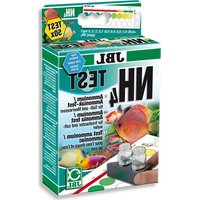
NH4 Test - Water filter JBL - Free user manual and instructions
Find the device manual for free NH4 Test JBL in PDF.



| Product type | Aquarium ammonium/ammonia test kit |
| Brand | JBL |
| Model | NH4 Test |
| Measurement range | 0.1 to 5.0 mg/l (ppm) |
| Use | Freshwater, saltwater, garden ponds |
| Box contents | 3 reagents, 2 test tubes, syringe, color chart, comparator |
| Number of tests | Approximately 50 tests per kit |
| Test duration | Approximately 15 minutes |
| Accuracy | Water color compensation (peat, medications) |
| Maintenance | Rinse test tubes after use |
| Spare parts | Reagent refills commercially available |
| Safety | Corrosive and flammable reagents; wear gloves and eye protection |
| Storage | Keep away from heat and flames |
| Dimensions | Approximately 20 x 10 x 5 cm |
| Weight | Approximately 200 g |
Frequently Asked Questions - NH4 Test JBL
User questions about NH4 Test JBL
0 question about this device. Answer the ones you know or ask your own.
Ask a new question about this device
Download the instructions for your Water filter in PDF format for free! Find your manual NH4 Test - JBL and take your electronic device back in hand. On this page are published all the documents necessary for the use of your device. NH4 Test by JBL.
USER MANUAL NH4 Test JBL
natural_image
Symbolic diagram of a robotic arm and a plant inside a diamond frame (no text or labels)Gefahr
natural_image
Symbolic illustration of a tree with a person and a dog, enclosed in a diamond shape (no text or numbers)Gefahr
The JBL ammonium test set is for the measurement and routine control of the ammonium/ammonia content in freshwater and saltwater as well as in garden ponds (koi ponds) within a range of 0.1 to 5.0mg / l (ppm). Using the compensation method specially developed by JBL, precise and reliable results can be obtained even in moderately discoloured water, e.g. as a result of peat filters and disease treatment.
Why test?
The following applies to freshwater and saltwater as well as to garden ponds (koi ponds):
The process involved in the breakdown or the mineralization of organic matter in the aquarium and pond (feed and plant debris, fish excrement) follows the following stages: proteins - ammonium - nitrite - nitrate. Certain bacteria are responsible for this process. Measuring the intermediate stages ammonium, nitrite and nitrate allows certain conclusions to be made about the “function” of the system “aquarium” or the system “pond”. Normally, ammonium and nitrite should not be allowed to enrich concentrations of above 0.2 mg/l (ppm). If they do, the bacterial balance may be disturbed. Many of the medications used to treat fish diseases can damage beneficial cleansing bacteria, leading to an increase in ammonium levels. As a rule, ammonium is not found in measurable amounts in a well-maintained aquarium with an efficient biological filter or in a correctly planted garden pond. Ammonium is an important plant nutrient and is normally non-toxic to fish. But, depending on the pH value, the ammonium ion (NH 4^+ ) may convert into ammonia (NH 3 ) which is toxic to fish. This is why any ammonia measurement should always be accompanied by pH measurements. The following table shows the toxicity as factor of the pH value (at 25°C):
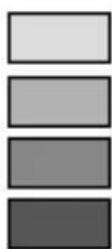
May be harmful to sensitive fish and small fry.
May be harmful to adult fish, very harmful to young fry.
Very harmful to adult fish, lethal for small fry.
Absolutely lethal for all species of fish.
Short-term measure (aquarium only):
Change about 50 % of the water. Do not allow the pH level of the freshwater to exceed the pH level of the aquarium.
Long-term measure:
Aquarium:
Add cleansing bacteria with JBL Denitrol and JBL FilterStart.
Use a suitable biological filter. Reduce feed, reduce density of fish stock, if necessary.
Garden pond:
Add cleansing bacteria with JBL BactoPond and JBL FilterStart Pond. If not already in use, install an efficient pond filter. If necessary, review general design concept of pond: is there sufficient ground-covering material, marshy area, working as a plant based purification system etc...?
Instructions:
- Repeatedly rinse both test jars with the water to be tested.
-
Use the enclosed syringe to fill each of the test jars with 5 ml of sample water.
-
Add the reagents to one of the test jars in the following sequence:
a) 4 drops of reagent 1, mix well!
b) 4 drops of reagent 2, mix
c) 5 drops of reagent 3, mix. Allow to settle for 15 minutes.
-
Place both test jars into the comparator block: the jar with added reagent into the smooth end of the comparator block, the jar with untreated test water (blank sample) into the notched end of the comparator block.
-
Move the comparator block together with the jars backwards and forwards on the colour chart, with the notched side of the block facing the scale, until the colour of the sample treated with reagent matches the colour under the blank sample as closely as possible.
-
Read the ammonium content in the notch of the comparator block.
Note:
In the event that the colour of your test sample is darker than the colours of the chart, dilute the sample with distilled or ammonium-free water and measure again.
Depending on the dilution, the result must be multiplied as follows to determine the actual ammonium content:
2.5 ml sample + 2.5ml dist. water: result x 2
1 ml sample + 4 ml dist. water: result x 5
0.5 ml sample + 4.5ml dist. water: result x 10
Our tip for the environmentally-friendly user:
All reagents for JBL test sets are available from your retailer as reasonably-priced refill packs!
Warning and safety notices:
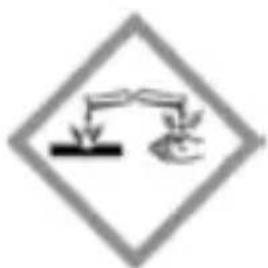
NH_4 reagent 2:
natural_image
Symbolic diagram showing a crane lifting a weight, enclosed in a diamond frame (no text or labels)Danger
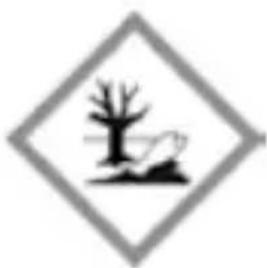
H314 Causes severe skin burns and eye damage. H400 Very toxic to aquatic life. EUH206: Warning! Do not use together with other products. May release dangerous gases (chlorine).
P101 If medical advice is needed, have product container or label at hand. P102 Keep out of reach of children. P273 Avoid release
natural_image
Symbolic illustration of a tree with a small figure inside, enclosed in a diamond shape (no text or numbers present)to the environment. P280 Wear protective gloves/protective clothing/eye protection/face protection. P305+P351+P338 IF IN EYES: Rinse cautiously with water for several minutes. Remove contact lenses, if present and easy to do. Continue rinsing. P310 Immediately call a POISON CENTER or doctor/physician. Hazard-determining component of labelling: sodium hydroxide.
NH_4 reagent 3:
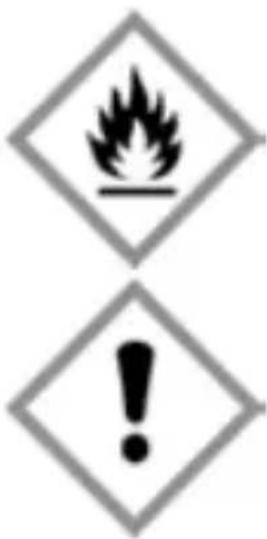
Danger
H225 Highly flammable liquid and vapour. H315 Causes skin irritation. H319 Causes serious eye irritation. H336 May cause drowsiness or dizziness.
P102 Keep out of reach of children. P210 Keep away from heat/sparks/open flames/hot surfaces. – No smoking. P280 Wear protective gloves/protective clothing/eye protection/face protection. P303+P361+P353 IF ON SKIN (or hair): Remove/Take off immediately all contaminated clothing. Rinse skin with water/shower. P304+P340 IF INHALED: Remove victim to fresh air and keep at rest in a position comfortable for breathing. P403+P233 Store in a well-ventilated place. Keep container tightly closed.
Kit de test JBL Ammonium / Ammoniaque (NH _4^+ / NH _3 )
Spécificité
natural_image
Two identical diamond-shaped icons: one with an excavator and tree, the other with a tree and shrub (no text or symbols)Danger
Danger
natural_image
Symbolic diagram of a robotic arm and base, enclosed in a diamond shape (no text or labels)Gevaar
natural_image
Symbolic illustration of a tree with a person and a dog, enclosed in a diamond shape (no text or numbers)Gevaar
natural_image
Symbolic diagram of a crane lifting a tree, enclosed in a diamond frame (no text or labels)Pericolo
natural_image
Symbolic illustration of a tree with a person standing on a slope inside a diamond frame (no text or symbols)Pericolo
natural_image
Symbolic diagram of a crane lifting a load, enclosed in a diamond frame (no text or labels)Fare
natural_image
Symbolic illustration of a tree with a person standing on a slope inside a diamond frame (no text or symbols)NH_4 reagens 3:
natural_image
Warning symbol of a flame inside a diamond shape (no text or numbers)
Fare
H225 Meget brandfarlig væske og damp. H315 Forårsager hudirritation. H319 Forårsager alvorlig øjenirritation. H336 Kan forårsage sløvhed eller svimmelhed.
natural_image
Symbolic diagram of a crane lifting a weight, enclosed in a diamond shape (no text or labels)natural_image
Symbolic illustration of a tree with a person standing on a slope inside a diamond frame (no text or numbers)natural_image
Symbolic diagram of a crane lifting a tree, enclosed in a diamond frame (no text or labels)Perigo
natural_image
Symbolic illustration of a tree with a person walking, enclosed in a diamond shape (no text or numbers)Perigo
natural_image
Symbolic diagram of a crane lifting a plant inside a diamond shape (no text or labels)Fara
natural_image
Symbolic illustration of a tree with a person standing on a slope inside a diamond frame (no text or numbers)Fara
natural_image
Two identical diamond-shaped icons: one depicting a crane lifting a tree, the other showing a tree with a log and a plant (no text or symbols)Nebezpečí
natural_image
Warning symbol of a flame inside a diamond frame (no text or numbers)Nebezpečí
CZ
natural_image
Symbolic diagram of a plant with roots and leaves inside a diamond shape (no text or labels)Veszély
natural_image
Symbolic illustration of a tree with a figure and ground, enclosed in a diamond shape (no text or numbers)Veszély
natural_image
Symbolic diagram of a crane lifting a weight, enclosed in a diamond shape (no text or labels)Niebezpieczeństwo
natural_image
Symbolic illustration of a tree with a small figure inside, enclosed in a diamond frame (no text or numbers present)Niebezpieczeństwo
natural_image
Two identical diamond-shaped icons showing a construction scene with an excavator and a tree, no text or symbols present.Опасно
Опасно
natural_image
Two identical diamond-shaped icons with abstract line and tree symbols, no text or labels present.위험
위험
natural_image
Two identical diamond-shaped icons: one with a tree and plant, the other with a leaf and tree (no text or symbols)危險
危險

Brand : JBL
Model : NH4 Test
Category : Water filter