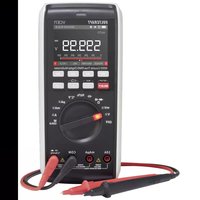
VC871 - Multimeter VOLTCRAFT - Free user manual and instructions
Find the device manual for free VC871 VOLTCRAFT in PDF.
Download the instructions for your Multimeter in PDF format for free! Find your manual VC871 - VOLTCRAFT and take your electronic device back in hand. On this page are published all the documents necessary for the use of your device. VC871 by VOLTCRAFT.

USER MANUAL VC871 VOLTCRAFT
Operating Instructions Digital multimeter VC871 Item No. 2576867 Page
14.3 Opening the battery and fuse compartment ........................................95
2 Introduction Thank you for purchasing this product. If there are any technical questions, please contact: www.conrad.com/contact 3 Intended use – Measures and displays electrical parameters in the measurement category CAT III (up to 1000 V) or CAT IV (up to 600 V) against earth potential. Com- plies with the EN 61010-1 standard and all lower categories. – Measures direct voltage up to 1000 V – Measures alternating voltage up to 1000 V – Measures direct and alternating currents up to 10 A – Measures frequency from 10 Hz to 60 MHz (max. 20 Vrms) – Displays pulse ratio (duty cycle) in % – Measures capacitance up to 60 mF – Measuresresistanceupto60MΩ – Active power measurement up to max. 2500 W via protective contact meas- uring adapter – Measuring temperatures from -40 to +1000 °C – Continuitytest(Resistancethresholdcanbesetas1~1000Ω) – Diode test – Bluetooth
interface for app control The measurement modes are selected using the control dial. The measurement range is selected automatically in most modes (except continuity test, diode test and current measurement ranges). Effective (True RMS) measurements are displayed when measuring AC voltages/ currents with a frequency of up to 1 kHz. This ensures that sinusoidal and non- sinusoidal voltage/currents are measured accurately. Negative polarity readings are indicated with the (-) sign automatically. A low-impedance mode (LoZ) enables voltage measurement with reduced internal60 resistance. This suppresses phantom voltages, which may occur in high-impedance measurements. The low-impedance mode must only be used to measure circuits of up to 1000 V for a maximum of 3 seconds. The two current measurement inputs are protected against overload with high- performance ceramic fuses. The voltage in the measuring circuit must not exceed 1000 V. The multimeter is powered by three standard micro batteries (type AAA). Only use batteriesofthespeciedtype.Rechargeablebatterieshavealowercapacityand should not be used. The device switches off automatically after a preset time if no buttons are pressed. This prevents the battery from draining. The automatic shut-off function can be disa- bled. The front and rear of the device feature a switchable LED lamp that can be used as a torch. There is a fold-out stand on the rear of the device. This allows you to place the multimeter on a level surface for better readability. There is also an integrated tripod socket on the back. Do not use the multimeter when the battery compartment is open or when the bat- tery compartment cover is missing. A protective mechanism prevents the battery compartment from opening when test leads are connected. Do not take measurements in potentially explosive areas, damp rooms or adverse conditions. Unfavourable ambient conditions include: Moisture or high humidity, dust andammablegases,vapoursorsolvents,thunderstormsandstrongelectromag- neticelds. For safety reasons, only use test leads or accessories that match the multimeter’s specications. The multimeter must only be used by people who are familiar with the relevant regulations and understand the potential hazards. The use of personal protective equipment is recommended. Using this product for any purposes other than those described above may damage theproductandresultinashortcircuit,reorelectricshock.Theproductmustnot bemodiedorreassembled! Read the operating instructions carefully and keep them in a safe place for future61 reference. Always observe the safety information in these instructions! Brand names mentioned herein are the property of their respective owners. USB Type-C
are registered trademarks of USB Implementers Forum.62 4 Product overview A AB
A LED torch B Optical actuation control C Colour display, graphics compatible (1) System symbols (from left to right: battery level Bluetooth
, APO, sound, torch, lightning for dangerous voltage) (2) REC display, active (3) MAX/MIN display, active (4) System date and time (5) HOLD display, active (6) Relative value display (7) DC/AC current display (8) Measurement display (9) Measuring unit display (10) Bar graph display (11) LoZ low impedance, active (12) Functions for buttons F1 to F4 (13) Low-passlterenabled (14) MAX/MIN and AUTO range function D Function buttons E Control dial for selecting the measurement mode F Measurement sockets G Connection thread for stand H Fold-out stand I Screw for battery and fuse compartment J Magnetic measuring tip holder for enclosed measuring tips Caution,strongmagnet!Keepthedeviceawayfrompacemakers,de- brillators or check cards. .64 5 Delivery content
2x safety test leads with CAT III/CAT IV protective caps
Protective contact measuring adapter for AC power measurement
Operating instructions 6 Operating Instructions for download Use the link www.conrad.com/downloads (alternatively scan the QR code) to down- load the complete operating instructions (or new/current versions if available). Fol- low the instructions on the web page. 7 Explanation of symbols The following symbols appear on the product/device or in the text: Thissymbolwarnsofhazardsthatcanleadtoinjury. Thissymbolwarnsofadangerousvoltagewhichcanleadtoinjuriesdue to electric shock. Protection class 2 (double or reinforced insulation, protective insulation)65 CAT I Measurement Category I: For measuring circuits of electrical and elec- tronic equipment that is not directly supplied with a mains voltage (e.g. battery-operated devices, safety extra-low voltage systems, signal/con- trol voltages, etc.) CAT II Measurement Category II: For measuring circuits of electrical and elec- tronic equipment that is directly supplied with a mains voltage via a mains plug. This category also includes all lower categories (e.g. CAT I for measuring signal and control voltages). CAT III Measurement Category III: For measuring circuits of installations in buildings (e.g. mains sockets or sub-distributions). This category also in- cludes all lower categories (e.g. CAT II for measuring electrical devices). Measuring in CAT III is only permitted with test prods with a maximum free contact length of 4 mm or with cover caps over the test prods. CAT IV Measurement Category IV: For measuring at the origin of a low-voltage installation (e.g. mains distribution, electricity provider’s transfer points to homes) and outdoors (e.g. when conducting tasks on underground ca- bles or overhead lines). This category also includes all lower categories. Measuring in CAT IV is only permitted with test prods with a maximum free contact length of 4 mm or with cover caps over the test prods. Earth potential66 8 Safety information Read the operating instructions carefully and especially observe the safety information. If you do not follow the safety instructions and information on proper handling, we assume no liability for any resulting personal injury or damage to property. Such cases will invalidate the warranty/guarantee.
This product is not a toy. Keep it out of the reach of children and pets.
Do not leave packaging material lying around carelessly. It may become a dan- gerous plaything for children.
Should you have any questions or concerns after reading this document, please contact our technical support or a professional technician.
Maintenance,adjustmentandrepairworkmaybecarriedoutonlybyanexpert or a specialist workshop.
Please handle the product carefully. Impact, shocks or a fall even from a low height can damage the product.
To prevent an electric shock, do not touch the measuring points when taking measurements, either directly or indirectly. When taking measurements, do not touch any area beyond the grip markings on the probe tips.
8.3 Operating environment
Do not expose the product to any mechanical stress.
Protect the product from high humidity and moisture.
The product must not be exposed to direct sunlight.
Never switch the product on immediately after taking it from a cold into a warm environment. This may cause condensation to form, which can destroy the prod- uct. Allow the product to reach room temperature before using it.
Do not use the device shortly before or after a thunderstorm (lightning! /high-67 powersurges!).Ensurethatyourhands,shoes,clothes,theoor,circuitand circuit components are dry.
Consult an expert when in doubt about the operation, safety or connection of the device.
For installations in industrial facilities, follow the accident prevention regulations for electrical systems and equipment issued by the national safety organisation or the corresponding national authority.
In schools, educational facilities, and hobby and DIY workshops, meters must beusedundertheresponsiblesupervision ofqualied personnel.Thesame applies when the meter is used by people with reduced physical and mental capabilities.
Always ensure that the multimeter is set to the correct measurement mode be- fore taking a measurement.
Check the multimeter and test leads for signs of damage before each measure- ment. Never take measurements if the protective insulation is damaged (torn, missing, etc.). The test leads come with a wear indicator. The second layer of insulation will become visible if the lead is damaged (the second layer of in- sulation is a different colour). If this occurs, discontinue use and replace the measurement accessory.
The voltage between the multimeter connection points and the earth must not exceed 1000 V DC/AC in CAT III or 600 V DC/AC in CAT IV.
Exercise particular caution when working with voltages higher than 33 V (AC) and 70 V (DC)! Touching electrical conductors with these voltages may cause a fatal electric shock.68
When using test probes without protective caps, meas- urements between the multimeter and the earth poten- tial must not exceed the CAT II measurement category.
When taking CAT III measurements, the protective caps must be placed on the probe tips (max. length of exposed contacts = 4 mm) to avoid accidental short circuits. These are supplied with the device and pre-mounted on the test probes.
If it is no longer possible to operate the product safely, stop using it and prevent unauthorised use. DO NOT attempt to repair the product yourself. Safe opera- tion can no longer be guaranteed if the product: – is visibly damaged, – is no longer working properly, – has been stored for extended periods in poor ambient conditions or – hasbeensubjectedtoanyserioustransport-relatedstress. 9 Product description The digital multimeter (multimeter) displays measurements on a digital display (dis- play). The multimeter features a digital 60000-count display (count = smallest dis- play value). The multimeter monitors the correct socket assignment. The multimeter beeps and displays a warning when the sockets are not assigned correctly. This increases the operational safety of the multimeter for the user. The multimeter switches off automatically after a preset time if no buttons are pressed. This protects the batteries and extends the battery life. The automatic shut- off feature can be preset and disabled manually. The multimeter can be used to take measurements up to CAT III 1000 V/CAT IV 600 V. It is suitable for use in hobby and professional applications. The multimeter can be placed on a level surface using the fold-out stand for better readability. The battery and fuse compartment can only be opened when all test leads have been disconnected from the multimeter. When the battery and fuse compartment are open, the test leads cannot be inserted into the measurement sockets. This is a built-in safety feature to protect the user.69 A switchable Bluetooth
LE 4.0 interface. The free measurement app compatible with Android or iOS devices can be found on the public download portals. The app also allows recording your measurements. It is available for Android devices from version 4.3 or later and iOS devices from version 7.0 or later (iPhone 5 or later). Control dial (E) Individual measurement modes are selected using the control dial. Automatic range selection (“Autorange”) is enabled in most measurement modes. The measurement range will be selected automatically. The current measurement ranges must be set manually. Always start current measurements with the largest measurement range, and then switch to a smaller range if necessary. The control dial features an indicator light that shows the setting position. Use the “SELECT” button to switch to a sub-mode when the measurement mode has more than one function (e.g. to switch from resistance measurement to diode test or conti- nuity test or from AC to DC current). The function is toggled with each press. To switch the multimeter off, move the control dial to the “OFF” position. Always turn the multimeter off when it is not in use.70 10 Display elements and symbols The following symbols and letters appear on the device/display. Other symbols may appear on the display (display test), but these have no function. True RMS True effective measurement Δ Delta symbol for relative measurement (= reference measure- ment). M Mega symbol (exp. 6) k Kilo symbol (exp. 3) Ω Ohm(unitofelectricalresistance) Hz Hertz (unit of frequency) n Nano symbol (exp. -9) µ Micro symbol (exp. -6) m Milli symbol (exp. -3) V Volt (unit of electrical voltage) A Ampere (unit of electrical current) F Farad (unit of electrical capacity) W Watt (unit of active power) VA Volt-ampere (unit of apparent power) COSФ/PF Cosphi(unitofpowerfactor) Wh Watt-hour (unit of electrical energy) mAh Milliampere-hour (unit of electric charge) °C/°F Degrees Celsius / Degrees Fahrenheit (unit of temperature) REL Relative measurement button (= reference measurement) SELECT Switches to sub-mode SETUP Setup menu BLE Enable Bluetooth
interface HOLD Freezes the current measurement OL Overload; the measurement range was exceeded Check inPut Warning message “Wrong measurement socket selection”.71 OFF Move to this position to turn the multimeter off Diode test symbol Acoustic continuity tester symbol Capacity measuring range symbol Alternating current symbol Direct current symbol COM Connection for reference potential Torch symbol USB power measurement symbol Bluetooth
interface symbol </> Arrow buttons to navigate through the function menu MAX/MIN Hold the maximum or minimum measurement COMP Value comparison; compare the current measurement with the set maximum and minimum measurements for a quick assess- ment. RECORD Automatic recording of measurements. Measurements are sent tothemeasurementappusingamobiledevice.Aashingdoton the “REC” display indicates the storage process RECORD STOP Stop recording measurements SAVE Manual saving of measurements LOG Read out manually stored measurements PEAK Peak value display (only in AC mode) Lo 1 kHz low-pass lter suppresses high-frequency interference signals (only in ACV mode) FREQ Frequency display (only in AC mode) 4-20mA Loop current measurement (only in the DC mA range)72 11 Taking measurements Never exceed the maximum permitted input values. Never touch circuits or parts of circuits when they may contain voltages greater than 33 V/ACrms or 70 V/DC! Danger to life! Measurements can only be taken when the battery and fuse com- partment is closed. Cables cannot be inserted when the compart- ment is open. Before measuring, check the connected test leads for damage, such as cuts, tears and kinks. Never use defective test leads! Dan- ger to life! When taking measurements, do not touch any area beyond the grip markings on the probe tips. Only connect the two test leads that you require to take measure- ments. For safety reasons, remove all unnecessary test leads from the multimeter before taking a measurement. Measurements in electrical circuits rated at >33 V/AC and >70 V/DC must only be carried out by qualied and trained personnel who are familiar with the relevant regulations and the associated hazards. Check the multimeter for functionality before each measurement. An incorrect check result indicates a possible malfunction. The multimeter must be checked. “OL” (overload) indicates that the measurement range has been exceeded.73
11.1 Switching the multimeter on and off
Turn the control dial (E) to select the desired mode. The optimal measurement range is automatically selected (except in current mode). When measuring a current, always start with the largest measurement range, and then switch to a smaller range if necessary. Always disconnect the test leads from themeasuredobjectbeforeswitchingtoanothermode. To turn the multimeter off, move the control dial to the “OFF” position. Always turn the measurement device off when it is not in use. Before storing the multimeter, insert the test leads into the high-impedance meas- urement sockets (COM and V). This helps to prevent errors when making subse- quent measurements. The included test lead plugs are tted with transport protection caps. These caps must be removed before inserting the test leads into the measurement sockets. Before using the multimeter, you must insert the included batter- ies. For more information on inserting/replacing the batteries, see “Cleaning and care”.
11.2 Incorrect wiring alarm
The multimeter automatically detects which sockets are connected to the test leads. If the test leads are connected to the wrong sockets (which can be dangerous for the user and damage the multimeter), the multimeter triggers an acoustic and opti- cal alarm. If you switch to another measurement mode (except current mode) when the test leads are connected to the sockets, the multimeter triggers an alarm. The alarm is also triggered when the measuring input is switched from the 10 A socket to the mAµA one. If the alarm is triggered and “Check InPut” (followed by the relevant socket) appears on the display, check that the leads are connected to the correct sockets and that you have selected the correct measurement mode. If the alarm is triggered, check that you have selected the correct measurement mode and that the cables are connected to the cor- rect sockets.74
11.3 DC voltage mode (“V ”)
Proceed as follows to measure DC voltages:
Turn the multimeter on and select “V ” mode. “ ” and “V” will appear on the display. For lower voltages up to max. 600 mV, select the “mV” measurement function.
Plug the red test lead into the V measurement socket and the black test lead into the COM measure- ment socket.
Connect the two test probes in paralleltotheobjectthatyouwant to measure (e.g. battery or circuit). Connect the red test probe to the positive terminal and the black test probe to the negative terminal.
The measured value and polarity are indicated on display. If “-” appears in front of a direct voltage measurement, this indicates that the measured voltage is negative (or that the test leads have been connected in reverse). The“VDC”voltagerangehasaninputresistanceof≥10MOhm;the“mVDC” rangehasaninputresistanceof≥10MOhm.
Aftertakingameasurement,removethetestleadsfromthemeasuredobject and turn the multimeter off.75
11.4 AC voltage mode “V ”
Proceed as follows to measure AC voltages:
Turn the multimeter on and select “V ” mode. Press the “SELECT” button to switch to “AC” mode. “ ” and “V” will appear on the display.
For lower voltages up to max. 600 mV, select the “mV” measurement range.
Plug the red test lead into the V measurement socket and the black test lead into the COM measure- ment socket.
Connect the two test probes in par- alleltotheobjectthatyouwantto measure (e.g. generator or circuit).
The measured value appears on display.
Aftermeasuring,removethetestleadsfromthemeasuredobjectandturnthe multimeter off. The“V/AC”voltagerangehasaninputresistanceof≥10MΩ.Thismeansthat there is almost no load on the circuit.76
11.5 LoZ voltage mode
LoZ mode allows you to measure DC and AC voltages with a low impedance (ap- prox.400kΩ).Inthismode,themultimeterlowerstheinternalresistancetoprevent “phantom” voltage readings. As a result, the circuit is more heavily loaded than in the standard measurement mode. To enable LoZ mode, press the “LoZ” button when taking a voltage measurement. The impedance will be reduced until you release the button. In the LoZ mode, a beep sounds and the display (B) is indicated. The “Loz” symbol (C11) appears on the display. The LoZ mode can only be used for circuits with a voltage of up to 1000 V. The duration of the LoZ measurement must be limited to a maximum of 3 s. After using the LoZ mode, leave the multimeter for 1 minute before using it again.
11.6 Taking current measurements
Never exceed the maximum permitted input values. Never touch circuits or parts of circuits when they may contain voltages greater than 33 V/ACrms or 70 V/DC! Danger to life! The voltage in the measured circuit must not exceed 1000 V. Measurements greater than 10 A must only be made for a maximum of 10 seconds in 10-minute intervals. Always start the current measurement using the largest measure- ment range, and then switch to a smaller range if necessary. Always disconnect the circuit before connecting the multimeter and chang- ing the measurement range. All current measurement ranges are protected against overload. Do not measure any currents above 10 A in the A range or currents above 600 mA in the mA/μA range, as this will trigger the fuses.77 Current measurements should be made as quickly as possible. Avoid taking measurements for prolonged periods. An optical and acoustic alarm is triggered when the measurement range is exceeded. Proceed as follows to measure direct currents (A ):
Insert the red test lead into the mAµA or 10A measurement socket. Insert the black test lead into the COM measurement socket.
Connect the two test probes in se-
riestotheobjectthatyouwantto measure (e.g. battery or circuit). The electrical circuit must be dis- connected before you connect the probes.
Reconnect the circuit. The meas- ured value appears on display.
After taking a measurement, dis- connect the circuit and remove the test leads from the measured ob- ject.Switchthemultimeteroff.78 Proceed as follows to measure alternating currents (A ):
Switch the multimeter on and select “10A, mA, or µA” mode. Press the “SE- LECT” button to switch to AC mode. The display shows “ ”. Press the “SE- LECT” button again to switch back to DC mode.
Connect the multimeter to the corresponding measuring inputs and the measur- ing circuit as described in “DC measurement” and follow the steps below.
11.7 Measuring frequency/duty cycle in %
The multimeter can be used to measure the frequency of a signal voltage (supports frequencies from 10 Hz to 10 MHz). The maximum input is 20 Vrms. This mode is notsuitablefortakingmeasurementsonmainsvoltages.Observetheinputspeci- cations in the technical data. Proceed as follows to take a frequency measurement:
Switch on the multimeter and select “Hz” mode. “Hz” appears on the display.
Plug the red test lead into the Hz measurement socket and the black test lead into the COM measure- ment socket.
Connect the two test probes to the object that you want to measure (e.g. signal generator or circuit).
The frequency and corresponding unit will be indicated on the main display. The sub-display will show the pulse ratio of the positive half- wave in %. Pressing the “SELECT” button toggles the “Hz/%” display.
11.8 Measuring resistance
Make sure that all objects that you wish to measure (including cir- cuit components, circuits and component parts) are disconnected and discharged. Follow the steps below to measure the resistance:
InserttheredtestleadintotheΩ measurement socket, the black test lead into the COM measure- ment socket.
Check the test leads for continuity by connecting both test probes to one another. The multimeter should then show a resistance value of ap- prox 0–0.5 Ω (inherent resistance of the test leads).
For low-impedance measurements of<600Ω,presstheF3“REL”but- ton when the measuring probes are short-circuited. This ensures that the inherent resistance of the test leads does not affect the resistance measure- ment.Thedisplayshouldshow0Ω.
Connectthetestprobestotheobjectthatyouwanttomeasure.Themeasure- mentvaluewillbeindicatedonthedisplay(providedthattheobjectyouare measuring is not highly resistive or disconnected). Wait until the display stabi- lises.Thismaytakeafewsecondsforresistancesgreaterthan1MΩ.
“OL” (overload) indicates that the measurement range has been exceeded or that the circuit is broken.
Aftermeasuring,removethetestleadsfromthemeasuredobjectandturnthe multimeter off.80 When taking a resistance measurement, make sure that the points that come into contact with the probe tips are free from dirt, oil, solder and other impuri- ties. These substances may distort the result. The “REL” button only works when a measurement is displayed. It cannot be used when “OL” is displayed.
Make sure that all objects that you wish to measure (including cir- cuit components, circuits and component parts) are disconnected and discharged.
Turn the multimeter on and select the measurement mode .
Press the “SELECT” button twice to switch to diode test mode. The diode symbol and “V” appear on the display. Press the button again to switch to the next measurement mode.
InserttheredtestleadintotheΩ measurement socket, the black test lead into the COM measure- ment socket.
Check the measuring leads for continuity by connecting both measuring probes to one another. A value of approx. 0.000 V should be shown.
Connectthetwotestprobestotheobjectthatyouwanttomeasure(diode). Connect the red test lead to the anode (+) and the black test lead to the cathode
The continuity voltage (“UF”) will be shown in Volts (V). “OL” indicates that the diode is reverse-biased (UR) or defective (interrupted). Try taking the measure- ment again with the opposite polarity.81
Aftermeasuring,removethetestleadsfromthemeasuredobjectandturnthe multimeter off.
11.10 Continuity test
Make sure that all objects that you wish to measure (including cir- cuit components, circuits and component parts) are disconnected and discharged.
Turn the multimeter on and select measurement mode .
Press the “SELECT” button once to switch to continuity test mode. The continuity test symbol and the Ω symbol appear on the display. Press the key again to switch to the next measuring mode.
InserttheredtestleadintotheΩ measurement socket, the black test lead into the COM measure- ment socket.
If the measured resistance is equal toorlessthan50Ω,themultimeter will beep to indicate continuity. The beeps stop when the resistance ex- ceeds50Ω.Thecontinuitytestmeasuresresistancesofupto1000Ω.
“OL” (overload) indicates that the measuring range has been exceeded or that the circuit is broken.
Make sure that all objects that you wish to measure (including cir- cuit components, circuits and component parts) are disconnected and discharged. Always pay attention to the polarity when using electrolytic capaci- tors.
Turn the multimeter on and select the measurement range .
Plug the red test lead into the V measurement socket and the black test lead into the COM measure- ment socket.
Connect the two test probes (red = positive, black = negative) to the object that you want to measure (capacitor). The capacitance will be shown on the display after a few seconds. Wait until the display stabilises. This may take a few sec- onds for capacitances greater than 60 µF.
“OL” (overload) indicates that the measuring range has been exceeded.
Aftermeasuring,removethetestleadsfromthemeasuredobjectandturnthe multimeter off. Due to the sensitive measuring input, the display may show a value if the test leads are “open”. Press the “REL” button to measure small capacities (<600 nF). The display then shows “0”. The Autorange function is thus deactivated.83
11.12 Temperature measurement
During temperature measurement, only the temperature probe may be exposed to the temperature to be measured. The working temperature of the measuring instrument must not be exceeded or fallen short of, otherwise measurement errors may occur. The contact temperature probe may only be used on stress-free surfaces.
All K-type thermocouples can be used for temperature measurement. The tem- peratures can be displayed in °C or °F. The enclosed wire probe is suitable for the range -20 to +230°C. With optional probes, the entire measurement range (-40 to +1000 °C) can be used.
Switch on the DMM and select the
Plug the enclosed wire thermo- couple into the °C (+) and COM (-) measurement sockets with correct polarity.
The temperature value with the corresponding unit appears in the display.
Switching from °C to °F is done via the „SELECT“ key.
As soon as „OL“ (for overload) ap- pears in the display, you have ex- ceeded the measuring range.
If no probe is connected, readout from the display is not relevant and should be neglected.
11.13 Power measurement
The power measurement range may only be set between 0 and 2500 W. Use extra care when measuring power without the measur- ing adapter. Be careful not to mistake the low-impedance current measuring circuit for the high-impedance voltage measuring circuit, as this would result in a short circuit and an arc explosion. Always use double or reinforced insulated measuring accessories. Open contact surfaces must be avoided. The power measurement for the current measurement path may only be connected via the 10 A measurement input. Never use the “mAųA” socket!
The power measurement can be used for alternating current ( ), direct cur- rent ( ) or USB (power and energy capacity). The AC measuring adapter is included and described in this document. The USB measuring adapter is op- tional.
11.13.1 Follow the steps below to measure AC power:
Turn the multimeter on and select measurement mode “W”. The sym- bol “ ” appears on the display.
Plug the supplied socket measur- ing adapter correctly into the meter. Plug the test lead with the inscrip- tion “10A” into the 10 A test socket, the test lead “COM” into the COM test socket and the test lead “V” into the V test socket.
Then plug the measuring adapter into a properly earthed protective contact socket.
You can now plug the load to be measured into the measuring adapter. Make sure that the load is switched off to prevent arcing when plugging it in. You can then switch on the load. 10A VCOM 230 VAC85
The main display shows the active power in watts, and the sub-display shows the apparent power in “VA”.
Use the button “F1 Display” to change the measured values: voltage “V” and current “A”, power factor “PF” and frequency “Hz”.
Once you are done with the measurement, switch off the load and unplug it. Unplug the measuring adapter from the socket and switch off the multimeter.
11.13.2 Follow these steps to measure DC power:
Note – The DC adaptor is an optional item. – You can purchase it on www.conrad.com under item no.: 2890767 Optional adaptor shown below: PRECONDITIONS: D The multimeter is switched OFF. D The DC power supply is switched OFF. D The test load is switched OFF (if applicable).
1. Connect the DC adaptor plugs to the corresponding multimeter sockets:
DCadaptor:[10A,COM,V/Ω250V]→multimeter:[10A,COM,°CHzVΩ].
2. Connect the DC power supply to the DC adaptor using suitable cables (e.g.,
4mm male to male banana plugs). – DC power supply “OUTPUT” (+) connect to power adaptor red “INPUT” port
– DC power supply “OUTPUT” (-) connect to power adaptor black “INPUT” port (-).
3. Connect the test load to the DC adaptor “OUTPUT” ports.86
Make sure that the load is switched OFF to prevent arcing when plugging it in.
4. Double-check that the measurement setup is correct.
5. Switch the multimeter ON and then select measurement mode “W”.
6. Press the SELECT button, the “ ” symbol will appear on the display.
7. Switch the DC power supply ON.
– The main display will show the active power in watts and the sub-display will show the current “A”. – Press the F1 button to toggle between “V”(voltage) and “W” (active power).
11.13.3 Follow these steps to measure USB power:
Note – The USB adaptor is an optional item. – You can purchase it on www.conrad.com under item no.: 2890769. Optional adaptor shown below: PRECONDITIONS: D The multimeter is switched OFF. D The USB power supply is de-energised / switched OFF. D The test load is switched OFF (if applicable).
1. Connect the USB adaptor plugs to the corresponding multimeter sockets:
USBadaptor:[5A,COM,V/Ω48V]→multimeter:[10A,COM,°CHzVΩ]
2. Connect a USB power supply to the USB adaptor “INPUT” (USB-C
3. Connect the test load to the USB adaptor “OUTPUT” (USB-C
Make sure that the load is switched OFF to prevent arcing when plug- ging it in.
If a USB power supply with PD (Power Delivery), QC (Quick Charge), or GaN (gallium nitride) technologies is connected to an “INPUT” port, the test load must only be connected to the USB-C
Test cables and connected loads must be compatible with the related power supply technology (e.g., PD, QC, or GaN), otherwise there may be inaccurate readings or no output.
4. Double-check that the measurement setup is correct.
5. Switch the multimeter ON and then select measurement mode “W”.88
– The main display will show the active power in watts, and the sub-display will show the current “A”. – Press the F1 button to toggle between “V”(voltage) and “W” (active power). – Press the F4 button repeatedly to: start/stop counting elapsed time and show the total current and power consumption of the connected load(s).
12 Additional functions You can use the function buttons (F1 to F4) to enable a range of different functions. These additional functions vary with the measurement mode. The multimeter beeps each time you press a button. Some additional functions are not available in some measurement modes. The unavailable functions are highlighted in dark grey and cannot be activated.
TheRANGEbuttonservesforthemanualsettingofadenedmeasurementrange. The Autorange function is deactivated. Each time you press the button, the meas- urement range display toggles. Press and hold the button for approx. 1 second to activate the AUTO function again. A beep will sound and “AUTO” appears on the display.
12.2 MAX/MIN function
The MAX/MIN function enables you to store the measurements for a short time. Each selected range (MAX or MIN) is recorded and displayed. The function is tog- gled with each press. Press and hold the button for approx. 1 second to activate the MAX/MIN function again. A beep will sound and “AUTO” appears on the display.89
The REL function allows you to take a reference measurement to avoid possible line losses (e.g. during resistance measurements). For this purpose, the current indicated value is set to zero. A new reference value is set. Pressthe“REL”buttontoenablethisfunction.Thedisplayshows“Δ”andthemeas- urement will be reset to zero. The automatic measurement range selection function will be disabled. To disable this function, change the measurement mode or press and hold the but- ton for approx. 1 second. The REL function is not available in the “continuity test” mode. The “REL” button only works when a measurement is displayed. It cannot be used when “OL” is displayed.
This function freezes the current reading on the display so that you can record it for future reference. When testing live wires, ensure that this function is disabled before taking any measurements. Otherwise, a false measuring result is simulated! Press the “HOLD” button to enable this feature. The multimeter will beep and “HOLD” will be displayed. To disable the hold feature, press the “HOLD” button again or change the measure- ment mode.
12.5 Automatic shut-off function
The multimeter switches off automatically after a preset time if no buttons are pressed or the control dial is not used. This function saves battery power and ex- tends the battery life. The time symbol will be displayed at the top left when the automatic shut-off feature is enabled. The multimeter will beep one time approx. 1 minute before it turns off. You will hear a long beep when the multimeter switches off. Pressing any button or moving the control dial interrupts the shut-off sequence.90 To switch the multimeter back on, move the control dial over the “OFF” position or press the “SELECT” button. Theautomaticshut-offfeaturecanbeadjustedusingthesetupfunctionanddisa- bled manually.
The COMP function allows automatic comparison of measurements with preset limits. Hence, it allows quick evaluation of measurements during time-intensive measurement series.
12.7 RECORD function
The RECORD function allows mobile recording of measurements via the Bluetooth
interface on the measurement app installed on your smartphone or tablet.
12.8 SELECT function
Some measurement modes have sub-modes (e.g. AC/DC). The sub-modes are marked around the control dial. To switch to a sub-mode, press the “SELECT” but- ton. Press the button again to switch to the next sub-mode.
Thesetupmenuservestocongurevarioussystemparametersaccordingtoyour needs. To select the setup menu, press the “SELECT” button. To open or close the setup menu, press and hold the button “SELECT” for approx. 2 seconds. The function buttons “F1” and “F2” serve to navigate through the menu. They are used to select the menu items. Usethetwoarrowbuttons“<”and“>”toselecttheeldsyouwishtoset. Use the function buttons “F3” and “F4” to change values. To exit the setup menu, press and hold the button “SETUP” for approx. 2 seconds. Brightness Display backlight Sound Button tones Color Mode Display theme (light/dark) Auto Power Off Automatic shut-off (Always ON = disabled) Display Display backlight switch-off time Key Light Position illumination on the control dial91 Torch Time Torch switch-off time (Always ON = disabled). Cont Threshold Acoustic continuity test threshold (1-1000Ω) Set Time System time setting (hours:minutes:seconds) Set Date Date setting Date Format Date Format (DD = day, MM = month, YY = year) Compare Type Comparison type (INNER = within tolerance, OUTER = outside tolerance) Compare Min Lower tolerance limit Compare Max Upper tolerance limit Record Num Number of stored values (1 - 10000 values) Record Rate Storage interval (1 - 10000 s) Factory Reset Restore factory settings Device Info System information display
12.10 Torch function
The multimeter features two integrated white LED lamps. These LED lamps serve as torches. Keeping the button “>” with the torch symbol pressed for approx. 2 seconds ac- tivates the torch function. The function buttons “F1” to “F4” can also be used to activate this function. F1 TORCH activates and deactivates the torch function. F2 FRONT activates the LED lamp on the front side F3 BACK activates the LED lamp on the rear side F4 EXIT exits the torch menu92
mode “BLE” The integrated Bluetooth™ interface allows transferring measurement data from the meter to a smartphone or tablet for their subsequent limited control. This mode is compatible with smartphones or tablets with a Bluetooth
LE 4.0 inter- face. The app “Voltcraft VC800-Series” is available free of charge at “Google Play” or in the “App Store” from Apple and must be installed before you can use it. Install the app on your smartphone or tablet. Activate the Bluetooth
symbol will be displayed on the left in the top line. Opentheapponyoursmartphoneortabletandcreateanewprojectbytappingon the large “plus sign” in the middle of the screen. Select your meter “VC871” from the list of available devices. A chain symbol displayed next to the interface symbol indicates that the meter is connected with the app. Measurement data can now be transferred. Measurement data are transferred from the meter to the app for their subsequent limited control. The knob function cannot be controlled! Foroperationandcongurationintheapp,pleaserefertotheseparateapp operating instructions. This is available under the listed URL in the chapter “Latest product information”.93 13 Troubleshooting Error Possible cause Solution The multimeter does not work. Are the batteries empty? Check the status. Re- place the batteries. The measured value does not change. Have you selected the wrong measurement mode (AC/DC)? Check the display (AC/ DC) and select another mode if necessary. Did you use the wrong measurement sockets? Check that the test leads are connected to the correct measurement sockets. Is the hold function enabled? Disable the hold function. The multimeter cannot take measurements in the 10 A rangeThe multimeter cannot take measurements in the 10 A range Is the fuse in the 10 A input defective? Is the fuse in the 10 A input defective? Is the fuse in the 10 A input defective? Is the fuse in the 10 A input defective? Is the fuse in the 10 A input defective? Check the 10 A fuse. The multimeter cannot take measurements in the mA/µA range The multimeter cannot take measurements in the mA/µA range The multimeter cannot take measurements in the mA/µA range Is the fuse in the 10 A input defective? Is the fuse in the 10 A input defective? Is the fuse in the 10 A input defective? Is the fuse in the mAµA range defec- tive? Is the fuse in the 10 A input defective? Check the 600 mA fuse.94 14 Cleaning and care Important: – Do not use aggressive cleaning agents, rubbing alcohol or other chemi- cal solutions. They can damage the housing and can cause the product to malfunction. – Do not immerse the product in water.
14.1 General information
The multimeter should be calibrated once a year to ensure that measurements re- main accurate. The multimeter does not need to be serviced (apart from occasional cleaning and replacing the battery/fuse). Refer to the following sections for instructions on how to change the fuse and bat- tery. Regularly check the device and measuring leads for signs of dam- age.
Always observe the following safety information before cleaning the device: Opening any covers on the product or removing parts – unless this is possible by hand – may expose voltage-carrying components. Before cleaning or servicing the multimeter, disconnect all cables from the multimeter and all measured objects. Power the multimeter off. Do not use abrasive detergents, petrol, alcohol or other similar chemicals to clean the device. They may damage the surface of the device. In addition, the vapours emitted by these substances are explosive and harmful to your health. Do not use sharp-edged tools, screwdrivers or metal brushes to clean the device.95 Use a clean, damp, lint-free and antistatic cloth to clean the device, display and test leads. Allow the device to dry completely before using it again.
14.3 Opening the battery and fuse compartment
For safety reasons, fuses and batteries may only be replaced after all test leads were removed from the multimeter. You cannot open the battery and fuse compart- ment (I) when the test leads are connected to the sockets. In addition, the measurement sockets are automatically locked when the battery and fuse compartment is opened to prevent leads from being inserted. The sockets are unlocked when the battery and fuse compartment is closed. The multimeter casing is designed so that you can only access the battery and fuse compartment. The casing does not need to be opened and disassembled. This makes the multimeter safer and easier to use. Follow the steps below to open the battery and fuse com-
Disconnect all test leads from the multimeter and switch it off.
Unfold the fold-out stand on the back of the multimeter.
Loosen and remove the battery compartment screw (I) on the back of the multimeter.
Remove the cover of the battery and fuse compart- ment (P) by sliding it upwards and then lifting it off the device.Youshouldrstdisconnectalltestleadsfrom the multimeter to be able to remove the cover.
You should now be able to access the fuses and the battery compartment.
Repeat the above steps in the reverse order to replace the battery and fuse compartment, and then screw it in place.
The multimeter is now ready for use.96
14.4 Changing the fuse
The two current measuring inputs are equipped with high-performance ceramic fus- es. If you cannot take measurements in this range, you will need to replace the fuse. Proceed as follows to replace the fuse:
Disconnect the test leads from the measurement circuit and the multimeter. Power the multimeter off.
Remove the battery and fuse compartment cover (see “Opening the battery and fuse compartment” for details).
Replace the defective fuse with a new one of the same type and nominal volt- age.Thefuseshavethefollowingspecications:
CeramicSuperink10A/1000V,10kAdisconnectingcapacity
Carefully replace the battery and fuse compartment cover. Using patched fuses or bridging the fuse holder is not permitted for safety reasons. This may cause a re or explosion. Never use the multimeter when the battery and fuse compartment is open.
14.5 Inserting/changing the battery
The multimeter is powered by three micro batteries (AAA). Insert three new, fully- chargedbatteriesbeforeusingthemultimeterforthersttimeorwhenthelow battery symbol appears on the display. Proceed as follows to insert or change the battery:
Disconnect all circuits from the multimeter and test leads. Disconnect all test leads from the multimeter. Power the multimeter off.Remove the battery and fuse compartment cover (see “Opening the battery and fuse compartment”).
Replace the used batteries with new ones of the same type. Insert the new bat- teries into the battery compartment with the correct polarity. Pay attention to the polarity markings in the battery compartment.97
Carefully replace the battery compartment cover. Never operate the measuring device when it is open. !DANGER TO LIFE!! Do not leave empty batteries in the multimeter. Even leakproof bat- teries may corrode and destroy the device or release chemicals that are harmful to your health. Do not leave batteries unattended. They may be swallowed by chil- dren or pets. Seek immediate medical attention if a battery is swal- lowed. If you do not plan to use the meter for an extended period, remove the battery to prevent it from leaking. Leaking or damaged batteries may cause acid burns if they come into contact with your skin. Always use protective gloves when han- dling leaking or damaged batteries. Ensure that the batteries are not short-circuited. Do not throw bat- teries into re! Do not recharge or disassemble non-rechargeable batteries. There is a risk of ex- plosion. You can order compatible alkaline batteries using the following item number.: Item no. 65 22 78 (please order 3 batteries). Only use alkaline batteries, as alkaline batteries are more powerful and have a longer lifespan.98 15 Disposal
All electrical and electronic equipment placed on the European market must be labelled with this symbol. This symbol indicates that this device should be disposed of separately from unsorted municipal waste at the end of its service life. Owners of WEEE shall dispose of it separately from unsorted municipal waste. Spent batteries and accumulators, which are not enclosed by the WEEE, as well as lamps that can be removed from the WEEE in a non- destructive manner, must be removed by end users from the WEEE in a non-destructive manner before it is handed over to a collection point. Distributors of electrical and electronic equipment are legally obliged to provide free take-back of waste. Conrad provides the following return options free of charge (more details on our website):
at our Conrad stores
at the collection points established by Conrad
at the collection points of public waste disposal agencies or at the collection sys- tems set up by manufacturers and distributors in accordance with the German Electrical and Electronic Equipment Act. The end user is responsible for deleting personal data from the WEEE to be dis- posed of. It should be noted that different obligations about the return or recycling of WEEE may apply in countries outside of Germany.99
15.2 Batteries/rechargeable batteries
Remove any inserted batteries and dispose of them separately from the product. You as the end user are required by law (Battery Ordinance) to return all used batter- ies/rechargeable batteries. Disposing of them in the household waste is prohibited. Batteries/rechargeable batteries containing hazardous substances are labelled with this symbol to indicate that disposal in household waste is forbidden. The abbreviations for heavy metals in batteries are: Cd = Cadmium, Hg = Mercury, Pb = Lead (name on batteries/rechargeable batteries, e.g. below the trash icon on the left). Used batteries/rechargeable batteries can be returned free of charge to local collec- tionpoints,ourstoresorbatteryretailers.Youthusfullyourstatutoryobligations and contribute to environmental protection. Batteries/rechargeable batteries that are disposed of should be protected against short circuit and their exposed terminals should be covered completely with insulat- ing tape before disposal. Even empty batteries/rechargeable batteries can contain residualenergythatmaycausethemtoswell,burst,catchreorexplodeinthe event of a short circuit. 16 Declaration of Conformity (DOC) Conrad Electronic SE, Klaus-Conrad-Straße 1, D-92240 Hirschau hereby declares that this product conforms to the 2014/53/EU directive.
Click on the following link to read the full text of the EU declaration of conformity: www.conrad.com/downloads Selectalanguagebyclickingonaagsymbolandentertheproductordernumber in the search box. You can then download the EU declaration of conformity in PDF format.100 17 Technical data
Accuracy in ± (% of reading + display error in counts (= number of smallest points)). These accuracy readings are valid for one year at a temperature of +23 °C (± 5 °C) and relative humidity of less than 80 % (non-condensing). If the multimeterisusedoutsideofthistemperaturerange,usethefollowingcoefcient tocalculatetheaccuracy.+0.1x(speciedaccuracy)/1°C The accuracy of measurements may be affected when the device is used in a high- frequencyelectromagneticeld. Direct voltage (V/DC) Range Resolution Accuracy
Overload protection: Fuse Fuses: µA/mA = 600mA 1000V high-performance ceramic fuse 10 A = F10AH1000V high-performance ceramic fuse Measuring time 10 A input: 10 seconds with 10-minute intervals Loop current 4 - 20 mA/DC Range Resolution Accuracy
0 - 100% 0.01% ±(1.2% + 2)
Overload protection: Fuse Fuses: µA/mA = 600 mA 1000 V high-performance ceramic fuse104 Alternating current (A/AC) Range Resolution Accuracy
- additional tolerance of the temperature probe Never exceed the maximum permitted input values. Never touch circuits or parts of circuits when they may contain voltages greater than 33 V/ACrms or 70 V/DC! Danger to life!108 DC power measurement Range Resolution Accuracy
Overload protection 1000 V, 10 A Never exceed the maximum permitted input values. Never touch circuits or parts of circuits when they may contain voltages greater than 33 V/ACrms or 70 V/DC! Danger to life! AC power measurement Range Resolution Accuracy
50/60 Hz 0.1 Hz ±(1.0% + 10) Overload protection 1000 V, 10 A Never exceed the maximum permitted input values. Never touch circuits or parts of circuits when they may contain voltages greater than 33 V/ACrms or 70 V/DC! Danger to life!109 USB power measurement Range Resolution Accuracy
ManualGo.com