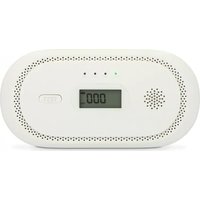
COA2650 - Gas detector ALECTO - Free user manual and instructions
Find the device manual for free COA2650 ALECTO in PDF.



| Product type | Carbon monoxide (CO) detector |
| Brand | Alecto |
| Model | COA2650 |
| Power supply | 2 high-energy alkaline LR6 1.5 V AA batteries |
| Sensitivity | 30 ppm, 50 ppm, 100 ppm, 300 ppm |
| Alarm times | No alarm before 120 min at 30 ppm; alarm between 60-90 min at 50 ppm, 10-40 min at 100 ppm, 3 min at 300 ppm |
| Standby consumption | < 30 µA |
| Alarm consumption | < 45 mA |
| Sound level of alarm | > 85 dB at 3 m |
| Operating temperature | -10 °C to +40 °C |
| Operating humidity | 0 to 95 % RH |
| Type | Type B (non-controlled output) |
| Sensor lifespan | 10 years |
| Display | Digital display showing concentration in ppm |
| LED indicators | Green LED (Power), yellow LED (Fault and Life), red LED (Alarm) |
| Standard | EN50291 |
| Self-test | Regular automatic, manual test via TEST button |
| Maintenance | Clean with a soft cloth or vacuum brush; do not use chemicals |
| Safety | Never ignore the alarm; evacuate, ventilate, contact a professional |
| Spare parts and repairability | No detachable parts; replace entire unit at end of life (10 years) |
Frequently Asked Questions - COA2650 ALECTO
User questions about COA2650 ALECTO
0 question about this device. Answer the ones you know or ask your own.
Ask a new question about this device
Download the instructions for your Gas detector in PDF format for free! Find your manual COA2650 - ALECTO and take your electronic device back in hand. On this page are published all the documents necessary for the use of your device. COA2650 by ALECTO.
USER MANUAL COA2650 ALECTO
natural_image
Front view of a white electronic device with digital display and dotted border (no readable text or symbols)MANUAL
Carbon monoxide alarm for use in the home
CONTENT
Nederlands....4
Français....14
Deutsch....24
English....34
Dansk....44
Svenska....54
Suomalainen....64
Polski....74
Ελληνική......84
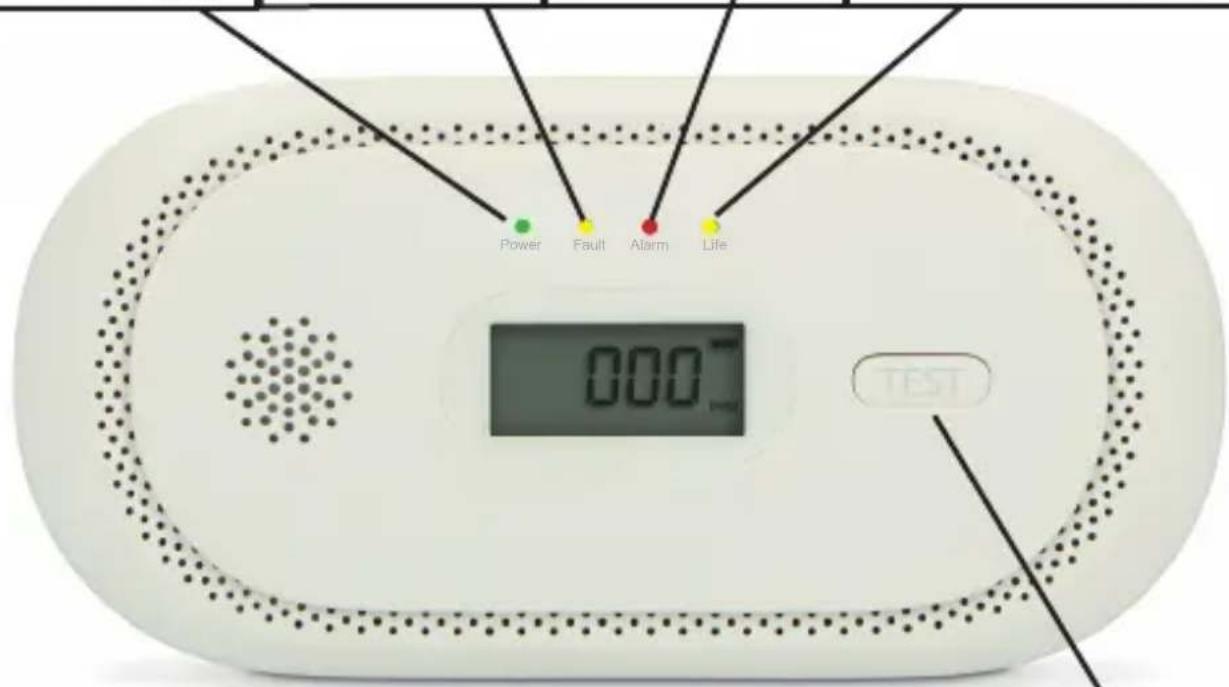
| Groen - StroomVert - AlimentationGrün - LeistungGreen - PowerGrøn - StrømGrön - StrömVihreä - VirtaZielony - ZasilanieΠράσινο - Ισχύς | Geel - FoutJaune - ErreurGelb - StörungYellow - FaultGul - FejlGul - FelKeltainen - VikaŻółty - UsterkaΚίτρινο - Βλάβη | Rood - AlarmRouge - AlarmeRot - AlarmRed - AlarmRød - AlarmRöd - LarmPunainen - hälytysCzerwony - AlarmΚόκκινο - Συναγερμός | Geel - Einde levensduurJaune - Fin de vieGelb - Ende LebensdauerYellow - End of lifeGul - Afsluttet levetidGul - Slut på livslängdKeltainen - käyttöiän loppuŻółty - koniec żywotnościΚίτρινο - Τέλος ζωής |
text_image
Power Fault Alarm Life 000 TESTTestknop
Bouton de test
Test-Taste
Test button
Test-knap
Testknapp
Testipainike
Przycisk testu
Κουμπί δοκιμήσ
NL
text_image
Diagram illustrating home security and fire safety rules with icons for living room, kitchen, shower, fire extinguisher, car, and fire extinguisher.
Vereist

Niet gebruiken
OOK BESCHIKBAAR

Brandblusser Blusdeken

natural_image
Illustration of a person working at a desk with a computer and a wall-mounted device, no text or symbols present.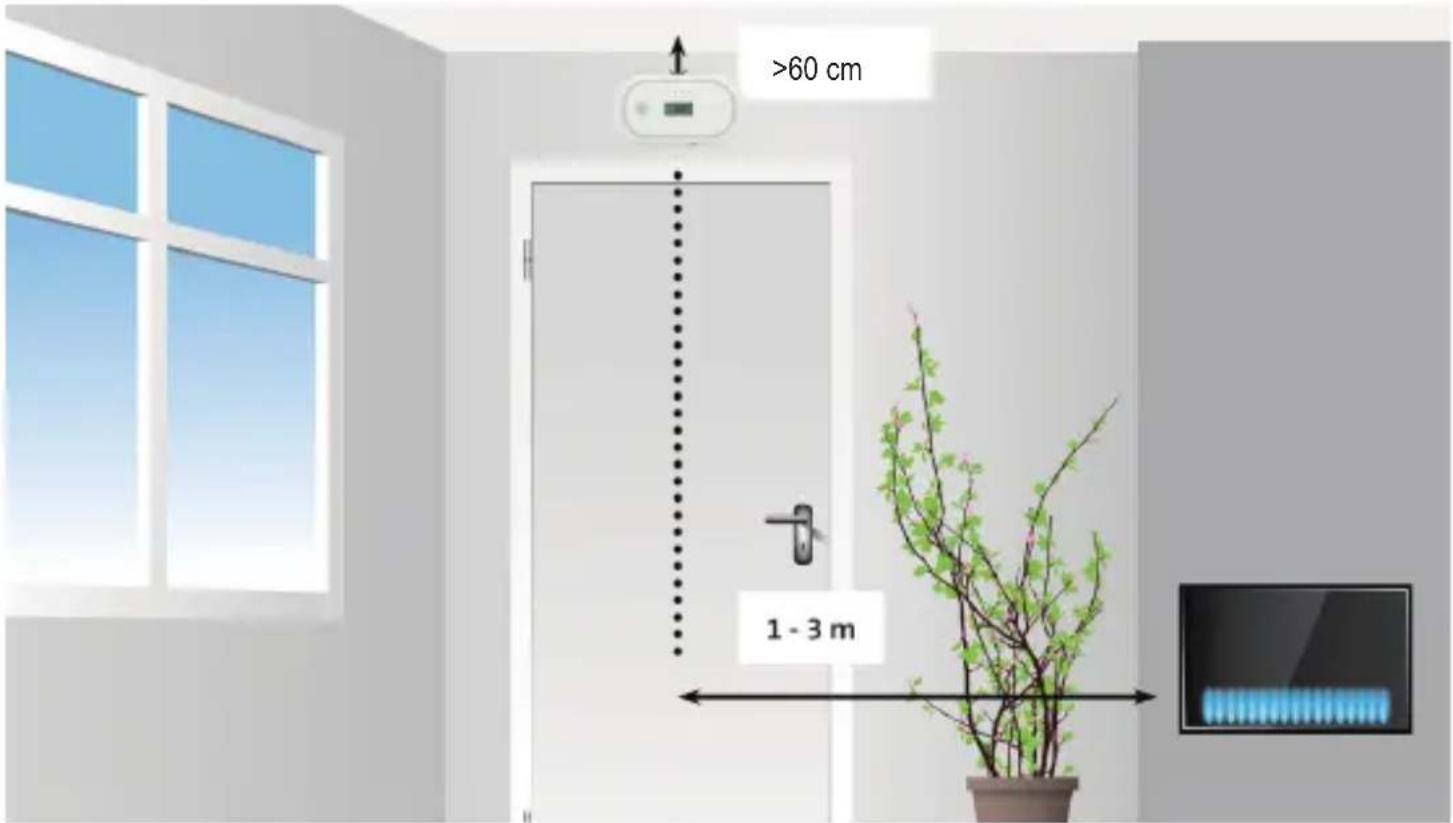
text_image
>60 cm 1 - 3 mnatural_image
Two electronic components: a battery with two AA terminals and a connected device with a green indicator light (no text or symbols visible)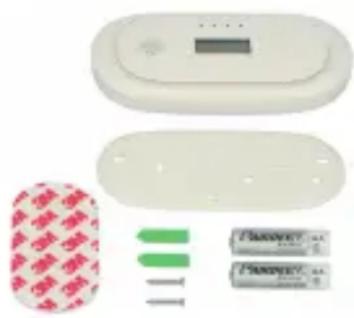
natural_image
Product display of a medical or electronic device with a red patterned pad and two green battery packs (no visible text or symbols)GEBRUIK:
Afmeting: 140mm x 70mm x 28mm
MILIEU:
text_image
Diagram illustrating home safety and fire safety rules with checkmarks and red exoskeleton symbols
Recommandé

Ne pas utiliser
AUSSI DISPONIBLE

natural_image
Illustration of a person using a laptop at a desk with a digital timer and a flower on a cabinet (no text or symbols)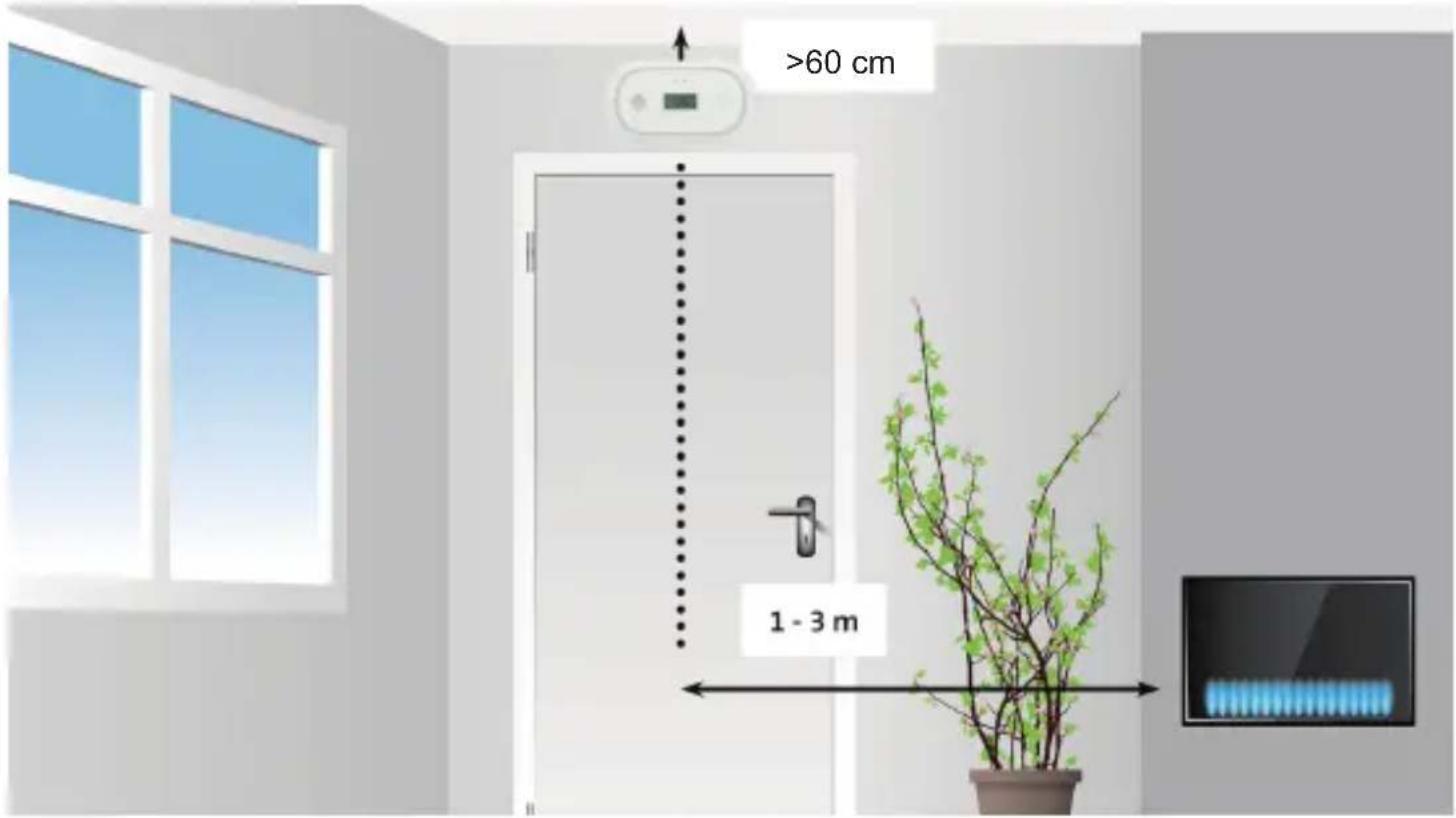
text_image
>60 cm 1 - 3 mnatural_image
Product display of a smart air conditioner unit with green and red buttons, no visible text or symbolsREEMPLACEMENT DES PILES:
text_image
Diagram illustrating home security and fire safety rules with checkmarks, no text, and symbols for vehicle use.
natural_image
Illustration of a person using a laptop in an office with a wall-mounted digital timer and a flower on a cabinet (no text or symbols)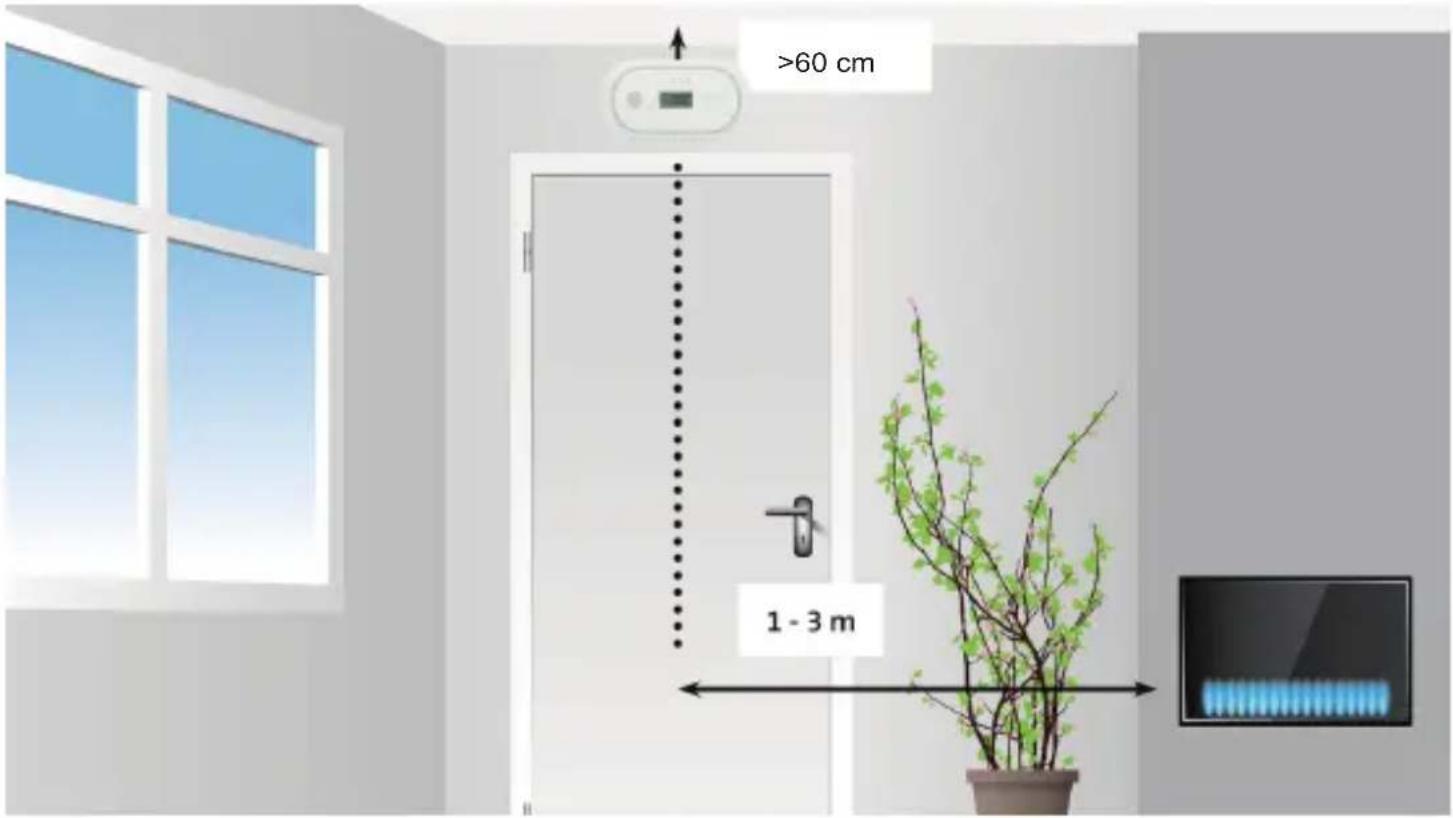
text_image
>60 cm 1 - 3 mnatural_image
White electronic device with a small square display and green indicator light (no visible text or symbols)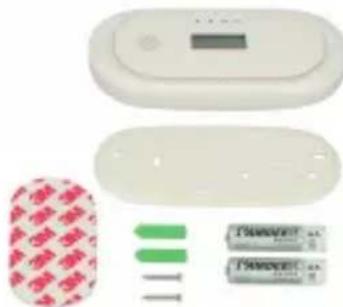
natural_image
Product display of a medical or electronic device with a red patterned band and two green bars (no visible text or symbols)LED-ANZEIGE:
POWER - grüne LED:
FAULT - gelbe LED:
ALARM - rote LED:
LIFE - gelbe LED:
The COA2650 is a CO detector, developed especially to detect carbon monoxide in your living area.
GENERAL:
What is carbon monoxide?
Carbon monoxide, designated CO, is also called carbon monoxide. It is a colorless, tasteless, odorless and poisonous gas. ATTENTION this is CO (carbon monoxide) and not CO2 (carbon dioxide).
YOU CANNOT SEE. SMELL OR TASTE CARBON MONOXIDE AND IT CAN BE FATAL.
CO is emitted as part of a hot gas mix and therefore it tends to rise until it cools down. This is in contrast to CO2, which is heavier than air and drops.
All fuel types can produce carbon monoxide.
Most common CO sources:
The most common carbon monoxide sources are (faulty) gas devices used for:
• Heating (Central heating boiler, Geyser, gas heater, portable fuel stoves)
- Cooking
• Vehicles running in an adjacent garage
• Clogged chimneys, smoke ducts or fireplaces
- Fuel-powered tools
• The use of open fire in an enclosed space
The COA2650 does not detect any gases other than CO gas.
Symptoms of carbon monoxide poisoning:
Symptoms of carbon monoxide poisoning are dizziness, fatigue, weakness, headaches, nausea, vomiting, sleepiness and confusion.
Everybody is sensitive to the dangers of carbon monoxide, experts agree however that small children, pregnant women and their unborn babies, elderly people and persons with heart or breathing problems have the highest risk of serious or even fatal injuries. Every year an authorized installer must inspect and clean your heating system, vents, chimney and smoke ducts.
Important:
• This CO detector is not a replacement for smoke, fire or other detectors.
• The detector must be installed by a competent person.
• This detector cannot protect people with special medical conditions
• This detector might not prevent any chronic health effects of carbon monoxide on the body.
• This CO detector is not a replacement for the correct installation, use and periodic maintenance of combustion equipment, nor adequate ventilation of spaces in which these devices are being used.
- We recommend you to weekly test the CO detector using the "TEST/RESET" button on the CO detector.
- This CO detector only sounds the alarm when carbon monoxide is present at its sensor. Therefore, it's possible for carbon monoxide to be present elsewhere and the alarm doesn't sound.
- When the alarm sounds, possible harmful carbon monoxide levels are present! Carbon monoxide can be deadly!
| CO concentration | Period of inhaling and symptoms |
| 50PPM | The maximum concentration a healthy adult can withstand in 8 hours. |
| 200PPM | After 2-3 hours, mild headache, sensations of weakness, dizziness, nausea. |
| 400PPM | Within 1-2 hours, ache in forehead; after 3 hours, life-threatening. |
| 800PPM | Within 45 mins, dizziness, nausea, convulsions; Loss of consciousness within 2 hours; Fatal within 2-3 hours. |
| 1600PPM | Within 20 mins, headache, dizziness, nausea; Fatal within 1 hour. |
| 3200PPM | Within 5-10 mins, headache, dizziness, nausea; Fatal within 25-30 mins. |
| 6400PPM | Within 1-2 min, headache, dizziness, nausea; Fatal within 10-15 mins. |
| 12800PPM | Fatal within 1-3 min. |
Alarm
When the CO detector sounds the alarm, carbon monoxide (CO) might be present which can be fatal. Therefore, never ignore this alarm.
With a measured value of 30 ppm or higher the COA 50 will give an alarm. The ALARM led will now blink 4x rapidly in short intervals and at the same time a warning sound will sound. The display will show the measured value. As soon as the carbon monoxide concentration is lower than 30 ppm the alarm will stop.
What to do when the alarm sounds:
- Open doors and windows and immediately do outside into the fresh air. Check whether everybody has left the building.
- Call an official installer to inspect the correct functioning and state of maintenance of the combustion source (gas or oil powered equipment) that could be the cause for the CO alarm.
- Only enter the building again after the cause has been resolved and the building has been well ventilated.
If the alarm sounds and the source is not clear then you should assume at all times that the CO concentration is too high. Immediately follow the steps listed above under “What to do when the alarm sounds”.
Recommended locations for the installation of the COA2650
General:
• Install the CO detector in a location where the alarm can be heard inside bedrooms.
• In houses with multiple floors, it's recommended to install a CO detector on each floor.
• Install the detector on a spot where the weekly check can be performed easily.
• We recommend that a CO detector be hung in every room with a combustion appliance at the air outlet of the appliance.
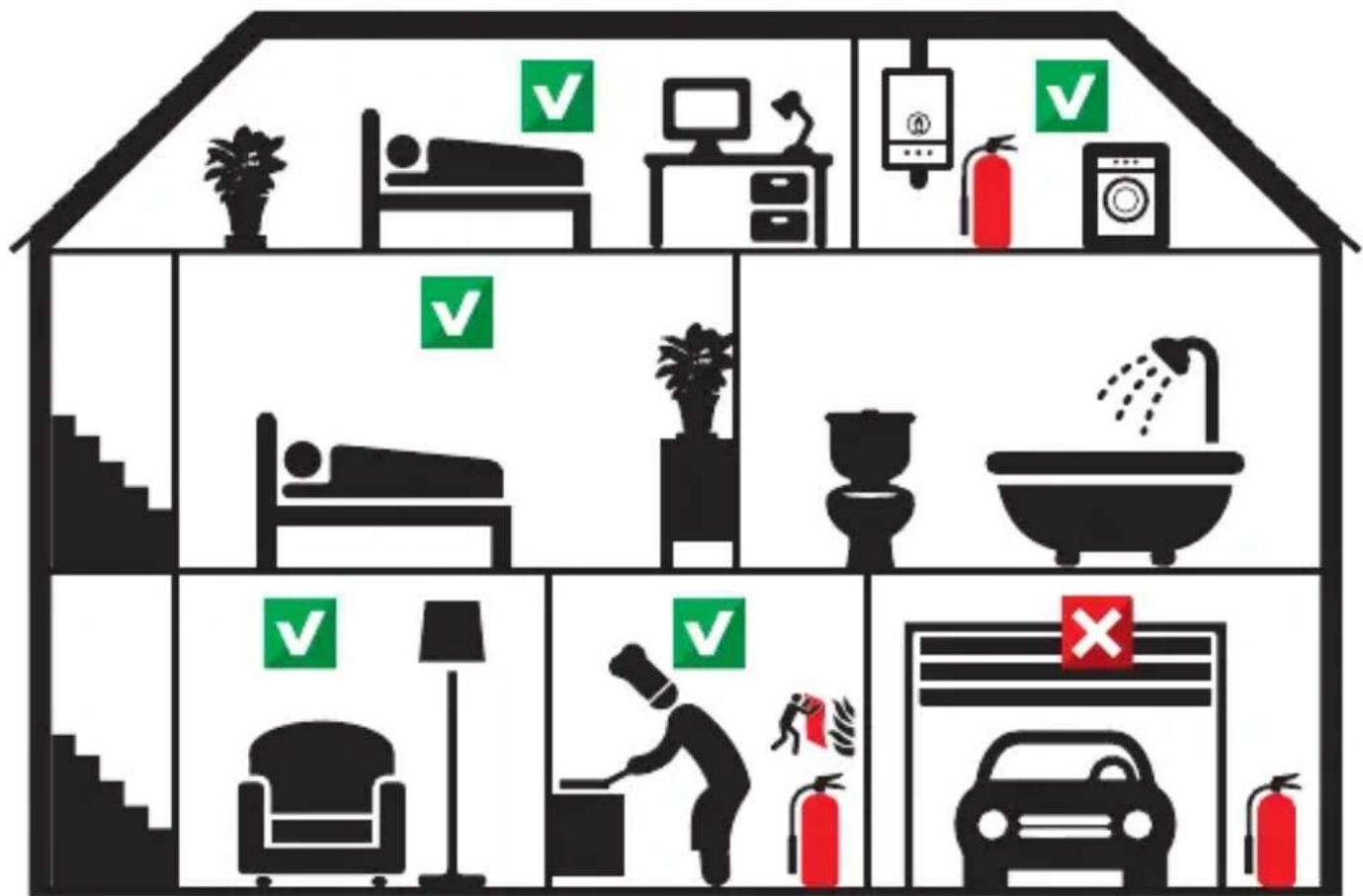
text_image
Diagram illustrating home safety rules with checkmarks and red/green icons for different actions like bed, toilet, fire extinguisher, and car.
Required

Do not use
ALSO AVAILABLE


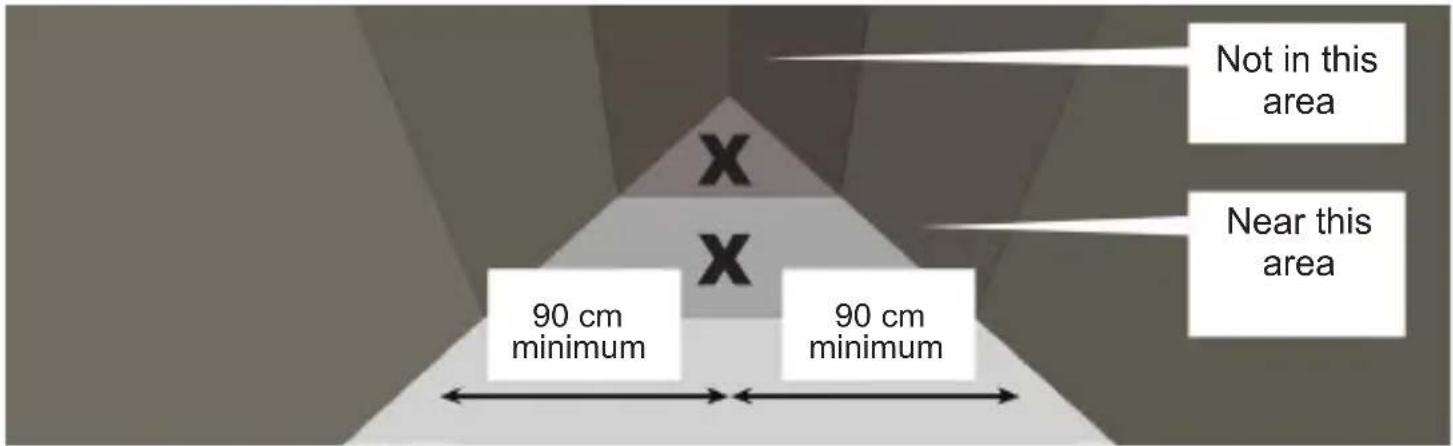
text_image
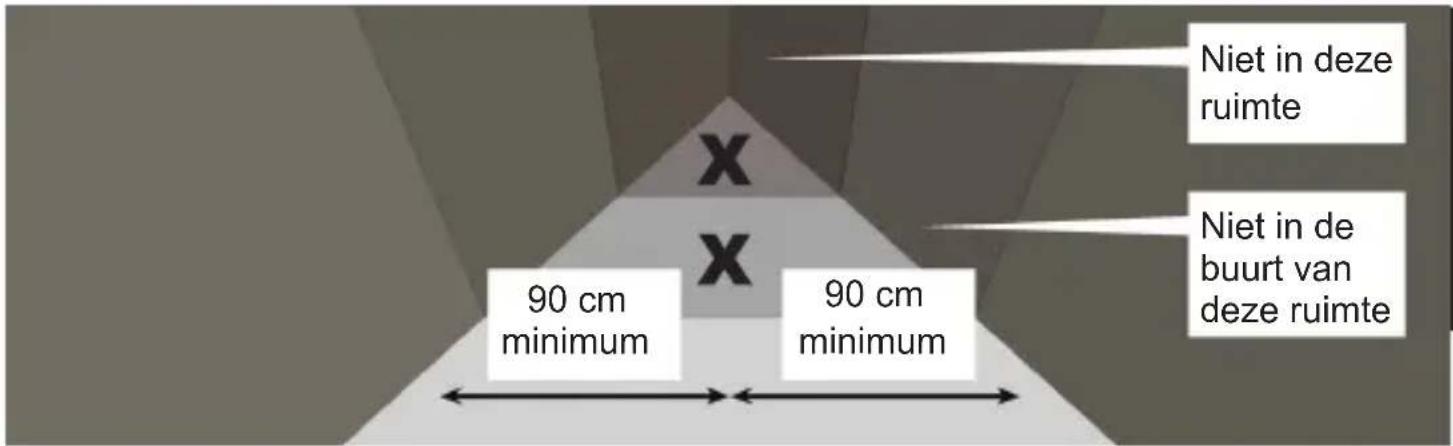
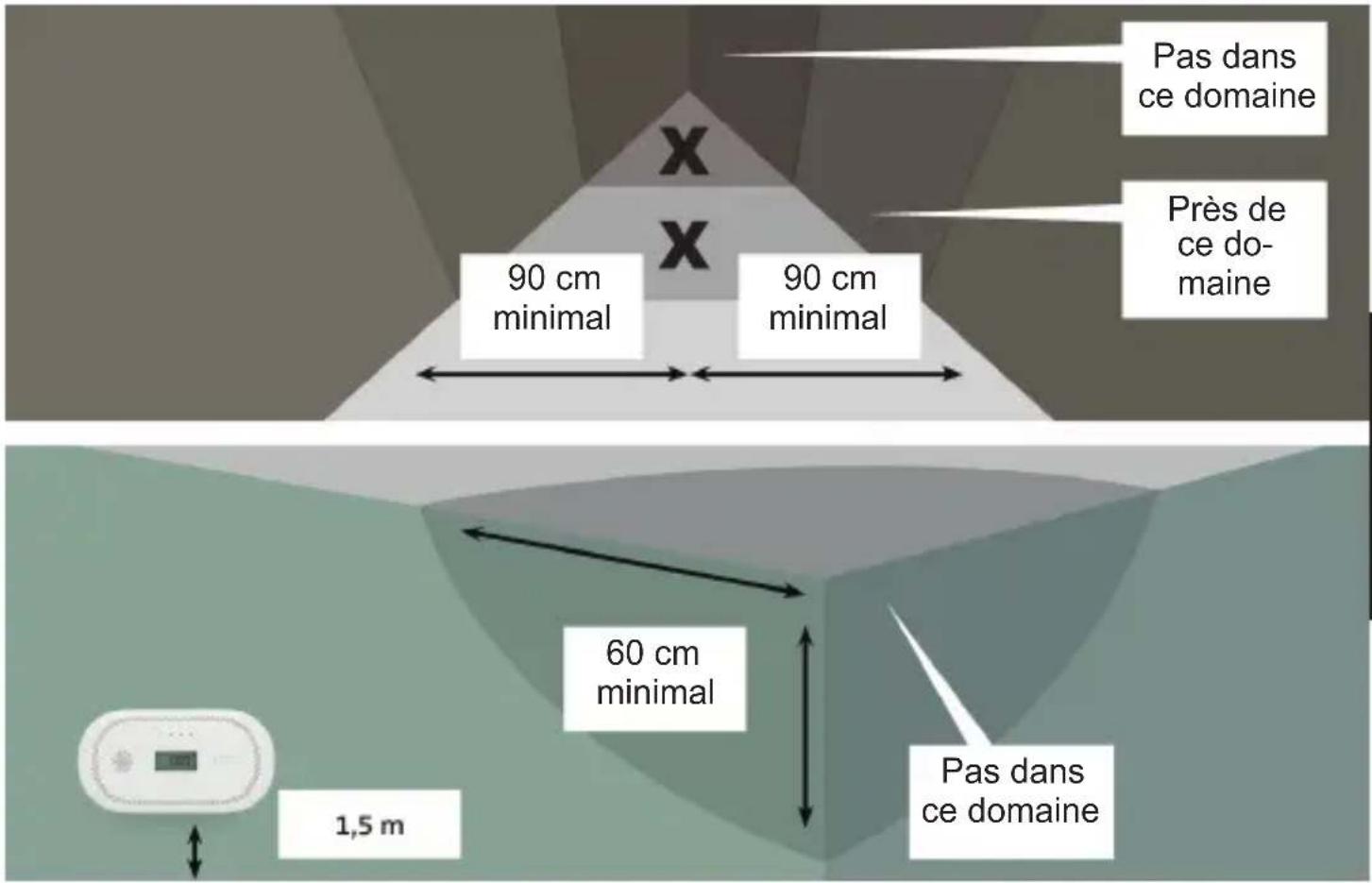
90 cm minimum 90 cm minimum Not in this area Near this area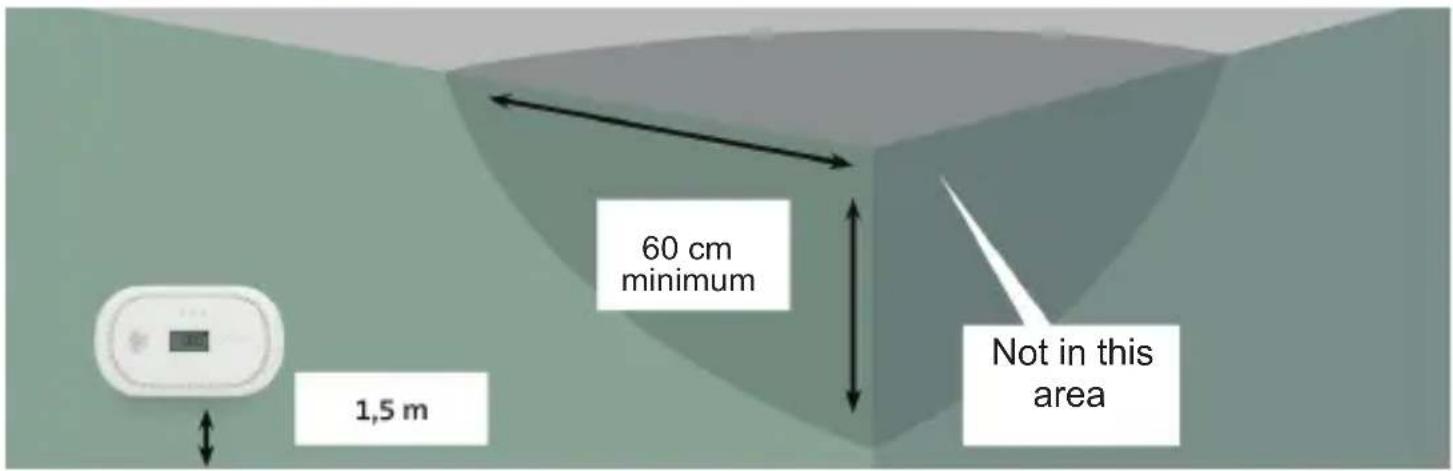
text_image
60 cm minimum 1,5 m Not in this areaIn spaces without combustion devices:
• Install the CO detector in spaces without combustion devices, preferably at breathing height.
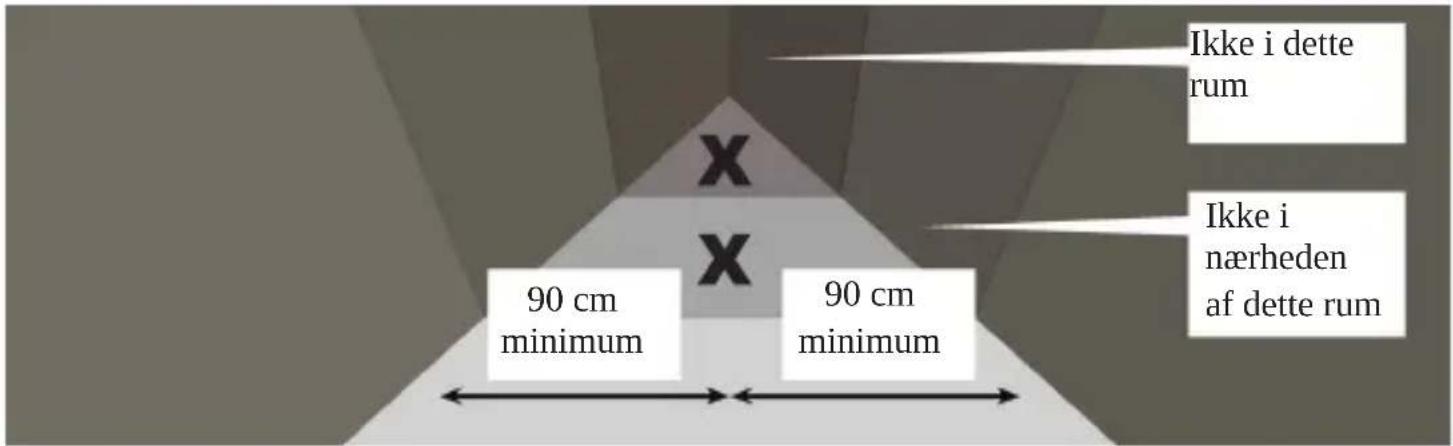
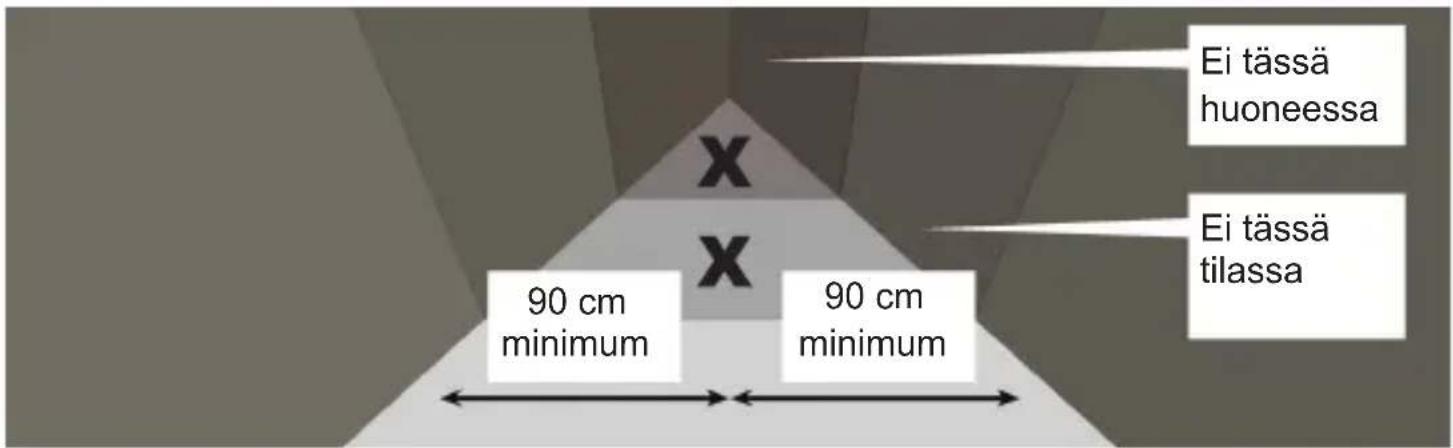
• I install the CO detector minimum 90 cm way from of roof ridges, corners, arched ceilings or front roofs.
• Install the CO detector minimum 60 cm from surrounding walls and ceilings.
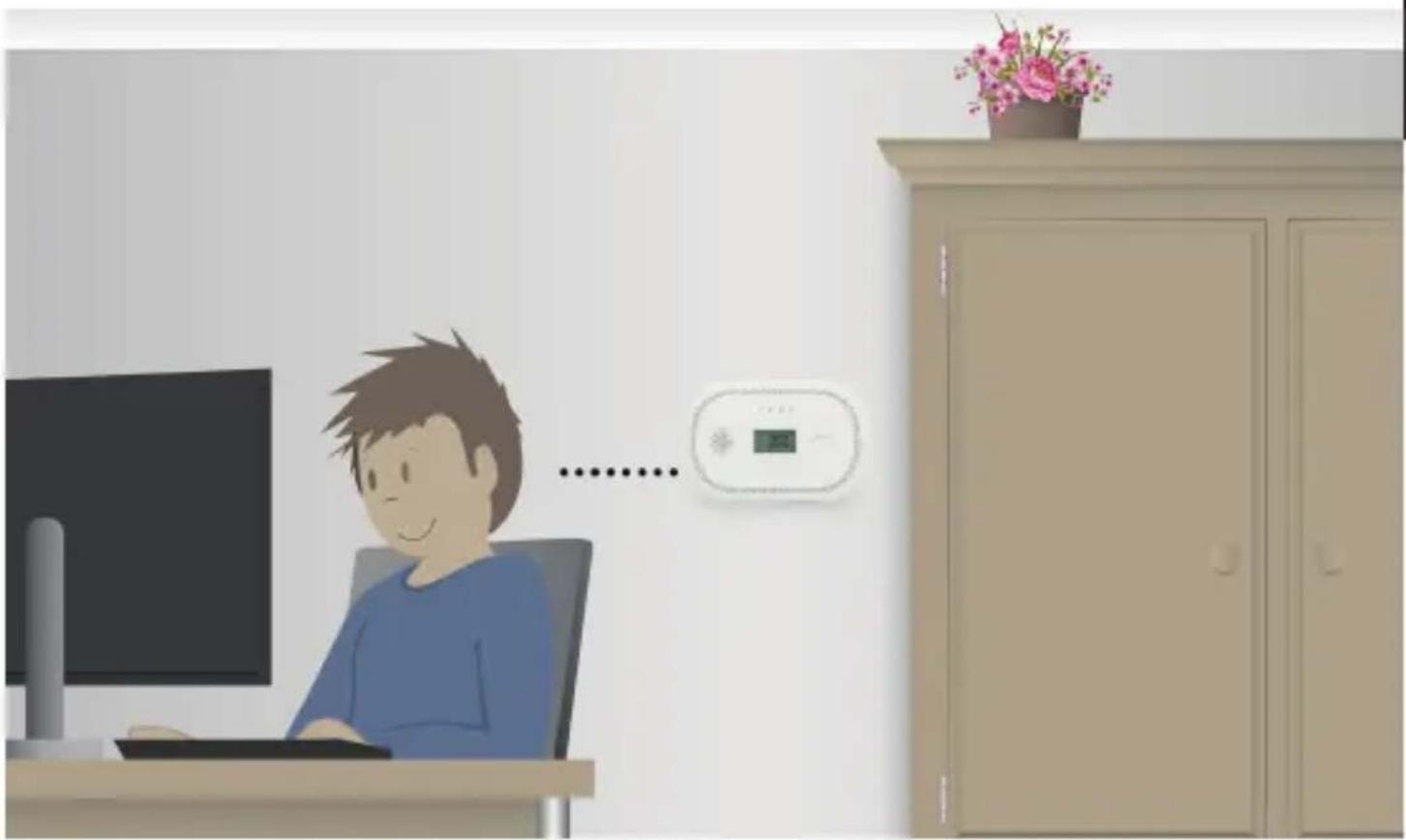
natural_image
Illustration of a person using a laptop at a desk with a wall-mounted digital thermometer and a flower on a cabinet (no text or symbols)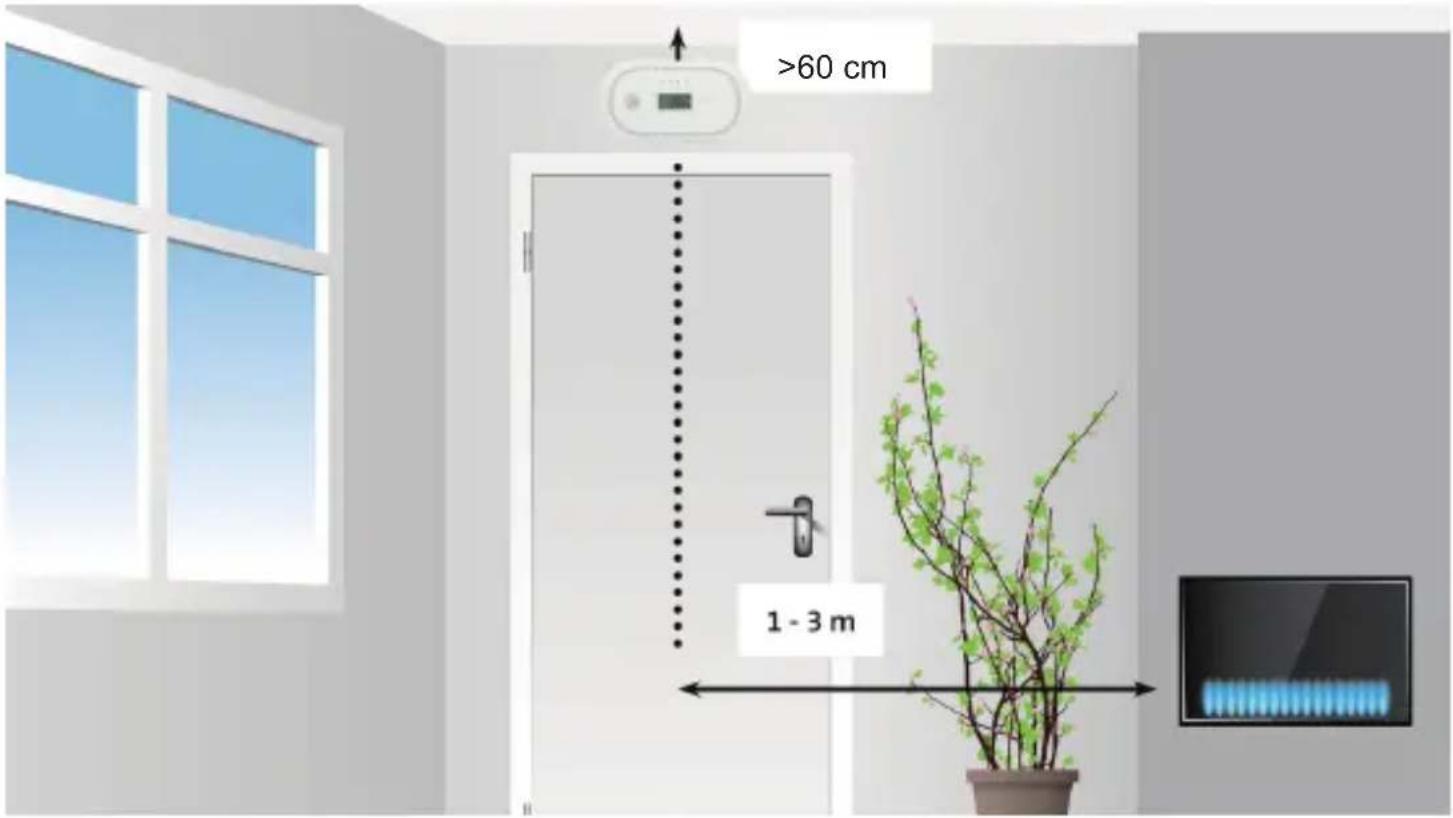
text_image
>60 cm 1 - 3 mIn spaces with combustion devices:
• Install the CO detector at 1 to 3 meters away from combustion devices, within the air flow from the combustion device.
• I install the CO detector way from of roof ridges, corners. arched ceilings or front roofs.
• In the case of smaller spaces ( <4m^3 ), the detector should be installed outside these spaces.
• Install the CO detector minimum 60 cm from surrounding walls and ceilings. Installation on both walls and ceiling is possible in rooms with a combustion device.

text_image
> 60 cm 1 - 3 m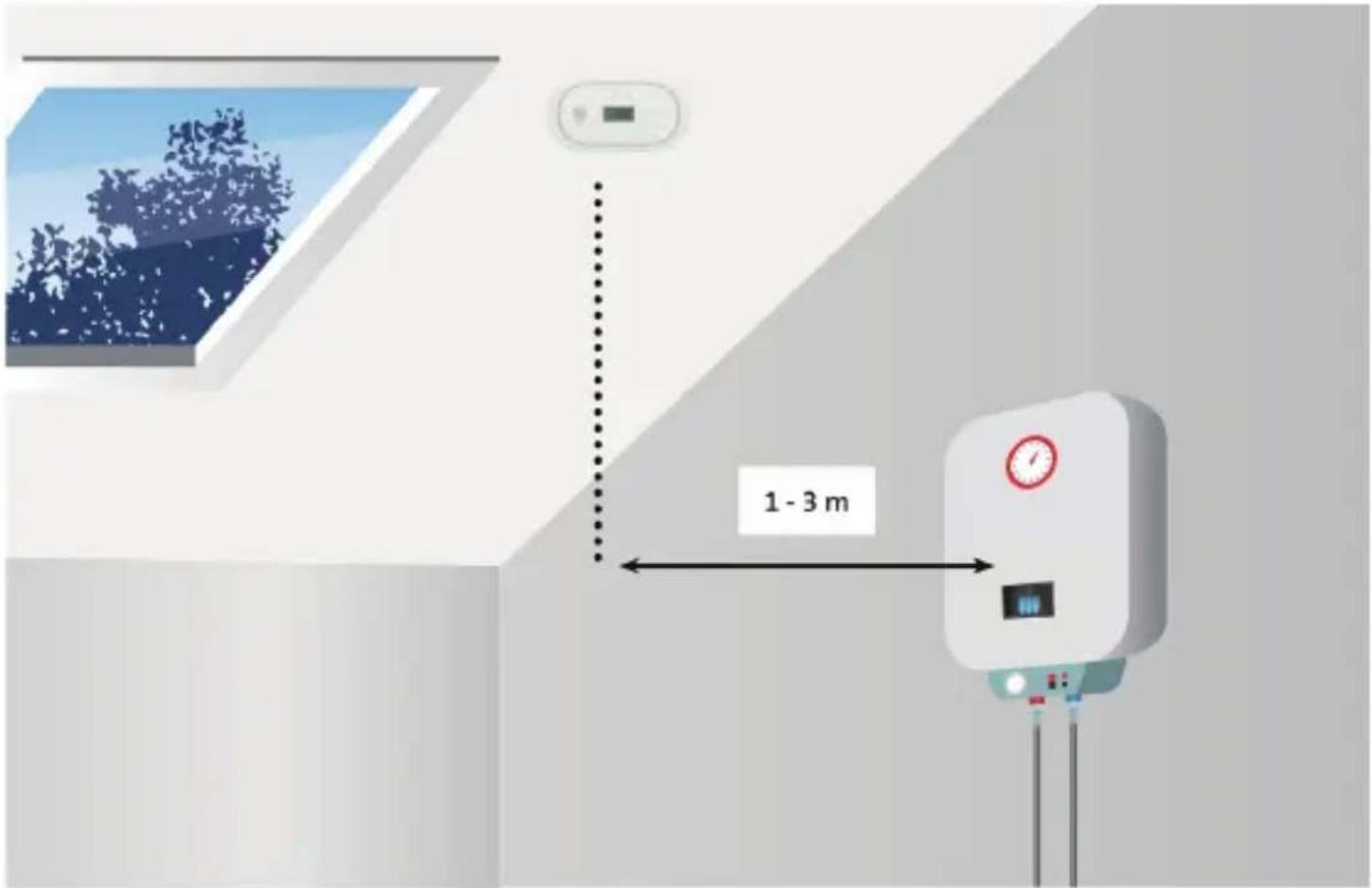
text_image
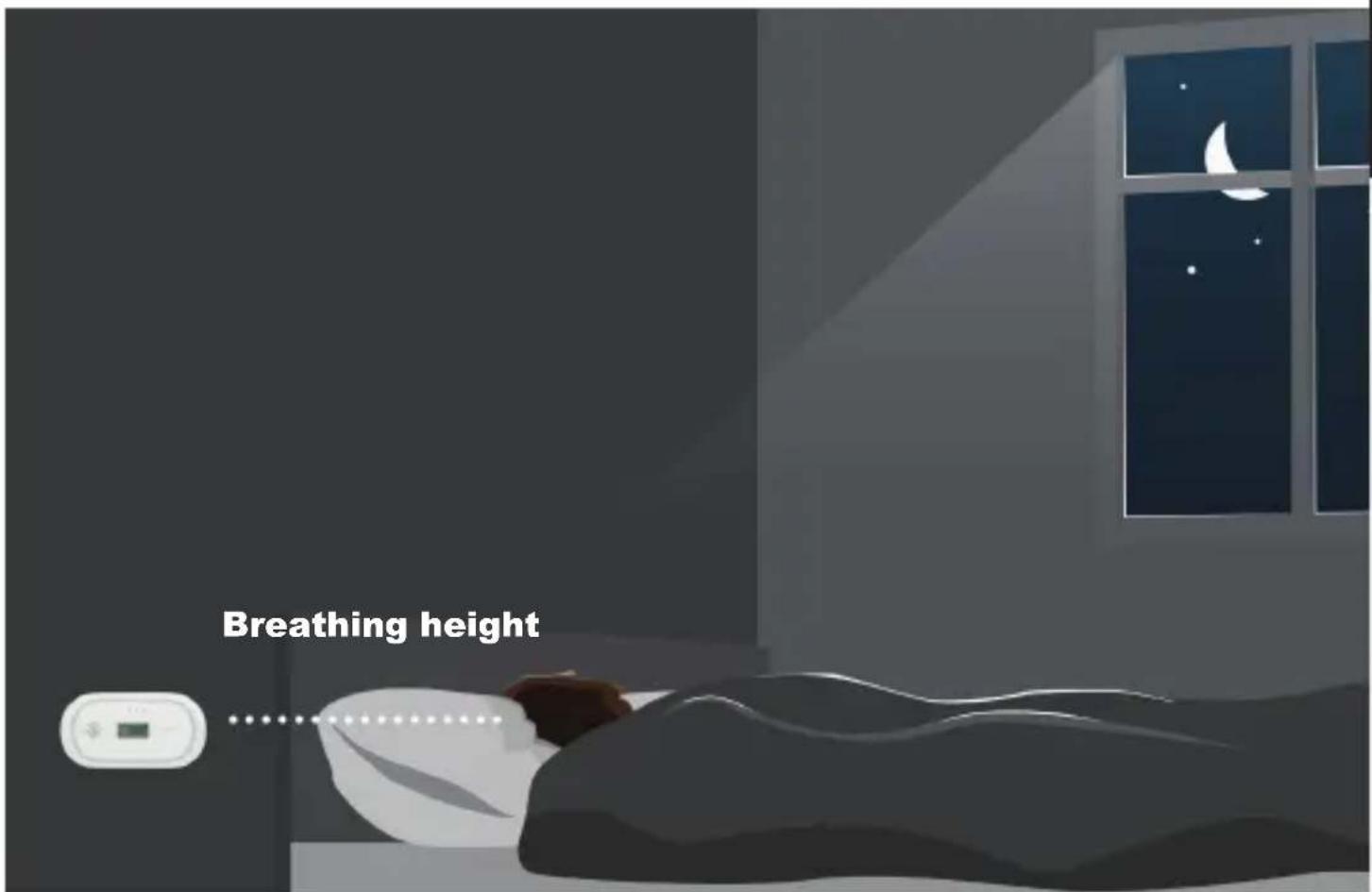
1 - 3 mIn bedrooms:
• Install the CO alarm in bedrooms at breathing height while sleeping.
• I install the CO detector way from of roof ridges, corners, arched ceilings or front roofs.
text_image
Breathing height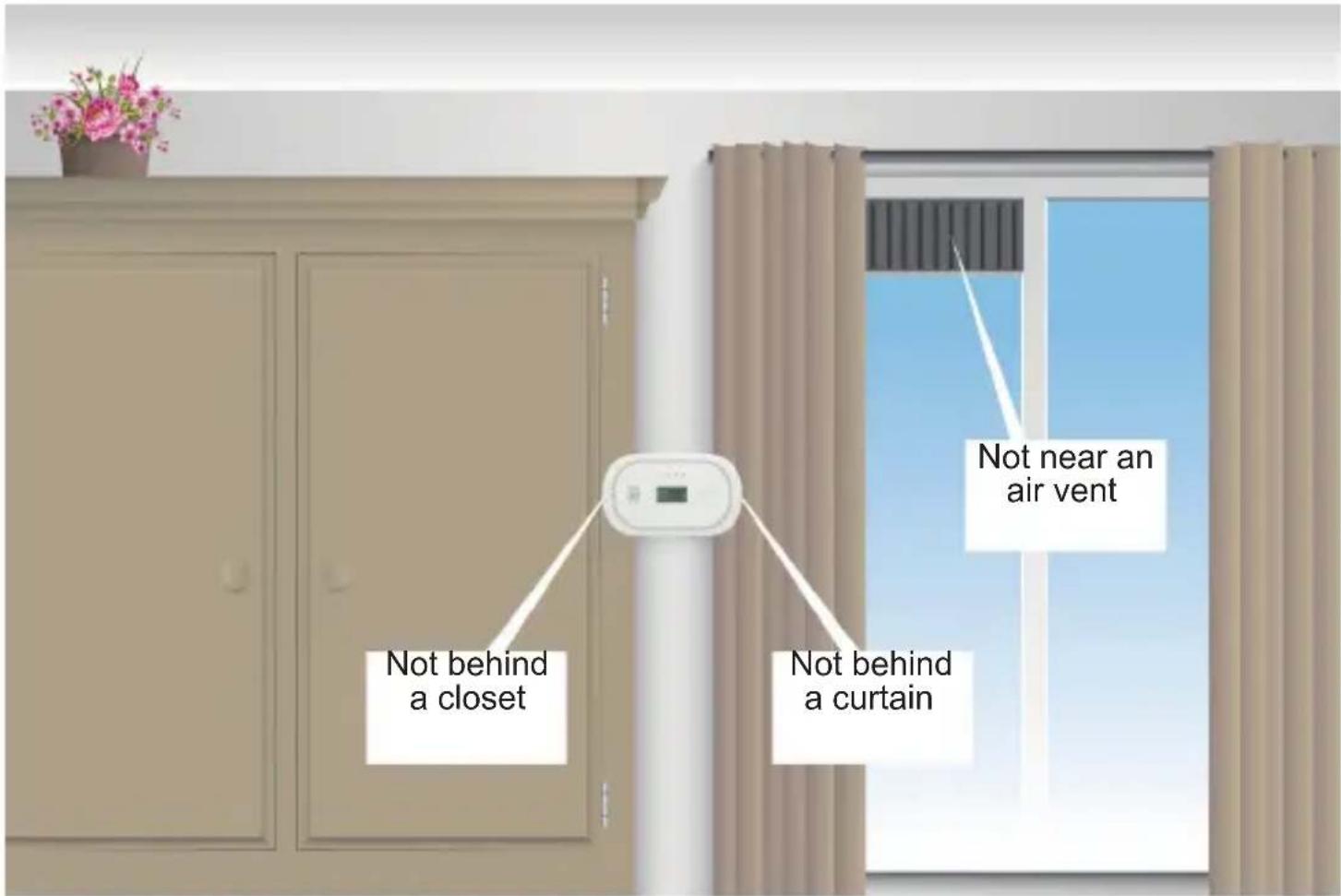
text_image
Not behind a closet Not behind a curtain Not near an air ventAVOID THE FOLLOWING PLACES FOR INSTALLATION:
- Do not install the CO detector in the turbulent air created by ceiling fans.
• Do not install the CO detector near vents with fresh air.
• Do not install the CO detector near doors and windows leading outdoors. - Do not install the CO detector near extremely dusty, dirty or greasy spaces such as heating spaces < 4m^3 or pantries. Dust, grease and household chemicals can affect the sensor.
• Install the CO detector at least 0.5 meters away from gas discharge lamps (halogen) because of electronic interferences that can lead to false alarms.
• Do not install the CO detector in humid and wet spaces, such as the bathroom.
• Do not install the CO detector in a location where the temperature is lower than -10^ C or warmer than +40^ C.
• Do not install the CO detector in a place where the humidity is higher than 95%RH. - Never install the CO detector behind curtains or furniture. Carbon monoxide must be able to reach the sensor to ensure the sensor can properly detect carbon monoxide levels.
• Never install the CO detector flat on a table or similar surface.
• Never install the CO detector in spaces where spray cans may be used (hair spray, deodorant)
INSTALLATION:
- Insert the included batteries into the CO detector.
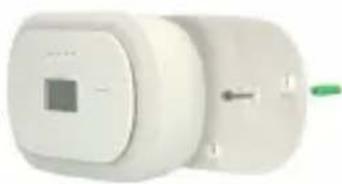
A. Slide the mounting plate down.
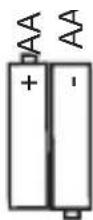
B. Insert the 2 AA batteries, observing polarity.
(High Energy Alkaline batteries 1.5V AA - LR6) (Rechargeable batteries are not suitable.)
C. The POWER, FAULT AND ALARM LEDs will light for 0.5 second and the detector will emit a short audible signal. 120 seconds will count down on the display while the power.
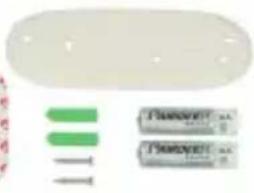
- Mount the mounting plate in a suitable location. Use the supplied plugs and screws or self-adhesive tape.
- You can perform the first test by briefly pressing the test button; see also paragraph "Testing".
- Now interlock the mounting plate with the CO detector by inserting the latch on top into the hole until you hear a click. If no batteries are installed, it is impossible to mount the CO detector on the mounting plate.
- The CO detector is now functional.
USE:
- Every 40 seconds, the POWER LED briefly to indicate that the detector is operating.
- When the detector gives a short bleep and the "FAULT" LED lights up briefly, the batteries should be replaced as soon as possible.
- The table below shows when the detector will sound the alarm.
| CO concentration | NO ALARM for | ALARM for |
| 30PPM 120 min. - | ||
| 50PPM 60 min. 90 min. | ||
| 100PPM 10 min. 40 min. | ||
| 300PPM - 3 min. |
natural_image
White industrial electrical device with a digital display and green cable (no visible text or symbols)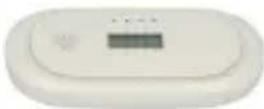

text_image
Image showing a white oval shape with three horizontal green bars and two labeled yellow bars (yellow and gray) with text.In accordance to the EN50291 standard.
- When the alarm sounds, it will turn off automatically when the CO concentration is below 30PPM.
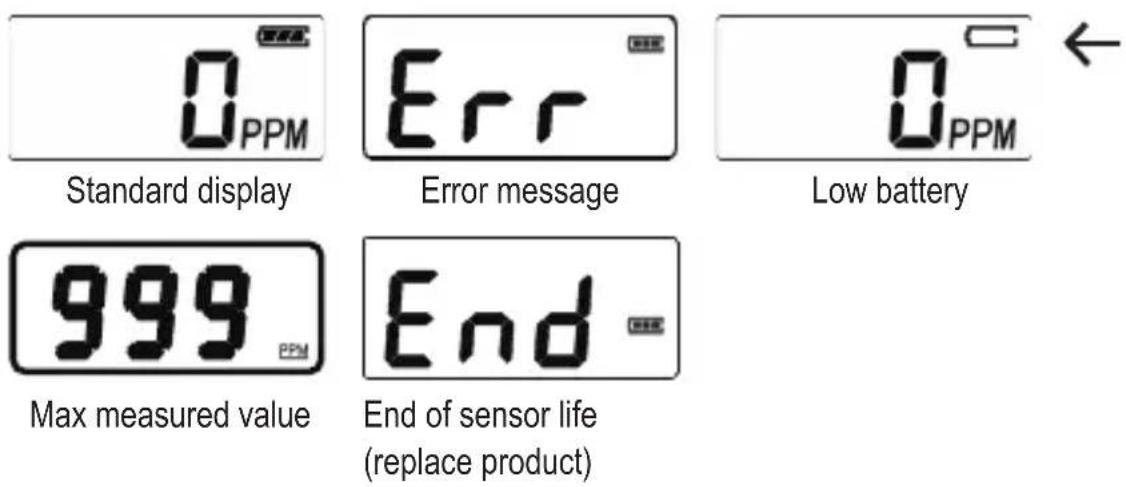
- The CO detector will regularly perform a self-test. In the event of an error condition, "Err" will appear on the display and a double bleep will be heard at regular intervals. At the same time, the "FAULT" LED will light up briefly at intervals of 2 times.
TESTING:
When the CO detector is operating under normal conditions it should be tested every month. Press the "TEST" button for a few seconds. "POWER", "FAULT" and "LIFE" light up briefly with the "ALARM" LED flashing 4x. Also, 4 beeps are heard.
SENSOR ERROR:
In the event of a sensor error, the "FAULT" led will briefly light up 2x every 40 seconds. There are also 2 short beeps audible at the same time. The display will show "Err".
LED INDICATION:
POWER - green LED: Normal functioning, the LED
FAULT - yellow LED: Sensor problem
ALARM - red LED: Alarm, carbon monoxide present
LIFE - yellow LED: End of sensor life
flashes every 40 seconds
BATTERY INFORMATION INDICATION:
-
Every 40 seconds the battery is automatically checked.
-
If the battery voltage is too low, the "FAULT" LED will light up briefly every 40 seconds and a short beep will also be heard.
When empty batteries are indicated, the batteries should be replaced as soon as possible.
Use High Energy Alkaline batteries (2 x LR6 / 1.5V AA). Rechargeable batteries are not suitable.
REASON FOR SENSOR FAULT:
Faults can be caused by broken circuitry, a faulty sensor or other faulty electronic parts.
SENSOR FAULT CAUSED BY CHEMICAL GASES:
When volatile chemical gases such as alcohol are the cause for error detection, this may be corrected by switching the detector off and leave it in fresh air for 24 hours. This will restore the sensor. If the error is not cleared after these 24 hours, the detector is faulty and should be replaced. Don't repair the detector yourself, but have it repaired by the importer.
When the alarm is contaminated and damaged by high concentrations of chemical gases, the sensor could be affected. This will lead to a temporary error or permanent damage. When the alarm sounds and you can smell a chemical gas, this could be the reason. Carbon monoxide is a colourless and odourless gas. Chemical gases do have an odour.
The following substances and gases can cause false alarms or permanently damage the detector: Methane, propane, iso-butane, ethylene, ethanol, alcohol, iso-propanol, benzene, toluene, acid, ether, hydrogen, hepatic gas, sulphur dioxide, aerosol, propellant, alcohol preparation, paint, thinner, dissolvent, bonding agents, shampoo, aftershave balm, perfume, car exhaust (cold start) and certain cleaning agents.
SCREENMESSAGES:
MAINTENACE:
To keep your CO detector in proper working order, please follow these easy steps:
• Once a month, check that the alarm is working properly by pressing the test button briefly.
• Clean the CO detector with a vacuum cleaner or with a soft cloth or brush once every month to remove excess dust.
- Check whether the batteries are damaged, exhausted or corroded.
• Explain to children that they should not play with the CO detector.
• Ensure children are aware of the dangers of carbon monoxide poisoning.
• Never use cleaning agents or other solutions to clean the CO detector.
• Never use air fresheners, hair spray or other aerosols near the CO detector.
- Don't paint the CO detector. Paint covers the vents preventing the sensor from detecting CO.
- Never disassemble, repair or modify the product yourself; there's a high risk that it will no longer function correctly or reliably.
BATTERY REPLACEMENT
Remove the CO detector from the wall plate. You will now have access to the batteries.
Remove the batteries from the unit and replace them with 2x new High Energy Alkaline batteries 1,5V AA - LR6, making sure that the battery polarity matches the instructions in the battery compartment.
SENSOR REPLACEMENT:
The sensor has a lifetime of 10 years. After 10 years you need to replace the complete product, the sensor itself is not exchangeable.
If the "LIFE" LED lights up and 3 short beeps are heard every minute, the entire product must be replaced.
This is the End of life warning. The reliability of the sensor can no longer be guaranteed.
SPECIFICATIONS:
| Power supply: | 2 x LR6, 1,5V AA high energy Alkaline batteries |
| Sensitivity and time: | 30ppm, alarm is not activated within 120 minutes50ppm, alarm is activated within 60~90 minutes100ppm, alarm is activated within 10~40 minutes300ppm, alarm is activated within 3 minutes |
| standby consumption: | <30μA |
| consumption at alarm: <45mA | |
| Sound pressure at alarm: | >85dB (3m distance) |
| Environmental conditionsduring use: | Temperature: -10~+40°CHumidity: 0~95% |
| Type: | Type B (unchecked output) |
ENVIRONMENT:
Do not throw away used batteries, but recycle them using your local chemical depot. Product may not be thrown out as normal waste, but must be recycled as electrical waste.
DECLARATION OF PERFORMANCE
The declaration of performance is available on the website
DA
text_image
Diagram illustrating home safety and fire safety rules with icons for check, no check, and no checkmark
Påkrævet

Brug ikke
OGSÅ TILGÆNGELIG

Brandslukker Brandtæppe

text_image
Ikke i dette rum Ikke i nærheden af dette rum 90 cm minimum 90 cm minimum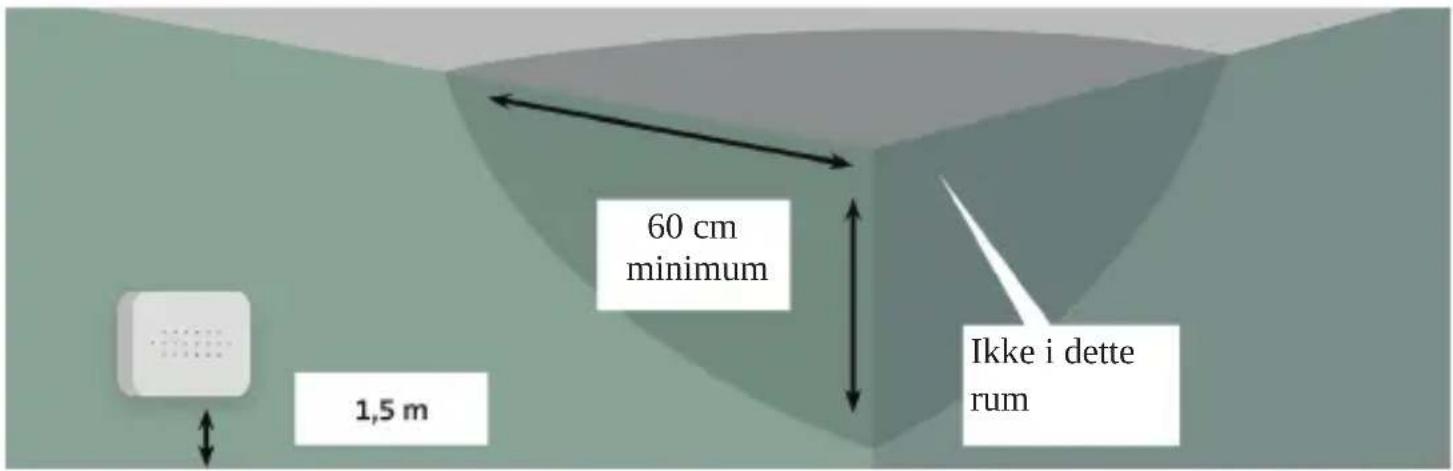
text_image
60 cm minimum Ikke i dette rum 1,5 mnatural_image
Product assembly diagram showing battery, switch, and battery modules with no visible text or symbolsBRUG:
300ppm, giver alarm inden for 3 minutter
Standby-strøm: <30μA
Alarmstrøm: <45mA
text_image
Diagram illustrating home safety and fire safety rules with icons for check, no check, and no checkmark
Krävs

Använd inte
natural_image
Illustration of a person working at a desk with a computer and a wall-mounted device, no text or symbols present.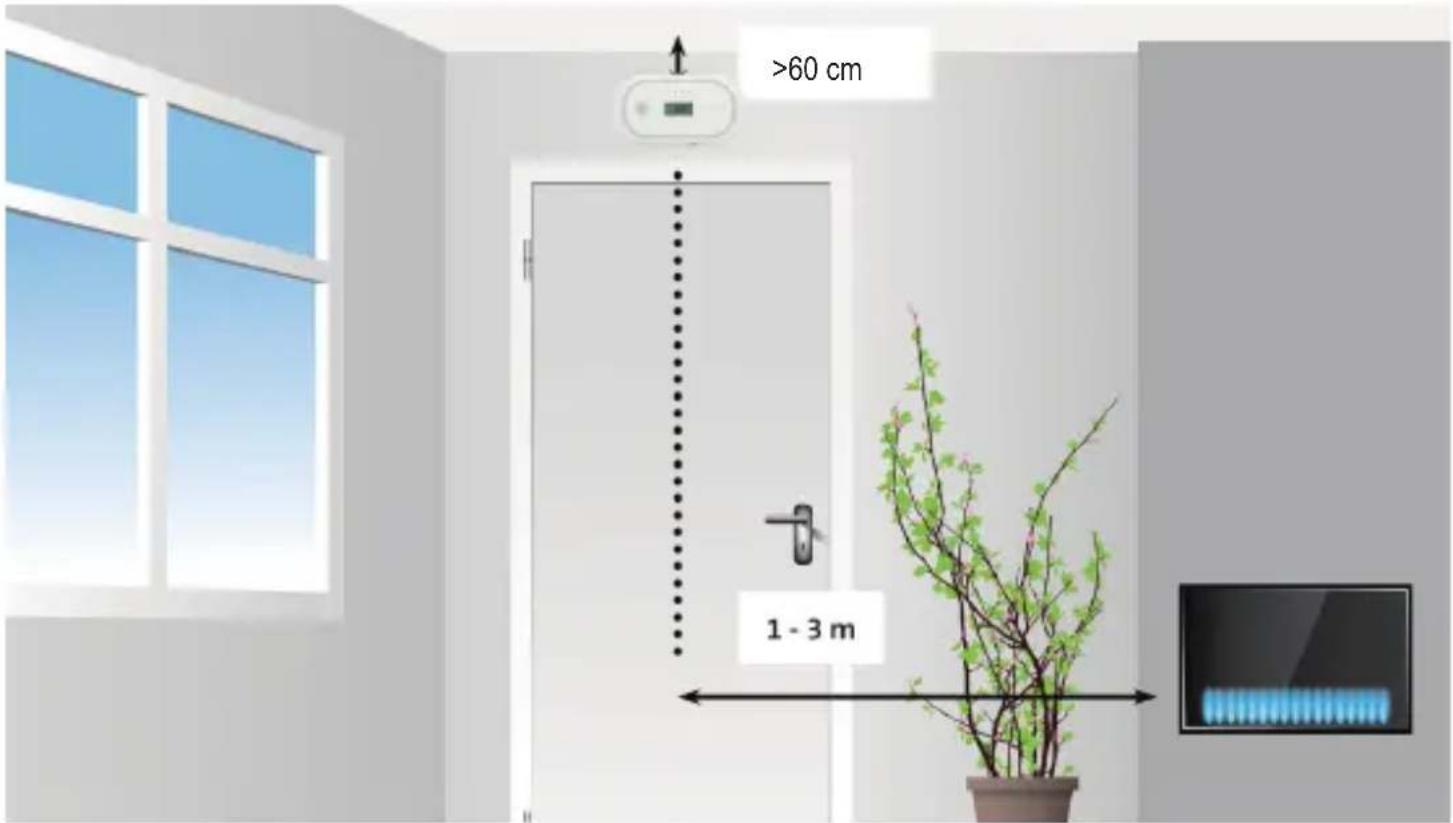
text_image
>60 cm 1 - 3 mnatural_image
Product display of a battery with various components including a battery, switch, and battery pack (no visible text or symbols)ANVÄND:
text_image
Diagram illustrating home safety and fire safety rules with checkmarks, no text, and icons for different locations.
Vaadittu

Älä käytä
MYÖS SAATAVILLA

Palosammutin Sammutuspeite

natural_image
Illustration of a person working at a desk with a computer and a wall-mounted device, no text or symbols present.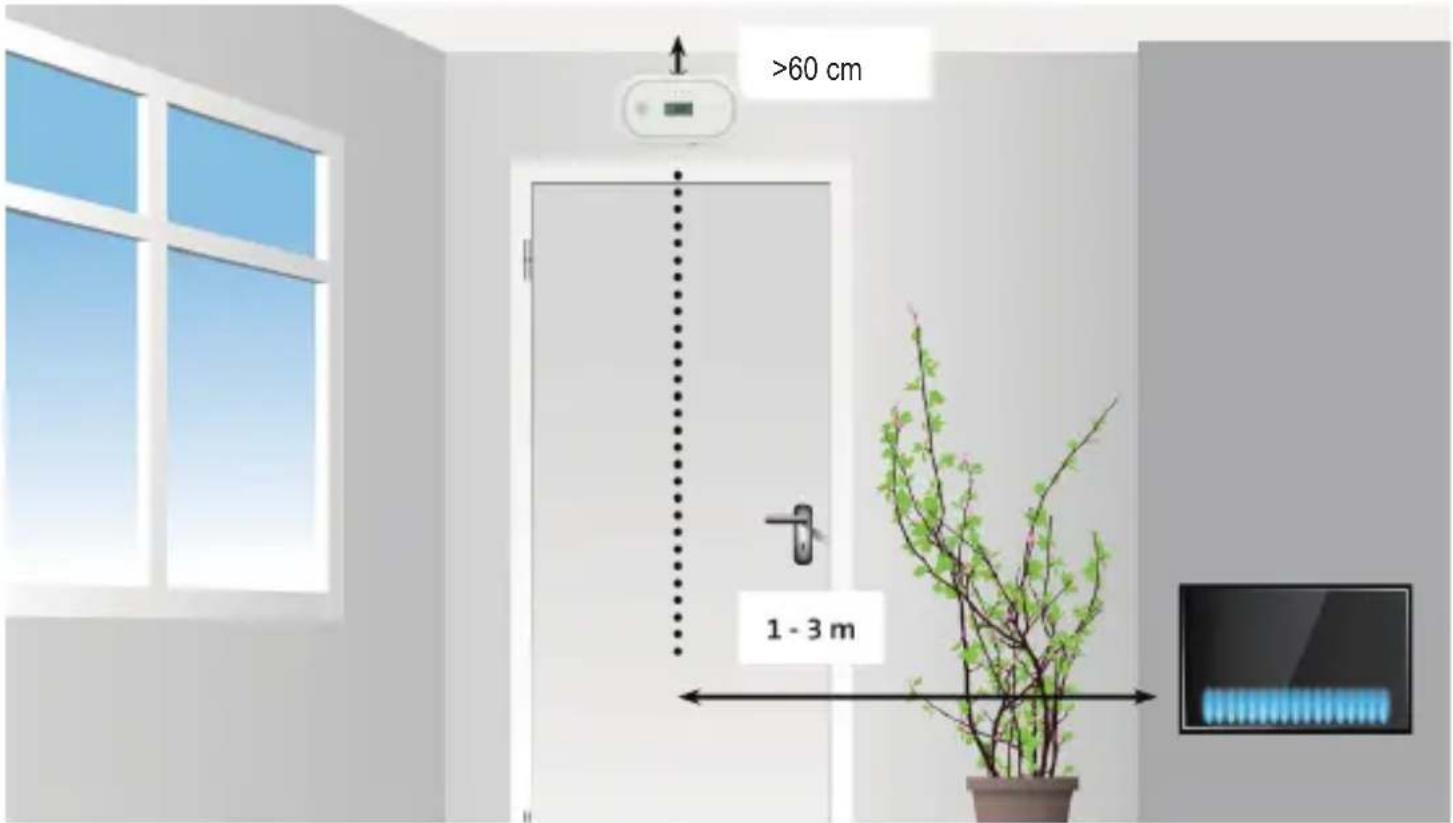
text_image
>60 cm 1 - 3 mnatural_image
Product display of a battery with various components including a battery, switch, and battery pack (no visible text or symbols)KÄYTTÖ:
text_image
Diagram illustrating home safety and fire safety rules with checkmarks, no text, and icons for different locations.
Wymagane
Nie używać
natural_image
Illustration of a person working at a desk with a computer and a wall-mounted device, no text or symbols present.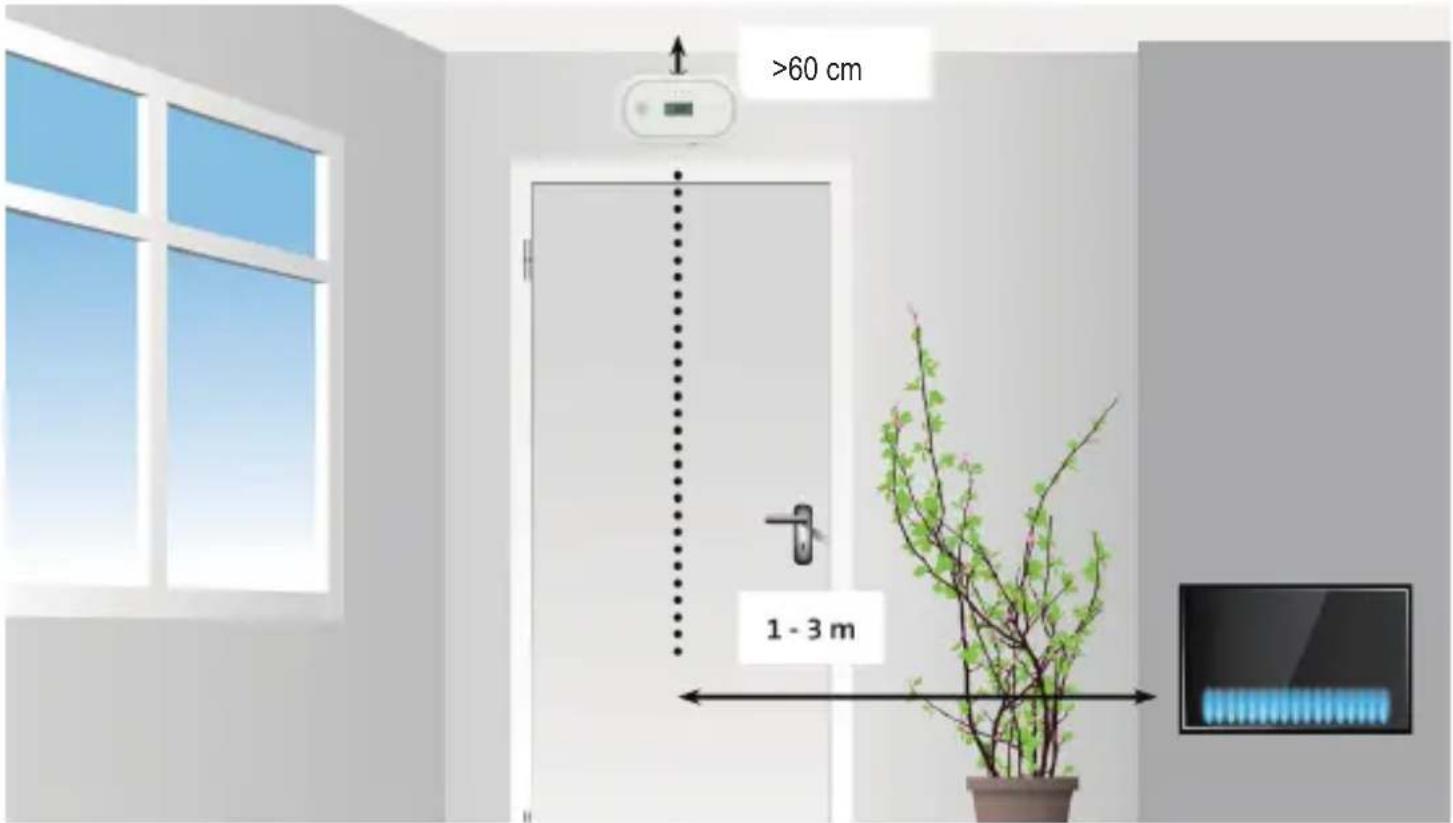
text_image
>60 cm 1 - 3 mnatural_image
Product assembly diagram showing battery, charging device, and battery pack components (no text or symbols)UŻYCIE:
text_image
Diagram illustrating home security and fire safety rules with icons for living room, kitchen, shower, fire extinguisher, car, and fire extinguisher.
Απαιτούμενο
Μην χρησιμοποιείτε
ΕΠΙΣΗΣ ΔΙΑΘΕΣΙΜΟ

natural_image
Illustration of a person working at a desk with a computer and a wall-mounted device, no text or symbols present.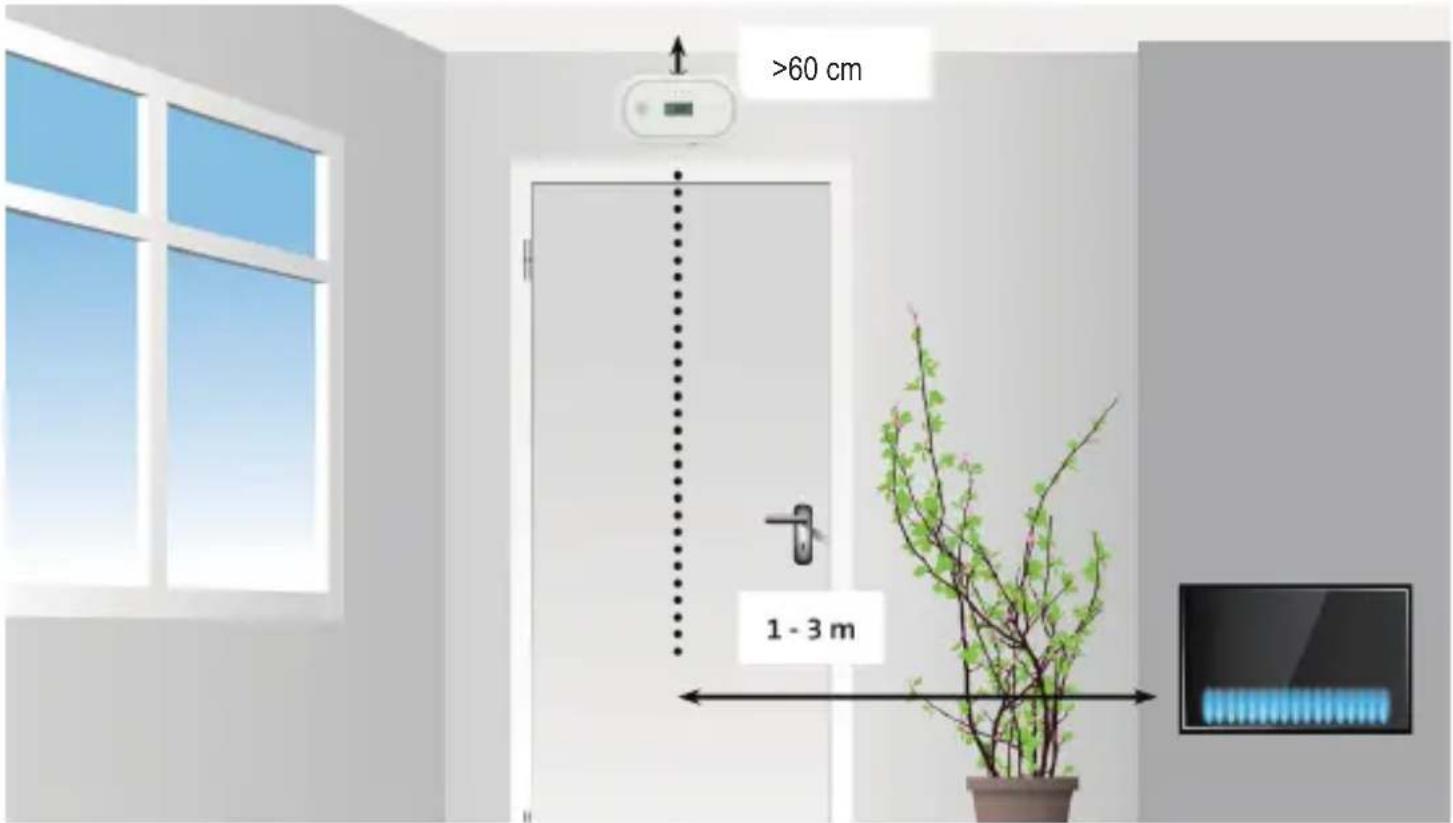
text_image
>60 cm 1 - 3 mnatural_image
White electrical plug with indicator lights and a green connector (no visible text or symbols)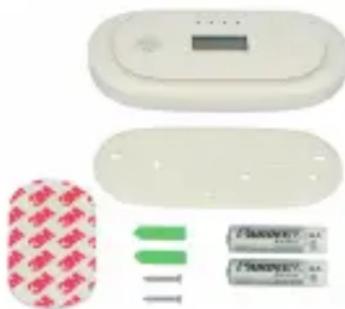
natural_image
Product display and battery components including a red patterned band, green batteries, and a white electronic device (no visible text or symbols)'ENΔEIEH LED:
Alecto is a brand of Commaxx B.V. Wiebachstraat 37, 6466 NG Kerkrade, The Netherlands

Service / Help ? www.alecto.nl
Support.alecto.nl
Our service department cannot give personalized information regarding the installation or placement of these devices in your specific environment. Please consult a mechanic or home security specialist.