LXGEPR1 - Dishwasher Hobart - Free user manual and instructions
Find the device manual for free LXGEPR1 Hobart in PDF.

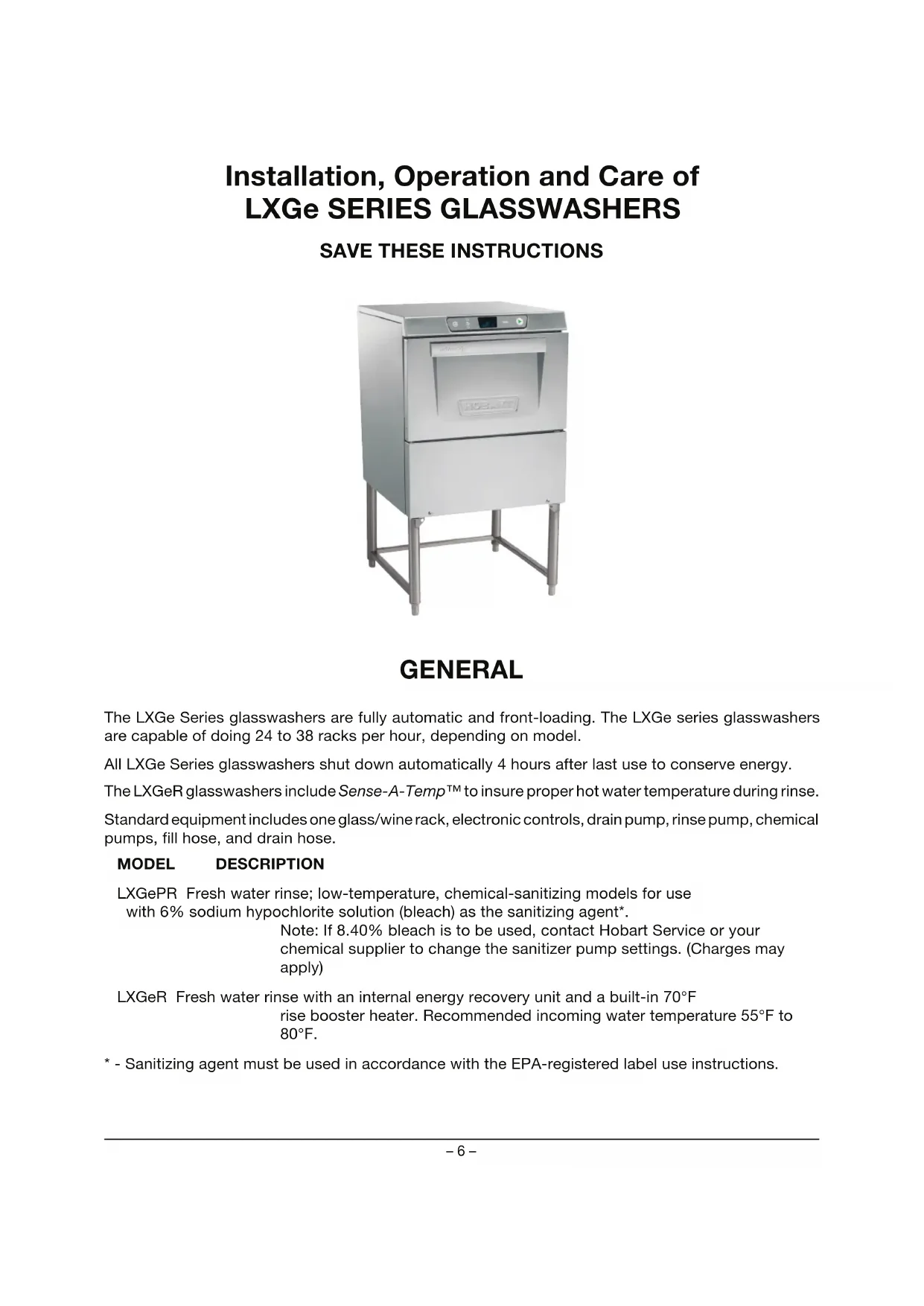


| Product Type | Professional Front-Loading Dishwasher |
| Model | LXGePR (chemical sanitization) |
| Brand | Hobart |
| Power Supply | 120 V / 60 Hz / 1 phase, 15.4 A |
| Circuit Protection | 20 A minimum, 20 A maximum |
| Dimensions (W × D × H) | 873 × 608 × 1040 mm (34 3/8 × 23 15/16 × 40 15/16 in) |
| Net Weight | 68 kg (150 lb) |
| Shipping Weight | 77 kg (170 lb) |
| Capacity | Up to 38 racks per hour |
| Required Water Temperature | Min 49 °C (120 °F), recommended 60 °C (140 °F) |
| Dynamic Water Pressure | 103.4 to 448 kPa (15 to 65 psi) |
| Rinse Type | Rinse pump, chemical sanitization (sodium hypochlorite 6% or 8.4%) |
| Main Functions | Automatic cycles (light, normal, heavy), automatic shutoff after 4 h, Sense‑A‑Temp booster heater, detergent/rinse agent/sanitizer/descaling chemical pumps, management programming, customizable Advansys button |
| Maintenance and Cleaning | Daily cleaning of filters and arms, automatic or manual descaling, use of stainless steel cleaner |
| Compatible Materials | Stainless steel; avoid silver, aluminum, tin (attacked by bleach) |
| Mounting and Installation | Requires leveling, electrical connection 1 in, water supply 3/4 in, drain 5/8 in, pressure 15‑65 psi |
| Safety | Grounding instructions, do not mix bleach with other products, electrical interlock, use of moisture-resistant materials |
| Spare Parts and Repairability | Filters, wash/rinse arms, chemical pumps, sensors, pressure switches; service by authorized Hobart technician |
| Warranty | See specific conditions; damage from debris not covered |
Frequently Asked Questions - LXGEPR1 Hobart
User questions about LXGEPR1 Hobart
0 question about this device. Answer the ones you know or ask your own.
Ask a new question about this device
Download the instructions for your Dishwasher in PDF format for free! Find your manual LXGEPR1 - Hobart and take your electronic device back in hand. On this page are published all the documents necessary for the use of your device. LXGEPR1 by Hobart.
USER MANUAL LXGEPR1 Hobart
IN M IN S O D E R U C D, CT U C C I M C I N SSWASHER GAMME LXGe
HOBART
701 S. RIDGE AVENUE
TROY, OHIO 45374-0001
937 332-3000
www.hobartcorp.com
FORM 47526 Rev. A (January 2015)
TABLE OF CONTENTS
GENERAL 6
INSTALLATION....7
Unpacking....7
Location 7
Leveling....7
Water Requirements 7
Plumbing Connections....8
Before First Use 8
Electrical Connection 9
Electrical Data....9
Connection Method 10
Detergent and Rinse Aid 11
Chemical Sanitizer (LXGePR) 12
Checking Sanitizer Concentration 12
Deliming Solution....12
Priming Chemical Pumps....13
Installation Diagram (LXGePR, short) 14
Installation Diagram (LXGePR, tall)....15
Installation Diagram (LXGeR, short) 16
Installation Diagram (LXGeR, tall)....17
PROGRAMMING....18
Manager Mode Programming 18
Programming Instructions....18
Menu Display Prompts....18
LXGe advansys Manager Mode Programming Card 19
Parameters Menu Table 21
OPERATION....23
Operating the LXGeR Glasswasher....23
Diagnostic/Error Messages 24
Wash/Rinse Cycle Times (LXGePR and LXGeR) 25
Preparation 25
Do's and Don'ts For Your New Hobart Glasswasher 26
CLEANING....27
MAINTENANCE 28
Deliming 28
Lubrication 28
TROUBLESHOOTING....29
TABLE DES MATIÈRES
DESCRIPTION GÉNÉRALE 31
INSTALLATION 32
Déballage 32
Emplacement 32
Installation, Operation and Care of LXGe SERIES GLASSWASHERS
SAVE THESE INSTRUCTIONS
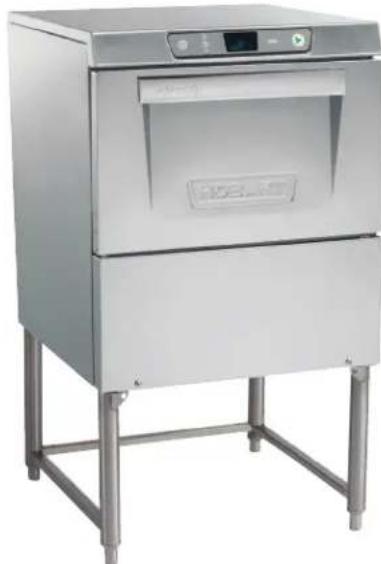
natural_image
Exterior view of a stainless steel kitchen appliance with control panel and side legs (no visible text or symbols)GENERAL
The LXGe Series glasswashers are fully automatic and front-loading. The LXGe series glasswashers are capable of doing 24 to 38 racks per hour, depending on model.
All LXGe Series glasswashers shut down automatically 4 hours after last use to conserve energy.
The LXGeR glasswashers include Sense-A-Temp™ to insure proper hot water temperature during rinse.
Standard equipment includes one glass/wine rack, electronic controls, drain pump, rinse pump, chemical pumps, fill hose, and drain hose.
MODEL DESCRIPTION
LXGePR Fresh water rinse; low-temperature, chemical-sanitizing models for use with 6% sodium hypochlorite solution (bleach) as the sanitizing agent*.
Note: If 8.40% bleach is to be used, contact Hobart Service or your chemical supplier to change the sanitizer pump settings. (Charges may apply)
LXGeR Fresh water rinse with an internal energy recovery unit and a built-in 70°F rise booster heater. Recommended incoming water temperature 55°F to 80°F.
* - Sanitizing agent must be used in accordance with the EPA-registered label use instructions.
INSTALLATION
UNPACKING
Immediately after unpacking the glasswasher, check for possible shipping damage. If this machine is found to be damaged, save packaging material and contact the carrier within 15 days of delivery.
LOCATION
Prior to installation, verify that the electrical supply agrees with the specifications on the machine data plate, which is located on the top of the door.
Steam generated from normal operation may escape from the door. Wood, laminates, veneers, etc. are unsuitable materials for use in areas exposed to glasswasher steam and detergents. Stainless steel or other moisture-resistant shields are recommended for surfaces adjacent to LXGe sides and top.
LEVELING
The machine must be level to operate properly. Place the glasswasher in its operating location. Level the machine before any connections are made. Using a carpenter's level placed diagonally on the rack tracks, level the machine front to back and side to side by threading the adjustable feet in or out.
WATER REQUIREMENTS
Proper water quality can improve glass washing performance by reducing spotting, enhancing effectiveness of labor and extending equipment life. Water conditions vary from one location to another. The recommended proper water treatment for effective and efficient use of this equipment will also vary depending on the local water conditions. Ask your municipal water supplier for details about your local water conditions prior to installation.
Recommended water hardness is 3 grains of hardness per gallon or less. Higher hardness may cause excessive formation of lime scale. Water hardness above 3 grains per gallon requires water treatment. Water treatment has been shown to reduce costs associated with machine cleaning, reduce deliming of the glasswasher, and reduce detergent usage in the glasswasher.
NOTICE High iron levels in the water supply can cause staining and may require an iron filter. High chloride levels in the water supply can cause pitting and may require a chloride removal system. Contact your local water treatment professional for proper water treatment.
Sediment may require a particulate filter. Dissolved solids may require water treatment such as a water softener, reverse osmosis system, etc. Contact your local water treatment professional for proper water treatment.
If an inspection of the glasswasher or booster heater reveals lime buildup after the equipment has been in service, water treatment is recommended. If a water softener is already in place, ensure there is a sufficient level of salt. Contact your local Hobart Service office for specific recommendations.
A water hammer arrestor (meeting ASSE-1010 Standard or equivalent) should be installed (supplied by others) in the common water supply line at the service connection.
The plumber connecting this machine is responsible for making certain that water lines are THOROUGHLY FLUSHED OUT BEFORE connecting to the glasswasher. This "flush-out" is necessary to remove all foreign matter, such as chips (resulting from cutting or threading of pipes) pipe joint compound from the lines; or, if soldered fittings are used, bits of solder or cuttings from the tubing. Debris, if not removed, may lodge in the glasswasher's plumbing components and render them inoperative. Manual valves or solenoid valves fouled by foreign matter and any expenses resulting from this fouling are NOT the responsibility of the manufacturer and associated repair costs are not covered under warranty.
Water supply requirements are as follows:
MODEL
TEMPERATURE
LXGePR 120°F Minimum
LXGeR 55°F Minimum, 85°F Maximum
NOTE: On LXGeR installations, if cold water supply temperature is consistently above 80^ F or if excessive water vapor or steam is entering the room after the condensing cycle is complete, contact Hobart Service to increase condensing time.
Required flowing water pressure to the glasswasher is 15-65 PSIG. If pressures higher than 65 PSIG are present, a pressure regulating valve must be installed in the water line to the glasswasher (by others). If flowing pressure is less than 15 psi, improper machine operation may result. All LXGe glasswashers are equipped with a pumped rinse system; therefore, a water pressure gauge is not required and is not supplied with the machine.
NOTICE The water pressure regulator must have a relief bypass. Failure to use the proper type of pressure regulator may result in damage to the unit.
A manual shutoff valve (not supplied) should be installed upstream of the fill hose to accommodate servicing the machine.
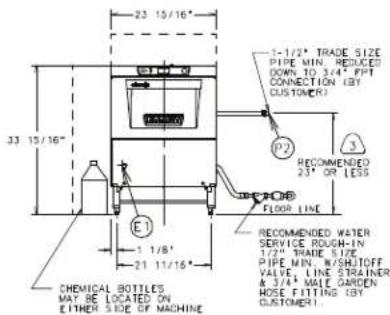
It is recommended that a line strainer (not supplied) be installed in the supply line between the manual shutoff valve (not supplied) and the connection point on the machine. Make plumbing connections with 12 " minimum copper piping OD ( 34 " recommended), with a 34 " male garden hose fitting (not supplied). See installation diagrams, pages 14-17.
PLUMBING CONNECTIONS
WARNING
Plumbing connections must comply with applicable sanitary, safety, and plumbing
Drain
A drain hose, 5 / 8'' inside diameter and 6' long, is provided. This should be securely plumbed into a drain. Use care not to kink hose. See installation diagrams, pages 14-17. Drain must have a minimum flow capacity of 5 gallons per minute.
BEFORE FIRST USE
This machine must be cleaned after installation and before being put into operation. (See Cleaning)
ELECTRICAL CONNECTION
⚠ WARNING Electrical and grounding connections must comply with the applicable portions of the National Electrical Code and/or other local electrical codes.
WARNING Disconnect the electrical power to the machine and follow lockout/tagout procedures.
ELECTRICAL DATA
Complied in accordance with the National Electrical Code NFPA-70, latest addition.
NOTICE For supply connections, use copper wire only rated at 90°C minimum.
| ledoMesahP/ztreH/stloV | Minimum Supply Circuit ydCapnoC | Maximum Protective ydCapD | |
| LXGePR | 0621 | 20 | 20 |
| LXGeR | 120/208-240(3W)/60/1* | 40 | 40 |
*The (3W) systems require three power wires that include a current carrying neutral. An additional fourth wire must be provided for machine ground.
Refer to the top of the door of the machine and the electrical label on the back side of the lower front panel for proper selection.
Connection Method
- Remove the lower front panel by removing the two screws at the bottom of the panel (Fig. 1).
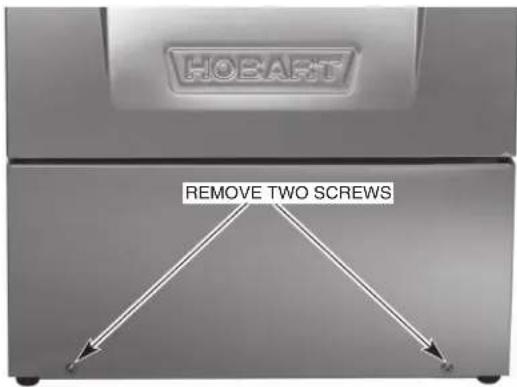
Fig. 1
- Open door of glasswasher and remove the two left screws and the top right screw (Fig. 2). Pull top of unit forward approximately 1" and remove the left side panel.
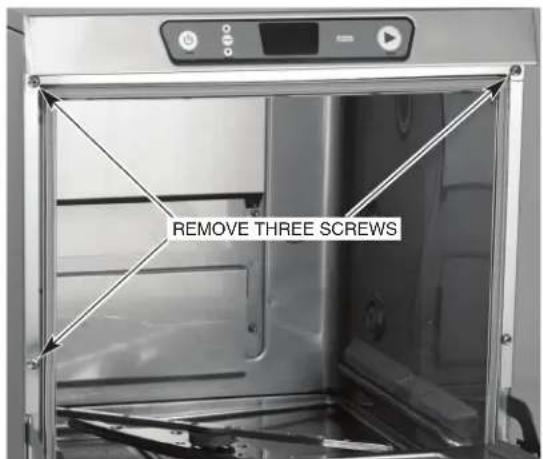
Fig. 2
- A hole for 1" trade size conduit is supplied at the lower right in the back of the machine (Fig. 3). If necessary due to space requirements, remove the knockout and use a 45^ fitting.
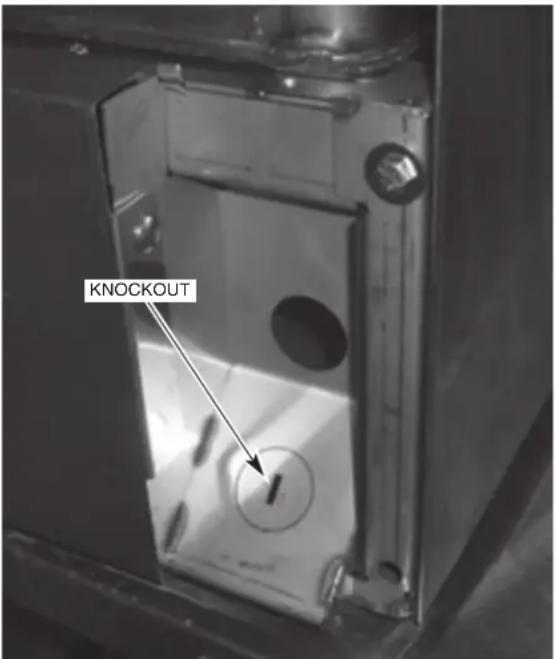
Fig. 3
- Install 1" trade size conduit and fitting. Leave at least four feet of electrical line between wall connection and machine. This allows machine to be pulled away from the wall for cleaning and/or servicing.
- Feed wires thru base of unit to front of unit. At least 24" and not more than 28" of the required wire size must extend from the end of the conduit fitting.
- Make electrical connections according to wiring diagram supplied with the machine and secure wires to the machine service connection. Keep excess wire in the base of the unit to a minimum.
- Replace the left side panel, top of unit, and lower front panel. Re-install the three screws located behind the door and the two screws at the bottom of the front panel.
DETERGENT AND RINSE AID
Use only commercial-grade detergents recommended by your chemical professional. Do not use detergents formulated for residential glasswashers.
The detergent and rinse aid pump "ON" times are factory-set. If adjustments are required, contact your local Hobart Service Office or your chemical supplier.
Place the detergent and rinse aid containers (which are obtained from an independent supplier) under the glasswasher.
Remove the detergent bottle cap and put the red delivery tube in the detergent container by snapping the bottle connector onto the container.
Remove the rinse aid bottle cap and place the blue delivery tube in the rinse aid container by snapping the bottle connector onto the container.
Be sure to push the delivery tubes completely to the bottom of each container. Check to make sure there are no obstructions or kinks in the delivery tubes.
CHEMICAL SANITIZER (LXGePR)
NOTICE Items such as pewter, aluminum and silver will be attacked by sodium hypochlorite (bleach). Therefore, chemical-sanitizing glasswashers should not be used to wash such items.
The LXGePR chemical sanitizer pump is factory-set for use with 6% sodium hypochlorite solution.
NOTICE If 8.40% sodium hypochlorite solution is to be used, contact your local Hobart Service Office.
On LXGePR models, place a sanitizer approved for potable water rinse machines under the glasswasher no higher than 10 inches off the floor. Do not pre-mix sanitizing solution with water or any other liquid.
⚠ WARNING Never premix a wetting agent with the sanitizing solution. Mixing may cause hazardous gas to form.
Remove the sanitizer bottle cap and place the white delivery tube in the sanitizer container by snapping the bottle connector onto the container. Be sure to push the delivery tube completely to the bottom of the container. Check to make sure there are no obstructions or kinks in the delivery tube.
Frequently check your sanitizer bottle to make sure there is a sufficient chemical supply.
CHECKING SANITIZER CONCENTRATION
Verify there is sufficient chemical supply in the sanitizer bottle and that the delivery tube standpipe is inserted completely to the bottom of the chemical container. Place a glass rack, with glasses, in the machine.
On LXGePR models, the PuriRinse feature must be deactivated to properly check the sanitizer concentration. To deactivate PuriRinse, press and hold the WASH key for five seconds until wash cycle starts.
Follow the directions precisely that are on the litmus paper vial and test the water on the surface of the bottom of the glasses. Concentration should be 50 p.p.m. minimum to 100 p.p.m. maximum.
If reading is incorrect, contact your local Hobart Service Office or chemical provider for adjustments.
DELIMING SOLUTION
All LXGePR and LXGeR models are equipped with an automatic deliming system. At installation, a qualified Hobart Service technician or your chemical supplier must adjust the total water hardness setting to properly set the delime intervals.
Remove the deliming agent bottle cap and put the black delivery tube in the container by snapping the bottle connector onto the container.
Be sure to push the delivery tube completely to the bottom of the container. Check to make sure there are no obstructions or kinks in the delivery tube.
PRIMING CHEMICAL PUMPS
When a chemical becomes empty, the priming operation starts automatically the next time the machine is turned on or a wash cycle is started. Note that the initial prime time for all pumps (Detergent, Rinse Agent, and Sanitizer) is 60 seconds. If the chemical is not sensed within 60 seconds, the add chemical indicator will flash. After the chemical is sensed, the indicator in the display turns off; and the pump continues to prime for 10 seconds to allow the chemicals to reach the machine. If all chemicals are empty, the sanitizer will prime first followed by detergent. Only one chemical pump will run at a time.
If chemicals are not sensed after three consecutive priming operations, the add chemical indicator will flash and priming is cancelled. The next time a wash cycle is started, the add chemical indicator will continue to flash. Verify that the chemical bottles are not empty and that the delivery tubes are inserted completely to the bottom of the containers.
The priming operation can be reset by turning the glasswasher off, then back on.
If the chemical bottles are not empty and the delivery tubes are inserted correctly, then the chemical sensor or pumps may have malfunctioned; contact your local Hobart Service Office.
WARNING
Do not pre-mix other chemicals and sodium hypochlorite (liquid bleach). dous gas to form.
NOTICE
Required flowing water pressure to the dishmachine is 15-65 PSIG. If pressures
higher than 65 PSIG are present, a pressure regulating valve must be installed in the water line to the dishmachine (by others).
Pressure guage not provided on pumped rinse machines.
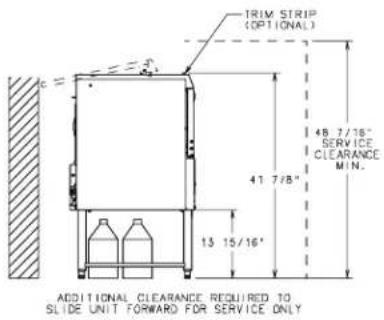
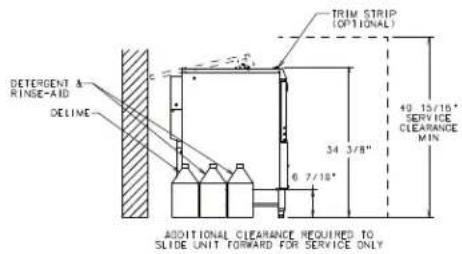
Important: The chemical containers should be placed no higher than 16" above floor.
If chemical containers are to be placed in cabinet adjacent to machine, a 1/2" dia. hole is required in the cabinet to run chemical supply line.
Use only 6% or 8.4% sodium hypochlorite (liquid bleach) as sanitizing chemical to insure proper operation of dishmachine.
Certain materials including silver plate, aluminum and pewter are attacked by sodium hypochlorite (liquid bleach).
NOTES:
-
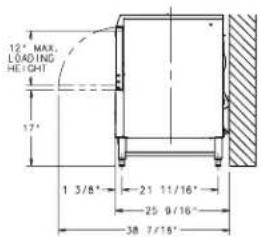
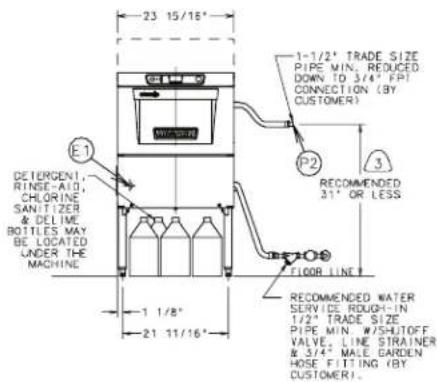
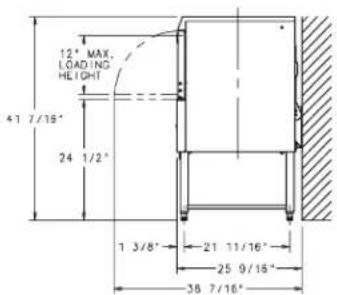
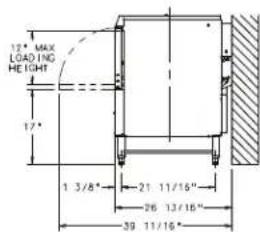
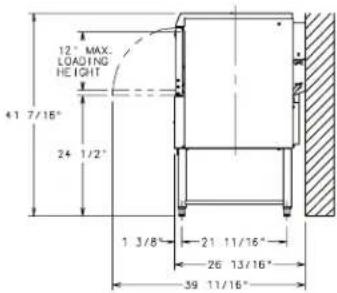
All vertical machine dimensions taken from floor may be increased by .875" or decreased by .375".
-
Moist air escapes from the door.
Use only moisture resistant materials adjacent to dishmachine sides and top.
- A vent hood is not recommended above the undercounter dishmachine since it does not produce excessive vapors.
PLUMBING NOTES:
- Water hammer arrestor (meeting ASSE-1010 standard or equivalent) to be supplied (by others) in common water supply line at service connection.
- Recommended water hardness to be 3 grains or less for best results.
- If drain hose is looped above a sink, the loop must not exceed 44" AFF.
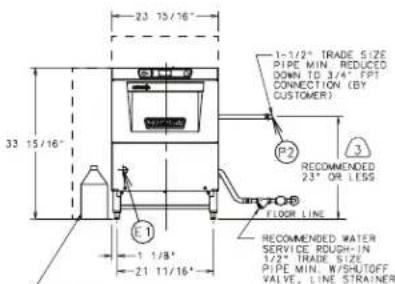
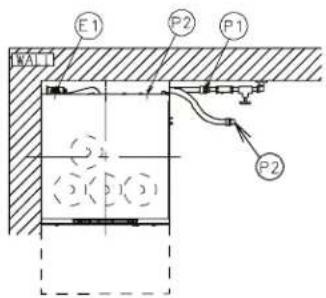
CONNECTION INFORMATION (AFF = ABOVE FINISHED FLOOR)
LEGEND
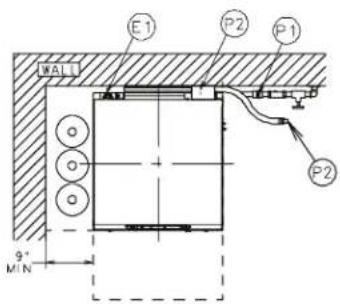
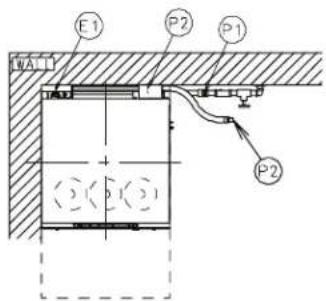
E1 ELECTRICAL CONNECTION: 1-3/8" DIA. HOLE FOR 1" TRADE SIZE CONDUIT; 10-5/8" AFF.
P1 SINGLE FILL AND RINSE CONNECTION:
3/4' FEMALE GARDEN HOSE FITTING ON 6' LONG HOSE SUPPLIED WITH MACHINE;
120°F WATER MIN. FOR LXGePR, 140°F RECOMMENDED.
P2 DRAIN CONNECTION: 5/8" BARB FITTING WITH 6' LONG HOSE SUPPLIED WITH MACHINE.
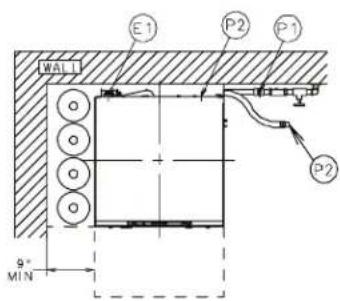
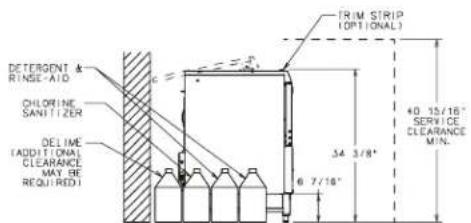
ADDITIONAL CLEARANCE REQUIRED TO SLIDE UNIT FORWARD FOR SERVICE ONLY
CHEMICAL BOTTLES MAY BE LOCATED ON EITHER SIDE OF MACHINE
| MODEL VOLTS/HERTZ/PHASE | RATED AMPS | MIN SUPPLY CKT CONDUCT AMPACITY | MAX PROTECTIVE DEVICES |
| LXGePR 120/60/1 15.4 20 20 |
| HEAT OUTPUT, BTU/HR | ||
| MODEL LATENT SENSIBLE | ||
| LXGePR 1900 | 800 | |
| SHIPPING WEIGHTS | LXGePR |
| NET WEIGHT OF MACHINE | 150 LBS |
| DOMESTIC SHIPPING WEIGHT | 170 LBS |
ACCESSORY CORD KITS AVAILABLE FOR ALL MACHINES
NOTE: FOR SUPPLY CONNECTIONS, USE COPPER WIRE ONLY RATED AT 90°C MINIMUM.
WARNING
Electrical and grounding
connections must comply with the applicable portions of the National Electrical Code and/or other local electrical codes.
Plumbing connections must comply with applicable sanitary, safety and plumbing codes. Drain and fill line configurations vary, some methods are shown on this drawing.
INSTALLATION DIAGRAM (LXGePR, short)
WARNING
Do not pre-mix other chemicals and sodium hypochlorite (liquid bleach).
Mixing may cause hazardous gas to form.
NOTICE
higher than 65 PSIG are present, a pressure regulating valve must be installed in the water line to the dishmachine (by others).
Pressure guage not provided on pumped rinse machines.
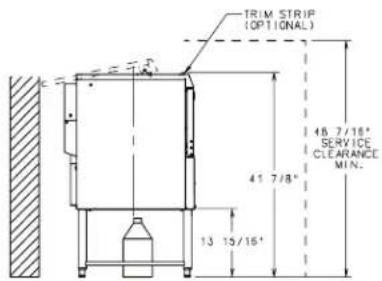
Important: The chemical containers should be placed no higher than 24" above floor.
If chemical containers are to be placed in cabinet adjacent to machine, a 1/2* dia. hole is required in the cabinet to run chemical supply line.
Use only 6% or 8.4% sodium hypochlorite (liquid bleach) as sanitizing chemical to insure proper operation of dishmachine.
Certain materials including silver plate, aluminum and pewter are attacked by sodium hypochlorite (liquid bleach).
NOTES:
- All vertical machine dimensions taken from floor may be increased by .875" or decreased by .375".
- Moist air escapes from the door.
Use only moisture resistant materials adjacent to dishmachine sides and top. - A vent hood is not recommended above the undercounter dishmachine since it does not produce excessive vapors.
PLUMBING NOTES:
- Water hammer arrestor (meeting ASSE-1010 standard or equivalent) to be supplied (by others) in common water supply line at service connection.
- Recommended water hardness to be 3 grains or less for best results.
- If drain hose is looped above a sink, the loop must not exceed 51" AFF.
CONNECTION INFORMATION
(AFF = ABOVE FINISHED FLOOR)
LEGEND
E1 ELECTRICAL CONNECTION: 1-3/8" DIA. HOLE FOR 1" TRADE SIZE CONDUIT; 18-1/8" AFF.
P1 SINGLE FILL AND RINSE CONNECTION: 3/4' FEMALE GARDEN HOSE FITTING ON 6' LONG HOSE SUPPLIED WITH MACHINE;
120°F WATER MIN. FOR LXGePR, 140°F RECOMMENDED.
P2 DRAIN CONNECTION: 5/8" BARB FITTING WITH 6' LONG HOSE SUPPLIED WITH MACHINE.
| MODEL VOLTS/HERTZ/PHASE | RATED AMPS | MIN SUPPLY CKT CONDUCT AMPACITY | MAX PROTECTIVE DEVICES |
| LXGePR 120/60/1 15.4 20 20 |
| HEAT OUTPUT, BTU/HR | ||
| MODEL LATENT SENSIBLE | ||
| LXGePR 1900 | 800 | |
| SHIPPING WEIGHTS | LXGePR |
| NET WEIGHT OF MACHINE | 150 LBS |
| DOMESTIC SHIPPING WEIGHT | 170 LBS |
ACCESSORY CORD KITS AVAILABLE FOR ALL MACHINES
NOTE: FOR SUPPLY CONNECTIONS, USE COPPER WIRE ONLY RATED AT 90°C MINIMUM.
WARNING
Electrical and grounding
connections must comply with the applicable portions of the National Electrical Code and/or other local electrical codes.
Plumbing connections must comply with applicable sanitary, safety and plumbing codes. Drain and fill line configurations vary, some methods are shown on this drawing.
NOTICE
Required flowing water pressure to the dishmachine is 15-65 PSIG. If pressures
higher than 65 PSIG are present, a pressure regulating valve must be installed in the water line to the dishmachine (by others).
Pressure gauge not provided on pumped rinse machines.
If chemical containers are to be placed in cabinet adjacent to machine, a 1/2" dia. hole is required in the cabinet to run chemical supply line.
NOTES:
-
All vertical machine dimensions taken from floor may be increased by .875" or decreased by .375".
-
Moist air escapes from the door.
Use only moisture resistant materials adjacent to dishmachine sides and top.
- A vent hood is not recommended above the undercounter dishmachine since it does not produce excessive vapors.
PLUMBING NOTES:
- Water hammer arrestor (meeting ASSE-1010 standard or equivalent) to be supplied (by others) in common water supply line at service connection.
- Recommended water hardness to be 3 grains or less for best results.
- If drain hose is looped above a sink, the loop must not exceed 44" AFF.
CONNECTION INFORMATION (AFF = ABOVE FINISHED FLOOR)
LEGEND
E1 ELECTRICAL CONNECTION: 1-3/8" DIA. HOLE FOR 1" TRADE SIZE CONDUIT; 10-5/8" AFF.
P1 SINGLE FILL AND RINSE CONNECTION:
3/4" FEMALE GARDEN HOSE FITTING ON 6' LONG HOSE SUPPLIED WITH MACHINE;
55-85°F (COLD) RECOMMENDED FOR LXGeR.
P2 DRAIN CONNECTION: 5/8" BARB FITTING WITH
6' LONG HOSE SUPPLIED WITH MACHINE.
| MODEL VOLTS/HERTZ/PHASE | RATED AMPS | MIN SUPPLY CKT CONDUCT AMPACITY | MAX PROTECTIVE DEVICES |
| LXGeR 120/208-240(3W)/60/1^30.5 | 40 40 |
| HEAT OUTPUT, BTU/HR | ||
| MODEL LATENT SENSIBLE | ||
| LXGeR 1100 | 2000 | |
| SHIPPING WEIGHTS | LXGeR |
| NET WEIGHT OF MACHINE | 165 LBS |
| DOMESTIC SHIPPING WEIGHT | 185 LBS |
* THIS SYSTEM REQUIRES THREE POWER WIRES WHICH INCLUDES A CURRENT CARRYING NEUTRAL, AN ADDITIONAL FOURTH WIRE MUST BE PROVIDED FOR MACHINE GROUND.
ACCESSORY CORD KITS AVAILABLE FOR ALL MACHINES
NOTE: FOR SUPPLY CONNECTIONS, USE COPPER WIRE ONLY RATED AT 90°C MINIMUM.
WARNING
Electrical and grounding
connections must comply with the applicable portions of the National Electrical Code and/or other local electrical codes.
Plumbing connections must comply with applicable sanitary, safety and plumbing codes. Drain and fill line configurations vary, some methods are shown on this drawing.
INSTALLATION DIAGRAM (LXGeR, short)
NOTICE Required flowing water pressure to the dishmachine is 15-65 PSIG. If pressures higher than 65 PSIG are present, a pressure regulating valve must be installed in the water line to the dishmachine (by others).
Pressure gauge not provided on pumped rinse machines.
If chemical containers are to be placed in cabinet adjacent to machine, a 1/2" dia. hole is required in the cabinet to run chemical supply line.
NOTES:
- All vertical machine dimensions taken from floor may be increased by .875" or decreased by .375".
- Moist air escapes from the door.
Use only moisture resistant materials adjacent to dishmachine sides and top.
- A vent hood is not recommended above the undercounter dishmachine since it does not produce excessive vapors.
PLUMBING NOTES:
- Water hammer arrestor (meeting ASSE-1010 standard or equivalent) to be supplied (by others) in common water supply line at service connection.
- Recommended water hardness to be 3 grains or less for best results.
- If drain hose is looped above a sink, the loop must not exceed 51" AFF.
CONNECTION INFORMATION (AFF = ABOVE FINISHED FLOOR)
LEGEND
E1 ELECTRICAL CONNECTION: 1-3/8" DIA. HOLE FOR 1" TRADE SIZE CONDUIT; 18-1/8" AFF.
P1 SINGLE FILL AND RINSE CONNECTION: 3/4' FEMALE GARDEN HOSE FITTING ON 6' LONG HOSE SUPPLIED WITH MACHINE;
55-85°F (COLD) RECOMMENDED FOR LXGeR. P2 DRAIN CONNECTION: 5/8" BARB FITTING WITH 6' LONG HOSE SUPPLIED WITH MACHINE.
ADDITIONAL CLEARANCE REQUIRED TO SLIDE UNIT FORWARD FOR SERVICE ONLY
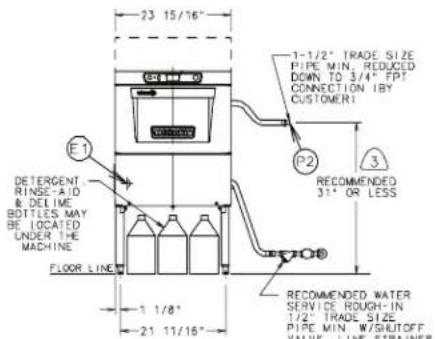
RECOMMENDED WATER SERVICE ROUGH-IN 1/2" TRADE SIZE PIPE MIN W/SHUTOFF VALVE, LINE STRAINER & 3/4" MALE GARDEN HOSE FITTING (BY CUSTOMER),
| MODEL VOLTS/HERTZ/PHASE | RATED AMPS | MIN SUPPLY CKT CONDUCT AMPACITY | MAX PROTECTIVE DEVICES |
| LXGeR 120/208-240(3W)/60/1" 30.5 | 40 40 |
| HEAT OUTPUT, BTU/HR | ||
| MODEL LATENT SENSIBLE | ||
| LXGeR 1100 | 2000 | |
| SHIPPING WEIGHTS | LXGeR |
| NET WEIGHT OF MACHINE | 165 LBS |
| DOMESTIC SHIPPING WEIGHT | 185 LBS |
* THIS SYSTEM REQUIRES THREE POWER WIRES WHICH INCLUDES A CURRENT CARRYING NEUTRAL, AN ADDITIONAL FOURTH WIRE MUST BE PROVIDED FOR MACHINE GROUND.
ACCESSORY CORD KITS AVAILABLE FOR ALL MACHINES
NOTE: FOR SUPPLY CONNECTIONS, USE COPPER WIRE ONLY RATED AT 90°C MINIMUM.
WARNING
Electrical and grounding
connections must comply with the applicable portions of the National Electrical Code and/or other local electrical codes.
Plumbing connections must comply with applicable sanitary, safety and plumbing codes. Drain and fill line configurations vary, some methods are shown on this drawing.
INSTALLATION DIAGRAM (LXGeR, tall)
PROGRAMMING
MANAGER MODE PROGRAMMING
The LXGe series glasswasher's microprocessor allows customization options for machine operation. To activate or change these features, the programming edit mode must be entered.
The manager programming mode requires a MANAGER CODE to be entered to access the options listed in the PARAMETERS MENU. The manager code is 1001.
PROGRAMMING INSTRUCTIONS
All customization is performed through the on-screen menu using the UP Arrow, MENU/DOWN Arrow, and the ENT keys located on the keypad at the top of the machine (Fig. 4).
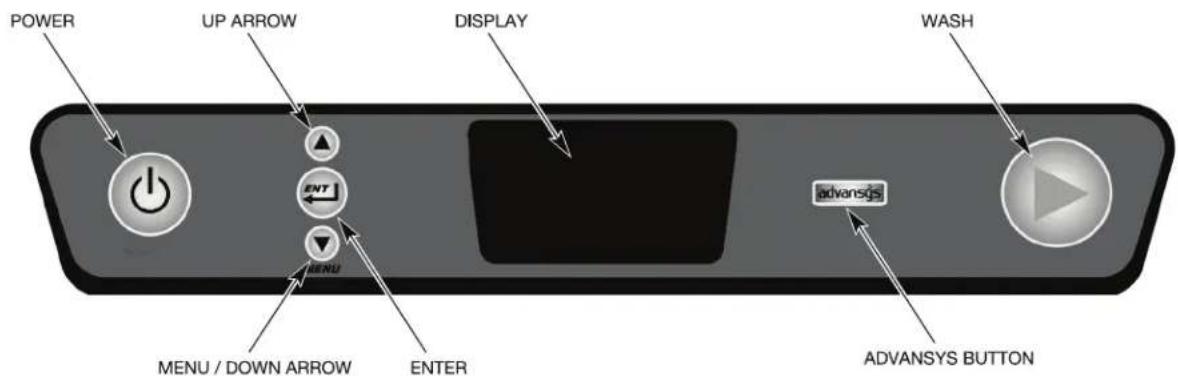
Fig. 4
MENU DISPLAY PROMPTS
The following prompts are used inside the menus:
- The UP arrow and MENU/DOWN arrow keys are used to change parameter values and to navigate the menu.
- The ENT key is used to accept a value, to perform a specified action, or to enter a submenu.
- The text just to the right of the '>' symbol on the display screen shows what action or command will occur if the ENT key is pressed.
CHANGING PARAMETERS ENTER MANAGER SECURITY CODE: 1001

flowchart
graph LR
    A["MANAGER MENU"] --> B["ENTER SECURITY CODE"]
    B --> C["(for 1)"]
    C --> D["EDIT"]
    D --> E["(for 0)"]
    E --> F["(for 1)"]
    F --> G["EDIT"]
    G --> H["Edit Parameters"]
CHANGING PARAMETERS IS REQUIRED TO CHANGE ALL CODES BELOW
CHEMICAL PUMP enable or disable the detergent pump or rinse aid pump.

flowchart
graph LR
    A["Start"] --> B["until DETERGENT PUMP or RINSE AID PUMP"]
    B --> C["ENT"]
    C --> D["to enable or disable"]
    D --> E["OR"]
    E --> F["until EXIT MENU"]
    F --> G["ENT"]
    G --> H["until EXIT"]
    H --> I["ENT"]
WASH CYCLE allows the customization of total run time.

flowchart
graph LR
    A["until CYCLE TIME"] --> B["ENT"]
    B --> C["to choose cycle,"]
    C --> D["ENT"]
    D --> E["OR"]
    E --> F["until EXIT MENU"]
    F --> G["ENT"]
    G --> H["until EXIT"]
LOW TEMP ALARMS for hot machines only: (parameter) enables or disables alert indicating that the final rinse temperature has been below the minimum temperature for a period of time.

flowchart
graph LR
    A["Start"] --> B["until LOW TEMP ALARMS"]
    B --> C["ENT"]
    C --> D["to enable or disable"]
    D --> E["ENT"]
    F["OR"] --> G["until EXIT MENU"]
    G --> H["ENT"]
    H --> I["until EXIT"]
    I --> J["ENT"]
WASH ARM ALARM enables or disables an alarm that alerts the operator that the wash arms may be clogged or blocked.

flowchart
graph LR
    A["→ until WASH ARM ALARM"] --> B["→ ENT"] --> C["→ to disable, Visual, or Audio & Visual"]
    D["→ ENT"] --> E["OR"] --> F["→ until EXIT MENU"] --> G["→ ENT"] --> H["→ until EXIT"] --> I["→ ENT"]
DELIME enables or disables the delime reminder alert.

flowchart
graph LR
    A["until DELIME"] --> B["ENT"]
    B --> C["to enable or disable"]
    C --> D["ENT"]
    E["OR"] --> F["until EXIT MENU"]
    F --> G["ENT"]
    G --> H["until EXIT"]
TEMPERATURE UNITS allows the choice of Fahrenheit or Celsius.

flowchart
graph LR
    A["→ until TEMPERATURE UNITS"] --> B["→ ENT"]
    B --> C["→ to choose Fahrenheit or Celsius"]
    D["→ ENT OR"] --> E["→ until EXIT MENU"]
    E --> F["→ ENT"]
    F --> G["→ until EXIT"]
    G --> H["→ ENT"]
POTABLE RINSE for cold machines only enables or disables the potable water rinse option.

flowchart
graph LR
    A["Start"] --> B["until POTABLE RINSE"]
    B --> C["ENT"]
    C --> D["to enable or disable"]
    D --> E["ENT"]
    E --> F["OR"]
    F --> G["until EXIT MENU"]
    G --> H["ENT"]
    H --> I["until EXIT"]
    I --> J["ENT"]
| DIRTY WATER INDICATOR disables or gives a choice of how many cycles the machine will run between dirty water alert and refresh cycles.→ until DIRTY WATER INDICATOR →ENT→ to Disable, 20 cycles, 40 cycles,or 60 cycles →ENTOR→ until EXIT MENU →ENT→ until EXIT →ENT |
| ENERGY SAVER MODE disables or gives choice of how many hours before the unit will stay on before entering energy saving mode.→ until ENERGY SAVING MODE →ENT→ to Disabled, 1 Hour, 2 Hours, or 3 Hours→ENTOR→ until EXIT MENU →ENT→ until EXIT →ENT |
| ADD CHEMICAL ALERT enable or disable the audio alert of missing chemicals.→ until ADD CHEM AUDIO ALERT →ENT→ to enable or disable →ENTOR→ until EXIT MENU →ENT→ until EXIT →ENT |
| END CYCLE AUDIO ALERT enable or disable the unit creating an audio alert at the end of each wash cycle.→ until END CYCLE AUDIO ALERT →ENT→ to enable or disable →ENTOR→ until EXIT MENU →ENT→ until EXIT →ENT |
| LANGUAGE allows the choice of English, French or Spanish language.→ until LANGUAGE →ENT→ to English, French or Spanish →ENTOR→ until EXIT MENU →ENT→ until EXIT →ENT |
| advansigs BUTTON allows the customization of the advansigs button to be used for a variety of options.→ until advansigs BUTTON →ENT→ to: Clean Sump, One Light Wash,One Normal Wash, One Heavy Wash (LXe only), Run Delime Cycle, or Energy Saver →ENTOR→ until EXIT MENU →ENT→ until EXIT →ENT |
| EXIT MENU TO MAIN MANAGER MENU→ until EXIT MENU →ENT |
| DELIME NOW allows for a single delime cycle to be run from the menu at anytime.Note: this operation takes 20-45 minutes depending on conditions.→ until DELIME NOW →ENT→ to YES or NO →ENT (this will exit menu) |

701 South Ridge Avenue, Troy, OH 45374-0001
PARAMETERS MENU TABLE
| Parameter Name | Advansys Models (LXGePR, LXGeR) | Description | Possible Values | Default Value |
| Detergent Pump | √ | Enables or disables the detergent pump. | Disabled or Enabled | Enabled |
| Rinse Aid Pump | √ | Enables or disables the rinse aid pump. | Disabled or Enabled | Enabled |
| Wash Cycle | √ | Sets the cycle duration. Light or Normal Light | ||
| Low Temp Alarms | LXGeR Only | Enables or disables a visual alert on the display that indicates that the Final Rinse water temperature is below the required minimum of 180°F (82°C). When enabled, a message will display notifying the user of this condition after three consecutive cycles do not reach the required final rinse temperature. However, machine operation will not change and ware will continue to wash as expected. After the temperature increases past the minimum, the message stops. When disabled, there will be no extra message indicating a low temperature event; however, the temperature display will still show the current Final Rinse water temperature. | Disabled or Enabled | Disabled |
| Wash Arm Alert | √ | Enables Visual Alert, Audio and Visual Alert, or disables an alert that is displayed when the machine detects a wash arm that is clogged or blocked such that ware wash results could be affected. | Disabled, Visual, or Audio and Visual | Disabled |
| Delime | √ | Enables or disables the alert to delime option. | Disabled or Enabled | Enabled |
| Temperature Units | √ | Sets the display units to either Fahrenheit or Celsius. | Fahrenheit or Celsius | Fahrenheit |
| Potable Rinse | LXGePR Only | On LXGePR machines, this setting enables or disables the PuriRinse option that sprays fresh water after the sanitization cycle to remove the sanitizer from the ware. | Disabled or Enabled | Enabled |
| Dirty Water Indicator | √ | On Advansys machines, this setting allows for a reminder for the operator to be notified that 20, 40, or 60 cycles have passed and a special water refresh cycle is recommended. This cycle will drain a portion of the wash water and refresh it with fresh hot water. | Disabled, 20, 40, or 60 cycles | Disabled |
| Energy Saver Mode | √ | On Advansys machines, this setting will control when the machine will turn the heaters off in order to save energy when not in use. | Disabled, 1, 2, or 3 hours | 2 hours |
| Add Chemical Alert | √ | Enables or disables an audible alert if chemical is not being detected. | Disabled, Visual, or Audio and Visual | Audio and Visual |
| End Cycle Audio Alert | √ | Enables or disables an audible alert at the end of a cycle. | Disabled or Enabled | Disabled |
| Language | √ | Sets the language on the display to either English or French. | English (US) or French (Canada) | English (US) |
| Advansys Button | √ | Choose function for Advansys button. | Not programmedClean the sumpOne light washOne normal washRun delime cycleEnergy saver | Not Programmed From Factory |
| Exit Menu | √ | Press ENT to exit the Parameters Menu and return to the Manager Menu. Any settings that were changed are saved. |
| DO THIS DISPLAY | SHOWS REMARKS | |
| Press ON. Model number. Glassw | washer performs self- | check. This takes 5 seconds. |
| FILL and fill icon lit; sump temperature displayed when machine is filling.WARMING UP and warming up icon are displayed when booster is preheating on models LXGeR. This preheat could take up to 15 minutes. | Glasswasher fills with water. When filled, pump turns on for 10 seconds.If door is opened during fill cycle, fill will stop. After door is closed, the process continues where it stopped. | |
| During fill, sump temperature is displayed. | When filled, machine will maintain an idle state. Heat is maintained in both sump and/or booster. | |
| Open door; slide rack of dishes into glasswasher. Close door. | READY lit and sump temperature displayed. | Detergent will be added automatically during wash cycle.Rinse Aid and Sanitizer will be added automatically during rinse cycle. (NOTE: Sanitizer only used on LXGePR models.) |
| Press WASH. WASH and wash ic | on lit; sump temperature displayed during wash cycle.RINSE and rinse icon lit; rinse temperature displayed during rinse cycle. | Machine initiates a wash and rinse cycle.If door is opened during wash, rinse, or drain cycle, cycle will continue at point where door was opened upon closing door.If POWER is pressed during cycle, machine will drain and shut down. |
| When cycle is complete, reload machine for next wash/rinse cycle; or, if not in use, machine will maintain idle mode. | READY lit and sump temperature displayed. | Machine will drain and shut down if the four hour idle shut-down time is reached. |
| At the end of the day, press POWER. | DRAIN and SHUTDOWN IN PROGRESS are displayed; then the display shuts down. | When POWER key is pressed, machine will drain and shut down. |
DIAGNOSTIC/ERROR MESSAGES
| Error Display Description | |||
| Door Open Door Open | Displayed when the door of the machine is opened. | ||
| Clogged/Blocked Wash Arm | WASH ARM ALERT- Remove & clean arm- Check nozzles- Replace arm- Close door | 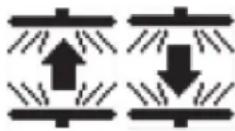 | Displayed if wash arm is blocked or clogged which would result in poor wash results. Follow on-screen instructions. |
| Low Rinse Temperature | LOW RINSE TEMP | After two consecutive low temperatures, if problem occurs on the third consecutive cycle, the error will display. The machine will continue to run cycles. | |
| Low Rinse Temperature (10 In A Row) | LOW RINSE TEMPCheck Water Input |  | If the Low Rinse Temperature error occurs for 10 consecutive cycles, the error will change. The machine will continue to run cycles. |
| Wash Thermistor Error | WASH TEMP SENSOR Service Required (Service Phone Number) OPEN or SHORT |  | Error displayed if wash temperature probe is out of range. The machine will continue to run cycles. |
| Booster Thermistor Error | BOOSTER TEMP SENSOR Service Required (Service Phone Number) OPEN or SHORT |  | Error displayed if booster temperature probe is out of range. The machine will continue to run cycles. (LXGeR only) |
| Final Rinse Thermistor Error | RINSE TEMP SENSOR Service Required (Service Phone Number) OPEN or SHORT |  | Error displayed if final rinse temperature probe is out of range. The machine will continue to run cycles. |
| Low Water In Booster (Time Out Within Any Cycle) | FILL ERROR Service Required (Service Phone Number) |  | Error displayed if the unit times out before the unit is completely filled. The machine will not operate and will only allow power down. |
| Drain Error | DRAIN ERROR Service Required (Service Phone Number) |  | Error displayed if the water level in the unit will not come up. The machine will not operate and will only allow power down. |
| Sump Level Error | SUMP LEVEL SENSOR Service Required (Service Phone Number) OPEN or SHORT |  | Error displayed if sump pressure switch is out of range. The machine will not operate and will only allow power down. |
| Booster Level Error | BOOSTER LEVEL SENSOR Service Required (Service Phone Number) OPEN or SHORT |  | Error displayed if booster pressure switch is out of range. The machine will not operate and will only allow power down. |
WASH/RINSE CYCLE TIMES (LXGePR)
WASH/RINSE CYCLE TIMES (LXGeR)
Wash 56 Seconds ** Wash 56 Seconds *, **
Drain 18 Seconds Max Drain 18 Seconds Max
Rinse 8 Seconds Rinse 8 Seconds
Dwell 10 Seconds Dwell 5 Seconds
PuriRinse 7 Seconds Condense 105 Seconds Max
* Maximum wash time may vary, depending on operation voltage and incoming water temperature for 70°F rise on LXGeR machines.
** Wash cycle time can be adjusted to a 56- or 85- second cycle.
PREPARATION
Make sure the coarse (Fig. 6) and fine (Fig. 7) strainers are in place and free of debris. Ensure that the coarse strainer is installed with the handle towards the front of the machine. Check both wash arms and rinse arms to make sure they spin freely and are not clogged.
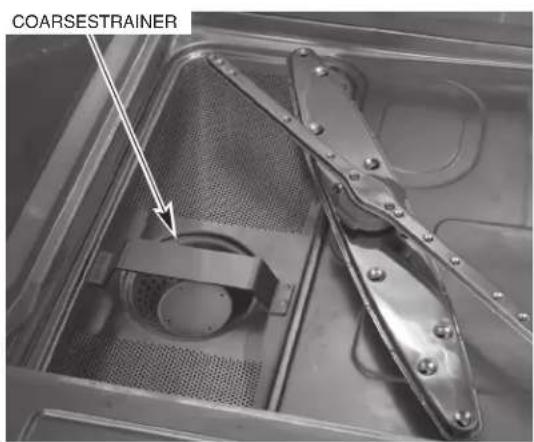
Fig. 6 Fig. 7
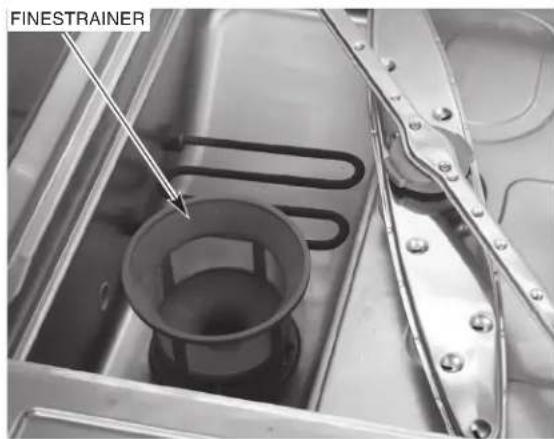
Check to see if any detergent, rinse aid or sanitizer chemicals need to be replenished. Use only commercial-type detergents, as prescribed by your chemical professional.
DO'S AND DON'TS FOR YOUR NEW HOBART GLASSWASHER
DO assure proper water hardness.
DO prescrape dishes thoroughly.
DO use only detergents recommended by your chemical professional.
DO at the end of the day, thoroughly clean the machine, rinse and dry. (Leave door open.)
DO use only products formulated to be safe on stainless steel.
DO NOT use detergents formulated for residential glasswashers.
DO NOT allow food soil to accumulate on the tank bottom.
DO NOT exceed chemical manufacturer's recommended concentrations for detergent, sanitizer, rinse aid or lime scale remover.
DO NOT use steel wool to clean ware or glasswasher surface.
DO NOT allow foreign objects to enter the unit, especially metallic contaminants.
CLEANING
This machine must be cleaned at least once each working day. Use only products formulated to be safe on stainless steel.
-
Press POWER. The machine will drain. When the display is no longer lit, open the door and remove any debris from the bottom of the tank. Do not allow food soil to accumulate on the tank bottom.
-
Remove the lower rinse arm by pressing in on the buttons located on the sides of the center hub and pull off (Fig. 8). Remove the lower wash arm by pulling the arm off the shaft. Remove the upper rinse and wash arms in the same manner. Remove the coarse and fine strainers (see Figs. 6 and 7). Thoroughly clean these items in a sink. Remove debris from wash/rinse arm nozzles.
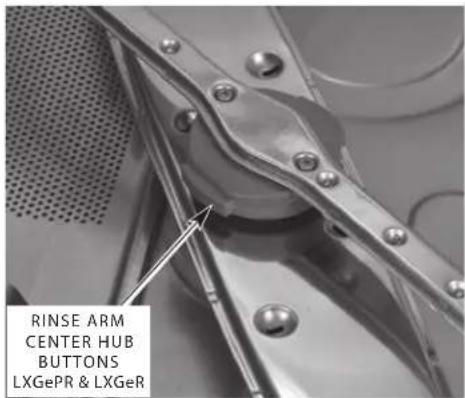
Fig. 8
-
With a damp cloth, wipe the interior of the machine. DO NOT use steel wool. Wipe the exterior of the machine. Remove any remaining debris with a mild cleanser formulated for stainless steel and a soft cloth or brush.
-
Replace the fine and coarse strainers. Reinstall the lower wash arm by pushing it down on the shaft. Press in on the buttons located on the sides of the center hub, place the rinse arm on the shaft, and release. Spin arms to make sure they spin freely. Repeat this procedure with the upper wash and rinse arms.
-
Use a soft, damp cloth or sponge and mild cleanser to clean the control keypad and display. DO NOT use abrasive or harsh cleaners or scouring pads.
-
Leave the door ajar overnight to allow the interior to air out and dry. The door design allows for the door to remain partially open and can be used to vent the machine at the end of the day.
MAINTENANCE
Maintenance and regular care is important to maintain optimal results with your Hobart glasswasher.
DELIMING
⚠ WARNING Deliming solution, rinse agents or any other kind of acid must not come in contact with bleach or rinse solution containing bleach used in chemical-sanitizing machines. Mixing may cause hazardous gas to form. This entire procedure must be followed step by step for safe and satisfactory results.
NOTICE Do not allow the deliming agent to remain in the machine longer than recommended by the deliming agent manufacturer.
DELIME THE GLASSWASHER ON A REGULAR BASIS AS REQUIRED. The regularity will depend on mineral content of the supply water. Deliming should be done when you can see clear signs of lime deposits (a white, chalky substance) on the inside walls and on the wash arms. All LXGe glasswashers are equipped with an automatic delime cycle reminder and are equipped with an internal delime pump which will automatically pump the required amount of deliming agent into the unit.
If deliming is necessary, a deliming agent (such as Lime-A-Way ^® or LSR ^® ) should be used for best results.
After the preprogrammed number of cycles has expired, the control will indicate the delime request by displaying DELIME RECOMMENDED and will prompt 'Would you like to delime now?'. You must enter 'Yes' or 'No' to proceed with a delime cycle or to continue with normal machine operation. If 'No' is selected, the machine will continue to notify the operator at each start-up and power down until the delime cycle is completed. To delime the unit:
- Press the MENU/DOWN Arrow key until the '>' symbol is shown to the left of 'Yes' and press the ENT key.
- Remove dish rack from machine.
- Remove strainers from machine and clean. Replace strainer, empty rack and close door.
- Ensure delimer chemical container is not empty. Be sure to push the delivery tube standpipe completely to the bottom of the container. Check to make sure there are no obstructions or kinks in the delivery tube.
- Press ENT key to enter the delime mode. The machine will drain and refill with fresh water.
- The unit will automatically enter the wash mode for 10 minutes, then will begin two rinse and drain operations after the fill cycle is complete.
- After the deliming operation is completed, power to the control will be turned off.
- Inspect the interior of the machine for lime deposits. If necessary, another delime cycle can be initiated by entering the Manager Programming Mode.
LUBRICATION
The pump motor has permanently sealed bearings and requires no lubrication.
TROUBLESHOOTING
This section outlines various symptoms and possible causes that may be encountered in the event of abnormal machine operation. If symptoms persist after possible causes have been checked, service may be required.
| Symptom Possible Causes | |
| No machine operation (no display). 1. | Machine OFF - turn machine ON.2. Blown fuse or circuit breaker off at power supply.3. Cord not plugged in (corded models only) |
| No machine operation (with display). 1. | Display: "DOOR OPEN" - open and close door. If problem persists, contact your local Hobart Service Office.2. See "Machine will not fill or will not fill high enough". |
| Glasses not clean. 1. Strainers clogged | causing inadequate water supply to pump - clean according to instructions. (See CLEANING.)2. Obstruction in wash arm(s) or wash arms will not turn - clean according to instructions. (See CLEANING.)3. Wash and/or rinse arms will not turn - check that they spin freely.4. Detergent dispenser may be clogged.5. Soil quantity - scrape dishes before cycle.6. Improper rack loading. (See PREPARATION.)7. Low water - check water supply.8. Water temperature too low - note wash temperature on display during WASH; should be above 120°F for chemical sanitizing machines and above 150°F for high temperature machines.9. Incoming water supply turned off. |
| Spotting of silverware, glasses, or dishes. | Improperly loaded racks.Water temperature too low.Improper type or concentration of detergent - contact your chemical representative.Hard water - install a water softener; use a rinse agent.Insufficient fill - check water supply. |
| Chemicals not feeding. 1. Low on chem | chemicals - check levels.Air leak at feeder hose connections - check insertion of quick connect fittings and wire ties at tube to tube connections.Tubes kinked - check for smooth bends. |
| Food soils remain in glasswasher. | Follow daily cleaning instructions. (See CLEANING.) |
| Appearance of rust in machine. 1. Ens | ure steel wool is not used to clean machine.May be due to high iron content in water supply. |
| Unexpected results on glasses or other ware. | 1. Etching - usually caused by any combination of high temperatures, soft water, soft glass, or high alkaline washing solutions.2. Tarnishing - avoid washing silver, silver plates, and pewter in chemical sanitizing machines.3. Pitting - stainless steel may pit with lengthy contact of foods containing salt, fruit juices, vinegar, etc. Wash immediately.4. Black or gray marks - may have been rubbed with aluminum.5. Brown stains - may be due to high iron content in water supply.6. Chipping - improper loading or glasses are too delicate.7. Wooden ware damage - avoid washing in glasswasher.8. Rust on cast iron - seasoning is lost in glasswasher. Avoid washing in glasswasher.9. Plastic ware distortion - high temperatures. Check plastic ware's instructions. |
| Low temperature readings. | 1. Low water supply temperature - make sure it meets the recommended minimum temperature.2. Rapid cycle use - if incoming water temperature is low and cycle use rate is high, the hot water supply may be insufficient to meet the demand.3. Heavy ware load cools wash water - do not overload racks.4. Booster heater or sump heater set low - contact your local Hobart Service Office. |
| Machine will not fill or will not fill high enough. | 1. Low water pressure - check for clogged hose strainer; ensure the site water pressure meets minimum flow pressures.2. No water flow - main water supply valves may not be working. |
| Machine fills too high or leaks from door. | 1. Machine not level. (see LEVELING.)2. Fill solenoid valve leaking - power the glasswasher OFF; if water continues to flow into the machine, contact your local Hobart Service Office. |
| Machine will not drain. 1. Drain pipes restricted - check glasswasher drain line for kinks; ensure proper drain rate is allowed from plumbing.2. Power machine OFF. Wait several seconds and then power back ON. Repeat this procedure twice if necessary. If problem persists, contact your local Hobart Service Office. | |
| Some water occasionally drips out of rinse arms (high temperature glasswashers only). | This is normal due to expansion of water being heated in the booster tank. |
natural_image
Exterior view of a stainless steel industrial machine with control panel and display (no visible text or symbols)DESCRIPTION GÉNÉRALE
| MODÈLE VOLTS/HERTZ/PHASE | INTENSITÉ (A) | COURANT MINIMAL ADMISSIBLE DU CIRCUIT D'ALIMENTATION (AMPÈRES) | COURANT MAXIMAL ADMISSIBLE DU DISPOSITIF DE PROTECTION (AMPÈRES) |
| LXGePR 120/60/1 15,4 20 20 |
| DÉGAGEMENT DE CHALEUR EN BTU/H | ||
| MODÈLE LATE | NTE SENSIBLE | |
| LXGePR 1 900 | 800 | |
| POIDS D'EXPÉDITION LXGePR | |
| POIDS NET DE L'APPAREIL 150 lb (68 kg) | |
| POIDS À L'EMBARQUEMENT 170 lb (77,1 kg) | |
DES TROUSSES DE CÂBLES DE CONNEXION SONT LIVRABLES AVEC TOUS LES APPAREILS.
REMARQUE : POUR LES CONNEXIONS D'ALIMENTATION, N'UTILISEZ QUE DES CÂBLES DE CUIVRE D'UNE RÉSISTANCE MINIMALE DE 90 °C.
▲ AVERTISSEMENT
SCHÉMA D'INSTALLATION (LXGePR, petit)
SCHÉMA D'INSTALLATION (LXGePR, grand)
ATTENTION
| MODÈLE | VOLTS/HERTZ/PHASE | INTENSITÉ (A) | COURANT MINIMAL ADMISSIBLE DU CIRCUIT D'ALIMENTATION (AMPÈRES) | COURANT MAXIMAL ADMISSIBLE DU DISPOSITIF DE PROTECTION (AMPÈRES) |
| LXGeR | 120/208-240(3F)/60/1" 30,5 40 40 |
| DÉGAGEMENT DE CHALEUR EN BTU/H | ||
| MODÈLE LATE | NTE SENSIBLE | |
| LXGeR 1 100 | 2 000 | |
| POIDS D'EXPÉDITION LXGeR | |
| POIDS NET DE L'APPAREIL 165 | b (74,8 kg) |
| POIDS À L'EMBARQUEMENT 185 | lb (84 kg) |
* CE SYSTÈME EXIGE 3 FILS D'ALIMENTATION Y COMPRIS UN FIL NEUTRE SOUS TENSION; UN QUATRIÈME FIL DOIT ÊTRE FOURNI POUR LA MISE À LA TERRE DE L'APPAREIL. DES TROUSSES DE CÂBLES DE CONNEXION SONT LIVRABLES AVEC TOUS LES APPAREILS.
REMARQUE : POUR LES CONNEXIONS D'ALIMENTATION, N'UTILISEZ QUE DES CÂBLES DE CUIVRE D'UNE RÉSISTANCE MINIMALE DE 90 °C.
▲ AVERTISSEMENT
SCHÉMA D'INSTALLATION (LXGeR, petit)
ATTENTION
| MODÈLE | VOLTS/HERTZ/PHASE | INTENSITÉ (A) | COURANT MINIMAL ADMISSIBLE DU CIRCUIT D'ALIMENTATION (AMPÈRES) | COURANT MAXIMAL ADMISSIBLE DU DISPOSITIF DE PROTECTION (AMPÈRES) |
| LXGeR | 120/208-240(3F)/60/1" 30,5 40 40 |
| DÉGAGEMENT DE CHALEUR EN BTU/H | ||
| MODÈLE LATE | NTE SENSIBLE | |
| LXGeR 1 100 | 2 000 | |
| POIDS D'EXPÉDITION LXGeR | |
| POIDS NET DE L'APPAREIL 165 | lb (74,8 kg) |
| POIDS À L'EMBARQUEMENT 185 | lb (84 kg) |
* CE SYSTÈME EXIGE 3 FILS D'ALIMENTATION Y COMPRIS UN FIL NEUTRE SOUS TENSION; UN QUATRIÈME FIL DOIT ÊTRE FOURNI POUR LA MISE À LA TERRE DE L'APPAREIL. DES TROUSSES DE CÂBLES DE CONNEXION SONT LIVRABLES AVEC TOUS LES APPAREILS.
REMARQUE : POUR LES CONNEXIONS D'ALIMENTATION, N'UTILISEZ QUE DES CÂBLES DE CUIVRE D'UNE RÉSISTANCE MINIMALE DE 90 °C.
▲ AVERTISSEMENT
SCHÉMA D'INSTALLATION (LXGeR, grand)
PROGRAMMATION
PROGRAMMATION DU MODE DE GESTION
701 South Ridge Avenue, Troy, OH 45374-0001
GRILLE DU MENU DES PARAMÈTRES
natural_image
Close-up of a mechanical device with a cylindrical component and metal clamps, no visible text or symbolsFig. 7
natural_image
Exterior view of a stainless steel kitchen appliance with control panel and metal legs (no visible text or symbols)GENERAL
701 South Ridge Avenue, Troy, OH 45374-0001
TABLA DEL MENÚ DE PARÁMETROS

- TABLE OF CONTENTS
- GENERAL 6
- INSTALLATION....7
- PROGRAMMING....18
- OPERATION....23
- CLEANING....27
- MAINTENANCE 28
- TROUBLESHOOTING....29
- TABLE DES MATIÈRES
- DESCRIPTION GÉNÉRALE 31
- INSTALLATION 32
- Installation, Operation and Care of LXGe SERIES GLASSWASHERS
- GENERAL
- MODEL DESCRIPTION
- INSTALLATION
- UNPACKING
- LOCATION
- LEVELING
- WATER REQUIREMENTS
- MODEL
- TEMPERATURE
- NOTICE The water pressure regulator must have a relief bypass. Failure to use the proper type of pressure regulator may result in damage to the unit.
- PLUMBING CONNECTIONS
- WARNING
- Drain
- BEFORE FIRST USE
- ELECTRICAL CONNECTION
- ELECTRICAL DATA
- Connection Method
- DETERGENT AND RINSE AID
- CHEMICAL SANITIZER (LXGePR)
- CHECKING SANITIZER CONCENTRATION
- DELIMING SOLUTION
- PRIMING CHEMICAL PUMPS
- NOTICE
- NOTES:
- PLUMBING NOTES:
- CONNECTION INFORMATION (AFF = ABOVE FINISHED FLOOR)
- LEGEND
- INSTALLATION DIAGRAM (LXGePR, short)
- INSTALLATION DIAGRAM (LXGeR, short)
- INSTALLATION DIAGRAM (LXGeR, tall)
- PROGRAMMING
- MANAGER MODE PROGRAMMING
- PROGRAMMING INSTRUCTIONS
- MENU DISPLAY PROMPTS
- CHANGING PARAMETERS ENTER MANAGER SECURITY CODE: 1001
- CHANGING PARAMETERS IS REQUIRED TO CHANGE ALL CODES BELOW
- CHEMICAL PUMP enable or disable the detergent pump or rinse aid pump.
- WASH CYCLE allows the customization of total run time.
- LOW TEMP ALARMS for hot machines only: (parameter) enables or disables alert indicating that the final rinse temperature has been below the minimum temperature for a period of time.
- WASH ARM ALARM enables or disables an alarm that alerts the operator that the wash arms may be clogged or blocked.
- DELIME enables or disables the delime reminder alert.
- TEMPERATURE UNITS allows the choice of Fahrenheit or Celsius.
- POTABLE RINSE for cold machines only enables or disables the potable water rinse option.
- WASH/RINSE CYCLE TIMES (LXGePR)
- WASH/RINSE CYCLE TIMES (LXGeR)
- PREPARATION
- DO'S AND DON'TS FOR YOUR NEW HOBART GLASSWASHER
- CLEANING
- MAINTENANCE
- DELIMING
- LUBRICATION
- TROUBLESHOOTING
- DESCRIPTION GÉNÉRALE
- ▲ AVERTISSEMENT
- SCHÉMA D'INSTALLATION (LXGePR, petit)
- SCHÉMA D'INSTALLATION (LXGePR, grand)
- ATTENTION
- SCHÉMA D'INSTALLATION (LXGeR, petit)
- SCHÉMA D'INSTALLATION (LXGeR, grand)
- PROGRAMMATION
- PROGRAMMATION DU MODE DE GESTION
Brand : Hobart
Model : LXGEPR1
Category : Dishwasher