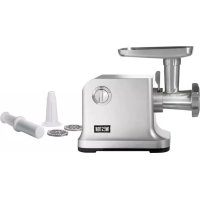
331301W - Chopper Weston - Free user manual and instructions
Find the device manual for free 331301W Weston in PDF.


| Product Type | Electric Meat Grinder |
| Brand | Weston |
| Model | 331301W |
| Power Supply | 120 V, 60 Hz, grounded plug |
| Material of food contact parts | Stainless steel |
| Main functions | Meat grinding, sausage stuffing, reverse (models 22 and 32) |
| Included grinding plates | 4.5 mm and 7 mm |
| Stuffing accessories | Funnels 10, 20, 30, 40 mm, high speed plastic auger |
| Safety | Safety device/tray, food pusher, circuit breaker, grounding |
| Maintenance | Immediate manual cleaning of parts, lubrication with food-grade silicone spray |
| Warranty | 1 year (subject to sending warranty card) |
| Customer service | 1-800-814-4895 (US), 001-216-901-6801 (outside US) |
| Repairability | Spare parts available at WestonProducts.com/support |
Frequently Asked Questions - 331301W Weston
User questions about 331301W Weston
0 question about this device. Answer the ones you know or ask your own.
Ask a new question about this device
Download the instructions for your Chopper in PDF format for free! Find your manual 331301W - Weston and take your electronic device back in hand. On this page are published all the documents necessary for the use of your device. 331301W by Weston.
USER MANUAL 331301W Weston
pro series TM
MEAT GRINDERS
10-0501-W (#5 MEAT GRINDER)
10-0801-W (#8 MEAT GRINDER)
10-1201-W (#12 MEAT GRINDER)
10-2201-W (#22 MEAT GRINDER)
10-3201-W (#32 MEAT GRINDER)
GENERAL SAFETY RULES 4
COMPONENT LIST 6
UNPACKING INSTRUCTIONS 8
GROUNDING INSTRUCTIONS 8
CLEANING INSTRUCTIONS 9
GRINDER ASSEMBLY INSTRUCTIONS 10
GRINDING INSTRUCTIONS 1
STANDARD STUFFER ASSEMBLY INSTRUCTIONS 1
HIGH-SPEED STUFFER ASSEMBLY INSTRUCTIONS 1
STUFFING INSTRUCTIONS 14-15
REVERSE FUNCTION 15
CIRCUIT BREAKER INSTRUCTIONS 16
AUGER GRABBING STOMPER INSTRUCTIONS 17
FOOD SAFETY 18
SAUSAGE INFORMATION 19
WARRANTY 20
REGLAS IMPORTANTES SEGURIDAD 23
DESCRIPTION DE LA PIÈCE 24
INSTRUCCIONES PARA EL DESEMPAQUE 26
INSTRUCCIONES PARA HACER TIERRA 26
INSTRUCCIONES DE LIMPIEZA 27
INSTRUCCIONES DE ENSAMBLE DEL MOLINO 28
INSTRUCCIONES PARA MOLER 29
RELLENADOR ESTÁNDAR INSTRUCCIONES DE ENSAMBLADO 30
ALTA VELOCIDAD DE INSTRUCCIONES DE MONTAJE EMBUTIDORA 31
INSTRUCCIONES DE RELLENADO 32-33
FUNCION DE REVERSA 33
INSTRUCCIONES PARA EL CORTADOR DE CIRCUITOS 34
INSTRUCCIONES PARA EL PRENSADOR RETIRA EL SINFÍN 35
SEGURIDAD DE LOS ALIMENTOS 36
INFORMACIÓN DE LA SALCHICHA 37
INFORMACIÓN DE GARANTÍA WESTON 38
IMPORTANTES RÈGLES DE SÉCURITÉ 41
DESCRIPTION DE LA PIÈCE 42
INSTRUCTIONS DE DÉBALLAGE 44
INSTRUCTIONS DE MISE À LA TERRE 44
INSTRUCTIONS DE NETTOYAGE 45
INSTRUCTIONS POUR COUPER LA PÂTELE MONTAGE D'UN HACHOIR 46
INSTRUCTIONS POUR HACHER 47
INSTRUCTIONS D'ASSEMBLAGE D'UN REMPLISSEUR STANDARD 48
REEMPLISSEUR HAUTE VITESSE INSTRUCTIONS D'ASSEMBLAGE 49
INSTRUCTIONS DE BOURRAGE 50-51
FONCTION DE MARCHE ARRIÈRE 51
INSTRUCTIONS RELATIVES AU DISJONCTEUR 52
INSTRUCTIONS POUR PILON D'EXTRACTION DE LA VRILLE 53
SÉCURITÉ ALIMENTAIRE 54
INFORMATIONS SUR LES SAUCISSES 55
INFORMATION SUR LA GARANTIE 56

WARNING!
NEVER operate Grinder without the Tray/Safety Guard secured in place.
To avoid serious or fatal injury, NEVER reach into any Grinder inlet.
ALWAYS use the Stomper to push meat into the Grinder Head.
Read & fully understand all instructions & warnings prior to use.
GENERAL SAFETY RULES
READ AND FULLY UNDERSTAND ALL INSTRUCTIONS AND WARNINGS PRIOR TO USING THIS UNIT. YOUR SAFETY IS MOST IMPORTANT! FAILURE TO COMPLY WITH PROCEDURES AND SAFE GUARDS MAY RESULT IN SERIOUS INJURY OR PROPERTY DAMAGE. REMEMBER: YOUR PERSONAL SAFETY IS YOUR RESPONSIBILITY!
- DO NOT use the Grinder without the Tray/Safety Guard secured into place.
- ALWAYS DISCONNECT Grinder from power source before servicing, changing accessories or cleaning the unit.
- Plug the Grinder into a standard 120 Volt, 60 Hz wall outlet. Check if the voltage indicated on the appliance corresponds to the local voltage before you connect the appliance.
- DO NOT USE the Grinder if the Power Cord, Plug or any other parts are damaged. If the Power Cord or the Grinder is damaged, call Customer Service. DO NOT ATTEMPT TO REPLACE THE CORD. Be sure to not allow the Power Cord to drape into your work area. Check that all parts are operating properly, and perform the intended functions. Check for alignment of moving parts or any other conditions that may affect the operation.
- NEVER use any accessories or parts from other manufacturers. Doing so will VOID YOUR WARRANTY and may cause fire, electrical shock or injury.
- TO PROTECT AGAINST RISK OF ELECTRICAL SHOCK: DO NOT SUBMERGE THE MAIN GRINDER BODY INTO WATER OR LIQUID. BE SURE THE GRINDER IS DISCONNECTED FROM THE POWER SOURCE BEFORE CLEANING. Wash all parts by hand and thoroughly dry. Thoroughly clean all parts that will come in contact with food before using the appliance. NEVER rinse appliance Grinder Motor under tap, only use a moist cloth to clean the Grinder Motor Unit.
- Reduce risk of unintentional starting. Make sure the Power Switch is in the "OFF" position before attaching to the power source.
- KEEP FINGERS CLEAR of the Auger and Cutting Blades AT ALL TIMES. NEVER REACH INTO THE GRINDER, doing so may cause serious injury. ALWAYS USE THE PROVIDED STOMPER, NEVER FEED FOOD BY HAND.
- NEVER use fingers to scrape food away from the Grinding Plate while the Grinder is in operation. SEVERE INJURY MAY RESULT.
-
NEVER OPERATE THE GRINDER UNATTENDED. Be safe, DISCONNECT the Grinder from power source before leaving the work area. Close supervision is necessary when any appliance is used near children. This appliance is NOT to be used by children.
-
Avoid contact with moving parts. Wait until all moving parts have stopped before you remove any part of the Grinder.
- TIE BACK loose hair and clothing, and roll up long sleeves before operating the Grinder. REMOVE ties, rings, watches, bracelets, or other jewelry before operating the Grinder.
- Be sure the Grinder is on a stable work surface. Be sure all the Grinder Feet are stable.
- DO NOT attempt to grind bones, nuts or other hard items. DO NOT let cord come in contact with a hot surface. DO NOT use on an oven or stove. Check if the voltage indicated on the appliance corresponds to the local voltage before you connect the appliance.
- DO NOT run Grinder without meat in the Head. Severe damage to the Head and Auger may occur.
- WEAR EYE PROTECTION. Wear safety glasses. Everyday eye glasses are not safety glasses. Safety glasses conform to ANSI Z87.1 requirements. Note: approved safety glasses have Z87 printed or stamped on them.
- DO NOT use outdoors.
- DO NOT use the Grinder while under the influence of drugs, medications or alcohol.
- DO NOT let the Power Cord hang over edge of work surface.
- DO NOT attempt to operate the Grinder if the Grinder itself is cold. The Grinder temperature should be at least 45° F ( 7° C) before beginning.
- The Gear Housing and the Motor Cover may become HOT during operation. This is normal. DO NOT touch these parts during operation or until they cool after use.
- WARNING: Busted, splintered bones can get into the digestive tract of a pet and cause severe damage, even death by puncturing the walls of the intestines or even stomach
- Weston Pro Series Electric Meat Grinders (#22 and #32) are capable of grinding smaller, softer animal bones such as rabbit, whole chickens* or chicken quarters, and other birds, due to both the power and all metal construction of the units.
- Avoid grinding large, dense animal bones as they are very difficult to process (i.e., bones one would find in large-game, pigs, or cows).
SAVE THESE INSTRUCTIONS
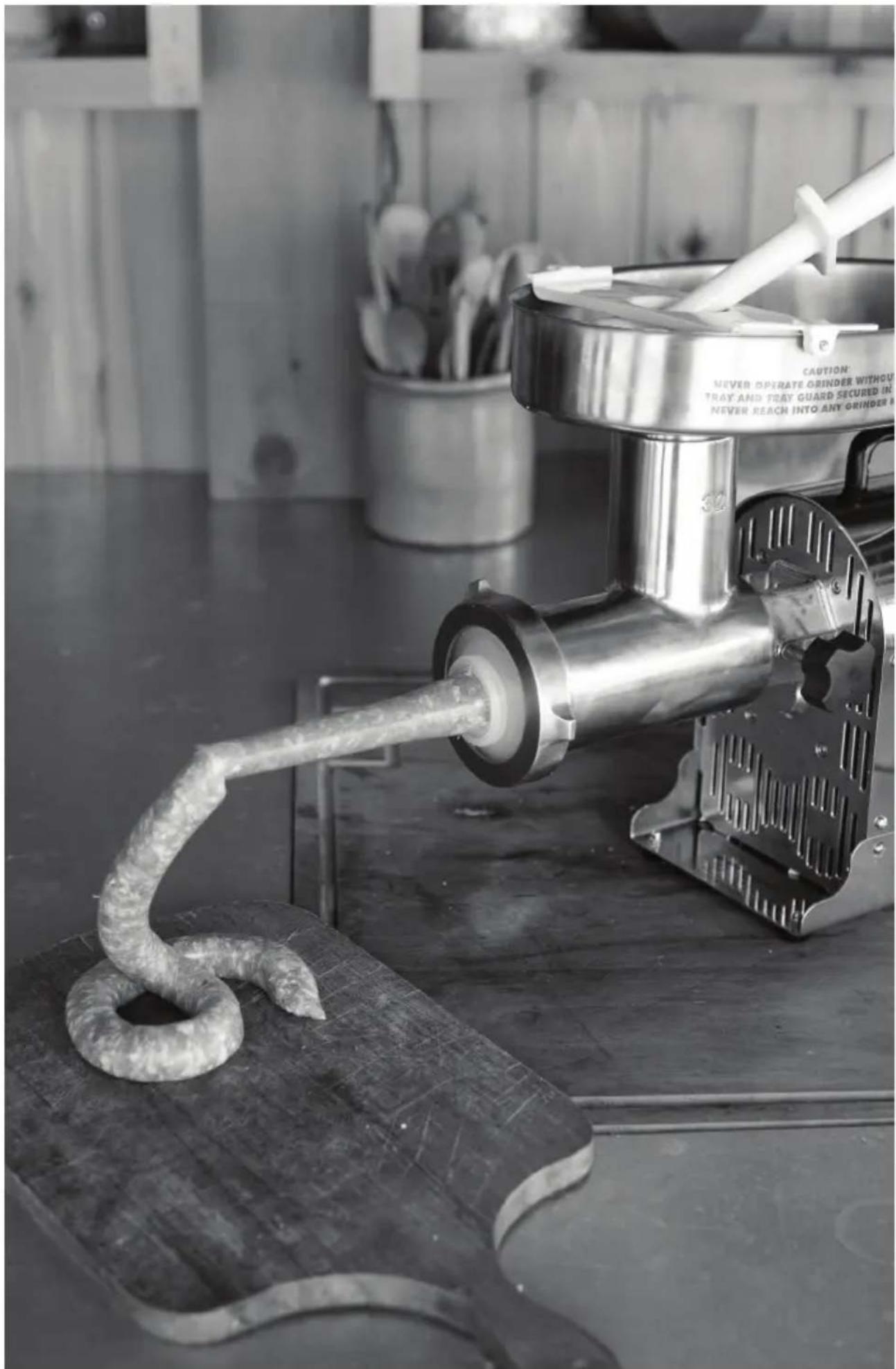
COMPONENT LIST
| DIAGRAM NUMBER | PART DESCRIPTION #5 | #8 | #12 | #22 | #32 | |
| 10-0501-W | 10-0801-W | 10-1201-W | 10-2201-W | 10-3201-W | ||
| 1 FRONT | RING NUT 08-0542 08-0842 | 08-1242 08-2242 | 08-3242 | |||
| 2 4.5 MM | GRINDER PLATE 29-0504 | 29-0804 29-1204 | 29-2204 29-3204 | |||
| 3 7 MM | GRINDER PLATE 29-0507 | 29-0807 29-1207 | 29-2207 29-3207 | |||
| 4 GRINDING | KNIFE 29-0550 29-0850 | 29-1250 29-2250 | 29-3250 | |||
| 5 AUGER | PIN 08-0549 08-0849 08-1249 | 08-2246 08-3246 | ||||
| 6 | AUGER | 08-0502-U | 08-0802-U | 08-1202 | 08-2202-N | 08-3202-N |
| 7 | AUGER BEARING | 08-0547 08-0847 | 08-0847 08-3047 | 08-3047 08-3047 | ||
| 8 | STAINLESS STEEL HEAD | 08-0509-W | 08-0809-W | 08-1209 | 08-2209-W | 08-3209-W |
| 9 | RUBBER FEET WITH NUTS [4] | 08-2007 08-2007 | 08-2007 08-2007 | 08-2007 08-2007 | ||
| 10 | HEAD LOCKING KNOB 08-2005 | 08-2005 | 08-2005 | 08-2005 | ||
| 11 | STAINLESS STEEL TRAY | 08-0524 08-0824 | 08-1224 08-2224 | 08-3224 | ||
| 12 | STORAGE TRAY | 08-0521 | 08-0821 | 08-1221 | 08-2221 | 08-3221 |
| 13 AUGER | GRABBING STOMPER | 09-0577 09-0877 | 09-0877 09-2277 | 09-2277 09-2277 | ||
| 14 | TRAY COVER | 08-0522 08-0822 | 08-1222 08-2222 | 08-3222 | ||
| 15 | KNIFE SHARPENER | 08-0803 08-0803 | 08-0803 08-0803 | 08-0803 08-0803 | ||
| NOT SHOWN | SAFETY GUARD N/A N/A | N/A | 08-2223 08-3223 | |||
| 16 | STUFFER ASSEMBLY | 08-2501-W | 08-2501-W | 08-2501-W | 08-2501-W | 08-2501-W |
| STUFFER ASSEMBLY |
| STUFFING STAR |
| 10 MM SNACK STICK STUFFING FUNNEL |
| FLANGE |
| 20 MM FUNNEL |
| 30 MM FUNNEL |
| 40 MM FUNNEL |
| HIGH SPEED AUGER |
If any components of this unit are broken, the unit does not operate properly or you need a replacement instruction manual, visit us on the web at
WestonProducts.com
Or call Weston Brands LLC Toll Free at 1-800-814-4895
Monday thru Friday 8:00am-5:00pm ET. Outside the U.S. call 001-216-901-6801
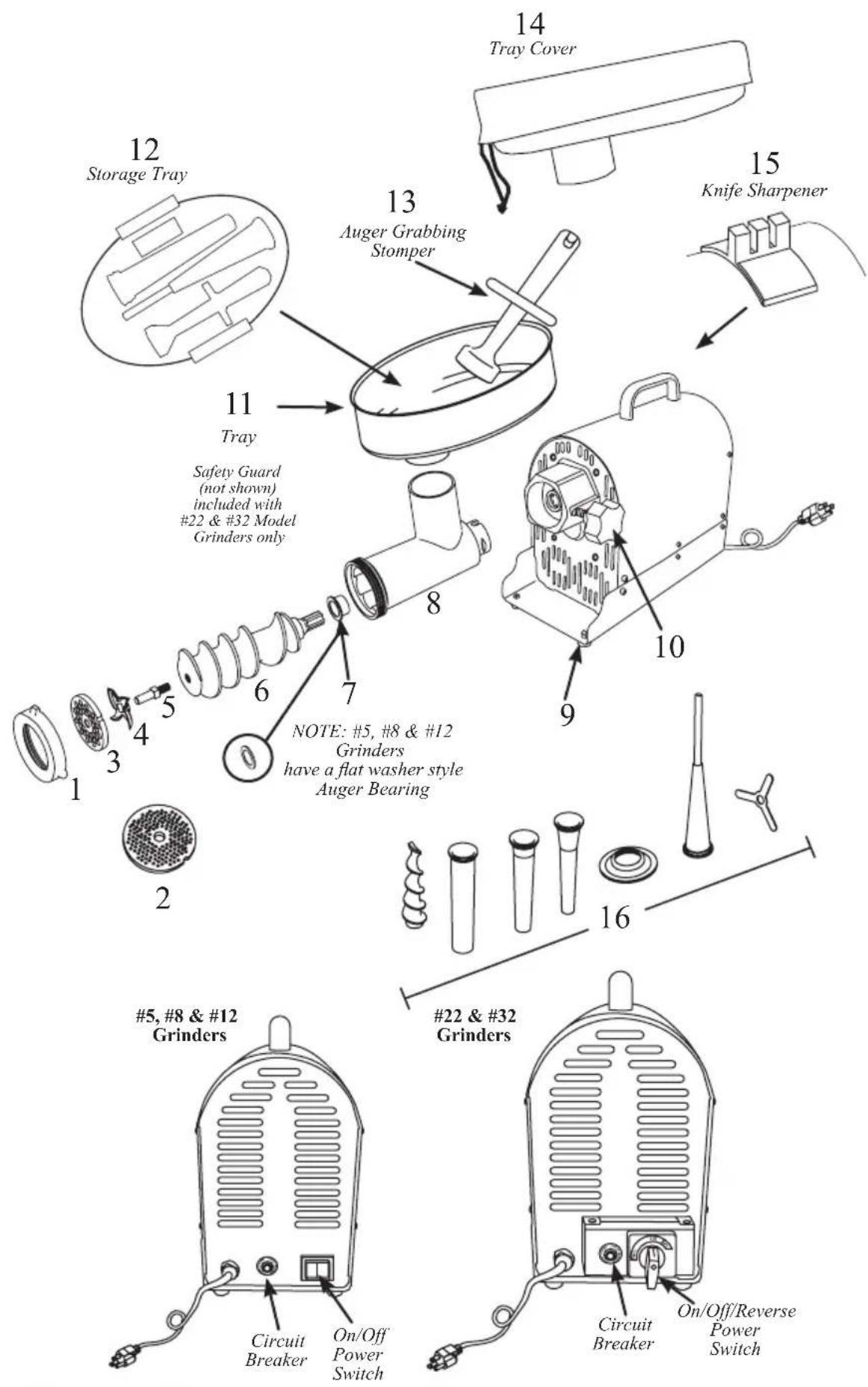
WARNING! Before cleaning, assembling or disassembling the Grinder, make sure the Grinder Motor is OFF and the PLUG IS REMOVED FROM THE OUTLET/POWER SOURCE!
UNPACKING INSTRUCTIONS
. Remove all parts from packaging material and check to be sure there are no missing parts.
. Retain packaging material for storage of the Grinder and Grinder parts when not in use.
GROUNDING INSTRUCTIONS
GROUNDING
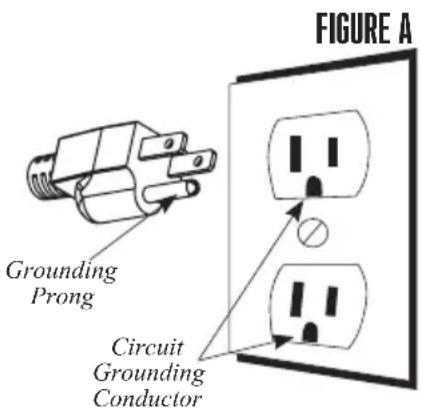
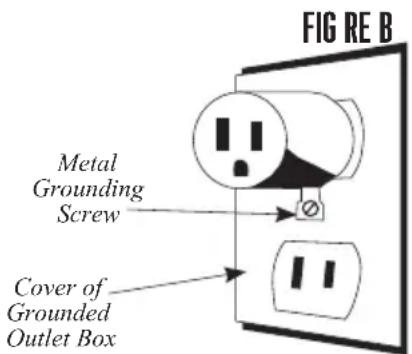
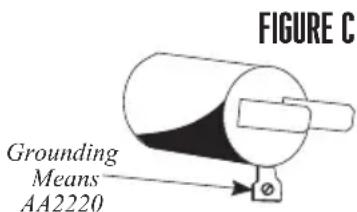
This appliance must be grounded while in use to protect the operator from electrical shock. The appliance is equipped with a 3-conductor cord and a 3-prong grounding type plug to fit the proper grounding-type receptacle. The appliance has a plug that looks like Figure A. An adapter, Figure B, should be used for connecting Figure A plugs to two-prong receptacles. The grounding tab which extends from the adapter must be connected to a permanent ground such as a properly grounded outlet box as shown in Figure C using a metal screw.
EXTENSION CORDS
Use only 3-wire extension cords which have 3-prong grounding-type plugs and a 3-pole cord connector that accepts the plug from the appliance. Use only extension cords having an electrical rating not less than the rating of the appliance. Do not use damaged extension cords. Examine extension cord before using and replace if damaged. Do not abuse extension cord and do not yank on any cord to disconnect. Keep cord away from heat and sharp edges.
CLEANING INSTRUCTIONS

WARNING! Before cleaning, assembling or disassembling the Grinder, make sure the Grinder Motor is OFF and the PLUG IS REMOVED FROM THE OUTLET/POWER SOURCE!
- See page 17 for instructions on using the Auger Grabbing Stomper to disassemble the head.
- Separate the head from the body.
- Remove the Safety Guard from the Tray. Safety Guards only come with #22 and #32 Model Grinders.
- Wash all parts that have come in contact with meat in hot soapy water. BE SURE TO CLEAN IMMEDIATELY AFTER USE. DO NOT IMMERSE THE MOTOR IN WATER OR OTHER LIQUIDS!
- Rinse the Grinder parts with clean hot water, then dry them IMMEDIATELY.
- Fully lubricate the Head, Plates and the Knife with a food grade silicone spray before and after each use.
- Clean the Motor Cover and Gear Housing with a damp towel and wipe dry. DO NOT IMMERSE THE MOTOR IN WATER OR OTHER LIQUIDS!
IMPORTANT: Any metal parts should be coated with a food safe silicone spray to prevent rusting. If not properly protected, these parts can begin to rust very quickly. DO NOT use rusted parts. Ordering information can be found on the last page of this instruction manual.
- Make sure the grinder and all components are completely dry before assembling or storing.
WARNING!
NEVER operate Grinder without the Tray/Safety Guard secured in place. To avoid serious or fatal injury, NEVER reach into any Grinder inlet. ALWAYS use the Stomper to push meat into the Grinder Head. Read & fully understand all instructions & warnings prior to use.
GRINDER ASSEMBLY INSTRUCTIONS
WARNING! Before cleaning, assembling or disassembling the Grinder, make sure the Grinder Motor is OFF and the PLUG IS REMOVED FROM THE OUTLET/POWER SOURCE!
- Insert the Head into the Gear Housing with the Feed Chute facing straight up. You will need to line up the slot in the Head with the Pin inside the Gear Housing. Be sure the Head is seated fully into the Gear Housing (Figure 1).
- Tighten the Head Locking Knob to lock the Head into place.
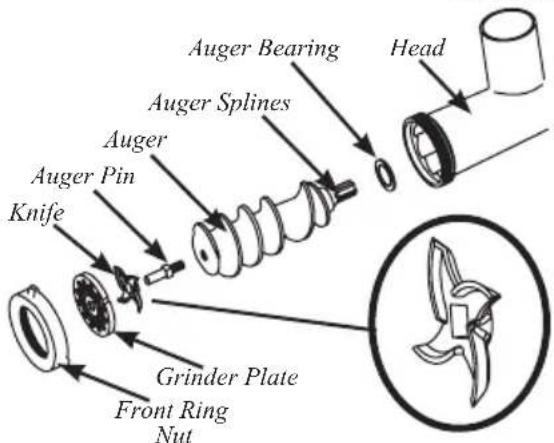
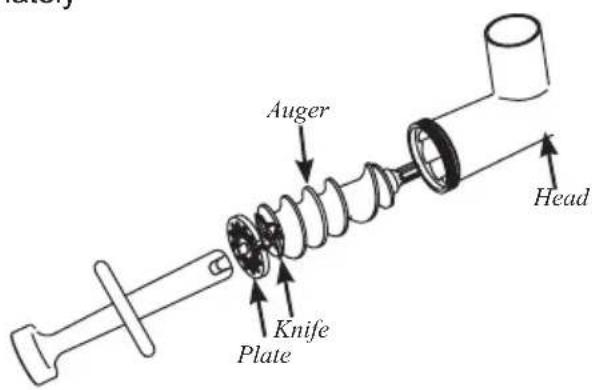
- Insert the Auger, with the Auger Bearing attached (already attached for #22, #32) into the Head (Figure 2). Align the Auger Splines with the Drive Shaft of the Grinder.
NOTE: Periodically inspect the Auger Bearing for wear. If the Auger Bearing has excessive wear, replace it to prevent head damage.
- Place the Knife onto the square part of the Auger Pin (Figure 2). Be sure the blades of the Knife are facing outward.
- Place one of the Grinder Plates onto the Auger Pin; align the notch in the Grinder Plate with the Pin in the Grinder Head.
- Install the Front Ring Nut. DO NOT OVERTIGHTEN. Turn the Front Ring Nut until it makes contact with the Grinder Plate, then make 1/4 turn more to tighten into place.
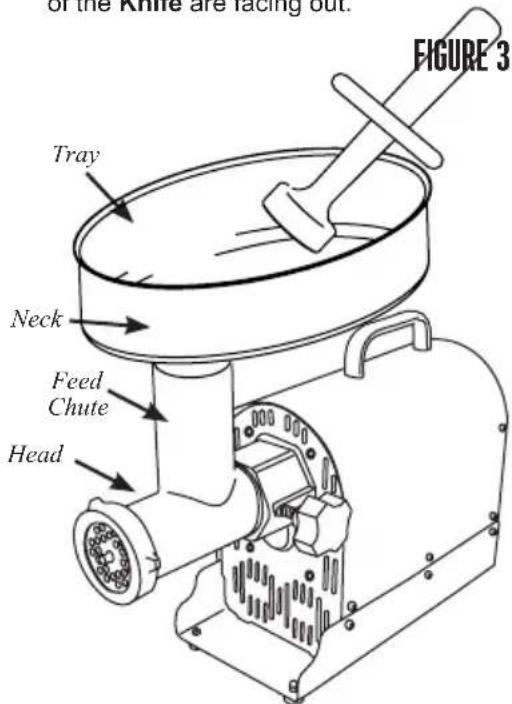
- Insert the neck of the Tray into the Feed Chute (FIGURE 3).
- NEVER operate Grinder without the Tray secured in place (FIGURE 3). REFER TO "GRINDING INSTRUCTIONS"
WARNING!
See Safety Guard
Instructions Prior to
Operation!
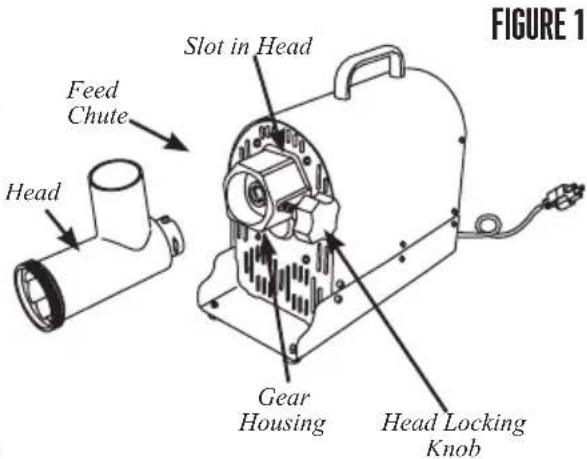
FIGURE 2
NOTE! Be sure the blades of the Knife are facing out.
GRINDING INSTRUCTIONS

WARNING! Before cleaning, assembling or disassembling the Grinder, make sure the Grinder Motor is OFF and the PLUG IS REMOVED FROM THE OUTLET/POWER SOURCE!
- Follow the "Grinder Assembly Instructions" to fully assemble the Grinder including the Tray.
NOTE: It is best to grind the meat using the coarse, 7 mm Grinding Plate first. If a finer grind of meat is desired, run the coarse ground meat through the Grinder a second time using the fine, 4.5 mm Grinding Plate.
- Trim the meat of all cords, tendons, bones, shot, etc.
- For best results, be sure that all meat has been chilled to between 32-34°F (0-1°C) before grinding. DO NOT ALLOW MEAT TO SIT OUT AT ROOM TEMPERATURE LONGER THAN ABSOLUTELY NEEDED. Closely follow the "Food Safety" instructions as outlined by the USDA.
- Cut meat into sizes small enough to fit into the Feed Chute. Approximately 1" (2.5 cm) cubes.
- Place cubed meat to be ground into the Tray. Do not overfill the Tray, place just enough meat to leave the Feed Chute area open.
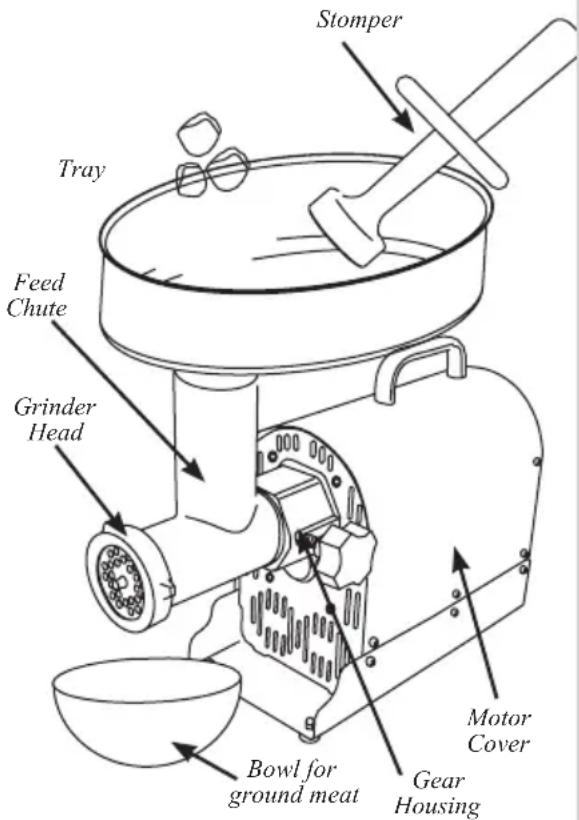
- Place a dish or bowl to collect the ground meat at the end of the Grinder Head (Figure 4).
- Make sure the Grinder is in the "OFF" position. Attach the Grinder to the power supply.
- Switch the Grinder to the forward "FWD" position. Carefully start feeding cubes of meat into the Feed Chute. ONLY USE THE STOMPER TO PUSH MEAT INTO THE HEAD, DO NOT USE YOUR FINGERS OR ANY OTHER OBJECT.
CAUTION! It is important to follow the "Food Safety" guidelines outlined in this manual. For the most up to date instruction visit the USDA website.
WARNING!
NEVER operate Grinder without the Tray/Safety Guard secured in place. To avoid serious or fatal injury, NEVER reach into any Grinder inlet.
ALWAYS use the Stomper to push meat into the Grinder Head.
Read & fully understand all instructions & warnings prior to use.
FIGURE 4

DO NOT TOUCH!
The Gear Housing and the Motor Cover may become HOT during operation. This is normal. DO NOT touch these parts during operation or until they cool after use.
STANDARD STUFFER ASSEMBLY INSTRUCTIONS
WARNING! Before cleaning, assembling or disassembling the Grinder, make sure the Grinder Motor is OFF and the PLUG IS REMOVED FROM THE OUTLET/POWER SOURCE!
- Insert the Head into the Gear Housing with the feed chute of the Head facing straight up. You will need to line up the slot in the Head with the Pin inside the Gear Housing. Be sure the Head is seated fully into the Gear Housing. (FIGURE 5)
- Tighten the Head Locking Knob to lock the Head into place.
- Insert the Auger, with the Auger Bearing attached, into the Head (FIGURE 6). Align the Auger Splines with the Drive Shaft of the Grinder.
NOTE: Periodically inspect the Auger Bearing for wear. If the Auger Bearing has excessive wear, replace it to prevent head damage.
- Slide the Stuffing Star over the round portion of the Auger Pin.
- Slide one of the Stuffing Funnels through the Flange and place it through the Front Ring Nut.
- Install the Front Ring Nut, DO NOT OVERTIGHTEN. Turn the Front Ring Nut until it makes contact with the Flange, then make 1/4 turn more to tighten into place.
- Insert the neck of the Tray into the Feed Chute (FIGURE 7).
- NEVER operate Grinder without the Tray secured in place (FIGURE 7).
REFER TO "STUFFING INSTRUCTIONS"
WARNING!
See Safety
Guard
Instructions
Prior to
Operation!
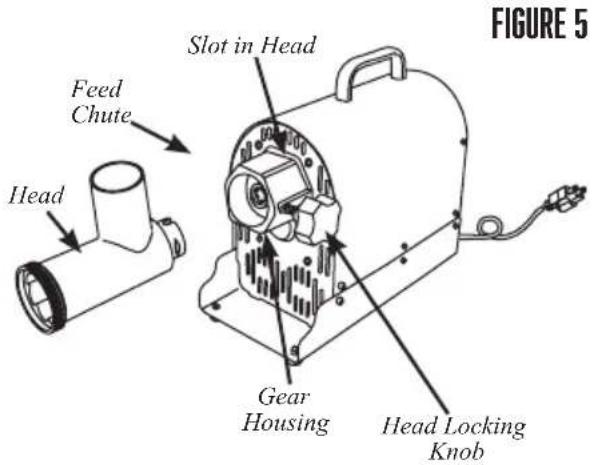
FIGURE 6
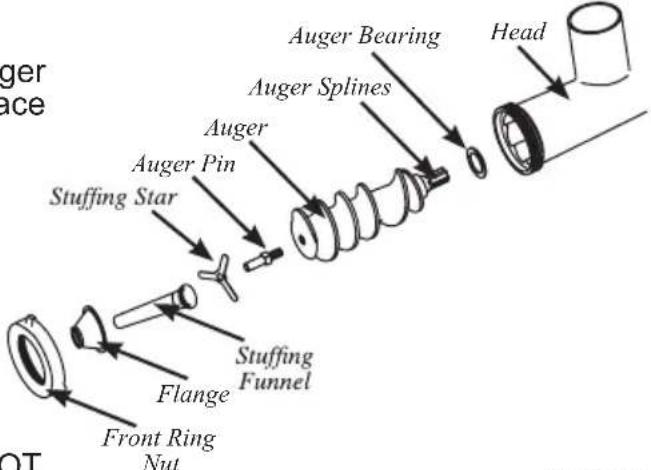
FIGURE 7
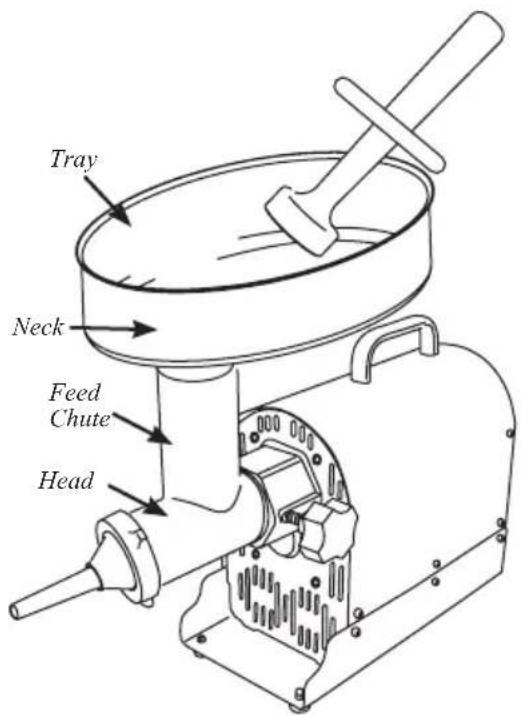
STUFFER ASSEMBLY INSTRUCTIONS
WARNING! Before cleaning, assembling or disassembling the Grinder, make sure the Grinder Motor is OFF and the PLUG IS REMOVED FROM THE OUTLET/POWER SOURCE!
NOTE: The High Speed Stuffing System is designed for use with the 10 mm Funnel ONLY. DO NOT attempt to use the High-Speed Plastic Auger with any other Funnels. SERIOUS DAMAGE to the Grinder Head and other components may occur. Follow the "Standard Stuffer Assembly Instructions" located in this manual, when using the 20, 30, or 40 mm Funnels.
- Insert the Head into the Gear Housing with the feed chute of the Head facing straight up. You will need to line up the slot in the Head with the Pin inside the Gear Housing. Be sure the Head is seated fully into the Gear Housing (FIGURE 8).
- Tighten the Head Locking Knob to lock the Head into place.
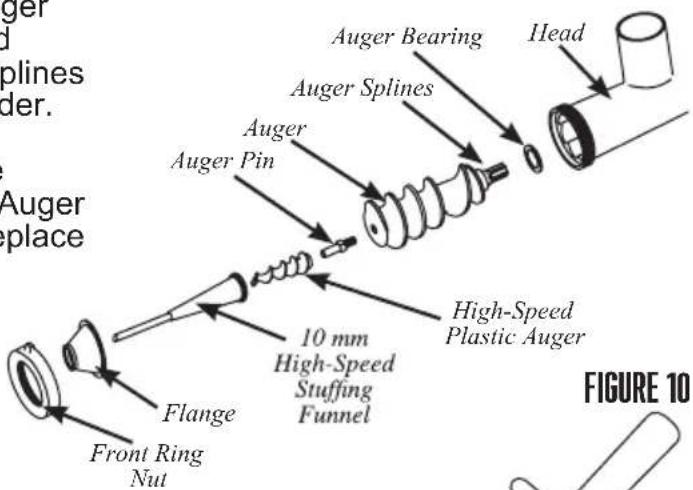
- Insert the Auger, with the Auger Bearing attached, into the Head (FIGURE 9). Align the Auger Splines with the Drive Shaft of the Grinder.
NOTE: Periodically inspect the Auger Bearing for wear. If the Auger Bearing has excessive wear, replace it to prevent head damage.
- Slide the High Speed Plastic Auger onto the Auger Pin making sure the square part of the Plastic Auger fully seats on to the square portion of the Auger Pin.
- Slide the 10 mm Stuffing Funnel through the through the Flange and place it through the Front Ring Nut.
- Install the Front Ring Nut, DO NOT OVERTIGHTEN. Turn the Front Ring Nut until it makes contact with the Flange, then make 1/4 turn more to tighten into place.
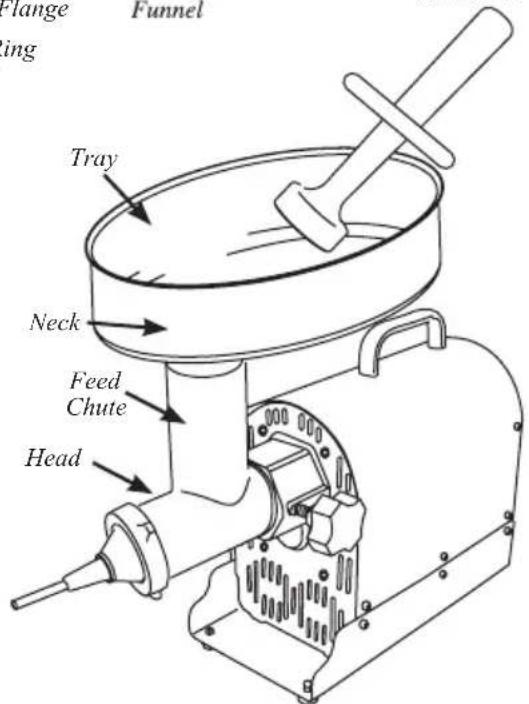
- Insert the neck of the Tray into the Feed Chute (FIGURE 10).
- NEVER operate Grinder without the Tray secured in place (FIGURE 10).
REFER TO "STUFFING INSTRUCTIONS"
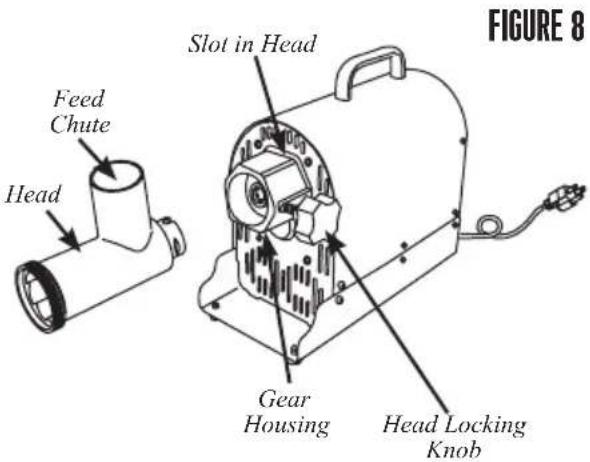
FIGURE 9
STUFFING INSTRUCTIONS
WARNING! Before cleaning, assembling or disassembling the Grinder, make sure the Grinder Motor is OFF and the PLUG IS REMOVED FROM THE OUTLET/POWER SOURCE!
- After grinding the meat following the "Grinding Instructions", mix the ground meat with the sausage seasonings.
- Follow the "Stuffer Assembly Instructions" or the "High-Speed Stuffer Assembly Instructions" to fully assemble the Grinder as a Stuffer including the Tray.
NOTE: While one person can stuff sausage with this Grinder, it is recommended that two people perform this operation. For best results when using the High-Speed Stainless Steel 10 mm Stuffing Funnel do not grind the meat through the 4.5 mm Grinding Plate.
- Place seasoned ground meat into the Tray. Do not overfill the Tray, place just enough meat to leave the Feed Chute area open.
- Slide a sausage casing over the Stuffing Funnel. See the "Sausage Information / Casing" section of this manual for more information.
- Slide 4"-6" (10-15 cm) of casing from the end of the Stuffing Funnel and
tie a knot in the end of the casing. If you are using large diameter fibrous casing, hold the closed end of the casing tightly against the end of the Stuffing Funnel (FIGURE 11).
- Make sure the Grinder is in the "OFF" position. Attach the Grinder to the power supply.
- Switch the Grinder to the forward "FWD" position. Carefully start feeding ground meat into the Feed Chute. ONLY USE THE STOMPER TO PUSH MEAT INTO THE HEAD, DO NOT USE YOUR FINGERS OR ANY OTHER OBJECT.
CAUTION! It is important to follow the "Food Safety" guidelines outlined in this manual. For the most up to date instruction visit the USDA website.
WARNING!
NEVER operate Grinder without the Tray/Safety Guard secured in place. To avoid serious or fatal injury, NEVER reach into any Grinder inlet. ALWAYS use the Stomper to push meat into the Grinder Head. Read & fully understand all instructions & warnings prior to use.
FIGURE 11
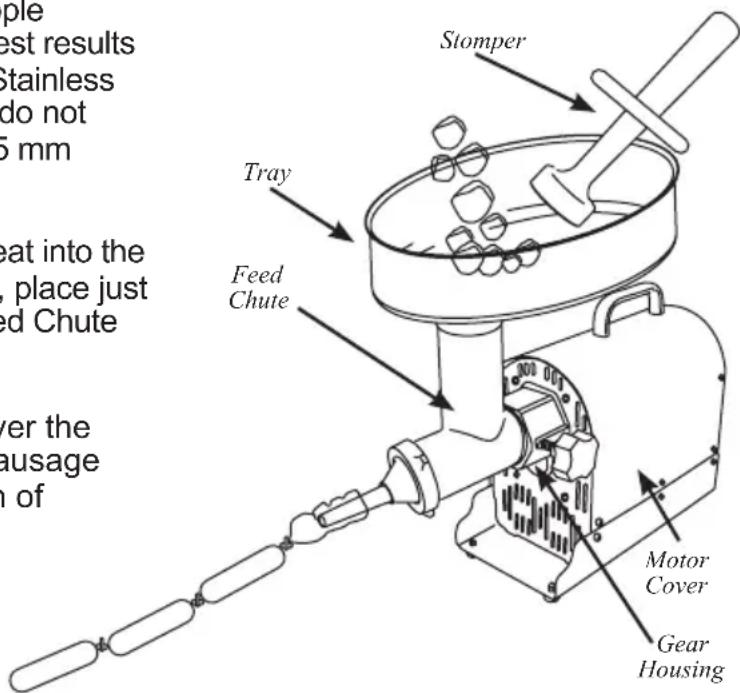
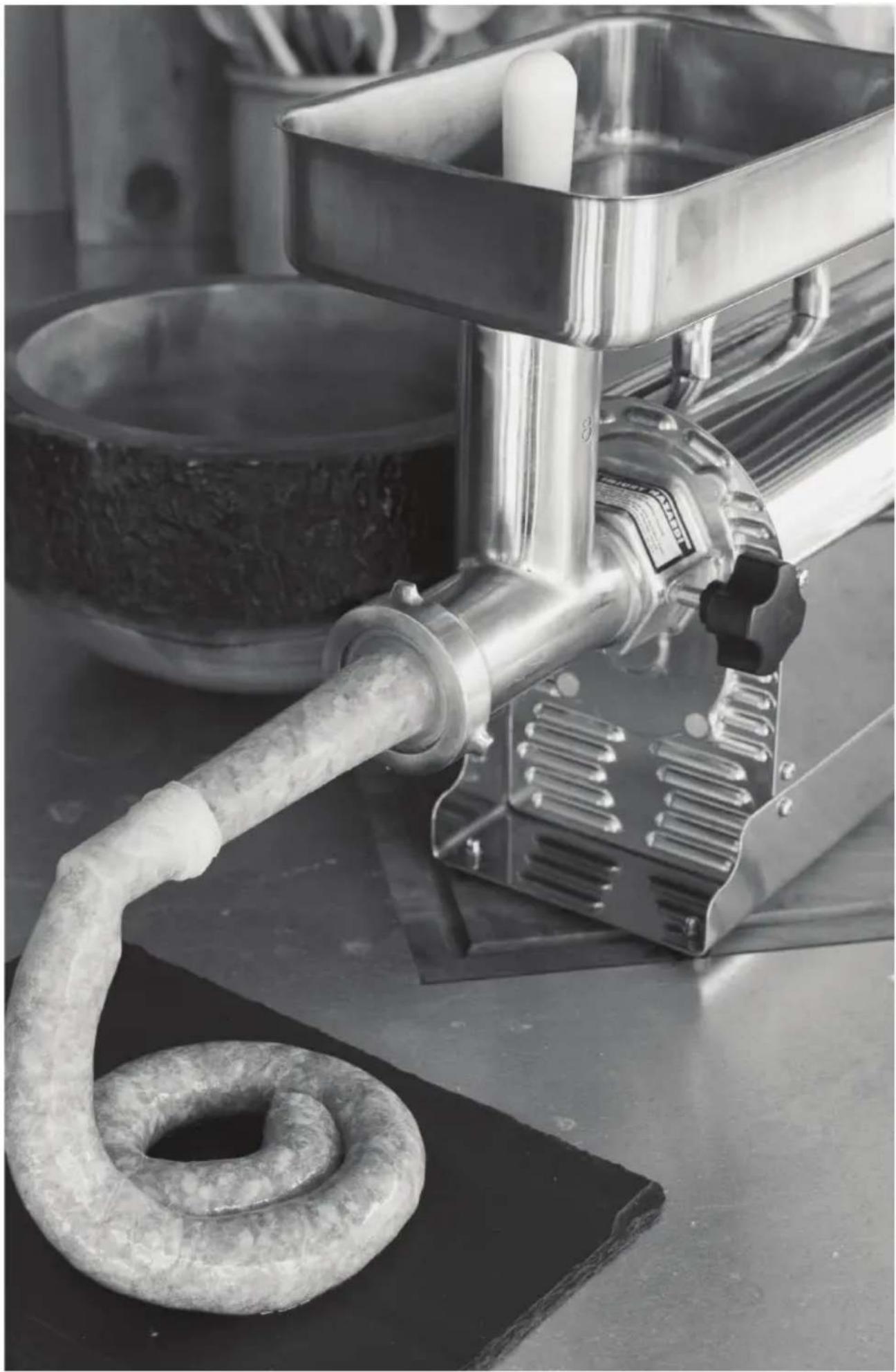
- Hold the casing in place with one hand while feeding the sausage mixture through the Grinder. As the meat fills the casing, gently lay it on a clean, dry surface. NOTE: When using natural casings, use a wet surface.
- Do not fill the last 3"-4" (7.5-10 cm) of casing. After the entire length of casing has been stuffed, twist the open end to close, then tie off the ends of the casing tightly to close. Twist into links.
- Whenever stuffing sausage, fill the casing slowly to avoid air pockets. If air pockets do appear in the sausage use a pin to prick the bubbles. The small holes will seal naturally.
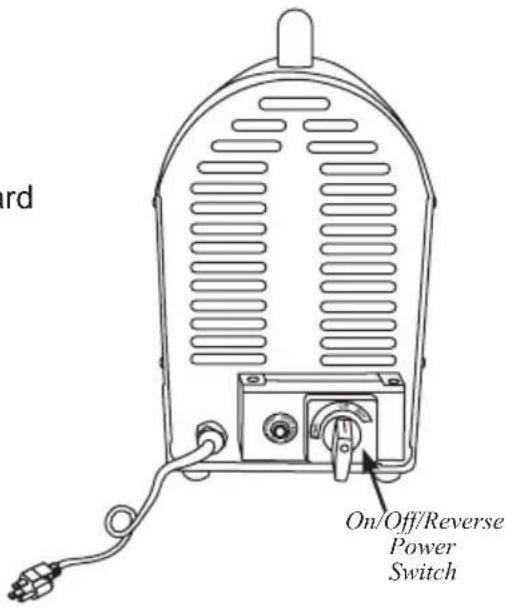
REVERSE FUNCTION
(Only applicable on #22 & #32 Grinders)
. Allow the Grinder Motor to come to a COMPLETE STOP before engaging into reverse "REV" (FIGURE 12).
. Allow the Grinder Motor to come to a COMPLETE STOP before engaging in forward "FWD" after using the reverse function.
. NEVER operate the Grinder in reverse for more than 5 seconds at a time.
FIGURE 12
WARNING!
NEVER operate Grinder without the Tray/Safety Guard secured in place. To avoid serious or fatal injury, NEVER reach into any Grinder inlet. ALWAYS use the Stomper to push meat into the Grinder Head. Read & fully understand all instructions & warnings prior to use.
CIRCUIT BREAKER INSTRUCTIONS
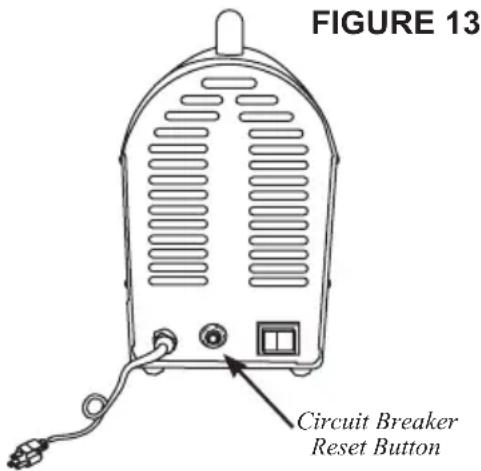
This Grinder is equipped with a Circuit Breaker as a safety precaution. If the Grinder stops running follow these steps to remedy:
- Turn the Grinder to the "Off" position.
- Check the Grinder to see if there is a jam in the Grinder Head. If there is, the jam needs to be cleared of the obstruction as outlined in "Grinding Tips".
- Press the Circuit Breaker Reset Button (FIGURE 13).
- Turn the Grinder back on and resume grinding.
- If the Grinder still does not turn on, check that the electrical wall outlet is properly working. Plug in another appliance to see if that appliance works from the wall outlet. Check that the household circuit breaker has not been tripped. If none of the above steps remedy the situation, or if the Circuit Breaker repeatedly shuts off the Grinder contact a customer service for further assistance.
WARNING! DO NOT continue to use the Grinder if the Circuit Breaker trips repeatedly. Continued use may cause permanent damage to the Grinder and will void the warranty.
PLEASE NOTE: This Grinder features an all hardened steel gear transmission. This causes the Grinder to operate at a higher volume and temperature than other Grinders. This is normal and will not affect the Grinder's performance.
GRINDING TIPS
- DO NOT over-tighten the Front Ring Nut. It should be firmly tight.
- Make sure the Grinding Knife blades lay flat on the Grinder Plate.
- DO NOT operate the Grinder without meat in the Head. Running the Grinder while dry could damage the Head and Auger.
- ALWAYS lubricate the Head, Grinding Plate and Grinding Knife with a food-grade silicone spray after cleaning.
- If the Grinder Plate becomes jammed/clogged during operation, follow these steps to restore normal output.
- Turn the Grinder "OFF" and disconnect the Power Cord from the electrical outlet.
- Remove the Front Ring Nut and Grinding Plate.
- Thoroughly clean the Grinding Plate. Make sure all of the holes are clear.
- Re-install the Grinding Plate and Front Ring Nut.
- Re-connect the Grinder to the electrical outlet.
Continue with grinding.
- Repeat as necessary.
AUGER GRABBING STOMPER INSTRUCTIONS

WARNING! Before cleaning, assembling or disassembling the Grinder, make sure the Grinder Motor is OFF and the PLUG IS REMOVED FROM THE OUTLET/POWER SOURCE!
To use the stomper to disassemble the head of the meat grinder, follow these instructions:
- Unscrew the front ring nut.
- Attach the handle end of the stomper onto the auger pin. The opening on the stomper should completely secure around the groove in the pin (FIGURE 14).
- Pull the stomper toward yourself, and away from the grinder. The auger will begin to disengage from the head of the grinder.
- Use the hand that is not holding the stomper to guide the auger out from the head completely.
- The auger, grinder knife and plate are all now free from the head and can be cleaned appropriately (FIGURE 15).
FIGURE 14
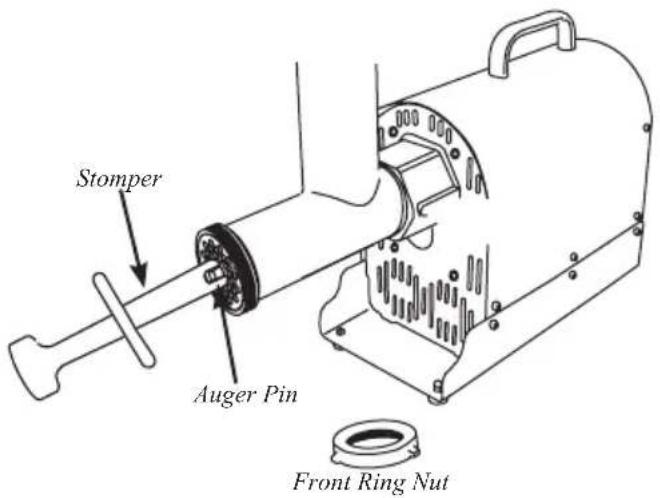
FIGURE 15
WARNING!
NEVER operate Grinder without the Tray/Safety Guard secured in place. To avoid serious or fatal injury, NEVER reach into any Grinder inlet. ALWAYS use the Stomper to push meat into the Grinder Head. Read & fully understand all instructions & warnings prior to use.
FOOD SAFETY
There are basic rules to follow when handling food. They are COOK, SEPARATE, CLEAN, and CHILL.
COOK
It's crucial to cook food to a safe internal temperature to destroy bacteria that is present. The safety of hamburgers and other foods made with ground meat has been receiving a lot of attention lately, and with good reason. When meat is ground, the bacteria present on the surface is mixed throughout the ground mixture. If this ground meat is not cooked to at least 160°F to 165°F (71°C to 74°C), bacteria will not be destroyed and there's a good chance you will get sick.
Solid pieces of meat like steaks and chops don't have dangerous bacteria like E. coli on the inside, so they can be served more rare. Still, any beef cut should be cooked to an internal temperature of at least 145°F (63°C) (medium rare). The safe temperature for poultry is 180°F (82°C) and solid cuts of pork should be cooked to 160°F (71°C). Eggs should be thoroughly cooked too. If you are making a meringue or other recipe that uses uncooked eggs, buy specially pasteurized eggs or use prepared meringue powder.
SEPARATE
Foods that will be eaten uncooked and foods that will be cooked before eating MUST ALWAYS be separated. Cross-contamination occurs when raw meats or eggs come in contact with foods that will be eaten uncooked. This is a major source of food poisoning. Always double-wrap raw meats and place them on the lowest shelf in the refrigerator so there is no way juices can drip onto fresh produce. Then use the raw meats within 1-2 days of purchase, or freeze for longer storage. Defrost frozen meats in the refrigerator, not on the counter.
When grilling or cooking raw meats or fish, make sure to place the cooked meat on a clean platter. Don't use the same platter you used to carry the food out to the grill. Wash the utensils used in grilling after the food is turned for the last time on the grill, as well as spatulas and spoons used for stir-frying or turning meat as it cooks.
Make sure to wash your hands after handling raw meats or raw eggs. Washing hands with soap and water, or using a pre-moistened antibacterial towelette is absolutely necessary after you have touched raw meat or raw eggs. Not washing hands and surfaces while cooking is a major cause of cross-contamination.
CLEAN
Wash your hands and work surfaces frequently when you are cooking. Washing with soap and warm water for at least 15 seconds, then dry with a paper towel.
CHILL
Chilling food is very important. The danger zone where bacteria multiply is between 40° F and 140° F ( 4° C and 6° C). Your refrigerator should be set to 40° F ( 4° C) or below; your freezer should be 0° F (-17°C) or below. Simple rule: serve hot foods hot, cold foods cold. Use chafing dishes or hot plates to keep food hot while serving. Use ice water baths to keep cold foods cold. Never let any food sit at room temperature for more than 2 hours - 1 hour if the ambient temperature is 90° F ( 32° C) or above. When packing for a picnic, make sure the foods are already chilled when they go into the insulated hamper. The hamper won't chill food - it just keeps food cold when properly packed with ice. Hot cooked foods should be placed in shallow containers and immediately refrigerated so they cool rapidly. Make sure to cover foods after they are cool.
NOTE: Special considerations must be made when using venison or other wild game, since it can become heavily contaminated during field dressing. Venison is often held at temperatures that could potentially allow bacteria to grow, such as when it is being transported. Refer to the USDA Meat and Poultry Department for further questions or information on meat and food safety.
SAUSAGE INFORMATION
MEAT SELECTION FOR SAUSAGE MAKING
Sausage making has evolved over many years and generations, and as a result there are countless types of sausage you can make using the basic ingredients of meat, fat and a few carefully blended spices. Following are a few simple guidelines that will help you make the best tasting sausage possible.
Any type of meat can be used for making sausage: pork, beef, bison, moose and caribou, even antelope make great sausage. It is important when preparing venison or other red game meats to trim all the fat from the meat, as red game tallow will turn rancid in as few as five days. Replace the fat with either pork or beef fat, depending on the type of product you are making, at a ratio of 1 pound (0.5 kg) of fat for every 4 pounds (1.8 kg) of game meat.
The fat content of your sausage will affect the taste, texture, cooking characteristics and shelf life of your product. Most commercially made sausage has a fat content of about 20%. Using less than 12% fat will result in a very dry tasting sausage, while using more than 20% may result in a sticky flavorless sausage that will be difficult to cook.
CURING
It is important to properly cure meats to preserve meat and poultry, and to destroy undesirable microorganisms on the meat surfaces that cause spoilage and food born illnesses. There are many steps that help in this process, including smoking, cooking, drying, chilling and the addition of cure ingredients. The oldest means of accomplishing this is by introducing salt into the meat. The resistance of bacteria to salt varies widely among different types of bacteria. The growth of some bacteria is inhibited by salt concentrations as low as 3%, e.g., Salmonella, whereas other types are able to survive in much higher salt concentrations, e.g., Staphylococcus. Fortunately, the growth of many undesirable organisms normally found in cured meat and poultry products is inhibited at low concentrations of salt.
Modern curing is based on Nitrates and is very scientific. The best way to ensure proper curing is to purchase one of the many commercially available curing agents from either a grocery store or your local butcher. A very common cure is Prague Powder, which is available in two types (#1 and #2).
CASING
There are many different types of casings available, the right choice depends on personal preference as well as the type of sausage you wish to make. For most sausages, your choices are natural or collagen. Don't let the names fool you; collagen casings are not a synthetic product. They are made from beef skin and other tissues. Collagen casings are uniform in size and texture and require almost no preparation. "Natural" casings are the intestines of lamb, sheep, hogs or beef. They are less uniform in size and require substantial preparation. For those reasons, more than 75% of commercially made sausage in the U.S. is made with collagen casing. There are also fibrous non-edible casings that are used for some varieties of smoked sausages and bolognas.
TYPES OF SAUSAGE
Most sausages fall into one of four categories: Fresh, Smoked, Cooked or Dried. All sausages, except dried, require refrigerated storage. There is also a sub-category of uncooked smoked sausages.
Among the fresh and uncooked smoked sausages, you will find such flavors as kielbasa or Polish sausage, Italian sausage, breakfast sausage and many others. Both fresh and uncooked smoked sausages require cooking before eating and also require refrigerated storage.
Smoked and cooked sausages include salami, bologna, the ever-popular hot dogs and many others. Proper smoking requires a smokehouse or smoker. These can be simple home-built structures made from metal drums or even old refrigerators or they can be elaborate manufactured units. Most smoked sausages are warmed before serving. Many people think that a smoked sausage will last much longer without spoilage, but this is not true. Smoked sausages should be treated the same as fresh sausage in terms of storage.
Dried sausages require the longest processing time, as they are air dried over a long period of time. Some types of dry sausages are pepperoni, prosciutto and a variety of ham products, just to name a few. The conditions under which the meat is dried are very exacting; temperature, time and humidity must all be carefully monitored for a safe and delicious product.
STORAGE
It is important to remember that sausage will lose its flavor the longer that it is stored. It is recommended that you only make as much sausage as you will need for 4-6 weeks. Even frozen sausage will begin to lose flavor noticeably after 6 weeks. Frozen sausage should be thawed slowly in the refrigerator before cooking or serving. Quick thawing of the product will degrade the taste as well.
WESTON WARRANTY INFORMATION
SAVE THIS WARRANTY INFORMATION FOR YOUR RECORDS!
Weston Brands LLC warrants to the ORIGINAL RETAIL PURCHASER of this product that if operated in accordance with the printed instruction accompanying it, then for a period of 5 years from the date of purchase, the product shall be free from defects in material and workmanship.
The Warranty Card, along with a copy of the original receipt, must be received by Weston Brands LLC within 30 days from purchase date for the warranty to apply. Failure to send the completely filled out Warranty Card, along with a copy of the original receipt, will void the warranty.
The product must be delivered to or shipped freight prepaid to Weston Brands LLC for warranty services, in either its original packaging or similar packaging affording an equal degree of protection. Damage due to shipping is not the responsibility of the company. Weston Brands LLC charges a \$35.00 per hour bench charge. NOTE: No repairs will be started without the authorization of the customer. The return shipping cost to the customer will be added to the repair invoice.
Prior to returning the product for Warranty Repair, the product must be thoroughly cleaned and free from any food particles or other debris. Failure of the purchaser to comply with this standard will result in the unit being returned without repair. In some cases, a \$50 cleaning surcharge may apply.
Weston Brands LLC will repair (or at its discretion, replace) the product free of charge, if in the judgment of the company, it has been proven to be defective as to seller's labor and material, within the warranty period.
New or rebuilt replacements for factory defective parts will be supplied for 5 years from the date of purchase. Replacement parts are warranted for the remainder of the original warranty period.
For non-warranty repairs, contact Weston Brands LLC's Customer Service at 1-800-814-4895 M-F 8am-5pm ET (outside of the United States 001-216-901-6801) to obtain a Return Merchandise Authorization Number (RMA Number).
Weston Brands LLC will refuse all returns that do not contain this number. DO NOT RETURN THE UNIT WITHOUT PROPER AUTHORIZATION FROM WESTON BRANDS LLC.
LIMITATIONS: The warranty is void if the product is used for any purpose other than that for which it is designed. The product must not have been previously altered, repaired, or serviced by anyone else other than Weston Brands LLC. If applicable, the serial number must not have been altered or removed. The product must not have been subjected to accident in transit or while in the customer's possession, misused, abused, or operated contrary to the instructions contained in the instruction manual. This includes failure caused by neglect of reasonable and necessary maintenance, improper line voltage and acts of nature. This warranty is not transferable and applies only to U.S. and Canadian sales. Except to the extent prohibited by applicable law, no other warranties whether expressed or implied, including warranty merchantability and fitness for a particular purpose, shall apply to this product. Under no circumstances shall Weston Brands LLC be liable for consequential damages sustained in connection with said product and Weston Brands LLC neither assumes nor authorizes any representative or other person to assume for it any obligation or liability other than such as is expressly set forth herein. Any applicable implied warranties are also limited to the 5 year period of the limited warranty.
This warranty covers only the product and its specific parts, not the food or other products processed in it. Weston is not responsible for missing or damaged parts on discounted/clearance, resale or final sale items where the seller may not be able to guarantee full functionality or completeness of the unit.
CUT ALONG THE DOTTED LINE AND SEND THE WARRANTY CARD ALONG WITH A COPY OF YOUR ORIGINAL PURCHASE RECEIPT TO:
Weston Brands LLC / WARRANTY
7575 E. PLEASANT VALLEY RD., INDEPENDENCE, OH 44131
WESTON WARRANTY CARD
SEND THIS CARD ALONG WITH A COPY OF YOUR ORIGINAL PURCHASE RECEIPT TO: WESTON BRANDS LLC / WARRANTY, 7575 E. PLEASANT VALLEY RD., INDEPENDENCE, OH 44131 USA
Customer Name:
Address:
City/State/Zip/Country:
Telephone Number:
E-Mail Address:
Original Date of Purchase:
Product Model #:
Serial # (if applicable):
I have read the warranty information. Initial here:
Copy of Receipt Included

pro series TM
MOLINO ELECTRICO
10-0501-W (#5 MOLINO ELÉCTRICO)
10-0801-W (#8 MOLINO ELÉCTRICO)
10-1201-W (#12 MOLINO ELÉCTRICO)
10-2201-W (#22 MOLINO ELÉCTRICO)
10-3201-W (#32 MOLINO ELÉCTRICO)
STOP
¡ADVERTENCIA!
WARNING! Before cleaning, assembling or disassembling the Grinder, make sure the Grinder Motor is OFF and the PLUG IS REMOVED FROM THE OUTLET/POWER SOURCE!
Weston Brands LLC / WARRANTY
7575 E. Pleasant Valley Rd., Independence, OH 44131 USA
TARJETA DE GARANTÍA WESTON
ENVÍE ESTA TARJETA JUNTO CON UNA COPIA DE SU RECIBO DE COMPRA ORIGINAL A: WESTON BRANDS LLC/WARRANTY, 7575 E. Pleasant Valley Rd., Independence, OH 44131 USA
INSTRUCTIONS RELATIVES AU DISJONCTEUR
INFORMATION SUR LA GARANTIE
CONSERVEZ CETTE INFORMATION SUR LA GARANTIE POUR VOS DOSSIERS!
Weston Brands LLC / WARRANTY
7575 E. Pleasant Valley Rd., Independence, OH 44131 USA
CARTE DE GARANTIE
ENVOYEZ CETTE CARTE DE GARANTIE AVEC UNE COPIE DE VOTRE REÇU D'ACHAT ORIGINAL À: WESTON BRANDS LLC / WARRANTY, 7575 E. Pleasant Valley Rd., Independence, OH 44131 USA
Nom du Client:
Adresse:
Province/Code postal/Région:
ATTENTION!
PLEASE INSPECT THIS PACKAGE THOROUGHLY FOR MISSING PARTS OR ANY PRODUCT DAMAGE. IF YOUR PRODUCT CONTAINS SHIPPING DAMAGE, PLEASE CONTACT RETAILER FOR ASSISTANCE.
For all other questions regarding product usage, missing parts, product damage, difficulty or warranty activation, please contact the Weston Brands Customer Service Team: 8:00 am to 5:00 pm ET, Monday thru Friday
CustomerService@WestonProducts.com
U.S. Residents Customer Service Line: 1-800-814-4895 (Outside U.S. Call: 001-216-901-6801) Weston Brands LLC, 7575 E. Pleasant Valley Rd., Independence, OH 44131 WestonProducts.com
Please DO NOT return this item to the retailer before contacting Weston Brands Customer Service.
SAVE THESE INSTRUCTIONS!
Refer to them often and use them to instruct others.
ATTENTION!
VEUILLEZ INSPECTER CET EMBALLAGE AVEC SOIN POUR Y DÉTECTER TOUTE PIÈCE MANQUANTE OU ENDOMMAGÉE. SI DES PIÈCES ONT ÉTÉ ENDOMMAGÉES PENDANT LE TRANSPORT, VEUILLEZ COMMUNIQUER AVEC LE DÉTAILLANT POUR OBTENIR DE L'AIDE.

- MEAT GRINDERS
- WARNING
- GENERAL SAFETY RULES
- SAVE THESE INSTRUCTIONS
- WESTONPRODUCTS.COM
- UNPACKING INSTRUCTIONS
- GROUNDING INSTRUCTIONS
- GROUNDING
- EXTENSION CORDS
- CLEANING INSTRUCTIONS
- GRINDER ASSEMBLY INSTRUCTIONS
- GRINDING INSTRUCTIONS
- STANDARD STUFFER ASSEMBLY INSTRUCTIONS
- STUFFER ASSEMBLY INSTRUCTIONS
- WARNING! BEFORE CLEANING, ASSEMBLING OR DISASSEMBLING THE GRINDER, MAKE SURE THE GRINDER MOTOR IS OFF AND THE PLUG IS REMOVED FROM THE OUTLET/POWER SOURCE
- STUFFING INSTRUCTIONS
- REVERSE FUNCTION
- CIRCUIT BREAKER INSTRUCTIONS
- GRINDING TIPS
- AUGER GRABBING STOMPER INSTRUCTIONS
- FOOD SAFETY
- COOK
- SEPARATE
- CLEAN
- CHILL
- SAUSAGE INFORMATION
- MEAT SELECTION FOR SAUSAGE MAKING
- CURING
- CASING
- TYPES OF SAUSAGE
- STORAGE
- WESTON WARRANTY INFORMATION
- SAVE THIS WARRANTY INFORMATION FOR YOUR RECORDS
- WESTON WARRANTY CARD
- MOLINO ELECTRICO
- STOP
- ¡ADVERTENCIA
- TARJETA DE GARANTÍA WESTON
- INSTRUCTIONS RELATIVES AU DISJONCTEUR
- INFORMATION SUR LA GARANTIE
- CARTE DE GARANTIE
- ATTENTION
Brand : Weston
Model : 331301W
Category : Chopper