
Bronco 42I - Tractor TROY-BILT - Free user manual and instructions
Find the device manual for free Bronco 42I TROY-BILT in PDF.



| Product Type | Lawn Tractor |
| Brand | Troy-Bilt |
| Model | Bronco 42I |
| Cutting Width | 107 cm (42 inches) |
| Engine | Gasoline, 4-stroke, air-cooled |
| Engine Power | ~ 19-22 hp (depending on version) |
| Transmission | Continuously Variable (TVC) or pedal |
| Cutting Height | Variable range with lever |
| Fuel Tank Capacity | Approximately 11 L (3 US gallons) |
| Weight | ~ 200 kg (440 lb) |
| Dimensions (L x W x H) | ~ 178 x 117 x 107 cm |
| Battery Type | Lead-acid 12 V or AGM |
| Discharge Deflector | Yes, removable |
| Safety System | Seat lock, parking brake, engine stop |
| Maintenance | Oil change, air filter, spark plug, blade sharpening |
| Deck Cleaning | Integrated rinsing system (optional) |
| Warranty | Limited warranty (see manual) |
| Use | Residential, grass up to 25 cm high |
| Spare Parts | Available at authorized dealer |
| Repairability Index | User repairable (routine maintenance) |
| Environmental Standards | Compliant with EPA/CARB (spark arrestor optional) |
Frequently Asked Questions - Bronco 42I TROY-BILT
User questions about Bronco 42I TROY-BILT
0 question about this device. Answer the ones you know or ask your own.
Ask a new question about this device
Download the instructions for your Tractor in PDF format for free! Find your manual Bronco 42I - TROY-BILT and take your electronic device back in hand. On this page are published all the documents necessary for the use of your device. Bronco 42I by TROY-BILT.
USER MANUAL Bronco 42I TROY-BILT
Front Engine Lawn Tractor
English Page 1
Spanish (Español)......Page 30
French (Français) Page 62
Record Product Information
Before setting up and operating your new equipment, please locate the model plate on the equipment and record the information in the provided area to the right. You can locate the model plate by lifting up the seat and looking under the seat pan. This information will be necessary, should you seek technical support via our web site or with your local authorized service dealer.
Model Number
Serial Number
WARNING
Read and follow all safety rules and instructions in this manual before attempting to operate this machine.
Failure to comply with these instructions may result in personal injury - SAVE THESE INSTRUCTIONS.
WARNING
CALIFORNIA PROPOSITION 65
Engine Exhaust, some of its constituents, and certain vehicle components contain or emit chemicals known to the State of California to cause cancer and birth defects or other reproductive harm.
Battery posts, terminals, and related accessories contain lead and lead compounds, chemicals known to the State of California to cause cancer and reproductive harm. Wash hands after handling. www.p65warnings.ca.gov
NOTE: This Operator's Manual covers several models. Features may vary by model. Not all features in this manual are applicable to all models and the model depicted may differ from yours.
WARNING

This symbol points out important safety instructions which, if not followed, could endanger the personal safety and/or property of yourself and others. Read and follow all instructions in this manual before attempting to operate this machine. Failure to comply with these instructions may result in personal injury. When you see this symbol, HEED ITS WARNING!
! DANGER
This machine was built to be operated according to the safe operation practices in this manual. As with any type of power equipment, carelessness or error on the part of the operator can result in serious injury. This machine is capable of amputating hands and feet and throwing objects. Failure to observe the following safety instructions could result in serious injury or death.
GENERAL OPERATION
- Read, understand, and follow all instructions on the tractor and in the manual(s) before attempting to assemble and operate. Keep this manual in a safe place for future and regular reference and for ordering replacement parts.
- Be familiar with all controls and their proper operation. Know how to stop the tractor and disengage them quickly.
- Never allow children under 14 years of age to operate this tractor. Children 14 and over should read and understand the instructions and safe operation practices in this manual and on the tractor and should be trained and supervised by an adult.
- Never allow adults to operate this tractor without proper instruction.
- If situations occur which are not covered in this manual, use care and good judgment. Contact your customer service representative for assistance.
- According to the U.S. Consumer Products Safety Commission (CPSC) and the U.S. Environmental Protection Agency (EPA), this product has an estimated useful life of seven (7) years, under ordinary use conditions. At the end of its useful life, have the product inspected annually to ensure all mechanical and safety systems are operating properly, safely, and are not worn excessively. Failure to do so may result in accident, injury, or death.
- Thoroughly inspect the area where the tractor is to be used. Remove all stones, sticks, wire, bones, toys, and other foreign objects which could be picked up and thrown by the blade(s). Thrown objects can cause serious personal injury.
- To help avoid blade contact or a thrown object injury, keep helpers at least 75 feet (23 meters) from the tractor while it is in operation. Keep bystanders, children, and pets inside during operation. Stop tractor if anyone enters the area.
-
Be aware of the tractor discharge direction and do not point it at anyone.
-
Always wear safety glasses or safety goggles during operation and while performing an adjustment or repair to protect your eyes. Thrown objects which ricochet can cause serious injury to the eyes.
- Wear sturdy, rough-soled work shoes and close-fitting slacks and shirts. Loose fitting clothes, jewelry, and long hair can be caught in moving parts. Never operate this tractor in bare feet or sandals.
- Never over fill fuel tank. Fill tank to no more than 1/2 inch (13 mm) below bottom of filler neck to allow space for fuel expansion.
- Replace gasoline cap and tighten securely.
- Use only accessories and attachments approved for this tractor by the tractor manufacturer. Read, understand, and follow all instructions provided with the approved accessory or attachment.
OPERATING
- Data indicates that operators, age 65 years and above, are involved in a large percentage of tractor-related injuries. These operators should evaluate their ability to operate the tractor safely enough to protect themselves and others from serious injury.
- Disengage the blades and set the parking brake before attempting to start the tractor.
- Do not put hands or feet near rotating parts or under the cutting deck. Contact with the blade(s) can amputate hands and feet.
- Watch for holes, ruts, bumps, rocks, or other hidden objects. Uneven terrain could overturn the tractor. Tall grass can hide obstacles.
-
Plan your mowing pattern to avoid discharge of material toward roads, sidewalks, helpers, and the like. Avoid discharging material against a wall or obstruction which may cause discharged material to ricochet back toward the operator.
-
Check overhead clearances carefully before driving under low hanging tree branches, wires, door openings, etc., where the operator may be struck or pulled from the tractor, which could result in serious injury.
- Never leave a running tractor unattended. Always turn off blade(s), set the parking brake, stop the engine, and remove the key before dismounting.
- Disengage blade(s), set the parking brake, stop engine, and wait until the blade(s) come to a complete stop before removing grass catcher, emptying grass, unclogging chute, removing any grass or debris, or making any adjustments.
- Your tractor is designed to cut normal residential grass of a height no more than 10 inches (25 cm). Do not attempt to mow through unusually tall, dry grass (e.g. pasture) or piles of dry leaves. Dry grass or leaves may contact the engine exhaust and/or build up on the tractor deck presenting a potential fire hazard.
- Back up slowly. Always look down and behind before and while backing to avoid a back-over accident.
- Never carry passengers.
- Stay at least 10 feet (3 meters) from drop-offs, ditches, embankments, or the edge of water. The tractor could suddenly turn over if a wheel is over the edge of a cliff, ditch, or if an edge caves in.
- A missing or damaged chute deflector can cause blade contact or thrown object injuries.
- Do not operate the tractor without the chute deflector or entire grass catcher in its proper place.
- Use extra care with grass catchers or other attachments. These can change the stability of the tractor. Always follow the attachment manufacturer's instructions.
- Stop the blades when crossing gravel drives, walks, or roads and while not cutting grass.
- Watch for traffic when operating near or crossing roadways. This tractor is not intended for use on any public roadway.
- Mow only in daylight or good artificial light.
- Do not operate the tractor while under the influence of alcohol or drugs.
- Slow down before turning. Operate the tractor smoothly. Avoid erratic operation and excessive speed.
- The muffler and engine become very hot and can cause serious burn injuries. Do not touch. Allow the tractor to cool for five minutes before attempting any service.
- Never run an engine indoors or in a poorly ventilated area. Engine exhaust contains carbon monoxide, an odorless and deadly gas.
CHILDREN
- Tragic accidents can occur if the operator is not alert to the presence of children. Children are often attracted to the tractor and the mowing activity. They do not understand the dangers. Never assume that children will remain where you last saw them.
- Keep bystanders, children, and pets inside during operation under the watchful care of a responsible adult other than the operator. Stop tractor if anyone enters the area.
- Never carry children, even with the blade(s) shut off. They may fall off or interfere with safe tractor operation, causing serious injury or death.
- Children who have been given rides in the past could suddenly appear in the mowing area for another ride and be run over or backed over by the tractor, causing serious injury or death.
- Be alert and turn tractor off if a child or bystander enters the area.
- To avoid back-over accidents, always look behind and down for small children.
- Use extreme care when approaching blind corners, doorways, shrubs, trees, or other objects that may block your vision of a child who may run into the path of the tractor.
- Never allow children under 14 years of age to operate this tractor. Children 14 and over should read and understand the instructions and safe operation practices in this manual and on the tractor and should be trained and supervised by an adult.
- Do not allow any child to joy ride on the tractor. The tractor is not a toy or a go-cart. Warn children that the tractor can be dangerous and they must stay away from it at all times.
- Keep children away from hot or running engines. They can suffer burns from a hot muffler.
- Remove key when tractor is unattended to prevent unauthorized operation. Make certain the key is inaccessible to small children.
SLOPE OPERATION
- Slopes are a major factor related to loss of control and tip-over accidents which can result in severe injury or death. All slopes require extra caution. If you cannot back up the slope or if you feel uneasy on it, do not mow it.
- For your safety, measure any slope before using the tractor on the sloped area. Use a slope measuring device in addition to the slope gauge included as part of this manual to measure slopes before operating this tractor on a sloped or hilly area. Smart phone applications can also be utilized to measure slopes. If the slope is greater than 15^ (25%) as shown on the slope gauge or a slope measuring device, do not operate this tractor on that area or serious injury could result.
SAFE OPERATION PRACTICES
- Do not mow on slopes greater than 15^ (25%).
- Do not mow across slopes, only mow up and down slopes that are less than 15^ (25%). Use low speeds and avoid sudden turns.
- Do not mow on wet grass. Reduced traction could cause sliding or a loss of control.
- Do not operate tractor under any conditions where traction, steering, or stability is in question. Tires could slide even if the wheels are stopped.
- Avoid starting and stopping on slopes. Avoid making sudden changes in speed or direction. Make turns slowly and gradually.
- Use extra care while operating tractor with grass catcher or other attachment(s). They can affect the stability of the tractor. Do not use grass catcher on slopes greater than 10^ (17%).
- Do not try to stabilize the tractor by putting your foot on the ground.
- Keep all movement on slopes slow and gradual. Do not make sudden changes in speed or direction. Rapid acceleration could cause the front of the tractor to lift and rapidly roll over backwards, which could cause serious injury or death.
- Do not turn off tractor and freewheel downhill. Overspeeding may cause the operator to lose control of the tractor resulting in serious injury or death.
SLOPE GAUGE (BACK COVER)

WARNING
Slopes are a major factor related to slip and fall accidents which can result in severe injury or death. All slopes require extra caution. If you feel uneasy on the slope, do not mow it. Do not mow on slopes greater than 15^ (25%). Do not mow across slopes, only mow up and down slopes.
USE THE SLOPE GAUGE ON THE BACK COVER AS SHOWN TO DETERMINE IF A SLOPE IS TOO STEEP FOR SAFE OPERATION!
To check the slope, proceed as follows:
- Open manual to the back cover and fold along the dashed line.
- Locate a vertical object on or behind the slope (e.g. a pole, building, fence, tree, etc.).
- Align either side of the slope gauge with the object.
- Adjust gauge up or down until the left corner touches the slope.
- If there is a gap below the gauge, the slope is too steep for safe operation.
FIRE AND FUEL
- To avoid personal injury or property damage use extreme care in handling gasoline. Gasoline is extremely flammable and the vapors are explosive. Serious personal injury can occur when gasoline is spilled on yourself or your clothes which can ignite. Wash your skin and change clothes immediately.
- Extinguish all cigarettes, cigars, pipes, and other sources of ignition.
- Use only an approved gasoline container.
- Never remove gas cap or add fuel while the engine is hot or running. Allow engine to cool at least five minutes before refueling.
- Never fuel tractor indoors.
- Never store the tractor or fuel container inside where there is an open flame, spark, or pilot light as on a water heater, space heater, furnace, clothes dryer, or other gas appliances.
- If gasoline is spilled, wipe it off the engine and equipment. Clean up oil or fuel spillage and remove any fuel soaked debris. Move tractor to another area. Wait five minutes before starting the engine.
- To reduce fire hazards, keep tractor free of grass, leaves, or other debris build-up. Follow the Post-Operation Tractor Care instructions in the Product Care section.
- The tractor is designed to cut normal residential grass of a height no more than 10 inches (25 cm). Do not attempt to mow through unusually tall, dry grass (e.g., pasture) or piles of dry leaves. Dry grass or leaves may contact the engine exhaust and/or build up on the tractor deck presenting a potential fire hazard.
- Never over fill fuel tank. Fill tank to no more than 1/2 inch (13 mm) below bottom of filler neck to allow space for fuel expansion.
- Replace gasoline cap and tighten securely. Do not operate without fuel cap in place.
- Allow tractor to cool at least five minutes before fueling or storing.
- Never fill containers inside a vehicle or on a truck or trailer bed with a plastic liner. Always place containers on the ground away from your vehicle before filling.
- When practical, remove gas-powered equipment from the truck or trailer and refuel it on the ground. If this is not possible, then refuel such equipment on a trailer with a portable container, rather than from a gasoline dispenser nozzle.
- Keep the nozzle in contact with the rim of the fuel tank or container opening at all times until fueling is complete. Do not use a nozzle lock-open device.
HAULING
- Use properly secured full width ramps for loading and unloading tractor for transport.
- Use extra care when loading or unloading the tractor into a trailer or truck. This tractor should not be driven up or down ramp(s), because the tractor could tip over, causing serious personal injury. The tractor must be pushed manually on ramp(s) to load or unload properly.
- Raise the deck to the highest position for loading clearance.
TOWING
- Do not tow a load that exceeds 250 lbs (113 kg) rolling weight and never exceed 50 lbs (22 kg) tongue weight.
- Do not attach towed equipment except at the hitch point of the tractor.
- Never allow children or others in or on towed equipment.
- Do not tow on slopes greater than 5^ (9%). On slopes, the weight of towed equipment may cause loss of traction, loss of control, and/or the ability to stop.
- Always use extra caution when towing with a tractor capable of making tight turns (e.g. tight-turn tractor). Make wide turns to avoid jack-knifing.
- Travel slowly and allow extra distance to stop.
SERVICE
- Keep machine in good working order. Do not use the tractor until worn or damaged parts are replaced.
- To avoid serious injury or death, do not modify engine in any way. Tampering with the governor setting can lead to a runaway engine and cause it to operate at unsafe speeds. Never tamper with factory setting of engine governor. Do not change the engine governor settings or over-speed the engine. The governor controls the maximum safe operating speed of the engine.
- Tractor blades are sharp. Wrap the blade or wear gloves, and use extra caution when servicing them.
- Tractors with hydraulic pumps, hoses, or motors; and/or diesel injection systems have fluid systems under pressure. Fluid escaping under pressure may have sufficient force to penetrate skin and cause serious injury. If fluid is injected into the skin, seek immediate medical attention. Keep body and hands away from pin holes or nozzles that eject fluid under high pressure. If a leak occurs, have the tractor immediately serviced by an authorized dealer.
-
Before cleaning, repairing, or inspecting, make certain the blade(s) and all moving parts have stopped. Turn off the engine, remove the key, and disconnect the spark plug wire(s) and negative battery cable to prevent unintended starting.
-
Check to make sure the blades come to a complete stop in not more than five seconds after disengaging the blade disengagement control per the schedule shown on the Maintenance Schedule chart in the Product Care section of this manual. Measure the stopping time with a stop watch. If the blades do not stop completely in less than five seconds, the tractor should be serviced professionally by an authorized dealer.
- Check the safety interlock system for proper function per the schedule shown on the Maintenance Schedule chart in the Product Care section of this manual. If the safety interlock system does not function properly, have the tractor serviced professionally by an authorized dealer.
- Never tamper with the safety interlock system or other safety devices. Check their proper operation regularly.
- Check the blade(s) and engine mounting bolt torque in accordance with the Maintenance Schedule chart in this manual. Also, visually inspect blade(s) for damage (e.g., excessive wear, bent, cracked). Replace the blade(s) with the original equipment manufacturer's (O.E.M.) blade(s) only.
- Use of service parts which do not meet the original equipment specifications may lead to improper performance and compromise safety.
- Keep all nuts, bolts, and screws tight to be sure the equipment is in safe working condition. Review the Maintenance Schedule chart in this manual for service interval information.
- After striking a foreign object, stop the engine, remove the key, and disconnect the spark plug wire(s) and negative battery cable to prevent unintended starting. Thoroughly inspect the tractor for any damage. Repair the damage before starting and operating.
- Never attempt to make adjustments or repairs to the tractor while the engine is running.
- Grass catcher components and the chute deflector are subject to wear and damage which could expose moving parts or allow objects to be thrown. Frequently check components and replace immediately with original equipment manufacturer's (O.E.M.) parts only.
- Maintain or replace safety and instruction labels, as necessary.
- Observe proper disposal laws and regulations for gas, oil, etc. to protect the environment.
SAFE OPERATION PRACTICES
NOTICE REGARDING EMISSIONS
Engines which are certified to comply with California and federal EPA emission regulations for SORE (Small Off Road Equipment) are certified to operate on regular unleaded gasoline and may include the following emission control systems: Engine Modification (EM) and Three Way Catalyst (TWC), if so equipped.
When required, models are equipped with low permeation fuel lines and fuel tanks for evaporative emission control. California models may also include a carbon canister. Please contact Customer Support for information regarding the evaporative emission control configuration for your model.
SPARK ARRESTOR
WARNING
This machine is equipped with an internal combustion engine and should not be used on or near any unimproved forest-covered, brush-covered, or grass-covered land unless the engine's exhaust system is equipped with a spark arrestor meeting applicable local or state laws (if any).
If a spark arrestor is used, it should be maintained in effective working order by the operator. In the State of California the above is required by law (Section 4442 of the California Public Resources Code). Other states may have similar laws. Federal laws apply on federal lands.
A spark arrestor for the muffler is available through your nearest engine authorized service dealer or contact the service department, P.O. Box 361131, Cleveland, Ohio 44136-0019.
SAFETY SYMBOLS
This table depicts and describes safety symbols that MAY APPEAR on this tractor.
| Symbol Description | |
 OPESymbol.com OPESymbol.com | WARNING - READ OPERATOR'S MANUAL - Read, understand, and follow all the safety rules and instructions in the manual(s) and on the tractor before attempting to operate this tractor. Failure to comply with this information may result in personal injury or death. Keep this manual in a safe location for future and regular reference. Using a Smart Phone, scan the QR code symbol to learn more information concerning the warnings contained on this tractor. You can also go to www.OPESymbol.com for more information. |
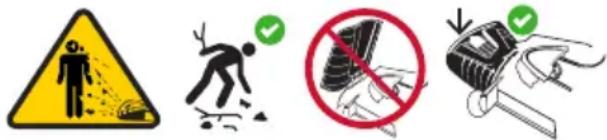 | WARNING - AVOID THROWN OBJECTS INJURY - Keep helpers at least 75 feet (23 meters) from tractor during operation. Remove all stones, sticks, wire, bones, toys, and other foreign objects which could be picked up and thrown by the blade(s). Do not operate the tractor without the discharge cover or entire grass catcher in its proper place. |
 | WARNING - AVOID CHILD BACKOVER/RUNOVER/BLADE INJURY - To avoid back-over accidents, always look behind and down for small children. Never carry children, even with the blade(s) shut off. Keep bystanders, children, and pets inside during operation under the watchful care of a responsible adult other than the operator. Stop tractor if anyone enters the area. |
SAFE OPERATION PRACTICES
| Symbol Description | |
      | WARNING - AVOID TIP-OVER/ROLL-OVERINJURY- Do not operate tractor on a slope greater than 15° (25%). Do not mow across slopes, only mow up and down slopes that are less than 15° (25%). Use low speeds and avoid sudden turns on slopes. Stay at least 10 feet (3 meters) from drop-offs, ditches, embankments, or the edge of water. |
 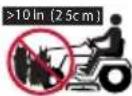  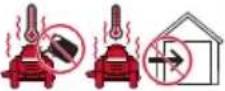 | WARNING - AVOID FIRES- Your tractor is designed to cut normal residential grass of a height no more than 10 inches (25 cm). Do not attempt to mow through unusually tall, dry grass (e.g., pasture) or piles of dry leaves. Allow tractor to cool at least five minutes before fueling or storing inside an enclosed garage or storage shed. |
 | WARNING - AVOID AMPUTATION INJURY- Donot put hands or feet near or under the cutting deck. Contact with the blade(s) can amputate hands and feet. |
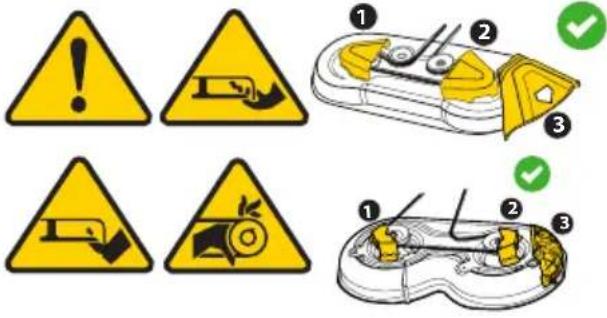 | WARNING - AVOID AMPUTATION INJURY- Do not put hands or feet near rotating parts or under the cutting deck. Contact with the blade(s) can amputate hands and feet. Ensure that all safety devices (guards, shields, switches, etc.) are in place and working. Belt and/or blade spindle contact can crush or injure body parts. |
 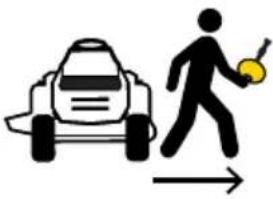 | WARNING - REMOVE KEY- Always turn off blade(s), set the parking brake, stop engine, and remove key before dismounting. If you are leaving the tractor unattended, always remove the key to prevent unauthorized use by children or others. |
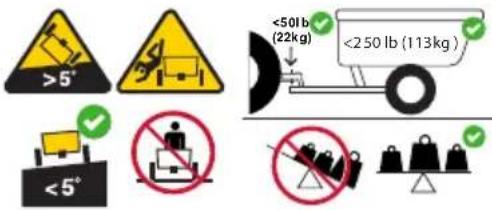 | WARNING - AVOID TOWING RELATED INJURY- Donot tow a load that exceeds 250 lbs (113 kg) rolling weight and never exceed 50 lbs (22 kg) tongue weight. Never allow children or others in or on towed equipment. Do not tow on slopes greater than 5° (9%). On slopes, the weight of the towed equipment may cause loss of traction, loss of control, and/or loss of the ability to stop. Travel slowly and allow extra distance to stop. |
WARNING
Your Responsibility—Restrict the use of this power machine to persons who read, understand, and follow the warnings and instructions in this manual and on the machine - SAVE THESE INSTRUCTIONS!
SET-UP
NOTE: This Operator's Manual covers several models. Not all features in this manual are applicable to all models and the model depicted may differ from yours.
NOTE: All references in this manual to the left or right side and front or back of the tractor are from the operating position only. Exceptions, if any, will be specified.
Refer to Figure 1 to match your transmission style; Foot Control CVT (Continuously Variable Transmission) or CVT.
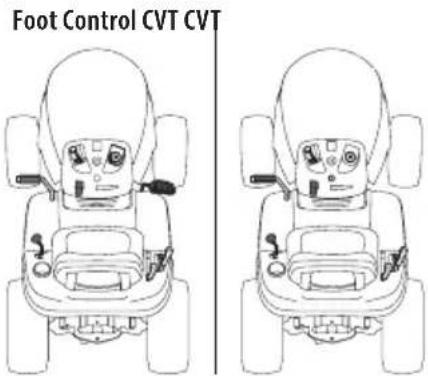
Figure 1
MANUALLY MOVING THE TRACTOR
- Release parking brake, if activated.
- Place the shift lever in the NEUTRAL (N) position.
INSTALL OPERATOR'S SEAT (IF NECESSARY)
Knob Adjust or Bolt Adjust
NOTE: The seat is shipped fastened to the tractor seat's pivot bracket with a cable tie OR mounted backward to the pivot bracket.
To install the seat proceed as follows:
- Remove the seat from its shipping position.
- Remove the seat adjustment knob or 9/16 inch bolt (a) from the bottom of the seat (b) (Figure 2).
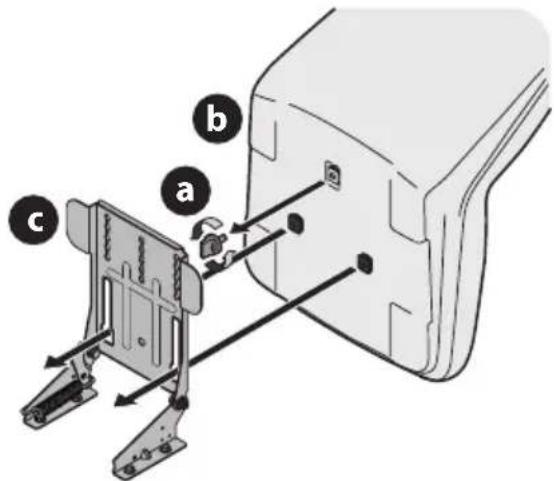
Figure 2
- Align the seat (b) over the seat pivot bracket (c) (Figure 2) and fit the seat (b) onto the seat pivot bracket (c) inserting the two tabs on the seat (b) bottom into the wide opening of the slots on the seat pivot bracket (c).
- Slide the seat (b) rearward in the seat pivot bracket (c), lining up one of the slots in the seat pivot bracket (c) with the hole in the center rear of the seat (b) base (Figure 3).
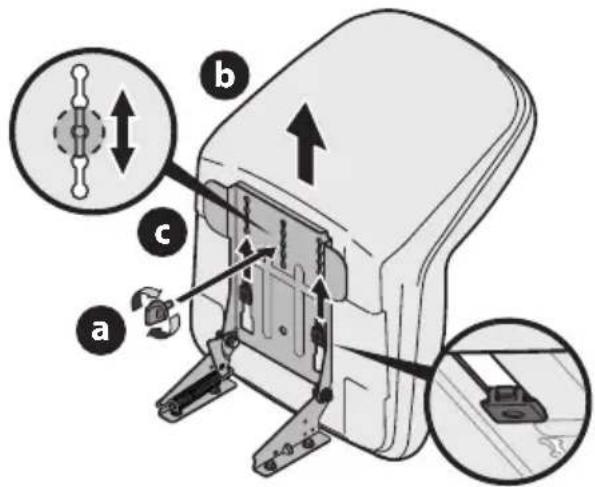
Figure 3
NOTE: Be certain the two seat tabs engage the seat pivot bracket as shown in the bottom right inset of Figure 3.
5. Select the desired position for the seat (b), and secure with the adjustment knob or 9/16 inch bolt (a) removed in Step 2 (Figure 3).
DASH SHROUD (IF EQUIPPED)
- If the dash shroud (a) was shipped loose, the hardware for attaching the dash shroud (a) is shipped attached to the dash shroud (a). Remove the two bolts (b) from the dash shroud (a) (Figure 4).
- Mount the dash shroud (a) and align the mounting holes between the top of the dash and the dash shroud (Figure 4).
- Secure the dash shroud (a) to the dash (c) with the bolts (b) removed in Step 1 (Figure 4).
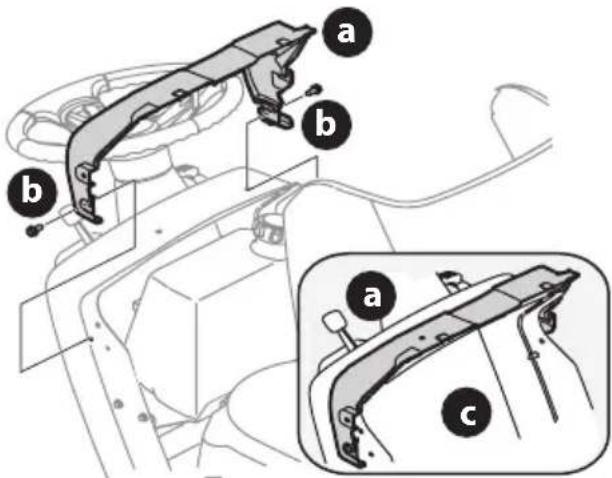
Figure 4
ATTACHING THE HOOD TOPPER (IF NECESSARY/IF EQUIPPED)
NOTE: Be careful not to damage the headlight harness when installing the hood topper.
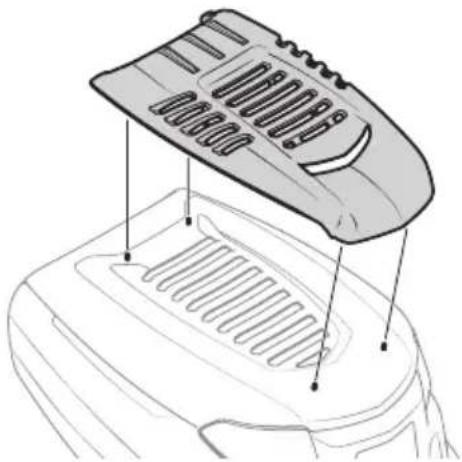
- Cut the cable ties securing the hood topper to the tractor.
- Remove the four screws pre-installed in the hood topper and retain for Step 4.
- Snap the hood topper into place using the hood as your guide (Figure 5).
natural_image
Technical line drawing of a car front panel with ventilation grilles and ventilation grilles (no text or symbols)Figure 5
- Install the hood topper onto the hood of the tractor and secure from the underside using the four screws removed in Step 2.
INSTALLING THE STEERING WHEEL (IF NECESSARY)
The hardware for attaching the steering wheel has been packed within the steering wheel, beneath the steering wheel cap. Carefully remove the cover by inserting a small flat screwdriver into one of the three snap locations, while slowly prying up on the steering wheel cap to remove the hardware.
IMPORTANT! Do not use impact tools to install or remove the steering wheel. Doing so can over-torque and damage the fastener.
-
Remove the key, attached with a cable tie to the steering wheel.
-
With the front wheels of the tractor pointing straight forward, align the steering wheel (a) and place it onto the steering shaft (b) (Figure 6).
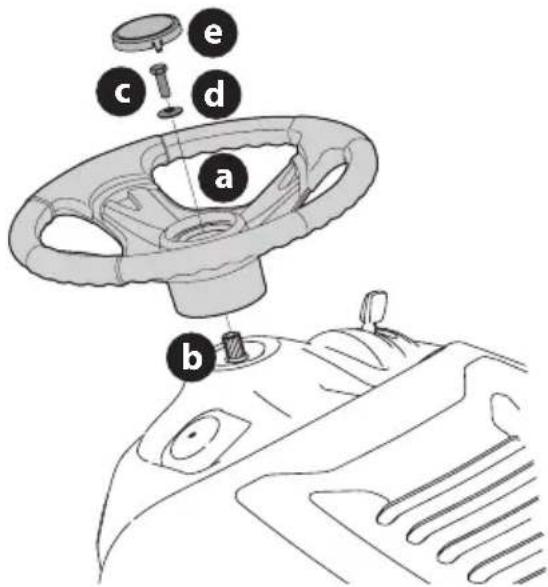
Figure 6
-
Secure the steering wheel (a) with the hex bolt (c) and washer (d) from under the steering wheel cap (e) and torque to 18-22 ft-lbs (24-30 N-m) (Figure 6).
-
Place the steering wheel cap (e) over the center of the steering wheel (a) and push downward until it "clicks" into place (Figure 6).
NOTE: The hex bolt (c) securing the steering wheel (a) has thread locker applied to it, so if it is removed, it is recommended that the hex bolt (c) be replaced or thread lock re-applied (Figure 6).
LOWER DECK DISCHARGE CHUTE DEFLECTOR (IF EQUIPPED)
WARNING
Never operate the mower deck without the chute deflector installed and in the down position.
46-Inch Deck Models
- Remove the key attached with a zip tie to the chute bracket.
-
Remove the flange lock nut and hex screw from the deck.
-
Place the chute deflector on the deck, be sure to insert the tabs on the chute deflector into the holes on the deck (Figure 7).
- Slide the chute deflector toward the rear of the tractor until the bolt hole in the chute deflector aligns with the hole in the deck (Figure 7).
- Secure the chute deflector in place with the flange lock nut and hex screw removed in Step 2. Tighten to 102-124 in-lbs (12-14 N-m) (Figure 7). Skip ahead to Setting the Deck Wheels (If equipped).
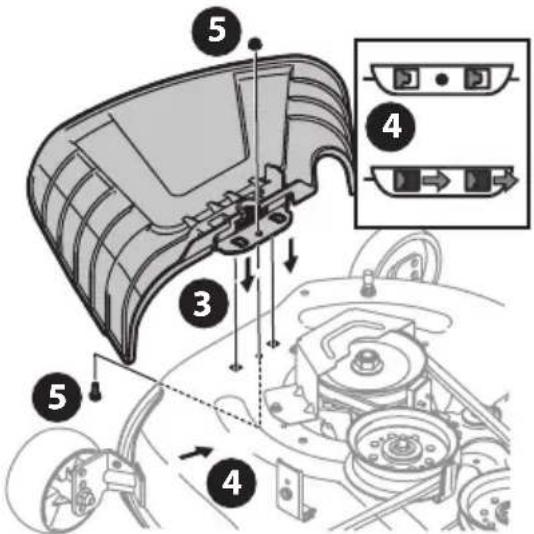
Figure 7
42/50/54-Inch Deck Models
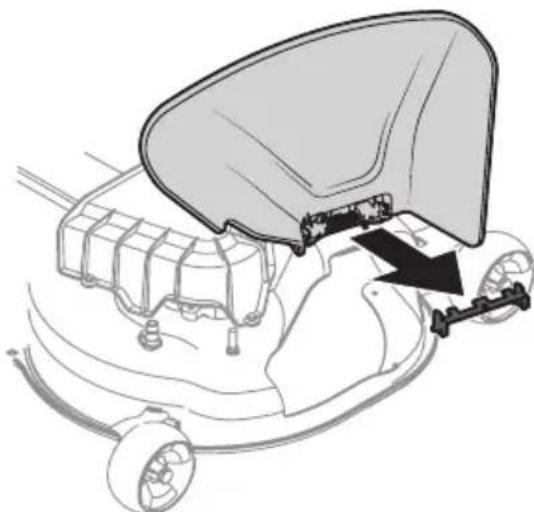
- Check the tractor deck for a shipping brace that may be holding the chute deflector upward for shipment. If the shipping brace is present, it must be removed before operating the tractor. Holding the chute deflector fully upward, remove the shipping brace.
- Lower the chute deflector and discard the shipping brace (Figure 8).
natural_image
Diagram of a lawn mower base with mechanical components and a directional arrow indicating motion (no text or symbols)Figure 8
NOTE: 36-inch deck models come equipped with mulch plugs rather than chute deflectors and no shipping brace is included.
SETTING THE DECK WHEELS (IF EQUIPPED)
NOTE: The deck wheels are an anti-scalp feature of the deck and are not designed to support the weight of the cutting deck.
- Move the tractor to a level surface, preferably pavement.
- Check the tire pressure, adjust, if necessary. See tire sidewall for proper tire pressure.
- Make sure the deck is level side-to-side and properly pitched. See the Product Care section for deck leveling information and instructions.
-
Place deck lift lever in the desired mowing height position.
-
Check the wheels for contact or excessive clearance with the surface below.
NOTE: The deck wheels should have between 1/4-1/2 inch (6.35 mm-12.7 mm) clearance above the ground. Proceed as follows to adjust the wheels:
a. Raise the deck lift lever to its highest setting.
b. Remove the front (a) and rear (b) deck wheels by removing the flange lock nuts (c) and shoulder bolts (d) that secure them to the deck (Figure 9).
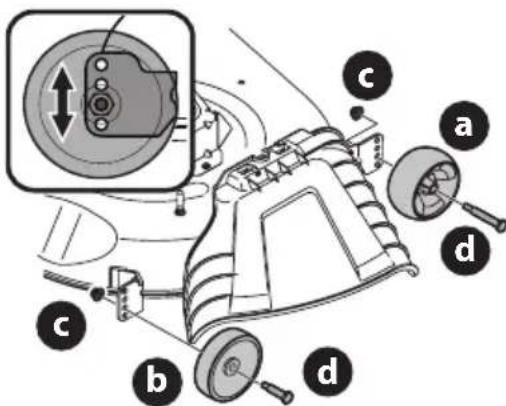
Figure 9
c. Place the deck lift lever in the desired mowing height setting.
d. Reinsert the shoulder bolt (with each deck wheel) into the index hole that leaves approximately 1/2 inch (13 mm) between the bottom of the wheel and the pavement. Tighten the flange lock nut and shoulder bolt to between 25-30 ft-lbs (34-40 N-m) using a torque wrench.
NOTE: Refer to the Product Care section of this manual for more detailed instructions regarding various deck adjustments.
BATTERY INFORMATION

WARNING
CALIFORNIA PROPOSITION 65 WARNING: Battery posts, terminals, and related accessories contain lead and lead compounds, chemicals known to the State of California to cause cancer and reproductive harm. Wash hands after handling.

WARNING
Should battery acid accidentally splatter into the eyes or onto the skin, rinse the affected area immediately with clean cold water. Seek prompt medical attention.
If acid spills on clothing, first dilute it with clean water, then neutralize with a solution of ammonia/water or baking soda/water.
NEVER connect (or disconnect) battery charger clips to the battery while the charger is turned on, as it can cause sparks.
Keep all sources of ignition (cigarettes, matches, lighters) away from the battery. The gas generated during charging can be combustible.
As a further precaution, only charge the battery in a well ventilated area.
Always shield eyes and protect skin and clothing when working near batteries.
Batteries contain sulfuric acid and may emit explosive gases. Use extreme caution when handling batteries. Keep batteries out of the reach of children.
The battery may present a risk of fire or chemical burn if misused. Do not open, disassemble, overheat, or incinerate the battery.

CAUTION
When attaching battery cables, always connect the POSITIVE (Red) wire to the terminal first, followed by the NEGATIVE (Black) wire.
NOTE: The positive battery terminal is marked Pos. (+). The negative battery terminal is marked Neg. (−).
Connecting the Battery Cables

CAUTION
When attaching battery cables, always connect the POSITIVE (Red) wire to the terminal first, followed by the NEGATIVE (Black) wire.
For shipping reasons the factory may leave both battery cables disconnected from the terminals. To connect the battery cables, proceed as follows:
NOTE: Wiring harness should lay on top of battery hold down rod, otherwise damage to the wiring harness may result (Figure 13 on page 13).
MODELS WITH LEAD-ACID BATTERY
- If present, remove the plastic cover from the positive battery terminal. Attach the red connector to the positive battery terminal (+) using the bolt (a) and hex nut (b) (Figure 10).
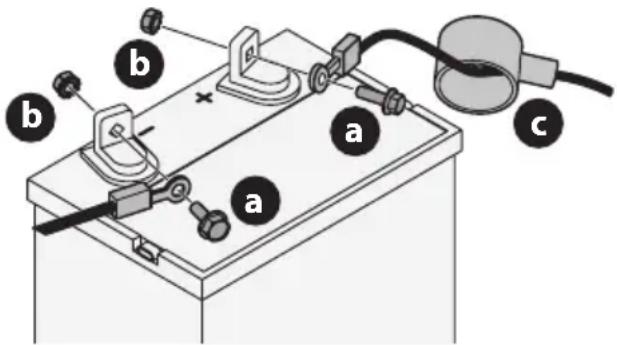
Figure 10
- Position the red rubber boot (c) over the positive battery terminal to help protect it from corrosion (Figure 10).
- If present, remove the plastic cover from the negative battery terminal and attach the black cable to the negative battery terminal (−) with the bolt (a) and hex nut (b) (Figure 10).
NOTE: If the battery is put into service after the date shown on top/side of battery, charge the battery as instructed in the Charging the Battery section prior to operating the tractor.
MODELS WITH AGM BATTERY
- Remove the hex screws (a) and square nuts (b) located either on the end of the wiring harness or in the bag with this manual. Retain the hardware for later instructions (Figure 11).
- Remove the plastic cover (c), if present, from the positive battery terminal (d) and attach the red cable (e) to the positive battery terminal (d) with one of the hex screws (a) and square nuts (b), from Step 1. Use a Philips screw driver (Figure 11).
- Position the red rubber boot over the positive battery terminal to help protect it from corrosion (Figure 11 inset).
- Remove the plastic cover (c), if present, from the negative battery terminal (f) and attach the black cable (g) to the negative battery terminal (f) with the remaining hex screw (a) and square nut (b) (Figure 11).
NOTE: If the battery is put into service after the date shown on top/side of battery, charge the battery as instructed in the Charging the Battery section prior to operating the tractor.
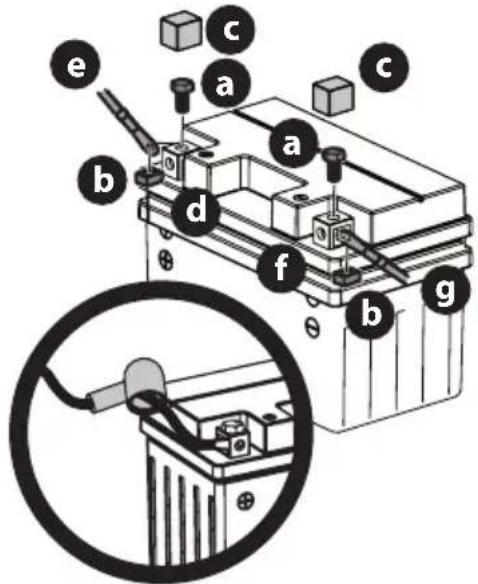
Figure 11
Battery Maintenance
- Some batteries are filled with battery acid and then sealed at the factory. However, even a "maintenance free" battery requires some maintenance to ensure its proper life cycle.
- Spray the terminals and exposed wire with a battery terminal sealer, or coat the terminals with a thin coat of grease or petroleum jelly, to protect against corrosion.
- Always keep the battery cables and terminals clean and free of corrosion.
- Some models are equipped with a battery containing a liquid electrolyte. Handle the battery with care and avoid tipping to prevent leakage.
Battery Storage
- When storing the tractor for extended periods, disconnect the negative battery cable. It is not necessary to remove the battery.
- All batteries discharge during storage. Keep the exterior of the battery clean, especially the top. A dirty battery will discharge more rapidly.
- The battery must be stored with a full charge. A discharged battery can freeze sooner than a charged battery. A fully charged battery will store longer in cold temperatures than hot.
- Recharge the battery before returning to service. Although the tractor may start, the engine charging system may not fully recharge the battery.
Battery Removal
WARNING
Battery posts, terminals, and related accessories contain lead and lead compounds. Wash hands after handling.
The battery is located beneath the seat frame. To remove the battery:
MODELS WITH LEAD-ACID BATTERY
- Remove the bolt and hex nut securing the black negative battery lead to the negative battery post (marked NEG (-)). Move the cable away from the negative battery post.
- Remove the bolt and hex nut securing the red positive battery lead to the positive battery post (marked POS (+)).
- Remove the battery hold down bracket by pushing the hooked end out of the tab on the fender to the right side of the battery. Then flip the battery hold-down bracket up to free the battery (Figure 12).
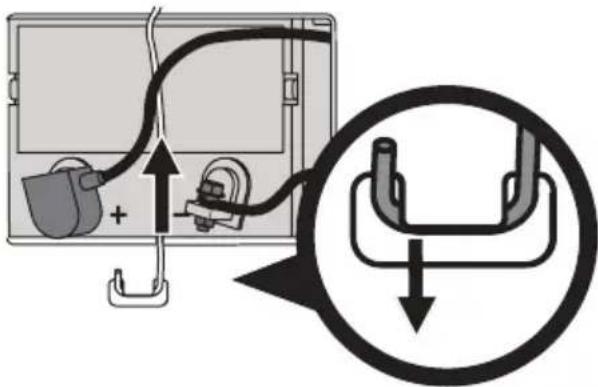
Figure 12
- Carefully lift the battery out of the tractor.
- Install the battery by repeating the above steps in the reverse order.
MODELS WITH AGM BATTERY
- Remove the hex screw and square nut securing the black negative battery lead to the negative battery post (marked NEG (-)). Move the cable away from the negative battery post.
- Remove the hex screw and square nut securing the red positive battery lead to the positive battery post (marked POS (+)).
- Remove the battery hold down rod by pushing the hooked end out of the tab on the fender to the right side of the battery. Then flip the battery hold down rod up to free the battery (Figure 13).
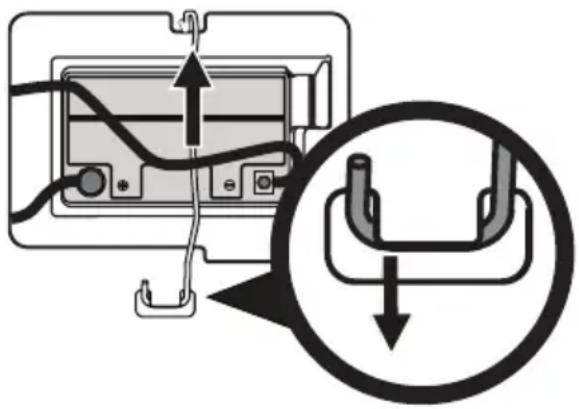
Figure 13
- Carefully lift the battery out of the tractor.
- Install the battery by repeating the above steps in the reverse order.
Charging the Battery
Test and, if necessary, recharge the battery after the tractor has been stored for a period of time.
MODELS WITH LEAD-ACID BATTERY
- A voltmeter or load tester reading of 12.4 volts (DC) or lower across the battery terminals indicates that the battery needs to be charged.
- A lead-acid battery charger should be used. Recommended charge rate is 4A/14.7V.
- If your battery charger is automatic, charge the battery until the charger indicates that charging is complete. If the charger is not automatic, charge for no fewer than eight (8) hours.
MODELS WITH AGM BATTERY
- An AGM battery charger should be used. Recommended charge rate is 1.1A/14.8V.
IMPORTANT! Do NOT use an automotive charger.
- If your battery charger is automatic, charge the battery until the charger indicates that charging is complete. If the charger is not automatic, charge for no fewer than eight (8) hours.
ADJUSTING THE SEAT
Knob Adjust or Bolt Adjust
To adjust the position of the seat, remove the adjustment knob or 9/16 inch bolt (a) on the bottom of the seat (b). Slide the seat (b) forward or backward as desired. Reinstall the adjustment knob or 9/16 inch bolt (a) (Figure 2 and Figure 3 on page 8).
OIL
NOTE: Your tractor is shipped with oil in the engine. However, you MUST check the oil level before operating. See the Engine Operator's Manual for instructions on checking, adding and changing oil.
CAUTION
Always check the engine oil level before each use as instructed in the Engine Operator's Manual. Add oil as necessary. Failure to do so may result in serious damage to your engine.
OPERATION
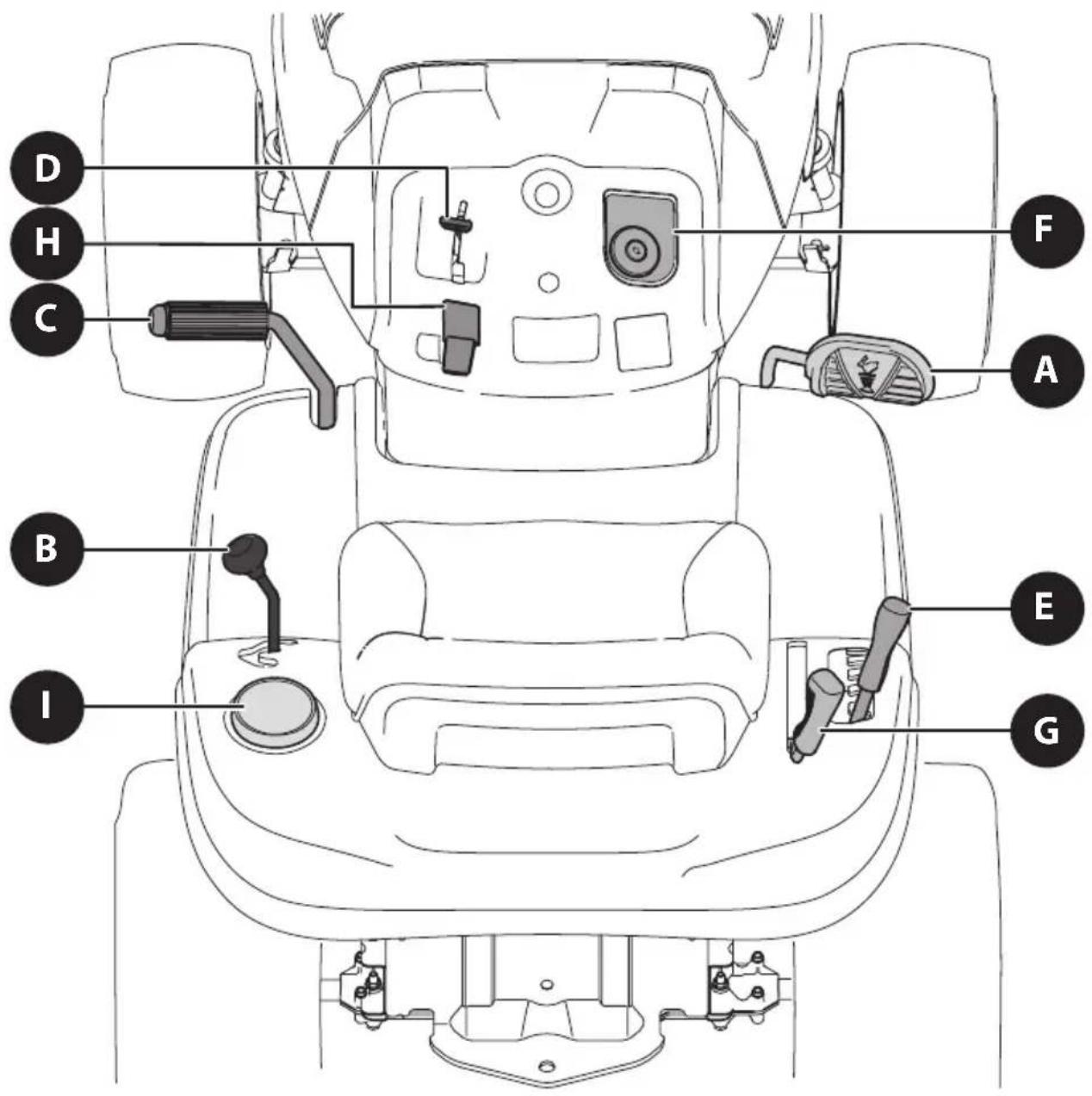
Figure 14
NOTE: This Operator's Manual covers several models. Tractor features may vary by model. Not all features in this manual are applicable to all tractor models and the tractor model depicted may differ from yours.
NOTE: All references in this manual to the left or right side and front or back of the tractor are from the operating position only. Exceptions, if any, will be specified.
A. DRIVE PEDAL (FOOT CONTROL CVT MODELS) (IF EQUIPPED)
Depress the drive pedal forward to allow the tractor to travel. The further forward the pedal is depressed, the faster the tractor will travel. The pedal will return to its original/neutral position when it is not depressed.
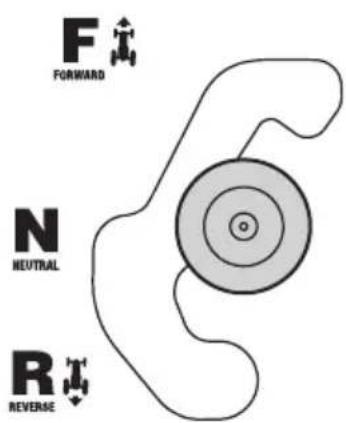
B. SHIFT LEVER
The shift lever is located on the left side of the fender and has three positions; FORWARD (F), NEUTRAL (N) and REVERSE (R). The brake pedal must be depressed and the tractor must not be in motion when moving the shift lever.
IMPORTANT! Never force the shift lever. Doing so may result in serious
damage to the tractor's transmission.
C. BRAKE PEDAL/CLUTCH-BRAKE PEDAL
Depress the brake pedal/clutch-brake pedal while the tractor is in use to stop the tractor, to shift and for setting the parking brake.
NOTE: The brake pedal/clutch-brake pedal must be fully depressed to start the tractor. Refer to Safety Interlock System for more information.
D. THROTTLE OR THROTTLE/CHOKE CONTROL LEVER
Some models have an auto-choke feature. These models do not come with a manual choke function. Push the throttle or throttle/choke control lever forward to increase the engine speed. The tractor is designed to operate with the throttle/choke control lever at full throttle (FAST) when the tractor is being driven and the mower deck is engaged. Pull the throttle/choke control lever rearward to decrease the engine speed. When starting the engine, if equipped with a throttle/choke control lever, push the control lever fully forward into the "CHOKE" position. After starting and warming the engine, move the control lever rearward until you feel it move past the choke detent. Throttle is not meant to control unit speed, throttle should remain in high speed while operating blades.
E. DECK LIFT LEVER
The deck lift lever is used to raise and lower the deck. Pull the lever to the left out of the index notch and push downward to lower the deck, or pull upward to raise the deck. When the desired height is attained, move the lift lever to the right until fully engaged in the index notch.
F. IGNITION SWITCH MODULE

WARNING
Never leave a running tractor unattended. Always disengage PTO, set parking brake, stop tractor, and remove the key to prevent unauthorized operation.
Refer to Starting the Engine for information on how to start the engine. Refer to Stopping the Engine for instructions on how to stop the engine.
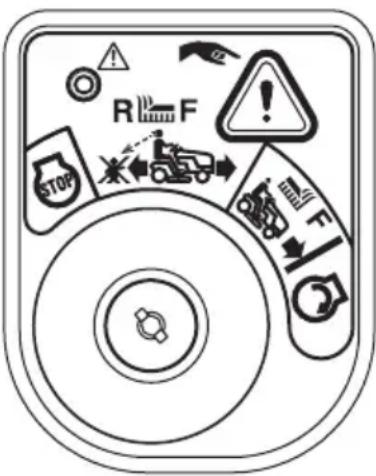

CAUTION
Prior to operating the tractor, refer to both Stopping the Engine and Starting the Engine in the Operation section of this manual for detailed instructions regarding the ignition switch module and operating the tractor in REVERSE CAUTION MODE
G. PTO (BLADE ENGAGE) LEVER
The PTO (blade engage) lever engages power to the cutting deck or other (separately available) attachments. See Engaging the PTO (Blade Engage) section for information and instructions on using the PTO.
The park brake or park brake/CVT drive control lever is used to engage the parking brake and set the drive speed of CVT models. Refer to the Driving the Tractor section of this manual for detailed instructions regarding the parking brake.
NOTE: The parking brake must be set if the operator leaves the seat with the engine running or the engine will automatically shut off.
I. CUP HOLDER
The cup holder is located to the left of the operator's seat.
HEADLIGHTS (NOT SHOWN)
On some tractors the lights are ON whenever the ignition key is rotated out of the STOP position. The lights turn OFF when the ignition key is moved to the STOP position.
On some tractors the lights are ON only while the engine is running. Turning the tractor OFF will turn the lights OFF.
The headlights may flicker briefly as the tractor is turned OFF.
OPERATION
Before Operating Your Tractor
- Before operation, refer to the Maintenance Schedule chart located in this manual for regularly scheduled service items.
- This engine is certified to operate only on clean, fresh, unleaded gasoline. Fill only with clean, fresh, unleaded gasoline with a pump sticker octane rating of 87 or higher.
- Do not use gasoline left over from the previous season, to minimize gum deposits in the fuel system.
- Gasohol (up to 10% ethyl alcohol, 90% unleaded gasoline by volume) is an approved fuel. Other gasoline/alcohol blends are not approved.
- Methyl Tertiary Butyl Ether (MTBE) and unleaded gasoline blends (up to a maximum of 15% MTBE by volume) are approved fuels. Other gasoline/ether blends are not approved.
Safety Interlock System

WARNING
Do not operate the tractor if the safety interlock system is malfunctioning. This system was designed for your safety and protection.
This tractor is equipped with a safety interlock system for the protection of the operator. If the safety interlock system should ever malfunction, do not operate the tractor. Contact an authorized service dealer.
- The safety interlock system prevents the engine from cranking or starting unless the parking brake is engaged or the operator is in the seat and the brake pedal is fully depressed, with the PTO (blade engage) lever in the disengaged (OFF) position.
- The engine will automatically shut OFF if the operator leaves the seat before engaging the parking brake.
- The engine will automatically shut OFF if the operator leaves the tractor's seat with the PTO (blade engage) lever in the ENGAGED (ON) position, regardless of whether the parking brake is engaged.
- With the ignition key in the NORMAL DRIVING MODE position, the engine will automatically shut OFF if the PTO (blade engage) lever is moved into the ENGAGED (ON) position with the speed control in REVERSE (R) position.
Checking the Safety Interlock Circuits
Periodically check the safety interlock circuits to ensure they are working properly. If a safety circuit is not working as designed, contact your authorized service dealer to have the tractor inspected. Do NOT operate the tractor if any safety circuit is not functioning properly. To check the safety circuits, proceed as follows:
- With the engine off and sitting in the seat, place the PTO (blade engage) lever in the ENGAGED (ON) position. Momentarily turn the ignition switch module to the START position; the engine should not crank.
- With the tractor running, and the parking brake not engaged; lift upward from the operator's seat. The engine should stop.
- With the parking brake engaged, engage the PTO. Lift upward from the operator's seat; the engine should stop.
Starting the Engine

CAUTION
The operator should be sitting in the tractor seat when starting the engine.
- Insert the ignition key into the ignition switch module.
- Place the PTO (blade engage) lever in the OFF position.
-
Engage the tractor's parking brake.
-
Push the throttle control upward. If equipped with a throttle/choke control lever, push the throttle/choke control lever past the detent, to engage the choke.
NOTE: If the engine is warmed up, it may not be necessary to choke the engine.
- Turn the ignition key clockwise to the START position. After the engine starts, release the key. It will return to the NORMAL MOWING MODE position.

CAUTION
Do not hold the key in the START position for longer than ten seconds at a time. Doing so may cause damage to your engine's electric starter.
- For models equipped with a throttle/choke control lever: as the engine warms up, gradually pull the throttle/choke control lever rearward past the choke detent position. Do not use the choke position to enrich the fuel mixture, except as necessary to start the engine.
- Allow the engine to run for a few minutes at mid-throttle before putting the engine under load.
NOTE: When operating the tractor be certain that the throttle lever is always in the FAST position.
Using Jumper Cables to Start the Engine

WARNING
Batteries contain sulfuric acid and produce explosive gases. Make certain the area is well ventilated, wear gloves and eye protection, and avoid sparks or flames near the battery.
If the battery charge is not sufficient to crank the engine, recharge the battery. If a battery charger is unavailable and the tractor must be started, the aid of a booster battery will be necessary. Connect the booster battery as follows:
- Connect one end of the red cable to the disabled tractor battery's positive terminal; then connect the other end of that cable to the booster battery's positive terminal.
- Connect one end of the black cable to the booster battery's negative terminal; then connect the other end of that cable to the frame of the disabled tractor, as far from the battery as possible.
- Start the disabled tractor following the normal starting instructions previously provided; then disconnect the jumper cables in the exact reverse order of their connection.
- Have the tractor's electrical system checked and repaired as soon as possible to eliminate the need for jump starting.
OPERATION
Stopping the Engine
- If the blades are engaged, place the PTO (blade engage) lever in the OFF position.
- Engage the tractor parking brake.
- Place the throttle control to midway between the FAST and SLOW positions.
- Turn the ignition key counter-clockwise to the STOP position.
DRIVING THE TRACTOR

WARNING
Keep all movement of the drive pedal (if equipped), speed control lever (if equipped), and brake pedal slow and smooth. Abrupt movement of the drive control or brake pedal can affect the stability of the tractor and could cause the tractor to flip over, which may result in serious injury or death to the operator.
Sharp turns can affect control of the tractor. ALWAYS slow the tractor before making sharp turns.
Do not leave the seat of the tractor without first placing the PTO (blade engage) lever in the DISENGAGED (OFF) position and engaging the parking brake. If leaving the tractor unattended, also turn the engine off and remove the ignition key.
CVT
- Move the throttle into the FAST position.
- Depress the clutch-brake pedal and move the park brake/CVT drive control lever to the desired speed setting to take the tractor out of PARK and set the drive speed.
IMPORTANT! First-time operators should use speed positions 1 or 2. Become completely familiar with the tractor's operation and controls before operating the tractor in higher speed positions. - Place the shift lever in either the FORWARD (F) or REVERSE (R) position.

WARNING
Do NOT use the shift lever to change the direction of travel when the tractor is in motion. Always use the clutch-brake pedal to bring the tractor to a complete stop before shifting.
- Release clutch-brake pedal slowly to put the tractor into motion.
- To stop, depress the clutch-brake pedal.
If tractor stalls with speed control in high speed, or if tractor will not operate with speed control lever in a low speed position, proceed as follows: - Depress the clutch-brake pedal.
-
Place shift lever in NEUTRAL (N).
-
Restart engine.
- Place CVT drive control lever in highest speed position.
- Release clutch-brake pedal fully.
- Depress clutch-brake pedal.
- Place CVT drive control lever in desired position.
- Place shift lever in either FORWARD (F) or REVERSE (R), and follow normal operating procedures.
Foot Control CVT
- Move the throttle into the FAST position.
- Depress the brake pedal and move the park brake/CVT drive control lever out of the PARK position.
- Place the shift lever in either the FORWARD (F) or REVERSE (R) position.
- Release clutch-brake pedal fully.
- Gradually begin to apply pressure to the drive pedal. The further down the pedal is pushed, the faster the tractor will travel in the desired direction based on the position of the shift lever.
- Stop the tractor by releasing the drive pedal and then depressing the brake pedal.
NOTE: The parking brake must be set if the operator leaves the seat with the engine running or the engine will automatically shut off.
To set the parking brake:
- Depress clutch-brake pedal completely down with your left foot and hold it in that position.
- Move the park brake lever (Foot Control CVT models) or park brake/CVT drive control lever (CVT models) all the way down and into the park brake engaged position.
- Remove your foot from the clutch-brake pedal.
After completing Step 3, the brake pedal should remain in the down position. If it does not, the parking brake is not engaged. Repeat Steps 1-3 to engage the parking brake.
Depress the brake pedal/clutch-brake pedal and move the park brake or park brake/CVT drive control lever out of the ENGAGED position and into the DISENGAGED position for Foot Control CVT models. For CVT models, depress the brake pedal/clutch-brake pedal and move the parking brake lever out of the ENGAGED position and into the desired speed setting.
OPERATION
REVERSE CAUTION MODE (IF EQUIPPED)
The REVERSE CAUTION MODE position of the ignition switch module allows the tractor to be operated in reverse with the PTO (blade engage) lever in the engaged (ON) position.
NOTE: Mowing in reverse is not recommended.

WARNING
Use extreme caution while operating the tractor in the REVERSE CAUTION MODE. Always look down and behind before and while backing. Do not operate the tractor when children or others are around. Stop the tractor immediately if someone enters the area.
To use the REVERSE CAUTION MODE:
NOTE: The operator MUST be seated in the tractor seat.
- Start the engine as previously instructed.
- Turn the ignition key from the NORMAL MOWING MODE (a) position to the REVERSE CAUTION MODE (b) position of the ignition switch module (Figure 15).
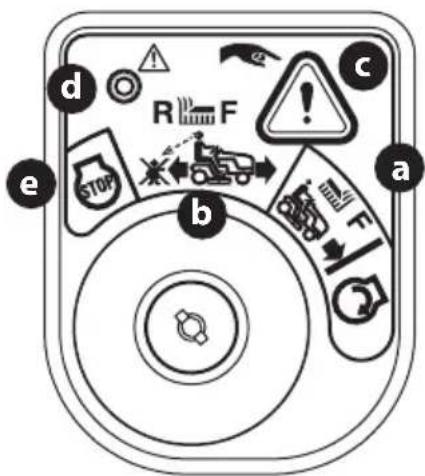
Figure 15
- Press and hold the REVERSE CAUTION MODE BUTTON (c) at the top, right corner of the ignition switch module for 3 seconds. The red indicator light (d) at the top, left corner of the ignition switch module will be ON while activated (Figure 15).
- Once activated (indicator light ON), the tractor can be driven in reverse with the PTO (blade engage) in the ENGAGED (ON) position.
- Always look down and behind before and while backing up slowly to make sure no children are around. After resuming forward motion, return key to the NORMAL MOWING MODE (a) position to return to normal mowing operation (Figure 15).
The REVERSE CAUTION MODE (b) will remain activated until (Figure 15):
a. The key is placed in either the NORMAL MOWING MODE (a) position or STOP (e) position.
b. The operator leaves the seat/the parking brake is set (manual PTO).
ENGAGING THE PTO (BLADE ENGAGE)
Engaging the PTO (blade engage) transfers power to the cutting deck. To engage the PTO:
- Move the throttle to the FAST position.
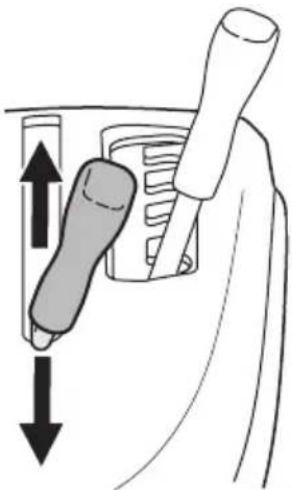
- Push the PTO (blade engage) lever forward into the engaged (ON) position (Figure 16).
natural_image
Illustration of a hand holding a tool with an upward arrow and downward arrow indicating movement (no text or symbols)Figure 16
- To disengage the PTO (blade engage), pull the lever backward, into the disengaged PTO (blade engage) OFF position.
OPERATION
MOWING

WARNING
To help avoid blade contact or a thrown object injury, keep bystanders, helpers, children, and pets at least 75 feet (23 meters) from the machine while it is in operation. Stop machine if anyone enters the area.

WARNING
Make certain the area to be mowed is free of debris, sticks, stones, wire, or other objects that can be thrown by the rotating blades.
NOTE: Do not engage the mower deck when lowered in grass. Premature wear and possible failure of the "V" belt and PTO clutch will result. Fully raise the deck or move to a non-grassy area before engaging the mower deck.
- Mow up and down slopes, not across. If mowing a slope, start at bottom and work upward to ensure turns are made uphill.
- Do not mow at high ground speed, especially if a mulch kit or grass collector is installed.
- Do not cut the grass too short. Short grass is prone to weed growth and yellows quickly in dry weather.
- Always operate the tractor with the throttle in the FAST position while mowing.
- On the first pass, pick a point on the opposite side of the area to be mowed. Follow the point to maintain a straight line.
- Engage the PTO and move the throttle control or throttle/choke control to the FAST position.
- Lower the mower deck to the desired height setting.
- For best results it is recommended that the first two laps be cut with the discharge thrown towards the center. After the first two laps, reverse the direction to throw the discharge to the outside for the balance of cutting. This will give a better appearance to the lawn.
NOTE: The speed of the tractor will affect the quality of the mower cut. Mowing at full speed will adversely affect the cut quality.
- Your tractor is designed to cut normal residential grass of a height no more than 10 inches (25 cm). Do not attempt to mow through unusually tall, dry grass (e.g., pasture) or piles of dry leaves. Dry grass or leaves may contact the engine exhaust and/or build up on the tractor.
- Do not attempt to mow heavy brush and weeds or extremely tall grass. Your tractor is designed to mow lawns, not clear brush.
- Keep the blades sharp and replace the blades when worn.
- When approaching the other end of the strip, slow down or stop before turning. A three point turn is recommended.
- Align the tractor with an edge of the mowed strip and overlap approximately 3 inches (7.6 cm).
- Direct the tractor on each subsequent strip to align with a previously cut strip.
- To prevent rutting or grooving of the turf, if possible, change the direction that the strips are mowed by approximately 45^ for the next and each subsequent mowing.
When stopping the tractor for any reason while on a grass surface, always:
- Engage the parking brake.
- Shut engine off and remove the ignition key.
- Doing so will minimize the possibility of having your lawn "browned" by hot exhaust from your tractor's running engine.
PRODUCT CARE
MAINTENANCE SCHEDULE

WARNING
Before performing any type of maintenance/service, disengage all controls and stop the engine. Wait until all moving parts have come to a complete stop. Allow the engine to cool. Disconnect spark plug wire(s) and negative battery cable to prevent unintended starting. Always wear safety glasses during operation or while performing any adjustments or repairs.
Follow the Maintenance Schedule given below. This chart describes service guidelines only. Refer to the Engine Operator's Manual for engine maintenance items listed in the table below.
| Before Each Use | After First 5 Hours | Every 10 Hours | Every 25 Hours | Every 50 Hours | Every 100 Hours | Every 200 Hours | Prior to Storing | See Engine Manual | |
| Check/Clean Engine Intake Screens & Cooling Fans # | √ | √ | |||||||
| Check/Clean Exhaust Manifold, Muffler Pipe & Muffler Shields # | √ | √ | |||||||
| Check/Clean Top & Underside of Deck, Under & Around Spindle Covers & Belt Area # | √ | √ | |||||||
| Check/Clean Around Fuses, Wiring & Wiring Harnesses # | √ | √ | |||||||
| Check/Clean Around Transmission, Axle & Fans # | √ | √ | |||||||
| Check Air Filter for Dirty, Loose or Damaged Parts | √ | ||||||||
| Check Engine Oil Level | √ | ||||||||
| Clean Battery Terminals | √ | √ | |||||||
| Grease All Lubrication Points | √ | √ | |||||||
| Check Engine Intake Screen/Clean as Needed | √ | √ | |||||||
| Check Blades/Sharpen or Replace as Needed | √ | √ | |||||||
| Check Tire Pressure | √ | √ | |||||||
| Check/Clean Underside of Deck | √ | ||||||||
| Check Safety Interlock System | √ | √ | |||||||
| Check Mower Blade Stop Time | √ | √ | |||||||
| Inspect & Lube Deck Wheels | √ | √ | |||||||
| Check Deck Level/Pitch | √ | √ | |||||||
| Check Belts & Pulleys for Damage/Wear | √ | ||||||||
| Check that All Hardware is in Place & Secure | √ | ||||||||
| Check Engine Mounting Bolt Torque (Tighten to 325-450 in-lbs (37-50 N-m)) | √ | √ | √ |
PRODUCT CARE
| Before Each Use | After First 5 Hours | Every 10 Hours | Every 25 Hours | Every 50 Hours | Every 100 Hours | Every 200 Hours | Prior to Storing | See Engine Manual | |
| Check Blade Mount Nut Torque (Tighten to 70-90 ft-lbs (95-122 N-m)) | √ | √ √ | |||||||
| Check Spark Plug Condition & Gap | √ | √ √ | |||||||
| Engine Break-In Oil Change | √ | √ | |||||||
| Change Engine Oil | √ | √ √ | |||||||
| Check Fuel System (Lines, Tank, Cap, Fittings) | √ | √ √ | √ | ||||||
| Check Spark Arrestor | √ | √ √ | √ | ||||||
| Replace Oil Filter | √ | √ √ | |||||||
| Clean or Change Air Filter | √ | √ | |||||||
| Replace Fuel Filter | √ | √ | |||||||
| Have Valve Lash Checked & Adjusted* | √ |
* -- Have this item performed by an authorized service dealer
NOTE: This Operator's Manual covers several models. Tractor features may vary by model. Not all features in this manual are applicable to all tractor models and the tractor depicted may differ from yours.
After each operation of the tractor, the following procedures should be implemented to extend the life of your tractor and ensure safe operating conditions.

WARNING
Failure to follow these recommendations may result in serious injury to yourself or others and may cause damage to the tractor.
CLEANING THE UNDERSIDE OF THE DECK
Deck Wash System (If equipped)
Your tractor's deck may be equipped with a water port on its surface as part of its deck wash system.
Use the deck wash system to rinse grass clippings from the deck's underside and prevent the buildup of corrosive chemicals. Complete the following steps AFTER EACH MOWING:
- Attach the nozzle adapter to a standard garden hose connected to a water supply.
- Move the tractor to an area within reach of the hose where the dispersal of wet grass clippings is acceptable. Disengage the PTO, engage the parking brake and stop the engine.
# -- Perform more often in dry conditions and/or when mulching
- Pull back the lock collar (a) of the nozzle adapter (b) and push the nozzle adapter onto the deck wash nozzle (c). Release the lock collar to lock the nozzle adapter on the deck wash nozzle (Figure 17).
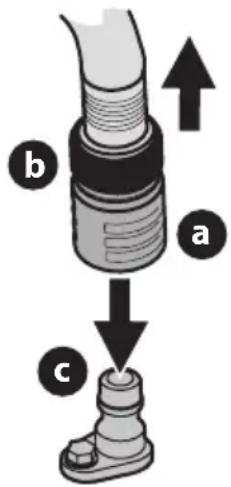
Figure 17
- Turn on the water supply.
- From the tractor operator's seat, start the engine and engage the PTO. Allow to run as needed. Disengage the PTO and stop the engine.
- Turn off the water supply.
- Pull back the lock collar of the nozzle adapter to disconnect the nozzle adapter from the deck wash nozzle.
PRODUCT CARE
CLEANING THE TRACTOR

WARNING
If the tractor has been recently run, the engine, muffler, and surrounding metal surfaces will be very hot and can cause burns to the skin. Let the engine cool for at least five minutes. Exercise caution to avoid burns.
Your tractor should be cleaned after each use and under certain conditions, i.e. dry conditions and/or mulching situations, additional cleaning may be necessary.
One of the best ways to keep your tractor running efficiently and to reduce fire risk is to regularly remove debris buildup from the tractor. Follow the recommendations below and contact your authorized dealer with any questions.
- Allow the tractor to cool at least five minutes in an open area before cleaning.
NOTE: Using a pressure washer or garden hose is not recommended for cleaning your tractor other than to clean the underside of the deck. It may cause damage to electrical components, spindles, pulleys, bearings or the engine. The use of water will result in shortened life and reduce serviceability.
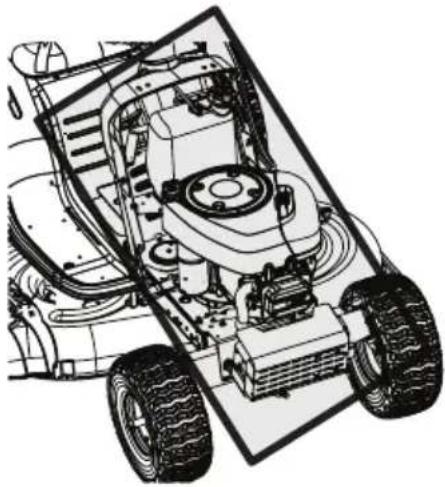
- Clean under the hood, including exhaust manifold, around fuses, all wiring and harnesses, muffler pipe, muffler shield, engine intake screens and cooling fins, etc (Figure 18).
natural_image
Technical line drawing of a tractor's front wheel assembly (no text or symbols)Figure 18
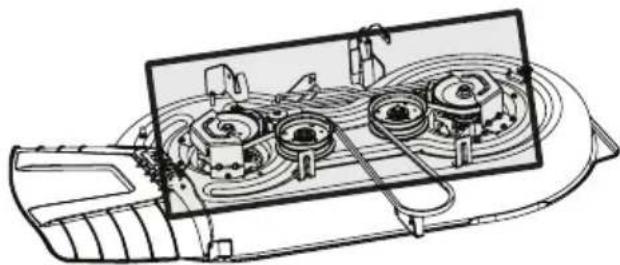
- Clean the top of the tractor deck, under the spindle covers, and belt area (Figure 19).
natural_image
Technical line drawing of a mechanical device with internal components and wiring (no text or symbols)Figure 19
- Clean around and near the transmission, axle and the fan area (Figure 20).
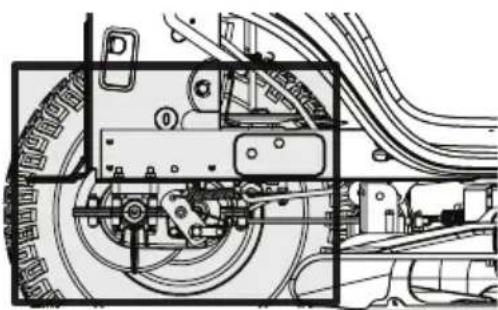
natural_image
Technical line drawing of a vehicle's internal components including tire, gear, and suspension system (no text or labels)Wheel Not Shown For Clarity
Figure 20
- Debris can accumulate anywhere on the tractor, especially on horizontal surfaces. Additional cleaning may be necessary when mowing in dry conditions or when mulching.
- Fuel leaks/spills, oil leaks/spills and excess lubrication can also become collection sites for debris. Immediate repair and cleaning up of oil or fuel spills can help reduce fire hazards.
- In addition to cleaning the tractor before operating and storing, do not attempt to mow unusually tall grass, 10 inches (25 cm) or higher, dry grass (e.g., pasture) or piles of dry leaves. Dry grass or leaves may contact the engine exhaust and/or build up on the tractor deck presenting a potential fire hazard.
STORING THE TRACTOR
- Allow the tractor to cool at least five minutes in an open area before storing.
- Do not park the tractor near any flammable materials (wood, cloth, or chemicals) or any open flames or other potential source of ignition (furnace, water heater or any other type of heater).
- Remove all combustible materials from the tractor before storing. Empty cargo boxes, grass catchers or containers.
• Always shut off fuel flow when storing or transporting if tractor is equipped with a fuel shutoff. - Check the fuel system (lines, tank, cap and fittings) frequently for cracks or leaks. Repair and clean as necessary.
MAINTENANCE
Engine

WARNING
Allow machine to cool in an open area for at least five minutes before storing or refueling.
Refer to the Engine Operator's Manual for all engine issues and questions.
NOTE: Maintenance, repair or replacement of the emission control devices and systems which are being done at owner's expense may be performed by any engine repair establishment or individual. Warranty repairs must be performed by an authorized dealer.
PRODUCT CARE
Changing Engine Oil

WARNING
If the tractor has been recently run, the engine, muffler, and surrounding metal surfaces will be very hot and can cause burns to the skin. Let the engine cool for at least five minutes. Exercise caution to avoid burns.
NOTE: The oil filter should be changed at every oil change interval.
OIL DRAIN TUBE MODELS
To complete the oil change, proceed as follows:
- Run the engine for a short time to warm the engine oil. The oil will flow more freely and carry away more impurities. Use care to avoid burns from hot oil.
- Open the tractor's hood and locate the oil drain port on the side of the engine.
- Place an appropriate oil collection container with at least a 2.5 quart (2.36 L) capacity below the opening of the oil drain tube, to collect the used oil. Remove the oil fill cap/dipstick from the oil fill tube.
- Open the protective cap on the end of the oil drain valve to expose the drain port (Figure 21).
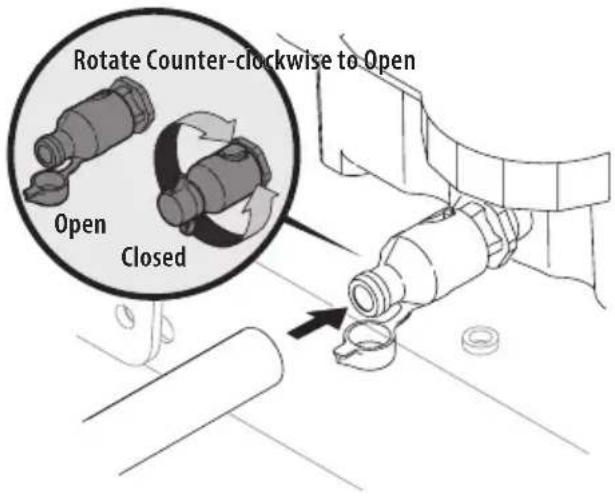
Figure 21
- Push the oil drain tube (packed with this manual) onto the oil drain port. Route the opposite end of the tube into an appropriate oil collection container with at least a 2.5 quart (2.36 L) capacity to collect the used oil.
-
The engine is equipped with a twist-and-pull drain port. Turn the oil drain valve 1/4-turn counter-clockwise, then pull outward to begin draining oil. After the oil has finished draining, push the end of the oil drain valve back in and turn 1/4-turn clockwise to close the oil drain. Re-cap the end of the oil drain valve to keep debris from entering the drain port.
-
Replace the oil filter, and refill the engine with new oil as instructed in the Engine Operator's Manual.
- Reinstall the oil fill cap/dipstick.
NOTE: Place an absorbent towel beneath the oil filter to keep oil off the engine pulley.
NOTE: Observe proper disposal laws and regulations for gas, oil, etc. to protect the environment.
NOTE: Maintenance, repair or replacement of the emission control devices and systems which are being done at the owner's expense may be performed by any engine repair establishment or individual. Warranty repairs must be performed by an authorized dealer.
OIL DRAIN SLEEVE MODELS
To complete the oil change, proceed as follows:
- Run the engine for a short time to warm the engine oil. The oil will flow more freely and carry away more impurities. Use care to avoid burns from hot oil.
- Open the tractor's hood and locate the oil drain port on the side of the engine.
- Place an appropriate oil collection container with at least a 2.5 quart (2.36 L) capacity below the opening of the oil drain tube, to collect the used oil. Remove the oil fill cap/dipstick from the oil fill tube.
- Snap the small end of the oil drain sleeve onto the oil sump (Figure 22).
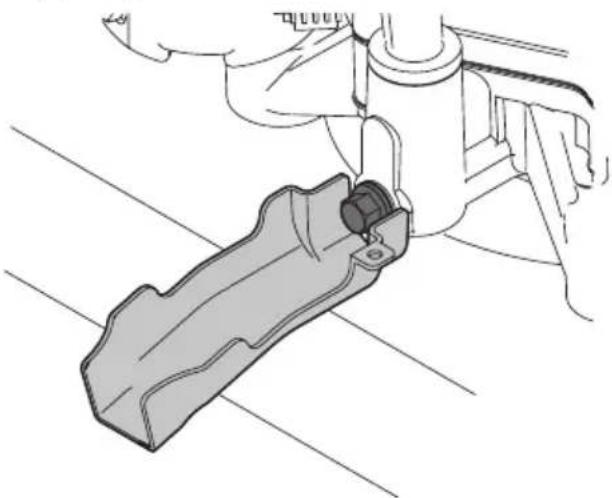
natural_image
Technical line drawing of a mechanical assembly with a component inserted into a housing (no text or symbols)Figure 22
- Remove drain plug and drain oil into collection container.
- Replace the oil filter as instructed in the separate Engine Operator's Manual.
- Reinstall oil drain plug and refill the engine with new oil as instructed in the Engine Operator's Manual.
- Reinstall the oil fill cap/dipstick.
LUBRICATION

WARNING
Before lubricating, repairing, or inspecting, always disengage PTO, set parking brake, stop engine, and remove key to prevent unintended starting.
Using a quality lubricating oil, lubricate all lubrication points. Refer to Maintenance Schedule chart located in this manual for proper service intervals.
Lubricating Pivot Points and Linkage
Lubricate all the pivot points on the drive system, parking brake and lift linkage per the Maintenance Schedule.
NOTE: It is not necessary to grease the steering pinion/sector gear interface. Doing so will allow dirt to accumulate and can affect steering performance.
Rear Wheels
The rear wheels should be removed from the axles once a season. Lubricate the axles and the rims with an all-purpose grease before re-installing them.
Front Axles (If equipped)
Each end of the tractor's front pivot bar may be equipped with a grease fitting. Lubricate with a No. 2 multi-purpose grease applied with a grease gun per the Maintenance Schedule (Figure 23).
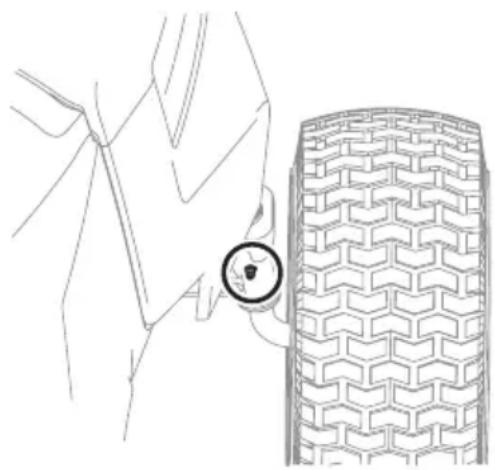
natural_image
Line drawing of a person's arm holding a magnifying glass over a brick-patterned tire (no text or symbols)Figure 23
SPARK ARRESTOR MAINTENANCE (IF EQUIPPED)
Spark arrestor assemblies must be inspected and cleaned periodically (see the Maintenance Schedule chart in this manual). Visually inspect the screen for tears, broken wires or loose welds. Replace the spark arrestor assembly if any of these conditions exist. If the screen is in good condition, clean the screen by brushing away loose dirt or carbon particles.
TIRES
Keep the tires inflated to the recommended pressures. Improper inflation will shorten the tire service life. See the tire side wall for proper inflation pressures. Refer to Maintenance Schedule chart located in this manual for proper service intervals.
Observe the following guidelines:
- Do not inflate a tire above the maximum pressure shown on the sidewall of the tire.
- Do not reinflate a tire that has been run flat or seriously under-inflated. Have it inspected and serviced by a qualified tire mechanic.
OFF-SEASON STORAGE
If your tractor is not going to be operated for an extended period of time (30 days to approximately six months), the tractor should be prepared for storage. Store the tractor in a dry and protected location. If stored outside, cover the tractor (including the tires) to protect it from the elements. The procedures outlined below should be performed whenever the tractor is placed in storage.
- Change the engine oil and filter following the instructions provided in this manual as well as the Engine Operator's Manual provided with this tractor.

WARNING
Never store the tractor with fuel in the tank indoors or in poorly ventilated enclosures, where fuel fumes may reach an open flame, spark, or pilot light as on a furnace, water heater, clothes dryer, etc.
- If storing the tractor for 30 days or more:
a. To prevent gum deposits from forming inside the engine's carburetor and causing possible malfunction of the engine, the fuel system must be either completely emptied, or the gasoline must be treated with a stabilizer to prevent deterioration.
b. Using a fuel stabilizer for storage between 30 and 90 days:
- Read the product manufacturer's instructions and recommendations.
- Add to clean, fresh gasoline the correct amount of stabilizer for the capacity of the fuel system.
- Fill the fuel tank with treated fuel and run the engine for 2-3 minutes to get stabilized fuel into the carburetor.
- Fuel left in the fuel tank deteriorates and will cause serious starting problems.
c. Emptying the fuel system for storage of more than 90 days:
- Prior to putting the tractor in storage, monitor fuel consumption with the goal of running the fuel tank empty.
PRODUCT CARE
- Run the engine until it begins to stall. Use the choke to keep the engine running until all fuel in the carburetor has been exhausted.
-
Referring to the Engine Operator's Manual, drain the fuel from the carburetor bowl.
-
Clean the engine and the entire tractor thoroughly.
NOTE: Using a pressure washer or garden hose is not recommended for cleaning your tractor other than to clean the underside of the deck. It may cause damage to electrical components, spindles, pulleys, bearings or the engine. The use of water will result in shortened life and reduce serviceability.
4. Fully charge the battery, then disconnect the negative cable at the battery to prevent possible discharge. Recharge the battery periodically when in storage.
NOTE: Remove the battery if exposed to prolonged periods of sub-freezing temperatures. Store in a cool, dry location where temperatures are above freezing.
- Lubricate all lubrication points.
REMOVING THE TRACTOR FROM STORAGE
- Check the engine oil.
- Fully charge the battery and inflate the tires to the recommended pressure. See tire side wall for proper tire inflation pressure.
- Fill the fuel tank with clean, fresh gasoline.
- Start the engine and allow to idle for a few minutes to ensure engine is operating properly.
- Drive the tractor without a load to make certain all the tractor systems are functioning properly.
LEVELING THE DECK (SIDE-TO-SIDE)

WARNING
Tractor blades are sharp. Wrap the blade or wear gloves, and use extra caution when servicing them.
- With the tractor parked on a firm, level surface, place the deck lift lever in the second notch from the top (second highest position) and rotate both blades so that they are perpendicular with the tractor.
- Measure the distance from the outside of the left blade tip to the ground and the distance from the outside of the right blade tip to the ground. Both measurements taken should be equal. If they are not, proceed to the next step.
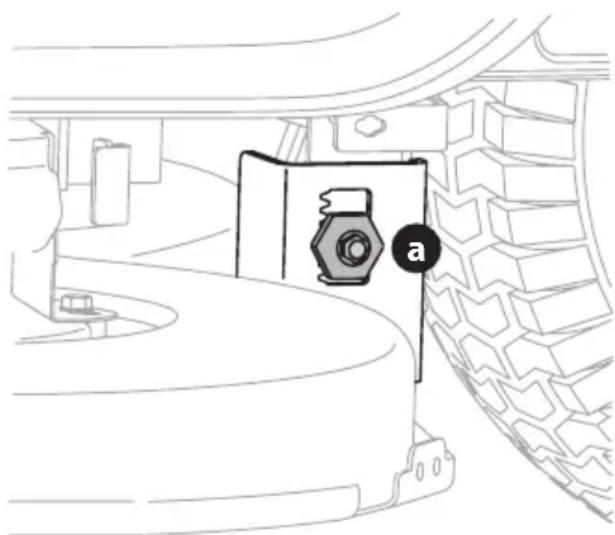
- Under the rear fenders inside the wheels there is a lift adjustment hex cap screw and gear for each side of the deck (Figure 24).
natural_image
Technical line drawing of a mechanical component with a labeled component 'a' (no text or symbols beyond label)Figure 24
- Loosen, but do NOT remove, the hex cap screw (a) on the left deck hanger bracket (Figure 24).
- Minor adjustments should be made to the adjustment gear immediately behind the hex cap screw loosened in the previous step (clockwise/up or counter-clockwise/down).
- When the proper adjustment is achieved, tighten the hex cap screw (a) on the left deck hanger bracket (Figure 24).
- The deck is properly balanced when both blade tip measurements taken earlier are equal.
LEVELING THE DECK (PITCH/FRONT-TO-REAR)

WARNING
Tractor blades are sharp. Wrap the blade or wear gloves, and use extra caution when servicing them.
The front of the deck is supported by a stabilizer bar that can be adjusted to level the deck from front to rear. The front of the deck should be 1/4-3/8 inch (6.35-9.5 mm) lower than the rear of the deck. Adjust if necessary as follows:
- Park the tractor on a firm, level surface, place the lever for lifting the platform on the second to the top notch (second highest position) and rotate the end of the blade nearest the discharge chute so that it is parallel with the tractor.
- Measure the distance from the front of the blade tip to the ground and the rear of the blade tip to the ground. The front of the deck should be between 1/4-3/8 inch (6.35-9.5 mm) less than the rear of the deck.
- Determine the approximate distance necessary for proper adjustment and proceed, if necessary.
- To raise the front of the deck, loosen the outer nut then tighten (thread inward) the inner nut against the front hanger bracket (Figure 25 on page 26). When proper adjustment is achieved, re-tighten the outer nut to 25-30 ft-lbs (34-41 N-m).
PRODUCT CARE
- To lower the front of the deck, loosen the outer nut then loosen (thread outward) the inner nut, away from the front hanger bracket (Figure 25). When proper adjustment is achieved, re-tighten the outer nut.
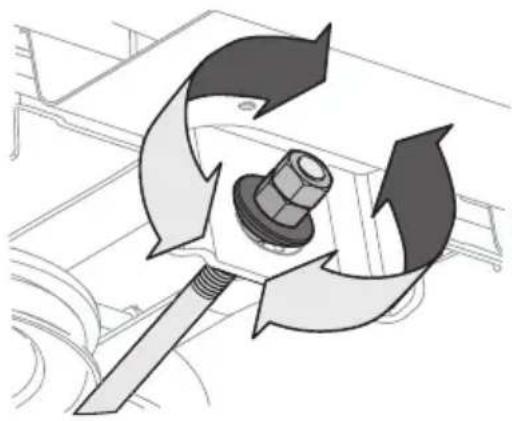
natural_image
Mechanical diagram showing a bolt and screw being moved in a circular motion, with no visible text or symbols.Figure 25
ADJUSTING THE DECK WHEELS
WARNING
Keep hands and feet away from the discharge opening of the cutting deck.
NOTE: The deck wheels are an anti-scalp feature of the deck and are not designed to support the weight of the deck.
The deck wheels should be approximately 1/4-1/2 inch (6.35-12.7 mm) above the ground when the deck is set in the desired height setting. To adjust the deck wheels see the Set-Up section for instructions.
SERVICE
Electrical System
A fuse is installed to protect the tractor's electrical system from damage caused by excessive amperage. Always use the same capacity fuse for replacement. If the electrical system does not function, check for a blown fuse.
If you have a recurring problem with blown fuses, have the tractor's electrical system checked by your authorized service dealer.
Relays and Switches
There are several safety switches in the electrical system. If a function of the safety interlock system described earlier is not functioning properly, have the electrical system checked by your authorized service dealer.
Parking Brake Adjustment
If the tractor does not come to a complete stop when the brake pedal is completely depressed, or if the tractor's rear wheels can roll with the parking brake applied, the brake is in need of adjustment. See your authorized service dealer to have the brake adjusted.
WHEEL ALIGNMENT
If your tractor pulls to one side or is out of alignment, a wheel alignment might be necessary. Contact an authorized service dealer to have the wheels properly aligned.
DECK REMOVAL
WARNING
Use caution to avoid pinching your fingers when rolling the belt off the PTO pulley.
To remove the cutting deck, proceed as follows:
- Move the tractor to a level surface, disengage the PTO, stop the engine and ENGAGE the parking brake.
- Lower the deck by moving the deck lift lever into the bottom notch on the right fender.
- Remove the belt-keeper rod (a), from around the tractor's engine pulley, by removing the self-tapping screw (b) that secures it (Figure 26).
NOTE: Make a note what hole the other end of the belt-keeper rod is inserted in for reinstallation purposes.
4. Remove the belt (c) from around the tractor's engine pulley and idler pulley(s) (Figure 26).
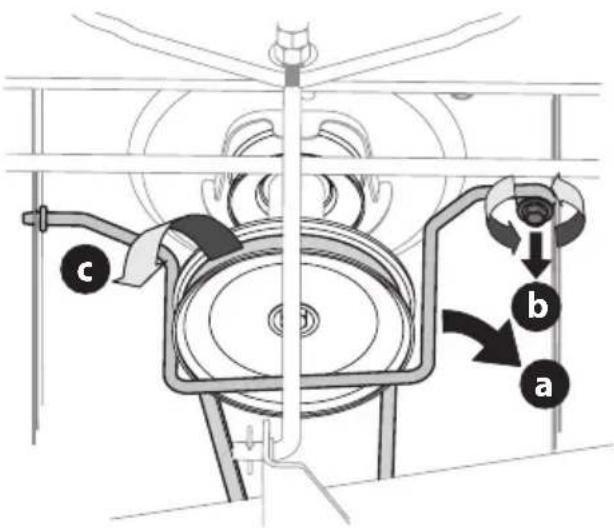
Figure 26
- Looking at the cutting deck from the left side of the tractor, locate the bow-tie pin (a) that secures the deck support rod (b) on the rear left side of the deck (Figure 27 on page 27). Remove the bow-tie pin (a) that secures the deck support rod (b), and carefully remove the deck support from the deck lift arm.
PRODUCT CARE
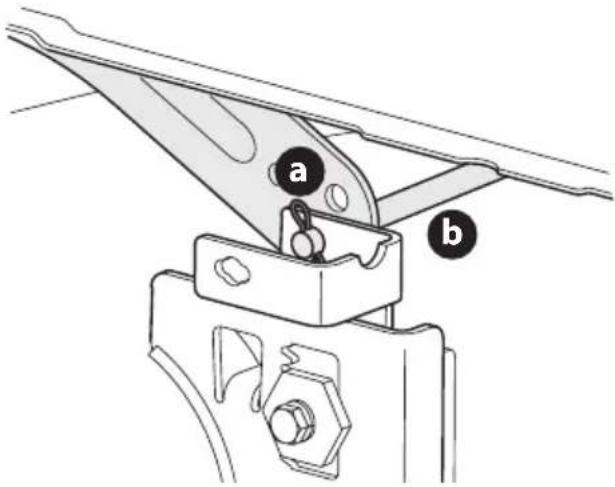
Figure 27
- Repeat Step 5 on the tractor's right side.
- Move the deck lift lever into the top notch on the right fender to raise the deck lift arms up and out of the way.
- On 36, 42 and 46 inch decks, remove the bow-tie pin (a) securing the deck stabilizer rod (b) to the deck. Slide the deck lift rod from the mounting weldment on the deck (Figure 28).
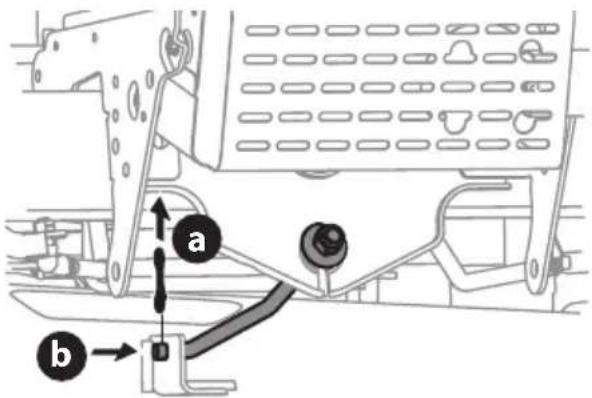
Figure 28
- Carefully remove the PTO cable (a) from the rear of the cutting deck by removing the bow-tie clip (b) which secures it. Remove the spring (c) from the deck idler bracket (Figure 29).
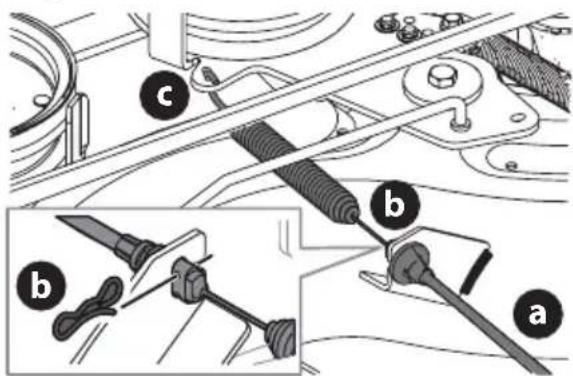
Figure 29
- Gently slide the cutting deck (from the left side) out from underneath the tractor.
NOTE: To reinstall the deck after service, reverse the order of deck removal Steps 1-11 in this section.
REMOVING THE BLADE
WARNING
Shut the engine off and remove ignition key before removing the cutting blade(s) for sharpening or replacement. Protect your hands by using heavy gloves when grasping the blade.
Periodically inspect the blade and/or spindle for cracks or damage, especially after striking a foreign object. Do not operate the tractor until damaged components are replaced.
If the cutting edge of the blade has previously been sharpened, or if any metal separation is present, replace the blades with new ones.
Star-Blade System (If equipped)
- Remove the deck from beneath the tractor, (refer to Deck Removal) then gently flip the deck over to expose its underside.
- Place a block of wood between the center deck housing baffle and the cutting blade to act as a stabilizer (Figure 30).
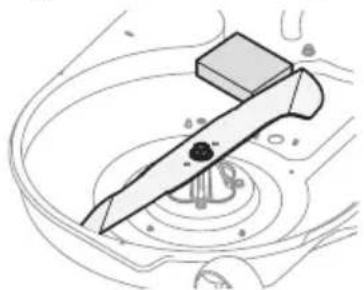
natural_image
Diagram of a mechanical device with a cutting tool and base, surrounded by concentric circular patterns (no text or symbols)Figure 30
- Remove the hex flange nut that secures the blade to the spindle assembly (Figure 30).
S-Blade System (If equipped)
- Remove the deck from beneath the tractor, (refer to Deck Removal) then gently flip the deck over to expose its underside.
- Place a block of wood (c) between the deck housing and the cutting edge of the blade (b) to help in breaking loose the hex nut (a) and washer (d)* securing the blade (b). Use a 15/16 inch wrench to loosen the hex nut (a) and washer (d)* (Figure 31).
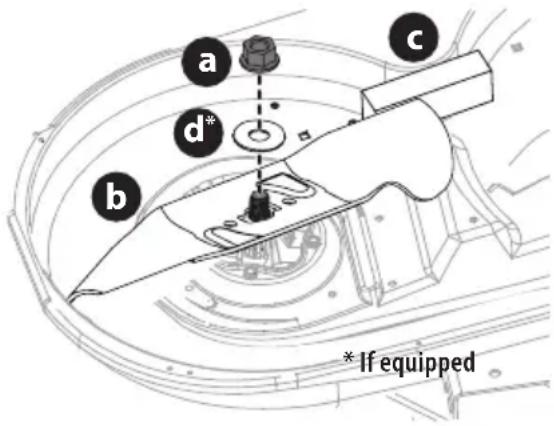
Figure 31
INSTALLING THE BLADE
Star-Blade System (If equipped)
- With the deck removed gently flip the deck over to expose its underside.
- Line up the hole in the center of the blade with the retainer at the bottom of the spindle assembly, and the side stamped with "grass-side", "Bottom" or with a part number, so that it will be facing the ground with the deck reinstalled and in the proper operating position.
- Place a block of wood between the deck housing baffle and the cutting blade to act as a stabilizer (Figure 30 on page 27).
- Thread on the hex flange nut to secure the blade to the spindle assembly. Use a torque wrench to tighten the blade spindle hex flange nut to 80-90 ft-lbs (95-122 N-m).
NOTE: When replacing or reinstalling the blade, be sure to install the blade with the side of the blade marked "grass-side", "Bottom" or with a part number stamped in it facing the ground.
S-Blade System (If equipped)
- With the deck removed gently flip the deck over to expose its underside.
- When re-installing blades, be sure of the following (Figure 31):
a. Blades (b) are installed so that wings are pointing upward toward the top of the deck.
b. Washer (d)* is placed between bottom of blade (b) and hex nut (a).
IMPORTANT! Align "S" shaped cutout with matching "S" shape on spindle for secure fit.
-
Tighten hex nuts (a) to 70-90 ft-lbs (95-122 N-m) (Figure 31).
-
Re-install the deck.
- To properly sharpen the cutting blades, remove equal amounts of metal from both ends of the blades along the cutting edges, parallel to the trailing edge, at a 25^ to 30^ angle. Always grind each cutting blade edge equally to maintain proper blade balance (Figure 32).
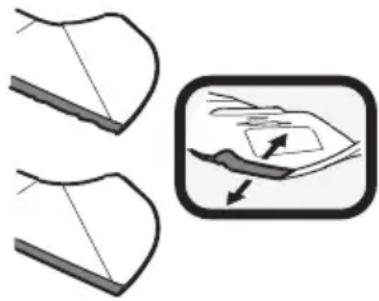
natural_image
Diagram showing two views of a mechanical component with an inset highlighting a section (no text or symbols)Figure 32
- Test the blade's balance using a blade balancer. Grind metal from the heavy side until it balances evenly.
WARNING
A poorly balanced blade will cause excessive vibration, may damage the tractor, and/or result in personal injury.
TROUBLESHOOTING
WARNING
Before performing any type of maintenance/service, disengage all controls and stop the engine. Wait until all moving parts have come to a complete stop. Allow the engine to cool. Disconnect spark plug wire(s) and negative battery cable to prevent unintended starting. Always wear safety glasses during operation or while performing any adjustments or repairs.
This section addresses minor service issues. To locate the nearest authorized service center consult the separate supplement sheet for contact information.
| Problem Cause | Remedy | |
| Engine fails to start | PTO (blade engage) lever engaged.Parking brake not engaged.Spark plug wire disconnected.Throttle control lever not in correct starting position.Fuel tank empty, or stale fuel.Blocked fuel line.Faulty spark plug.Engine flooded.Fuse(s) blown. | Place lever in disengaged (OFF) position.Engage parking brake.Connect wire to spark plug.Place throttle lever into the FAST position.Fill tank with clean, fresh (less than 30 days old) gas.Replace fuel line. See a qualified service dealer. Replace fuel filter. See the Product Care section.Clean, adjust gap or replace plug.Crank engine with throttle in FAST position.Replace fuse. |
| Engine runs erratically | Tractor running with CHOKE activated.Spark plug wires loose.Blocked fuel line or stale fuel.Vent in gas cap plugged.Water or dirt in fuel system.Dirty air cleaner. | Deactivate the CHOKE.Connect and tighten spark plug wires.Replace fuel line. See a qualified service dealer. Fill tank with clean, fresh gasoline and replace fuel filter. See the Product Care section.Clear vent or replace cap if damaged.Drain fuel tank. Refill with clean, fresh gasoline. See the Product Care section.Replace air cleaner paper element or clean foam pre-cleaner, if equipped. |
| Engine overheats 1. | Engine oil level low.Air flow restricted. | Fill engine with proper amount and type of oil.Clean grass clippings and debris from around the engine's cooling fins and housing. |
| Engine hesitates at high RPM | Spark plug gap too close. | Remove spark plug and adjust gap. |
| Engine idles rough 1. | Fouled spark plug.Dirty air cleaner. | Replace spark plug and adjust gap.Clean or replace air cleaner element and/or clean pre-cleaner. |
| Excessive vibration | Cutting blades loose or unbalanced.Damaged, dull or bent cutting blade. | Tighten blade and spindle. Balance blade.Replace blade. |
| Tractor will not mulch grass | Engine speed too low.Wet grass.Excessively high grass.Dull blade. | Place throttle in FAST position.Do not mulch when grass is wet.Mow once at a high cutting height, then mow again at desired height or make a narrower cutting swath.Sharpen or replace blade. |
| Uneven cut 1. Deck not leveled properly.Dull blade.Uneven tire pressure. | Perform side-to-side deck adjustment.Sharpen or replace blade.Check tire pressure in all four tires. | |
MANUAL DEL OPERADOR
Figura 2
Figura 3
Figura 4
natural_image
Technical line drawing of a car hood with ventilation grilles and ventilation grilles (no text or symbols)Figura 5
Figura 6
Figura 7
natural_image
Diagram of a car engine component with a handle and mounting bracket (no text or symbols)Figura 8
Figura 9
Figura 10
Figura 11
Figura 12
natural_image
Diagram showing a switch connected to an electrical meter with a magnified view of the switch mechanism (no text or symbols present)Figura 13
Figura 14
PRECAUCIÓN
FAROS (NO SE MUESTRAN)
Figura 15
natural_image
Diagram of a hand holding a pen and a measuring tool, with arrows indicating movement (no text or symbols)Figura 16
Figura 17
natural_image
Technical line drawing of a grassy tractor with visible engine and wheels (no text or symbols)Figura 18
natural_image
Technical line drawing of a mechanical assembly with gears and tubing (no text or symbols)Figura 19
natural_image
Technical line drawing of a mechanical assembly with a component inserted into a housing (no text or symbols)Figura 22
natural_image
Line drawing of a person using a pressure gauge to measure a brick tire (no text or symbols)Figura 23
MANTENIMIENTO DEL AMORTIGUADOR DE CHISPAS (SI SE INCLUYE)
natural_image
Diagram of a vehicle interior showing a vehicle with a mounted sensor or sensor device labeled 'a' (no text or symbols beyond the label)Figura 24
natural_image
Diagram of a mechanical assembly with a bolt and nut, showing rotational motion (no text or symbols)Figura 25
AJUSTE DE LAS RUEDAS DE LA PLATAFORMA
ADVERTENCIA
Figura 28
Figura 29
natural_image
Diagram of a mechanical device with rotating components and concentric circular patterns (no text or symbols)Figura 30
natural_image
Diagram showing two views of a boat with directional arrows indicating flow or movement (no text or symbols)Figura 32
Espagnol (Spanish) Page 30
Français......Page 62
Transmissio
Figure 1
DÉPLACEMENT MANUEL DE L'APPAREIL
Figure 2
Figure 3
Figure 4
INSTALLATION DU COUVERCLE DU CAPOT (SI NÉCESSAIRE/SI ÉQUIPÉ)
natural_image
Technical line drawing of a car hood with ventilation slots and ventilation grilles (no text or symbols)Figure 5
Figure 7
natural_image
Diagram of a lawn mower with attached frame and wheels, showing mechanical components without any text or symbols.Figure 8
Figure 9
Figure 10
Figure 11
Figure 12
Figure 13
Figure 14
ATTENTION
Figure 15
natural_image
Diagram showing a hand holding a tool with an arrow indicating downward motion (no text or symbols present)Figure 16
Figure 17
natural_image
Technical line drawing of a grassy tractor body showing engine, wheels, and structural components (no text or labels)Figure 18
natural_image
Technical line drawing of a mechanical assembly with gears and components (no text or symbols)Figure 19
natural_image
Technical line drawing of a mechanical component with a cylindrical part inserted into a housing (no text or symbols)Figure 22
natural_image
Line drawing of a person using a tool to inspect a brick tire (no text or symbols)Figure 23
ENTRETIEN DU PARE-ÉTINCELLES (SI ÉQUIPÉ)
natural_image
Technical line drawing of a mechanical component with a labeled section 'a' (no text or symbols beyond label)Figure 24
natural_image
Mechanical diagram showing a bolt and nut assembly with directional arrows indicating rotation (no text or symbols)Figure 25
RÉGLAGE DES ROUES DU PLATEAU DE COUPE
AVERTISSEMENT
Figure 26
Figure 28
Figure 29
natural_image
Diagram of a mechanical device with a central blade and surrounding circular components (no text or symbols)Figure 30
natural_image
Diagram showing two views of a boat being folded, with an inset highlighting the hull area (no text or symbols)Figure 32





- Front Engine Lawn Tractor
- Record Product Information
- Model Number
- Serial Number
- WARNING
- CALIFORNIA PROPOSITION 65
- ! DANGER
- GENERAL OPERATION
- OPERATING
- CHILDREN
- SLOPE OPERATION
- SAFE OPERATION PRACTICES
- SLOPE GAUGE (BACK COVER)
- FIRE AND FUEL
- HAULING
- TOWING
- SERVICE
- NOTICE REGARDING EMISSIONS
- SPARK ARRESTOR
- SAFETY SYMBOLS
- SET-UP
- MANUALLY MOVING THE TRACTOR
- INSTALL OPERATOR'S SEAT (IF NECESSARY)
- Knob Adjust or Bolt Adjust
- DASH SHROUD (IF EQUIPPED)
- ATTACHING THE HOOD TOPPER (IF NECESSARY/IF EQUIPPED)
- INSTALLING THE STEERING WHEEL (IF NECESSARY)
- LOWER DECK DISCHARGE CHUTE DEFLECTOR (IF EQUIPPED)
- 46-Inch Deck Models
- 42/50/54-Inch Deck Models
- SETTING THE DECK WHEELS (IF EQUIPPED)
- BATTERY INFORMATION
- CAUTION
- Connecting the Battery Cables
- MODELS WITH LEAD-ACID BATTERY
- MODELS WITH AGM BATTERY
- Battery Maintenance
- Battery Storage
- Battery Removal
- Charging the Battery
- ADJUSTING THE SEAT
- OIL
- OPERATION
- DRIVE PEDAL (FOOT CONTROL CVT MODELS) (IF EQUIPPED)
- SHIFT LEVER
- BRAKE PEDAL/CLUTCH-BRAKE PEDAL
- THROTTLE OR THROTTLE/CHOKE CONTROL LEVER
- DECK LIFT LEVER
- IGNITION SWITCH MODULE
- PTO (BLADE ENGAGE) LEVER
- CUP HOLDER
- HEADLIGHTS (NOT SHOWN)
- Before Operating Your Tractor
- Safety Interlock System
- Checking the Safety Interlock Circuits
- Starting the Engine
- Using Jumper Cables to Start the Engine
- Stopping the Engine
- DRIVING THE TRACTOR
- CVT
- Foot Control CVT
- REVERSE CAUTION MODE (IF EQUIPPED)
- ENGAGING THE PTO (BLADE ENGAGE)
- MOWING
- PRODUCT CARE
- MAINTENANCE SCHEDULE
- CLEANING THE UNDERSIDE OF THE DECK
- Deck Wash System (If equipped)
- CLEANING THE TRACTOR
- STORING THE TRACTOR
- MAINTENANCE
- Engine
- Changing Engine Oil
- OIL DRAIN TUBE MODELS
- OIL DRAIN SLEEVE MODELS
- LUBRICATION
- Lubricating Pivot Points and Linkage
- Rear Wheels
- Front Axles (If equipped)
- SPARK ARRESTOR MAINTENANCE (IF EQUIPPED)
- TIRES
- OFF-SEASON STORAGE
- REMOVING THE TRACTOR FROM STORAGE
- LEVELING THE DECK (SIDE-TO-SIDE)
- LEVELING THE DECK (PITCH/FRONT-TO-REAR)
- ADJUSTING THE DECK WHEELS
- Electrical System
- Relays and Switches
- Parking Brake Adjustment
- WHEEL ALIGNMENT
- DECK REMOVAL
- REMOVING THE BLADE
- Star-Blade System (If equipped)
- S-Blade System (If equipped)
- INSTALLING THE BLADE
- TROUBLESHOOTING
- MANUAL DEL OPERADOR
- PRECAUCIÓN
- FAROS (NO SE MUESTRAN)
- MANTENIMIENTO DEL AMORTIGUADOR DE CHISPAS (SI SE INCLUYE)
- AJUSTE DE LAS RUEDAS DE LA PLATAFORMA
- ADVERTENCIA
- DÉPLACEMENT MANUEL DE L'APPAREIL
- INSTALLATION DU COUVERCLE DU CAPOT (SI NÉCESSAIRE/SI ÉQUIPÉ)
- ATTENTION
- ENTRETIEN DU PARE-ÉTINCELLES (SI ÉQUIPÉ)
- RÉGLAGE DES ROUES DU PLATEAU DE COUPE
- AVERTISSEMENT
Brand : TROY-BILT
Model : Bronco 42I
Category : Tractor