R5011 - Drill RIDGID - Free user manual and instructions
Find the device manual for free R5011 RIDGID in PDF.



| Brand | Ridgid |
| Model | R5011 |
| Type | Hammer drill |
| Power | 120 V, 60 Hz, AC, 8.5 A |
| No-load speed | Low speed: 0-1,000 RPM High speed: 0-3,000 RPM |
| Blows per minute (hammer) | 0-19,000 / 0-57,000 CPM |
| Chuck capacity | 1/2 in (13 mm) keyed |
| Number of speeds | 2 (low and high) |
| Rotation direction | Forward / reverse |
| Safety clutch | Yes, limits torque |
| Auxiliary handle | Yes, 360° adjustable |
| Depth stop | Yes, adjustable |
| Trigger lock | Yes, for continuous drilling |
| Anti-vibration system | Yes |
| Double insulation | Yes |
| Weight (approx.) | 2.5 kg |
| Dimensions (L x W x H, approx.) | 30 x 20 x 8 cm |
| Warranty | 3-year limited + 90-day satisfaction |
| Applications | Hammer drilling (concrete, brick, masonry), drilling wood, metal, ceramic, plastic, fiberglass |
| Maintenance and cleaning | Clean with a dry cloth; avoid solvents; integrated lubrication |
| Safety | ANSI Z87.1 eye protection required; hearing protection recommended; dust mask if necessary; unplug before any adjustment |
| Replacement parts and serviceability | Use only genuine RIDGID parts; repairs by authorized center |
Frequently Asked Questions - R5011 RIDGID
User questions about R5011 RIDGID
0 question about this device. Answer the ones you know or ask your own.
Ask a new question about this device
Download the instructions for your Drill in PDF format for free! Find your manual R5011 - RIDGID and take your electronic device back in hand. On this page are published all the documents necessary for the use of your device. R5011 by RIDGID.
USER MANUAL R5011 RIDGID
natural_image
Line drawing of a drill bit with attached screwdriver and hose (no text or symbols)To register your RIDGID
product, please visit:
http://register.RIDGID.com
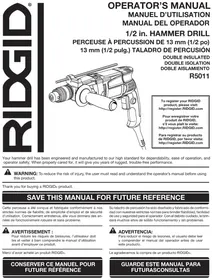
Your hammer drill has been engineered and manufactured to our high standard for dependability, ease of operation, and operator safety. When properly cared for, it will give you years of rugged, trouble-free performance.

WARNING: To reduce the risk of injury, the user must read and understand the operator's manual before using this product.
Thank you for buying a RIDGID® product.
SAVE THIS MANUAL FOR FUTURE REFERENCE
This product has many features for making its use more pleasant and enjoyable. Safety, performance, and dependability have been given top priority in the design of this product making it easy to maintain and operate.
* * *
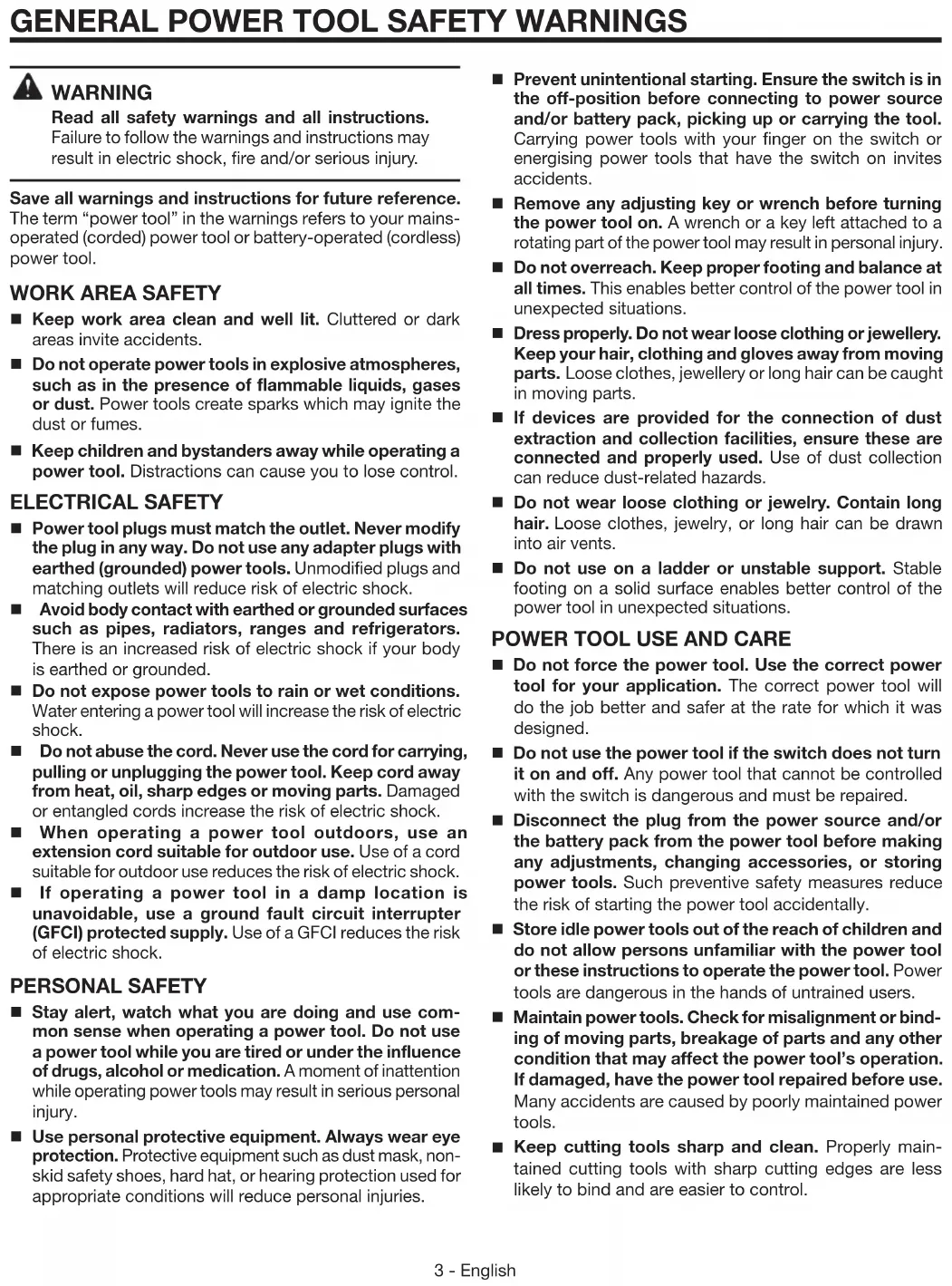
Read all safety warnings and all instructions.
Failure to follow the warnings and instructions may result in electric shock, fire and/or serious injury.
Save all warnings and instructions for future reference. The term “power tool” in the warnings refers to your mains-operated (corded) power tool or battery-operated (cordless) power tool.
WORK AREA SAFETY
- Keep work area clean and well lit. Cluttered or dark areas invite accidents.
■ Do not operate power tools in explosive atmospheres, such as in the presence of flammable liquids, gases or dust. Power tools create sparks which may ignite the dust or fumes. - Keep children and bystanders away while operating a power tool. Distractions can cause you to lose control.
ELECTRICAL SAFETY
■ Power tool plugs must match the outlet. Never modify the plug in any way. Do not use any adapter plugs with earthed (grounded) power tools. Unmodified plugs and matching outlets will reduce risk of electric shock.
■ Avoid body contact with earthed or grounded surfaces such as pipes, radiators, ranges and refrigerators. There is an increased risk of electric shock if your body is earthed or grounded.
■ Do not expose power tools to rain or wet conditions. Water entering a power tool will increase the risk of electric shock.
- Do not abuse the cord. Never use the cord for carrying, pulling or unplugging the power tool. Keep cord away from heat, oil, sharp edges or moving parts. Damaged or entangled cords increase the risk of electric shock.
■ When operating a power tool outdoors, use an extension cord suitable for outdoor use. Use of a cord suitable for outdoor use reduces the risk of electric shock.
If operating a power tool in a damp location is unavoidable, use a ground fault circuit interrupter (GFCI) protected supply. Use of a GFCI reduces the risk of electric shock.
PERSONAL SAFETY
■ Stay alert, watch what you are doing and use common sense when operating a power tool. Do not use a power tool while you are tired or under the influence of drugs, alcohol or medication. A moment of inattention while operating power tools may result in serious personal injury.
■ Use personal protective equipment. Always wear eye protection. Protective equipment such as dust mask, non-skid safety shoes, hard hat, or hearing protection used for appropriate conditions will reduce personal injuries.
■ Prevent unintentional starting. Ensure the switch is in the off-position before connecting to power source and/or battery pack, picking up or carrying the tool. Carrying power tools with your finger on the switch or energising power tools that have the switch on invites accidents.
■ Remove any adjusting key or wrench before turning the power tool on. A wrench or a key left attached to a rotating part of the power tool may result in personal injury.
■ Do not overreach. Keep proper footing and balance at all times. This enables better control of the power tool in unexpected situations.
■ Dress properly. Do not wear loose clothing or jewellery. Keep your hair, clothing and gloves away from moving parts. Loose clothes, jewellery or long hair can be caught in moving parts.
If devices are provided for the connection of dust extraction and collection facilities, ensure these are connected and properly used. Use of dust collection can reduce dust-related hazards.
■ Do not wear loose clothing or jewelry. Contain long hair. Loose clothes, jewelry, or long hair can be drawn into air vents.
■ Do not use on a ladder or unstable support. Stable footing on a solid surface enables better control of the power tool in unexpected situations.
POWER TOOL USE AND CARE
■ Do not force the power tool. Use the correct power tool for your application. The correct power tool will do the job better and safer at the rate for which it was designed.
■ Do not use the power tool if the switch does not turn it on and off. Any power tool that cannot be controlled with the switch is dangerous and must be repaired.
■ Disconnect the plug from the power source and/or the battery pack from the power tool before making any adjustments, changing accessories, or storing power tools. Such preventive safety measures reduce the risk of starting the power tool accidentally.
■ Store idle power tools out of the reach of children and do not allow persons unfamiliar with the power tool or these instructions to operate the power tool. Power tools are dangerous in the hands of untrained users.
- Maintain power tools. Check for misalignment or binding of moving parts, breakage of parts and any other condition that may affect the power tool's operation. If damaged, have the power tool repaired before use. Many accidents are caused by poorly maintained power tools.
- Keep cutting tools sharp and clean. Properly maintained cutting tools with sharp cutting edges are less likely to bind and are easier to control.
■ Use the power tool, accessories and tool bits etc. in accordance with these instructions, taking into account the working conditions and the work to be performed. Use of the power tool for operations different from those intended could result in a hazardous situation.
SERVICE
■ Have your power tool serviced by a qualified repair person using only identical replacement parts. This will ensure that the safety of the power tool is maintained.
■ When servicing a power tool, use only identical replacement parts. Follow instructions in the Maintenance section of this manual. Use of unauthorized parts or failure to follow Maintenance instructions may create a risk of shock or injury.
HAMMER DRILL SAFETY WARNINGS
■ Wear ear protectors with impact drills. Exposure to noise can cause hearing loss.
■ Use auxiliary handle(s), if supplied with the tool. Loss of control can cause personal injury.
- Hold power tool by insulated gripping surfaces, when performing an operation where the cutting accessory may contact hidden wiring or its own cord. Cutting accessory contacting a “live” wire may make exposed metal parts of the power tool “live” and could give the operator an electric shock.
- Know your power tool. Read operator's manual carefully. Learn its applications and limitations, as well as the specific potential hazards related to this tool. Following this rule will reduce the risk of electric shock, fire, or serious injury.
■ Always wear eye protection with side shields marked to comply with ANSI Z87.1 when assembling parts, operating the tool, or performing maintenance. Following this rule will reduce the risk of serious personal injury.
■ Protect your lungs. Wear a face or dust mask if the operation is dusty. Following this rule will reduce the risk of serious personal injury.
■ Protect your hearing. Wear hearing protectors during extended periods of operation. Following this rule will reduce the risk of serious personal injury.
■ Inspect tool cords periodically and, if damaged, have repaired at your nearest authorized service center. Constantly stay aware of cord location. Following this rule will reduce the risk of electric shock or fire.
- Check damaged parts. Before further use of the tool, a guard or other part that is damaged should be carefully checked to determine that it will operate properly and perform its intended function. Check for alignment of moving parts, binding of moving parts, breakage of parts, mounting, and any other conditions that may affect its operation. A guard or other part that is damaged should be properly repaired or replaced by an authorized service center. Following this rule will reduce the risk of shock, fire, or serious injury.
■ Make sure your extension cord is in good condition. When using an extension cord, be sure to use one heavy enough to carry the current your product will draw. A wire gauge size (A.W.G.) of at least 14 is recommended for an extension cord 50 feet or less in length. A cord exceeding 100 feet is not recommended. If in doubt, use the next heavier gauge. The smaller the gauge number, the heavier the cord. An undersized cord will cause a drop in line voltage resulting in loss of power and overheating.
■ Inspect for and remove all nails from lumber before using this tool. Following this rule will reduce the risk of serious personal injury.
If the power supply cord is damaged, it must be replaced only by the manufacturer or by an authorized service center to avoid risk.
■ Save these instructions. Refer to them frequently and use them to instruct others who may use this tool. If you loan someone this tool, loan them these instructions also.
| The following signal words and meanings are intended to explain the levels of risk associated with this product. | ||
| SYMBOL | SIGNAL | MEANING |
 | DANGER: | Indicates an imminently hazardous situation, which, if not avoided, will result in death or serious injury. |
 | WARNING: | Indicates a potentially hazardous situation, which, if not avoided, could result in death or serious injury. |
 | CAUTION: | Indicates a potentially hazardous situation, which, if not avoided, may result in minor or moderate injury. |
| NOTICE: | (Without Safety Alert Symbol) Indicates important information not related to an injury hazard, such as a situation that may result in property damage. | |
| Some of the following symbols may be used on this product. Please study them and learn their meaning. Proper interpretation of these symbols will allow you to operate the product better and safer. | ||
| SYMBOL | NAME | DESIGNATION/EXPLANATION |
 | Safety Alert Indicates a potential | personal injury hazard. |
 | Read Operator's Manual | To reduce the risk of injury, user must read and understand operator's manual before using this product. |
 | Eye Protection | Always wear eye protection with side shields marked to comply with ANSI Z87.1. |
 | Wet Conditions Alert Do not expose to rain or use in damp locations. | |
| V Volts Voltage | ||
| A Amperes Current | ||
| Hz Hertz Frequency (cycles per second) | ||
| min Minutes Time | ||
| ~ | Alternating Current Type of current | |
| no | No Load Speed Rotational speed, at no load | |
| ☐ | Class II Construction Double-insulated construction | |
| .../min Per Minute Revolutions, strokes, surface speed, orbits etc., per minute | ||
DOUBLE INSULATION
Double insulation is a concept in safety in electric power tools, which eliminates the need for the usual three-wire grounded power cord. All exposed metal parts are isolated from the internal metal motor components with protecting insulation. Double insulated tools do not need to be grounded.

WARNING:
The double insulated system is intended to protect the user from shock resulting from a break in the tool's internal wiring. Observe all normal safety precautions to avoid electrical shock.
NOTE: Servicing of a tool with double insulation requires extreme care and knowledge of the system and should be performed only by a qualified service technician. For service, we suggest you return the tool to your nearest authorized service center for repair. Always use original factory replacement parts when servicing.
ELECTRICAL CONNECTION
This tool has a precision-built electric motor. It should be connected to a power supply that is 120 volts, 60 Hz, AC only (normal household current). Do not operate this tool on direct current (DC). A substantial voltage drop will cause a loss of power and the motor will overheat. If the tool does not operate when plugged into an outlet, double-check the power supply.
EXTENSION CORDS
When using a power tool at a considerable distance from a power source, be sure to use an extension cord that has the capacity to handle the current the tool will draw. An undersized cord will cause a drop in line voltage, resulting in overheating and loss of power. Use the chart to determine the minimum wire size required in an extension cord. Only round jacketed cords listed by Underwriter's Laboratories (UL) should be used.
When working outdoors with a tool, use an extension cord that is designed for outside use. This type of cord is designated with "W-A" or "W" on the cord's jacket.
Before using any extension cord, inspect it for loose or exposed wires and cut or worn insulation.
**Ampere rating (on tool data plate)
0-2.0 2.1-3.4 3.5-5.0 5.1-7.0 7.1-12.0 12.1-16.0
| Cord Length | Wire Size (A.W.G.) | |||||
| 25' | 16 | 16 | 16 | 16 | 14 | 14 |
| 50' | 16 | 16 | 16 | 14 | 14 | 12 |
| 100' | 16 | 16 | 14 | 12 | 10 | — |
**Used on 12 gauge - 20 amp circuit.
NOTE: AWG = American Wire Gauge

WARNING:
Keep the extension cord clear of the working area. Position the cord so that it will not get caught on lumber, tools or other obstructions while you are working with a power tool. Failure to do so can result in serious personal injury.

WARNING:
Check extension cords before each use. If damaged replace immediately. Never use tool with a damaged cord since touching the damaged area could cause electrical shock resulting in serious injury.
PRODUCT SPECIFICATIONS
Input ......120 V, 60 Hz, AC only, 8.5 Amps
Hammer Speed 0-19,000/0-57,000 BPM
No Load Speed .... Low (0-1,000 r/min. (RPM)
High (0-3,000 r/min. (RPM)
KNOW YOUR HAMMER DRILL
See Figure 1, page 14.
The safe use of this product requires an understanding of the information on the tool and in this operator's manual as well as a knowledge of the project you are attempting. Before use of this product, familiarize yourself with all operating features and safety rules.
The anti-vibration system absorbs hammer impacts during operation.
AUXILIARY HANDLE ASSEMBLY
The drill is equipped with an auxiliary handle assembly for ease of operation and to prevent loss of control.
BLOWS PER MINUTE
This tool features an impact speed of 0-19,000/0-57,000 BPM (Blows Per Minute). Blows Per Minute is the number of impacts per minute.
CHUCK KEY
A chuck key has been provided for use when installing or removing bits and removing the chuck. When not in use, the chuck key can be placed in the chuck key holder.
CLUTCH
This drill features a clutch that limits the amount of torque transferred to the user. With an excessive load, the clutch will slip and make a ratcheting sound. The clutch disengages the bit from the gear train to reduce the chance of damage to the tool or of causing the user to lose control.
DEPTH STOP ROD
A depth stop rod has been supplied with this product to assist in controlling the depth of drilled holes.
DIRECTION OF ROTATION SELECTOR (FORWARD/REVERSE)
The drill has a direction of rotation (forward/reverse) selector located above the switch trigger for changing the direction of bit rotation.
LOCK-ON BUTTON
The lock-on button is convenient for continuous drilling for extended periods of time.
TWO-SPEED GEAR TRAIN
The two-speed gear train is designed for drilling or driving at LO (1) or HI (2) speeds. A slide switch is located on the side of your drill for selecting either LO (1) or HI (2) speed. Use low speed for high torque and high speed for faster operation during low torque applications.
VARIABLE SPEED
The variable speed switch trigger delivers higher speed with increased trigger pressure and lower speed with decreased trigger pressure.
CALIFORNIA PROPOSITION 65

WARNING:
This product and some dust created by power sanding, sawing, grinding, drilling, and other construction activities may contain chemicals, including lead, known to the State of California to cause cancer, birth defects, or other reproductive harm. Wash hands after handling.
Some example of these chemicals are:
- lead from lead-based paints,
- crystalline silica from bricks and cement and other masonry products, and
• arsenic and chromium from chemically-treated lumber.
Your risk from these exposures varies, depending on how often you do this type of work. To reduce your exposure to these chemicals: work in a well ventilated area, and work with approved safety equipment, such as those dust masks that are specially designed to filter out microscopic particles.
UNPACKING
This product requires assembly.
- Carefully remove the tool and any accessories from the box. Make sure that all items listed in the packing list are included.

WARNING:
Do not use this product if it is not completely assembled or if any parts appear to be missing or damaged. Use of a product that is not properly and completely assembled could result in serious personal injury.
- Inspect the tool carefully to make sure no breakage or damage occurred during shipping.
■ Do not discard the packing material until you have carefully inspected and satisfactorily operated the tool.
■ If any parts are damaged or missing, please call 1-866-539-1710 for assistance.
PACKING LIST
Hammer Drill
Depth Stop Rod
Auxiliary Handle
Tool Bag
Chuck Key
Operator's Manual

WARNING:
If any parts are damaged or missing do not operate this tool until the parts are replaced. Use of this product with damaged or missing parts could result in serious personal injury.

WARNING:
Do not attempt to modify this tool or create accessories not recommended for use with this tool. Any such alteration or modification is misuse and could result in a hazardous condition leading to possible serious personal injury.

WARNING:
Do not connect to power supply until assembly is complete. Failure to comply could result in accidental starting and possible serious personal injury.
INSTALLING AUXILIARY HANDLE ASSEMBLY
See Figure 2, page 14.
An auxiliary handle is packed with the drill for ease of operation and to help prevent loss of control.
■ Open the clamping ring by turning the handle counterclockwise.
■ Slide the ring of the auxiliary handle onto the spindle collar of the drill.
■ Tighten the auxiliary handle at the desired angle by turning the handle clockwise.
NOTE: For convenience the screw has been trapped inside the auxiliary handle.
To prevent thread damage and possible loss of control, the auxiliary handle should be checked periodically for tightness. Do not operate the drill with the handle loose.
INSTALLING THE DEPTH STOP ROD
See Figure 3, page 14.
Follow these steps to install the depth stop rod:
■ Depress the depth stop rod adjustment button.
■ Insert the depth stop rod as shown in figure 3.
■ Release the depth stop rod adjustment button.

WARNING:
Do not allow familiarity with tools to make you careless. Remember that a careless fraction of a second is sufficient to inflict severe injury.

WARNING:
Always wear eye protection marked to comply with ANSI Z87.1. Failure to do so could result in objects being thrown into your eyes resulting in possible serious injury.

WARNING:
Do not use any attachments or accessories not recommended by the manufacturer of this tool. The use of attachments or accessories not recommended can result in serious personal injury.
APPLICATIONS
You may use this tool for the purposes listed below:
■ Hammer drilling in concrete, brick, or other masonry
■ Drilling in wood
■ Drilling in ceramics, plastics, fiberglass, and laminates
■ Drilling in metals
SWITCH TRIGGER
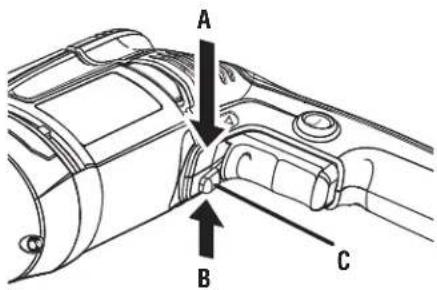
See Figure 4, page 14.
To turn the drill ON, depress the switch trigger. To turn it OFF, release the switch trigger.
VARIABLE SPEED
The variable speed switch delivers higher speed with increased trigger pressure and lower speed with decreased trigger pressure.
NOTE: You might hear a whistling or ringing noise from the switch during use. Do not be concerned; this is a normal part of the switch function.
DIRECTION OF ROTATION SELECTOR (FORWARD/REVERSE)
See Figure 5, page 14.
The direction of bit rotation is reversible and is controlled by a selector located above the switch trigger. With the drill held in normal operating position, the direction of rotation selector should be positioned to the left of the switch trigger for forward drilling. The drilling direction is reversed when the selector is to the right of the switch trigger.
NOTICE:
To prevent gear damage, always allow the chuck to come to a complete stop before changing the direction of rotation.
To stop the drill, release the switch trigger and allow the chuck to come to a complete stop.
NOTE: The drill will not run unless the direction of rotation selector is pushed fully to the left or right.
Avoid running the drill at low speeds for extended periods of time. Running at low speeds under constant usage may cause the drill to become overheated. If this occurs, cool the drill by running it without a load and at full speed.
TWO-SPEED GEAR SHIFT KNOB
See Figure 6, page 15.
The drill has a two-speed gear train designed for drilling or driving at LO (1) or HI (2) speeds. A switch is located on the side of the drill to select either LO (1) or HI (2) speed. When using drill in the LO (1) speed range, speed will decrease and unit will have more power. When using drill in the HI (2) speed range, speed will increase and unit will have less power. Use LO (1) speed for high power and torque applications and HI (2) speed for fast drilling or driving applications.
NOTICE:
Never change gears while the tool is running. Failure to obey this caution could result in serious damage to the drill.
If you have difficulty changing from one gear range to the other, turn the chuck by hand until the gears engage.
TO INSTALL BITS
See Figures 7 - 8, page 15.
■ Unplug the drill.
■ Insert the chuck key and twist counterclockwise.
■ Open or close the chuck jaws to a point where the opening is slightly larger than the bit size you intend to use. Also, raise the front of the drill slightly to keep the bit from falling out of the chuck jaws.

WARNING:
Make sure to insert the drill bit straight into the chuck jaws. Do not insert the drill bit into the chuck jaws at an angle then tighten, as shown in figure 8. This could cause the drill bit to be thrown from the drill, resulting in possible serious personal injury or damage to the chuck.
■ Insert the drill bit.
■ Tighten the chuck jaws securely on the drill bit, using the chuck key provided.
■ Remove the chuck key.
TO REMOVE BITS
See Figure 7, page 15.
■ Unplug the drill.
■ Loosen the chuck jaws using the chuck key provided.
■ Remove the drill bit.
■ Remove the chuck key.
USING THE AUXILIARY HANDLE ASSEMBLY
See Figure 9, page 15.
An auxiliary handle assembly is packed with the drill for ease of operation and to help prevent loss of control. The handle can be rotated 360^ , and it can also be mounted on the opposite side for left hand use.
To adjust the auxiliary handle assembly:
■ Loosen the auxiliary handle assembly by turning the knob counterclockwise.
■ Rotate the auxiliary handle assembly to the desired location.
■ Tighten the auxiliary handle assembly securely by turning the knob clockwise.
Be sure the handle assembly is securely tightened against the depth stop clamp. This secures the handle assembly.
NOTE: For convenience and ease of starting threads, the hex nut has been trapped inside the molded slot in the handle assembly.
ADJUSTING THE DEPTH STOP ROD
See Figure 9, page 15.
Follow these steps to adjust the depth stop rod.
■ Press the depth stop rod release button.
■ Adjust the depth stop rod so that the drill bit extends beyond the end of the rod to the required drilling depth.
■ Release the depth stop rod release button.
NOTE: When properly installed, the teeth on the depth stop rod should be aligned with the teeth indicator on the depth stop clamp.
Adjust the depth stop rod so that the drill bit extends beyond the end of the rod to the required drilling depth.
When drilling holes with the depth stop rod installed, the desired hole depth has been reached when the end of the rod comes in contact with the surface of the workpiece.
SELECTING HAMMER MODE OR DRILLING MODE
See Figure 10, page 15.
To adjust for type of drilling, slide the selector on top of the motor housing to hammer mode or drilling mode. The hammer mode symbol is on the right and the drill bit symbol is on the left.
NOTE: The hammer drill has not been designed for reverse hammering.
Use carbide-tipped bits and select hammer mode when drilling in hard materials such as brick, tile, concrete, etc.
Select normal drill mode when drilling with twist drills, hole saws, etc., in soft materials.
The hammer drill is equipped with an anti-vibration system that absorbs impacts while drilling. When sharp impacts happen, the hammer drill body will flex, as shown in figure 11.
LOCK-ON BUTTON
See Figure 12, page 15.
This drill is equipped with a lock-on feature, which is convenient for continuous drilling for extended periods of time.
To lock-on:
■ Depress the switch trigger.
■ Push in and hold the lock-on button, located on the side of the handle.
■ Release the switch trigger.
■ Release the lock-on button and the drill will continue running.
■ To release the lock, depress and release the switch trigger.
If the lock-on feature is engaged during use and the drill becomes disconnected from the power supply, disengage the lock-on feature immediately.
WARNING:
Before connecting the drill to a power supply source, always check to be sure it is not in lock-on position (depress and release the switch trigger). Failure to ensure that it is not locked-on could result in accidental starting of the drill resulting in possible serious injury. Do not lock the switch trigger in applications where the drill may need to be suddenly stopped.
Always use the auxiliary handle when using this tool to help resist torque reactions. Binding or stalling of this product could lead to serious personal injury.
■ Install the auxiliary handle.
■ Depress and release the switch trigger to be sure the drill is in the OFF position before connecting it to a power supply.
- Check the direction of rotation selector for the correct setting (forward or reverse).
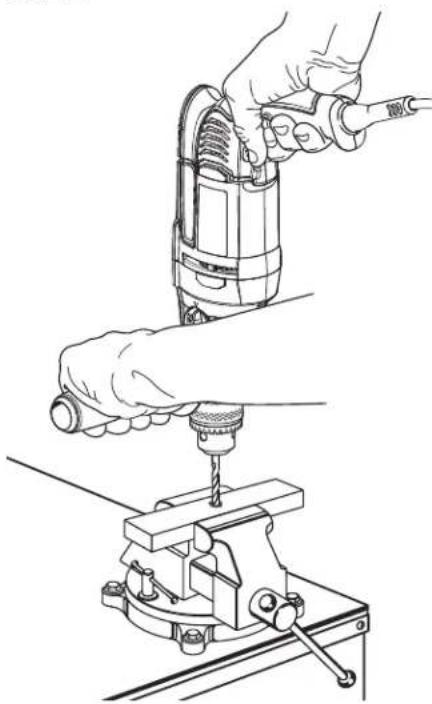
- Secure the material to be drilled in a vise or with clamps to keep it from turning as the drill bit rotates.
- Plug the drill into power supply. Hold the drill firmly and place the bit at the point to be drilled, or where the screw is to be driven.
■ Depress the switch trigger to start the drill.
■ Move the drill bit into the workpiece, applying only enough pressure to keep the bit cutting. Do not force the drill or apply side pressure to elongate a hole. Let the tool do the work.

WARNING:
Be prepared for binding at bit breakthrough. When these situations occur, the drill has a tendency to grab and kick in the opposite direction and could cause loss of control when breaking through material. If not prepared, this loss of control can result in possible serious injury.
■ When drilling hard, smooth surfaces, use a center punch to mark the desired hole location. This will prevent the drill bit from slipping off-center as the hole is started.
■ When drilling metals, use a light oil on the drill bit to keep it from overheating. The oil will prolong the life of the bit and increase the drilling action.
If the bit jams in the workpiece or if the drill stalls, stop the tool immediately. Remove the bit from the workpiece and determine the reason for jamming.
WOOD AND METAL DRILLING
For maximum performance, use high speed steel bits for wood or metal drilling. Select drilling mode. Begin drilling at a very low speed to prevent the bit from slipping off the starting point.
Wood Drilling
■ Increase the speed as the drill bit bites into the material.
■ When drilling through holes, place a block of wood behind the workpiece to prevent ragged or splintered edges on the back side of the hole.
Metal and Steel Drilling
■ Use a light oil on the drill bit to keep it from overheating. The oil will prolong the life of the bit and increase the drilling action.
- Maintain a speed and pressure which allows cutting without overheating the bit. Applying too much pressure will:
• Overheat the drill;
- Wear the bearings;
- Bend or burn bits; and
- Produce off-center or irregular-shaped holes.
■ When drilling large holes in metal, start with a small bit, then finish with a larger bit.
MASONRY DRILLING
For maximum performance, use carbide-tipped masonry impact bits or designated hammer drill bits when drilling holes in brick, tile, concrete, etc. Select hammer mode.
■ Apply light pressure at medium speed for best results in brick.
■ Apply additional pressure for hard materials such as concrete.
■ When drilling holes in tile, practice on a scrap piece to determine the best speed and pressure. Begin drilling at a very low speed to prevent the bit from slipping off the starting point.

WARNING:
When servicing use only identical RIDGID replacement parts. Use of any other parts may create a hazard or cause product damage.

WARNING:
Always wear eye protection marked to comply with ANSI Z87.1. Failure to do so could result in objects being thrown into your eyes resulting in possible serious injury.
GENERAL MAINTENANCE
Avoid using solvents when cleaning plastic parts. Most plastics are susceptible to damage from various types of commercial solvents and may be damaged by their use. Use clean cloths to remove dirt, dust, oil, grease, etc.

WARNING:
Do not at any time let brake fluids, gasoline, petroleum-based products, penetrating oils, etc., come in contact with plastic parts. Chemicals can damage, weaken or destroy plastic which may result in serious personal injury.
Electric tools used on fiberglass material, wallboard, spackling compounds, or plaster are subject to accelerated wear and possible premature failure because the fiberglass chips and grindings are highly abrasive to bearings, brushes, commutators, etc. Consequently, we do not recommend using this tool for extended work on these types of materials. However, if you do work with any of these materials, it is extremely important to clean the tool using compressed air.
LUBRICATION
All of the bearings in this tool are lubricated with a sufficient amount of high grade lubricant for the life of the unit under normal operating conditions. Therefore, no further lubrication is required.
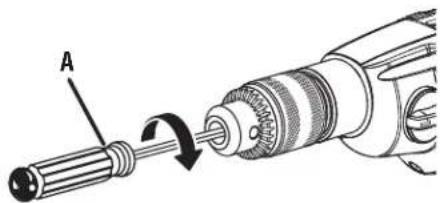
CHUCK REMOVAL
See Figures 14 - 16, page 16.
The chuck may be removed and replaced with a new one.
■ Unplug the drill.
■ Open chuck jaws using the provided chuck key.
■ Insert a 5/16 inch (8 mm) or larger hex key into the chuck of the drill and tighten the chuck jaws securely.
■ Tap the hex key sharply with a mallet in a clockwise direction. This will loosen the screw in the chuck for easy removal.
■ Open chuck jaws and remove hex key. Remove the chuck screw by turning it in a clockwise direction.
NOTE: The screw has left hand threads.
■ Insert the hex key into the chuck and tighten the chuck jaws securely. Tap sharply with a mallet in a counterclockwise direction. This will loosen the chuck on the spindle. It can now be unscrewed by hand.
TO RETIGHTEN A LOOSE CHUCK
The chuck may become loose on the spindle and develop a wobble. Also, the chuck screw may become loose, causing the chuck jaws to bind and prevent them from closing. To tighten:
■ Unplug the drill.
■ Open the chuck jaws.
■ Insert the hex key into the chuck and tighten the chuck jaws securely. Tap the hex key sharply with a mallet in a clockwise direction. This will tighten the chuck on the spindle.
■ Open the chuck jaws and remove the hex key.
■ Tighten the chuck screw.
RIDGID® HAND HELD AND STATIONARY POWER TOOL 3 YEAR LIMITED SERVICE WARRANTY
Proof of purchase must be presented when requesting warranty service.
Limited to RIDGID® hand held and stationary power tools purchased 2/1/04 and after. This product is manufactured by One World Technologies, Inc. The trademark is licensed from RIDGID, Inc. All warranty communications should be directed to One World Technologies, Inc., attn: RIDGID Hand Held and Stationary Power Tool Technical Service at (toll free) 1-866-539-1710.
90-DAY SATISFACTION GUARANTEE POLICY
During the first 90 days after the date of purchase, if you are dissatisfied with the performance of this RIDGID® Hand Held and Stationary Power Tool for any reason you may return the tool to the dealer from which it was purchased for a full refund or exchange. To receive a replacement tool you must present proof of purchase and return all original equipment packaged with the original product. The replacement tool will be covered by the limited warranty for the balance of the 3 YEAR service warranty period.
WHAT IS COVERED UNDER THE 3 YEAR LIMITED SERVICE WARRANTY
This warranty on RIDGID® Hand Held and Stationary Power Tools covers all defects in workmanship or materials and normal wear items such as brushes, chucks, motors, switches, cords, gears and even cordless batteries in this RIDGID® tool for three years following the purchase date of the tool. Warranties for other RIDGID® products may vary.
HOW TO OBTAIN SERVICE
To obtain service for this RIDGID® tool you must return it; freight prepaid, or take it in to an authorized service center for RIDGID® branded hand held and stationary power tools. You may obtain the location of the authorized service center nearest you by calling (toll free) 1-866-539-1710 or by logging on to the RIDGID® website at www.ridgid.com. When requesting warranty service, you must present the original dated sales receipt. The authorized service center will repair any faulty workmanship, and either repair or replace any part covered under the warranty, at our option, at no charge to you.
WHAT IS NOT COVERED
This warranty applies only to the original purchaser at retail and may not be transferred. This warranty only covers defects arising under normal usage and does not cover any malfunction, failure or defect resulting from misuse, abuse, neglect, alteration, modification or repair by other than an authorized service center for RIDGID® branded hand held and stationary power tools. Consumable accessories provided with the tool such as, but not limited to, blades, bits and sand paper are not covered.
RIDGID, INC. AND ONE WORLD TECHNOLOGIES, INC. MAKE NO WARRANTIES, REPRESENTATIONS OR PROMISES AS TO THE QUALITY OR PERFORMANCE OF ITS POWER TOOLS OTHER THAN THOSE SPECIFICALLY STATED IN THIS WARRANTY.
ADDITIONAL LIMITATIONS
To the extent permitted by applicable law, all implied warranties, including warranties of MERCHANTABILITY or FITNESS FOR A PARTICULAR PURPOSE, are disclaimed. Any implied warranties, including warranties of merchantability or fitness for a particular purpose, that cannot be disclaimed under state law are limited to three years from the date of purchase. One World Technologies, Inc. and RIDGID, Inc. are not responsible for direct, indirect, incidental or consequential damages. Some states do not allow limitations on how long an implied warranty lasts and/or do not allow the exclusion or limitation of incidental or consequential damages, so the above limitations may not apply to you. This warranty gives you specific legal rights, and you may also have other rights which vary from state to state.
One World Technologies, Inc.
P.O. Box 35, Hwy. 8
Pickens, SC 29671
AVERTISSEMENTS DE SÉCURITÉ GÉNÉRALES RELATIVES AUX OUTILS ÉLECTRIQUES

AVERTISSEMENT
0-2,0 2,1-3,4 3,5-5,0 5,1-7,0 7,1-12,0 12,1-16,0
RÉPARATIONS SOUS GARANTIE
One World Technologies, Inc.
P.O. Box 35, Hwy. 8
One World Technologies, Inc.
P.O. Box 35, Hwy. 8
Pickens, SC 29671 USA
Fig. 1
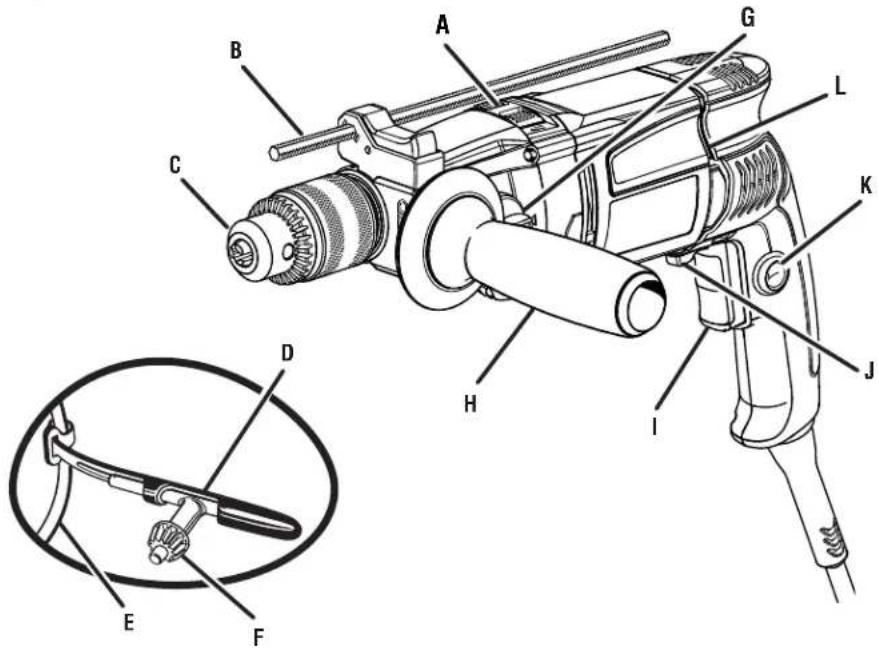
A - Drilling/hammer mode selector (sélecteur de perceuse / marteau, selector de taladro / percusión)
B - Depth stop rod (tige de butée de profondeur, barra limitadora de profundidad)
C - Chuck (mandrin, portabrocas)
D - Chuck key storage (porte-clé du mandrin, almacenamiento de la llave del portabrocas)
E - Power cord (cordon endommagé, cordón eléctrico)
F- Chuck key (clé de mandrin, llave del portabrocas)
G - Two-speed gear train (hi-lo) (train d'engrenages à deux vitesses [haute-
basse], engranaje de dos velocidades [alta-baja])
H - Auxiliary handle assembly (poignée auxiliaire, conjunto del mango auxiliar)
I - Switch trigger (gâchette, gatillo del interruptor)
J - Direction of rotation selector (forward/reverse) (sélecteur de sens de rotation [avant/arrière], selector de sentido de rotación [adelante/atrás])
K - Lock-on button (bouton de verrouillage, botón del seguro de encendido)
L - Anti-vibration system (système anti-vibration, sistema de antivibraciones)
Fig. 4
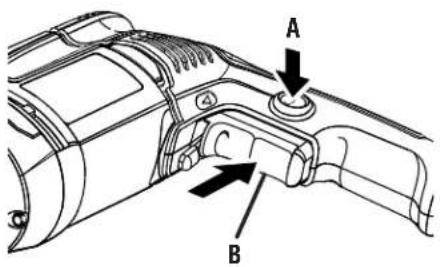
A - Lock-on button (bouton de verrouillage, botón del seguro de encendido)
B - Switch trigger (gâchette, gatillo del interruptor)
Fig. 5
A - To increase drilling depth (pour augmenter la profondeur de perçage, para aumentar la profundidad de taladrado)
B - To decrease drilling depth (pour réduire la profondeur de perçage, para disminuir la profundidad de taladrado)
C - Depth stop rod (tige de butée de profondeur, barra limitadora de profundidad)
D - Drilling depth (profoneur de perçage, profundidad de taladrado)
E - Drill bit (embout, broca)
F - Auxiliary handle assembly (poignée auxiliaire, conjunto del mango auxiliar)
G - Depress here to adjust depth stop rod (appuyer ici pour régler la tige de butée de profondeur, presionar aquí para ajustar la barra limitadora de profundidad)
Fig. 6
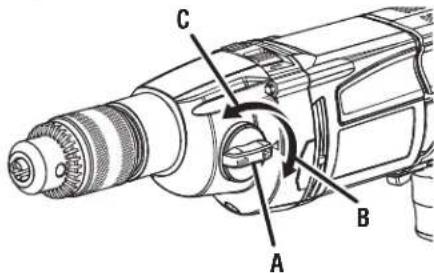
A- Two-speed gear shift knob (train d'engrenages à deux vitesses, engranaje de dos velocidades)
B - Lo (1) (basse [1], velocidad baja [1])
C - Hi (2) (haute [2], velocidad alta [2])
Fig. 7
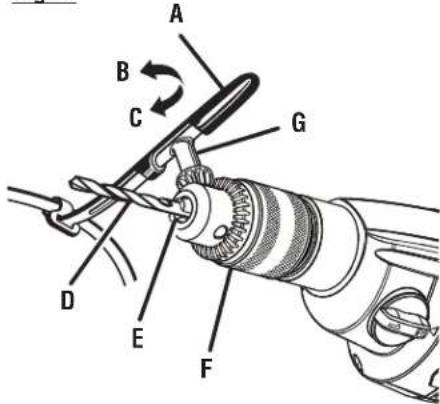
RIGHT / CORRECT / FORMA CORRECTA
A - Chuck key storage (porte-clé du mandrin, almacenamiento de la llave del portabroca)
B - To loosen (pour desserrer, para aflojar)
C - To tighten (pour serrer, para apretar)
D - Drill bit (embout, broca)
E - Chuck jaws (mors du mandrin, mordazas del portabrocas)
F - Chuck (mandrin, portabrocas)
G - Chuck key (clé de mandrin, llave del portabrocas)
Fig. 8

natural_image
Diagram of a mechanical device with a diagonal line and a circular cross-section, no text or symbols present.WRONG / INCORRECT / FORMA INCORRECTA
Fig. 9
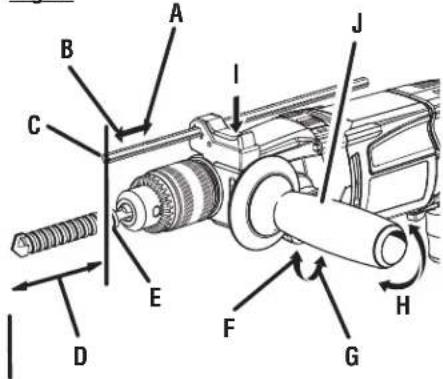
A - To increase drilling depth (pour augmenter la profondeur de perçage, para aumentar la profundidad de taladrado)
B - To decrease drilling depth (pour réduire la profondeur de perçage, para disminuir la profundidad de taladrado)
C - Depth stop rod (tige de butée de profondeur, barra limitadora de profundidad)
D - Drilling depth (profoneur de perçage, profundidad de taladrado)
E - Drill bit (embout, broca)
F - To tighten (pour serrer, para apretar)
G - To loosen (pour desserrer, para aflojar)
H - 360° rotation (rotation 360°, rotación 360°)
I - Depress here to adjust depth stop rod (appuyer ici pour régler la tige de butée de profondeur, presionar aquí para ajustar la barra limitadora de profundidad)
J - Auxiliary handle assembly (poignée auxiliaire, conjunto del mango auxiliar)
Fig. 10

A - Hammer mode (mode percussion, modo percusión)
B - Drilling mode (mode perçage, modo taladro)
C - Drilling/hammer mode selector (sélecteur de mode de perçage/percussion, selector de taladro/percusión)
Fig. 11
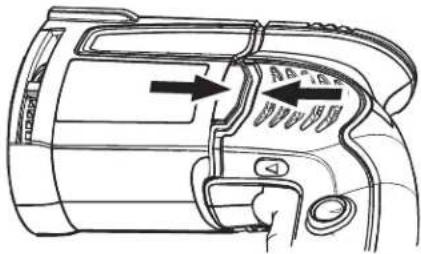
Fig. 12
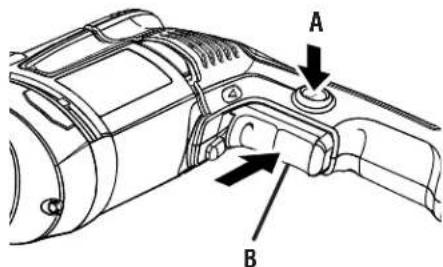
A - Lock-on button (bouton de verrouillage, botón del seguro de encendido)
B - Switch trigger (gâchette, gatillo del interruptor)
Fig. 13
natural_image
Line drawing of hands using a drill press to lift a workpiece (no text or symbols present)Fig. 14
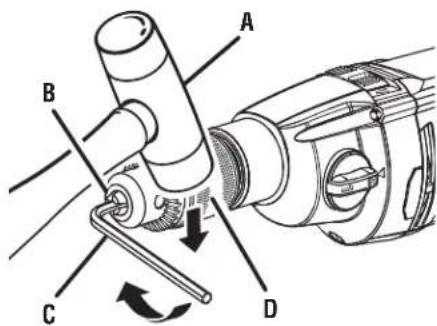
A - Mallet (maillet, mazo de goma)
B - Chuck jaws (mors du mandrin, mordazas del portabrocas)
C - Hex key (clé hexagonale, llave hexagonal)
D - Chuck (mandrin, portabrocas)
Fig. 15
natural_image
Mechanical diagram showing a shaft being inserted into a worm gear (no text or symbols present)A - Screwdriver (tournevis, destornillador)
Fig. 16
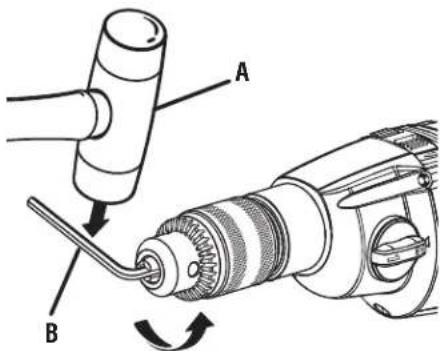
A - Mallet (maillet, mazo de goma)
B - Hex key (clé hexagonale, llave hexagonal)
OPERATOR'S MANUAL
MANUEL D'UTILISATION
MANUAL DEL OPERADOR
1/2 in. HAMMER DRILL DOUBLE INSULATED
PERCEUSE À PERCUSSION DE 13 mm (1/2 po) DOUBLE ISOLATION
Customer Service Information:
For parts or service, do not return this product to the store. Contact your nearest RIDGID® authorized service center. Be sure to provide all relevant information when you call or visit. For the location of the authorized service center nearest you, please call 1-866-539-1710 or visit us online at www.ridgid.com.
MODEL NO. ____ SERIAL NO. ____
RIDGID is a registered trademark of RIDGID, Inc., used under license.
- SAVE THIS MANUAL FOR FUTURE REFERENCE
- WORK AREA SAFETY
- ELECTRICAL SAFETY
- PERSONAL SAFETY
- POWER TOOL USE AND CARE
- SERVICE
- HAMMER DRILL SAFETY WARNINGS
- DOUBLE INSULATION
- WARNING:
- ELECTRICAL CONNECTION
- EXTENSION CORDS
- PRODUCT SPECIFICATIONS
- KNOW YOUR HAMMER DRILL
- AUXILIARY HANDLE ASSEMBLY
- BLOWS PER MINUTE
- CHUCK KEY
- CLUTCH
- DEPTH STOP ROD
- DIRECTION OF ROTATION SELECTOR (FORWARD/REVERSE)
- LOCK-ON BUTTON
- TWO-SPEED GEAR TRAIN
- VARIABLE SPEED
- CALIFORNIA PROPOSITION 65
- UNPACKING
- PACKING LIST
- INSTALLING AUXILIARY HANDLE ASSEMBLY
- INSTALLING THE DEPTH STOP ROD
- APPLICATIONS
- SWITCH TRIGGER
- NOTICE:
- TWO-SPEED GEAR SHIFT KNOB
- TO INSTALL BITS
- TO REMOVE BITS
- USING THE AUXILIARY HANDLE ASSEMBLY
- To adjust the auxiliary handle assembly:
- ADJUSTING THE DEPTH STOP ROD
- SELECTING HAMMER MODE OR DRILLING MODE
- To lock-on:
- WOOD AND METAL DRILLING
- Wood Drilling
- Metal and Steel Drilling
- MASONRY DRILLING
- GENERAL MAINTENANCE
- LUBRICATION
- CHUCK REMOVAL
- TO RETIGHTEN A LOOSE CHUCK
- RIDGID® HAND HELD AND STATIONARY POWER TOOL 3 YEAR LIMITED SERVICE WARRANTY
- 90-DAY SATISFACTION GUARANTEE POLICY
- WHAT IS COVERED UNDER THE 3 YEAR LIMITED SERVICE WARRANTY
- HOW TO OBTAIN SERVICE
- WHAT IS NOT COVERED
- RIDGID, INC. AND ONE WORLD TECHNOLOGIES, INC. MAKE NO WARRANTIES, REPRESENTATIONS OR PROMISES AS TO THE QUALITY OR PERFORMANCE OF ITS POWER TOOLS OTHER THAN THOSE SPECIFICALLY STATED IN THIS WARRANTY.
- ADDITIONAL LIMITATIONS
- AVERTISSEMENTS DE SÉCURITÉ GÉNÉRALES RELATIVES AUX OUTILS ÉLECTRIQUES
- AVERTISSEMENT
- RÉPARATIONS SOUS GARANTIE
- RIGHT / CORRECT / FORMA CORRECTA
- OPERATOR'S MANUAL
- MANUEL D'UTILISATION
- MANUAL DEL OPERADOR
- 1/2 in. HAMMER DRILL DOUBLE INSULATED
- PERCEUSE À PERCUSSION DE 13 mm (1/2 po) DOUBLE ISOLATION
- Customer Service Information:
Brand : RIDGID
Model : R5011
Category : Drill