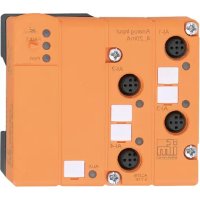
AC2526 - Electronic module IFM - Free user manual and instructions
Find the device manual for free AC2526 IFM in PDF.



| Product Type | AS-i Analog Input Module |
| Brand | IFM |
| Model | AC2526 |
| Category | Electronic Module |
| Number of channels | 4 analog inputs (current 4…20 mA) |
| AS-i Profile | S-7.3.E (AS-i specification V2.1) |
| Resolution | 1 A |
| Power supply | Via AS-i (max. 100 mA for sensors) or external 24 V SELV (max. 500 mA, black flat cable) |
| Conversion time per channel | 20 ms (1 channel), 120 ms (2 channels), 180 ms (3 channels), 240 ms (4 channels) |
| Nominal measurement range | 4 … 20 mA (digital value 4000 … 20000) |
| LED display | PWR (green), AUX (green), FAULT (red), AI-1…AI-4 (yellow) |
| Sensor connection | M12 5-pin connectors |
| Addressing | Addresses 1 to 31 via addressing unit (AC1144) or cable E70213 |
| Mounting | On wiring base, tightening torque 0.8 Nm |
| Max. number of modules per AS-i beam | 31 |
| Main functions | Conversion of 4…20 mA analog signals into digital data, bidirectional transmission via AS-i, peripheral fault detection |
| Care and cleaning | No specific maintenance. Clean with a dry, lint-free cloth. Disconnect power before cleaning. |
| Safety | Observe SELV voltages (24 V). Disconnect the module before any intervention. Use protective equipment if necessary. |
| Spare parts and repairability | Wiring bases (AC5000, AC5001, AC5003, AC5010, AC5011) and addressing cable E70213 available. Module not repairable, replace if defective. |
| General information | Manual available in French at notice-facile.com. Free PDF download. |
Frequently Asked Questions - AC2526 IFM
User questions about AC2526 IFM
0 question about this device. Answer the ones you know or ask your own.
Ask a new question about this device
Download the instructions for your Electronic module in PDF format for free! Find your manual AC2526 - IFM and take your electronic device back in hand. On this page are published all the documents necessary for the use of your device. AC2526 by IFM.
USER MANUAL AC2526 IFM
natural_image
Top-down schematic of a room layout with labeled compartments and circular symbols (no text or labels)Function and features
The slave converts analogue input signals and transfers them to the AS-i master via the AS-Interface. The AS-i module operates as a slave with bidirectional data transfer in the AS-i network.
The data transfer to the host is asynchronous according to the AS-i profile S-7.3 and the AS-i specification V2.1.
- Current measurement 4 ... 20mA
- AS-i profile S-7.3.E
- The sensors are connected via M12 connection cables
• Maximum number of modules per AS-i system: 31 - R_i current measurement < 50
- Time for converting the measured values in the slave
- for one channel: 20ms
- for two channels: 120ms
- for three channels: 180ms
- for four channels: 240ms
- Sensor supply from AS-i (max. 100mA) or external 24V PELV voltage source (black flat cable, max. 500 mA)
- Resolution: 1 A
Installation / Addressing
When you use module lower parts without addressing socket (AC5000, AC5001 or AC5003) first address the module by placing it onto an addressing unit (AC1144) and assign a free address between 1 and 31.
When you use module lower parts with an addressing socket (AC5010 or AC5011) the modules can be addressed with the addressing adapter E70213 later on.
Mount the module onto the wired module lower part of the AS-i network, tightening torque 0.8Nm.
As an alternative FC/FC-E lower parts with earthing lead (AC5020...AC5023) can be used to increase the noise immunity.
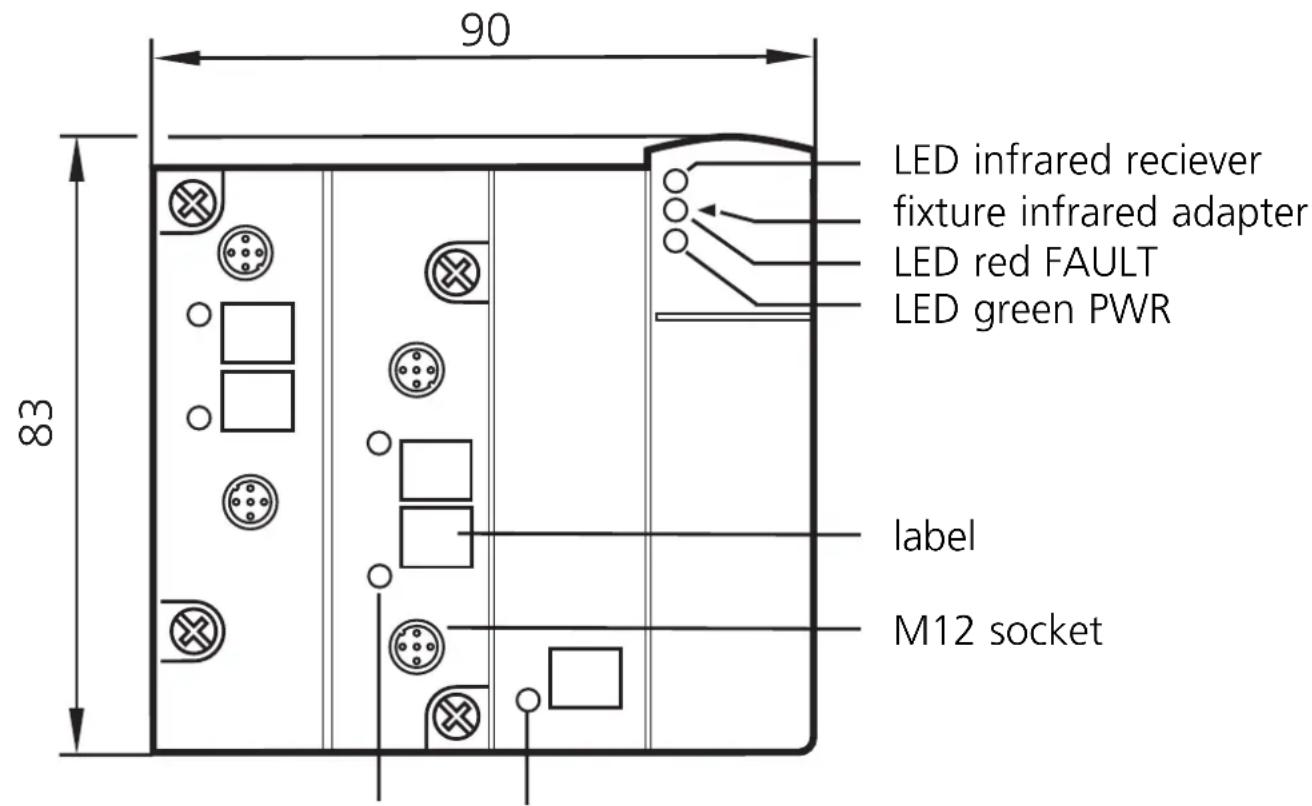
4x LED yellow analogue inputs
LED green AUX
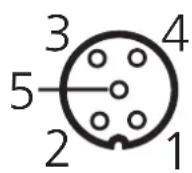
Pin 1: sensor supply +24V
Pin 2: Al+ analogue input
Pin 3: sensor supply 0V
Pin 4: not connected
Pin 5: functional earth
Electrical connection
The analogue module is connected to the AS-Interface via the standardised EMS (supply from AS-i) or the E-EMS (supply from an ext. 24V PELV voltage source).
If the supply is to be from an external 24V source, a FC-E lower part (art. no. AC5003 or AC5011) must be used.

If a total of over 100mA is needed for the sensor supply, the supply must be from an external 24V PELV voltage source.
The supply is automatically changed when the external 24V voltage is supplied.
Current measurement
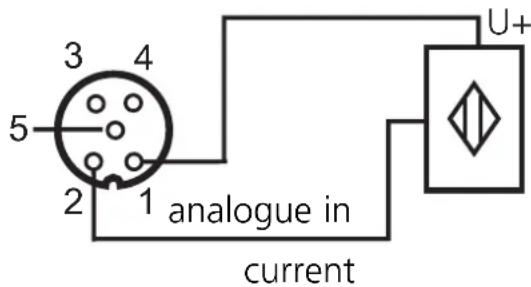
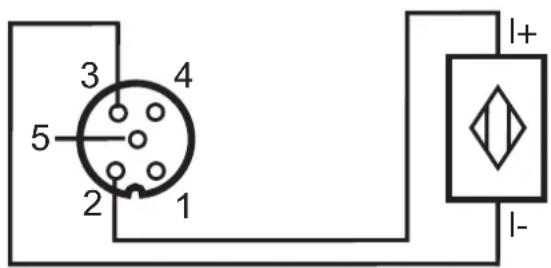
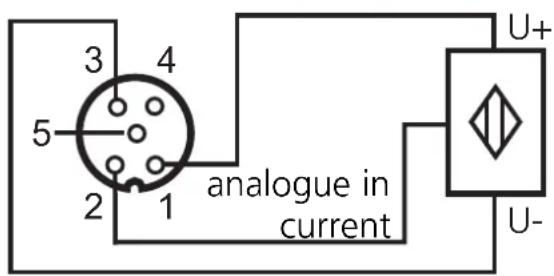
For all the following wiring diagrams the indicated pin connection refers to the analogue module.
Connection of a 2-wire sensor without own supply
Pin 1: sensor supply +24V
Pin 2: Al+ analogue input
Pin 3: sensor supply 0V
Pin 4: not connected
Pin 5: functional earth
Connection of a 2-wire sensor with own supply
Pin 1: sensor supply +24V
Pin 2: Al+ analogue input
Pin 3: sensor supply 0V
Pin 4: not connected
Pin 5: functional earth
Connection of a 3-wire sensor without own supply
Pin 1: sensor supply +24V
Pin 2: AI+ analogue input
Pin 3: sensor supply 0V
Pin 4: not connected
Pin 5: functional earth
Parameter setting of the analogue modules
| Parameter bit | Designation | Description | |||||
| P0 | 1 2-/3-wire operation | ||||||
| P1, P2 | channel activation | P1 | P2 | channel1 | channel2 | channel3 | channel4 |
| 0 | 0 | on | off | off | off | ||
| 0 | 1 | on | on | off | off | ||
| 1 | 0 | on | on | on | off | ||
| 1 | 1 | on | on | on | on | ||
| P3 | periphery fault | 1 periphery fault indication active0 periphery fault indication not active | |||||
Operation
Check the safe functioning of the unit. Display by LEDs:
• LED yellow AI-1...AI off: no sensor connected
(at least one LED flashes because not all channels can be deactivated via the parameter bit P1/P2 (channel activation))
• LED yellow AI-1...AI-4 on: analogue signal in the measuring range
- LED yellow AI-1...AI-4 analogue signal outside the measuring - flashes: range or no sensor connected
- LED green PWR on: AS-i voltage is applied
• LED green AUX on: external 24V voltage is applied
- LED red FAULT on: AS-i communication error
- LED red FAULT flashes: periphery fault*
* periphery fault
A periphery fault is indicated:
- if at least one of the analogue signals is outside the value range.
- if nothing is connected to at least one analogue channel although the respective channel is activated
Measuring range of the analogue input modules
The measuring ranges, the states of the LEDs and their meaning are indicated in the following tables:
Analogue input module 4 ... 20mA
| Range4 ... 20mA | Unitsdec. | Unitshex. | LED AI1...AI4 analogue | Meaning |
| < 1mA 32767 | 7FFF flashes wire break | |||
| 1mA ... 3.999mA | 1000 ... 3999 | 03E8 ... 0F9F | on | below nominal range |
| 4mA ... 20mA | 4000 ... 20000 0FA | 0 ... 4E20 on nominal range | ||
| 20.001mA ... 23mA | 20001 ... 23000 | 4E21 ... 59D8 on above nominal | range | |
| > 23mA | 32767 | 7FFF | flashes | outside range |
Transmission time of the analogue values
The transmission time of the analogue values depends on the conversion time of the analogue signals into digital signals in the AS-i module and on the transmission time via the AS-Interface.
Example: Transmission time of 2 analogue channels
The conversion time for 2 analogue input signals into digital signals is 120ms. The transmission time of the 2 16-bit values via the AS-interface ideally is 7 AS-i cycles per value. For a cycle time of 5ms per AS-i cycle this results in a transmission time of 2 x 7 x 5ms = 70ms via the AS-Interface.
Thus the total transmission time for 2 analogue values ideally is 120ms (conversion time) + 70ms (transmission time) = 190ms.
Example: Transmission time of 4 analogue channels
The conversion time for 4 analogue input signals into digital signals is 240ms. The transmission time of the 4 16-bit values via the AS-interface ideally is 7 AS-i cycles per value. For a cycle time of 5ms per AS-i cycle this results in a transmission time of 4 x 7 x 5ms = 140ms via the AS-Interface.
Thus the total transmission time for 4 analogue values ideally is 240ms (conversion time) + 140ms (transmission time) = 380ms.
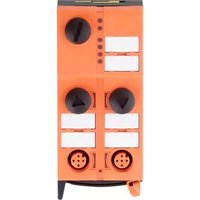
Brand : IFM
Model : AC2526
Category : Electronic module