CS25 - Saw SABO - Free user manual and instructions
Find the device manual for free CS25 SABO in PDF.



| Product type | Battery chainsaw |
| Brand / Model | SABO CS25 (SA561521) |
| Motor | Brushless DC motor, 40 V |
| Chain speed | 20 m/s |
| Chain stop time | < 0.2 s |
| Oil tank capacity | 180 ml (run time 20-40 min) |
| Guide bar length | 250 mm or 350 mm (supplied) |
| Weight (without battery) | 3.65 kg (250 mm bar) / 3.75 kg (350 mm bar) |
| Battery type | Lithium-ion 40 V (compatible SAU15032, SAU16450/ SAU16451, SAU17028/ SAU17029) |
| Charger | SAU15033 / SAU16509 |
| Sound pressure level (LPA) | 92.0 dB(A) (k = 3 dB(A)) |
| Guaranteed sound power level | 104 dB(A) |
| Vibration (a) | 4.9 m/s² (k = 1.5 m/s²) |
| Main features | Chain brake, anti-kickback protection, oil indicator, ergonomic handles, automatic chain lubrication |
| Usage | Cutting branches, trunks, logs – outdoor domestic use |
| Maintenance and cleaning | Regular cleaning, chain sharpening (round file 4 mm / 5/32"), checking and adjusting tension, lubricating bar and chain |
| Required protective equipment | Helmet, goggles, hearing protection, gloves, cut-resistant trousers, sturdy shoes |
| Safety | Chain brake, safety lock, front hand guard, automatic shutdown in case of overheating |
| Spare parts and repairability | Guide bar (250/350 mm), chain (SAU17058/ SAU17060), charger, battery – repair recommended by an authorized professional |
| Warranty / Approval | CE compliant, Machinery Directive 2006/42/EC, RoHS 2011/65/EU |
Frequently Asked Questions - CS25 SABO
User questions about CS25 SABO
0 question about this device. Answer the ones you know or ask your own.
Ask a new question about this device
Download the instructions for your Saw in PDF format for free! Find your manual CS25 - SABO and take your electronic device back in hand. On this page are published all the documents necessary for the use of your device. CS25 by SABO.
USER MANUAL CS25 SABO
| Product description Chainsaw | |
| Type SA561521 | |
| Motor | 40 V brushless dc motor |
| Chain speed 20 m/s | |
| Chain stop time < 0.2 s | |
| Capacity of saw chain lubricant | 180 ml |
| Guide bar length 250 mm, 350 mm | |
| Weight without battery (with 250 mm guide bar) | 3.65 kg |
| Weight without battery (with 350 mm guide bar) | 3.75 kg |
| Battery | SAU15032 SAU16450 / SAU16451 SAU17028 / SAU17029 |
| Charger SAU15033 / SAU16509 | |
| Guide bar 250 mm / Chain 250 mm | SAU17061 / SAU17058 |
| Guide bar 350 mm / Chain 350 mm SAU17062 / SAU17060 | |
| Measured sound pressure level | LPA = 92.0 dB(A) k = 3 dB(A) |
| Guaranteed sound power level | LwA = 104 dB(A) |
| Vibration a | n = 4.9 m/s2 k = 1.5 m/s2 |

WARNING
The hand-arm vibrations from actually using the tool may deviate from the stated value. This depends on the how the tool is used. Avoid the danger of vibrations with the following precautionary measures: wear gloves when using it, limit the period of use and shorten the application time.
2 DESCRIPTION
see figure 1 to 22
31 Work on the ground, while leaving the lower branches to provide support until the log is cut
33 Cut from top (over buck) avoid cutting into the ground
39 Stand on uphill side when cutting because log may roll
1 Guide bar cover
2 Front handle guard / chain brake
3 Front handle
4 Safety lock button
5 Switch trigger
6 Oil tank cap
7 Oil level gauge
8 Spike bumpers
9 Saw chain
10 Guide bar
11 Wrench
12 Rear handle
13 Chain adjustment screw
14 Chain cover
15 Chain cover nuts
16 Bolt for saw chain tension
17 Sprocket
18 Battery release button
19 Oil outlet
20 Bar groove
21 Chain drive links
22 Cutter
23 Felling direction
24 Hazard zone
25 Escape route
26 Direction of fall
27 Notch
28 Directional notches
29 Hinge
30 Limb cut
32 Log supported along the entire length
34 Log supported on one end
35 Under buck
36 Over buck
37 Log supported at both ends
38 Bucking a log
40 Relief cut
41 Bucking cut

3 EXPLANATION OF THE IDENTIFICATION PLATE ON THE CHAINSAW
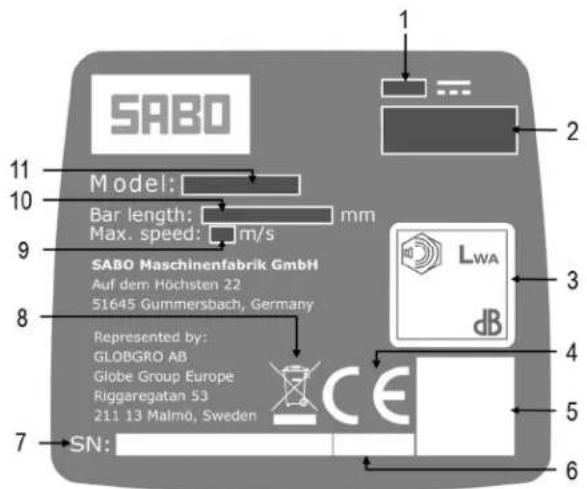
1 Rated voltage
2 Product description
3 Guaranteed sound power level
4 CE conformity mark
5 QR code
6 Date of production
7 Production identification number
8 Do not dispose of this device with household waste. The device, accessories and packaging must be returned for recycling in accordance with environmental guidelines
9 Maximum chain speed
10 Blade length
11 Type description
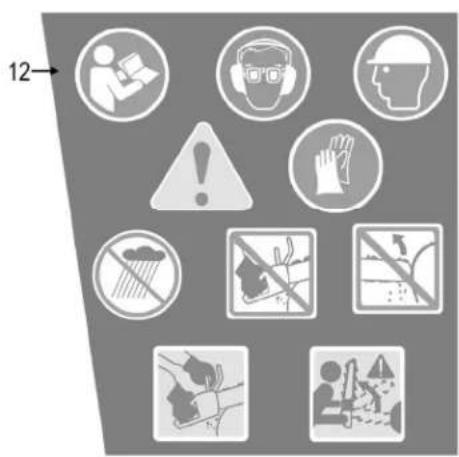
12 Instruction, prohibition and warning information
4 EXPLANATION OF THE SYMBOLS
The following symbols may be found on your device. Familiarise yourself with these symbols and note their meaning. Correctly interpreting these symbols allows you to use your device safely and appropriately.
| SYMBOL DESCRIPTION/EXPLANATION | |
| Important safety measures This is about your safety. | |
| Read the operating instructions and observe the warnings and safety requirements. | |
| Wear head protection when using this device. | |
| When using this device, wear safety goggles and ear protection. | |
| Wear protective gloves when using this device. | |
| Do not expose to rain or wet conditions. | |
| Hold the device with both hands. | |
EN
| Avoid contact with the bar nose. | |
| DANGER! Caution: kickbacks. | |
| The symbol shows the direction of movement of the saw chain. | |
| The symbol indicates the rotation direction for tightening and releasing the chain tension. | |
| The symbol shows the oil tank for the saw chain lubricant. | |
| • Up symbol: The chain brake is released in this direction • Down symbol: The chain brake is engaged in this direction. |
| The following signal words and meanings indicate the degree of risk associated with this product. | ||
| SYMBOL SIGNAL MEANING | ||
| A | DANGER: | Describes an immediate dangerous situation that, if it is not prevented, can lead to death or serious injuries. |
| A | WARNING: | Describes a possible dangerous situation that, if it is not prevented, can lead to death or serious injuries. |
| A | ATTENTION! | Describes a possible dangerous situation that, if it is not prevented, can lead to minor and moderate injuries. |
| ATTENTION! | (without safety symbol) Describes a situation which can lead to material damage. | |
| i | NOTE Describes information that will help you better understand the operation of the device. | |
TECHNICAL MAINTENANCE
The maintenance requires the highest levels of caution and knowledge and therefore should only be performed by an expert. We recommend that you take the device to a nearby approved dealer. When maintaining the device, only identical and original spare parts should be used.

WARNING
Use of a power tool can lead to other objects hitting you in the eyes and cause serious eye injuries. Before working with power tools, always wear safety goggles with side protection and, if applicable, with face protection. We recommend vision safety mask, which can be used with normal glasses or standard safety goggles with side protection. Always wear eye protection that corresponds to standard EN 166.
5 INTENDED USE
The device may only be used for the following purposes:
This product is designed for cutting branches, stumps and beams of a diameter determined by the cutting length of the guide bar.
olt is designed exclusively for cutting wood.
It is strictly for use by adults in an outdoor setting and for domestic uses.
Any use going beyond this is not considered proper use; the manufacturer is not liable for any damage resulting from such use, the risk is borne by the user alone. Proper use also
includes adherence to the operation, maintenance and service conditions prescribed by the manufacturer.
Special care is required during use in public areas, parks, sports facilities, on roads and in agricultural and forestry operations. Local laws and provisions are to be strictly followed.
not use this product for any purpose other than those named above.
Use of this product for professional tree care is prohibited. It is not to be used by children or by persons who are not wearing appropriate personal protective equipment and clothing.
Please note that this device is not designed for commercial, trade or industrial use. We accept no warranty claims for devices that are used in commercial, trade or industrial operations or similar activities.
The use of any additional equipment and attachments not approved by the manufacturer is prohibited. If such additional equipment and attachments are used, the CE conformity and guarantee shall be null and void. Unauthorized modifications to this product exclude the manufacturer from liability for any damage resulting from these modifications.
There is a residual risk despite the intended use and particular care of the user. Use the device with care at all times. Possible hazards by device type and model:
口 Contact with exposed saw teeth of the saw chain (cutting hazard).
Access to the rotating saw chain (cutting hazard).
Unforeseen, abrupt movement of the guide bar (cutting hazard).
Flying parts from the saw chain (cutting hazard / injury from flying chips)
Flying parts from the object being sawed.
oBreathing in particles from the object being sawed.
Skin contact with the saw chain lubricant.
O Hearing loss from failure to wear ear protection while working.
Safety datasheet
Your chainsaw has been developed and produced with the highest levels of reliability, user-convenience and user safety. It maintained carefully, the device will work reliably and fault-free for many years.
6 GENERAL SAFETY WARNINGS

WARNING
Read all safety warnings and all instructions.
Failure to follow the warnings and instructions may result in electric shock, fire and/or serious injury.
Save all warnings and instructions for future reference.
The term "power tool" in the warnings refers to your mains-operated (cored) power tool or battery-operated (cordless) power tool.
Work area safety
- Keep work area clean and well lit. Cluttered or dark areas invite accidents.
Do not operate power tools in explosive atmospheres, such as in the presence of flammable liquids, gases or dust. Power tools create sparks which may ignite the dust or fumes. - Keep children and bystanders away while operating a power tool. Distractions can cause you to lose control.
Do not use the device in bad weather if there is any risk of a lightning strike.
Electrical safety
- Power tool plugs must match the outlet. Never modify the plug in any way. Do not use any adapter plugs with earthed (grounded) power tools. Unmodified plugs and matching outlets will reduce risk of electric shock.
- Avoid body contact with earthed or grounded surfaces, such as pipes, radiators, ranges and refrigerators. There is an increased risk of electric shock if your body is earthed or grounded.
- Do not expose power tools to rain or wet conditions. Water entering a power tool will increase the risk of electric shock.
Do not abuse the cord. Never use the cord for carrying, pulling or unplugging the power tool. Keep cord away from heat, oil, sharp edges or moving parts. Damaged or entangled cords increase the risk of electric shock. - When operating a power tool outdoors, use an extension cord suitable for outdoor use. Use of a cord suitable for outdoor use reduces the risk of electric shock.
If operating a power tool in a damp location is unavoidable, use a residual current device (RCD) protected supply. Use of an RCD reduces the risk of electric shock
NOTE The term "residual current device (RCD)" may be replaced by the term "ground fault circuit interrupter (GFCI)" or "earth leakage circuit breaker (ELCB)".
Personal safety
- Stay alert, watch what you are doing and use common sense when operating a power tool. Do not use a power tool while you are tired or under the influence of drugs, alcohol or medication. A moment of inattention while operating power tools may result in serious personal injury.
Use personal protective equipment. Always wear eye protection. Protective equipment such as dust mask, non-skid safety shoes, hard hat, or hearing protection used for appropriate conditions will reduce personal injuries.
Prevent unintentional starting. Ensure the switch is in the off-position before connecting to power source and/or battery pack, picking up or carrying the tool. Carrying power tools with your finger on the switch or energising power tools that have the switch on invites accidents. - Remove any adjusting key or wrench before turning the power tool on. A wrench or a key left attached to a rotating part of the power tool may result in personal injury.
Do not overreach. Keep proper footing and balance at all times. This enables better control of the power tool in unexpected situations. - Dress properly. Do not wear loose clothing or jewellery. Keep your hair, clothing and gloves away from moving parts. Loose clothes, jewellery or long hair can be caught in moving parts.
If devices are provided for the connection of dust extraction and collection facilities, ensure these are connected and properly used. Use of dust collection can reduce dust-related hazards.
Careful handling and use of power tools
Do not overload the tool. Use the right power tool for your task. You can work better and more safely within the specified performance range with the right power tool.
Do not use a power tool with a defective switch. A power tool which can no longer be switched on or off is dangerous and must be repaired.
- Remove the battery before adjusting settings, replacing accessories or after use. The safety provisions prevent the power tool from starting accidentally.
Store all unused power tools out of the reach of children. Do not let persons use the device who are unfamiliar with it or who have not read these instructions. Power tools are dangerous if they are used by inexperienced persons.
- Carefully maintain your device. Check that the moving parts work correctly. Make sure that no part of the device is damaged. Check the assembly and all other elements that could affect the operation of the device. If parts are damaged, you must have your device repaired before use. Many accidents are caused by poorly maintained power tools.
- Keep cutting tools sharp and clean. Carefully maintained cutting tools with sharp cutting edges get stuck less often and are easier to use.
- Use power tools, accessories, tool bits, etc. according to their instructions. Consider the working conditions and work to be performed. The use of power tools for purposes other than the intended uses can lead to dangerous situations.

Specific safety provisions for battery-powered devices
Before inserting the battery, make sure that the switch is either at "Off" or is locked. Inserting a battery into a switched-on device can lead to accidents.
- Recharge only with the charger specified by the manufacturer. A charger that is suitable for one type of battery pack may create a risk of fire when used with another battery pack.
Use power tools only with specifically designated battery packs. Use of any other battery packs may create a risk of injury and fire.
- When battery pack is not in use, keep it away from other metal objects, like paper clips, coins, keys, nails, screws or other small metal objects, that can make a
connection from one terminal to another. Shorting the battery terminals together may cause burns or a fire.
Under abusive conditions, liquid may be ejected from the battery; avoid contact. If contact accidentally occurs, flush with water. If liquid contacts eyes, additionally seek medical help. Liquid ejected from the battery may cause irritation or burns.
All safety information regarding the handling, storage, safekeeping, transport, disposal of the lithium-ion battery and first-aid measures and measures for.
combating fires is contained in the "Product safety datasheet" at www.sabo-online.com under Instructions.
Information hotline for lithium ion batteries
+49 (0) 2261 704-0
Service
Have your power tool serviced by a qualified repair person using only identical replacement parts. This will ensure that the safety of the power tool is maintained.
INSTRUCTION
- Read the instructions carefully. Familiarise yourself with the operating elements and correct machine operation.
- Never allow persons who are not familiar with these instructions to use the device. Regional regulations may restrict the age of the user.
- Remember that the operator or user is responsible for accidents with or dangers to other persons or their property.
PREPARATION
Check the battery for signs of damage and ageing before use. If the battery is damaged during use, switch off the device and immediately remove the battery. Do not use the device if the battery is damaged or worn.
Before use, always perform a visual inspection in order to check that none of the protective covers or panels is damaged, missing or incorrectly fitted.
Never use the machine while persons, particularly children, or animals are nearby.
OPERATION
- Keep mains cables away from cutting tools.
- When using this machine, always wear ear protectors, eye protectors, long trousers and sturdy shoes.
If applicable, wear eye and ear protection. - Do not use the device in bad weather if there is any risk of a lightning strike.
- Do not use expose the machine to rain when in use
- Only use the machine in daylight or good artificial light.
- Never use the machine with defective or missing safety equipment and shields.
- Switch on the motor only when hands and feet are away from the cutting tool.
- Always remove the battery from the device
- when the machine is left unsupervised.
- before you remove a blockage.
- before you inspect or clean the machine or carry out work on it.
- to inspect the device after strong contact with an object
- if the machine starts to vibrate strangely (immediate inspection necessary).
- Prevent injuries to feet and hands from the cutting tool.
- Always ensure that the fan openings are free from deposits.
CARE AND STORAGE
Always remove the battery from the device.
- Use only spare parts and accessories that are recommended by the manufacturer.
Regularly inspect and maintain the machine. Have the machine repaired by an authorised workshop.
- Keep the machine out of reach of children when it is not being used.
REQUIREMENTS OF THE USER
Users who are not trained in the use of a chainsaw for tree service may not be able to recognize or properly assess the risks of the chainsaw and the battery. There is a risk of serious and even fatal injuries to the user or other persons.
- Read and understand these operating instructions fully and keep them for future reference.
- Use the chainsaw only if you are trained in the use of a chainsaw for tree care.
- When giving the chainsaw or the battery someone else, include these operating instructions.
- Make sure that the following requirements are met during operation:
You are well rested.
You are physically, sensorially and mentally capable of operating and working with the chainsaw and battery. If your physical, sensory and mental faculties are limited, you can only work under the supervision or instruction of a responsible person.
You can recognize and assess the hazards of the chainsaw and the battery.
You are of age or you have been trained in a profession under supervision in accordance with the national rules.
oYou are not impaired by alcohol, medications or drugs.
7 SAFETY INFORMATION FOR CHAINSAWS
- Keep all parts of the body away from the saw chain when the chain saw is operating. Before you start the chain saw, make sure the saw chain is not contacting anything. A moment of inattention while operating chain saws may cause entanglement of your clothing or body with the saw chain
Always hold the chain saw with your right hand on the rear handle and your left hand on the front handle. Holding the chain saw with a reversed hand configuration increases the risk of personal injury and should never be done. - Hold the power tool by insulated gripping surfaces only, because the saw chain may contact hidden wiring or its own cord. Saw chains contacting a "live" wire may make exposed metal parts of the power tool "live" and could give the operator an electric shock.
- Wear safety glasses and hearing protection. Further protective equipment for head, hands, legs and feet is recommended. Adequate protective clothing will reduce personal injury by flying debris or accidental contact with the saw chain.
- Do not operate a chain saw in a tree. Operation of a chain saw while up in a tree may result in personal injury
Always keep proper footing and operate the chain saw only when standing on fixed, secure and level surface. Slippery or unstable surfaces such as ladders may cause a loss of balance or control of the chain saw - When cutting a limb that is under tension be alert for spring back. When the tension in the wood fibres is released the spring loaded limb may strike the operator and/or throw the chain saw out of control.
Use extreme caution when cutting brush and saplings. The slender material may catch the saw chain and be whipped toward you or pull you off balance. - Carry the chain saw by the front handle with the chain saw switched off and away from your body. When transporting or storing the chain saw always fit the guide bar cover. Proper handling of the chain saw will reduce the likelihood of accidental contact with the moving saw chain.
Follow instructions for lubricating, chain tensioning and changing accessories. Improperly tensioned or lubricated chain may either break or increase the chance for kickback. - Keep handles dry, clean, and free from oil and grease. Greasy, oily handles are slippery causing loss of control.
Cut wood only. Do not use chain saw for purposes not intended. For example: do not use chain saw for cutting plastic, masonry or non-wood building materials. Use of the chain saw for operations different than intended could result in a hazardous situation.
- Causes and operator prevention of kickback:
o Kickback may occur when the nose or tip of the guide bar touches an object, or when the wood closes in and pinches the saw chain in the cut. Tip contact in some cases may cause a sudden reverse reaction, kicking the guide bar up and back towards the operator. Pinching the saw chain along the top of the guide bar may push the guide bar rapidly back towards the operator. Either of these reactions may cause you to lose control of the saw which could result in serious personal injury. Do not rely exclusively upon the safety devices built into your saw. As a chain saw user, you should take several steps to keep your cutting jobs free from accident or injury. Kickback is the result of tool misuse and/or incorrect operating procedures or conditions and can be avoided by taking proper precautions as given below:
o Maintain a firm grip, with thumbs and fingers encircling the chain saw handles, with both hands on the saw and position your body and arm to allow you to resist kickback forces. Kickback forces can be controlled by the operator, if proper precautions are taken. Do not let go of the chain saw.
Do not overreach and do not cut above shoulder height. This helps prevent unintended tip contact and enables better control of the chain saw in unexpected situations.
Only use replacement bars and chains specified by the manufacturer. Incorrect replacement bars and chains may cause chain breakage and/or kickback.
Follow the manufacturer's sharpening and maintenance instructions for the saw chain. Decreasing the depth gauge height can lead to increased kickback
The battery must be removed from the device before it is disposed of.
The battery must be disposed of safely.
- Avoid unergonomic postures. Make sure you have a firm footing and keep your balance at all times. This allows you to control the power tool better in unexpected situations.
Wear clothing appropriate for the conditions. Do not wear loose-fitting clothing or jewellery. Keep hair, clothing and gloves away from moving parts. Loose-fitting clothing, jewellery and long hair can be trapped in moving parts.
- Do not proceed with cutting down a tree until you have familiarized yourself with all of the possible hazards and know how to prevent them. There is a risk of serious or fatal injury to operators and persons inside the hazard area.
- Recommendation: First-time users should, as a minimum of practice, cut logs on a saw-horse or cradle (frame).
SAFE CONDITION
The chainsaw is in safe condition if the following conditions are met:
- The chainsaw is undamaged.
- The chainsaw is clean.
The chain brake is working. - The operating controls are working and have not been modified.
The chain lubrication is working. - The grooves on the sprocket are not deeper than 0.5 mm .
- Only original guide bars and saw chains are installed on the chainsaw.
- The guide bar and saw chain are properly installed.
The saw chain is properly tightened. - Only original replacement parts are used for this chainsaw.
The accessories are correctly installed.
The oil tank cap is sealed.

WARNING
When the unit is not in safe condition, parts may not work properly and safety features may be deactivated. This can result in severe or fatal injury.
Work only with an undamaged chainsaw.
- Clean any accumulated matter off of the chainsaw.
Do not make any modifications to the chainsaw. Exception: installation of an original guide bar and saw chain.
- Do not use the chainsaw if the operating controls are not working properly.
- Use only original replacement parts for this chainsaw.
- Install the guide bar and saw chain only as instructed in these operating instructions.
Install accessories as instructed in these operating instructions or in the operating instructions for the accessories.
- Do not put any objects in the openings of the chainsaw.

- If there are any questions, contact a specialist dealer or contact customer service.
The guide bar is in safe condition if the following conditions are met:
The guide bar is undamaged.
The guide bar is not deformed.
The groove should be as deep or deeper than the minimum groove depth. This is the case when the sliding surface of the links rests on the rails and the saw chain is not resting on the bottom of the groove.
- The bar rails are free of burrs.
The bar groove is not pinched or splayed.

WARNING
When the unit is not in safe condition, the guide bar may no longer guide the saw chain. The rotating saw chain may fly off of the guide bar. This can result in severe or fatal injury.
Work only with an undamaged guide bar.
- If the depth of the groove is less than the minimum depth: Replace the guide bar.
- Deburr the guide bar regularly
If there are any questions, contact a specialist dealer or contact customer service
The saw chain is in safe condition if the following conditions are met:
The saw chain is undamaged.
The saw chain is properly sharpened.
The wear marks on the teeth are visible.

WARNING
When the unit is not in safe condition, parts may not work properly and safety features may be deactivated. This can result in severe or fatal injury.
Work only with an undamaged saw chain.
- Sharpen the saw chain correctly.
- If there are any questions, contact a specialist dealer or contact customer service
The battery is in safe condition if the following conditions are met:
The battery is undamaged.
The battery is clean and dry.
The battery is working and has not been altered.

WARNING
When the unit is not in safe condition, the battery may not function reliably. This can result in severe injury.
- Work only with an undamaged and properly functioning battery.
- Never load a damaged or defective battery.
- If the battery is unclean or wet: Clean the battery and let it dry.
- Do not modify the battery.
- Do not put any objects in the openings of the battery.
- Never bridge electrical contacts of the battery with metal objects (short circuit).
- Do not open the battery.
Fluid can leak out of a damaged battery. If the fluid comes into contact with skin or eyes, this may cause irritation to the skin or eyes.
- Avoid contact with the fluid.
- In case of contact with skin, wash the affected skin areas generously with water and soap.
In case of contact with the eyes, rinse eyes generously with water for at least 15 minutes and consult a doctor.
A damaged or defective battery can smell unusual, smoke or burn. This can result in severe or fatal injury and physical damage.
If the battery is emitting unusual odours or smoke, do not use the battery and keep it away from flammable materials.
- If the battery is on fire, try to extinguish it using a fire extinguisher or water.
HAZARDS WHEN SAWING

WARNING
If there is no one outside the work area within earshot, then it is not possible to render aid in the event of an emergency.
- Make sure that there is someone outside the work area who is within earshot.
The operator may not be able to concentrate in certain situations. The operator may lose control of the chainsaw, fall and be injured seriously. - Be calm and mindful in your work.
- Do not work with the chainsaw under conditions of poor lighting and visibility.
-
Operate the chainsaw alone.
-
Do not use the machine above shoulder height.
- Be aware of obstacles.
- When you notice signs of fatigue, take a break from work.
There is a risk of the rotating saw chain hitting the operator. The operator may be seriously injured.
- Do not touch the rotating saw chain.
If the saw chain is jammed with an object, turn the chainsaw off, engage the chain brake and take the battery out. Only then can you proceed to remove the object.
The rotating saw chain will then become warm and expand. If the saw chain is not adequately lubricated and is tightened, the saw chain may fly off of the guide bar or break. This can result in severe injury and physical damage.
- Use saw chain lubricant.
Check the tension of the saw chain regularly while working. If the tension of the saw chain is too low, tighten the saw chain.
If the chainsaw changes while working or behaves differently, the chainsaw may be in an unsafe condition. This can result in severe injury and physical damage.
- Stop working immediately, remove the battery and seek assistance from a specialist dealer or contact customer service.
Vibration may be caused by the chainsaw while working.
- Wear gloves.
Take breaks. - If there are signs of circulatory disorder, seek care from a doctor.
Sparks may be produced when the rotating saw chain strikes against a hard object. Sparks can ignite a fire in a highly flammable environment. This can result in severe or fatal injury and physical damage.
- Do not work in a highly flammable environment.
When the switch trigger is released, the saw chain will continue running for a short time. The moving saw chain can cause cutting injuries. This can result in severe injury.
- Wait until the saw chain is no longer running.
When sawing wood that is under tension, the guide bar may become jammed. The operator may lose control of the chainsaw and be injured seriously.
First, saw a relief cut (40) into the compression side (bottom), then saw into the tension side (top) one cutting layer (41) removed in the direction of the trunk. (see figure 11)
HAZARDS WHEN CUTTING DOWN TREES
| WARNING |
| Untrained persons may not be able to properly assess the dangers of cutting down trees. This can result in severe or fatal injury and physical damage. · If you have any questions, do not proceed with tree cutting by yourself. |
Loose tree parts and branches may fall on persons or objects may fall when cutting down trees. This can result in severe or fatal injury and physical damage.
- Set the felling direction so that the area in which the tree will fall is clear.
Make sure that other persons, children and animals remain at least 2.5m from the work area.
PREVENTING KICKBACK ON THE USER
A kickback can occur when the bar nose comes into contact with an object or when the wood comes together and clamps the saw chain in cutting.
In some cases a backwards reaction is possible, in which the guide bar jerks up and back toward the user.
A saw chain that gets caught at the top of the guide bar can cause the guide bar to surge quickly back at the user.
Any of these reactions can cause you to lose control of the saw, resulting in serious injury. Do on rely exclusively
on the safety features integrated in your saw. As the user of a chainsaw, you should take multiple measures to keep your cutting free of accidents and injury.
A kickback is the result of the improper use of the tool and/or improper procedure or conditions and can be avoided by taking the appropriate preventive measures, such as those described below:
- Maintain a firm grip with thumbs and fingers around the grips of the chainsaw and both hands on the saw, as well as body and arm positioned so that they can resist recoil forces. Recoil forces can be controlled by the user when appropriate measures are taken. Do not release the chainsaw.
- Do not hold the chainsaw too far away from the body during use and do not cut above shoulder height. This prevents accidental contact with the tip of the chainsaw and allows better control of the chainsaw in unexpected situations.
Only use replacement bars and chains that are recommended by the manufacturer. The wrong replacement bars and chains can lead to broken chains and/or kickback.
Following manufacturer specifications on sharpness and service for the saw chain. A reduction of the depth adjustment can cause increased kickback.
PREVENTING PULL-IN ACCIDENTS
When working with the bottom of the guide bar, the chainsaw is pulled away from the user.
EN

WARNING
When the rotating saw chain strikes a hard object and slows down quickly, the chainsaw can suddenly pull away from the user with great force. The operator may lose control of the chainsaw, leading to serious injury or even death.
- Hold the chainsaw with both hands at all times.
- Follow the procedures described in these operating instructions.
- Hold the guide bar straight when cutting.
- Apply the bumper spike (8) properly.
Always cut with the chain running at full speed.
PREVENTING PUSHBACK
When working with the top of the guide bar, the chainsaw is thrust towards the user.

WARNING
When the rotating saw chain strikes a hard object and slows down quickly, the chainsaw can suddenly pull away from the user with great force. The operator may lose control of the chainsaw, leading to serious injury or even death.
- Hold the chainsaw with both hands at all times.
- Follow the procedures described in these operating instructions.
- Hold the guide bar straight when cutting.
Always cut with the chain running at full speed.
ADDITIONAL WARNINGS
It has been reported that vibrations on hand-held tools can in some persons lead to an illness called Raynaud Syndrome. Symptoms may include tingling, numbness, and blanching of the fingers, which usually occur in cold and damp conditions. Diet, smoking, and work practices are believed to contribute to the development of these symptoms. It is not yet known what type of vibrations, if any, or amount of exposure may contribute to the condition. There are measures that the operator can take to reduce the effects of vibrations.
- Keep your body warm in cold weather. Wear gloves when operating the device so that hands and writes say warm. It is reported that cold is an important factor contributing to Raynaud Syndrome.
Exercise after each period of use to promote circulation., Take plenty of breaks. Limit the amount of exposure per day.
When you sense one of the symptoms of this condition, stop work immediately and consult a doctor for these symptoms.
The metal cutting prongs are designed to make cutting easier. When these are pressed against the trunk during cutting, make sure that you have a stable rotating point.
Any chainsaw can be potentially fatal when improperly used. We urgently recommend professional training in safety and the use of this tool.
KEEP THESE INSTRUCTIONS SAFE. READ THEM REGULARLY AND EXPLAIN THEM TO ANYONE WHO MAY WANT TO USE THIS DEVICE. IF YOU LEND THIS DEVICE, PLEASE ALSO PASS ON THESE INSTRUCTIONS.
8 ASSEMBLY
UNPACKING
This product must be assembled before the first use.
Carefully remove the product and accessories from the box. Check whether all the objects listed in the packing list are included.

WARNING
Do not use this product if parts listed on the packing list are already fitted to your product when you unpack it. The parts on this list have not been prefitted to the product by the manufacturer and must be fitted by the customer. The use of a product that has not been correctly fitted can lead to serious injuries. When parts are damaged or missing, contact customer service.
PACKING LIST
- Chainsaw (device)
Guide bar 250mm (10)
Guide bar 350mm (10) - Chain for 250 mm guide bar (9)
- Chain for 350mm guide bar (9)
- Protective cover (1)
Wrench (11) -
Operating instructions
-
Carefully inspect the product and make sure that no damage has occurred during the transport.
Do not immediately dispose of the packaging material until you have carefully inspected and successfully used the product.

WARNING
If any of the parts are damaged or missing, wait until the parts have been replaced before using the device. Using this product with damaged or missing parts can lead to serious injuries.
EN

WARNING
Do not try to modify this device or attach accessories that have not been recommended for this device. Any changes or incorrect use of this device can be very risky and lead to possible serious physical injuries.

WARNING
In order to avoid injuries, always remove the battery from the device before fitting parts.
INSTALLING THE GUIDE BAR AND CHAIN
see figures 1-7
- Remove the chain cover nuts (15) with the wrench (11).
- Remove the chain cover (14).
- Insert the chain drive links (21) into the groove of the bar (20).
- Install the chain cutters so that they are going in cutting direction.
- Put the chain (9) in position, making sure that the loop is behind the guide bar (10).
- Hold the chain and bar tight.
- Place the chain loop around the sprocket.
- Make sure the chain tension pin hole on the guide bar fits correctly with the bolt (16).
Install the chain cover (14). - Tighten the chain. See Setting the chain tension.
- Tighten the nuts when the chain is properly tensioned.

NOTE
When starting the chainsaw with a new chain, allow it to run for 2 to 3 minutes as a test run.
A new chain will be longer after the first use, so check the tension and tighten the chain if necessary.
9 COMMISSIONING
INSERTING THE BATTERY

WARNING
- Replace a damaged battery or charger.
- Stop the machine and wait for the motor to come to a stop before inserting or removing the battery.
Read, understand and follow the procedures in the operating instructions for the battery and the charger.
See figure 2
- Insert the battery in the chainsaw. Align the bar on the battery with the guide in the battery shaft.
- Allow the latch on the bottom of the battery to lock in place and make sure the battery is securely inserted before beginning use.
REMOVING THE BATTERY
See figure 2
- Release the switch trigger (5) and the safety lock button (4) to stop the chainsaw.
- Press the battery release button (18) on the battery and hold.
- Remove the battery from the chainsaw.
OPERATION

NOTE
Remove the battery and keep hands clear of the safety lock button (4) when moving the machine.

IMPORTANT
Check the chain tension before each use.
CHECKING THE CHAIN LUBRICATION

NOTE
Do not use the machine without adequate chain lubrication.
See figure 1
- Check the lubricant level of the chainsaw from the oil level gauge (7).
- Add saw chain lubricant when necessary.
HOLDING THE CHAINSAW
See figure 8

Hold the chainsaw in your right hand by the rear handle (12) and hold the front handle (3) in your left hand.
- Grasp the handles with your thumb and fingers.
- Make sure that your left hand is holding the front handle with your thumb under the handle.
STARTING THE CHAINSAW
See figure 1
- Press the safety lock button (4).
- Press the switch trigger (5) while holding down the safety lock button (4).
- Release the safety lock button (4).

IMPORTANT
The chain brake (2) must be loosened for the chainsaw to start. Move the chain brake forward to release it.
STOPPING THE CHAINSAW
See figure 1
- Release the switch trigger (5) to stop the machine.
ACTIVATING THE CHAIN BRAKE

WARNING
Make sure that your hands are on the handles at all times.
See figure 22
- Start the machine.
- Rotate your left hand around the front handle (3) to activate the chain brake (2).
- Pull the front handle lock or the chain brake to the front handle to release the chain brake.
- For repair before use, contact customer service if the chain brake does not stop the chain immediately; the chain brake does not stay in unlocked position without aid.
FELLING A TREE
see figures 9-10
Recommendation: First-time users should, as a minimum of practice, cut logs on a saw-horse or cradle.
Before you begin felling a tree, make sure that
the minimum distance between the work areas trimming and felling is 2.5 times the height of the tree;
the activity does not cause injury or personal harm;
the activity does not damage supply lines; If the tree touches supply lines, immediately inform the utility company.
the activity does not cause physical damage.
- the user is not inside the hazard area, e.g. on the downhill side of the area.
the escape routes going to the rear or diagonally behind the felling direction. The felling direction (23) is influenced by the direction of growth of the tree; the position of larger branches; the wind direction.
- there is no dirt, stones, loose bark, nails or staples on the tree.
9. Make notch cut at a lower height. Make sure that this cut is
1/3 of the tree diameter;
perpendicular to felling direction.

CAUTION
The level notching cut helps prevent pinching of the saw chain or the guide bar when you make the second notch.
10. Make the felling cut no lower than 50mm and no higher than the level notching cut. Make sure that this cut is
Is parallel to the level notching cut.
there is sufficient wood to become a hinge which prevents the tree from twisting and falling in the wrong direction.
- When the felling cut gets near the hinge, the tree falls. Stop the felling cut if the tree does not fall in the right direction or moves forwards and backwards and the chain jams.
11. Use the felling wedge to open the cut and let the tree fall in the right direction.
12. When the tree begins to fall,
- Remove the chain saw from the cut;
- Stop the machine;
- Put the machine down;
- Move out of the way using the escape route;
- Be careful of overhead branches and watch your step.
PRUNING
See figure 11
Pruning is the process of removing limbs from a standing tree.
- Using the chainsaw like a lever, push the guide bar (10) against the limb at full speed.
- First, make a relief cut (40) on the compression side (bottom).
Then make a bucking cut (41), offset in the direction of the trunk, on the tension side (top).
DELIMBING
See figure 12.
Delimbing is the process of removing limbs from a felled tree (30).
- Leave the larger bottom limbs in place so that the trunk is not resting on the ground.
- Remove small branches in one cut.
- Remove tensioned branches from bottom to top.
- Use the larger bottom branches as support until the trunk is cut (31).
BUCKING A LOG
see figures 13 to 15
Bucking is the process of cutting a log into lengths (38). Make sure you have a firm footing and keep your balance at all times. If it is possible, life the log and hold it with branches, logs or chocks.
If the log is held along the entire length (32), cut it starting at the top (33).
If the log is supported at one end (34),
oin a first cut, remove 1/3 of the diameter from the bottom (35);
oin a second cut, start cutting from the top (36) to finish the bucking.
If the log is supported at both ends (37),
in a first cut, remove 1/3 of the diameter from the top (36);
cut lower in a second cut, 2/3 from the bottom (35), to finish the bucking.
If the log is on a slope,
© Stand on the uphill sound (39);
Control the chainsaw;
oHold the handles tightly;
Release the cut pressure near the end of the cut;

NOTE
Do not let the chain touch the ground.
When bucking is complete,
- Release the switch trigger (5).
- Stop the chainsaw entirely.
- Move to the next tree with the chainsaw.
10 GENERAL MAINTENANCE AND CARE

WARNING
To avoid serious injuries during cleaning or to carry out other maintenance work, always remove the battery from the tool first.

CAUTION
Never allow brake fluids, petrol products based on oils, etc. come into contact with plastic parts. Chemicals can damage, weaken or destroy plastic, which can lead to serious injuries.

CAUTION
Do not use strong solvents or cleaning agents on the plastic housing or the components.
SETTING THE CHAIN TENSION
see figure 2 to 7
The more that you use a chain, the longer it becomes. It is therefore important to configure the chain regularly to reduce slack.
Tighten the chain as much as possible, but not so tight that you cannot pull it off by hand.
EN

WARNING
A loose chain can fly off and cause serious injury or even death.

CAUTION
Wear protective gloves when touching the chain, the bar or areas around the chain.
- Release the switch trigger (5) to stop the machine and wait until the machine comes to a stop.
- Remove the battery
- Loosen the lock nuts with the wrench.

NOTE
It is not necessary to remove the chain cover (14) to adjust the chain tension.
- Turn the chain adjustment screw (13) clockwise to increase chain tension.
- Turn the chain adjustment screw (13) counter-clockwise to decrease chain tension.
- When you reach the desired tension, tighten the lock nuts.
SHARPENING THE CUTTERS
Sharpen the cutters (22) when the chain stops cutting into the wood easily.

NOTE
We recommend consulting a dealer, who will have an electrical sharpening tool for particularly high-level and essential sharpening work.
see figures 17 to 20
- Tighten the chain.
- Sharpen the cutter corners with a round file that is 4mm / 5/32 in.in diameter.
- Sharpen the top plate, side plate and depth gauge with a flat file.
- File all the cutters to the specified angles and the same length.

NOTE
While you work,
hold the file flat on the surface being sharpened;
- use the middle part of the file surface when filing;
- apply light, but constant pressure when sharpening the surface;
- pull the file away with each return stroke;
- sharpen the cutters on one side and then continue with the other side.
Replace the chain if:
the length of the blades (22) is less than 5mm
- there is too much distance between the chain drive links (21) and the grooves;
- the cutting speed is too slow;
even after repeated sharpening of the chain, it is not possible to increase the cutting speed. The chain is worn.
SERVICING THE GUIDE BAR
see figures 21 to 22

NOTE
Make sure that the bar is turned over regularly to ensure symmetrical wear and tear.
- Lubricate the bearings of the nose sprocket (if present) with a syringe (not included).
- Clean the bar groove (20) with the scraping hook (not included)
Clean the lubrication holes. - Deburr the edges and file the cutters with a flat file.
Replace the guide bar (10) when:
the bar groove (20) no longer matches the height of the chain drive links (21), which can never touch the bottom side;
- the inside of the guide bar is worn, causing the chain to lean to one side.
ADDING BAR AND CHAIN LUBRICANT
Check the oil quantity in the machine using the oil indicator (7) or by looking in the opened tank. If the oil level is too low, add bar and chainsaw lubricant as follows.

IMPORTANT
Use only the bar and saw chain lubricant that is recommended by the manufacturer.

NOTE
The machine is delivered from the factory without bar and chain lubricant.
- Loosen and remove the lid of the oil tank (6).
- Add oil to the oil tank.
Monitor the oil indicator (7) to ensure that there is no dirt in the oil tank while you add oil. - Place the lid on the oil tank (6).
- Tighten the lid of the oil tank.
- A full oil tank can be used for 20 to 40 minutes.

IMPORTANT
Do not use dirty, used or contaminated oil. This can cause damage to the guide bar or chain.
11 TRANSPORT AND STORAGE OF THE CHAINSAW
Before moving the machine, you should always
- Remove the battery from the machine.
- Keep hands clear of the safety lock button.
- Put the scabbard on the guide bar and the chain.
Before storage of the machine, you should always
- Remove the battery from the machine.
- Remove any unwanted material from the machine and clean.
Make sure that the storage area
ols out of the reach of children.
ols free of corrosive substances such as garden chemicals and de-icing salts.
-
Put the scabbard on the guide bar and the chain.
-
Keep an unused battery away from paperclips, coins, keys, screws, nails and all other objects that could connect the contacts.
A short circuit of the battery can cause burning or fires. Store the battery in a dry place and at a temperature below 27^ - Never store discharged batteries. A battery that is too warm must be allowed to cool before charging.
The battery's charge will diminish during storage. The higher the temperature, the faster the discharge. Recharge the batteries monthly if they are being stored for a longer period. This increases the life and maintains performance. - Remove the battery from the device before adjusting settings, replacing accessories or after use. This prevents the risk of your device being switched on inadvertently or unsupervised.
ENVIRONMENTAL PROTECTION
Environmental protection should be an essential and prioritised aspect when using the machine. Do not disturb your surroundings when using the device.
Strictly observe the local provisions for disposal of the packaging, oil, petrol, filters, damaged parts or all other polluting materials. These materials must not be disposed of with domestic waste, but instead must be collected separately and disposed of at a recycling site that recycles the materials.
- Strictly observe the local provisions for disposal of the cut waste.
If decommissioning the machine, it must not be simply disposed of in the environment, but instead must be disposed of at a recycling site according to the local provisions.

12 TROUBLESHOOTING
| PROBLEM POSSIBLE CAUSES SOLUTION | ||
| The guide bard become hot and there is smoke. | The chain is tightened too tight. | Correctly set the chain tension. See chapter Setting the chain tension. |
| The oil tank is empty. | Add chain lubricant. | |
| Contamination causes clogging of the oil outlet (19). | Remove the guide bar and clean the oil outlet. | |
| Contamination causes clogging of the oil tank. | Clean the oil tank and add chain lubricant. Do not use dirty, used or contaminated oil. This can cause damage to the guide bar (10) or chain (9). | |
| Contamination causes clogging of the guide bar (10) and the oil tank cap (6). | Clean the guide bar (10) and the oil tank cap (6). | |
| Accumulated dirt can cause a blockage of the sprocket (17) or the guide wheels. | Clean the sprocket (17) and guide wheels. | |
| The motor is running, but the chain does not turn. | The chain is tightened too tight. | Correctly set the chain tension. See chapter Setting the chain tension. |
| The guide bar and chain are damaged. | Replace the guide bar and chain if necessary. | |
| The motor is damaged. | Take the battery out of the machine. Remove the guide bar cover (2). Remove the guide bar (10) and the saw chain (9). Clean the machine. Insert the battery and start the machine. If the sprocket (17) is turning, that means that the motor is running properly. If this is not the cases, call customer service. | |
| The motor is running and the chain is turning, but the chain does not cut. | The chain (9) is dull. | Sharpen or replace the saw chain (9). |
| The chain (9) has been installed incorrectly in the opposite direction. | Install the chain in the opposite direction. See the chapter Installing the Guide Bar and Chain | |
| The chain (9) is tight or loose. | Correctly set the chain tension. See chapter Setting the chain tension. | |
| The machine does not start | The chain brake (2) is released. | Pull the chain brake towards the user to loosen it. See figure 22 below. |
| Battery is not engaged. | To lock in the battery, make sure that the tabs on the top of the battery engage. | |
| The battery is not charged. Charge the battery following the instructions with your model. | ||
| Safety lock button (4) and the release switch (5) are not pressed at the same time. | Press the safety lock button (4). Press the switch trigger (5) while holding down the safety lock button (4). Release the safety lock button (4). | |
| The battery or the machine is too hot. | Let the battery cool until its temperature is reduced. Let the machine cool for approx. 10 minutes. | |
| The motor is running but the chain is not cutting properly or the motor stops after around 3 seconds. | The machine is in safety mode to protect the electronic parts. | Release the switch trigger (5) and re-start the machine. Do not use force when cutting. |
| The battery is not charged. Charge the battery following the instructions with your model. | ||
| The chain is not lubricated. | Lubricate the chain to reduce friction. Do not start the guide bar and the chain without adequate lubricant. See the chapter Adding bar and chain lubricant. | |
| The battery or the machine is too hot. | Let the battery cool until its temperature is reduced. Let the machine cool for approx. 10 minutes. | |
13 DISPOSING OF THE DEVICE
Do not dispose of electric devices with household waste. Dispos of these devices at recing centres. Contact the relevant authorities or your retailer for information about this. Separate collection of used products and packaging allows materials to be recycled. The reuse of materials helps to prevent pollution and reduces the demand for raw materials. Disopf of batteries at the end of their service life and in a manner that respects the environment. The battery contains material that is dangerous to you and to the environment. Therefore, it must be disposed of separately in a facility that accepts lithium-ion batteries.
14 SPARE PARTS LIST
See spare parts catalogue

Batteries

1 SPECIFICATIONS
| Productbenaming Kettingzaag | |
| Type SA561521 | |
| Motor | 40 V borstelloze gelifkstroommotor |
| Kettingsnelheid 20 m/s | |
| Stoptijd ketting < 0,2 s | |
| Inhoud zaagkettingsmeermiddel | 180 ml |
| Geleiderlengte 250 mm, 350 mm | |
| Gewicht zonder accu (met zaagblad van 250 mm) 3,65 kg | |
| Gewicht zonder accu (met zaagblad van 350 mm) | 3,75 kg |
| Accu | SAU15032 SAU16450 / SAU16451 SAU17028 / SAU17029 |
| Lader SAU15033 / SAU16509 | |
| Zaagblad 250 mm / Ketting 250 mm | SAU17061 / SAU17058 |
| Zaagblad 350 mm / Ketting 350 mm SAU17062 / SAU17060 | |
| Gemeten geluidsdrukniveau | LPA = 92.0 dB(A) k = 3 dB(A) |
| Gegarandeerd geluidsvermogensniveau | LWA = 104 dB(A) |
| Trilling a | η = 4,9 m/s2 k = 1,5 m/s2 |
6 ALGEMENE VEILIGHEIDSWAARSCHUWINGEN

WAARSCHUWING
IEC 62321-3-1, IEC 62321-4, IEC 62321-5, IEC 62321-6, IEC 62321-7-1, IEC 62321-7-2, IEC 62321-8
GLOBGRO AB, Globe Group Europe
EU DECLARATION OF CONFORMITY
GLOBGRO AB, Globe Group Europe
Riggaregatan 53,211 13 MalmöSweden
Name and address of the person authorised to collate technical files:
Name: Peter Söderström
Address: Riggaregatan 53, 211 13 Malmo, Sweden
We herewith declare that the product
Category:
40 V chainsaw
Model:
SA561521
Serial number
see product identification plate
Year of manufacture:
see product identification plate
EC type-examination certificate number: MD-203 issued by SGS Fimko Ltd (0598), Takomote 8, FI00380 Helsinki, Finland
-
complies with the corresponding conditions of the Machinery Directive (2006/42/EC)
-
complies with the conditions of the other following EC Directives:
EMC Directive (2014/30/EU)
Directive 2000/14/EC on noise emissions as amended by 2005/88/EC
RoHS Directive 2011/65/EC as amended by 2015/863/EC
and we also declare that the following (parts'conditions from) European harmonised standards
have been applied
EN 55014-1, EN 65014-2
EN60745-1,EN60745-2-13
EN ISO 3744.ISO 11094
IEC62321-3-1,IEC62321-4,IEC62321-5,IEC62321-6,IEC62321-7-1,IEC62321-7-2,IEC62321-8
Measured sound power level:
101.1 dB(A)
Guaranteed sound power level:
104.0 dB(A)
Method for assessing conformity with Annex V /Directive 2000/14/EC
Place, date: Malmö, 01/01/2021
Signature:
Balf Pankalla
GLOBGRO AB, Globe Group Europe
as authorised representative of the manufacturer

DECLARATION DE CONFORMITE UE
GLOBGRO AB, Globe Group Europe
Riggaregatan 53,211 13 Malmo,Suede
Dcutive CEM (2014/30/UE)
GLOBGRO AB, Globe Group Europe
GLOBGRO AB, Globe Group Europe
Riggaregatan 53,211 13 Malmö,Zweden
IEC 62321-3-1, IEC 62321-4, IEC 62321-5, IEC 62321-6, IEC 62321-7-1, IEC 62321-7-2, IEC 62321-8
Gemeten geluidsvermögensniveau:
101,1 dB(A)
Gegarandeero geluidsvermogensniveau:
104.0 dB(A)
GLOBGRO AB, Globe Group Europe
GLOBGRO AB, Globe Group Europe
IEC 62321-3-1, IEC 62321-4, IEC 62321-5, IEC 62321-6, IEC 62321-7-1, IEC 62321-7-2, IEC 62321-8
GLOBGRO AB, Globe Group Europe

- WARNING
- DESCRIPTION
- EXPLANATION OF THE SYMBOLS
- EN
- TECHNICAL MAINTENANCE
- INTENDED USE
- Safety datasheet
- GENERAL SAFETY WARNINGS
- Save all warnings and instructions for future reference.
- Work area safety
- Electrical safety
- Personal safety
- Careful handling and use of power tools
- Service
- INSTRUCTION
- PREPARATION
- OPERATION
- CARE AND STORAGE
- REQUIREMENTS OF THE USER
- SAFETY INFORMATION FOR CHAINSAWS
- - Causes and operator prevention of kickback:
- SAFE CONDITION
- HAZARDS WHEN SAWING
- HAZARDS WHEN CUTTING DOWN TREES
- PREVENTING KICKBACK ON THE USER
- PREVENTING PULL-IN ACCIDENTS
- PREVENTING PUSHBACK
- ADDITIONAL WARNINGS
- ASSEMBLY
- UNPACKING
- PACKING LIST
- INSTALLING THE GUIDE BAR AND CHAIN
- NOTE
- COMMISSIONING
- INSERTING THE BATTERY
- REMOVING THE BATTERY
- IMPORTANT
- CHECKING THE CHAIN LUBRICATION
- HOLDING THE CHAINSAW
- STARTING THE CHAINSAW
- See figure 1
- STOPPING THE CHAINSAW
- ACTIVATING THE CHAIN BRAKE
- See figure 22
- FELLING A TREE
- see figures 9-10
- Make notch cut at a lower height. Make sure that this cut is
- CAUTION
- Make the felling cut no lower than 50mm and no higher than the level notching cut. Make sure that this cut is
- Use the felling wedge to open the cut and let the tree fall in the right direction.
- When the tree begins to fall,
- PRUNING
- DELIMBING
- BUCKING A LOG
- GENERAL MAINTENANCE AND CARE
- SETTING THE CHAIN TENSION
- SHARPENING THE CUTTERS
- SERVICING THE GUIDE BAR
- ADDING BAR AND CHAIN LUBRICANT
- TRANSPORT AND STORAGE OF THE CHAINSAW
- ENVIRONMENTAL PROTECTION
- DISPOSING OF THE DEVICE
- SPARE PARTS LIST
- ALGEMENE VEILIGHEIDSWAARSCHUWINGEN
- WAARSCHUWING
- EU DECLARATION OF CONFORMITY
- SA561521
- Balf Pankalla
- DECLARATION DE CONFORMITE UE
Brand : SABO
Model : CS25
Category : Saw