ODW 4531 E BI - Dishwasher OK - Free user manual and instructions
Find the device manual for free ODW 4531 E BI OK in PDF.



| Type | Built-in dishwasher |
| Capacity | 9 place settings |
| Number of programs | 6 (Intensive, Universal, Eco, Glass, 90 min, Quick) |
| Eco program - Water consumption | 9 L |
| Eco program - Energy consumption | 0,704 kWh |
| Eco program - Duration | 235 min |
| Power supply | 220-240 V ~ 50 Hz |
| Power consumption | 1760-2100 W |
| Water pressure | 0.4 - 10 bar (0.04 - 1 MPa) |
| Water supply temperature | Cold |
| Salt container | Yes, with hardness setting |
| Rinse aid compartment | Yes, capacity 110 ml, adjustable on 6 levels |
| Detergent dispenser | Double compartment (pre-wash and main wash) |
| Half load function | Yes |
| Delay start | 3h / 6h / 9h |
| Child lock | Yes |
| Filter | Main filter, micro-filter and coarse mesh filter |
| Spray arms | Upper and lower, removable |
| Height-adjustable upper basket | Yes, 2 positions |
Frequently Asked Questions - ODW 4531 E BI OK
User questions about ODW 4531 E BI OK
0 question about this device. Answer the ones you know or ask your own.
Ask a new question about this device
Download the instructions for your Dishwasher in PDF format for free! Find your manual ODW 4531 E BI - OK and take your electronic device back in hand. On this page are published all the documents necessary for the use of your device. ODW 4531 E BI by OK.
USER MANUAL ODW 4531 E BI OK
Oberkommit der Hochwirkung (Hochwirkung) von Oberkommiten in der Gesellschaft Schwerz GmbH, Schwerz GmbH, Schwerz GmbH, Schwerz GmbH, Schwerz GmbH, Schwerz GmbH, Schwerz GmbH, Schwerz GmbH, Schwerz GmbH, Schwerz GmbH, Schwerz GmbH, Schwerz GmbH, Schwerz GmbH, Schwerz GmbH, Schwerz GmbH, Schwerz GmbH, Schwerz GmbH, Schwerz GmbH, Schwerz GmbH, Schwerz GmbH, Schwerz GmbH
10 The link link/Ink/Abstract/Comment: To discuss the above product database fields, in which more information about the product is needed, we have to use the following formula on the panel of the machine vs. user: Maximum load or maximum load on the machine vs. user: Maximum load or maximum load on the machine vs. user: Maximum load
12. [a] 1975.
[13] 1975.
[14] 1975.
[2] Deka et al. Inequalities for integrals of a non-negative function. In: The Journal of Mathematics, vol. 103, pp. 1-56 (2004).
[3] Deka et al. On the convergence of integrals of a function. In: The Journal of Mathematics, vol. 103, pp. 1-56 (2004).
[4] Deka et al. On the convergence of integrals of a function. In: The Journal of Mathematics, vol. 103, pp. 1-56 (2004).
1. Valuable information on http://www.cns.com/australia/australia/australia/australia/australia/australia/australia/australia/australia/australia/australia/australia/australia/australia/australia/australia/australia/australia/australia/australia/australia/australia/australia/australia/australia/austrlia
98 Cebada de la rida yra, yalal a rasa ayu, con doyos y kai yan.
100 de la rida yra (de la rida yra, yalal a rasa ayu, con doyos y kai yan).
101 de la rida yra (de la rida yra, yalal a rasa ayu, con doyos y kai yan).
102 de la rida yra (de la rida yra, yalal a rasa ayu, con doyos y kai yan).
IR_CCW6021EBLGDW2531EBL201234VIO


DW6031E BIDOW4531E BID
EINBAU-GESCHIRRSPULER // FITTED DISHWASHER


HERZLICHEN GLUCKWUNSCH!
Thank you for your purchase of an ok. product. Please read this manual carefully and keep it for future reference.
IMPORTANT SAFETY INSTRUCTIONS . READ CAREFULLY AND KEEP FOR FUTURE REFERENCE.
- This product can be used by children aged from 8 years and above and persons with reduced physical, sensory or mental capabilities or lack of experience and / or knowledge if they are being supervised or if they have received instructions concerning use of the appliance in a safe way and understand the hazards involved.
- Children shall not play with the product.
- Cleaning and user maintenance shall not be carried out by children without supervision.
- This product is designed for washing a maximum 12 place setting (ODW 6031 E BI) / 9 place settings (ODW 4531 E BI).
- The door shall not be left in the open position since this could present a tripping hazard.
- Follow the instructions on how to load the dishwasher.
Warning: Knives and other utensils with sharp points must be loaded in the basket with their points down or placed in a horizontal position.
- The product is designed for the processing of normal household quantities in the home, or in household-like, non-commercial environments. Household-like environments include staff kitchens in shops, offices, agricultural and other small businesses or for use by guests at bed-and-breakfast establishments, small hotels and similar residential facilities.
- Follow the supplied instructions for installation.
- The dishwasher has ventilation openings in the base. These openings must not be obstructed, e.g. by a carpet.
- If the power supply cord is damaged, it must be replaced by the manufacturer, its service agent or similarly qualified persons in order to avoid a hazard.
EN
-
This product is connected to the water mains. Consider the minimum and maximum permitted inlet water pressure, see chapter Technical Data. Consider all instructions about the installation of detachable hose-sets, use new hose-sets for installation. Do not reuse old hose-sets.
-
Follow the instructions in the chapter Cleaning and Care.
-
Read this user manual thoroughly before first use and pass it on with the product. Pay attention to the warnings on the product and in this user manual. It contains important information for your safety as well as for the use and maintenance of the equipment.
- Use the product only for its intended purpose and with recommended accessories and components. Improper use or wrong operation may lead to hazards.
- Never leave the product unsupervised while it is switched on.
- Do not, under any circumstances, attempt to repair the product yourself (e.g. power supply cord has been damaged, product has been dropped during installation). For servicing and repairs, please consult an authorised service agent.
- The mains voltage must match the information on the rating label of the product.
- Avoid damages to the power cord that may be caused by kinks or contact with sharp corners.
- Keep this product including power cord and power plug away from all heat sources such as, ovens, hot plates and other heat-producing products/objects.
- Only unplug from the power socket by the plug itself. Do not pull on the cord.
-
Unplug the product ...
-
when the product is not being used,
-in case of malfunctions, - before attaching / detaching accessories and
-
before cleaning the product.
-
Use this product in dry indoor areas only and never outdoors.
- This product is not intended for commercial use. It is designed for household use only.
INTENDED USE
This product is only intended for cleaning dishes and cutlery which are dishwasher proof or suitable for dishwashers. Any other use may result in damage to product or injuries. This product is designed for household use only and not intended for commercial use.
The Imtron GmbH assumes no liability for damage to the product, for property damage or for personal injury due to careless or improper usage of the product, or usage of product which does not meet the manufacturer's specified purpose.
WARRANTY AND SPARE PARTS
The warranty period of the product, as well as the applicable conditions of the warranty can be found in the warranty card provided with the product. The spare parts, which are listed in the corresponding ecodesign directive, can be obtained by contacting the customer service center, for a period of at least 7 years, respectively 10 years.
CONTROLS AND COMPONENTS
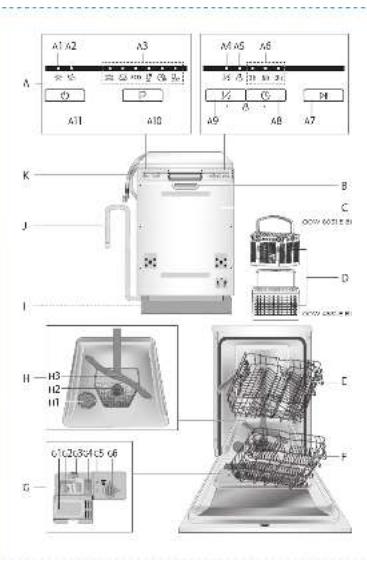
A. Operation panel
A1. Signal lamp for rinse aid
A2. Signal lamp for water softener (Salt)
A3.Mode display ECO
A4. Half load display 12
A5.Key lockindicator
A6. Timer display 3h 6h 9h
A7.Start/Pause button
A8. Delay button
A9. Half load button 12
A10.Mode selection button P
A11. On/Off button
B. Handle
C. Door
D. Cutlery basket
E. Upper dish basket
F. Lower dish basket
G. Fill compartment
Detergent tab/powder compartment
G1. Cover
G2. Compartment for main washing
G3. Lock
G4. Compartment for pre-washing
Rinse aid compartment
G5. Fill indicator
G6. Rinse aid container
H. Inside
H1. Salt container
H2. Water outlet with filter set
H3. Upper and lower spray arms
Backside
I. Power cord with plug
J. Waste water hose (pre-assemble)
K. Hose for water inlet (pre-assemble)
Accessories
Funnel (Not shown)
BEFORE FIRST TIME USE
- Remove the product and accessories carefully from the original packaging. It is recommended to keep the original packaging for storage. If you wish to dispose of the original packaging, please observe applicable legal provisions. Should you have any questions regarding proper disposal, contact your local waste management center.
- Inspect the delivery contents for completeness and damages. Should the delivery contents be incomplete or damaged, contact your sales outlet immediately.
After unpacking, please refer to chapter Cleaning and care.
EN
INSTALLATION
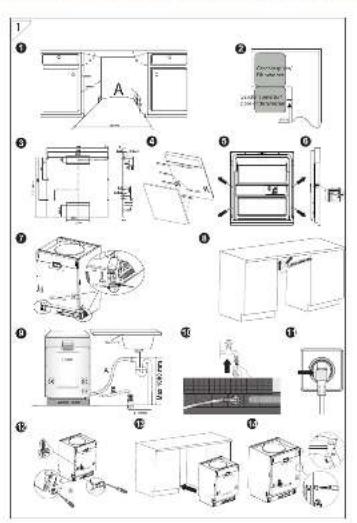
1 The dishwasher must be installed in sufficient proximity of suitable water, sewage and electrical connections.
Note: Please check the included mounting material, brackets, screws and Velcro strips for attaching the decorative panel, etc.
1 Observe the installation dimensions.
- A location near the sink is recommended for the dishwasher to be connected to water and sewage connections easier.
- At the back of one or both lateral cupboards, recesses of size 80 × 100 ~mm must be fitted for water, sewage and electrical connection (A).
If the dishwasher is installed in a corner, a minimum clearance of 50mm between the opened door and surrounding cabinets must be respected.
Note the dimensions, holes and cutouts of the decorative plate.
Pull apart the supplied Velcro strips and remove the protective strips. Stick the 4 Velcro strips in the recesses of the door and the decorative plate. Align the decor panel and attach it to the door of the dishwasher.
Remove the 4 lower screws from the inside of the door.
6 Screw the supplied 4 long screws through the door and fasten the decorative plate.
The springs of the dishwasher door are preset at the factory.
- After installation of the decorative plate, the spring force of the door may have to be adjusted.
- Twist the adjusting screws on both sides to increase/decrease the spring force. Please refer to the illustration in addition to the screws.
- The spring force is adjusted correctly when the fully open door remains in a horizontal position and can be moved all the way up, by slightly pulling on it.
Attach the condensation strip to the bottom of the worktop. Make sure that it is aligned with the front edge of the countertop.
The dishwasher must be connected to drainage.
- The hose is already connected to the waste water outlet at the back of the product. Cut the straps and unwind the hose.
- Connect the end to a drainpipe (Option A or B). Observe the max. height of the outlet of the drainage hose.
Note: A suitable hose holder is available as an optional accessory.
10 Connect the water inlet to a tap water supply (3 / 4^ ) using the pre-assembled hose and make sure it is fastened tightly.
Note: If the water pipes are new or have not been used for an extended period of time, let the water run for a while, to make sure that the water is clear and free of impurities. If this precaution is not taken, there is a risk that the water inlet gets blocked and the appliance is damaged.
1 Connect the power plug to the mains.
12 The dishwasher must be placed in the installation position so that it is absolutely level.
- The rear stand can be adjusted by turning the middle Phillips screw (Pos. A) in height. Please refer to the figure next to the screw (UP: rear is raised, DOWN: rear is lowered).
- The front feet can be adjusted by turning the feet by hand.
- Check the horizontal stand with a spirit level on horizontal or vertical surfaces in the interior of the dishwasher and the door.
13 Place the dishwasher into position.
14 The dishwasher must be fastened in the mounting position using screws.
Option I
Wood Countertop: Insert the mounting bracket on top of the cut-outs. Screw the mounting bracket to the underside of the countertop.
Option II
Natural stone countertop: Remove the plastic cap of the side walls of the dishwasher (with the door open). Fasten the dishwasher laterally with the screws through the openings of the cabinets left and right from the dishwasher.
Note: Before using the product for the first time, make sure, that all hydrophilic connections of the product are correctly sealed and connected to both the device as well as the water mains. Check all connections periodically to avoid possible leakage.
PREPARATION
Filling salt into the salt container
Depending on your tap water hardness (hardness degree) use additional salt (water softener). Always consider the instructions provided with the salt.
- Remove the basket and then unscrew and remove the cap from the salt container.
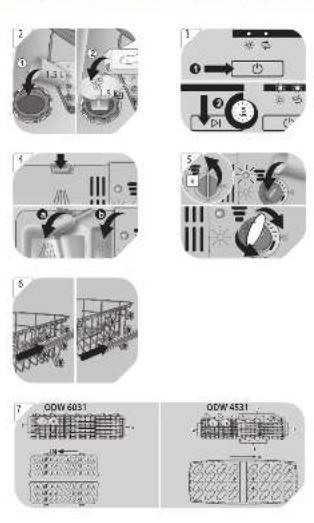
- Before first usage, pour 1.5 litres of water in the salt container of your machine.
- Place the end of the funnel (supplied) into the hole and fill in about 1.5kg of salt. It is normal for a small amount of water to come out of the salt container.
- After filling the container, screw the cap tightly back on in a clockwise direction.
- Immediately after filling the salt into the salt container, a washing program must be started (rapid program suggested). Otherwise the filter system, pump or other important components of the machine may be damaged by salty water which voids the warranty.
Note: Depending on how fully the salt dissolves, the salt warning light may still be on even though the salt container is filled.
Warning!
- Only use salt specifically designed for use in dishwashers! All other types of salt not specifically designed for use in a dishwasher, especially table salt, will damage the water softener. In case of damages caused by the use of unsuitable salt the manufacturer does not give any warranty nor is he liable for any caused damages.
- If salt has been spilled a soak or a rapid program must be started to remove the excess salt.
- Only fill in salt just before starting one of the complete washing programs. This will prevent any grains of salt or salty water, which may have been spilt, from remaining at the bottom of the machine for any period of time, which may cause corrosion.
- The salt container must only be refilled when the salt warning light in the control panel comes on.
EN
Adjusting the salt consumption

- Activate the setup mode: Close the door within 60 seconds after power ON, press the program button P and hold it for 5 seconds, the machine will enter the setting mode which is indicated by the blinking indicator light of
- Adjust the level of salt consumption: Press the program button P to select the proper setting according to your local environment. Follow table below to find correct setting. You can see the current setting, by observing, which program indicators light up.
| Water Hardness level | Setting Digital | display stalls | Salt consumption Gram/Cycle | |
| \( ^o \)dH 1) | mmol/I 2) | |||
| 0-5 0-0.94 1 | \( ♀♂♀ \) | 0 | ||
| 6-11 1.0-2.0 2 | \( ♀♂♀ \) | 9 | ||
| 12-17 2.1-3.0 3 * | \( ♀♂♀ \) and \( ♀♂♀ \) | 12 | ||
| 18-22 3.1-4.0 4 | \( ♀♂♀ \) | 20 | ||
| 23-34 4.1-6.0 5 | \( ♀♂♀ \) and \( ♀♂♀ \) | 30 | ||
| 35-55 6.1-9.8 6 | \( ♀♂♀ \) and \( ♀♂♀ \) | 60 | ||
- The product will exit the setup mode automatically, 5 seconds after last setting/operation of switch.
Note:
1) German degree of measurement for the water hardness
2 Millimol, international unit for water hardness
* Factory setting
Contact your local water board for information on the hardness of your water supply.
Adding detergent

- The dispenser must be refilled before the start of each wash cycle.
-
For the correct amount follow the instructions provided with the detergent.
-
Press the release button and the lid springs open.
- Always add the detergent just before starting each wash cycle, otherwise it could get damp and will not dissolve properly.
- If the dishes are heavily soiled, place an additional detergent dose in the pre-wash detergent chamber. This detergent will take effect during the pre-wash phase.
Consider the difference of the two compartments:
a) Compartment for detergent for main wash cycle.
b) Compartment for detergent for pre-wash cycle.
- Close the lid and press it down until it locks in place.
Note: Use only detergent specifically made for use in dishwashers. Keep your detergent fresh and dry.
Filling the rinse aid dispenser
5 Your dishwasher is designed to use liquid rinse aids which are released during the final rinse to prevent water from forming droplets on your dishes.
-
Open the cap and pour the rinse aid into the dispenser until the level indicator turns completely black. The volume of the rinse aid container is about 110ml .
-
To open the dispenser, turn the cap towards the "open" (left) arrow and lift it out.
- Pour the rinse aid into the dispenser, being careful not to overfill it.
| Indicator Status | |
| ● | Full |
| ◎ | 3/4 full |
| ◎ | 1/2 full |
| ◎ | 1/4 full |
| ○ | Empty |
- Replace the cap by inserting it aligned with the "open" arrow and turning it towards the "closed" (right) arrow.
Note: Never fill the rinse aid dispenser with any other substances (e.g. dishwasher cleaning agent, liquid detergent). This would damage the appliance.
- Rinse aid is automatically added during the last rinse, ensuring thorough rinsing, and spot and streak free drying.
- If the rinse aid dispenser is empty, the rinse aid signal lamp will turn on red.
Adjust the rinse aid dispenser
The dosage can be adjusted in 6 levels. Default level is 4. This setting is a recommendation.
Note:
- Set the dosage level higher, if stains remain on the dishes.
- Set the dosage lower, if clouds or streaks remain on the dishes.
- Use a coin to change the setting.
Loading the dishwasher basket
- Only clean dishes and cutlery which are dishwasher proof or suitable for dishwashers. Follow the instructions of the manufacturers.
- Scrape off any large amounts of leftover food. Soften remnants of burnt-in food in pans, pots etc.
- It is not necessary to rinse the dishes under running water.
-
Place objects in the dishwasher in the following way:
-
Items such as cups, glasses, pots/pans, etc. face down.
- Curved items, or those with recesses, should be loaded at a slant so that water can run off.
- All utensils must be stacked securely so they cannot tip over.
- All utensils must be placed in the way that the spray arms can rotated freely during washing.
- Arrange small dishes in the upper basket, e.g. lightweight and delicate items such as saucers, cups, glasses, dessert bowls etc.
- Arrange large and heavy parts in the lower basket, such as plates, sheets, pots, bowls etc.
Note: Very small items should not be washed in the dishwasher as they could easily fall out of the basket and damage the appliance.
Warning!
- Long bladed knives stored in an upright position are a potential hazard.
- Do not let any item extend through the bottom of the baskets.
- Always load sharp utensils with the sharp points down!
- Do not overload your dishwasher as this will impair the results.
6
Adjusting the upper basket
In order to increase the space in the upper or lower basket for taller / larger pieces of crockery, you can load the upper basket in 2 positions. Pull out the upper basket and depending on the desired position, set the corresponding rollers on the top rail.
7
Observe the plan for placing cutlery into the cutlery basket. See below table for possible part designations.
| ① Soup spoons | ② Forks | ③ Knives | ④ Teaspoons |
| ⑤ Dessert spoons | ⑥ Serving spoons | ⑦ Serving forks | ⑧ Grave ladies |
Basket loading plan
Observe the general plan for placing dishes and cutlery into the basket. See table below for possible part designations.
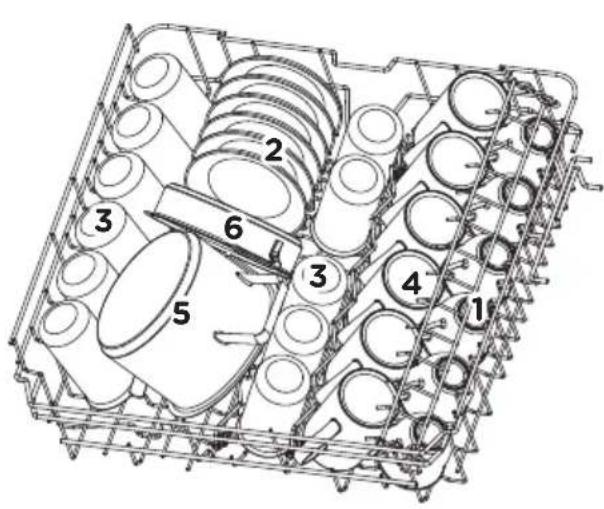
ODW6031EBI
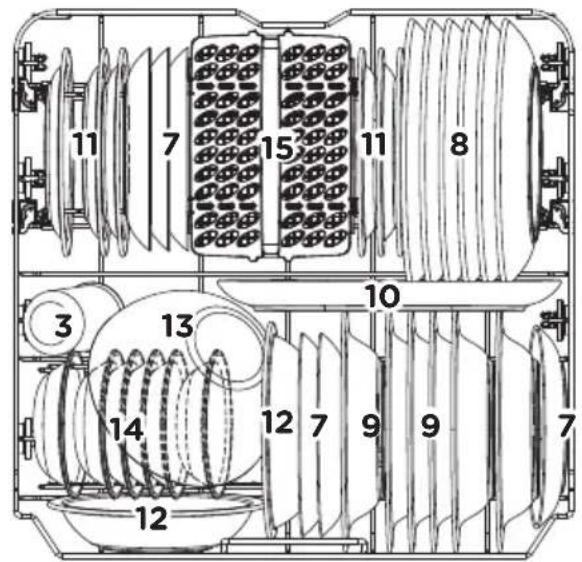
Upper basket Lower basket
| 1 Cups Saucers | 2 Glasses Mugs Small | 3 pot | 4 | 5 |
| 6 Oven pot Dessert dishes | 7 | 8 | 9 | 10 |
| Dinner plates Soup plates Oval platter | ||||
| 11 Melamine dessert plates | 12 | 13 | 14 | 15 |
| Melamine bowls Glass bowl Dessert bowls Cutlery basket | ||||
ODW4531EBI
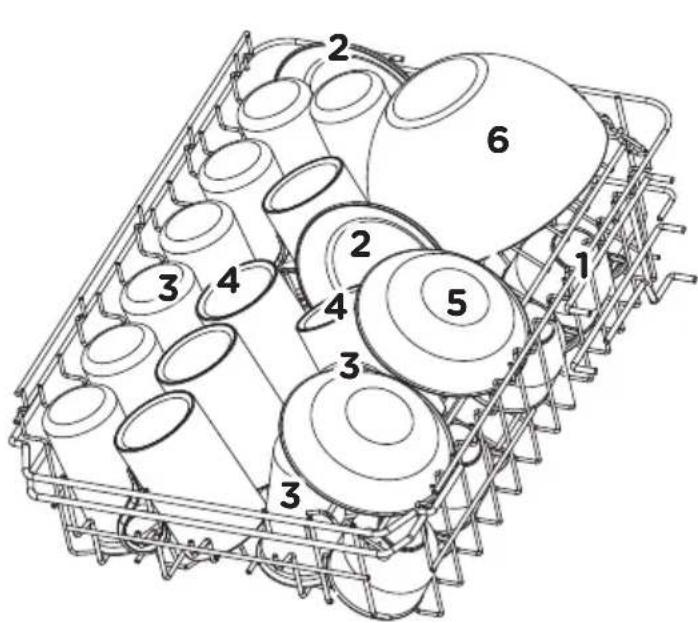
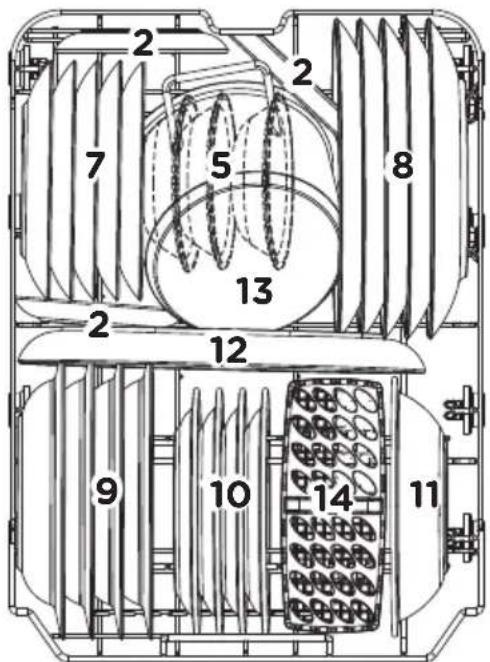
Upper basket Lower basket
| 1 Cups Saucers | 2 Glasses Mugs Dessert bowls | 3 | 4 | 5 |
| 6 Glass bowl Dessert plates Dinner plates Soup plates | 8 | 9 | 10 Melamine dessert plates | |
| 11 Melamine bowl Oval platter Small pot Cutlery basket | 13 | 14 | ||
OPERATION
Washing dishes

-
Consider the following steps to start the washing process:
-
Load the dishwasher basket
- Add detergent or rinse aid
Important: Make sure the water-tap/water supply is open, the appliance is connected to the mains and the door is closed correctly.
- Push the switch to turn on the dishwasher.
Press the P to choose your program, refer to chapter Choosing Program.
If the dishwasher is not fully loaded, then you can additionally select the half load mode. This mode allows you to save both water and electricity when using the bottom and top basket of your dishwasher. Press the 1/2 and the half load indicator lights up.
Note:
- This mode can only be used with the program settings Intensive, Universal, Eco, Glass and 90 min.
-
We recommend to use the half load function if the dishes are slightly soiled.
-
For the timer function (Delay), please refer to chapter TIMER-DELAY WASHING.
Push the button.
- To stop the running program push the button.
Note: The program lights show the state of the dishwasher:
a) Program light on: standby or pause
b) Program light blinking: washing process ongoing
-
When the working cycle has finished, an acoustical signal will sound for 8 seconds, then stop.
-
Turn off the appliance using the button and shut off the water supply.
- Open the door of the dishwasher.
Warning! It is dangerous to open the door when washing, because the hot water may scald you.
- Wait a few minutes before unloading the dishwasher to avoid handling the dishes and utensils while they are still hot. They will also dry better.
- Unload the dishwasher.
Pause the wash cycle
-
You can modify the washing program when the dishwasher had only been running for a short time. Otherwise, the detergent may have already been released, and the appliance may have already drained the wash water.
-
Press the button and then the button for more than 3 seconds. The machine will switch to standby mode.
- Change the program to the desired cycle setting.
- Press the button again to continue washing process.
Note: If you open the door during washing, the machine will pause. When you close the door, the machine will continue working after 10 seconds.
-
If you forgot a dish you can pause the program and add it, but make sure the detergent compartment has not already opened.
-
Press the button to pause the washing process.
- After the spray arms have come to rest, you can open the door completely.
- Add forgotten dishes.
- Close the door and press the button, the dishwasher will continue after 10 seconds.
CHILD LOCK
- The child lock can be activated when the dishwasher is running or has been started with the start time delay.
- Press the half full button and the timer button simultaneously for 3 seconds. All keys of the dishwasher are locked and the corresponding indicator light is on. To deactivate child lock, press the two buttons again for 3 seconds.
RECOMMENDATIONS ON THE TYPE OF DETERGENT
Consider below notes in order to improve the cleaning result, while reducing the energy consumption as well as environmental impact:
- Dose the detergent, salt based on the recommendations / requirements of the supplier, while considering the mass and soiling level of the tablewares.
- Do not mix different detergents and / salts
- Do you use detergents that are based on solvents or corrosive ingredients
- Avoid overdosing
Caution: An incorrect dosage of detergent, salt and other additives can damage the product and impair its correct function.
CHOOSING PROGRAM

ODW6031 EBI
The table below shows which programs are best for the levels of food residue on the dishes and how much detergent is needed. It also shows various information about the programs.
| Program | Information and purpose | Description of cycle | Detergent Pre/Main | Running time in min | Energy cons. in kWh | Water cons. in litre | Rinse aid |
| Intensiv | For heaviest soiled crockery, and normally soiled pots, pans, dishes, etc. with dried on soiling | Pre-wash 50 °C Wash 65 °C Rinse Rinse Rinse 65 °CDrying | 4/16 g (1 or 2 pcs.) | 205 1.6 | 21 17.8 | ★ | |
| Universal | For normally soiled loads such as pots, plates, glasses and lightly soiled pans | Pre-wash 45 °C Wash 55 °C Rinse Rinse 65 °CDrying | 4/16 g (1 or 2 pcs.) | 175 1.3 | 02 14.3 | ★ | |
| ECO (*EN 60436) | This is the standard programme; It is suitable to clean normally soiled tableware and is the most efficient program in terms of its combined energy and water consumption for that type of tableware | Wash 45 °C Rinse Rinse 60 °CDrying | 4/16 g (1 or 2 pcs.) | 220 0.9 | 23 11 | ★ | |
| Glas | For lightly soiled crockery and glass | Pre-wash Wash 50 °C Rinse Rinse 65 °CDrying | 4/16 g (1 or 2 pcs.) | 120 1.1 | 00 14.3 | ★ | |
| 90' 90 min | For normally soiled loads that do not need extensive drying | Wash 60 °C Rinse Rinse 65 °CDrying | 20 g (1 pc.) | 90 1.3 | 0 11.7 | ★ | |
| Rapid | A quick rinse for lightly soiled loads without drying | Wash 50 °C Rinse Rinse 45 °C | 20 g (1 or 2 pcs.) | 30 0.7 | 1 11.2 - |
NOTE:
- ECO: This program is suitable to clean normally soiled tableware and for this use, it is the most efficient program in terms of its combined energy and water consumption. It is used to assess the compliance with the EU ecodesign legislation.
Note:
The values given for programs other than the ECO program are indicative only.
ODW 4531 E BI, according to EN 60436
The table below shows which programs are best for the levels of food residue on the dishes and how much detergent is needed. It also shows various information about the programs.
| Program | Information and purpose | Description of cycle | Detergent Pre/Main | Running time in min | Energy cons. in kWh | Water cons. in litre | Rinse aid |
| Intensiv | For heaviest soiled crockery, and normally soiled pots, pans, dishes, etc. with dried on soiling | Pre-wash 50 °C Wash 65 °C Rinse Rinse Rinse 65 °CDrying | 4/13 g 20 | 1.378 15.3 | ★ | ||
| Universal | For normally soiled loads such as pots, plates, glasses and lightly soiled pans | Pre-wash 45 °C Wash 55 °C Rinse Rinse 65 °CDrying | 4/13 g 17 | 1.287 13.1 | ★ | ||
| ECO (*EN 60436) | This is the standard programme; It is suitable to clean normally soiled tableware and is the most efficient program in terms of its combined energy and water consumption for that type of tableware | Wash 45 °C Rinse Rinse 60 °CDrying | 17 g 235 | 0.704 9 | ★ | ||
| Glas | For lightly soiled crockery and glass | Pre-wash Wash 50 °C Rinse Rinse 65 °CDrying | 4/13 g 12 | 0.934 13.1 | ★ | ||
| 90' 90 min | For normally soiled loads that do not need extensive drying | Wash 60 °C Rinse Rinse 65 °CDrying | 17 g 90 1 | 234 10.2 | ★ | ||
| Rapid | A quick rinse for lightly soiled loads without drying | Wash 50 °C Rinse Rinse 45 °C | 12 g 30 0 | 611 10- |
Note:
- ECO: This program is suitable to clean normally soiled tableware and for this use, it is the most efficient program in terms of its combined energy and water consumption. It is used to assess the compliance with the EU ecodesign legislation.
Note:
The values given for programs other than the ECO program are indicative only.
TIMER - DELAY WASHING
The dishwasher is equipped with a timer function that enables subsequent rinsing. Choose from 3, 6, or 9 hours delay.
- Select the desired delay time with the delay button (Start time delay). The selected time will be indicated by a red LED. The washing process starts with the set delay.
CLEANING AND CARE
- Warning! When cleaning, never use solvents or abrasive materials, hard brushes, metallic or sharp objects. Solvents are harmful to human health and can attack plastic parts, while abrasive cleaning mechanisms and tools may scratch the surface(s).
- Clean the exterior surfaces of the product with a slightly damp cloth and dry them well. Make sure that no water enters the product interior (e.g. at the switches).
- Clean the edge around the door using a soft, warm and damp cloth only. To avoid penetration of water into the door lock and electrical components, do not use a spray cleaner of any kind.
Cleaning the filter assembly
The filter prevents larger remnants of food or other objects from getting inside the pump. Inspect the filters for blocking every time the dishwasher has been used.
11 The filter system consists of a coarse filter, a flat (main filter) and a micro filter (fine filter).
- Main filter A: Food and soil particles trapped by this filter are pulverized by a special jet on the spray arm and washed down the drain.
- Fine filter B: This filter holds soil and food residue in the sump area and prevents it from being deposited on the dishes during the washing.
- Coarse filter C: Larger items, such as pieces of bones or glass that could block the drain are trapped in the coarse filter. To remove the items caught by the filter, gently squeeze the tap on the top of this filter and lift out.
Disassemble and clean the filter according to the following steps:
- Turn the filter cap (filter C) anti-clockwise and take off the whole filter assembly.
Take out filters B and C.
Take out filter C. - Wash the filters under running water and remove all residues and foreign objects.
- Reassembling is done in reverse order. Make sure the filter assembly is installed correctly.
Note! Never use the dishwasher when the filter system not installed.
Cleaning the spray arms
12 The spray arms can be easily removed for periodic cleaning of the nozzles, to prevent possible clogging. We suggest to clean them every two month.
- Grasp the middle of the spray arm, pull it upwards / downwards to remove it.
- Wash the arms under a jet of running water.
- Return them carefully to their seat and make sure that the spray arms are installed correctly and can rotate freely.
DESCALING
Descaling is not necessary if the detergent is dosed correctly. If you want to descale the product, proceed according to the descending agent manufacturer's instructions. You can obtain suitable descending agents from retailers.
ERROR CODES
| Code Meaning Possible causes | |
| The light flickers | Longer inlet time |
| The light flickers | Overflow |
| The and lights flicker | Not reaching required temperature |
| The ECO, and lights flicker | Failure of communication between main PCB and display PCB |
When an ERROR code appears and the problem cannot be solved, please contact the customer service. The respective hotlines are noted in the provided warranty card.
TROUBLESHOOTING
If there are any problems during operation, please refer to the following table. If the problems cannot be solved as indicated under Solution or if spare parts for self-repair are necessary, please contact the service center. The respective hotlines are noted in the warranty card, provided with this product. Please note, that improper self-repair can lead to hazards as well as avoidance of the warranty and should be refrained from, if in doubt.
| Problem Possible causes Solution | ||
| Product does not work • Intu-rupted power supply • Check the pow-nter supply | ||
| Water pressure is low • Check w-hether water supply is connected properly and the faucet is opened | ||
| Dishwasher door is not closed properly | • Ensure door is closed properly | |
| Water isn't pumped from dishwasher | • Kink in drain hose • Check the d-drain hose | |
| Filter is clogged • Check and clean the coarse filter | ||
| Kitchen sink is clogged • Check whether the kitchen sink is draining well or call a service agent for help | ||
| Sud in the tub • Improper detergent | • Only use special dishwasher detergent | |
| Spilled rinse aid • Wipe up rinse-aid spills | ||
| Stained tub interior | • Detergent with colourant was used | • Only use detergent without colourant |
| White film on inside surfact | • Hard water minerals | • Clean the interior with a damp sponge regular |
| Rust stains on cutlery | • Cutlery are not corrosion resistant | • Do not wash these items in the dishwasher |
| • A programme was not run after refilling salt | • Always run a short programme after adding salt | |
| • Softener lid is loose | • Check and properly close it | |
| Problem Possible causes Solution | ||
| Knocking noise in the cabinet · | Spray arm is knocking against an item in the basket | |
| Rattling noise · Items of crockery are loose in the cabinet | ||
| Knocking noise in water pipes · | Caused by on- site installation or cross section of the piping | |
| Dishes aren't cleaned · Dishes not loaded correctly · Re-arrange the dishes | dishes | |
| Spray arms are blocked | ||
| Not enough detergent · Add more detergent | ||
| Program was not powerful enough | ||
| Filter is dirty or not correctly inserted | ||
| Cloudiness on glassware · Too much detergent · Use less detergent | shortest cycle for cleaning glasses | |
| Black or grey marks on dishes · Aluminum utensils have rubbed against dishes | Use a mild abrasive cleaner to clean them | |
| Detergent left in dispenser cups | Detergent cups are blocked · Re-arrange the dishes | |
| Dishes are not drying · Improper loading | ||
| · Rinse-aid level is too low | ||
| · Dishes removed too soon | ||
TECHNICAL DATA
| Power consumption | 1760 - 2100 W |
| Rated voltage / frequency | 220 - 240 V ~ 50 Hz |
| Water pressure (flow pressure) | 0.4 - 10 bar / 0.04 - 1 MPa |
| Water temperature | Cold |
- See website below for detailed technical information or ask your vendor for specification sheet. www.ok-online.com.
EN
Notes concerning the energy- and water consumption of the dishwasher
- The eco program is suitable for cleaning normally soiled dishes. It is the most efficient program for this purpose in terms of combined energy and water consumption and is used to assess compliance with the EU ecodesign legislation.
- By loading the domestic dishwasher up to the capacity specified by the manufacturer, energy and water can be saved. Arrange the dishes correctly as described in the loading plans in these instructions. Improper loading causes inefficient dish-washing and possibly malfunctions.
- Manual pre-washing of the dishes leads to higher water and energy consumption and is not recommended.
- Washing dishes in a household dishwasher generally uses less energy and water than washing by hand, provided the household dishwasher is used in accordance with the manufacturer's instructions.
- Values for the program duration as well as the energy and water consumption of all programs that include an operating cycle can be found in the corresponding tables in these instructions.
- Observe the information on proper installation (including horizontal alignment, connection to the power supply, water connections) in these instructions.
- Use of cleaning agents, salt and other additives must be carried out properly. Incorrect dosage leads to increased environmental pollution and possibly damage to the device.
- Before each use, remove all foreign objects from the household dishwasher.
- Regular cleaning and compliance with the optimal cleaning intervals and measures to prevent limescale deposits, are important. Please refer to the chapter on Cleaning and care.
- Regular control of the filters and the optimal cleaning intervals are important. Please refer to the chapter on Cleaning and care.
DISPOSAL
Do not dispose of this product as unsorted municipal waste. Return it to a designated collection point for the recycling of WEEE. By doing so, you will help to conserve resources and protect the environment. Contact your retailer or local authorities for more information.
ENHORABUENA
| Indicatore Stato | |
| ● | Piano |
| ◎ | 3/4 piano |
| ◎ | 1/2 piano |
| ◎ | 1/4 piano |
| ○ | Vuoto |
Spoelmiddelcompartment
G5. Vulindicator
G6. Spoelmiddelreservoir