268819 - Drill SILVERLINE - Free user manual and instructions
Find the device manual for free 268819 SILVERLINE in PDF.


User questions about 268819 SILVERLINE
0 question about this device. Answer the ones you know or ask your own.
Ask a new question about this device
Download the instructions for your Drill in PDF format for free! Find your manual 268819 - SILVERLINE and take your electronic device back in hand. On this page are published all the documents necessary for the use of your device. 268819 by SILVERLINE.
USER MANUAL 268819 SILVERLINE
1500W SDS Plus Drill
FR Perceuse SDS Plus 1 500 W
DE SDS-Plus-Bohrhammer, 1500 W
ES Taladro SDS Plus 1500 W
IT Trapano SDS Plus 1500 W
NL 1500 W SDS-Plus boormachine
natural_image
Silverline impact energy tool with handle and grip (no visible text or symbols on body)





text_image
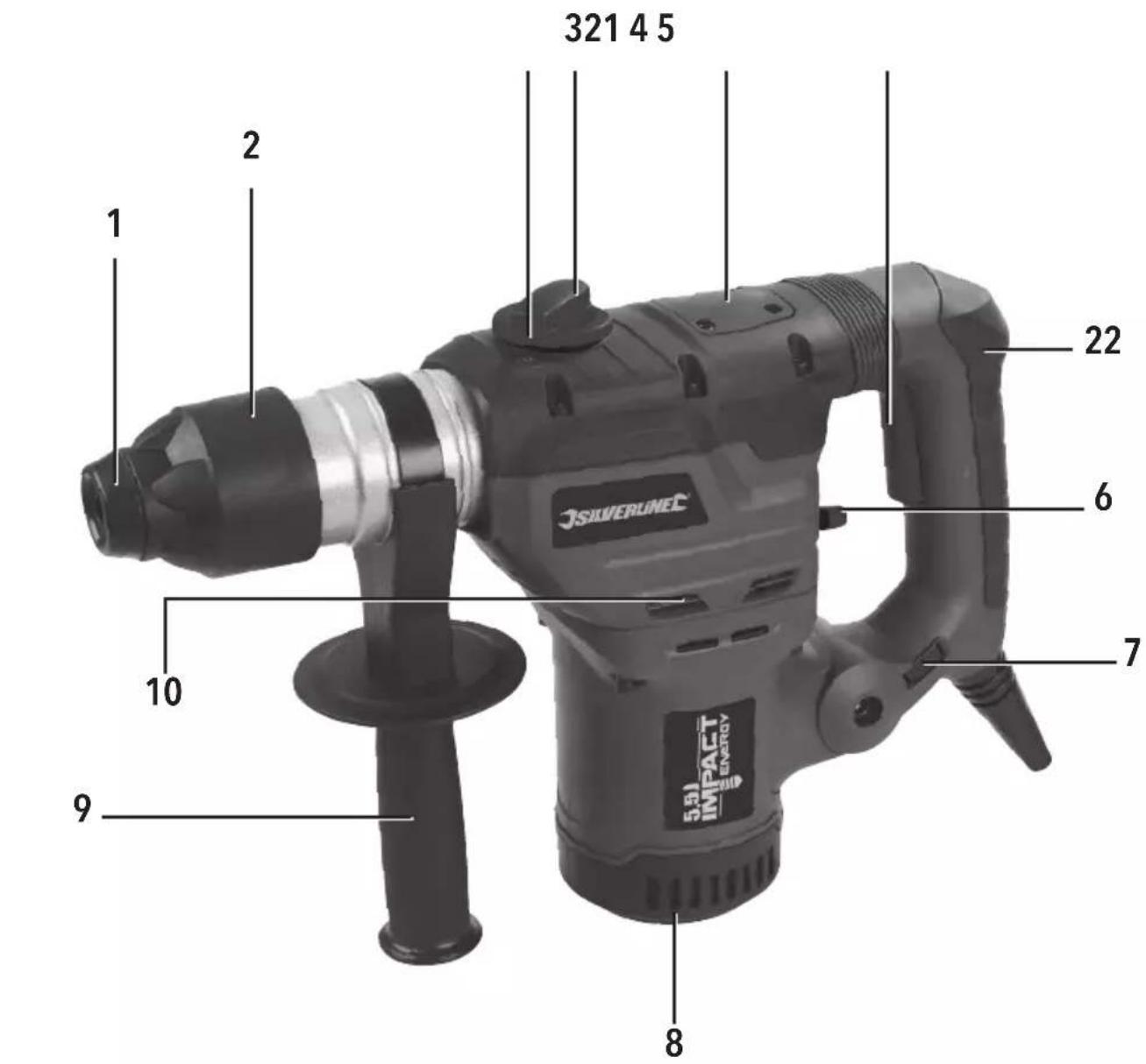
321 4 5 2 22 1 6 7 10 9 8 551 IMPACT ENERGY SILVERLINEC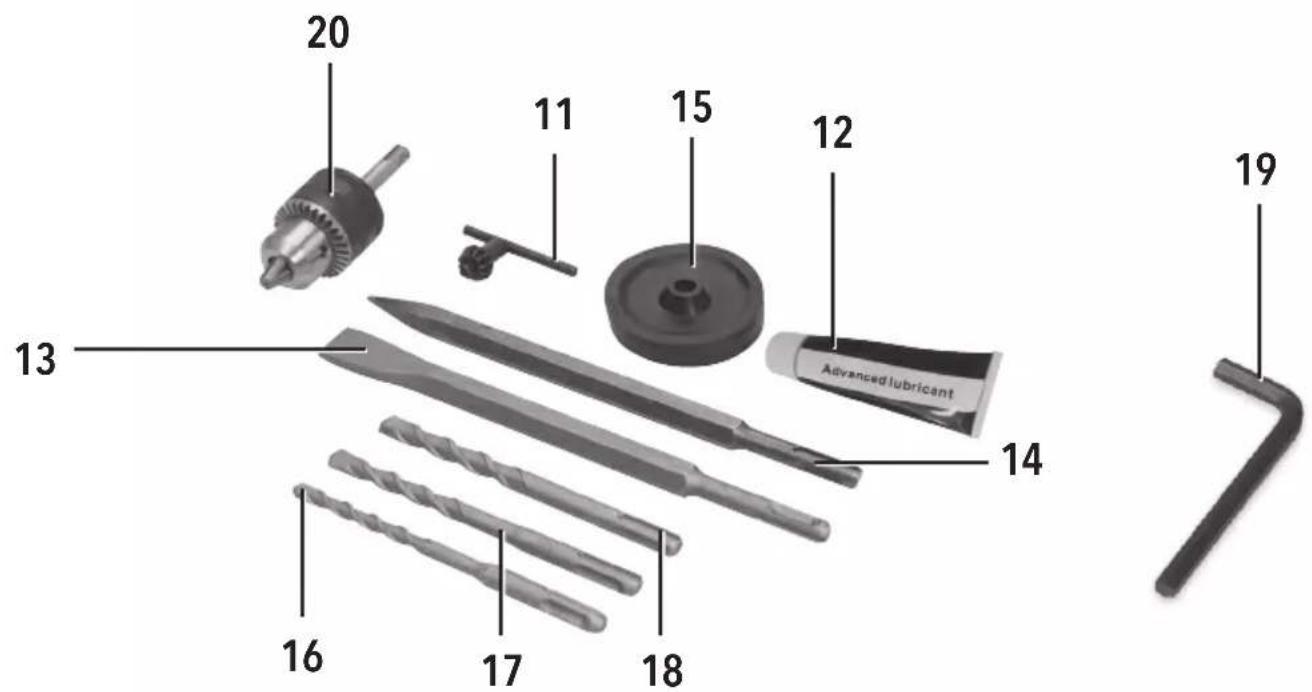
text_image
20 11 15 12 13 14 19 16 17 18 Advanced lubricantFig. I
natural_image
Diagram of a drill bit being inserted into a drill bit, showing motion direction (no text or symbols)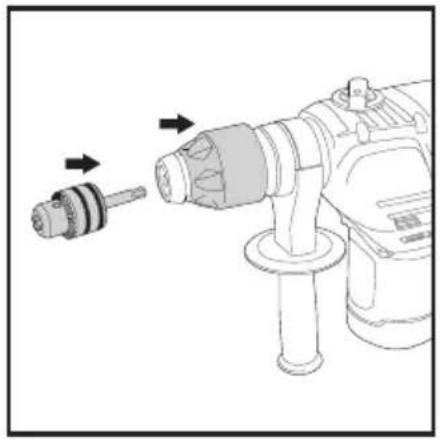
natural_image
Diagram of a drill bit being inserted into a drill bit, showing mechanical components and motion arrows (no text or labels)Fig. II
natural_image
Technical line drawing of a drill bit with a tool, showing mechanical components and motion direction (no text or symbols)Fig. III
natural_image
Mechanical assembly diagram showing a rotating component with directional arrows indicating motion (no text or symbols)Fig. IV
natural_image
Line drawing of a drill bit with a screwdriver inserted, no text or symbols presentFig. V
text_image
Technical diagram showing a mechanical component with directional arrows and labeled section '1'Fig. VI
natural_image
Technical line drawing of a mechanical component with three bolted fasteners and directional arrows indicating movement (no text or symbols)English ......6
Français ......14
Deutsch......22
Español......30
Italiano ......38
Nederlands .....46
Polski ....54
Introduction
Thank you for purchasing this Silverline product. This manual contains information necessary for safe and effective operation of this product. This product has unique features and, even if you are familiar with similar products, it is necessary to read this manual carefully to ensure you fully understand the instructions. Ensure all users of the product read and fully understand this manual. Keep these instructions with the product for future reference.
Description of Symbols
The rating plate on your tool may show symbols. These represent important information about the product or instructions on its use.

Wear hearing protection
Wear eye protection
Wear breathing protection
Wear head protection

Wear hand protection

WARNING: To reduce the risk of injury, user must read instruction manual

Always disconnect from the power supply when adjusting, changing accessories, cleaning, carrying out maintenance and when not in use!

Class II construction (double insulated for additional protection)

DO NOT use on scaffolding or ladders!

Environmental Protection
Waste electrical products should not be disposed of with household waste. Please recycle where facilities exist. Check with your local authority or retailer for recycling advice.

Caution!

DO NOT use in rain or damp environments!

Conforms to relevant legislation and safety standards.
Technical Abbreviations Key
| V Volts | |
| ~, a.c. Alternating current | |
| A, mA Ampere, milli-Amp | |
| n_0 | No load speed |
| Nm Newton metres (torque) | |
| ∅ Diameter | |
| Hz Hertz | |
| W, kW Watt, kilowatt | |
| min ^-1 | Operations per minute |
| bpm Blows (impacts) per minute (drill) | |
| J Joules | |
| dB(A) Decibel sound level (A weighted) | |
| m/s ^2 | Metres per second squared (vibration magnitude) |
Specification
Voltage: 230-240V\~, 50Hz
Power: 1500W
No load speed: 0-880min ^-1
Impact rate: 0.4350bpm
Impact energy: 5.5J
Chuck: ....SDS Plus
Accessory keyed chuck capacity: 0-13mm
Gearbox grease capacity: 80g
Ingress protection: IP20
Protection Class:
Power cable length: 2m
Max drilling capacity: Concrete: ∅ 32mm
Wood: ∅ 40mm
Steel: ∅ 13mm
Dimensions (L x W x H): 390 x 95 x 280mm
Weight 5.5kg
As part of our ongoing product development, specifications of Silverline products may alter without notice.
Sound & vibration information
Sound pressure L_N : 96.4dB(A)
Sound power L_WA 107.4dB(A)
Uncertainty K: 3dB
Weighted vibration (Hammer drill mode): 19.327 m/s
Weighted vibration (Chisel mode): 17.879m/s
Uncertainty: 1.5m/s
The sound intensity level for the operator may exceed 85dB(A) and sound protection measures are necessary.
WARNING: Always wear ear protection where the sound level exceeds 85dB(A) and limit the time of exposure if necessary. If sound levels are uncomfortable, even with ear protection, stop using the tool immediately and check the ear protection is correctly fitted and provides the correct level of sound attenuation for the level of sound produced by your tool.
WARNING: User exposure to tool vibration can result in loss of sense of touch, numbness, tingling and reduced ability to grip. Long-term exposure can lead to a chronic condition. If necessary, limit the length of time exposed to vibration and use anti-vibration gloves. Do not operate the tool with hands below a normal comfortable temperature, as vibration will have a greater effect. Use the figures provided in the specification relating to vibration to calculate the duration and frequency of operating the tool.
WARNING: The vibration emission during actual use of the power tool can differ from the declared total value depending on the ways in which the tool is used. There is the need to identify safety measures to protect the operator that are based on an estimation of exposure in the actual conditions of use (taking account of all parts of the operating cycle such as the times when the tool is switched off and when it is running idle in addition to the trigger time).
The declared vibration total value has been measured in accordance with a standard test method and may be used for comparing one tool with another. The declared vibration total value may also be used in a preliminary assessment of exposure.
Sound levels in the specification are determined according to international standards. The figures represent normal use for the tool in normal working conditions. A poorly maintained, incorrectly assembled, or misused tool, may produce increased levels of noise and vibration. www.osha.europa.eu provides information on sound and vibration levels in the workplace that may be useful to domestic users who use tools for long periods of time.
Carefully read and understand this manual and any label attached to the tool before use. Keep these instructions with the product for future reference. Ensure all persons who use this product are fully acquainted with this manual.
Even when used as prescribed it is not possible to eliminate all residual risk factors. Use with caution. If you are at all unsure of the correct and safe manner in which to use this tool, do not attempt to use it.
General Power Tool Safety Warnings
⚠ WARNING: Read all safety warnings, instructions, illustrations and specifications provided with this power tool. Failure to follow all instructions listed below may result in electric shock, fire and/or serious injury.
Save all warnings and instructions for future reference.
The term "power tool" in the warnings refers to your mains-operated (corded) power tool or battery-operated (cordless) power tool.
1) Work area safety
a) Keep work area clean and well lit. Cluttered or dark areas invite accidents.
b) Do not operate power tools in explosive atmospheres, such as in the presence of flammable liquids, gases or dust. Power tools create sparks which may ignite the dust or fumes.
c) Keep children and bystanders away while operating a power tool. Distractions can cause you to lose control.
2) Electrical safety
a) Power tool plugs must match the outlet. Never modify the plug in any way. Do not use any adapter plugs with earthed (grounded) power tools. Unmodified plugs and matching outlets will reduce risk of electric shock.
b) Avoid body contact with earthed or grounded surfaces, such as pipes, radiators, ranges and refrigerators. There is an increased risk of electric shock if your body is earthed or grounded.
c) Do not expose power tools to rain or wet conditions. Water entering a power tool will increase the risk of electric shock.
d) Do not abuse the cord. Never use the cord for carrying, pulling or unplugging the power tool. Keep cord away from heat, oil, sharp edges or moving parts. Damaged or entangled cords increase the risk of electric shock.
e) When operating a power tool outdoors, use an extension cord suitable for outdoor use. Use of a cord suitable for outdoor use reduces the risk of electric shock.
f) If operating a power tool in a damp location is unavoidable, use a residual current device (RCD) protected supply. Use of an RCD reduces the risk of electric shock.
g) When used in Australia or New Zealand, it is recommended that this tool is ALWAYS supplied via Residual Current Device (RCD) with a rated residual current of 30mA or less.
h) Use proper extension cord. Make sure your extension cord is in good condition. When using an extension cord, be sure to use one heavy enough to carry the current your product will draw. An undersized cord will cause a drop in line voltage resulting in loss of power and overheating. Table A shows the correct size to use depending on cord length and nameplate ampere rating. If in doubt, use the next heavier gauge. The smaller the gauge number, the heavier the cord.
| Table A | ||||||
| Ampere rating Volts | Total length of cord in meters (feet) | |||||
| 120 7.5 (25) 15 (50) 30.5 (100) 46 (150) | ||||||
| 240 15 (50) 30.5 (100) 61 (200) 92 (300) | ||||||
| More than | Not more than | Minimum gauge for cord | ||||
| 0 6 18 | 6 16 14 | 16 16 14 12 | ||||
| 6 | 10 | 18 16 14 12 | ||||
| 10 12 | 14 12 | |||||
| 12 16 | Not recommended | |||||
3) Personal safety
a) Stay alert, watch what you are doing and use common sense when operating a power tool. Do not use a power tool while you are tired or under the influence of drugs, alcohol or medication. A moment of inattention while operating power tools may result in serious personal injury.
b) Use personal protective equipment. Always wear eye protection. Protective equipment such as a dust mask, non-skid safety shoes, hard hat or hearing protection used for appropriate conditions will reduce personal injuries.
c) Prevent unintentional starting. Ensure the switch is in the OFF position before connecting to power source and/or battery pack, picking up or carrying the tool. Carrying power tools with your finger on the switch or energising power tools that have the switch ON invites accidents.
d) Remove any adjusting key or wrench before turning the power tool ON. A wrench or a key left attached to a rotating part of the power tool may result in personal injury.
e) Do not overreach. Keep proper footing and balance at all times. This enables better control of the power tool in unexpected situations.
f) Dress properly. Do not wear loose clothing or jewellery. Keep your hair and clothing away from moving parts. Loose clothes, jewellery or long hair can be caught in moving parts.
g) If devices are provided for the connection of dust extraction and collection facilities, ensure these are connected and properly used. Use of dust collection can reduce dust-related hazards.
h) Do not let familiarity gained from frequent use of tools allow you to become complacent and ignore tool safety principles. A careless action can cause severe injury within a fraction of a second.
4) Power tool use and care
a) Do not force the power tool. Use the correct power tool for your application. The correct power tool will do the job better and safer at the rate for which it was designed.
b) Do not use the power tool if the switch does not turn it ON and OFF. Any power tool that cannot be controlled with the switch is dangerous and must be repaired.
c) Disconnect the plug from the power source and/or remove the battery pack, if detachable, from the power tool before making any adjustments, changing accessories, or storing power tools. Such preventive safety measures reduce the risk of starting the power tool accidentally.
d) Store idle power tools out of the reach of children and do not allow persons unfamiliar with the power tool or these instructions to operate the power tool. Power tools are dangerous in the hands of untrained users.
e) Maintain power tools and accessories. Check for misalignment or binding of moving parts, breakage of parts and any other condition that may affect the power tool's operation. If damaged, have the power tool repaired before use. Many accidents are caused by poorly maintained power tools.
f) Keep cutting tools sharp and clean. Properly maintained cutting tools with sharp cutting edges are less likely to bind and are easier to control.
g) Use the power tool, accessories and tool bits, etc. in accordance with these instructions, taking into account the working conditions and the work to be performed. Use of the power tool for operations different from those intended could result in a hazardous situation.
h) Keep handles and grasping surfaces dry, clean and free from oil and grease. Slippery handles and grasping surfaces do not allow for safe handling and control of the tool in unexpected situations.
5) Service
a) Have your power tool serviced by a qualified repair person using only identical replacement parts. This will ensure that the safety of the power tool is maintained.
b) If the supply cord is damaged, it must be replaced by the manufacturer, its service agent or similarly qualified persons in order to avoid a hazard.
6) Hammer safety warnings
a) Wear ear protectors. Exposure to noise can cause hearing loss.
b) Use auxiliary handle(s), if supplied with the tool. Loss of control can cause personal injury.
c) Hold power tool by insulated gripping surfaces when performing an operation where the cutting accessory may contact hidden wiring or its own cord. Cutting accessory contacting a 'live' wire may make exposed metal parts of the power tool 'live' and could give the operator an electric shock.
IMPORTANT: Even when this tool is used as prescribed it is not possible to eliminate all residual risk factors. If you are in any doubt as to safe use of this tool, do not use it.
SDS Plus Drill Safety Warnings
WARNING: If you suspect or discover asbestos is present in any area you are working seek professional advice immediately. Removal of asbestos should be done by a licensed contractor. Contact the HSE in the UK (www.hse.gov.uk) or your national health and safety authority in your country for further information about dealing with asbestos. European Directive 2009/148/EC provides additional information related to exposure to asbestos at work.
- Follow all national safety regulations concerning the type of work being undertaken. Do not allow anyone under the age of 18 years to use this tool.
- Ensure that operators are qualified and familiar with the operating and safety instructions.
- Masonry drilling or chiselling can create sharp particles that will impact the operator. Wear impact-resistant safety glasses and protective clothing, including safety boots.
- If the safety clutch operates during use, quickly release the trigger and remove the bit from the masonry surface being drilled. Do not continue work until the cause of the safety clutch operating is understood.
- Do not operate SDS drills whilst up a ladder or in any location where there is a risk of falling. SDS drills are heavy and produce strong vibration and high torque in use.
- Wear suitable protective anti-vibration gloves that are non-fabric or coated fabric to prevent loose strands of material catching in the rotating drill bit. Discard gloves immediately if material is visibly frayed.
- Drilling can produce large volumes of dust and debris that may be toxic. Wear respiratory protection suitable for the work being undertaken. A minimum rating of FFP2 is recommended.
- SDS drills produce high levels of noise and suitable ear protection must be worn at all times while operating the tool.
- SDS drills produce a very high level of vibration when operating in hammer or chisel mode. Frequent breaks are advised.
- Only use SDS Plus chisels or points with SDS drills that can disengage rotary drilling mode.
- Use metal and voltage detectors to locate concealed electric, water or gas lines. Avoid touching live components or conductors.
- Extension cable reels used with this tool must be completely unwound. Minimum conductor cross section: 1.25mm ^2 .
- Extension reels used outside should be designed for outdoor use and should feature water-protected sockets and correct cable insulation.
- When using an SDS drill outdoors, an RCD device must be used either by connecting to a socket which incorporates an RCD, or through use of an inline RCD.
- Ensure that the chisel or drill bit is securely fixed in the chuck before operating the tool. Insecure drill bits can be ejected from the machine, causing a hazard.
- Ensure lighting is adequate.
- Use both hands when operating this tool.
- Do not place pressure on the tool – to do so could shorten its service life.
- Drill bits become hot during operation. Allow to cool prior to handling.
- If you are interrupted when operating the drill, complete the process and switch off before diverting your attention elsewhere.
• Always disconnect the SDS drill from the electric supply before changing a chisel or drill bit.
- Examine the chuck regularly for signs of wear or damage. Have damaged parts repaired by a qualified technician.
• Always wait until the drill has come to a complete stop before placing it down.
- On completion of the work, disconnect the tool from the power source and remove the chisel/bit from the machine.
• Periodically check all nuts, bolts and other fixings and tighten where necessary.
- Check the tool for damage after use, paying special attention to the power cable which can be damaged by sharp masonry.
• Always fit the dust guard to the bit in use to prevent damage from debris entering the SDS chuck.
- If operating the tool causes discomfort in any way, stop immediately and review your method of use.
Product Familiarisation
- SDS Plus Chuck
- SDS Plus Chuck Collar
- Rotation Mode Selection Switch
- Gearbox Cover
- ON/OFF Trigger
- Hammer Mode Selection Switch
- Variable Speed Control
- Brush Access Cover
- Auxiliary Handle
- Auxiliary Handle Grip
- Auxiliary Handle Collar
- Motor Vents
- Chuck Key
- Tube of Grease
- Chisel
- Point
- Dust Guard
- 3mm Masonry SDS Plus Drill Bit
- 10mm Masonry SDS Plus Drill Bit
- 12mm Masonry SDS Plus Drill Bit
- Hex Key
- 13mm Keyed Chuck
- SDS Plus Screw
- Mode Selector Lock
- Main Handle
Intended Use
Portable medium-duty corded power tool optimally designed for drilling masonry and breaking light masonry. It is also capable of drilling wood and metal by attaching the 13mm Keyed Chuck (22) supplied or with an additional purchase of a standard chuck with SDS Plus connector. This tool has a fixed rotation speed and is not suitable for use with core drills or for driving screws and fasteners.
The tool must ONLY be used for its intended purpose. Any use other than those mentioned in this manual will be considered a case of misuse. The operator, and not the manufacturer, shall be liable for any damage or injury resulting from such cases of misuse. The manufacturer shall not be liable for any modifications made to the tool, nor for any damage resulting from such modifications.
Unpacking Your Tool
- Carefully unpack and inspect your tool. Fully familiarise yourself with all its features and functions.
- Ensure that all parts of the tool are present and in good condition. If any parts are missing or damaged, have such parts replaced before attempting to use this tool.
Before Use
Applying grease
IMPORTANT: Always check there is sufficient grease in the gearbox cavity before using the drill. Before first use and after every six hours of further use, replenish the gearbox cavity with good quality lithium gearbox grease. A Tube of Grease (14) is supplied for initial use. See 'Gearbox Maintenance' for application guidance.
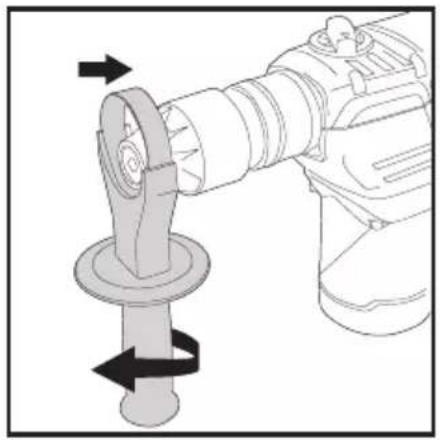
Fitting the auxiliary handle (Fig. III)
⚠ WARNING: Always fit the Auxiliary Handle (9) before use.
- Turn Auxiliary Handle Grip (10) anti-clockwise to loosen Auxiliary Handle Collar (11).
- Place Auxiliary Handle Collar over the Chuck (1) and Chuck Collar (2) as per the product image.
- Turn the Auxiliary Handle to the appropriate angle for the task at hand, then turn the Auxiliary Handle Grip clockwise to secure the Auxiliary Handle Collar.
IMPORTANT: Ensure the Auxiliary Handle is not tightened onto any moving parts of the tool before use.
Operation
SDS Plus Chuck operation
Note: The SDS Plus system allows the bit to move slightly within the chuck when inserted correctly. SDS Plus bits will not lock into place in the same way as conventional bits used with a conventional chuck.
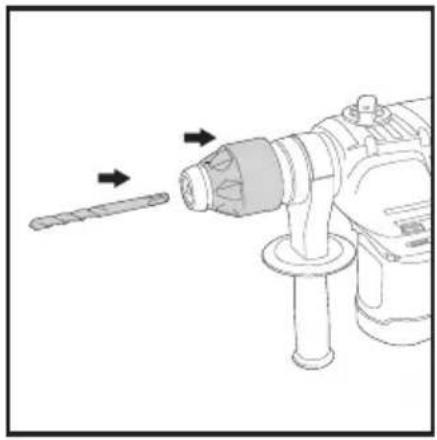
Fitting a bit (Fig. I)
- Grease the shank of the bit. The Tube of Grease (14) supplied is suitable for this.
- Pull back the SDS Plus Chuck Collar (2) and hold it in place.
- Push and rotate the bit into the SDS Plus Chuck (1) as far as it will go. Release the SDS Plus Chuck Collar.
- Check the bit is secure by pulling on the bit. If the bit can be removed, turn the bit to allow the chuck bearings to engage with the indentations on the shank. If the bit can still be pulled out, repeat the fitting steps until it is held securely.
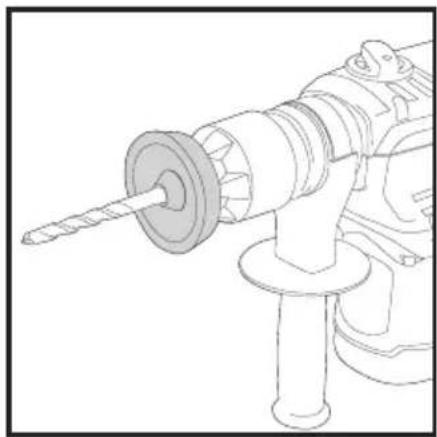
Note: The Dust Guard (17) should be fitted to the drill or chisel bit to prevent debris and dust entering the Chuck (Fig. IV). This is especially important when the drill is used at a raised angle when working on walls or ceilings. For larger drill or chisel bits it may need to be fitted before the bit is inserted in the Chuck.
Removing a bit
- To release the bit from the SDS Plus Chuck (1), pull the SDS Plus Chuck Collar (2) back and hold it in place. The bit can then be removed from the drill.
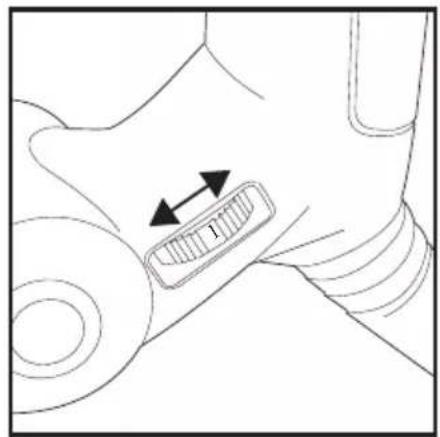
Variable speed selection (Fig. V)
- The Variable Speed Control (7) is used to adjust the speed of the tool. Increasing the number indicated on the Control will increase the speed of the tool operation; decreasing slows the speed.
Mode selection
WARNING: Do not change modes when the drill is operating. Changing modes while the mechanical parts of the drill are working may cause damage. Use the Hammer Mode Selection Switch (6) and Rotation Mode Selection Switch (3) to set the tool to the correct action for the task required. Use the table to see how to set each mode.
| Tool action Application | Hammer Mode Selection Switch position and symbol | Rotation Mode Selection Switch position and symbol | |
| Rotation with hammer | Masonry drilling | Right | Left |
| Rotation only | Conventional drilling (wood, metal etc.) | Right | Right |
| Hammer only (chiselling) | Masonry chiselling | Left | Left |
ON/OFF Trigger
CAUTION: The drill is not designed to be permanently switched on and there is no lock-on feature. Do not attempt to improvise such a feature.
- To start the drill, squeeze the ON/OFF Trigger (5).
- To stop the drill, release the ON/OFF Trigger.
CAUTION: The maximum speed of the drill is governed by the Variable Speed Control (7). Take time adjusting the Variable Speed Control Switch to ensure the maximum speed is correctly set before use.
⚠ WARNING: Do not use drill bits that have a maximum rotational speed of less than that of the maximum speed of the drill (see Specification).
Safety clutch
In the event of the drill operating at a very low rotational speed or the bit becoming locked in the workpiece, the safety clutch will disengage the drive.
In this event quickly release the ON/OFF Trigger (5). This will help prevent injury and reduce wear on the safety-clutch mechanism.
After the safety clutch has activated, thoroughly check all equipment is correctly set up and the drill bit or core drill is not badly worn or damaged. It may be necessary to work at a slower rate. In some instances you may find the drill is not suitable for the accessory or application.
WARNING: Do not rely on the safety clutch. Always configure your equipment for safe use so that the safety clutch does not need to operate.
Drilling, breaking and chiselling
IMPORTANT: Applying excess pressure does not result in faster or more efficient drilling. If the pressure applied to the drill has a noticeable effect on the speed of the drill then reduce the pressure. Overloading the drill will reduce its service life.
Drilling concrete
- Apply the hammer drill mode and rotation mode settings, and apply pressure to the rear of the drill in line with the drill bit. Do not apply excessive force to the drill, as this may cause damage or injury.
• Tungsten carbide-tipped (TCT) drill bits are recommended for efficiency. - Ensure the drill bit size is within the maximum capacity of the drill.
- Do not activate the drill until the bit is in contact with the workpiece.
Breaking and chiselling concrete
WARNING: An SDS Plus drill with a chisel does not have the same functionality or capacity of an electric breaker. Do not use this tool for breaking up patios, paths or other areas of thick concrete. Always consider the force required to work on the material at hand. If the chisel fails to break the material being worked on, stop using it immediately. The chisel tip and internal parts of the SDS drill will become damaged if the chisel tip strikes a surface that it cannot break or requires repeated strikes at the same point to break.
- Using hammer drill mode and roto-stop mode, apply pressure to the rear of the drill in line with the chisel. Do not apply excessive force to the drill, as this may cause damage or injury.
- Be aware that when chiselling, there is a high risk of chips and other waste being ejected from the workpiece.
- Do not activate the drill until the bit is in contact with the workpiece.
Drilling wood and plastic
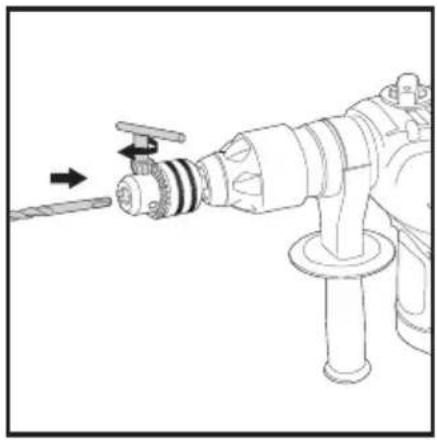
Attaching the Keyed Chuck (Fig. II)
CAUTION: The 13mm Keyed Chuck (22) is not intended for use with masonry bits and will be damaged if used in hammer mode. Always use SDS Plus masonry bits fitted directly into the SDS Plus Chuck (1) for masonry use.
- Screw the SDS Plus Screw (23) to the 13mm Keyed Chuck.
Note: The SDS Plus Screw has a left-handed thread and therefore will tighten by turning anticlockwise and loosen by turning clockwise. - Insert the 13mm Keyed Chuck into the SDS Plus Chuck (1)
- Insert a conventional drill bit for either wood or metal into the 13mm Keyed Chuck and tighten with the Chuck Key (13). See Specification for maximum drilling capacity in wood and metal.
Drilling wood
- Use rotary drill mode only.
- Ensure drill bits are suitable for the material being worked on and are within the maximum capacity of this drill.
Drilling metal
This drill is suitable for light-duty drilling mild steel, aluminium and brass.
- Use rotary drill mode only.
- To ensure accuracy, mark the intended hole position using a hammer and centre punch.
- Ensure drill bits are suitable for the grade of metal being drilled and are within the maximum capacity of the drill.
- To ensure efficient cutting and prolong drill bit life, use a suitable lubricant/cutting fluid.
- As the drill bit penetrates the material being drilled it may catch or snag. This can cause the machine to suddenly 'kick'. To prevent any possibility of injury always hold the drill securely, use the Auxiliary Handle (9) and use sharp drill bits.
Always ensure material is secure. If appropriate use a vice or clamp to hold the work. Always keep two hands on the drill.
Accessories
- A range of accessories for this product are available from your Silverline dealer including SDS Plus drill and chisel bits. Carbon brushes are available from www.toolsparesonline.com or your Silverline dealer.
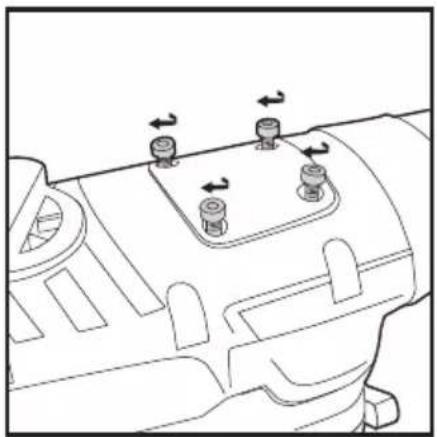
Gearbox maintenance (Fig. VI)
Before first use and after every six hours of use (approx.), the gearbox must be regreased using the supplied Tube of Grease (14) or a good quality lithium gearbox grease.
- To access the gearbox, use the Hex Key (21) to release the Gearbox Cover (4). Remove the cap.
- Cover the inside of the gearbox cavity with a thick layer of grease (no more than 80 grams).
- Replace the Gearbox Cover and use the Hex Key to secure.
- Do not over-tighten the Gearbox Cover.
- If you are not sure how to change the grease, of the amount of grease to use, or which type of grease to use, take your drill to your dealer or the nearest authorised service centre and ask a qualified person to replace the grease.
General inspection
• Regularly check that all the fixing screws are tight.
- Inspect the supply cord of the tool, prior to each use, for damage or wear. Repairs should be carried out by an authorised Silverline service centre. This advice also applies to extension cords used with this tool.
Cleaning
- Keep your tool clean at all times. Dirt and dust will cause internal parts to wear. quickly and shorten the machine's service life. Clean the body of your tool with a soft brush, or dry cloth. If available, use clean, dry, compressed air to blow through the ventilation holes.
- Clean the tool casing with a soft damp cloth using a mild detergent. Do not use alcohol, petrol or strong cleaning agents.
- Never use caustic agents to clean plastic parts.
Lubrication
- Slightly lubricate all moving parts at regular intervals with a suitable spray lubricant with the exception of the gearbox, which requires good quality lithium-based grease.
Brushes
• Over time the carbon brushes inside the motor may become worn.
- Excessively worn brushes may cause loss of power, intermittent failure, or visible sparking.
- To replace the brushes, remove the Brush Access Cover (8). The worn brushes can then be withdrawn and replaced.
• Always replace worn brushes in pairs.
• Refit the brush access cover.
• Alternatively, have the tool serviced at an authorised Silverline service centre.
Storage
After use, return the drill and accessories to the supplied case and store in a damp-free environment, out of reach of children.
Disposal
Always adhere to national regulations when disposing of power tools that are no longer functional and are not viable for repair.
- Do not dispose of power tools, or other waste electrical and electronic equipment (WEEE), with household waste.
- Contact your local waste disposal authority for information on the correct way to dispose of power tools.
Contact
For technical or repair service advice, please contact the helpline on (+44) 1935 382 222
Web: www.silverlinetools.com
UK Address:
Toolstream Ltd.
Boundary Way
Lufton Trading Estate
Yeovil, Somerset
BA22 8HZ, United Kingdom
EU Address:
Toolstream B.V.
Holtum-Noordweg 11
Unit 4
6121 RE Born
The Netherlands
Troubleshooting
| Problem Cause Solution | ||
| Drill is uncomfortable to use due to vibration Tool is being used for too long at one time | Take frequent breaks and read the sections in this manual regarding vibration | |
| Tool will not start | No power, fuse blown or circuit breaker tripped | Check and replace fuse if necessary or reset circuit breaker. In the event the fuse blows after replacing or the circuit breaker trips again, immediately contact an authorised service centre |
| Power cable damaged Contact an authorised service centre | ||
| ON/OFF Trigger switch faulty Contact an authorised service centre | ||
| Faulty motor Contact an authorised service centre | ||
| Slow rotation speed Tool is overheating | Switch off the tool and let it cool down to room temperature. Inspect and clean the ventilation slots. | |
| Slow rotation speed or no rotation plus possible visible sparking from Motor Vents (12) | Carbon brushes worn | Contact an authorised service centre to have the carbon brushes replaced |
| Vibration or abnormal noise | Gearbox low on grease Add or replace grease | |
| Internal moving parts excessively worn Contact an authorised service centre | ||
| Chisel mode not breaking material | Material too dense or thick Drill not suitable for material or thickness | |
| Chisel tip worn Replace chisel | ||
| Chisel tip is rotating Tool incorrectly set Select roto-stop mode | ||
| Drilling performance poor with masonry | Hammer mode not selected Enable hammer mode | |
| Drill bit tip worn or damaged Replace SDS Plus drill bit | ||
| Very dense material | Drilling speed will be slow in such material. A smaller pilot drill can be drilled first to speed up the drilling process. | |
| Bits do not fit easily into SDS Plus Chuck (1) Debris and dirt in chuck | Clean out by positioning chuck downwards and vacuuming while operating the chuck as if to insert bits. Ensure dust guard is used to prevent debris entering chuck. | |
This Silverline product comes with a 3 year guarantee
Register this product at www.silverlinetools.com within 30 days of purchase in order to qualify for the 3 year guarantee. Guarantee period begins according to the date of purchase on your sales receipt.
Guarantee period becomes effective from the date of retail purchase as detailed on your sales receipt.
PLEASE KEEP YOUR SALES RECEIPT
If this product develops a fault within 30 days of purchase, return it to the stockist where it was purchased, with your receipt, stating details of the fault. You will receive a replacement or refund.
If this product develops a fault after the 30-day period, return it to:
Silverline Tools Service Centre
PO Box 2988
Yeovil
BA21 1WU, UK
The guarantee claim must be submitted during the guarantee period.
You must provide the original sales receipt indicating the purchase date, your name, address and place of purchase before any work can be carried out.
You must provide precise details of the fault requiring correction.
Claims made within the guarantee period will be verified by Silverline Tools to establish if the deficiencies are related to material or manufacturing of the product.
Carriage will not be refunded. Items for return must be in a suitably clean and safe state for repair, and should be packaged carefully to prevent damage or injury during transportation.
We may reject unsuitable or unsafe deliveries.
All work will be carried out by Silverline Tools or its authorised repair agents.
The repair or replacement of the product will not extend the period of guarantee
Defects recognised by us as being covered by the guarantee shall be corrected by means of repair of the tool, free of charge (excluding carriage charges) or by replacement with a tool in perfect working order.
Retained tools, or parts, for which a replacement has been issued, will become the property of Silverline Tools.
The repair or replacement of your product under guarantee provides benefits which are additional to and do not affect your statutory rights as a consumer.
Registering your purchase
Registration is made at silverlinetools.com by selecting the Guarantee Registration button. You will need to enter:-
- Your personal details
• Details of the product and purchase information
Once this information is entered your guarantee certificate will be created in PDF format for you to print out and keep with your purchase.
What is covered:
- The repair of the product, if it can be verified to the satisfaction of Silverline Tools that the deficiencies were due to faulty materials or workmanship within the guarantee period.
- If any part is no longer available or out of manufacture, Silverline Tools will replace it with a functional replacement part.
What is not covered:
Silverline Tools does not guarantee repairs required as a result of:
- Normal wear and tear caused by use in accordance with the operating instructions e.g. blades, brushes, belts, bulbs, batteries etc.
- The replacement of any provided accessories such as drill bits, blades, sanding sheets, cutting discs and other related items.
- Accidental damage, faults caused by negligent use or care, misuse, neglect, careless operation or handling of the product.
- Use of the product for anything other than normal domestic purposes.
- Change or modification of the product in any way.
- Use of parts and accessories which are not genuine Silverline Tools components.
- Faulty installation (except if installed by Silverline Tools).
- Repairs or alterations carried out by parties other than Silverline Tools or its authorised repair agents.
- Claims other than the right to correction of faults on the tool named in these guarantee conditions are not covered by the guarantee.
Introduction
Silverline Tools Service Centre
PO Box 2988
Yeovil
Silverline Tools Service Centre
PO Box 2988
Yeovil
Silverline Tools Service Centre
PO Box 2988
Yeovil
BA21 1WU, VK
Silverline Tools Service Centre
PO Box 2988
Yeovil
BA21 1WU, UK
natural_image
Exterior view of a black and gray electric drill putter (no visible text or symbols)EN 3 Year Guarantee. Register online within 30 days. Terms and Conditions apply.