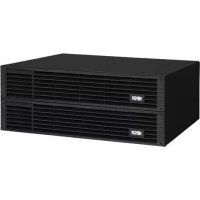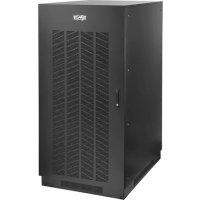
BP240V100 - Battery Tripp Lite - Free user manual and instructions
Find the device manual for free BP240V100 Tripp Lite in PDF.


User questions about BP240V100 Tripp Lite
0 question about this device. Answer the ones you know or ask your own.
Ask a new question about this device
Download the instructions for your Battery in PDF format for free! Find your manual BP240V100 - Tripp Lite and take your electronic device back in hand. On this page are published all the documents necessary for the use of your device. BP240V100 by Tripp Lite.
USER MANUAL BP240V100 Tripp Lite
Extended-Run Battery Cabinet
Models: BP240V65, BP240V65-NIB, BP240V65L, BP240V65L-NIB, BP240V100, BP240V100-NIB, BP240V100L, BP240V100L-NIB
Not suitable for mobile applications.
Manufacturing Excellence
1111 W. 35th Street, Chicago, IL 60609 USA · triplite.com/support
Copyright © 2020 Tripp Lite. All rights reserved.
Table of Contents
1. Introduction 3
1.1 Features 3
1.2 UPS and Battery Cabinet 4 Compatibility Chart
2. Important Safety Instructions 5
2.1 Installation and LocationWarnings 5
2.2 ConnectionWarnings 5
2.3 BatteryWarnings 6
2.4 Standards Compliance 6
3. Battery Cabinet Installation 7
3.1 Preparation 7
3.2 Transportation 7
3.3 Mechanical Check 7
3.4 Package Contents 8
3.5 Internal Wiring (Typical) 8
3.6 Battery Cabinet Placement 9
3.7 Electrical Connection 9
3.8 Final Electrical Check 10
4.Mechanical Data 10
4.1 Physical Measurements 10
4.1.1 Dimensions for BP240V65, 10 BP240V65-NIB, BP240V100, BP240V100-NIB
4.1.2 Dimensions for BP240V65L, 12 BP240V65L-NIB, BP240V100L, BP240V100L-NIB
4.2 Physical Requirements (All Models) 14
5.Installation 15
5.1 Unpacking and Inspection 15
5.2 Selecting Installation Position 16
5.3 Power Cables 17
5.3.1 Cable Sizes
5.4 Battery Cabinet Connections - 17 Models BP240V65, BP240V65-NIB, BP240V100, BP240V100-NIB
5.4.1 Remove the Chassis Shell 18
5.4.2 Battery Installation 18 and Connection
5.4.2.1 Battery Installation 22
and Setup: Models
BP240V65-NIB,
BP240V100-NIB
5.5 Battery Cabinet Connections - 32 Models BP240V65L, BP240V65L-NIB, BP240V100L, BP240V100L-NIB
5.5.1 Remove the Chassis Shell 32
5.5.2 Battery Installation and Connection 33
5.5.2.1 Battery Installation and Setup: Models BP240V65L-NIB, BP240V100L-NIB
5.6 Multiple Battery Pack Connections 48
6. Operation and Configuration 52 of S3M UPS Models and Battery Cabinets
6.1 S3M UPS Compatibility with BP240V65 to BP240V100L Battery Cabinets
6.2 Configuring 10-20K UPS for Specific Battery Cabinets using the LCD Display
6.2.1 S3M 10-20K UPS Home Display 53
6.2.2 Setting 55
6.2.3 Battery Setup 56
6.2.4 Confuring the S3M 10-20-NIB 57 and Optimizing Charging of BP240V65/V65L and BP240V100/V100L Battery Cabinets
6.3 Configuring 25-100K UPS for 59 Specific Battery Cabinets Using the LCD Display
6.3.1 S3M 25-100K UPS Home Display 60
6.3.2 Setting 60
6.3.3 Battery Setup: Click BATT Setup 62
6.3.4 Configuring the S3M25-100K UPS and Optimizing Charging of the BP240V65/V65L and BP240V100/V100L Battery Cabinets 63
6.4 Configuring Reference Tables 66
7. Specifications 67
7.1 Battery Cabinet Specifications 67
8.Storage 67
9. Service and Warranty 68
1. Introduction
Tripp Lite's Extended-Run Battery Cabinets connect to SmartOnline® UPS Systems to provide long-lasting battery backup for data centers, telecommunications, networks, industrial facilities, security, emergency systems and other mission-critical applications that require high capacity, high availability and extended runtime.
Battery cabinets are available in seven models, with pre-installed batteries and without: BP240V65, BP240V65-NIB, BP240V65L, BP240V65L-NIB, BP240V100, BP240V100-NIB, BP240V100L-NIB.
The "-NIB" suffix battery cabinet models BP240V65-NIB, BP240V65L-NIB, BP240V100-NIB and BP240V40L-NIB do not include pre-installed batteries. However, they include all of the jumper cables, fuses and breakers, enabling the flexibility to purchase batteries separately for the battery cabinets. The BP240V65-NIB and BP240V65L-NIB battery cabinets are designed for CSB GP12650i batteries. The BP240V100-NIB and BP240V100L-NIB battery cabinets are designed for CSB GP121000 batteries.
1.1 Features
- The battery cabinets are designed for battery string voltages of ± 120V DC and battery capacities of 65Ah or 100Ah, @ C20 to 1.67VPC.
- Battery cabinets contain multiple 12V DC AGM batteries connected in series to achieve higher voltages.
Each battery cabinet contains several shelves to achieve the required battery string voltages:
o BP240V65 / BP240V65-NIB: Holds 20 x 65Ah AGM batteries
o BP240V100 / BP240V100-NIB: Holds 20 x 100Ah AGM batteries
o BP240V65L / BP240V65L-NIB: Holds 40 x 65Ah AGM batteries
o BP240V100L / BP240V100L-NIB: Holds 40 x 100Ah AGM batteries
- A hinged, lockable door facilitates access to batteries for periodic maintenance.
- A minimum of 4 in. (100 mm) clearance is located above the individual batteries for access to terminals.
- The battery cabinet is constructed of heavy-gauge steel for durability.
- A baked powder-coat finish provides corrosion resistance.
- The battery cabinet ships bolted to a pallet with a double layer of protective stretch wrap and integrated corner and top protection.
- Appropriate ventilation and convection cooling of individual batteries is provided via spacing between batteries. Front and rear vents allow the free flow of warmer air out of the battery cabinet.
- A molded case circuit breaker is provided for overcurrent protection.
- User-supplied power output cables can be fed into the battery cabinet via built-in conduit knockouts on the bottom of the cabinet.
- For improved safety, higher power density and minimized maintenance, the cabinet systems use Valve-Regulated Lead-Acid (VRLA) recombinant batteries. The electrolyte in these batteries is immobilized in either an absorbent mat separator or a gelling medium, eliminating the spilling hazards and maintenance requirements of free liquid electrolyte. There is no need to add water or measure specific gravity.
- Because the batteries are recombinant cells that employ an oxygen recombination cycle, minimal gasses are emitted during normal float charging. Each cell contains an individual valve, which releases the gas products from overcharge and prevents pressure build-up within the cell.
1. Introduction
1.2 UPS and Battery Cabinet Compatibility Chart
| Cabinets with Internal Batteries | BP240V65 BP240V65L BP240V100 BP240V100L | |||
| Cabinets with NO Internal Batteries | BP240V65-NIB BP240V65L-NIB BP240V100-NIB BP240V100L-NIB | |||
| 10kVA-20kVAUPS with Internal Batteries | • S3M10K1B,S3M10K2B,S3M10K3B• S3M15K2BS3M15K3B• S3M20K3B | No No No No | ||
| 10kVA-20kVA UPSwith NO Internal Batteries | • S3M10K-NIB• S3M15K-NIB• S3M20K-NIB | Yes Yes Yes No | ||
| Cabinets with Internal Batteries | BP240V65 BP240V65L BP240V100 BP240V100L | |||
| Cabinets with NO Internal Batteries | BP240V65-NIB BP240V65L-NIB BP240V100-NIB BP240V100L-NIB | |||
| 25kVA-100kVAUPS with NOInternal Batteries | • S3M25K• S3M30K | Yes Yes Yes No | ||
| • S3M50K Yes Yes YesYes | ||||
| • S3M60K No Yes YesYes | ||||
| • S3M80K• S3M100K | No Yes No Yes | |||
2. Important Safety Instructions
SAVE THESE INSTRUCTIONS
All sections of this manual contain instructions and warnings that must be followed during the installation and operation of the battery cabinet described in this manual. Read ALL instructions thoroughly before attempting to move, install or connect your battery cabinet.
Failure to heed these warnings may affect your warranty and cause serious property damage and/or personal injury.

DANGER! LETHAL HIGH-VOLTAGE HAZARD!
All wiring should be performed by a qualified electrician in accordance with the warnings in this manual and all applicable electrical and safety codes. Incorrect wiring may cause serious personal injury and property damage.
2.1 Installation and LocationWarnings
- Install the battery cabinet in a controlled indoor environment, away from moisture, temperature extremes, flammable liquids and gasses, conductive contaminants, dust and direct sunlight.
- Install the battery cabinet in a level, structurally sound location.
- The battery cabinet is extremely heavy. Exercise caution when moving or lifting the unit.
- Operate the battery cabinet at indoor temperatures between 0^ and 40^ only. For best results, maintain an ambient indoor temperature of 25^ .
- Allow adequate space around the front and rear of the battery cabinet for proper ventilation. Do not block, cover or insert objects into the battery cabinet's external ventilation openings.
- Do not place any object on the battery cabinet, especially containers of liquid.
- Do not attempt to stack the battery cabinet. Attempting to stack the battery cabinet may cause permanent damage and create a potential for serious personal injury.
- Do not attempt to unpack or move the battery cabinet without assistance. Use appropriate handling equipment rated to bear the weight and bulk of the battery cabinet, such as freight elevators, pallet jacks and forklifts. (Fully extend forks under load. Spread forks to maximum possible width under load. Lift cabinet from bottom only. Wear safety shoes.)
- For emergency use, install a fire extinguisher rated for energized electrical equipment fires (Class C rating or exact equivalent, with a non-conductive extinguishing agent) near the battery cabinet.
2.2 ConnectionWarnings
- The battery cabinet contains hazardous high voltages that have the potential to cause personal injury or death from electric shock.
- The battery cabinet has its own energy source. The output terminals may be live, even when the battery cabinet is not connected to a UPS system.
- The battery cabinet must be suitably grounded according to all applicable electrical wiring regulations.
- Use of this equipment in life support applications where failure of this equipment can reasonably be expected to cause the failure of the life support equipment or to significantly affect its safety or effectiveness is not recommended.
- De-energize all input and output power sources before installing cables or making electrical connections.
- Use flexible cable of sufficient length to permit battery cabinet servicing.
- Use ferrule caps to cover termination cables and prevent frayed ends from shorting on terminal blocks. Use cabling rated VW-1, FT-1 or better. Use cable sleeves and connector clamps.
- Confirm all cables are marked correctly according to their purpose, polarity and diameter.
- Observe proper polarity by following the positive and negative markings on the unit. Failure to observe proper polarity may damage the batteries and create a serious risk of personal injury and property damage.
2. Important Safety Instructions
- Wiring and assembly should be performed by trained, qualified electricians only. Refer to the UPS unit's Owner's Manual for wire sizing.
2.3 BatteryWarnings
- The battery cabinet requires routine maintenance by qualified, knowledgeable service personnel familiar with its operation. All required precautions should be taken prior to opening the cabinet for any reason. Keep unauthorized personnel away from batteries.
- The battery cabinet contains valve-regulated recombinant lead-acid (VRLA) batteries. Do not attempt to add water to these batteries or sample the electrolyte specific gravity.
- VRLA batteries can contain an explosive mixture of hydrogen gas. DO NOT SMOKE when near batteries. DO NOT cause flames or sparks near batteries. Discharge static electricity from body before touching batteries. DO NOT open or mutilate batteries—released electrolyte is harmful to the skin and eyes and may be toxic. DO NOT dispose of batteries in a fire—they may explode.
- Batteries present a risk of electrical shock and burns from high short-circuit current. Battery connection or replacement should be performed only by qualified service personnel observing proper precautions. Use tools with insulated handles. Remove watches, rings or other metal objects. Wear rubber gloves and boots. Do not short or bridge the battery terminals with any object. Do not lay tools or metal parts on top of batteries.
- Replace batteries with equivalent batteries (same number and type) available from Tripp Lite.
- The batteries are recyclable. Refer to local codes for disposal requirements. Do not dispose of batteries except through approved channels in accordance with all applicable local, state and national regulations.
- Do not connect or disconnect batteries when the UPS system is operating from the battery supply or when the unit is not in bypass mode. Disconnect the charging source prior to connection or disconnecting battery terminals.
- If the charging source remains off for an extended period of time, it should be turned on periodically to allow the batteries to recharge. The charging source should be turned on and the batteries should be recharged at least one uninterrupted 24-hour period every 3 months. Failure to recharge the batteries periodically may cause permanent battery damage.
- Allow batteries to charge uninterrupted for 24 hours after installation.
Note on Labeling
These symbols may appear on the product label:
V=DC Voltage
:Ground
+: Battery Positive
-Battery Negative
Refer to the product label for model numbers, voltage ratings and other important information.
2.4 Standards Compliance
- UL 1778, CSA-C22.2 No. 107.3-14 (3rd Ed)
- ISTA B (Transport, Vibration, Tilt)
3. Battery Cabinet Installation

Read Section 2 - Important Safety Instructions Before Installation

3.1 Preparation
- At your site, prepare to off-load the battery cabinet from the delivery truck and transport it to the final installation location. Consider both the packaged weight and dimensions.
- Make sure the floor can support the load of the specific battery cabinet being installed. The battery cabinet must be installed in a structurally sound area with a level floor that is able to bear the weight of the battery cabinet and other equipment that will be installed nearby.
- Draw a wiring schematic representing the cables connected between the battery cabinet's output terminal blocks and any external disconnect device, junction box and/or load/rectifier.
- If you plan to store the battery cabinet for an extended period before or after installation, follow the instructions in section 9. Storage and Service.
3.2 Transportation
- Inspect the shipping container(s) for visible damage (do not remove the stretch wrap around the unit until it has been transported to the final installation location). Confirm that the model name and rating match the unit you ordered. If you determine the unit has been damaged during shipping or if anything appears to be missing, contact Tripp Lite for assistance. Do not attempt to use the unit if it has been damaged or mishandled.
- Do not attempt to move or unpack the battery cabinet without assistance. Use appropriate handling equipment rated to bear the weight and bulk of the battery cabinet, such as freight elevators, pallet jacks and forklifts. (Fully extend forks under load. Spread forks to maximum possible width under load. Lift cabinet from bottom only. Wear safety shoes.) Confirm load limits for freight elevators, handling equipment and floors along the transport route are not exceeded by the combined weight of the packaged battery cabinet, handling equipment and personnel. Confirm that the packaged unit will pass through any doorways along the intended route.
- The battery cabinet is secured with stretch wrap to protect it during shipping and movement within a facility. Remove the stretch wrap from the battery cabinet when the unit is in the final installation location—not before.
3.3 Mechanical Check
While the assembled cabinet battery system is still on the shipping pallet, inspect all sides for impact or other damage.
- Open the front door of the battery cabinet.
- Confirm none of the internal parts (batteries, terminal blocks, circuit breaker and other parts) have been damaged.
- Note the individual battery model number and terminal type shown in section 8. Specifications.
- Use insulated tools to tighten all battery terminal connections to the recommended torque shown in the table in section 6.3 Power Cables.
- Use insulated tools to tighten the cables from the positive and negative output terminals at the end batteries to the circuit breaker.
3. Battery Cabinet Installation
3.4 Package Contents
| Part Number | Description | BP240V65 B | BP240V65L BP2 | BP240V65- NIB | BP240V65L- NIB | BP240V100 | BP240V100L BP | BP240V100- NIB | BP240V100L- NIB | |
| Owners Manual | 933BF8 | Yes Yes Yes | Yes Yes Yes Yes Yes | |||||||
| Battery Cables | 731891 "Battery cables to connect to S3M10-20K UPS" | 2 2 2 2 | 2 No 2 No | |||||||
| Battery Insulators | 83084A/83084B | Protective materials | N/A N/A 4 | 5 8/8 N/A | N/A | N/A N/A | ||||
| "Cabinet Bottom Side Metal Skirts" | 1038F7A | Cover bottom area of cabinet | 2 | N/A | 2 | N/A | 2 | N/A | 2 | N/A |
| "Cabinet Bottom Side Metal Skirts" | 1038F8A | Cover bottom area of cabinet | 2 2 2 2 | 2 | 2 | 2 | 2 | |||
| "Cabinet Bottom Side Metal Skirts" | 1038F8A | Cover bottom area of cabinet | N/A | 2 | N/A | 2 | N/A | 2 | N/A | 2 |
| Battery Cables for "-NIB" Models | Several P/N | For connecting the battery strings to the cabinet | N/A | N/A | 10 | 16 | N/A | N/A | 10 | 16 |
| Copper Jumper Bars | 1038F3 | For intercon- necting adjacent batteries | N/A | N/A | 10 | 20 | N/A | N/A | N/A | N/A |
| Copper Jumper Bars | 1038F4 | For intercon- necting adjacent batteries | N/A | N/A | 3 | 8 | N/A | N/A | N/A | N/A |
| Copper Jumper Bars | 1038F5 | For intercon- necting adjacent batteries | N/A N/A N/A | N/A N/A N/A | N/A | 3 | 8 | |||
| Copper Jumper Bars | 1038F6 | For intercon- necting adjacent batteries | N/A N/A N/A | N/A N/A N/A | N/A | 10 | 20 |
3.5 Internal Wiring (Typical)
- Battery cabinets use multiple 12V DC batteries connected in series to provide nominal DC voltage of 240V DC (±120V DC).
- Internal cabling is sized for specific application load currents. Do not use any other cable size other than the one provided in the battery cabinet.
Each battery cabinet shelf includes a specific wiring diagram. Refer to section 6. Installation for battery installation details. - All circuit breakers are in the middle tier of the battery cabinet.
- All load connection polarities will be labeled as “+” (battery positive), “-” (battery negative) and “N” (battery center tap) for ±120V DC strings.
- All battery cabinets are provided with a branch circuit overcurrent protection device and may be wired directly to the load or UPS.
3. Battery Cabinet Installation
3.6 Battery Cabinet Placement
Place the battery cabinet in a cool location with free airflow and away from direct heat sources. The lifespan and performance of a battery may be dramatically affected by elevated temperature, decreasing 50% for each 8.25^ above 25^ .
- Prepare the surface where the cabinet will be placed. The surface must be clean, flat and able to support the battery cabinet and other equipment installed nearby. See section 8. Specifications for floor loads.
- Allow adequate clearance around the front and rear of the battery cabinet for ventilation and maintenance. The front door must be accessible to allow easy access to internal batteries, internal fuses and other overcurrent protection devices. See section 6.1 Unpacking and Inspection for dimensions and battery cabinet measurements.
- If the cabinet will be anchored to the floor, install appropriate anchor bolts in the mounting hole located at the bottom of the cabinet. Use washers to create a level surface between the mounting areas around the anchor bolts.
- Using extreme caution, remove the bolts securing the battery cabinet to the shipping pallet.
- Forklift forks should be at maximum width within the cabinet clearance opening and fully inserted to prevent tipping. Lift cabinet from bottom only. Be careful not to damage the sheet metal floor of the cabinet with the forks.
- If the battery cabinet will be secured to the floor, carefully align and lower the battery cabinet down on the floor anchor bolts and secure it in place.
- If the cabinet will not be secured to the floor, lower it into the designated space and then level it using shims. Leveling does not affect performance, but does align the battery cabinet with other equipment in the facility.
3.7 Electrical Connection

DANGER! LETHAL HIGH-VOLTAGE HAZARD!
All wiring should be performed by a qualified electrician in accordance with the warnings in this manual and all applicable electrical and safety codes. Incorrect wiring may cause serious personal injury and property damage.
- The battery cabinet is connected to the load through a DC circuit breaker. This allows the battery to disconnect from the load and charger for maintenance and/or repair.
- The DC molded case circuit breakers are CE-approved for branch circuit protection. If replacement is required, CE-approved components with the same voltage and current rating must be used.
- The size of the load connection cables must consider maximum allowable voltage drop, as well as the cables' continuous ampere capacity and anticipated ampere discharge rate of the individual battery cabinet. A maximum voltage drop of 1.5V DC in the load connection cables is recommended. Refer to the UPS unit's Owner's Manual for recommended wire sizes.
- Refer to all applicable local, state and national codes for appropriate cable size and ratings.
- External circuit protection devices (fuses or circuit breakers) must consider the discharge rate of the battery, the wiring to be protected and the DC short circuit current of the battery.
After performing the installation procedures in section 6. Installation, perform the following:
- Open the front door of the battery cabinet to access internal components. Use a digital voltmeter when voltage measurements are required.
- Determine if the battery has been inadvertently grounded by resetting the circuit breaker to the "On" position and measuring the voltage between the battery cabinet grounding lug and the positive load connection point within the cabinet. This voltage should measure 0 (zero) VDC. If the measured voltage is not zero, determine the cause and correct before proceeding.
- Return the internal circuit breaker to an open "Off" position as a safety precaution while connecting the output cables. Doing so prevents damage in the event the cables are accidentally shorted.
- The top of the battery cabinet includes knockouts for load connection cable entry. Punch out the appropriate knockout and connect the conduit or cable bushing.
- The output circuit breaker accommodates cables up to 300mm^2
3. Battery Cabinet Installation
- Connect an appropriate equipment grounding cable to the grounding lug located on the top of the battery cabinet.
- Feed the positive and negative cables (and "N" center, if equipped) from the open external disconnect switch or the UPS battery field wiring terminals through the conduit/cable bushing. Connect to the respective output terminals inside the battery cabinet.
3.8 Final Electrical Check
Before closing any connecting circuit breaker or disconnect switch, complete these verification steps:
- Verify the battery cabinet output voltage is correct.
- If battery cabinets will be operated in parallel, verify that the individual system output voltages match within 2V DC.
- Verify the voltage measured between either output terminal and the battery cabinet ground is zero.
- If any of the above verification steps show an irregularity, determine and correct the cause before proceeding.
- Reset the circuit breaker to the "On" position.
4. Mechanical Data
4.1 Physical Measurements
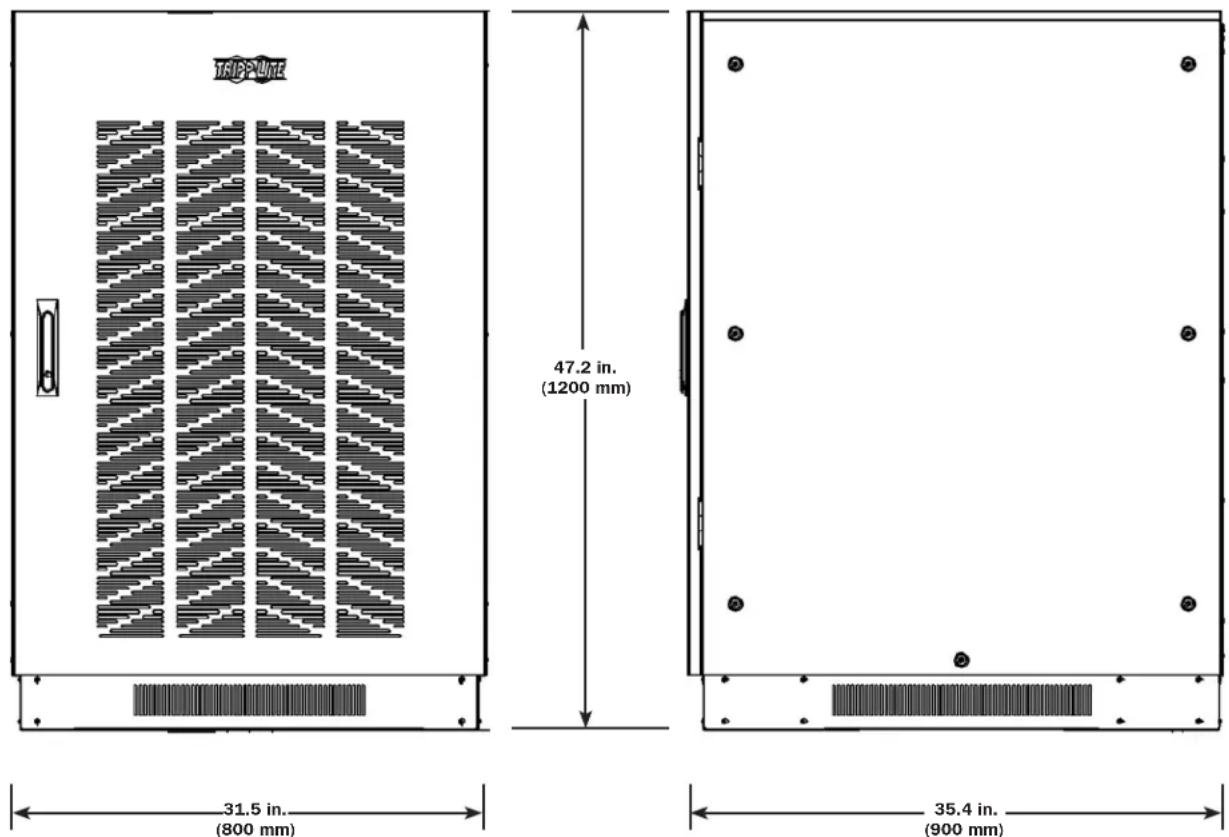
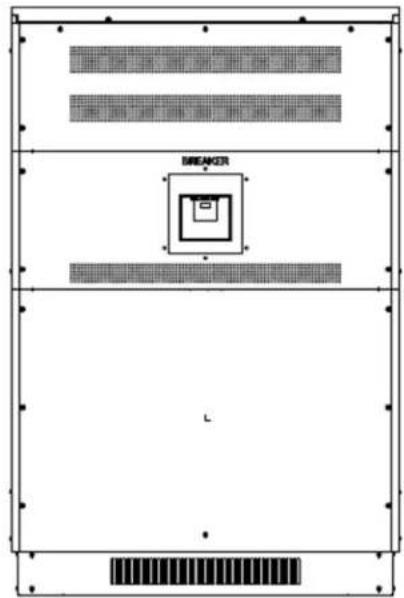
4.1.1 Dimensions for BP240V65, BP240V65-NIB, BP240V100, BP240V100-NIB
4. Mechanical Data
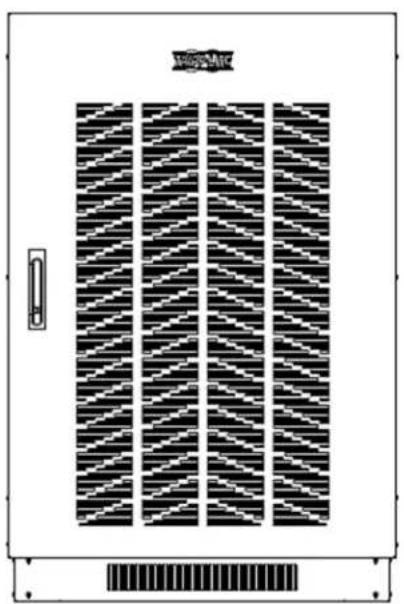
Front View
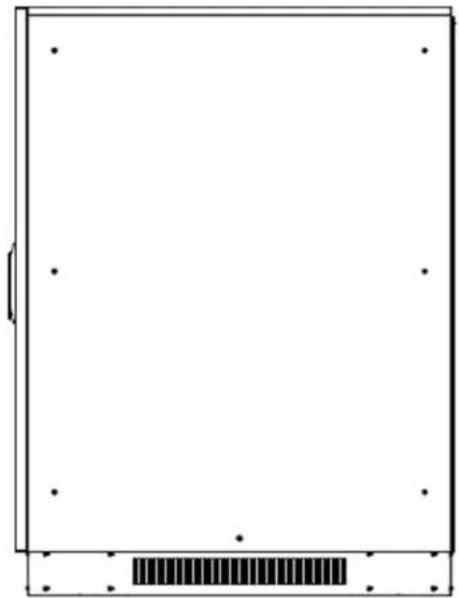
Side View
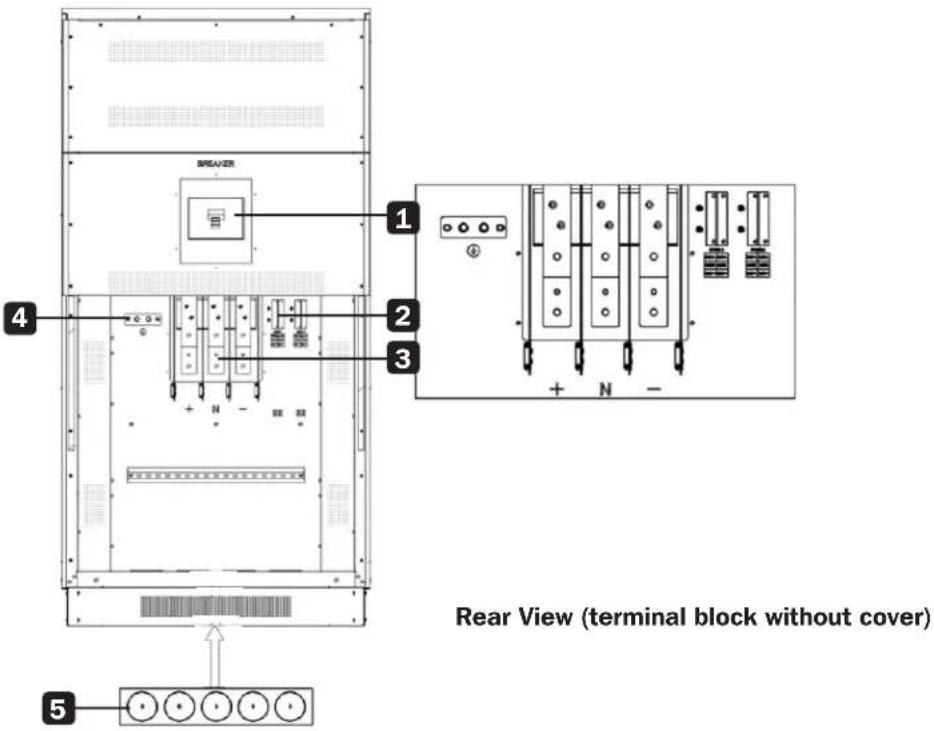
Rear View
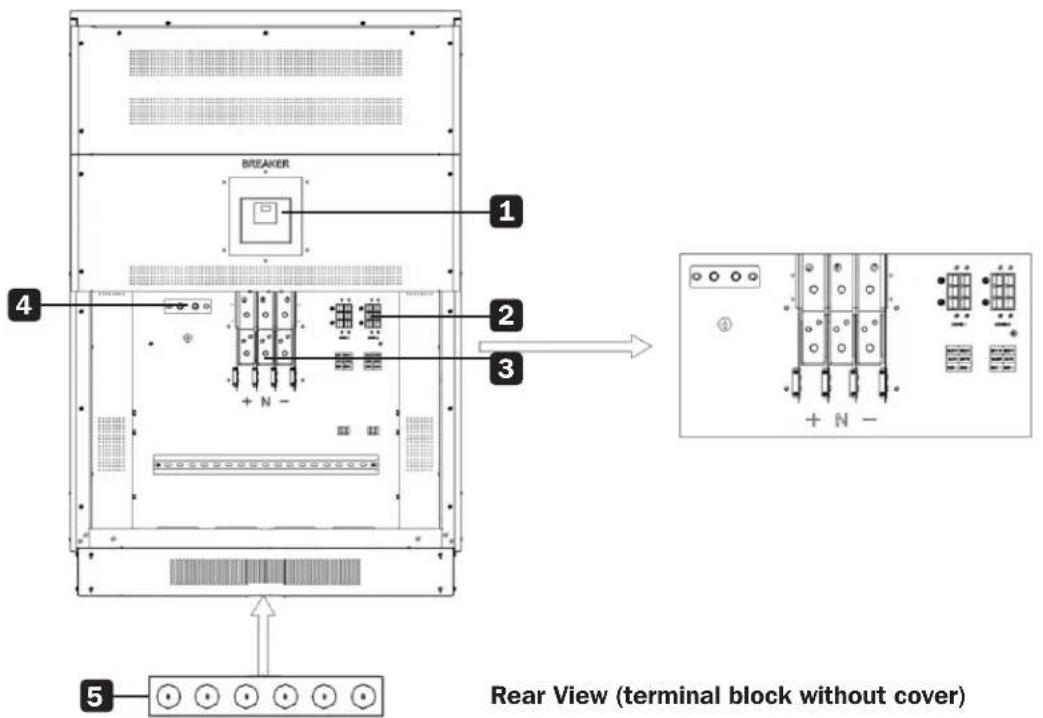
1 Battery Breaker
2 Battery Terminal for 10kVA-20kVA UPS
3 Battery Terminal for 25kVA-60kVA UPS
4 Grounding Lugs
5 Battery Cable Knockouts
4. Mechanical Data
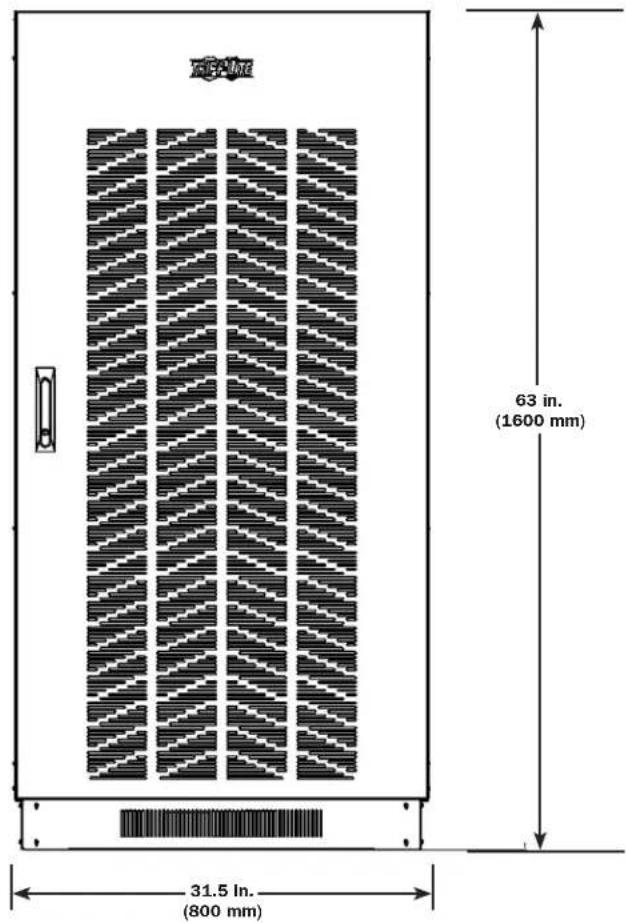
4.1.2 Dimensions for BP240V65L, BP240V65L-NIB, BP240V100L, BP240V100L-NIB
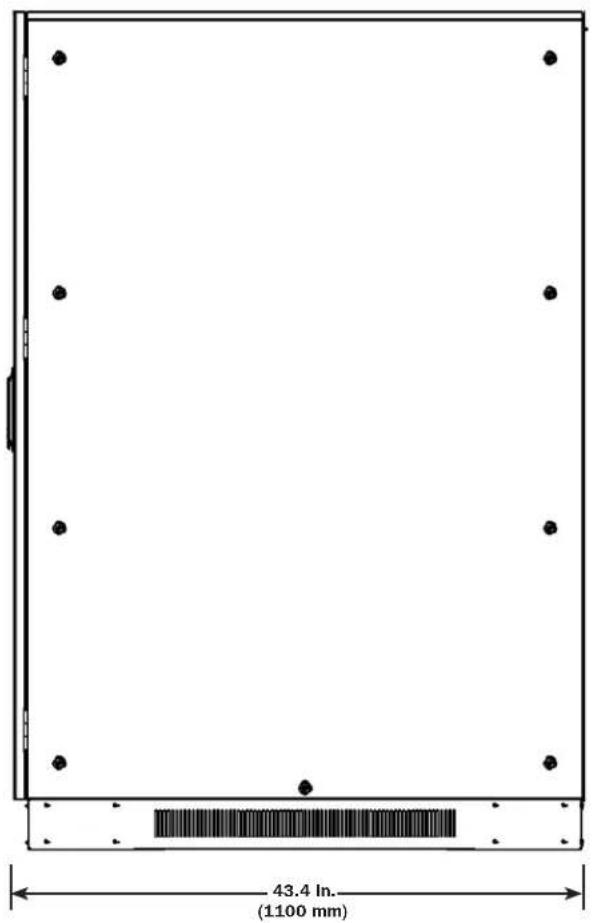
4. Mechanical Data
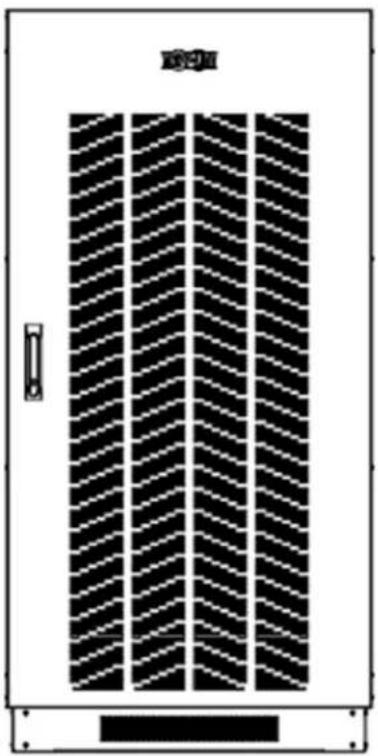
Front View
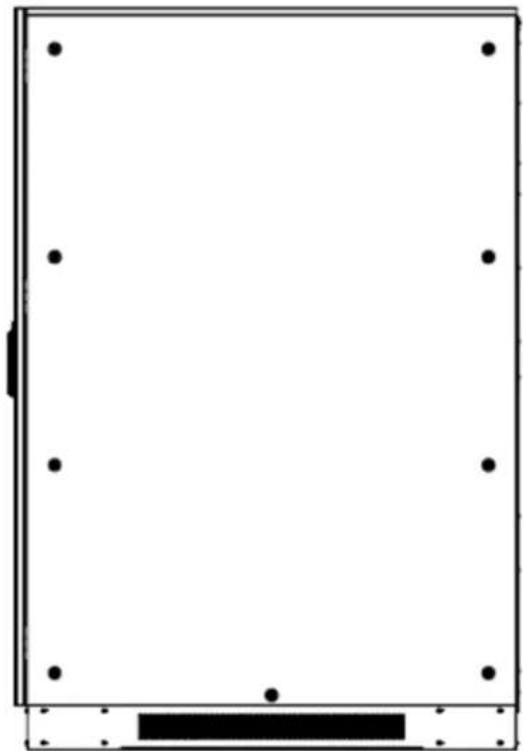
Side View
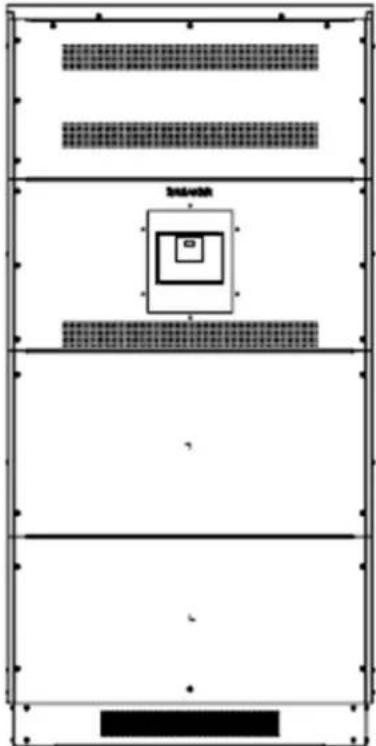
Rear View
1 Battery Breaker
2 Battery Terminal for 10kVA-20kVA UPS
3 Battery Terminal for 25kVA-60kVA UPS
4 Grounding Lugs
5 Battery Cable Knockouts
4. Mechanical Data
4.2 Physical Requirements (All Models)
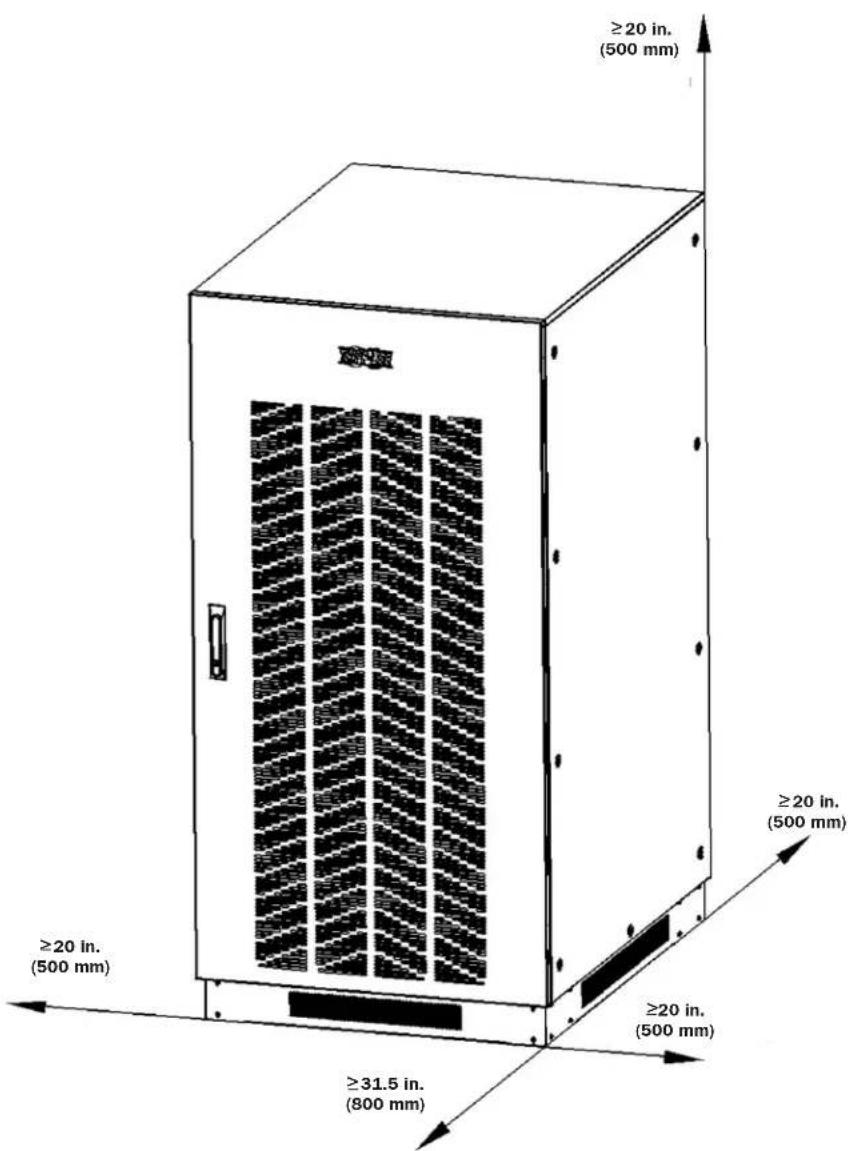
Leave some space around the cabinet for operation and ventilation.
- Leave at least 31.5 in. (800mm) space in the front for ventilation.
- Leave at least 20 in. (500 mm) space at the right and left for operation.
- Leave at least 20 in. (500 mm) space at the back for ventilation.
5. Installation
Note: Before installation, inspect the unit. Ensure nothing inside the package is damaged. Retain the original packing material in a safe place for future use.
5.1 Unpacking & Inspection

Any damage to packaging should be noted with the delivery carrier at the time of receipt. Remove the rail kit, battery enclosure, and battery modules from the packaging.
Note: The battery modules are very heavy. Be cautious when unpacking and lifting the unit to avoid injury.
- Don't tilt the battery pack when removing it from the packaging.
- Inspect the battery cabinet for damage that may have occurred from transport. If damage is found, do not turn on the unit. Contact the dealer from whom the unit was purchased immediately.
-
Check the accessories according to the packing list and contact the dealer in case of missing parts.
-
Hold the sliding plate steady. Cut and remove the binding tapes.
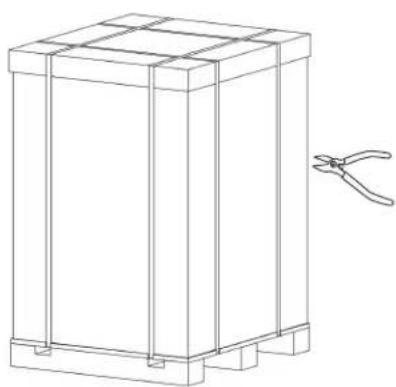
- Remove the plastic bag and the shipping carton.
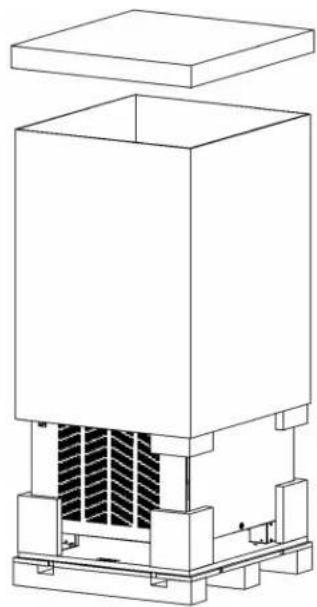
- Remove the packing foam and the beveled pallet. 4. Remove the bolts securing the cabinet to the shipping pallet.
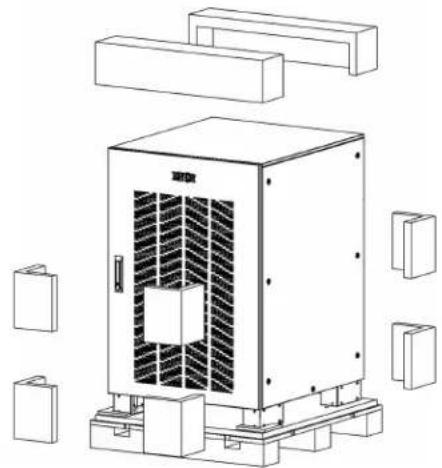

5. Installation
- Use a forklift to lift the battery cabinet from the pallet.
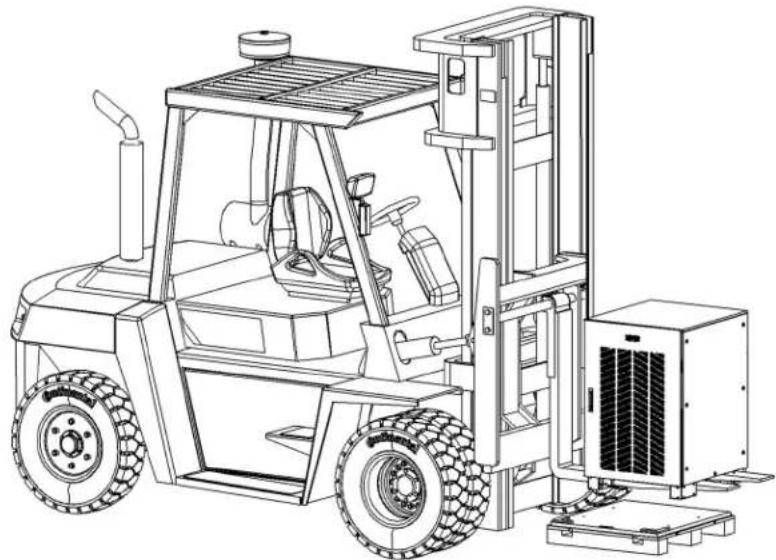
5.2 Selecting Installation Position
Select a proper environment to install the unit, in order to minimize the possibility of damage to the battery system and maximize the life of the batteries.
- Do not block air flow to the ventilation openings of the unit.
- Ensure environmental conditions of the installation site are in accordance with the unit specifications to avoid overheat and excessive moisture. Refer to section 4.2 Physical Requirements.
- Do not place the unit in a dusty or corrosive environment or near any flammable objects.
- The unit is not designed for outdoor use.
Notes:
- Place the battery cabinet in a clean, stable environment. Avoid vibration, dust, humidity, flammable gases, liquids and corrosives.
To help prevent high temperatures in the room where the UPS is installed, extractor fans and/or cooling systems are recommended. - Batteries should be mounted in an environment where the temperature is within the required specifications. Temperature is a key factor in determining battery life and capacity. Battery temperature should be maintained between 59^ to 77^ ( 20^ to 25^ ). Keep batteries away from heat sources, main air ventilation areas, etc.

WARNING!
Typical battery performance data reflects an operating temperature between 59^ to 77^ (20°C to 25°C). Operating the UPS above this range will reduce the battery life, while operating the UPS below this range will reduce battery capacity.
- If the UPS will not be installed immediately, it must be stored in a room without excessive heat or humidity.
6. Installation
5.3 Power Cables
The cable design shall comply with the voltages and currents provided in this section, and in accordance with local electrical codes.

WARNING!
UPON STARTING, PLEASE ENSURE YOU ARE AWARE OF THE LOCATION AND OPERATION OF THE EXTERNAL ISOLATORS CONNECTED TO THE UPS INPUT/BYPASS SUPPLY OF THE UTILITY DISTRIBUTION PANEL.
CHECK TO SEE IF THESE SUPPLIES ARE ELECTRICALLY ISOLATED AND POST ANY NECESSARY WARNING SIGNS TO PREVENT ANY INADVERTENT OPERATION
5.3.1 Cable Sizes
| UPS MODEL | BP240V65 / BP240V100 BP240V65-NIB / BP240V100-NIB | BP240V65L / BP240V100L BP240V65L-NIB / BP240V100L-NIB | Recommended Torque | ||
| CABLE SIZES (THHW wiring at 167°F / 75°C) | |||||
| DC INPUT GROUND | DING DC INPUT GROUND | DING | |||
| 10kVA | 6 AWG 6 AWG | 6 AWG 6 AWG Anderson | Connector | (No Torque Parameter) 0kgf.com / ON·m | |
| 15kVA | 6 AWG x 2 6 AWG | x 2 6 AWG x 2 6 AWG x | 2 | ||
| 20kVA | 6 AWG x 2 6 AWG | x 2 6 AWG x 2 6 AWG x | 2 | ||
| 25kVA | 1/0 AWG 2 AWG | 1/0 AWG 2 AWG 450kgf. cm/ | 44N·m | ||
| 30kVA | 1/0 AWG 1/0 AWG | 1/0 AWG 1/0 AWG | |||
| 50kVA | 2/0 AWG 2/0 AWG | 2/0 AWG 2/0 AWG | |||
| 60kVA | 2/0 AWG 2/0 AWG | 2/0 AWG 2/0 AWG | |||
| 80kVA | 2/0 AWG x 2 2/0 AWG x 2 | ||||
| 100kVA | 2/0 AWG x 2 2/0 AWG x 2 | ||||
- S3M10-30K UPS systems do not support BP240V100L/100L-NIB battery cabinet models.
5.4 Battery Cabinet Connections: Models BP240V65, BP240V65-NIB, BP240V100 and BP240V100-NIB
Each battery cabinet design includes built-in internal battery connection cables, breaker, fuses and terminals. The standard cabinet can hold 20 pieces of 12V 65Ah 12V 100Ah batteries. The DC voltage system for all cabinets is 240VDC with ± 120V internal battery strings.
Figures 6-1 and 6-2 show the overall chassis design and exploded views for the BP240V65, BP240V65-NIB, BP240V100 and BP240V100-NIB models. The corresponding views for the BP240V65L, BP240V65L-NIB, BP240V100L and BP240V100L-NIB models are shown in section 6.5 Battery Cabinet Connections: Models BP240V65L, BP240V65L-NIB, BP240V100L and BP240V100L-NIB.
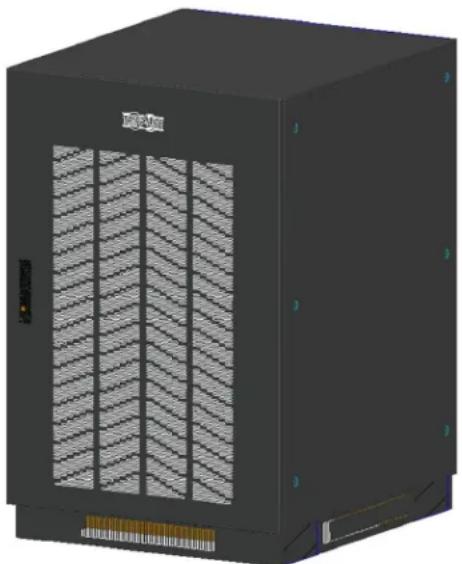
Figure 5-1: BP240V65, BP240V65-NIB, BP240V100, & BP240V100-NIB Battery Cabinet Chassis
5. Installation
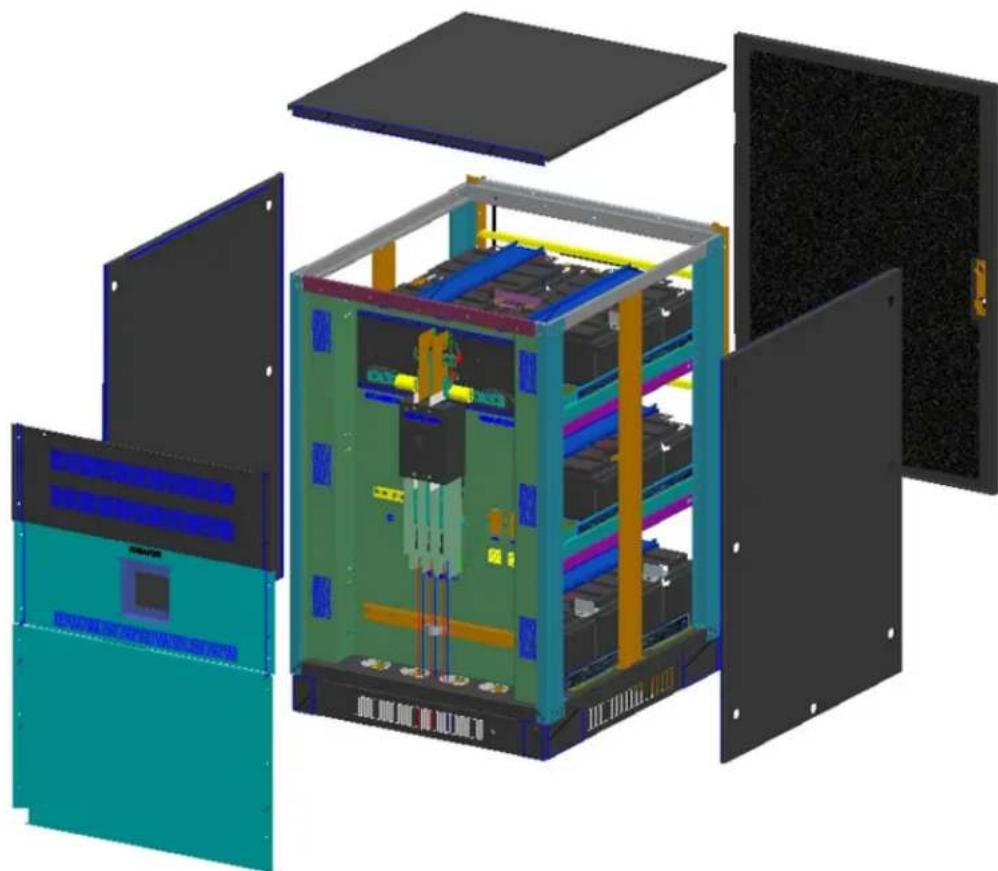
Figure 5-2: Exploded Chassis View, Models BP240V65, BP240V65-NIB, BP240V100, BP240V100-NIB
5.4.1 Remove the Chassis Shell
Place the battery cabinet in position. Remove the top, front, left and right panels. Remove the right and left cover plate of the battery pack and the battery flapper to install the batteries.
5.4.2 Battery Installation and Connection
Each battery group has 20 pieces of batteries in series (BAT+, N and BAT-). Place the batteries in the cabinet from the bottom to top one-by-one, then connect the battery cables according to the diagrams that follow.
Note: The positive and negative polarity of the battery cannot be reversed or short circuited. Doing so will damage the battery and/or cause injury. Do not touch the battery's positive and negative terminals at the same time. Before replacing or removing the batteries, disconnect the breaker, pull up cell terminals and remove the screws of the copper bus bar. Not following the instructions could result in damage to the equipment or personal injury. The installation must consist of 40 batteries.
5. Installation
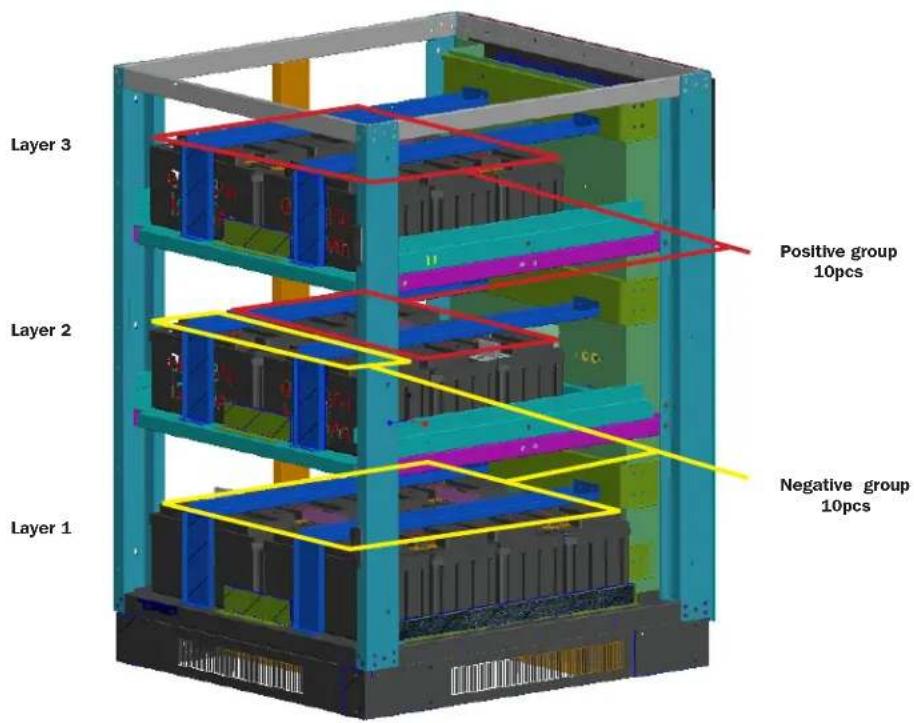
Figure 5-3A: Front View
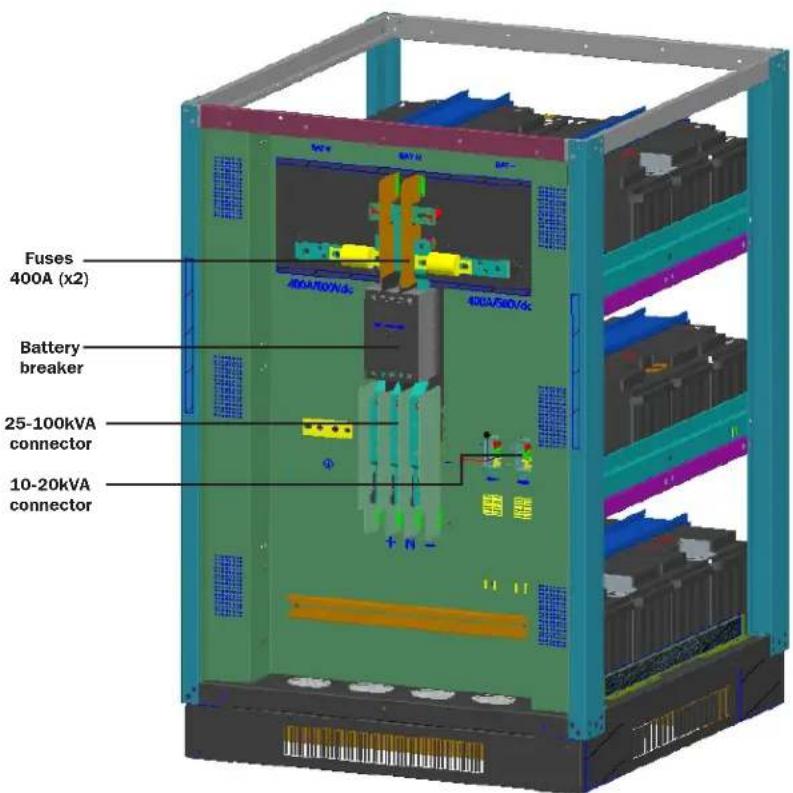
Figure 5-3B: Rear View
5. Installation
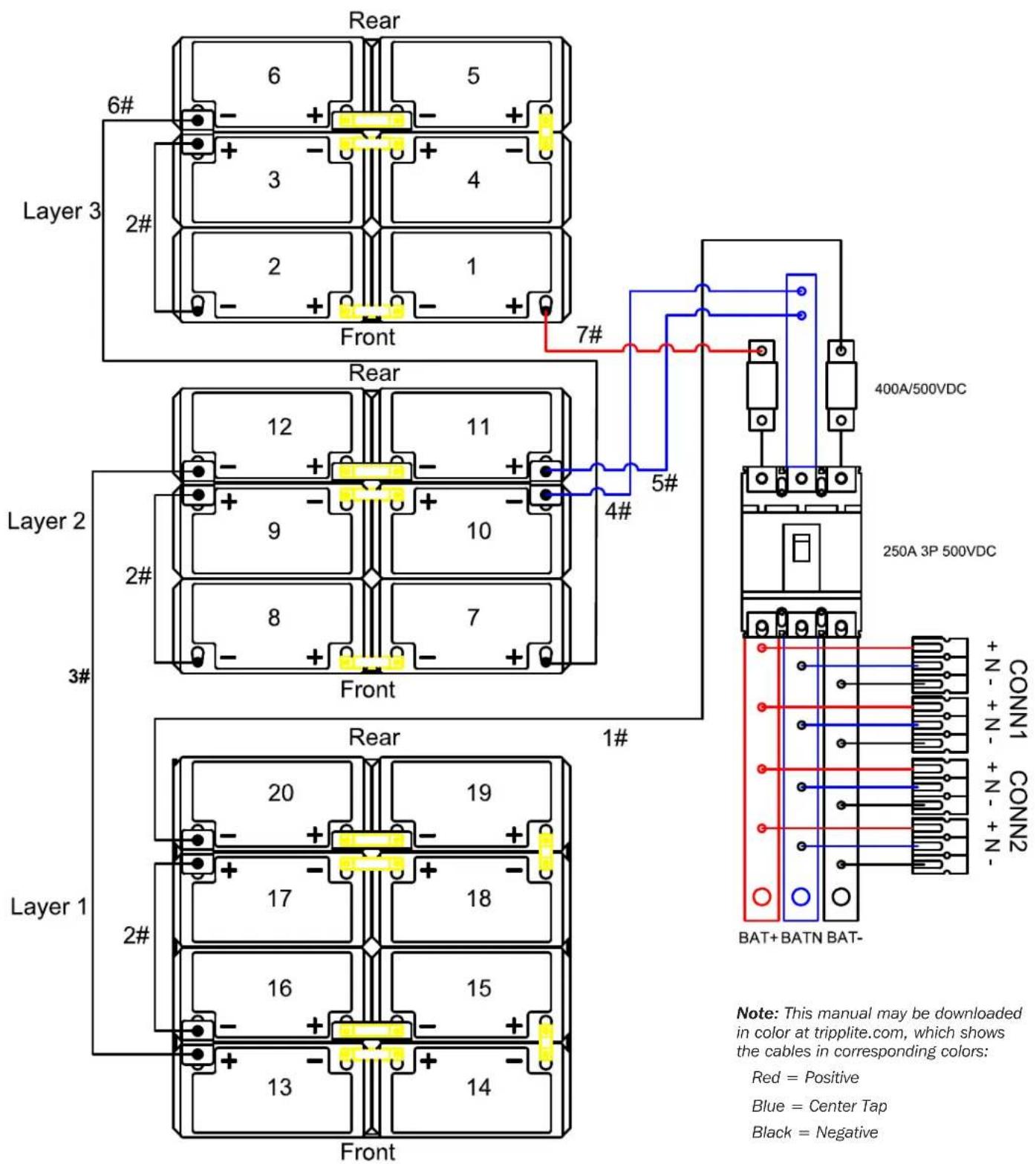
Figure 5-4: Wiring Diagram for Model BP240V65
5. Installation
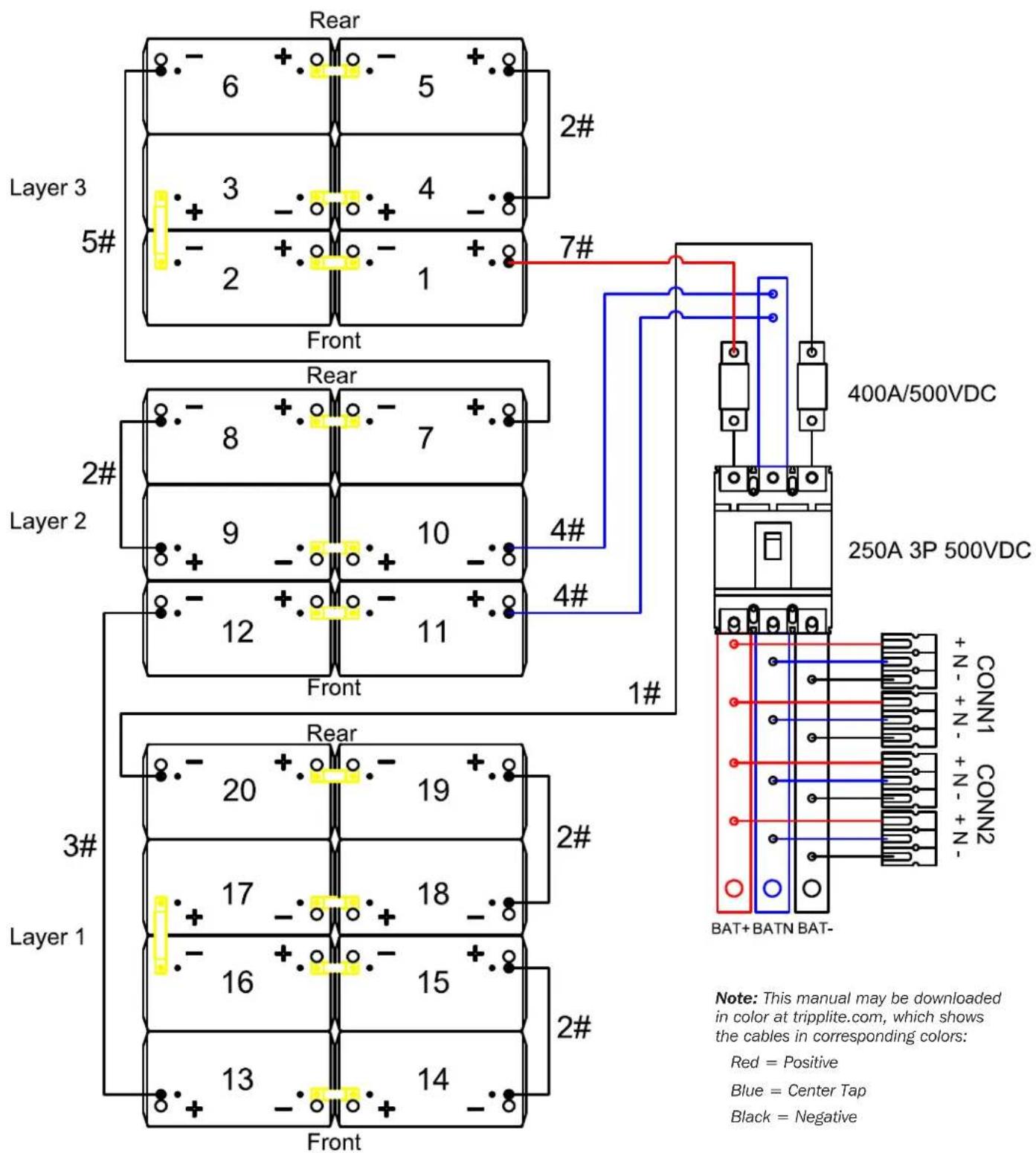
Figure 5-5: Wiring Diagram for Model BP240V100
5. Installation
5.4.2.1 Battery installation and Setup: Models BP240V65-NIB, BP240V100-NIB
- Remove all screws labeled 1 (Figures 5-6A and 5-6B).
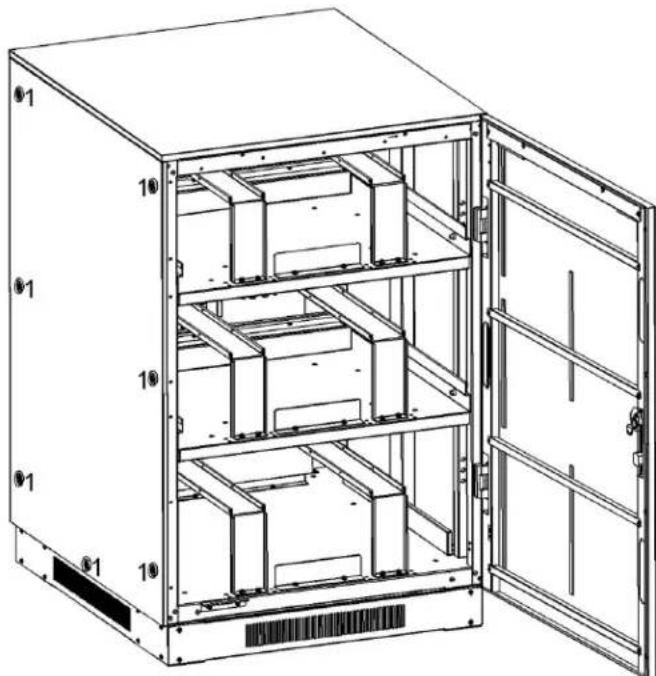
Figure 5-6A
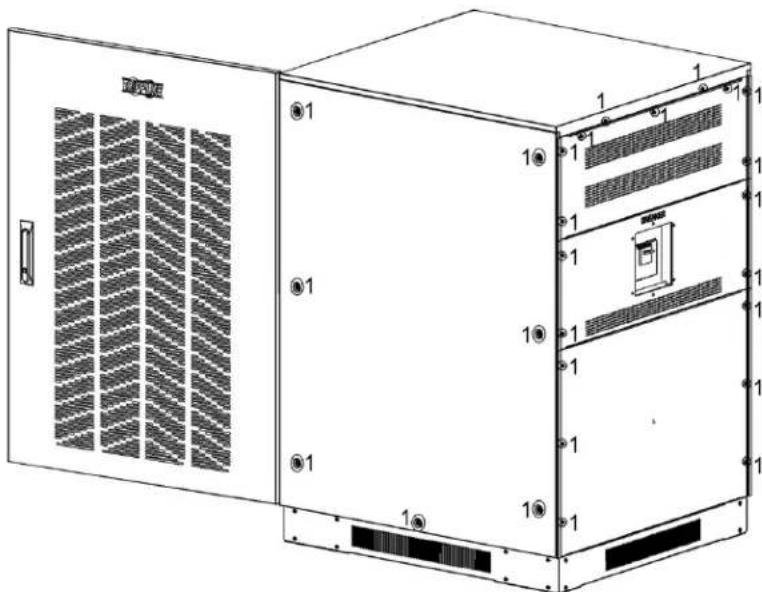
Figure 5-6B
5. Installation
- Remove the top, right side and left side plates (Figure 5-7).
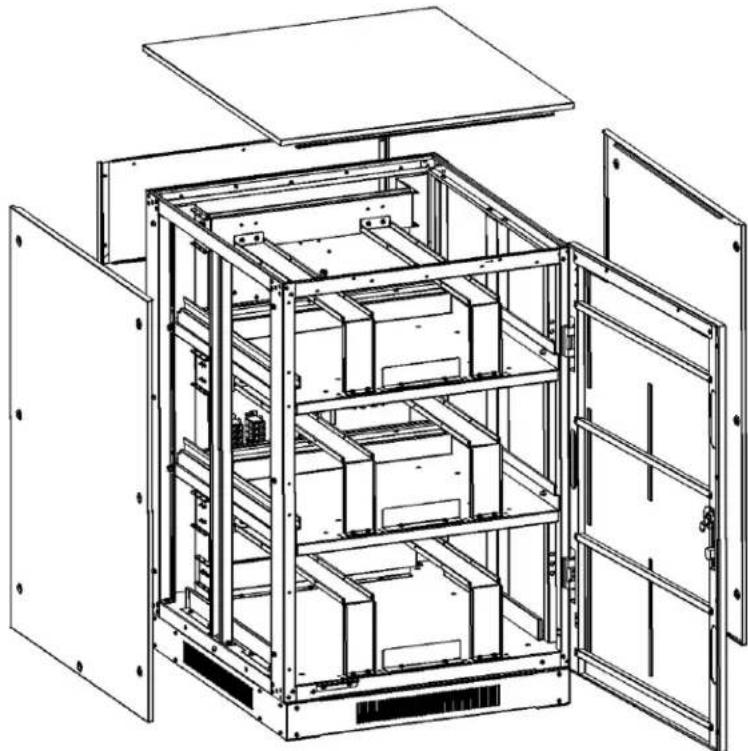
Figure 5-7
- Remove all screws of the battery retention brackets and remove the retention brackets (Figure 5-8).
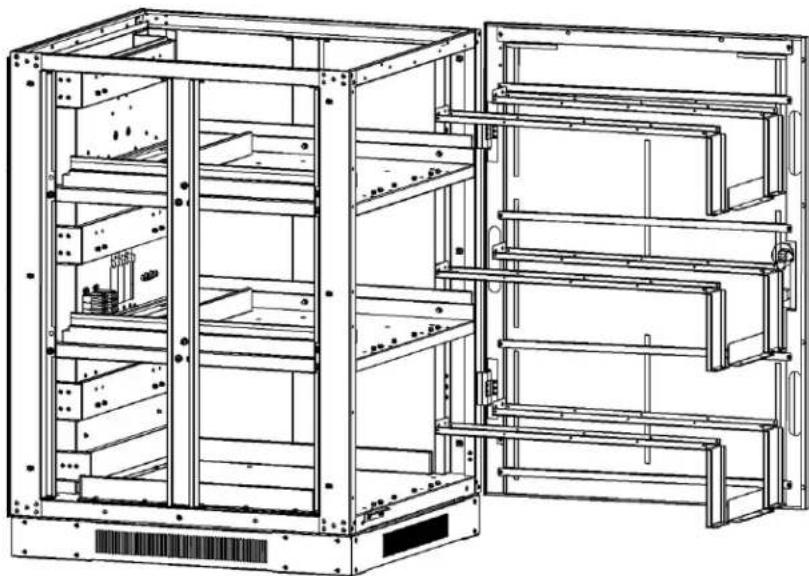
Figure 5-8
5. Installation
- Install 8 battery packs in layer 1 (Figure 5-9: Model BP240V65-NIB or Figure 5-10: Model BP240V100-NIB).
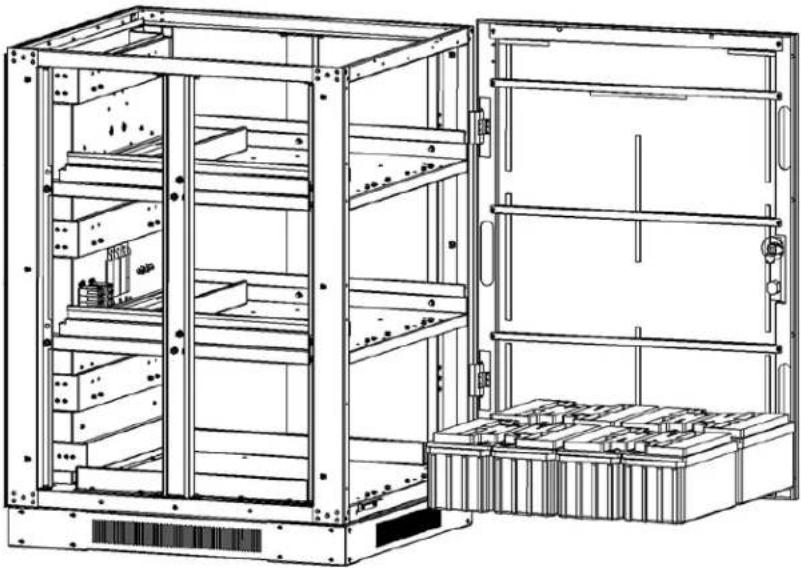
Figure 5-9: Model BP240V65-NIB
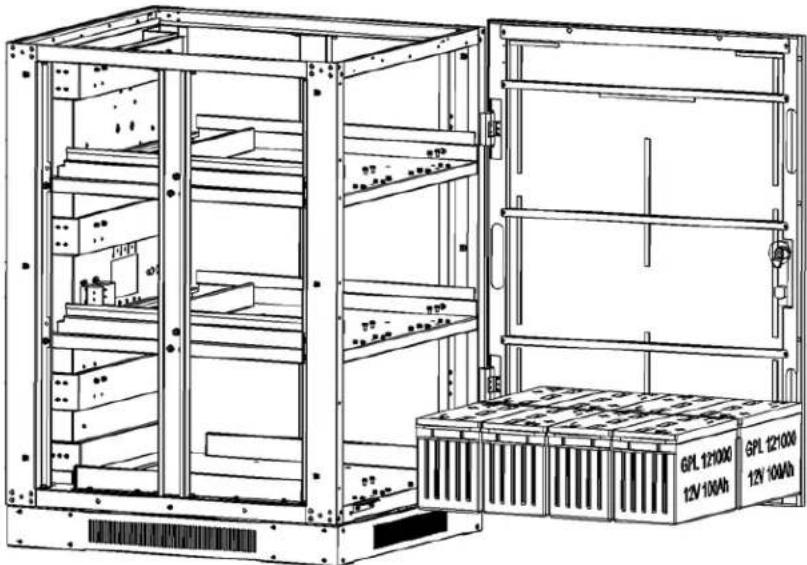
Figure 5-10: Model BP240V100-NIB
5. Installation
- Install 6 battery packs in layer 2 (Figure 5-11: Model BP240V65-NIB or Figure 5-12: Model BP240V100-NIB).
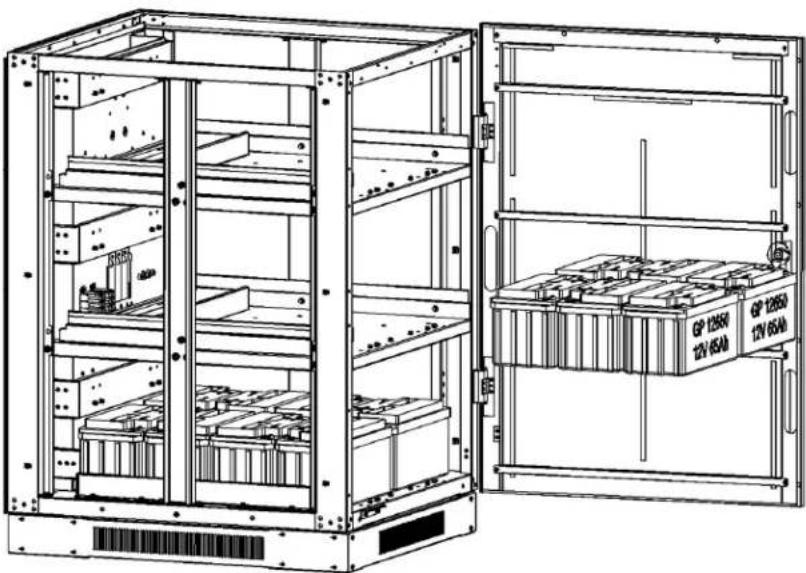
Figure 5-11: Model BP240V65-NIB
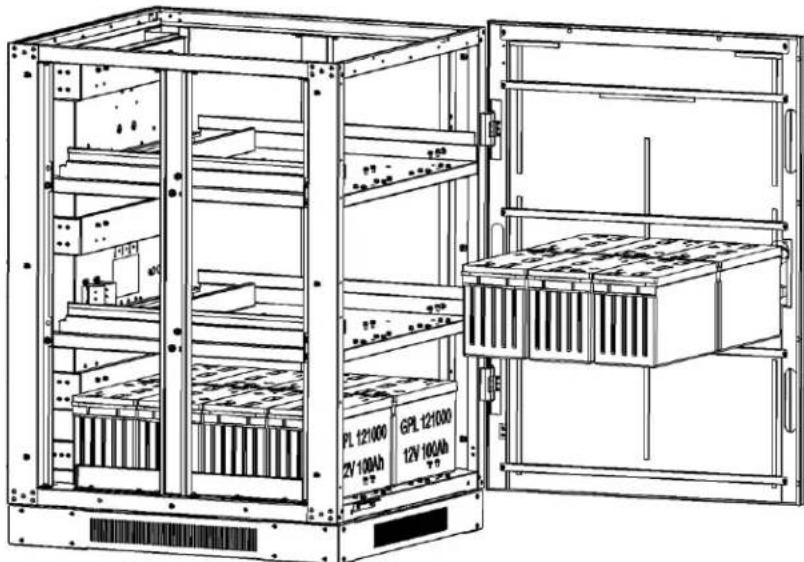
Figure 5-12: Model BP240V100-NIB
5. Installation
- Install 6 battery packs in layer 3 (Figure 5-13: Model BP240V65-NIB or Figure 5-14: ModelBP240V100-NIB).
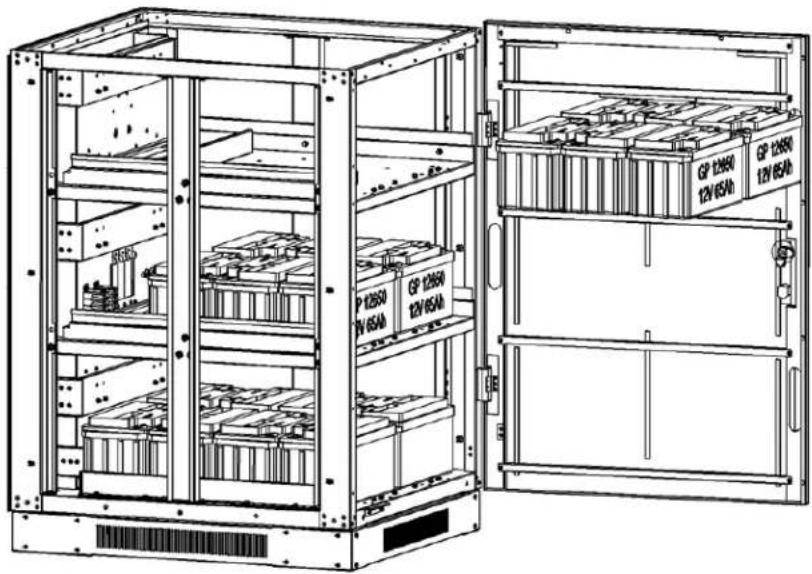
Figure 5-13: Model BP240V65-NIB
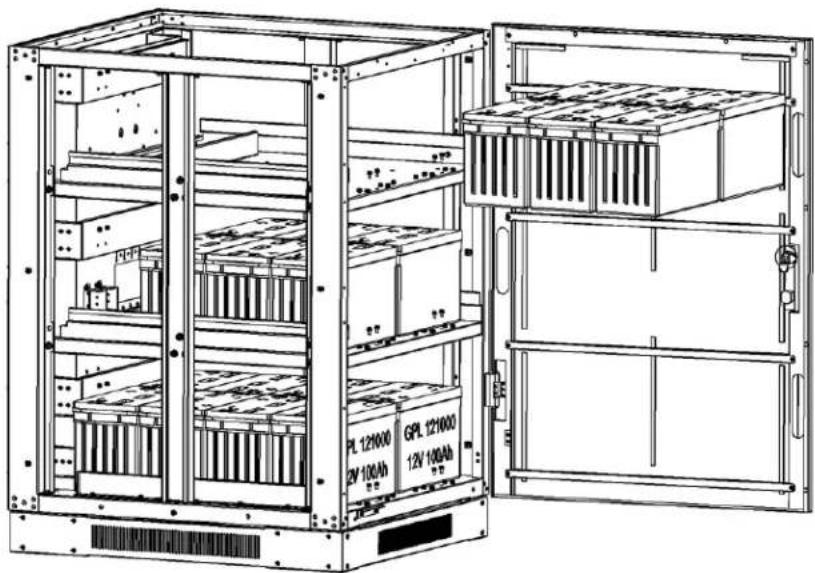
Figure 5-14: Model BP240V100-NIB
5. Installation
- Reinstall all battery retention brackets and screws (Figure 5-15: Model BP240V65-NIB or Figure 5-16: Model BP240V100-NIB).
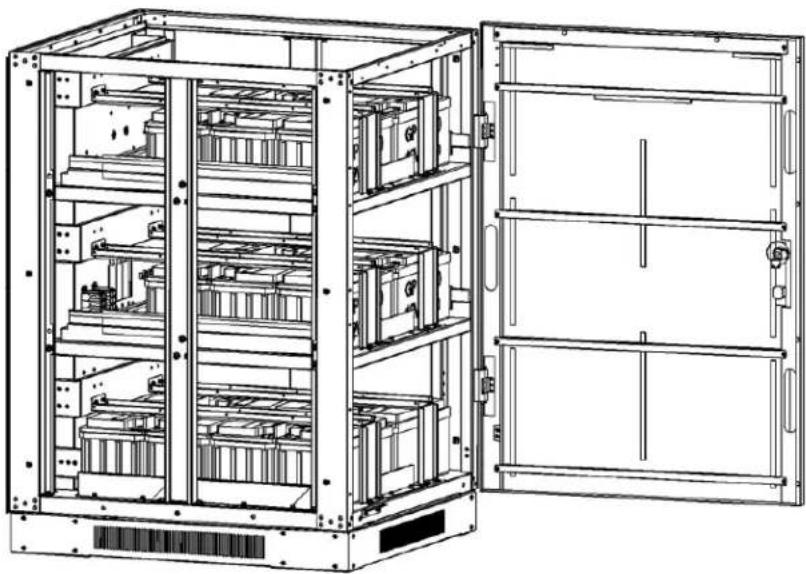
Figure 5-15: Model BP240V65-NIB
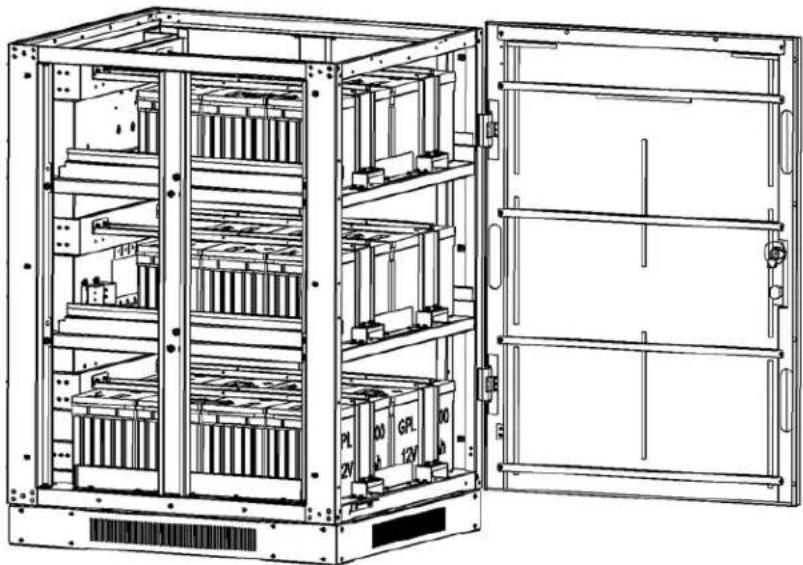
Figure 5-16: Model BP240V100-NIB
5. Installation
- Model BP240V65-NIB: Install copper bus bars (13 pieces) between adjacent batteries and the battery insert bolts/screws (Figures 5-17A and 5-17B).
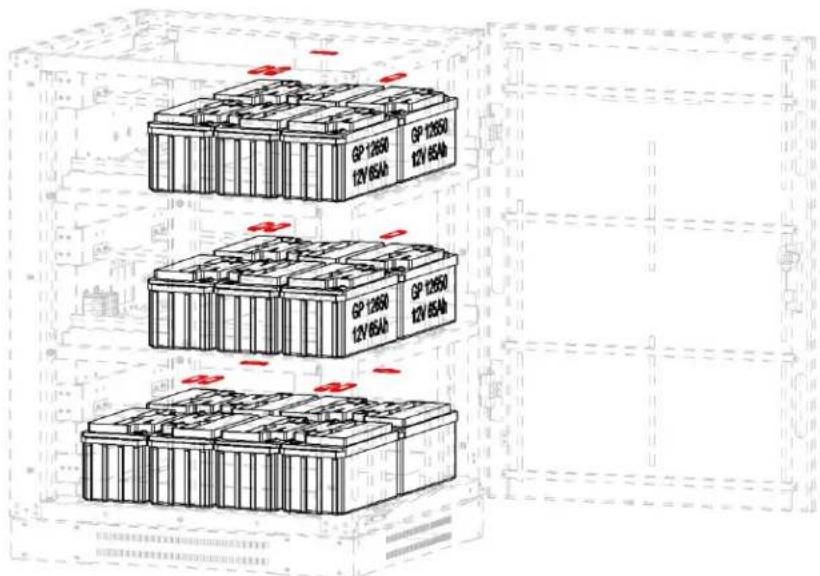
Figure 5-17A
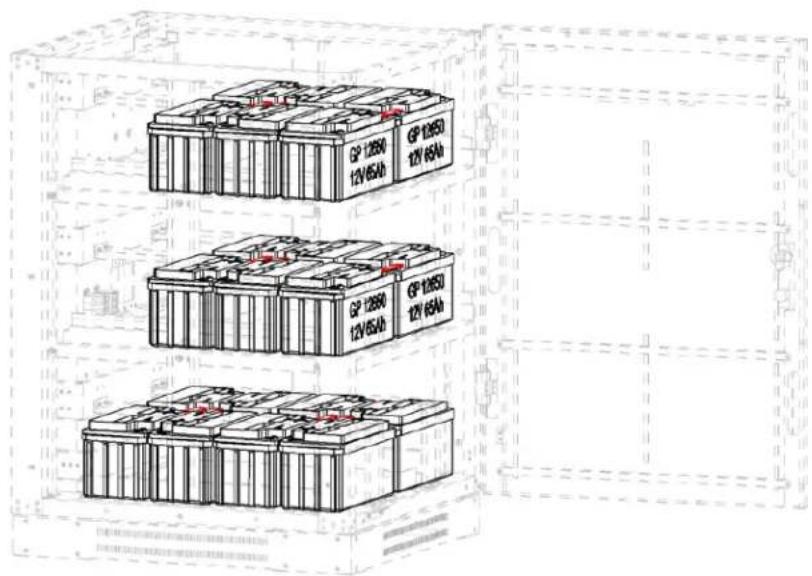
Figure 5-17B
5. Installation
- Model BP240V100-NIB: Install copper bus bars (12 pieces) between adjacent batteries and the battery insert bolts/screws (Figures 5-18A and 5-18B).
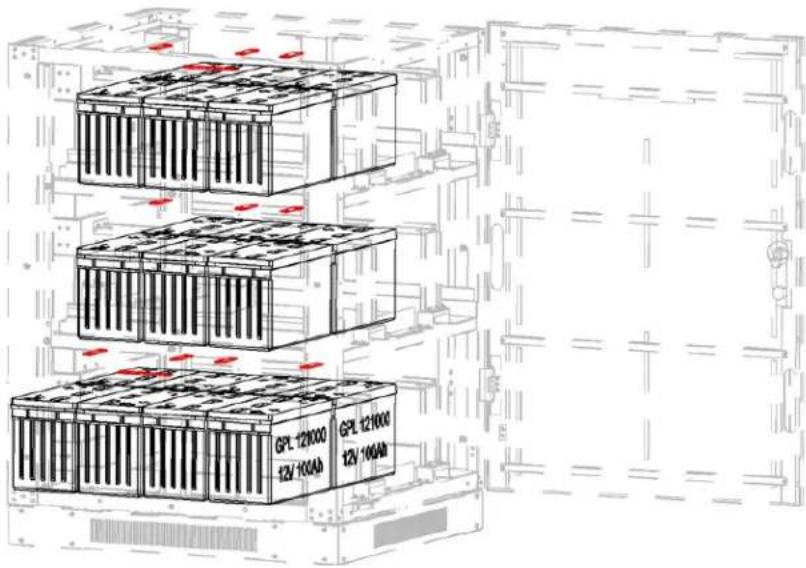
Figure 5-18A
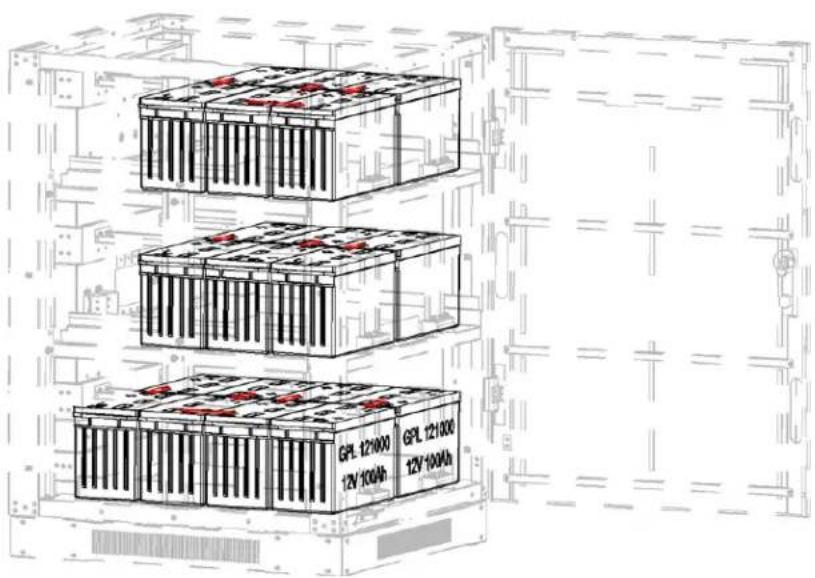
Figure 5-18B
5. Installation
- Connect the cables from battery 1+ to BAT+ bus bar, battery 10- to BATN bus bar, battery 11+ to BATN bus bar, battery 20- to BAT- bus bar and the layer connect cables (Figure 5-19: Model BP240V65-NIB or Figure 5-20: Model BP240V100-NIB and Figure 5-21).
Notes:
- Use the wiring schematics as reference for the following assemblies:
Use Figure 5-4 for BP240V65-NIB Use Figure 5-5 for BP240V100-NIB
- This manual may be downloaded in color at triplite.com, which shows the cables in corresponding colors:
Red = Positive
Blue = Center Tap
Black = Negative
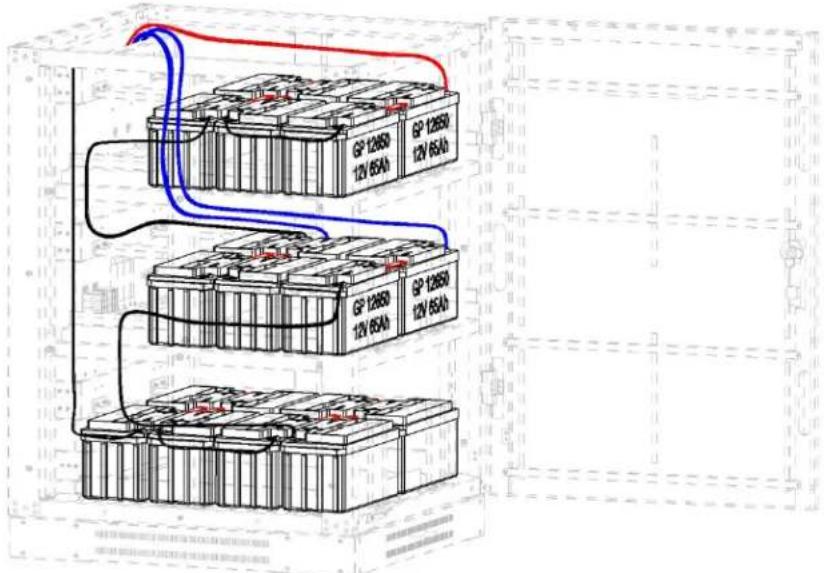
Figure 5-19: Model BP240V65-NIB
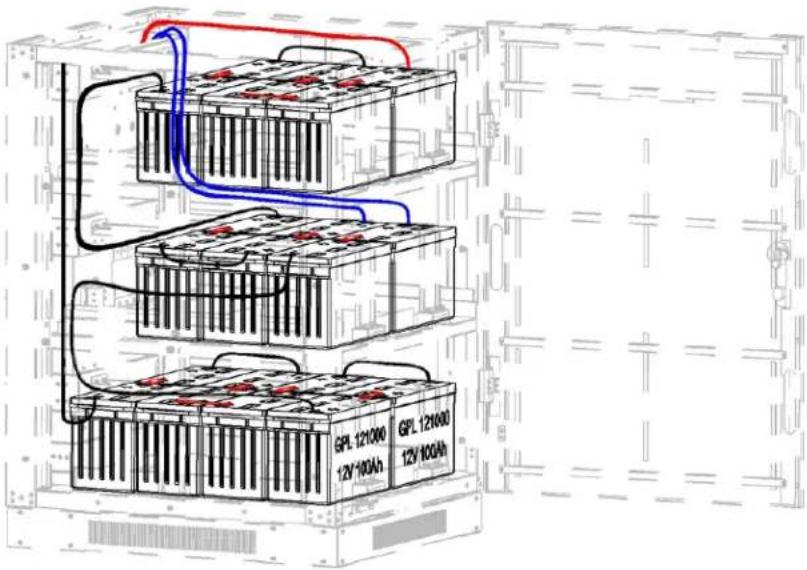
Figure 5-20: Model BP240V100-NIB
5. Installation
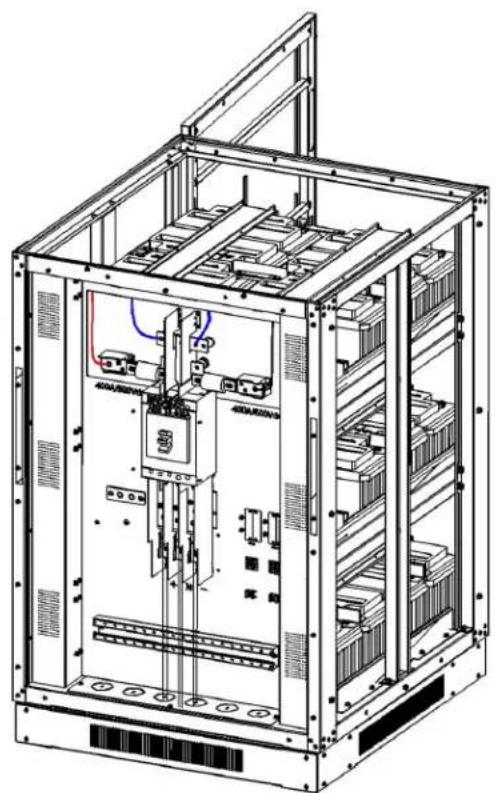
Figure 5-21
- Reinstall all covers and screws (Figure 5-22).
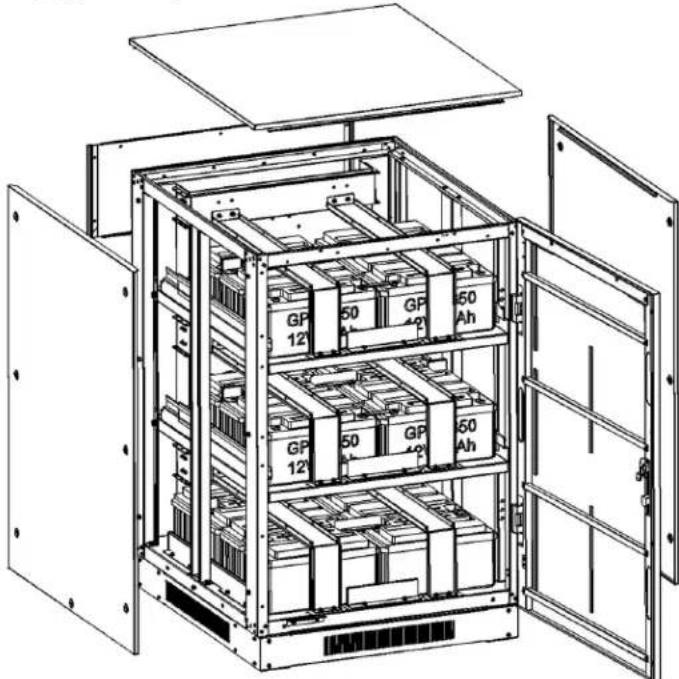
Figure 5-22
5. Installation
5.5 Battery Cabinet Connections: Models BP240V65L, BP240V65L-NIB, BP240V100L and BP240V100L-NIB
Each battery cabinet design includes built-in internal battery connection cables, breaker, fuses and terminals. The standard cabinet can hold 20 pieces of 12V 65Ah (12V/100Ah) batteries. The "L" long-routine battery cabinets can hold 40 pieces of the 12V 65Ah (12V 100Ah) batteries. The DC voltage system for all cabinets is 240VDC with ± 120V internal battery strings.
Figures 5-23 and 5-24 show the overall chassis design and exploded views for the BP240V65L, BP240V65L-NIB, BP240V100L and BP240V100L-NIB models. The corresponding views for the BP240V65, BP240V65-NIB, BP240V100 and BP240V100-NIB models are shown in section 5.4 Battery Cabinet Connections: Models BP240V65, BP240V65-NIB, BP240V100 and BP240V100-NIB.
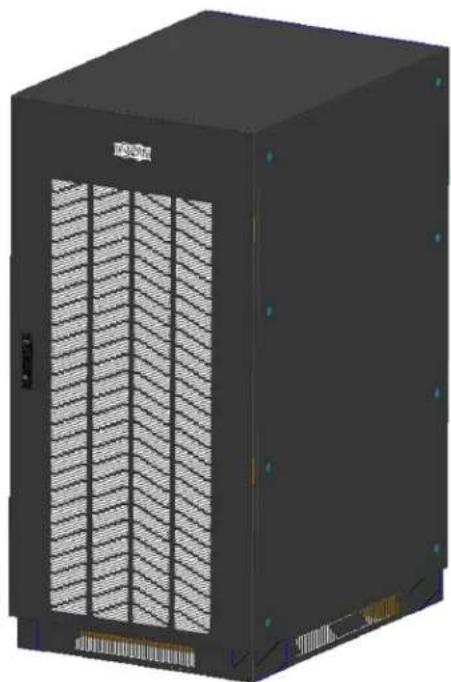
Figure 5-23: BP240V65L, BP240V65L-NIB, BP240V100L, & BP240V100L-NIB Battery Chassis
5.5.1 Remove the Chassis Shell
Place the battery box its final location. Remove the top, front, left and right panels. Remove the right and left cover plates of the battery pack and the battery supports to install the batteries strings.
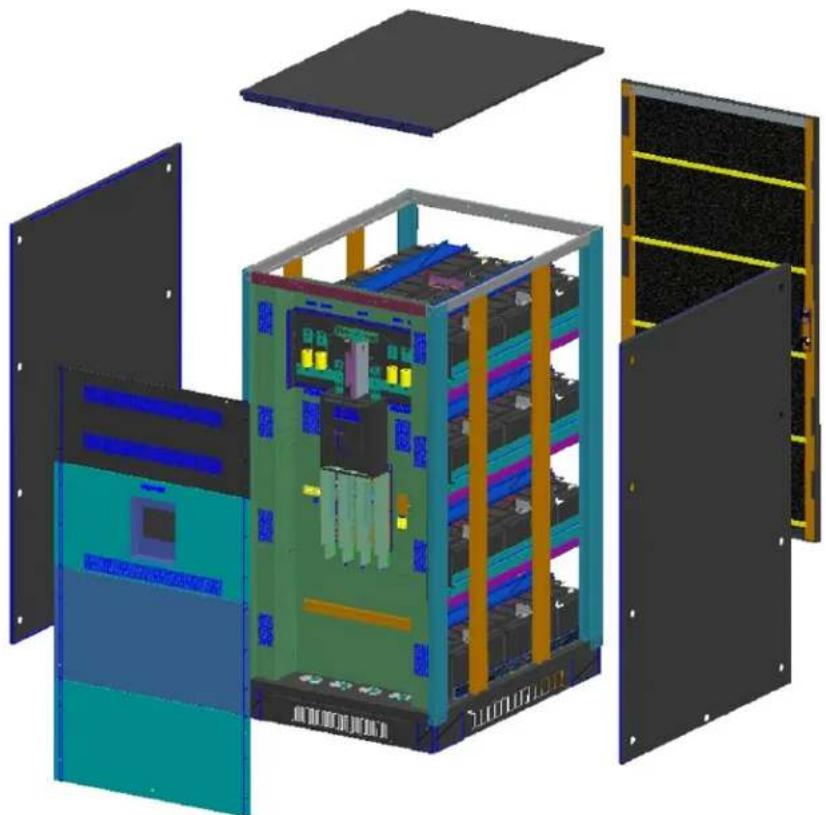
Figure 5-24: Exploded View - Models BP240V65L, BP240V65L-NIB, BP240V100I, BP240V100L-NIB
5. Installation
5.5.2 Battery Installation and Connection
The 40 batteries can be divided into two groups connected in parallel for use. Each group has 20 batteries in series (BAT+, N and BAT-). Place the batteries in the cabinet from the bottom to top one-by-one, then connect the battery cables according to the diagrams that follow.
Note: The positive and negative polarity of the battery cannot be reversed or short circuited. Doing so will damage the battery and/or cause injury. Do not touch the battery's positive and negative terminals at the same time. Before replacing or removing the batteries, disconnect the breaker, pull up cell terminals and remove the screws of the copper bus bar. Not following the instructions could result in damage to the equipment or personal injury. The installation must consist of 40 batteries.
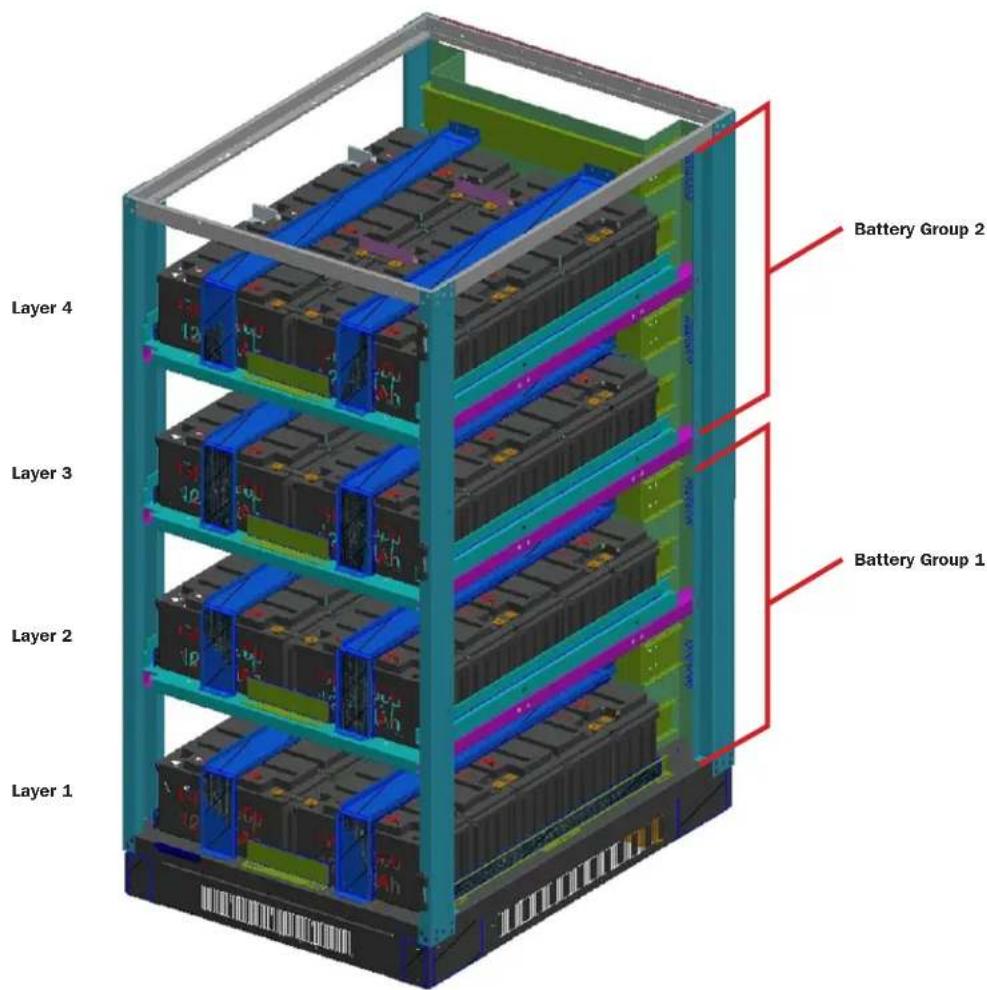
Figure 5-25A: Front view
5. Installation
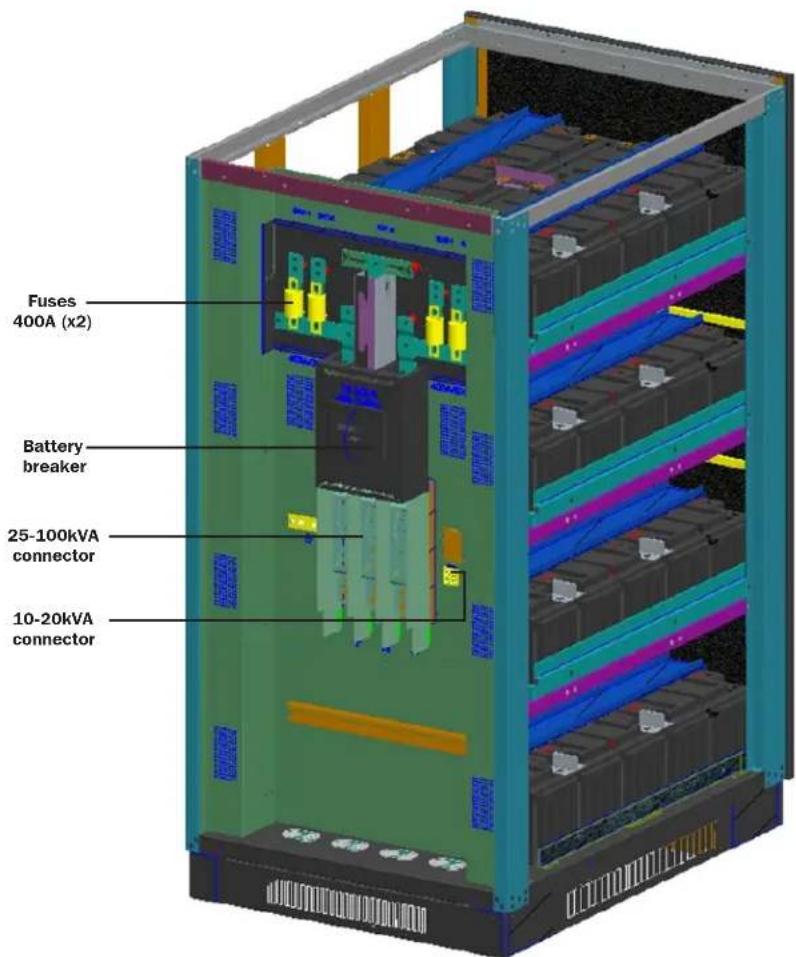
Figure 5-25B: Rear View
5. Installation
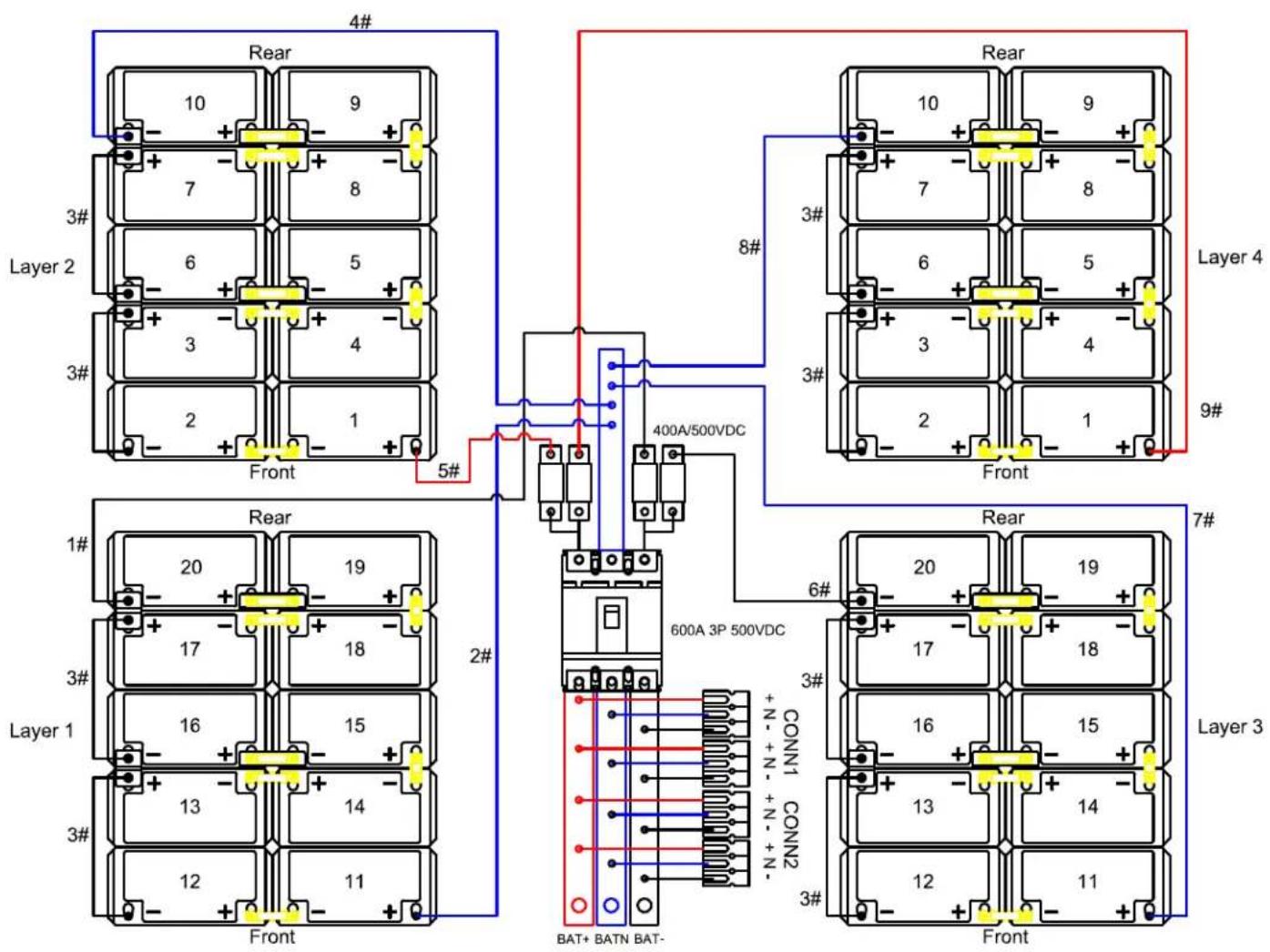
Figure 5-26: Wiring diagram for BP240V65L (40 batteries installed)
Note: This manual may be downloaded in color at tripplite.com, which shows the cables in corresponding colors:
Red = Positive
Blue = Center Tap
Black = Negative
5. Installation
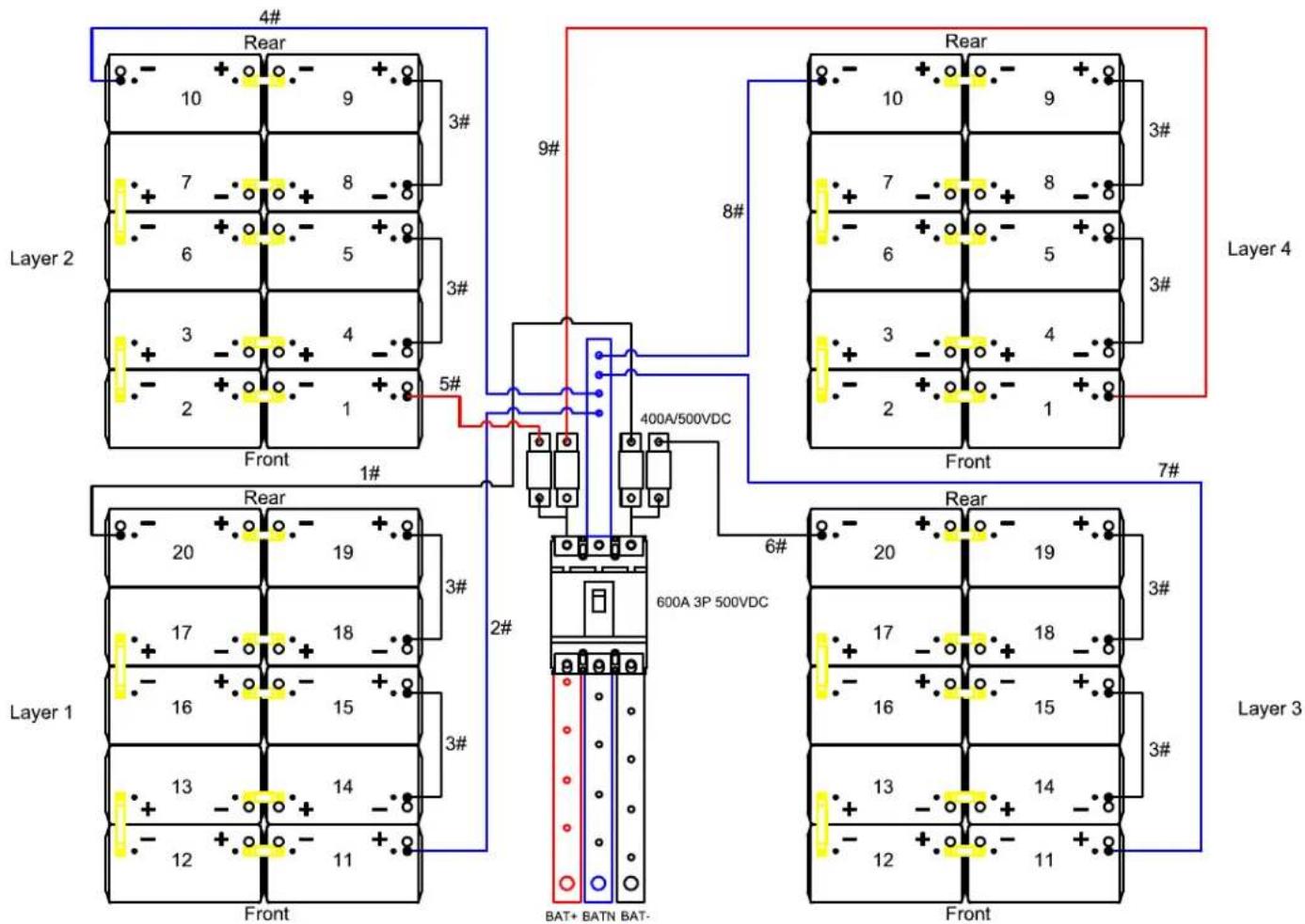
Figure 5-27: Wiring diagram for BP240V100L (40 batteries installed)
When the battery installation and connection is completed, use a multi-meter or other instrument to check if the voltages between BAT + and N, N and BAT- are normal. If normal, lock the chassis cover.
Note: This manual may be downloaded in color at tripplite.com, which shows the cables in corresponding colors:
Red = Positive
Blue = Center Tap
Black = Negative
5. Installation
5.5.2.1 Battery Installation and Setup: Models BP240V65L-NIB, BP240V100L-NIB
- Remove all screws labeled 1 (Figures 5-28A and 5-28B).
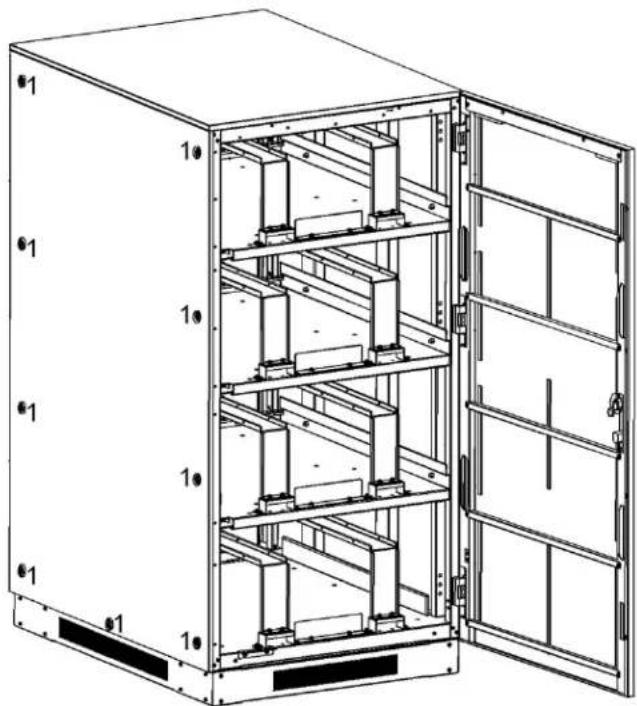
Figure 5-28A
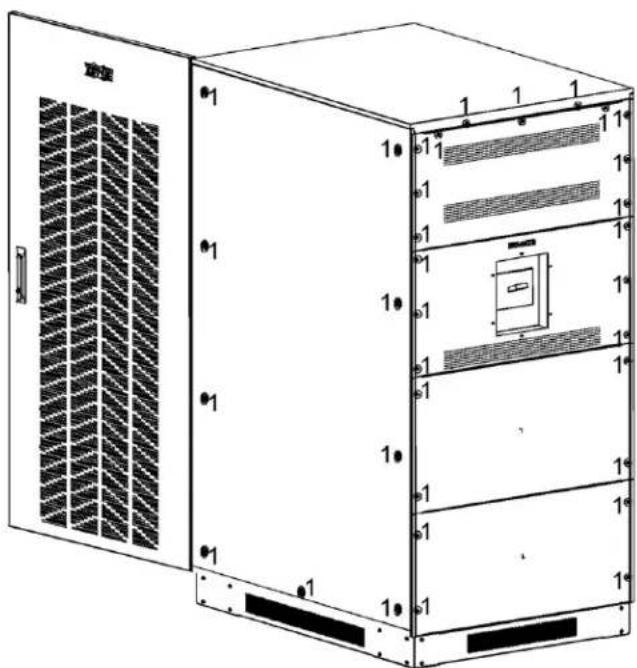
Figure 5-28B
5. Installation
- Remove the top, right side and left side plates (Figure 5-29).
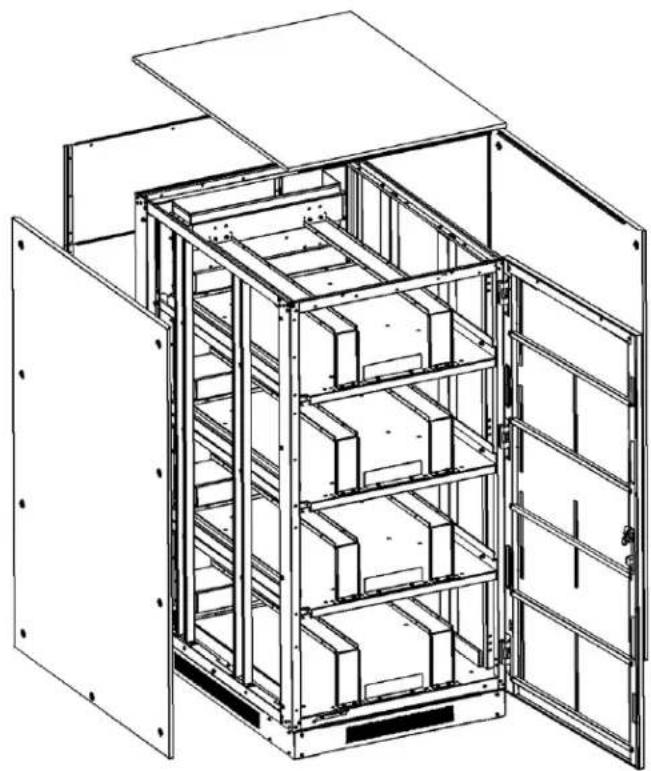
Figure 5-29
- Remove all screws of the battery retention brackets and remove the retention brackets (Figure 5-30).
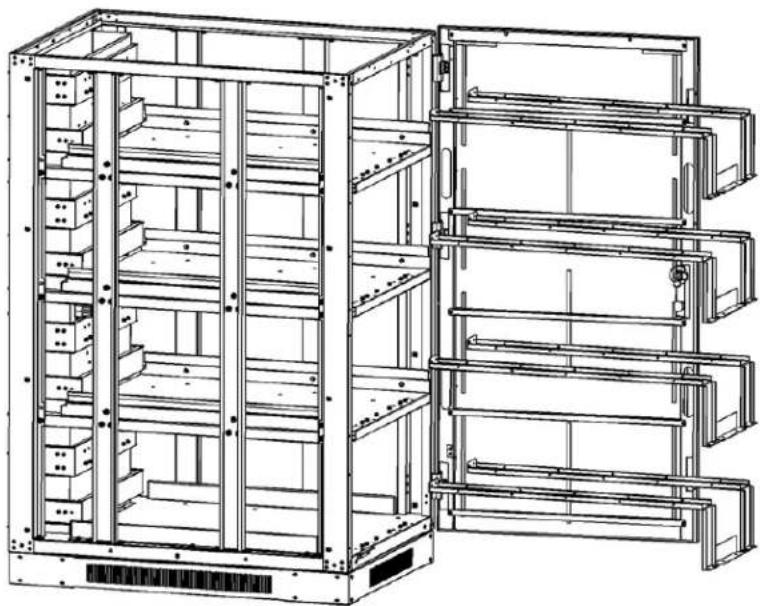
Figure 5-30
5. Installation
- Install 10 battery packs in layer 1 (Figure 5-31: Model BP240V65L-NIB or Figure 5-32: Model BP240V100L-NIB).
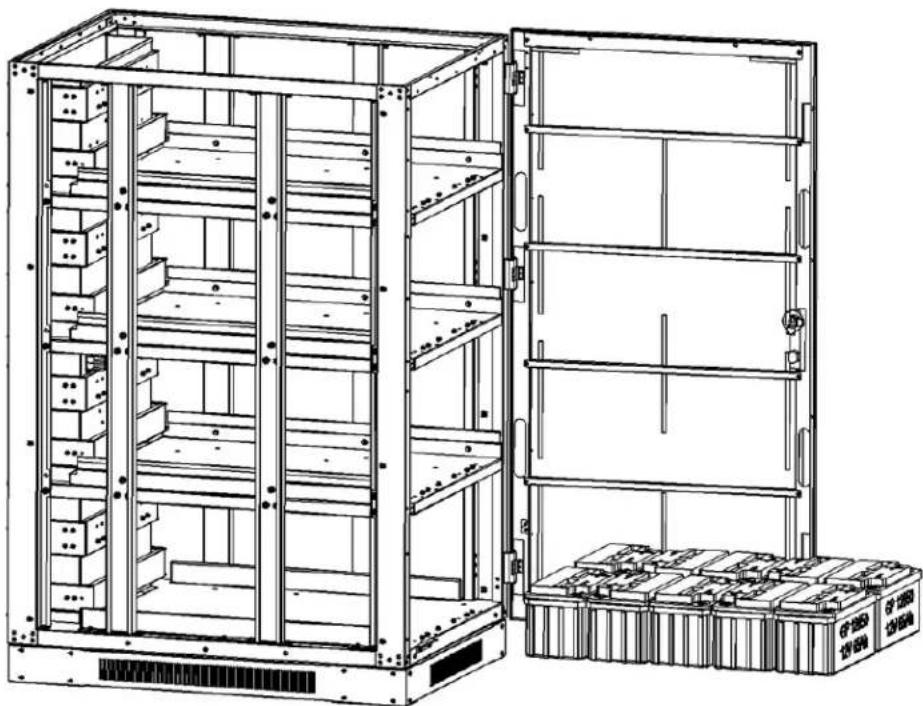
Figure 5-31: Model BP240V65L-NIB
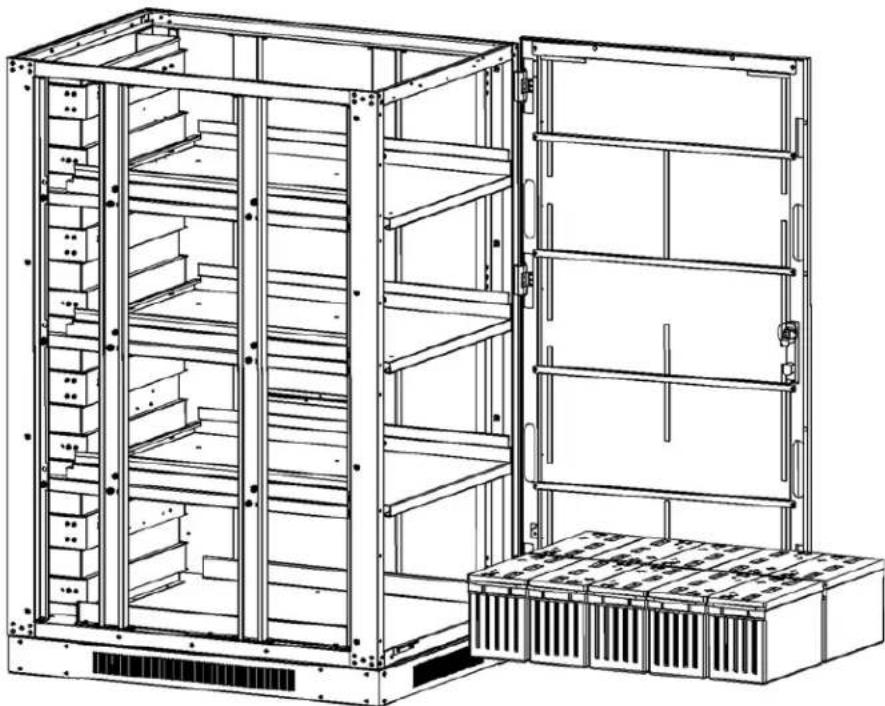
Figure 5-32: Model BP240V100L-NIB
5. Installation
- Install 10 battery packs in layer 2 (Figure 5-33: Model BP240V65L-NIB or Figure 5-34: Model BP240V100L-NIB).
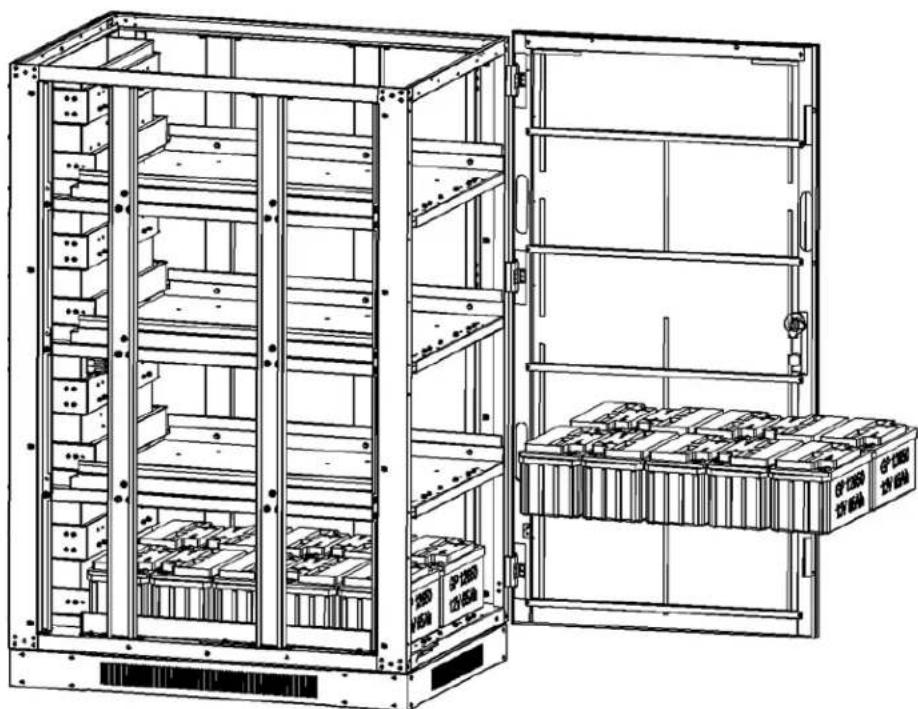
Figure 5-33: Model BP240V65L-NIB
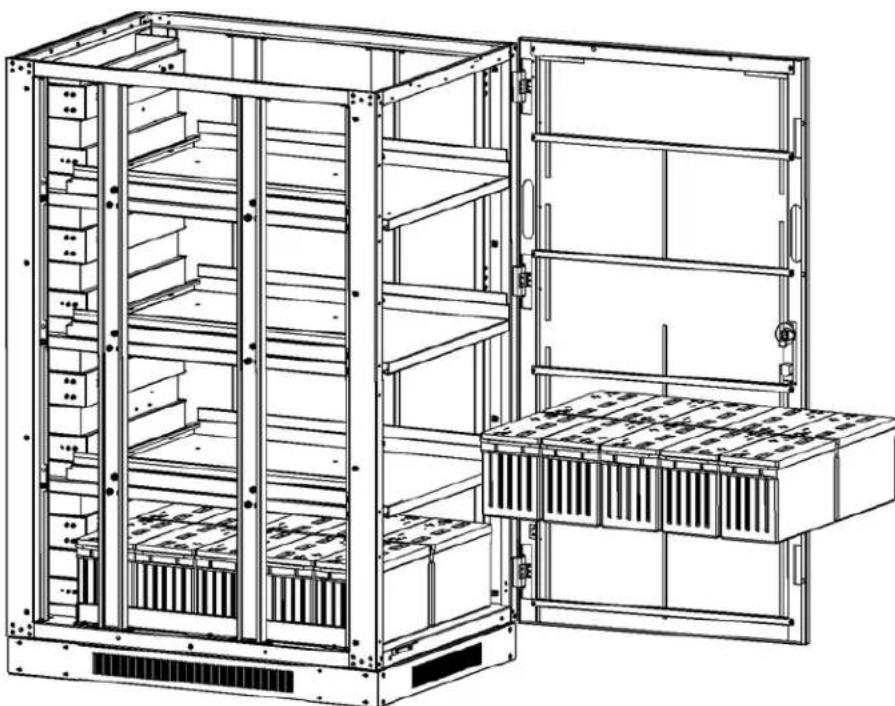
Figure 5-34: Model BP240V100L-NIB
5. Installation
- Install 10 battery packs in layer 3 (Figure 5-35: Model BP240V65L-NIB or Figure 5-36: Model BP240V100L-NIB).
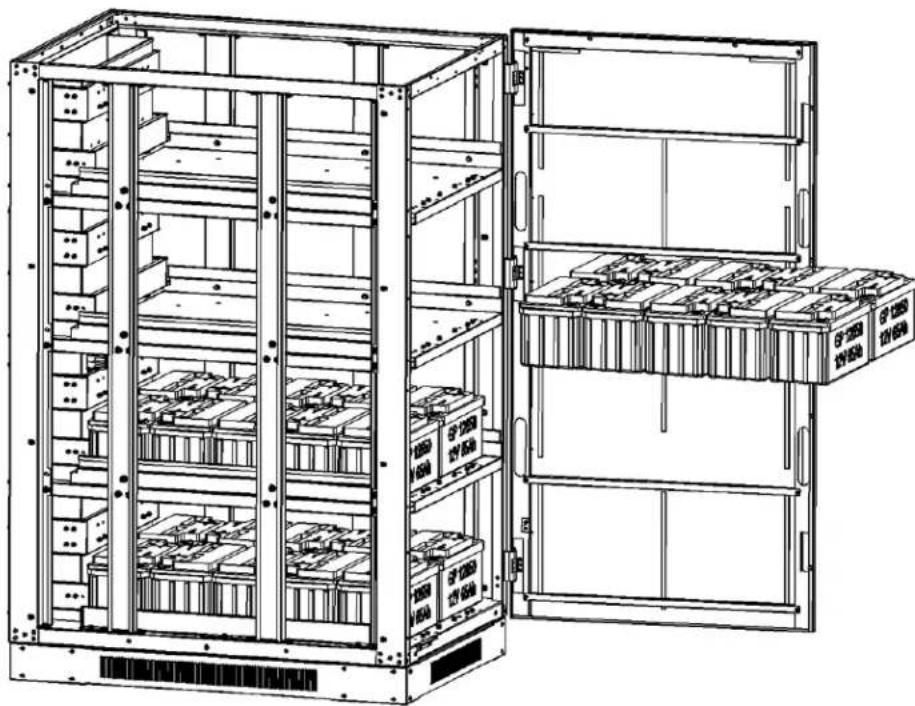
Figure 5-35: Model BP240V65L-NIB
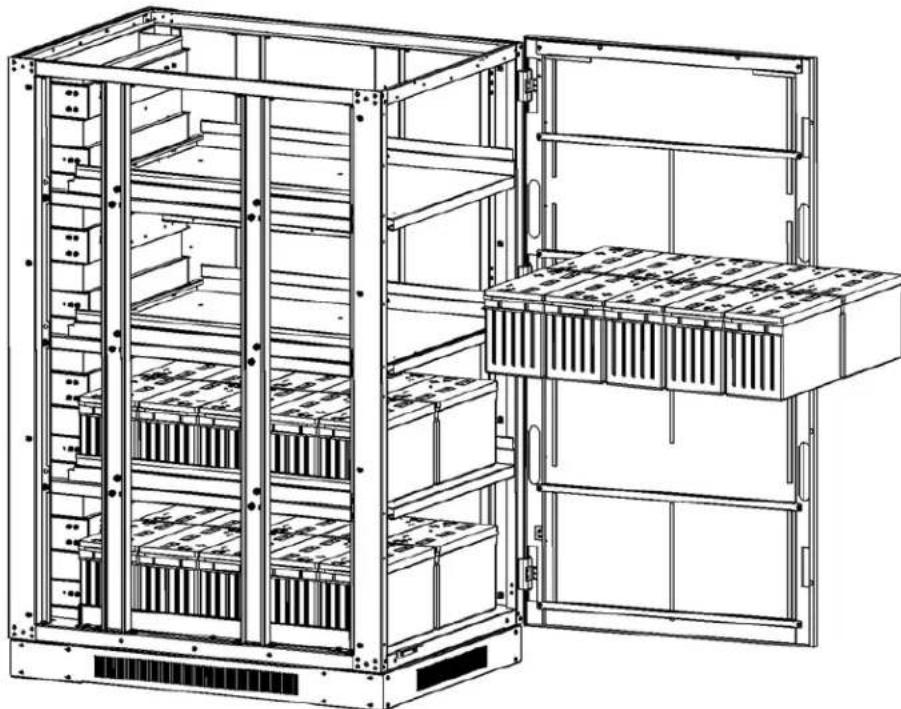
Figure 5-36: Model BP240V100L-NIB
5. Installation
- Install 10 battery packs in layer 4 (Figure 5-37: Model BP240V65L-NIB or Figure 5-38: Model BP240V100L-NIB).
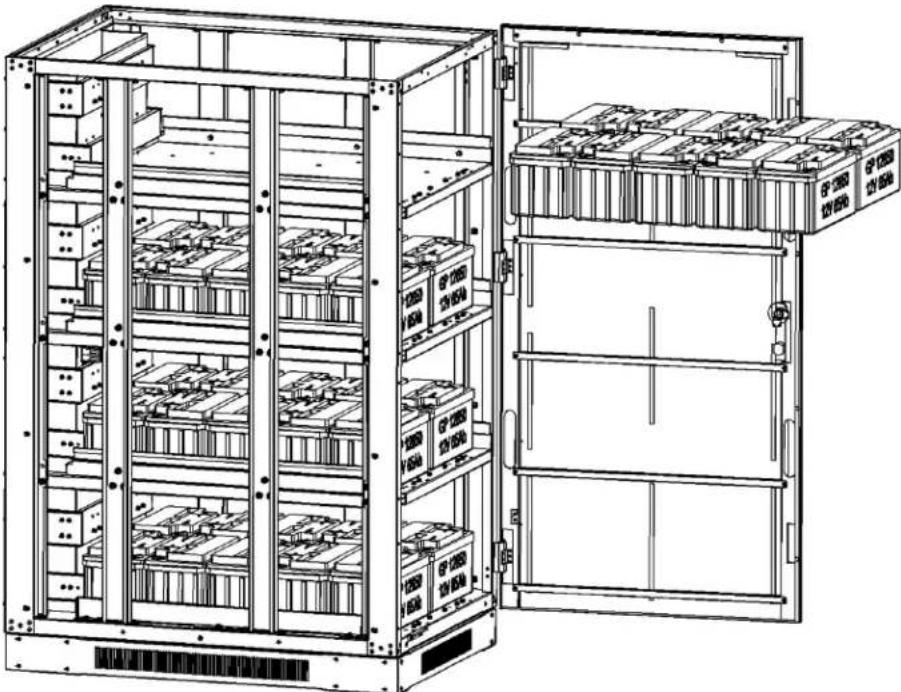
Figure 5-37: Model BP240V65L-NIB
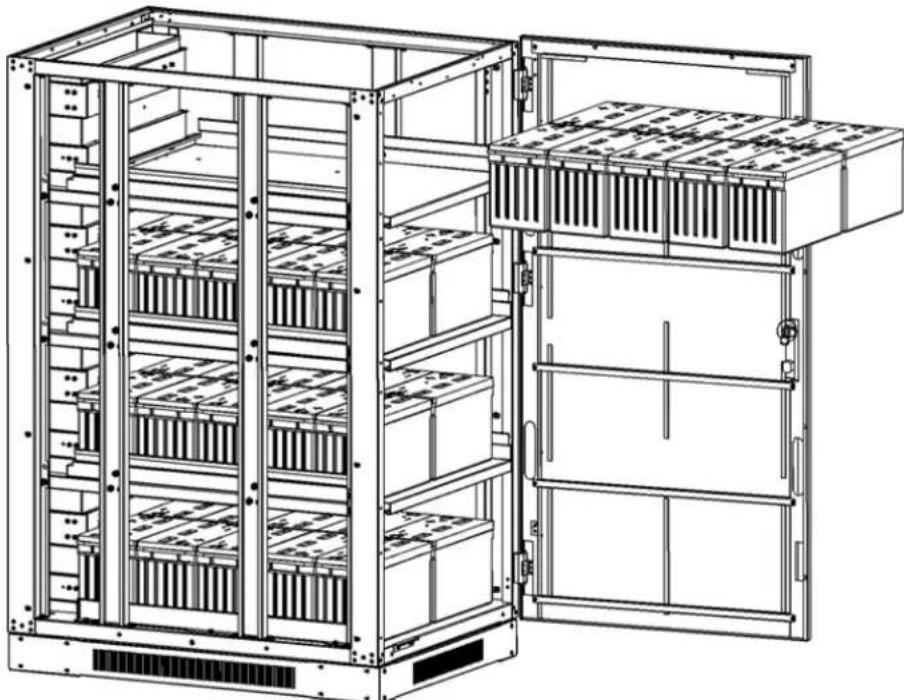
Figure5-38: Model BP240V100L-NIB
5. Installation
- Reinstall all battery retention brackets and screws (Figure 5-39).
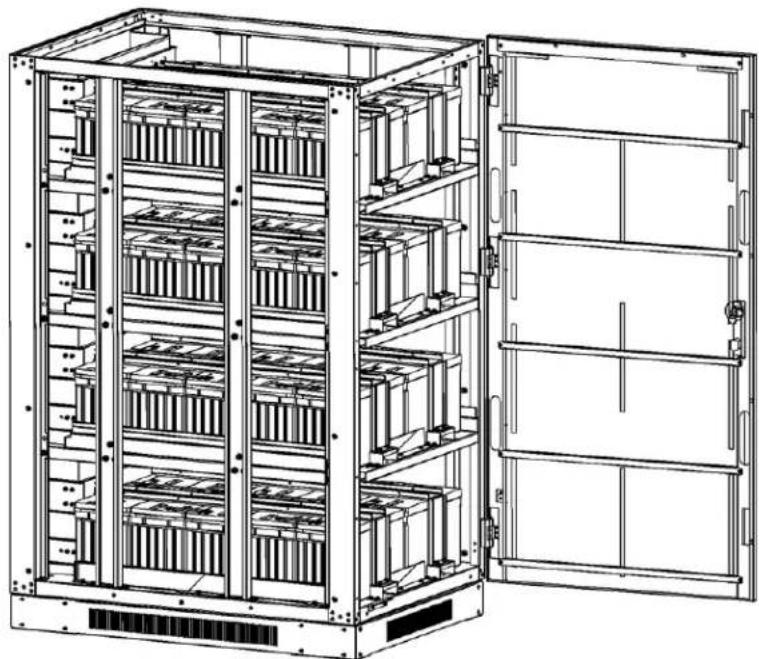
Figure 5-39
- Model BP240V65L-NIB: Install copper bus bars (13 pieces) between adjacent batteries and the battery insert bolts/posts (Figures 5-40A and 5-40B).
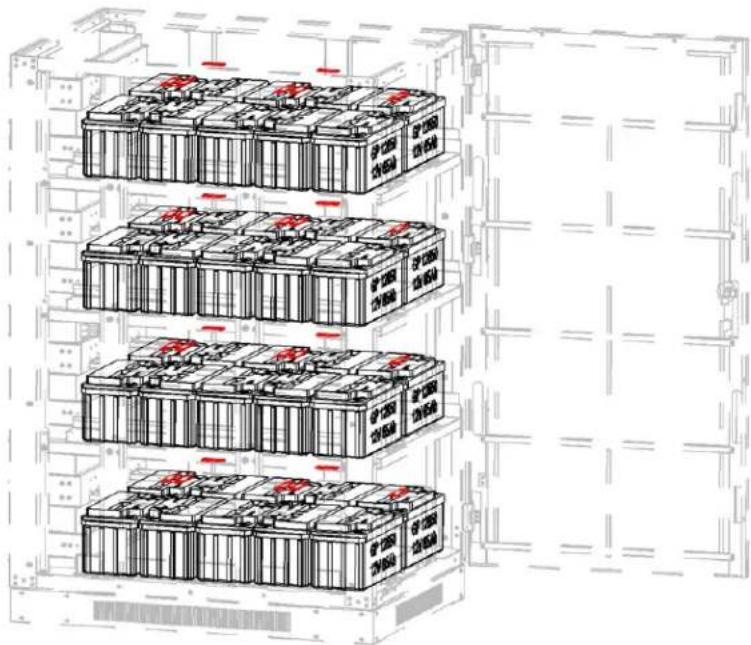
Figure 5-40A
5. Installation
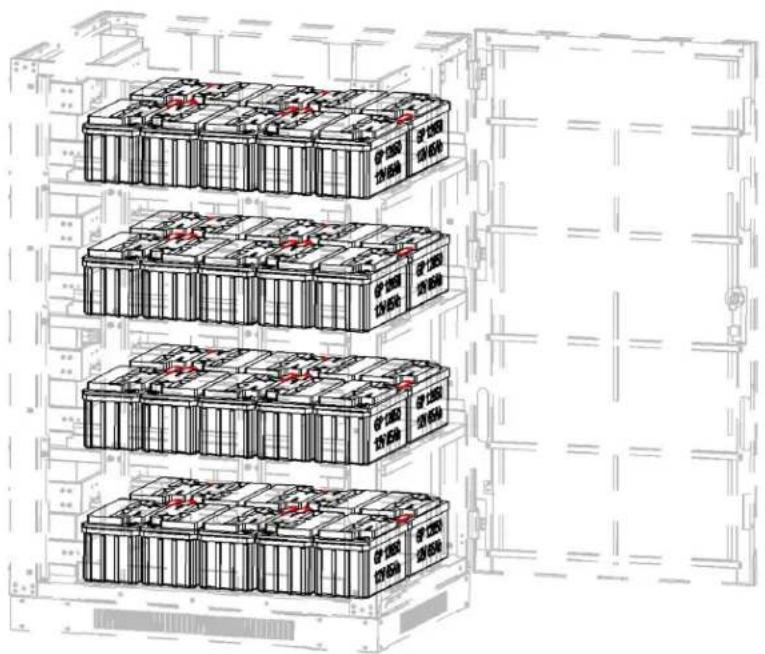
Figure 5-40B
- Model BP240V100L-NIB: Install copper bus bars (12 pieces) between adjacent batteries and the battery insert bolts/posts (Figures 5-41A and 5-41B).
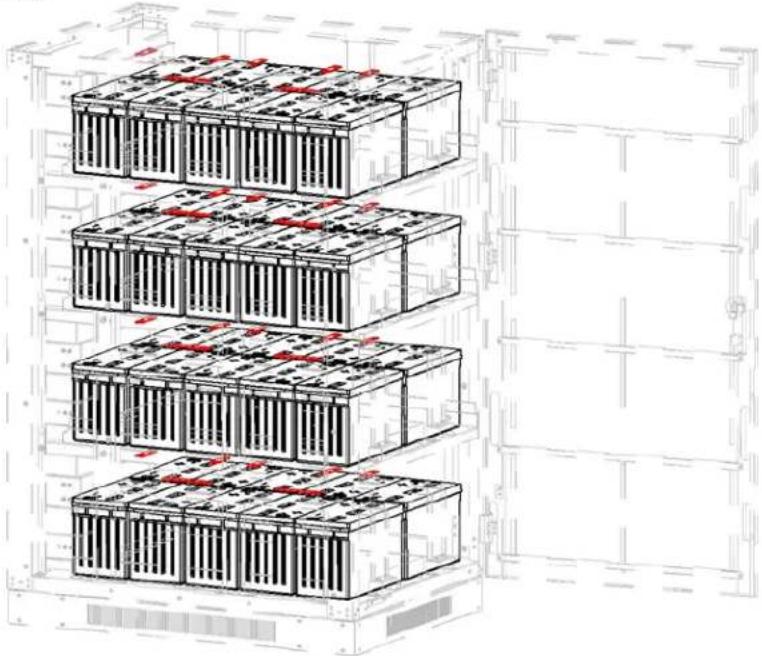
Figure 6-41A
5. Installation
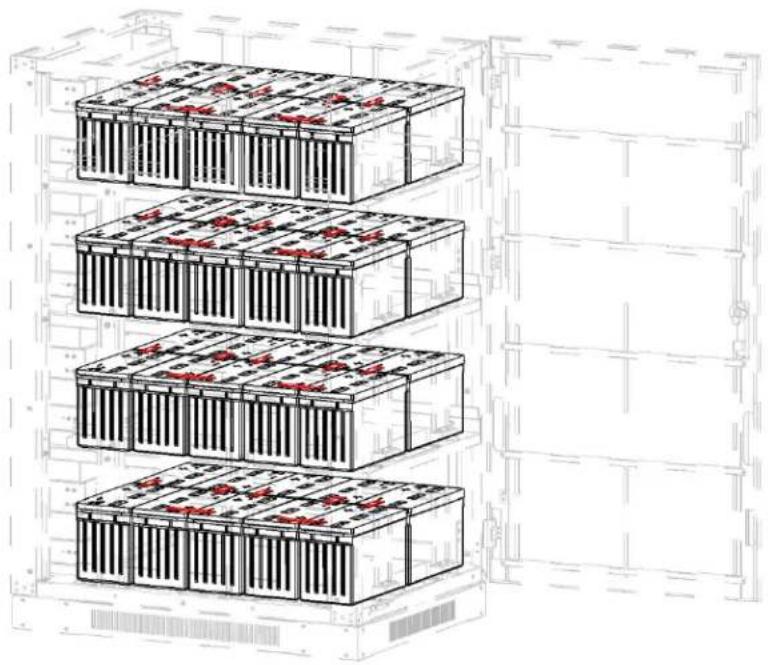
Figure 5-41B
- Connect the cables from battery group 1 battery 1+ to BAT+ bus bar, battery 10- to BATN bus bar, battery 11+ to BATN bus bar, battery 20- to BAT- bus bar and the layer connect cables. Connect battery group 2 battery 21+ to BAT+ bus bar, battery 30- to BATN bus bar, battery 31+ to BATN bus bar, battery 40- to BAT- copper bar and the layer connect cables (Figure 5-42: Model BP240V65L-NIB or Figure 5-43: Model BP240V100L and Figure 5-44).
Notes:
- Use the wiring schematics as reference
for the following assemblies:
Use Figure 5-26 for BP240V65L-NIB
Use Figure 5-27 for BP240V100L-NIB
- This manual may be downloaded in color at tripplite.com, which shows the cables in corresponding colors:
Red = Positive
Blue = Center Tap
Black = Negative
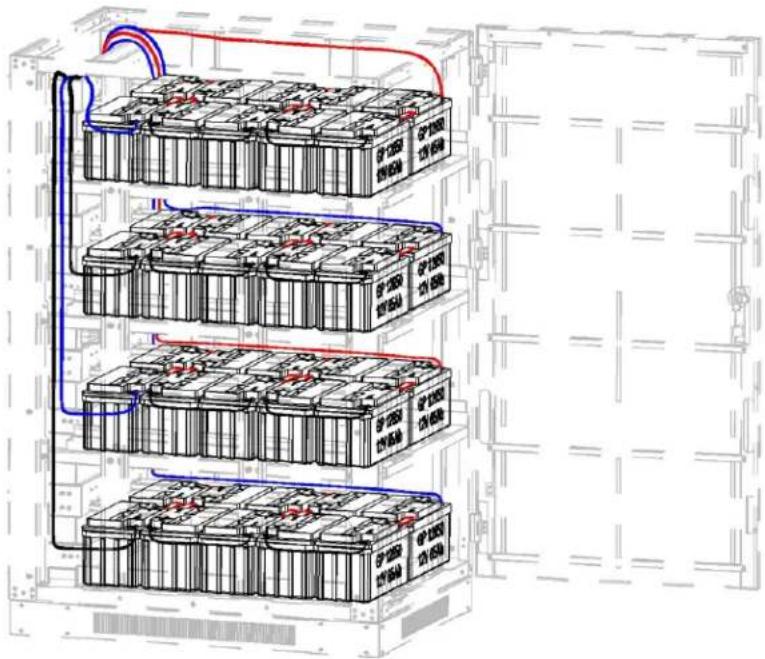
Figure 5-42: Model BP240V65L-NIB
5. Installation
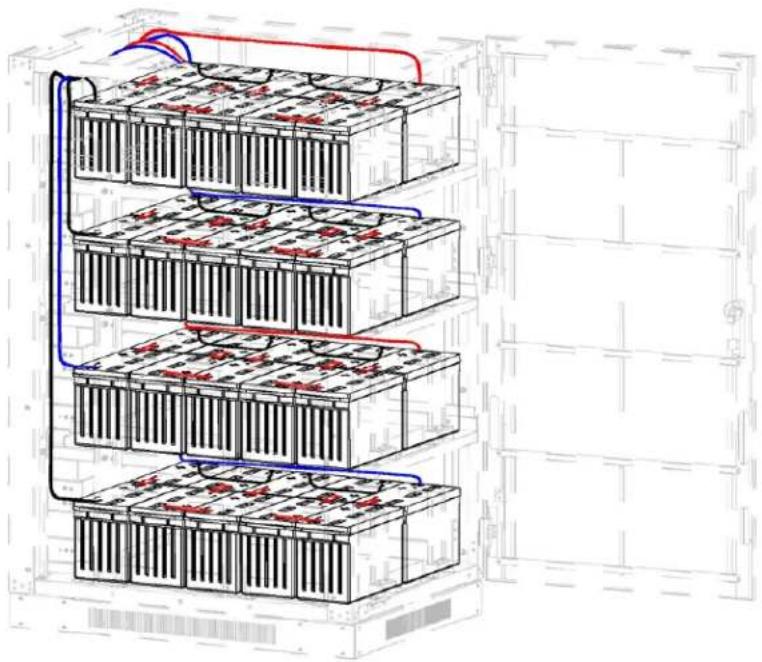
Figure 5-43: Model BP240V100L-NIB
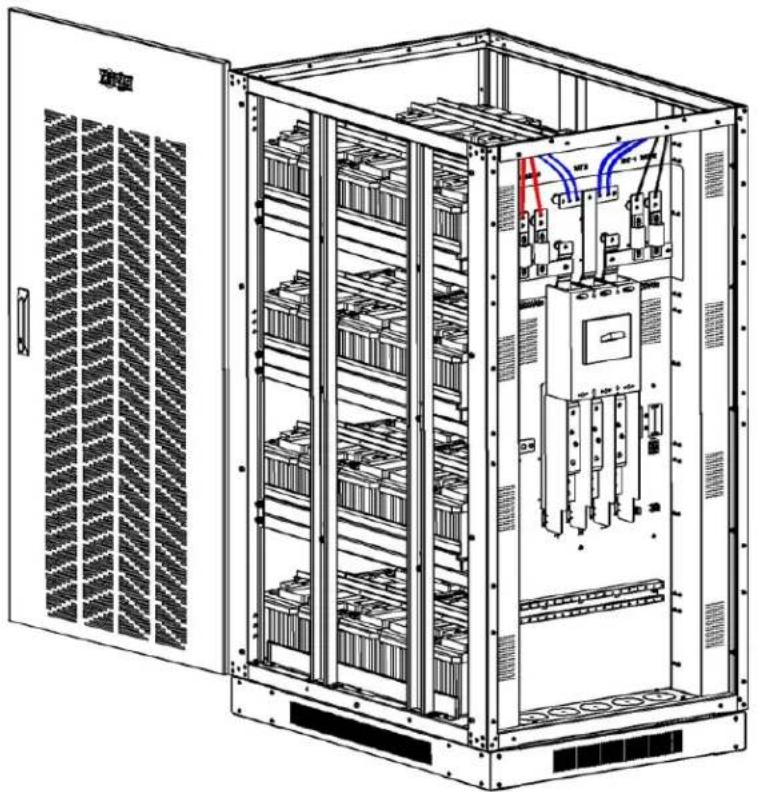
Figure 5-44
5. Installation
- Reinstall all covers and screws (Figure 5-45).
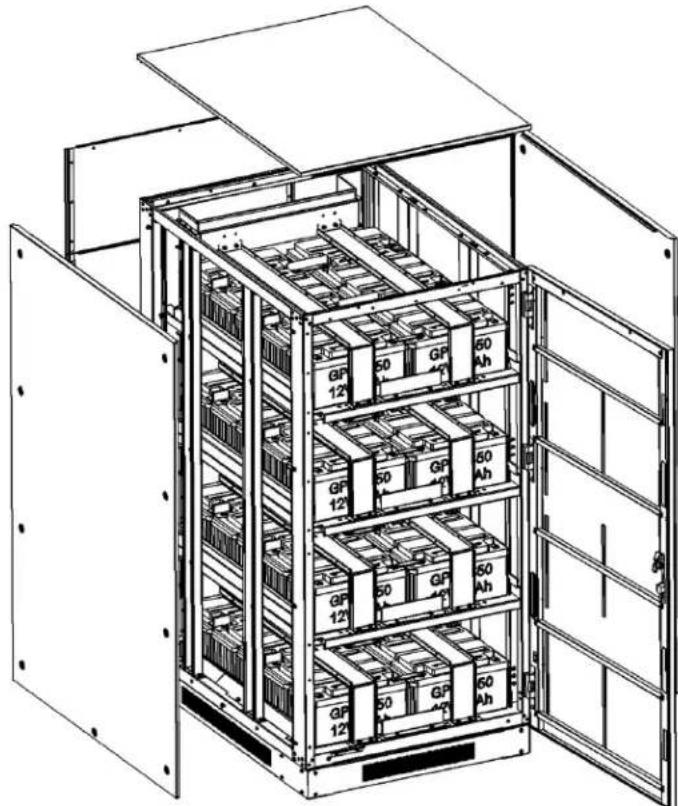
Figure 5-45
5. Installation
5.6 Multiple Battery Pack Connections

CAUTION!
Ensure correct polarity of the battery string series connection. DO NOT mix batteries with different capacities, different brands or new and old batteries.

WARNING!
ENSURE CORRECT POLARITY OF STRING END CONNECTIONS TO THE BATTERY CIRCUIT BREAKER, AND FROM THE BATTERY CIRCUIT BREAKER TO THE UPS TERMINALS (I.E. (+) TO (+) / (-) TO (-) / (N) TO (N)). DISCONNECT ONE OR MORE BATTERY CELL LINKS IN EACH TIER. DO NOT RECONNECT THESE LINKS AND DO NOT CLOSE THE BATTERY CIRCUIT BREAKER UNLESS ALL CONNECTIONS ARE PROPERLY CHECKED AND APPROVED.
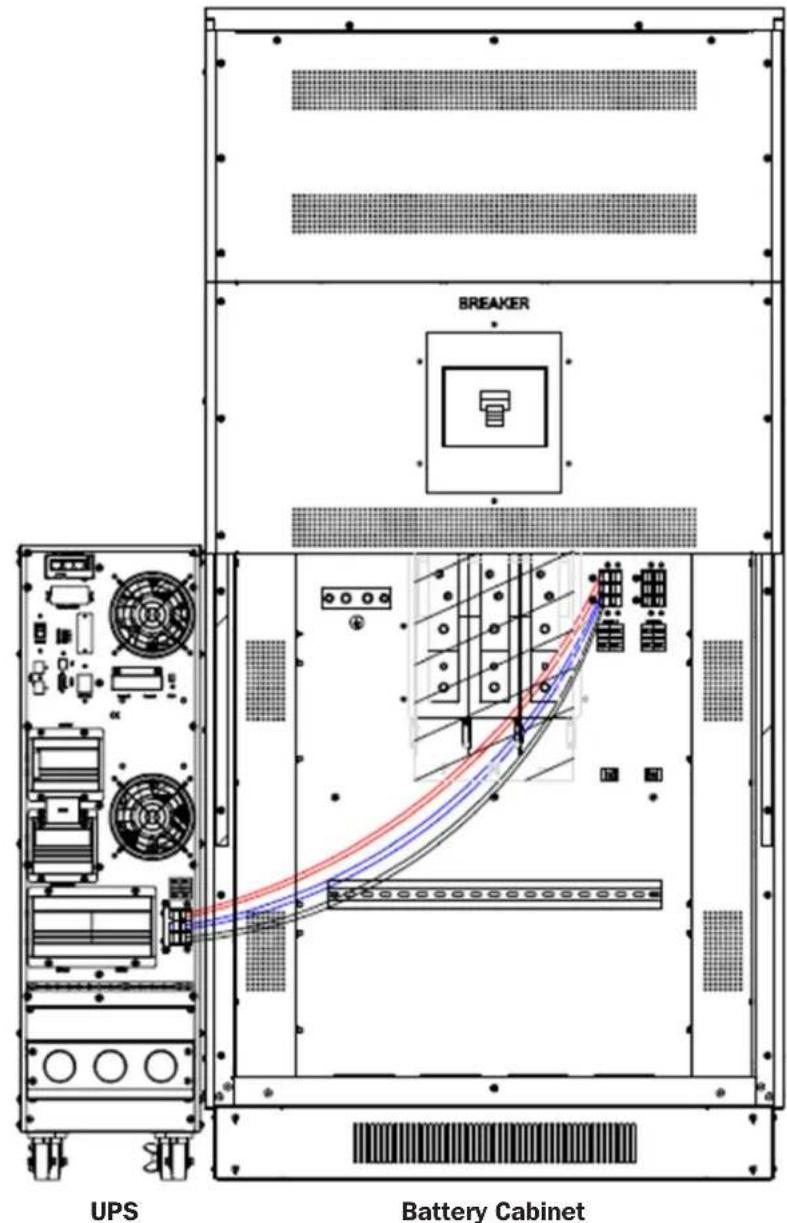
Figure 5-46: Connection of BP240V65L and BP240V65L-NIB for 10kVA, 15kVA and 20kVA UPS
5. Installation
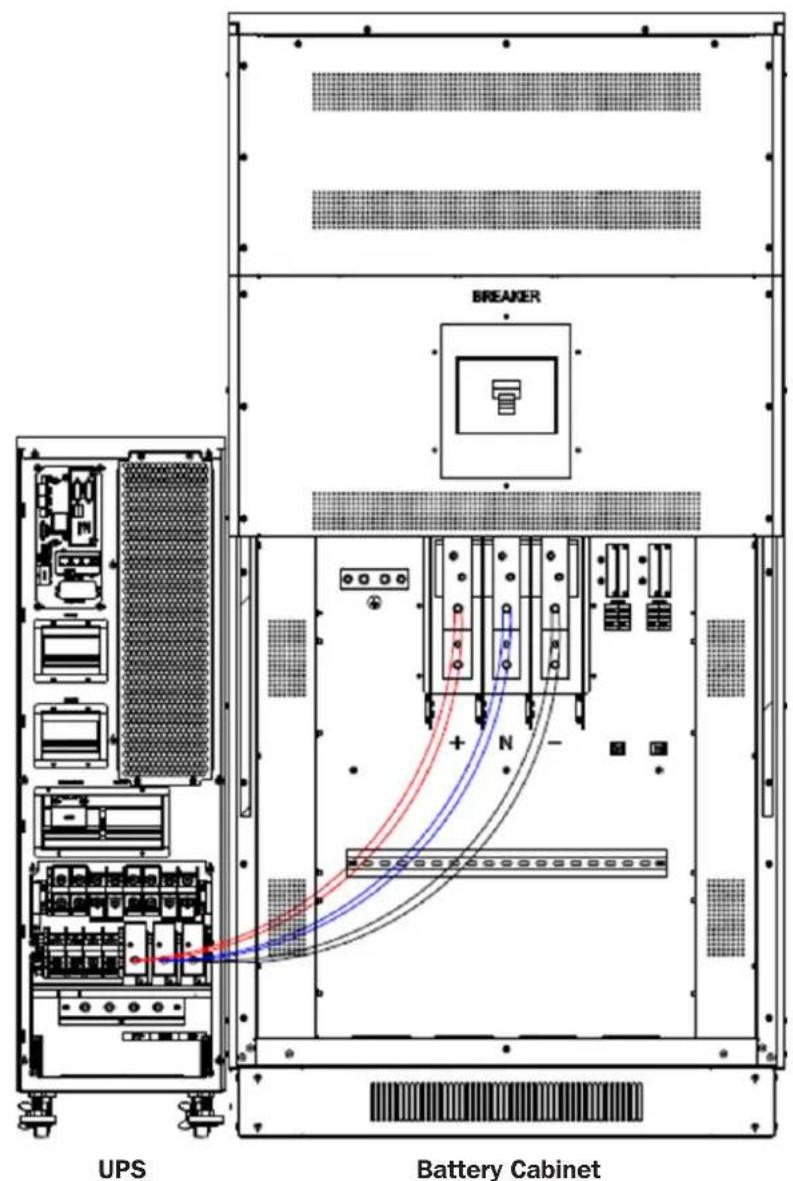
Figure 5-47: Connection of BP240V65L and BP240V65L-NIB for 25kVA and 30kVA UPS
5. Installation
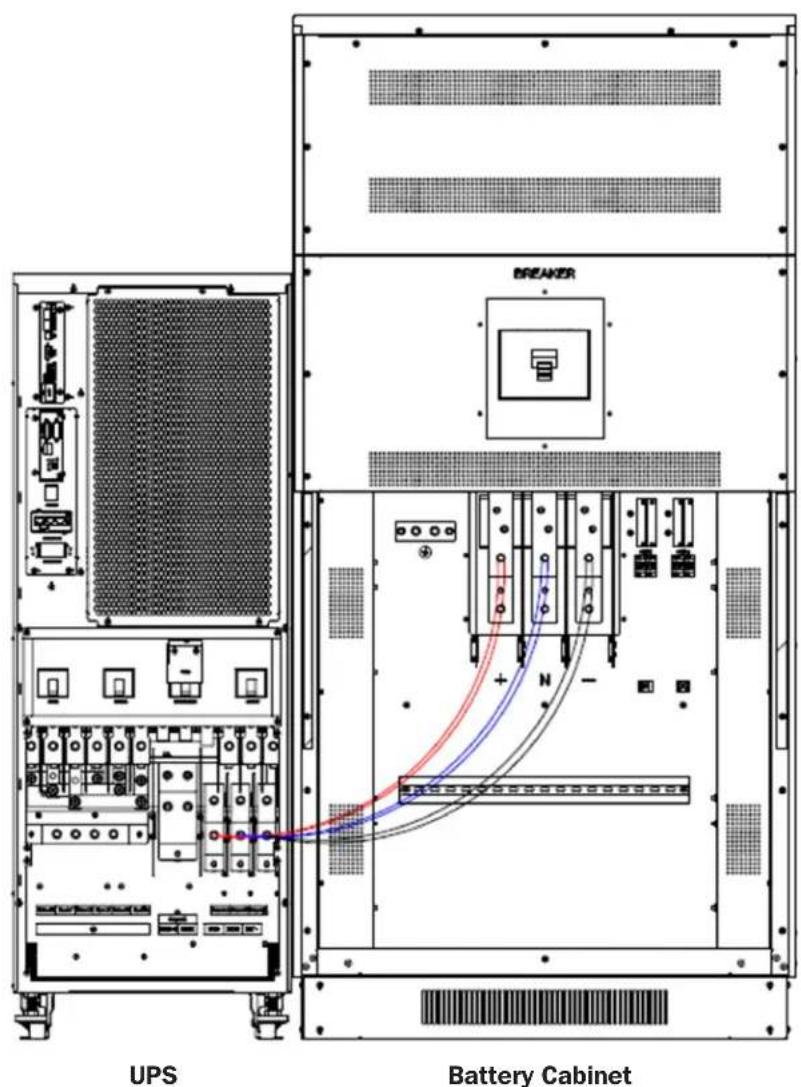
Figure 5-48: Connection of BP240V65L, BP240V65L-NIB, BP240V100L or BP240V100L-NIB for 50kVA & 60kVA UPS Systems
5. Installation
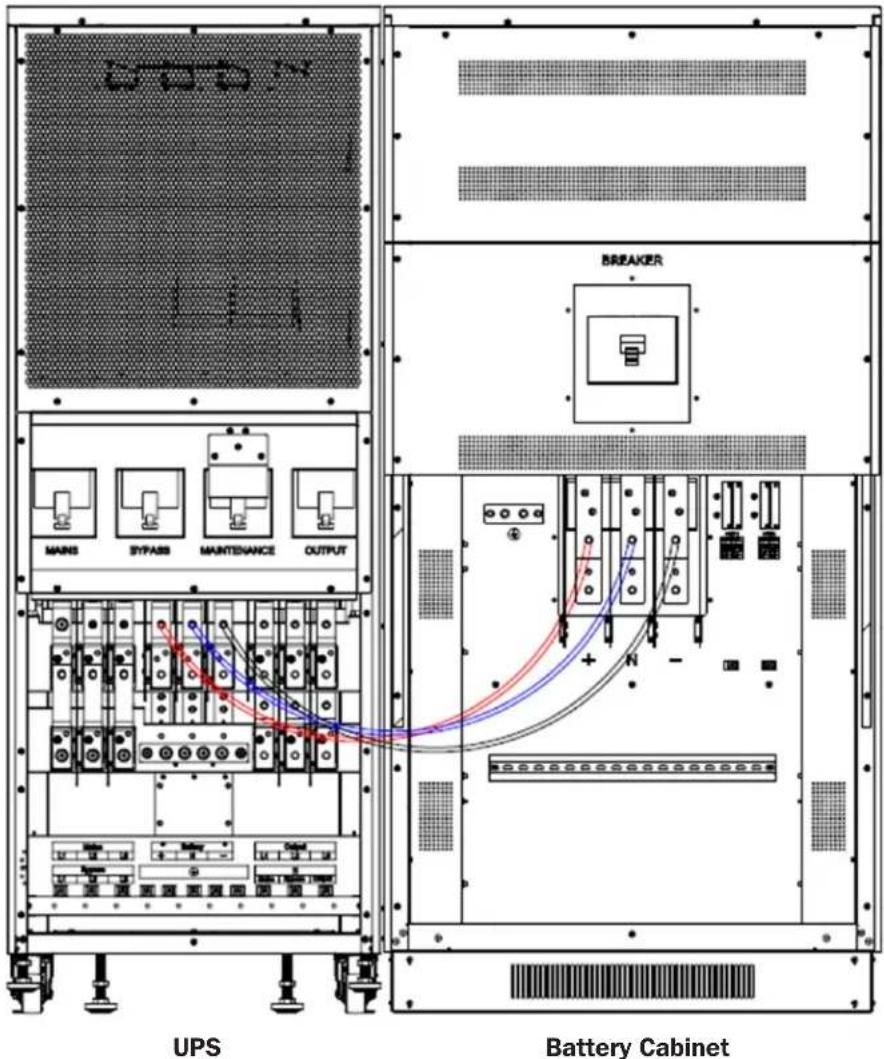
Figure 5-49: Connection of BP240V65L, BP240V65L-NIB, BP240V100L or BP240V100L-NIB for 80kVA & 100kVA UPS
6. Operation and Configuration of S3M UPS Models and Battery Cabinets
6.1 S3M UPS Compatibility with BP240V65 to BP240V100L Battery Cabinets
| Cabinets with Internal Batteries | BP240V65 BP240V65L BP240V100 BP240V100L | ||||
| Cabinets with NO Internal Batteries | BP240V65-NIB BP240V65L-NIB BP240V100-NIB BP240V100L-NIB | ||||
| 10kVA-20kVAUPS with Internal Batteries | • S3M10K1B,S3M10K2B,S3M10K3B• S3M15K2BS3M15K3B• S3M20K3B | No No No No | |||
| 10kVA-20kVA UPSwith NO Internal Batteries | • S3M10K-NIB• S3M15K-NIB• S3M20K-NIB | Yes Yes Yes No | |||
| Cabinets with Internal Batteries | BP240V65 BP240V65L BP240V100 BP240V100L | |||
| Cabinets with NO Internal Batteries | BP240V65-NIB BP240V65L-NIB BP240V100-NIB BP240V100L-NIB | |||
| 25kVA-100kVAUPS with NOInternal Batteries | • S3M25K• S3M30K | Yes Yes Yes No | ||
| • S3M50K | Yes Yes Yes | Yes | ||
| • S3M60K No Yes Yes | Yes | |||
| • S3M80K• S3M100K | No Yes No | Yes | ||
6. Operation and Configuration of S3M UPS Models and Battery Cabinets
6.2 Configuring 10-20K UPS for Specific Battery Cabinets using the LCD Display
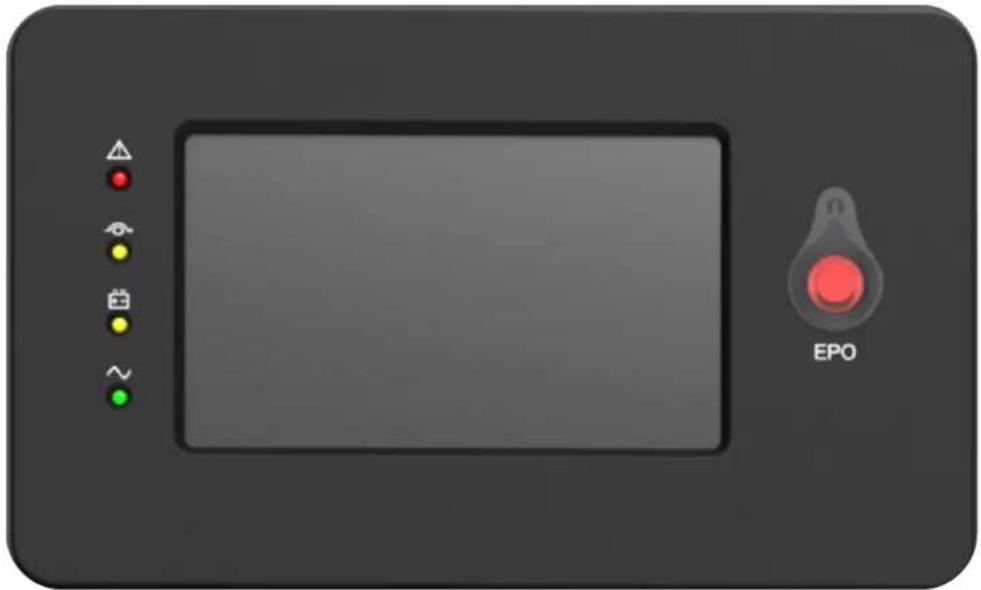

CAUTION!
Settings for most parameters cannot be changed when the UPS is in inverter mode.
6.2.1 S3M10-20K UPS Home Display
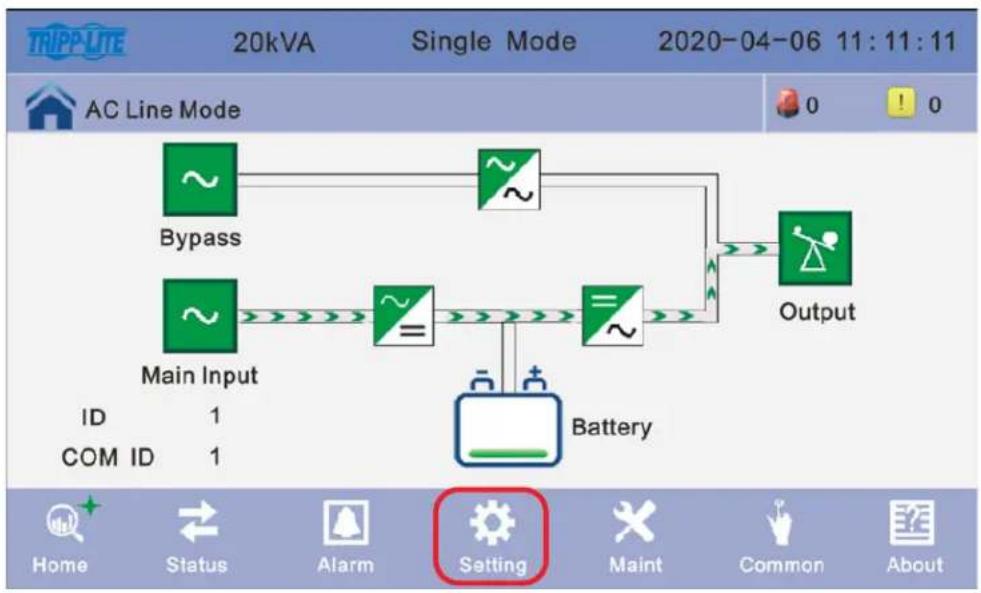
6. Operation and Configuration of S3M UPS Models and Battery Cabinets
6.2.2 Setting
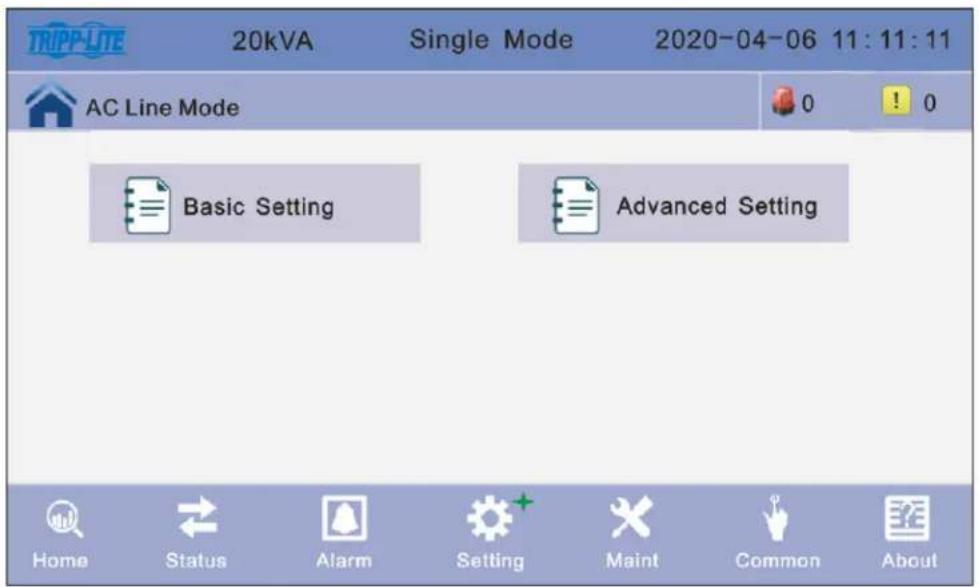
Click on the Settings icon to enter two setting levels. The Basic Setting is for user settings, and the Advanced Setting is for technical personnel only. Contact your administrator to enter advanced settings.
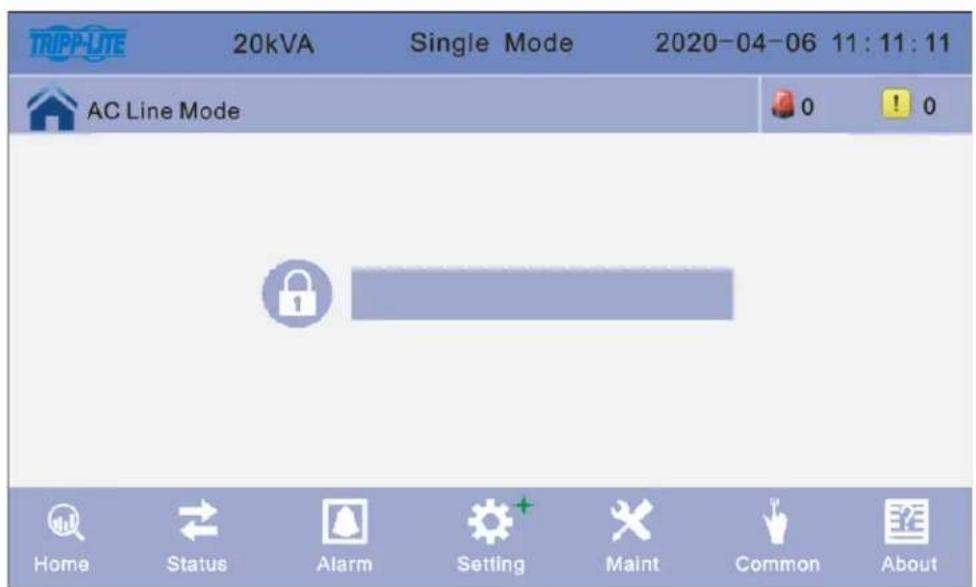
Advanced Setting: Click Advanced Setting and input the correct password. The user password is "191210".
6. Operation and Configuration of S3M UPS Models and Battery Cabinets
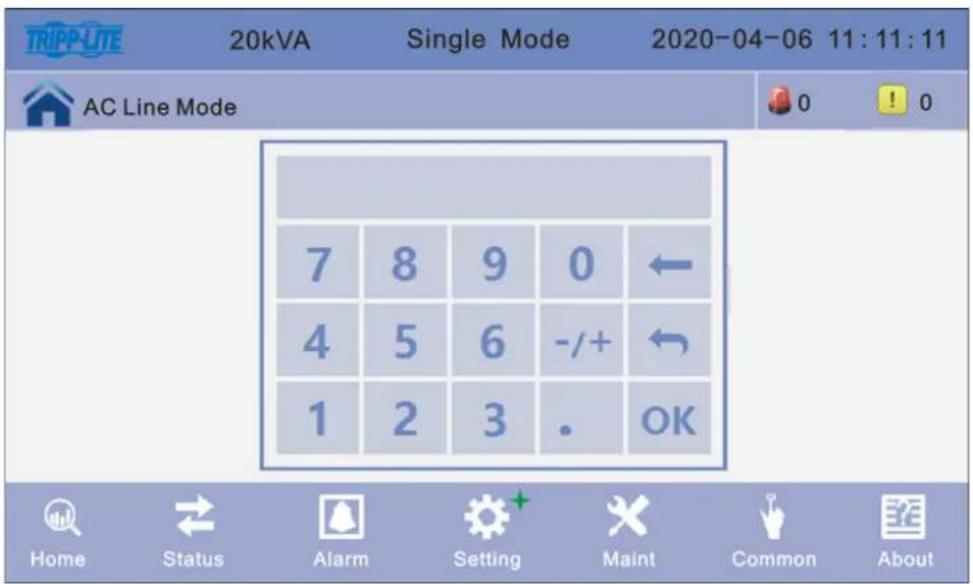
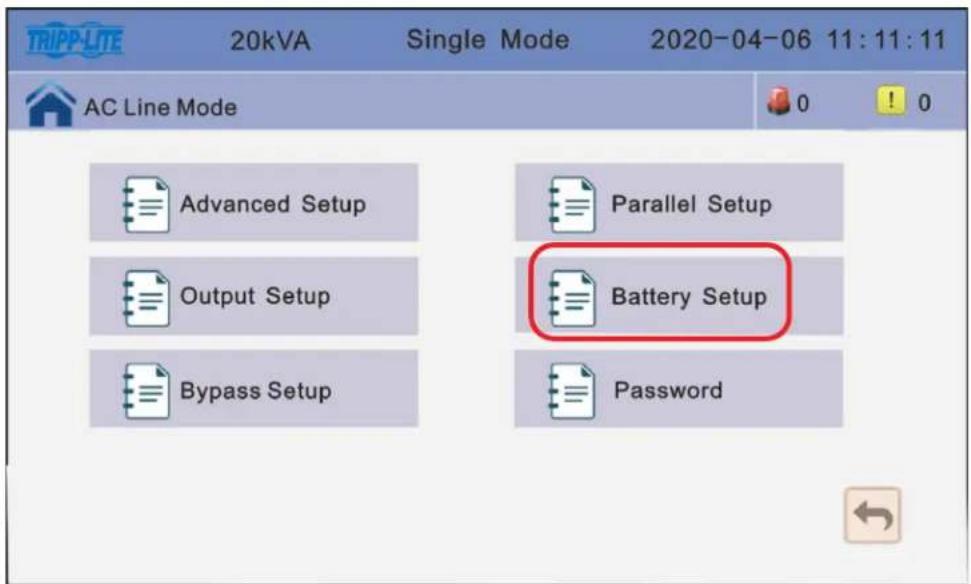
6.2.3 Battery Setup
Click Battery Setup
6. Operation and Configuration of S3M UPS Models and Battery Cabinets
6.2.4 Configuring the S3M25-100K UPS and Optimizing Charging of the BP240V65/V65L and BP240V100/V100L Battery Cabinets
Step 1: Setting the Battery Group
The Battery Group is Quantity 1 for every set of 20 batteries that are in and/or connected to the UPS model. For example, UPS model S3M20K-NIB has no internal batteries and is Battery Group 1 by default for any UPS model. However, to connect a BP240V65 cabinet with 20 internal batteries to the S3M20K-NIB, the S3M20K-NIB UPS must remain set to Battery Group 1 (one set of 20 batteries). However, to connect a second BP240V65 to the S3M20K-NIB UPS, the UPS Battery Group must be 2 (two sets of 20 batteries). Obtain the Battery Group number based on the specific S3M UPS and Battery Cabinet models combination from the chart under Section 6.4.
The value can be 1 to 8. The default value is 1 for S3M UPS models without internal batteries.
Step 2: Setting the Battery Number
The battery number must remain at 20 for all S3M10-100K UPS models when connected to Tripp Lite external battery cabinets designed for the S3M-Series UPS Series.
Step 3: Setting Single Battery (Ah) Capability
Change the Single Battery (Ah) Capability to the individual Ah capacity for one individual battery as follows for the specific battery cabinet models:
- BP240V09/BP240V09K: the Single Battery (Ah) Capacity is 9
BP240V40/BP240V40L: the Single Battery (Ah) Capacity is 40
BP240V65/BP240V65L: the Single Battery (Ah) Capacity is 65
BP240V100/BP240100L: the Single Battery (Ah) Capacity is 100
The values can be 7 2000
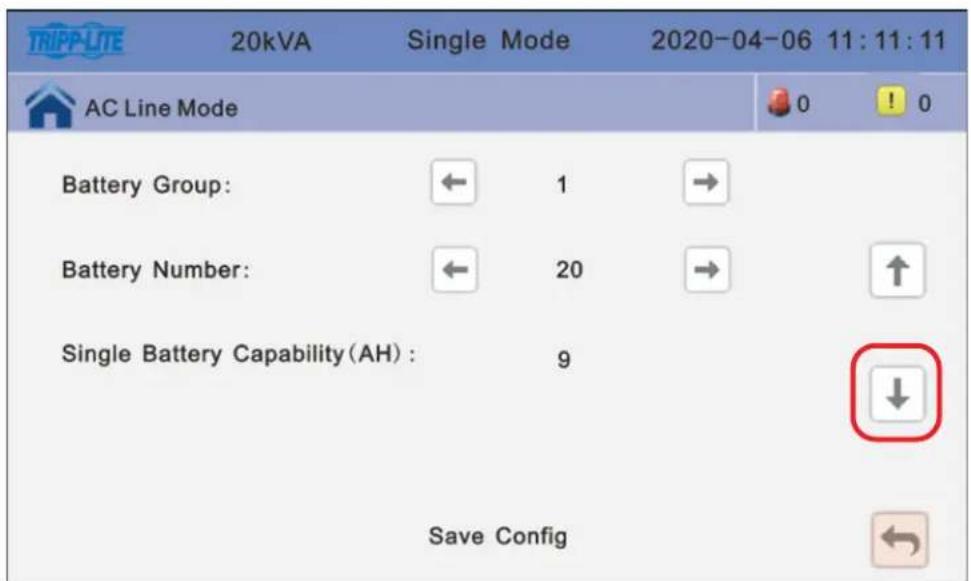
Scroll to the next display screen by pressing the down arrow.
6. Operation and Configuration of S3M UPS Models and Battery Cabinets
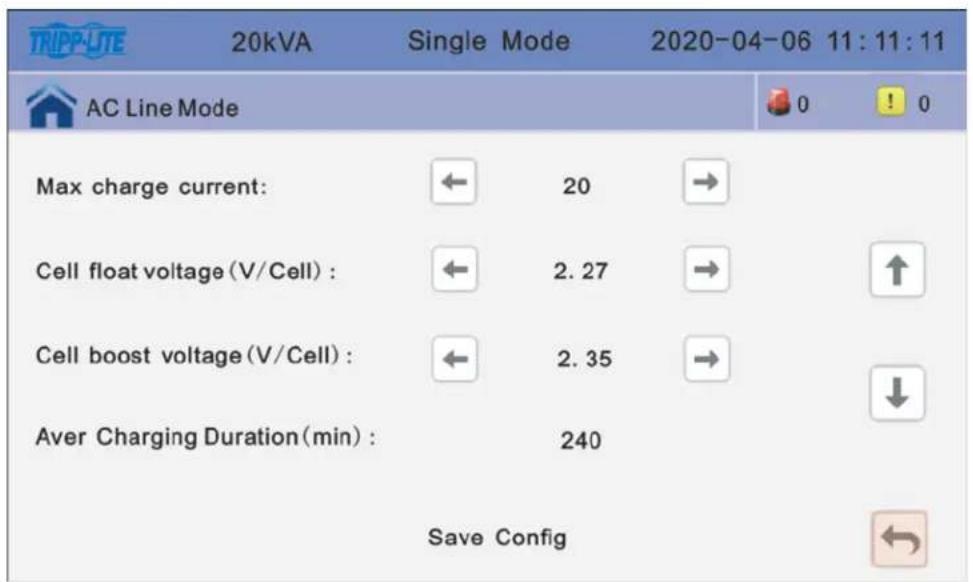
Step 4: Setting Max Charge Current
Max Charge Current is the estimated charge current that the UPS will use to charge the batteries. Obtain the recommended estimated Max Charge Current based on the specific S3M UPS and battery cabinet model combination from the chart in Section 6.4.
Float and Boost Voltage: The UPS is factory-set for proper float (2.27V/cell, 13.62V/battery) and boost (2.35V/cell, 14.1V/battery) voltages.
Cell float voltage: The float voltage value can be 2.23~2.30 V/cell. The default value is 2.27 V/cell.
Cell boost voltage: The battery equalized voltage value can be 2.30 2.40V / cell . The default value is 2.35 V/cell.
Step 5: Setting Aver Changing Duration (min)
Setting the Average Charging Duration in minutes is an estimation of the boost charger time duration to charge new batteries to 90% capacity at 25^ . Obtain the recommended Average (Aver) Charging Duration (min) number based on the specific S3M UPS and battery cabinet model combination from the chart in Section 6.4. Note the recommended battery boost charge durations are estimates only based on new batteries. These numbers may change with the age of the batteries and the battery ambient temperature. To change the Aver Charging Duration, press directly on the defaulted 240 value in the display.
- The Average (Aver) charging duration is the battery boost charge time limit. The value can be 1 999 min. The default is value 240 (4 hours).
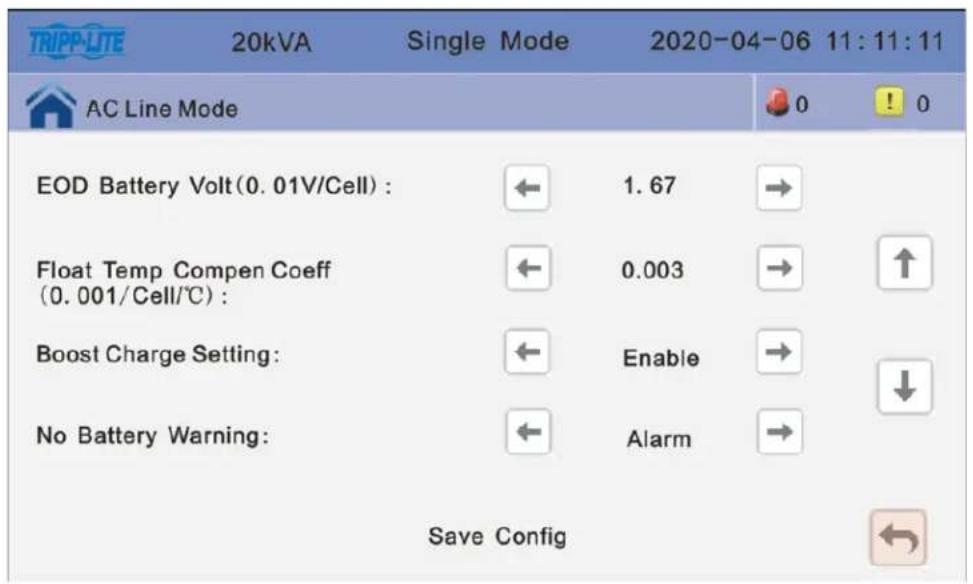
EOD Battery Volt: End of discharge voltage is the low voltage cutoff of the batteries during a battery mode operation. The value can be 1.60~1.90. The default value is 1.67V/cell, or 10.02Vdc per battery.
Float Temp Compen Coeff: Modifies the voltage of compensation after enabling the switch. The value can be 0.001~0.007V/cell/°C. The default value is 0.003V/cell/°C.
Boost Charge Setting: Boost charge can be set to Disable or Enable. The default value is Enable.
No Battery Warning: Keep this alarm enabled if you want the UPS to provide a warning when no batteries are present. The default value is Alarm.
6. Operation and Configuration of S3M UPS Models and Battery Cabinets
6.3 Configuring 25-100K UPS for Specific Battery Cabinets Using the LCD Display
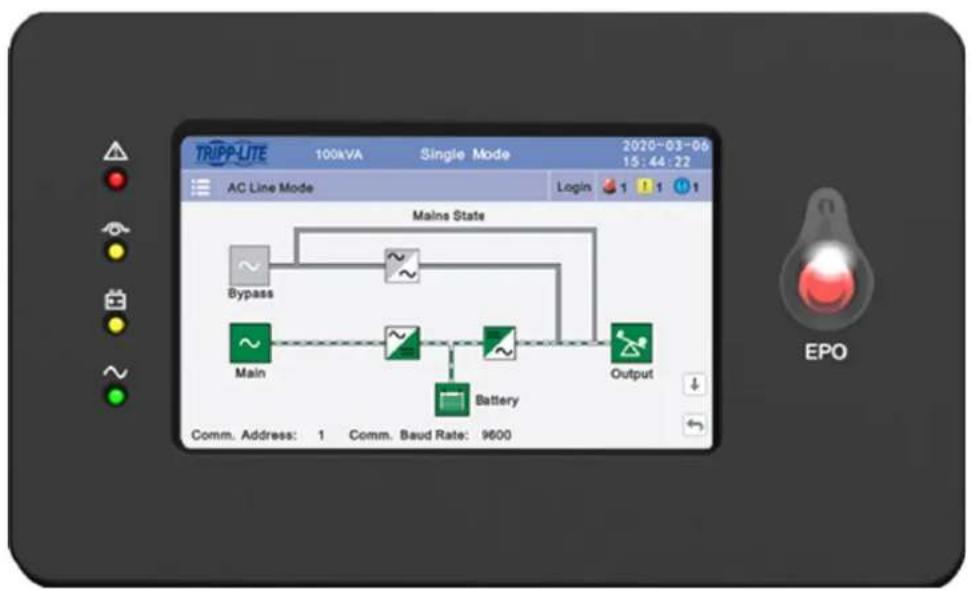

CAUTION!
Settings for most parameters cannot be changed when the UPS is in inverter mode.
6. Operation and Configuration of S3M UPS Models and Battery Cabinets
6.3.1 S3M25-100K UPS Home Display
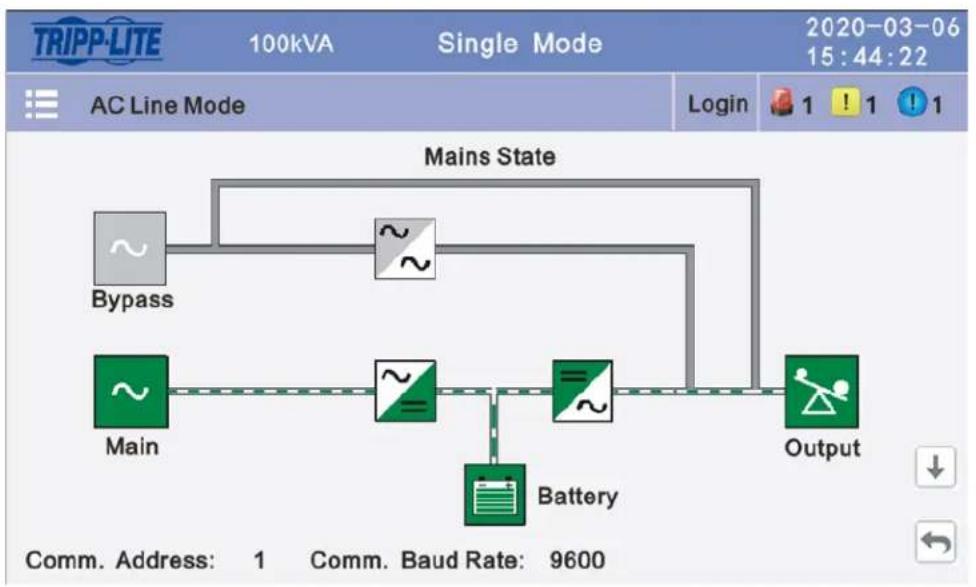
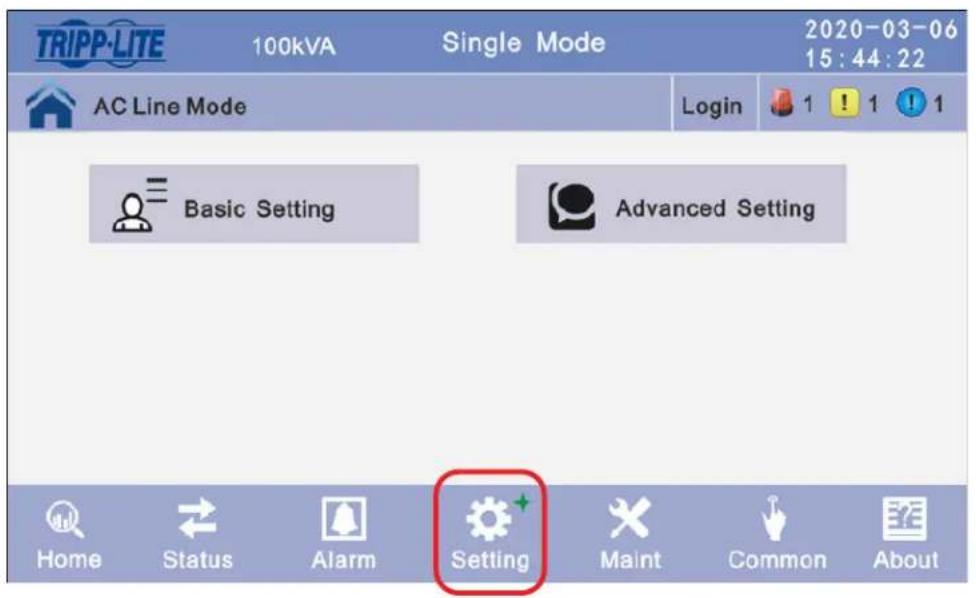
6.3.2 Setting
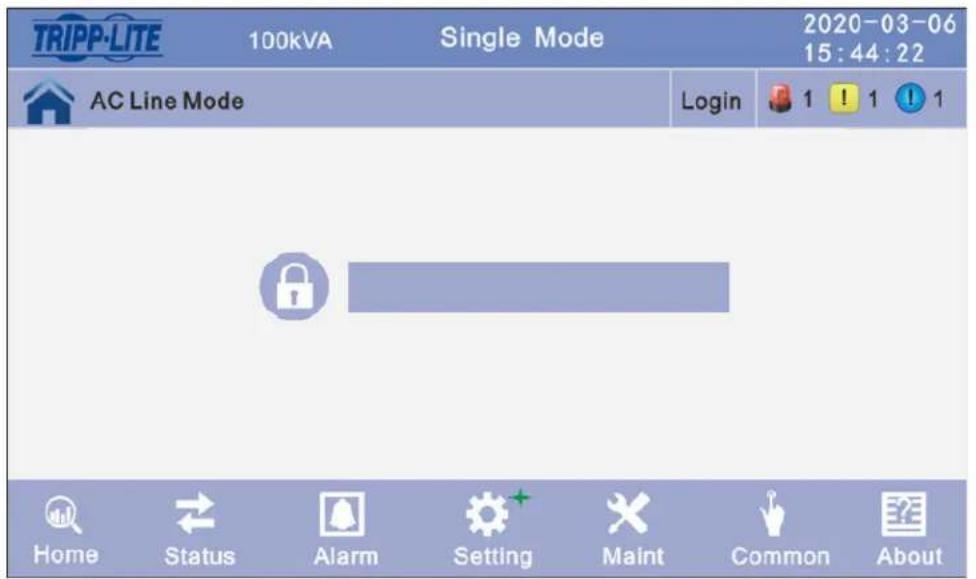
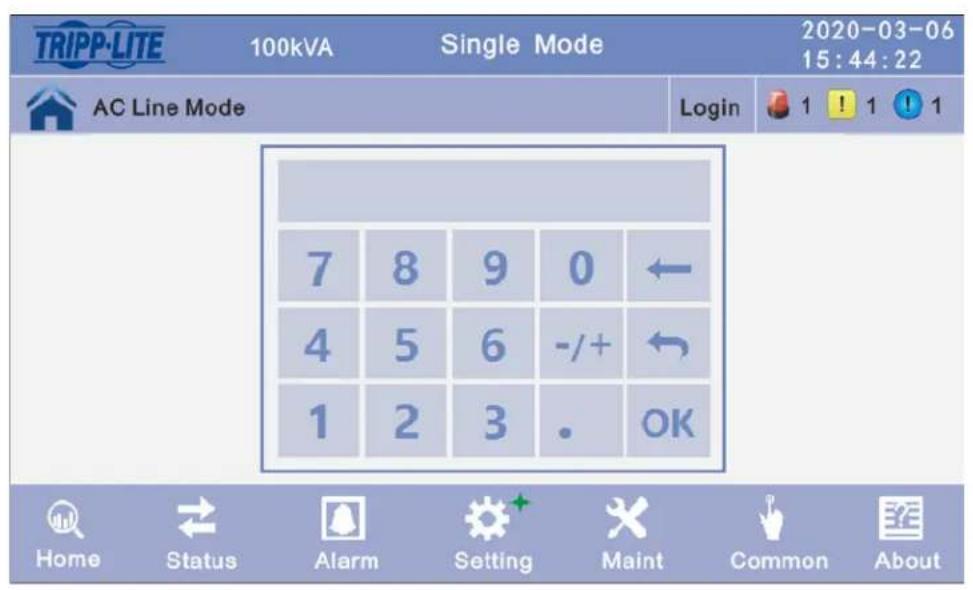
Click on the Settings icon to enter two setting levels. The Basic Setting is for user settings, and the Advanced Setting is for technical personnel only. Contact your administrator to enter advanced settings.
Advanced Setting: Click Advanced Setting and input the correct password. The user password is "191210".
6. Operation and Configuration of S3M UPS Models and Battery Cabinets
6. Operation and Configuration of S3M UPS Models and Battery Cabinets
6.3.3 Battery Setup
Click BATT Setup
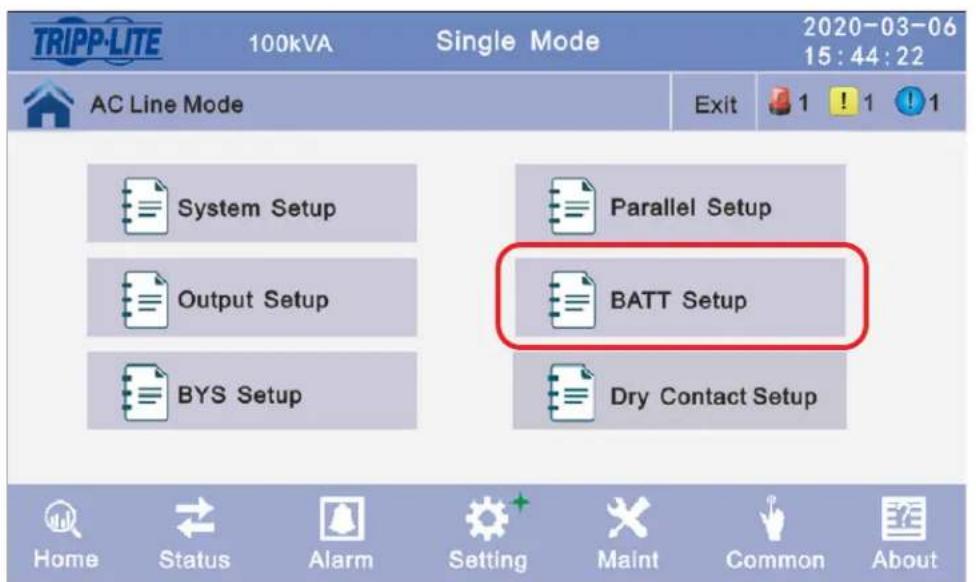
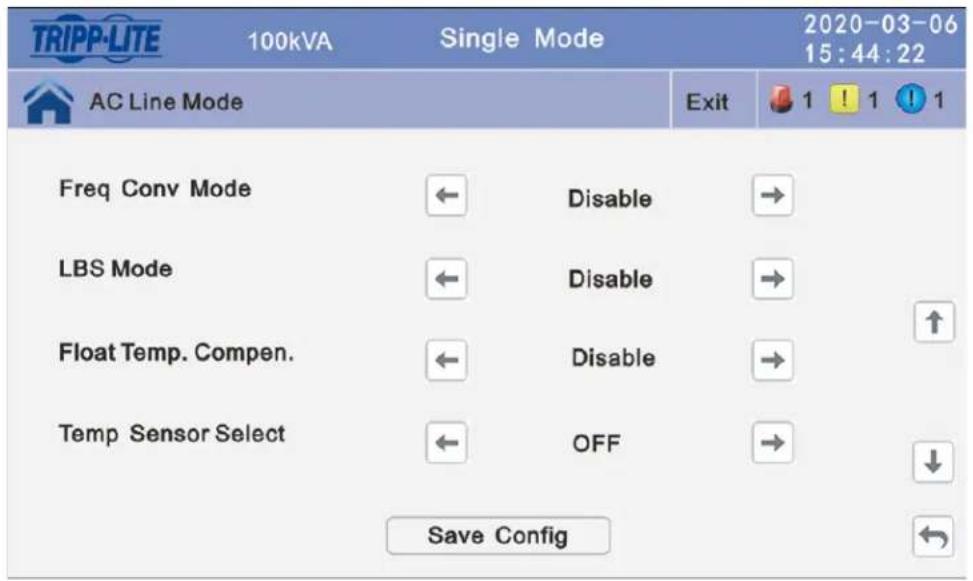
Float Temp. Compen.: The temperature sensor compensation setting maybe changed to Enable when a battery temperature sensor is connected to the UPS system's RJ45 rear port.
Temp Sensor Select: Set the temperature sensor type to NTC for single and short distances. Set the temperature sensor type to RS485 for multiple and far distances.
6. Operation and Configuration of S3M UPS Models and Battery Cabinets
6.3.4 Configuring the S3M25-100K UPS and Optimizing Charging of the BP240V65/V65L and BP240V100/V100L Battery Cabinets
Step 1: Setting the Battery Group
The Battery Group is Quantity 1 for every set of 20 batteries that are in and/or connected to the UPS model. For example, UPS model S3M100K UPS has no internal batteries and is Battery Group 1 by default. However, to connect a BP240V100L cabinet with 40 internal batteries to the S3M100K, the S3M100K UPS must be configured to Battery Group 2. To connect a second BP240V100L cabinet to the S3M100K UPS, the Battery Group must be set to 4 (four sets of 20 batteries). Obtain the Battery Group number based on the specific S3M UPS and Battery Cabinet models combination from the chart under Section 6.4.
The value can be 1 to 8. The default value is 1 for S3M UPS models without internal batteries.
Step 2: Setting the Battery Number
The battery number must remain at 20 for all S3M10-100K UPS models when connected to Tripp Lite external battery cabinets designed for the S3M-Series UPS Series.
Step 3: Setting Single Battery (Ah) Capability
Change the Single Battery (Ah) Capability to the individual Ah capacity for one individual battery as follows for the specific battery cabinet model:
BP240V40/BP240V40L: the Single Battery (Ah) Capacity is 40
BP240V65/BP240V65L: the Single Battery (Ah) Capacity is 65
BP240V100/BP240V100L: the Single Battery (Ah) Capacity is 100
The Single Battery (Ah) values can be 7~2000.
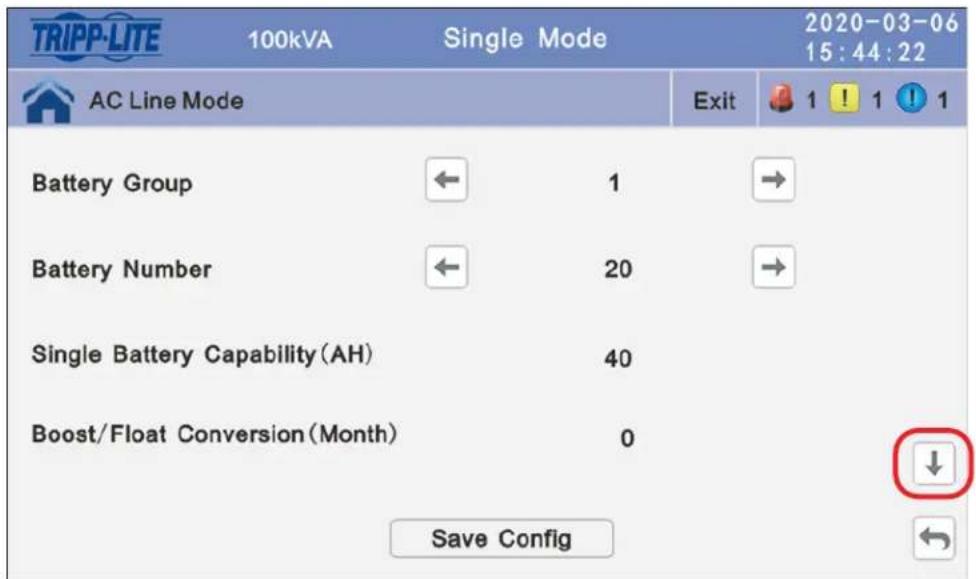
Scroll to the next display screen by pressing the down arrow.
6. Operation and Configuration of S3M UPS Models and Battery Cabinets
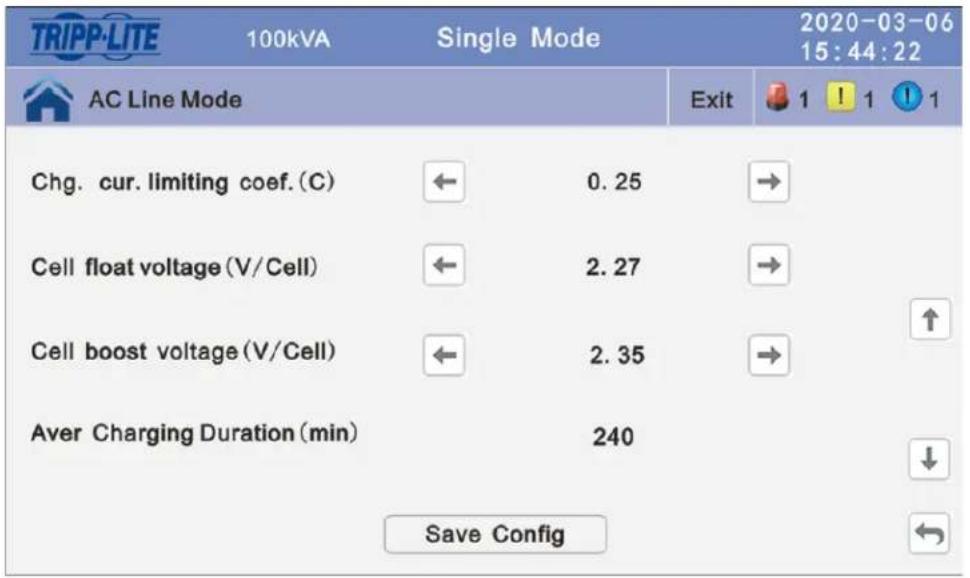
Step 4: Setting Chg. cur. limiting coef (C)
The charging current limit is a multiple of the battery capacity. It is used to set the battery boost charging time limit. The value can be 0.05~0.25, and is 0.25 by default. Obtain the Charging (Chg) current (cur) limiting coefficient (C) based on the specific S3M UPS and battery cabinet model combination from the chart in Section 6.4.
Float and Boost Voltage: The UPS is factory-set for proper float (2.27V/cell, 13.62V/battery) and boost (2.35V/cell, 14.1V/battery) voltages.
Cell float voltage: The float voltage value can be 2.23~2.30 V/cell. The default value is 2.27 V/cell.
Cell boost voltage: The battery equalized voltage value can be 2.30 2.40V / cell . The default value is 2.35 V/cell.
Step 5: Setting Aver Changing Duration (min)
Setting the Average Charging Duration in minutes is an estimation of the boost charger time duration to charge new batteries to 90% capacity at 25^ . Obtain the recommended Average (Aver) Charging Duration (min) number based on the specific S3M UPS and battery cabinet model combination from the chart in Section 6.4. Note the recommended battery boost charge durations are estimates only based on new batteries. These numbers may change with the age of the batteries and the battery ambient temperature. To change the Aver Charging Duration, press directly on the defaulted 240 value in the display.
- The Average (Aver) charging duration is the battery boost charge time limit. The value can be 1~999 min. The default is value 240 (4 hours).
6. Operation and Configuration of S3M UPS Models and Battery Cabinets
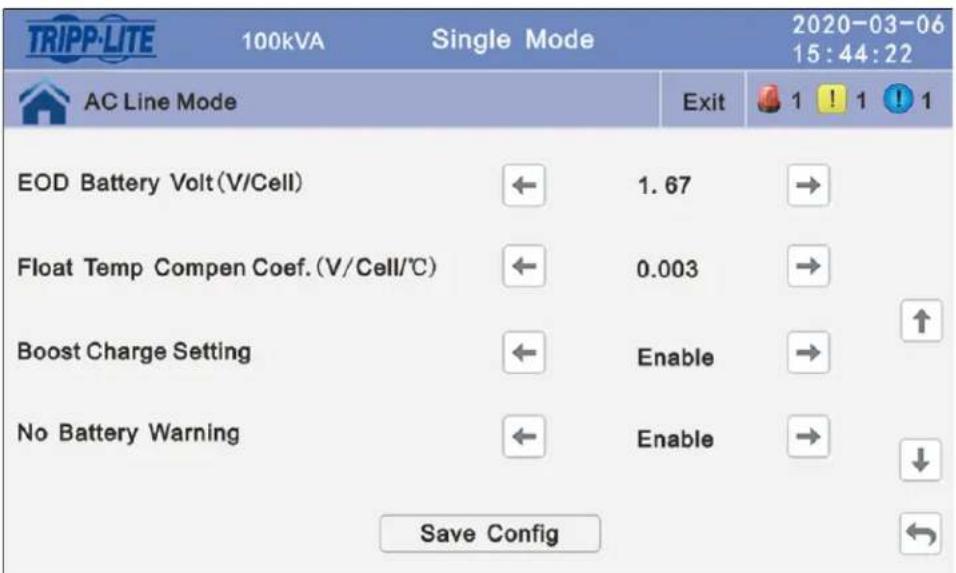
EOD Battery Volt: End of discharge voltage is the low voltage cutoff of the batteries during a battery mode operation. The value can be 1.60~1.90. The default value is 1.67V/cell, or 10.02Vdc per battery.
Float Temp Compen Coeff: Modifies the voltage of compensation after enabling the switch. The value can be 0.001~0.007V/cell/°C. The default value is 0.003V/cell/°C.
Boost Charge Setting: Boost charge can be set to Disable or Enable. The default value is Enable.
No Battery Warning: Keep this alarm enabled if you want the UPS to provide a warning when no batteries are present. The default value is Enable.
6. Operation and Configuration of S3M UPS Models and Battery Cabinets
6.4 Configuration Reference Table for S3M10-100K UPS and BP240V09K-BP240V100L Battery Cabinet Models
Configurations for S3M10K-NIB, S3M15K-NIB, S3M20K-NIB UPS with no internal batteries
| Battery Packs Batteries Qty. of | Battery Cabinets | Step 1 Step | 2 Step 3 Step | 4 Step 5 | ||
| Battery Group | Battery Number | Single Battery Capability | Max Charge Current (A) | Aver Changing Duration (min) Time (minutes) to Charge Batteries to 90% at 25°C | ||
| BP240V65 20 x 65Ah 1 1 20 65 | 9.75 500 | |||||
| BP240V65 20 x 65Ah 2 2 20 65 | 19.5 500 | |||||
| BP240V65 20 x 65Ah 3 3 20 65 | 20 720 | |||||
| BP240V65L 40 x 65Ah 1 2 20 65 | 19.5 500 | |||||
| BP240V65L 40 x 65Ah 2 4 20 65 | 20 960 | |||||
| BP240V100 20 x 100Ah 1 1 20 | 100 | 15 500 |
Configurations for S3M25K and S3M30K
| Battery Packs Batteries Qty. of | Battery Cabinets | Step 1 Step | 2 Step 3 Step | 4 Step 5 | ||
| Battery Group | Battery Number | Single Battery Capability | Chg. Cur. Limiting Coef. (C) | Aver Changing Duration (min) Time (minutes) to Charge Batteries to 90% at 25°C | ||
| BP240V65 20x | 65Ah 1 1 | 20 65 0.15 | 540 | |||
| BP240V65 20 x | 65Ah 2 2 20 65 | 0.15 540 | ||||
| BP240V65 20 x | 65Ah 3 3 20 65 | 0.1 | 900 | |||
| BP240V65L 40 | x 65Ah 1 2 20 65 | 0.15 540 | ||||
| BP240V65L 40 | x 65Ah 2 4 20 65 | 0.07 999 | ||||
| BP240V100 20 | x 100Ah 1 1 20 | 100 | 0.15 540 |
Configurations for S3M50K and S3M60K
| Battery Packs Batteries Qty. of | Battery Cabinets | Step 1 | Step 2 | Step 3 | Step 4 | Step 5 |
| Battery Group | Battery Number | Single Battery Capability | Chg. Cur. Limiting Coef. (C) | Aver Changing Duration (min) Time (minutes) to Charge Batteries to 90% at 25°C | ||
| BP240V65 | 20 x 65Ah | 1 | 1 | 20 | 65 | 0.15 |
| BP240V65 | 20 x 65Ah | 2 | 2 | 20 | 65 | 0.15 |
| BP240V65 | 20 x 65Ah | 3 | 3 | 20 | 65 | 0.15 |
| BP240V65L | 40 x 65Ah | 1 | 2 | 20 | 65 | 0.15 |
| BP240V65L | 40 x 65Ah | 2 | 4 | 20 | 65 | 0.15 |
| BP240V65L | 40 x 65Ah | 3 | 6 | 20 | 65 | 0.1 |
| BP240V100 | 20 x 100Ah | 1 | 1 | 20 | 100 | 0.15 |
| BP240V100 | 20 x 100Ah | 2 | 2 | 20 | 100 | 0.15 |
| BP240V100 | 20 x 100Ah | 3 | 3 | 20 | 100 | 0.13 |
| BP240V100L | 40 x 100Ah | 1 | 2 | 20 | 100 | 0.15 |
| BP240V100L | 40 x 100Ah | 2 | 4 | 20 | 100 | 0.1 |
6. Operation and Configuration of S3M UPS Models and Battery Cabinets
Configurations for S3M80K
| Battery Packs Batteries Qty. of | BatteryCabinets | Step 1 Step | 2 Step 3 Step | 4 Step 5 | ||
| BatteryGroup | BatteryNumber | SingleBatteryCapability | Chg. Cur.LimitingCoef. (C) | Aver Changing Duration (min)Time (minutes) to ChargeBatteries to 90% at 25°C | ||
| BP240V65 20 x | 65Ah 1 1 20 65 | 0.15 540 | ||||
| BP240V65 20 x | 65Ah 2 2 20 65 | 0.15 540 | ||||
| BP240V65 20 x | 65Ah 3 3 20 65 | 0.15 540 | ||||
| BP240V65L 40 x | 65Ah 1 2 20 65 | 0.15 540 | ||||
| BP240V65L 40 x | 65Ah 2 4 20 65 | 0.15 540 | ||||
| BP240V65L 40 x | 65Ah 3 6 20 65 | 0.15 540 | ||||
| BP240V100 20 x | 100Ah 1 1 20 | 100 | 0.15 540 | |||
| BP240V100 20 x | 100Ah 2 2 20 | 100 | 0.15 540 | |||
| BP240V100 20 x | 100Ah 3 3 20 | 100 | 0.15 540 | |||
| BP240V100L 40 x | 100Ah 1 2 20 | 100 | 0.15 540 | |||
| BP240V100L 40 x | 100Ah 2 4 20 | 100 | 0.15 540 | |||
| BP240V100L 40 x | 100Ah 3 6 20 | 100 | 0.1 | 840 |
Configurations for S3M100K
| Battery Packs Batteries Qty. of | BatteryCabinets | Step 1 Step | 2 Step 3 Step | 4 Step 5 | ||
| BatteryGroup | BatteryNumber | SingleBatteryCapability | Chg. Cur.LimitingCoef. (C) | Aver Changing Duration (min)Time (minutes) to ChargeBatteries to 90% at 25°C | ||
| BP240V65 20 x | 65Ah 1 1 20 65 | 0.15 540 | ||||
| BP240V65 20 x | 65Ah 2 2 20 65 | 0.15 540 | ||||
| BP240V65 20 x | 65Ah 3 3 20 65 | 0.15 540 | ||||
| BP240V65L 40 x | 65Ah 1 2 20 65 | 0.15 540 | ||||
| BP240V65L 40 x | 65Ah 2 4 20 65 | 0.15 540 | ||||
| BP240V65L 40 x | 65Ah 3 6 20 65 | 0.15 540 | ||||
| BP240V100 20 x | 100Ah 1 1 20 | 100 | 0.15 540 | |||
| BP240V100 20 x | 100Ah 2 2 20 | 100 | 0.15 540 | |||
| BP240V100 20 x | 100Ah 3 3 20 | 100 | 0.15 540 | |||
| BP240V100L 40 x | 100Ah 1 2 20 | 100 | 0.15 540 | |||
| BP240V100L 40 x | 100Ah 2 4 20 | 100 | 0.15 540 | |||
| BP240V100L 40 x | 100Ah 3 6 20 | 100 | 0.13 540 |
7. Specifications
7.1 Battery Cabinet Specifications (DC Nominal Voltage: ± 120V DC, 240V DC)
| Battery Pack BP240V65 | (-NIB) BP240V100 (-NIB) BP240V65L (-NIB) BP240V100L (-NIB) | |||
| Dimension W × D × H | 31.5 x 35.4 x 47.2 in. (800 x 900 x 1200 mm) | 31.5 x 43.3 x 63 in. (800 x 1100 x 1600 mm) | ||
| Weight | 608 lb. (275.8 kg)* 930 lb. (421.8 kg)* 1083 lb. (491.2 kg)* 1637 lb. (742.5 kg)* | |||
| Breaker | 1x 250A 1x 600A | |||
| Fuse | 2x 400A 4x 400A | |||
*Models with the -NIB suffix do not include internal batteries, so their total weight varies based on batteries installed by the end user.
8. Storage
Storage
The battery cabinet must be stored in a clean, secure environment with a temperature less than 104^ (40^) and a relative humidity less than 90% (non-condensing). Store the battery cabinet in its original shipping container if possible. Charge the batteries for at least 24 hours prior to use. Do not rely on the battery cabinet to provide backup power to connected equipment until the batteries are fully charged.
Note: If the UPS system remains off for an extended period of time, it should be turned on periodically to allow the batteries to recharge. The UPS system should be turned on and the batteries should be recharged at least one uninterrupted 24-hour period every 3 months. Failure to recharge the batteries periodically may cause irreversible battery damage.
9. Service and Warranty
Service
Your Tripp Lite product is covered by the warranty described in this manual. A variety of Extended Warranty and On-Site Service Programs are also available from Tripp Lite. For more information on service, visit tripplite.com/support. Before returning your product for service, follow these steps:
- Review the installation and operation procedures in this manual to ensure that the service problem does not originate from a misreading of the instructions.
- If the problem continues, do not contact or return the product to the dealer. Instead, visit triplite.com/support.
- If the problem requires service, visit tripplite.com/support and click the Product Returns link. From here you can request a Returned Material Authorization (RMA) number, which is required for service. This simple on-line form will ask for your unit's model and serial numbers, along with other general purchaser information. The RMA number, along with shipping instructions will be emailed to you. Any damages (direct, indirect, special or consequential) to the product incurred during shipment to Tripp Lite or an authorized Tripp Lite service center are not covered under warranty. Products shipped to Tripp Lite or an authorized Tripp Lite service center must have transportation charges prepaid. Mark the RMA number on the outside of the package. If the product is within its warranty period, enclose a copy of your sales receipt. Return the product for service using an insured carrier to the address given to you when you request the RMA.
9. Service and Warranty
Limited Warranty
Seller warrants this product, if used in accordance with all applicable instructions, to be free from original defects in material and workmanship for a period of one (1) year from the date of initial purchase. If the product should prove defective in material or workmanship within that period, Seller will repair or replace the product, in its sole discretion. Service under this Warranty includes parts and Tripp Lite service center labor. On-site service plans are available from Tripp Lite through authorized service partners (in most areas). Visit triplite.com/support for details. International customers should contact Tripp Lite support at intlservice@triplite.com.
THIS WARRANTY DOES NOT APPLY TO NORMAL WEAR OR TO DAMAGE RESULTING FROM ACCIDENT, MISUSE, ABUSE OR NEGLECT. SELLER MAKES NO EXPRESS WARRANTY OTHER THAN THE WARRANTY EXPRESSLY SET FORTH HEREIN. EXCEPT TO THE EXTENT PROHIBITED BY APPLICABLE LAW, ALL IMPLIED WARRANTY, INCLUDING ALL WARRANTY OF MERCHANTABILITY OR FITNESS, ARE LIMITED IN DURATION TO THE WARRANTY PERIOD SET FORTH ABOVE; AND THIS WARRANTY EXPRESSLY EXCUSES ALL INCIDENTAL AND CONSEQUENTIAL DAMAGES. (Some states do not allow limitations on how long an implied warranty lasts, and some states do not allow the exclusion or limitation of incidental or consequential damages, so the above limitations or exclusions may not apply to you. This Warranty gives you specific legal rights, and you may have other rights which vary from jurisdiction to jurisdiction.)
Tripp Lite; 1111 W. 35th Street; Chicago IL 60609; USA
WARNING: The individual user should take care to determine prior to use whether this device is suitable, adequate or safe for the use intended. Since individual applications are subject to great variation, the manufacturer makes no representation or warranty as to the suitability or fitness of these devices for any specific application.
Regulatory Compliance Identification Numbers
For the purpose of regulatory compliance certifications and identification, your Tripp Lite product has been assigned a unique series number. The series number can be found on the product nameplate label, along with all required approval markings and information. When requesting compliance information for this product, always refer to the series number. The series number should not be confused with the marketing name or model number of the product.
WEEE Compliance Information for Tripp Lite Customers and Recyclers (European Union)

Under the Waste Electrical and Electronic Equipment (WEEE) Directive and implementing regulations, when customers buy new electrical and electronic equipment from Tripp Lite they are entitled to:
- Send old equipment for recycling on a one-for-one, like-for-like basis (this varies depending on the country)
- Send the new equipment back for recycling when this ultimately becomes waste
Tripp Lite has a policy of continuous improvement. Specifications are subject to change without notice. Photos and illustrations may differ slightly from actual products.


1111 W. 35th Street, Chicago, IL 60609 USA · triplite.com/support
1111 W. 35th Street, Chicago, IL 60609 EE UU • triplite.com/support
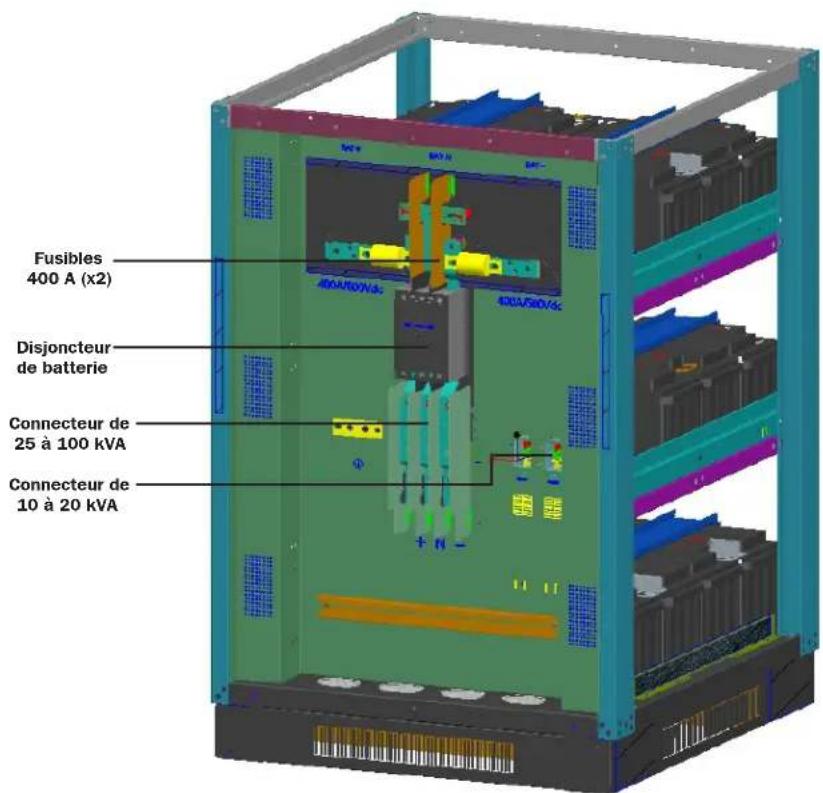
Figure 5-3B:Vue arriere
5. Installation
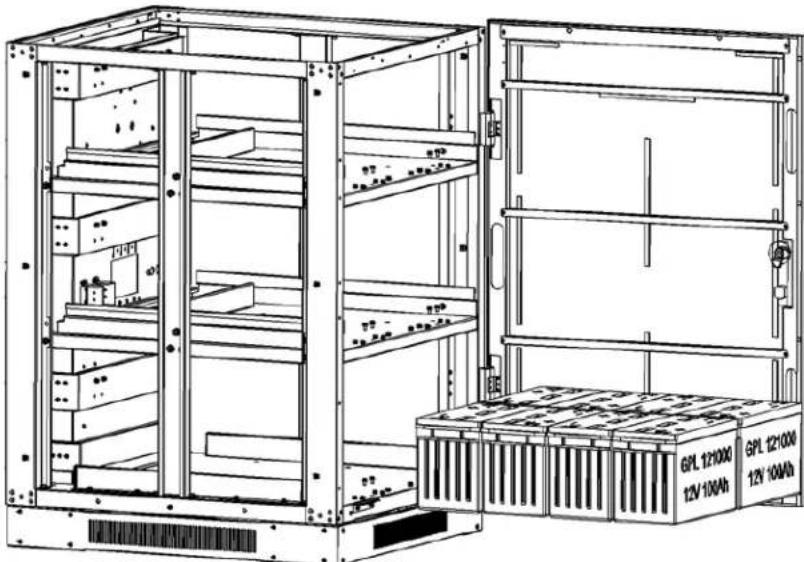
Figure 5-10:modele BP240V100-NIB
5. Installation
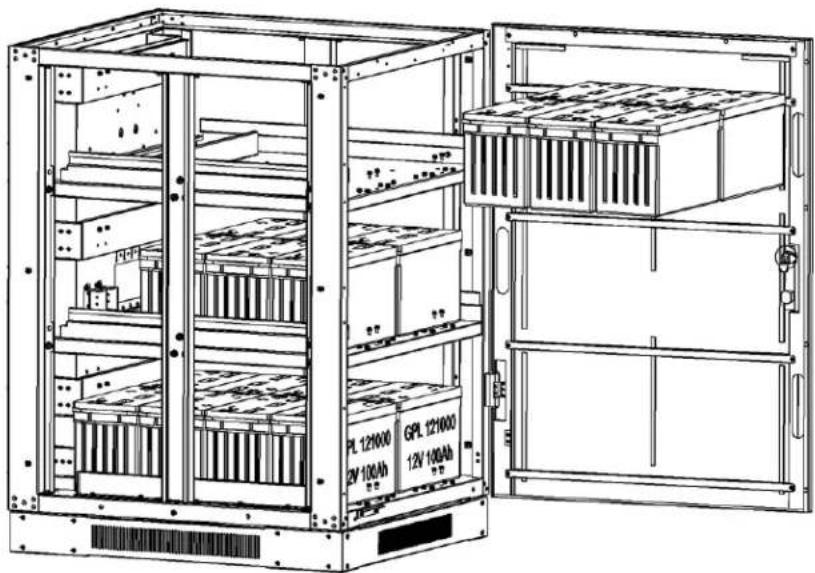
Figure 5-14:modele BP240V100-NIB
5. Installation
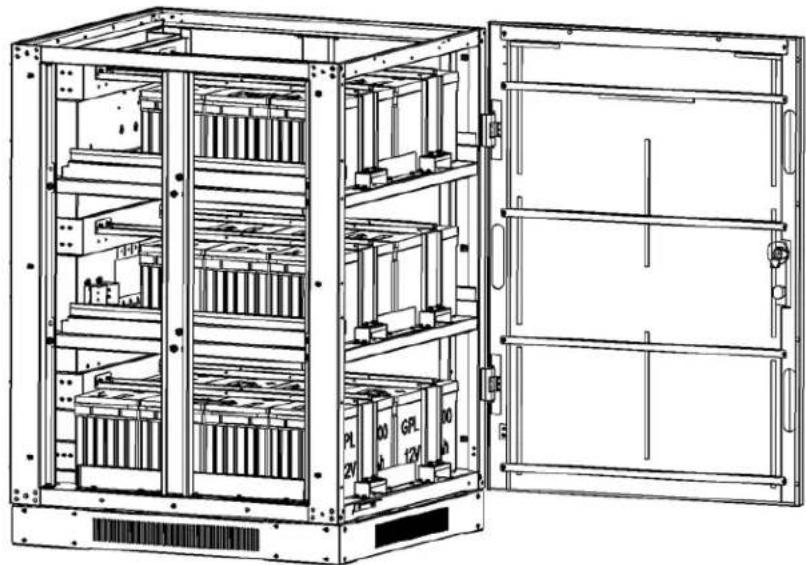
Figure 5-16: modele BP240V100-NIB
5. Installation
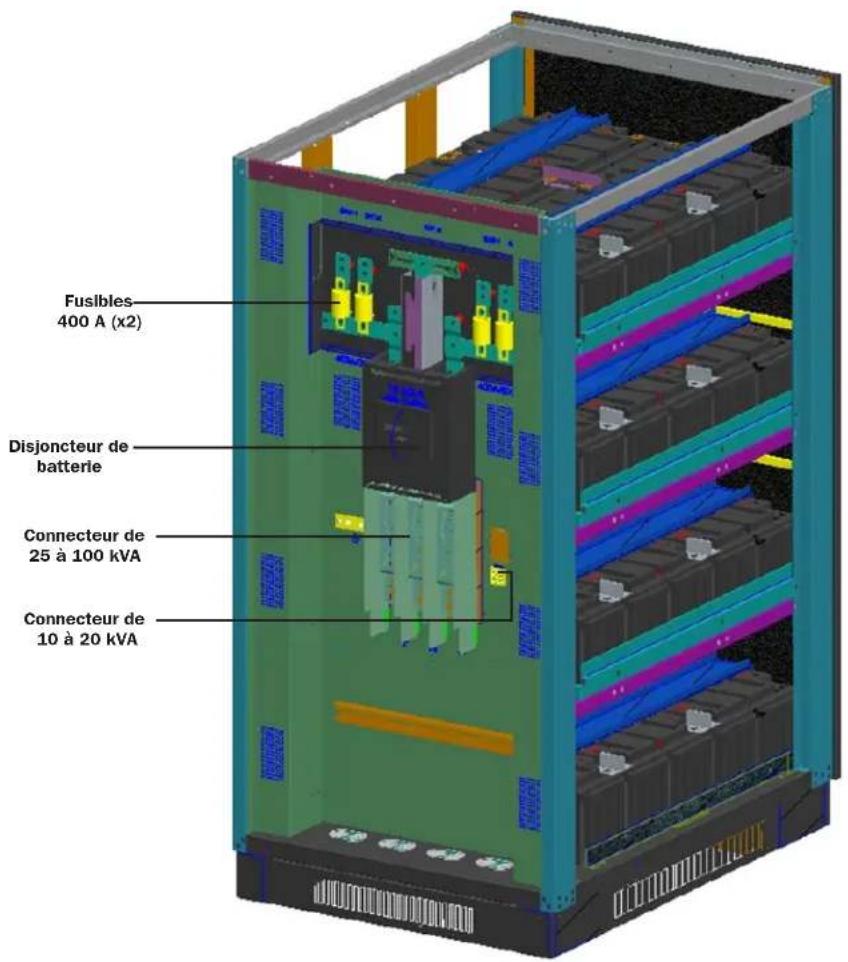
Figure 5-25B:Vue arriere