
BKS 2625 TSB - Saw AL-KO - Free user manual and instructions
Find the device manual for free BKS 2625 TSB AL-KO in PDF.



| Product type | Gas chainsaw for tree maintenance |
| Brand | AL-KO |
| Model | BKS 2625 TSB |
| Displacement | 25,4 cm³ |
| Maximum engine power | 0,9 kW |
| Guide bar length | 25 cm (10 inches) |
| Effective cutting length | 22 cm |
| Net weight (without accessories, empty tank) | 3,2 kg |
| Engine type | Two-stroke engine |
| Fuel | Mixture of unleaded gasoline 90 octane and synthetic oil (40:1) |
| Fuel tank capacity | 200 ml |
| Chain oil tank capacity | 140 ml |
| Chain pitch | 1/4" (for TSB) |
| Chain brake | Yes, automatic and manual |
| Idle speed | 3100 ± 400 rpm |
| Maximum speed | 11000 rpm |
| Maximum chain speed | 21 m/s |
| Guaranteed sound power level (LwA) | 108 dB(A) |
| Vibrations (front handle) | 5,8 m/s² (K=1,5) |
| Vibrations (rear handle) | 12,1 m/s² (K=1,5) |
| Use | Pruning and tree maintenance at height with rope and harness |
| Recommended accessories | Guide bar OREGON 100DEA041 or QIRUI AT10-50; chain 91P040x or E1-25AP060T |
| Warranty | Legal against manufacturing defects (according to country) |
Frequently Asked Questions - BKS 2625 TSB AL-KO
User questions about BKS 2625 TSB AL-KO
0 question about this device. Answer the ones you know or ask your own.
Ask a new question about this device
Download the instructions for your Saw in PDF format for free! Find your manual BKS 2625 TSB - AL-KO and take your electronic device back in hand. On this page are published all the documents necessary for the use of your device. BKS 2625 TSB by AL-KO.
USER MANUAL BKS 2625 TSB AL-KO
AL-KO KOBER GROUP Kottz, Germany
This documentation or excerpts therefrom may not be reproduced or disclosed to third parties without the express permission of the AL-KO KOBER GROUP.
How to use this manual. 34
Identification of the main components. 35
Safety regulations. 36
Using the chain saws for tree maintenance with a rope and climbing harness. 40
Assembling the chain saw. 42
Preparing for work. 43
Starting the engine, using the machine and switching it off. 45
Using the machine. 46
Maintenance and storage. 49
Troubleshooting. 53
Accessories 54
Technical data. 54
Maintenance schedule. 55
Guarantee. 57
EU declaration of conformity. 58

This special type of chain saw was developed specifically for tree maintenance and therefore may only be operated by skilled workers using safe and carefully configured work equipment.
This chain saw may only be used for tree maintenance and in adherence with the above conditions. Normally it is used with two hands like a conventional chain saw. Some national regulations may restrict its use.
HOW TO USE THIS MANUAL
Some particularly important sections are identified differently in the text of this manual, and the meaning of such markings should be understood as follows:
NOTE or IMPORTANT

Provides explanatory notes or other information about statements made previously, with the intention of avoiding damage to the machine or causing other damage.

CAUTION!
Non-compliance represents a risk of injury to yourself or others.

DANGER!
Non-compliance represents a risk of severe or even fatal injury to yourself or others.
Symbols

1 Please read carefully and follow all instructions.
2 Danger of kickback.
3 Hold the chain saw with both hands.
4 Read the instructions for use carefully before using the saw.
5 Wear a helmet, protective glasses and ear defenders. The operator should be aware that under normal working conditions, he/she will be exposed to a noise level of 85 dB (A) or more on a daily basis.
6 Use sturdy working gloves.
7 Wear boots or work shoes with a non-slip sole and steel caps.
8 Use suitable safety devices for feet/legs and hands/arms.
9 This chain saw is only suitable for users who have been trained in tree maintenance. (see instructions for use).
Descriptive symbols on the machine (if applied)

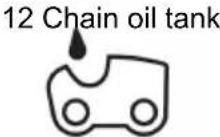
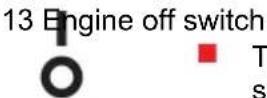
The engine starts with the switch in position «I».
The engine stops immediately when the switch is set to O
14 Carburettor setting

L = mixture control, low speed
H = mixture control, high speed
T-IDLE-MIN= idle setting
15 Chokker (starter)
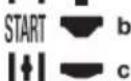
Starting when the engine is cold
Starting when the engine is warm
Operation

17 On panchontroller

When you turn the knob in the direction of the arrow to the "MAX" position with a screwdriver, more oil will flow to the chain.
When you turn it to the "MIN" position, less oil will flow.
18 Direction of motion of the chain
IDENTIFICATION OF THE MAIN COMPONENTS
Main components
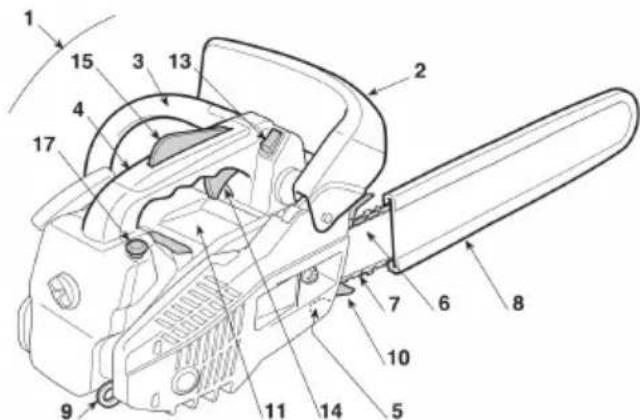
1 Engine 7 Chain
2 Front hand guard 8 Chain guard
3 Front hand grip 9 Eyelet
4 Rear hand grip 10 Bumper spike
5 Chain interception 11 Type plate bolt
6 Bar
Controls and filling
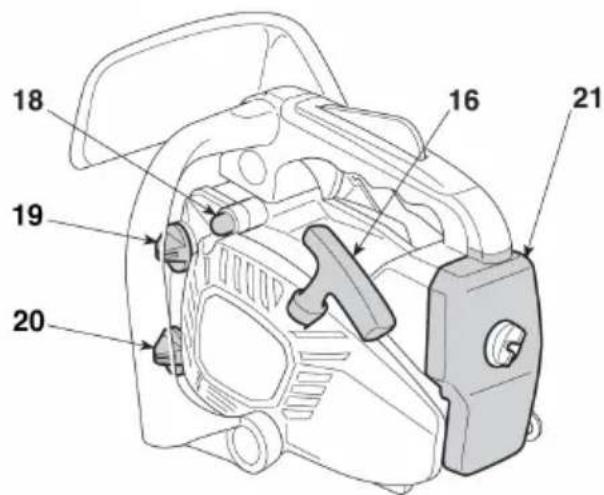
13 Start/stop switch 18 Primer
14 Speed regulator 19 Mixture tank cap
15 Throttle lever det- 20 Chain oil tank lock tent
16 Starter handle 21 Air filter cover
17 Choke lever
SAFETY REGULATIONS
Intended use/unintended use
The chain saw may only be used by skilled workers and was developed to cut the treetops of standard tall trees, bushes, trunks/logs or wooden beams, whose diameter depends on the length of the bar. It may only be used to cut wood. Any other type of use is not permissible. IN ADDITION, THE CHAIN SAW MAY ONLY BE USED BY QUALIFIED SKILLED WORKERS FOR TREE MAINTENANCE.
When using the chain saw, the worker is responsible for ensuring use of safety equipment in line with the instructions in the manual and the symbols on the chain saw. In addition, the safety instructions in the manual and the information on use and maintenance are an important part of the instructions for use. Any person operating the chain saw or performing saw maintenance must be familiar with the manual. It is only permissible to use original spare parts or those approved by the manufacturer (bar, chain, spark plug) and the approved bar/chain combinations that are specified in the manual. Responsibility for any type of accident due to the unintended use and/or an unapproved change to the structure of the chain saw lies with the user and not with the manufacturer. This chain saw may only be used in the open.
Residual risks
Even if the chain saw is used as instructed, a residual risk remains that cannot be eliminated. Depending on the type and structure of the chain saw, the following potential risks exist:
- Contact with the exposed teeth of the chain (risk of cutting)
Access to the moving chain (risk of cutting)
Sudden and unexpected movement of the bar (risk of cutting) - Detachment of parts of the chain (risk of cutting/injury)
Detachment of parts of the wood being worked on
Inhalation of particles of the wood being worked on, emissions from the petrol engine
Contact of the skin with fuel (petrol/oil)
Impairment of hearing during work if ear defenders are not used
Training
Read the instructions carefully. Familiarise yourself with the control elements and correct use of the machine. Learn how to stop the engine quickly.
Never allow children or people lacking the necessary knowledge as described in these instructions to use the machine. Local regulations may specify the minimum age of the user.
The machine is not allowed to be used by more than one person.
The machine must never be used:
When there is anyone, especially children or animals, in the vicinity;
If the user is tired or feels unwell, is under the influence of drugs, alcohol or other substances that impair his/her attention and reactions;
If the user is incapable of holding the machine firmly in two hands, or if he/she is unable to maintain a stable equilibrium with his/her legs during work.
Note that the user is responsible for accidents and damage that may befall other persons or their property.
Preparatory measures
The user must wear suitable clothing which does not obstruct his/her movements while working.
Wear close-fitting protective clothing with cut-resistant protective inserts.
Wear a protective helmet, gloves, protective goggles, dust mask and cut-resistant safety boots with a non-slip sole.
Wear ear defenders.
- Do not wear scarves, shirts, necklaces or other loosely hanging accessories that could get snagged on the machine or on any objects in the workplace.
Tie back long hair.
IMPORTANT: DANGER! Petrol is highly inflammable:
Store fuel in containers designed and approved specifically for this purpose;
Do not smoke when handling fuels;
Open the tank cap slowly to allow the pressure inside to escape gradually;
Only refuel in the open air and using a funnel;
Fill fuel before starting the engine. Do not open the tank cap or refuel with petrol while the engine is still running and while the machine is still hot;
If petrol overflows, do not attempt to start the engine. Instead, move the machine away from the area contaminated by fuel. Avoid doing anything that could cause a fire until the petrol has completely evaporated and the fuel vapours have volatilized;
- Immediately remove all traces of any petrol that is spilled onto the machine or the ground;
Do not start the machine in the location where it was filled;
Avoid contact between fuel and clothing; if you do get fuel on your clothing, you should change before starting the engine;
The tank cap and petrol container cap must always be screwed firmly on.
Renew faulty or damaged silencers.
Before use, thoroughly check the entire machine and in particular:
Make sure the throttle lever and the operator presence control lever can be moved easily, do not jam and when they are released, they must automatically and quickly return to their initial position;
Make sure the throttle lever is blocked when the operator presence control lever is not actuated;
Make sure the engine stop switch can be moved from one position to the other easily;
Make sure that the electrical cable and above all the spark plug cable are in perfect condition to exclude the possibility of sparking, and the connector must be attached to the spark plug correctly;
Make sure that the hand grips and protective devices of the machine are clean and dry, and are firmly attached to the machine;
Make sure that the chain brake is fully functional;
Make sure that the bar and chains are fitted according to the regulations;
Make sure that the chain is correctly tensioned.
Before starting work, make sure that all protective devices have been attached correctly.
The machine in use
The engine is not allowed to run in enclosed spaces within which dangerous carbon monoxide fumes could collect. Ensure an exchange of air if you are working in ditches, caves or the like.
Only work during daylight or with good artificial light.
Assume a safe and stable position while working on the ground:
As far as possible, avoid using the machine on wet or slippery ground, or in any case on uneven or steeply sloping ground if the user cannot achieve sufficient stability during work;
Avoid steps and unstable platforms;
Do not work with the machine above shoulder height;
Do not run, always proceed carefully and watch out for unevenness in the ground as well as the presence of potential obstacles.
Do not work alone or in remote places so that you can quickly request first aid in the event of an accident.
Press down on the machine firmly when starting the engine:
Do not start the engine unless you are at least 3 metres away from the place where you filled the fuel;
Make sure that no one else is within range of the machine;
Never point the silencer and consequently also the exhaust gases towards inflammable substances:
Pay attention to the possibility of material being thrown out due to the chain movement, above all if the chain encounters obstacles or foreign bodies.
Do not alter the basic setting of the engine or overrev it.
- Do not expose the machine to excessive forces, and do not use small machines for heavy work. Using a suitable machine reduces the risks and improves the quality of work.
Make sure that the chain does not move when the engine is idling, and that after the throttle lever is operated the engine quickly returns to idling speed.
Make sure that the bar does not collide with foreign bodies, and also pay attention to material flying around due to the friction of the chain.
The engine must be switched off:
If you leave the machine unattended.
Before refuelling.
- Switch off the engine and remove the ignition key.
Before you check the machine, clean it or carry out work on it;
After encountering a foreign body. Check if the machine has been damaged and carry out the necessary repairs before you use the machine again;
If the machine starts to vibrate abnormally (immediately identify the causes of the vibration and have the necessary inspections carried out at a specialist company).
If the machine is not used.
Avoid exposure to the dust and chips created by the chain during cutting.
Maintenance and storage
Make sure that all nuts and screws are firmly tightened so as to be certain that the machine is always operating under good conditions. Regular maintenance is essential for safety and maintaining performance.
Never store the machine with fuel in the tank inside a room in which petrol vapours could come into contact with naked flames, a heat source or sparks.
- Allow the engine to cool down before you place the machine in a room.
To reduce the risk of fire, always keep the engine, the exhaust silencer and the fuel storage location free from saw chips, prunings, leaves or surplus grease; never leave containers with cutting residues inside a room.
If you need to empty the tank, do this outdoors with the engine cold.
Wear gloves whenever working on the cutting device.
Always make sure that the chain is well sharpened. All work to be performed on the chain requires technical skills and the use of special tools.
For safety reasons, never use the machine with worn or damaged parts. The damaged parts must be renewed and are never allowed to be repaired. Only use genuine spare parts. Non-equivalent spare parts can damage the machine and endanger the operator.
Before putting the machine away, make sure that you have removed the spanners or tools used for maintenance.
Store the machine out of reach of children!
Transport and handling
The following instructions must be complied when transporting and handling the machine:
- Switch off the engine; wait for the chain to come to a complete standstill, disconnect the spark plug connector;
Put on the chain guard;
Only lift the machine using the hand grips and position the bar so it is pointing opposite to the direction in which you are walking;
If the machine is transported in a motor vehicle, it must be positioned so that it does not represent a danger and can also be effectively attached to prevent it from tipping over with consequent damage and leaking of fuel.
Residual risks
- Keep all parts of your body away from the saw chain when the saw is running. Before starting the saw, make sure that nothing is touching the saw chain. When working with a chain saw, one moment of inattention can mean your clothing or parts of your body coming into contact with the saw chain.
When working with both hands, the right hand always grasps the rear grip while the left hand grasps the front grip. Holding the chain saw with your hands the other way around increases the risk of injury and is not allowed.
Wear protective goggles and ear defenders. Further protective equipment is recommended for the head, hands, legs and feet. Appropriate protective clothing reduces the risk of injury due to flying chips and inadvertent contact with the saw chain.
When cutting a branch that is under tension, expect it to spring back. When the tension in the wood fibres is released, the branch under tension can hit the operator and/or cause a loss of control over the chain saw.
Take particular care when cutting undergrowth and young trees. The thin material can get caught in the saw chain and hit you or cause you to lose your balance. - Carry the chain saw at the front grip when it is switched off, and have the saw chain pointing away from your body. Always put on the protective cover when transporting or storing the chain saw. Careful handling of the chain saw reduces the probability of inadvertent contact with the running saw chain.
Follow the instructions for lubrication, chain tensioning and changing accessories. An incorrectly tensioned or lubricated chain can either tear or increase the risk of kickback.
- Keep the grips dry, clean and free from oil and grease. Greasy, oily grips are slippery and result in loss of control.
The starter system of this machine generates a relatively weak magnetic field, nevertheless it is not possible to exclude the likelihood of interference with active or passive implants in the operator's body, with correspondingly severe health risks. Users of such medical devices are thus strongly recommended to seek advice from a doctor or the manufacturer of the devices before using the machine.
Causes of kickback and how to avoid them
Be especially careful in slippery conditions (wet ground or snow), on uneven ground or on terrain covered in plant growth. Watch out for hidden obstacles like logs, roots, rocks, holes and ditches to avoid tripping. Exercise special care on slopes and uneven ground. Never use the saw with only one hand. If only one hand is used, it is more difficult to control and prevent kickback since the bar or chain can slip along or rebound off of a branch or trunk. Kickback can occur if the tip of the chain bar touches an object or if the wood bends and traps the saw chain during cutting.
In many cases, contact with the tip of the bar can lead to an unexpected, rearward reaction causing the chain bar to be knocked upwards and towards the operator.
If the saw chain is trapped on the top edge of the chain bar, the bar can be forced violently back towards the operator. Each of these reactions can result in you losing control of the saw, with the possibility of severe injury. Do not rely entirely on the safety devices installed on the chain saw. As user of a chain saw, you should take various measures to be able to work without accident and injury.
Kickback is the consequence of incorrect or faulty use of the chain saw. It can also be prevented by taking suitable precautions as described below:
Hold the saw tight with your thumb and fingers grasping the grips and assume a position with your body and arms that enables you to withstand kickback forces. If suitable measures are taken, the operator will be able to control the kickback forces. Never release the chain saw.
Avoid any abnormal posture, and do not saw anything above shoulder height. This will avoid inadvertent contact with the tip of the bar, and allow better control of the chain saw in unexpected situations.
Always use replacement bars and saw chains prescribed by the manufacturer. Incorrect replacement bars and saw chains can lead to the chain breaking and/or to kickback.
Comply with the instructions of the manufacturer for sharpening and maintaining the saw chain. Depth limiters set too low increase the tendency to kickback.
Techniques for using the chain saw
Always comply with the safety instructions and use the best cutting technique for the work to be carried out according to the information and the examples given in the instructions for use.
Recommendations for beginners
Before you fell a tree or prune a tree for the first time, you should:
Have attended a special training course for using this type of tool;
Have carefully read the safety instructions and the instructions in this manual;
Practice on a tree stump or a log set up on a stand in order to get the feel of the machine and acquire suitable cutting techniques.
USING THE CHAIN SAWS FOR TREE MAINTENANCE WITH A ROPE AND CLIMBING HARNESS
This section describes the procedures that reduce the risk of injury when using chain saws for tree maintenance with the aid of a rope or climbing harness. Even if this description could serve as a basic description for guidelines or training manuals, it should not be viewed as a substitute for formal training. The rules described in this appendix are examples of good practice. National laws and regulations must always be complied with.
General requirements for working at heights
The operators of chain saws for tree maintenance using a rope or climbing harness must never work
alone. They should be supported by a worker on the ground who is trained in the appropriate emergency procedures.
The operators of chain saws for tree cutting should be trained in the general climbing techniques and working positions used in this type of work and in the use of climbing harnesses, ropes, belts with loops at the ends, carabiners and other equipment for securely holding the operator and the chain saw and assuming a safe working position.
Preparing to use the chain saw on a tree
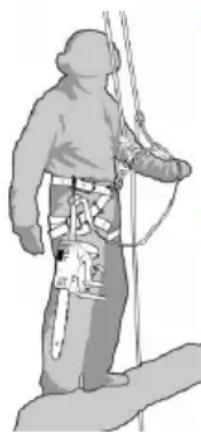
The chain saw should be checked, refuelled, started and warmed up by the worker on the ground before it is switched off and handed to the worker in the tree.
The chain saw should be attached to the climbing harness of the user with a belt suitable for this purpose.
- Attach the belt to the eyelet on the back of the chain saw (A).
Have suitable carabiners available for connecting the chain saw indirectly (i.e. with a belt) or directly (i.e. to the eyelet of the chain saw) to the climbing harness of the operator.
Ensure that the chain saw if securely connected when you reach it to the user.
Ensure that the chain saw is attached to the climbing harness before taking it from the hoisting device.
The possibility of attaching the chain saw directly to the climbing harness reduces the risk of damage to the equipment while the operator moves around the tree. Always switch off the chain saw if it is connected directly to the harness. The chain saw should be connected to the recommended loops on the climbing harness.
These may be found in the middle (front or rear) or on the sides.
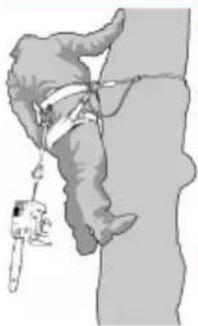
If possible, connect the chain saw to the rear middle loop to prevent it from hindering the climbing ropes and to ensure that its weight is centred at base of the spine of the operator.
When transferring the chain saw from one loop to another, the operator must ensure that it is attached to the new position before detaching it from the previous loop.
Using a chain saw in a tree
An analysis of the accidents with these chain saws during tree maintenance work shows that the main cause of accidents is the unintended use of the chain saw with only one hand. In most accidents, the operators do not try to assume a safe working position that enables them to grasp the chain saw with both hands.
This causes an increased risk of injury because:
The operator does not have a firm hold on the chain saw in case of a kickback.
The operator does not have control over the chain saw, which increases the possibility of contact between the chain saw and the climbing ropes and with the body of the operator (especially with the left arm and left hand),
It is possible to lose control because the operator does not assume a safe working position, which can lead to contact with the chain saw (unintentional movement while the chain saw is running).
Safe working position for two-hand operation
To enable the operator to use the chain saw with both hands, it must be a general rule to assume a safe working position when operating the chain saw.
At hip height, when cutting horizontally
At solar plexus height, when cutting vertically When the operator is working close to vertical trunks, with low thrust forces on the working position, a good support may be necessary to maintain a safe working position.
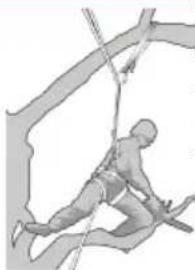
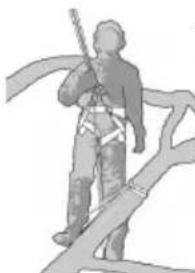
When the operator moves away from the trunk, however, an attempt must be made to cancel out or neutralise the growing thrust forces, such as by changing the direction of the main rope with an additional anchor point or by connecting an adjustable belt directly to the harness at an additional loop.
A secure hold in the working position can be achieved by using a stirrup that is temporarily fashioned from a loop into which the foot is placed.
Starting the chain saw in a tree
When starting the chain saw in a tree, the operator:
Must apply the chain brake before starting the chain saw
Hold the chain saw on the left or right side of the body before starting the chain saw, i.e.:
On the left side, grasping the chain saw with the left hand at the front grip and away from the body, while pulling the starter cable with the right hand, or
On the right side, grasping the chain saw with the right hand at the front grip and away from the body, while pulling the starter cable with the left hand, or
The chain brake must always be applied before letting the running chain saw hang from the belt. Before performing critical cuts, the operator must always check if the chain saw has enough fuel.
Using the chain saw with only one hand
The chain saws for tree maintenance should not be operated using only one hand if the operator is not in a safe working position or the chain saw is being using to cut twigs at the ends of branches instead of a hand saw.
The chain saws for tree maintenance are only permitted to be used with one hand if:
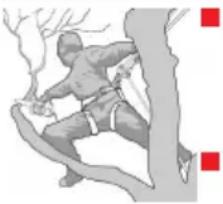
The operator is unable to assume a working position in which two-hand use is possible, and
The operator requires one hand to maintain the working position and the chain saw is fully extended, perpendicular to the body of the operator and held away from the operator.
The operator must:
Never cut using the kickback area of the saw at the tip of the bar
Never "cut and hold" pieces and
Never try to grasp pieces as they fall.
Freeing a jammed chain saw
If the chain saw becomes jammed while cutting, the operator must:
- Switch off the chain saw and safely secure it to the trunk-side of the branch, or to a rope of the equipment.
Pull the chain saw out of the cut while lifting the branch, for example.
If necessary, use a hand saw or a second chain saw to free the jammed chain saw by introducing a cut of at least 30~cm away from the jammed saw.
If a hand saw or chain saw is used to free the jammed saw, the cuts should be made on the tip-side of the branch (i.e. between the jammed saw and the tip of the branch and not between the trunk and the jammed saw) to prevent an even more difficult situation in which the chain saw is dragged along with the cut branch.
ASSEMBLING THE CHAIN SAW

The machine is supplied with the bar and chain dismantled, and with the mixture and oil tanks empty.

CAUTION!
Unpacking and assembly must be carried out on a firm and level surface. There must be sufficient space for moving the machine and the packaging, and suitable tools must be available. The packaging must be disposed of according to local regulations.

CAUTION!
Always wear sturdy working gloves when assembling the bar and chain. When installing the bar and chain, take the greatest of care so as not to impair the safety and efficiency of the machine; contact your dealer if you are in doubt.
Before installing the bar, make sure that the chain brake is not applied; the chain brake is released when the front hand guard is pulled all the way to the rear in the direction of the engine housing.

DANGER!
Carry out all work with the engine switched off.
Assembling the bumper spike (if not already fitted at the factory)
- Release the nut (1) and take off the cover (2).
Installing the bar and chain
- Unscrew the nut and remove the cover to access the chain sprocket and the seat of the bar (Fig. 2).
- Remove the plastic spacer (1); this spacer is only used for transporting the packaged machine and is not required any longer (Fig. 2).
- Install the bar (2) by inserting the grub screw into the groove and pressing the bar towards the rear of the machine housing (Fig. 3).
- Fit the chain around the chain sprocket and along the bar guides, paying attention to the running direction (see Fig. 4); if the tip of the bar is equipped with a reversing sprocket, make sure that the chain links are seated correctly in the recesses of the reversing sprocket.
- Mount the cover again without tightening the nut, ensuring that the two rear fasteners are correctly seated.
- Check that the pin of the chain tensioner (3) of the cover is seated correctly in the corresponding hole of the bar; if not, use a screwdriver to turn the screw (5) of the chain tensioner until the pin is completely seated (Fig. 5).
- Turn the screw of the chain tensioner (4) until the chain is correctly tensioned (Fig. 5).
- Lift the bar and tighten the nut of the cover with the supplied spanner (Fig. 6).
Checking the chain tension
- Check the chain tension. The tension is correct if the links do not come out of the guide when you lift the chain in the middle of the bar (Fig. 7).
PREPARING FOR WORK
Mixture preparation
This machine is equipped with a two-stroke engine that runs on a petrol/oil mixture.

CAUTION!
Using petrol alone will damage the engine and invalidate the warranty.

CAUTION!
Only use high-quality petrol and lubricating oil so as to ensure overall performance and the service life of the mechanical parts in the long term.
Petrol properties
Only lead-free petrol (green petrol) with an octane number less than 90 RON.

Lead-free petrol tends to leave deposits in the tank if it is stored for more than 2 months. Always use fresh petrol!
Oil properties
Only use high-quality synthetic oils specifically for two-stroke engines.
Oils specially developed for such engines are available from your dealer, which can guarantee high performance.
Using such oils permits a 2.5% mixture composition, i.e. 1 part oil to 40 parts petrol.
Mixture preparation and storage

DANGER!
Petrol and mixed fuel are highly inflammable!
Exclusively store fuel and mixed fuel in containers specially approved for fuels, and keep them in a safe place away from heat sources and naked flames.
Never leave the containers within reach of children.
Do not smoke when mixing fuel, and attempt to avoid inhaling the petrol vapours.
The table shows the amounts of fuel and oil required for mixture preparation depending on which oil is used.
| Mixing proce-dure | Petrol Mixing oil |
| 40 parts petrol: 1 part mixing oil (2-stroke mixing oil) | 1 litres 25 ml |
| 2 litres 50 ml | |
| 4 litres 100 ml |
For the mixture preparation:
- Pour about half of the specified quantity of fuel into an approved canister.
- Pour in the full volume of oil specified in the table.
- Then pour in the remaining petrol.
- Close the container and shake well.

The mixture is subject to a continuous ageing process. Do not prepare excessive amounts in order to avoid deposits forming.

Always store the mixed fuel and petrol containers separately and identifiably so as to eliminate any risk of mixing them up during use.

Regularly clean the petrol and mixture containers to remove any deposits.

CAUTION!
An excessively lean mixture increases the risk of a premature piston seizure. The warranty shall be rendered void if the instructions on mixing the fuel, etc., in this manual are not followed.
Refuelling

DANGER!
RISK OF BURNS AND FIRE
The petrol and petrol vapours are highly inflammable.

CAUTION!
Always open the tank cap carefully because pressure may have built up inside.

DANGER!
Do not smoke while refuelling and do not inhale the petrol vapours.
Fill in fuel before starting the engine.
Ensure that the tank cap is closed again correctly after refuelling.
Never remove the tank cap or add fuel whilst the engine is running or still warm.
Do not spill fuel whilst refuelling.
Start the engine at an appropriately safe distance from the refuelling place.
Before refuelling:
Shake the mixture container well.
Place the machine on a level surface in a stable position with the tank cap pointing upwards.
Clean the tank cap and the surrounding area so that no dirt will drop into the tank when refuelling.
Carefully open the tank cap to allow the pressure to escape slowly. Always refuel using a funnel, and do not fill the tank brim-full.

Always close the tank very firmly.

CAUTION!
Immediately remove any mixed fuel residues which may have spilled onto the machine or the ground, and do not start the engine until all petrol vapours have evaporated.
Chain lubricant

CAUTION!
Only use special chain saw oil or chain saw adhesive oil for chain lubrication. Do not use contaminated oil, since this can lead to blockage of the filter in the tank and irreparable damage to the oil pump.

Specific oil for chain lubrication is biodegradable. Using mineral oil or engine oil is harmful to the environment.
Using high-quality oil is a decisive factor in achieving effective lubrication for the cutting elements; used or low-quality oil impairs lubrication and reduces the service life of the chain and bar.
It is recommended that you fill the oil tank fully every time you refuel (by means of a funnel). The capacity of the oil tank is designed so that the fuel will run out before the oil does, thereby guaranteeing that the machine will not be operated without lubricant.
Checking the machine
Check the following before you start work:
Check that the clutch is operating properly (the chain is not permitted to move while the machine is idling).
Check the saw daily or every time before use, and after a fall or any kind of impact for damage or major defects.
Fill mixed fuel and oil into the corresponding tanks;
Make sure all screws on the machine and the bar are tightened;
Make sure that the chain is sharp and undamaged;
Make sure that the air filter is clean;
Make sure that the hand grips and protective devices on the machine are clean and dry, correctly mounted and firmly attached to the machine;
Make sure that the hand grips are correctly attached;
Make sure that the chain brake functions correctly;
Check the chain tension.
Checking the chain tension

DANGER!
Carry out all work with the engine switched off.
- The tension is correct if the links do not come out of the guide when you lift the chain in the middle of the bar (Fig. 7).
- Loosen the nut of the cover using the supplied spanner (Fig. 4).
- Turn the screw of the chain tensioner (4) until the chain is correctly tensioned (Fig. 4).
- Lift the bar and tighten the nut of the cover with the supplied spanner (Fig. 5).
Checking the chain brake
This machine is equipped with a safety brake system.
The chain brake was developed to immediately halt the chain in case of kickback. The brake
is normally applied automatically through inertia. It can also be applied manually by pushing brake lever (hand guard) forward and down.
This brake can also be operated manually by pressing the front hand guard forwards. To release the brake, pull the front hand guard towards the hand grip until the brake disengages.
To check the brake effect:
- Start the engine and hold the grips with both hands.
- Operate the throttle lever to keep the chain moving, then press the brake lever forwards using the back of your left hand; the chain must stop immediately.
- When the chain has stopped, immediately release the throttle lever.
- Release the brake.

DANGER!
The machine is not allowed to be used if the chain brake is not functioning correctly. Contact your dealer to have the required checks carried out.
STARTING THE ENGINE, USING THE MACHINE AND SWITCHING IT OFF
Starting the engine

WARNING!
The engine is not allowed to be started unless it is at least 3m away from the fuel filling location.
Before starting the engine:
- Place the machine on the ground in a stable position.
- Remove the chain guard.
- Make sure that the bar is not touching the ground or other objects.
Cold start

A cold start refers to starting after at least 5 minutes has elapsed following switching off the engine or refuelling. To start the engine (Fig. 8):
- Make sure that the chain brake is applied (front hand guard pressed fully forwards).
- Move the switch (1) to the "START" position.
-
Activate the starter by pulling the knob (2) all the way out.
-
Press the primer knob (3) three to four times to enrich the mixture for starting.
- With one hand on the grip, press the machine firmly against the ground to prevent losing control of the machine when starting it (Fig. 9).

WARNING!
If the machine is not held firmly, the thrust force developed by the engine could cause the user to lose his/her balance or the bar might be pressed against an object or the operator who is starting the machine.
- Pull the starter handle slowly out by 10-15 cm until you feel a certain resistance, then pull firmly a couple of times until you notice the engine firing for the first time.

WARNING!
Never wind the starter cord around your hand.

DANGER!
Never start the chain saw by letting it drop while holding the starter cord. This method is extremely dangerous, because it represents a complete loss of control over the machine and the chain.

CAUTION!
To avoid damage, it is better not to pull the cord out fully or to cause it to rub against the edge of the cord guide opening; also, do not let go of the handle in such a way that the cord is retracted in an uncontrolled manner.
- Let the starter knob move back in about half way.
- Pull the starter handle again until the engine starts correctly.

If the handle of the starter cord is pulled several times with the starter actuated, this can flood the engine and make starting more difficult. If the engine has flooded, remove the spark plug and pull lightly on the handle of the starter cord to remove the surplus fuel, then dry the electrodes of the spark plug and insert it again.
- After the engine starts, press the speed regulator briefly to release the starter so the engine runs at idling speed.

CAUTION!
Avoid running the engine at high speed when the chain brake is applied; this can cause the clutch to overheat and become damaged.
- Allow the engine to run for at least 1 minute at idling speed before you start using the machine.
Warm start
For a warm start (immediately after the engine is switched off), perform steps1 - 2 - 5 - 6 - 9 of the procedure described above.

The notes in the "For your safety" section must be followed closely.
Engine operation (Fig. 10)

Release the chain brake by pulling the lever towards the operator before pressing the throttle lever.
The chain speed is controlled using the speed regulator (1) on the rear hand grip (2).
It is only possible to operate the speed regulator if the interlock lever (3) is operated at the same time.
The movement is transferred from the engine to the chain via a centrifugal clutch which prevents the chain from moving when the engine is idling.

CAUTION!
Do not use the machine if the chain turns when the engine is idling; in this case, you must contact the dealer for advice.
The correct working speed is achieved by moving the speed regulator (1) up to the stop.

CAUTION!
Do not run the engine at maximum speed during the first 6-8 hours of use.
Engine shutdown
To switch off the engine:
- Release the control of the speed regulator (1) and allow the engine to run at idling speed for a few seconds.
- Move the switch (4) to the "STOP" position.

CAUTION!
When the speed regulator is moved to idling speed, it can take a few seconds before the chain comes to a complete standstill.

If the machine does not switch off, operate the starter to cause the engine to switch off by overrunning and immediately contact the dealer to establish the cause of the problem and have the necessary repairs carried out.
USING THE MACHINE

Always consider that an incorrectly used chain saw can disturb other people and pollute the environment significantly.
For considerate use with regard to other people and the environment:
Avoid using the machine in surroundings and at times that can be disruptive.
Strictly observe the local regulations on the disposal of cutting residues.
Strictly observe the local regulations on the disposal of oil, damaged parts and all other environmentally polluting substances.
During work, a certain amount of oil is released into the environment for the purpose of chain lubrication; for this reason, only biodegradable oil specially intended for this purpose is allowed to be used.
To reduce the risk of fire, do not put the machine down amongst leaves or dry grass when its engine is hot.

Wear appropriate clothing during work. Your dealer can provide you with useful information about the best health and safety devices to guarantee your safety when working. Do not apply constant or excessive pressure when gripping the handles.
- Extensive use of the chain saw exposes the operator to vibrations, which can lead to circulation issues ("white fingers"). To avoid this risk, wear gloves and keep your hands warm. If any symptom of "white fingers" occurs, consult a physician immediately. These symptoms include: Numbness, loss of feeling, tingling, itching, pain, reduced muscular strength, changes in the colour or condition of the skin. Normally these conditions affect the fingers, hands or pulse. The risk increases at low temperatures.
Plan your work in such a way that the use of devices that generate strong vibrations is spread over several days.

Using the machine for felling and pruning trees requires special training.

WARNING!
- Keep the chain saw away from all parts of your body while working.
Do not work with the chain saw in wind, bad weather, poor visibility, and too low or high temperatures. Ensure that there are no dead branches that may fall down.
Never work inside the crown of a tree unless you have been specifically trained to do so.
Checks to carry out during work
Checking the chain tension
During work, the chain undergoes continuous elongation, as a result of which the tension must be checked regularly.

During the first period of use (or after changing the chain), the check for chain elongation must be carried out more frequently.

WARNING!
Do not work with a loose chain so as to avoid hazardous situations that can occur if the chain slips out of its guide.
To tighten the chain tension, proceed as described under "Preparing for work" > "Checking the chain tension".
Checking the oil flow

CAUTION!
Do not use the machine without lubrication! The oil in the oil tank can be entirely consumed during the time it takes to use each fill of fuel. Make sure that you replenish the oil tank each time you refuel the chain saw.

When checking the oil flow, make sure that the bar and the chain are correctly positioned.
- Start the engine, let it run at medium speed and check that the oil is distributed by the chain as shown in Fig. 11.
- The oil flow can be adjusted with a screwdriver at the corresponding adjusting screw (1 or 1a) of the pump, which is found at the bottom of the machine (Fig. 11).
Working methods and cutting techniques
Before you fell or prune a tree for the first time, you should practice on a tree stump or a branch set up on a stand to gain a feel for the machine and acquire the suitable cutting techniques.

WARNING!
If the chain does not run true during work, switch off the engine immediately.

WARNING!
Always be aware of the possibility of kickbacks that can occur if the bar encounters an obstacle.
Kickback occurs when the tip of the chain touches an obstacle, or when wood blocks the chain whilst cutting. This contact with the tip of the chain can cause the bar to be violently jerked backwards in the opposite direction, throwing it up toward the user. This also happens when the chain is jammed along the top of the bar. In both cases, kickback can lead to a loss of control of the chain saw and the potentially serious consequences.
Before beginning with work, please read the "For your safety" section. We recommend practising on thinner tree trunks first. This will help you become accustomed to working with the chain saw.
Always follow the safety instructions. Only use the chain saw to cut wood. It is prohibited to cut other materials. In this case, the vibrations and kickback would be different and the safety requirements would not be complied with. Do not use the chain saw as a lever to lift, move or split objects and do not block it on firm ground. It is prohibited to attach tools or parts to the power take-off of the chain saw that were not specified by the manufacturer.
It is not necessary to apply force while cutting. After the engine has reached its maximum speed, apply light pressure only.
If the chain becomes jammed while cutting, do not try to free it with force but use a wedge or lever.
If there is an obstacle between the piece being cut and the chain saw, switch off the chain saw and wait for it to come to a standstill. Put on safety gloves and remove the obstacle. If the chain needs to be removed, follow the instructions in the section on installing the chain saw. After the obstacles has been removed and the chain reinstalled, perform a test run. If vibrations or mechanical noises are perceived during the test, stop working and contact your dealer.
Using the bumper spike (if intended, Fig. 12)
- Force the bumper spike into the trunk and use the bumper spike as a fulcrum about which to move the chain saw in an arc, thereby cutting into the wood.
- Repeat the working procedure several times, moving the point of contact of the bumper spike if necessary.
Pruning a tree (Fig. 13)

DANGER!
Make sure that the area where the branches will fall is clear.

When pruning trees at heights using a rope and climbing harness, the instruction in the "For your safety" section must be following closely.

WARNING!
Do not stand on unstable ground or rung ladders when working.
Do not stretch out too far.
Do not cut higher than shoulder level.
- Position yourself on the opposite side of the branch to be cut off.
- Start with the lowermost branches and then move on to cutting the higher ones.
- Cut from the top of the branch to the bottom so as to prevent the bar from getting jammed.
Felling a tree (Fig. 14)

WARNING!
On slopes, always work on the uphill side of the tree, and check that the felled tree cannot cause any damage by rolling.
- Select the felling direction of the tree by taking account of the wind, angle of the tree, position of the heaviest branches, simplicity of working after felling, etc.
- Clear the area around the tree and make sure that you have a good standing position.
-
Make sure that suitable escape routes are available without obstacles; the escape routes must be approximately 45^ opposite to the felling direction of the tree, and must make it possible for the worker to escape to a safe area at a distance that is about 2.5 times the height of the tree to be felled.
-
Prepare an undercut on the felling side of the tree with a depth of approx. 1/3 of the diameter of the trunk.
- Cut into the tree on the opposite side at a position slightly above the horizontal cut of the felling notch, and leave a bridge (1) of approx. 5 - 10cm
- Slowly reduce the thickness of the bridge, without pulling out the bar, until the tree falls.
- Under particular conditions or if there is low stability, felling can be completed by inserting wedges (2) into the undercut and driving them in with a hammer.
Cutting off branches after felling (Fig. 15)

Pay attention to where the branch is in contact with the ground because it is possible for the branch to be under tension, consider the direction that the branch will move in when cut and the possible instability of the tree after the branch has been cut.
- Take account of the direction in which the branch is growing out of the trunk.
- Make the first cut on the side with the bend, and complete the cut on the opposite side.
Cutting through a trunk on the ground (Fig. 17)
- Cut through the trunk to about the middle of its diameter, roll the trunk and complete the cut on the opposite side.
Cutting through a raised trunk (Fig. 18)
- If the majority of the cut is to be made opposite to the contact points (A), cut one third of the diameter from underneath and then complete the work from above.
- If the cut is made between two contact points (B), cut one third of the diameter from above and complete the work from below.
Completing work
When the work is done:
- Switch off the engine as described above (section 6).
- Wait for the chain to come to a complete standstill and allow the machine to cool down.
- Loosen the fastening nut on the bar so as to reduce the chain tension.
-
Remove all traces of saw chips or oil residues.
-
If the chain is highly contaminated or gummed with resin, remove it and leave it to soak for a few hours in a container of special cleaner. Then rinse with clean water and spray with an appropriate anticorrosion product before installing on the machine.
- Fit the chain guard before putting the machine away.

CAUTION!
Allow the engine to cool down before you place the machine in a room. To reduce the risk of fire, the machine must be cleaned to remove saw chips, twigs, leaves or surplus grease; do not store containers with cutting residues inside rooms.
MAINTENANCE AND STORAGE
For your safety and the safety of others:
Correct maintenance is essential to retain the original efficiency and working safety of the machine.
Make sure that all nuts and screws are firmly tightened so as to be certain that the machine is always operating under good conditions.
Never use the machine with worn or damaged components. The damaged parts must be renewed and are never allowed to be repaired. Use original spare parts only. Nonequivalent spare parts can damage the machine and endanger the operator.
During maintenance work:
Remove the spark plug connector.
Wait until the motor has cooled down sufficiently.
Wear protective gloves when working on the bar and the chain.
Do not remove the chain guard unless you need to work on the bar or the chain themselves.
- Dispose of oils, petrol or other contaminating substances according to the regulations.
Cylinder and silencer (19)
To reduce the risk of fire to a minimum, frequently clean the cylinder vanes with compressed air and keep the area around the silencer free from twigs, cuttings, leaves or other residues.
Starter group
Always keep the cooling air intake grille clean and free from saw chips and dirt at all times to prevent
the engine from overheating and becoming damaged.
The starter cord must be renewed if it shows any sign of wear.
Clutch group (20)
The clutch bell housing must be kept free from saw chips and dirt by removing the clutch cover after completing work and blowing out the clutch with compressed air. Your dealer must lubricate the inside bearing after every 30 operating hours.
Chain brake
Regularly check the function of the chain brake and that the metal band around the clutch bell housing is undamaged. Do this by removing the cover after completing work and then reinstalling it correctly.
The band must be replaced if the thickness at the contact points with the clutch bell is reduced to approx. half of its thickness at the two ends, which are not exposed to wear.
Chain sprocket
The condition of the pinion must be checked regularly by the dealer and it must be renewed if the wear exceeds the permitted amount.
Do not install a new chain on a worn chain sprocket or vice versa.
Lubricating hole (21)
Regularly remove the cover, remove the bar and check that the lubricating holes of the machine (1) and the bar (2) are not blocked.
Chain interception bolt
This bolt is an important safety element because it prevents uncontrolled movements of the chain if it breaks or becomes loose.
Regularly check the condition of the bolt and repair it if damaged.
Fastenings
Regularly check that all fastening screws and nuts are firms seated, and that all hand grips are firmly attached.
Cleaning the air filter (22)

CAUTION!
Cleaning the air filter is a prerequisite for correct operation and a long service life of the machine. To avoid irreparable damage to the engine, do not work without a filter, or if the filter is damaged.

Cleaning should be carried out after every 15 hours of machine use.
To clean the filter:
- Unscrew the rotary cap (1).
- Remove the cover (2) and filter element (3).
- Strike the filter element (3) lightly to remove dirt, and clean it with low-pressure compressed air if necessary.

CAUTION!
Never wash the filter element (3). Replace it if it becomes too dirty or is damaged.
- Mount the filter element (3) and cover (2) again.
- Screw the rotary cap (1) back on.
Checking the spark plug (23)
The spark plug can be accessed by removing the cover of the air filter.
- Regularly remove the spark plug and clean off any deposits using a small metal brush.
- Check the electrode gap and re-establish the correct dimension if necessary.
- Reinsert the spark plug and use the supplied spanner to tighten it as far as the stop.

The spark plug must be renewed using an equivalent spark plug with corresponding properties if the electrodes have burned out or the insulation is damaged. In any event, renew it every 100 operating hours.
Carburettor setting
The carburettor is set at the factory so that maximum performance will be achieved in any operating situation, with minimum harmful exhaust emissions and in accordance with the applicable standards.
If the performance is poor, make sure in advance that the chain can run freely and that the bar does not have worn guides; contact your dealer to have the carburettor performance and engine checked.
ldling speed setting
The chain is not allowed to move when the engine is idling. If the chain does move when the engine is idling, you will have to contact your dealer in order to achieve the correct engine setting.
Sharpening the chain

The cutting elements must always be well sharpened for reasons of safety and efficiency.
Sharpening is required if:
The saw chips resemble sawdust.
Greater force is necessary for cutting.
The cut is not straight.
Vibration increases.
Fuel consumption increases.

WARNING!
If the saw chain is not adequately sharpened, the danger of kickback will be increased.
If trained customer service personnel are asked to sharpen the chain, they will be able to do this with the appropriate tools for a minimum of material removal and uniform sharpening of all teeth. Sharpening the chain yourself is possible using special round files with a diameter selected for the individual type of chain (see "Chain maintenance table") and if you have the necessary skill and experience to avoid damaging the teeth.
To sharpen the chain (Fig. 24):
-
Switch off the engine, release the chain brake and clamp the bar firmly in a suitable vice with the chain mounted, making sure that the chain can move freely.
-
Tighten the chain if it is loose.
-
Place the file in the corresponding guide and then guide the file through the opening of the tooth making sure that you keep an even angle according to the tooth profile.
- Only perform a few strokes of the file and exclusively in the forwards direction, then repeat the working step on all teeth in the same orientation (right or left).
- Reverse the position of the bar in the vice and repeat the working step on the remaining teeth.
- Check that the limit tooth does not project beyond the checking tool, and file off any projection using a flat file, then round down the profile.
- After sharpening, clean away all filings and dust, then lubricate the chain in an oil bath.
The chain must be renewed if:
The length of the teeth is less than 5mm
The play on the links at the chain rivets is excessive.
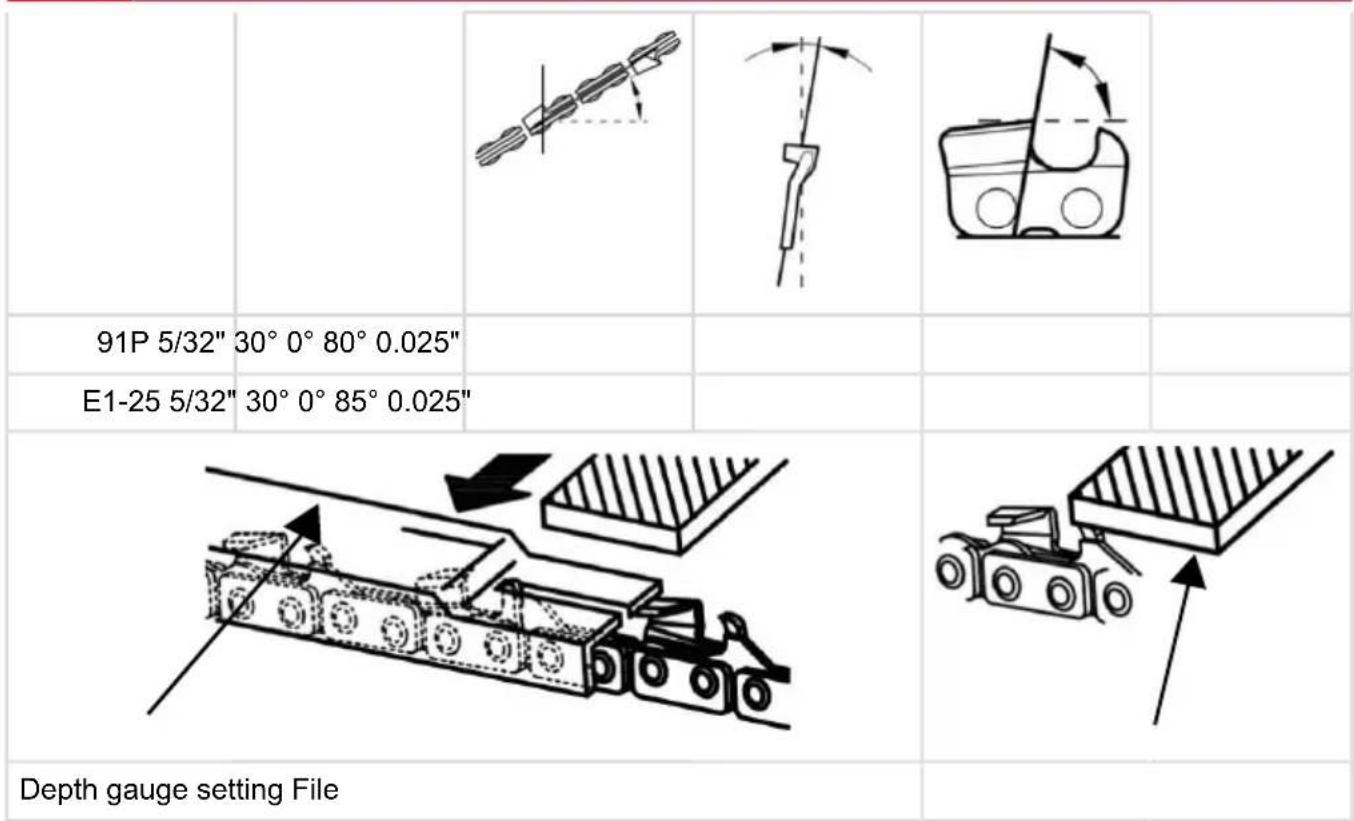
Chain maintenance table

The technical data of the chain and the bar authorised for use with this machine are stated in the "EC declaration of conformity" supplied with the machine.

WARNING!
For reasons of safety, no other types of chain or bar are allowed to be used.
The table shows the sharpness for various chain types, but should not be interpreted as authorisation for using chains other than those which are approved.
| Chain type | File diameter Top plate angle Down angle | Head tilt angle (55°) | Depth gauge setting | ||
| Rotatio-nal angle of the tool | Inclina-tion angle of the tool | Side plate angle | |||
Maintenance of the bar (25)
The bar should be turned around regularly in order to prevent asymmetrical wear. The following are required to retain the efficiency of the bar:
Lubricate the bearings of the reversing sprocket using the corresponding spray (if available).
Clean the groove of the bar using the appropriate scraper (not included in the scope of delivery).
Clean the lubricating holes.
Use a flat file to remove burrs from the guide flanks and compensate for any deviations between the guides.
The bar must be renewed if:
The depth of the groove is less than the height of the pulling link (which is never allowed to touch the base of the groove);
The inner guide wall is worn to such an extent that the chain tilts to the side.
Work that does not form part of the usual procedures
Any maintenance work not described in this manual is only allowed to be performed by your dealer.
Work that is not carried out by a specialist organisation or is performed by unqualified personnel will invalidate the warranty in all cases.
Storage
After working, clean the machine carefully and remove dust and residues, and repair damaged parts or renew them. The machine must be kept in a dry place, protected against the weather and with the chain guard fitted properly.
Lengthy downtimes
If the machine is not expected to be used for 2-3 months, perform the following tasks so as to avoid difficulties or permanent engine damage when taking it back into operation.
Storage
Before the machine is taken out of service:
Clean the chain saw and service it before storing it.
Unscrew the nut, remove the cover and take off the chain and bar.
Empty the oil tank, fill approx. 100-120 cc of specific cleaning fluid and put the cap back on.
Mount the cover again without tightening the nut, ensuring that the two rear fasteners are correctly seated.
Start the machine and run the engine at high speed until all of the cleaning fluid has been consumed.
Set the engine to idling speed and allow the machine to run until the fuel remaining in the tank and the carburettor has been fully consumed.
Remove the spark plug when the machine is cold.
Pour a spoonful of two-stroke oil (new) into the opening for the spark plug.
Pull the starter handle several times to distribute the oil in the cylinder.
Then reinsert the spark plug when the piston is at the top dead centre position (this can be seen through the spark plug opening when the piston has reached the highest point in its stroke).
Returning to operation
When taking the machine back into operation:
Remove the spark plug.
Pull the starter handle a few times to remove the surplus oil.
Check the spark plug as described under "Checking the spark plug".
Set the machine as described under "Machine preparation".
TROUBLESHOOTING
| Malfunction Possible cause Remedy | ||
| Engine can either not be started or switches off immediately. | Incorrect starting procedureSpark plug dirty or electrode gap incorrectAir filter blockedProblems with the mixture preparation | Follow the instructions (see "Starting the engine")Check the spark plug (see "Maintenance and storage")Clean the filter or change it (see "Maintenance and storage")Contact the dealer |
| The engine emits excessive smoke. | Incorrect mixture preparationProblems with the mixture preparation | Prepare the mixture as instructed (see "Mixture preparation and storage")Contact the dealer |
| The engine can be started, but only develops low power. | Air filter blockedProblems with the mixture preparation | Clean the filter or change it (see "Maintenance and storage")Contact the dealer |
| The engine runs irregularly or does not develop any power under load. | Spark plug dirty or electrode gap incorrectProblems with the mixture preparation | Check the spark plug (see "Maintenance and storage")Contact the dealer |
| No oil comes out. Low-quality oil | Lubricating holes blocked | Empty the tank, flush the tank and lines with cleaning fluid and change the oil.Clean |
ACCESSIONS
The table contains a list of possible combinations of bar and chain, specifying the parts that can be used on each machine, identified with the symbol **
The selection, installation and use of the chain and bar are carried out entirely autonomously by the user, as a result of which the user is also liable for damage of any kind attributable to these working procedures.
If you have any doubts or are uncertain about the properties of the individual bars and chains, contact your dealer or a specialist garden centre.

CAUTION!
The use of unapproved bar/chain combinations reduces the degree of safety and original level of performance of the machine, and can also damage the machine or become dangerous to the operator and other persons.
Bar and chain combinations
TECHNICAL DATA
| Pitch Guide rail (bar) Chain Chain saw model | ||||||
| Inch Length Inch/cm | Groove width Inch/mm | Code Code BKS | 2625 T | BKS 2625 TSB | ||
| 3/8" 10" / 25 cm 0.050" / 1.3 mm 100SDEA041 91P040X * | ||||||
| 1/4" | 10" / 25 cm | 0.050" / 1.3 mm | QIRUI AT10-50 | E1-25AP060T | * | |
| Type | BKS 2625 T | BKS 2625 TSB |
| Art. no. | 113 355 | 113 474 |
| Displacement | 25.4 cm³ | |
| Max. engine output | 0.9 kW | |
| Length Guide rail (OREGON) | 25 cm 100DEA041 | 25 cm QIRUI AT10-50 |
| Effective cutting length | 22 cm | |
| Saw chain (OREGON) | 91P040x | E1-25AP060T |
| Pitch – chain sprocket | 3/8" | 1/4" |
| Drive link count | 6T | |
| Chain brake | Yes | |
| Idling speed | 3100 ± 400 rpm | |
| Maximum speed (with cutting tool) | 11000 rpm | |
| Max. chain speed | 21 m/s | |
| Fuel tank capacity | 200 ml | |
| Large chain oil tank | 140 ml | |
| Fuel mixture ratio | 40:1 | |
| Type BKS 2625 T BKS 2625 TSB | ||
| Net weight without chain and guide rail, with empty tanks 3.2 kg | ||
| Fuel consumption at max. engine output 560 g/kWh | ||
| Sound power level LwA (EN ISO 11681) 104.5 dB(A) (K=3) | ||
| Sound pressure value LpA (EN ISO 11681) 87.3 dB(A) (K=3) | ||
| Max. vibration acceleration a vhw (K=1.5) | ||
| Front handle 5.8 m/s | 2 | |
| Rear handle 12.1 m/s | 2 | |
| Guaranteed sound power level LwA (2000/14/EC+2005/88/EC) | 108 dB(A) | |
MAINTENANCE SCHEDULE
The following information relates to normal application conditions. Under special conditions such as working for a particularly long time, the specified maintenance intervals will have to be shortened accordingly.
| Maintenance schedule | |||||||
| Once after 5 operating hours | Before starting work | Every week | Every 50 operating hours | Every 100 operating hours | If required | Be-fore/after the season, annually | |
| Carburettor | |||||||
| Check idling speed X | |||||||
| Air filter | |||||||
| Clean X | |||||||
| Renew X | |||||||
| Spark plug | |||||||
| Check electrode gap, adjust if necessary | X | X | |||||
| Renew | X | X | |||||
| Silencer | |||||||
| Visual inspection for condition | X | ||||||
| Fuel tank, oil tank | |||||||
| Clean | X | X | |||||
Maintenance schedule
| Once after 5 operating hours | Before starting work | Every week | Every 50 operating hours | Every 100 operating hours | If required | Be-fore/after the season, annually | |
| Fuel filter | |||||||
| Renew X | |||||||
| Chain brake | |||||||
| Functional test, check freedom of movement | X | ||||||
| Clean, grease articulation points X X | |||||||
| Chain lubrication | |||||||
| Check X X | |||||||
| Saw chain | |||||||
| Visual check for condition, check sharpness | X | ||||||
| Resharpen X X | |||||||
| Renew, if necessary renew the chain sprocket as well and grease the chain sprocket bearing | X | ||||||
| Chain bar | |||||||
| Visual inspection for condition X | |||||||
| Turn over the bar X | |||||||
| Grease the reversing sprocket X | |||||||
| Clean the chain groove/oil hole X | |||||||
| Clean the inside of the chain guard X | |||||||
| Controls | |||||||
| Engine start/stop switch, speed regulator, interlock of speed regulator, starter cord | X | ||||||
| All accessible screws (except for setscrews) | |||||||
| Retighten X X X | |||||||
| Complete machine | |||||||
| Maintenance schedule | |||||||
| Once after 5 operating hours | Before starting work | Every week | Every 50 operating hours | Every 100 operating hours | If required | Be-fore/after the season, annually | |
| Visual inspection for condition X | |||||||
| Clean (including air inlet, cylinder cooling vanes) | XXXX | ||||||
Carry out the maintenance work regularly. If necessary, contact a specialist workshop if you cannot do all the work yourself. The owner of the machine is also responsible for:
- Damage caused by incorrectly performed maintenance or repair work, or if such work is not carried out on schedule
Follow-on damage, including corrosion, caused by incorrect storage
GUARANTEE
We will resolve any material or manufacturing faults on the machine during the legal warranty period for claims relating to faults, in accordance with our choice either to repair or replace. The legal warranty period is determined by the legislation of the country in which the machine was purchased.
Our warranty promise applies only if:
these operating instructions are complied with
The warranty becomes void if:
the appliance is handled correctly
unauthorised repair attempts
original spare parts have been used
unauthorised technical modifications
The guarantee excludes:
non-intended use
Paint damage that can be attributed to normal wear and tear
Wear parts that are marked with a frame on the spare parts card: [xxx xxx (x)]
Internal combustion engines (these are covered by the warranty provisions of the corresponding engine manufacturers).
The guarantee period commences with purchase by the first end user. The date on the proof of purchase is decisive. In the event of a warranty claim, please take this warranty declaration and the original proof of purchase, and contact your dealer or the nearest authorised customer service centre. This statement does not affect the purchaser's statutory claims for defects against the vendor.
EU DECLARATION OF CONFORMITY
We hereby declare that this product in the version introduced into trade by us, complies with the requirements of the harmonised EU Directives, EU safety standards and the product-specific standards.
Product Manufacturer Duly authorised person
Chain saw
AL-KO Geräte GmbH
Andreas Hedrich
Serial number
lichenhauser Str. 14
Ichenhauser Str. 14
G4114115
D-89359 Kotz, Germany
D-89359 Kotz, Germany
Model EU directives Harmonised standards
BKS 2625 T
2006/42/EC
EN ISO 11681-2:2011
BKS 2625 TSB
2000/14/EC
EN ISO 14982:2009
Sound power level Conformity evaluation
measured/guaranteed
2000/14/EC Appendix V
BKS 2625 T: 106.5 / 110 dB(A)
BKS 2625 TSB:106.5/110 dB(A)
Type examination as per
Named position
2006/42/EC Annex IX
Kotz, Germany 20/05/2016
Wolfgang Hergeth
Managing Director
TRADUCTION DU MODE D'EMPLOI D'ORIGINE
Table des matieres
COMMENT LIRE CE MANUEL
Los)."Losylvania, where the "suelo" is a popular term for the city of Los Angeles. It's a popular term for people who are in Los Angeles and who have been in Los Angeles for some time.




- HOW TO USE THIS MANUAL
- NOTE or IMPORTANT
- CAUTION!
- DANGER!
- Symbols
- Descriptive symbols on the machine (if applied)
- IDENTIFICATION OF THE MAIN COMPONENTS
- Main components
- Controls and filling
- SAFETY REGULATIONS
- Intended use/unintended use
- Residual risks
- Training
- Preparatory measures
- The machine in use
- Maintenance and storage
- Transport and handling
- Causes of kickback and how to avoid them
- Techniques for using the chain saw
- Recommendations for beginners
- USING THE CHAIN SAWS FOR TREE MAINTENANCE WITH A ROPE AND CLIMBING HARNESS
- General requirements for working at heights
- Preparing to use the chain saw on a tree
- Using a chain saw in a tree
- Safe working position for two-hand operation
- Starting the chain saw in a tree
- Using the chain saw with only one hand
- Freeing a jammed chain saw
- ASSEMBLING THE CHAIN SAW
- Assembling the bumper spike (if not already fitted at the factory)
- Installing the bar and chain
- Checking the chain tension
- PREPARING FOR WORK
- Mixture preparation
- Petrol properties
- Oil properties
- Mixture preparation and storage
- Refuelling
- RISK OF BURNS AND FIRE
- Before refuelling:
- Chain lubricant
- Checking the machine
- Checking the chain brake
- STARTING THE ENGINE, USING THE MACHINE AND SWITCHING IT OFF
- Starting the engine
- WARNING!
- Cold start
- Warm start
- Engine operation (Fig. 10)
- Engine shutdown
- USING THE MACHINE
- Checks to carry out during work
- Checking the oil flow
- Working methods and cutting techniques
- Using the bumper spike (if intended, Fig. 12)
- Pruning a tree (Fig. 13)
- Felling a tree (Fig. 14)
- Cutting off branches after felling (Fig. 15)
- Cutting through a trunk on the ground (Fig. 17)
- Cutting through a raised trunk (Fig. 18)
- Completing work
- During maintenance work:
- Cylinder and silencer (19)
- Starter group
- Clutch group (20)
- Chain brake
- Chain sprocket
- Lubricating hole (21)
- Chain interception bolt
- Fastenings
- Cleaning the air filter (22)
- Checking the spark plug (23)
- Carburettor setting
- ldling speed setting
- Sharpening the chain
- Chain maintenance table
- Maintenance of the bar (25)
- Work that does not form part of the usual procedures
- Storage
- Lengthy downtimes
- Returning to operation
- TROUBLESHOOTING
- ACCESSIONS
- MAINTENANCE SCHEDULE
- GUARANTEE
- EU DECLARATION OF CONFORMITY
- Product Manufacturer Duly authorised person
- Model EU directives Harmonised standards
- Sound power level Conformity evaluation
- Type examination as per
- Named position
- TRADUCTION DU MODE D'EMPLOI D'ORIGINE
- Table des matieres
- COMMENT LIRE CE MANUEL
Brand : AL-KO
Model : BKS 2625 TSB
Category : Saw