
One+ R18JSCS - Electric saw RYOBI - Free user manual and instructions
Find the device manual for free One+ R18JSCS RYOBI in PDF.



| Product type | Cordless circular saw |
| Brand | RYOBI |
| Model | One+ R18JSCS |
| Power source | 18 V lithium-ion battery (One+ series) |
| Blade diameter | 165 mm |
| Maximum cutting depth | 54 mm (at 90°) |
| Bevel cut capacity | 0° to 45° |
| No-load speed | 4,500 rpm |
| Weight (without battery) | 3.5 kg |
| Length | 320 mm |
| Width | 250 mm |
| Height | 280 mm |
| Blade bore | 20 mm |
| Number of teeth | 24 |
| Cutting width | 2 mm |
| Dust extraction connection | Yes |
| Parallel guide | Included |
| Lower blade guard | Spring-loaded, retractable |
| Trigger with safety lock | Yes |
| Auxiliary handle | Yes |
| Operating temperature | 0 °C to 40 °C |
| Storage temperature | 0 °C to 40 °C |
| Warranty | 24 months (extendable to 36 months upon registration) |
| Intended use | Cross-cutting and ripping of wood, derived panels |
| Allowed materials | Wood, similar materials (no metal, masonry) |
Frequently Asked Questions - One+ R18JSCS RYOBI
User questions about One+ R18JSCS RYOBI
0 question about this device. Answer the ones you know or ask your own.
Ask a new question about this device
Download the instructions for your Electric saw in PDF format for free! Find your manual One+ R18JSCS - RYOBI and take your electronic device back in hand. On this page are published all the documents necessary for the use of your device. One+ R18JSCS by RYOBI.
USER MANUAL One+ R18JSCS RYOBI


| Important! | It is essential that you read the instructions in this manual before assembling, maintaining and operating the product. |
| Attention! | Il est essentiel que vous lisiez les instructions contenues dans ce manuel avant d'assembler, d'entretenir et d'utiliser le produit. |
| Achtung! | Es ist wichtig, dass Sie vor Zusammenbau, Wartung und Benutzung des Produktes die Anweisungen in dieser Anleitung lesen. |
| ¡Atención! | Resulta fundamental que lea este manual de instrucciones antes de realizar el montaje, el mantenimiento y de utilizar este producto |
| Attenzione! | E' importante leggere le istruzioni contenute nel presente manuale prima di montare il prodotto, svolgere le operazioni di manutenzione sullo stesso e metterlo in funzione. |
| Let op! | Het is van essentieel belang dat u de instructies in deze gebruiksaanwijzing leest voor u het product monteert, onderhoudt en gebruikt. |
| Atenção! | É fundamental que leia as instruções deste manual antes da montagem, manutenção e operação do aparelho. |
| OBS! | Det er vigtigt, at man læser instrukserne i denne brugsanvisning, inden man samler, vedligeholder og betjener produktet. |
| Observera! | Det är viktigt att du läser instruktionerna i manualen före montering, användning och underhåll av produkten. |
| Huomio! | On tärkeää, että luet tämän käsikirjan ohjeet ennen tuotteen kokoamista, huoltoa ja käyttöä. |
| Advarsel! | Det er viktig at du leser instruksjonene i denne manualen før sammensetning, vedlikehold og bruk av produktet |
| Внимание! | Необходимо прочитать инструкции в данном руководстве перед сборкой, обслуживанием и эксплуатацией этого изделия. |
| Uwaga! | Koniecznie należy przeczytać instrukcje zawarte w tym podręczniku przed montażem, obsługą oraz konserwacją produktu. |
| Dûležité upozornění! | Neinstalujte, neprovádějte údržbu ani nepoužívejte tento výrobek dříve, než si přečtete pokyny uvedené v tomto návodu. |
| Figyelem! | Fontos, hogy a termék összeszerelése, karbantartása és használata előtt elolvassa a kézikönyvben található utasításokat. |
| Atenție! | Este esențial să citiți instrucțiunile din acest manual înainte de asamblare, efectuarea întreținerii și operarea produsului. |
| Uzmanību! | Ir svarīgi izlasīt šīs rokasgrāmatas instrukcijas pirms uzstādīšanas, apkopes un preces darbināšanas. |
| Dèmesio! | Prieš surenkant, prižiūrint ir naudojant gaminį, būtina perskaityti šiame vadove pateiktus nurodymus. |
| Tähtis! | Enne masina kokkupanekut, hooldamist ja kasutama hakkamist tuleb käesolevas juhendis esitatud juhised kindlasti läbi lugeda. |
| Upozorenje! | Vrlo je važno da ste prije sklapanja, održavanja i rada s ovim proizvodom pročitali upute u ovom priručniku. |
| Pomembno! | Pomembno je da pred montažo vzdrževanjem in uporabo tega izdelka preberete navodila v tem priročniku. |
| Upzornenie! | Je dôležité, aby ste si pred montážou, údržbou a obsluhou produktu prečitali pokyny v tomto návode. |
| Важно! | Изключително важно е да прочетете инструкциите в настоящото ръководство, преди да преминете към сглобяване, поддръжка или работа с продукта. |
| Важливо! | Дуже важливо, щоб ви прочитали інструкції в цьому керівництві перед складанням, обслуговуванням та експлуатацією цієї машини. |
| Dikkat! | Ürünün montajını, bakımını yapmadan ve ürünü çalıştırmadan önce bu kılavuzda yer alan talimatları okumanız önemlidir. |
| Проσοχή! | Eívai полú σημαντικό να διαβάσετε τις οδηγίες στο παρόν εγχειρίδιο πριν συναρμολογήσετε, συντηρήσετε ή λειτουργήσετε το προϊόν. |
Subject to technical modification | Sous réserve de modifications techniques | Technische Änderungen vorbehalten | Bajo reserva de modificaciones técnicas | Con riserva di eventuali modifiche tecniche | Technische wijzigingen voorbehouden | Com reserva de modificações técnicas | Med forbehold for tekniske ændringer | Med förbehåll för tekniska ändringar | Tekniset muutokset varataan | Med forbehold om tekniske endringer | могут быть внесены технические изменения | Z zastrzeżeniem modyfikacji technicznych | Změny technických údajů vyhrazeny | A můszaki módosítás jogát fenntartjuk | Sub rezerva modificațiilor tehnice | Paturam tiesības mainīt tehniskos raksturlielumus | Pasiliekant teisę daryti techninius pakeitimus | Tehnilised muudatused võimalikud | Podloæno tehniëkim promjenama | Tehnične spremembe dopuščene | Právo na technické zmeny je vyhradenė | Подлежи на технически модификации | Є об'єктом для технічних змін | Teknik değişiklik hakkı saklıdır | Упó тнүv επιφύλαξη τεχνικών τροποποιήσεων

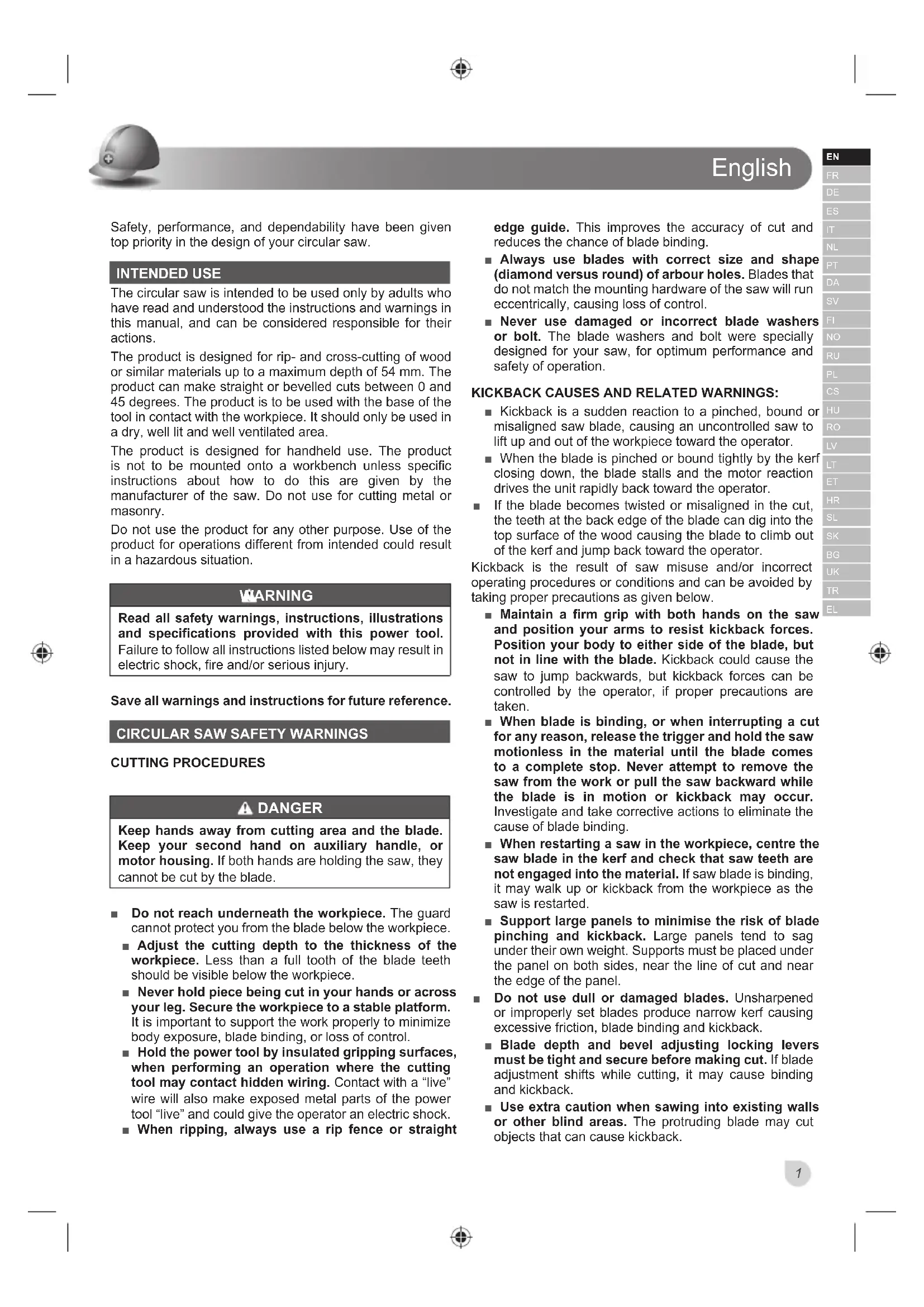
Safety, performance, and dependability have been given top priority in the design of your circular saw.
INTENDED USE
The circular saw is intended to be used only by adults who have read and understood the instructions and warnings in this manual, and can be considered responsible for their actions.
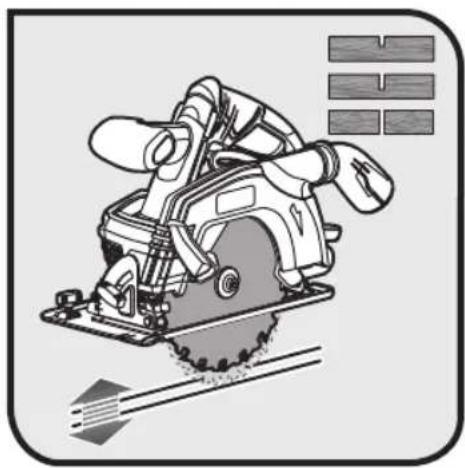
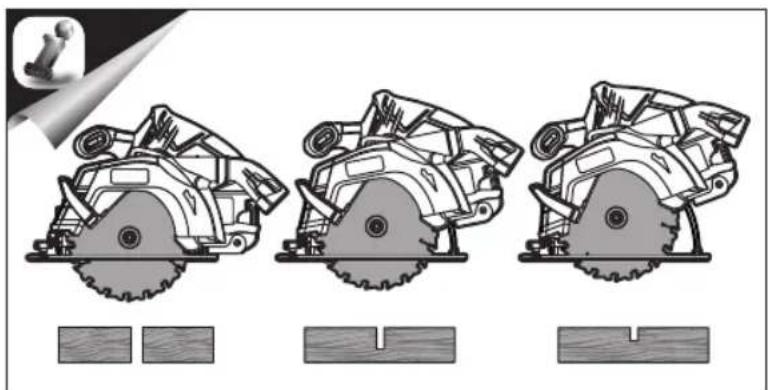
The product is designed for rip- and cross-cutting of wood or similar materials up to a maximum depth of 54 mm. The product can make straight or bevelled cuts between 0 and 45 degrees. The product is to be used with the base of the tool in contact with the workpiece. It should only be used in a dry, well lit and well ventilated area.
The product is designed for handheld use. The product is not to be mounted onto a workbench unless specific instructions about how to do this are given by the manufacturer of the saw. Do not use for cutting metal or masonry.
Do not use the product for any other purpose. Use of the product for operations different from intended could result in a hazardous situation.
WARNING
Read all safety warnings, instructions, illustrations and specifications provided with this power tool. Failure to follow all instructions listed below may result in electric shock, fire and/or serious injury.
Save all warnings and instructions for future reference.
CIRCULAR SAW SAFETY WARNINGS
CUTTING PROCEDURES
DANGER
Keep hands away from cutting area and the blade. Keep your second hand on auxiliary handle, or motor housing. If both hands are holding the saw, they cannot be cut by the blade.
- Do not reach underneath the workpiece. The guard cannot protect you from the blade below the workpiece.
- Adjust the cutting depth to the thickness of the workpiece. Less than a full tooth of the blade teeth should be visible below the workpiece.
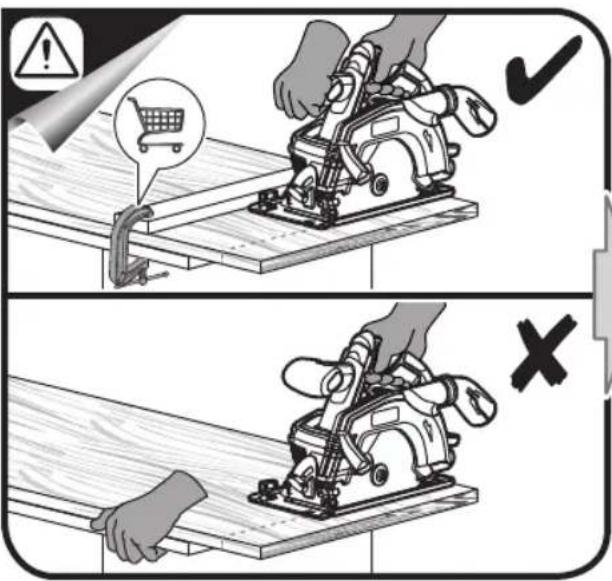
■ Never hold piece being cut in your hands or across your leg. Secure the workpiece to a stable platform. It is important to support the work properly to minimize body exposure, blade binding, or loss of control. - Hold the power tool by insulated gripping surfaces, when performing an operation where the cutting tool may contact hidden wiring. Contact with a "live" wire will also make exposed metal parts of the power tool "live" and could give the operator an electric shock.
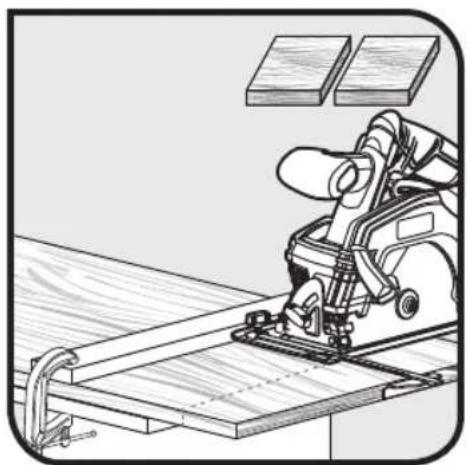
■ When ripping, always use a rip fence or straight
edge guide. This improves the accuracy of cut and reduces the chance of blade binding.
■ Always use blades with correct size and shape (diamond versus round) of arbour holes. Blades that do not match the mounting hardware of the saw will run eccentrically, causing loss of control.
■ Never use damaged or incorrect blade washers or bolt. The blade washers and bolt were specially designed for your saw, for optimum performance and safety of operation.
KICKBACK CAUSES AND RELATED WARNINGS:
■ Kickback is a sudden reaction to a pinched, bound or misaligned saw blade, causing an uncontrolled saw to lift up and out of the workpiece toward the operator.
- When the blade is pinched or bound tightly by the kerf closing down, the blade stalls and the motor reaction drives the unit rapidly back toward the operator.
If the blade becomes twisted or misaligned in the cut, the teeth at the back edge of the blade can dig into the top surface of the wood causing the blade to climb out of the kerf and jump back toward the operator.
Kickback is the result of saw misuse and/or incorrect operating procedures or conditions and can be avoided by taking proper precautions as given below.
- Maintain a firm grip with both hands on the saw and position your arms to resist kickback forces. Position your body to either side of the blade, but not in line with the blade. Kickback could cause the saw to jump backwards, but kickback forces can be controlled by the operator, if proper precautions are taken.
- When blade is binding, or when interrupting a cut for any reason, release the trigger and hold the saw motionless in the material until the blade comes to a complete stop. Never attempt to remove the saw from the work or pull the saw backward while the blade is in motion or kickback may occur. Investigate and take corrective actions to eliminate the cause of blade binding.
- When restarting a saw in the workpiece, centre the saw blade in the kerf and check that saw teeth are not engaged into the material. If saw blade is binding, it may walk up or kickback from the workpiece as the saw is restarted.
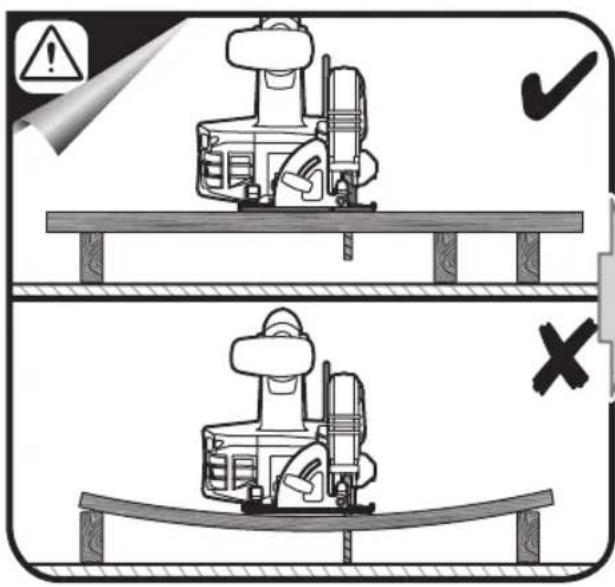
■ Support large panels to minimise the risk of blade pinching and kickback. Large panels tend to sag under their own weight. Supports must be placed under the panel on both sides, near the line of cut and near the edge of the panel.
- Do not use dull or damaged blades. Unsharpened or improperly set blades produce narrow kerf causing excessive friction, blade binding and kickback.
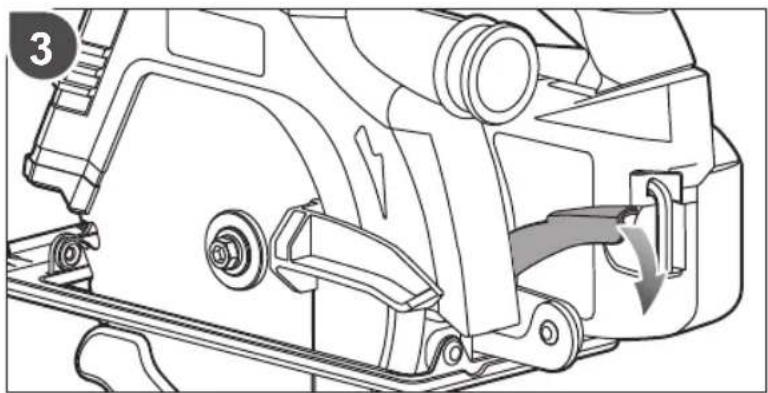
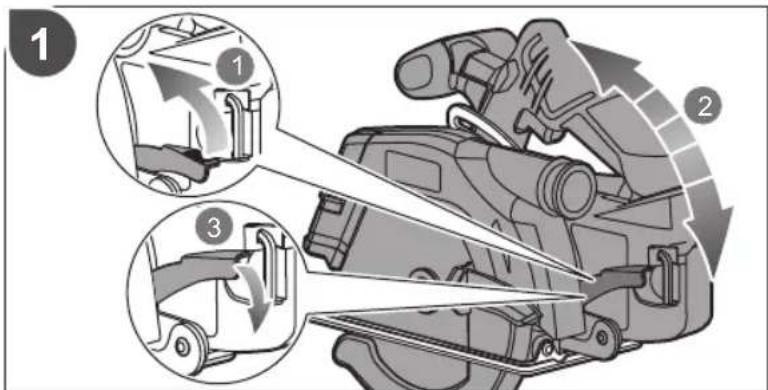
■ Blade depth and bevel adjusting locking levers must be tight and secure before making cut. If blade adjustment shifts while cutting, it may cause binding and kickback.
■ Use extra caution when sawing into existing walls or other blind areas. The protruding blade may cut objects that can cause kickback.
LOWER GUARD FUNCTION
- Check lower guard for proper closing before each use. Do not operate the saw if lower guard does not move freely and close instantly. Never clamp or tie the lower guard into the open position. If saw is accidentally dropped, lower guard may be bent. Raise the lower guard with the retracting handle and make sure it moves freely and does not touch the blade or any other part, in all angles and depths of cut.
- Check the operation of the lower guard spring. If the guard and the spring are not operating properly, they must be serviced before use. Lower guard may operate sluggishly due to damaged parts, gummy deposits, or a build-up of debris.
- Lower guard may be retracted manually only for special cuts such as "plunge cuts" and "compound cuts". Raise lower guard by retracting handle and as soon as blade enters the material, the lower guard must be released. For all other sawing, the lower guard should operate automatically.
■ Always observe that the lower guard is covering the blade before placing saw down on bench or floor. An unprotected, coasting blade will cause the saw to walk backwards, cutting whatever is in its path. Be aware of the time it takes for the blade to stop after switch is released.
ADDITIONAL SAFETY WARNINGS
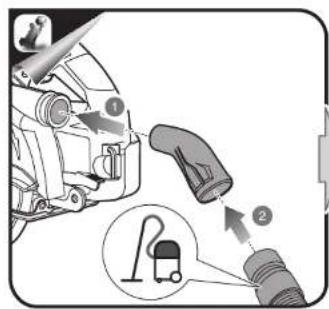
■ The dust produced when using the product may be harmful to your health, inflammable, or explosive. Do not inhale the dust. Use a dust extraction system, and wear a suitable dust protection mask. Remove deposited dust thoroughly, e.g., with a brush and vacuum cleaner.
■ Do not use any abrasive wheels.
■ Avoid overheating the blade tips. Do not use dull or damaged blades. Do not force the tool.
■ Do not use blades of larger or smaller diameter than recommended.
■ Wear ear protection.
- Clamp workpiece with a clamping device. Unclamped workpieces can cause severe injury and damage.
■ Thoroughly check the material to be cut, particularly when using recycled wood, for foreign objects such as nails, screws, and staples. If nails, screws, staples or similar items contact the blade whilst cutting, the saw will be damaged and severe injury to the operator or others may occur.
■ Do not touch the saw blade immediately after sawing. The saw blade gets hot during sawing.
■ Use only blade diameter(s) in accordance with the markings.
■ Identify the correct saw blade to be used for the material to be cut.
■ Use only saw blades that are marked with a speed equal or higher than the speed marked on the tool.
■ Use only saw blades recommended by the manufacturer, which conform to EN 847-1, if intended for wood and analogous materials.
■ Wear a dust mask.
■ Ambient temperature range for tool during operation is between 0°C and 40°C.
■ Ambient temperature range for tool storage is between 0°C and 40°C.
■ The recommended ambient temperature range for the charging system during charging is between 10°C and 38°C.
ADDITIONAL BATTERY SAFETY WARNINGS
WARNING
To reduce the risk of fire, personal injury, and product damage due to a short circuit, never immerse your tool, battery pack or charger in fluid or allow a fluid to flow inside them. Corrosive or conductive fluids, such as seawater, certain industrial chemicals, and bleach or bleach-containing products, etc., can cause a short circuit.
■ Ambient temperature range for battery during use is between 0°C and 40°C.
■ Ambient temperature range for battery storage is between 0°C and 20°C.
TRANSPORTING LITHIUM BATTERIES
Transport the battery in accordance with local and national provisions and regulations.
Follow all special requirements on packaging and labelling when transporting batteries by a third party. Ensure that no batteries can come in contact with other batteries or conductive materials while in transport by protecting exposed connectors with insulating, non-conductive caps or tape. Do not transport batteries that are cracked or leaking. Check with the forwarding company for further advice.
RESIDUAL RISKS
Even when the product is used as prescribed, it is still impossible to completely eliminate certain residual risk factors. The following hazards may arise and the operator should pay special attention to avoid the following:
■ Injury caused by kickback
-Read and understand the information in this manual.
■ Injury caused by vibration
-Limit exposure. See Risk Reduction.
■ Injury caused by dust
—Wear eye protection at all times. Wear appropriate dust mask with suitable filters that can protect against particles from the material being worked on. Do not eat, drink, or smoke in the work area. Ensure adequate ventilation.
Electric shock
- The blade may contact hidden wiring causing parts of the product to become live. Always hold the product by the designated handles and take care when blind-cutting into walls and floors where cables may be hidden.

English
NOTE: When working on walls, ceilings, or floors, take care to avoid electric cables and gas or water pipes.
■ Injury from contact with the cutting blade
—The blades are sharp and will become hot during use. Wear gloves when changing blades. Keep hands away from the cutting area at all times. Never hold workpiece being cut in your hands or across your leg. Clamp the work piece whenever possible.
RISK REDUCTION
It has been reported that vibrations from handheld tools may contribute to a condition called Raynaud's Syndrome in certain individuals. Symptoms may include tingling, numbness, and blanching of the fingers, usually apparent upon exposure to cold. Hereditary factors, exposure to cold and dampness, diet, smoking, and work practices are all thought to contribute to the development of these symptoms. There are measures that can be taken by the operator to possibly reduce the effects of vibration:
- Keep your body warm in cold weather. When operating the unit, wear gloves to keep the hands and wrists warm. It is reported that cold weather is a major factor contributing to Raynaud's Syndrome.
■ After each period of operation, exercise to increase blood circulation.
■ Take frequent work breaks. Limit the amount of exposure per day.
If you experience any of the symptoms of this condition, immediately discontinue use and see your doctor about these symptoms.
WARNING
Injuries may be caused, or aggravated, by prolonged use of a tool. When using any tool for prolonged periods, ensure you take regular breaks.
KNOW YOUR PRODUCT
See page 107.
- Edge guide knob
- Bevel adjustment knob
- Spindle lock button
- Front handle, insulated gripping surface
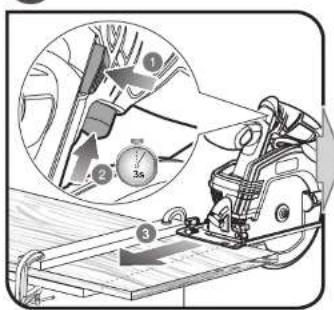
- Lock-off button
- Switch trigger
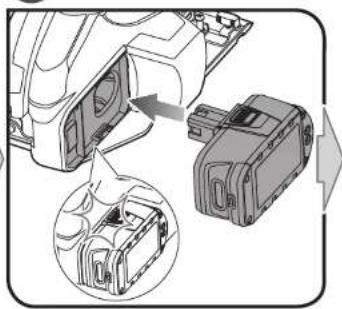
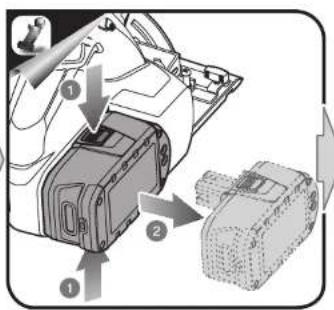
- Battery port
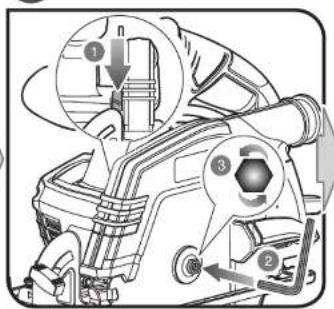
- Dust pipe joint
- Dust port
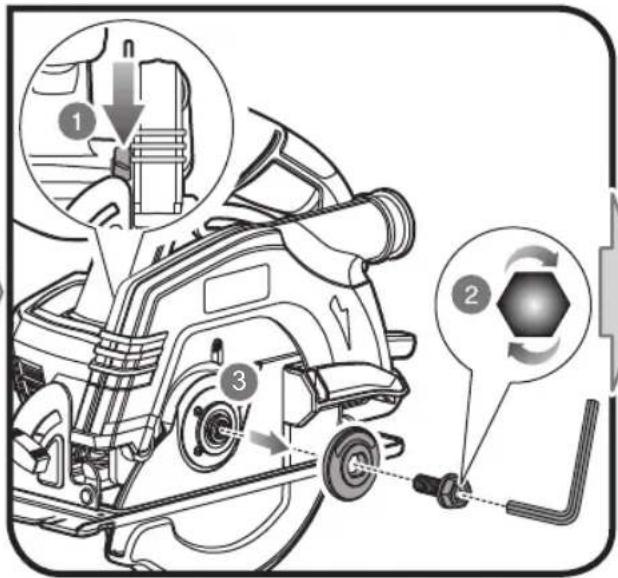
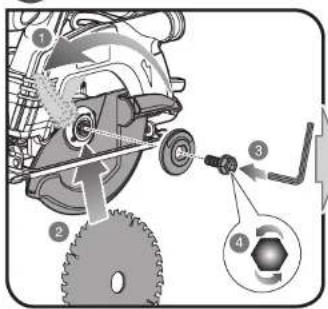
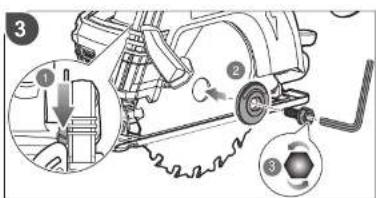
- Inner flange
- Outer flange
- Blade screw
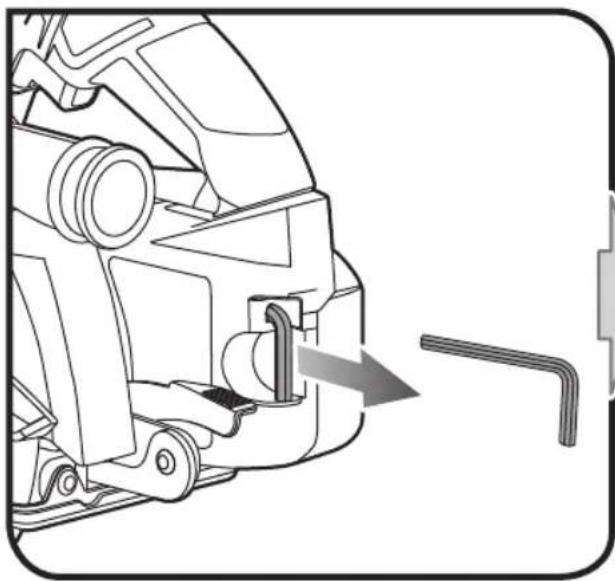
- Hex key
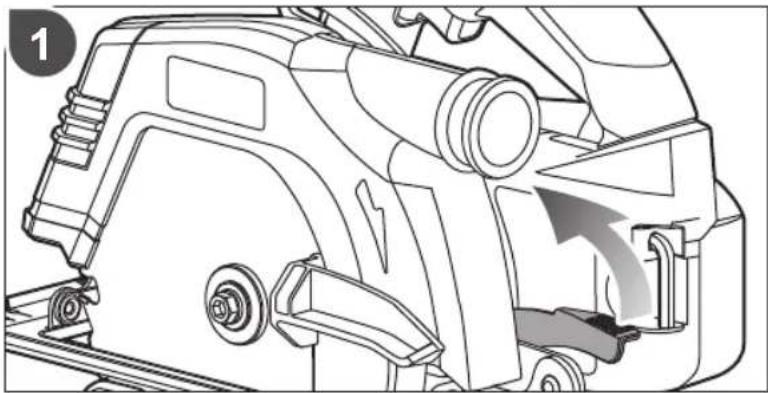
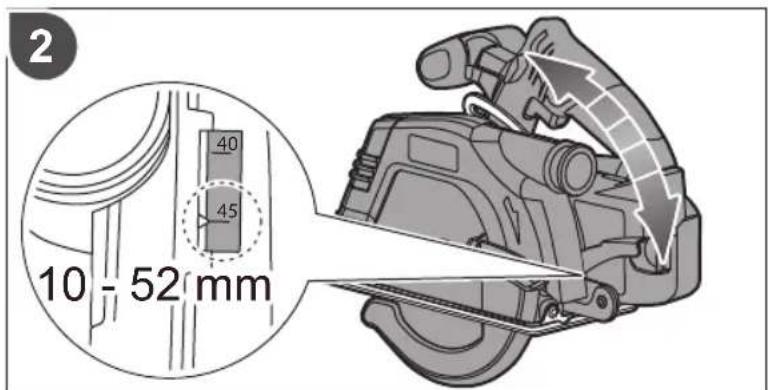
- Depth adjustment lock lever
- Blade
- Handle, insulated gripping surface
MAINTENANCE
WARNING
The product should never be connected to a power supply when assembling parts, making adjustments, cleaning, performing maintenance, or when the product is not in use. Disconnecting the product from the power supply will prevent accidental starting that could cause serious injury.
WARNING
Do not at any time let brake fluids, gasoline, petroleum-based products, penetrating oils, etc., come in contact with plastic parts. Chemicals can damage, weaken or destroy plastic which may result in serious personal injury.
- When servicing, use only original manufacturer's replacement parts. Use of any other parts may create a hazard or cause product damage.
■ Clean the tool and guarding system with clean cloths, or blow it clean with compressed air. - Avoid using solvents when cleaning plastic parts. Most plastics are susceptible to damage from various types of commercial solvents and may be damaged by their use. Use clean cloths to remove dirt, dust, oil, grease, etc.
- Do not attempt to modify this tool or create accessories not recommended for use with this tool.
■ All repairs should be performed by an authorised RYOBI service centre.
ENVIRONMENTAL PROTECTION
Recycle raw materials instead of disposing of as waste. The machine, accessories and packaging should be sorted for environmental-friendly recycling.
SYMBOLS

Safety alert

No-load speed

Blade diameter

CE conformity

EurAsian Conformity Mark

English

Ukrainian mark of conformity

Please read the instructions carefully before starting the machine.

Do not cut metals

Wood

Width of cut

Blade teeth

Wear eye protection

Danger! Sharp blade.

Do not expose to rain
Waste electrical products should not be disposed of with household waste. Please recycle where facilities exist. Check with your local authority or retailer for recycling advice.

The Ground Truth image displays a single, solid horizontal line. According to Rule 2 (UNDERSCORE & LINE RULES), this is a stylistic or background line, not a placeholder underscore. Therefore, the OCR result must ignore it and output nothing or only meaningful text. The provided OCR content is "____", which consists of four underscores. This is an incorrect interpretation of the line as a placeholder, violating the rule that stylistic lines must be ignored. The OCR has hallucinated underscores where none should exist based on the GT's visual context. Hence, the OCR result is inconsistent with the Ground Truth.
MACHEN SIE SICH MIT IHREM PRODUKT VERTRAUT
Siehe Seite 107.
DODATNA VARNOSTNA OPOZORILA
OBOZNÁMTE SA S VAŠÍM PRODUKTOM
Vid' strana 107.

1
2

3
4

5
6


110



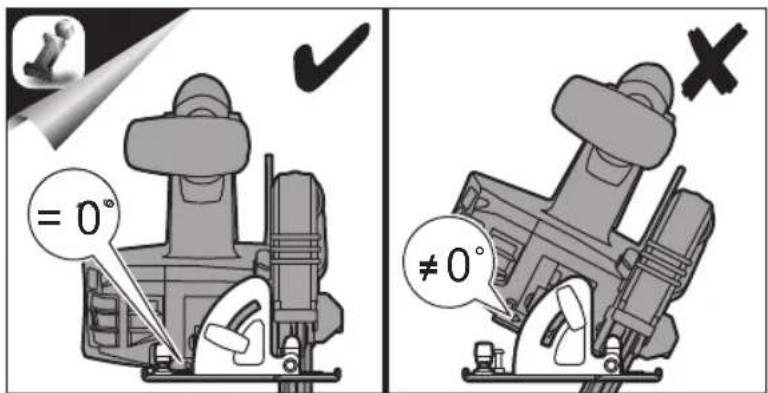
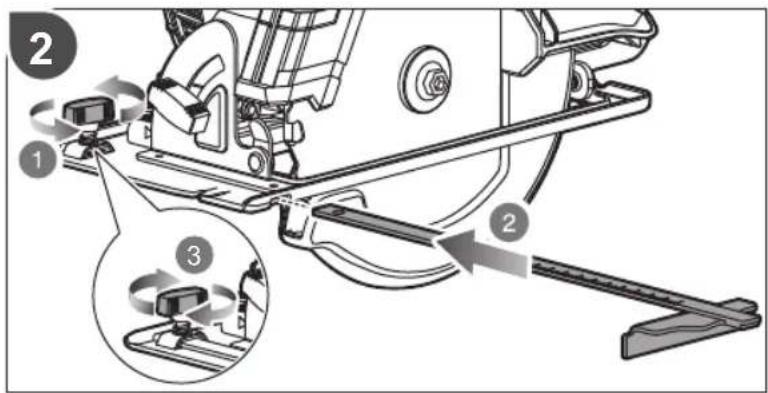
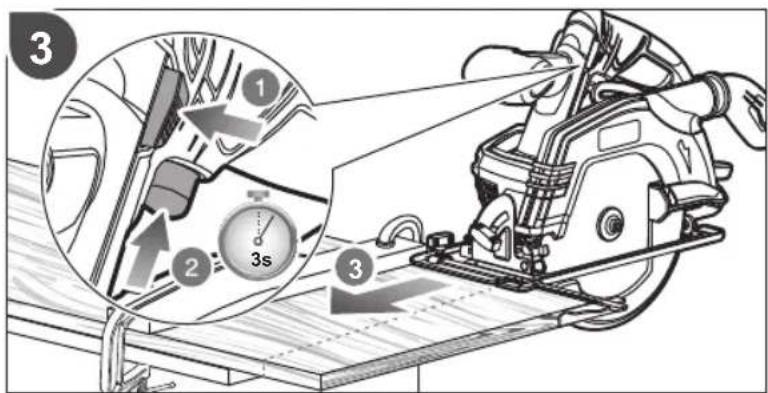
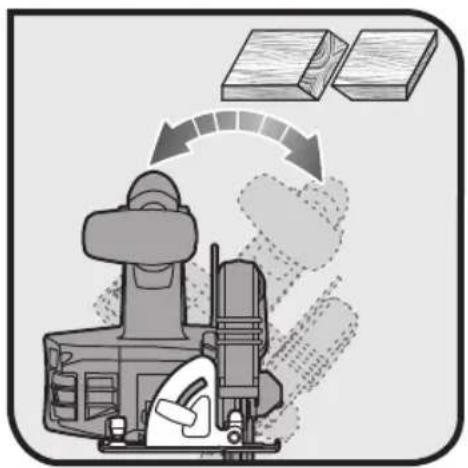
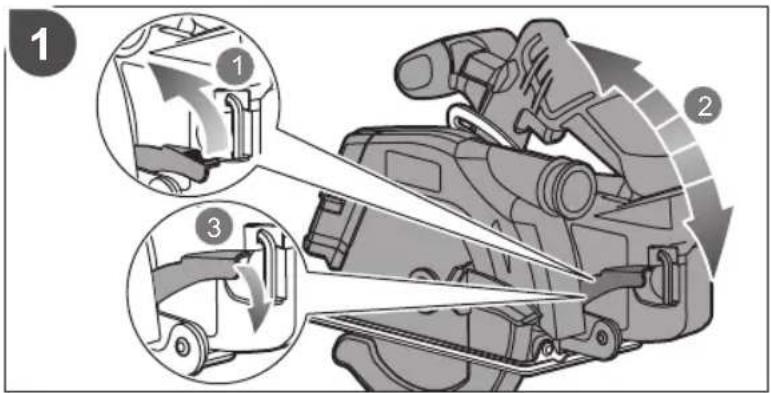
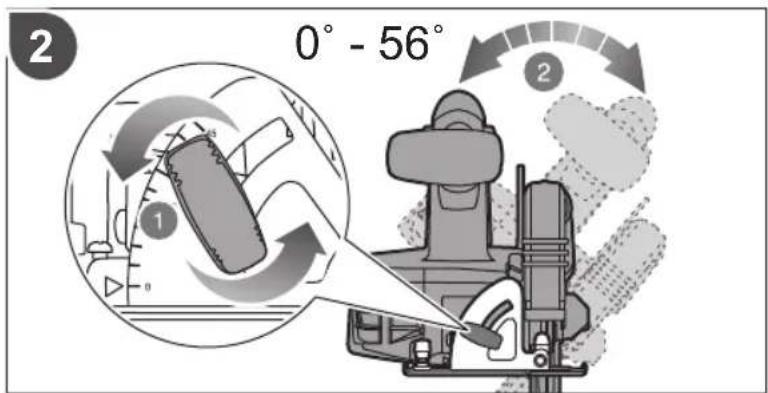
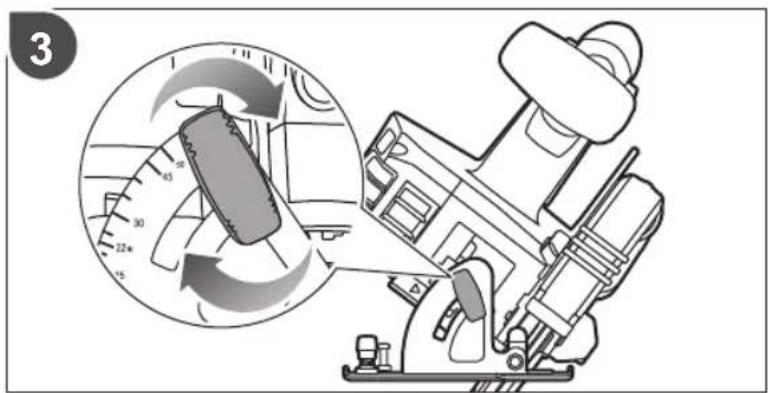
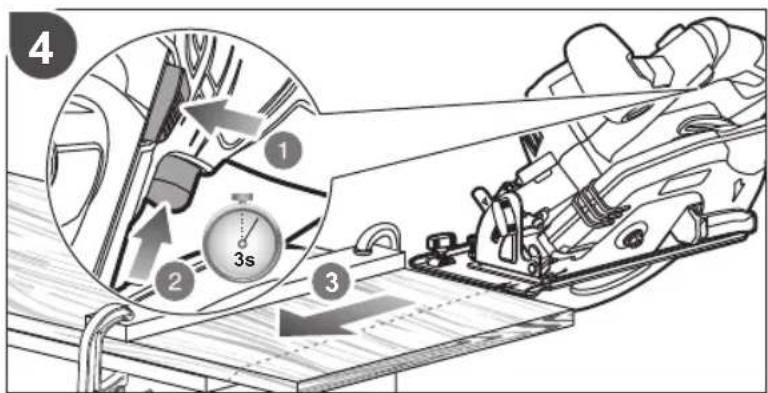
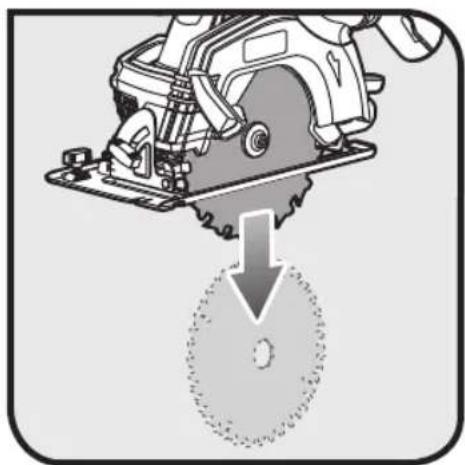
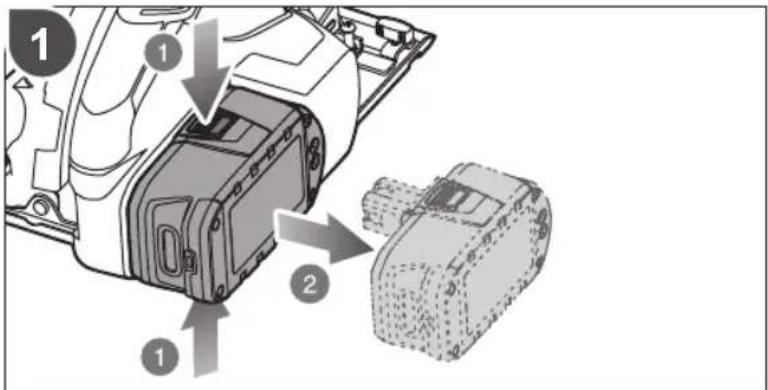
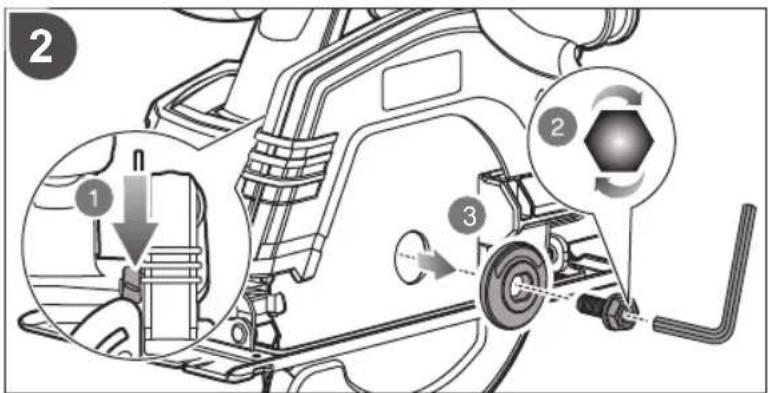
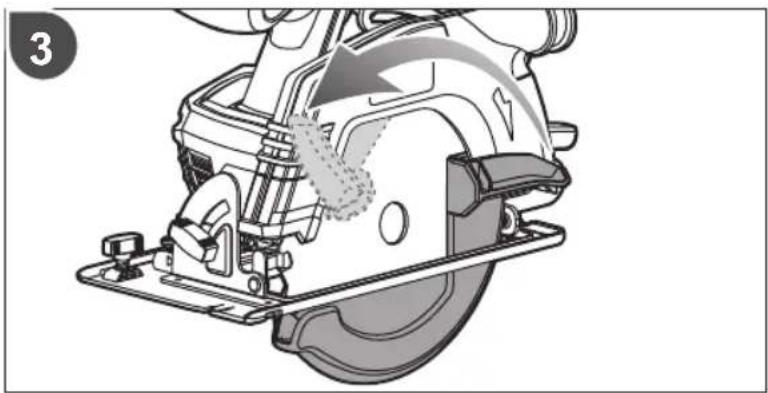
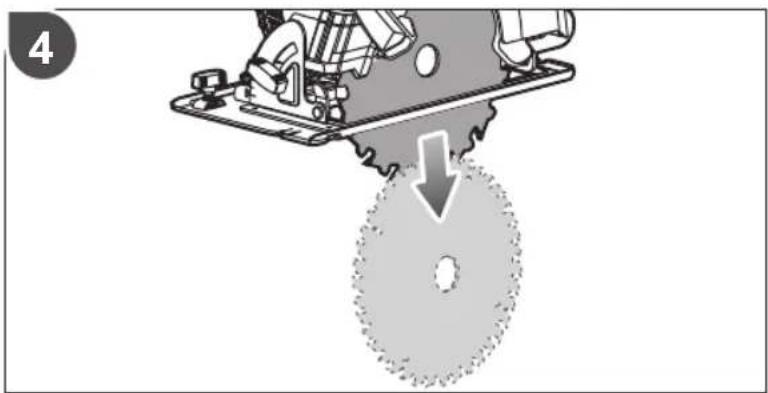

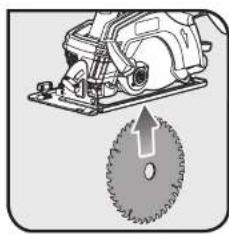
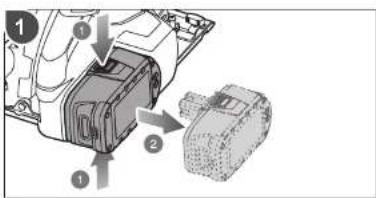
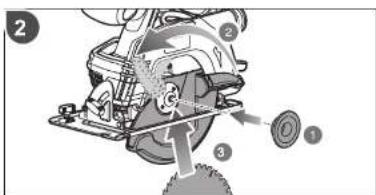
Maintenance
| English Français Deutsch | Español Italiano Nederlands Português | |||||
| Product specifications | Caractéristiques de l'appareil | Produkt-Spezifikationen | Especificaciones del producto | Specifiche prodotto Productspecificaties | Especificações do produto | |
| Cordless Circular Saw | Visseuse Scie Circulaire | Kabellose Akku-Kreissäge | Inalámbrico Sierra Circular | Senza Fili Sega Circolare | Snoerloze Cirkelzaagmachine | Sem Fios Serra Circular |
| Model | Modèle | Modell | Modelo | Modello | Model | Modelo |
| Voltage | Tension | Spannung | Tensión | Voltaggio | Spanning | Voltagem |
| Blade diameter | Diamètre du disque de coupe | Sägeblattdurchmesser | Diámetro de la hoja | Diametro lama | Zaagblad ø | Diâmetro da lâmina |
| Blade arbor | Arbre de Lame | Sägeblattspindel | Ranura de la cuchilla | Portalama | Asgat ø | Eixo da Lâmina |
| Cutting capacity at 0° | Profondeur de Coupe à 0° | Schnitttiefe bei 0° | Corte a 0° de profundidad | Profondità di taglio a 0° | Zaagdiepte bij 0° | Profundidade de Corte a 0° |
| Cutting capacity at 45° | Profondeur de Coupe à 45° | Schnitttiefe bei 45° | Corte a 45° de profundidad | Profondità di taglio a 45° | Zaagdiepte bij 45° | Profundidade de Corte a 45° |
| No-load speed | Vitesse à vide | Leerlaufdrehzahl | Velocidad sin carga | Velocità a vuoto | Onbelast toerental | Velocidade em vazio |
| Blade - width of cut | Lame - Largeur de coupe | Sägeblatt - Breite des Schnitts | Hoja - Ancho del corte | Lama - Ampiezza di taglio | Zaagblad - Maaibreedte | Lâmina - Largura do corte |
| Blade teeth | Nombre de dents | Sägezähne | Dientes de la hoja | Denti lame | Zaagbladtanden | Dentes da lâmina |
| Blade thickness | Epaisseur de la Lame | Sägeblatt Dicke | Grosor hoja | Spessore lama | Zaagbladdikte | Espessura lâmina |
| Weight (According to EPTA procedure 01/2014) | Poids - Selon la procédure EPTA 01/2014 | Gewicht - Gemäß EPTA-Verfahren 01/2014 | Peso - Según el procedimiento EPTA 01/2014 | Peso - Secondo quanto indicato dalla EPTA-Procedura 01/2014 | Gewicht - Overeenkomstig de EPTA-procedure 01/2014 | Peso - De acordo com o Procedimento EPTA 01/2014 |
| Weight - not incl. battery pack | Poids - sauf pack batterie | Gewicht - ohne Akkupack | Peso - Excluyendo conjunto de baterla | Peso - Senza gruppo batteria | Gewicht - exclusief accupack | Peso - excluindo conjunto de baterla |

| Čeština | Magyar | Română | Latviski | Lietuviškai | Eesti | Hrvatski |
| Technické údaje produktu | Termék műszaki adatai | Specificațiile produsului | Produkta specifikacijas | Gaminio techninės savybės | Toote tehnilised andmed | Specifikacije proizvoda |
| Bezdrátová Okružní Pila | Akkumulátoros Kõrfürész | Ferăstrău Circular La Fără Fir | Bezvada Ripzágis | Belaidis Diskinis Pjūklas | Juhtmeta Ketassaag | Bežična Cirkularna Pila |
| Model | Típus | Model | Modelis | Modelis | Mudeli tähis | Model |
| Elektrickė napětí | Feszültség | Tensiune | Spriegums | Jtampa | Pinge | Napon |
| Průměr kotouče | Tárcsa átmérője | Diametru lamă | Asmens diametrs | Pjovimo disko skersmuo | Saeketta lăbimõõt | Promjer rezne ploče |
| Hřídel kotouče | Fürészlap furata | Ax lamă | Asmens ass | Geležtės ašis | Lõiketera | Rezna ploča |
| Hloubka řezu při 0° | Vágási mélység 0°-nál | Adâncime de tăiere la 0° | Griešanas dzilums pie 0° | Pjovimo gylis 0° kampu | Lõikesügavus nurgal 0° | Dubina rezanja pri 0° |
| Hloubka řezu při 45° | Vágási mélység 45°-nál | Adâncime de tăiere la 45° | Griešanas dzilums pie 45° | Pjovimo gylis 45° kampu | Lõikesügavus nurgal 45° | Dubina rezanja pri 45° |
| Otäčky naprázdno | Üresjáratí fordulatszám | Viteză în gol | Apgriezieni bez slodzes | Greitis be apkrovimo | Kiirus ilma koormuseta | Brzina bez opterečenja |
| Pilový kotouč - Šířka řezu | Fürészlemez - Vágás szélessège | Lamă - Lățime a tăierii | Ripa - Griezuma platums | Geležtė - Pjovimo plotis | Saeketas - Lõikelaius | Oštrica - Širina reza |
| Zub kotouče | Fürészlap fogai | Dinte lamă | Asmens zobi | Geležtės dantukų skaičius | Lõiketera hammas | Zubi pile |
| Pilový kotouč Tloušťka | Vastagság Fürészlemez | Grosime Lamă | Ripa biezums | Geležtė storis | Saeketas paksus | Debljina Oštrica |
| Hmotnost - Dle protokolu EPTA 01/2014 | Tömeg - A 01/2014 EPTA-eljárás szerint | Greutate - Īn conformitate cu Procedura EPTA din 01/2014 | Svars - Saskaņa ar EPTA procedūru 01/2014 | Svoris - Pagal Europos elektrinių irankių asociacijos (EPTA) nustatytą tvarką 01/2014 | Mass - Vastavalt EPTA-protseduurile 01/2014 | Težina - Prema EPTA-postupku 01/2014 |
| Hmotnost - bez baterie | Tömeg - akkumulátor nélkül | Greutate - exclusiv acumulatorul | Svars - izņemot akumulatora iepakojumu | Svoris - nejskaitant baterijos paketo | Mass - välja arvatud akupakett | Težina - baterija nije uključena |

| Dansk Svenska Suomi Norsk Русский Polski | ||||||
| Produktspecifikationer | Produktspecifikationer Tuotteen tekniset tiedot Produktspesifikasjoner | Характеристики изделия | Parametry techniczne | |||
| Akku-Rundsav Sladdlös | Cirkelság | Johdoton Iskuporakone Pyörösaha | Johdoton Sirkelsag | Беспроводная Циркулярная пила | Akumulatorowa Pilarka Tarczowa | |
| Model | Modell | Malli | Modell | Модель | Model | R18CS |
| Spænding | Spänning | Jännite | Spenning | Напряжение | Napięcie | 18 V --- |
| Klingediameter Klingdiameter | Terän läp | mitta Bladdiameter | Диаметр режущего диска | Średnica tarczy tnącej | 165 mm | |
| Klingeholder | Sågklinga Terän varsi | Bladaksel | Шпиндель режущего диска | Trzpień tarczy tnącej | 16 mm | |
| Skæredybde ved 0° | Spårdjup vid 0° | Leikkuusyvyys kulmassa 0° | Skjæredybde ved 0° | Глубина резания при 0° | Głębokość cięcia dla kąta 0° | 52 mm |
| Skæredybde ved 45° Spårdjup vid 45° | Skårdjup vid 45° | Leikkuusyvyys kulmassa 45° | Skjæredybde ved 45° | Глубина резания при 45° | Głębokość cięcia dla kąta 45° | 36 mm |
| Tomgangshastighed | Tomgångshastighet | Tyhjäkäyntinopeus | Hastighet ubelastet | Скорость на холостом ходу | Prędkość bez obciążenia | 4,700 min -1 |
| Klinge - Snitbredde Sågklinga - Skärbredd | Terä - Leikkauksen leveys | Blad - Bredde på kappet | Лезвие - Ширина разреза | Tarcza - Szerokość cięcia | 1,6 mm | |
| Klingetænder | Sågtand | Terän hampaat | Bladtenner | Число зубьев | Liczba zębów tarczy | 24 T |
| Klingetykkelse | Sågklingatjocklek | Teräpaksuus | Blad tykkelse | Толщина Лезви | Grubość Tarcza | 1,0 mm |
| Vægt - I henhold til EPTA-procedure 01/2014 | Vikt - Enligt EPTA 01/2014 | Paino - EPTA- menetelmän 01/2014 mukaan | Vekt - I henhold til EPTA-prosedyre 01/2014 | Вес - Соответствует требованиям EPTA-Procedure 01/2014 | Waga - Zgodnie z procedurą EPTA 01/2014 | 2,7 kg (1,5 Ah) – 3,5 kg (9,0 Ah) |
| Vægt - Batteri medfölger ikke | Vikt - Batteri medföljer ej | Paino - ilman akkua | Vekt - uten batteripakke | Вес - без аккумуляторной батареи | Waga - bez akumulatora | 2,4 kg |

The vibration emission level given in this information sheet has been measured in accordance with a standardised test given in EN 62841 and may be used to compare one tool with another. It may be used for a preliminary assessment of exposure. The declared vibration emission level represents the main applications of the tool. However if the tool is used for different applications, with different accessories or poorly maintained, the vibration emission may differ. This may significantly increase the exposure level over the total working period.
An estimation of the level of exposure to vibration should also take into account the times when the tool is switched off or when it is running but not actually doing the job. This may significantly reduce the exposure level over the total working period. Identify additional safety measures to protect the operator from the effects of vibration such as: maintain the tool and the accessories, keep the hands warm, organisation of work patterns.
FR AVERTISSEMENT
In addition to any statutory rights resulting from the purchase, this product is covered by a warranty as stated below.
- The warranty period is 24 months for consumers and commences on the date the product was purchased. This date has to be documented by an invoice or other proof of purchase. The product is designed and dedicated to consumer and private use only. So there is no warranty provided in case of professional or commercial use. This warranty applies only on new products.
- There is a possibility to extend for a part of the range of power (AC/DC) the warranty period over the period described above using the registration on the www.ryobitools.eu website. The eligibility of products for extended warranty is clearly displayed in stores and / or on packaging and is contained within the product documentation. The end user is required to register his/her newly-acquired products online within 30 days from the date of purchase. The end user may register for the extended warranty in his/her country of residence if listed on the online registration form where this option is valid. Furthermore, end users must give their consent to the storage of their personal data that is required to be entered online. They must also accept the terms and conditions. The registration confirmation receipt, which is sent out by e-mail, and the original invoice showing the date of purchase will serve as proof of the extended warranty.
- The warranty covers all defects of the product during the warranty period due to faults in workmanship or material at the purchase date warranty is limited to repair and/or replacement and does not include any other obligations including but not limited to incidental or consequential damages. The warranty is not valid if the product has been misused, used contrary to the instruction manual, or has been incorrectly connected to a power supply. This warranty does not apply to:
– any damage to the product that is the result of improper or lack of maintenance
—any product that has been altered or modified
– any product where original identification (trade mark, serial number) markings have been defaced, altered or removed
– any damage caused by non-observance of the instruction manual
– any product not displaying the CE approval mark on the rating plate
– any product that has been attempted to be repaired by a non-authorised warranty service centre or without prior authorisation by Techtronic Industries
– any product connected to improper power supply (amps, voltage, frequency)
– any damage caused by external influences (water, chemical, physical, shocks) or foreign substances
– normal wear and tear spare parts
– inappropriate use, overloading of the tool
– use of non-approved accessories or parts
- Power tool accessories provided with the tool or purchased separately, including but not limited to screw driver bits, drill bits, abrasive discs, sand paper and blades, lateral guide, etc.
- Components (parts and accessories) subject to natural wear and tear, including but not limited to service & maintenance kits, carbon brushes, bearings, chuck, SDS drill bit attachment or reception, power cord, auxiliary handle, transport carry case, sanding plate, dust bag, dust exhaust tube, felt washers, impact wrench pins & springs, etc.
- For servicing, the product must be sent or presented to a RYOBI authorised service station listed for each country in the following list of service station addresses. In some countries your local RYOBI dealer undertakes to send the product to the RYOBI service organisation. When sending a product to a RYOBI service station, the product should be safely packed without any dangerous contents such as petrol, marked with sender's address and accompanied by a short description of the fault.
- A repair / replacement under this warranty is free of charge. It does not constitute an extension or a new start of the warranty period. Exchanged parts or products become our property. In some countries delivery charges or postage will have to be paid by the sender. Your statutory rights arising from the purchase of the product remain unaffected
- This warranty is valid in the European Community, Switzerland, Iceland, Norway, Liechtenstein, Turkey and Russia. Outside these areas, please 6. contact your authorised RYOBI dealer to determine if another warranty applies.
AUTHORISED SERVICE CENTRE
To find an authorised service centre near you, visit http://uk.ryobitools.e header/service-and-support/service-agents
FR RYOBI® CONDITIONS D'APPLICATION DE LA GARANTIE
EN DECLARATION OF CONFORMITY
Techtronic Industries GmbH
Max-Eyth-Straße 10, 71364 Winnenden, Germany
Herewith we declare that the product
Cordless Circular Saw
Brand: RYOBI
Model number: R18CS
Serial number range: 44442504000001 - 44442504999999
is in conformity with the following European Directives and harmonised standards 2006/42/EC, 2014/30/EU, 2011/65/EU,
EN 55014-1:2017, EN 55014-2:2015, EN 62841-1:2015, EN 62841-2-5:2014
RoHS documentation is compiled according to EN 50581:2012
CE
Todd Chipner
Sr. Director, Regulatory & Safety
Winnenden, Oct. 30, 2018
Authorised to compile the technical file:
Alexander Krug, Managing Director
Techtronic Industries GmbH
Max-Eyth-Straße 10, 71364 Winnenden, Germany
FR DÉCLARATION DE CONFORMITÉ
Techtronic Industries GmbH
Max-Eyth-Straße 10, 71364 Winnenden, Germany
Winnenden, Oct. 30, 2018
Max-Eyth-Straße 10, 71364 Winnenden, Germany
Max-Eyth-Straße 10, 71364 Winnenden, Germany
Winnenden, Oct. 30, 2018
Max-Eyth-Straße 10, 71364 Winnenden, Germany
Max-Eyth-Straße 10, 71364 Winnenden, Germany
Winnenden, Oct. 30, 2018
Max-Eyth-Straße 10, 71364 Winnenden, Germany
Max-Eyth-Straße 10, 71364 Winnenden, Germany
Winnenden, Oct. 30, 2018
Max-Eyth-Straße 10, 71364 Winnenden, Germany
NL CONFORMITEITSVERKLARING
Techtronic Industries GmbH
Max-Eyth-Straße 10, 71364 Winnenden, Germany
Winnenden, Oct. 30, 2018
Max-Eyth-Straße 10, 71364 Winnenden, Germany

Max-Eyth-Straße 10, 71364 Winnenden, Germany
Winnenden, Oct. 30, 2018
Max-Eyth-Straße 10, 71364 Winnenden, Germany
DA OVERENSSTEMMELSESERKLÆRING
Techtronic Industries GmbH
Max-Eyth-Straße 10, 71364 Winnenden, Germany
Vi erklærer hermed, at produktet
Akku-Rundsav
Brand: RYOBI
Modelnummer: R18CS
Serienummerområde: 44442504000001 - 44442504999999
Winnenden, Oct. 30, 2018
Max-Eyth-Straße 10, 71364 Winnenden, Germany
SV KONFORMITETSDEKLARATION
Techtronic Industries GmbH
Max-Eyth-Straße 10, 71364 Winnenden, Germany
Winnenden, Oct. 30, 2018
Max-Eyth-Straße 10, 71364 Winnenden, Germany
FI SÄÄNNÖSTEN NOUDATTAMINEN
Techtronic Industries GmbH
Max-Eyth-Straße 10, 71364 Winnenden, Germany
Winnenden, Oct. 30, 2018
Max-Eyth-Straße 10, 71364 Winnenden, Germany
NO SAMSVARSERKLÆRING
Techtronic Industries GmbH
Max-Eyth-Straße 10, 71364 Winnenden, Germany
Winnenden, Oct. 30, 2018
Max-Eyth-Straße 10, 71364 Winnenden, Germany
Max-Eyth-Straße 10, 71364 Winnenden, Germany
Winnenden, Oct. 30, 2018
Max-Eyth-Straße 10, 71364 Winnenden, Germany

PL DEKLARACJA ZGODNOŚCI
Techtronic Industries GmbH
Max-Eyth-Straße 10, 71364 Winnenden, Germany
Winnenden, Oct. 30, 2018
Max-Eyth-Straße 10, 71364 Winnenden, Germany
CS PROHLÁŠENÍ O SHODĚ
Techtronic Industries GmbH
Max-Eyth-Straße 10, 71364 Winnenden, Germany
Winnenden, Oct. 30, 2018
Max-Eyth-Straße 10, 71364 Winnenden, Germany
HU MEGFELELŐSÉGI NYILATKOZAT
Techtronic Industries GmbH
Max-Eyth-Straße 10, 71364 Winnenden, Germany
Winnenden, Oct. 30, 2018
Max-Eyth-Straße 10, 71364 Winnenden, Germany
RO DECLARATIE DE CONFORMITATE
Techtronic Industries GmbH
Max-Eyth-Straße 10, 71364 Winnenden, Germany
Winnenden, Oct. 30, 2018
Alexander Krug, Director general
Techtronic Industries GmbH
Max-Eyth-Straße 10, 71364 Winnenden, Germany
LV ATBILSTĪBAS DEKLARĀCIJA
Techtronic Industries GmbH
Max-Eyth-Straße 10, 71364 Winnenden, Germany
Winnenden, Oct. 30, 2018
Max-Eyth-Straße 10, 71364 Winnenden, Germany
LT ATITIKTIES PAREIŠKIMAS
Techtronic Industries GmbH
Max-Eyth-Straße 10, 71364 Winnenden, Germany
Winnenden, Oct. 30, 2018
Max-Eyth-Straße 10, 71364 Winnenden, Germany

ET VASTAVUSDEKLARATSIOON
Techtronic Industries GmbH
Max-Eyth-Straße 10, 71364 Winnenden, Germany
Kinnitame, et see toode
Juhtmeta Ketassaag
Mark: RYOBI
Mudeli number: R18CS
Seerianumbri vahemik: 44442504000001 - 44442504999999
Winnenden, Oct. 30, 2018
Max-Eyth-Straße 10, 71364 Winnenden, Germany
HR IZJAVA O USKLAĐENOSTI
Techtronic Industries GmbH
Max-Eyth-Straße 10, 71364 Winnenden, Germany
Winnenden, Oct. 30, 2018
Max-Eyth-Straße 10, 71364 Winnenden, Germany
SL IZJAVA O SKLADNOSTI
Techtronic Industries GmbH
Max-Eyth-Straße 10, 71364 Winnenden, Germany
Winnenden, Oct. 30, 2018
Max-Eyth-Straße 10, 71364 Winnenden, Germany
SK PREHLÁSENIE O ZHODE
Techtronic Industries GmbH
Max-Eyth-Straße 10, 71364 Winnenden, Germany
Winnenden, Oct. 30, 2018
Max-Eyth-Straße 10, 71364 Winnenden, Germany
Max-Eyth-Straße 10, 71364 Winnenden, Germany
Winnenden, Oct. 30, 2018
Max-Eyth-Straße 10, 71364 Winnenden, Germany
Max-Eyth-Straße 10, 71364 Winnenden, Germany
Winnenden, Oct. 30, 2018
Max-Eyth-Straße 10, 71364 Winnenden, Germany

TR UYGUNLUK BEYANI
Techtronic Industries GmbH
Max-Eyth-Straße 10, 71364 Winnenden, Germany
Winnenden, Oct. 30, 2018
Max-Eyth-Straße 10, 71364 Winnenden, Germany
Max-Eyth-Straße 10, 71364 Winnenden, Germany
Winnenden, Oct. 30, 2018
Max-Eyth-Straße 10, 71364 Winnenden, Germany
EN RYOBI is a trademark of Ryobi Limited, and is used under license.
71364 Winnenden, Germany
961075492-01




- INTENDED USE
- WARNING
- CIRCULAR SAW SAFETY WARNINGS
- DANGER
- KICKBACK CAUSES AND RELATED WARNINGS
- LOWER GUARD FUNCTION
- ADDITIONAL SAFETY WARNINGS
- ADDITIONAL BATTERY SAFETY WARNINGS
- TRANSPORTING LITHIUM BATTERIES
- RESIDUAL RISKS
- ENGLISH
- RISK REDUCTION
- KNOW YOUR PRODUCT
- MAINTENANCE
- ENVIRONMENTAL PROTECTION
- SYMBOLS
- MACHEN SIE SICH MIT IHREM PRODUKT VERTRAUT
- DODATNA VARNOSTNA OPOZORILA
- OBOZNÁMTE SA S VAŠÍM PRODUKTOM
- FR AVERTISSEMENT
- AUTHORISED SERVICE CENTRE
- FR RYOBI® CONDITIONS D'APPLICATION DE LA GARANTIE
- EN DECLARATION OF CONFORMITY
- FR DÉCLARATION DE CONFORMITÉ
- NL CONFORMITEITSVERKLARING
- DA OVERENSSTEMMELSESERKLÆRING
- SV KONFORMITETSDEKLARATION
- FI SÄÄNNÖSTEN NOUDATTAMINEN
- NO SAMSVARSERKLÆRING
- PL DEKLARACJA ZGODNOŚCI
- CS PROHLÁŠENÍ O SHODĚ
- HU MEGFELELŐSÉGI NYILATKOZAT
- RO DECLARATIE DE CONFORMITATE
- LV ATBILSTĪBAS DEKLARĀCIJA
- LT ATITIKTIES PAREIŠKIMAS
- ET VASTAVUSDEKLARATSIOON
- HR IZJAVA O USKLAĐENOSTI
- SL IZJAVA O SKLADNOSTI
- SK PREHLÁSENIE O ZHODE
- TR UYGUNLUK BEYANI
Brand : RYOBI
Model : One+ R18JSCS
Category : Electric saw