
Heat X345 - Barbecue Outdoorchef - Free user manual and instructions
Find the device manual for free Heat X345 Outdoorchef in PDF.



| Product Type | Gas Barbecue |
| Brand | Outdoorchef |
| Model | Heat X345 |
| Fuel | Butane (G30) or propane (G31) |
| Total Power | 23.50 kW (Hs) |
| Gas Consumption | 1644 g/h |
| Main Burners | 2 stainless steel Twin Burners |
| Rear Burner | Yes, 4.40 kW |
| Blazing Zone | Infrared burner, 3.60 kW |
| Cooking Zone | Height-adjustable cast iron plate, 2.90 kW |
| Ignition | Electric (battery) |
| Battery | 10,000 mAh, 5V/2.1A, rechargeable |
| Safety | Safety Light: gas opening reminder |
| Ambient Lighting | LED, adjustable color |
| Cooking Grates | Cast iron, with protective patina |
| Cooking Methods | Direct, indirect, low & slow, rotisserie (accessory) |
| Storage | Low cabinet for gas bottle and accessories |
| Mobility | Wheels with brakes |
| Maintenance | Regular cleaning of grease receptacles and burners |
| Warranty | See General Terms and Conditions of Sale on outdoorchef.com |
| Spare Parts | Available on outdoorchef.com |
| Use | Outdoor only |
| Standards | CE 0063 DP 3432 |
Frequently Asked Questions - Heat X345 Outdoorchef
User questions about Heat X345 Outdoorchef
0 question about this device. Answer the ones you know or ask your own.
Ask a new question about this device
Download the instructions for your Barbecue in PDF format for free! Find your manual Heat X345 - Outdoorchef and take your electronic device back in hand. On this page are published all the documents necessary for the use of your device. Heat X345 by Outdoorchef.
USER MANUAL Heat X345 Outdoorchef
Please read these instructions carefully before using your OUTDOORCHEF gas kettle barbecue.

INSTRUCTIONS FOR USE
L83/P (50 mbar) Butane / Propane 50 mbar
Gas output 23.50 kW Hs
EB/P (30 mbar) Butane / Propane 30 mbar
L3P5pB) Butane / Propane 5 mbar
Gas output 27.70 kW Hs
L33/P (50 mbar) Butane / Propane 50 mbar
2.1 Storage of the User Guide
- IMPORTANT SAFETY INFORMATION 33
3.1 Installation and assembly 3.2 Operation 3.3 Storage and/or non-use
5.1 Connecting the gas hose 5.2 Leak test
6.1 Master switch 6.2 Control dial 6.3 Ambient lighting
- BEFORE FIRST USE 39
- BARBECUE CHAMBER 39
8.1 Twin Burners 8.2 Heat Regulator 8.3 Operating the barbecue chamber
8.3.2
Instructions for lighting
8.3.2
Before barbecuing
8.3.3
After barbecuing
8.4 Cleaning and maintenance of the barbecue chamber
8.4.1
8.4. Cleaning and maintenance of the barbecue chamber
8.4.2
Maintenance
8.4.2
Maintenance
8.5 Direct and indirect barbecuing method with the HEAT 8.6 Barbecuing in two barbecue chambers
- REAR BURNER
44
9.1 Heat radiation from behind 9.2 Operating the rear burner
9.2.1
Instructions for lighting
9.2.2
Before barbecuing
9.2.3
After barbecuing
9.3 Cleaning and maintenance of the rear burner
9.3.1
Cleaning
9.3.2
Maintenance
10. BLAZING ZONE
46
10.1 Infrared burner 10.2 Operating the Blazing Zone
10.2.1 Instructions for lighting 10.2.2 Before barbecuing 10.2.3 After barbecuing
10.3 Cleaning and maintenance of the BLAZING ZONE
10.3.1 Cleaning 10.3.2 Maintenance
11. COOKING ZONE 49
11.1 Three application areas 11.2 Operating the Cooking Zone
11.2.1 Instructions for lighting 11.2.2 Before cooking 11.2.3 After cooking
11.3 Cleaning and maintenance of the Cooking ZONE
11.3.1 Cleaning 11.3.2 Maintenance
12. SAFETY LIGHT 51
13. POWER BANK 52
14. HEAT STORAGE SPACE 52
15. MOVING AND MANOEUVRING THE HEAT 52
16. NOTES ON THE CAST-IRON BARBECUE GRIDS 53
17. TROUBLESHOOTING 53
18. CONSUMER WARRANTY/GUARANTEE 54
19. REPLACEMENT PARTS 54
20. WASTE DISPOSAL 54
21. TECHNICAL INFORMATION 55
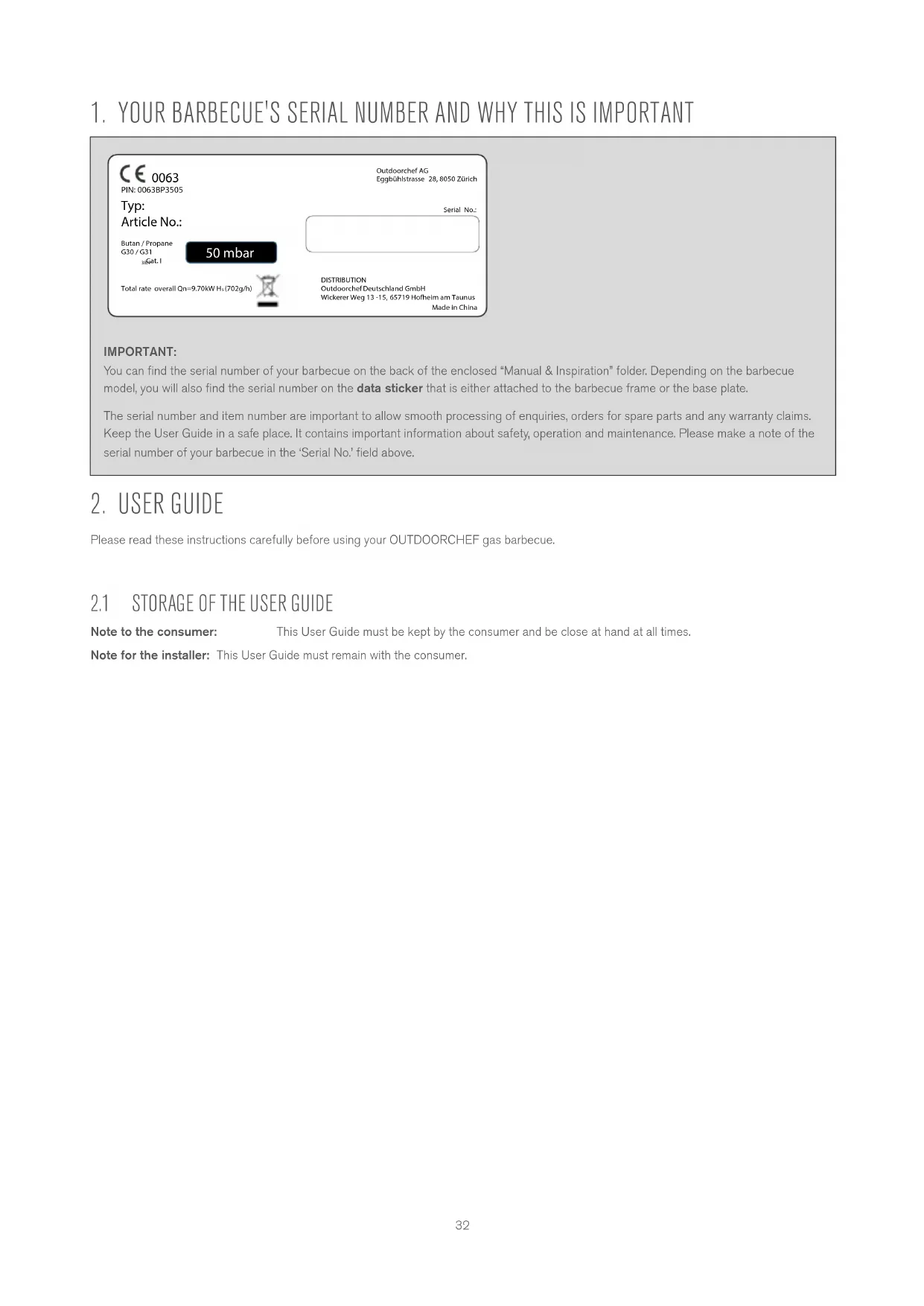
1. YOUR BARBECUE'S SERIAL NUMBER AND WHY THIS IS IMPORTANT
PIN:0063BP3505
Typ:
Article No.:
Butan /Propane
G30/G41
50 mbar

Outdoorchef AG
Eggbuhlstrasse 28, 8050 Zurich
Serial No.:
Total rate overall: 9.70 kW (702 g/h)
DISTRIBUTION
You can find the serial number of your barbecue on the back of the enclosed "Manual & Inspiration" folder. Depending on the barbecue model, you will also find the serial number on the data sticker that is either attached to the barbecue frame or the base plate.
The serial number and item number are important to allow smooth processing of enquiries, orders for spare parts and any warranty claims. Keep the User Guide in a safe place. It contains important information about safety, operation and maintenance. Please make a note of the serial number of your barbecue in the 'Serial No.' field above.
2. USER GUIDE
Please read these instructions carefully before using your OUTDOORCHEF gas barbecue.
2.1 STORAGE OF THE USER GUIDE
Note to the consumer:
This User Guide must be kept by the consumer and be close at hand at all times.
Note for the installer: This User Guide must remain with the consumer.
3. IMPORTANT SAFETY INFORMATION
Please read this user guide carefully before using your OUTDOORCHEF gas barbecue. Use outdoors only.
DANGER, WARNING, and CAUTION notes are provided in this user guide to highlight important and critical usage information. Please read and follow these instructions to ensure safety and to avoid damage to property and personal injury.
DANGER: Indicates dangerous situations resulting in death or serious injury if these instructions are not observed. WARNING: Indicates dangerous situations potentially resulting in death or serious injury if these instructions are not observed. CAUTION: Indicates dangerous situations potentially resulting in minor or moderate injuries if these instructions are not observed.
DANGER
If you smell gas:
- Disconnect the gas supply to the barbecue.
- Extinguish all open flames.
- Open the lid.
- If you still smell gas, move away from the barbecue and contact the fire services immediately.
WARNING
- Do not keep flammable liquids, materials and/or gases (petrol, gas, highly flammable material, etc.) in the immediate vicinity of your barbecue.
- Never store an unused gas bottle near the barbecue or in closed rooms.
3.1 INSTALLATION AND ASSEMBLY
Read the instructions before using the appliance.
Select a location that is as sheltered as possible from the wind before lighting the barbecue.
DANGER: This barbecue is not suitable for installation in or on boats or caravans. WARNING: The barbecue is supplied with the appropriate gas hose and gas pressure regulator. It is essential to keep the gas hose away from the hot outside surfaces of the barbecue. The hose must not be twisted. On barbecue models that have a hose guide, it is essential for the hose to be secured in this guide. WARNING: The hose and regulator correspond to the respective national regulations and the EN standards and BS standard (gas pressure regulator BS EN 16129/gas hose BS EN 16436/gas pressure regulator EN 16129/gas hose EN 16436). WARNING: Do not modify the appliance. Contact a specialist if you suspect there is a malfunction. WARNING: Before first use and always after connecting a new gas bottle, check the connection parts in accordance with the instructions below in the LEAK TEST section of this operating manual.
3.2 OPERATION
Anyone who operates the barbecue must know and follow the ignition process precisely. Children must not be allowed to use the barbecue.
Follow the assembly instructions exactly. Incorrect assembly can have dangerous consequences.
Do not position any flammable liquids, materials or spare gas bottles in the vicinity of the barbecue. Never set up the barbecue or the gas bottle(s) in enclosed rooms without ventilation.
Please read these instructions carefully before using your OUTDOORCHEF gas barbecue. The barbecue is for outdoor use only. Make sure that your barbecue is positioned in front of a non-combustible rear wall or at least 1.5 metres away from combustible objects.
DANGER: Only use the barbecue outdoors. Never use indoors, e.g. in garages, buildings, tents and other enclosed areas or under flammable constructions.
DANGER: Never use the barbecue under a canopy. DANGER: This appliance must be kept away from flammable materials during use. DANGER: Only use the barbecue on firm, secure ground. Never place the barbecue on wooden floors or other flammable surfaces while it is in use. Keep the barbecue away from flammable materials. DANGER: Turn off the gas supply at the gas bottle after use. DANGER: After grilling, always turn the gas regulating knob to the position and close the gas supply at the gas bottle. DANGER: When changing the gas bottle, make sure that the gas regulating knob is in the position and the gas supply is closed at the gas bottle. Ensure that there are no ignition sources in the vicinity of the barbecue. WARNING: Renew the hose and the gas pressure regulator after a usage period of 3 years from the purchase date. Make sure that the gas pressure regulator and hose comply with the corresponding EN standards and BS standards (gas pressure regulator BS EN 16129/gas hose BS EN 16436/gas pressure regulator EN 16129/gas hose EN 16436). WARNING: Replace the gas hose immediately if it is damaged or displays signs of wear. The hose must be free from kinks and must not have any cracks. Do not forget to switch off the gas regulating knob and the gas supply before you remove the hose. WARNING: If you suspect that parts are leaking, turn the gas regulating knob to the 0 position and close the gas supply at the gas bottle. Have the parts that carry gas checked at a specialist gas equipment retailer. WARNING: Never leave the barbecue unsupervised during operation. WARNING: Do not move the appliance during use. WARNING: Fat residues in the drip pans may ignite and cause a fire.
These must be cleaned after each use.
WARNING: Never block the large air intake hole on the base of the bowl or the air slots in the lid. The ventilation openings in the gas bottle compartment must never be closed or covered. WARNING: Never cover the surfaces of the BLAZING and COOKING ZONE during operation as this can lead to a build-up of heat. WARNING: Never place cooking pots, pans or griddle plates on the BLAZING ZONE, these may only be placed on the COOKING ZONE. WARNING: Never bring the power bank into contact with flames or high temperatures. CAUTION: The recommended length of the gas hose is 90 cm and it must not be longer than 150 cm. CAUTION: Accessible parts may be very hot. Keep children away. Caution: The barbecue remains hot for quite some time after being switched off. Make sure you do not burn yourself or place any objects on the barbecue due to the danger of burns. CAUTION: Wear protective gloves when touching hot parts. CAUTION: Contact a specialist gas equipment retailer if full power is not achieved and you suspect there may be a blockage in the gas supply. CAUTION: Appliances with castor wheels must not be pushed across uneven ground or steps. CAUTION: Never place hot objects such as barbecue grids, barbecue pans and cast-iron pans on the shelf or preparation surfaces of your barbecue. This could damage the varnish or paintwork on your barbecue. CAUTION: Do not place any flammable objects in the immediate vicinity of the grill chamber.
3.3 STORAGE AND/OR NON-USE
DANGER: Do not store the barbecue in the vicinity of highly inflammable liquids or materials. DANGER: If you store the barbecue indoors over winter, it is essential for the gas bottle to be removed. It should always be stored outdoors in a well ventilated location which is inaccessible to children. CAUTION: When the barbecue is not in use, and once it has cooled down fully, protect it against weather damage by using a cover. Covers can be purchased from your barbecue retailer. CAUTION: To avoid condensation build-up, remove the cover after heavy rain and allow the barbecue to dry.
4. GAS BOTTLES
Only gas bottles up to a maximum net weight of 11 kg may be placed on the base plate. Position the bottle in the space provided.

- Make sure there are no leaking screw connections.
- Carry out the LEAK TEST before use and after each gas bottle change. Gas bottles must not be exposed to temperatures exceeding 50°C, and must never be stored in an enclosed room or basement.
- Read and follow the safety instructions on the gas bottles being used. NOTE: Check whether the pressure regulator and gas bottle are approved for use in your country. Use only gas bottles that comply with the applicable national standard. The different sealing systems mean that any discrepancy in the pressure regulator and gas bottle systems will prevent the secure closure of the seal. This could result in a leakage of gas, which could then be ignited by an open fire or a spark. For safety and liability reasons, in all cases we recommend checking gas barbecues intended for sale and, if required, adapting the pressure regulator and gas hose in accordance with national regulations, or arranging for this work to be performed.
5. FIRST USE OF THE BARBECUE
5.1 CONNECTING THE GAS HOSE
WARNING:
Always use the spanner supplied to attach the gas hose to ensure the connection is sufficiently secure. For your safety, never tighten the gas hose by hand to avoid any risk of barbecue fires.

Please refer also to the information in the separate assembly instructions for your barbecue.
5.2 LEAK TEST
WARNING: Ensure that no ignition sources are in the vicinity during the leak test. This also includes smoking.
Never check for leaks with a burning match or a naked flame, and always do this task outdoors.
WARNING: Carry out the LEAK TEST each time the gas bottle is connected or changed, and also at the start of the barbecue season. WARNING: Do not use the barbecue until all leaks have been eliminated.
- The gas regulating knob must be in the OFF position.
- Open the gas supply on the bottle and brush the soap-water solution provided or a home-made soap solution comprising 50% liquid soap and 50% water onto all parts that carry gas (connection at the gas bottle / gas pressure regulator / gas hose / gas inlet / connection on the valve). You can also use a leak spray.
- Bubbles forming in the soap solution indicate that there are leaks. Turn off the gas supply at the gas bottle.
- Eliminate the leaks by re-tightening the connections if possible, or else renew the defective parts.
- Repeat steps 1 and 2.
- Contact your specialist gas equipment retailer if the leaks cannot be eliminated.

The master switch for the power supply to the ignition and lighting is located on the inside left of the floor unit.
The button lights up green in the ON position. After barbecuing, switch the switch back to OFF to protect the power bank.

6.2 CONTROL DIAL
Heat settings/heat levels and Ignition
O: Off position; : Low power; : Medium power; : High power; : Ignition; : Igniter

The control dial reaches its highest power at the setting and its lowest power at the setting
6.3 AMBIENT LIGHTING
The desired light colour can be defined using the button on the bottom left of the front panel. Press the button for a few seconds to activate the light and then click to select your desired light colour.

7. BEFORE FIRST USE
- Clean all parts that come into contact with food.
- Check all parts that carry gas, as described in the LEAK TEST section. Do this even if your barbecue was delivered already assembled by the retailer.
- Let each burner burn separately for about 20-25 minutes at the setting
WARNING:
Never use all of the burners at the same time. Using all of the burners at full load can cause the gas bottle to freeze and thus impair its function.
8. BARBECUE CHAMBER
8.1 TWIN BURNERS
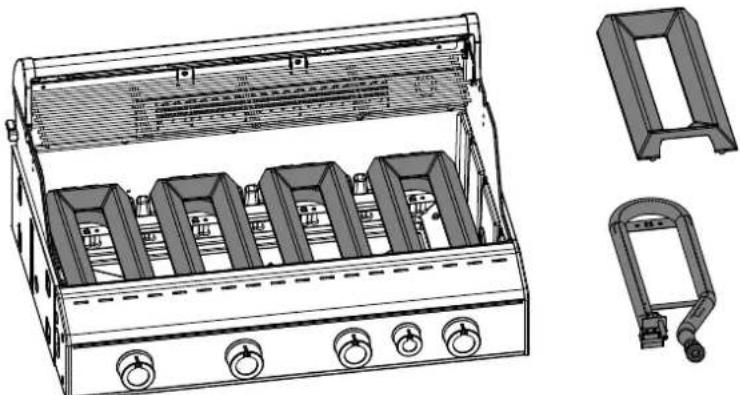
The stainless steel Twin Burners with electric one-touch ignition ensure a wider temperature application range compared to conventional burners. The stainless steel flame shields reduce flare-ups and ensure even heat distribution.
8.2. HEAT REGULATOR
With the Heat Regulator, the temperature on the barbecue grid and warming rack can be adjusted even more precisely.
Slow roasting
When the Heat Regulator is open and the burner is set accordingly, slow roasting is also possible with your HEAT.
Keeping food warm
Use the Heat Regulator to adjust the temperature of the warming rack and prevent your food from continuing to cook.
NOTE: Protect the Heat Regulator with a cover to prevent water from entering your barbecue chamber.

WARNING: Never ignite the barbecue when the lid is closed.
- Make sure that all connections between the gas hose, the gas pressure regulator and the gas bottle are firmly tightened (as described in the LEAK TEST section).
- Open the barbecue lid.
- Open the gas supply at the gas bottle.
- Press the gas regulating knob of the selected burner and turn it anticlockwise to the setting. Hold the gas regulating knob down until the gas is burning.

- If the gas does not ignite within 8 seconds, set the gas regulating knob to the off position. Wait 2 minutes to allow the uncombusted gas to dissipate. Then repeat step 4.
- If it is not possible to light the barbecue after 3 attempts, look for the causes (as described in the TROUBLESHOOTING section).
- Preheat the barbecue with the lid closed for about 10-15 minutes at the maximum setting.
- Place the food to be grilled on the barbecue grid and freely control the temperature between 100°C and 250°C according to your requirements.
8.3.3 AFTER BARBECUING
- Set the gas regulating knob for each burner to the off position.
- Turn off the gas supply at the gas bottle.
The bottle tap must be closed even on empty bottles.
- Allow the barbecue to cool down fully and clean it.
- Protect the barbecue with the corresponding cover.
8.4. CLEANING AND MAINTENANCE OF THE BARBECUE CHAMBER
8.4.1 CLEANING
WARNING: When cleaning inside the barbecue around the burner system, take care not to damage any components of the burners.
CLEANING THE OUTSIDE OF THE BARBECUE
NOTE: Never use glass cleaner or other cleaning sprays to clean the barbecue as these can damage the surfaces.
Clean the outside of the barbecue and shelf surfaces using only conventional non-aggressive cleaning agents (e.g. standard washing-up liquid). In the case of special barbecue cleaners (not recommended), we recommend testing the product first on a concealed area.
CLEANING THE INSIDE OF THE BARBECUE
NOTE: When cleaning with a nylon barbecue brush always make sure that the barbecue has cooled down completely.
Recommended cleaning for heavier soiling:
- Heat the barbecue for around 10 minutes at full power to burn off food residue (residue from meat, fat, sugar from marinades, etc.).
- Allow the barbecue to cool completely to allow all food residue to solidify/harden (this allows easier and more effective cleaning)
- Clean the barbecue grid using an OUTDOORCHEF nylon or brass barbecue brush for optimum results (do not use a brush with steel bristles).
- Remove the barbecue grid and clean the burning chamber. Alternatively, you can use a nylon kitchen sponge and soapy water in order to remove all loose residues. For thorough cleaning, we recommend the OUTDOORCHEF barbecue and cold smoke generator cleaner.
- You can clean the stainless-steel components with a conventional stainless-steel cleaner or a polishing sponge available in DIY stores.
NOTE: We recommend regular cleaning to avoid incrustations and flare-ups.
TIP: Preparation for the next barbecue starts straight away because if you clean the barbecue grid after each use, this will save you having to do this before your next barbecue.
CLEANING THE DRIP PAN
WARNING: Neglecting to clean the drip pans can lead to flare-ups.
Check the drip pans after each use and remove any fat residue.
TIP: The perfect accessory for the collecting tray is the OUTDOORCHEF Grill Powder.
This absorbs dripping fat and allows easy disposal.

8.4.2 MAINTENANCE
Regular maintenance of your barbecue will ensure it functions correctly.
At least twice a year, check all parts that carry gas; also check them after extended periods of storage. Spiders or insects can cause blockages that must be cleared before use. - If the barbecue is regularly pushed across uneven ground, check from time to time whether all screws are still tight. If you have not used the barbecue for a long period, you should carry out a LEAK TEST before using it again. If you have any doubts, please contact your gas supplier or the retailer. - To prevent damage due to corrosion, oil all metal parts before long storage periods. - Following long storage periods, and at least once a year during the barbecue season, you should check the gas hose for cracks, kinks and other damage. A damaged gas hose must be replaced immediately, as described in the SAFETY NOTES section. To allow you to enjoy using your barbecue for as long as possible, protect it from the effects of the weather using a suitable OUTDOORCHEF cover once it has cooled down completely. - Remove the cover after any rain in order to prevent condensation build-up. Covers can be purchased from your barbecue retailer. The soft-close function of the doors must be adjusted from time to time

8.5 DIRECT AND INDIRECT BARBECUING METHOD WITH THE HEAT
WHAT IS THE DIFFERENCE?
DIRECT BARBECUING METHOD
As the name says, the food to be barbecued is placed directly above the heat source when using the direct barbecuing method. This method is ideal for flash-grilling meat. The high temperature enables a nice crust or a perfect seared pattern on the steak.
INDIRECT BARBECUING METHOD
With indirect grilling the heat circulates around the food to be grilled. The closed lid turns the barbecue into a convection oven. This barbecuing method is ideal for cooking large pieces of meat at low temperatures or gently cooking fish. The "low&slow" barbecuing method for dishes such as pulled pork, ribs or brisket is based on indirect barbecuing
The HEAT barbecuing system lets you switch from using direct to indirect heat in the blink of an eye.
For indirect barbecuing, cooking and baking, place the food to be barbecued in the middle of the grate and only ignite the two outer burners.
DIRECT HEAT INDIRECT HEAT
For direct grilling and cooking: Place the food to be grilled above the ignited burners.
For indirect grilling, cooking and baking: Place the food to be grilled in the middle, close the lid and ignite only the two outer burners.
8.6 BARBECUING IN TWO BARBECUE CHAMBERS
In addition to traditional barbecuing methods (see chapter DIRECT AND INDIRECT BARBECUING METHODS), the HEAT also offers unique barbecuing in two barbecue chambers.
The OUTDOORCHEF Zone Divider HEAT (available as an accessory) can be used to divide your HEAT into two barbecue zones. The zone divider offers new options – be it preparing numerous dishes at the same time or avoiding the transfer of flavours and odours between various grilled foods.
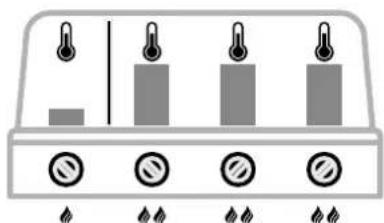
The barbecue zones can be controlled and monitored independently via the individual burners. The two thermometers in the lid indicate the temperature of the respective zones.


9. REAR BURNER
DANGER:
Make sure that your barbecue is positioned in front of a non-combustible rear wall or at least 1.5 metres away from combustible objects. With a rear burner, there is always a risk of flames escaping from the back of the barbecue.
9.1 HEAT RADIATION FROM BEHIND
The rear burner is used in combination with the rotisserie spit (not included).
By turning the spit, the food is slowly cooked on all sides and gets a delicious crust.
TIP: We recommend that you use the OUTDOORCHEF rotisserie spit and rotisserie kit HEAT.
- Make sure that all connections between the gas hose, the gas pressure regulator and the gas bottle are firmly tightened (as described in the LEAK TEST section).
- Open the barbecue lid.
- Open the gas supply at the gas bottle.
- Press the gas regulating knob for the rear burner and turn it anticlockwise to the setting. Hold the gas regulating knob down until the gas is burning.
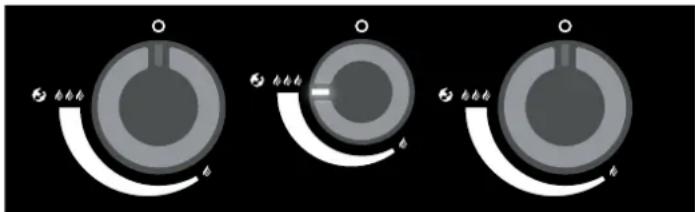
- If the gas does not ignite within 8 seconds, set the gas regulating knob to the off position. Wait 2 minutes to allow the uncombusted gas to dissipate. Then repeat step 3.
- If it is not possible to light the rear burner after 3 attempts, look for the causes (as described in the TROUBLESHOOTING section).
NOTE:
For perfect barbecue results, we recommend using the OUTDOORCHEF HEAT rotisserie spit. This is available as an accessory from your retailer.
DANGER:
Never use the rear burner in combination with the main burners in the rear burner area.
CAUTION
Using all of the burners at full load can cause the gas bottle to freeze and thus impair its function.


- Remove the warming rack.
- Preheat the rear burner with the lid closed for about 10-15 minutes at the setting.
- Position the food to be barbecued with the rotisserie spit and freely control the temperature between - - - - - - - - - - - - - - - - - - - - - - - - - - requirements.
TIP: Place a tray under the rotisserie spit and your food so that dripping juices and fat are collected and do not soil your barbecue unnecessarily. The dripping juices and fats are also ideal as a base for delicious sauces.
9.2.3 AFTER BARBECUING
- Set the gas regulating knob for the rear burner to the off position.
- Turn off the gas supply at the gas bottle.
The bottle tap must be closed even on empty bottles.
- Allow the barbecue to cool down fully and clean it.
- Protect the barbecue with the corresponding cover.
9.3 CLEANING AND MAINTENANCE OF THE REAR BURNER
9.3.1 CLEANING
We recommend that you clean the rear burner after every use. Clean it with a conventional stainless-steel cleaner or a polishing sponge available in DIY stores.
9.3.2 MAINTENANCE
Regular maintenance of your rear burner will ensure it functions correctly.
At least twice a year, check all parts that carry gas; also check them after extended periods of storage. Spiders or insects can cause blockages that must be cleared before use. If the barbecue is regularly pushed across uneven ground, check from time to time whether all screws are still tight. If you have not used the barbecue for a long period, you should carry out a LEAK TEST before using it again. If you have any doubts, please contact your gas supplier or the retailer. Following long storage periods, and at least once a year during the barbecue season, you should check the gas hose for cracks, kinks and other damage. A damaged gas hose must be replaced immediately, as described in the SAFETY NOTES section.
10. BLAZING ZONE®
10.1 INFRARED BURNER
How does an infrared burner work?
The gas flame created when the BLAZING ZONE is ignited is distributed evenly in the ceramic plate and generates infrared radiation on the surface. This emits concentrated direct heat of up to 900°C onto the food to be grilled. This makes it possible to work with far higher temperatures in comparison with a traditional gas burner.


High temperature 600 - 900°C
High-performance ceramic burner
High-temperature grilling
Perfect crust on meal
Height-adjustable grid, 3 levels
Perfect for lean cuts
With the BLAZING ZONE®, it is possible to cook steaks and other cuts of meat at maximum heat over 900°C, for a perfect seared crust.
WARNING: The lid must always be open during operation.
- Make sure that all connections between the gas hose, the gas pressure regulator and the gas bottle are firmly tightened (as described in the LEAK TEST section).
- Open the lid.
- Open the gas supply at the gas bottle.
- Press the gas regulating knob of the BLAZING ZONE® and turn it anticlockwise to the measuring hold the gas regulating knob down until the gas is burning.

- If the gas does not ignite within 8 seconds, set the gas regulating knob to .
Wait 2 minutes to allow the uncombusted gas to dissipate. Then repeat step 3.
- If it is not possible to light the burner of the BLAZING ZONE after 3 attempts, look for the causes (as described in the TROUBLESHOOTING section).
CAUTION
Using all of the burners at full load can cause the gas bottle to freeze and thus impair its function.
WARNING: Always wear heat-resistant gloves when working.
Allow the BLAZING ZONE to cool down completely before touching any parts.
- Move the barbecue grid to the desired position.
- Heat the BLAZING ZONE for around 10 minutes at the desired setting.
- Place the food to be grilled on the barbecue grid and adjust the temperature as required between.


10.2.3 AFTER BARBECUING
- Set the gas regulating knob for the BLAZING ZONE to.
- Turn off the gas supply at the gas bottle.
The bottle tap must be closed even on empty bottles.
- Allow the BLAZING ZONE to cool down completely and then clean the barbecue grid.
- Protect the barbecue and the complete BLAZING ZONE * with the corresponding cover.
10.3 CLEANING AND MAINTENANCE OF THE BLAZING ZONE
10.3.1 CLEANING
We recommend cleaning your BLAZING ZONE® after every 3rd use. Remove the barbecue grid and simply clean it in your dishwasher. Wipe the inside with a dry cloth and empty the drip pan.
We also recommend that you dismantle the burner of the BLAZING ZONE once a year to clean all surrounding parts and remove any spiders' webs and food residue.
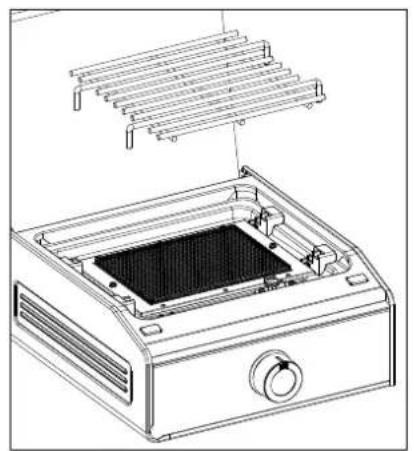


After removing the BLAZING ZONE, carry out the following steps.
- Check the burner for any deformations or cracks.
- The Venturi pipes (pipe section on the burner) can be cleaned/brushed using a thin bottle brush.
- Clean the inside of the supporting frame of the BLAZING ZONE. Do not use any harsh or flammable cleaning agents for this.
- Place the entire BLAZING ZONE back in the side table as described in the separate assembly instructions.
IMPORTANT: If you use a cleaning agent when cleaning, you must allow the barbecue to dry out correctly after cleaning. To accelerate the drying procedure, you can switch on the BLAZING ZONE and let it burn off for a few minutes at the highest setting.
CLEANING THE DRIP PAN
WARNING: Neglecting to clean the drip pans can lead to flare-ups. Check the drip pans after each use and remove any fat residue.
TIP: The perfect accessory for the collecting tray is the OUTDOORCHEF Grill Powder. This absorbs dripping fat and allows easy disposal.
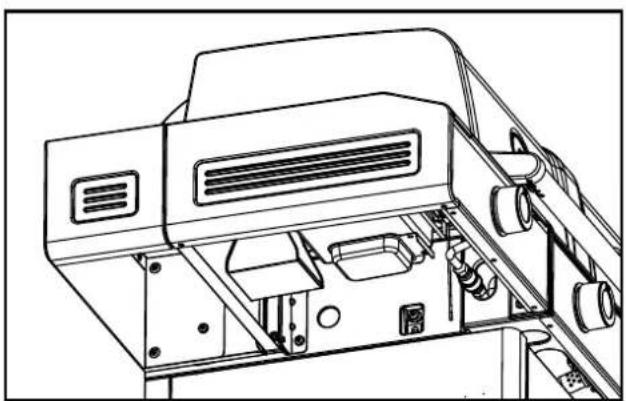
10.3.2 MAINTENANCE
Regular maintenance of your BLAZING ZONE will ensure it functions correctly. At least twice a year, check all parts that carry gas; also check them after extended periods of storage. Spiders or insects can cause blockages that must be cleared before use. If the barbecue is regularly pushed across uneven ground, check from time to time whether all screws are still tight. If you have not used the barbecue for a long period, you should carry out a LEAK TEST before using it again. If you have any doubts, please contact your gas supplier or the retailer. - To prevent damage due to corrosion, oil all metal parts before long storage periods. - Following long storage periods, and at least once a year during the barbecue season, you should check the gas hose for cracks, kinks and other damage. A damaged gas hose must be replaced immediately, as described in the SAFETY NOTES section. - To allow you to enjoy using your BLAZING ZONE for as long as possible, protect it from the effects of the weather using a suitable OUTDOORCHEF cover once it has cooled down completely. - Remove the cover after any rain in order to prevent condensation build-up. Covers can be purchased from your barbecue retailer.
11. COOKING ZONE
11.1 THREE APPLICATION AREAS
The completely newly developed COOKING ZONE is, as the name suggests, more than a conventional side cooking plate as it opens up a far wider temperature range. While standard side cooking plates are usually designed for medium and high temperatures, the COOKING ZONE can also be used to cook dishes at low heat (pasta sauces, soups, stews, etc.).
This is made possible by a completely new burner design and the option of using the side cooking plate at 3 different heights.
The concave shape of the solid cast-iron surface also allows the COOKING ZONE to be combined ideally with the OUTDOORCHEF BBQ Wok, which can be used directly on the surface (without the wok adapter ring).
Adjusting the height of the cast-iron cooking surface
Protective covers for the cast iron cooking surface
Make sure you always use the supplied protective silicone covers for the cast iron cooking surface. These protect the holes used to adjust the height of the grid from scratches.


Lower heat
In combination with the control dial, various application areas can be covered in the low temperature range.
- Heating sauces, soups and stews, boiling rice-based dishes
WARNING: The lid must always be open during operation.
- Make sure that all connections between the gas hose, the gas pressure regulator and the gas bottle are firmly tightened (as described in the LEAK TEST section).
- Open the lid.
- Open the gas supply at the gas bottle.
- Press the gas regulating knob for the COOKING ZONE and turn it anticlockwise to setting. Hold the gas regulating knob down until the gas is burning.

- If the gas does not ignite within 8 seconds, set the gas regulating knob to Wait 2 minutes to allow the uncombusted gas to dissipate. Then repeat step 3.
- If it is not possible to light the burner for the COOKING ZONE after 3 attempts, look for the causes (as described in the TROUBLESHOOTING section).
CAUTION: Using all of the burners at full load can cause the gas bottle to freeze and thus impair its function.
11.2.2 BEFORE COOKING
WARNING: Always wear heat-resistant gloves when working. Allow the COOKING ZONE to cool down completely before touching any parts.
- Adjust the cast iron surface to the required position (3 height levels).
- Place the pan or wok on the cast iron surface and heat it for 5 minutes at the desired level.
- Place the food to be grilled in the pan or wok and adjust the temperature as required between -
11.2.3 AFTER COOKING
- Set the gas regulating knob for the burner to
- Turn off the gas supply at the gas bottle.
The bottle tap must be closed even on empty bottles.
- Allow the COOKING ZONE to cool down completely and then clean the area below the cast-iron cooking surface.
- Protect the barbecue and the complete COOKING ZONE with the corresponding cover.
11.3 CLEANING AND MAINTENANCE OF THE COOKING ZONE
11.3.1 CLEANING
We recommend cleaning your COOKING ZONE after every 3rd use. Remove the cast iron surface and simply clean underneath it.
11.3.2 MAINTENANCE
Regular maintenance of your COOKING ZONE will ensure it functions correctly.
At least twice a year, check all parts that carry gas; also check them after extended periods of storage. Spiders or insects can cause blockages that must be cleared before use. - If the barbecue is regularly pushed across uneven ground, check from time to time whether all screws are still tight. If you have not used the barbecue for a long period, you should carry out a LEAK TEST before using it again. If you have any doubts, please contact your gas supplier or the retailer. To prevent damage due to corrosion, oil all metal parts (in particular, the cast iron cooking surface) before long storage periods. - Following long storage periods, and at least once a year during the barbecue season, you should check the gas hose for cracks, kinks and other damage. A damaged gas hose must be replaced immediately, as described in the SAFETY NOTES section. To allow you to enjoy using your barbecue and COOKING ZONE for as long as possible, protect your barbecue from the effects of the weather using a suitable OUTDOORCHEF cover. - Remove the cover after any rain in order to prevent condensation build-up. Covers can be purchased from your barbecue retailer.
12. SAFETY LIGHT
WARNING: Remember to always close the gas supply at the gas bottle and turn off the gas tap after barbecuing.
The SAFETY LIGHT in the control dial of your barbecue is activated when you turn the gas regulating knob anticlockwise from the 0 position towards the flame symbol - thereby opening the gas supply.
The power for the SAFETY LIGHT is supplied by the power bank provided.
Benefit:
- The SAFETY LIGHT reminds you that the valve is open and gas could escape.
HEAT operating console - control dial with Safety Light

13. POWER BANK
The power bank powers the SAFETY LIGHT, the electric ignition and all LED lighting on the HEAT. We recommend removing it after using the barbecue each time, charging it fully and storing it in a dry place.
The operating period is around 8 hours; the charging time from empty to full is around 7 hours. The current charging status is visible on the display of the power bank.

TIP: We recommend removing the power bank and charging it fully after each use.
TIP: If you need a second power bank, you can order this at www.outdoorchef.com under Spare Parts.
TIP: As an alternative to the power bank, you can also connect your HEAT directly to the mains using the OUTDOORCHEF transformer power supply unit (available as an accessory).
NOTE: In general, we recommend using the OUTDOORCHEF power bank. However, if you wish to use a different one, make sure that the output does not exceed 5V/2.1A.
14. HEAT STORAGE SPACE
In addition to the gas bottle, the floor unit of your HEAT offers plenty of space for customised storage solutions.
TIP: To keep things organised in your floor unit, we recommend the OUTDOORCHEF HEAT organisation set. Kitchen roll waste and other accessories can be perfectly stowed away.
15. MOVING AND MANOEUVRING THE HEAT
Always release the brakes on the wheels before moving or manoeuvring the barbecue. You can use both side tables to lift and move the barbecue. Only move and manoeuvre the barbecue when it is switched off and the gas bottle is closed.
CAUTION: Always lock the two parking brakes on the wheels after moving the barbecue.

16. NOTES ON THE CAST-IRON BARBECUE GRIDS
SEASONING
- Clean the cast-iron barbecue grids with water before using them for the first time.
- Brush the grids thinly with refined cooking oil.
- Season the grids for about 20-25 minutes at the setting.
- The seasoning process creates a patina that protects your cast-iron grids from rust.
USAGE
Heat the cast-iron grids before each use for at least 5 minutes at setting. Always put on barbecue gloves before touching the grids during use on the barbecue. Never place the hot cast iron barbecue grids on flammable or heat-sensitive surfaces.
CLEANING
- Allow the cast iron barbecue grids to burn out on the barbecue at full power for around 10 minutes.
- Let them cool down afterwards.
- Use a brush with nylon or brass bristles (not steel bristles) to remove residues and soiling.
- In case of persistent dirt: For thorough cleaning, use the OUTDOORCHEF cleaner.
- Do not use any aggressive, fat-dissolving or chemical cleaning agents.
NOTE: Cleaning agents and large amounts of water will damage the protective patina, making your cast-iron grid susceptible to rust.
17. TROUBLESHOOTING
The burner does not ignite:
- Check if sparks are passing between the electrode and the burner.
CAUTION: This inspection may only be performed with the gas supply fully closed.
- Check if the gas supply is open at the gas bottle.
- Make sure there is enough gas in the bottle.
No spark:
- Make sure the power bank has been connected correctly and is fully charged. The distance between the burner and electrode must only be 5 - 8 mm.
- Check whether the cables of the electric ignition and the electrode are plugged in and firmly connected.
- Manual ignition is possible with a stick lighter through the opening on the right-hand side of the barbecue chamber.
No power or reduced power:
- Check whether the burners are blocked by any insects or spiders/cobwebs.
You can find more information on cleaning the burners here: https://de.outdoorchef.com/blogs/questions-lips/how should I clean my burners
The SAFETY LIGHT does not work:
- Check if the gas supply is open at the gas regulating knobs (with the gas bottle valve closed).
- Make sure the power bank is inserted correctly and charged.
The axle is jammed:
To prevent the axle from jamming, we recommend you remove any dust, dirt and pollen from behind the wheels at least once a year.
18. CONSUMER WARRANTY/GUARANTEE
For detailed information on the Consumer Warranty/Guarantee, please refer to the General Terms and Conditions (T&Cs) at https://www.outdoorchef.com/agb
The registered brand OUTDOORCHEF is represented by the following enterprise:
Outdoorchef AG | Eggbuhlstrasse 28 | Postfach | 8050 Zurich, Switzerland | www.outdoorchef.com
- A dealer directory can be found on our website at www.outdoorchef.com. The serial number and item number can be found on the data sticker on your barbecue (see the first section of this USER GUIDE).
19. REPLACEMENT PARTS
Replacement parts can be obtained from specialist dealers or very easily directly on www.outdoorchef.com.
20. WASTE DISPOSAL

This label indicates that this product and the power bank it contains may not be disposed of with household waste throughout the EU. To avoid possible damage to the environment or health due to uncontrolled disposal of waste, recycle it responsibly. To return your used appliance, please use the return and collection system or contact the retailer from whom the product was purchased. You can use this product for environmentally friendly recycling.
Please remove the power bank from the device before taking it to a disposal centre and dispose of it in accordance with local regulations.
21. TECHNICAL INFORMATION
HEAT X-345 RB
CE 0063 DP 3432
Gas Butane G30 / Propane G31
3+ (28/30/37 mbar)
Butane 30 mbar / Propane 37 mbar
135VP (3D min)
Butane / Propane 30 mbar
185/P (50 mbar)
Butane / Propane 50 mbar
Gas output 23.50 kW
HS
Gas consumption 1644 g/h
HEAT X-445 RB
CE 0063 DP 3432
Gas Butane G30 / Propane G31
3+ (28/30/37 mbar) Butane 30 mbar / Propane 37 mbar
I35/P(30 mbar) Butane / Propane 30 mbar
ISBP (50 mbar) Butane / Propane 50 mbar
Gas output 27.70 kW Hs
Gas consumption 1937 g/h
HEAT X-545 RB
CE 0063 DP 3432
Gas Butane G30 / Propane G31
13+ (28/30/37 mbar)
Butane 30 mbar / Propane 37 mbar
I85/P (30 mbar) Butane / Propane 30 mbar
133/P (50 mbar) Butane / Propane 50 mbar
Gas output 31.90 kW Hs
Gas consumption 2231 g/h
BLAZING ZONE
COOKING ZONE
Power 3.60 kW
HS Power 2.90 kW H
Gas consumption
203 g/h
Gas consumption 252 g/h
Nozzle (28-30/37 mbar)
0.90 mm mark: BM
Nozzle (28-30/37 mbar)
S
Nozzles (50 mbar)
0.78 mm mark: BD
Nozzles (50 mbar)
0.84 mm mark: AR
0.74 mm mark: AE
REAR BURNER
Power 4.40 kW
HS
Gas consumption
308 g/h
Nozzle (28-30/37 mbar)
1.02 mm mark: AN
MAIN BURNER
Power
4.20 kW Hs
Nozzles (50 mbar)
0.90 mm mark: BM
Gas consumption
294 g/h
POWER BANK
Power 10,000 mAh
Input
5V/2.0A
Output
5V/2.1A
Electric ignition
The power bank supplied powers the operation of the electric ignition.
Note on the temperature display
The thermometer display is subject to a +/- 10% fluctuation.
Web page
More information, tips, hints, recipes and all kinds of useful information about OUTDOORCHEF products can be found at www.outdoorchef.com
- THE SERIAL NUMBER OF YOUR BARBECUE AND WHY IT IS IMPORTANT 58
- INSTRUCTIONS FOR USE 58
9.2.1 LIGHTING INSTRUCTIONS
11.2.1 LIGHTING INSTRUCTIONS


- INSTRUCTIONS FOR USE
- BLAZING ZONE
- COOKING ZONE
- SAFETY LIGHT
- POWER BANK
- HEAT STORAGE SPACE
- MOVING AND MANOEUVRING THE HEAT
- NOTES ON THE CAST-IRON BARBECUE GRIDS
- TROUBLESHOOTING
- CONSUMER WARRANTY/GUARANTEE
- REPLACEMENT PARTS
- WASTE DISPOSAL
- TECHNICAL INFORMATION
- YOUR BARBECUE'S SERIAL NUMBER AND WHY THIS IS IMPORTANT
- USER GUIDE
- STORAGE OF THE USER GUIDE
- IMPORTANT SAFETY INFORMATION
- DANGER
- IF YOU SMELL GAS
- WARNING
- INSTALLATION AND ASSEMBLY
- OPERATION
- STORAGE AND/OR NON-USE
- GAS BOTTLES
- FIRST USE OF THE BARBECUE
- CONNECTING THE GAS HOSE
- LEAK TEST
- CONTROL DIAL
- AMBIENT LIGHTING
- BEFORE FIRST USE
- BARBECUE CHAMBER
- TWIN BURNERS
- HEAT REGULATOR
- SLOW ROASTING
- KEEPING FOOD WARM
- AFTER BARBECUING
- CLEANING AND MAINTENANCE OF THE BARBECUE CHAMBER
- CLEANING
- CLEANING THE OUTSIDE OF THE BARBECUE
- CLEANING THE INSIDE OF THE BARBECUE
- CLEANING THE DRIP PAN
- MAINTENANCE
- DIRECT AND INDIRECT BARBECUING METHOD WITH THE HEAT
- WHAT IS THE DIFFERENCE
- DIRECT BARBECUING METHOD
- INDIRECT BARBECUING METHOD
- DIRECT HEAT INDIRECT HEAT
- BARBECUING IN TWO BARBECUE CHAMBERS
- REAR BURNER
- HEAT RADIATION FROM BEHIND
- CLEANING AND MAINTENANCE OF THE REAR BURNER
- BLAZING ZONE®
- INFRARED BURNER
- CLEANING AND MAINTENANCE OF THE BLAZING ZONE
- THREE APPLICATION AREAS
- PROTECTIVE COVERS FOR THE CAST IRON COOKING SURFACE
- LOWER HEAT
- BEFORE COOKING
- AFTER COOKING
- CLEANING AND MAINTENANCE OF THE COOKING ZONE
- BENEFIT
- SEASONING
- USAGE
- THE BURNER DOES NOT IGNITE
- NO SPARK
- NO POWER OR REDUCED POWER
- THE SAFETY LIGHT DOES NOT WORK
- THE AXLE IS JAMMED
- THE REGISTERED BRAND OUTDOORCHEF IS REPRESENTED BY THE FOLLOWING ENTERPRISE
- HEAT X-345 RB
- HEAT X-445 RB
- HEAT X-545 RB
- MAIN BURNER
- ELECTRIC IGNITION
- NOTE ON THE TEMPERATURE DISPLAY
- WEB PAGE
- LIGHTING INSTRUCTIONS
Brand : Outdoorchef
Model : Heat X345
Category : Barbecue