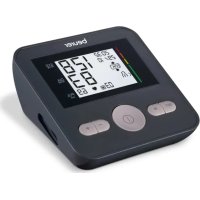
BM 2 R Beat+ - Measuring equipment BEURER - Free user manual and instructions
Find the device manual for free BM 2 R Beat+ BEURER in PDF.


| Product Type | Automatic Upper Arm Blood Pressure Monitor |
| Brand | Beurer |
| Model | BM 2 R Beat+ |
| Measurement Method | Oscillometric, non-invasive |
| Pressure Measurement Range | 0 – 300 mmHg |
| Systolic Measurement Range | 50 – 280 mmHg |
| Diastolic Measurement Range | 30 – 200 mmHg |
| Pulse Measurement Range | 40 – 199 beats/min |
| Pressure Accuracy | ± 3 mmHg |
| Pulse Accuracy | ± 5 % of displayed value |
| Memory | 4 x 30 measurements (4 users) |
| Cuff Size | 22 – 42 cm arm circumference |
| Dimensions | 112 x 110 x 53 mm |
| Weight | Approx. 341 g (with batteries and cuff) |
| Power Supply | 4 AA 1.5 V batteries (LR06) or mains adapter (optional) |
| Battery Life | Approx. 300 measurements |
| Protection Rating | IP21 |
| Display | Systolic pressure, diastolic pressure, pulse, date, time, risk indicator |
| Special Functions | Arrhythmia detection, color-coded risk indicator, user memory, average calculation |
| Maintenance | Clean with a damp cloth, do not use solvent |
| Included Accessories | Cuff, batteries, storage pouch, instruction manual |
| Warranty | See included warranty card |
Frequently Asked Questions - BM 2 R Beat+ BEURER
User questions about BM 2 R Beat+ BEURER
0 question about this device. Answer the ones you know or ask your own.
Ask a new question about this device
Download the instructions for your Measuring equipment in PDF format for free! Find your manual BM 2 R Beat+ - BEURER and take your electronic device back in hand. On this page are published all the documents necessary for the use of your device. BM 2 R Beat+ by BEURER.
USER MANUAL BM 2 R Beat+ BEURER
EN Upper arm blood pressure monitor Instructions for use. 21
EN Unfold page 3 before reading the instructions for use.
1Quelle: WHO, 1999 (World Health Organization) 2Quelle: National Health Service, 2023
Read these instructions for use carefully. Observe the warnings and safety notes. Keep these instructions for use for future reference. Make the instructions for use accessible to other users. If the device is passed on, provide the instructions for use to the next user as well.
CONTENTS
- Included in delivery 21
- Signs and symbols 21
- Intended use 23
4.Warnings and safety notes.. 24 - Device description 27
- Usage 27
6.1 Initial use 27
6.2 Before the blood pressure measurement 29
6.3 Taking a blood pressure measurement 30
6.4 Evaluating the results 30
6.5 Displaying and deleting measured values 31
- Cleaning and maintenance 32
- Accessories and/or replacement parts 32
9.Troubleshooting 33 - Disposal 33
- Technical specifications 34
12.Guarantee/service 35
1. INCLUDED IN DELIVERY
Check that the exterior of the cardboard delivery packaging is intact and make sure that all contents are included in the delivery. Before use, ensure that there is no visible damage to the device and accessories and/or replacement parts, and that all packaging material has been removed. If you have any doubts, do not use the device and contact your retailer or the specified Customer Services address.
- Upper arm blood pressure monitor
- Upper arm cuff (22-42 cm)
- Batteries, see chapter "Technical specifications"
- Storage bag
- Instructions for use
2. SIGNS AND SYMBOLS
The following symbols are used on the device, in these instructions for use, on the packaging and on the type plate for the device:
| WARNING Indicates a potentially impending danger. If it is not avoided, death or serious injury will occur. |
| CAUTION Indicates a potentially impending danger. If it is not avoided, slight or minor injuries may occur. |
| Product information Note on important information |
| Observe the instructions Read the instructions before starting work and/or oper-ating devices or machines |
| The electronic device must not be disposed of with household waste |
| Do not dispose of batteries containing harmful substances with household waste |
| Manufacturer |
| Date of manufacture |
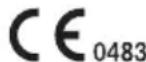
| CE labelling This product satisfies the requirements of the applicable European and national directives. | |
| Separate the packaging elements and dispose of them in accordance with local regulations. | |
| Marking to identify the packaging material. A = material abbreviation, B = material number: 1-7 = plastics, 20-22 = paper and cardboard | |
| Separate the product and packaging elements and dispose of them in accordance with local regulations. | |
| IP21 Protected against solid foreign objects 12.5 mm in diameter and larger, and against vertically falling drops of water | |
| Direct current | |
| UDI Unique device identifier (UDI) Identifier for unique product identification | |
| LOT Batch designation | |
| REF Item number | |
| SN Serial number | |
| MD Medical device | |
| # Type number | |
| Type BF applied part | |
| Temperature range | |
| Humidity range | |
| Atmospheric pressure limitation | |
| Importer |
3. INTENDEDUSE
Intended Purpose
The blood pressure monitor (hereinafter, device) is intended for the fully automatic, non-invasive measurement of arterial blood pressure and pulse values on the upper arm. It is designed for self-measurement by adults in a domestic environment.
Intended Users
The blood pressure measurement is suitable for adult users whose upper arm circumference is within the range printed on the cuff.
Clinical benefits
The user can record their blood pressure and pulse values quickly and easily using the device. The recorded values are classified according to internationally applicable guidelines and evaluated graphically. Furthermore, the device can detect any irregular heart beats that occur during measurement and inform the user via a symbol in the display. The device saves the recorded measurements and can also output average values of previous measurements. The recorded data can provide healthcare service providers with support during the diagnosis and treatment of blood pressure problems, and therefore it plays a part in the long-term monitoring of the user's health.
Indications
In the event of hypertension or hypotension, the user can independently monitor their blood pressure and pulse values at home. However, the user does not need to be suffering from hypertension or arrhythmia in order to use the device.
Contraindications
WARNING
-
Do not use the blood pressure monitor on newborns, children or pets.
-
Persons with reduced physical, sensory or mental capabilities should be supervised by a person responsible for their safety and receive instructions from that person on how to use the device.
- Do not use the device if you are using electrical implants (e.g. pacemakers).
- Do not use the device if you have metal implants.
- Do not use the cuff on people who have undergone a mastectomy or who have had their lymph nodes removed.
- Do not place the cuff over wounds as this may cause further injury.
- Make sure that the cuff is not placed on an arm whose arteries or veins are undergoing medical treatment, e.g. intravascular access or intravascular therapy, or an arteriovenous (AV) shunt.
- Do not use the device on people with allergies or sensitive skin.
Undesirable side effects
- Skin irritation
- Negative influence on blood circulation
4. WARNINGS AND SAFETY NOTES General warnings
WARNING
- The measurements you take are for your information only - they are not a substitute for a medical examination! Discuss your measured values with your doctor and never make your own medical decisions based on them (e.g. regarding medicine doses).
- The device is only intended for the purpose described in these instructions for use. The manufacturer is not liable for damage resulting from improper or incorrect use.
- Using the blood pressure monitor outside your home environment or while on the move (e.g. while travelling in a car, ambulance or helicopter, or while undertaking physical activity such as playing sport) can influence the measurement accuracy and cause incorrect measurements.
- Cardiovascular diseases may lead to incorrect measurements or have a detrimental effect on measurement accuracy.
- If you have any of the following conditions, it is essential you consult your doctor before using the device: Cardiac arrhythmia, circulatory disorders, diabetes, pregnancy, pre-eclampsia, hypotension, chills, shivering.
-
Do not use the device at the same time as other medical electrical devices (ME equipment). This could cause the measuring device to malfunction and/or an inaccurate measurement.
-
Do not use the device outside of the specified storage and operating conditions. This could lead to incorrect measurements.
- Only use the cuffs included in delivery or described in these instructions for use with the device. Using a different cuff may lead to inaccurate measurements.
- Note that when inflating the cuff, the functions of the limb affected may be impaired.
- Do not perform measurements more frequently than necessary. Due to the restriction of blood flow, some bruising may occur.
- Blood circulation must not be stopped for an unnecessarily long time during the blood pressure measurement. If the device malfunctions, remove the cuff from the arm.
- Place the cuff on the upper arm only. Do not place the cuff on other parts of the body.
- The air line poses a risk of strangulation for small children.
- Small parts may present a choking hazard for small children if swallowed. They should therefore always be supervised
- Keep packaging material away from children. There is a risk of suffocation.
- Keep away from children, pets and pests.
- Do not drop, step on or shake the device.
- Do not disassemble the device as this may cause damage, faults and malfunctions.
-
Do not modify the device.
-
To rule out a difference between sides, the measurement should initially be taken on both arms.
- Never operate the device during maintenance work. Maintenance work includes maintenance, inspection and repair.
General precautions
CAUTION
- The blood pressure monitor is made from precision and electronic components. The accuracy of the measurements and service life of the device depend on its careful handling.
- Protect the device and its mains adapter from impacts, humidity, dirt, drastic changes in temperature and direct sunlight.
- Ensure the device is at room temperature before taking a measurement. If the measuring device has been stored close to the maximum or minimum storage and transport temperatures and is placed in an environment with a temperature of 20^ , it is recommended that you wait approx. 2 hours before using the measuring device.
- Do not use the device in the vicinity of strong electromagnetic fields and keep it away from radio systems or mobile telephones.
- We recommend removing the batteries if the device is not going to be used for a prolonged period of time.
- Avoid any mechanical restriction, compression or bending of the cuff line.
Notes on handling batteries
WARNING
- If your skin or eyes come into contact with battery fluid, rinse the affected areas with water and seek medical assistance.
- Choking hazard! Small children may swallow and choke on batteries. Therefore, store batteries out of the reach of small children.
- Seek medical attention immediately if swallowed.
- Risk of explosion! Do not throw batteries into a fire.
- If a battery has leaked, put on protective gloves and clean the battery compartment with a dry cloth.
- Do not disassemble, open or crush the batteries.
- Observe the plus (+) and minus (-) polarity signs.
CAUTION
- Protect batteries from excessive heat.
- Do not charge or short-circuit the batteries.
- If the device is not going to be used for a long period of time, remove the batteries from the battery compartment.
- Use identical or equivalent battery types only.
Always replace all batteries at the same time. - Do not use rechargeable batteries.
Notes on electromagnetic compatibility
CAUTION
- The device is suitable for use in all environments listed in these instructions for use, including domestic environments.
- The device may not be fully usable in the presence of electromagnetic disturbances. This could result in issues such as error messages or the failure of the display/device.
- Avoid using this device directly next to other devices or stacked on top of other devices, as this could lead to faulty operation. If, however, it is necessary to use the device in the manner stated, this device as well as the other devices must be monitored to ensure they are working properly.
- The use of accessories and/or replacement parts other than those specified or provided by the manufacturer of this device could lead to an increase in electromagnetic emissions or a decrease in the device's electromagnetic immunity; this can result in faulty operation.
- Keep portable RF communication devices (including peripheral equipment, such as antenna cables or external antennas) at least 30cm away from all device parts, including all cables included in delivery.
- Failure to comply with the above can impair the performance of the device.
5. DEVICE DESCRIPTION
The associated drawings are shown on page 3.
1 Cuff
3 Cuff connector
5 Risk indicator
7 Function buttons -/+
9 Memory button M
11 Connection for mains adapter
Cuff line
4 Connection for cuff connector
6 Display
8 START/STOPbutton①
10 Setting button SET
Information on the display
12 Risk indicator
14 Systolic pressure
16 Calculated pulse value
18 Memorydisplay average value (R), morning (R) evening ( memory space number
20 User memory
22 Cuff position control
13 Time and date
15 Diastolic pressure
17 Cardiac arrhythmia symbol
19 Releaseair
21 Battery replacement symbol
6.USAGE
6.1 Initial use
Inserting the batteries
- Remove the battery compartment cover on the back of the device A.
- Insert the batteries (see chapter "Technical specifications"). Insert the batteries, making sure the polarity is correct according to the label A.
- Close the battery compartment cover.
If the rsvbnol is displayed and does not disappear, measurement is no longer possible. Replace all the batteries. Once the batteries have been removed from the device, the date and time must be set again. Any saved measured values are retained.
Operation with the mains part
You can also operate this device with a mains part (not included in delivery). However, before connecting the device with the mains part, please ensure that you have removed the batteries from the device. During mains operation, there must not be any batteries in the battery compartment, as this could damage the device.
- To avoid any potential damage, the device may only be operated with a mains part that meets the specifications described in the chapter "Technical specifications".
-
Furthermore, the mains part must only be connected to the mains voltage that is specified on the type plate.
-
Insert the mains adapter into the connection provided for this purpose on the blood pressure monitor.
- Then insert the mains plug of the mains part into the mains socket.
- After using the blood pressure monitor, unplug the mains part from the mains socket first and then disconnect it from the blood pressure monitor. As soon as you unplug the mains part, the blood pressure monitor loses the date and time setting but the saved measured values are retained.
Adjusting the settings
Make sure that the device's settings have been set correctly so you can make full use of all its functions. Otherwise you will not be able to save your measured values with the date and time and access them later.
There are two different ways to access the settings menu:
- Before initial use and after each time you replace the battery: When inserting batteries into the device, you will be taken to the relevant menu automatically.
- If the batteries have already been inserted: With the device switched off, press and hold the setting button SET for approx. 5 seconds.
Set these settings in the order shown below:

Press SET to confirm your selection each time.
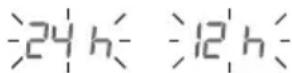
Time format
Time format flashes:
- Press - / + to select the time format.
Date
The year flashes:
Press - / + to select the year.
The month flashes:
- Press - / + to select the month.
The day flashes:
Press - / + to select the day.
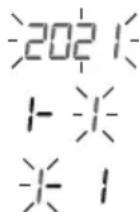
If the time format is set to the 12-hour format, the order in which the day and month are displayed is reversed.
Time
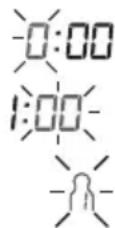
The hour flashes:
Press - / + to select the hour.
The minutes flash:
Press - / + to select the minutes.
User
The user symbol flashes:
- Press - / + to select the user.
The device switches off automatically.
6.2 Before the blood pressure measurement
General rules when measuring your own blood pressure
- In order to generate an informative profile of changes in your blood pressure that can be used for comparisons, you should measure your blood pressure regularly and always at the same time of day.
Measure your blood pressure twice a day: once in the morning after getting up and once in the evening. - Always perform the measurement when you are sufficiently physically rested. Avoid taking measurements at stressful times.
- Do not take a measurement within 30 minutes of eating, drinking, smoking or exercising.
- Before the initial blood pressure measurement, make sure always to rest for about 5 minutes.
- If you want to take several measurements in succession, always make sure that you leave 5 minutes between each measurement.
- Repeat the measurement if you have doubts about the measured value.
Attaching the cuff
You can measure your blood pressure on either arm. Some deviations between the values in the right and left arm are perfectly normal. Always perform the measurement on the arm with the
higher blood pressure values. Consult your doctor about this before starting self-measurement.
Always measure your blood pressure on the same arm.
- Only use the device with the cuff supplied, based on your upper arm circumference.
- Before taking the measurement, check the fit using the index mark described below.
- Expose your upper arm. The circulation of the arm must not be hindered by tight clothing or similar.
- The cuff must be placed on the upper arm so that the bottom edge is positioned 2-3 cm above the elbow and over the artery. The line should point to the centre of the palm here B. The cuff should be fastened so that two fingers fit under the cuff when it is closed C
- Now insert the cuff line into the connection for the cuff connector.
- The cuff is suitable for you if the index mark within the OK range after fitting the cuff.
Adopting the correct posture
- Sit in a comfortable upright position when taking the blood pressure measurement. Lean back so that your back is supported.
- Place your arm on a surface D
-
Place your feet flat on the ground next to one another.
The cuff must be level with your heart. -
Stay as still as possible during the measurement and do not talk.
Selecting the user
This device can have up to 4 users with 30 memory spaces each, allowing you to separately save measurements from 4 different people.
If multiple people are using the device, make sure that the correct user has been selected before each measurement:
- Use M to select the desired user.
6.3 Taking a blood pressure measurement
Requirement: cuff attached, user selected.
Measurement
- Press 1 All display elements are briefly displayed. The cuff inflates itself automatically. The measurement process starts. is displayed as soon as a pulse is detected.
To cancel the measurement, press ①
- The systolic pressure, diastolic pressure and pulse measurements are displayed.
"E" is displayed if the measurement could not be performed properly. In this case, please refer to the "Troubleshooting" section.
If necessary, re-attach the cuff after 1 minute.
The device switches off automatically after approx. 30 seconds. The value is saved to the selected or most recently used user.
6.4 Evaluating the results
General information about blood pressure
- Blood pressure is the force with which the bloodstream presses against the arterial walls. Arterial blood pressure constantly changes in the course of a cardiac cycle.
-
Blood pressure is always stated in the form of two values:
-
The highest pressure is the systolic blood pressure. This occurs when the heart muscle contracts and blood is pumped into the blood vessels.
-
The lowest pressure is the diastolic blood pressure. This occurs when the heart muscle has completely relaxed again and the heart is filling with blood.
-
Fluctuations in blood pressure are normal. Even during repeat measurements, there may be considerable differences between the measured values. One-off or irregular measurements therefore do not provide reliable information about the actual blood pressure. Reliable assessment is only possible when you perform the measurement regularly under comparable conditions.
Cardiac arrhythmia
The device can identify heart rhythm abnormalities during the blood pressure measurement. If displayed after the measurement, this indicates that an irregularity has been detected in your pulse.
Repeat the measurement if it is displayed.
When assessing your blood pressure, only use the results that have been recorded without any irregularities in your pulse.
Consult your doctor if it is displayed frequently. Only they can determine, through an examination, whether there is an abnormality.
Risk indicator
| Measured blood pres-sure value range | Classification | Risk indicator colour | |
| Systolic (in mmHg) | Diastolic (in mmHg) | ||
| ≥ 180 ≥ 110 | Stage 3 high blood pressure (severe),1 | Red | |
| 160 – 179 100 – 109 | Stage 2 high blood pressure (moderate),1 | Orange | |
| 140 – 159 90 – 99 | Stage 1 high blood pressure (mild),1 | Yellow | |
| 130 – 139 85 – 89 High normal 1 | Green | ||
| 120 – 129 80 – 84 Normal 1 | Green | ||
| < 120 < 80 Optimal 1 | Green | ||
| < 90 < 60 Low blood pressure 2 | Orange | ||
1 Source: WHO, 1999 (World Health Organization)
2 Source: National Health Service, 2023
The risk indicator 5/12 indicates which category the recorded blood pressure values fall into. If the measured values are in two
different categories (e.g. systolic pressure in the "high normal" range and diastolic pressure in the "normal" range), the risk indicator always indicates the higher range - "high normal" in the example described.
Note that these default values are for general guidance only, as individual blood pressures may vary.
Please note that self-measurement at home usually results in values lower than those recorded at a doctor's surgery. Consult your doctor at regular intervals. Only they are able to give you personal target values for controlled blood pressure, particularly if you are receiving medical therapy.
Low blood pressure
WARNING
Low blood pressure (hypotension) can be a health hazard and cause dizziness or fainting. Blood pressure is considered low if systolic and diastolic pressure are below 90/60mmHg (source: National Health Service, 2023).
Seek medical attention if you suddenly suffer from low blood pressure.
6.5 Displaying and deleting measured values
User
The results of every successful measurement are saved with the date and time. If there are more than 30 saved measurements, the oldest measurement records are deleted.
Press the memory button M. Select the desired user memory (山) by pressing the memory button M again.
Average value
- Press+.
R flashes:
The average value of all this user's saved measured values is displayed.
- Press +.
AN flashes:
The average value of the morning measurements for the last 7 days is displayed (morning: 5:00-9:00).
- Press +.
PN flashes:
The average value of the evening measurements for the last 7 days is displayed (evening: 18:00-20:00).
Individual measured values
- If you press + again, the last individual measurement is displayed.
- If you press + again, you can view the individual measured values.
- Press to switch the device off again.
Deleting measured values
-
If you want to delete the whole memory for the respective user, press the memory button M.
-
Now press and hold the memory button M and the setting button SET simultaneously for 5 seconds.
7. CLEANING AND MAINTENANCE
- Clean the device and cuff carefully using only a slightly damp cloth.
- Do not use any cleaning solutions or solvents.
- Under no circumstances hold the device or cuff under water, as this can cause liquid to enter and damage the device and cuff.
- If you store the device and cuff, do not place heavy objects on the device and cuff. The cuff line should not be bent sharply.
- Remove the batteries if the device is not going to be used for a long period of time.
8. ACCESSORIESAND/OR REPLACEMENT PARTS
Accessories and/or replacement parts are available at www.beurer.de, under "Service". Please state the corresponding order number.
| Designation Item number and/or order number | |
| Universal cuff (22-42 cm) 110.03 | |
| Mains part (EU) 072.78 | |
| Mains part (UK) 072.79 | |
9. TROUBLESHOOTING
In the event of errors, the error message E appears on the display. Error messages may appear if:
It was not possible to correctly record the pulse: E 1
The measured blood pressure is outside the measurement range: 62
The cuff is fastened too tightly or loosely: E3
- Errors occur during the measurement: E4
- The inflation pressure is higher than 300mmHg : E5
- There is a system error. If this error message appears, please contact Customer Services: 66
- The batteries are almost empty:
In such cases, repeat the measurement. Ensure that the cuff line is correctly attached and that you do not move or speak during the measurement.
If necessary, reinsert or replace the batteries.
10. DISPOSAL
Repairing and disposing of the device
- Do not repair or modify the device yourself. Proper operation can no longer be guaranteed in this case.
- Do not open the device except for the battery compartment. Failure to comply will invalidate the warranty.
- Repairs must only be carried out by Customer Services or authorised retailers. Before making a complaint, first check the batteries and replace them if necessary.
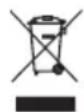
- The device must not be disposed of with household waste.
Dispose of the device at a suitable local collection or recycling point in your country. Dispose of the device in accordance with EC Directive - WEEE (Waste Electrical and Electronic Equipment). Please contact the local authorities responsible for waste disposal if any questions regarding disposal.
Disposal of the batteries
-
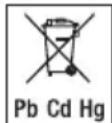
Used, completely discharged batteries must not be disposed of with household waste. Dispose of the batteries in specially designated collection boxes, at recycling points or at electronics retailers. You are legally required to dispose of the batteries correctly.
-
The codes below are printed on batteries containing harmful substances:
Pb = battery contains lead
- Cd = battery contains cadmium
- Hg = battery contains mercury
11. TECHNICAL SPECIFICATIONS
Type BM 27
| Model BM 2 R | |
| Measurement method | Oscillometric, non-invasive blood pressure measurement on the upper arm |
| Measurement range | Cuff pressure 0 – 300 mmHg, systolic pressure 50 – 280 mmHg, diastolic pressure 30–200 mmHg, pulse 40 – 199 beats/minute |
| Display accuracy | Systolic pressure ± 3 mmHg, diastolic pressure ± 3 mmHg, pulse ± 5% of the displayed value |
| Measurement uncertainty | Max. permissible standard deviation according to clinical testing: systolic pressure 8 mmHg, diastolic pressure 8 mmHg |
| Memory 4 x 30 memory spaces | |
| Dimensions L 112 mm x W 110 mm x H 53 mm | |
| Weight Approx. 341 g (without batteries, with cuff) | |
| Cuff size 22 to 42 cm upper arm circumference | |
| Operating conditions | + 10 °C to + 40 °C, <90% relative humidity, 800 -1050 hPa ambient pressure |
| Storage and transport conditions | -20 °C to + 55 °C, <90% relative humidity (non-condensing) |
| Power supply | 4x1.5V LB6AA batteries |
| Battery life | For approx. 300 measurements, depending on blood pressure and inflation pressure levels |
| Expected service life | Information on the service life of the product can be found on the homepage |
| Classification | Internal power supply, IP21, no AP or APG, continuous operation, type BF applied part |
The serial number is located on the device or in the battery compartment. We reserve the right to make technical changes to improve and develop the product.
- This device conforms with the European standard EN 60601-1-2 (Group 1, Class B, in accordance with CISPR-11, IEC 61000-3-2, IEC 61000-3-3, IEC 61000-4-2, IEC 61000-4-3, IEC 61000-4-4, IEC 61000-4-5, IEC 61000-4-6, IEC 61000-4-7, IEC 61000-4-8, IEC 61000-4-11) and is subject to particular precautions with regard to electromagnetic compatibility. Please note that portable and mobile HF communication systems may interfere with this device.
- The accuracy of this blood pressure monitor has been carefully checked and developed with regard to a long useful life. If the device is used for commercial medical purposes, the applicable national regulations determine whether it must be tested for accuracy by appropriate means.
12. GUARANTEE/SERVICE
Further information on the guarantee and guarantee conditions can be found in the guarantee leaflet supplied.
Notification of incidents
For users/patients in the European Union and identical regulation systems (EU Medical Device Regulation (MDR) 2017/745), the following applies: If during or through use of the product a major incident occurs, notify the manufacturer and/or their representative of this as well as the respective national authority of the member state in which the user/patient is located.
FRANÇAIS

Instructions relatives aux piles
A AVENTISSEMENT
1 Source: WHO, 1999 (World Health Organization)
2 Source: National Health Service, 2023
Fuente: WHO, 1999 (World Health Organization)
2 Fuente: National Health Service, 2023
1Fonte: WHO, 1999 (World Health Organization)
2Fonte: National Health Service, 2023
8. ACCESSORI E/O RICAMBI
604.30_BM2R_2024-01-31_01_IM1a_BEU

Beurer GmbH • Söflinger Str. 218 • 89077 Ulm, Germany • www.beurer.com www.beurer-gesundheitsratgeber.com • www.beurer-healthguide.com

- CONTENTS
- INCLUDED IN DELIVERY
- SIGNS AND SYMBOLS
- INTENDEDUSE
- Intended Purpose
- Intended Users
- Clinical benefits
- Indications
- Contraindications
- WARNING
- Undesirable side effects
- WARNINGS AND SAFETY NOTES General warnings
- General precautions
- CAUTION
- Notes on handling batteries
- Notes on electromagnetic compatibility
- DEVICE DESCRIPTION
- Information on the display
- 6.USAGE
- Initial use
- Inserting the batteries
- Operation with the mains part
- Adjusting the settings
- Time format
- Date
- Time
- User
- Before the blood pressure measurement
- General rules when measuring your own blood pressure
- Attaching the cuff
- Adopting the correct posture
- Selecting the user
- Taking a blood pressure measurement
- Measurement
- Evaluating the results
- General information about blood pressure
- Cardiac arrhythmia
- Low blood pressure
- Displaying and deleting measured values
- Average value
- Individual measured values
- Deleting measured values
- CLEANING AND MAINTENANCE
- ACCESSORIESAND/OR REPLACEMENT PARTS
- TROUBLESHOOTING
- DISPOSAL
- Repairing and disposing of the device
- Disposal of the batteries
- TECHNICAL SPECIFICATIONS
- GUARANTEE/SERVICE
- Notification of incidents
- FRANÇAIS
- Instructions relatives aux piles
- A AVENTISSEMENT
- ACCESSORI E/O RICAMBI
Brand : BEURER
Model : BM 2 R Beat+
Category : Measuring equipment