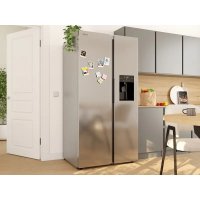
SBS5734WDILE - Refrigerator SABA - Free user manual and instructions
Find the device manual for free SBS5734WDILE SABA in PDF.


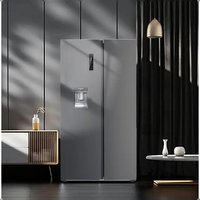
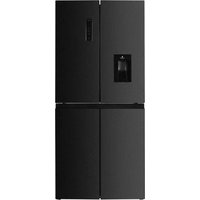
| Product type | Combined refrigerator with water dispenser and ice maker |
| Brand | SABA |
| Model | SBS5734WDILE |
| Dimensions (H x W x D) | 1793 x 910 x 698 mm |
| Total volume | 569 L (refrigerator 372 L, freezer 197 L) |
| Energy class | E (energy efficiency index 100) |
| Annual consumption | 324 kWh/year |
| Noise level | 41 dB(A) - class C |
| Power supply | 220-240 V ~ 50 Hz |
| Climate class | SN/N/ST/T (10°C to 43°C) |
| Main functions | Refrigeration, freezing, fresh water dispenser, ice maker (cubes and crushed ice), LED lighting, digital display, super cool, super freeze, holiday, child lock modes |
| Defrost | Automatic (for both compartments) |
| Water filter | Yes, to be replaced every 6 months or 150 days (indicator) |
| Maintenance and cleaning | Clean the interior and exterior regularly with a soft cloth and baking soda. Do not use abrasive products. Defrost if necessary. Clean the ice bin. |
| Safety | Screen lock, child safety (lock mode), audible alarm in case of error. |
| Spare parts | Water filter, LED bulb (replacement by professional), door seals. Parts availability: 10 years. |
| Repairability | Repairability index not provided. Contact a professional for any repairs. |
| Warranty | 2 years (legal warranty) |
| Additional information | Manufactured for CONFORAMA France S.A. Manual available at www.conforama.fr |
Frequently Asked Questions - SBS5734WDILE SABA
User questions about SBS5734WDILE SABA
0 question about this device. Answer the ones you know or ask your own.
Ask a new question about this device
Download the instructions for your Refrigerator in PDF format for free! Find your manual SBS5734WDILE - SABA and take your electronic device back in hand. On this page are published all the documents necessary for the use of your device. SBS5734WDILE by SABA.
USER MANUAL SBS5734WDILE SABA
natural_image
Simple line drawing of a door with a handle and internal structure, no text or symbols presentFR
GB
natural_image
Technical line drawing of a mechanical device with internal components and mounting holes (no text or symbols)natural_image
Simple line drawing of a bucket placed inside a container (no text or symbols)natural_image
Diagram of a car air conditioner unit with airflow direction indicated by arrows (no text or symbols)FR
natural_image
Technical line drawing of a mechanical housing component with a 90-degree angle indicator (no text or symbols beyond label)NOTE
INDICATEUR DE TEMPERATURE
| Reference: SBS5734WDILE | |
| Rated voltage: 220-240V~ | |
| Ampere: 1.9A | |
| Defrost power input: 208W | |
| Rated frequency: 50Hz | |
| Climate class: SN/N/ST/T | |
| Refrigerant: R600a(79g) | |
| Protection against electrical shock: I | |
| Insulation foam: CYCLOPENTANE |
Classe climatique :
https://sav-client.conforama.fr
09 69 32 05 05
natural_image
Symbol of a trash bin crossed with a diagonal line, no text or numbers presentThank you for choosing SABA quality. This product has been developed by our team of professional and according to European regulations. In order to get the most out of your new appliance, we recommend that you read this instruction manual carefully and keep it for future reference.
TABLE OF CONTENTS
SAFETY INSTRUCTIONS 41
DESCRIPTION OF THE DEVICE 45
INSTALLATION 45
THE WATERWAY INSTALLATION....46
USE 48
FUNCTIONS....50
STORAGE OF FOOD....56
HELPFUL HINTS AND TIPS 60
CLEANING AND CARE....62
CLEANING OF ICE STORAGE BOX....64
COLDEST ZONE IN THE REFRIGERATOR 66
TECHNICAL SPECIFICATIONS 67
TROUBLESHOOTING....70
CORRECT DISPOSAL OF THIS PRODUCT ....72
SAFETY INSTRUCTIONS
- IMPORTANT SAFETY INSTRUCTIONS: READ CAREFULLY AND KEEP FOR FUTURE REFERENCE
- This appliance is intended to be used in household and similar applications such as
- staff kitchen areas in shops, offices and other working environments;
- farm houses and by clients in hotels, motels and other residential type environments;
- bed and breakfast type environments;
-
catering and similar non-retail applications.
-
WARNING: Keep ventilation openings, in the appliance enclosure or in the built-in structure, clear of obstruction.
-
WARNING: Do not use mechanical devices or other means to accelerate the defrosting process, other than those recommended by the manufacturer.
-
WARNING: Do not damage the refrigerant circuit.
-
If the refrigerant circuit is damaged:
- Avoid naked ames and sources of ignition
- Thoroughly ventilate the room in which the appliance is situated.
-
WARNING: Do not use electrical appliances inside the food storage compartments of the appliance, unless they are of the type recommended by the manufacturer.
-
Children aged from 3 to 8 years are allowed to load and unload refrigerating appliances.
-
This appliance can be used by children aged from 8 years and above and persons with reduced physical, sensory or mental capabilities or lack of experience and knowledge if they have been given supervision or instruction concerning use of the appliance in a safe way and understand the hazards involved. Children shall not play with the appliance.
-
Cleaning and user maintenance shall not be made by children without supervision.
-
WARNING: When positioning the appliance, ensure the supply cord is not
trapped or damaged.
- If the supply cord is damaged, it must be replaced by the manufacturer, its service agent or similarly qualified persons in order to avoid a hazard.
- WARNING: Do not locate multiple portable socket-outlets or portable power supplies at the rear of the appliance.
- WARNING: To avoid a hazard due to instability of the appliance, it must be xed in accordance with the instructions.
- Do not store explosive substances such as aerosol cans with a ammable propellant in this appliance.
- WARNING: Il the ice-maker with potable water only. For information on the installation, handling, maintenance and disposal of the device, and the method of replacing the lamp, please refer to the following paragraphs of this manual.
- WARNING: Connect to potable water supply only.
- Gas warning
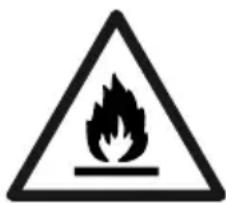
WARNING: Risk of re / ammable materials. Ther are ammable materials at the back of appliance, please keep the product far away re source
-
To avoid contamination of food, please respect the following instructions:
-
Opening the door for long periods can cause a significant increase of the temperature in the compartments of the appliance.
- Clean regularly surfaces that can come in contact with food and accessible drainage systems.
- Clean water tanks if they have not been used for 48 h; flush the water system connected to a water supply if water has not been drawn for 5 days.
- Store raw meat and sh in suitable containers in th refrigerator, so that it is not in contact with or drip onto other food.
- Two-star frozen-food compartments are suitable for storing pre-frozen food, storing or making ice-cream and making ice cubes.
- One-, two- and three-star compartments are not suitable for the freezing of fresh food.
- If the refrigerating appliance is left empty for long periods, switch off,
defrost, clean, dry, and leave the door open to prevent mould developing within the appliance.
- The appliance shall be connected to the water mains using new hose-sets supplied with the appliance, old hose-sets should not be reused.
- The new connection sets supplied with the appliance must be used, and used connection sets must not be reused.
WARNINGS
- If you are discarding an old freezer or refrigerator with a lock / catch tted to the door, ensure that it is left in a disabled condition to prevent the entrapment of young children when playing.
- As old refrigeration equipment may contain CFC's which will damage the ozone layer, when disposing of any refrigeration equipment please contact your local waste disposal department for advice on the correct method of disposal.
- Unplug the appliance from the mains socket when not in operation and before cleaning. Remove food before cleaning the appliance.
- Do not insert oversized food as this could cause incorrect operation.
- Extreme caution must be used when moving an appliance.
- To turn the aooliance off, turn the thermostat knob fully anticlockwise to OFF, then remove the plug from the mains socket.
- Do not give children ice-cream and water ices direct from the freezer as the low temperature may cause 'freezer burns' on the lips.
- The appliance must be installed on the ground, on a at, horizontal surface, making sure that the ventilation openings are completely clear.
- Never try to replace or repair any part or component of the appliance yourself; seek the assistance of professional, qualified personnel, if need be.
- This refrigerating appliance is not intended to be used as a built-in appliance.
- In order to improve efficiency of the cooling system and save energy, it is necessary to maintain good ventilation around the appliance for the dissipation of heat. For this reason, sufficient clear space should be available around the refrigerator.
- To save energy, please avoid keeping the door open for a long time when using
the appliance.
-
If the refrigerant circuit is damaged:
-
Avoid naked ames and sources of ignition
-
Thoroughly ventilate the room in which the appliance is situated.
-
This appliance must be installed on the ground, on a at, horizontal surface, making sure that the ventilation openings are completely clear.
-
Regarding the information pertaining to the installation, handling, servicing and disposal of the appliance, thanks to refer to the below paragraph of the manual.
- Replacing certain parts of your household electrical appliance may lead to a danger.
- Please ensure that you have the necessary skills and own all tools required to carry out the self-repair operations safely. Otherwise, please contact a qualified professional
-
Install the water pipes away from the hot source.
-
The minimum inlet water pressure: 147KPa
-
The maximum inlet water pressure: 834KPa.
-
Please according to local regulations regarding disposal of the appliance for its flammable blowing gas.
- Before you scrap the appliance, please take off the doors to prevent children trapped.
- The built-in ice maker is designed to be installed only by the manufacturer or its after-sales service.
DESCRIPTION OF THE DEVICE
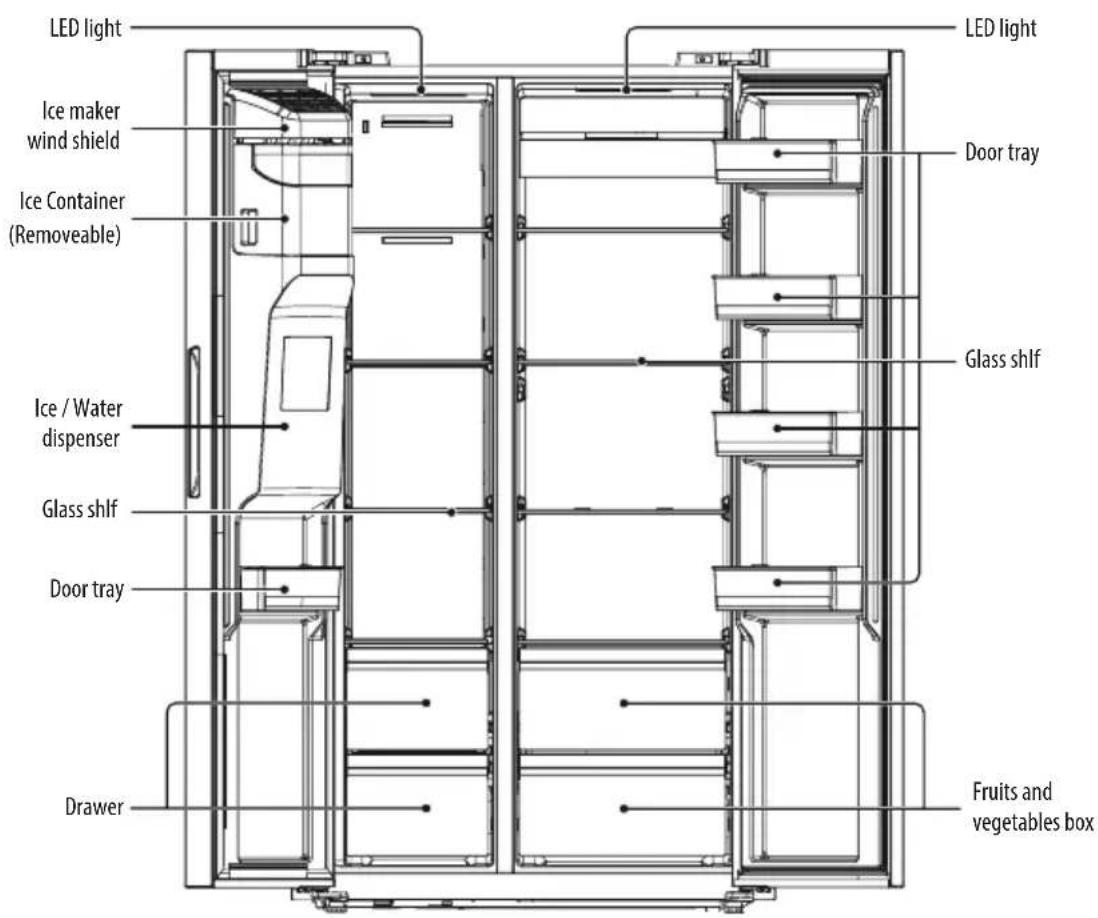
GB
INSTALLATION
Position the appliance and allow it to stand for two to three hours before it is turned on for the rst time to allow the system tsettle. Do not position next to any heat source e.g. cooker, boiler or in direct sunlight etc.
Allow at least 10cm of space at the top and 10 cm of space on both sides of the appliance and between the back of the appliance and the wall for adequate air circulation.
The appliance is not designed for recessed installation ("building in").
Install on a good rm level surface, and any unevenness of th floor should be corrected prior to installation, slight unevenness can be overcome by adjusting the front feet.
NOTE: covering you should readjust the front feet once the appliance If the appliance is positioned on a carpet, soft oo has had time to settle.
THE WATERWAY INSTALLATION
Pre-installation
- Install the water pipes away from the hot source.
- The minimum inlet water pressure: 147KPa
- The maximum inlet water pressure: 834KPa.
NOTE: In order for the automatic ice-making and the cold water supply to work normally, you may need to buy a booster.
Ensure the pipes length is not beyond 8 metres and be careful not to kink together.
-
Please do not connect the appliance to a tap of water heater.
-
Please do not bend inlet pipes and drain-pipes when placing, and shall carefully connect water pipes.
flowchart
graph LR
    A["joint"] --> B["connecting hose"]
    B --> C["Refrigerators back"]
    C --> D["Refrigerators side"]
    style A fill:#f9f,stroke:#333
    style B fill:#ccf,stroke:#333
    style C fill:#cfc,stroke:#333
    style D fill:#fcc,stroke:#333
-
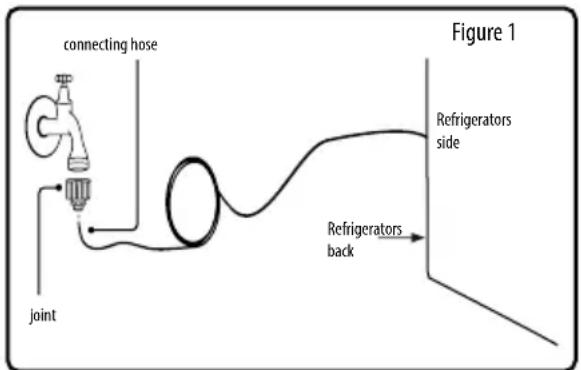
Do not use any old and used water pipes. Please purchase the joint to connect the pipe and the water tap and install it according to the schematic diagram (Figure 1).
-
After being used for 6 consecutive months, the icon (on display panel will blink.
If that happens, please replace the water filter.
The water filter installation and replacement
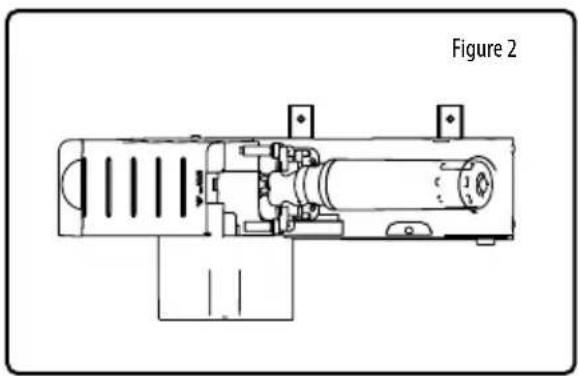
Please refer to the user manual for the position of water filter
natural_image
Technical line drawing of a mechanical device with internal components and mounting holes (no text or symbols)- Remove the filter by turning it clockwise (Figure.2).
- Remove the packaging of the new filter and make sure the o-rings are properly positioned. Insert the new filter into the lousing and lock it by turning it counterclockwise.
- Resetting the filter status: After changing the water filter, reset the water filter by pressing and holding the FILTER on for 3 seconds. When the filter status is reset, the corresponding icon (≡) will turn off from the display panel.
NOTE: If you don't use the function of cool water for a long time, please discard first several cups of water (residual water in water tank) before next using
USE
- This appliance is designed to operate in ambient temperature between 10^ C and 43^ C. If these temperatures are exceeded, i.e. colder or warmer, the appliance will not operate correctly. If the ambient temperatures are exceeded for long periods, the temperature in the freezer section will rise above -18^ C and food spoilage may occur.
- Remove all packaging materials from the appliance. Wash the inside of the cabinet with lukewarm water and bicarbonate of soda (5ml to 0.5 liter of water). Dry the appliance thoroughly.
- When you use the freezer for the rst time or a ter defrosting, set the thermostat control to the maximum position for at least 2 hours before introducing food to be stored, and then readjust to the normal position.
- If there is a power failure, do not open the door. Frozen food should not be affected if the failure lasts for less than 12 hours. If the failure is longer, then the food should be checked and either eaten immediately or cooked and then re-frozen.
Place the food in different compartments according to the following table.
| Location Type of food Storage time | ||
| Door or balconies of fridge compartment | ·Foods with natural preservatives, such as jams, juices, drinks, condiments.·Do not store perishable foods. | 1-2 days |
| Crisper drawer (salad drawer) | ·Fruits, herbs and vegetables should be placed separately in the crisper bin.·Do not store bananas, onions, potatoes, garlic in the refrigerator. | 1-2 days |
| Fridge shelf – bottom Chiller (box/drawer) | Raw meat, poultry, sh (for short-term storage) | 1 month |
| Fridge shelf – middle Dairy products, eggs 2-4 weeks | ||
| Fridge shelf – top | Foods that do not need cooking, such as ready-to-eat foods, deli meats, leftovers. | 1-2 days |
| Freezer drawer(s)/shelf | • Bottom drawer/shelf for raw meat, poultry, fish | 4 months |
| • Middle drawer/shelf for frozen vegetables, chips. | 6 months | |
| • Top drawer/shelf for ice cream, frozen fruit, frozen baked goods. | 2 months |
FUNCTIONS
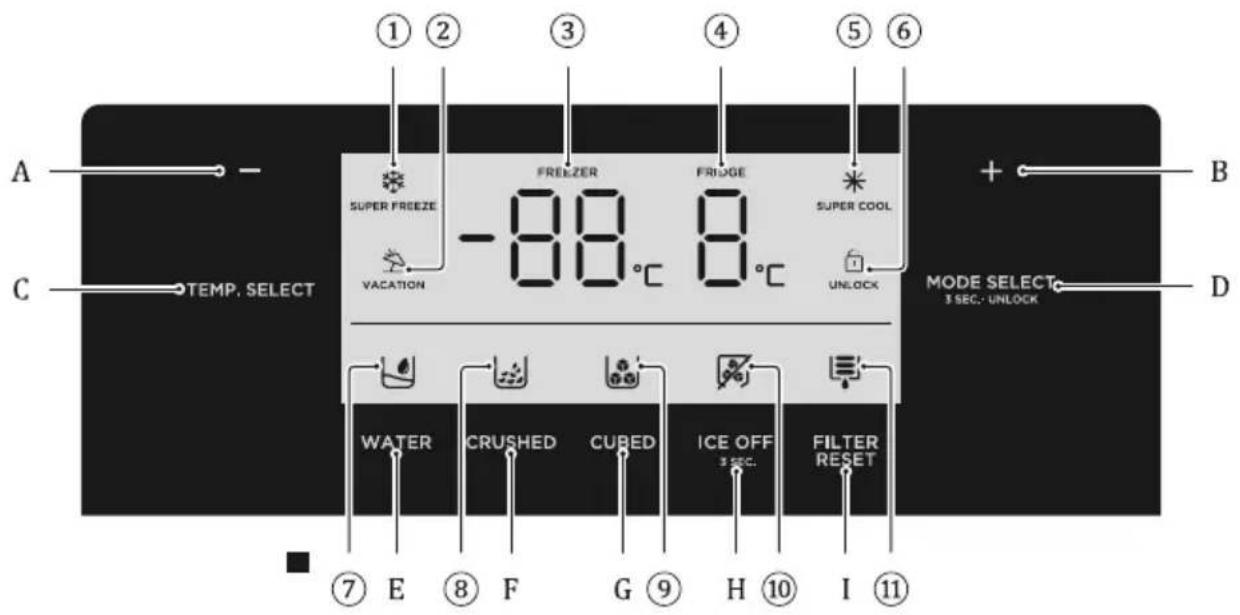
Display
| 1 Super freezing mode icon 2 Vacation mode icon | ||
| 3 Freezing temperature display zone 4 Refrigerating temperature display zone | ||
| 5 Super cooling mode icon 6 Lock / Unlock icon | ||
| 7 Water discharging mode icon 8 Ice crushing mode icon | ||
| 9 Ice cubing mode icon 10 On/off icon for icemaker | ||
| 11 Filter reset icon | ||
Key operation
| A Temperature down button B Temperature up button | |||
| C | Temperature zone selection button | D Mode / Unlock / Lock button | |
| E Water discharging mode button F Ice crushing mode button | |||
| G Ice cubing mode button H On / off button for icemaker | |||
| I Filter reset button | |||
Operating Instructions
Display
Display on the door:
When powering on for the first time, display at full screen for 3s, hear a start-up tone simultaneously, and then enter the normal operation display;
(The temperature of the refrigerating/freezing chamber is set at 5^ C / -18^ C respectively when powering on for the first time).
Display the fault code if there is a fault (display in a cycle);
Display the set temperature of the refrigerating chamber if there is no fault.
Under normal circumstances, the display will be locked after 30s if there is no door opening action or key operation; the display screen will go out after 30s in the locked state;
When the display screen is not lit, the display will be lit up normally if there is a key operation;
If a “visible fault code” type of fault occurs, the display screen will be lit, and then will go out after 30s.
Icemaker display:
When powering on for the first time, display at full screen for 3s, and then enter the normal operation display;
(The water discharging function is set by default for initial power-on).
If there is a communication failure between the distributor board and the icemaker board, the ice cubing indicator lights, water discharging indicator lights, ice crushing mode indicator lights, on/off light for icemaker and time setting indicator light for filter will flash simultaneously;
The current state of the distributor board will be displayed if there is no fault.
Lock / unlock
In the non-locked state, press and hold the lock key for 3 seconds to enter the locked state, and then hear a lock buzzing sound; at this point, the lock icon is lit; In the locked state, press and hold the lock key for 3 seconds to enter the unlocked state, and then hear a unlock buzzing sound; at this point, the lock icon goes out;
Automatically enter the locked state after 30 seconds if there is no key operation; The alarm tone release operation can be carried out in the locked state, and other key operations must be carried out in the non-locked state. If such operations are carried out in the locked state, an error beep prompt will be given.
Temperature adjustment of refrigerating / freezing chamber
When selecting the refrigerating chamber (freezing chamber), press the “+” button to adjust the temperature up; every time you press the button, the temperature will be increased by 1^ C;
When selecting the refrigerating chamber (freezing chamber), press the “-” button to adjust the temperature down; every time you press the button, the temperature will be drop by 1°C;
The temperature setting range of the refrigerating chamber is 2 8^ ; when the temperature is set to the boundary value, pressing the corresponding temperature adjustment button will prompt the button invalid
sound;
The temperature setting range of the freezing chamber is -16 -24^ ; When super freezingmode is set, temperature of freezingchamber will automatically set at -24^ , exit after 24 hours of operation.
Mode settings
Press the function selection key, and the Super cooling, Super freezing and Vacation modes are cycled as follows:
Cycle setting Vacation mode—Super freezing Super cooling Super cooling and Super freezing None Vacation mode ...
When setting the super cooling mode, the temperature of the refrigerating chamber will be automatically set at 2^ C; when exiting the super cooling mode, the set temperature of the refrigerating chamber will automatically return to the set temperature before the super cooling mode.
When setting the super freezing mode, the temperature of the freezing chamber will be automatically set at -24^ ; when exiting the super freezing mode, the set temperature of the freezing chamber will automatically return to the set temperature before the super freezing mode.
NOTE
The quick-freezing function is designed to maintain the nutritional value of the food in the freezer. It can freeze the food in the shortest time. If a large amount of food is frozen at one time, it is recommended that the user turn on the quick-freezing function and put the food in. At this time, the freezing speed of the freezer compartment is increased, which can quickly freeze the food, effectively lock the nutrition of the food, and facilitate storage.
When setting the vacation mode, the freezing chamber will be automatically set to -18, and the refrigerating chamber will be turned off; when exiting the vacation mode, the set temperature of the refrigerating / freezing chamber will automatically return to the set temperature before setting the vacation mode.
Setting of dispenser status
Tap the button corresponding to mode to select the ice cubing / water discharging / ice crushing mode; the corresponding mode indicator light will be on after selecting the corresponding function.
Setting of icemaker switch
Press and hold the on / off button of the icemaker for more than 3s to set the on / off function of the icemaker. The display light of the icemaker is on, indicating that the icemaker is off.
Dispenser light control
When the dispenser switch is pressed, the dispenser light will be on. When the dispenser switch is off, the dispenser light will go out after a delay of 3S.
Filter time reset
The working time of the poweron filter is accumulated. After the filter has been working for 150 days, the filter icon will be lit up to prompt the user to replace the filter. After 180 days, the filter icon will flash to prompt the user to replace the filter. Press and hold the “filter time reset” button for 3S to execute the “FILTER RESET” function. And then, the filter timer will be reset.
NOTE
The timing unit of the cumulative working time of the filter is accumulated once every 24 hours and stored in EEPROM, with the power lost memory function.
Power-off storage
If a power failure occurs, the working status will be memorized. After the next power-on, the refrigerator will be operated according to the setting before the
power failure.
Fault indication
When the refrigerator displays the following prompts, it indicates that the refrigerator is malfunctioning. Although the refrigerator can still use the refrigerating / freezing function in the case of the following faults, the user should contact the maintenance personnel to ensure that the refrigerator is in normal operation.
| Fault code Fault description |
| E0 Icemaker fault |
| E1 Refrigerating chamber temperature sensor fault |
| E2 Freezing chamber temperature sensor fault |
| E5 Freezing and defrosting sensor fault |
| E6 Communication fault of main board and display board |
| E7 Ambient temperature sensor fault |
| EH Humidity sensor fault |
| EE Icemaker sensor fault |
| EP Ice-separating fault of icemaker |
| CA Communication fault of main board and ice making board |
FETCHING WATER AND ICE
Sounds will be produced during making ice cubes and crushed ice: Water valve will produce buzzing sounds; water's flowing into ice vessel will produce sounds; grinding machine's grinding ice into small pieces or product ice's falling into the container will produce sounds. The sounds are normal.
Scratching noises may be produced when taking out the ice cubes. Nothing to worry about this. The ice in the container may be stuck together. In such cases, please take out the ice container and separate stuck ice into pieces by means of, for instance, using plastic or wooden spoons to push hard on the ice carefully.
Other possibilities are illustrated in the chapter “ice container cleaning” To avoid overheating of the ice-making machine’s engine, please fetch ice about 1 minute after the stopping. Please wait for a while until the engine’s temperature reaches
working temperature. Please fetch the ice from the ice container if you need a lot of ice.
The chapter “ice container cleaning” explains how to remove ice container from freezer compartment. If there is no enough ice in the ice container, the ice cannot be taken out. Please wait for a while until new ice is made. To prevent ice smell or bad taste of the ice, please clean the ice container regularly.
Ice and water can only be fetched when the door of freezer compartment is closed. In the process of fetching water and ice, if you open the freezer door, that process will automatically end.
When it displays 📃r does out, you click the buttons of water dispenser again.
Fetching cold water
Keep pressing the buttons until the indicator turns on.
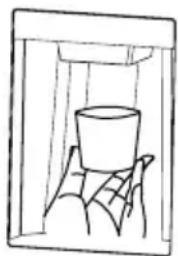
Push the container in the direction of fetching water cushion, Cold water starts to flow into the container.
natural_image
Simple line drawing of a bucket placed inside a frame, no text or symbols presentRemove the container from fetching water cushion and end the exporting of water.
Fetching crushed ice
Keep pressing the buttons of Until the signal turns up.
Make the container tight with mouth of water dispenser to prevent the side jet.
Press the container in the direction of fetching water cushion. Fill the container with crushed ice.
Fetching ice cubes
Keep pressing the buttons 🚙 Until the signal lights up.
Push the container in the direction of fetching water cushion. Ice cubes start to fall into the container.
STORAGE OF FOOD
Your appliance has the accessories as the “Structure illustration” showed in general, with this part instruction you can have the right way to storage your food. The glass shelves and crisper can be removed to store food if needed.
Note: Food is not allowed to touch directly the surface inside the appliance, and should be stored in proper containers
Storing food in the refrigerator compartment
The fridge freezer compartment helps to extend the storage times of fresh perishable foods.
Fresh food care for best results:
- Store foods that are very fresh and of good quality.
- Ensure that food is well wrapped or covered before it is stored. This will prevent food from dehydrating, deteriorating in colour or losing taste and will help maintain freshness. It will also prevent odour transfer. Vegetables and fruit need not be wrapped if they are stored in the vegetable container of the fridge compartment.
- Make sure that strong smelling foods are wrapped or covered and stored away from foods such as butter, milk and cream which can be tainted by strong odours.
- Cool hot foods down before placing them in the fridge compartment.
Dairy foods and eggs
- Most pre-packed dairy foods have a recommended 'use by /best before/best by/date stamped on them. Store them in the fridge compartment and use within the recommended time.
- Butter can become tainted by strong smelling foods so it is best stored in a sealed container.
- Eggs should be stored in the fridge compartment.
Red meat
- Place fresh red meat on a plate and loosely cover with plastic wrap or foil.
- Store cooked and raw meat on separate plates. This will prevent any juice lost from the raw meat from contaminating the cooked product.
Fish and seafood
- Until required, refrigerate on a plate loosely covered with plastic wrap, waxed paper or foil.
- Whole fish should be rinsed in cold water to remove loose scales and dirt and then patted dry with paper towels. Place whole fish or fillets in a sealed plastic bag.
- Keep shellfish chilled at all times. Use within 1-2 days.
Cooked food
- These should be stored in suitable covered containers so that the food will not dry out.
- Keep for only 1-2 days.
Vegetable container
- The vegetable container is the optimum storage location for fresh fruit and vegetables.
• Take care not to store the following at temperatures of less than 7^ C for long periods: Citrus fruit, melons, aborigines, pineapple, papaya, curettes, passion fruit, cucumber, peppers, tomatoes. - Undesirable changes will occur at low temperatures such as softening of the flesh, browning and/or accelerated decaying.
- Do not refrigerate avocados (until they are ripe), bananas and mangoes.
Refrigerated food
- For optimized storage, please refer to the storage time shown in the table below.
| Food Location Storage time | ||
| Butter, cheese Upper door rack 1 month | ||
| Eggs Door rack 2-4 weeks | ||
| Fruit, vegetables, salad Crisper 3-5 days | ||
| Meat, sausage, cheese, milk Lower area (lowest shelf / crisper cover) 1-4 days | ||
| Dairy products, canned food, cans Upper area or door rack | 1 week | |
| Drinks, bottles, tubes | Door rack 3 days |
Take care not to store the following at temperatures of less than 7^ C for long periods:
Citrus fruit, melons, aborigines, pineapple, papaya, curettes, passion fruit, cucumber, peppers, tomatoes.
Undesirable changes will occur at low temperatures such as softening of the flesh, browning and/or accelerated decaying.
Do not refrigerate avocados (until they are ripe), bananas and mangoes.
Freezing and storing food in the freezer compartment
• To store deep-frozen food.
- To make ice cubes.
- To freeze food.
Purchasing frozen food
- Packaging must not be damaged.
- Use by the 'use by /best before/best by/' date.
- If possible, transport deep-frozen food in an insulated bag and place quickly in the freezer compartment.
Storing frozen food
Store at -18^ or colder. Avoid opening the freezer compartment door unnecessarily.
Freezing fresh food
Freeze fresh and undamaged food only.
To retain the best possible nutritional value, flavour and colour, vegetables should be blanched before freezing. Aubergines, peppers, zucchini and asparagus do not require blanching.
Note: Keep food to be frozen away from food which is already frozen.
The following foods are suitable for freezing:
Cakes and pastries, fish and seafood, meat, game, poultry, vegetables, fruit, herbs, eggs without shells, dairy products such as cheese and butter, ready meals and leftovers such as soups, stews, cooked meat and fish, potato dishes, soufflés and desserts.
The following foods are not suitable for freezing:
Types of vegetables, which are usually consumed raw, such as lettuce or radishes,
eggs in shells, grapes, whole apples, pears and peaches, hard-boiled eggs, yoghurt, soured milk, sour cream, and mayonnaise.
Packing frozen food
To prevent food from losing its flavor or drying out, place food in airtight packaging.
- Place food in packaging.
- Remove air.
- Seal the wrapping.
- Label packaging with contents and dates of freezing.
Suitable packaging: Plastic film, tubular film made of polyethylene, aluminum foil.
Recommended storage times of frozen food in the freezer compartment
These times vary depending on the type of food. The food that you freeze can be preserved from 1 to 12 months (minimum at -18^ ).
| Food Storage time | |
| Bacon, casseroles, milk 1 month | |
| Bread, ice cream, sausages, pies, prepare d shellfish, oily fish 2 month | |
| Non-oily fish, shellfish, pizza, scones and muffins 3 month | |
| Ham, cakes, biscuits, beef and lamb chops, poultry pieces 4 month | |
| Butter, vegetables (blanched), eggs whole and yolks, cooked crayfish, minced meat (raw), pork (raw) | 6 month |
| Fruit (dry or in syrup), egg whites, beef (raw), whole chicken, lamb (raw), fruit cakes | 12 month |
Never forget:
- When you freeze fresh foods with a 'use by /best before/best by/'' date, you must freeze them before this date expires.
- Check that the food was not already frozen. Indeed, frozen food that has thawed completely must not be refrozen.
- Once defrosted, food should be consumed quickly. In order to avoid to waste food, please set the themastat lower than -18^ .
HELPFUL HINTS AND TIPS
We recommend that you follow the tips below to save energy.
- Try to avoid keeping the door open for long periods.
- Ensure the appliance is away from any sources of heat(Direct sunlight, electric oven, cooker, etc.)
- Don't set the temperature colder than necessary.
- Don't store warm food or evaporating liquid in the appliance.
- Place the appliance in a well ventilated, humidity free room. Please refer to Installing your new appliance chapter.
- The “STRUCTURE ILLUSTRATION” shows the correct combination for the drawers, crisper and shelves.
Hints for fresh food refrigeration
- Do not place hot food directly into the refrigerator or freezer, the internal temperature will increase resulting in the compressor having to work harder and will consume more energy.
- Do cover or wrap the food.
- Place food properly so that air can circulate freely around it.
Hints for refrigerator
- Meat (All Types) Wrap food: wrap and place on the glass shelf above the vegetable drawer. Always follow food storage times and use by dates suggested by manufacturers.
- Cooked food, cold dishes, etc.: They should be covered and may be placed on any shelf.
- Fruit and vegetables: They should be stored in the special drawer provided.
- Butter and cheese: Should be wrapped in airtight foil or plastic film wrap.
- Milk bottles: Should have a lid and be stored in the door racks.
Hints for freezing
- When first starting-up or after a period out of use, let the appliance run at least 2 hours on the higher settings before putting food in the compartment.
- Prepare food in small portions to enable it to be rapidly and complete frozen and
to make it possible to subsequently thaw only the quantity required.
- Wrap up the food in aluminum foil or polyethylene food wraps which are airtight.
- Do not allow fresh, unfrozen food to touch the food which is already frozen to avoid temperature rise of the latter.
- Iced products, if consumed immediately after removal from the freezer compartment, will probably cause frost burns to the skin.
- It is recommended to label and date each frozen package in order to keep track of the storage time.
Hints for the storage of frozen food
- Ensure that frozen food has been stored correctly by the food retailer
- Once defrosted, food will deteriorate rapidly and should not be re-frozen. Do not exceed the storage period indicated by the food manufacturer.
Switching off your appliance
If the appliance needs to be switched off for an extended period, the following steps should be taken prevent mould on the appliance.
- Remove all food;
- Remove the power plug from the mains socket;
- Clean and dry the interior thoroughly;
- Ensure that all the doors are wedged open slightly to allow air to circulate.
CLEANING AND CARE
For hygienic reasons the appliance (including exterior and interior accessories) should be cleaned regularly at least every two months.
WARNING: The appliance must not be connected to the mains during cleaning. Danger of electrical shock! Before cleaning switch the appliance off and remove the plug from the mains socket.
Exterior cleaning
- To maintain good appearance of your appliance, you should clean it regularly.
- Wipe the digital panel and display panel with a clean, soft cloth.
- Spray water onto the cleaning cloth instead of spraying directly on the surface of the appliance. This helps ensure an even distribution of moisture to the surface.
- Clean the doors, handles and surfaces of machine with a mild detergent and then wiped dry with a soft cloth.
Caution!
- Don't use sharp objects as they are likely to scratch the surface.
- Don't use Thinner, Car detergent, bleach, ethereal oil, abrasive cleansers or organic solvent such as Benzene for cleaning. They may damage the surface of the appliance and may cause fire.
Interior cleaning
You should clean the appliance interior regularly. It will be easier to clean when food stocks are low. Wipe the inside of the fridge freezer with a weak solution of bicarbonate of soda, and then rinse with warm water using a wrung-out sponge or cloth. Wipe completely dry before replacing the shelves and baskets. Thoroughly dry all surfaces and removable parts.
Although this appliance automatically defrosts, a layer of frost may occur on the freezer compartment's interior walls if the freezer door is opened frequently or kept open too long. If the frost is too thick, choose a time when the supply of food stocks are low and proceed as follows:
- Remove existing food and accessories baskets, unplug the appliance from the mains power and leave the doors open. Ventilate the room thoroughly to accelerate the thawing process.
- When defrosting is completed, clean your freezer as described above.
Caution! Do not use sharp objects to remove the freeze from the freezer. Wait until the interior is completely dry before connecting the unit to the mains and turning it on again.
Caution!
- Don't use sharp objects to remove frost from the freezer. Only after the interior completely dry should the appliance be switched back on and plugged back into the mains socket.
Door seals cleaning
Take care to keep door seals clean. Sticky food and drinks can cause seals to stick to the cabinet and tear when you open the door. Wash seal with a mild detergent and warm water. Rinse and dry it thoroughly after cleaning.
Caution!
- Only after the door seals are completely dry should the appliance be powered on.
Replacing the LED light
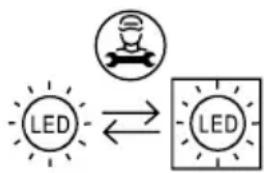
WARNING: The LED light must not be replaced by the user! If the LED light is damaged, contact the customer helpline for assistance.
This product contains two light sources of energy efficiency class (G).
flowchart
graph LR
    A["LED"] --> B["Robot Icon"]
    B --> C["LED"]
CLEANING OF ICE STORAGE BOX
- The ice in the ice storage box may clump or block the outlet for other reasons. In such cases, the ice container needs to be cleaned, or the blockage needs to be removed.
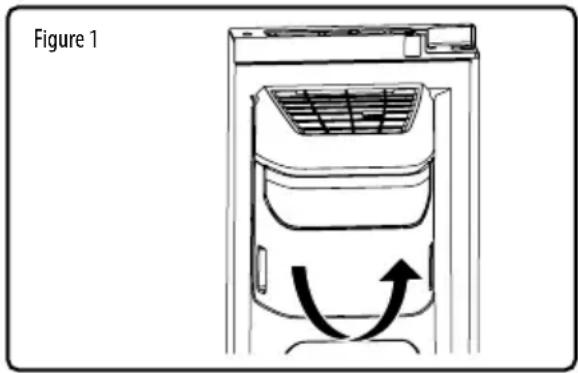
- When the ice on light goes out, hold the left and right clasps of the ice storage box with both hands, and move the ice storage box vertically to get it out of the limit buckle, and then slowly remove the ice storage box along the vertical door liner, as shown in Figure 1
natural_image
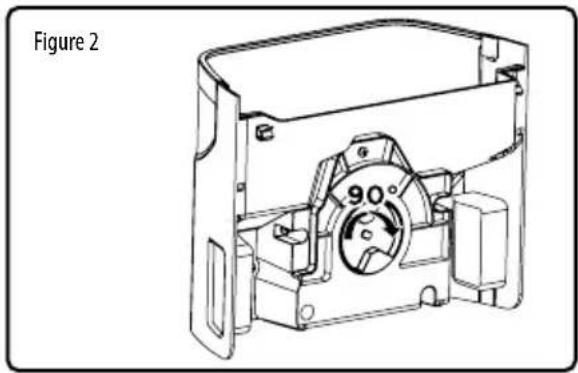
Diagram of a car air conditioner unit with airflow direction indicated by arrows (no text or symbols)- Clean the ice storage box as needed. The installation process of the ice storage box is contrary to the removal process. Pull the ice storage box downwards forcefully until it is installed in place. If it is difficult to install the ice storage box, turn the turntable on the ice storage box 90° according to Figure 2, and then install the ice storage box.
Normal phenomenon
- It is normal to hear a sound when the icemaker turns over ice to the ice storage box.
- If the ice has not been removed for a long time, it may cause the ice to freeze into clumps in the storage box and become inaccessible outside the door. In this case, the ice storage box needs to be cleaned and used again.
- As there is air in the water supply waterway of the icemaker, the water injection rate for the first ice making may be low, resulting in small ice cubes. However, during the normal use of the icemaker, the air in the pipeline will be emptied.
natural_image
Technical line drawing of a mechanical housing component with a 90-degree angle indicator (no text or symbols beyond label)NOTE
If the door is opened, ice or water cannot be taken from the door.
To ensure hygiene, it is recommended to pour out all the ice cubes made fully in the ice storage box for the first time.
If slamming the door, it may cause the water in the icemaker to splash into the ice storage box.
To prevent the ice storage box from accidentally falling, please operate with both hands when disassembling the ice storage box.
To avoid personal injury, please clean up any water or ice that may fall on the ground. To avoid possible injury to children, do not allow children to touch the ice fetching area or ice storage box.
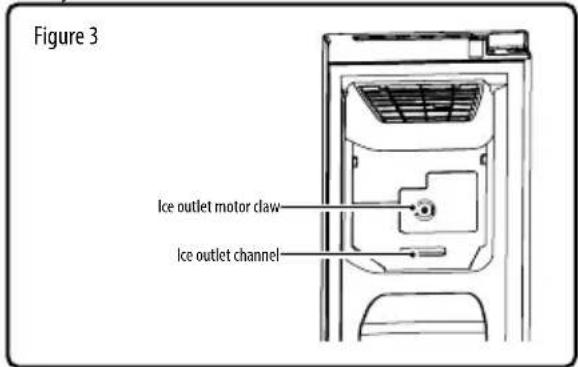
Do not put your hands or any objects into the ice outlet channel, otherwise, it may cause personal injury or damage to the parts of the ice storage box. To avoid possible injury, do not touch the ice outlet motor claw with your hands, as shown in Figure 3.
The recommended external water pressure for the ice maker is (0.25\~0.42) Mpa, and the nominal ice making capacity is generally measured at 0.33Mpa. When the water pressure is not within the recommended range, the ice making function is normal, but the ice making volume will fluctuate, which is a normal phenomenon.
If it is impossible to get ice from the dispenser outside the door when the ice storage box is full of ice, it may be because the ice impeller is stuck by ice. In such case, you need to manually remove the stuck ice, and then the ice can be taken normally.
COLDEST ZONE IN THE REFRIGERATOR
In order to help you get the correct adjustment of your device, it is equipped with a temperature gauge placed in the coldest area.
For the proper storage of food in your refrigerator and in particular in the coldest area, make sure that "OK" appears in the temperature indicator.
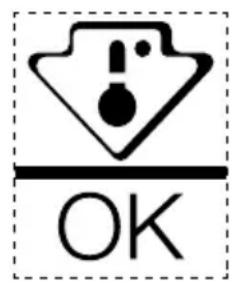
The symbol on the left side indicates the location of the coldest area of your refrigerator. It defines the height of this area.
If"OK" is not displayed, the average temperature in this area will be very high. You ought to adjust the thermostat to a colder setting.
For every modification of your thermostat, you are supposed to wait for the stabilization of the temperature inside the unit before proceeding, if necessary, to a new setting. Do change the position of the thermostat gradually and wait at least 12 hours before re-checking.
NOTE: after charging the device for fresh food or after repeated or prolonged door openings, it is normal that the inscription “OK” does not appear in the temperature indicator. Wait at least 12 hours before readjusting the thermostat.
TECHNICAL SPECIFICATIONS
| Product Information Sheet COMMISSION DELEGATED REGULATION (EU) 2019/2016 | |||||
| Supplier's name or trademark: SABA | |||||
| Supplier's address: BOULEVA | RD DU MANDINET 80, 77432 LOGNES MARNE LA VALLEE (LOGNES), FR | ||||
| Model identifier: SBS5734WDILE | |||||
| Type of refrigerating appliance: | |||||
| Low-noise appliance: No Design type: free standing | |||||
| Wine storage appliance: No Other refrigerating | appliance: yes | ||||
| General product parameters: | |||||
| Parameter Value Parameter Value | |||||
| Overall dimensions (millimetre) | Height | 1793 | Total volume (dm3 or l) 569 | ||
| Width 910 | |||||
| Depth | 698 | ||||
| EEI (%) | 100 | Energy efficiency class | |||
| Airborne acoustical noise emissions (dB(A) re 1 pW) | 41 | Airborne acoustical noise emission class | |||
| Annual energy consumption (kWh/a) | 324 | Climate class: | |||
| Minimum ambient temperature (°C), for which the refrigerating appliance is suitable | 10 | Maximum ambient temperature (°C), for which the refrigerating appliance is suitable | |||
| Winter setting | NO | ||||
GB
| Compartment Parameters: | |||||
| Compartment type | Compartment parameters and values | ||||
| Compartment volume (dm3 or l) | Recommended temperature setting for optimised food storage (°C) | Freezing capacity (kg/24h) | Defrosting type (auto-defrost=A, manual defrost=M) | ||
| Pantry No - - - - | |||||
| Wine storage No - - - | |||||
| Cellar No - - - - | |||||
| Fresh food Yes 372 4 - A | |||||
| Chill No - - - - | |||||
| 0-star or icemaking | No - - - - | ||||
| 1-star No - - - - | |||||
| 2-star No - - - - | |||||
| 3-star No - - - - | |||||
| 4-star Yes 197 -18 | 12 | A | |||
| For 4-star compartments | |||||
| Fast freeze facility | Yes | ||||
| Light source parameters: | |||||
| Type of light source | LED | ||||
| Energy efficiency class | G | ||||
| Minimum duration of the guarantee offered by the manufacturer: 2 Years | |||||
| Additional information: | |||||
| Weblink to the manufacturer's website, where the information in point4(a) Annex of Commission Regulation (EU)2019/2019 is found: www.conforama.fr | |||||
| Reference: SBS5734WDILE | |
| Rated voltage: 220-240V~ | |
| Ampere: 1.9A | |
| Defrost power input: 208W | |
| Rated frequency: 50Hz | |
| Climate class: SN/N/ST/T | |
| Refrigerant: R600a(79g) | |
| Protection against electrical shock: I | |
| Insulation foam: CYCLOPENTANE |
Climate class:
Extended temperate(SN): 'this refrigerating appliance is intended to be used at ambient temperatures ranging from 10 °C to 32 °C;
Temperate(N): 'this refrigerating appliance is intended to be used at ambient temperatures ranging from 16 °C to 32 °C;
Subtropical(ST): 'this refrigerating appliance is intended to be used at ambient temperatures ranging from 16 °C to 38 °C;
Tropical(T): 'this refrigerating appliance is intended to be used at ambient temperatures ranging from 16 °C to 43 °C;
Flash the QR code on your appliance to access its main information
If you have any question, please contact our home appliances after-sales service before going to Conforama store :
https://sav-client.conforama.fr
09 69 32 05 05
This instruction book is also available on our website: www.conforama.fr Period of availability of repair spare parts: 10 years.
TROUBLESHOOTING
If you experience a problem with your appliance or are concerned that the appliance is not functioning correctly, you can carry out some easy checks before calling for service, please see below. You can carry out some easy checks according to this section before calling for service.
WARNING! Don't try to repair the appliance yourself. If the problem persists after you have made the checks mentioned below, contact a qualified electrician, authorized service engineer or the shop where you purchased the product.
| Problem Possible reason | |
| Failed operation | Check whether the appliance is connected to power or whether the plug is in well contact |
| Check whether the voltage is too low | |
| Check whether there is a power failure or partial circuits have tripped | |
| Odor | Odorous foods shall be tightly wrapped |
| Check whether there is any rotten food | |
| Clean the inside of the refrigerator | |
| Long-time operation of the compressor | Long operation of the refrigerator is normal in summer |
| when the ambient temperature is high It is not suggestible having too much food in the appliance at the same time | |
| Food shall get cool before being put into the appliance | |
| The doors are opened too frequently | |
| Light fails to get lit | Check whether the refrigerator is connected to power supply and whether the illuminating light is damaged |
| Have the light replaced by a specialist | |
| Door can not be properly closed | The door is stuck by food packages Too much food is placed |
| The refrigerator is tilted. | |
| Loud noises | Check whether the floor is level and whether the refrigerator is placed stably |
| Check whether accessories are placed at proper locations | |
| Door seal fails to be tight | Remove foreign matters on the door seal |
| Heat the door seal and then cool it for restoration (or blow it with an electrical drier or use a hot towel for heating) | |
| Water pan overflows | There is too much food in the chamber or food stored contains too much water, resulting in heavy defrosting |
| The doors are not closed properly, resulting in frosting due to entry of air and increased water due to defrosting | |
| Hot housing | Heat dissipation of the built-in condenser via the housing, which is normal When housing becomes hot due to high ambient temperature, storage of too much food or shutdown of the compressor is shut down, provide sound ventilation to facilitate heat dissipation |
| Condensation on the exterior surface and door seals of the refrigerator is normal when the ambient humidity is too high. Just wipe the condensate with a clean towel. | |
Disposal
The refrigerating gas contained in the circuit of this appliance is isobutane (R600a); it causes a low level of pollution but is inflammable. Please contact your local disposal department for advice on the correct method of disposal.
CORRECT DISPOSAL OF THIS PRODUCT

European directive 2012/19/EU on Waste from Electrical and Electronic Equipment (WEEE), requires that used household appliances are not thrown into the normal municipal waste stream.
Used appliances must be collected separately in order to optimize the rate of recovery and recycling of materials that compose them, and to reduce the impact on human health and on the environment.
The crossed bin symbol is affixed to all the products to remind you of the obligations of separated collection.
CE
GB

SABA is a German brand born in 1923 in the heart of the black forest.
Pioneers in electrical equipment, it continues its search for quality by offering smart products that will accompany you on a daily life.
This product has been manufactured and sold under the responsibility of CONFORAMA FRANCE S.A..
SABA, and the SABA logo are trademarks used under license by CONFORAMA FRANCE S.A. – further information at www.saba-brand.com.
All other products, services, companies, trademarks, trade or product names and logos referenced herein are the property of their respective owners.
CONFORAMA France SA
- FR
- NOTE
- INDICATEUR DE TEMPERATURE
- Classe climatique :
- TABLE OF CONTENTS
- SAFETY INSTRUCTIONS
- WARNINGS
- DESCRIPTION OF THE DEVICE
- INSTALLATION
- THE WATERWAY INSTALLATION
- Pre-installation
- The water filter installation and replacement
- USE
- FUNCTIONS
- Operating Instructions
- Display
- Display on the door:
- Icemaker display:
- Lock / unlock
- Temperature adjustment of refrigerating / freezing chamber
- Mode settings
- Setting of dispenser status
- Setting of icemaker switch
- Dispenser light control
- Filter time reset
- Power-off storage
- Fault indication
- FETCHING WATER AND ICE
- STORAGE OF FOOD
- Storing food in the refrigerator compartment
- Fresh food care for best results:
- Dairy foods and eggs
- Red meat
- Fish and seafood
- Cooked food
- Vegetable container
- Refrigerated food
- Freezing and storing food in the freezer compartment
- Purchasing frozen food
- Storing frozen food
- Freezing fresh food
- The following foods are suitable for freezing:
- The following foods are not suitable for freezing:
- Packing frozen food
- Recommended storage times of frozen food in the freezer compartment
- Never forget:
- HELPFUL HINTS AND TIPS
- Hints for fresh food refrigeration
- Hints for refrigerator
- Hints for freezing
- Hints for the storage of frozen food
- Switching off your appliance
- CLEANING AND CARE
- Exterior cleaning
- Caution!
- Interior cleaning
- Door seals cleaning
- Replacing the LED light
- CLEANING OF ICE STORAGE BOX
- Normal phenomenon
- COLDEST ZONE IN THE REFRIGERATOR
- TECHNICAL SPECIFICATIONS
- Climate class:
- Flash the QR code on your appliance to access its main information
- TROUBLESHOOTING
- Disposal
- CORRECT DISPOSAL OF THIS PRODUCT
- CE
Brand : SABA
Model : SBS5734WDILE
Category : Refrigerator