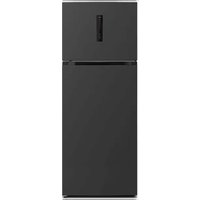
CT4654NFDKE - Fridge SABA - Free user manual and instructions
Find the device manual for free CT4654NFDKE SABA in PDF.


| Product type | Freestanding refrigerator-freezer |
| Brand | SABA |
| Model | CT4654NFDKE |
| Height (mm) | 1855 |
| Width (mm) | 703 |
| Depth (mm) | 703 |
| Total volume (L) | 465 |
| Refrigerator volume (L) | 365 |
| Freezer volume (L) | 100 |
| Energy efficiency class | E |
| Annual consumption (kWh/year) | 252 |
| Noise emissions (dB(A)) | 39 |
| Climate class | SN, N, ST, T (10°C to 43°C) |
| Refrigerant gas | R600a (52g) |
| Power supply | 220-240 V~, 50 Hz, 1.05 A |
| Freezing capacity (kg/24h) | 4.5 |
| Defrosting | Automatic (No Frost) |
| Special functions | Rapid cooling, Smart mode, Child lock, Open door alarm |
| Light source | LED (class G, replaceable by professional) |
| Door reversal | Possible (left/right, tools required) |
| Cleaning | Warm water and mild soap, baking soda |
| Spare parts available | 10 years after purchase, contact Conforama after-sales service |
| Warranty | 2 years |
Frequently Asked Questions - CT4654NFDKE SABA
User questions about CT4654NFDKE SABA
0 question about this device. Answer the ones you know or ask your own.
Ask a new question about this device
Download the instructions for your Fridge in PDF format for free! Find your manual CT4654NFDKE - SABA and take your electronic device back in hand. On this page are published all the documents necessary for the use of your device. CT4654NFDKE by SABA.
USER MANUAL CT4654NFDKE SABA
natural_image
Curved grid pattern with no text or symbols, showing a grid of intersecting lines (no text or symbols present)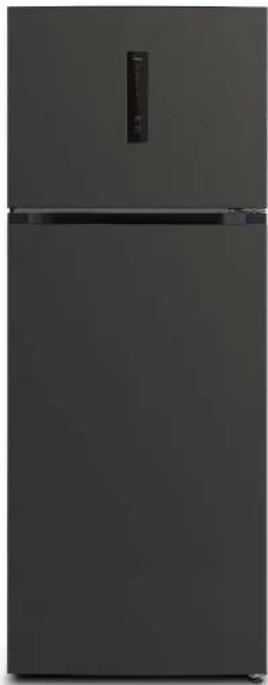
natural_image
Exterior view of a modern stainless steel refrigerator (no visible text or symbols)SABA
CT4654NFDKE

CONFORAMA France
UTILISATION
FRF
natural_image
Technical line drawing of a mechanical assembly with no visible text or symbolsThank you for choosing SABA quality. This product has been developed by our team of professional and according to European regulations. In order to get the most out of your new appliance, we recommend that you read this instruction manual carefully and keep it for future reference.
TABLE OF CONTENTS
Safety instructions 44
Description of the device 50
Installation....51
Use 52
Functions 53
Temperature indicate. 58
DAILY USE. 62
Reversing the door 67
Maintenance....73
Cleaning 75
Troubleshooting....76
Servicing 78
Accessories....78
Disposal. 78
Disposal of old electrical appliances 79
SAFETY INSTRUCTIONS
- IMPORTANT SAFETY INSTRUCTIONS: READ CAREFULLY AND KEEP FOR FUTURE REFERENCE
- This appliance is intended to be used in household and similar applications such as.
- staff kitchen areas in shops, offices and other working environments.
- farm houses and by clients in hotels, motels and other residential type environments.
- bed and breakfast type environments, catering and similar non-retail applications.
- WARNING: Keep ventilation openings, in the appliance enclosure or in the built-in structure clear of obstruction.
- WARNING: Do not use mechanical devices or other means to accelerate the defrosting process, other than those recommended by the manufacturer.
- WARNING: Do not damage the refrigerant circuit.
- If the refrigerant circuit is damaged:
- Avoid naked flames and sources of ignition.
- Thoroughly ventilate the room in which the appliance is situated.
- WARNING: Do not use electrical appliances inside the food storage compartments of the appliance, unless they are of the type
recommended by the manufacturer.
8. Children aged from 3 to 8 years are allowed to load and unload refrigerating appliances.
9. This appliance can be used by children aged from 8 years and above and persons with reduced physical, sensory or mental capabilities or lack of experience and knowledge if they have been given supervision or instruction concerning use of the appliance in a safe way and understand the hazards involved.
10. Children shall not play with the appliance.
11. Cleaning and user maintenance shall not be made by children without supervision.
12. WARNING: When positioning the appliance, ensure the supply cord is not trapped or damaged.
13. If the supply cord is damaged, it must be replaced by the manufacturer, its service agent or similarly qualified persons in order to avoid a hazard.
14. WARNING: Do not locate multiple portable socket-outlets or portable power supplies at the rear of the appliance.
15. WARNING: To avoid a hazard due to instability of the appliance, it must be fixed in accordance with the instructions.
16. Do not store explosive substances such as aerosol cans with a flammable propellant in this appliance.
- WARNING: fill the ice-maker with potable water only.
- For information on the installation, handling, maintenance and disposal of the device, and the method of replacing the lamp, please refer to the following paragraphs of this manual.
- Gas warning: risk of fire /flammable materials
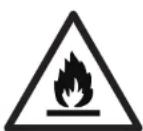
Please keep the product far away fire source during using, service and disposal. There are flammable materials at the back of the appliance. Please according to local regulations regarding disposal of the appliance for its flammable blowing gas, Before you scrap the appliance, please take off the doors to prevent children trapped.
-
To avoid contamination of food, please respect the following instructions:
-
Opening the door for long periods can cause significant increase of the temperature in the compartments of the appliance.
- Clean regularly surfaces that can come in contact wit food and accessible drainage systems.
- Store raw meat and fish in suitable containers in the refrigerator, so that it is not in contact with or drip onto other food.
- Two-star frozen-food compartments are suitable for storing pre-frozen food, storing or making ice-cream and making ice cubes.
One-, two- and three-star compartments are not suitable for the freezing of fresh food.
-If the refrigerating appliance is left empty for long periods, switch off, defrost, clean, dry, and leave the door open to prevent mould developing within the appliance.
WARNINGS
- If you are discarding an old freezer or refrigerator with a lock/ catch fitted to the door, ensure that it is left in a disabled condition to prevent the entrapment of young children when playing.
- Unplug the appliance from the mains socket when not in operation and before cleaning. Remove food before cleaning the appliance.
- Do not insert oversized food as this could cause incorrect operation.
- Extreme caution must be used when moving an appliance.
- Do not give children ice-cream and water ices direct from the freezer as the low temperature may cause 'freezer burns' on the lips.
- The appliance must be installed on the ground, on a flat, horizontal surface, making sure that the ventilation openings are completely clear.
-
Never try to replace or repair any part or component of the appliance yourself; seek the assistance of professional, qualified personnel, if need be.
-
This refrigerating appliance is not intended to be used as a built-in appliance.
- In order to improve efficiency of the cooling system and save energy, it is necessary to maintain good ventilation around the appliance for the dissipation of heat. For this reason, sufficient clear space should be available around the refrigerator.
- To save energy, please avoid keeping the door open for a longtime when using the appliance.
- Replacing certain parts of your household electrical appliance may lead to a danger. Please ensure that you have the necessary skills and own all tools required to carry out the self-repair operations safely. Otherwise, please contact a qualified professional.
- Regarding the information pertaining to the installation, handling, servicing and disposal of the appli ance, thanks to refer to the below paragraph of the manual.
-
As old refrigeration equipment may contain CFC's which will damage the ozone layer, when disposing of any refrigeration equipment please contact your local waste disposal department for advice on the correct method of disposal.
-
Please according to local regulations regarding disposal of the appliance for its flammable blowing gas. Before you scrap the appliance, please take off the doors to prevent children trapped.
DESCRIPTION OF THE DEVICE
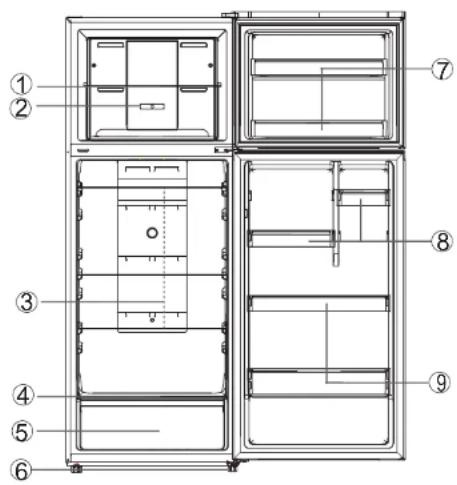
- Freezer Shelf
- Adjustable Feet
- Air regulating rod
- Bottle Racks Light
- Refrigerator Glass Shelves
- Little Bottle Racks
- Crisper Cover
- Bottom Bottle Racks
- Salad Crisper
NOTE: The appliance design is subject to change without prior notice.
INSTALLATION
Position the appliance and allow it to stand for two to three hours before it is turned on for the first time to allow the System to settle. Do not position next to any heat source e.g. cooker, boiler or in direct sunlight etc.
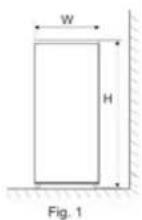
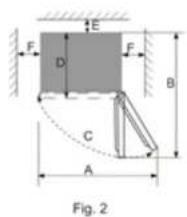
Allow at least 10cm of space at the top and 10 cm of space on both sides of the appliance and between the back of the appliance and the wall for enough air circulation. The appliance is not designed for recessed installation ("building in").
Install on a good firm level surface, and any unevenness of the floor should be corrected prior to installation, slight unevenness can be overcome by adjusting the front feet.
NOTE: If the appliance is positioned on a carpet, soft floor covering you should readjust the front feet once the appliance has had time to settle.
Heat dissipation space
When working, the refrigerator gives off heat to surroundings. Therefore, at least 30mm of free space should be spared at the top side, more than 100mm on both sides, and above 50mm at the back side of the refrigerator.
Dimensions in mm:
| W D H A B C(°) E F | ||||||
| 703 703 1855 1147 | 1359 130±5 | 50 | 100 |
Note: Figure 1, Figure 2 only illustrate the space demand of the product.
USE
- This appliance is designed! to operate in ambient temperature between 10°C and 43°C. If these temperatures are exceeded, i.e. colder or warmer, the appliance will not operate correctly. If the ambient temperatures are exceeded for long periods, the température in the freezer section will rise above -18°C and food spoilage may occur.
- Remove all packaging materials from the appliance. Wash the inside of the cabinet with lukewarm water and bicarbonate of soda (5ml to 0.5 liter of water). Dry the appliance thoroughly.
- If there is a power failure, do not open the door. Frozen food should not be affected if the failure lasts for less than 10 hours. If the failure is longer, then the food should be checked and either eaten immediately or cooked and then re-frozen.
Functions
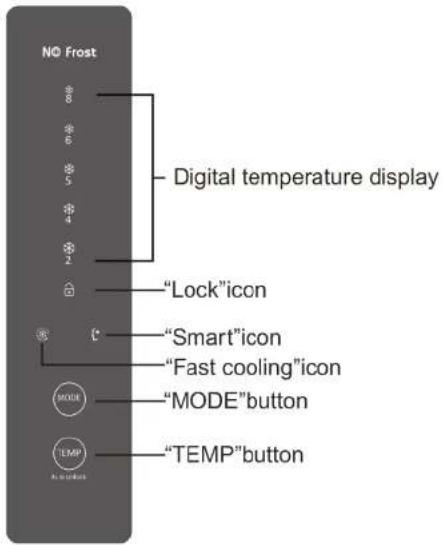
When the refrigerator is connected to the power supply, all indicator icons on the display screen light up, which will return to the normal display after 2 seconds.
| Usage environment | Whentheambient temperature is higherthan35°C | When the ambient temperature is 16 °C - 35 °C | When the ambient temperature is lower than 16 °C | Special tips |
| Setting of freezer air adjusting lever | 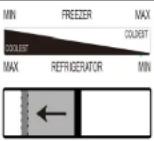 | 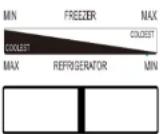 | 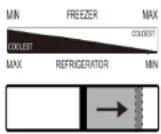 | 1) The middle mode is recommended2) In the case of change to the ambient temperature around the refrigerator, adjust the temperature mode by reference to the left table. |
| RECOMMENDTEMP.CONTROL | RECOMMENDTEMP.CONTROL | RECOMMENDTEMP.CONTROL | ||
| Display settings | 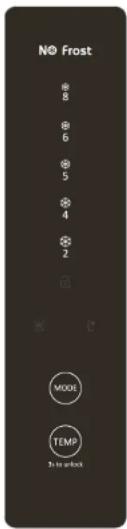 | 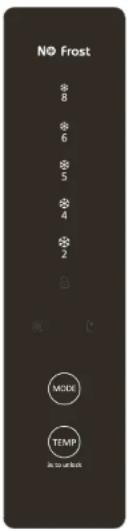 | ||
Temperature setting
Press the "TEMP" key to adjust temperature, until the desired temperature mode is selected, which will take effect if no key operation within 5 seconds; Then, the system will operate according to the temperature setting immediately.
The temperature modes cycle in the sequence as following: "5-4-2-8-6-5".
Fast cooling
When the "Fast Cooling" function is enabled, the fridge compartment cools down rapidly, and the temperature in the freezer compartment also drops rapidly at the same time, in order to prevent foods against nutrient losses and keep them fresh and tasty. The "Fast Cooling" function keeps operating for 30 hours at the most; and after that, it will automatically exit, with the temperature mode restored to the setting that is set before the "fast cooling" function is enabled.
- Press the "Mode" key until the icon of "Fast Cooling" starts flickering, and if no key operation within 5s, the "Fast Cooling" function will take effect, with the flickering stopped.
- When the fast-cooling function is active, it will be disabled if the refrigerator temperature is adjusted or the other function is enabled.
Smart
Setting the refrigerator at the "Smart" mode ensures that foods are stored in a better temperature range, with the refrigerator operating with better efficiency and performance.
- Press the "Mode" key until the icon of "Smart" starts flickering, and if no key operation within 5s, the "Smart"
function will take effect, with the flickering stopped.
- When the "Smart" function is active, it will be disabled if the refrigerator temperature is adjusted or the other function is enabled.
Child Lock
When the refrigerator "Child Lock" function is active, the temperature or function is subject to no change, to avoid maloperation.
- When there is no key operation within 3 minutes, the refrigerator "Child Lock" function will be enabled automatically.
• To exit "Child Lock" function
When the "Temp" is pressed and held for 3 seconds, the "Child Lock" function will be enabled
Door open alarm
When the fridge door or freezer door is open for more than 3 minutes, buzzer alarms will be continuously issued, which can be stopped when any key is pressed, but will be restored after 3 minutes if the door keeps open. The alarms will not be lifted until the door is closed.
Power cut memory
In case of power failure, the refrigerator will maintain the operating state before power failure when power supply is restored.
Power-on delay
In order to protect the refrigerator compressor from being damaged in the case of short-time power failure (i.e., less than 5 minutes), the compressor will not be started immediately after it is powered on.
Fault alarm
In case the indicator of Mode 2, Mode 4, Mode 5, Mode 6 or Mode 8 keeps flickering, it indicates fault with the refrigerator. Please contact the aftersales person for visiting service in such case.
Notes
- When the ambient temperature around the refrigerator is higher than 35^ , do not set the fridge and the freezer at the coldest mode, to avoid the normal refrigeration of the refrigerator being affected.
- Do not set the fridge temperature mode at the coldest mode, nor adjust the freezer air adjusting lever to the leftmost position, because this may lead to undercooling of the refrigerator compartment.
- When the refrigerator temperature is insufficiently cold or excessively cold, it is advisable to set the fridge in the middle mode and adjust the freezer air adjusting lever to the middle position.
- Note: During actual use, icing may occur in the freezer compartment due to high humidity or frequent opening of the freezer door. In such case, do not try to adjust the adjusting lever by force; instead, it is recommended to use a hot towel for local heating to get it thawed, so as to avoid damaging the freezer adjusting lever.
TEMPERATURE INDICATE
In order to help you get the correct adjustment of your device, it is equipped with a temperature gauge placed in the coldest area. For the proper storage of food in your refrigerator and in particular in the coldest area, make sure that «OK» appears in the temperature indicator.
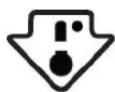
The symbol on the left side indicates the location of the coldest area of your refrigerator. It defines the height of this area.

If «OK» is not displayed, the average température in this area will be very high. You ought to adjust the thermostat to a colder setting.
For every modification of your thermostat, you are supposed to wait for the stabilization of the temperature inside the unit before proceeding, if necessary, to a new setting. Do change the
position of the thermostat gradually and wait at least 12 hours before re-checking.
NOTE: after charging the device for fresh food or after repeated or prolonged door openings, it is normal that the inscription «OK» does not appear in the temperature indicator. Wait at least 12 hours before readjusting the thermostat.
Shopping for frozen food
The appliance is rated as a 4 star freezer and can freeze fresh food and store pre-frozen food. When you are buying frozen food, look at the Storage Guidelines on the packaging. You will be able to store each item of frozen food for the period shown against the 4 star rating.
Check the Fridge/Freezer temperature
Check the temperature of the frozen food cabinet in the shop where you buy your frozen foods. It should show a temperature lower than -18°C.
Choose packs carefully
Make sure the frozen food package is in perfect condition.
Purchase frozen food last
Always buy frozen products last on your shopping trip or visit to the supermarket.
Keep frozen foods together
Try to keep frozen food together whilst shopping, and on the journey home as this will help to keep the food cooler.
Store food straight away
Dont buy frozen food unless you can freeze it straight away.
Special insulated bags can be bought from most supermarkets and hardware shops. These keep frozen food cold for longer.
Thawing frozen food
For some foods, thawing before cooking is unnecessary Vegetables and pasta can be added directly to boiling water or steam cooked Frozen sauces and soups can be put into a saucepan and heated gently until thawed.
Freezing fresh food
Ensure that your freezing operations are carried out under the most hygienic conditions as freezing alone does not improve the food. Never put hot or even warm foodstuffs into the freezer. Prior to freezing the food, food should always be covered tightly with foil, plastic film, placed in plastic bags or stored in airtight containers. This will prevent food from dehydrating and to prevent any strong odors of some foods transferring to milder ones.
To freeze raw meat, wrap in plastic bags or in airtight containers and place on the lowest shelf to avoid cross contamination. Do not allow raw meat to come into contact with cooked foods. For safety, only store raw meat for two or three days Fruit and vegetables should be thoroughly cleaned and placed in the crisper.
Milk and other liquids should be sealed with lids and placed in the bottle shelf in the door. NOTE: The ambient temperature of the freshly stored food and how often the door is opened affect the temperature in the refrigerator. If required, change the thermostat temperature settings.
Storing frozen food
Ail frozen food you purchase should be placed in the freezer as soon as possible to avoid them from defrosting and spoiling. Ail storage recommendations printed on the packaging of frozen food by the manufacturer should always be followed.
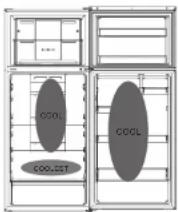
Storing food in fridge Cool area
This is where to store foods which will keep longer if they are kept cool. Milk, eggs, yogurt, fruit juices, hard cheeses e.g. Cheddar. Opened jars and bottles of salad dressings, sauces and jams. fats, e.g. Butter, margarine, cooking fats and lard.
Coldest area: 0°C to 5°C
This is where foods which must be cold to keep them safe should be kept:
- Raw and uncooked foods should always be wrapped.
- Pre-cooked chilled foods, e.g. Ready meals, meat pies, soft cheeses.
– Pre-cooked meats e.g. Ham,
– Prepared salads (including pre-packed mixed green salads, rice, potato salad etc.).
– Desserts, e.g. Fromage frais, home-prepared food and leftovers or cream cakes.
Salad bin
This is the most humid part of the Fridge. Vegetables, fruit, fresh salad items e.g. Unwashed whole lettuce, whole tomatoes, radishes etc can be stored here.
WE RECOMMEND THAT ALL PRODUCE KEPT IN THE SALAD BIN IS WRAPPED.
NOTE: Always wrap and store raw meat, poultry and fish on the lowest shelf at the bottom of the fridge. This will stop them dripping onto, or touching other foods. Do not store inflammable gasses or liquids in the fridge.
DAILY USE
FIRST USE Cleaning the interior
Before using the appliance for the first time, wash the interior and all internal accessories with lukewarm water and some neutral soap so as to remove the typical smell of a brand new product, then dry thoroughly.
IMPORTANT! Do not use detergents or abrasive powders, as these will damage the finish.
MAKING ICE CUBES
-
Fill the ice tray with % full of clean water
-
Place the tray in the top freezing drawer
-
Close the door
To remove the ice cubes from the tray, put the tray under running water for a while and then twist the tray slightly to loosen the ice cubes
FRIDGE FOOD
Storage time of different food in different compartments according to be below table.
| Refridgeratorcomportments | Type of food | Storage time |
| Door or balconies offridge compartment | Food with natural preservatives, such jams,juices, drinks, condiments.Do not store perishable foods. | 3 days |
| Crisper drawer(salad drawer) | Fruits, herbs and vegetables should be placed separately in the crisper bin.Do not store bananas, onions, potatoes, garlic in the refrigerator. | 1 week |
| Fridge shelf - middle | Dairy products, eggs | 1 week |
| Fridge shelf - top | Foods that do not need cooking, such a s ready-to-eat food, deli meats, leftovers | 1 week |
Take care not to store the following at temperatures of less than 7°C for long periods
- Citrus fruit, melons, aborigines, pineapple, papaya, curettes, passion fruit, cucumber, peppers, tomatoes.
- Undesirable changes will occur at low temperatures such as softening of the flesh, browning and/or accelerated decaying.
- Do not refrigerate avocados (until they are ripe), bananas and mangoes.
Use of the humidity regulating rod of the crisper box
- The humidity regulating rod is used to preserve moisture inside the crisper box, so as to keep fresh the vegetables and fruits stored inside.
- When the humidity regulating rod is adjusted to the right side, with more holes exposed, the internal moisture of the crisper box can be maintained at the low level.
- When the humidity regulating rod is adjusted to the left side, with less holes exposed, the internal humidity of the crisper box can be maintained at the high level.
FREEZING FRESH FOOD
- The freezer compartment is suitable for freezing fresh food and storing frozen and deep-frozen food for a long time.
- Place the fresh food to be frozen in the top compartment.
- The maximum amount of food that can be frozen in 24 hours is specified on the rating plate.
- The freezing process lasts 24 hours: during this period do not add other food to be frozen.
- The combination of the drawers, baskets and shelves shown in the device description is optimal for efficient energy savings. Changing the combination proposition could alter the efficiency.
STORING FROZEN FOOD
- When first starting-up or after a period out of use. Before putting the product in the compartment, let the appliance run at least 2 hours on the lowest temperature.
- IMPORTANT! In the event of accidental defrosting, for example the power has been off for longer than the value shown in the technical characteristics chart under "rising time", the defrosted food must be consumed quickly or cooked immediately and then re-frozen (after cooked).
| Food | Storage time |
| Bacon, casseroles, milk | 1 month |
| Bread, ice cream, sausages, pies, prepared shell fish oily fish | 2 months |
| Non-oily fish, shellfish, pizza, scones and muffins | 3 months |
| Ham, cakes, biscuits, beef and lamb chops, poultry pieces | 4 months |
| Butter, vegetables (blanched), eggs whale and yolks, cooked crayfish, mincedmeat (raw),pork (raw) | 6 months |
| Fruit (dry air in syrup), egg whites, beef (raw), whole chicken, lamb (raw), fruit cakes | 12 months |
Never forget
- When you freeze fresh food with a 'use by / best before/best by/' date, you must freeze them before this date expires.
- Check that the food was not already frozen. Indeed frozen food that has thawed completely must not be re-frozen.
- Once defrosted, food should be consumed quickly.
- These times vary depending on the type of food. The food that you freeze can be preserved from 1 to 12 months (minimum at -18^ ).
THAWING
Deep-frozen or frozen food, prior to be used, can be thawed in the freezer compartment or at room temperature, depending on the time available for this operation.
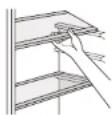
MOVABLE SHELVES
The walls of the refrigerator are equipped with a series of runners so that the shelves can be positioned as desired.
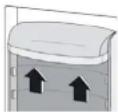
POSITIONING THE DOOR BALCONIES
To permit storage of food packages of various sizes, the door balconies can be placed at different heights. To make these adjustments proceed as follows: gradually pull the balcony in the direction of the arrows until it comes free, then reposition as required.
Energy-saving tips
Install the fridge or freezer in a cool place out of direct sunlight and away from cookers, heaters, dishwashers or any hot air emitting items.
Do not set the fridge and freezer temperatures lower than necessary. Set the internal temperature within the correct range e.g. adjust the thermostat at middle position for 4^ C in the fridge compartment and -18^ C in the freezer respectively. Let pre-cooked foods cool down before placing them in the fridge or freezer. This will prevent the internal temperature of the fridge from rising.
Keep your fridge full, but not over crowded, this helps reduce «cold» air loss. Meanwhile, avoid overloading the fridge or freezer. Try to leave about 20% free space for air circulation. To prevent cold air escaping, limit the frequency of opening door. When retuning from shopping, sort foods to be kept in your fridge before opening the door. Only open the door to put food in or take it out.
Make sure the door seal is clean and in good condition. It should hold a piece of paper tightly in place when shut. Defrost regularly or when ice is more than 5mm thick. Thick ice covering the inner sides significantly increases energy use. The combination of the drawers, baskets and shelves shown in the device description is optimal for efficient energy savings. Changing the combination proposition could alter the efficiency.
REVERSING THE DOOR
This refrigerator can be opened either from the left or right side. The default way of opening the door is from the right side. If you want to open the door from the left side, please follow the instructions below.
Tools Required: Phillips style screwdriver / Fiat blated screwdriver / Hexagonal spanner.
- If you want to have the door swing reversed, we recommend that you contact a qualified technician. You should only try to reverse the door yourself if you believe that you are qualified to do so.
- Ensure the unit is unplugged and empty.
- Adjust the two levelling feet to their highest position.
- To take the door off it is necessary to tilt the unit backwards. You should rest the unit on something solid so that it will not slip during the door reversing process.
- Ail parts removed must be saved to do the reinstallation of the door.
- The refrigerator inclination angle should be less than 45^ .
- Do not lay the unit fat as this may damage the coolant System.
- You should rest the Appliance on something solid e.g. a chair just below the top panel.
- We recommend that 2 people handle the unit during assembly.
You need the following tools to reverse the door:
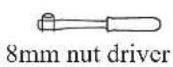
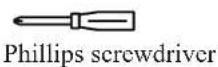
- Make sure that your refrigerator is unplugge.
- Remove one screw in the hinge cover, remove hinge cover and screws, then remove the hinge.
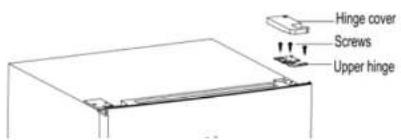
- Remove the freezer compartment door from the cabinet
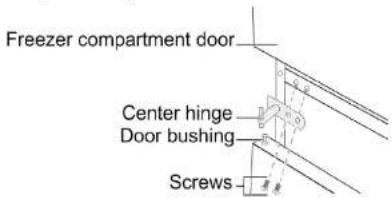
- Remove the two screws that secure the center hinge.
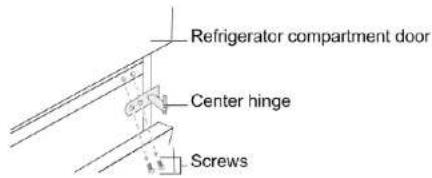
- Remove the freezer compartment door.
- Remove the screws that secure the lower hinge to the rig side of the cabinet, then remove the hinge.
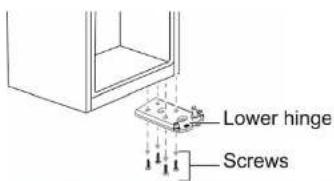
7.. Remove the washer and nut that secure the pin shaft to the right hole on the lower hinge, then remove the shaft
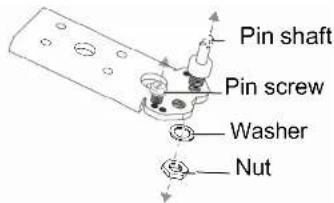
8.. Insert the pin shaft into the left hole on the lower hinge, then secure the shaft with the washer and nut.
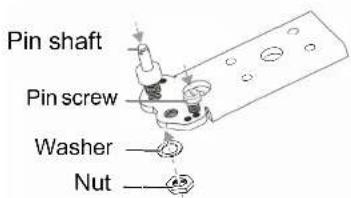
-
Install the lower hinge on the left side of the cabinet.
-
Remove the screw that secures the door stop from the bottom right of the refrigerator compartment door, then remove the door stop and install to the bottom left side.
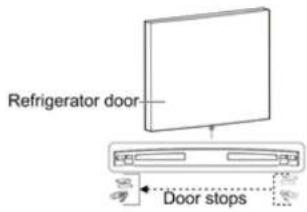
-
Install the refrigerator compartment door.
-
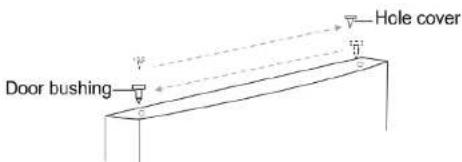
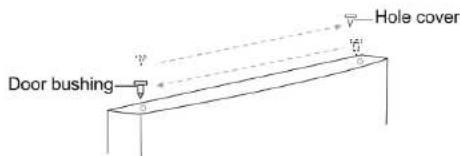
Move the door bushing from the top right side of the refrigerator door to the top left side of the door. And move the left hole cover to the right side.
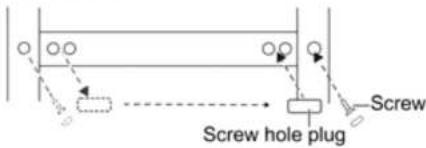
- Remove screws and the center hinge screw hole plug on the left side of the cabinet, then install in the screw holes on the right side of the cabinet.
- Install the center hinge to the left side with the two screws you removed previously.
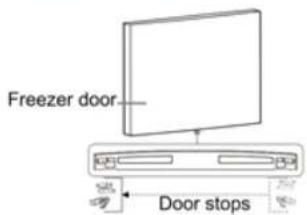
- Remove the screw that secures the door stop from the bottom right of the freezer compartment door, then remove the door stop and install to the bottom left side.
-
Install the Freezer compartment door.
-
Move the door bushing from the top right side of the freezer d to the top left side of the door. And move the left hole cover to the right side.
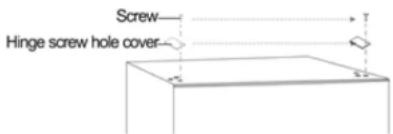
18.8. Remove the screw that secures the hinge screw hole cover from the top left side of the cabinet, remove the cover, and secures the cover on the top right side of the cabinet.
- Secure the upper hinge to the top left side of the cabinet with screws you removed previously. Before you tighten the upper hinge screws, make sure that the top of the door is level with the cabinet and that the rubber gasket makes a good seal.
- Install the hinge cover over the hinge on the top left side of cabinet.
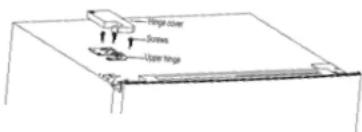
Note: Ensure the rubber gaskets are making a good seal with the cabinet all the way around the doors before tightening the hinge screws.
MAINTENANCE
Noise from your appliance
You may notice some rather unusual noises. The noises are caused by circulation of refrigerant in the cooling System. It has become more pronounced since the introduction of CFC free gases. This is not a fault and will not affect the performance of your fridge.
Prolonged off periods
If the appliance is not in use for a long period of time, proceed as follows:
- Disconnect from the mains supply.
- Clean and dry the inside (see 'Cleaning and maintenance').
- Leave the door open to prevent any unpleasant smells from building up while the appliance is not in use.
Notes for use
Do clean and defrost your appliance regularly. Do check contents of the compartments every so often.
Do store commercially prepared food in accordance with the instructions given on the packets.
Do choose high quality fresh food and be sure it is thoroughly clean before freezing it.
Do wrap all food in food quality polythene bags or air tight containers and make sure any air is excluded.
Do Not store poisonous or any dangerous substances in your freezer. It is designed for the freezing of edible foodstuffs only.
Do Not consume food which has been frozen for an excessive length of time.
Do Not leave the door open for long periods, as this will make the appliance more costly to run and cause excessive ice formation. Do Not use sharp objects such as knives to remove the ice from the appliance. Only use a plastic scraper.
Do Not put hot food into the appliance. Let it cool down to room temperature.
Do Not put liquid-filled bottles or sealed cans containing carbonated liquids into the freezer as they may burst.
Do Not give children ice-cream and water ices direct from the freezer as the low température may cause 'freezer burns' on the lips.
Do Not try to keep frozen food which has thawed; it should be eaten within 24 hours or cooked and re-frozen.
Changing the light bulb
The LED lamp is used by the refrigerator for lighting, which features low energy consumption and long service life. In case of any abnormality, please contact the after-sales personnel for visiting service.
Lamp type: LED light.
Energy efficiency level: G
This product contains a light source of energy efficiency class G.
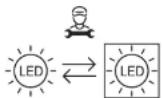
LED lighting source
Replaceable by professional
CLEANING
- Unplug the appliance.
- Remove ail substances.
Cleaning inside the Fridge/Freezer
You should clean the Fridge/Freezer internally with a weak solution of bicarbonate of soda. Then rinse with warm water using a damp sponge or cloth and wipe dry. Wash the baskets in warm soapy water and ensure they are completely dry before replacing in the Fridge/ Freezer.
Cleaning outside the Fridge/Freezer
Use standard non-abrasive detergent diluted in warm water to clean the Fridge/Freezer exterior. The grille of the condenser at the back of the Fridge/Freezer and the adjacent components can be vacuumed using a soft brush attachment.
Do not use harsh cleaners, scouring pads or solvents to clean any part of the Fridge/Freezer
TROUBLESHOOTING
With regard to the following small faults, not every failure needs to be fixed by the technical service personnel; you can try to solve the problem.
Note: If the above descriptions are inapplicable to troubleshooting, do not disassemble and repair it yourself. Repairs carried out by inexperienced persons may cause injury or serious malfunctioning. Contact the local store where your purchase was made. This product should be serviced by an authorized engineer and only genuine spare parts should be used.
When the appliance is not in use for long periods, disconnect from the electricity supply, empty all foods and clean the appliance, leaving the door ajar to prevent unpleasant smells.
| Case Inspection | Solution | |
| No refrigerating at all | Is power plug off? | Re-plug |
| Are breakers and fuses broken? | Opening the door and checking whether the lamp is lit. | |
| No electricity or line trip? | Power outage or line tripping? | |
| Where is the refrigerator installed? Is it placed in balconies, garages, storage rooms and other places where the ambient temperature is below 10°C? | Install refrigerator in a location that is protected and the ambient temperature is above 10°C. If your refrigerator is installed in too low temperature condition, the internal cooling system may not work correctly. | |
| Abnormal noise | Is refrigerator stable? Adjusting refrigerator's leveling feet. | |
| Does refrigerator contact the wall? | Off the wall. | |
| Poor refrigerating efficiency. | Do you put hot food or too much food? | Putting food into refrigerator when hot food becomes cool. |
| Do you open the door frequently? | Checking and closing the door | |
| Do you clip food bag to the door gasket? | Removing the refrigerator from the heat source | |
| Direct sunlight or near a furnace or stove? | Emptying the distance to maintain good ventilation | |
| Is it well-ventilated? | Emptying the distance to maintain good ventilation | |
| Temperature setting in too high? | Setting to the appropriate temperature | |
| Peculiar smell in refrigerator | Any spoiled food? Throwing away spoiled food | |
| Do you need to clean refrigerator? | Cleaning refrigerator | |
| Have you packed food of strong flavors? | Packing food of strong flavors.. | |
SERVICING
This product should be serviced by an authorized engineer and only genuine spare parts should be used.
Under no circumstances should you attempt to repair the appliance yourself.
Repairs carried out by inexperienced persons may cause injury or serious malfunctioning. Contact the local store where your purchase was made. When the appliance is not in use for long periods, disconnect from the electricity supply, empty ail foods and clean the appliance, leaving the door ajar to prevent unpleasant smells.
This instruction book is also available on our website: www.conforama.fr
ACCESSORIES
Energy label
FR/ENG manual
Ice box
Egg tray
Hinge
DISPOSAI
The refrigerating gas contained in the circuit of this appliance is isobutane (R600a); it causes a low level of pollution but is inflammable. Please contact your local disposal department for advice on the correct method of disposal.
Disposal of old electrical appliances

European directive 2012/19/EU on Waste from Electrical and Electronic Equipment (WEEE), requires that used household appliances are not thrown into the normal municipal waste stream. Used appliances must be collected separately in order to optimize the rate of recovery and recycling of materials that compose them, and to reduce the impact on human health and on the environment. The crossed bin symbol is affixed to all the products to remind you of the obligations of separated collection.


SABA is a German brand born in 1923 in the heart of the black forest.
Pioneers in electrical equipment, it continues its search for quality by offering smart products that will accompany you on a daily life.
This product has been manufactured and sold under the responsibility of CONFORAMA FRANCE
SABA, and the SABA logo are trademarks used under license by CONFORAMA FRANCE – further information at www.saba-brand.com.
All other products, services, companies, trademarks, trade or product names and logos referenced herein are the property of their respective owners.
TECHNICAL SPECIFICATIONS
| General information cooling | |||||
| Supplier's name or trademark: SABA | |||||
| Supplier's address: BOULEVARD DU MANDINET 80, 77432 LOGNES MARNE LA VALLEE (LOGNES), FR | |||||
| Model identifier: CT4654NFDKE | |||||
| Type of refrigerating appliance: | |||||
| Low-noise appliance: | no | Design type: | freestanding | ||
| Wine storage appliance: | no | Other refri gerating appliance: | yes | ||
| General product parameters: | |||||
| Parameter | Value | Parameter | Value | ||
| Overall dimensions (millimetre) | Height | 1855 | Total volume (dm3 ou l) | 465 | |
| Width | 703 | ||||
| Depth | 703 | ||||
| EEI | 100 | Energy efficiency class | E | ||
| Airborne acoustical noise emissions (dB(A) re1 pW) | 39 | Airborne acoustical noise emission class | C | ||
| Annual energy consumption (kWh/a) | 252 | Climate class: | SN,N,ST,T | ||
| Minimum ambient temperature (°C), for which the refrigerating appliance is suitable | 10 | Maximum ambient temperature (°C), for which the refrigerating appliance is suitable | 43 | ||
| Winter setting | no | ||||
| Compartment Parameters: | |||||
| Compart ment type | Compartment parameters and values | ||||
| Compart ment Volume (dm3 or l) | Recommended temperature setting for optimised food storage (°C) These settings shall not contradict the storage conditions set out in Annex IV, Table 3 | Freezing capacity (kg/24 h) | Defrosting type (auto-defrost = A, manual defrost = M) | ||
| Pantry | no | - | - | - | - |
| Wine storage | no | - | - | - | - |
| Cellar | no | - | - | - | - |
| Fresh food | yes | 365,0 | 4 | - | A |
| Chill | no | - | - | - | - |
| Compartment type | Compartment para meters and values | ||||
| Compartment Volume (dm3 or l) | Recommended temperature setting for optimised food storage (°C) These settings shall not contradict the storage conditions set out in Annex IV, Table 3 | Freezing capacity (kg/24 h) | Defrosting type (auto-defrost = A, manual defrost = M) | ||
| 0-star or ice-making | no | - | - | - | - |
| 1-star no | - | - | - | - | |
| 2-star no | - | - | - | - | |
| 3-star no | - | - | - | - | |
| 4-star yes | 100,0 | -18 A | 4,5 | ||
| 2-star section | no | - | - | - | - |
| Variable temperature compartment | no | - | - | - | - |
| For 4-star compartments | |||||
| Fast free ze facility | Yes | ||||
| Lightsource parameters: | |||||
| Type of light source | LED | ||||
| Energy efficiency class | G | ||||
| Minimum duration of the guarantee offered by the manufacturer: 2 years | |||||
| Additional information: N/A | |||||
| Weblink to the manufacturer's website, where the information in point 4(a) Annex of Commission Regulation (EU) 2019/2019 is found: www.conforama.fr | |||||
| Reference: | CT4654NFDKE |
| Rated voltage: | 220-240V~ |
| Ampere: | 1.05A |
| Rated frequency: | 50Hz |
| Climate class: | SN/N/ST/T |
| Refrigerant: | R600a (52g) |
| Protection against electrical shock: | I |
| Insulation foam: | CYCLOPENTANE |
This instruction book is also available on our website:
www.conforama.fr
Climate class:
- Extended temperate(SN): 'this refrigerating appliance is intended to be used at ambient temperatures ranging from 10 °C to 32 °C';
- Temperate(N): 'this refrigerating appliance is intended to be used at ambient temperatures ranging from 16 °C to 32 °C';
- Subtropical(ST): 'this refrigerating appliance is intended to be used at ambient temperatures ranging from 16 °C to 38 °C';
- Tropical(T): 'this refrigerating appliance is intended to be used at ambient temperatures ranging from 16 °C to 43 °C';
Flash the QR code on your appliance to access its main information.
Period of availability of repair spare parts: 10 years.
If you have a problem with your product, before going to your Conforama store, please get in touch with our aftersales services for electrical household appliances:
https://sav-client.conforama.fr
09 69 32 05 05
- SABA
- UTILISATION
- FRF
- TABLE OF CONTENTS
- SAFETY INSTRUCTIONS
- WARNINGS
- DESCRIPTION OF THE DEVICE
- INSTALLATION
- Heat dissipation space
- USE
- Functions
- Temperature setting
- Fast cooling
- Smart
- Child Lock
- Door open alarm
- Power cut memory
- Power-on delay
- Fault alarm
- Notes
- TEMPERATURE INDICATE
- Shopping for frozen food
- Check the Fridge/Freezer temperature
- Choose packs carefully
- Purchase frozen food last
- Keep frozen foods together
- Store food straight away
- Thawing frozen food
- Freezing fresh food
- Storing frozen food
- Storing food in fridge Cool area
- Coldest area: 0°C to 5°C
- Salad bin
- DAILY USE
- FIRST USE Cleaning the interior
- MAKING ICE CUBES
- FRIDGE FOOD
- Take care not to store the following at temperatures of less than 7°C for long periods
- Use of the humidity regulating rod of the crisper box
- Never forget
- THAWING
- MOVABLE SHELVES
- POSITIONING THE DOOR BALCONIES
- Energy-saving tips
- REVERSING THE DOOR
- MAINTENANCE
- Noise from your appliance
- Prolonged off periods
- Notes for use
- Changing the light bulb
- CLEANING
- Cleaning inside the Fridge/Freezer
- Cleaning outside the Fridge/Freezer
- TROUBLESHOOTING
- SERVICING
- ACCESSORIES
- DISPOSAI
- Disposal of old electrical appliances
- TECHNICAL SPECIFICATIONS
- Climate class:
Brand : SABA
Model : CT4654NFDKE
Category : Fridge