FS65IM - Ice machine Orien - Free user manual and instructions
Find the device manual for free FS65IM Orien in PDF.


| Product Type | Automatic Ice Machine |
| Brand | Orien |
| Model | FS65IM |
| Dimensions (L x D x H) | 420 x 540 x 840 mm |
| Net Weight | 41.4 kg |
| Power Supply | 115 V~, 60 Hz, 470 W |
| Freeze Current | 6.7 A |
| Harvest Current | 11.2 A |
| Electrical Protection | 15 A Fuse or Circuit Breaker |
| Refrigerant | R134a, 0.195 kg |
| Production Capacity | Up to 29.5 kg of ice cubes per day |
| Ice Cube Type | Clear Cubic Ice |
| Storage Bin | Insulated, with automatic stop when full |
| Main Functions | Full automatic cycle, adjustable ice cube size, LED indicators (full, making, harvest), manual cleaning mode, compressor protection |
| Exterior Cleaning | Mild detergent diluted in hot water, soft sponge |
| Condenser Cleaning | Every 6 months, with vacuum cleaner and brush |
| Interior Cleaning | Disinfectant solution (1 ounce bleach + 2 gallons hot water) |
| Ice System Cleaning | Nickel-Safe descaling product, every 6 months |
| Safety | Grounding mandatory, do not use extension cord, cut power before maintenance, two people to move |
| Warranty | 1 year parts and labor, 5 years compressor (parts only) |
| After-sales Service | Contact Orien USA at 1-877-316-1725 or www.orienusa.com |
Frequently Asked Questions - FS65IM Orien
User questions about FS65IM Orien
0 question about this device. Answer the ones you know or ask your own.
Ask a new question about this device
Download the instructions for your Ice machine in PDF format for free! Find your manual FS65IM - Orien and take your electronic device back in hand. On this page are published all the documents necessary for the use of your device. FS65IM by Orien.
USER MANUAL FS65IM Orien
Automatic Ice Makers
Be sure ice maker is standing upright 24 hours prior to plug-in.
Location Requirements 8-10
Electrical Requirements 10
Leveling the Ice Maker 11
Water Supply and Drain Connections 11-12
Installation Types 13-14
OPERATION 14-17
Final Checklist before Operation 14
Operating Method 15
How the Machine Makes Ice 15-16
Normal Sounds 16-17
Preparing the Ice Maker for Long Storage 17
CLEANING AND MAINTENANCE 18-25
Exterior Cleaning 18-19
Condenser Cleaning 19
Interior Cleaning 20-22
Ice Making System Cleaning 22-23
Control Box 24-25
MAJOR FUNCTIONS 25
TROUBLESHOOTING 26-27
LIMITED WARRANTY 28
SPANISH VERSION OF THIS MANUAL 29-58
FRENCH VERSION OF THIS MANUAL 59-87
We reserve the right to make changes in specifications and design without prior notice.
ICE MAKER SAFETY
Your safety and the safety of others are very important.
We have provided many important safety messages in this manual and on your appliance. Always read and obey all safety messages.

This is the Safety Alert Symbol. This symbol alerts you to potential hazards that can injure or kill you and others. All safety messages will follow the Safety Alert Symbol and either the words "DANGER", "WARNING" OR "CAUTION".
DANGER
DANGER means that failure to heed this safety statement may result in severe personal injury or death.
WARNING
WARNING means that failure to heed this safety statement may result in extensive product damage, serious personal injury, or death.
CAUTION
CAUTION means that failure to heed this safety statement may result in minor or moderate personal injury, or property or equipment damage.
All safety messages will alert you to what the potential hazard is, tell you how to reduce the chance of injury, and let you know what can happen if the instructions are not followed.
IMPORTANT SAFETY INSTRUCTIONS WARNING: To reduce the risk of fire, electric shock or injury when using your ice maker, follow these basic precautions:
- Plug into grounded 3-prong outlet
- Do not remove grounding prong
- Do not use an adapter
-
Do not use an extension cord
-
Disconnect power before cleaning
- Disconnect power before servicing
- Replace all panels before operating
- Use 2 or more people to move & install ice maker
SAVE THESE INSTRUCTIONS
IMPORTANT SAFEGUARDS

Before the ice maker is used, it must be properly positioned and installed as described in this manual, so read the manual carefully. 2 UHQU 86 / & strongly recommends that you have a professional install your new machine. The warranty may be affected or voided by an incorrect installation. To reduce the risk of fire, electrical shock or injury when using the ice maker, follow basic precautions, including the following:
DANGER
- Plug into a grounded 3-prong outlet; do not remove grounding prong, do not use an adapter, and do not use an extension cord.
- It is recommended that a separate circuit, serving only your ice maker, be provided. Use receptacles that cannot be turned off by a switch or pull chain.
- Do not connect or disconnect the electric plug when your hands are wet.
- Never clean ice maker parts with flammable fluids. These fumes can create a fire hazard or explosion. Do not store or use gasoline or other flammable vapors and liquids in the vicinity of this or any other appliance. The fumes can create a fire hazard or explosion.
- Before proceeding with cleaning and maintenance operations, make sure the power line of the unit is disconnected and the water line is shut off (EXCEPTION: when cleaning the machine's ice making and water systems - see pages 22-24).
Before operating, put all panels back into place. - Unplug the ice maker or disconnect power before cleaning or servicing. Failure to do so can result in electrical shock or death.
- Do not attempt to repair or replace any part of your ice maker unless it is specifically recommended in this manual. All other servicing should be referred to a qualified technician.
WARNING
- When you disassemble the front cover, do not use too much force, as the wire leads connected to the power switch can be inadvertently disconnected.
- Use two or more people to move and install ice maker. Failure to do so can result in back or other injury.
-
To ensure proper ventilation for your ice maker, the front of the unit must be completely unobstructed. Choose a well-ventilated area with temperatures above 55^ (13^) and below 90^ (32^) . This unit MUST be installed in an area protected from the elements, such as wind, rain, water spray or drips.
-
The ice maker should not be located next to ovens, grills or other sources of high heat.
- The ice maker must be installed with all electrical, water and drain connections in accordance with state and local codes. A standard electrical supply (115 VAC only, 60Hz , 15 A), properly grounded in accordance with the National Electrical Code and local codes and ordinances is required.
- Do not kink or pinch the power supply cord or drain lines between the ice maker and the cabinet.
- The fuse (or circuit breaker) size should be 15 amperes.
- It is important for the ice maker to be leveled in order to work properly. You may need to make several adjustments to level it.
- All installations must be in accordance with local plumbing code requirements.
- Make certain that the hoses are not pinched or kinked or damaged during installation.
- Check for leaks after connection.
- Never allow children to operate, play with or crawl inside the ice maker.
- Although the unit has been tested at the factory, due to long-term transit and storage, the first batch of cubes must be discarded.
- Never turn the water supply tap off when the ice maker is working.
- If the ice maker will not be used for a long time, before the next use it must be thoroughly cleaned. Follow carefully any instructions provided for cleaning or use of sanitizing solution. Do not leave any solution inside the ice maker after cleaning.
- DO NOT touch the condenser fins. The condenser fins are sharp and can be easily damaged.
DO NOT use solvent-based cleaning agents or abrasives on the interior. These cleaners may transmit taste to the ice cubes, or damage or discolor the interior. - The ice machine cleaner contains acids. DO NOT use or mix with any other solvent-based cleaner products. Use rubber gloves to protect hands. Carefully read the material safety instructions on the container of the ice machine cleaner.
- Do not use this apparatus for other than its intended purpose.
SAVE THESE INSTRUCTIONS
Electrical Connection
Do not, under any circumstances, cut or remove the third (ground) prong from the power cord. For personal safety, this appliance must be properly grounded. The power cord of this appliance is equipped with a 3-prong grounding plug that mates with a standard 3-prong grounding wall outlet to minimize the possibility of electric shock hazard from the appliance. Have the wall outlet and circuit checked by a qualified electrician to make sure the outlet is properly grounded. When a standard 2-prong wall outlet is encountered,
it is your responsibility and obligation to have it replaced with a properly grounded 3-prong wall outlet. The ice maker should always be plugged into its own individual electrical outlet which has a voltage rating that matches the rating label on the appliance. This provides the best performance and also prevents overloading house wiring circuits which could cause a fire hazard from overheated wires. Never unplug your ice maker by pulling on the power cord. Always grip the plugfirmly and pull straight out from the outlet. Repair or replace immediately all power cords that have become frayed or otherwise damaged. Do not use a cord that shows cracks or abrasion damage along its length or at either end. When moving the ice maker, be careful not to damage the power cord.
Extension Cord
Because of potential safety hazards under certain conditions, it is strongly recommended that you do not use an extension cord with this ice maker.
Technical Information
| Model | FS-65IM | FS-85IM | FS-110IM |
| Rated power | 115VAC ~ 60Hz ~ 470W | 115VAC ~ 60Hz ~ 520W | 115VAC ~ 60Hz ~ 580W |
| Ice-making rated current | 6.7A | 7.3A | 7.5A |
| Ice-harvest rated current | 11.2A | 11.7A | 11.8A |
| Refrigerant | R134a, 6.88 oz. | R134a, 8.96 oz. | R134a, 9.92 oz. |
| High side pressure | 320 psi | 320 psi | 320 psi |
| Low side pressure | 120 psi | 120 psi | 120 psi |
| Width x depth x height | 16.5”x21.3”x32.5” | 22.1”x21.3”x32.5” | 22.1”x21.3”x32.5” |
| Unit weight | 91 lbs | 106 lbs | 102 lbs |
| Ice-making capacity | Up to 65 lbs/day* | Up to 83 lbs/day* | Up to 110 lbs/day* |
The technical data and performance index listed above should be used for reference only. They are subject to change.
INTRODUCTION
The ORIEN Ice Makers find wide application in households, bars, restaurants, hotels, supermarkets, etc. These units produce crystal-clear, gourmet cube ice, and offer convenience for homeowners and hotel guests. An insulated ice storage bin is built into each ice maker.
This user's manual is intended as a resource for persons installing, using and servicing models FS-65IM, FS-85IM and FS-110IM. It contains valuable information on safety and maintenance. Orien USA L.L.C. strongly recommends that this manual be kept in a place where it can be accessed when needed.
Every ORIEN Ice Maker is designed and manufactured according to the highest standards of safety and performance. It meets or exceeds the safety standard of UL563.
Orien USA L.L.C. assumes no liability or responsibility of any kind for products manufactured by Orien that have been altered in any way, including the use of any parts and/or other components not specifically approved by Orien USA L.L.C. Orien USA L.L.C. reserves the right to make design changes and/or improvements at any time. Specifications and designs are subject to change without notice.
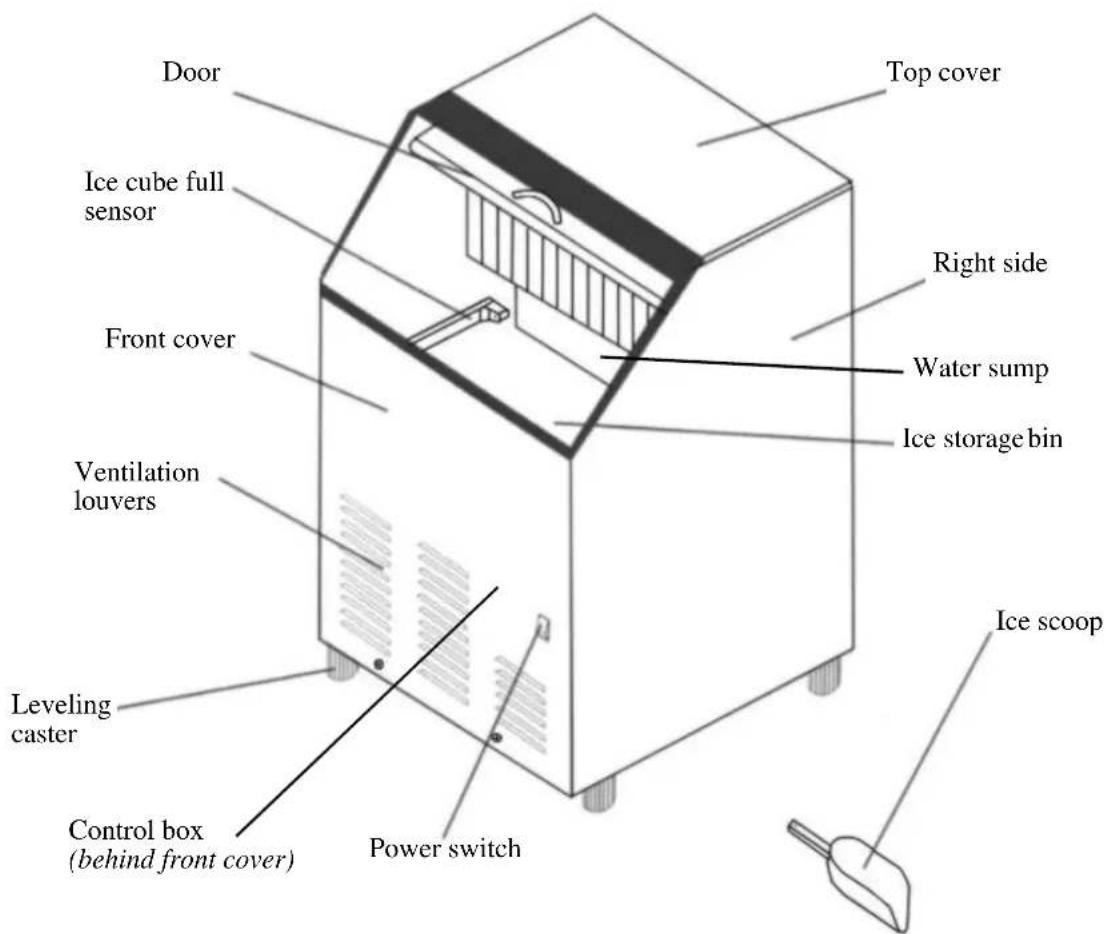
COMPONENT LOCATIONS
ICE MAKER INSTALLATION
Unpacking
WARNING
Excessive Weight Hazard
Use two or more people to move and install ice maker. Failure to do so can result in back or other injury.
Remove packaging materials
IMPORTANT: Do not remove any permanent instruction labels or the data label on your ice maker.
Remove tape and glue from your ice maker before using.
- To remove any remaining tape or glue, rub the area briskly with your thumb. Tape or glue residue can also be easily removed by rubbing a small amount of liquid dish soap over the adhesive with your fingers. Wipe with warm water and dry.
- Do not use sharp instruments, rubbing alcohol, flammable fluids, or abrasive cleaners to remove tape or glue. These products can damage the surface of your ice maker.
Cleaning before use
After you remove all of the packaging materials, clean the inside of your ice maker before using it. See "Interior Cleaning" in the Cleaning and Maintenance section.
Location Requirements
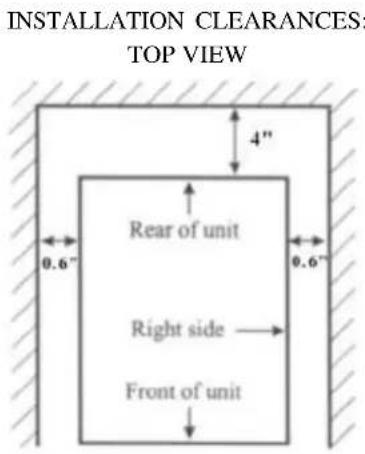
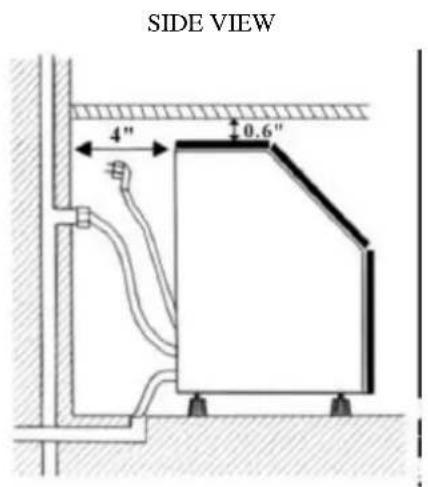
- To ensure proper ventilation for your ice maker, the front of the unit must be completely unobstructed. Allow at least 101mm(4^ ) clearance at rear, and 15mm (0.6^ ) at top and sides for proper air circulation. The installation should allow the ice maker to be pulled forward for servicing if necessary.
- When installing the ice maker under a counter, follow the recommended spacing dimensions shown. Place electrical and water supplies and drain fixtures in the recommended locations as shown.
- Choose a well-ventilated area with temperatures above 55^ (13^) and below 90^ (32^) . This unit MUST be installed in an area protected from the elements, such as wind, rain, water spray or drips.
- The unit should not be located next to ovens, grills or other sources of high heat.
- Installation of the ice maker requires a cold water supply inlet of 6.35mm (1/4 in.) soft copper tubing with a shut-off valve and a gravity-drain system. (NOTE: Runoff water can also be drained into a sink via a pump – not included – when a gravity drain is not available.)
- The ice maker requires a continuous water supply with a minimum pressure of 20 psig and a static pressure not to exceed 80 psig. The temperature of the water feeding into the ice maker should be between 41^ ( 5^ ) and 77^ ( 25^ ) for proper operation.
WARNING
Normal operating ambient temperature should be between 55^ (13^) to 90^ (32^) . Normal operating water temperature should be between 41^ (5^) and 77^ (25^) . Operation of the ice maker for extended periods outside of these normal temperature ranges may affect production capacity.
- In general, it is always a good idea to filter the water. A water filter, if it is of the proper type, can remove taste and odors as well as particles. Where water is very hard, softened water may result in white, mushy cubes that stick together. Deionized water is not recommended.
- The ice maker must be installed with all electrical, water and drain connections in accordance with state and local codes.
-
The unit should be located on a firm and level surface. It is important for the ice maker to be leveled in order to work properly. If needed, you can adjust the height of the ice maker by revolving the feet. See the "Leveling the Ice Maker" section.
-
A standard electrical supply (115 VAC only, 60Hz , 15 A), properly grounded in accordance with the National Electrical Code and local codes and ordinances is required.
- IMPORTANT: Do not kink or pinch the power supply cord between the ice maker and wall or cabinet.
Electrical Requirements
DANGER
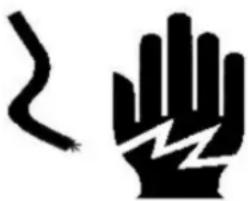
Electrical Shock Hazard
Plug into a grounded 3-prong outlet.
Never remove the grounding prong from the plug.
Never use an adapter.
Never use an extension cord.
Failure to follow these instructions can result in fire,
HOHFWULFD0VVRKFNRUIGHDWKO
Before you move your ice maker into its final location, it is important to make sure you have the proper electrical connection.
A standard electrical supply (115 VAC only, 60Hz , 15 A), properly grounded in accordance with the National Electrical Code and local codes and ordinances, is required.
It is recommended that a separate circuit, serving only your ice maker, be provided. Use receptacles that cannot be turned off by a switch or pull chain.
The fuse (or circuit breaker) size should be 15 amperes.
Recommended grounding method
For your personal safety, this appliance must be grounded. This appliance is equipped with a power supply cord having a 3-prong grounding plug. To minimize possible shock hazard, the cord must be plugged into a mating 3-pronged and grounding-type wall receptacle, grounded in accordance with the National Electrical Code and local codes and ordinances. If a mating wall receptacle is not available, it is the personal responsibility of the customer to have a properly grounded, 3-prong wall receptacle installed by a qualified electrician.
Leveling the Ice Maker
It is important for the ice maker to be leveled in order to work properly. It can be raised or lowered by rotating the plastic sheaths around each of the four rolling casters on the bottom of the machine. If you find that the surface is not level, rotate the casters until the ice maker becomes level. You may need to make several adjustments to level it. We recommend using a carpenter's level to check the machine.
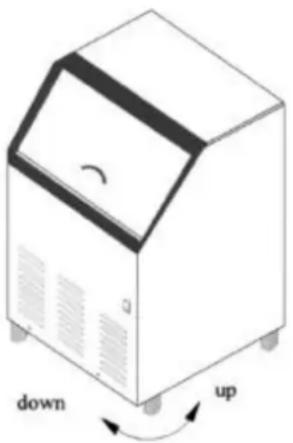
You will find that the casters make it easy for one person to move the machine. This is useful for cleaning and sanitizing the surface on which the ice maker is installed because it allows you to move the unit and have easy access to the surface to be cleaned.
IMPORTANT: Once you are ready to install the ice maker in a cabinet or directly on the floor, you must adjust the feet to level the ice maker and lock the rollers. If the floor is level, just revolve the two front feet to touch the floor. (See illustration.)
Water Supply and Drain Connections
The water supply and drain should be ready at the point of installation. A wall outlet directly behind the ice maker will make installation easier.
IMPORTANT:
- All installations must be in accordance with local plumbing code requirements. Professional installation is recommended.
- Make certain that the hoses are not pinched or kinked or damaged during installation.
- Check for leaks after connection.
Tools required:
1/2 in. open-end wrench
- Phillips screwdriver
Connecting the water line:
- Turn off main water supply. Turn on nearest faucet long enough to clear line of water.
- Find a 1/2 in. to 3/4 in. vertical cold water pipe near the installation location. The distance should be less than 9 feet. The water supply hose provided with the ice maker is about 9 feet.
- A shut-off valve must be installed to the main water supply. If the water pipe has a plain piece of copper tubing, attach a 14 O.D. compression union to the tubing and remove the nut.
- Connect nuts of water supply hose to tap and water inlet valve. Tighten firmly by hand, then one-half turn with wrench.
- Turn on main water supply and tap. Check for water supply connection leaks. Tighten any connections (including connections at the valve) or nuts that leak.
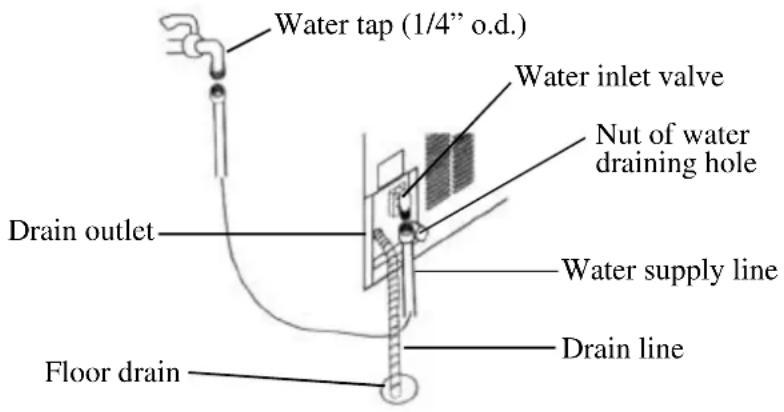
NOTE: Connection to the water line may vary according to installation requirements.
Connecting the drain line:
A gravity drain system is used in this type ice maker. Excess water flows to the drain through the drain line provided with the ice maker.
- Find the floor drain near the ice maker. The distance should be less than 9 feet as the length of the long drain line provided with the ice maker is about 9 feet.
- Find the drain outlet on the back of ice maker. Connect one end of the long drain line to the drain outlet of the machine, the other end to the floor drain.
-
All horizontal runs of drain lines must have a fall of 14 per foot. An air gap will likely be required between the ice maker drain tube and the drain/waste receptacle. A standpipe with a trap below it would be acceptable for the drain/waste receptacle. NOTE: If you cannot locate a floor or wall drain that allows the drain line to descend 14 per foot, you may wish to purchase a drain pump from your local 2 UHQ86 / / & supplier.
-
Pour 1 gallon of water into the ice storage bin to check for leaks at all drain connections and at the nut of the drain water hole. Tighten any connections or nuts that leak.
IMPORTANT: Poor drainage will cause a high rate of ice melting in the ice storage bin.
Installation Types
This ice maker has been designed for Mobile (free-standing) installation. It can also be Enclosed (as under a cabinet) or Built-in (sealed to the floor), although this last option is not the preferred method of installation. In every case, there must be adequate air space around the unit for ventilation purposes (see diagrams on page 8).
Mobile Installation:
A mobile installation will allow you to install the icemaker free-standing in any place you desire provided you have access to a water supply and drainage facilities. You must follow the stated instructions for
a. Electrical requirements
b. Water supply and drain connections
c. Leveling the icemaker.
Enclosed Installation:
An enclosed installation will allow you to install the ice maker under a cabinet, or in a kitchen cabinet provided the required clearance space around the ice maker is respected. This installation has the same requirements as a mobile installation.
The unit should be placed in the cabinet by sliding it into the cabinet 's opening and then leveling it properly.
IMPORTANT: For Mobile and Enclosed installations you must use flexible water and drain connections to the water supply and drain. This will allow the moving of the ice maker for cleaning. Use the water and drain hoses supplied with the unit for these connections.
Built-in Installation:
If this method of installation is chosen, it will still be necessary to allow adequate ventilation space around the unit. The following additional items must be observed.
- Place the ice maker in front of the installation location. Remove the feet and place the unit flat on the floor or on a platform depending on your installation requirements.
- The water supply line and drain line must be plumbed before connecting to the ice maker.
- Turn on the main water supply and tap. Check for water supply connection leaks. Tighten any connections (including connections at the valve) or nuts that leak.
-
Pour 1 gallon of water into the ice storage bin to check for leaks at all drain connections and the nut of the drain water hole. Tighten any connections or nuts that leak. (This procedure will also indicate if the drainpipe is kinked or pinched.)
-
If the electrical outlet for the ice maker is behind the cabinet, plug in the ice maker.
- Push the ice maker into position.
- Seal all around the cabinet to the floor with an approved caulking compound.
OPERATION
Final Check List before Operation
- Have all packing materials and tape been removed from the interior and exterior of the ice maker?
- Did you clean the ice storage bin?
- Have the installation instructions been followed, including connecting the machine to water, drain and electricity?
- Has the machine been leveled?
- Is the ice maker in a site where the ambient temperature is between 13^ (55^) and 32^ (90^) and the water temperature within 5^ (41^) and 25^ (77^) all year round?
- Has the water supply pressure been checked to ensure a minimum of 20 psig with a static pressure not to exceed 80 psig?
- Is there a clearance of at least 4 in. (101mm) at the rear, and 0.6 in. (15mm) at the sides and top for proper air circulation?
- Has the power supply voltage been checked or tested against the nameplate rating? And has proper grounding been installed in the ice maker?
- Is the ice maker plugged in?
- Did you turn on the main water supply and the tap?
- Did you check for leaks at all water supply and drainpipe connections?
Operating Method
- Switch on the Power switch on the right side panel. The light will be on. The ice maker will start working automatically and feeding water.
- After the first feeding of the water, the machine will automatically go to the ice making stage, and the sound of water spraying will be heard.
- Ice will be harvested to the ice storage bin. When the storage bin is filled to the point that the ice-full sensor is covered, the ice maker will automatically stop working. The machine will restart making ice once the storage bin is less than full.
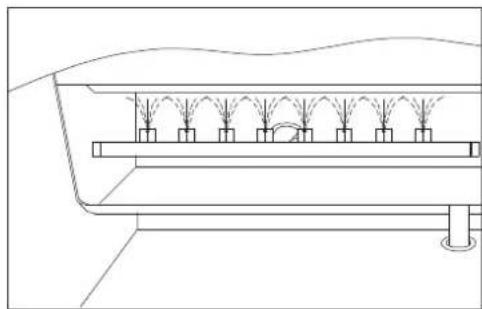
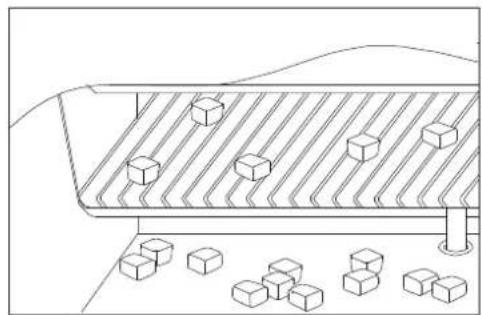
- Excess water will flow through the drain outlet at the back of the machine and empty into the floor drain.
IMPORTANT:
- Although the unit has been tested at the factory, due to long-term transit and storage, the first batch of cubes must be discarded.
- Never turn the water supply tap off when the icemaker is working.
How the Machine Makes Ice
There are two distinct cycles: freeze and harvest.
During the freeze cycle, water is sprayed against the evaporator surface.
In the harvest cycle, the ice is released and water enters the machine. A complete cycle takes about 20 minutes, but is dependent on temperature and operating conditions.
Freeze: During the freeze cycle the compressor is pumping refrigerant, the fan motor is blowing air, and the water pump is circulating water. When the batch of ice has been fully formed, the ice maker stops the freeze cycle and begins to harvest the ice.
Harvest: During the harvest cycle the compressor is still operating, but the water pump has stopped. Two other components have been energized: the hot gas valve and the water inlet valve. These two valves open and warm up the freezing surface, allowing the cubes to fall into the bin. The freeze cycle will restart when all the cubes have been harvested.
How the machine uses water:
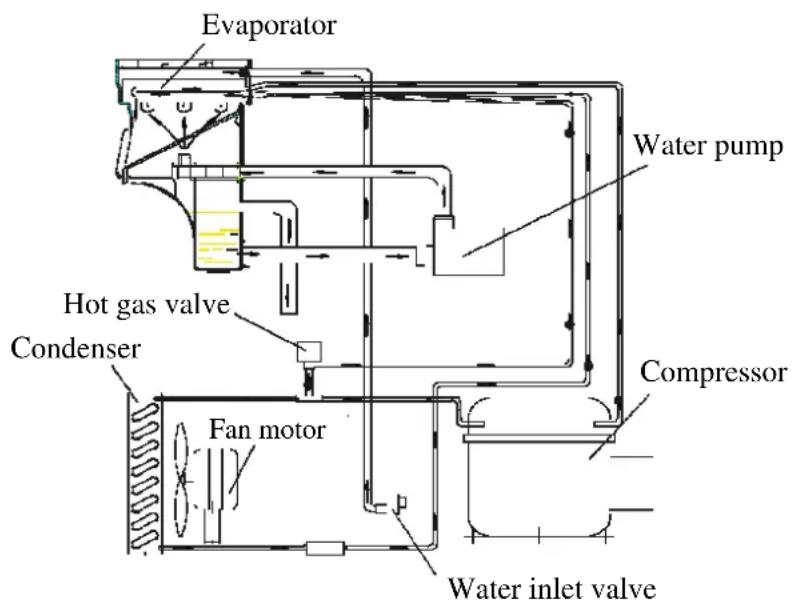
The ice maker begins with a fixed charge of water that is contained in the water sump. As the water is sprayed against the freezing evaporator surface, the portion of water that does not contain mineral impurities will freeze and stick to the ice cube molds. The water containing impurities falls back into the water sump. Gradually, during the
freezing portion of the ice-making cycle, the water in the sump will become highly concentrated with mineral impurities.
During the harvest cycle, fresh water flows into the machine to dilute the bin water and rinse the concentrated minerals down the drain.
Normal Sounds
Your new ice maker may make sounds that are not familiar to you. Most of the new sounds are normal. Hard surfaces like the floor and walls can make the sounds seem louder than they actually are. The following describes the kinds of sounds that might be new to you and what may be making them.
- You will hear a swooshing sound when the water valve opens to fill the water sump for each cycle.
- Rattling noises may come from the flow of the refrigerant or the water line. Items stored on top of the ice maker can also make noises.
-
The high-efficiency compressor may make a pulsating or high-pitched sound.
-
Water running from the water sump to the evaporator plate may make a splashing sound.
Water running from the evaporator to the water sump may make a splashing sound. - As each cycle ends, you may hear a gurgling sound due to the refrigerant flowing in your ice maker.
- You may hear air being forced over the condenser by the condenser fan.
- During the harvest cycle, you may hear the sound of ice cubes falling into the ice storage bin.
- When you first start the ice maker, you may hear water running continuously. The ice maker is programmed to run a rinse cycle before it begins to make ice.
Preparing the Ice Maker for Long Storage
If the ice maker will not be used for a long time, or is to be moved to another place, it will be necessary to drain the system of water.
- Shut off the water supply at the main water source.
- Disconnect the water supply line from the water inlet valve.
- Disconnect the drain pipe to the drain line or floor drain.
- Allow the ice maker to run for an hour or more until all remaining ice cubes have been ejected from the ice maker assembly.
- Shut off the electric supply at main electrical power source.
- Screw off the nut of the water drain hole at the back of the machine, drain out water residue completely (do not loosen or screw off the nut at other times), then tighten the nut after finishing.
- Drop the door open to allow for circulation and prevent mold and mildew.
- Leave water supply line and power cord disconnected until ready to reuse.
CLEANING AND MAINTENANCE
CAUTION
If the ice maker is left unused for a long time, before the next use it must be thoroughly cleaned. Follow carefully any instructions provided for cleaning or use of sanitizing solution. Do not leave any solution inside the ice maker after cleaning.
Periodic cleaning and proper maintenance will ensure efficiency, top performance, and long life. The maintenance intervals listed are based on normal conditions. You may want to shorten the intervals if you have pets, or the unit is used outdoors, or there are other special considerations.
What shouldn't be done
Never keep anything in the ice storage bin that is not ice: objects like wine and beer bottles are not only unsanitary, but the labels may slip off and plug up the drain.
What should be kept clean
There are 4 things to keep clean:
- The exterior
- The condenser
- The interior
- The ice making system

WARNING
Before proceeding with cleaning and maintenance operations, make sure the power line of the unit is disconnected and the water line is shut off (EXCEPTION: Ice maker system cleaning).
Exterior Cleaning
The door and cabinet may be cleaned with a mild detergent and warm water solution such as 1 oz of dishwashing liquid mixed with 2 gallons of warm water. Do not use solvent-based or abrasive cleaners. Use a soft sponge and rinse with clean water. Wipe with a soft clean towel to prevent water spotting.
Stainless steel can discolor when exposed to chlorine gas and should be cleaned. Clean stainless steel with a mild detergent and warm water solution and a damp cloth. Never use abrasive cleaning agents.
NOTICE: Stainless steel exposed to chlorine gas and moisture, such as in areas with spas or swimming pools, may show some discoloration. Discoloration from chlorine gas is normal.
Condenser Cleaning
A dirty or clogged condenser prevents proper airflow, reduces ice making capacity, and causes higher than recommended operating temperatures that may lead to component failure. Have the condenser cleaned at least once every six months.
- Unplug the ice maker or disconnect power.
- Remove the 2screwsat the bottom of the front cover.
- Grasp the lower edge of the front cover at the right and left sides, raise it a little and then pull down.
NOTE: Do not use too much force, as the wire leads connected to the power switch can be inadvertently disconnected.
- Locate the condenser surface.
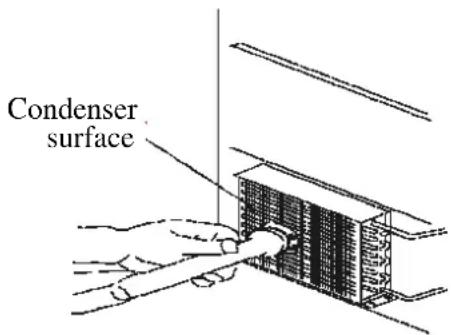
- Remove dirt and lint from the condenser fins and the unit compartment with a brush attachment on a vacuum cleaner.
- Reassemble the front cover.
- Plug in the ice maker or reconnect power.
WARNING
DO NOT touch condenser fins. They are sharp and can be damaged easily.
Interior Cleaning
The ice storage bin should be sanitized occasionally. Clean the bin before the ice maker is used for the first time and reused after stopping for an extended period of time. It is usually convenient to sanitize the bin after the ice making system has been cleaned and the storage bin is empty.
- Disconnect power to the unit.
- Open the door and with a clean cloth, wipe down the interior with a sanitizing solution made of 1 ounce of household bleach or chlorine and 2 gallons of hot water (95^ to 115^)
- Rinse thoroughly with clear water. The waste water will be drained off through the drainpipe.
- Reconnect power to the unit.
The ice scoop should be washed regularly. Wash it just like any other food container.
WARNING
DO NOT use solvent-based cleaning agents or abrasives on the interior. These cleaners may transmit taste to the ice cubes, or damage or discolor the interior.
IMPORTANT NOTE: The sprinkler should only be cleaned when you find that some of the ice cubes are improperly shaped during ice making. Cleaning the ice making system should follow cleaning of the sprinkler.
- Disconnect power to the unit and open the door.
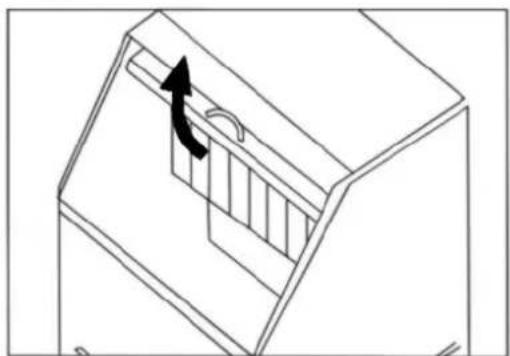
- Take out the row of flake covers by snapping one end up and pulling forward.
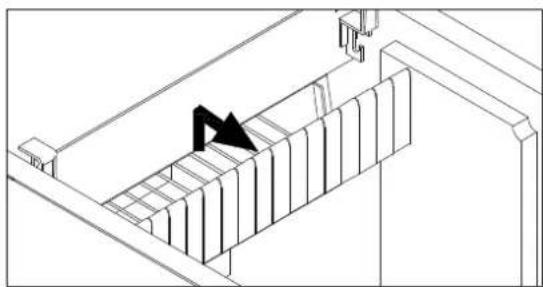
- Remove the sidewalk from the water sump.
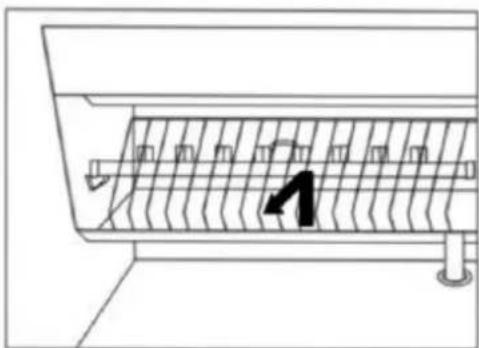
- Find the sprinkler arm and raise it. Disconnect it from the water tube which is connected at the back of the sprinkler arm.
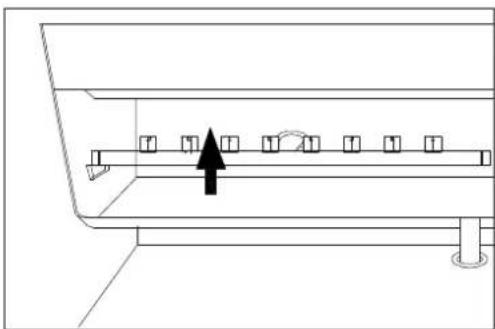
- A de-scaling solution can be prepared in a plastic basin with Nu-Calgon Nickel-Safe Ice Machine Cleaner. Mix 4 ounces of the ice machine cleaner per gallon of warm water.
Remove the sprinkler arm from the interior. Thoroughly clean the sprinkler arm by soaking it in the basin filled with the de-scaling solution until it is free of any deposit; use a soft brush to remove any thick or stubborn residue and to help the dissolving action. Rinse under a stream of tap water.
- Wipe down the interior of the water sump with the de-scaling solution and warm water. Rinse thoroughly with clear water.
- Reassemble the sprinkler arm, sidewalk and row of flake covers.
- Perform steps 1, 3, 6, 7 and 8 of the Ice Making System Cleaning procedure below.
Ice Making System Cleaning
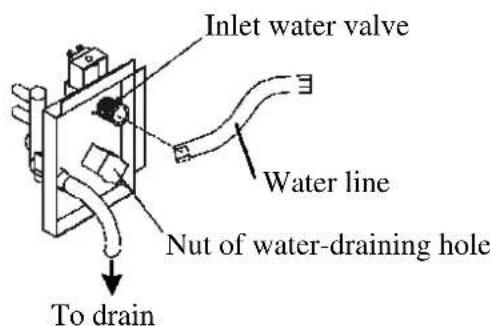
Minerals that are removed from water during the freezing cycle will eventually form a hard scaly deposit in the water system. Cleaning the system regularly helps remove the mineral scale buildup. How often you need to clean the system depends upon how hard your water is or how effective your filtration may be. With hard water of 15 to 20 grains/gal. (4 to 5 grains/liter), you may need to clean the system as often as every 6 months.
-
Turn off power to the ice maker. Keep the ice maker connected to the water supply and drainpipe.
-
Open the door and scoop out all of the ice cubes. Either discard them or save them in an ice chest or cooler.
-
Remove the 2 screws in the front cover and push forward to remove the front cover. Locate the control box. NOTES: Do not use too much force, as the wire leads connected to the power switch can be inadvertently disconnected. Use care in the area of the control box. Do not expose it to moisture.
-
Turn on the power to the ice maker. Pour 8 oz. of Nickel-Safe Ice Machine Cleaner solution into the
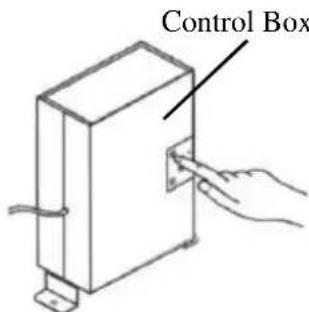
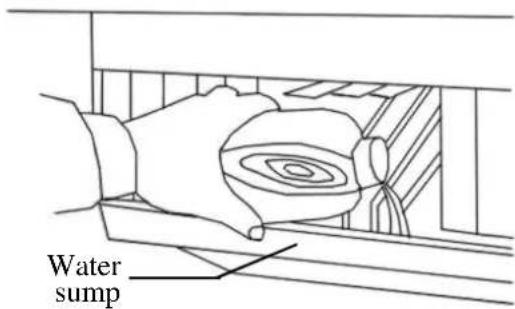
water sump. Add 8 oz. of tap water. After about 5 minutes, press down the "Clean" button on the Control Box. (See figures here and on page 24.) The machine will run the Automatic Clean Mode.
- Allow 30 minutes for proper cleaning. After cleaning, shut off the power switch, and unscrew the nut of the water-draining hole on the rear of the unit. Drain off the waste water to some container, and then screw the nut on tightly when the waste water is fully drained off.
WARNING
The ice machine cleaner contains acids.
DO NOT use or mix with any other solvent-based cleaner products.
Use rubber gloves to protect hands. Carefully read the material safety instructions on the container of the ice machine cleaner.
DISCARD the first batch of ice produced after cleaning.
- Repeat steps 4 and 5 (without Ice Maker Cleaning Solution) to rinse the ice making system 3 times.
NOTE: The use of the Ice Maker Cleaner Solution in the water sump during the rinse is not needed. - Prepare a sanitizing solution made of 1 ounce of household bleach and 2 gallons of hot water (95^ to 115^) . Remove the flake covers and sidewalk from the water sump and wipe the entire bin inside and out, covering the entire surface of the walls.
- Fill a spray bottle with the sanitizing solution and spray all corners and edges, making sure to cover all surfaces with the solution. Soak the flake covers and sidewalk in the solution and put back in place after drying.
- Allow the solution to be in contact for at least 3 minutes, then dry.
- Repeat step 6 to rinse the ice making system one more time.
- Reassemble the front cover.
- Turn on the power again. The machine will return to the regular ice making mode. Discard the first batch of ice.
Control Box (behind front cover)
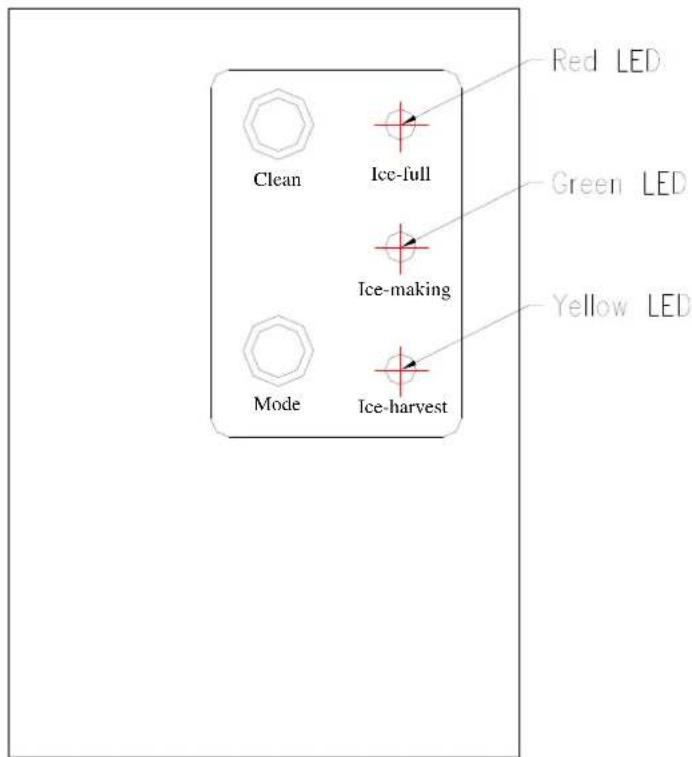
Descriptions of LEDs and buttons:
- Red LED: Ice Full indicator light.
When this LED is lit, the ice storage bin is full of ice or there is something between the two arms of the ice-full sensor in the ice storage bin. The unit will stop working. When ice cubes are taken out of the ice storage bin, clearing the sensor, the red LED will keep flashing for 3 minutes. Then the unit will restart and return to the ice making mode.
- Green LED: Ice Making indicator light.
When this LED is lit, the unit is working in the Ice Making mode controlled by a temperature probe on the evaporator. When the green LED is flashing, the unit is working in the Ice Making mode controlled by a fixed timer.
- Yellow LED: Ice Harvest indicator light.
When this LED is lit, the unit is working in the Ice Harvest mode controlled by a temperature probe on the evaporator. When the yellow LED is flashing, the unit is working in the Ice Harvest mode controlled by a fixed timer.
-
Clean button: When this button is pressed, the unit enters the Cleaning mode. The green and yellow LEDs flash together. To stop the Cleaning mode, just press the button again.
-
Mode button: Mainly for service. When this button is pressed, unit can change from Ice Making mode to Ice Harvest mode, or from Ice Harvest mode to Ice Making mode. You can judge the mode from the status of the green and yellow LEDs.
6. Ice Size Adjustment Guide:
1.) Press and hold the "Clean" button and the "Mode" button together for at least 3 seconds. The unit will enter the Ice Size Adjustment mode. The "ICE Making" LED (green) will be blinking continuously during the ice size adjustment.
2.) While in the Ice Size Adjustment mode, press the "Clean" button or the "Mode" button for the desired ice size.
Smaller ice setting:
By pressing the "Clean" button, you can decrease the size of the ice cubes. The "ICE FULL" LED (red) will flash as you lower the ice size and will finally be blinking at the setting of smallest ice size.
Larger ice setting:
By pressing the "Mode" button, you can increase the size of the ice cubes. The "ICE HARVEST" LED (yellow) will flash as the larger size is set and will blink when the setting of largest ice size has been reached.
After 10 seconds without any operation, the unit will automatically memorize the current state and return to the previous mode.
NOTE: If during the ice size adjustment, the "ICE FULL", "ICE MAKING" and "ICE HARVEST" LEDs blink all at once, this indicates that the unit is in the default factory setting of the ice size adjustment.
- If the red, green and yellow LEDs are flashing together, the machine is not working. The major fuse of the control box has failed. Call for service.
NOTE: Avoid letting water contact the control box.
MAJOR FUNCTIONS
- Completely automatic operating procedure.
- When the ice storage bin is full of ice cubes, the machine stops working automatically and starts again after the cubes are removed.
- The different colors of the LED display indicate various work modes.
- Indication of failure of major control box fuse.
- The fan motor responds to the ambient temperature. If it is cold, the motor will stop working to keep the cooling system in good working condition.
- Ice cube size is adjustable.
- A sensitive probe and accurate timer enhance the performance of the ice maker.
- Manual Clean mode to start or stop the ice making system cleaning.
- Built-in compressor protection system.
TROUBLESHOOTING
Before Calling for Service
If the unit appears to be malfunctioning, read through the OPERATION section of this manual first. If the problem persists, check the TROUBLESHOOTING GUIDE below and on the following page. The problem could be something very simple which can be solved without a service call.
Troubleshooting Guide
| Problem | Possible Cause | Probable Correction |
| The machine doesn't operate. | The ice maker is unplugged. | Plug the ice maker in. |
| The fuse is blown. | Replace fuse. If it happens again, call for service to check for a short circuit in the ice maker. | |
| The ice maker power switch is OFF. | Turn the ice maker power switch ON. | |
| The ice storage bin is full of ice. | Remove some ice; make sure the ice-full sensor is free of ice. | |
| The water doesn't feed in after the ice maker starts. | The water supply tap is turned off. | Turn on the water supply tap. |
| The water supply line is not connected properly. | Reconnect the water supply line. | |
| Machine makes ice, but ice storage bin does not fill up with ice. | The bin should fill up and the machine shut off in 9-14 hours. If not, the condenser may be dirty. | Clean the condenser. |
| The bin drain may be partially restricted. | Clean out the drain; check the installation. | |
| The airflow to the ice maker may be obstructed. | Check the installation. | |
| The ambient temperature and water temperature are high, or machine is near some heat source. | Check the installation. | |
| Water is leaking from the unit. | A few water drops fall to the floor when you open the door to take out ice from ice storage bin. | Normal condensation on the door or some water together with ice. Take care when you take out ice. |
| Water supply connection leaking. | Tighten fitting. See “Connecting the Water Line”. | |
| Nut of water drain hole leaking. | Tighten the nut. | |
| Drain hose connection leaking. | Tighten fitting. See “Connecting the Drain”. | |
| Cubes are partially formed or are white at the bottom. | Not enough water in the water sump. | Check if the water supply pressure is below 20 psig. |
| Check water supply; filter may be restricted. | ||
| Check for a water leak at the water sump | ||
| Check if water inlet valve is restricted. | ||
| The ice cubes are incomplete when being dumped. | The sprinkler is blocked. | Clean it; see “Interior Cleaning”. |
| Noise during operation | The feet are not leveled and locked. | Level and lock the feet. See “Leveling the Ice Maker”. |
| Certain sounds are normal. | See “Normal Sounds”. | |
| The ice maker stops suddenly while making ice. | The electricity is off. | Reconnect the power supply line. |
| The room temperature is out of the stated range. | Cut off the electricity; let the ice maker stop working till the temperature returns within the stated range. | |
| The ventilation louvers are covered. | Remove the obstruction. | |
| The body of the ice maker is electrified. | The grounding line isn’t in the socket. | Use a socket meeting the required electrical standard. |
| Scale occurs frequently inside the machine. | The hardness of the water is too high. | Use a water-softening device installed in front of the water inlet valve. |
Limited Warranty
Orien USA L.L.C., warrants this product to be free from defects in materials and workmanship for a period of one year from the date of the original purchase. Orien also warrants the compressor for 5 years with a Parts-only warranty from the date of purchase. Any parts that are determined to be defective will be replaced or repaired, at its sole discretion, by Orien at no charge as long as it has been determined that the unit was operated in accordance with the instructions attached or furnished with the product. If the unit proves to be defective, your first course of action should be to follow the retailer's return policy.
This warranty covers units only in the continental United States and does not cover the following:
- Damage from improper voltage or installation
- Damage in shipping
Defects other than manufacturing defects - Any installation expenses that may be incurred
Labor or repairs after the initial 12-month period - Damage from abuse, misuse, accident, alteration or lack of proper care or maintenance
- Improper or incorrectly performed maintenance or repairs
- Use of parts not recommended by Orien USA, L.L.C.
- Damage due to acts of God.
This limited warranty is given in lieu of all other warranties expressed or implied. This warranty does not cover incidental or consequential damages. Some States do not allow the exclusion or limitation of incidental or consequential damages, so the above limitation or exclusion may not apply to you.
This warranty provides you with specific legal rights and you may have other rights which vary from State to State. Consult the written materials accompanying your product for the safe and proper operation.
This warranty may not be assigned.
For warranty service, contact:
Orien USA, L.L.C.
921 General Hill Drive,
Virginia Beach, VA23454
Website: www.orienusa.com
When service is required, have on hand the Model and Serial numbers found on the rating label on the back of the unit, as well as proof of purchase such as a sales or gift receipt.
If you have a service issue or wish to talk to a technical representative please call: 1-877-316-1725
INDICE
Pagina
921 General Hill Drive,
Virginia Beach, VA23454
Types d installation 71-72
FONCTIONNEMENT 73-76
Types d installation
Installation Mobile:
921 General Hill Drive,
Virginia Beach, VA23454