Baby Carrier We and We Air - Baby swing BabyBjörn - Free user manual and instructions
Find the device manual for free Baby Carrier We and We Air BabyBjörn in PDF.



| Product type | Soft baby carrier |
| Brand | BabyBjörn |
| Model | Baby Carrier We and We Air |
| Recommended age | From birth to approx. 3 years |
| Minimum weight | 3.5 kg (8 lb) |
| Maximum weight | 15 kg (33 lb) |
| Minimum height | 53 cm (21 in) |
| Maximum height | 100 cm (40 in) |
| Carrying positions | Facing you (newborn and baby), on the back (from 12 months) |
| Adjustable height | Newborn height (up to 62-68 cm) and lower baby height (from 62 cm) |
| Main material (We) | 100% cotton |
| Main material (We Air) | 100% polyester (mesh) |
| Other textiles | 100% polyester |
| Care | Machine wash delicate cycle warm water, mild detergent, hang to dry. No bleach or fabric softener. Do not iron the padding or mesh. |
| Safety standards | EN 13209-2:2005 and ASTM F2236 |
| Warranty | 2 years against defects in materials and workmanship |
| Included accessories | Adjustable head support, leg attachments for small weights |
| Features | Safety buckles, waist belt, adjustable shoulder straps, height zipper |
| Use | Walking only, do not use for sports or driving |
| Repairability | Contact customer service or retailer for warranty repair |
Frequently Asked Questions - Baby Carrier We and We Air BabyBjörn
User questions about Baby Carrier We and We Air BabyBjörn
0 question about this device. Answer the ones you know or ask your own.
Ask a new question about this device
Download the instructions for your Baby swing in PDF format for free! Find your manual Baby Carrier We and We Air - BabyBjörn and take your electronic device back in hand. On this page are published all the documents necessary for the use of your device. Baby Carrier We and We Air by BabyBjörn.
USER MANUAL Baby Carrier We and We Air BabyBjörn
natural_image
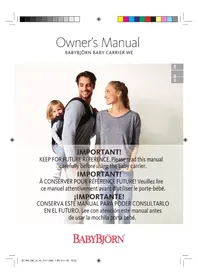
Family portrait of a man, a woman, and a child against a plain white background (no text or symbols visible)IMPORTANT!
KEEP FOR FUTURE REFERENCE. Please read this manual carefully before using the baby carrier.
IMPORTANT!
natural_image
Color palette bar with grayscale shades and a central crosshair (no text or symbols)


natural_image
Two horizontal bar segments with grayscale shades and a central crosshair symbol (no text or labels)ENGLISH 4-9
FRANÇAIS 10-15
ESPAÑOL 16-21


Baby Carrier We
Congratulations! Choosing BABYBJÖRN Baby Carrier We will ensure a long-lasting ergonomic carrying and maximum comfort for you and child from birth up to approx. three years. Min. 8 lb/3.5 kg, 21 in/53 cm. Max. 33 lb/15 kg, 40 in/100 cm. Please read this manual carefully and visit www.babybjorn.com to learn all about your new baby carrier.
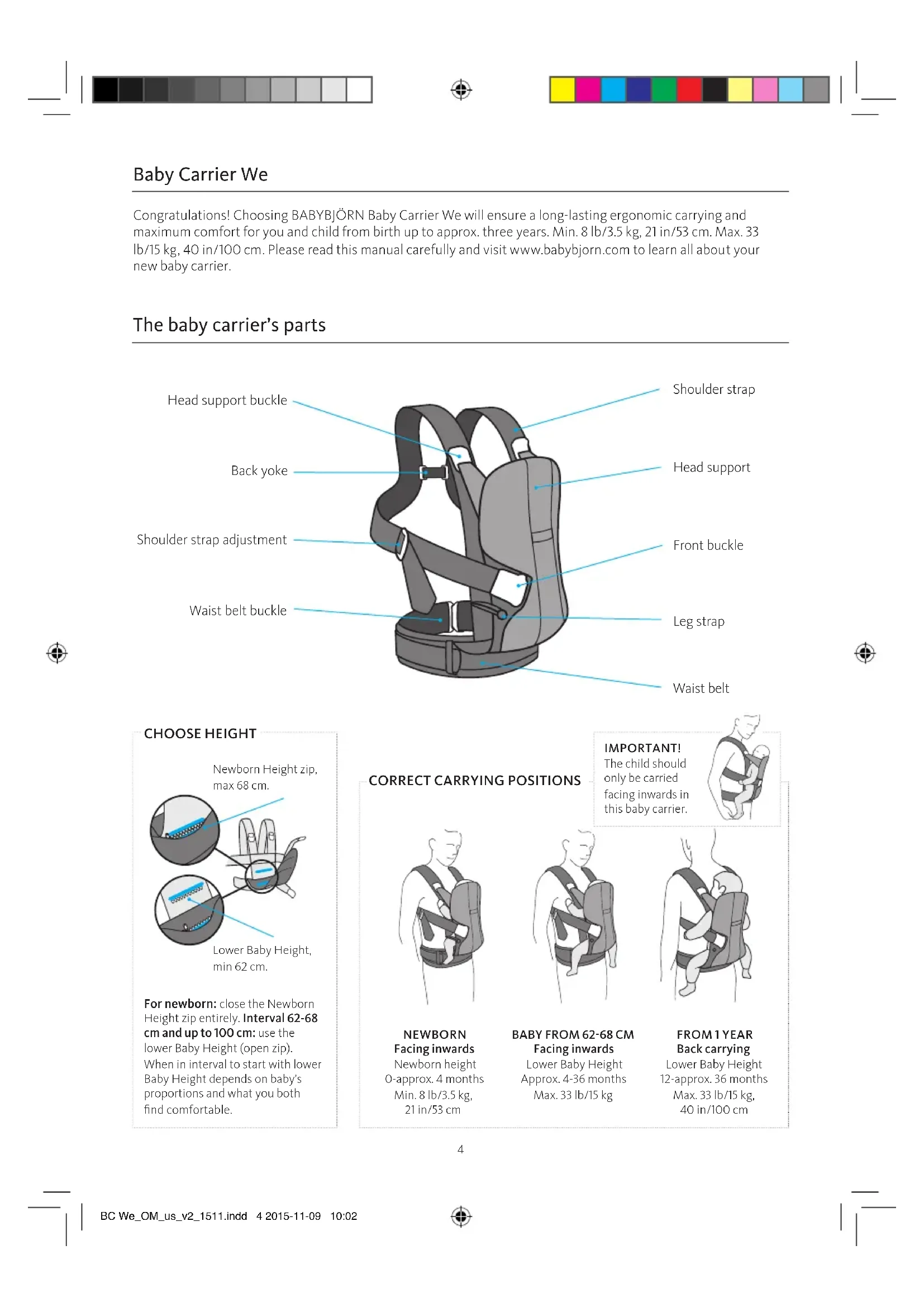
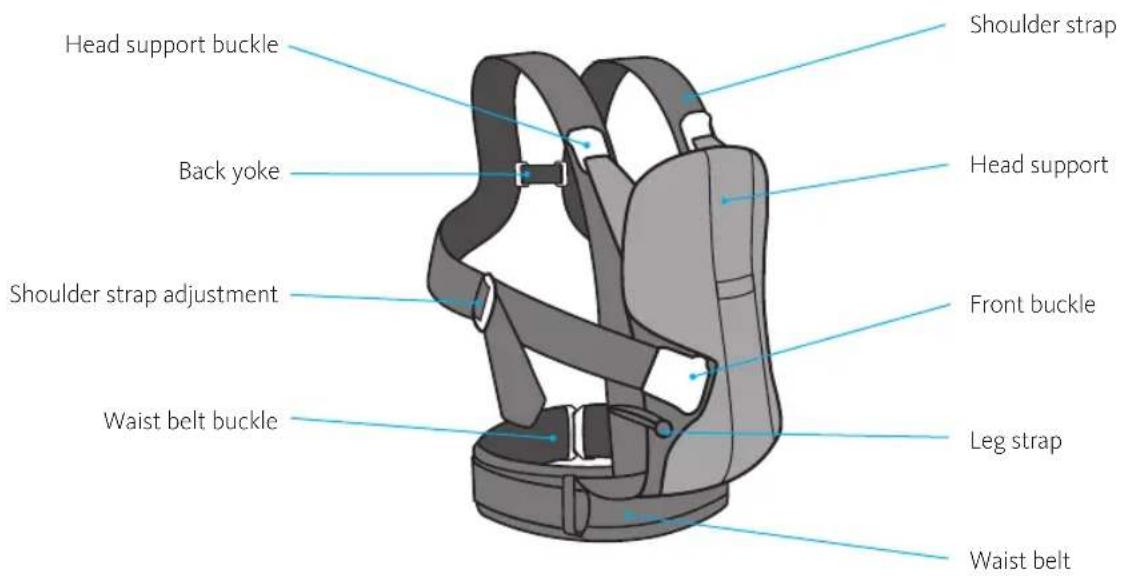
The baby carrier's parts
text_image
Head support buckle Back yoke Shoulder strap adjustment Waist belt buckle Shoulder strap Head support Front buckle Leg strap Waist beltCHOOSE HEIGHT
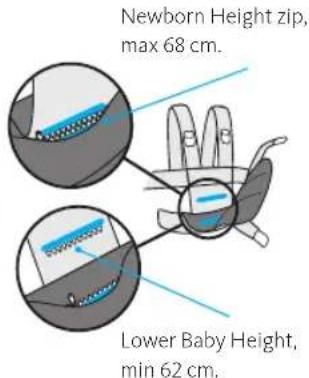
text_image
Newborn Height zip, max 68 cm. Lower Baby Height, min 62 cm.For newborn: close the Newborn Height zip entirely. Interval 62-68 cm and up to 100 cm: use the lower Baby Height (open zip). When in interval to start with lower Baby Height depends on baby's proportions and what you both find comfortable.
CORRECT CARRYING POSITIONS
natural_image
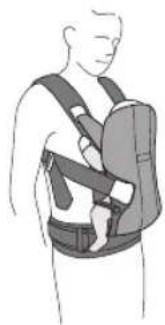
Line drawing of a person wearing a full-body backpack (no text or symbols)NEWBORN
Facing inwards
Newborn height O-approx. 4 months Min. 8 lb/3.5 kg, 21 in/53 cm
IMPORTANT!
The child should only be carried facing inwards in this baby carrier.
natural_image
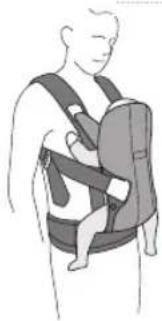
Line drawing of a person wearing a baby's carry (no text or symbols)BABY FROM 62-68 CM
Facing inwards Lower Baby Height Approx. 4-36 months Max. 33 lb/15 kg
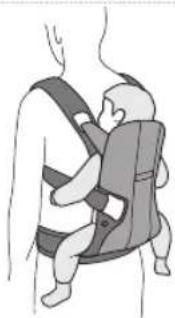
natural_image
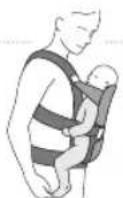
Illustration of a person wearing a baby in a full-body gait (no text or symbols)FROM 1 YEAR
Back carrying
Lower Baby Height 12-approx. 36 months Max. 33 lb/15 kg, 40 in/100 cm
How to put on the baby carrier
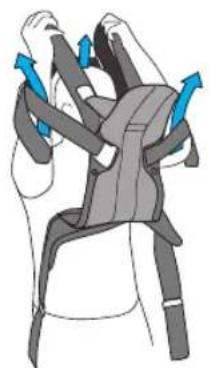
natural_image
Illustration of a person wearing a gray safety harness with blue directional arrows indicating movement (no text or symbols)- Put on the baby carrier like a pullover.
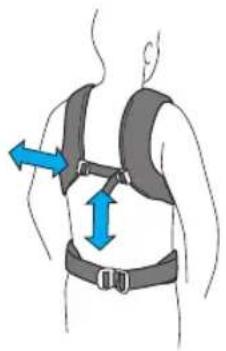
natural_image
Illustration of a person wearing a full-body shoulder harness with blue directional arrows indicating movement or pressure points (no text or symbols)- Adjust the back yoke by moving it vertically and sideways to ensure a comfortable fit. Keep the back yoke low for best comfort.
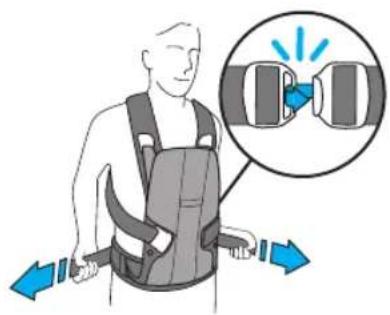
text_image
Illustration showing a person in a seatbelt with a magnified inset highlighting the seatbelt detail.- Fasten the waist belt around the back. It is locked when you hear a click. Tighten by pulling the straps evenly on both sides.
How to place your child in the baby carrier
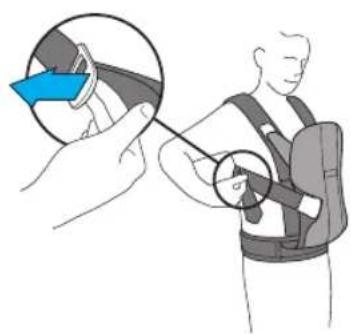
natural_image
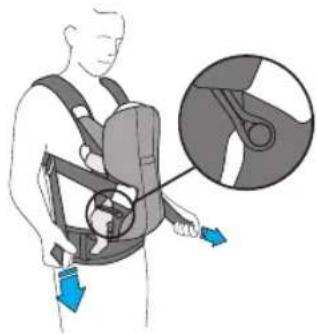
Illustration of a person using a device to adjust the seatbelt, showing a magnified view of the seatbelt (no text or symbols present)- Loosen the shoulder straps by lifting the outer edge of the buckles.
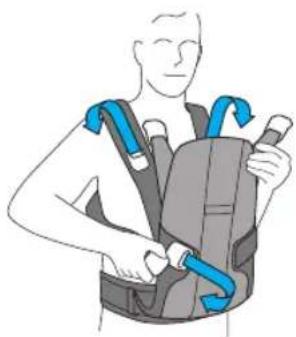
natural_image
Illustration of a person wearing a gray backpack with blue straps, holding a blue strap (no text or symbols)- Unbutton the head support on both sides by pushing the button and pulling upwards. Unbutton the front buckle by pushing the button and pulling downwards/inwards.
IMPORTANT!
A child too big to use the armholes can rest their arms above the armholes.

text_image
A child can use the a rest their the arm- Place the child in the baby carrier facing you, with the legs on either side of the front, and the arms through the armholes.
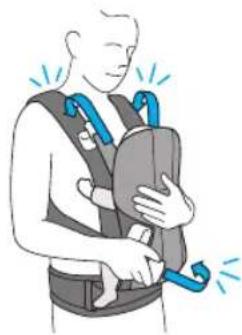
natural_image
Illustration of a person wearing a baby vest with blue straps, carrying a baby (no text or symbols)- Fasten the front buckle and the head support buckle on both sides. It is locked when you hear a click.
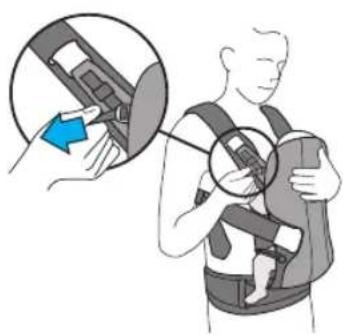
natural_image
Illustration of a person wearing a full-body bala life vest, with a magnified inset showing hand placement and blue arrow indicating direction (no text or symbols)- Adjust the head support. To tighten, carefully pull the adjustment straps. To loosen, lift the outer edge of the buckles.
natural_image
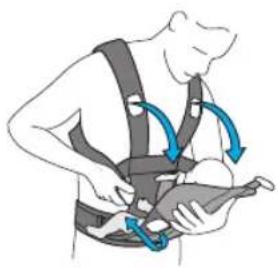
Illustration of a person wearing a full-body medical harness, with an inset showing the internal anatomy (no text or symbols present)- Tighten by pulling the shoulder straps evenly on both sides. Fasten the leg straps on both sides for a child smaller than 10 lb/4.5 kg.
How to remove your child
Unfasten the leg straps if they are being used. Unfasten the head support buckles. Loosen the shoulder straps and unfasten the front buckle. Take out your child.
natural_image
Illustration of a person wearing a full-body medical harness with blue arrows indicating motion or force (no text or symbols)How to carry your child on your back
From 12 months your child is old enough to be carried on your back. Start by placing your child in the baby carrier facing you, see pics 1-3 and 1-6 on previous pages. Then follow the instructions below.
natural_image
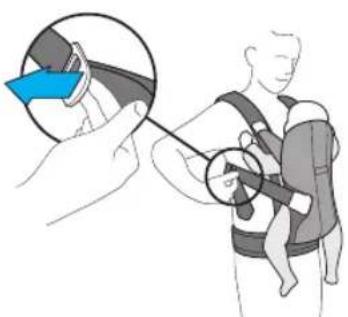
Illustration of a person using a device to lift a baby (no text or symbols present)- Loosen the shoulder straps by lifting the outer edge of the buckles.
natural_image
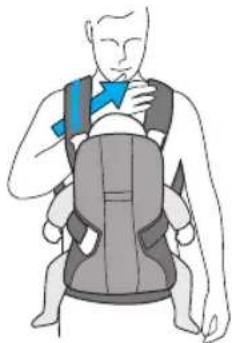
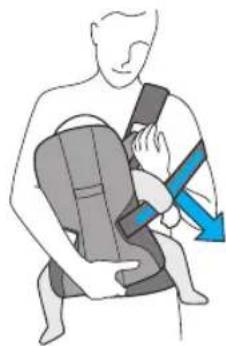
Illustration of a person carrying a baby in a full-body seatbelt (no text or symbols)- Slip your right arm upwards under the shoulder strap.
natural_image
Illustration of a person using a seatbelt to lift a person's shoulder, with a blue arrow indicating force direction (no text or symbols)- Slip your left arm downwards under the lower part of the shoulder strap. The shoulder strap is now a closed loop around your body.
natural_image
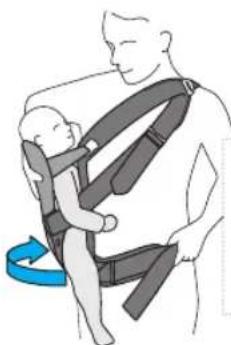
Illustration of a person carrying a baby in a full-body sling (no text or symbols)- Lift your child from underneath and carefully move him or her round your body under your raised right arm.
IMPORTANT!
Do not hold onto the safety buckle when moving your child around to your back.
natural_image
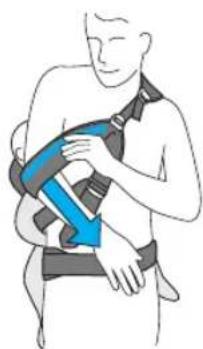
Illustration of a person holding a blue safety belt with a downward arrow (no text or symbols)- Lift the right shoulder strap back in place. Make sure it is not twisted.
natural_image
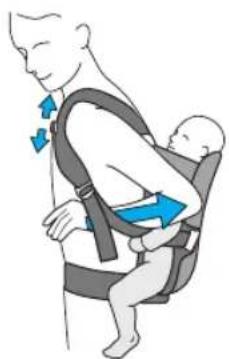
Illustration of a person carrying a baby in a full-body medical device (no text or symbols)- Slide the left shoulder strap back in place. Place the back yoke where it is comfortable by adjusting it vertically and sideways. Tighten the waist belt and shoulder straps.
How to remove your child from the back
With your child on your back, please follow steps 1-6 again. But this time, move your child round from your back to your front under your raised right arm.
WASHING INSTRUCTIONS
Machine wash separately in warm water, mild detergent, gentle cycle, and drip dry (no dryer). Do not use chlorine bleach or fabric softener. Iron only at low temperature and never iron the trim.
Do not iron mesh fabric.
Improper care will void any and all warranties.
SAFETY APPROVAL
BABYBJÖRN Baby Carrier We meets the safety requirements of EN13209-2:2005 and ASTM F2236.
FABRIC INFORMATION
Cotton Main fabric: 100% cotton.
Other fabrics: 100% polyester.
Mesh 100% polyester.
Important!
Premature infants, infants with respiratory problems, and infants under 4 months are at greatest risk of suffocation.
Never use a soft carrier when balance or mobility is impaired because of exercise, drowsiness, or medical conditions.
Avoid dressing your child too warmly.
Never wear a soft carrier while driving or being a passenger in a motor vehicle.
Never use a soft carrier while engaging in activities such as cooking and cleaning which involve a heat source or exposure to chemicals.
The baby carrier is NOT suitable for use during sports or other leisure activities.
Check to assure all buckles, snaps, straps, and adjustments are secure before each use.
Check for ripped seams, torn straps or fabric and damaged fasteners before each use.
WARNING! FALL AND SUFFOCATION HAZARD
FALL HAZARD - Infants can fall through a wide leg opening or out of baby carrier.
- Hold your baby closely at all times until correctly attached.
- Make sure baby's legs are straddling the seat and arms extend through arm holes.
- Small children can fall through a leg opening. Adjust the leg openings to fit the child's legs snugly.
- Before each use, make sure all buckles are secure.
• Take special care when leaning or walking. - Never bend at waist; bend at knees.
- This baby carrier is designed for use by adults while walking only.
- Only use this baby carrier for children between 8 lb/3.5 kg (21 in/53 cm) and 33 lb/15 kg.
- Ensure proper placement of child in product including leg placement.
- For children of 0–approx. 4 month always use the upper newborn height.
-
The leg straps must be used for children weighing 8–10 lb/3.5–4.5 kg.
-
Your balance may be adversely affected by your own or your child's movements.
- Regularly check that your child is comfortably and securely seated in the baby carrier, especially when using as a back carrier.
- Never use a damaged baby carrier.
SUFFOCATION HAZARD - Infants under 4 months can suffocate in this product if face is pressed tight against your body.
- Back carrying only after 12 months old.
- Do not strap baby too tight against your body.
- Allow room for head movement.
- Keep infant's face free from obstructions at all times.
- Never lie down or sleep with baby in the baby carrier.
- Inspect the baby carrier regularly for any signs of wear and tear.
- Do not carry your child facing outwards in this baby carrier.
2 YEAR EXPRESS WARRANTY
BABYBJÖRN warrants to the original consumer purchaser that this product will be free from defects resulting from material, design or workmanship for two (2) years from the original date of purchase.
If any defect is discovered within six (6) months from the date of purchase, we ask you to call the retailer where the product was purchased, to arrange for the replacement of the defective product. If this is not possible, please contact BabySwede LLC., following the instructions below.
If any defect is discovered after six (6) months and within two (2) years from the date of purchase, we ask you to call BabySwede LLC at 866-424-0200 You will be given a return authorization number and asked to send us the defective product, postage prepaid, along with proof of purchase. Please send the product to: BabySwede LLC, 1157 Rockside Road, Cleveland, OH 44134.
If BabySwede determines that the product is defective, BabySwede will either repair or replace the product and return it to you, all at BabySwede's expense.
This warranty applies only to defective original material, or to defects arising from faulty workmanship. The warranty does not apply to defects resulting from normal wear and tear, product misuse, after market product alterations, or failure to follow use and care instructions supplied with the product.
The warranty detailed above shall be in lieu of any and all other warranties. All other warranties, including implied warranties of merchantability and fitness for a particular purpose are hereby expressly disclaimed.
Porte-bébé We
text_image
Diagram illustrating hand manipulation or cleaning process with labeled steps and visual illustrationsnatural_image
Line drawing of a person wearing a full-body harness (no text or symbols)natural_image
Line drawing of a person wearing a baby's vest (no text or symbols)natural_image
Illustration of a person wearing a baby in a full-body gait (no text or symbols)natural_image
Illustration of a person wearing a gray backpack with blue directional arrows indicating movement or force (no text or symbols)natural_image
Illustration of a person wearing a back cover with blue arrows indicating movement or pressure points (no text or symbols)text_image
Illustration showing a person wearing a seatbelt with a magnified inset highlighting the belt buckle detail.natural_image
Illustration of a person using a belt drive a seatbelt, showing the angle and direction of movement (no text or symbols present)natural_image
Illustration of a person wearing a gray backpack with blue straps, holding a blue strap (no text or symbols)natural_image
Illustration of a person wearing a backpack with blue safety straps (no text or symbols)natural_image
Illustration of a person using a backpack to adjust the chest area, with a magnified inset showing hand placement (no text or symbols)natural_image
Illustration of a person wearing a baby boom device with a magnified inset showing internal anatomy (no text or symbols)natural_image
Illustration of a person wearing a full-body medical harness with blue arrows indicating motion or force (no text or symbols)natural_image
Illustration of a baby wearing a seatbelt, with a hand holding a blue object near the seat (no text or symbols present)natural_image
Illustration of a person carrying a baby in a full-body seatbelt, no text or symbols presentnatural_image
Illustration of a person sitting on a chair with a blue arrow indicating force or pressure (no text or symbols)natural_image
Illustration of a person wearing a baby's seatbelt, with a blue arrow indicating rotation (no text or symbols)natural_image
Illustration of a person holding a blue safety belt with a downward arrow (no text or symbols)natural_image
Illustration of a person carrying a baby in a full-body sling, with arrows indicating motion direction (no text or symbols)natural_image
Line drawing of a person wearing a full-body backpack (no text or symbols)natural_image
Illustration of a person wearing a baby baza life vest (no text or symbols)natural_image
Illustration of a person wearing a baby in a full-body gait (no text or symbols)natural_image
Illustration of a person wearing a gray safety harness with blue directional arrows indicating movement (no text or symbols)natural_image
Illustration of a person wearing a full-body backpack with blue arrows indicating movement or pressure direction (no text or symbols)text_image
Illustration showing a person wearing a seatbelt with a magnified inset highlighting the belt buckle detail.natural_image
Illustration of a person using a device to adjust a helmet, showing the magnified view of the component (no text or symbols present)natural_image
Illustration of a person wearing a gray backpack with blue straps, holding a blue strap (no text or symbols)natural_image
Illustration of a person wearing a full-body harness and holding a backpack, with motion lines indicating speed (no text or symbols)natural_image
Illustration of a person wearing a baza life vest, with a magnified inset showing the hand holding a device (no text or symbols present)natural_image
Illustration of a person wearing a baby boom device with a magnified inset showing internal anatomy (no text or symbols)natural_image
Illustration of a person wearing a full-body medical harness with blue arrows indicating motion or force (no text or symbols)natural_image
Illustration of a person using a bandpass to lift a baby (no text or symbols present)natural_image
Illustration of a person carrying a baby in a full-body seatbelt, no text or symbols presentnatural_image
Illustration of a person using a seatbelt to lift a person's chest, with a blue arrow indicating force direction (no text or symbols)natural_image
Illustration of a person wearing a baby's seatbelt, with a blue arrow indicating rotation (no text or symbols)natural_image
Illustration of a person holding a blue safety belt with a downward arrow (no text or symbols)natural_image
Illustration of a person carrying a baby in a full-body sling, with blue arrows indicating force or movement (no text or symbols)natural_image
Color palette bar with grayscale shades and a central crosshair (no text or symbols)



natural_image
Color palette bar with grayscale shades and a central crosshair (no text or symbols)