Masterdarter - Toys OneConcept - Free user manual and instructions
Find the device manual for free Masterdarter OneConcept in PDF.



User questions about Masterdarter OneConcept
0 question about this device. Answer the ones you know or ask your own.
Ask a new question about this device
Download the instructions for your Toys in PDF format for free! Find your manual Masterdarter - OneConcept and take your electronic device back in hand. On this page are published all the documents necessary for the use of your device. Masterdarter by OneConcept.
USER MANUAL Masterdarter OneConcept
| 1. Fence: Triple 13 | 3. Fence: Triple 8 | ||
| 2. Fence: Triple 17 | 4. Fence: Triple 5 |
Congratulations on purchasing this device. Please read the following instructions carefully and follow them prevent possible damages. We assume no liability damage caused by disregard of the instructions an improper use. Scan the QR code to get access to the latest user manual and more product information.

CONTENT
Safety Instructions 34
Mounting 35
The Dart Board 37
General Operation 38
List of Games 40
Game Instructions 41
Troubleshooting 60
Hints on Disposal 61
Producer 61
TECHNICAL DATA
| Item number 10030658, 10030659 |
| Power supply 9V DC, 500 mA (Adaptor 100-240 V, 50 Hz) |
| Dimensions (w x h x d) 513 x 572 x 65mm |
| Scope of delivery • Electronic dartboard • Playing and user instructions • 12 darts (in parts) • 24 soft tips • 2 x screw, 2 x wall plug • Power adapter |
SAFETY INSTRUCTIONS
- These operating instructions are intended to familiarize you with the operation of this product. Therefore, always keep this manual in a safe place so that you can access it at any time.
- When you purchase this product, you will receive a two-year warranty for defects when used properly.
- Please use the product only in its intended manner. Any other use may result in damage to the product or its surroundings.
- Modification or alteration of the product impairs product safety.
Attention: Risk of injury! - Never open the product without authorization and never carry out repairs yourself!
- Handle the product carefully. It can be damaged by shocks, blows or falling from a low height.
- Keep the product away from moisture and extreme heat.
- Do not allow metal objects to fall into this unit.
- Do not place heavy objects on this product.
- Clean only with a dry cloth.
- Only use accessories recommended by the manufacturer or a qualified dealer.
- The warranty expires if the device is tampered with by a third party.
AC Adapter
- Use the supplied adapter only in combination with the dartboard. If there is any damage, use an identical mains adapter, which you can obtain from a qualified dealer or from the manufacturer.
- The mains adapter is only approved for indoor use.
- Keep the AC adapter away from moisture and extreme heat.
- Always unplug the AC adapter from the wall outlet before disconnecting the adapter from the dartboard.
- Be sure to replace the AC adapter if the power cord is damaged.
Small objects/packaging parts

WARNING
Danger of suffocation! Keep small objects (e.g. screws and other mounting materials, memory cards) and packaging parts out of the reach of children so that they cannot be swallowed by them. Do not let small children play with foil.
Transporting the device
Please keep the original packaging. To ensure adequate protection during transport, pack the unit in its original packaging.
Cleaning the outer surface
Do not use volatile liquids such as insect sprays. Excessive pressure when wiping may damage the surfaces. Rubber or plastic parts should not be in contact with the unit for long periods of time. Use a dry cloth.
MOUNTING
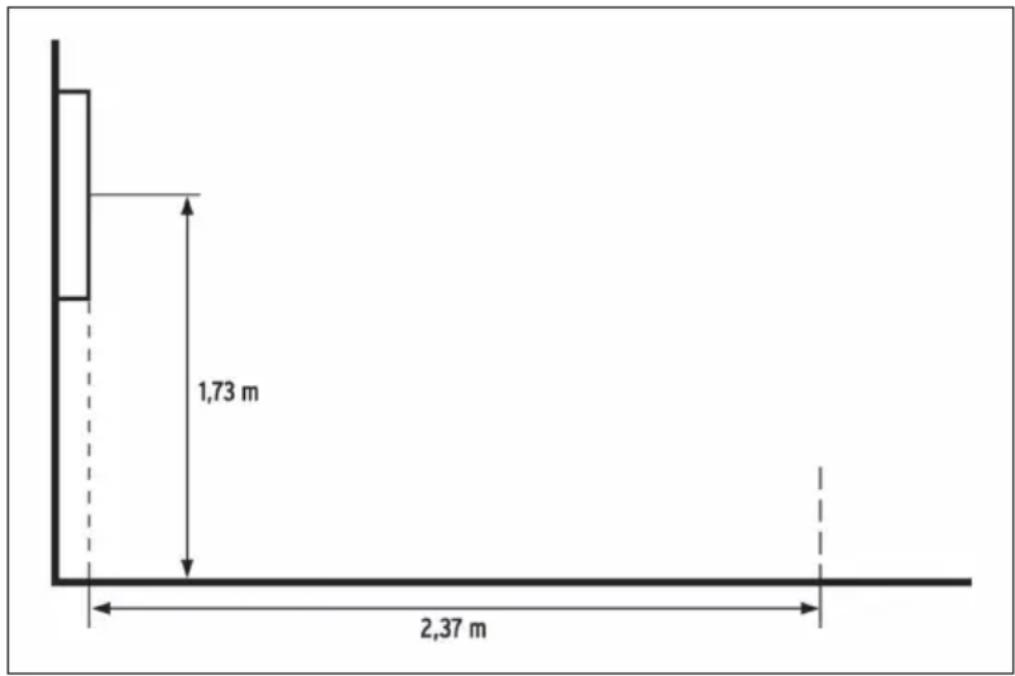
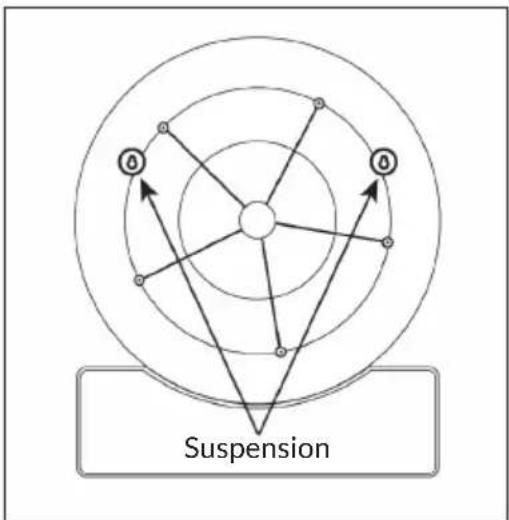
Select a suitable position with approx. 3m free space around it. The 'scratch line' must be at a distance of 2.37m from the dartboard. Fix the dartboard to the wall so that the centre of the bull's eye is at a height of 1.73m above the ground.
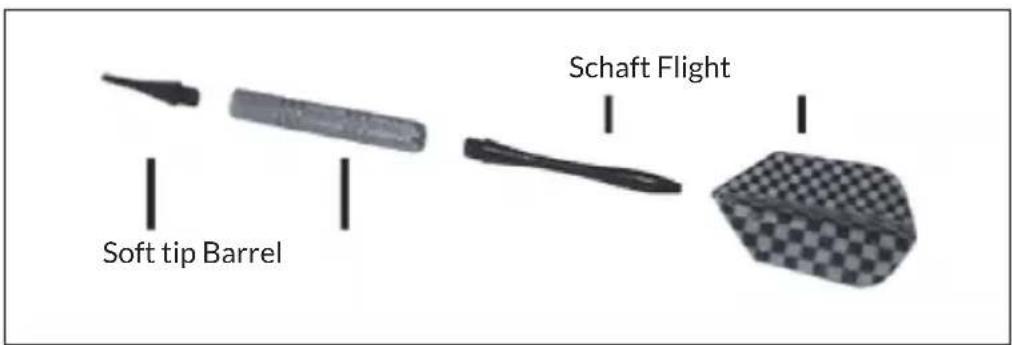
Put the arrows together:
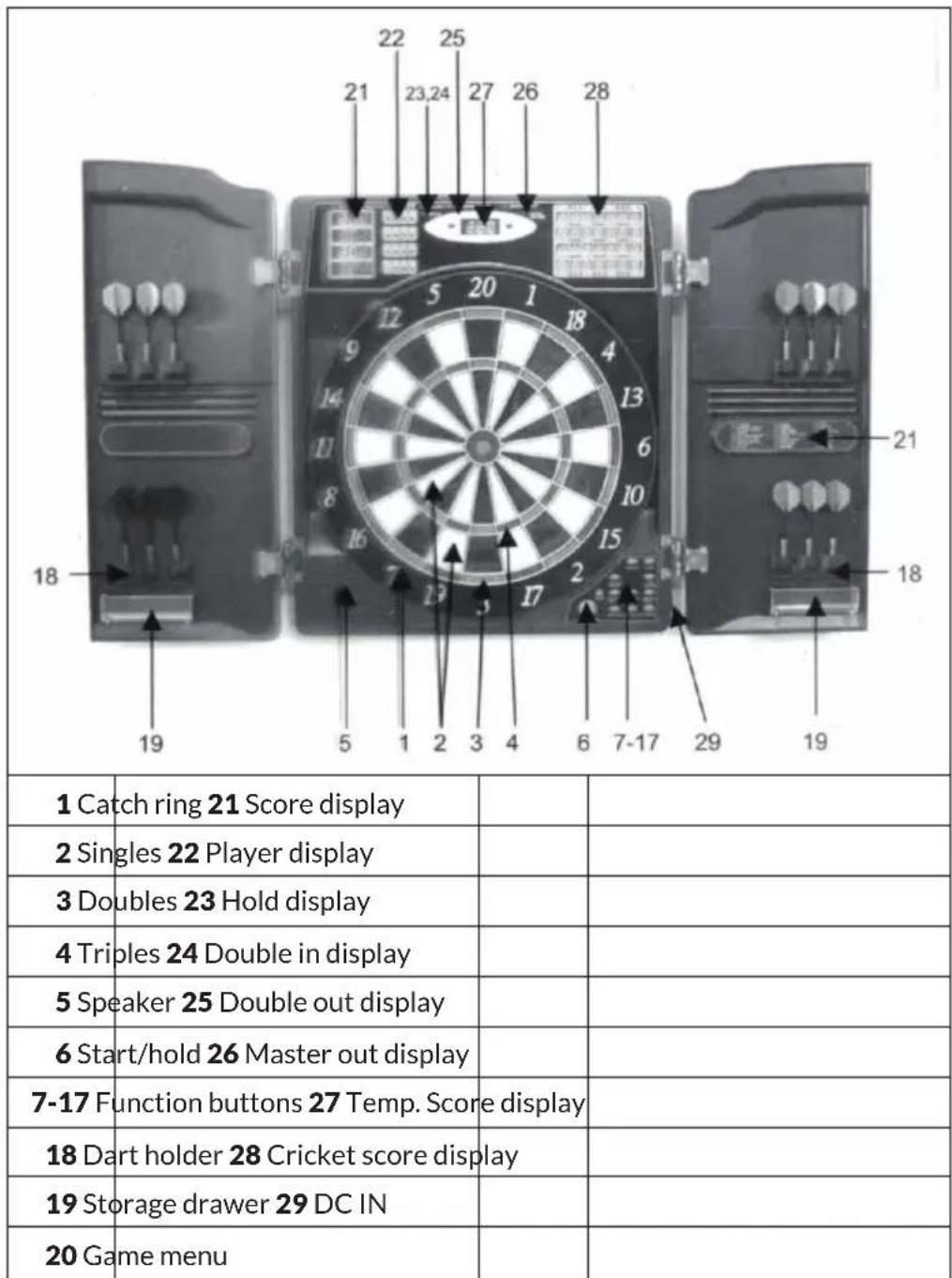
THE DART BOARD
GENERAL OPERATION
Switch on the device
Use the POWER switch on the lower right corner to turn on the unit after connecting it to a power outlet using the AC adapter.
Function keys
| GAME GUARD | Press to activate Game Guard. This function causes all keys and the target area to be "locked" and the next arrows do not affect the game, i.e. they are not counted. Press again to deactivate. |
| BOUNCE OUT | If an arrow that does not remain in the disc (bounce-out) is not to be counted, press BOUNCE OUT. |
| DART-OUT/SCORE | The dart-out function is active in the "-01" games. If your score is below 160, press to suggest how to place three throws to win the game (doubles and triples are represented by two and three dashes, respectively, e.g.: „//15". Press SCORE to display the score. |
| SOUND Press repeatedly | ly to adjust the volume. |
| DOUBLE/MISS | Double: Activate Double In/Double/Out/Master Out for "-01" games. |
| Miss: Register miss (if a dart has landed outside the target). | |
| PLAYER/PAGE | Enter the number of players by pressing repeatedly. During the game: scroll to show scores. |
| GAME Press repeatedly | to scroll through the game list. |
| SELECT Press repeatedly | ly to select game variant. |
| RESET Reset values. | |
| CYBERMATCH | Play against the computer via cybermatch. Select the difficulty level (C1 = Pro to C5 = Beginner) and press START. |
Example
- Press the POWER to activate dartboard. A short musical introduction is played as the dis-play goes through power-up test.
- Press GAME button until desired game is displayed.
- Press DOUBLE button (optional) to select starting and/or ending on doubles or Master Out (used only in 301 - 901 games). This is explained in the game rules section.
- Press PLAYER button to select the number of players (1, 2 ... 16). The default setting is 2 players. Or select Cybermatch option by pressing CYBERMATCH button.
Teamplay
In addition to scoring for up to 16 players, this dartboard is capable of keeping score for team play up to a maximum of 8 two-person teams (16 individuals). To enter team play mode, press PLAYER button continually until a "t" appears on the display. Each team option is illustrated below:
| Example | ||
| t 2-2 2 Teams, 4 Players Team 1: player 1&3 Team 2: player 2&4 | ||
| t 3-3 3 Teams, 6 Players Team 1: player 1&4 Team 2: player 2&5 Team 3: player 3&6 | ||
| t 4-4 4 teams, 8 players Team 1: player 1&5 Team 2: player 2&6 Team 3: player 3&7 Team 4: player 4&8 |
Press START to start.
- Throw. When three arrows have hit the disc, you can remove it without affecting the score by the movement. Then press START to move on to the next player. The player will be announced by loudspeaker and indicated by LEDs.
LIST OF GAMES
| No. Game No. Game | ||
| G01 301 G20 Football | ||
| G02 Cricket G21 Baseball | ||
| G03 Scram G22 Steele Chase | ||
| G04 Cut Throat G23 Bowling | ||
| G05 English Cricket G24 Car Rallye | ||
| G06 Advanced Cricket G25 Shove a Penny | ||
| G07 Shouted G26 Nine Darts | ||
| G08 Big Six G27 G&R | ||
| G09 Overs | G28 | Gold Hunt |
| G10 Unders | G29 | Casino A |
| G11 Count Up | G30 | Casino B |
| G12 High Score | G31 | Casino C |
| G13 Round The Clock | G32 | Elimination |
| G14 Killer | G33 | Horse Shoes |
| G15 Double DOwn | G34 | Warfare |
| G16 41 | G35 | Advanced Warfare |
| G17 All Fives | G36 | Paintball |
| G18 Shanghai | G37 | Fox Hunt |
| G19 Golf | G38 | Tic Tac Toe |
GAME INSTRUCTIONS
Game 1:301
This popular tournament and pub game is played by subtracting each dart from the starting to- tal until the player reaches exactly 0 (zero). If a player goes past zero it is considered a "Bust" and the score returns to where it was at the start of that round.
For example, if a player needs a 32 to finish the game and he/she hits a 20, 8, and 10 (totals 38), the score goes back to 32 for the next round.
In playing the game, the double in / double out option can be chosen (double out is the most widely used option). Simply press the "DOUBLE" button to change this setting. The indicators will display your current setting: Note: you can adjust total score of this game.
- Double In - A double must be hit before points are subtracted from the total. In other
- words, a player's scoring does not begin until a double is hit.
- Double Out - A double must be hit to end the game.
- Double In and Double Out - A double is required to start and end scoring of the game by each player.
- Master Out - A double or triple is required to finish the game.
- Dart-Out Feature ("01" games only): This electronic dartboard has a special "Dart Out" feature. When a player requires less than 160 to reach zero, the estimate feature becomes ac-tive. The player can press the DART OUT button to view the darts necessary to throw to finish the game (reach zero exactly). Doubles and triples are indicated with 2 or 3 lines to the left of each number respectively.
Game 2: CRICKET
Cricket is a strategic game for accomplished players and beginners alike. Players throw for numbers best suited for them and can force opponents to throw for numbers not as suitable for them. The object of Cricket is to "close" all of the appropriate numbers before one's opponent while racking up the highest number of points. Only the numbers 15 through 20 and the inner/outer bullseye are used. Each player must hit a number 3 times to "open" that segment for scoring.
A player is then awarded the number of points of the "open" segment each time he/she throws a dart that lands in that segment, provided their opponent has not closed that segment. Hitting the double ring counts as two hits, and the triple ring counts as 3 hits. Numbers can be opened or closed in any order. A number is "closed" when the other player(s) hit the open segment 3 times. Once a number has been "closed", any player for the remainder of the game can no longer score on it.
Winning: The side closing all the numbers first and accumulating the highest point total is the winner. If a player "closes" all numbers first but is behind in points, he/she must continue to score on the "open" numbers. If the player does not make up the point deficit before the opposing player(s) "closes" all the numbers, the opposing side wins. Play continues until all segments are closed.
NO-SCORE CRICKET:
Press SELECT button when Cricket is displayed. Same rules as standard Cricket except there is no point scoring. The object of this version is to be the first to simply "close" all the appropriate numbers (15 through 20 and the bullseye).
Note: If only 1 player plays, only No-Score-Cricket is activated automatically, because you have no opponents whose points can be surpassed.
Cricket Scoring Display:
This dartboard utilizes a dedicated scoreboard that keeps track of each player's segment status when playing Cricket. The exclusive Tournament Cricket Sco-ring display on this dartboard utilizes traditional X and O style or bar style characters to track 'marks'.
When Cricket is selected, the lights on the Cricket scoreboard are not lit - they will illuminate as 'marks' are scored. There are 3 separate lights within each number (15 through 20 and bullseye). During play, one of the status lights will turn on as a segment is hit. If a double or triple of an active number is hit, 2 or 3 lights will turn on respectively.
Game 3: SCRAM (2 players only)
This game is a variation of Cricket. The game consists of two rounds. The players have a different objective in each round.
In round 1, player 1 tries to "close" (score 3 hits in each segment - 15 to 20 and bullseye). During this time, player 2 attempts to rack up as many points in the segments that the other player has not yet closed. Once player 1 has closed all segments, round 1 is complete.
In round 2, each player's roles are reversed. Now, player 2 tries to close all the segments while player 1 goes for points. The game is over when round 2 is complete (player 2 closes all segments).
The player with the highest point total is the winner.
Same basic rules as standard Cricket except once scoring begins, points are added to your opponent(s) total. The object of this game is to end up with the fewest points. This variation of Cricket offers a different psychology to the players. Rather than adding to your own score and helping your own cause as in standard Cricket, Cut- Throat offers the benefit of racking up points for your opponent(s), digging him in a deeper hole. Competitive players will love this variation!
Game 5: ENGLISH CRICKET (2 players only)
This game is another variation of Cricket that requires precision dart throwing. The game consists of two rounds. The players have a different objective in each round. During the first round, player 2 attempts to throw bullseyes – with the objective of needing 9 to complete round 1. Double bull (red center) counts as 2 scores. Any throw that hit outer single and double segment is credited to player 1's point total.
For example, if player 2 throws an outer 20, a single bullseye, and an outer 7 during his/her turn, player 2 will have one bullseye subtracted from the 9 needed, and 27 points will be credited to player 1's point total. Player 2 must exhibit accurate bullseye dart throwing!
Meanwhile, player 1 attempts to score as many points as possible during this first round. Doub- les and triples count 2x and 3x their respective values. However, to score points, player 1 must score over 40 points in each turn (3 throws) to amass points against player 2. Only those points over 40 are counted toward the cumulative score. Player 1 must also exhibit precision dart throwing and avoid hitting any bullseyes during this first round because any hits scored by player 1 in the bullseye area will be subtracted from player 2's needed total of 9 bullseyes. Once player 2 reaches the objective of getting 9 bullseyes, the roles are reversed for round two.
Game 6: ADVANCED CRICKET
This difficult version of cricket was developed for the advanced player. Players must close out the segments (20, 19, 18, 17, 16, 15 and bullseye) by using only triples and doubles!
In this challenging game, doubles segments count as 1x the number, and triple segments count as 2x the number. The bullseye scoring is the same as in standard cricket. The first player to close out the numbers with the most points is the winner.
Game 7: SHOOTER
This challenging game tests the players ability to "group together" darts within a segment du-ring each round of play. The computer will randomly select the segment the players must shoot for at the start of each round - indicated by a flashing number in the display.
| Single 1 Point | |
| Double 2 Points | |
| Triple 3 Points | |
| Single Bullseye 4 Points | |
| Double Bull's Eye (Inner Bull) 4 Points | |
| Single Bull (Outer-Bull) 2 Points |
The player with the highest score at the end of the round wins.
Game 8: BIG SIX
This game allows players to challenge their opponents to hit the targets of their choice. Similar to the popular basketball game "HORSE"; however, players must earn the chance of picking the next target for their opponent by making a hit on the current target first.
Single 6 is the first target to hit when the game begins. Before the game starts, players must agree on how many lives will be used by pressing SELECT button. Within the three throws, player 1 must hit a 6 to "save" their life.
After the current target is hit, the next dart thrown will determine the opponent's target. If player 1 fails to hit the current target within 3 darts, they will lose a life and a chance to determine the next target for player 2. Player 2 will shoot for the single 6 that player 1 missed – and if it is hit, he can throw for a segment for the next round. Singles, doubles and triples are all separate targets for this game.
The object of the game is to force your opponent into losing lives by selecting tough targets for your opponent to hit such as "Double Bullseye" or "triple 20". The last player with a life left is the winner. Note: you can adjust number of lives.
Note: The number of „lives“ can be selected using the SELECT key.
Game 9: OVERS
The object of this game is to simply score higher ("over") than your own previous three dart total score. Before play begins, players choose the amount of lives to be used by pressing the SELECT button.
When a player fails to score "over their previous three-dart total, they will lose one life. When a player "equals" the previous three dart total, a life will also be lost. The screen on the right will light off once for each life taken away. The last player with a life remaining is the winner. Note: you can adjust number of lives.
Game 10: UNDERS
This game is the opposite of "Overs". Players must score less ("Under") than their own previous three-dart total.
The game begins with 180 (highest total possible) when the player shoots higher than his or her own previous three-dart total, they will lose a life. Each dart that hits outside the scoring area, including bounce outs will be penalized with 60 points added to your score.
This will be added at the end of the round when the "START/HOLD" button is pressed. The last player with a life remaining is the winner. Note: you can adjust number of lives.
Game 11: COUNT-UP
The object of this game is to be the first player to reach the specified point total (400, 500 ...). Point total is specified when the game is selected.
Each player attempts to score as many points as possible per round. Doubles and triples count 2 or 3 times the numerical value of each segment. For example a dart that lands in the triple 20 segment is scored as 60 points. The cumulative scores for each player will be displayed in the display as the game progresses. Note: you can adjust total score.
Game 12: HIGH SCORE
The rules for this competitive game are simple - Rack up the most points in three rounds (nine darts) to win. Doubles and triples count as 2x and 3x that segment's score respectively. You can adjust number of rounds.
Game 13:ROUND-THE-CLOCK
Each player attempts to score in each number from 1 through 20 in order. Each player throws 3 darts per turn. If a correct number is hit, he/she tries for the next number in sequence.
The first player to reach 20 is the winner. The display will indicate which segment you are shooting for. A player must continue shooting for a segment until it is hit.
The display will then indicate the next segment you should shoot for.
There are many difficulty settings available for this game. Each game has the same rules, the differences are detailed as follows:
ROUND-THE-CLOCK 1 - Game starts at segment number 1
ROUND-THE-CLOCK 5 - Game starts at segment number 5
ROUND-THE-CLOCK 10 - Game starts at segment number 10
ROUND-THE-CLOCK 15 - Game starts at segment number 15
Since this game does not utilize point scoring, the double and triple rings count as single numbers.
ROUND-THE-CLOCK Double - Player must score a Double in each segment from 1 through 20 in order.
ROUND-THE-CLOCK Double 5 - Game starts at double segment 5
ROUND-THE-CLOCK Double 10 - Game starts at double segment 10
ROUND-THE-CLOCK Double 15 - Game starts at double segment 15
ROUND-THE-CLOCK Triple - Player must score a Triple in each segment from 1 through 20 in order.
ROUND-THE-CLOCK Triple 5 - Game starts at triple segment 5
ROUND-THE-CLOCK Triple 10 - Game starts at triple segment 10
ROUND-THE-CLOCK Triple 15 - Game starts at triple segment 15
Game 14: KILLER
This game will really show who your friends are. The game can be played with as few as two players, but the excitement and challenge builds with even more players. To start, each player must select his number by throwing a dart at the target area. The display will indicate "SEL" at this point. The number each player gets is his assigned number throughout the game. No two players can have the same number. Once each player has a number, the action starts.
Your first objective is to establish yourself as a "Killer" by hitting the double segment of your number. Once your double is hit, you are a "Killer" for the rest of the game.
Now, your objective is to "kill" your opponents by hitting their segment number until all their "lives" are lost. The last player to remain with lives is declared the winner. It is not uncommon for players to "team up" and go after the better player to knock him out of the game.
Note: you can adjust number of lives. In addition, for those who really want a challenge, there are three additional difficulty settings: Doubles 3 lives, Doubles 5 lives, and Doubles 7 lives. In these games, you can only "Kill" opponents by scoring doubles in their number segment.
Game 15: DOUBLE DOWN
Each player starts with a score of 40. The goal is to score as many hits as possible in the active segment in each round.
Round 1: The player must throw on the 15 segment. If this fails, the current score (here: 40 points) is halved. However, if you have been successful, the total sum achieved is added to the current score.
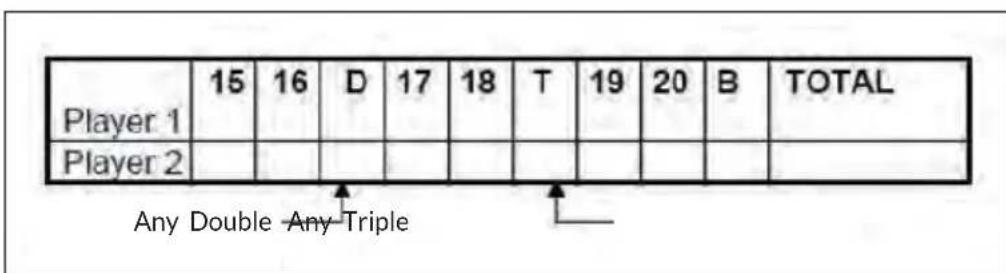
In the next round, the 16th segment is selected and all points scored are added to the new total. If they fail, the total number of points is halved. Each player throws at the numbers in the order shown in the graph below. The LED display also shows the segment to be hit. The player with the most points is the winner.
Game 16: FORTY ONE
This game follows similar rules as standard Double Down as described above with two exceptions. First, instead of going from 15 through 20 and bullseye, the sequence is reversed which will be indicated on the display.
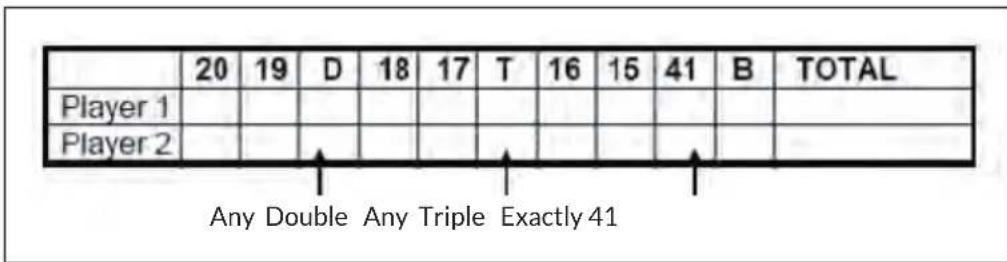
Second, an additional round is included toward the end in which players must attempt to score three hits that add up to 41 points (20, 20, 1; 19, 19, 3; D10, D10, 1: etc.). This "41" round adds an extra level of difficulty to the game.
Remember, a player's score is cut in half if not successful, so the "41" round presents quite a challenge!
Spiel 17: ALL FIVES
All segments are active, so the whole dartboard is used in this game.
In each round (3 darts) each player must achieve a total score divisible by 5. Each 5^ counts as 1 point. Example: In a run of 25 (10, 10, 5), the player gets 5 points for his score, because 25 / 5 = 5 .
If a player achieves a total score (3 rolls) that is not divisible by 5^n , no points are awarded. The last dart of a round must be thrown into a countable segment.
If this dart lands outside the segment ring (catch ring area) or misses the dartboard completely, the player does not receive any points either. Not even if the previous two throws result in a number that could be divided by 5.
This prevents a voluntary „tanking“ in order not to endanger the two good first throws. The first player with a total of 51 „Fives“ is the winner. The LED display always shows the current score.
Game 18: SHANGHAI
Each player must progress around the board from 1 through 20 in order.
Players start at num-ber 1 and throw 3 darts. The object is to score the most points possible in each round of 3 darts. Doubles and triples count toward your score. The player with the highest score after completing all twenty segments is the winner.
Adjustable Difficulty Settings for Shanghai include the following options:
- SHANGHAI 1 - Game starts at segment 1
- SHANGHAI 5 - Game starts at segment 5
- SHANGHAI 10 - Game starts at segment 10
- SHANGHAI 15 - Game starts at segment 15
In addition, Super Shanghai is more difficult. The game is only 7 rounds. This rule is similar as described above except that specific targets need to be hit in 3 darts, or the score will become zero.
Adjustable difficulty levels:
- SUPER SHANGHAI 1 - Game starts at segment 1, ends at segment 7. Specific targets are 3 and 5.
- SUPER SHANGHAI 5 - Game starts at segment 5, ends at segment 11. Specific targets are 7 and 9.
- SUPER SHANGHAI 10 - Game starts at segment 10, ends at segment 16. Specific targets are 12 and 14.
- SUPER SHANGHAI 15 - Game starts at segment 15, ends at segment 25. Specific targets are 17 and 19.
Game 19: GOLF
This is a dartboard simulation of the game golf (but you don't need clubs to play). The object is to complete a round of 9 through 18 "holes" with the lowest score possible. The Championship "course" consists of all par 3 holes making par 27 for a nine hole round or 54 for a round of 18. The segments 1 through 18 are used with each number representing a "hole." You must score 3 hits in each hole to move to the next hole. Obviously, double and triples affect your score as they allow you to finish a hole with fewer strokes. For example, throwing a triple on the first shot of a hole it is counted as an "eagle" and that player gets a complete that hole with 1 "stroke."
Note: Note: The active player continues to throw darts until he "holes out" (scores 3 hits on the current hole). The voice announcer will indicate the player that is up - listen carefully to avoid shooting out of sequence. By the way, there are no "gimmes" in this game!
Game 20: FOOTBALL
Strap your helmet on for this game! The first thing necessary is to select each player's "playing field."
This can be done by throwing a dart or by manually pressing a segment on the board by each player. This is entirely up to you, but whichever segment is selected becomes your starting point which carries through the bullseye and directly across to the other side of the bullseye (see diagram).
The First player to "score" is the winner. The display will keep track of your progress and indicate the segment you need to throw for next.
For example, if you select the 20 segment, you start on the double 20 (outer ring) and continue all the way through to the double 3. The "field" is made up of 11 individual segments and must be hit in order.
So, keeping with the example above, you must throw darts in the following segments in this order: Double 20 ... Outer Single 20(Rectangle) ... Triple 20 ... Inner Single 20 (Triangle) ... Outer Bullseye ... Inner Bullseye ... Outer Bullseye ... Inner Single 3(Triangle) ... Triple 3 ... Outer Single 3 (Rectangle) ... and finally a Double 3.
Game 21:BASEBALL
This dartboard version of baseball takes a great deal of skill. As in the real game, a complete game consists of 9 innings. Each player throws 3 darts per "inning." Inninq 1 will use segment 1 and so on. Player needs to hit the specific segment to run. The field is laid out as shown in the diagram. Once player runs to home base, he/she scores 1 point. Segment Results:
| Segment Result | |
| Single segment "Single" - 1 Base (One field) | |
| Double segment "Double" - 2 Bases (Two fields) | |
| Triple segment "Triple" - 3 Bases (Three fields) | |
| Bull's Eye "Home Run" (can only be tried with the 3rd dart in each round) |
The object of the game is to score as many points as possible each inning. The player with the highest point at the end of the game is the winner. Adjustable Difficulty Settings for BASEBALL include 6 rounds and 9 rounds. Each option is played exactly as outlined above with the exception of the number of round it takes to win the game.
Game 22: STEEPLECHASE
The object of this game is to be the first player to finish the "race" by being the first to complete the "track." The track starts at the 20 segment and runs clockwise around the board to the 5 segment and ends with a bullseye. Sounds easy right?
What has not yet been specified is that you must hit the inner single segment (Triangle) of each number to get through the course. This is the area between the bullseye and the triples ring. And, as with a real steeplechase, there are obstacles throughout the course to hurdle.
The four hurdles are found at the following places: (Hit the appointed segment to pass the hurdles)
| 1. Fence: Triple 13 | 3. Fence: Triple 8 | ||
| 2. Fence: Triple 17 | 4. Fence: Triple 5 |
The first player to complete the course and hit the bullseye wins the race.
Game 23: BOWLING
This dartboard adaptation of bowling is a real challenge! It is a difficult game in that you must be very accurate to rack up a decent score. Player one starts the game. You must select your "alley" by either throwing dart or manually pressing Diagram segment of choice. Once alley is selected, you have 2 remaining darts to throw in which to score points or "pins." Each specific segment in your "alley" is worth a given pin total:
| Segment Score | |
| Double 9 pins | |
| Outer Singe 3 pins | |
| Triple 10 pins | |
| Inner Single 7 pins |
There are several rules for this game as follows:
- A perfect game score would be 200 in this version of bowling. The game includes 10 round. The highest score is the winner.
- You cannot hit the same singles segment twice within the same "frame" (round). The second hit will count as zero points. Hint: Try to hit each single to reach 10 points in the frame.
- You can score 20 points per "frame" by hitting the triple segment twice.
- If your first dart hits a Double segment, your second dart hits a Double too and the third dart hit any segment, you will score 10 pins (point) for this round.
- If your first dart hits a Double segment, your second dart hits an Outer or Inner Single segment and the third dart hit the Double, this round will only score 9 points.
- If your first dart hits a Double segment, your second dart hits a Triple and the third dart hit a Double segment, you will score 19 points total.
Game 24: CAR RALLYING
This game is similar to steeplechase except we let you set up your own "race track." You can set up as many obstacles as you wish.
Before the game starts, the display will prompt you to select the course ("SEL"). Players should alternate selecting segments by pressing on the specific segment of your choice. Note: You will have to hit the exact segment you selected to move on during the race. If you choose inner single 20, that inner single area will need to be hit during the race.
The display will indicate inner single with a line next to the bottom of the 1, an outer single is shown with a line next to the top portion of the 1.
Obstacles usually comprise hitting a difficult number before continuing on the racetrack. Again, the route can be made as difficult or easy as you wish and can go anywhere on the target area of the board. After the track is selected, press START to begin the race. The first player to complete the course is the winner.
Game 25: SHOVE A PENNY
Only the numbers 15 through 20 and the bullseye are used. Singles are worth 1 point, doubles are worth 2, and triples are worth 3 points. Each player must throw for the numbers in order with the objective of scoring 3 points in each segment to move on to the next.
If a player scores more than 3 points in any one number, the excess points are given to the next player. The first player to score 3 points in all segments (15 - 20 and bull) is the winner.
Game 26: NINE-DART CENTURY
The object of this game is to attempt to score 100 points, or come as close as possible, after 3 rounds (9 darts). Doubles and triples count as 2x and 3x their value respectively.
Going over 100 points is considered a "bust" and causes you to lose unless all players go over. In that case, the player closest to 100 wins (player that scored the lowest amount over 100.
Game 27: GREEN VS. RED (2 players only)
This game is a race around the board, where skill at hitting doubles and triples pays off with victory. Player 1 is "green" and player 2 is "red."
Player 1 shoots for only doubles and triples that are green and works around the board clock- wise. Player 2 starts at 20 and works around the board counter-clockwise, shooting for red segments (the temporary score display will indicate which segment to throw for).
Note: a maximum of one double and one triple of the same number can be scored in a sin- gle round. What's more, hitting the wrong number (of your opponent's color) subtracts that amount from your score - so be careful. The player with the most points after completion of the game is the winner.
Note: Please use above chart to determine player 1 and player 2 if your dartboard segment color is not red and green.
Game 28: GOLD HUNTING
The object of this game is to find "gold." You collect gold for each 50 points. Gold is only collected only if your score is exactly 50 or a multiple of 50 (100, 150, etc.) at any point during a round. The player who reaches to selected total gold required first is the winner.
Game 29: CASINO A - FLUSH
This is about risking points to beat your opponent. The total score (260/310/360/410/460/510/560) is freely selectable by SELECT.
The dartboard indicates the numbers to be hit. The bet „bet“ is 10 points. At the beginning of each round, each player can increase his bet to 20, 30, 40 ... 90 points.
To change the "bet", press the BOUNCE OUT button at the beginning of each round. The new bet is shown on the display (,b20 = bet of 20 points) . The bet automatically falls back to 10 points for each new round.
In order to cash in your bet, you must hit the specified number.
- If the first roll hits a single segment ("push"), no points are scored. If the first roll hits in the given double or triple segment, the bet is counted single or double.
- For the remaining 2 darts, the bet (hits in the segment: single, double, triple) is counted single, double or triple. The segment scoring display lists the successful numbers.
- Missed dice (outside the countable segment) cost the predicted bet (each round: new bet selectable!). The first player to receive the total points wins the game.
Game 30: CASINO B - STRAIGHT
Another casino variant. The goal here is also to be the first to reach the specified total points. This can be selected by pressing the SELECT button. The dartboard indicates the numbers to be hit. The bet „bet“ is 10 points. At the beginning of each round, each player can increase his bet to 20, 30, 40 ... 90 points.
To change the „bet“, you can press the BOUNCE OUT button at the beginning of each round. The new bet is shown on the display (,b20^ = bet of 20 points). The bet automatically falls back to 10 points for each new round.
In order to cash in the bet, the specified number must be hit. If the first roll hits a single segment ("push"), no points are scored. If the first roll hits in the given double or triple segment, the bet is counted single or double.
At this point, another element of the game is revealed: Instead of throwing at the same segment again and again within a round, the sequence (throwing) should extend over the entire disc.
Example:
- If the display says to hit segment 1, the player tries to hit segment 1. Followed by a hit on the Bull's Eye and one in segment 19. The score display shows that segment after each throw.
- For the remaining 2 darts the stake (hits in the segment: single, double, triple) is counted single, double or triple. The display shows the successful numbers. Missed throws (outside the countable segment) cost the predicted bet (every run-de new bet selectable!). The first player to reach the total score wins the game.
Game 31: CASINO C - 3-STAR
This version of Casino is very difficult, as you need to score at least 3 hits in the active segment during each round to score points. Again, the object of the game is to be the first player to reach the designated point total. Note: you can adjust the end-game point total.
Only the segments 15 through 20 and bullseye are active in this game. The segment scoring display will be lit at the start of each round. The default "bet" is 10 points. However, each player can increase his bet at the start of each round to 20, 30, 40 ... 90 points.
Players usually wager high when a number appears they are confident in hitting. To change your bet (at start of a round), press the BOUNCE OUT button. Your new bet will be indicated in the display (for example, "b20"will appear to indicate a bet of 20 points). The bet will automatically revert to 10 points at the start of each round.
To "cash in" on your bet, you need to hit an active segment (15 - 20 and bullseye) 3 times or score a triple "opens' the segment for scoring and that player receives 3 times the value of his bet. Doubles and triples count as 2 and 3 hits respectively. Failing to hit a segment 3 times forces that player to lose the value of his bet. Also, hits within segments are not carried over to the next round. The first player to reach the designated point total is the winner.
Game 32: ELIMINATION
The object of the game is to "Eliminate" your opponents. The rules are very simple. Each player must score higher total points with 3 darts than the opponent before them. Each player starts with 3 lives. If the player fails to score higher total points than the previous opponents score, they lose one life. Tie scores will also result in a lost life. The winner is the last player with lives remaining. Note: you can adjust number of lives.
Game 33: HORSESHOES
This game is played by at least two players. Only the 20-segment and the 3-segment, which represent the "horseshoe pits", are included.
Player 1 throws at the 20 segment and player 2 must throw into the 3 segment. The points are collected per round. The winner is the first player to score 15 points.
| TRIPLE field 3 Points | |
| DOUBLE field 2 Points | |
| INNER SINGLE segment 1 Point | |
| OUTER SINGLE segment 0 Points |
Game 34: WARFARE
In this 2-player game, the dartboard is a battleground divided into two halves. The first player to hit all of the opposing segments (armies) wins the game. Segments do not have to be hit in order.
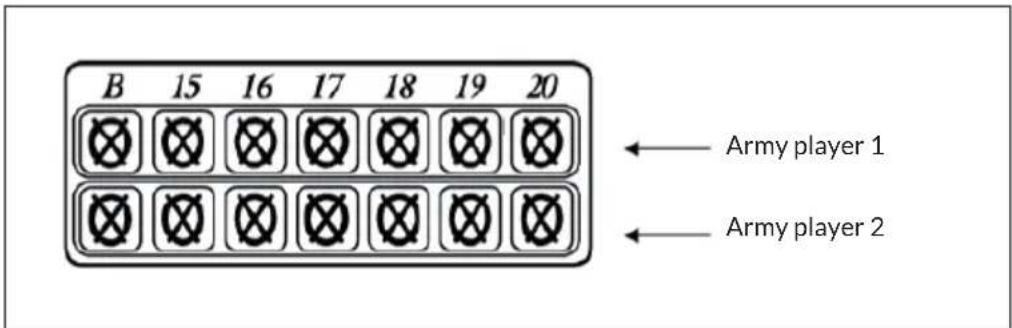
Player 1 is the "TOP" army and shoots darts at the bottom sections of the board. Player 1 needs to hit bottom segments (6, 10, 15, 2, 17, 3, 19, 7, 16, and 8)
Player 2 is the "BOTTOM" army and shoots for the top section of the dartboard Player 2 needs to hit top segments (11, 14, 9, 12, 5, 20, 1, 18, 4, and 13)
Adjustable difficulty settings are as follows:
- BATTLEGROUND DOUBLES: Players shoot for double segments only to eliminate opponent's armies
- BATTLEGROUND TRIPLES: Players shoot for triple segments only to eliminate opponent's armies
Battleground with generals:
This variation of the game includes one more obstacle to accomplish. Players must capture the "general" after all segments (armies) have been hit to win the game. One hit on the bullseye will capture the general. Hits to the bullseye will not count if all segments are not first closed.
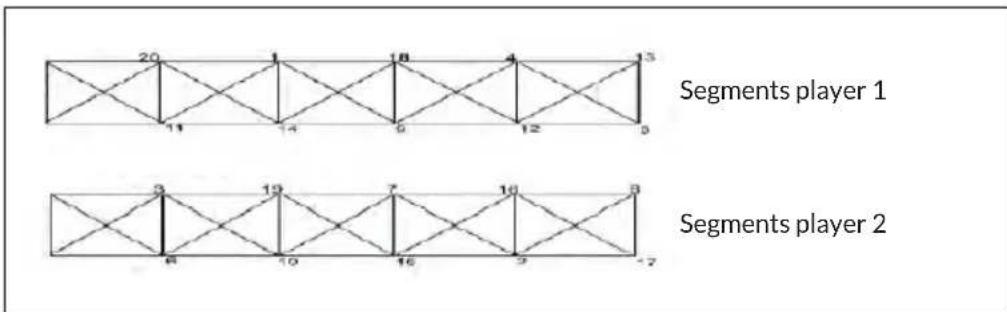
The top cricket scoring display on the dartboard shows player 1's army segments. Player 2's army segments are in the second row. Each time a segment is hit, the corresponding light will shut off. Follow the scoreboard map on the next page to keep track of which segments you need to hit to win.
Game 36: PAINTBALL
This game is similar to "Battleground" except there is an alternative way to win the battle other than just hitting the opposing teams' armies segments. As in the real game of paintball, players can also capture the opposing team's flag to win the game.
To capture the flag, the double bullseye must be hit 3 times to capture the opposing teams' flag! Single bullseye will not count towards the 3 needed to capture the flag. Double bullseyes do not have to be scored in the same round and will be tallied during the game. First player to either capture the flag or eliminate the opposing army is the winner.
Adjustable difficulty settings:
- Paintball Doubles Players must either hit 3 double bullseyes to capture the flag or hit double ringed segments to eliminate armies.
- Paintball Triples Players must either hit 3 double bullseyes to capture the flag or hit triple ringed segments to eliminate armies.
Game 37:FOX HUNT
This is a very challenging 2-player game that is best suited for players of advanced skill. One player will play the role of the cat and the other will be the mouse. The object of the game is for the mouse to get back to his hole before being caught by the cat. The mouse starts first from the "20" segment and proceeds counter-clockwise around the dartboard by hitting first the double segment and then the single of each segment.
The cat starts back at the "18" segment and proceeds counter clockwise around the dartboard to catch the mouse by hitting doubles only of each segment. If the mouse makes it all the way around the board back to the double 20, the mouse wins the game.
If the cat hits the double segment that the mouse is on, the cat has caught the mouse and has won the game.
Game 38: TIC-TACT TOE
Using the specified dartboard segments, the object of the game is to close out numbers to gain an X or an O. Traditional tic-tac-toe rules apply. Three X's or O's in a row horizontally, diag- nally, or vertically will win the game.
In order to place an X or O in one of the boxes, a player needs to score 3 times within that segment. (Double and triple rings count) (B is the Bullseye) The number of hits on each segment will be displayed on the screen.
One hit to the segment will show " \" Two hits will show "X" A closed segment will display either an " " or "O" depending on which player is scoring. Use the map below as a guide during play.
| 12 | 20 | 18 |
| 11 | B | 6 |
| 7 | 3 | 2 |
| B = Bullseye | ||
TROUBLESHOOTING
No power?
Make sure that the adaptor is plugged into an electric socket and that the adaptor is plugged into the connection socket on the dartboard.
No scores?
Check whether the game has been set to the 'Settings' mode or to the 'Pause' mode. Then check whether the sensor elements or the function keys are stuck or jammed.
Stuck sensor elements or stuck function keys?
During transportation and even during the normal operation of the dartboard it can happen that the sensor elements will occasionally get jammed and will no longer register a hit. In this case a warning signal will be heard, and an indicator will flash, indicating a stuck element. Gentle extraction of the dart from the element, or gently moving the element to and fro using light finger pressure will normally free the element quickly. The game can then be resumed and the scores will continue from exactly the point when they were interrupted.
Broken-off dart tips?
Soft tips are definitely safer to use, but they do not last forever. Should a tip break off and remain stuck in the dartboard, try to pull it out very carefully with suitable tweezers. Should a tip be broken off so short that it does not protrude beyond the surface of the dartboard, it can also be pushed into the dartboard through the hole.
HINTS ON DISPOSAL

According to the European waste regulation 2012/19/EU this symbol on the product or on its packaging indicates that this product may not be treated as household waste. Instead it should be taken to the appropriate collection point for the recycling of electrical and electronic equipment. By ensuring this product is disposed of correctly, you will help prevent potential negative consequences for the environment and human health, which could otherwise be caused by inappropriate waste handling of this product. For more detailed information about recycling of this product, please contact your local council or your household waste disposal service.
PRODUCER
Chal-Tec GmbH, Wallstraße 16, 10179 Berlin, Germany.
Chere cliente, cher client,
| Single 1 point | |
| Double 2 points | |
| Triple 3 points | |
| Single Bullseye 4 points | |
| Double Bull's Eye (Inner Bull) 4 points | |
| Single Bull (Outer-Bull) 2 points |
Jeu 22: STEEPLECHASE
| 1. Fence: Triple 13 | 3. Fence: Triple 8 | ||
| 2. Fence: Triple 17 | 4. Fence: Triple 5 |
| Segment Points | |
| Double 9 pins | |
| Outer Singe 3 pins | |
| Triple 10 pins | |
| Inner Single 7 pins |
Jeu 24: CAR RALLYING
Jeu 29: CASINO A - FLUSH
| 1. Fence: Triple 13 | 3. Fence: Triple 8 | ||
| 2. Fence: Triple 17 | 4. Fence: Triple 5 |
Gioco 15: DOUBLE DOWN
Gioco 22: STEEPLECHASE
| 1. Fence: Triple 13 | 3. Fence: Triple 8 | ||
| 2. Fence: Triple 17 | 4. Fence: Triple 5 |