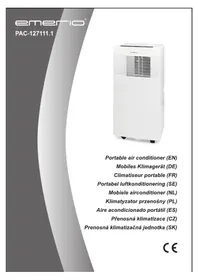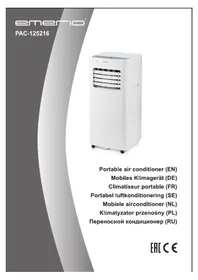
PAC125216 - Air Conditioning Emerio - Free user manual and instructions
Find the device manual for free PAC125216 Emerio in PDF.



| Product Type | Portable air conditioner (monoblock) |
| Brand | Emerio |
| Model | PAC125216 |
| Power Supply | 220-240 V ~ 50 Hz |
| Power consumption (cooling) | 750 W |
| Rated current | 3.4 A |
| Cooling capacity | 7000 BTU/h (2000 W) |
| Dehumidification | 0.8 L/h |
| Air flow rate | 250 m³/h |
| Noise level | ≤ 65 dB(A) |
| Refrigerant | R290 (135 g) |
| Energy class | A |
| Energy consumption (cooling mode) | 0.750 kWh/h |
| Standby consumption | 0.4 W |
| Minimum room area | 4 m² |
| Operating modes | Auto, Cooling, Dehumidification, Ventilation |
| Fan speed | 2 speeds (Low, High) |
| Timer | 1 to 24 hours |
| Remote control | Yes (CR2025 battery included) |
| Air filter | Washable (clean every 2 weeks) |
| Warranty | 2 years |
| Reparability | Only by an authorized technician (flammable refrigerant) |
Frequently Asked Questions - PAC125216 Emerio
User questions about PAC125216 Emerio
0 question about this device. Answer the ones you know or ask your own.
Ask a new question about this device
Download the instructions for your Air Conditioning in PDF format for free! Find your manual PAC125216 - Emerio and take your electronic device back in hand. On this page are published all the documents necessary for the use of your device. PAC125216 by Emerio.
USER MANUAL PAC125216 Emerio
Portable air conditioner (EN)
Mobiele airconditioner (NL)
Thank you very much for purchasing our products. In order to ensure correct operation, please read this manual and instruction carefully before use.
IMPORTANT INSTRUCTIONS
When using electrical appliances, basic precautions should always be followed to reduce the risk of fire, electric shock, burns and other injuries.
- Read and save these instructions. Attention: pictures in the IM are for reference only.
- This appliance can be used by children aged from 8 years and above and persons with reduced physical, sensory or mental capabilities or lack of experience and knowledge if they have been given supervision or instruction concerning use of the appliance in a safe way and understand the hazards involved.
- Children shall not play with the appliance.
- Cleaning and user maintenance shall not be made by children without supervision.
- If the supply cord is damaged, it must be replaced by the manufacturer, its service agent or similarly qualified persons in order to avoid a hazard.
- Indoor use only.
- Do not use the unit in an area: near to source of fire; where oil is likely to splash; exposed to direct sunlight; where water is likely to splash; near a bath, a laundry, a shower or a swimming pool.
- Never insert your fingers, rods into the air outlet. Take special care to warn children of these dangers.
- Keep the unit upward while transport and storage, for the compressor locates properly.
- Before cleaning or moving the appliance, always turn off and disconnect the power supply.
-
To avoid the possibility of fire disaster, the appliance shall not be covered.
-
All the air-conditioner sockets must comply with the local electric safety requirements. If necessary, please check it for the requirements.
- The appliance shall be installed in accordance with national wiring regulations.
- Details of type and rating of fuses: T, 250V AC, 3.15A.
- Contact authorized service technician for repair or maintenance of this unit.
- Do not pull, deform or modify the power supply cord, or immerse it in water. Pulling or misuse of the power supply cord can result in damage to the unit and cause electrical shock.
- Compliance with national gas regulations shall be observed.
- Servicing shall only be performed as recommended by the equipment manufacturer. Maintenance and repair requiring the assistance of other skilled personnel shall be carried out under the supervision of the person competent in the use of flammable refrigerants.
- Do not operate or stop the unit by inserting or pulling out power plug, it may cause electric shock or fire due to heat generation.
- Unplug the unit if strange sounds, smell, or smoke comes from it.
- Always plug the appliance into an earthed plug socket.
- In case of any damage, please turn off the switch, disconnect the power supply, and contact an authorized service center for repair.
- Do not use means to accelerate the defrosting process or to clean, other than those recommended by the manufacturer.
- The appliance shall be stored in a room without continuously operating ignition sources (for example: open flames, an operating gas appliance or an operating electric heater.)
-
Do not pierce or burn.
-
Be aware that refrigerants may not contain an odour.
- This appliance contains R290 refrigerant gas. R290 is a refrigerant gas that complies with the European directives on the environment. Do not puncture any part of the refrigerant circuit.
- If the appliance is installed, operated or stored in an unventilated area, the room must be designed to prevent to the accumulation of refrigerant leaks resulting in a risk of fire or explosion due to ignition of the refrigerant caused by electric heaters, stoves, or other sources of ignition.
- The appliance must be stored in such a way as to prevent mechanical failure.
- Individuals who operate or work on the refrigerant circuit must have the appropriate certification issued by an accredited organization that ensures competence in handling refrigerants according to a specific evaluation recognized by associations in the industry.
- Repairs must be performed based on the recommendation from the manufacturing company. Maintenance and repairs that require the assistance of other qualified personnel must be performed under the supervision of an individual specified in the use of flammable refrigerants.
- Regarding the instructions for repairing appliances containing R290, please kindly refer to below paragraphs.
- Always let the appliance rest for at least 2 hours after moving it from one location to another.
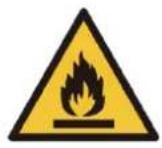
Warning: Risk of fire / Flammable materials.

Read instruction manuals.

Operator's manual; operating instructions.

Service indicator; read technical manual.
Warning: Keep ventilation openings clear of obstruction.
Warning: The appliance shall be stored in a well-ventilated area where the room size corresponds to the room area as specified for operation.
The required distance around the unit should be at least 30cm .
Appliance shall be installed, operated and stored in a room with a floor area larger than 4m^2
PARTS DESCRIPTION


- Control panel
- Air outlet
- Signal receptor
- Remote control
- Handle
- Air exhaust hose
- Air inlet
- Drain port (inserted by a stopper)
- Hose connector
- Window adaptor
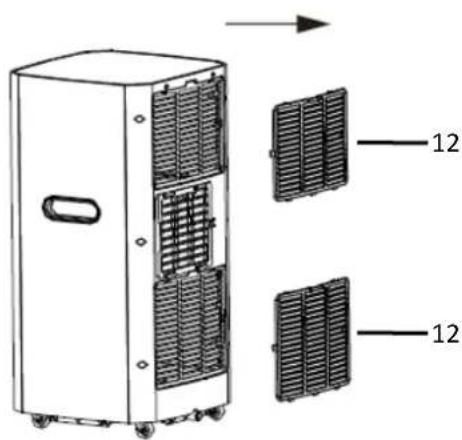
- Pull tab of the air filter
- Air filter
Remote control
This unit has a remote control. One piece of CR2025 battery will be provided with the remote control. Before starting to use the remote control, remove the plastic protection from the battery. If you want to change the battery, please refer to the instruction behind the remote control. If it is not in use for a long time, please take the battery out of the remote control. Keep button cell batteries out of reach of small children.
The functions of the remote control buttons are listed below.
- Power button
- Temperature/timer increasing button
- Temperature/timer decreasing button
- Timer on/off button
- Mode button
- Wind speed button
- Sleep button

Control panel
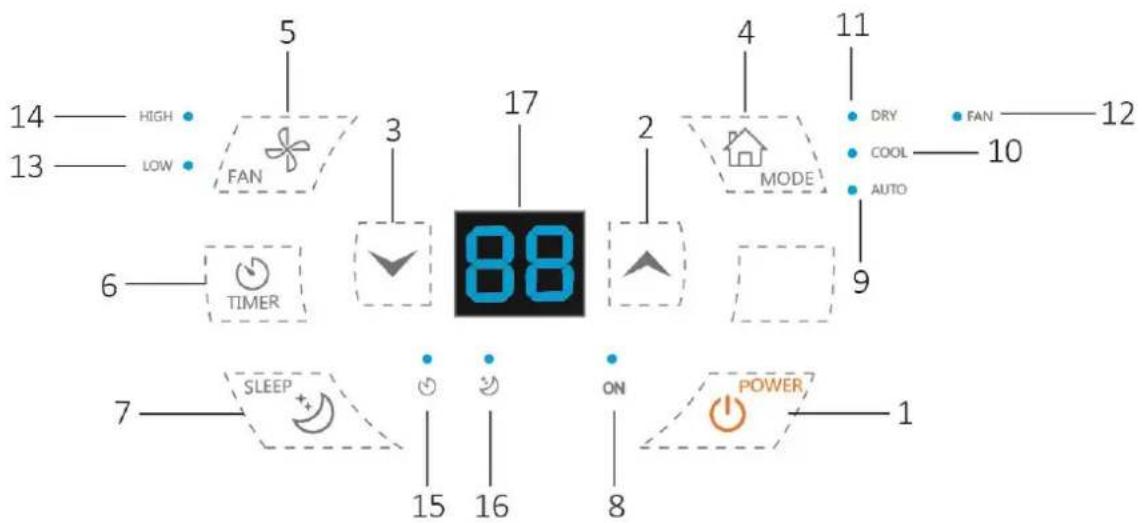
- Power button
- Temperature/timer increasing button
- Temperature/timer decreasing button
4.Mode button - Fan speed button
- Timer button
- Sleep button
- Power indicator light
-
Auto mode indicator light
-
Cooling mode indicator light
- Drying mode indicator light
- Fan mode indicator light
- Low speed indicator light
- High speed indicator light
- Timer indicator light
- Sleep indicator light
- Digital display
INSTALLATION
- The unit shall be installed on a flat surface where the air outlet would not be blocked. The required distance around the unit should be at least 30cm .
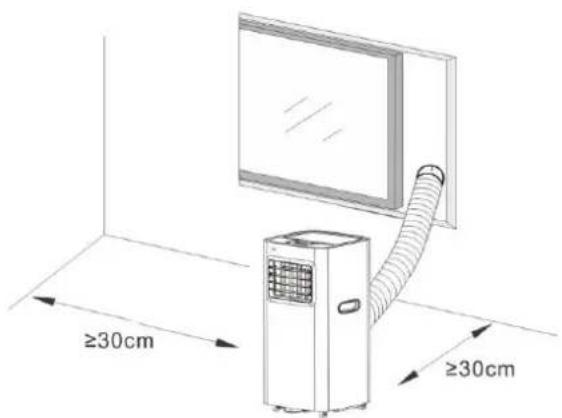
The unit shall not be installed in a laundry room.
- Extend the air exhaust hose by drawing out the two ends of the hose.
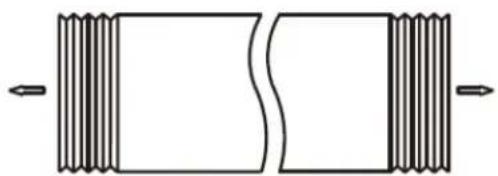
- Screw the air exhaust hose into the hose connector.
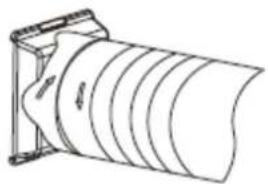
- Screw the other end of air exhaust hose into the window adaptor.

- Insert the hose connector into the bracket on the back of the unit.

OPERATION
*Always let the appliance rest for at least 2 hours after moving it from one location to another.
Before use, check up whether the exhaust hose has been mounted properly. Plug in the appliance.
1. Power button
Press the power button to turn on the appliance. Press the button again, the appliance will be turned off.
2. Temperature/timer increasing button & temperature/timer decreasing button
Press the button "▲" / "▼" to set your desired room temperature from 15^ to 31^ . The buttons can also be used for timer adjustment during timer setting. The value will be increased/decreased by 1 ( ^ / hour) for each press.
3. Fan speed button
Press the fan speed button to switch the fan speed between low and high. The corresponding indicator light "LOW"/"HIGH" will illuminate.
4. Mode button
Press the mode button to choose your desired working mode among cooling, drying and fan. The corresponding indicator light will turn on when the specific mode is selected.
- Auto mode
In AUTO mode, the indoor temperature sensor operates automatically to select the desired operation with cooling or fan: when the room temperature is no less than 24^ , the unit automatically selects cooling mode, and when the room temperature is less than 24^ , the unit automatically selects fan mode.
- Drying mode
The fan runs at a low speed. The fan speed and temperature cannot be adjusted.
The compressor will stop after 8 minutes of running and then run again after 6 minutes.
Cooling mode
When the room temperature is higher than the set temperature, the compressor starts to run.
When the room temperature is lower than the set temperature, the compressor stops and the fan operates at the original set speed.
Note: When the compressor is working, the unit will vibrate slightly. This is normal and harmless.
Fan mode
When the fan runs at the set speed, the compressor does not run.
The adjustment of temperature in Fan mode is not effective.
5. Timer button
Auto-ON setting
- When the appliance is OFF, press the timer button, the timer indicator light will flash.
- Press the timer increasing or decreasing button to select a desired auto-ON time from 1 to 24 hours. The digital display and timer indicator light will flash for several seconds, then the timer setting is confirmed and the timer indicator light will illuminate still.
- The appliance will automatically turn on once the select time passed.
Auto-OFF setting
- When the appliance is ON, press the timer button, the timer indicator light will flash.
- Press the timer increasing or decreasing button to select a desired auto-OFF time from 1 to 24 hours. The digital display and timer indicator light will flash for several seconds, then the timer setting is confirmed and the timer indicator light will illuminate still.
- The appliance will automatically turn off once the select time has passed.
To cancel the timer, set the time to 0 hour, or press into the timer setting, and when the digital display flashes, press the timer button again. The timer indicator light will then turn off.
6. Sleep button (only active in cooling mode)
Press the sleep button to activate the sleep mode. The sleep indicator light turns on.
In sleep mode, the fan turns to low speed automatically. The set temperature will increase 1 °C after one hour, and increase 2 °C after two hours. After six hours, the appliance stops running automatically.
NOTE:
The protective device may trip and stop the appliance in the conditions listed below.
| Cooling | Room temperature is over 43°C. |
| Room temperature is below 15°C. | |
| Drying | Room temperature is below 15°C. |
- If the appliance runs in cooling or drying mode with door or window opened for a long time when relative humidity is above 80% , dew may drip down from the air outlet.
Drain water
1) Special reminder: There is condensing water recycling hidden in this appliance. The condensing water is partly kept recycling between the condenser and the water tray. When the water level rises to the upper level, the water-full code "E4" will be shown on the digital display to remind of draining water.
2) Please cut off the power supply, move the appliance to a suitable place, pull out the stopper in the drain
port to drain the water completely. If conditions permitted, you can also connect the drain hose to the drain port for the water draining.
3) After the draining, insert back the stopper to the drain port, otherwise the appliance may leak and make your room wet.
CLEANING AND MAINTENANCE
Before cleaning, be sure to disconnect the appliance from any electric supply outlet.
- Do not use gasoline or other chemicals to clean the appliance.
- Do not wash the appliance directly.
If the appliance is damaged, please contact the dealer or repair shop.
Air Filter
If the air filter becomes clogged with dust/dirt, the air filter should be cleaned once every two weeks.
Pull out the air filter from the air inlet grille by the pull tab.
Clean the air filter with neutral detergent in lukewarm water (< 40^) and dry it up in the shade.
- Reinstall the air filter.
Clean the Surface
First clean the surface with a neutral detergent and wet cloth, and then wipe it with a dry cloth.
TROUBLESHOOTING
| Troubles | Possible Causes | Solutions |
| Not cool enough | The doors or windows are not closed. | Make sure all the windows and doors are closed. |
| There are heat sources inside the room. | Remove the heat sources if possible. | |
| The hot air exhaust hose is not connected or blocked. | Connect or clean the hot air exhaust hose. | |
| Temperature setting is too high. | Reset the temperature. | |
| Air inlet is blocked. | Clean the air inlet. | |
| Noisy | The ground is not level or not flat enough. | Place the appliance on a flat, level surface if possible. |
| The sound comes from the flowing of the refrigerant inside the appliance. | It is normal. | |
| Code “E2” on the digital display | Room temperature sensor failed. | Replace the room temperature sensor. Contact authorized service technician for repair. |
| Code “E3” on the digital display | Evaporator temperature sensor failed. | Replace evaporator temperature sensor. Contact authorized service technician for repair. |
| Code “E4” on the digital display | Water-full warning | Drain out the water. |
TECHNICAL DATA
Below data for your operating reference
| Model | PAC-125216 |
| Rated voltage | 220-240V |
| Rated frequency | 50Hz |
| Rated input | 750W |
| Rated current | 3.4A |
| Cooling capacity | 7000BTU / 2000W |
| Moisture removal (L/H) | 0.8 |
| Air flow | 250m³/h |
ERP INFORMATION
| Value | |
| Trademark | Emerio |
| Model identification | PAC-125216 |
| Sound power (cooling) | ≤ 65dB(A) |
| Name of refrigerant | R290 / 135g |
| Rated power input for cooling (kW) | 0.750 |
| Rated energy efficiency ratio | 2.6 |
| GWP (kgCO2eq) | 3 |
| Energy efficiency class | A |
| Energy consumption for double ducts appliances (kWh/h) | N.A |
| Energy consumption for single duct appliances (kWh/h) | 0.750 |
| Power consumption in thermostat-off mode (W) | N.A |
| Power consumption in stand-by mode (W) | 0.4W |
| Cooling capacity | 2000W |
| Refrigerant leakage contributes to climate change. Refrigerant with lower global warming potential (GWP) would contribute less to global warming than a refrigerant with higher GWP, if leaked to the atmosphere. This appliance contains a refrigerant fluid with a GWP equal to 3. This means that if 1 kg of this refrigerant fluid would be leaked to the atmosphere, the impact on global warming would be 3 times higher than 1 kg of CO2, over a period of 100 years. Never try to interfere with the refrigerant circuit yourself or disassemble the product yourself and always ask a professional. #Energy consumption 0.750 kWh for model PAC-125216 in 60 minutes of use under standard test conditions. The actual energy consumption depends on how the device is used and where it is located.For any additional information, please contact:Emerio Holland B.V.Zomervaart 1A2033 DA HaarlemThe NetherlandsCustomer service:T: +31(0)23 3034369E: info.nl@emerio.eu | |
GUARANTEE AND CUSTOMER SERVICE
Before delivery our devices are subjected to rigorous quality control. If, despite all care, damage has occurred
during production or transportation, please return the device to your dealer. In addition to statutory legal rights, the purchaser has an option to claim under the terms of the following guarantee:
For the purchased device we provide 2 years guarantee, commencing from the day of sale. If you have a defective product, you can directly go back to the point of purchase.
Defects which arise due to improper handling of the device and malfunctions due to interventions and repairs by third parties or the fitting of non-original parts are not covered by this guarantee. Always keep your receipt, without the receipt you can't claim any form of warranty. Damage caused by not following the instruction manual, will lead to a void of warranty, if this results in consequential damages then we will not be liable.
Neither can we hold responsible for material damage or personal injury caused by improper use if the instruction manual is not properly executed. Damage to accessories does not mean free replacement of the whole appliance. In such case please contact our service department. Broken glass or breakage of plastic parts is always subject to a charge. Defects to consumables or parts subjected to wearing, as well as cleaning, maintenance or the replacement of said parts are not covered by the warranty and are to be paid.
ENVIRONMENT FRIENDLY DISPOSAL
Recycling - European Directive 2012/19/EU
This marking indicates that this product should not be disposed with other household wastes. To prevent possible harm to the environment or human health from uncontrolled waste disposal, recycle it responsibly to promote the sustainable reuse of material resources. To return your used
device, please use the return and collection systems or contact the retailer where the product was purchased. They can take this product for environmental safe recycling.


BATTERY MUST BE RECYCLED OR DISPOSED OF PROPERLY. DO NOT OPEN. DO NOT
DISPOSE OR IN FIRE OR SHORT CIRCUIT.
Emerio Holland B.V.
Zomervaart 1A
2033 DA Haarlem
The Netherlands
Customer service:
T: +31(0)23 3034369
E: info.nl@emerio.eu
INSTRUCTIONS FOR REPAIRING APPLIANCES CONTAINING R290
1. Servicing
1) Checks to the area
Prior to beginning work on systems containing flammable refrigerants, safety checks are necessary to ensure that the risk of ignition is minimised. For repair to the refrigerating system, the following precautions shall be complied with prior to conducting work on the system.
2) Work procedure
Work shall be undertaken under a controlled procedure so as to minimise the risk of a flammable gas or vapour being present while the work is being performed.
3) General work area
All maintenance staff and others working in the local area shall be instructed on the nature of work being carried out. Work in confined spaces shall be avoided. The area around the workspace shall be sectioned off. Ensure that the conditions within the area have been made safe by control of flammable material.
4) Checking for presence of refrigerant
The area shall be checked with an appropriate refrigerant detector prior to and during work, to ensure the technician is aware of potentially flammable atmospheres. Ensure that the leak detection equipment being used is suitable for use with flammable refrigerants, i.e. non-sparking, adequately sealed or intrinsically safe.
5) Presence of fire extinguisher
If any hot work is to be conducted on the refrigeration equipment or any associated parts, appropriate fire extinguishing equipment shall be available to hand. Have a dry powder or CO_2 fire extinguisher adjacent to the charging area.
6) No ignition sources
No person carrying out work in relation to a refrigeration system which involves exposing any pipe work that contains or has contained flammable refrigerant shall use any sources of ignition in such a manner that it may lead to the risk of fire or explosion. All possible ignition sources, including cigarette smoking, should be kept sufficiently far away from the site of installation, repairing, removing and disposal, during which flammable refrigerant can possibly be released to the surrounding space. Prior to work taking place, the area around the equipment is to be surveyed to make sure that there are no flammable hazards or ignition risks. "No Smoking" signs shall be displayed.
7) Ventilated area
Ensure that the area is in the open or that it is adequately ventilated before breaking into the system or conducting any hot work. A degree of ventilation shall continue during the period that the work is carried out. The ventilation should safely disperse any released refrigerant and preferably expel it externally into the atmosphere.
8) Checks to the refrigeration equipment
Where electrical components are being changed, they shall be fit for the purpose and to the correct specification. At all times the manufacturer's maintenance and service guidelines shall be followed. If in doubt consult the manufacturer's technical department for assistance.
The following checks shall be applied to installations using flammable refrigerants:
- The charge size is in accordance with the room size within which the refrigerant containing parts are installed;
- The ventilation machinery and outlets are operating adequately and are not obstructed;
- If an indirect refrigerating circuit is being used, the secondary circuit shall be checked for the presence of refrigerant;
- Marking to the equipment continues to be visible and legible. Markings and signs that are illegible shall be corrected;
- Refrigeration pipe or components are installed in a position where they are unlikely to be exposed to any
substance which may corrode refrigerant containing components, unless the components are constructed of materials which are inherently resistant to being corroded or are suitably protected against being so corroded.
9) Checks to electrical devices
Repair and maintenance to electrical components shall include initial safety checks and component inspection procedures. If a fault exists that could compromise safety, then no electrical supply shall be connected to the circuit until it is satisfactorily dealt with. If the fault cannot be corrected immediately but it is necessary to continue operation, an adequate temporary solution shall be used. This shall be reported to the owner of the equipment so all parties are advised. Initial safety checks shall include:
- That capacitors are discharged: this shall be done in a safe manner to avoid possibility of sparking;
- That there no live electrical components and wiring are exposed while charging, recovering or purging the system;
- That there is continuity of earth bonding.
2. Repairs to sealed components
1) During repairs to sealed components, all electrical supplies shall be disconnected from the equipment being worked upon prior to any removal of sealed covers, etc. If it is absolutely necessary to have an electrical supply to equipment during servicing, then a permanently operating form of leak detection shall be located at the most critical point to warn of a potentially hazardous situation.
2) Particular attention shall be paid to the following to ensure that by working on electrical components, the casing is not altered in such a way that the level of protection is affected. This shall include damage to cables, excessive number of connections, terminals not made to original specification, damage to seals, incorrect fitting of glands, etc.
Ensure that apparatus is mounted securely. Ensure that seals or sealing materials have not degraded such that they no longer serve the purpose of preventing the ingress of flammable atmospheres. Replacement parts shall be in accordance with the manufacturer's specifications.
NOTE: The use of silicon sealant may inhibit the effectiveness of some types of leak detection equipment. Intrinsically safe components do not have to be isolated prior to working on them.
3. Repair to intrinsically safe components
Do not apply any permanent inductive or capacitance loads to the circuit without ensuring that this will not exceed the permissible voltage and current permitted for the equipment in use. Intrinsically safe components are the only types that can be worked on while live in the presence of a flammable atmosphere. The test apparatus shall be at the correct rating. Replace components only with parts specified by the manufacturer. Other parts may result in the ignition of refrigerant in the atmosphere from a leak.
4. Cabling
Check that cabling will not be subject to wear, corrosion, excessive pressure, vibration, sharp edges or any other adverse environmental effects. The check shall also take into account the effects of aging or continual vibration from sources such as compressors or fans.
5. Detection of flammable refrigerants
Under no circumstances shall potential sources of ignition be used in the searching for or detection of refrigerant leaks. A halide torch (or any other detector using a naked flame) shall not be used.
6. Leak detection methods
The following leak detection methods are deemed acceptable for systems containing flammable refrigerants. Electronic leak detectors shall be used to detect flammable refrigerants, but the sensitivity may not be
adequate, or may need re-calibration. (Detection equipment shall be calibrated in a refrigerant-free area.) Ensure that the detector is not a potential source of ignition and is suitable for the refrigerant used. Leak detection equipment shall be set at a percentage of the LFL of the refrigerant and shall be calibrated to the refrigerant employed and the appropriate percentage of gas (25% maximum) is confirmed. Leak detection fluids are suitable for use with most refrigerants but the use of detergents containing chlorine shall be avoided as the chlorine may react with the refrigerant and corrode the copper pipe-work. If a leak is suspected, all naked flames shall be removed/ extinguished. If a leakage of refrigerant is found which requires brazing, all of the refrigerant shall be recovered from the system, or isolated (by means of shut off valves) in a part of the system remote from the leak. Oxygen free nitrogen (OFN) shall then be purged through the system both before and during the brazing process.
7. Removal and evacuation
When breaking into the refrigerant circuit to make repairs - or for any other purpose - conventional procedures shall be used. However, it is important that best practice is followed since flammability is a consideration. The following procedure shall be adhered to:
- Remove refrigerant;
- Purge the circuit with inert gas;
Evacuate; - Purge again with inert gas;
- Open the circuit by cutting or brazing.
The refrigerant charge shall be recovered into the correct recovery cylinders. The system shall be "flushed" with OFN to render the unit safe. This process may need to be repeated several times. Compressed air or oxygen shall not be used for this task. Flushing shall be achieved by breaking the vacuum in the system with OFN and continuing to fill until the working pressure is achieved, then venting to atmosphere, and finally pulling down to a vacuum. This process shall be repeated until no refrigerant is within the system. When the final OFN charge is used, the system shall be vented down to atmospheric pressure to enable work to take place. This operation is absolutely vital if brazing operations on the pipe-work are to take place. Ensure that the outlet for the vacuum pump is not close to any ignition sources and there is ventilation available.
8. Charging procedures
In addition to conventional charging procedures, the following requirements shall be followed.
- Ensure that contamination of different refrigerants does not occur when using charging equipment. Hoses or lines shall be as short as possible to minimise the amount of refrigerant contained in them.
Cylinders shall be kept upright. - Ensure that the refrigeration system is earthed prior to charging the system with refrigerant.
- Label the system when charging is complete (if not already).
- Extreme care shall be taken not to overfill the refrigeration system.
Prior to recharging the system it shall be pressure tested with OFN. The system shall be leak tested on completion of charging but prior to commissioning. A follow up leak test shall be carried out prior to leaving the site.
9. Decommissioning
Before carrying out this procedure, it is essential that the technician is completely familiar with the equipment and all its detail. It is recommended good practice that all refrigerants are recovered safely. Prior to the task being carried out, an oil and refrigerant sample shall be taken in case analysis is required prior to re-use of reclaimed refrigerant. It is essential that electrical power is available before the task is commenced.
a) Become familiar with the equipment and its operation.
b) Isolate system electrically.
c) Before attempting the procedure ensure that:
- Mechanical handling equipment is available, if required for handling refrigerant cylinders;
- All personal protective equipment is available and being used correctly;
The recovery process is supervised at all times by a competent person;
- Recovery equipment and cylinders conform to the appropriate standards.
d) Pump down refrigerant system, if possible.
e) If a vacuum is not possible, make a manifold so that refrigerant can be removed from various parts of the system.
f) Make sure that cylinder is situated on the scales before recovery takes place.
g) Start the recovery machine and operate in accordance with manufacturer's instructions.
h) Do not overfill cylinders. (No more than 80% volume liquid charge).
i) Do not exceed the maximum working pressure of the cylinder, even temporarily.
j) When the cylinders have been filled correctly and the process completed, make sure that the cylinders and the equipment are removed from site promptly and all isolation valves on the equipment are closed off.
k) Recovered refrigerant shall not be charged into another refrigeration system unless it has been cleaned and checked.
10. Labelling
Equipment shall be labelled stating that it has been de-commissioned and emptied of refrigerant. The label shall be dated and signed. Ensure that there are labels on the equipment stating the equipment contains flammable refrigerant.
11. Recovery
When removing refrigerant from a system, either for servicing or decommissioning, it is recommended good practice that all refrigerants are removed safely. When transferring refrigerant into cylinders, ensure that only appropriate refrigerant recovery cylinders are employed. Ensure that the correct number of cylinders for holding the total system charge is available. All cylinders to be used are designated for the recovered refrigerant and labelled for that refrigerant (i.e. special cylinders for the recovery of refrigerant). Cylinders shall be complete with pressure relief valve and associated shut-off valves in good working order. Empty recovery cylinders are evacuated and, if possible, cooled before recovery occurs. The recovery equipment shall be in good working order with a set of instructions concerning the equipment that is at hand and shall be suitable for the recovery of flammable refrigerants. In addition, a set of calibrated weighing scales shall be available and in good working order. Hoses shall be complete with leak-free disconnect couplings and in good condition. Before using the recovery machine, check that it is in satisfactory working order, has been properly maintained and that any associated electrical components are sealed to prevent ignition in the event of a refrigerant release. Consult manufacturer if in doubt. The recovered refrigerant shall be returned to the refrigerant supplier in the correct recovery cylinder, and the relevant Waste Transfer Note arranged. Do not mix refrigerants in recovery units and especially not in cylinders. If compressors or compressor oils are to be removed, ensure that they have been evacuated to an acceptable level to make certain that flammable refrigerant does not remain within the lubricant. The evacuation process shall be carried out prior to returning the compressor to the suppliers. Only electric heating to the compressor body shall be employed to accelerate this process. When oil is drained from a system, it shall be carried out safely.
Competence of service personnel
General
Special training additional to usual refrigerating equipment repair procedures is required when equipment with flammable refrigerants is affected.
In many countries, this training is carried out by national training organisations that are accredited to teach the
relevant national competency standards that may be set in legislation.
The achieved competence should be documented by a certificate.
Training
The training should include the substance of the following:
Information about the explosion potential of flammable refrigerants to show that flammables may be dangerous when handled without care.
Information about potential ignition sources, especially those that are not obvious, such as lighters, light switches, vacuum cleaners, electric heaters.
Information about the different safety concepts:
Unventilated - Safety of the appliance does not depend on ventilation of the housing. Switching off the appliance or opening of the housing has no significant effect on the safety. Nevertheless, it is possible that leaking refrigerant may accumulate inside the enclosure and flammable atmosphere will be released when the enclosure is opened.
Ventilated enclosure - Safety of the appliance depends on ventilation of the housing. Switching off the appliance or opening of the enclosure has a significant effect on the safety. Care should be taken to ensure a sufficient ventilation before.
Ventilated room - Safety of the appliance depends on the ventilation of the room. Switching off the appliance or opening of the housing has no significant effect on the safety. The ventilation of the room shall not be switched off during repair procedures.
Information about the concept of sealed components and sealed enclosures according to IEC 60079-15:2010.
Information about the correct working procedures:
a) Commissioning
- Ensure that the floor area is sufficient for the refrigerant charge or that the ventilation hose is assembled in a correct manner.
- Connect the pipes and carry out a leak test before charging with refrigerant.
- Check safety equipment before putting into service.
b) Maintenance
- Portable equipment shall be repaired outside or in a workshop specially equipped for servicing units with flammable refrigerants.
- Ensure sufficient ventilation at the repair place.
- Be aware that malfunction of the equipment may be caused by refrigerant loss and a refrigerant leak is possible.
- Discharge capacitors in a way that won't cause any spark. The standard procedure to short circuit the capacitor terminals usually creates sparks.
- Reassemble sealed enclosures accurately. If seals are worn, replace them.
- Check safety equipment before putting into service.
c) Repair
- Portable equipment shall be repaired outside or in a workshop specially equipped for servicing units with flammable refrigerants.
- Ensure sufficient ventilation at the repair place.
- Be aware that malfunction of the equipment may be caused by refrigerant loss and a refrigerant leak is possible.
- Discharge capacitors in a way that won't cause any spark.
-
When brazing is required, the following procedures shall be carried out in the right order:
-
Remove the refrigerant. If the recovery is not required by national regulations, drain the refrigerant to the outside. Take care that the drained refrigerant will not cause any danger. In doubt, one person should guard the outlet. Take special care that drained refrigerant will not float back into the building.
Evacuate the refrigerant circuit.
- Purge the refrigerant circuit with nitrogen for 5 min.
Evacuate again. - Remove parts to be replaced by cutting, not by flame.
- Purge the braze point with nitrogen during the brazing procedure.
- Carry out a leak test before charging with refrigerant.
- Reassemble sealed enclosures accurately. If seals are worn, replace them.
- Check safety equipment before putting into service.
d) Decommissioning
- If the safety is affected when the equipment is putted out of service, the refrigerant charge shall be removed before decommissioning.
- Ensure sufficient ventilation at the equipment location.
- Be aware that malfunction of the equipment may be caused by refrigerant loss and a refrigerant leak is possible.
- Discharge capacitors in a way that won't cause any spark.
- Remove the refrigerant. If the recovery is not required by national regulations, drain the refrigerant to the outside. Take care that the drained refrigerant will not cause any danger. In doubt, one person should guard the outlet. Take special care that drained refrigerant will not float back into the building.
Evacuate the refrigerant circuit. - Purge the refrigerant circuit with nitrogen for 5 min.
Evacuate again. - Fill with nitrogen up to atmospheric pressure.
- Put a label on the equipment that the refrigerant is removed.
e) Disposal
- Ensure sufficient ventilation at the working place.
- Remove the refrigerant. If the recovery is not required by national regulations, drain the refrigerant to the outside. Take care that the drained refrigerant will not cause any danger. In doubt, one person should guard the outlet. Take special care that drained refrigerant will not float back into the building.
Evacuate the refrigerant circuit. - Purge the refrigerant circuit with nitrogen for 5 min.
Evacuate again. - Cut out the compressor and drain the oil.
Transportation, marking and storage for units that employ flammable refrigerants
Transport of equipment containing flammable refrigerants
Attention is drawn to the fact that additional transportation regulations may exist with respect to equipment containing flammable gas. The maximum number of pieces of equipment or the configuration of the equipment, permitted to be transported together will be determined by the applicable transport regulations.
Marking of equipment using signs
Signs for similar appliances used in a work area generally are addressed by local regulations and give the minimum requirements for the provision of safety and/or health signs for a work location.
All required signs are to be maintained and employers should ensure that employees receive suitable and sufficient instruction and training on the meaning of appropriate safety signs and the actions that need to be taken in connection with these signs.
The effectiveness of signs should not be diminished by too many signs being placed together.
Any pictograms used should be as simple as possible and contain only essential details.
Disposal of equipment using flammable refrigerants
See national regulations.
Storage of equipment/appliances
The storage of equipment should be in accordance with the manufacturer's instructions.
Storage of packed (unsold) equipment
Storage package protection should be constructed such that mechanical damage to the equipment inside the package will not cause a leak of the refrigerant charge.
The maximum number of pieces of equipment permitted to be stored together will be determined by local regulations.
PykoBoDCTBO NOIb3OBaTeJI; INHcTpYKcNJa PO
экплuyaрази.

CleyuT co6IouaTb paCCToHnE co Bcex cTOpOH npi6opa He MeHee 30 cm.
Pn6op cIeMyet yCTaHaBnBaTb, 3KcIIyaTnpoBaTb I xpaHnTb B nOMEseHnn PlouaDbIO 6OJIe 4 M2.
ONICAHNE PNPBOPA


- NaHeJIb ynpaBneHnIa
- BbIXoHHe OTBepCTne Ia BO3dyxa
- CnHaJIbHbI peuTeNTop
- NylbT dNCTaHcNOHHOro ynpabHeHn
- Puyka
- ⅢlaHr DnBbInycka Bo3dyxa.
- BxOdHoe OTBepCTne Ia BO3dyxa
- CInBHOI npT (co BCTaJIeHHoN npo6ko).
- CoeHHTeB WHaHra
- OkonHbI nepexOdHnK
11.Язвок BOЗдушно Фньтра
12.Bo3dyhblnIbTp

DuctanHnHOe npaBneHne
- Khonkn ybeHueHn n yMeHbSeHn TempeaTypbl/TaMepa (Temperature/timer increasing/ decreasing)
HaKMMTe KHONK "A" /"√" dIy UcTaHOBKn HUxHOn Bam TemnepaTypb I Dnana3oHe ot 15°C do 31°C. DaHHbIe KHNKn TaKKe MOxHNo IcNIOB3OBAbT dJIy UcTaHOBKn BpeMeHn TaMepa. 3HaueHne 6ydt YBeINuHBaTcR NII yMeHbWATbcra Ha 1 (°C/yac) dIy KaXdOro HxKaTna.
3. Khonka ckopocTN BeHTnIaTopa (Speed)
HaKImaTe Ha daHHyIO KhoNky dIra TORO, yTO6bl nepeKJIouHTb ckOpocTb MeJdy 2MЯ 3HaueHnAmi -MeDJIeHHaI n 6bICTpaar ckOpocTb. 3aRopNTcra COOTBeTCTByUoIu nCBetOBoI nHdInKaTOp "LOW" (MeDJIeHHA)/"HIGH"(6bICTPA).
4. Pekim (Mode)
Haxmataa Hnky TOro, To6bBb6paTb XeIaembI peKIM pa60tI: OxJaKeHne, OcyuHHe Bo3dyxa n BeHTnlaTOp. IocIe Bb6opa peKIMa 3arOpITcra COOTBeTCTByIOUcN CBeTOBOHnDnKaTOp.
- ABTomatnueckn pekM (Auto)
B aBTOMaTnueckom peKIMe daTtIK TeMnepaTypbI pa6OtaET B aBTOMaTnueckom peKIMe n cAmocToTseHbHO bblbupaet nporpammy oxlaXdeHn nn BeHTnlaTopa: eCIn Tempeatypa B nomeueHHn Bblwe 24^, np6op aBTOMaTnueckn Bblbupaet peKIM oxlaXdeHn, a eCIn Tempeatypa B nomeueHHn MeHee 24^, np6op aBTOMaTnueckn Bblbupaet peKIM BeHTnlaTopa.
- Peşkm OcyueneHry Bo3dyxa (Drying)
BeHTnIaTOp pa6oTaET Ha Hn3KoN CKOpocTu. CkOpocTb BeHTnIaTopa N TempepaTypa He MoryTp eryInpOBAtbcra. KomnPecccop ocTaHOBITcyepe3 8 MNHyT, a 3aTeM yepe3 6 MNHyT 3aNyCTiTcra ChOba. - PekimoxlaKdHnna (Cooling)
Ecn TEmnepaTpa B nomeeHn BBiue yCTaHOBJIeHHo TEMpePaTypbI, To KOMnpecccop np6opa HauHepa pa60TaTb. Ecn TempePaTpa B nomeeHn HHXe yCTaHOBJIeHHo TEMpePaTypbI, KOMnpecccop np6opa OCTaHOBNTcN BeHTNIJTop HaCHET pa60TaTb Ha NCxoJHO CKOpocTn.
IpnmeaHne: Ecnn Komppeccop np6opa pa6oTaet, np6op 6ydeT cIeRka Bn6pnpObaTb. 3To HopMaJIbHo n 6e30napHo.
- PechKM BeHTnlaTopa (Fan)
Ecn np6op pa6oTaet Ha yctaHOBLeHHoN CKOpocTn, KOMnpecccop np6opa He BKIOuAeTc. PerynpoBka TeMpepaTypb IB peKIMe BeHTINJTop ABJIeTc H3ΦΦeKTNBHOI.
5. Khonka TaMep (Timer)
YctaHOBKn ABOTMaTHueCKOrO BKIOUeHnA (Auto-ON)
- Ecnn npnbop BbIKnuehen, HaxMMte Ha KhoNky TaMepa, nocne yero 3amHraet coOTBeTCTByuon CBeTOBOn INDnKATOp.
HaXMMTe Ha KONky yBENueHn IIN yMeHbSeHn 3NaueHn IIN ToT, UTO6bl BbIbpaTb HUxHoe BpeM aBTOMaTHueCKoro BKIOueHn B dNAna3OHe ot 1 do 24 cAcob. LcΦpOBo DNcNlne N CBeTOBOI INDkATOp TaIMepa 3AMrAet Ha HeCKoJIbKO cekyHd, 3aTeM 6yDet nOdTBepKJeHO 3NaueHne TaIMepa N CBETOBO INDkATOp TaIMepa 6yDet rOpetb. - Pnp6op aBtOMaTnueckn 6ydt BkIoueH, KaK ToIbKO HaCTynr YcTaHOBLeHHoe Bpem.
YcTaHOBKn ABToMaTHueCKOrO OTKIOHeHnA (Auto-OFF)
- Ecnn npnbop BbIKNoyeH, HaxMMte Ha KHOpky TaMepa, nocne yero 3aMnraet COOTBeTCTBHyOuN CBeTOBOHINDKKaTOP.
- Haxmnte Ha KhoNkU yBeliueHn nn UMeNbEHHaHaeHHaJI ToI, YTObbl BbIbpaTb HyKHOe BpeMa ABToMaTHueCKOro BKIOueHHaBnAa3OHe ot 1 do 24 cAcOB. LiofoBoi DncPleN n CBeTOBOu INDikatop TaMepa 3amiraet Ha HeckOJIbKO cekyHd, 3aTeM 6yDet IOdTBeRjKeHo 3HaueHne TaIMepa N CBETOBO INDikatop TaMepa 6yDet rOpetb.
- Ipn6op aBTOMaTnueckn 6ytdet BbIKHoueH, KaK ToIbko HAcTyNt YcTaHOBJIeHNoe BpeMa.
ДлгTOrO,чTo6bl OTMeHnTb yCTaHOBKn TaIMepa,yCTaHOBnTe BpeMHa 3HaueHne O JIn6o HaxMnTe Ha KhoNkY NaCTpoKn TaIMepa B TOmMoment, Korda ZnΦpOBo DncPJIe 6yDet MngaTb, HaxMnTe Ha KhoNkY TaIMepa eue pa3.CBeTOBOHnDnKaTOp TaIMepa OTKnIOuHTc.
6. Khonka CoH (Sleep) (aKTnBHa TOnbKO B peKmE OxJaXDeHHA)
HaKMnTe Ha daHHyIO KhoNky IJIa TORO, YTO6bl aKTbBpuOBaTb peKIM cHa. 3arOpNTcra CBeTOBOI INHdNKaTOP CoH.
Bpekme cHa BeHTnJIaTOp aBTOMaTIueckn nepexoNT Ha pa6Ory Ha MaJIeHbKOI ckopocTN. YcTaHOBLeHHa TeMnepaTypa chep3 oDN Hac nobbcITcH a 1^ n Ha 2^ -chepe3 dBa yaca. Chepe3 6 cacOB np6Op aBTOMaTIueckn ppeKpaTNT pa6Ory.
ПОНМЕЧАНЕ:
3aunTHbI npedoxpAHntb MoKeT cpa6oTaB n octahOBnTB np6op npn co6HoeHN cnedyuOxN yCIOBn:
| Охлajдени | Temперараза в помацени в�ие 43°C. |
| Temперараза в помацени наже 15°C. | |
| ОсUALене ВОЗдуна | Temперараза в помацени наже 15°C. |
- EcIn npin6op pa6oTaET B pexKIMe oxlanJeHnI nn OcyuHnB03dyXa C OTkpblToI DBepbIO nn OKHom B TeueHne IInTeJbHorO BpeMeHn PnP OTHocHTelbHO BlaxHoCTn Bblwe 80%, n3 BBInyckHOrO OTBepctna MoKeT Haatb KaNaTb KOHeHcAT.
CnB BOaB1
1) Oco6oe HAnOMHaHHe: HactoI np6op ochaueh cnCTeMoR peuRPkyIaIIN KOHdeHcata. KoHdEHCAT YactnUHO peuPKyIpyeT MeJdy KOHDeHcaTOPOM IPOdoHOM dJIa BObl. KOrda yPoBeHb BObl IODHMaeTcI Do BepxHero UpoBna, Ha zIΦpOBom DInCJIee OTo6paXaETcKoD 3aONHeHra BOOJ «E4», HAnOMHaUoI M O CInBE BObl.
2) OTKIIOHTe 3JIeKTPoNITaHHe, nepemecTe npnbop B noDxOJaUee MecTo N BbITaUITE 3aRnyuKy B cINBHom OTBepCTnI DnToro, YTO6bl NOHocTbHO CnITb BOy. EcII No3BOJIoT ycNoBnA, Bbl TaKke MoKeTe IODKIIIOHTb CInBHO JnAHr K OTBepCTnIO DnI CInBa BOdbl.
3) После сива вды Вставп лрбку образно в сивhoe отberгп, в пotиьном слуае пибор может рpoTeч иnomeшени может прмokHyт.
CHCTKAI YXOJ
- Ipeed ouinckoi np6opa y6eintecb, YTO OH OTKJIIOHcHOT cTeu nHTaHn.
He nCnoB3yIte 6eH3nH nn npyrne XmMueckne BeueCTBa IJy NcTKn np6opa.
He MoITe npn6op Hnnpmyu. - Ecn np6op nobpeKdeH, o6paTntecb K npOaBcy IIN B aBTOp3OBaHHbI cepBnchbI ceHTp.
Bo3dyuHbI ΦnIbTp
EcnB03dyuHbI ΦnIbTp 3a6nbAetcNbIbIO /rpr3bIO,ero cneJeT OUnuTaB OOnH pa3 B DBe HeJeIN.
- BbITaHHTe BO3dyuHbI ΦnIbTp n3 peWetKn BO3dyXo3a6OpHnKa 3a Ra3bIyOK.
OuHCTnTe BO3dyhBi HneIbTp HeHtpaJIbHbIM MOIOUIM CpeCDTBOM B TeNIOB Boe (< 40 ^ C ) n npocyuHTe B TEHN. - YctaHOBnTe ΦnIbTp Ha MeCTo.
OuHCTka NOBepxHOctn
CnepBa ouHCTnTe NOBepxHOCTb HeITpaJIbHbIM MOIOUcIM CpeIcTBOM IN BlaJXHOI TKaHbIO, a 3aTeM npoTpnte ee cyXoT KHaHbIO.
PNOBJIEMblI CNOCObI INX PELEHHA
6) OTCyTCTBNE nCTOuHHKOB Bo3ropaHn
Hn Ondno IInuo, BbIIOJNHaIOoee pa60tb c XOJODINbHOcNCTeMOi, KOToPbIE C8a3aHbI c OTKpbITHeM IIO6bIX Tpy6OpOBoOB, CoedeJxuXr rOpUCh XlaJaAreHT, He DOLXHo NcNoJb3OBaTb KaKne-Im6o HcTOUHNBOcPnAmHeHn TaKIM o6pa3OM, YTO6bl 3TO MOrIto pnpBeCTn K pncKy Bo3RopAHn nn B3pBa. BCE BO3MOxHbIe NcTOUHNBOcPnAmHeHn, BKIOUChy KypEnHe CnIapeT, CLeDyET dpeKaTb Ha pacCTOHNOT MeCTa UcTaHOBKn, peMOHTa n yTuINzauN, BO BpeM KOTOPoBOcPnAmHeHouuNcXlaJaAreHT MoKet Nonactb B OkpykaIOoee npocTpAnCTBO. Peped NaHApom pa60tb cLeyeT obCleJeBOaTb TeppNTOpHIO BOKpyr np6bopa Ira ToR, YTO6bl y6eINTbcR B OTCyTCTBn BOcPnAmHeHouuXcB WeueCTB nn OnaCHOCTn BO3RopAHn. DOnkHbIb pa3MeSeHbI 3NaKn «He Kypntb>.
7) BeHTnIpyEmoe nomeueHne
Ipeed Bckpbitiem Cnctembl nll npoBeHnem IIObix pa6ot, CBraHHbx C Harpebom nll npimHeHnem nlaMeHN, y6eHTecb, yTO pa6Obl 6ydyT npoBOuNTbcra Ha OTKpbITOM Bo3dYxe nll YTO NOMEUHNE, BV KOTOPOM 6ydyT npoBOuNTbcra pa6Obl, xopoIo BeHTnLIpyeTc. NOMEUHNE doJXHO xopoIo npoBeTpNBaTBcRa Ha npotJxHn BCero BpemeHn npoBeHnpa6ot. BeHTnJIaundoJXHa 6eONacHo paccenBaT bIO6oBbByNUeHHbI XlaDareHTN, JKeNaTeNbHO, BBIOuNTb erO B aTMocΦepy.
6. CnocobI 6nbapyKeHHy yTeHek
Yka3aHbIe HnKe cNooc6bl ObnapyHexn yTeueK cHTaOTc npneMmEBIMn IJra CNTEm, copeXaunX JERKOBCnIaMeHryIOuNecx XlaJaTeHTbl.
3JIeKToHbIe DTeKTopbI yTeKn IOnJHbI IcNoJIb3OBAbCЯ JIyOBaHApUKeHn BocJIaMeHIOxxCy XlaJaAReHToB, HO INx CByCTBnTEbHOCTb MoKeT 6bITb HeIOCTaTOOH JIbO MoKeT NOTpe6oBaTcNobTOPHa KAIINbPoBka (ObopuDobAHne IJyOBAPUKeHn DOJXHO 6bITb OTKaJIb6pOBAHO B 30He, CBO6OHOJOT XlaJaAReHtA).YBeIITcB, YTO DaTnK He ABLaETcR NaTeHuaJIbHbIM NcTOUHKOM BOCJIaMeHHeHn I NOxOHT IJyNCIoB3yEmo R XlaJaAReHtA. ObOpuDobAHne IJyOBAPUKeHn YTeek DOJXHO 6bITb HAcTPOEHO Ha npoEcHT OT LFL XlaJaAReHtA n DoJXHO 6bITb OTKaJIb6pOBAHO IJyNCIoB3yEmo XlaJaAReHtA, a COOTBETCTBHyOUsI npoEcHT rAz (MaKcImyM 25%) DoJXeH 6bITb NODTBePjDeH. JNDKOCTN dJIyOBAPUKeHn YTeek NODXoAD TdN IcNoJIb3OBAHn C BoJIbWHCTBOM XlaJaDAreHToB, HO CJeDyET N36eRaTb IcNoJIb3OBAHn MOIOUHX CpeDCTB, CoDEpKaUx XLoP, NoCKoJIbKy XLoP MoKeT BCtUInTb B peAkUHO C XlaJaDAreHToM N Bbl3BaTb KoppOzHI MEdhIX Tpy6oPBODoB. EcNI PONBIAETcR NDOZPeHne Ha YTeKY, BCE NcTOUHKN OTKpbITOrO OrHr DOJXHbI 6bITb YdaJIeHb/IIoraWeHbI. EcNI OShapUKeHa YTeKA XLaJaDAreHtA, Tpe6yUOaI naIKN, BeCb XlaJaDAreH TdoJXHbI N3BLeueH n3 CnCTeMbI IJIY I3OJInpOBaH (C NOMOsbIO 3AnOpHBIX KlaNaHOB) B cactN CnCTeMbI, YdaJIeHHo OT yTeKN. 3aTeM CnCTeMy Heo6xoDIMO npoDyTB 6eCKncLOpoIDhbIM a3OTom (OFN) KaK Do, TaK IN BO BPEM npocecca naIKN.
7.ydaJIeHHe n 3BaKayaIaIa
PnB BCKpbTtn KOnTpy XlaDareHt dIpeMOHTa IIN dIJIIO6O dyroI cIeJyET co6IIOdaTb CTaHdapTHbIe npoceIpybl. Tem He MeHee, BaXHO cIeIOBaTb HauLyUwe MeToIke, NocKobky cIeJyET yuHTbIBaTB BOCIIaMeHReMoCTb. Heo6xoIMo co6IIODaTb cIeIyUoi nopraOK deIcTBn:
- ydaIte xlaIaIareHt;
-ПодунTe KOHTyp ИнртХьIM Ra30M;
-ПюиЗБeДиТеэВаКуацию; - NOBTOPO npOdyTe KOHTyp INHePTHbIM ra3OM;
- Pa3OMKHnTe ζeNb nyTem pe3Kn nIi naKn.
3anpaBky xnaadareHTa cneIyET c6bnpaB B COOTBeTcByIOUe 6aIIHObl IJRA c6opa XnaadareHTa. CnCTema DOJIkHa 6bITb «IpomIta» OFN (6eCKNCLOPOIDHbIM a3OTOM) IJRA oBeCNEueHHa 6e3ONaCHOCTH yCTAHOBKn. DAHHbI npoucc MoKet nOTpe6oBaTbcra NobTOpHT HeCKOJIbKO pa3. IJRA BBINOJIHeHHa 3TOJ 3aJaHn HeJIb3A INcNoJIb3OBaTB cKaTbI B03dYx IIN KICLOPOd. IpomBIBKa pON3BOIDTCra NytEm CHrTnB BaKyyMa B CnCTeme C nOMoCbIO OFN I npOdoJIkeHHa 3aONlHeHHa Do DCtNKeHHa pa6Oeero DaBJIeHHa, 3aTeM c6poca B aTMocΦepy
H, HakoHeu, c6pOa Do BakuYMa. 3TOT npoecc CneIyET NOBTOPraTb Do Tex nop, noka B cnCTeMe He octaHetcXlaJaAreHT. Pn nocJeDHe 3anpaBKe OFN Heo6xOJMo C6pOcntb DaBLeHne B cnCTeMe Do aTMocΦepHoro dIaTORo, yTo6bl MoKHO 6blIO npOBeCTn pa60Ty. DaHHa Onerpaunr Heo6xOJMa dIra naIKu Tpy6. Y6eINTecb, yTO BblNyCKHoe OTBepCTne BaKyyMHorO Haocca He HaxoNTc8 6IIN3KO K NCTOCHKAM BO3rOpAHnA, a TaKke IMeEtcAoCTaTOUHaB BeHTnlaZn.
8. Праздура задкн
BdoonHeHnK cTaHapThbIM npoueDypam 3apAkn DOnkHb co6nOaTbcra CneNyUoue Tpe6oBaHn.
- Y6eIHTecb, yTo npn nCnoB3OBAHnn 3apJdHoro 06OpyDObAHn He npOnCxOJIT 3aqr3HeHn pa3JIuHbIMn XlaadareHTamN. IlaHn DoJXHbI 6bTb KaK MoXHO Kopoye dJa TOrO, YTObI MNHMn3InpOBaTb KOJIueCTBO coepKaUeROc B Hnx XlaadareHTa.
-Балоны седует Держать В Бертукалов положени. - Peped 3a npabkoCnCTeMbI XlaanareHToM y6eHTecb, YTO XoJIoNJIbHaag CnCTema 3a3emJeHa.
-Пометътсистему, когда зарядka завершега (eclin有很大 He 6bila).
Cneyet npoABnTb oc6yIO octopoknOCTb Ira TORO, yTo6bl He nepenonHHTb cnCTemy OxJaKdeHna.
Ipepepe3ap4koCnTeMa D0JXHa 6bItb NcblTaHa DaBHeHem C nomoiu OFN (6ecknclopodoro a3oTa). CnTeMa D0JXHa 6bItb NcblTaHa Ha repMeTuHocTb No 3aBepSeHH 3ap4Kn, Ho Do BBOda B 3Kcnllyaatauio. Ipepe TeM, KaK 3aBepuHTb pa6Obl, Heo6xOIMo npOBecTI NcblTaHne Ha repMeTuHocTb.
9. BbIOd n3 3KcNlyatauH
Ipeed BbinoHHeHem DaHHo npOeDpybI BaxHo, yTo6bI TexHKn 6bl 3HaKOM c 06OpyDoBaHHeM n BCEm erO deTalAMn. PekomeHdyETc8 Be3oNaCha YtUIn3aunx XlaDareHTOB. Ipeed BbinoHHeHem DaHHo 3aDaun Heo6XoIMo B3rB npOby Macna H XlaDareHTA B TOM Clyuae, ecnn aHaJIIN Tpe6yeTcdo NOBTOPO HCNoB3OBAHnpeHepnpoBaHHoro XlaDareHTa. BaxHo HaJIuNe 3JeKtpo3HepRm Do HaUa pa60tbl.
a) O3HaKoMbTeCb c o6OpyDObaHnem n ero pa6oToi.
b) ɪəʊnɪpʌyɪte cɪsCTeMу ʒeɪkTpruːeCKn.
c) NpeD nonbITKO npOeUpybI y6eINTeCb, YTO:
-DocTynHO MexaHueeckoe norgy3oUHO-pa3rpy3oUHoe o6OpyDobAHne, ecn OHO Tpe6yeTcra Pa6ObI c 6aannohAmc xlaadareHTom;
Bce cpeIcTBA INHINBnDyalbHOJ 3aunTbI IMeOTcN INCNOJIb3yOTc npABInbHO;
- Ppoecc BocTaHOBLeHn NOCToHn HOKHTpOIpPyETcKOMTeHTbIM IINOM;
CnacateIbHoe o6opydoBaHne n 6aIIIOhBi COOTBcTCTBYOT DeNCTBYIOUIM CTAHapTaM.
d) Np BO3MOXHOCTN OTKaauTe CnCTeMy XlaDaIeHTa.
e) EcnI co3dAnHe BaKyyMa HeBO3MOxH0, CJeAaTe TaK, YTO6bI XlaJaAreHT MoXHo 6bIIO ydaJIuTb I3 pa3JIuHbIX qacte cnCTeMbI.
f) IpepeBocctaHOBJIeHEm y6eIITecb, YTO 6aIIIOH HxOJNTcHa BeCax.
g) 3anyCTne 3BaKayaunOHHy MaunHy npa6oTaTe B COOTBeTcBnC INHCTpyKzmaN m npOn3BoDnteJ.
h) He nepenonHnTe 6aIIOHbI (He 6oIee 80% obbema JnKIOrO 3apra).
i) He npebblaTe MaKcImMaIbHoe pa6ooye daBleHne B 6aIHOhe, daKe BpeMeHHO.
j) Nocne toro, kak 6aIohbI 6bln npabnlbHO 3anolHeHb I n pOcecc 3aBepweH, y6eNTecb, YTO 6aIIOhbl N o6OpydoBaHne HeMeJeHHO y6paHbI N BCE 3anOpHbI KlaIaNbI Ha o6OpydoBaHnn 3aKpbITbl.
k) BocstahOBJIeHbI XlaIaIeHT HeIb3a 3aIpaBIAbTb B dpyryIO cncTeMy OxJaXdEHHa, ecn OHa He 6bla OunuHa n npOBepeHa.
10. Марк inpовka
O6opydoBaHHe DoJHKHO HMeTb 3TNKeTky, yKa3bIBaIOuIyU, yTO OHO 6blIO BbIEdeHO n3 EKcnIyaTaunn IN B HeM
He octaIocb xlaadaReHtA. 3TnKeTka doJxHa 6bItb daTnpoBaHa n noDnicaHa. Y6eInTeCb, yTo Ha o6OpydoBaHHnecTb apIbIKN, yKa3bIBaIOUne, yTO OHO coDePjNT BOCnPJaMeHraOuSncr XlaadaReHT.
11. BocctaHOBJIeHne
Пи удалеленхладarentа ИЗ сисемы ппь ВьбODE ИЗ Экглуатаци pekomeндуетс,чтобихладarent 6ыл удаеленбezонасо.пи поекачиванихладarentаВбаллоньУбадentсь,чToИсноьзуOTСТОь cneцальныебаллоньДЯУтлinasцихладarentа.YбадentсьТOM,чToДOCTyHNOHyжhoeКOLINCHETO 6аллоновдяполною obbema сисемы.Вceбаллонь,КOTOBIEБуTИСПОЛБ3OBaTcB,ДOLЖНБ ppedHa3NaHeHblДЯpekynepinpoBaHnOxlaJadarentaNMapknipobAHbIДЯHERO(T.e.DOLXHbI nCNoJIb3OBaTbCSneuAlhBbIe6alloHbIДЯсбopaXlaJadarenta).БалLOHbI DOLXHbI 6byTB yKOMPJIeKTOBAHbl npdeoxpanHTelhBIM Klanahom N COOTBeTCTByUoUmm 3anOpNbIMKlanahAmB XopoWem pa6ooyem coSTOrHn.ПустieбаллоньДЯУтлinasциВakyyMnpyIOTИ,ecIn BO3MOxHOb,OXLAJXDAOTdoTORO,Kak npOn3OJET BOCSTAHOBLeHne.ObopydOBaHneДЯpekynepaUIMDOLXHO6byTB XopoWem pa6ooyem coSTOrHn C Na6opom INCTpyKcIIN OINMeIoUeMycsOBopYDoBANIOH NOIDXODITbДЯpekynepaUIMROPOHyx XlaJadarentOB.KpomeTO,OJLKeH 6byTB HAnuHnB INCPaBHOM COCTOHRN KOMPJIeKT KaIIb6PoBaHHbIX BecOB.IShaHrДOLXHbI 6byTB YKOMPJIeKTOBAHbI RepMeTNUHBMn Pa3beDNHITeAMN I 6byTB XopoWem coSTOrHn.пepeNtBOPAHmE peKynepauioHNO MaunHBI y6eNTecb,чTo OHa HaxOHTCB UdoBJeTBOpHTelhHom pa6ooyem COCTOHRN,OBcLyKnaBaTeCnHaDELkaUIM O6pa3Om uTO BCE CBZaHHbIe C He3JIeKTPoHNbIe KomnoHentbl repMeTn3InpoBaHbIДЯпeDOrBpaUeHn BO3RopAHHBn B clyuae Bbl6poca XlaJadarentHa.Bclyuae no8aBLenHn ComHeHn npOKOHcYbTIpuyTeCb C npOn3BoDlnteM. BocCTAHOBLeHHbI XlaJadarentTДOLXeH 6byTB Bo3BpaUeH noCTabUuNKy XlaJadarenta B COOTBeTCTByUoUeM 6aIIoHe nHa Hero DoJHXHa 6byTB OΦOpMlHeHa COOTBeTCTByUOUa HaKlADHaHa NepeDaCy OTXODOB.He CmeuBaIte XlaJadarentbIB UctAHOBkax peKynepaUzHnO B 6aJIoHax.EcIn KOMPecccorpHbIe MacLa Heo6xOdImO ydaJIHTb, y6eNTecb,yTO OHN bbln OKaUaHbI do npNeMleMo rYOBn,чTObI rOpUChn XlaJadarent He octaJIcB CMa3ke.пepeN Bo3Bpatom KOMPecccopa noctabUuKam Heo6xOdImO npOn3BeCTN OTKaUY.ДЯ yCKopeHn 3TORO pRocecca cleDuET nCNoJIb3OBAtB ToJIbKO 3JIeKTPnuueckn HarpeB Kopnyca KOMPecccopa.CInB Macla n3 cnCTeMbI DOJIxEN BblONJIYbTBC SE3onacHo.
KomneTeHTHOCTb 06cnykHBaIOUe rno nepcoHaHa
06nne nooKeHHa
ДлпpoВeDEHnЯ pa60T b cIyuae NOBpeJxDeHnЯ obOpyIDOBaHnЯ c IerKOBocIaMeHЯUOIMcra XlaJaTaHtAMn BdoNoJIHeHnE K O6bIuHbIM npoZeDypam peMOHTa XoIoDInIbHorO obOpyIDOBaHnЯ Tpe6yEtc r CneuaJIbHa nIOIroTOBkA.
Bo MHorix cTpaHax 3TO o6yueHne npoBOnTcnaHnHaJIbHbIMn yue6HbIMn opraHn3aunm, aKKpeIHTOBaHHbIMn IJRA o6yueHn COOTBeTCTByUOIm HaCIOHaJIbHbIM CTAHdApTaM, yCTaHOBJIeHHbIM 3aKHOJaTeJIbCTBOM.
OCTHryta KOMnTeHua DOLKHa 6bITb NOITBepKdHa cepTtQKaTOM.
06yueHne
O6yueHHe IOnKHO BkHouaTb Bce6a CneDyiooe:
HOpMaun O B3pbIBOONaCHoTn Tropoux XlaDareHTax, NOKa3bIBaIOUaJ, YTO JERKOBocPnaMeHraIOUeCBeueCTBa MOryT 6bITb ONaChbIMn pRn HeocToPOXHom o6paueHN.
HOpMaun O nToeHuaIbHbIX nCToUHnKax Bo3ropaHn, oO6eHNO O HeoYeBnHbIX, TaKHX KaK 3aKnRaJIKN, BbIKIOuataJIIN, nbIEcOCbl, 3JeKTpueckne obOrpeBaTeJI.
HΦopMaζησO pa3πuHbIX KOHεπιχ 6e3oNaCHOCTN:
Be3 BeHTnJIaun - Be3Oanachoctb np6opa He 3aBncnt OT BeHTnJIaun KOpnyca. BbIKHoueHne np6opa nn
OTKpbITHe KOpnyca He OKa3bIbAet cyuectBeHHoro BInraHna Ha 6e3oNaChocTb. TeM He MeHee, BO3MOxHo, YTO BbITEkUH XlaDareHT MOKeT cKOpNTbcra BHyTpN KOpNyca, IN BOCnlaMeHaOuaCra aTMocfepa 6ydtBbInyuHa npN OTKpbITn KOpnyca.
Bentnnpyembikopnyc-6e3oNaChoctb npnbopa 3aBncnt ot BeHTnlaun KOpnyca.BbIKluyeHne np6opan OTKpbITHe Kopnyca cyuieCTBeHHO BInraet Ha 6e3oNaChoctb. Pepe, 3TmCneDyET no3a60tntbcra o DOctaToCHOBENTnlaun.
BeHTnIpyEmoe nomeHne - 6eOnacHocTb npnbopa 3aBncnt OT BeHTnlaunnomeHne. BbIKIOueHne npnbopa nn OTKpbITHe Kopnyca He OKa3bBaet cyuecTBehHOro BInHnHa 6eOnacHocTb. 3anpeuaTeCtOKJIouaTb BeHTnlaUIO nomeHn BO BpeM peMOHTa.
Информачаю концentи repMeTnUHbIX KOMnoHeHTOB и repMeTnUHbIX KOpNycob B COOTBeTCTBnC IEC 60079-15:2010.
HΦopMaζη O npaBnIbNbIX pa6OuX npoεdypax:
a) BBoD B 3KcNpyatauio
- Y6eDNTecb, yTo nloaDb noLa doCTaTOHa dIy 3anpaBKn XlaDAreHTa IIN yTo BEHTnlaUHOHbI uHaHr yCTaHOBLeH npabNlbHO.
- PioDcoeHNHTe TpybI INpoBEdTe IcNbItaHne Ha repeMeTnUHocTb nepeZ 3anpaBkoXlaadareHtA.
- Ipeed BBODOM B 3KcnnyatauHIO npOBepbTe 3aunTHoe o6OpydoBaHne.
b) TexHHueckoe 6cbnyKuBaHne
- PeMoHT nepeHocHoro obOpydoBaHnI dOJKeH npOn3BODntbC BHe nOmeJeHn IIN B MaCTepcKoN, cneuaJIbHO o6OpyDoBaHHo dJa oCbLyKuBaHn aRperaTOB C rOpUChMn XlaJaAreHTaMn.
- ObecneuBte DoCTaTOHyIO BeHTnIaUHo Ha MecTe peMOHTa.
- ПомнITE, чTO HeICnpaBnOcTb O6OpyIDOBaHЯ мОжет 6blTb Bbl3BaHa nOtepei xlaIaReHTa, a TAKKe BO3MOxHа yTeUka xlaIaReHTa.
- Pa3pyaTe KOHdeHcaTopbI TaK, YTO6bI He 6bIIO nCKpbI. CtaHdapTHaI npoueDypa KopoTkoRo 3aMbikaHn KaemM KOHdeHcaTopa O6bUHO CO3daET nCKpbI.
ToUHcO6epHTe repMeTHHbIe KOpNyca. EcnYyNtHTeINn H3HOseHbI, 3aMeHTe Hx.
- Ipeed BBODOM B 3KcnIyatauHIO npOBepbTe 3aunTHoe o6OpydoBaHne.
c) PeMoHT
- Pemont nepehocho ro obopydoha nnojhen npon3bodntbcBne NomeeHn nn B MaCTepcko, cneuaIbHo obopydoaHHo Ira ocbnykuaHna arperatOB C ropouHM xlaDareHTAM.
- ObecneuBte DoCTaTOHyU BeHTnlaUH Ho MaMeTe peMOHTa.
- ПомнITE, чTO HeICnpaBHOCTb OБоруДованя может 6ыт b Bbl3BaHa Notepe xlaDAreHTa n BO3MOxHa yTeUka xlaDAreHTa.
- Pa3pIaNte KOHdEHaCaTOpbI TaK, qTo6bI He 6blIO NcKpbI.
- Ecni Tpe6yeTcnaIka, cIeIyIoUne npOeDpybIOJIKHbBbINOHHTbcB IpaBnHOM nopRdKe:
- YdaInte XlaIaIaIeHT. EcIn BOCCTaHOBJIeHHe He Tpe6yeTc HauNIOHaJIbHbIMn npaBILAMn, cIeIte XlaIaIaIeHT HapUKy. CLeIITe 3a Tem, yTo6bl cIITbI xlaIaIaIeHT He npeIcTaBJIan ONaChOCTn. PnH HAIuYHm comHeHn, OdnH yeNoBeKdoJIkeH OxpaHrTB po3eTKy. ByIbTe Oco6eHHo OCTOpOXHbI, yTo6bl cIITbI XlaIaIaIeHT He IonoJI o6paTHo.
-CneIte Bo3dyx n3 KOHTpya XlaadaReHtA.
-ПрдунTe KOHTyp xlaJaIaReHTo a3OTOM B TeueHne 5 MInHyT.
-ПониЗБeДиTe эВакyaцию. - YdaJIte 3aMeHReMbIe DeTaII pe3aHEm, a He nJaMaHeM.
-BoBpemn npOdyBaIe ToUky naKu a3OTOM. -
Ipepe3a npabkoXlaDareHToM BbINOHNHe npOBepy Ha repMeTuHocTb.
TuaTeIbHo co6epHte repMeTHHbIe KOpNyca. EcII npoklaKn I3HOweHbI, 3aMeHnte Hx. -
Npeed BBODOM B 3KcnIyatauio npOBepbTe 3aunTHoe o6OpdyoBaHne.
d) BbIO, n3 3KcNlyaTaun - Ecnn npn BbIOde obOpydoBaHnI 3 EKcNpyaTuIN CNHXaETc8 be3onacHocTb, Heo6xOdImo ydaNTb 3anpaBky XlaadareHTa nepei BbIOOM I3 EKcNpyaTuIN.
- ObecneuBTe DoCTaToUHyO BeHTnlaIcNIO B MeCe paCnoIooKeHHaOBOpyDoBaHHa.
- ПомнITE, чTo Heисправноctь оборудованя может 6ытб ВьзваHa потугхь xладаrenta И ВОЗможнaya Teчka xладаrenta.
- Pa3pIaNte KOHdEHCaTOpbI TaK, qTo6bI He 6blIO NcKpbI.
- YdaJInte XlaIaIaIeHT. EcIn BOCCTaHOBHeHne He Tpe6yEtCn HaUHOHaBbIMn npaBnAmn, CneTe XlaIaIaIeHT HApJx. CLeIITe 3a TeM, YTObI cIITbI XlaIaIaIeHT He NpeCTaBnIgOnacHocTn. Pn HAInuHcOMHeHn, OINH YeIOBeK DoJIkeH OxpaHrTaPo3eTKy. BybTe Oco6eHHO OCTOpOXHbI, YTObI cIITbI XlaIaIaIeHT He Nonan IobpaTHo.
- CneiTe Bo3DyX n3 KOHTypa xJaDaReHtA.
- Пюдутейконтухладагента a3OTOMВ TeueHne 5 MInHT.
- ChOba npOn3BvIte 3BaKyaunIO.
- 3aJIeTe a3OT Do DocTnKeHnA tMocΦepHOrO daBHeHn.
- HakleηTe Ha obopydOBaHne ΘιKεTKy O TOM, yTo xlaJaTeHT ydaJIeH.
e) YTNJIu3aUJIA
- 06ecneybTe DocTaOHyIO BeHTnIaIuHO Ha pa6ooyem MeCTe.
- YdaJInte XlaIaIaREHT. EcIn BOCCTaHOBHeHne He Tpe6yeTc HauNoHaJIbHbIMn npabINaMn, CneTe XlaIaIaREHT HApJy. CLeIITe 3a TeM, YTObI cInTbI XlaIaIaREHT He NpeCDTaBJIan ONaCHocTn. PpN HAIuYHm ComHeHn, ODNH YeIOBeK DoJIxH eOxApaHrTb po3eTKy. ByIbTe OCObEHNO OCTOpOJXhbl, YTObI cInTbI XlaIaIaREHT He NonaIb O6paTHo.
CneTe BO3DyX n3 KOHTypa xlaDaReHtA. - Пюдутей КОНТу xlaДаг enta a3OTOMВ TeueHne 5 MInHyT.
- ChOba npOn3BvIte 3BaKyaauHIO.
- BbIKIIOHTe KOMnpeccop n CJIeTe MaCNo.
TpaHcnpTnpoBka, MapKnpOBka n XpaHeHne yctpOietB, B KOTOpbIX NcNoIb3yOTc rOpIOue XlaJaAreHTbl TpaHcnpTnpoBka obOpudobAHn, coepeKaJero BocPiameHnoUncEca XlaJaAreHTbl
Оьрати Внмане Ha Tot Φакт,чTo MOry T cyuEcTBoBaT DoNoHInTeMbHbIe npaBnla TpaHCnOpTnOBKnВ OTHOseHnOBopUdoBaHn, copeJkaSero ropUoyn ra3. MaKcImaJIbHoe KoIueCTBO eINHnC o6OpUdoBaHn IIN KOHfNpyaun OBopUdoBaHn, pa3peSeHHa n COBMeCTHO nepeBo3Ke, 6yJeT onpeJeTbcra IprIMeHMbIMnpaBnAmnpeBo3Kn.
MapknpoBka o6opydoBaHna
Mapknopbka npi6opob, nCnoB3yeMbix B pa6oey 3OHe, o6bIuHO peyInpyETc MeCTHbIMN HopMaTHbIMn aKTaMn I copejXNT MInHMaJIbHbIe Tpe6OBaHnJ dJa obecneueHn 3HaKOB 6e3OnacHocTn N/nn 3doPobBa Ha pa6ooy MeCTe.
Bce Tpe6yembIe MapKnpoBkn DOLJHbI POnDepKnBaTbC B pa6ooyem COCTOAHN, a pa6oToaTeHN DOLJHbI o6ecneuHTb noLyuHHe COTpydHnKaMn COOTBeTCTByIOxN I DOCTaTOUHbIX INHCTpyKcN I O6yuEHN 3HaueHIO COOTBeTCTByIOxN MapKnpoBOK 6e30NaCHOCTN N DeiCTBnM, KOToPbIe Heo6XoDMO npeDnPrHrTb B CBz3N C 3TUMN MapKnpoBkAmn.
3HaKOB, pa3MeueHHbIX Bmecte.
JIIObIe IcNoJIb3YeMbIe NIKTORpaMMbl OJXHbI 6bITb MaKcIMaJIbHO IpocTbIMN I COpeKaTb ToJIbKO BaXHbIE deTaII.
Ytlln3aun OobpyoBaHn C nCnoIb3ObaHHeM IerKOBocIJaMeHryUxxCy XlaDareHTOB
Cm. NaCuHOHaJIbHbIe npaBnla
XpaHeHne o6OpyDoBaHn/TeXnKn
XpaHeHne o6OpdyoBaHHaONJOLKHO OcUeCTBnTbCBA COOTBeTCTBnC INHCTpyKunMn PpOHNITeJI.
XpaHHe ynaKoBaHHoro (HenpoDaHHoro) o6OpydoBaHHa
3aunTa ynaKOBKn DnXpaHeHn DaJnxHa 6bItb cKOHcTpynpObaHa TaKIM O6pa3OM, YTo6bl MexaHueckoe NobpeJdeHne o6OpyIDoBaHn BHyTpN yNaKOBKn He npuBOdIIO K yTeUke 3aPpABLeHHoro XlaJaAreHTa.
MaKcHmAlbHoe KOLnueCTBO eINHnC, o6OpyDoBaHNr, KOtOpoe pa3peWaeTcXpaHnTB BmecTe, 6ydt OnpedeJIaTbcMecTHbIMn npaBnlaMn.