BRBS 184 NAB - Fridge ROSIERES - Free user manual and instructions
Find the device manual for free BRBS 184 NAB ROSIERES in PDF.



| Brand | Rosieres |
| Model | BRBS 184 NAB |
| Product type | Refrigerator |
| Climate class | SN, N, ST, T (10°C to 43°C) |
| Refrigerant | R600a (isobutane) |
| Insulating gas | Cyclopentane |
| Interior lighting | LED |
| Refrigerator defrosting | Automatic |
| Freezer defrosting | Manual (when frost exceeds 3 mm) |
| Door reversibility | Yes (reversal possible by a technician) |
| Open door alarm | Yes, after 90 seconds |
| Temperature setting | 4 main levels + 4 sub-levels (advanced menu) |
| Interior fan | Optional (manual activation) |
| Power supply | 220-240 V / 50 Hz (estimate) |
| Warranty (EU) | 2 years minimum |
| Availability of spare parts | Thermostats, sensors, boards, LED: 7 years; handles, hinges, shelves: 7 years; door gaskets: 10 years |
| Intended use | Food preservation, household and similar use |
| Safety | Child lock not mentioned |
| Dimensions (H x W x D) | Not specified in the manual |
| Net weight | Not specified |
Frequently Asked Questions - BRBS 184 NAB ROSIERES
User questions about BRBS 184 NAB ROSIERES
0 question about this device. Answer the ones you know or ask your own.
Ask a new question about this device
Download the instructions for your Fridge in PDF format for free! Find your manual BRBS 184 NAB - ROSIERES and take your electronic device back in hand. On this page are published all the documents necessary for the use of your device. BRBS 184 NAB by ROSIERES.
USER MANUAL BRBS 184 NAB ROSIERES
GUIDA RAPIDA DI MANUTEZIONE E D'USO IT
MAINTENANCE AND USER'S GUIDE EN
MANUEL D'ENTRETIEN ET D'UTILISATION FR
GUIA RAPIDA DE USO Y MANTENIMIENTO ES
BEDIENUNGS- UND INSTALLATIONSANLEITUNG DE
GUIA RAPIDO DE MANUTENÇÃO E DE USO PT
HANDLEIDING VOOR ONDERHOUD EN GEBRUIK NL
ΓPHΓΟPOΣΟΔHΓΟΣ ΣYNTHPΗΣΗΚΑΙ XPHΗΣ EL
KROTKA INSTRUKCJA KONSERWACJI I UZYTKOWANIA PL
STRUÇNY NÁVOD PRO POUŽITÍ A UDRŽBU CZ
HCTPYKl3A EKCJIIOATAUaB
COMBINE FRIGORIFICE MANUAL DE UTILIZARE RO
NAVODILA ZA UPORABO SL
ITALIANO pag. 1--10
Congratulations on purchasing this fridge, which has been designed using the latest technologies for an easy-to-use, environmentally friendly appliance.
We recommend you read this guide and the technical datasheet carefully to find out everything you need to know about your new fridge.
FRANÇAIS
page 21--30
PRODUCT DIMENSION AND BUILT-IN COMPARTMENT.. 17--18
INSTALLATION OF THE APPLIANCE IN THE COLUMN.... 18--18
COPLING OF THE PANELS OF THE BUILT-IN COLUMN
OF THE APPLIANCE DOORS 19--19
PRECAUTIONS FOR THE CORRECT OPERATION 19--19
SUSPENDING USE OF THE APPLIANCE 19--19
TROUBLESHOOTING 20--20
Thank you for purchasing this product.
Before using your refrigerator, please carefully read this instruction manual in order to maximize its performance. Store all documentation for subsequent use or for other owners. This product is intended solely for household use or similar applications such as:
- the kitchen area for personnel in shops, offices and other working environments
- on farms, by clientele of hotels, motels and other environments of a residential type
- at bed and breakfasts (B & B)
- for catering services and similar applications not for retail sale.
This appliance must be used only for purposes of storage of food, any other use is considered dangerous and the manufacturer will not be responsible for any omissions. Also, it is recommended that you take note of the warranty conditions.
SAFET INFORMATION
The refrigerator contains a refrigerant gas (R600a: isobutane) and insulating gas (cyclopentane), with high compatibility with the environment, that are, however, inflammable.
We recommend that you follow the following regulations so as to avoid situations dangerous to you:
- Before performing any operation, unplug the power cord from the power socket.
- The refrigeration system positioned behind and inside the refrigerator contains refrigerant. Therefore, avoid damaging the tubes.
- If in the refrigeration system a leak is noted, do not touch the wall outlet and do not use open flames. Open the window and let air into the room. Then call a service centre to ask for repair.
- Do not scrape with a knife or sharp object to remove frost or ice that occurs. With these, the refrigerant circuit can be damaged, the spill from which can cause a fire or damage your eyes.
- Do not install the appliance in humid, oily or dusty places, nor expose it to direct sunlight and to water.
- Do not install the appliance near heaters or inflammable materials.
- Do not use extension cords or adapters.
- Do not excessively pull or fold the power cord or touch the plug with wet hands.
- Do not damage the plug and/or the power cord; this could cause electrical shocks or fires.
- It is recommended to keep the plug clean, any excessive dust residues on the plug can be the cause fire.
- Do not use mechanical devices or other equipment to hasten the defrosting process.
- Absolutely avoid the use of open flame or electrical equipment, such as heaters, steam cleaners, candles, oil lamps and the like in order to speed up the defrosting phase.
- Do not use or store inflammable sprays, such as spray paint, near the refrigerator. It could cause an explosion or fire.
- Do not use electrical appliances inside the food storage compartments, unless they are of the type recommended by the manufacturer.
- Do not place or store inflammable and highly volatile materials such as ether, petrol, LPG, propane gas, aerosol spray cans, adhesives, pure alcohol, etc. These materials may cause an explosion.
- Do not store medicine or research materials in the refrigerator. When the material that requires a strict control of storage temperatures is to be stored, it is possible that it will deteriorate or an uncontrolled reaction may occur that can cause risks.
- Maintain the ventilation openings in the appliance enclosure or in the built-in structure, free of obstruction.
- Do not place objects and/or containers filled with water on the top of the appliance.
- Do not perform repairs on this refrigerator. All interventions must be performed solely by qualified personnel.
- This appliance can be used by children aged from 8 years and above and by persons with reduced physical, sensory or mental capabilities or with a lack of experience and knowledge, provided that they have been given adequate supervision or instruction concerning how to use the appliance in a safe way and understand the hazards involved.
Children should not play with the appliance. Cleaning and user maintenance should not be made by children without supervision.
Turning the knob fully counterclockwise, you will hear a click which corresponds to the switch-off of the product.
When the appliance is installed, the electrical cord and the current socket must be easily reached.
The socket is compatible with the plug of the appliance. If not, request replacement of the plug by an authorized technician; do not use extension cords and/or multiple connectors.
Do not touch the internal parts or frozen food with moist or wet hands as it can cause burns.
Scrapbing old appliance

This appliance is marked according to the European directive 2012/19/EU on Waste Electrical and Electronic Equipment (WEEE). WEEE contains both polluting substances (which can cause negative consequences for the environment) and basic components (which can be re-used). It is important to have WEEE subjected to specific treatments, in order to remove and dispose properly all pollutants, and recover and recycle all materials. Individuals can play an important role in ensuring that WEEE does not become an environmental issue; it is essential to follow some basic rules:
- WEEE should not be treated as household waste;
- WEEE should be handed over to the relevant collection points managed by the municipality or by registered companies. In many countries, for large WEEE, home collection could be present.
In many countries, when you buy a new appliance, the old one may be returned to the retailer who has to collect it free of charge on a one-to-one basis, as long as the equipment is of equivalent type and has the same functions as the supplied equipment.
Conformity
By placing the C mark on this product, we are confirming compliance to all relevant European safety, health and environmental requirements which are applicable in legislation for this product.
INSTALLATION
WARNING:
- Do not install the appliance in a damp or wet location as this could compromise the insulation and result in leakage.
Furthermore, on the exterior of the same, condensate could accumulate - Do not place the appliance in locations outside or near sources of heat or exposed to direct sunlight.
The appliance operates properly within the range of environmental temperatures indicated:
+10 +32°C for the climatic class SN
+16 +32°C for the climatic class N
+16 +38°C for the climatic class ST
+16 +43°C for the climatic class T
(See the nameplate of the product)
- Do not place containers with liquids on top of the appliance.
- Wait at least 3 hours after final placement before placing the appliance in operation.
Electrical connection
After shipping, place the appliance vertically and wait at least 2 - 3 hours before connecting it to the electrical system. Before inserting the plug into the electrical socket, make sure that:
The socket is earthed and in compliance with the law.
- The socket can withstand the maximum power load of the appliance, as indicated on the nameplate of the refrigerator.
- The power supply voltage is within the amounts indicated on the nameplate of the refrigerator.
The cord must not be folded or compressed.
- The cord must be checked regularly and replaced solely by authorized technicians.
- The manufacturer declines any liability whenever these safety measures are not respected.
Appliance start-up
Remove all wrapping/packaging present inside the appliance and clean with water and baking soda or neutral soap.
After the installation, wait 2 - 3 hours to allow time for the refrigerator/ freezer to stabilize at normal working temperature, before placing fresh or frozen foods inside.
If the power cord becomes disconnected, wait at least five minutes before restarting the refrigerator/ freezer. At this point, the appliance is ready for use.
OPERATION
Turning On/Off
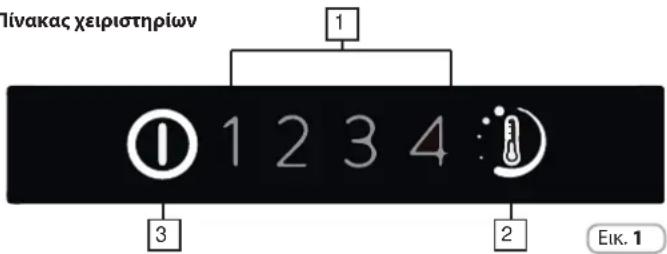
Control panel
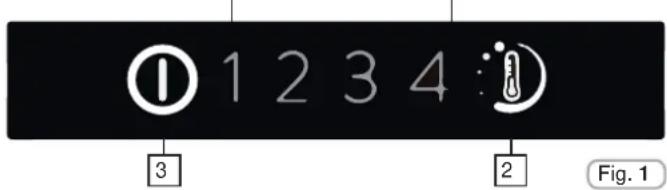
- Temperature indicator LED
- Temperature control
- ON/OFF button
Fig.1
Turning the appliance ON:
Plug the appliance in, if all the temperature indicators LEDs are off, press ON/OFF (3) for 1 second. When you release the ON/OFF button (3) a temperature light will come on and the appliance will beep.
Turning the appliance OFF:
Press the ON/OFF button (3) for 1 second, when you release it, the temperature light will go out and the appliance will beep. In the event of a power failure, when the power comes back on, the appliance will run using the last saved setting.
Setting the temperature
Press the button for setting the temperature until you reach the level you want where level 1 is the warmest and level 4 is the coldest. Under normal operating conditions, we recommend using an intermediate setting (level 2)
On/Off 1 2 3 4
Press button (2) for less than 2 seconds to change the temperature level.
On/Off 1 2 3 4
Advanced settings menu:
Use this menu to set an intermediate level.
On/Off 1 2 3 4
Press button (2) for more than 2 seconds. When you release it, LED 2 will flash
On/Off 1 2 3 4
The next time you press button (2) for less than 2 seconds, the intermediate level will be set. This operation works in cycles every time you press the button.
On/Off 1 2 3 4
On/Off 1 2 3 4
If you do not press the button (2) for more than 5 seconds, the settings will be saved.
The temperature levels in advanced settings are set from warmest to coldest e.g. 2/2.1/2.3/2.4 which means there are 4 sub-levels for every main level.
Door open alarm
If the door is left open for longer than 90 seconds, an alarm is sounded. To turn it off, simply close the door or press button 2.
| Position Conditions | |
| 1-2 Summer or ambient temperature between 25-35 °C | |
| 2-3 Spring, autumn or ambient temperature between 15-25 °C | |
| 3-4 Winter, or ambient temperature between 5-15 °C | |
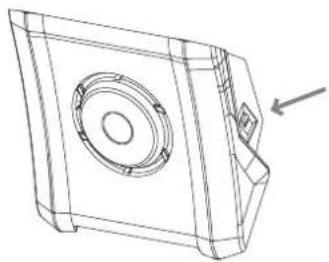
Refrigerator Compartment Fan (if present)
The fan is preset to OFF.
To activate, press the switch (Fig. 2).
To optimize energy consumption, it is recommended that you turn the fan on only when the ambient air temperature exceeds 28 to 30^ .
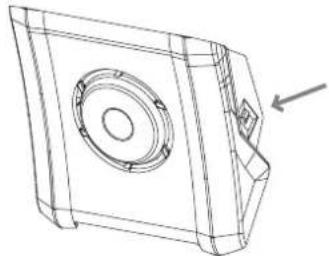
Fig. 2
CONSERVATION
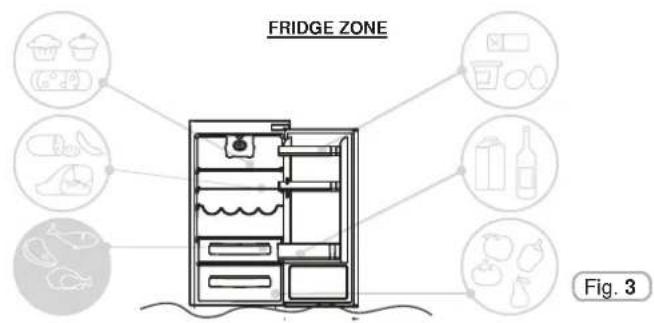
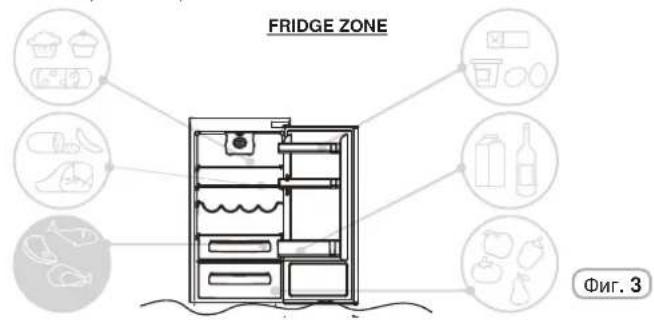
- To maintain the best flavour, nourishment and freshness of foods, it is advisable to store them in the refrigerator compartment as shown in Fig. 5 below, making sure to wrap them in aluminium or plastic sheets or in appropriate covered containers to avoid cross-contamination.
Refrigerator zone
Fruit / Vegetables
- To decrease fruit and vegetable moisture losses they must be wrapped in plastic materials such as, for example, films or bags and then inserted in the fruit/vegetable zone. In this way rapid deterioration is avoided.
Refrigerated section fresh zone
(not all models)
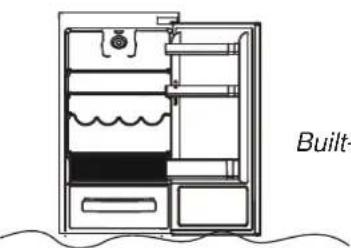
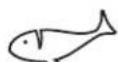
The zone shown below is recommended for meat, fish, poultry, etc.; do not store fruit and vegetables because they can freeze;
Indicator of the temperature in the coldest zone
(not all models)
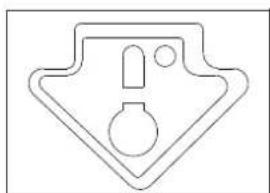
Some models are equipped with an indicator of the temperature in the refrigerator compartment in the coldest zone, for you to be able to control the average temperature.
This symbol indicates the coldest zone of the refrigerator (Fig. 4).
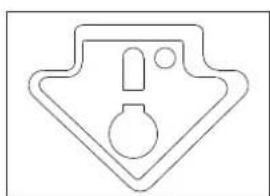
Fig. 4
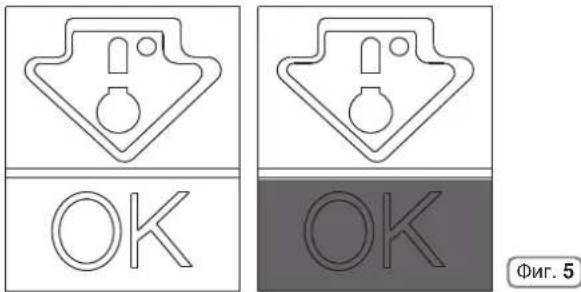
Check that on the indicator of the temperature, the word OK is clearly shown (Fig. 5). If the word does not appear, this means that the temperature is too high: adjust the temperature to a cooler setting and wait for about 10 hours.
Recheck the indicator: if necessary, proceed with a new adjustment.
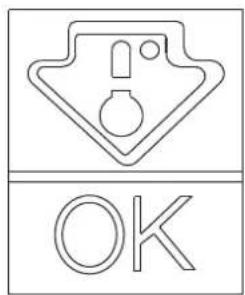
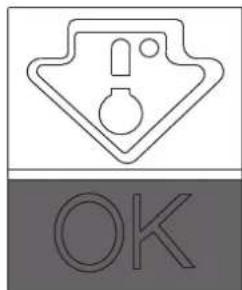
Fig.5
NOTE:
If large quantities of food are inserted or the refrigerator door frequently opened, it is normal for the indicator fails to show OK. Wait for at least 10 hours before setting the temperature at its coldest levels (3,4).
Freezer zone
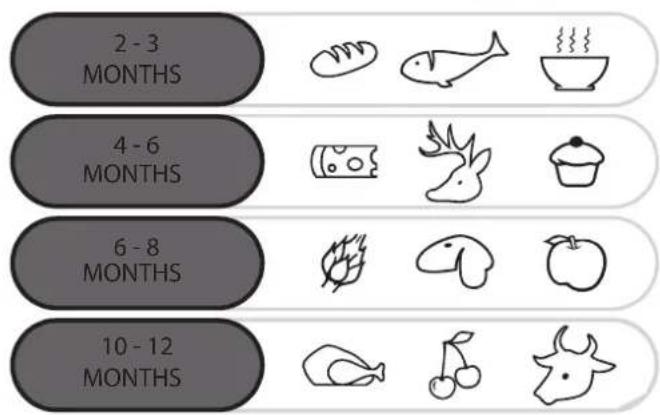
Use the table below for the compartments

Freezing process can only occur in the compartments
***
Practical recommendations
Place food on the shelves in a homogeneous manner to allow air to circulate properly and to cool it.
- Avoid contact between the food and the far end walls of the refrigerator compartment.
- Do not introduce hot foods as they can cause deterioration of existing ones and increase energy consumption.
- Remove the wrappings of foods before inserting them.
- Do not put in dishes or other containers unless previously washed.
- Do not obstruct the cold air ventilator openings with food.
- Do not cover the glass shelf of the vegetable bin to allow for proper air circulation.
- Do not store bottles in the freezer compartment as they can burst when frozen.
- In the case of prolonged power outage, keep the doors closed so that foods remain cold as long as possible.
- The installation of the appliance in a hot and humid location, with frequent door openings and storing large amounts of vegetables can cause the formation of condensate and affect the performance of the unit itself.
- To prevent excessive energy consumption, the frequent or prolonged opening of the doors is not recommended.
FREEZING
DEFROSTING
- Foods must be fresh.
- Freeze small amounts of food at a time in order to freeze quickly. Never exceed the maximum amount indicated on the rating label.
- During freezing, do not open the freezer door.
- Food must be sealed, airtight.
- Separate food to be frozen by those already frozen.
- Label bags or containers to keep an inventory of frozen foods.
- Once defrosted, do not ever refreeze foods and consume them promptly.
Defrosting the refrigerator compartment
During normal functioning, the refrigerator is automatically defrosted. There is no need to dry the drops of water present on the rear wall or to eliminate the frost (depending on functioning).
The water is conveyed to the rear part through the drain hole found there and the heat of the compressor causes it to evaporate.
- Keep the drainage pipe (Fig. 6) clean in the refrigerator compartment to keep it free of water.
NOTE:
The temperature doesn't usually need to be adjusted
Only in case you find excessive cooling of the products contained in the refrigerator compartment, gently set the warmest temperature levels (1,2).
On completion of freezing, set the warmest temperature levels (1,2).
The rating plate states the maximum quantity of foods that can be frozen, (see Figure 6).
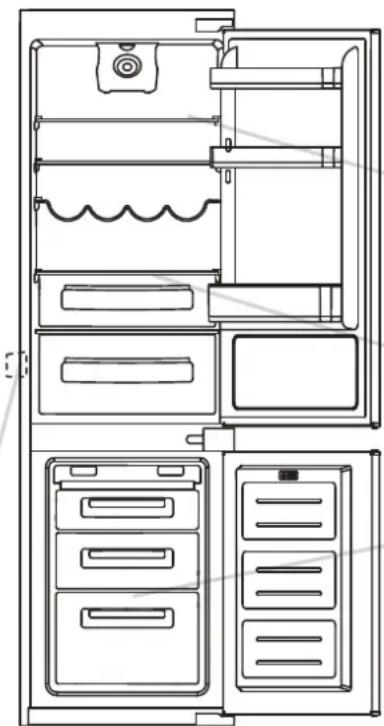
(Figure 6)
Defrosting of the fridge compartment occurs automatically in this product.
A small amount of frost or drops of water on the back of the fridge compartment when the fridge is working is normal.
Make sure the water outlet is always clean and make sure foods do not touch the back or sides of the freezer compartment.
We recommend you defrost the freezer area when the layer of frost is more than 3mm thick.
N.B. Here you will find your appliance rating plate: it includes all the data to be transmitted to the Customer Service should a fault arise.
Important: if your ambient temperature is high, the appliance may operate continuously, thus building up excessive frost on the inner wall of the fridge. Set the warmest temperature levels (1,2).
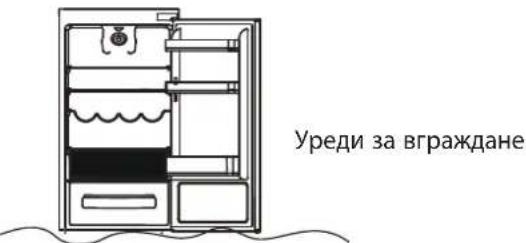
The most energy-saving configuration requires drawers, food box and shelves to be positioned in the product, please refer to the above pictures
Defrosting the freezer compartment (static products without NO-FROST technology)
When the layer of frost present in the freezer compartment exceeds 3mm it is recommended to proceed with the defrosting as it increases energy consumption.
1) Press the ON/OFF button (3) for 1 second.
2) Disconnect the power cord.
3) Remove the frozen food and temporarily place them in a cool place.
4) Leave the freezer door open to speed defrosting.
5) Collect the water on the bottom of the product.
6) Dry the freezer.
7) Reconnect the power cord and set the desired values.
8) Wait a moment and reintroduce the frozen foods.
WARNING:
Absolutely avoid the use of open flames or electrical appliances, such as heaters, steam cleaners, candles, oil lamps and the like to accelerate the defrosting phase.
Do not scrape with a knife or sharp object to remove frost or ice present. These can damage the refrigerant circuit, the leakage of which can cause a fire or damage your eyes.d.
Defrosting the freezer compartment (NO-FROST products)
Defrosting is automatic.
MAINTENANCE AND CLEANING
Lighting
LED lighting
The product is equipped with LED lights, please contact the Technical Assistance Service in case of replacement.
Compared to traditional light bulbs, the LEDs last longer and are environmentally friendly.
Cleaning
NOTICE:
- Before each operation, remove the refrigerator plug from the power socket to prevent electric shocks.
- Do not pour water directly on the outside or inside of the refrigerator itself. This could lead to oxidation and damaging of the electrical insulation.
IMPORTANT:
To prevent cracking of the inside surfaces and plastic parts, follow these suggestions:
- Wipe away any food oils adhered to plastic components.
-
The internal parts, gaskets and external parts can be cleaned with a cloth with warm water and baking soda or a neutral soap. Do not use solvents, ammonia, bleach or abrasives.
-
Remove the accessories, for example, the shelves, from the refrigerator and from the door. Wash in hot soapy water. Rinse and thoroughly dry.
- The back of the appliance tends to accumulate dust which can be eliminated with the use of a vacuum cleaner, after having switched off and disconnected the appliance from the electrical outlet. This provides greater energy efficiency.
ENERGY SAVINGS
For better energy savings, we suggest:
- Installing the appliance away from heat sources and not exposed to direct sunlight and in a well ventilated room.
- Avoid putting hot food into the refrigerator to avoid increasing the internal temperature and therefore causing continuous functioning of the compressor.
- Do not excessively stuff foods so as to ensure proper air circulation.
- Defrost the appliance in case there is ice (see DEFROSTING) to facilitate the transfer of cold.
- In case of absence of electrical energy, it is advisable to keep the refrigerator door closed.
- Open or keep the doors of the appliance open as little as possible
- Avoid adjusting the thermostat to temperatures too cold.
- Remove dust present on the rear of the appliance (see CLEANING).
AVOIDING NOISES
During its operation, the refrigerator emits some absolutely normal noises, such as:
HUMMING, the compressor is running.
- RUMBLINGS, RUSTLINGS and HISSING, the refrigerant is flowing through the tubes.
- TICKS and Clicks, the operation shutdown of the compressor. Small measures to r ed uce the vibration nois es:
- Containers touch each other: Avoid contact between containers and glass recipients.
- Drawers, shelves, bins vibrate: Check the proper installation of internal accessories.
NOTE:
The refrigerant gas produces noise even when the compressor is off; it is not a defect, it is normal.
If you hear a clicking sound inside the appliance, it is normal as due to expansion of the various materials.
REVERSIBILITY OF THE DOOR
The doors of the appliance can be reversed so as to allow the opening to the right or left according to exigency.
NOTE:
- Inversion of the doors must be performed by qualified technical personnel.
Inversion of the doors is not covered by the warranty.
REVERSING THE OPENING OF THE DOORS
Remove the upper plate and hinge by screw driver.
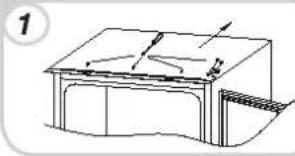
Remove the upper door. Remove the middle hinge and its connecting pin underneath.
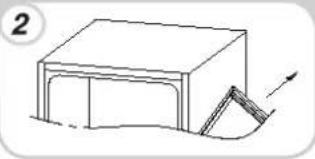
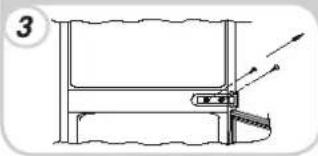
Remove the bottom door.
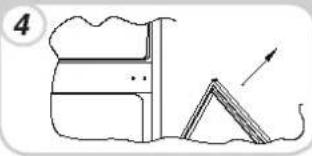
Remove the right bottom hinge and left plastic plugs, and refit them onto the opposite side.
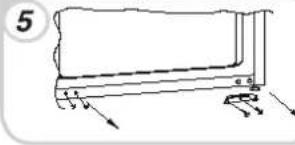
Use the opposite hinge and cover and fit into the left bottom.
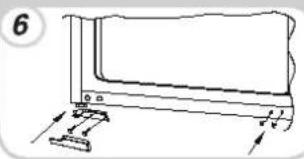
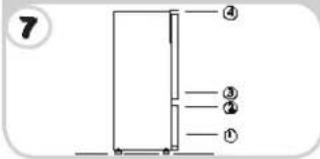
Reassemble the doors and hinges.
workings from bottom to top, from 1-4.
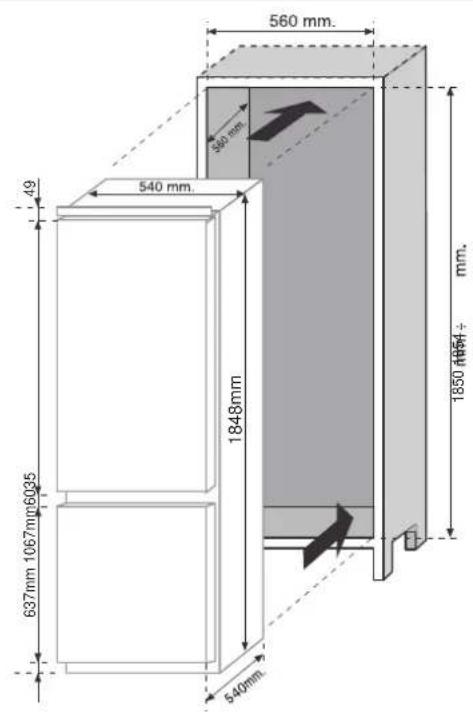
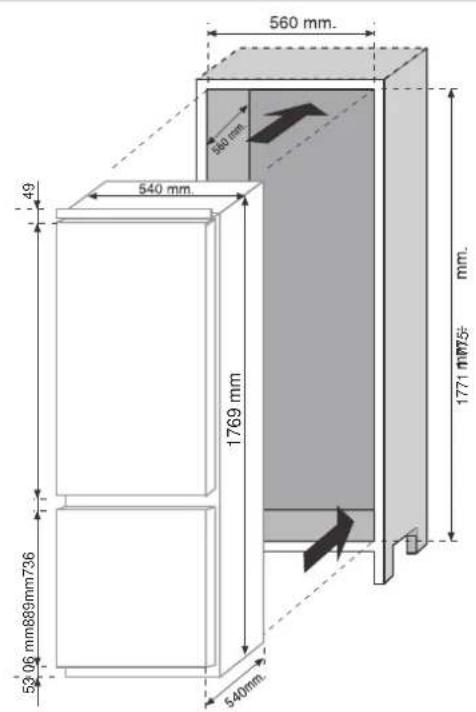
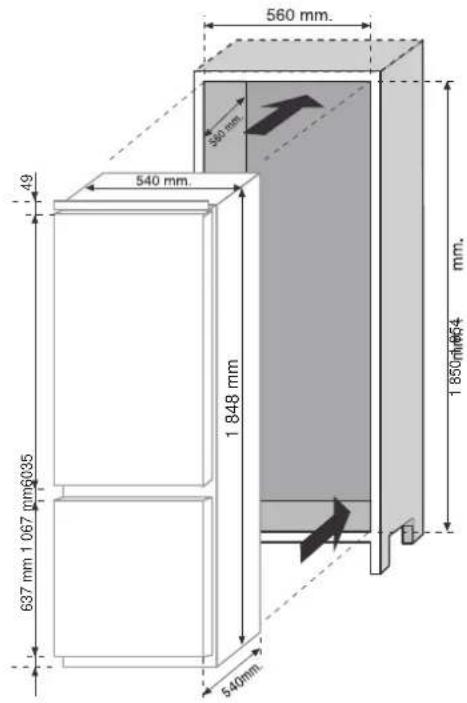
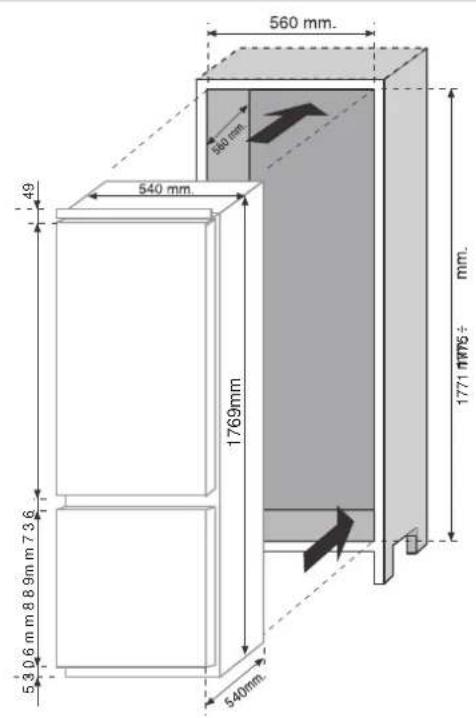
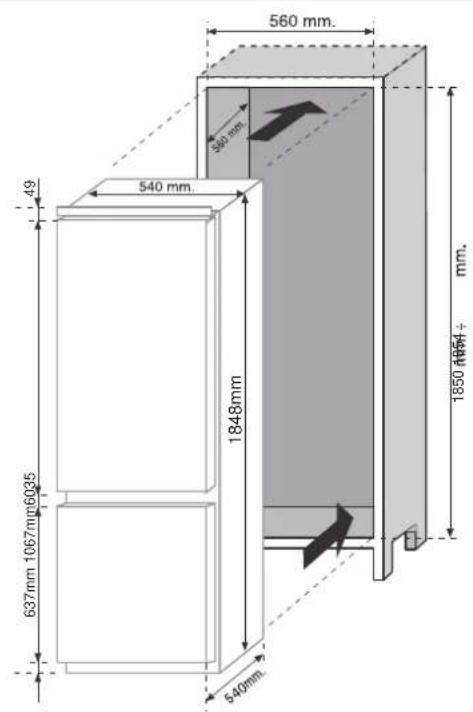
PRODUCT DIMENSIONS AND BUILT-IN COMPARTMENT
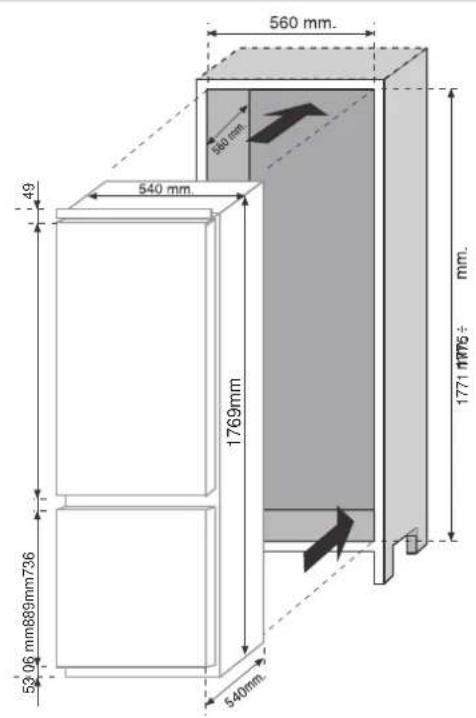
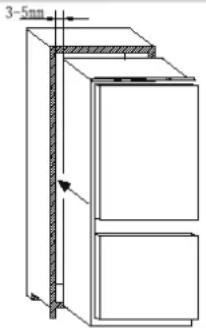
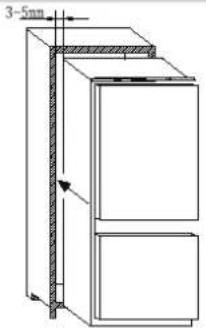
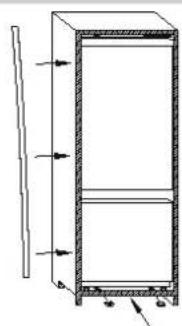
Insert the appliance into the column, placing it on the opposite site of the hinges, and make sure 3-5 mm distance gap.
1
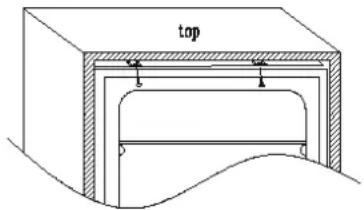
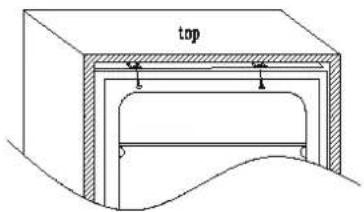
After ensuring the match between appliance door and column door, then screw the appliance upper part to the cabinet
2
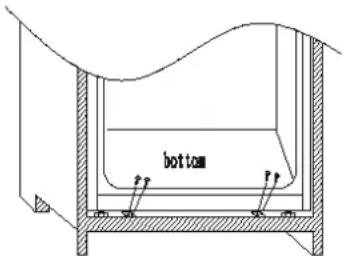
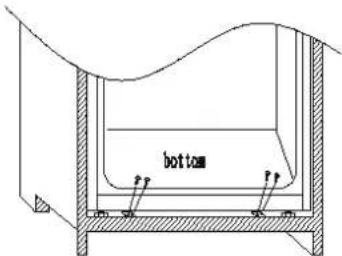
Screw the appliance lower part.
3
Fit the seal to the appliance, cut off the excessive part if necessary. Fit the bottom parts with plastic covers.
4
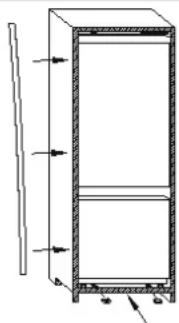
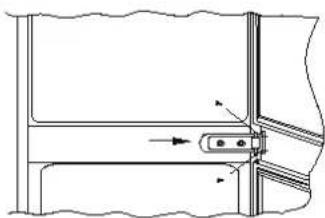
Use a cross-screwdriver to loosen the connecting pin underneath the right middle hinge, and adjust to screw onto the right cabinet wall.
5
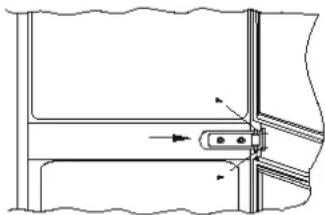
COUPLING OF THE PANELS OF THE BUILT-IN COLUMN OF THE APPLIANCE DOORS
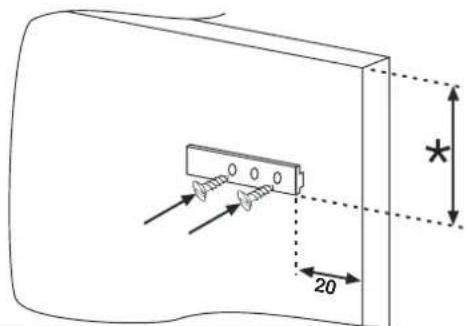
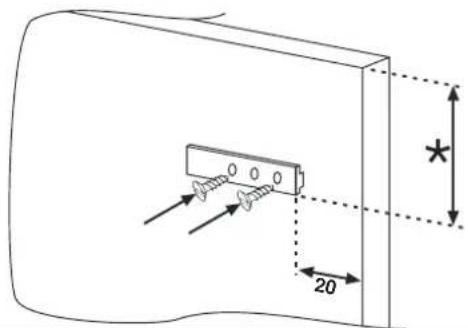
The appliance is equipped with coupling devices for the appliance doors with the column panels (loader slide).
Secure the slide in the inner part of the panel of the built-in column at the desired height and at approx. 20mm . From the outer wire of the door.
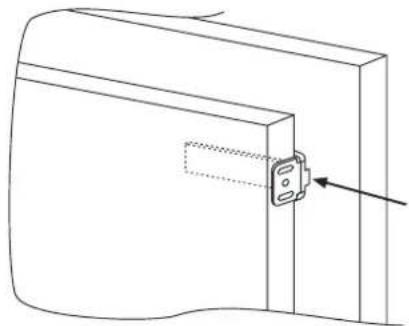
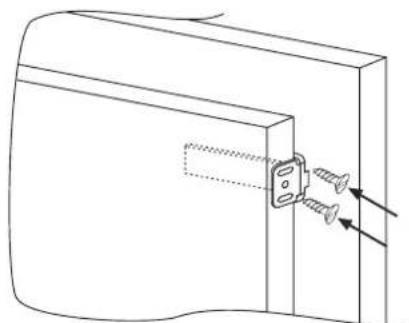
Open the doors of the built-in column and the fridge. Position the built-in loader in the slide, then fit it into the fridge door.
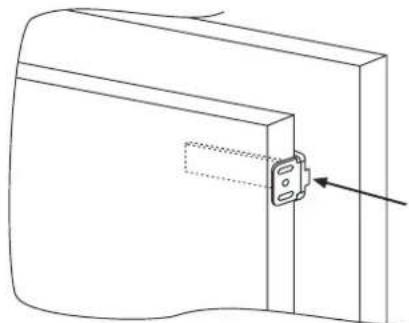
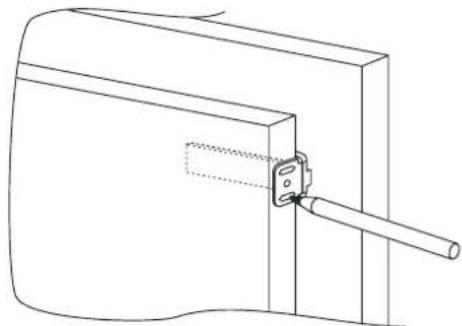
Mark the fixing points for the screws and drill with a bit of a diameter of 2.5mm.
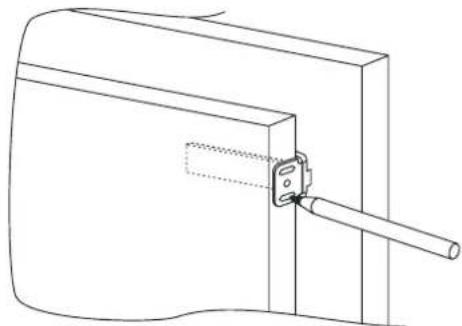
Connect the appliance door to the cabinet panel keeping the loader slots as guidelines.
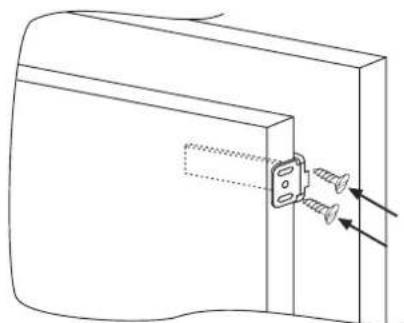
PRECAUTIONS FOR THE CORRECT OPERATION
Once the product has been embedded, place the rear part of the column in contact with the wall so as to prevent access to the compressor compartment.
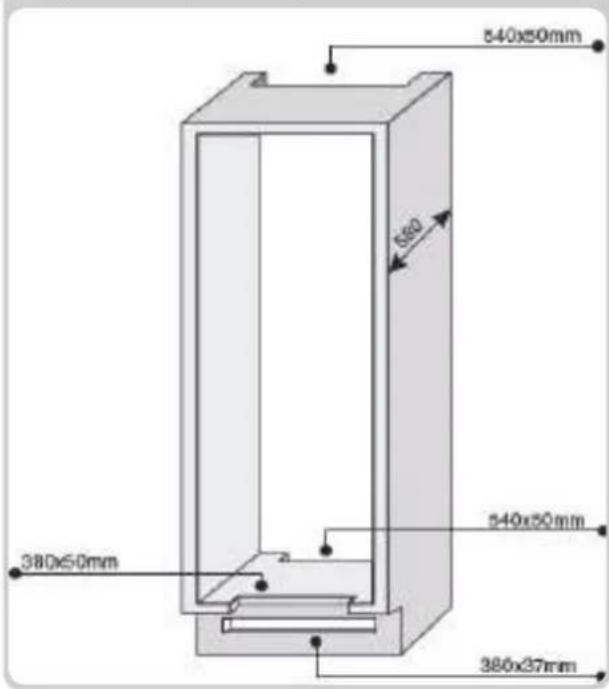
For the product to operate correctly it is essential to allow adequate air circulation so as to cool down the condenser located in the rear part of the appliance.
For this reason, the column must be equipped with a rear chimney, whose upper opening must not be blocked and with a front slot which will be covered with a ventilation grill.
Size of the unit cut outs.
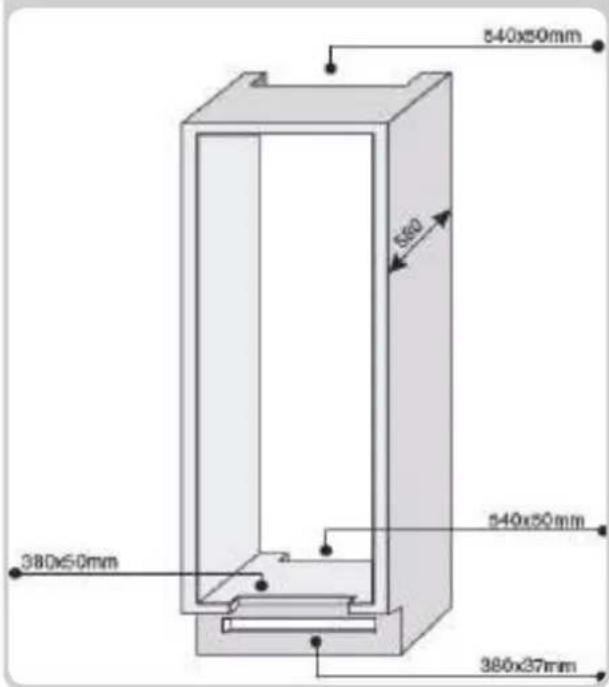
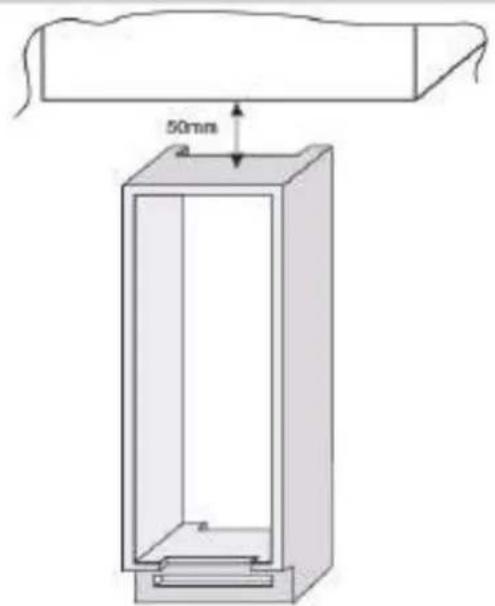
Room to leave between the unit and ceiling.
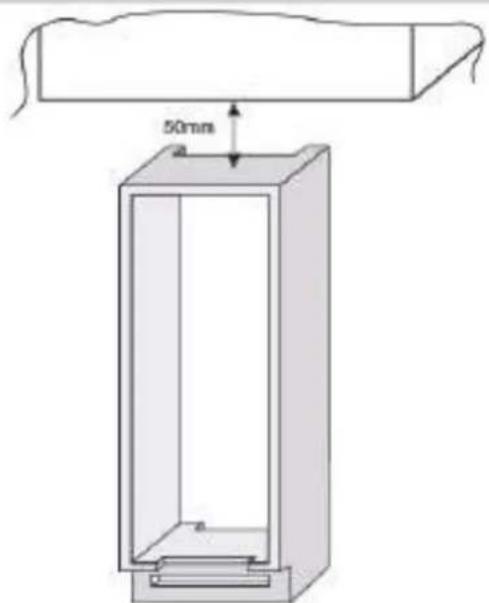
SUSPENDING USE OF THE APPLIANCE
If the appliance is not to be used for a long time:
1) Turn the appliance OFF (see Operation)
2) Extract the plug or remove the safety device.
3) Clean the appliance
4) Leave the doors of the appliance open.
TROUBLESHOOTING
CAUSEPROBLEM REMEDY
| The inside illumination light bulb does not turn on. | ·Electricity absence. | ·The power cord is not properly plugged in. ·Check whether the appliance is switched off. (see Temperature Adjustment). ·Ensure that there is a current in the house. ·Check that it is active. |
| ·Door switch is blocked. | ||
| The refrigerator and freezer do not sufficiently cool. | ·The doors are not closed. ·The doors are frequently opened | ·Check that the door and gaskets close properly. ·Avoid unnecessary opening of the doors for a period of time. ·Check the temperature setting and, if it is possible, cool even more (see Temperature adjustment) |
| ·Erroneous setting of the temperature. ·The refrigerator and freezer have been excessively filled. ·Surrounding temperature is too low. | ·Wait for the stabilization of the temperature of the refrigerator or freezer. ·Check that the ambient temperature is in accordance with what is indicated on the nameplate (see Installation). ·The power cord is not properly plugged in. ·Check whether the appliance is switched off (see Temperature adjustment) ·Ensure that in the home there is current. | |
| ·No electrical power. | ||
| The food in the refrigerator freezes. | ·Erroneous setting of the temperature. ·Food in contact with the back wall. ·The freezing of too much fresh food causes a lowering of the temperature of the refrigerator | ·Check the temperature setting (see Temperature Adjustment) and, if possible, decrease temperature setting. ·Separate the food from the back wall of the refrigerator. ·Do not exceed the maximum amount to be frozen (see Freezing). |
| The bottom of the refrigerator compartment is wet or droplets are present. | The drain tube could be clogged. | ·Clean the drain tube with a stick or the like to allow the discharge of water. |
| Presence of drops or water on the back wall of the refrigerator. | ·Normal operation of the refrigerator. | ·It is not a defect (see Defrosting). |
| Presence of water in the vegetable drawer. | ·Lack of air circulation. ·Vegetables and fruits with too much moisture. | ·Verify that your glass shelf tray vegetables are not put foods that prevent air circulation. ·Wrap the fruit and vegetable materials plastic such as, for example, films, bags or containers. |
| The motor runs continuously. | ·The doors are not closed. ·The doors are opened frequently. ·Ambient temperature is very high. | ·Make sure the doors are closed and if the seals close properly. ·Avoid unnecessary open ports for a certain period. ·Verify that the ambient temperature is in accordance with the specifications on the nameplate (see Installation). ·Set the display/thermostat a warmer temperature. ·Defrost the unit (see Defrosting). |
| ·Thickness of frost than 3mm. | ||
| The frozen food is thawing. | ·The ambient temperature range below climate class of the product. The compressor starts rarely ·The freezer door is not closed. | ·Move the unit to a warmer or heat the room. ·Make sure the door is closed and that the gasket is sealing properly. |
| WI-FI light flashes 3 sec on - 1 sec off. | ·Router off. ·Lacking connection. | ·Switch the router on. ·Reset the product (see WI-FI) |
IF YOU ARE NOT SOLVED THE PROBLEM, CONTACT THE SERVICE CENTER, PLEASE GIVE THE TYPE OF FAULT AND THE INFORMATION ON THE PLATE OF THIS APPARATUS TO INSIDE THE REFRIGERATOR COMPARTMENT:
The model of equipment.
The number of series.
CONTENU
FR
INFORMATIONS SUR LA SECURITE 22--22
INSTALLATION 23--23
FONCTIONNEMENT 23--23
CONSERVATION 24-24
CONGELATION 25--25
DEGIVRAGE 25--25
MAINTENANCE ET NETTOYAGE 26--26
ECONOMIES D'ENERGIE 26--26
DIMENSIONS DU PRODUIT ET COMPARTIMENT
ENCASTRE 27--28
INSTALLATION DE L'APPAREIL DANS LA COLONNE .... 28--28
ASSEMBLAGE DES PANNEAUX DE LA COLONNE
ENCASTREMENT DES PORTES DE L'APPAREIL 29--29
PRECAUTIONS RELATIVES AU FONCTIONNEMENT
CORRECT 29--29
SUSPENDRE L'UTILISATION DE L'APPAREIL 29--29
DEPANNAGE 30-30
DIMENSIONS DU PRODUIT ET COMPARTIMENT ENCASTRE
CAUSEPROBLEM CORRECTION
On/Off 1 2 3 4 On/Off 1 2 3 4
ACOPLAMENTO DOS PAINEIS NA COLUNA EMBUTIDA
DAS PORTAS DO APARELHO 59-59
CAUSAPROBLEMASOLUÇAO
EvpyooinAnevpyooin (On/Off)
Nivakac xeiipotnpiwv
He nHCTaIpaTte XlaIINHkA BbB BnaXHH, npaHn nn Ma3HN NOMEeHn. He n3PNaarTe Ha npKa CbHueBa CBETnHa nn DxKd.
-
He uHCTaHpaIte yctpoNcTBOTo B 6n3OcT do HArpeBaTeIIN nn neCHO 3anaJIIMMaTePnaJI.
-
He n3noJ3BaIte ydbJxKnteIu nn pa3KIOHnTeI.
He doKocBaIte c MOKpn Pbue n 3dBpBaIte 3axpaHbau n Ka6eJ caO 3a eceJa.
BHNMaBaTe Da He NobpeDInTe 3axpaHbAaun Ka6en. Toba MoKe da npuHnTOKOB yap nIIN noXap.
He noctabrai Te Hkabn npedmetn u/nn KOteHepn C TeuhoCT Ha rOpHaTa qact Ha ypeda
He ce onntbaite da peMOHTnpate ypeda camn. Bcnukn peMOHTn deHoctn Tp8Ba da ce n3BbPsaT ot KbaJIuΦnCupaHe texHnK.
To3n ypeJ moKe da ce n3noJ3Ba OT dea Ha Bb3pact OT 8 roDHH no-rope, n ot Jnua c HamaJeHn fN3nueckn, cetNBn nn yMCTBeHN CnOCO6HOCTn, nn C nnca Ha ONIT n 3HaHn, npu ycIOBne ye Te ca Na6IIOJaBAHn nn INCTpyKTIpaHn 3a TOBa KaK da n3noJ3BaTe ypeJa no 6e3oJaceHauHn n da pa36epaT onaCHOCTnte, CBbp3aHn C TOBa.
IeuaTHe Tpa6Ba Da cn nrgaT C ypea. NocCTBaHe n noDpBxka He Tpa6Ba Da ce npabn ot Ieata 6e3 Hnd3op.
3aBbptaikn Ha Konueto DOKpaai o6paTHo Ha yacOBHnKOBaTa CTpeIka, ige ce ue upaKaBaHe, KOeTO CbotBTcTBA Ha N3KNIOUbaHETo Ha npOdyKTa.
Korato ypeBt ce nHctaIInpa, eNeKtpnueckn Ka6en n uenca Ta6Ba da ca nechooocbHN.
KoHTaKaTAp Ta Ta Da e CbBMeCTnM C cencena Ha ypea. B npOTIBeH CnyaH ToI Tpa6Ba Da ce 3aMeHn OT OTOpN3uPAh TEXnK; He n3PON3BaIte YdbJXHTeIN N / nn pa3KnOHHTeIN
He dokocbaite Bbtpeunte qactn nn 3ampa3eHn XpaHn C BnaJHn nn MOKpn pbue, Tb' KaTO MoKe da npuHHn n3rapaHn.
N3XBbPJIaHeHa CTap ypeI

m = 311
To3n ype, e MapKpuH B cBtBcTCTBne C EbponeeCKa IupeKTHBa 2012/19/EC 3a OTnAdbuN OT EKeKTPnuecko EKeKTPoHNO O6OpyDbHe (OEOO).
OEOE cIbprkataKATO 3aMbpCBAaHBEeCTBa (KOHTo MOrat daIOBcAITdo HeATNBHIOCEJIeHN 3a OKJInaT CpeJa), Taka H OCHOBHIN KOMHOENTN (KOHTo MOrat Da 6b,Dat N3IOJ3BAHn NOBTOHO. BAKHO e OEOE da ca Obekt Ha CIEHuaHa o6pabotKa, 3a da ce IpemaxHar n da Ce IeIOHHPaTPaBvHIO BCHKN 3aMbPCHTeHn, H da CE Bb3CTaHOBt H peuHKHPaT BCHKN MaTePhaJIn.
IpaKaHHTe Moar Da Hparr BaKaHa poB Ra pAHTnPaHETo, Ye OEEO HmAT Da CTAHAT np6blem 3a OKOJIHATA CpeJa; OT cbIeCTBeHO 3HaueHne e da Ce CIEBaT HKOH OCHOBH IIpaBILA:
-
OEEO He Tp86Ba da ce TpeHpar KaTO bHTOB (OMaKHNCKN) OTIIaBk;
-
OEEO Tp86BaJa 6b,Dat npedabAHn B cbOTBeHTHe nyHKTOBE 3a cbHpaHE, yIpaBIAHbAHN OT 06HHATA HmN OT perHCTPpAHn KOMIIaHH. B MHORO CTpaHH MOKe Ja HMa cb6HpAe OJOMHa RoJIEMH OEEO.
B Mhoro cTpaHH, KORATO cn KyHnTe HOB ypeI, CTAPnH MT MoKe, da 6bJe BbPHa HA npOdaBaA, KOJI TO Tp8Ba DA rO B3eME 6e3n/AnTHo HA 6a3a eHNO-KbM-eJHO, aO bOpOyBaHeTo e O xCOneHN HJN H NMa CbHnTe FyHKNU KATO 3akynHeTO 06OpYBaHe.
CbotbETBME
IOCTABHnKn C H MapKnpaHKn TO3H IpOaYKT, Hne JeKlApnpame HaHaia OTROBOPHOCT,ue ToE B cBTBeCTBHe CbC BCHN EbponeeCKn H3NCKBAHn 3a 6e301AcTHOCT,3pabHH N EKOIoTHUHH HOpMH.
HcTaIpaHe
IPEyIPEKDEHNA
- He INCTAINHPaIeYpeJa BbB bJAAKHO HIN MOKPo POMueHHe, TbK KATO MoKe Da HApUHHTe N30JIaHHTa H da Ce TnHRe Odo YeTuKa. OCBet TOBA Ha BBHHATA NOB.pxHOCT MoKe Da ce 6p3ayBa KOHaDeH3aT.
He noctabraIte ypeHa MeCTa 6nH3KN Do H3TOUHNK Ha ToTJINHA Hn H30KeHH HA IIpKa CJIbHcEba TOnIIHHa
YpeBt Tp6Ba Da yHKUHOHpa B CJIeHNTe TEMnepaTyPHN dHaIa3OH KAKTO e YKa3aHO T KIAca:
+10 +32°C 3a KJIIMMaTnueH KJAC SN
+16 +32°C 3a KJIHMaTHUeH KJIac N
+16 +38°C 3a KJIHMaTHUeH KJAC ST
+16 +43°C 3a KJIMMaTHueh KJIac T
(BnKTe TaBekKaTa Ha H3JeHneTo)
HeIOCTABHHTe HNKABHCbDOBe C TeuHOCT Ha rOpHaTa qAcT Ha ypeJa
-ⅢaKaHte IHOe 3 haca OKOHuaTeJHOTo IIpeMeCTBaHe Ha ypeDa IIpeDu Da FO BKIOUHTe
EJIeKtpnuecko Cbbp3BaHe
C.IeIIOCTABHHe Ha ypeHa Na IpeBnDEHOTo 3a Hero MxTO, Ro octabere Hone 2-3 uaca IpeDn Da To BKnOHTe B KOHTAkr. IpeDn da HbBpntre TOBa ce yEpete:
KoHTaKTbTe npabHnHO 3a3eMeH.
KoHTaTKbT MoKeJa H3bPKN MaKCHMaJIHaTa MOUHOCT Ha ypeJa KaKTo eYka3aHo HA Ta6eJkata My
3axpaHbauoHa npexeHne eB rpaHnnte nocouehn Ha Tabekata HxJaHHnKa
KaBeIbT He Tp86Ba Da 6bJe npErBbAH Hn npEunBbAH
IPOBepBaHpeoBHOKa6eJa3aHeH3nPaBHOCTN HINpHHyKdaOT 3AMHaCeO6bPheTe KbM CneHuaHCT.
-ПОНБОДТЕЛТНЕСН OTROBOPHOC 3А ПОВРЕДИ NIN TРABM, aKOTe3N H3HCKBAIIHNE He Ca CnA3eHN.
No3nua YcbBn
| 1- | ПЯтуна НИн Okолина Temпегаразу мекду 25-35 °C |
| 2-3 | Пюлелотна, eccени НИн Okолина Temпегаразу мекду 15-25 °C |
| 3-4 | Зима НИн Okолина за Темпегаразу мекду 5-15 °C |
BkIIOUbaHe Ha ypeHa
IpeMaxHete BCnKOn OAnKOBKn Ha ypeJa BbN H3BbN Hero. IouHcTeTe BbTpeWHOCTTa C BODa N XIO6Ha COda NIN HEYTpAJIeH canyH.
C.IeB KIIIOUBAHETO,DAIHT BPEME (2-3 Yaca) Ha ypea Da TeMneppa XlaHnHaT HpH3epHATA CHT pEHN DA NOCTABTE pECHN HIN 3ampaeHHIPOyKTH BERO
Ako Ka6eNa ce H3BaHOn OT KOHTaKaTa, H3uKaAte NoHe 5 MmH, PpeH, OTHOBO Da BkIOUHTe ypeJa.
XJaHnHHKa e roTOB 3a ynoTpe6a.
EKCPIIOATAUIA
BkIIOUbaHe/V3KJIIOUbaHe
KoHTpOen nHaHEn
- HnHkaTOp LED 3a HnBO Ha TEMIEpaTpa
- PerylaTOp Ha HHBOTo HA TemIepaTypa
- BYTOH ON/OFF
BknquBaHe:
Iocabete ⅢeCena B KOHTAKTA, Ako BCWIK LED HINHKAtoPn 3a HNBOTo Ha TEmHepAtpyata Ca HKJIIOueHH HAIHCHETe 6yToHa ON/OFF (3) 3a 1 CekyHda. Korato OTIIYChEte 6yToHa ON/OFF (3) BKJIOUbaHeto e nOcLBeBAHO n NOTBbpeHOOT AKTHBpaHeto Ha eHNO HNBO Ha TempeAtypa N OAT KANBpaHETO HA 3ByKOB CHNJIAI.
N3KIOUyBaHe:
HaHCHETe 6yToHa ON/OFF (3) 3a 1 ckyu, npn ocbo6oxdaabaHeto Ha 6yToHa ON/OFF (3) HKNIOUbaHTo e nocJeBAHO nOTBbpDEHO OT H3KIIIOUbaHTo HA LED HHNkAtoPOnTe 3a HOBO HA TEmpeParpyo N ot AKTHINbPAHTo HA 3ByKOHBn CnHaJI. B Cnyau Ha IIpeKbCBAHe Ha 3axpaBaHTo pnp NobTOpHTo BKIOUbaHe, npOdyKTbT Ie Ce BBpHe KbM IOcJdHaIra 3aIIaEHa HaCTpoKa.
Hactpoika Ha TemnepaTypata
HaTHCHETe 6yToHa 3a peryIHpae Ha HNBO TEMTepaTypa IIO DocTHrae Ha CbOTBtHO TNO HNBO 1No-TOIJa HAcTpoKa, HNBO 4 No-CrUdEHa HAcTpoKa, IIIN HopMaJIH yCIOBHe, Ce IIpeIIOpYBa Da ce H3IOJI3Ba EaHJ MeKJHHNa HAcTpoKa (HNBO2)
On/Off 1 2 3 4
HaTnCKaHTo Ha 6yToH (2) 3a No-MaJIko ot 2 cek, ce npOMeHr HbOTo Ha TEMN.
On/Off 1234
MehnoHa pa3upeHn HacTpoKn:
ToBa MEHIO I03BOJRA Ba eHa HAcTPOHka Ha MekDHHO HHBO MeKny pa3IHHTE HBA.
On/Off 1 2 3

HaTnCKaHeTo Ha 6yToH (2) 3a noboeYe ot 2 cek., npn OTnyckaHe Ha 6yToHa, nHdNKatOpbTe led 2 mna.
On/Off 1 2 3 4

PnCIEBaaIOTo HATNCKaHe HbYToHa (2)3a No-MaJIO OR 2 Cek,CEAKTHBpa MEKHHHOTIO HHBO H TAKA INKINHIO 3a BCaKO HATNCKaHe.
On/Off 1234

On/Off 1234
B CnyaHa Ha Hnca Ha HATNCKaHe Ha 6yToHa (2) 3a NOBEe or 5 cek., HACTPOIKTE CE 3aIa3BaT.
HbataHa Temepatypata B pa3iHpeHHTe HactpoKn caB peO t HaH-TOIIO TO Ho HA-CTyDEHO, KaKTo B IIpHMeP 2/2,1/2,3/2,4, Koero IO3BOINBA peryHpaHrO Ha 4 IIO-HNBA 3a BCKO OCHOBHO HHBO.
AJaMa oTBopeHa BpaTa:
TbapnHTo H bpaata 3a nObue ot 90 cek. ce cHnHaI3Hp a T npOyKta Cbc 3BkyOBa cHnHaI3auu, 3a da To HKnIOHTe, npOCTo 3aTBOpTe BpTaTa H HAnCHETe 6yToHa (2).
BeHTnlaTOp Ha XnaIINHOTO OTdeneHne (aKO nMa)
BentnataTopa nnpesymuee n3KIOUey
3a da ro aKTNBnpuTe, HATncHete 6yToHa (DnR 2).
3a ONTNIMn3npaHe NaOTpe6BnHEMeTo Ha eHeprna, e npenopbHuTeNHO da BKNUHTe BENTnlaTopa cAmo KOrATo TeMnepaTypaTa Ha Bb3dyxa e HAd 28 do 30^
Φur.2
CbXPAHEHNE
- 3a da ce noDbPkaT Han-dobpnte BkycOBn KaecTBn CBexEcTa Ha xpaHNTe, npenopbUbaMe Da ce cbo6p3nTe C THXOTO pa3noJoxHe, kaTo e noka3Ho No-dony Ha fInr 5. MoKe da rnu NOCTABNTB BOtDenHH KytTH NIN Da rN yBnTe C fOnnO, 3a da He ce NOyUcMecBaHe Ha apOMATNE.
XnaHnHa 3oHa
Плобов/Зеленчуи
3a da ceHAMann 3ary6bata Ha Bnara B nnoobete n 3enehyuite, Te Tprba Da 6bDat oakOBaHN B Top6nKn uNn PVC fOnno n Tpr6ba Da 6bDat noCTabeHn B OTdeneHmTo 3a nnoObe n 3eneHuyu, 3a da ce N36erHe 6bp30TO mP3BaJIaHE
XnaunHaΦpew 3oHa
(He npBcNqKMOdeN)
3oHaTnok3aHa dony ce npenopbBy 3a p6a, Meco, nIuN np. He ce npenopbBy cbxpaHeHMeTo Ha IIODoBe n 3eNeHuyn 3a Da He 3Ampb3Ha
HnKaTopHa TempePaTaB Hau-CTydeHaTa
30Ha (He 3a BCNUKMOden)
HЯко модел са Chбден C INДиКATOP 3a TempepaTypaВ Hа CTyDEHOTO OTdelenHe Na XlaDINHaTa 30Ha, 3a Da MoKe da 6bde KOHTpOINpHa CpeDHaTa TempepaTypa.
To3n CmBON nOKa3Ba Hau-CTyDeHaT a 30Ha H xnaHInHnKa (fHr.4).
Φnr.4
YBepTe Ce He Ha HnDnKaTopa Ha TempePatpa Ta Ce BnKJa RCHO
dymata OK (Fir. 5) Ako Ta3n DmHa He ce Np8n, 3NaHr TempePatpa e TBbpDe BnCoka.PerynnpaiTe Tempepatpa TnN3uKaaiTe 10 caca.
PiobepTe HnDnKaTopa n npn Heo6xOdmocT, HanpaBe HOBA
NaCTpoKa.
3A6EJIEXKA
Ako YecTo ce OTBapra BpaTHa XnaDnHnka NnCe NOCTABT No-ROlemN KOINueCTBa XpaHa, e HOpMaHNO HnDnKaTopa Da He nokaxe OK.
U3yakai Te nohe 10 yaca npedn no3uohnpaHe Ha HnBa Ha no-CTydeHa TempepaTypa (3,4).
Φpns3epHa 30Ha
N3no13BaTe nok3aHaTa no-dony Ta6nua 3a oteneHnra 3ampa3raBaHemOKe da ce N3BpWbCa mBoTneHnra


2-3 MECELJA


4-6 MECELIA


6-8 MECELJA


10-12 MECELIA


IIPAKTINUeCKN CbBETN
IocTabTexpaHata Ha pafoBete TaKa,ue Bb3dyxbT da uKpynnpaMexy He n da MoKe 6bp3o Da a Oxna.
- IV36IIBaIe KOHTaKT MExkDy XpaHATA NdaJeHHN KpaH Ha XlaIINHaTa KaMepa
He noctabnre ropeu npodykTu bTu KaTo Te MoKe Ja pa3BaIaT Te3N KOnTO ca B KaMepaTa N Da yBeneuTNotpe6neHnETo Ha eHepnA. - MaxaTe onaKOBknte Ha xpaHnTe npedcxbpaHeHneTo
He noctabTte B cbdoBe nn KyTN, aKO He ca do6pe n3MNTn
-He3akpnaBte C npOdykTN BeHTnlaHmOHnTe OTbOpN - He nokpmbaTe cTBKeHata nonuHa OTeJeHMeTo 3a 3eJeHcyu 3a da He Hapuynte npabnHata uPKynaqna Ha Bb3dyxa
Ja He Ce CbXpaHbAT 6yTnKn BbB φpN3epa, 3aUTo npn 3Ampa3HaHeTo Te Morat Da ce npbCHaT
BcnyaHa npOdbnKHTeHNO npeKcbAHe Ha en. 3axpaHbAHeTo,dpkTe BpataTne 3aTBOpEHn Bb3MOKHO Hai-ndIro - MohtnpaHTo Ha ypeHa RaopeIo N BnaXHo MrcTo, C qecTo O TBapAne Ha BpaTn IcbxpaHeHHe Ha rOJIeMn KOJIueCTBa 3eNeHyU MoKe Da DOBePeI Do o6p3yBaHTo HA KOHN Hn BInne Ha paBotaHa cAmOTo YCTpoiCTBO.
3a da ce npdeoTbpaTu npekomepHaTa KOHCymaun Ha eheprn, He ce npenopbUba YecToTO mnn npOdbJnxTeHIO OTbapHe Ha BpaTne
3AMPA3RAHE
PA3MPA3RABAHE
XpaHaTa Tp86Ba Da 6bde CBeKa
3ampa3BaBteMaMKKoJNueCTBaXpHa,3a da ce 3ampa3n6bp30 He npBmuaBte MaKcMAmHTo KOJNueCTBO NocOeHO Ha etKeTa
-ПОВРЕмHa 3ampa3ЯBaHTo He OTBapЯTe BpaTaTa Ha XlaДинИнka
XpaHnTe Tp6Ba Da ca 3aneuTaHn, XepMeTuHNO
- Noctabrayte HOBNTe xpaHn OTdEnHO OT Beue 3ampa3eHnTe
- OINcBaIte CbIbpxKaHHeTo Ha 3aMpa3eHInTe npOdyKtn
BednbX pa3mpa3eHn, KOHCympaTe xpaHHTe BeHara, a He rn 3ampa3raTe OTHOBO
Pa3mpa3raBaHe Ha xnaDnHTo OTdJeHne
No Bpeme Ha HopMaHNO fYHKUOHNpaHe, XlaIIMNHa ce pa3Mpa3RbA abTomatnHo. He e Heo6XoIMMo da NoCyuwaBate KaKN Ha3aHata qacT Ha otJeeneHneTo mN da noocCTBaTe cKpek (B 3aBNCIMOC T OT fYHKUOHNpaHeTo)
Bodata ce hacouba KbM 3aHaTata qact Ha ypea N 3TuA ppe3 OTbopa TaM, cnei KOeTO TOnnHATA OKOMnPecopra N3napBa.
PA3MEPN HA IPOyKTA HnIATA 3A BTPAKDAHE
BpapnE ypeDa KONOHATA, NOCTABEToHa pOITBOONKHATA ACT Ha naHTNE mCe ye6eTe Ye nMa pa3cTOnHe NoHE 3-5 MM
1
3aBnTe DOnHaTa qact Ha ypeLa
3
V3non3BaIe KpbCTaO TBepTKa 3a Da Pa43XnabNTc Cbbp3Baunn BHT NOd CpEDHATA DcHa NaHTa N da perynpate BHTA Ha dnchaTbBpTa HA WkaF
5
Hanachete Bpaata Ha ypea KbM Me6enHata Bpata N 3abInTe rohpata Yaypea
2
Nocateye ynnTHeHMeToHaypea, KATO Otpekete HnMhHaT aact Ako e Heo6xmo. Nocateye Dony nnaCTAMCOBITE kanaKHN
4
CBbP3BAHE HA BPATATA HA BΓPAДЕΗΥPED CMEБΕΝΗΤΑ BPATA
YpeBt e o60pyBaH c yCTPOINCTBO 3a 3akpenBaHe Ha Me6enHata BpTa KbM BpTaHa XnAaINNInKa
3aKpenete nnaHkata Ha bTpeWHa Yacr Ha Me6enHata Bpata Ha KenaHATA BmcoHHa H a OKONO 20 MM OT BbHnHn p6.
OTbopete Bpatahe Ha xlaHnHa HskaHa n nocTabe HnA Hbpatata BA t3n Ha Me6enHata qact.
MapkntaTe MeCTaHa OTBOpHTe pa3npo6uTE CbC CBpeIIO 2,5MM
3aBnTe pHaKaTa HbPatata NocTabe B nAnKata Ha Me6enHata BpTa 3a Da MoRat Da ce Nb3rAt EaHa KbM npyra
ПРавиJA 3A ПРавиЛHа PABOTA
CnEi KaTo ypea e BrpaH, OnpTe 3aHaTc TcHa Ha Me6enHna Uka pnnbTHo B CteHata, Taka Ye ca Ce npDoTbpAtn Doctbna Do OTdeneHneTo cKOMnPecopa
3a da fyHKUHOHP npabINHO ypeA, e ot CbueCTBHeO 3HaueHne, da ce dae Bb3MOXHOCT Ha aekBaTHa cnpkyuaia Ha Bb3Dyxa, 3a da ce OXnADKoHEn3aTopa HAMPAuCe B3dHaTa Yact
3aToba KOJIOHTA Tp8Ba Da e o6bOpYBaHa C BENTINaIcHnO TbOpBnB 3aJHATA CNaCT, KONTO He Tp8Ba Da 6bDaT 6NOKpaHH N C npedeHOTbOP, Ha KOITo Ce NOCTABe BENTINaIcHnOHnApeWetKa
Pa3Mepn Ha BeHTnlaUHmHHTe OTbOpN
Pa3cToHnmeMexyMoynaNTabaHa
N3KJIIOUOBAHE HA YPEDA
Ako ypea Hama da 6bde n3n013BaH dIiro Bpeme:
1)N3knHouTe ypeJa (BxK EKCNIOATAUHA)
2) N3knHouTe Uencena OTOKHTAKTa
3)Почисту урета
4)OctaBeTe BpaTHe OTBOpEHn
OTCTPAHRABE HA HEN3INPABHOCTN
ПОНБЕМ OTСТРАНБАЕ ПИЧИHA
| He ce bknlochva Bbtprechnoto ocBteHneHa ypeda | • Hama 3axpaHbaHe | • He e bknlochey 3azpaHbnaHn Ka6e |
| • BvIXte daIII He e 3kKnIOChypeDa (npobepete noLoXeHnTo Ha TepmoCTata) | ||
| • YbepeTe ce ye B XmIIuTe To IMa TOK | ||
| • BLOKIPaI e KIOUHa Na BpATA | • Y6eTe ce ye KIOUHa e AKTINBeH | |
| Xladnilnka i φprizepa He npoIm3Bexdatt doctatbUHO CTudEnHnA | • BpatITE He ca 3aTbOpeHn | • YbepeTe ce ye BpTAite n UyJIbTHenHnTa ce 3aTbAParTdo6pe |
| • BpatITE ce OTbAParT cheTo | • M36BraJIte Da OTbAParTE BpTAite 3a DblbT nepMO dt BPEMe | |
| • POrpeuHNo hAcTPOIka Ha TempePAtypata. | • Pobepete hAcTPOIkaT a 3a TempePAtypa n a kIo e Bb3MoxNo yBvEunHcTe cTeneHTa ha NDabAHne Ha CTUDeHNHa | |
| • XlaDIIHnKa i φprizepa Ca 6bln MNoTO hAnbIhENi | • M3UakaiTe 3a CTaBnIbHnPaHne TempePAtypata Ha XlaDIIHnKa i φprizepa | |
| • BbNtHnATA TempePAtypa e TBbPrde NIscka | • YbepeTe ce, Ye TempePAtypata Ha OKoHnATA cpeLa e BcTbETCTBVE C TOBA, KoTo e uKazAnO Ha (BvIXte IVcTALPiAnHe). | |
| • HAm en. 3axpaHbAne | • 3axpaHbAunr Ka6e He e npabInho BVKnIOueH. | |
| • Pobepete dAIa NypedB t E 3kKnIOChen (npobepete noLoXeHnTo Ha TepmoCTata ) | ||
| • YbepeTe ce ye B XmIIuTe To IMa TOK | ||
| XpaHata B XlaDIIHnKa 3amptb3Ba. | • POrpeuHa hAcTPOIka Ha TempePAtypata. | • Pobepete hAcTPOIkaT a 3a TempePAtypa ako e Bb3MoxNo yBvEunHcTe cTeneHTa Ha NDabAHne Ha CTUDeHNHa |
| • XpaHata e Doopria No 3aHnata CteHa | • Pa3dJeUeTe XpaHata ot 3aHnata CteHa ha XlaDIIHnKa | |
| • 3aMpa3IABaHTo Ha TBbPrde MNoTo pReCn XpaHn IOnHJKBa TEMpePAtypata B XlaDIIHnKa | • Дa He ce 3aMpa3IABa NO rOJAMo KOJIuYeCTBO xpaHata OT HeOxOIMOTO | |
| B dlHOTo Ha XlaDIIHnKa ImA BnAra IIn kAnuizn Boda | ДрЕнЖнATA Trb6aМоже DA e 3aUnSeHa | • PocHcTeTe DpENaJHnATA Trb6a, 3a DA можe da INSTHua CB6OJDNo BODATA |
| HalaHne Ha Blara IIn kAnu Boda Ha 3aDnata CTeHa Ha XlaDIIHnKa | • Toba e HopMaIINo 3a XlaDIIHnKa | • Toba He e DeΦeKT (BvIX PA3MPA3RABAHE) |
| HalaHne Ha Boda B ChekmedKeTo 3a ZeelenchUz. | • Ilionca Ha ZIrpKUnauia Ha Bb3Dux | • YbepeTe ce Ye Ha CTbKNeHata polUHa He ca noCTABeHn IpOduKTI Ipueeuzn Ha ZIrpKUnauiauia |
| • PLoDObe II ZeelenchUz c IpEkanelho MNoTo BnAra. | • I3OJIpaIte IpOdoBete Ha ZeelenchUzte, KaTo rI yBnTe BbB φOJIO nIri NoCTabITE B TopbUKN | |
| MotopbT pa60ti 6e3 npEkbSbAhe | • BpatITE He ca 3aTbOpeHn | • YbepeTe ce Ye BpTAite n UyJIbTHenHnTA ce 3aTbAParTdo6pe |
| • BpatITE ce OTbAParT cheTo | • N36AorBaIte Da OTbAParTE BpTAite 3a DblbT nepMO dt BPEMe | |
| • TempePAtypa Ha OKoHnata CpeLa e MNoTo BnCOKA. | • YbepeTe ce, Ye TempePAtypata Ha OKoHnata CpeLa e BcTbETCTB He cBc CneUdFm KaUInTe Ha TabeKATA (BvIX NcHctan Ipane). | |
| • De6eHnHata Ha neLa e NaD 3 MM | • HacTPOIte Ha DaCnIeA/TepmoCTa TnoOBinCa TempePAtypa | |
| • Pa3Mpa 3eTe ypeLa | ||
| 3aMpa3eHnata Xpana 3aOpUVA da ce pa3mpa3Ba | • TempePAtypHnla DnIaIa3OHa Ha OKoHnata CpeLa e Noid KIIMaTmUeH KnLAc Ha npodukta. KompeCopbT pa60ti prAIDO | • PIpemecTeTe ypeLa Ha No-Toplno IIn 3aToIeCTa |
| • BpATat Ha φprZepHnata quch He e 3aTbOpeHa | • YbepeTe ce Ye BpTAite n UyJIbTHenHnTA ce 3aTbAParTdo6pe | |
| Wi-F1 lcbetlinnata mriga 3 cekBkn - 1 sec n3kn | • PyTeRa e Inskloucen | • BkIooTe pyTeRa |
| • HЯMa Bpv3ka | • PectaprtipaiTe proDyKtA (BIX Wl-Fl) |
AKe He CTpepeunnnnnpo6nema,MOJc CbpxkTe CbC cepBn3HnueHTbp. Pocoye BnaHa NOBpeDATA HNFOpMaunra,Ha perntpaunOHATA Ta6ena Ha yCTpoiCTBOTo HA BbTpeuHATA YAcT Ha XJaUNHOTO OTdeneHe:
- Moenda ha ypeda
CepHHHHOmeP
CUPRINS
RO
MÁSURI PRIVIND SIGURANTA 112--112
INSTALARE. 113--113
FUNCTIONARE 113--113
CONSERVAREA ALIMENTELOR. 114--114
CONGELARE. 115--215
DECONGELARE 115--115
INTRETINERE SICURATARE 116--116
REDUCEREA CONSUMULUI DE ENERGIE 116--116
ZGOMOTE PRODUSE DE APARAT. 116--116
MODIFICAREA SENSULUI DE DESCIDERE A UŞII... 116--117
DIMENSIUNI ALE PRODUSULUI SIALE SPATIULUI
DE INCORPORARE 117--118
INSTALLAREA APARATULUI IN CORP DE MOBILIER
TIP COLOANÄ 118--118
FIXAREA PANOURILOR DE MOBILIER PE USILE
APARATULUI 119--119
MÁSURI DE SIGURANTA PENTRU O FUNCTIONARE
CORECTA A APARATULUI 119--119
PERIOADE INDELUNGATE DE NEUTILIZARE. 119--119
PROBLEM IN FUNCTIONARE 120--120
CAUZAPROBLEMA REMEDIU
NAVODILA ZA VARNO UPORABO
FOR appliances without a 4-star compartment: this refrigerating appliance is not suitable for freezing foodstuffs
FOR a free standing appliance: this refrigerating appliance is not intended to be used as a built-in appliance
FOR Wine Coolers: this appliance is intended to be used exclusively for the storage of wine
FOOD STORAGE
Position different food in different compartments according to be below table
| Refrigerator compartment | Type of food |
| Door or balconies of fridge compartment | ·Foods with natural preservatives, such as jams, juices, drinks, condiments. ·Do not store perishable foods |
| Crisper drawers (salad drawer) | ·Fruits, herbs and vegetables should be placed separately in the crisper bin ·Do not store bananas, onions, potatoes, garlic in the refrigerator |
| Fridge shelf – middle | ·Dairy products, eggs |
| Fridge shelf – top | ·Foods that do no need coocking, such as ready-to-cat foods, deli meats, leftovers. |
| Freezer drawer(s)/tray | ·Foods for long-term storage ·Bottom drawer for raw meet, poultry, fish ·Middle drawer for frozen vegetables, chips. ·Top tray for ice cream, frozen fruit, frozen baked goods. |
It's suggested to set the temperature at 4^ in the fridge compartment, and, whether possible, at -18^ in the freezer compartment.
- For most food categories, the longest storage time in the fridge compartment is achieved with colder temperatures. Since some particular products (as fresh fruits and vegetables) may be damaged with colder temperatures, it is suggested to keep them in the crispier drawers, whenever present. If not present, maintain an average setting of the thermostat.
- For frozen food, refer to the storage time written on the food packaging. This storage time is achieved whenever the setting respects the reference temperatures of the compartment (one-star -6^ , two stars -12^ , three stars -18^
POSITIONING
Install the appliance at a location where the ambient temperature corresponds to the climate class indicated on the rating plate of the appliance:
- Extended temperate (SN): 'this refrigerating appliance is intended to be used at ambient temperatures ranging from 10^ to 32^
- Temperate (N): 'this refrigerating appliance is intended to be used at ambient temperatures ranging from 16^ to 32^
-
Subtropical (ST): 'this refrigerating appliance is intended to be used at ambient temperatures ranging from 16^ to 38^
-
Tropical (T): 'this refrigerating appliance is intended to be used at ambient temperatures ranging from 16^ to 43^
AVAILABILITY OF SPARE PARTS
"Thermostats, temperature sensors, printed circuit boards and light sources are available for a minimum period of seven years after placing the last unit of the model on the market. Door handles, door hinges, trays and baskets for a minimum period of seven years and door gaskets for a minimum period of 10 year, after placing the last unit of the model on the market".
GUARANTEE
Minimum guarantee is: 2 years for EU Countries, 3 years for Turkey, 1 year for UK, 1 year for Russia, 3 years for Sweden, 2 years for Serbia, 5 years for Norway, 1 year for Morocco, 6 months for Algeria, Tunisia no legal warranty required.
TECHNICAL ASSISTANCE
To contact the technical assistance, visit our website: https://corporate.haier-europe.com/en/ Under the section "website", choose the brand of your product and your country. You will be redirected to the specific website where you can find the telephone number and form to contact the technical assistance
For further information about the product, please consult https://eprel.ec.europa.eu/ or scan the QR on the energy label supplied with the appliance
BG
3a oxIaIITeIITe 3a BnHO: ,TO3H ypeI e IpeIHa3HaueH Ja ce H3IOJ3Ba eINHCTBeHO 3a cbXpaHRAHe Ha BnHO
3a cbo6oHocToIypei:TO3N XJIaIHHe ypeI He e IpeHa3HaueH 3a BrpaKaJhaHe
3a ypeH 6e3 oTHeHne 4 3Be3H: ,To3n XJaHHe Hype He e IIOxOJH 3a 3aMpa3BaHe Ha xpaHHTeHH pOyKTH
CKJIaI 3A XPAHA
IocTabaHTe pa3JHHTte xpaHH B pa3JHHTte OTJeHn, KaKTo c HocOueHO Ta6JIHntaTIO-JOly.
| Од��елене нахладилика | Видхраиа |
| Врараза плп поставкITE на врараза нахладилиото отд��елене | •Храни с ecTeCTBeHи KOнсерВaHTи KaTo KOнфПИори, сokOBc, habNTKN, пДПравКи. •He Дрьжte Там sbp3opaЗВаЛяпи ceхраии. |
| Чекmedжke 3a плобови и зелени (чекmedжke 3a сбсжо сьхсанни) | •Плобовete, билкITEи 3eЛeнчуиITE trябва за споставгт OTдELПИо. •He сьхсанявaite 6aHaHи, ЛуК, картофи и чесьи вхладилика. |
| Рафт нахладилика - средEN | •Млесни подуктNi, рицa |
| Рафт нахладилика - ГорсEN | •Х рани, КоюTO Hces СснждайTO habример ГOTOBи 3a KOнсумалыхраии, DeЛикATEСНMEca, OCTaТБПИ. |
| Чекmedжete/поставka нахладиrelа | •Храни 3a Дьл�срочNo сьхсанни. •Най-дOLIHOTO чекmedжke e 3a сypobO Meco, пТиПи и риба. •СрсIHOTO чекmedжke e 3a Замразсн 3сЛeнчуии 6лЯнширанNi KapToфи. •Най-горната поставka e 3a сладол徳, 3ampaЗEHи плобови и 3ampa3eHи пechINA. |
- IpeIopbUba ce TeMIIepaTypa Ta B XIAHJHOTO OTJeHHe Da ce 3aJaTe Ha 4^ n, ako e BB3MOKHO, Ha -18^ BBB pH3epHOTo OTJeHHe.
3a IOBeyTo KaTeOpHN XpaHn Hau-NbIbIc pOK Ha cbXpaHeHne B XJaHJHOto OTJeHHe ce NoCTHra IIpN IIO-HNCKN TeMpePaTyPh. Tb Kato OIIpeJeHn IpOdyKTH (KaTO IIpeCHN IIIOIOBE n 3eJIeHu) MoKe Ja ce pa3BaJIr TpN IIO-HNckN TeMpePaTyPh, ce IIpeIOpbYBa Da TN cbXpaHRAte B YeKMeJKeTaTa 3a CBeKO cbXpaHeHne, aKO HMa TaKNBa. B IIpoTHBeH cIyau NIOIbPkaIte TepMoCTaHa cpeHa IIO3HIN.
3a 3ampa3eHH xpaHH cna3BaHTe cpoKa 3a cbxpaHeHHe, nocoueH Ha oHaKOBkata Ha xpaHHTeJIHHIPOyKT. To3n cpoK Ha cbxpaHeHHe ce IocTHra, KOrato HAcTPOhKaTa OTROBapra Ha pepepeHTHHTe TEMIIepaTpyH B OTJeJIeHHeTo (eHa 3Be3Ja -6°C, DBe 3Be3HN -12°C, Tprn 3Be3JN -18°C).
IIO3NIOHHPAHE
HcTaInpaTe ypeHa Ha MxCTo, KbTeTo TeMIIepaTypaTa Ha OKJIHaTa cpeDa cbOTBeTcTBa Ha KJIIMaTHUHHa KJIac, IIOOueH Ha Ta6eJIkata C daHHH Ha ypeHa:
- Pa3HInpeH yMepeH (SN): ,To3N xJaIJIeH ypeI e IpeHa3HaueH Ja ce H3IOJ3Ba IIpH TeMIIepaTypa Ha OKoJIHaTa cpeIa ot 10^ do 32^
- YMepeH (N): ,To3H XIIaIJIeH ypeI e IpeIHa3HaueH Ja ce H3IOJ3Ba IIpn TeMIIepaTypa Ha OKoJIHaTa cpeIa or 16°C Do 32 °C
Cy6tpoHueh (ST):,TO3n XlaIHHJe Hyeep e IpeHa3HaueH da ce H3IOJI3Ba IIpn TeMIIepaTpa Ha OKOJIHaTa cpeJ aOr 16 ^ C do 38 ^ C
TpoHHueH (T): ,TO3N XIAIINJIe HyeE e IpeHnA3HaueH Ja ce H3IOJ3Ba IIpr TEmIIepaTypa Ha OKoJIHaTa cpeJa ot 16^ lo 43°C
HAJIINHOCHT HA PE3EPBHN YACTN
TePMOCTaTH, TeMIIepaTyPhN DaTChN, NeaTHN IIaTKn H3TOHnHa CBeTJHa Ha-MaIKo B IpoIbJIkeHHe Ha ceIeM rOHHcJeI PyCKaHETo Ha Na3apa Ha IocJIeIHATA 6pOJa OT MoJIa. PbKOXBaTK 3a BpaTH, NaHTN 3a BpaTH, paTOBe H YeKMeJKeTa Ha-HMaIKo B IpoIbJIkeHHe Ha ceIeM rOHHn, H yIIbTHeHn 3a BpaTH Ha-MaIKo B IpoIbJIkeHHe Ha 10 rOHHcJeI PyCKaHeTo Ha Na3apa Ha IocJIeIHHaTa 6pOJa OT MoJIa;
TAPAHIIH
MHHMaJIHaTa rapaHn e: 2 roHn3a ctpaHnTe ot EC, 3 roHn3a TypuHa, 1 roHnHa 3a O6eHNHeTO KpaJIcTBo, 1 roHn3a Pycn, 3 roHn3a IIBeuHa, 2 roHn3a CbPbHa, 5 roHn3a HopBerHa, 1 roHn3a MapoKo, 6 Meecua 3a AJKnp; 3a TyHnC He ce H3NckBa 3aKOHOba rapaHn.
TEXHNUECKA HOMOII
3a da ce cbbpxkeTe c texHHueckaTn HOMOII, Nocetete HaHINy ye6caIT: https://corperate.haier-europe.com/en/. B pa3IeJa ,websites "H36epete Mapkata Ha BaHIN ypoDyKT n BaHATA IIpPKaBA. Ile 6bJeTe IpeHACoeyH KbM KOHKpeTHNy ye6caIT, KbTeTo MOKeTe Ja HAMEPHTe TeJIefoHHNHOmep HΦOpMyJpa 3a Bpb3Ka c TexHHueckaTn HOMOII
3a IIOJIbIINTeJIHa HhOpMaIIHr OTHoCHO pOdyKtA, MoJIa, KOHCyJIITnpaIte ce c https://eprel.ec.europa.eu/ Hn cKaHpAIe QR Ha eHepRnHn erHKeT, IocTaBeH cypeJa
ES

- ITALIANO pag. 1--10
- FRANÇAIS
- page 21--30
- SAFET INFORMATION
- Scrapbing old appliance
- Conformity
- INSTALLATION
- WARNING:
- Electrical connection
- Appliance start-up
- OPERATION
- Turning On/Off
- Turning the appliance ON:
- Turning the appliance OFF:
- Setting the temperature
- Advanced settings menu:
- Door open alarm
- Refrigerator Compartment Fan (if present)
- CONSERVATION
- Refrigerator zone
- Fruit / Vegetables
- Refrigerated section fresh zone
- Indicator of the temperature in the coldest zone
- NOTE:
- Freezer zone
- Practical recommendations
- FREEZING
- DEFROSTING
- Defrosting the refrigerator compartment
- Defrosting the freezer compartment (static products without NO-FROST technology)
- Defrosting the freezer compartment (NO-FROST products)
- MAINTENANCE AND CLEANING
- Lighting
- LED lighting
- Cleaning
- NOTICE:
- IMPORTANT:
- ENERGY SAVINGS
- AVOIDING NOISES
- REVERSIBILITY OF THE DOOR
- REVERSING THE OPENING OF THE DOORS
- PRODUCT DIMENSIONS AND BUILT-IN COMPARTMENT
- COUPLING OF THE PANELS OF THE BUILT-IN COLUMN OF THE APPLIANCE DOORS
- PRECAUTIONS FOR THE CORRECT OPERATION
- SUSPENDING USE OF THE APPLIANCE
- TROUBLESHOOTING
- CAUSEPROBLEM REMEDY
- CONTENU
- FR
- DIMENSIONS DU PRODUIT ET COMPARTIMENT ENCASTRE
- CAUSEPROBLEM CORRECTION
- CAUSAPROBLEMASOLUÇAO
- EvpyooinAnevpyooin (On/Off)
- N3XBbPJIaHeHa CTap ypeI
- CbotbETBME
- HcTaIpaHe
- IPEyIPEKDEHNA
- EJIeKtpnuecko Cbbp3BaHe
- BkIIOUbaHe Ha ypeHa
- EKCPIIOATAUIA
- BkIIOUbaHe/V3KJIIOUbaHe
- BknquBaHe:
- N3KIOUyBaHe:
- Hactpoika Ha TemnepaTypata
- MehnoHa pa3upeHn HacTpoKn:
- AJaMa oTBopeHa BpaTa:
- BeHTnlaTOp Ha XnaIINHOTO OTdeneHne (aKO nMa)
- CbXPAHEHNE
- XnaHnHa 3oHa
- Плобов/Зеленчуи
- XnaunHaΦpew 3oHa
- HnKaTopHa TempePaTaB Hau-CTydeHaTa
- 3A6EJIEXKA
- Φpns3epHa 30Ha
- IIPAKTINUeCKN CbBETN
- 3AMPA3RAHE
- PA3MPA3RABAHE
- Pa3mpa3raBaHe Ha xnaDnHTo OTdJeHne
- PA3MEPN HA IPOyKTA HnIATA 3A BTPAKDAHE
- CBbP3BAHE HA BPATATA HA BΓPAДЕΗΥPED CMEБΕΝΗΤΑ BPATA
- ПРавиJA 3A ПРавиЛHа PABOTA
- N3KJIIOUOBAHE HA YPEDA
- OTCTPAHRABE HA HEN3INPABHOCTN
- ПОНБЕМ OTСТРАНБАЕ ПИЧИHA
- CUPRINS
- RO
- CAUZAPROBLEMA REMEDIU
- NAVODILA ZA VARNO UPORABO
- FOOD STORAGE
- POSITIONING
- AVAILABILITY OF SPARE PARTS
- GUARANTEE
- TECHNICAL ASSISTANCE
- BG
- CKJIaI 3A XPAHA
- IIO3NIOHHPAHE
- HAJIINHOCHT HA PE3EPBHN YACTN
- TAPAHIIH
- TEXHNUECKA HOMOII
- ES
Brand : ROSIERES
Model : BRBS 184 NAB
Category : Fridge