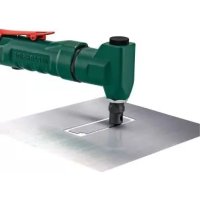
PDBN 6.3 A1 - Pneumatic tool PARKSIDE - Free user manual and instructions
Find the device manual for free PDBN 6.3 A1 PARKSIDE in PDF.


| Product type | Pneumatic nibbler |
| Brand | Parkside |
| Model | PDBN 6.3 A1 |
| Operating pressure | 6.3 bar |
| Compressed air connection | 1/4" (6.35 mm) |
| No-load speed | Up to 3500 min⁻¹ |
| Air consumption | Approx. 200 l/min |
| Max cutting thickness (steel sheet) | 1.2 mm |
| Max cutting thickness (aluminum) | 1.6 mm |
| Cutting width | 4.5 mm |
| Length | 195 mm |
| Weight | 0.8 kg |
| Sound level (sound pressure LpA) | 91.6 dB(A), uncertainty K=3 dB |
| Sound level (sound power LwA) | 102.6 dB(A), uncertainty K=3 dB |
| Vibrations (emission value) | 2.80 m/s², uncertainty K=0.77 m/s² |
| Power supply | Compressed air (max pressure 6.3 bar) |
| Recommended lubrication | Engine oil SAE 10-20 |
| Warranty | 3 years |
| Intended use | Domestic use, cutting of sheet metal, aluminum, plastic, leather, etc. |
| Delivery contents | 1 pneumatic nibbler, 1 nozzle, 1 instruction manual |
| Required protective equipment | Safety goggles, gloves, hearing protection, respiratory mask |
| Maintenance | Clean with a damp cloth and mild soap; lubricate regularly through the air connection; have repairs done by a professional. |
| After-sales service | www.lidl-service.com (ref. IAN 303635_1810) |
Frequently Asked Questions - PDBN 6.3 A1 PARKSIDE
User questions about PDBN 6.3 A1 PARKSIDE
0 question about this device. Answer the ones you know or ask your own.
Ask a new question about this device
Download the instructions for your Pneumatic tool in PDF format for free! Find your manual PDBN 6.3 A1 - PARKSIDE and take your electronic device back in hand. On this page are published all the documents necessary for the use of your device. PDBN 6.3 A1 by PARKSIDE.
USER MANUAL PDBN 6.3 A1 PARKSIDE
Operation and Safety Notes
Translation of the original instructions
NBLBE
PERSLUCHT
PLAATNIBBELSCHAAR
Before reading, unfold the page containing the illustrations and familiarise yourself with all functions of the device.
FR BE
GB/IE/NI Operation and Safety Notes Page 5
Table of pictograms used
Introduction
Intended use Page 6
Parts description 7
Technical specifications.. 7
Package contents
Safety instructions for compressed air tools.. Page 8
Residual risk Page 15
Operation 15
Before use.. 15
Using the device. 15
Switching OFF.. 16
Maintenance and cleaning.. Page 16
Warranty and service information.. Page 17
Warranty conditions.. 17
Warranty period and statutory claims for defects . Page 17
Extent of warranty . 17
Processing of warranty claims.. Page 17
Service 18
Information about recycling and disposal.. Page 18
EU Declaration of Conformity. Page 18
Table of pictograms used / Introduction
Table of pictograms used
Read the operating instructions! Important note!
Wear hearing protection, a respirator/dust mask, safety goggles and protective gloves!
Attention! Possible risks!
Compressed air hose
Never use hydrogen, oxygen, carbon dioxide or any other bottled gas as an energy source!
Dispose of packaging properly. Do not dispose of the appliance in household waste!
Oil regularly!
Made from recycling material
Packaging material - corrugated paper
AIR NIBBLER PDBN 6.3 A1
Introduction
Congratulations! You have purchased one of our high-quality products. Please familiarise yourself with the product before setup or first use. Please also read the safety instructions carefully. This product must be set up or used only by people who have been trained to do so.
KEEP OUT OF THE REACH OF CHILDREN!
- Intended use
The air nibbler is a tool powered by compressed air for skilled manual work. This is suitable for the cutting of sheet metal (max. material thickness 1.2mm ), aluminium (max. material thickness 1.6mm ), plastic, leather and much more. With a air nibbler it is possible to make wave-shaped, round, straight and winding cuts in the material. The operator must protect him/herself against fragments with the use of safety goggles and protective gloves for accidental contact with any sharp edges.
Caution! This device may be used only as specified herein. The stated material thickness (cutting capacity) must not be exceeded, this will damage your tool.
Keep these instructions in a safe place.
Ensure you hand over all documentation when passing the product on to anyone else.
Any use that differs to the intended use as stated above is prohibited and potentially dangerous.
Damage or injury caused by misuse or disregarding the above warning is not covered by the warranty or any liability on the part of the manufacturer.
This product is not suitable for commercial use. It is only suitable for domestic use or similar applications.
- Parts description
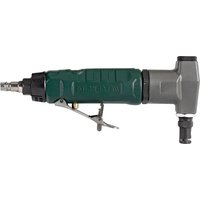
Air nibbler
Switch ON guard
3 Trigger lever
4 Compressed air connection
5 Barbed fitting
6 Exhaust air opening
7 Matrices
8 Stamp
Note: The use of the term "product" or "device" in the following text refers to the air nibbler named in these operating instructions.
- Technical specifications
Product:Airnibbler
Model: PDBN 6.3 A1
Operating pressure: 6.3 bar
Compressed air
connection: 14'' (6.35 mm)
Var. speed up to 3500 min
Air consumption: max. 200 l/min
Cutting capacity: Sheet metal 1.2 mm /
Aluminium 1.6 mm
Cutting width: 4.5mm
Length: 195 mm
Weight: 0.8kg
Noise emission values
(as per EN ISO 15744): LPC, peak: 104.2 dB
L:102.6dB
LpA:91.6dB
Uncertainty K: 3 dB
Vibration
(as per ISO 28927-7): 2.80 m/s2
Uncertainty K: 0.77 m/s²
Information on noise emission values
It must be noted that the stated noise emission values are noise emission levels and thus, do not represent safe workplace values at the same time. Based on the interaction between the emission and immission levels, the need for additional precautionary measures cannot be reliably assessed.
Factors that can influence the immission level present at the workplace include the duration of effects, characteristics of the working room, other noise sources, etc.
Furthermore, permissible immission levels can vary from state to state.
This information should allow the user to carry out a better assessment of hazards and risks.
Information on vibration value
The named vibration value can be used to compare a tool with another.
The actual vibration emission values can differ depending on the type of application. To protect the user, the following safety measures should be observed depending on the type of application or the conditions of use.
Service and maintain the device according to these instructions.
Only use accessories that are in perfect condition.
Plan your work steps so that devices that vibrate heavily do not need to be used during the day.
Package contents
1 air nibbler
1 set of operating instructions
1 barbed fitting

Safety instructions for compressed air tools
PLEASE READ THROUGH THE OPERATING INSTRUCTIONS CAREFULLY BEFORE USE. THESE FORM PART OF THE PRODUCT AND MUST BE AVAILABLE AT ALL TIMES!
WARNING! When compressed air tools are used, basic safety precautions must be taken in order to avoid the risk of fire, electric shock or personal injury. Before first using the product, please ensure you read and follow these operating instructions in full, and keep them in a safe place.
WARNING! The specified hazards are foreseeable risks associated with the general use of handheld air nibbler. However, users must themselves consider the risks that can occur when using the equipment for a specific application.
WARNING!
DANGER OF INJURY!
Switch off the compressed air supply before changing tools and settings or performing maintenance.
WARNING!
EXPLOSION HAZARD!
Never use petrol or other flammable liquids to clean the pneumatic device! Residual fumes in the pneumatic device could be ignited by sparks and cause the pneumatic device to explode. Do not work with the device in explosion hazard areas where combustible liquids, gases or dusts are present. Never work on materials which are or could potentially be highly flammable or explosive.
GENERAL SAFETY RULES
For multiple hazards: The safety instructions must be read and understood before configuration, operation, repair, maintenance, and exchange of accessories on the air nibbler and before all work near the machine. If this is not the case, there may be grievous injury as a result. The air nibbler should be configured, set, and used
exclusively by correspondingly qualified and trained operating personnel.
- Do not modify the air nibbler. Alterations may compromise the effectiveness of the safety measures and increase the risks for the operating personnel.
The safety instructions may not become lost - give these to the operating personnel.
Never use damaged air nibblers.
The air nibbler must be inspected regularly for the clear legibility of all rated values and labels as demanded under this section of ISO 11148. If necessary, the employer/user must contact the manufacturer for replacement labels.
HAZARDS FROM FLYING PARTS
- Disconnect the air nibbler from the compressed air supply before fitting or replacing the machine tool or accessories.
A fracturing workpiece, accessory, or machine tool can eject parts at high speed.
Impact resistant eye protection must be worn when the air nibbler is being operated. The degree of this requisite protection should be rated
separately for every single use.
Ensure that the workpiece is fixed securely in place.
- Appropriate safety precautions must be taken depending on the size and type of the workpiece.
Use suitable clamping devices to prevent a slipping of the workpiece.
It is important to ensure that metal cuts are guided in one direction that do not pose any hazards.
Check that there can be no hazards posed by sparks and debris generated during use.
TRAPPING HAZARDS
There is a risk of strangulation, scalp ing, and/or other cutting injury when loose clothing, jewellery, necklaces, hair, or gloves are not kept away from the machine and its accessories.
HAZARDS DURING OPERATION
Using the air nibbler may expose the operating personnel's hands to hazards such as e.g. cuts, scrapes, and heat.
Avoid touching the blade when the pneumatic sheet
metal nibbler is being connected to the compressed air supply.
Cutting with the air nibbler produces sharp edges.
Protective equipment such as gloves, aprons, and hard hats must be used.
The operating and the maintenance personnel must be physically able to handle the machine's position, size, mass, and power output.
Hold the machine correctly: Be prepared to counteract the usual or sudden movements - keep both hands ready.
Make sure that your body is balanced and that you are standing on a stable surface.
Activate a startup or shutdown control device in the event of power outage.
Use only those lubricants recommended by the manufacturer.
- Avoid direct contact with the machine tool during and after use because it will heat up.
It is always necessary to use sharp tools.
Avoid unsuitable postures because this could make a reaction to a normal or unexpected movement of the air nibbler impossible.
An unexpected movement of the machine or breaking of the blades can result in injuries.
Warnings of the risk of explosion or fire with regard to the processed material are necessary.
Safety goggles, protective gloves and protective clothing must be worn.
Wear protective equipment and always wear safety goggles. Depending on the type of pneumatic tool and how it is used, wearing protective equipment such as a dust mask, non-slip safety shoes, a hard hat and hearing protection can lessen the risk of injuries.
A hard hat must be worn for overhead work.
The operating personnel must make sure that there is nobody standing nearby.
Personal protective equipment such as suitable gloves, aprons, and hard hats must be used.
HAZARDS FROM REPEATED MOVEMENTS
Using a air nibbler for work related activities may cause unpleasant sensations in the
operating personnel's hands, arms, neck, shoulders, and other parts of the body.
When using a air nibbler, the operating personnel should adopt a comfortable posture, stand on a stable surface, and avoid postures making it difficult to maintain balance. The operating personnel should change their posture during long work periods, thereby helping to minimise unpleasant sensations and fatigue.
If the operating personnel should feel symptoms like e.g. constant or recurrent nausea, complaints, throbbing, pain, tingling, numbness, burning, or stiffness, these should not be ignored. The operating personnel should report this to the employer and consult a qualified medical expert.
HAZARDS FROM ACCESSORIES
- Disconnect the air nibbler from the compressed air supply before fitting or replacing the machine tool or accessory.
Exclusively use accessories and consumables in the sizes and types recommended by the manufacturer of the air nibbler; do not use any other
sizes or types of accessories or consumables.
Blade may heat up during use; they must not be touched.
Do not use accessories or machine tools that have tears or deformations.
HAZARDS AT THE WORKPLACE
Slipping, tripping, and falling are the predominant causes of injuries at work. Take note of surfaces that may have become slippery through the use of the machine and of tripping hazards posed by the air or hydraulic hose.
Proceed carefully in unfamiliar environments. There may be hidden dangers in the form of electric or other supply cables.
The air nibbler is not designed for use in potentially explosive atmospheres and is not insulated against contact with electrical power sources.
Make sure that there are no electrical lines, gas piping, etc., that may pose a hazard in the event of damage caused by the machine in use.
HAZARDS FROM DUST AND VAPOURS
The dusts and vapours generated by pneumatic sheet metal nibbler may be detrimental to health (e.g. cancer, birth defects, asthma, dermatitis). These risks must be assessed without fail and the corresponding regulating mechanisms implemented.
This risk assessment should extend to the dusts generated by the machine in use and to the potential raising of dust deposits.
The air nibbler must be operated and serviced as recommended in these instructions if the release of dust and vapours is to be minimised.
The exhaust air must be extracted in such a manner that the dust raised in dusty environments is reduced to a minimum.
If dusts and vapours are generated, the main task is to check these at the place of their release.
All machine fitted installations or accessories designed to capture, extract, or suppress airborne dust or vapours should be used and serviced
in accordance with the manufacturer's instructions.
Do not breathe in the device's exhaust air. Avoid exposing your eyes to the device's exhaust air.
The exhaust air from the pneumatic device can contain water, oil, particles of metal or dirt from the compressor. This can be harmful to health.
The consumables / machine tools must be selected, serviced, and replaced in compliance with the recommendations in these instructions if there is to be no unnecessary increase to dust and vapour levels.
Use respirator equipment as set down in your employer's instructions or in the work and health protection rules.
■ Be careful not to inhale the oil mist (lubricant) emitted by the unit.
HAZARDS FROM NOISE
The effects of high noise levels may cause permanent damage to hearing when there is inadequate protection.
This may lead to loss of hearing and other problems, e.g. tinnitus (ringing, buzzing, whistling, or humming in the ears). These risks must
be assessed without fail and the corresponding regulating mechanisms implemented.
Regulating mechanisms suitable for minimising risks include e.g. the use of insulating materials that suppress ringing noises on the workpieces.
Use hearing protection equipment as set down in your employer's instructions or in the work and health protection rules.
The air nibbler must be operated and serviced as recommended in these instructions if there is to be no unnecessary increase to noise levels.
If the air nibbler is fitted with a silencer, always make sure that this is in place and in full working order when the machine is operating.
The consumables / machine tools must be selected, serviced, and replaced in compliance with the recommendations in these instructions if there is to be no unnecessary increase to noise levels.
■ Be careful not to inhale the oil mist (lubricant) emitted by the unit.
HAZARDS FROM VIBRATIONS
Vibrations can prove detrimen
tal to the nerves and blood circulation in hands and arms.
When working in cold environments, wear warm clothing, and keep your hands warm and dry.
If you start feeling numbness, tingling, or pain in your fingers or hands, or the skin of your fingers or hands starts turning white, stop work with the air nibbler, notify your employer, and seek medical advice. Furthermore, you should consult an appropriately qualified doctor.
The air nibbler must be operated and serviced as recommended in these instructions if there is to be no unnecessary increase to vibration levels.
- Keep a reliable, but not too tight grip on the machine, noting the force of your manual response: vibration levels tend to increase with tighter grips.
ADDITIONAL SAFETY INSTRUCTIONS FOR PNEUMATICMACHINES
Compressed air can cause grievous injury.
When the machine is not in use and before replacing accessories or performing
repairs, make sure that the air supply has been shut off, the air hose is unpressurised, and the machine has been disconnected from the air supply.
Never direct the air flow towards yourself or any other person.
Thrashing hoses can cause grievous injury. So always check that the hoses and their fasteners are undamaged and have not detached.
Locking pins must be used on universal swivel (jaw) couplings. Whipcheck hose fasteners must be used as protection against a failing hose-hose and hose-machine connector.
Make sure that the maximum pressure specified on the machine is not exceeded.
Never carry pneumatic machines by their hoses.
Always use the device for the specific applications for which it has been designed!
Do not overload the device.
Protect the compressed air cable from heat, oil and sharp edges.
The operating pressure setting must be carried out via a pressure reducer.
Always check the hose before
using the device.
Never use hydrogen, oxygen, carbon dioxide or any other bottled gas as an energy for this tool, since this may cause an explosion and lead to serious injuries.
DANGER! Keep hands and other parts of the body away from rotating parts. Otherwise there is a risk of injury.
Make sure that the motor oil SAE 10-20 is applied correctly for the optimal lubrication of the pneumatic device (see Section "Operation" on page 15). Contact with eyes and skin or swallowing the oil can cause inflammations or skin irritations. It is therefore important that the motor oil is applied with great care into the compressed air connection on the pneumatic devices. Be careful not to inhale the oil mist (lubricant) emitted by the unit.
Never allow fresh or old oil to flow into the floor or sewer system. This is illegal! Collect old oil in a suitable container in order to protect the environment. Dispose of it at your
local collection point, petrol station or oil dealer.
- Residual risk
Even if you operate the device as intended, there will be residual risks. The following dangers may occur in connection with the build and design of this air nibbler:
Danger from beating compressed air hoses.
Danger of falling from compressed air hoses lying around.
Reduce the residual risk by carefully using the device as intended and observing all instruction.
Operation
Before use
Disconnect the compressed air supply from the air nibbler 1.
Compressed air supply and connection
Use filtered, lubricated, and regulated compressed air only.
Figure B shows the correct assembly of the barbed fitting 5. Wrap some Teflon sealing tape (not included in the scope of delivery) around the thread of the barbed fitting 5.
Before first use and thereafter at regular intervals (3-4 operating hours), apply a few drops of pneumatic equipment or motor oil SAE 10-20 into the compressed air connection 4 on the pneumatic
device.
Plug the quick-connect plug of the compressed air source with the assembled barbed fitting 5
Using the device
Caution: Please ensure the air nibbler is guided parallel to the surface of the workpiece that is to be cut. Otherwise the air nibbler will tilt and it could result in a reduced cutting capacity and scratches to the surface of the workpiece (Fig. C).
Put on protective clothing and goggles. OTHERWISE THERE IS DANGER OF INJURY!
Set the pressure on the compressor used at approx. 6.3 bar. The maximum operating pressure of the air nibbler is at 6.3 bar.
Check that the workpiece is supported or has been locked in place correctly. A C clamp is recommended on loose workpieces.
Make sure that generated sparks do not pose any danger, i.e. they cannot contact any persons or ignite flammable substances.
Press the switch ON guard and press the trigger arm 3, to be able to perform the work with the air nibbler 1. The device rotates at the maximum speed when the trigger arm 3 is completely pressed.
If the air nibbler tilts during operation, let go of the trigger arm 3
Now try to detach the air nibbler from the workpiece by moving it back and forth. Then remove any detached material found in the cutting element of the air nibbler 1 and start the process again.
To avoid an unwanted and uncontrolled operation, the trigger arm must be designed so that once it is released, it jumps back into the off position. This ends the operation.
Let go of the switch immediately in the event of an interruption of the compressed air supply.
- Switching OFF
Release the trigger area to switch OFF the air nibbler 1.
Disconnect the device from the compressed air supply after completing work.
Note: First detach the compressed air hose from the compressed air source, and then remove the compressed air hose from the device. This will prevent a situation where the compressed air hose whips around uncontrollably.
upwards, and apply a few drops of pneumatic equipment or motor oil SAE 10-20 into the compressed air connection 4 of the air nibbler 1
RECONNECT THE DEVICE TO THE COMPRESSED AIR SUPPLY.
Press the trigger and to distribute the oil more evenly. Hold a cloth or absorbent paper towel in front of the exhaust air openings, and let the device run in idle mode for a few seconds.
ATTENTION! EXCESS OIL IS BLOWN OUT. KEEP THE DISCHARGE HOLE AWAY FROM PERSONS AND OBJECTS.
- Maintenance and cleaning
If the machine is to enjoy a long service life and operate without problems, it is important that the following maintenance instructions are followed.
The air nibbler must be lubricated regularly (after every 3-4 operating hours) if it is to operate flawlessly at all times.
Note: The air nibbler must be regularly serviced and overhauled for proper function and for compliance with the safety requirements. Improper and wrong operation may cause failures and damage to the device.
ATTENTION: DISCONNECT THE DEVICE FROM THE COMPRESSED AIR SUPPLY PRIOR TO MAINTENANCE WORK!
- Keep the pneumatic devices clean. Clean the air nibbler at regular intervals using a moist cloth and a little liquid soap.
- Turn over the air nibbler 1 so that the compressed air connection 4 points
Speed and vibrations must be checked every time after maintenance and care.
The air nibbler should be stored in dry rooms. Make sure that no moisture can enter inside the air nibbler 1
Before all maintenance, clean the device of hazardous substances that have deposited on it (during work processes). Avoid all skin contact with these substances. Hazardous dust coming into contact with skin may cause serious dermatitis. Dust that is generated or raised during maintenance work can be breathed in.
Please ensure that the safety of your device is guaranteed by mean of regular maintenance operations.
- Maintenance must be performed by properly trained personnel only.
Ensure that device repairs always use original replacement parts and are performed by a qualified technician. This ensures that the device is safe to operate at all times.
Warranty and service information
Warranty from Creative Marketing & Consulting GmbH
Dear Customer,
The warranty for this equipment is 3 years from the date of purchase. In the event of product defects, you have legal rights against the retailer of this product.
Your statutory rights are not affected in any way by our warranty conditions, which are described below.
Warranty conditions
The warranty period begins on the date of purchase. Please retain the original proof of purchase. This document is required as your proof of purchase.
Should this product show any defect in materials or manufacture within 3 years from the date of purchase, we will repair or replace it - at our discretion - free of charge. This warranty service requires that you retain proof of purchase (sales receipt) for the defective device for the three year period and that you briefly explain in writing what the fault entails and when it occurred.
If the defect is covered by our warranty, we will repair and return your product or send you a replacement. The original warranty period is not extended when a device is repair or replaced.
Warranty period and statutory claims for defects
The warranty period is not extended by the guarantee. This also applies to replaced and repaired parts. Any damages or defects detected at the time of purchase must be reported immediately after unpacking. Any incidental repairs after the warranty period are subject to a fee.
- Extent of warranty
This device has been manufactured according to strict quality guidelines and carefully inspected before delivery.
The warranty applies to material and manufacturing defects only. This warranty does not cover product parts that are subject to normal wear and tear and can therefore be regarded as consumables, nor does it cover damage to fragile parts such as switches, rechargeable batteries or parts made from glass.
This warranty is voided if the product becomes damaged or is improperly used or maintained. For proper use of the product, all of the instructions given in the operating instructions must be followed precisely. If the operating instructions advise you or warn you against certain uses or actions, these must be avoided in all circumstances.
The product is for consumer use only and is not intended for commercial or trade use. The warranty becomes void in the event of misuse and improper use, use of force, and any work on the device that has not been carried out by our authorised service branch.
- Processing of warranty claims
To ensure prompt processing of your claim, please follow the instructions given below.
Please retain proof of purchase and the article number (e.g. IAN) for all inquiries. The product number can be found on the type plate, an engraving, the cover page of your instructions (bottom left), or the sticker on the back or underside of the device. In the event of malfunctions or other defects, please first contact our service department below by phone or email. If your product is found to be defective, you can then send your product with proof of purchase (till receipt) and a statement describing what
... / Information about recycling and disposal / EU Declaration of Conformity
the fault involves and when it occurred free of charge to the service address given.

Note: If you visit www.lidl-service.com, you can download this manual and many other manuals, product videos and software.
With this QR code you can gain immediate access to the Lidl Service page (www.lidl-service.com) and you can open your operating instructions by entering the article number (IAN) 303635_1810.

Service
How to contact us:
GB, IE, NI
Name: C. M. C. GmbH
Website: www.cmc-creative.de
E-mail: service.gb@cmc-creative.de
Phone: 0-808-189-0652
Registered office: Germany
IAN 303635_1810
Please note that the following address is not a service address. Please first contact the service point given above.
Address:
C. M. C. GmbH
Katharina-Loth-Str. 15
66386 St. Ingbert
GERMANY
Ordering spare parts: www.ersatzfteile.cmc-creative
Information about recycling and disposal

Please return this device, accessories and packaging to your local recycling depot.
Do not dispose of the pneumatic tool in household waste, in fire or in water. Devices that are no longer functional should be recycled wherever possible. Ask your local stockist for advice.
EU Declaration of Conformity
We,
C. M. C. GmbH
Responsible for documentation:
Alexander Hoffmann
Katharina-Loth-Str. 15
66386 St. Ingbert
Germany
hereby take sole responsibility for declaring that the product
Air nibbler
Model: PDBN 6.3 A1
Item number: 2194
IAN:3036351810
Year of manufacture: 2019/34
meets the basic safety requirements as
specified in the European Directives
Machinery Directive
EC Directive 2006/42/EU and the amendments to these Directives.
This conformity assessment is based on the following harmonised standards:
EN ISO 12100:2010
EN ISO 11148-11:2011
EN ISO 28927-7:2009
EN ISO 15744
St. Ingbert, 09/05/2019
On behalf of M. Sc. Alexander Hoffmann - Quality Assurance -
Notes
RISQUES DUS AU HAPPAGE
RISQUES DUS A DES MOUVEMENTSREPETITIFS
RISQUES AU POSTE DE TRAVAIL
RISQUES DUS AU BRUIT
RISQUES DUS AUX VIBRATIONS
Site web: www.cmc-creative.de
E-mail: service.fr@cmc-creative.de
Telephone: 0033 (0) 387 84 72 34
Siège: Allemagne
IAN 303635_1810
Directive relative aux machines
Directive CE 2006/42/CE
i.o. M. Sc. Alexander Hoffmann
service.at@cmc-creative.de
service.ch@cmc-creative.de
Telefon: +49 (0) 6894/ 9989751


- PERSLUCHT
- PLAATNIBBELSCHAAR
- FR BE
- Table of pictograms used
- Introduction
- Safety instructions for compressed air tools.. Page 8
- Residual risk Page 15
- Operation 15
- Maintenance and cleaning.. Page 16
- Warranty and service information.. Page 17
- Information about recycling and disposal.. Page 18
- EU Declaration of Conformity. Page 18
- AIR NIBBLER PDBN 6.3 A1
- KEEP OUT OF THE REACH OF CHILDREN!
- - Intended use
- - Parts description
- - Technical specifications
- Information on noise emission values
- Information on vibration value
- Package contents
- Safety instructions for compressed air tools
- PLEASE READ THROUGH THE OPERATING INSTRUCTIONS CAREFULLY BEFORE USE. THESE FORM PART OF THE PRODUCT AND MUST BE AVAILABLE AT ALL TIMES!
- WARNING!
- DANGER OF INJURY!
- EXPLOSION HAZARD!
- GENERAL SAFETY RULES
- HAZARDS FROM FLYING PARTS
- TRAPPING HAZARDS
- HAZARDS DURING OPERATION
- HAZARDS FROM REPEATED MOVEMENTS
- HAZARDS FROM ACCESSORIES
- HAZARDS AT THE WORKPLACE
- HAZARDS FROM DUST AND VAPOURS
- HAZARDS FROM NOISE
- HAZARDS FROM VIBRATIONS
- ADDITIONAL SAFETY INSTRUCTIONS FOR PNEUMATICMACHINES
- - Residual risk
- Compressed air supply and connection
- Using the device
- - Switching OFF
- RECONNECT THE DEVICE TO THE COMPRESSED AIR SUPPLY.
- ATTENTION! EXCESS OIL IS BLOWN OUT. KEEP THE DISCHARGE HOLE AWAY FROM PERSONS AND OBJECTS.
- - Maintenance and cleaning
- ATTENTION: DISCONNECT THE DEVICE FROM THE COMPRESSED AIR SUPPLY PRIOR TO MAINTENANCE WORK!
- Warranty and service information
- Warranty from Creative Marketing & Consulting GmbH
- Warranty conditions
- Warranty period and statutory claims for defects
- - Extent of warranty
- - Processing of warranty claims
- ... / Information about recycling and disposal / EU Declaration of Conformity
- Service
- How to contact us:
- IAN 303635_1810
- Information about recycling and disposal
- EU Declaration of Conformity
- Air nibbler
- Machinery Directive
- RISQUES DUS AU HAPPAGE
- RISQUES DUS A DES MOUVEMENTSREPETITIFS
- RISQUES AU POSTE DE TRAVAIL
- RISQUES DUS AU BRUIT
- RISQUES DUS AUX VIBRATIONS
- Directive relative aux machines
Brand : PARKSIDE
Model : PDBN 6.3 A1
Category : Pneumatic tool