
One+ RCS18X3050F - Electric saw RYOBI - Free user manual and instructions
Find the device manual for free One+ RCS18X3050F RYOBI in PDF.



| Brand | RYOBI |
| Model | One+ RCS18X3050F |
| Product type | Cordless battery chainsaw |
| Power supply | Lithium-ion battery (compatible with One+ system) |
| Guide bar length | 300 mm |
| Chain speed at no load | 10 m/s |
| Guaranteed sound power level | 96 dB(A) |
| Measured sound power level | 93.5 dB(A) |
| Oil tank capacity | Approximately 20 to 40 minutes of use |
| Chain type | Low-kickback chain |
| Chain brake | Yes, manually operated |
| Felling spike | Yes |
| Chain catcher | Yes |
| Handles | Front and rear, with insulated grip surface |
| Intended use | Cutting branches, trunks, logs, and wooden beams (private use) |
| Warranty | 24 months, extendable to 3 years via online registration |
| Routine maintenance | Chain lubrication and tensioning, chain brake cleaning, chain sharpening or replacement |
| Spare parts available | Chain, guide bar, battery pack, sprocket cover |
| Required protective equipment | Helmet, hearing protection, safety glasses, gloves, leg protection, safety boots |
Frequently Asked Questions - One+ RCS18X3050F RYOBI
User questions about One+ RCS18X3050F RYOBI
0 question about this device. Answer the ones you know or ask your own.
Ask a new question about this device
Download the instructions for your Electric saw in PDF format for free! Find your manual One+ RCS18X3050F - RYOBI and take your electronic device back in hand. On this page are published all the documents necessary for the use of your device. One+ RCS18X3050F by RYOBI.
USER MANUAL One+ RCS18X3050F RYOBI

EN
FR
DE
ES
IT
NL
PT
DA
sv
FI
NO
RU
PL
CS
HU
RO
LV
LT
ET
HR
SL
SK
BG
UK
TR


| Important! | It is essential that you read the instructions in this manual before assembling, maintaining and operating the product. |
| Attention! | Il est essentiel que vous lisiez les instructions contenues dans ce manuel avant d'assembler, d'entretenir et d'utiliser le produit. |
| Achtung! | Es ist wichtig, dass Sie vor Zusammenbau, Wartung und Benutzung des Produktes die Anweisungen in dieser Anleitung lesen. |
| ¡Atención! | Resulta fundamental que lea este manual de instrucciones antes de realizar el montaje, el mantenimiento y de utilizar este producto |
| Attenzione! | E' importante leggere le istruzioni contenute nel presente manuale prima di montare il prodotto, svolgere le operazioni di manutenzione sullo stesso e metterlo in funzione. |
| Let op! | Het is van essentieel belang dat u de instructies in deze gebruiksaanwijzing leest voor u het product monteert, onderhoudt en gebruikt. |
| Atenção! | É fundamental que leia as instruções deste manual antes da montagem, manutenção e operação do aparelho. |
| OBS! | Det er vigtigt, at man læser instrukserne i denne brugsanvisning, inden man samler, vedligeholder og betjener produktet. |
| Observera! | Det är viktigt att du läser instruktionerna i manualen före montering, användning och underhåll av produkten. |
| Huomio! | On tärkeää, että luet tämän käsikirjan ohjeet ennen tuotteen kokoamista, huoltoa ja käyttöä. |
| Advarsel! | Det er viktig at du leser instruksjonene i denne manualen før sammensetning, vedlikehold og bruk av produktet |
| Внимание! | Необходимо прочитать инструкции в данном руководстве перед сборкой, обслуживанием и эксплуатацией этого изделия. |
| Uwaga! | Koniecznie należy przeczytać instrukcje zawarte w tym podręczniku przed montażem, obsługą oraz konserwacją produktu. |
| Dûležité upozornění! | Neinstalujte, neprovádějte údržbu ani nepoužívejte tento výrobek dříve, než si přečtete pokyny uvedené v tomto návodu. |
| Figyelem! | Fontos, hogy a termék összeszerelése, karbantartása és használata előtt elolvassa a kézikönyvben található utasításokat. |
| Atenție! | Este esențial să citiți instrucțiunile din acest manual înainte de asamblare, efectuarea întreținerii și operarea produsului. |
| Uzmanību! | Ir svarīgi izlasīt šīs rokasgrāmatas instrukcijas pirms uzstādīšanas, apkopes un preces darbināšanas. |
| Dèmesio! | Prieš surenkant, prižiūrint ir naudojant gaminį, būtina perskaityti šiame vadove pateiktus nurodymus. |
| Tähtis! | Enne masina kokkupanekut, hooldamist ja kasutama hakkamist tuleb käesolevas juhendis esitatud juhised kindlasti läbi lugeda. |
| Upozorenje! | Vrlo je važno da ste prije sklapanja, održavanja i rada s ovim proizvodom pročitali upute u ovom priručniku. |
| Pomembno! | Pomembno je da pred montažo vzdrževanjem in uporabo tega izdelka preberete navodila v tem priročniku. |
| Upzornenie! | Je dôležité, aby ste si pred montážou, údržbou a obsluhou produktu prečitali pokyny v tomto návode. |
| Важно! | Изключително важно е да прочетете инструкциите в настоящото ръководство, преди да преминете към сглобяване, поддръжка или работа с продукта. |
| Важливо! | Дуже важливо, щоб ви прочитали інструкції в цьому керівництві перед складанням, обслуговуванням та експлуатацією цієї машини. |
| Önemli! | Ürünü monte etmeden, kullanmadan ve bakımını yapmadan önce bu kılavuzdaki talimatları okumanız önemlidir. |
Subject to technical modification | Sous réserve de modifications techniques | Technische Änderungen vorbehalten | Bajo reserva de modificaciones técnicas | Con riserva di eventuali modifiche tecniche | Technische wijzigingen voorbehouden | Com reserva de modificações técnicas | Med forbehold for tekniske ændringer | Med förbehåll för tekniska ändringar | Tekniset muutokset varataan | Med forbehold om tekniske endringer | могут быть внесены технические изменения | Z zastrzeżeniem modyfikacji technicznych | Změny technických údajů vyhrazeny | A můszaki módosítás jogát fenntartjuk | Sub rezerva modificațiilor tehnice | Paturam tiesības mainīt tehniskos raksturlielumus | Pasiliekant teisę daryti techninius pakeitimus | Tehnilised muudatused võimalikud | Podloæno tehniëkim promjenama | Tehnične spremembe dopuščene | Právo na technické zmeny je vyhradenė | Подлежи на технически модификации | Є ob’єктом для технічних змін | Teknik değişikliğe tabidir.


Safety, performance, and dependability have been given top priority in the design of your cordless chainsaw.
INTENDED USE
The cordless chainsaw is only intended for use outdoors. For safety reasons the product must be adequately controlled by using two-handed operation at all times.
The product is designed for cutting branches, trunks, logs and beams of a diameter determined by the cutting length of the guide bar. It is only designed to cut wood. It is only to be used in domestic application by adults who have received adequate training on the hazards and preventative measures/actions to be taken whilst using it.
Do not use the product for any purpose not listed above. It is not to be used for professional tree services. The product is not to be used by children or by persons not wearing adequate personal protective equipment and clothing.
WARNING
When using the product, the safety rules must be followed. For your own safety and that of bystanders, you must read and fully understand these instructions before operating the product. You should attend a professionally organized safety course in the use, preventative actions, fi rst-aid and maintenance of chainsaws. Please keep these instructions safe for later use.
WARNING
Chainsaws are potentially dangerous tools. Accidents involving the use of chainsaws often result in loss of limbs or death. It is not just the chainsaw that is the hazard. Falling branches, toppling trees, rolling logs can all kill. Diseased or rotting timber poses additional hazards. You should assess your capability of completing the task safely. If there is any doubt, leave it to a professional tree surgeon.
GENERAL SAFETY WARNINGS
WARNING
Read all safety warnings and all instructions. Failure to follow the warnings and instructions may result in electric shock, fire and/or serious injury.
Save all warnings and instructions for future reference.
The term “power tool” in the warnings refers to your mains-operated (corded) power tool or battery-operated (cordless) power tool.
WORK AREA SAFETY
- Keep work area clean and well lit. Cluttered or dark areas invite accidents.
- Do not operate power tools in explosive atmospheres, such as in the presence of flammable liquids, gases or dust. Power tools create sparks which may ignite the dust or fumes.
- Keep children and bystanders away while operating
a power tool. Distractions can cause you to lose control.
ELECTRICAL SAFETY
■ Power tool plugs must match the outlet. Never modify the plug in any way. Do not use any adapter plugs with earthed (grounded) power tools. Unmodified plugs and matching outlets will reduce risk of electric shock.
- Avoid body contact with earthed or grounded surfaces, such as pipes, radiators, ranges and refrigerators. There is an increased risk of electric shock if your body is earthed or grounded.
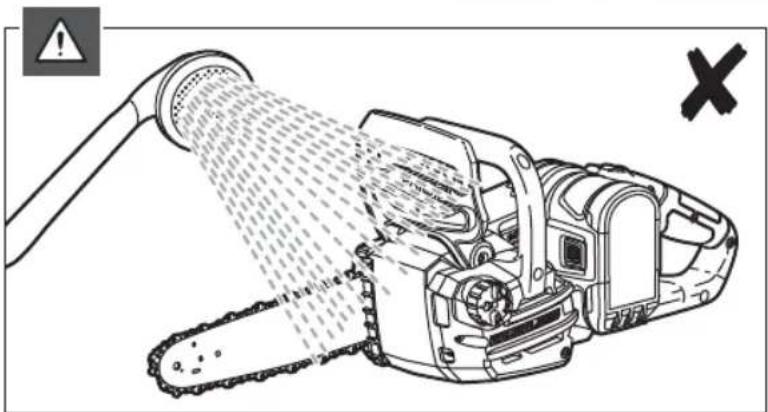
- Do not expose power tools to rain or wet conditions. Water entering a power tool will increase the risk of electric shock.
- Do not abuse the cord. Never use the cord for carrying, pulling or unplugging the power tool. Keep cord away from heat, oil, sharp edges or moving parts. Damaged or entangled cords increase the risk of electric shock.
- When operating a power tool outdoors, use an extension cord suitable for outdoor use. Use of a cord suitable for outdoor use reduces the risk of electric shock.
If operating a power tool in a damp location is unavoidable, use a residual current device (RCD) protected supply. Use of an RCD reduces the risk of electric shock.
PERSONAL SAFETY
■ Stay alert, watch what you are doing and use common sense when operating a power tool. Do not use a power tool while you are tired or under the influence of drugs, alcohol or medication. A moment of inattention while operating power tools may result in serious personal injury.
■ Use personal protective equipment. Always wear eye protection. Protective equipment such as dust mask, non-skid safety shoes, hard hat or hearing protection used for appropriate conditions will reduce personal injuries.
■ Prevent unintentional starting. Ensure the switch is in the off-position before connecting to power source and/or battery pack, picking up or carrying the tool. Carrying power tools with your finger on the switch or energising power tools that have the switch on invites accidents.
■ Remove any adjusting key or wrench before turning the power tool on. A wrench or a key left attached to a rotating part of the power tool may result in personal injury.
- Do not overreach. Keep proper footing and balance at all times. This enables better control of the power tool in unexpected situations.
■ Dress properly. Do not wear loose clothing or jewellery. Keep your hair, clothing and gloves away from moving parts. Loose clothes, jewellery or long hair can be caught in moving parts.
■ If devices are provided for the connection of dust
extraction and collection facilities, ensure these are connected and properly used. Use of dust collection can reduce dust-related hazards.
POWER TOOL USE AND CARE
- Do not force the power tool. Use the correct power tool for your application. The correct power tool will do the job better and safer at the rate for which it was designed.
- Do not use the power tool if the switch does not turn it on and off. Any power tool that cannot be controlled with the switch is dangerous and must be repaired.
■ Disconnect the plug from the power source and/or the battery pack from the power tool before making any adjustments, changing accessories or storing power tools. Such preventive safety measures reduce the risk of starting the power tool accidentally.
■ Store idle power tools out of the reach of children and do not allow persons unfamiliar with the power tool or these instructions to operate the power tool. Power tools are dangerous in the hands of untrained users. - Maintain power tools. Check for misalignment or binding of moving parts, breakage of parts and any other condition that may affect the power tool's operation. If damaged, have the power tool repaired before use. Many accidents are caused by poorly maintained power tools.
- Keep cutting tools sharp and clean. Properly maintained cutting tools with sharp cutting edges are less likely to bind and are easier to control.
- Use the power tool, accessories and tool bits etc, in accordance with these instructions, taking into account the working conditions and the work to be performed. Use of the power tool for operations different from those intended could result in a hazardous situation.
BATTERY TOOL USE AND CARE
■ Recharge only with the charger specified by the manufacturer. A charger that is suitable for one type of battery pack may create a risk of fire when used with another battery pack.
■ Use power tools only with specifically designated battery packs. Use of any other battery packs may create a risk of injury and fire
- When battery pack is not in use, keep it away from other metal objects, like paper clips, coins, keys, nails, screws or other small metal objects, that can make a connection from one terminal to another. Shorting the battery terminals together may cause burns or a fire.
■ Under abusive conditions, liquid may be ejected from the battery; avoid contact. If contact accidentally occurs, flush with water. If liquid contacts eyes, additionally seek medical help. Liquid ejected from the battery may cause irritation or burns.
SERVICE
- Have your power tool serviced by a qualified repair person using only identical replacement parts. This will ensure that the safety of the power tool is maintained.
ADDITIONAL GENERAL SAFETY WARNINGS
■ Some regions have regulations that restrict the use of the product. Check with your local authority for advice.
■ Never allow children or people unfamiliar with the instructions to use the product. Local regulations may restrict the age of the operator.
- Ensure before each use that all controls and safety devices function correctly. Do not use the product if the "off" switch does not stop the motor.
■ Wear full eye and hearing protection, strong sturdy boots and gloves, as well as head protection while operating the product. Use a face mask if operation is dusty.
■ Use of hearing protection reduces the ability to hear warnings (shouts or alarms). The operator must pay extra attention to what is going on in the work area.
- Keep firm footing and balance. Do not overreach. Overreaching can result in loss of balance and can increase the risk of kickback.
■ Do not wear loose fitting clothing, short trousers, or jewellery of any kind.
- Secure long hair so it is above shoulder level to prevent entanglement in moving parts.
■ Beware of thrown, flying, or falling objects. Keep all bystanders, children, and animals at least 15 m away from the work area.
- Do not operate in poor lighting. The operator requires a clear view of the work area to identify potential hazards.
■ Operating similar tools nearby increases both the risk of hearing injury and the potential for other persons to enter your work area.
- Keep all parts of your body away from any moving part.
- Inspect the product before each use. Check for correct operation of all controls, including the chain brake. Check for loose fasteners, make sure all guards and handles are properly and securely attached. Replace any damaged parts before use.
- Do not modify the product in any way or use parts and accessories which are not recommended by the manufacturer.
WARNING
If the product is dropped, suffers heavy impact or begins to vibrate abnormally, immediately stop the product and inspect for damage or identify the cause of the vibration. Any damage should be properly repaired or replaced by an authorised service centre.
CHAINSAW SAFETY WARNINGS
- Keep all parts of the body away from the saw chain when the chainsaw is operating. Before you start the chainsaw, make sure the saw chain is not
contacting anything. A moment of inattention while operating chainsaws may cause entanglement of your clothing or body with the saw chain.
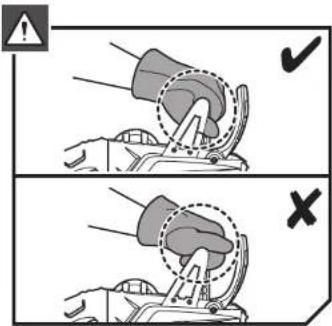
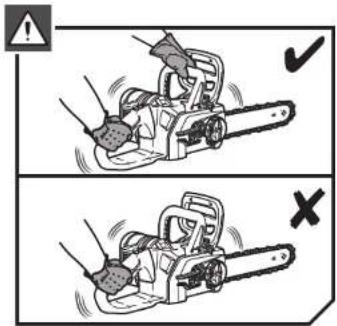
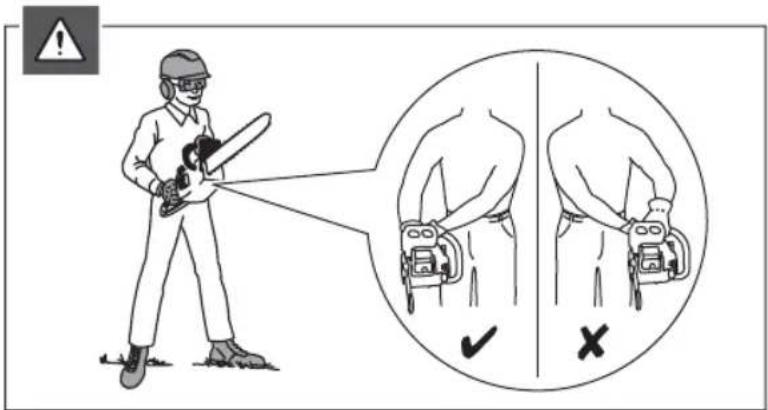
■ Always hold the chainsaw with your right hand on the rear handle and your left hand on the front handle. Holding the chainsaw with a reversed hand configuration increases the risk of personal injury and should never be done.
- Hold the power tool by insulated gripping surface only, because the saw chain may contact hidden wiring. Saw chains contacting a “live” wire may make exposed metal parts of the power tool “live” and could give the operator an electric shock.
■ Wear safety glasses and hearing protection. Further protective equipment for head, hands, legs and feet is recommended. Adequate protective clothing will reduce personal injury by flying debris or accidental contact with the saw chain.
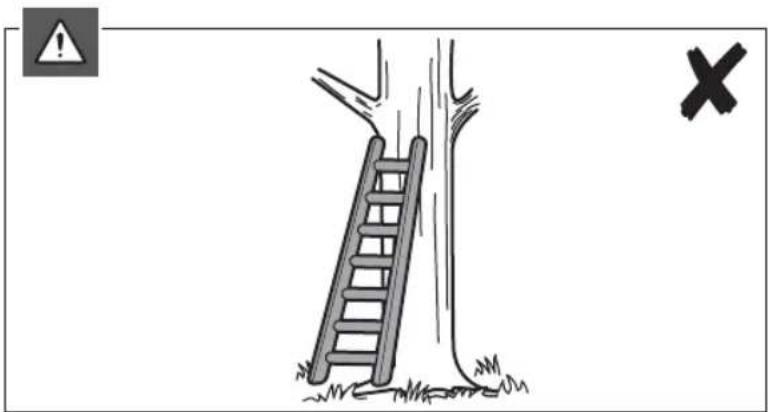
- Do not operate a chainsaw in a tree. Operation of a chainsaw while up in a tree may result in personal injury.
■ Always keep proper footing and operate the chainsaw only when standing on fixed, secure and level surface. Slippery or unstable surfaces such as ladders may cause a loss of balance or control of the chainsaw.
- When cutting a limb that is under tension be alert for spring back. When the tension in the wood fibres is released the spring loaded limb may strike the operator and/or throw the chainsaw out of control.
■ Use extreme caution when cutting brush and saplings. The slender material may catch the saw chain and be whipped toward you or pull you off balance.
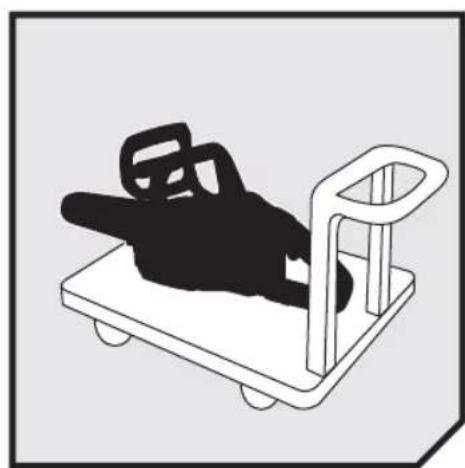
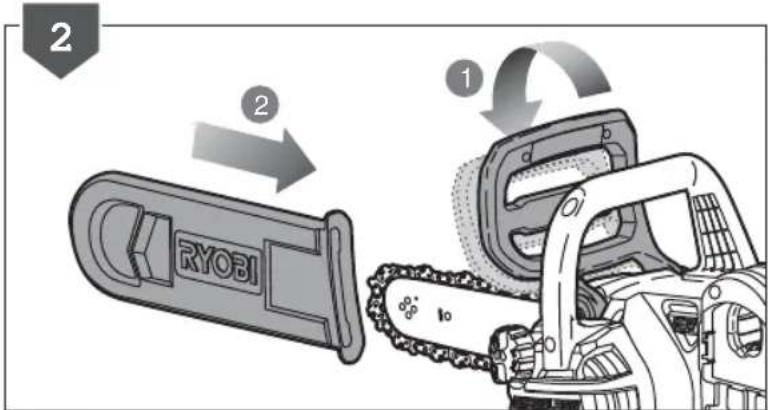
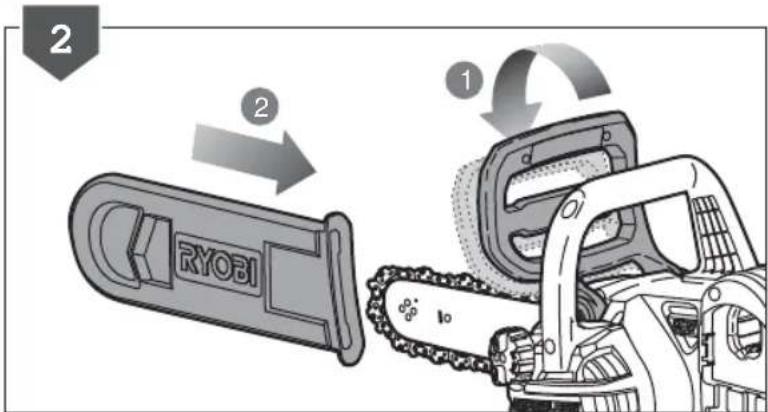
- Carry the chainsaw by the front handle with the chainsaw switched off and away from your body. When transporting or storing the chainsaw always fit the guide bar cover. Proper handling of the chainsaw will reduce the likelihood of accidental contact with the moving saw chain.
■ Follow instructions for lubricating, chain tensioning and changing accessories. Improperly tensioned or lubricated chain may either break or increase the chance for kickback.
- Keep handles dry, clean, and free from oil and grease. Greasy, oily handles are slippery causing loss of control.
- Cut wood only. Do not use chainsaw for purposes not intended. For example: do not use chainsaw for cutting plastic, masonry or non-wood building materials. Use of the chainsaw for operations different than intended could result in a hazardous situation.
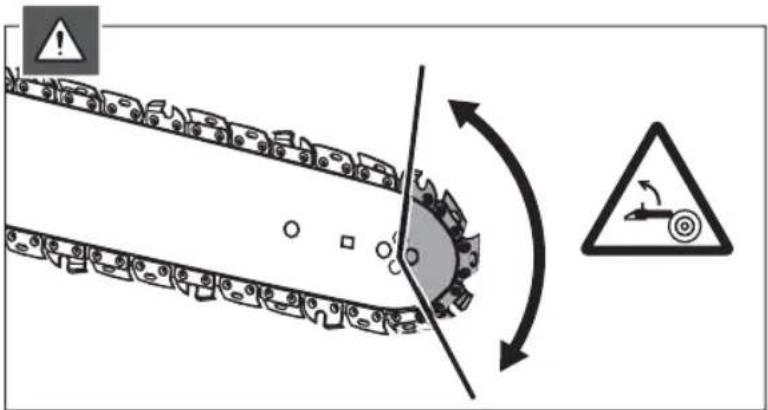
Causes and operator prevention of kickback:
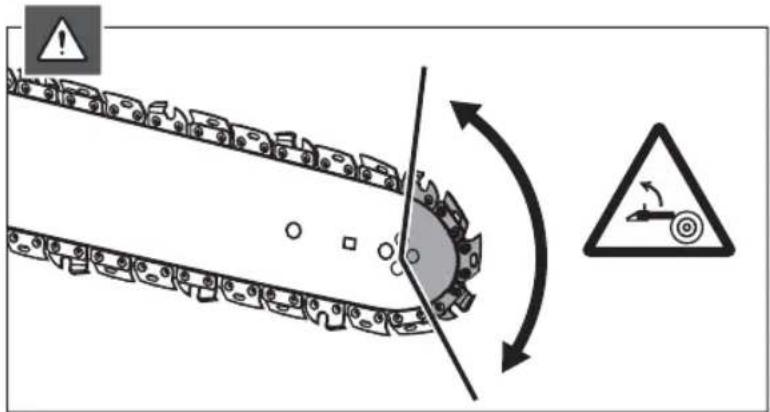
Kickback may occur when the nose or tip of the guide bar touches an object, or when the wood closes in and pinches the saw chain in the cut.
Tip contact in some cases may cause a sudden reverse reaction, kicking the guide bar up and back towards the operator.
Pinching the saw chain along the top of the guide bar may push the guide bar rapidly back towards the operator.
Either of these reactions may cause you to lose control of the saw which could result in serious personal injury. Do not rely exclusively upon the safety devices built into your saw. As a chainsaw user, you should take several steps to keep your cutting jobs free from accident or injury.
Kickback is the result of tool misuse and/or incorrect operating procedures or conditions and can be avoided by taking proper precautions as given below:
- Maintain a firm grip, with thumbs and fingers encircling the chainsaw handles, with both hands on the saw and position your body and arm to allow you to resist kickback forces. Kickback forces can be controlled by the operator, if proper precautions are taken. Do not let go of the chainsaw.
- Do not overreach and do not cut above shoulder height. This helps prevent unintended tip contact and enables better control of the chainsaw in unexpected situations.
■ Only use replacement bars and chains specified by the manufacturer. Incorrect replacement bars and chains may cause chain breakage and/or kickback. - Follow the manufacturer's sharpening and maintenance instructions for the saw chain. Decreasing the depth gauge height can lead to increased kickback.
ADDITIONAL CHAINSAW SAFETY WARNINGS
It is recommended to cut logs on a saw-horse or cradle when operating the product the first time.
■ Ensure all guards, handles and spiked bumper are properly fitted and are in good condition.
■ Persons using this chainsaw should be in good health. The chainsaw is a heavy unit so the operator requires to be physically fit. The operator should be alert, have good vision, mobility, balance and manual dexterity. If there is any doubt, do not operate the chainsaw.
- Do not start using the product until you have a clear work area, secure footing, and a planned retreat path away from the falling tree.
■ Beware of the emission of lubricant mist and saw dust. Wear a mask or respirator if required.
- Do not cut vines and/or small undergrowth (less than 75 mm in diameter).
■ Always hold the chainsaw with both hands when operating the saw. Use a firm grip with thumbs and fingers encircling the chainsaw handles. Right hand must be on the rear handle and left hand on the front handle.
■ Before starting the tool, make sure the saw chain is not contacting any object.
- Do not modify your tool in any way or use it to power any attachments or devices not recommended by the manufacturer for your saw.
■ There should be a first-aid kit containing large wound dressings and a means to summon attention (e.g., whistle) close to the operator. A larger more comprehensive kit should be reasonably nearby.
The operator may be tempted to remove the helmet if there is no danger of falling objects in the work area, but remember the helmet, particularly with the mesh visor, can help reduce the potential for injury to the face and head if kickback occurs.
■ An incorrectly tensioned chain can jump off the guide bar and could result in serious injury or fatality. The length of chain depends on the temperature. Check the tension frequently.
- You should get used to your new chainsaw by making simple cuts on securely supported wood. Do this whenever you have not operated the saw for some time.
■ To reduce the risk of injury associated with contacting moving parts, always stop the motor, apply chain brake, remove the battery pack and make sure all moving parts have come to a stop before:
– cleaning or clearing a blockage
– leaving the product unattended
- installing or removing attachments
– checking, maintenance or working on the machine
The size of the work area depends on the job being performed as well as the size of the tree or work piece involved. For example, felling a tree requires a larger work area than making other cuts, i.e., bucking cuts, etc. The operator needs to be aware and in control of everything happening in this work area.
- Do not cut with your body in line with the guide bar and chain. If you do experience kickback this will help prevent the chain coming into contact with your head or body.
- Do not use a back and forward sawing motion, let the chain do the work, keep the chain sharp and don't try to push the chain through the cut.
- Do not put pressure on the saw at the end of the cut. Be ready to take on the weight of the saw as it cuts free from the wood. Failure to do so could result in possible serious personal injury.
- Do not stop the saw in the middle of a cutting operation. Keep the saw running until it is already removed from the cut.
Push and pull
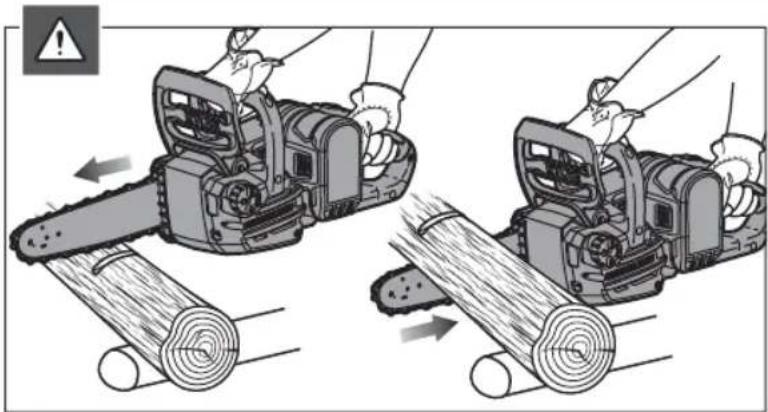
The reaction force is always opposite to the direction the chain is moving. Thus, the operator must be ready to control the tendency for the machine to pull away (forward motion) when cutting on the bottom edge of the bar and the push backwards (towards the operator) when cutting along the top edge.
Saw jammed in the cut
Stop the chainsaw and make it safe. Do not try to force the chain and bar out of the cut as this is likely to break the chain which may swing back and strike the operator. This situation normally occurs because the wood is incorrectly supported and forcing the cut to close under compression thereby pinching the blade. If adjusting the support does not release the bar and chain, use wooden wedges or a lever to open the cut and release the saw. Never try to start the chainsaw when the guide bar is already in a cut or kerf.
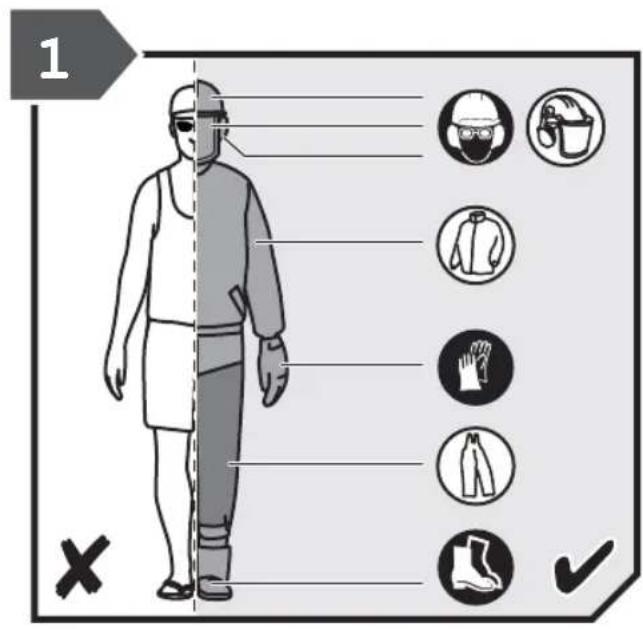
Personal protective equipment
Good quality, personal protective equipment as used by professionals will help to reduce the risk of injury to the operator. The following items should be used when operating your chainsaw:
Safety helmet
- should comply with EN 397 and be CE marked
Hearing protection
- should comply with EN 352-1 and be CE marked
Eye and face protection
- should be CE marked and comply with EN 166 (for safety glasses) or EN 1731 (for mesh visors)
Gloves
- should comply with EN381-7 and be CE marked
Leg protection (chaps)
- should comply with EN381-5, be CE marked and provide all-round protection.
Chainsaw safety boots
- should comply with EN ISO 20345:2004 and be marked with a shield depicting a chainsaw to show compliance with EN 381-3. (Occasional users may use steel toe-cap safety boots with protective gaiters which conform to EN 381-9 if the ground is even and there is little risk of tripping or catching on undergrowth)
Chainsaw jackets for upper body protection
- should comply with EN 381-11 and be CE marked
INSTRUCTIONS CONCERNING THE PROPER TECHNIQUES FOR BASIC FELLING, LIMBING, AND CROSS-CUTTING
Understanding the forces within the wood
When you understand the directional pressures and stresses inside the wood you can reduce the "pinches" or at least expect them during your cutting. Tension in the wood means the fi bers are being pulled apart and if you cut in this area the "kerf" or cut will tend to open as the saw goes through. If a log is being supported on a saw horse and the end is hanging unsupported over the end then tension is created on the upper surface due to the weight of the overhanging log stretching the fi bers. Likewise, the underside of the log will be in compression and the fi bers are being pushed together. If a cut is made in this area the kerf will have the tendency to close up during the cut. This would pinch the blade.
Felling a tree
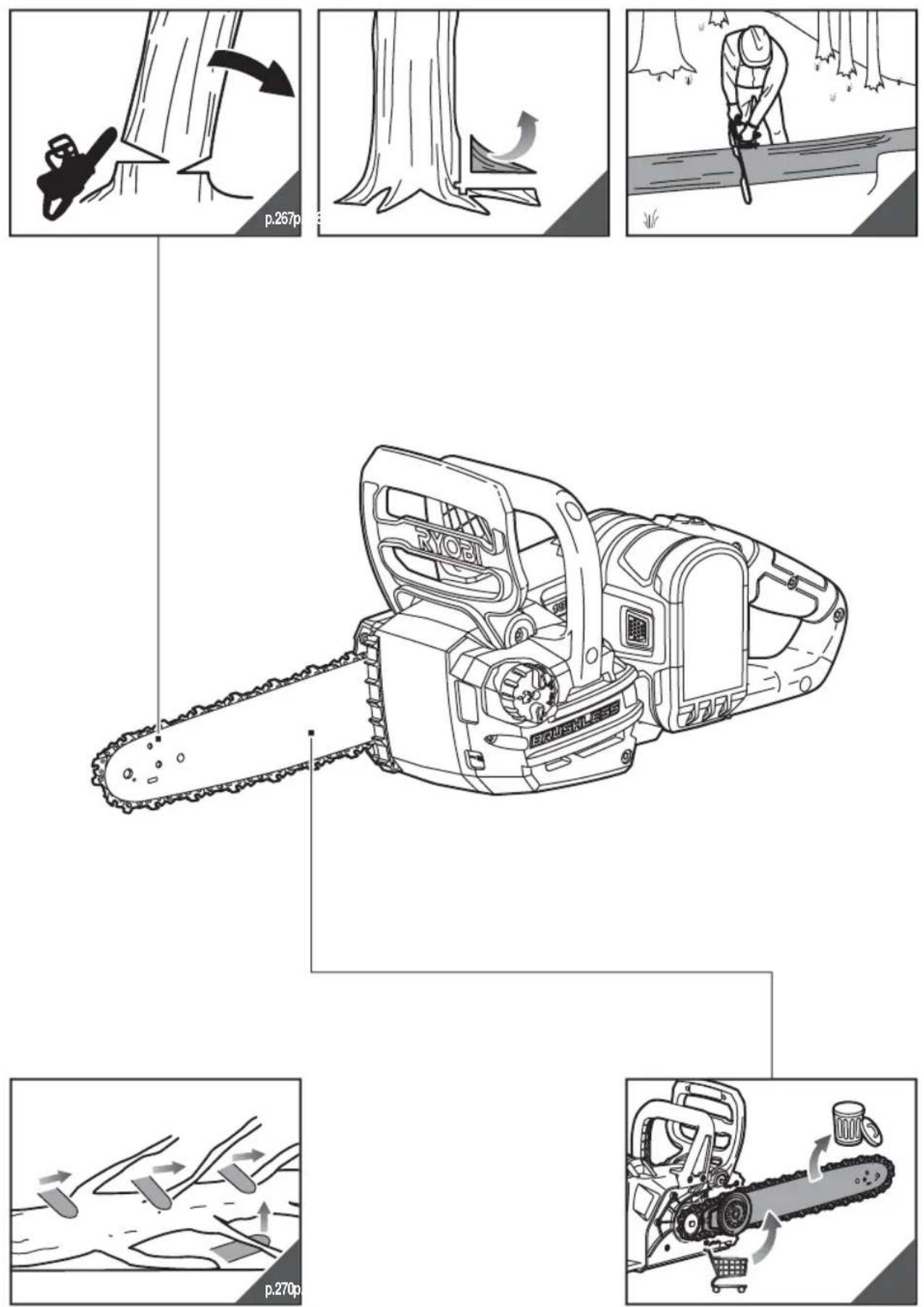
See page 267 - 268.
When bucking and felling operations are being performed by two or more persons at the same time, the felling operations should be separated from the bucking operation by a distance of at least twice the height of the tree being felled. Trees should not be felled in a manner that would endanger any person, strike any utility line or cause any property damage. If the tree does make contact with any utility line, the company should be notified immediately.
The chainsaw operator should keep on the uphill side of the terrain as the tree is likely to roll or slide downhill after it is felled.
An escape path should be planned and cleared as necessary before cuts are started. The escape path should extend back and diagonally to the rear of the expected line of fall.
Before felling is started, consider the natural lean of the tree, the location of larger branches and the wind direction to judge which way the tree will fall.
Remove dirt, stones, loose bark, nails, staples and wire from the tree.
Do not attempt to fell trees which are rotten or have been damaged by wind, fi re, lightning, etc. This is extremely dangerous and should only be completed by professional tree surgeons.
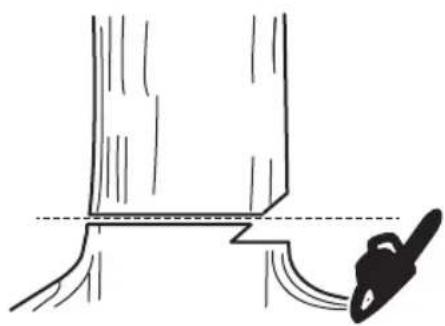
1. Notching undercut
See page 267 - 268.
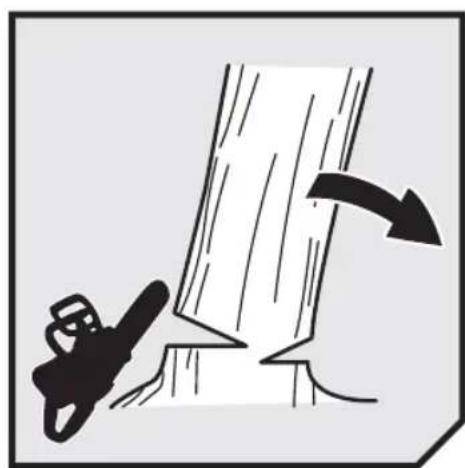
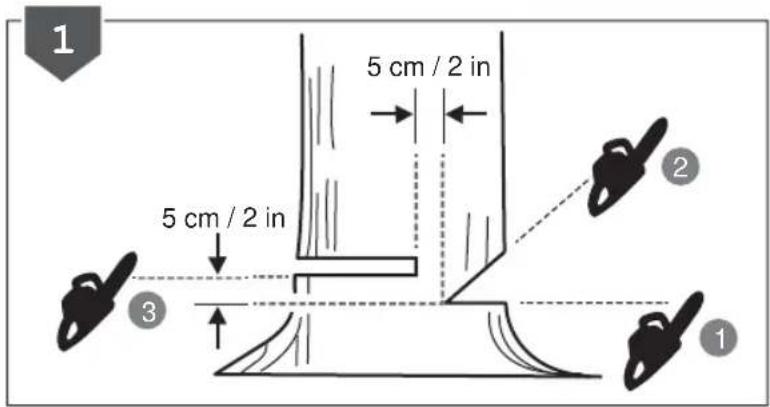
Make the notch 1/3 the diameter of the tree, perpendicular to the direction of falls. Make the lower horizontal notching cut first. This will help to avoid pinching either the saw chain or the guide bar when the second notch is being made.
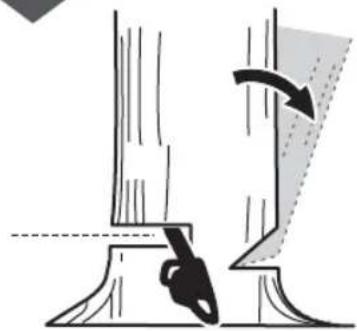
2. Felling back cut
See page 267 - 268.
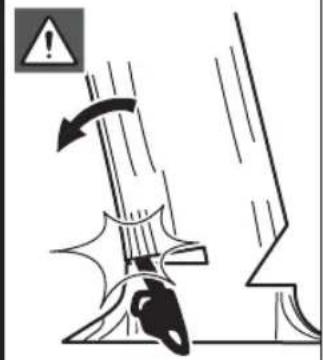
Make the felling back cut at least 50 mm/2 in higher than the horizontal notching cut. Keep the felling back cut parallel to the horizontal notching cut. Make the felling back cut so enough wood is left to act as a hinge. The hinge wood keeps the tree from twisting and falling in the wrong direction. Do not cut through the hinge.
As the felling gets close to the hinge, the tree should begin to fall. If there is any chance that the tree may not fall in desired direction or it may rock back and bind the saw chain, stop cutting before the felling back cut is complete and use wedges of wood, plastic or aluminium to open the cut and drop the tree along the desired line of fall.
When the tree begins to fall remove the chainsaw from the cut, stop the motor, put the chainsaw down, then use the retreat path planned. Be alert for overhead limbs falling and watch your footing.
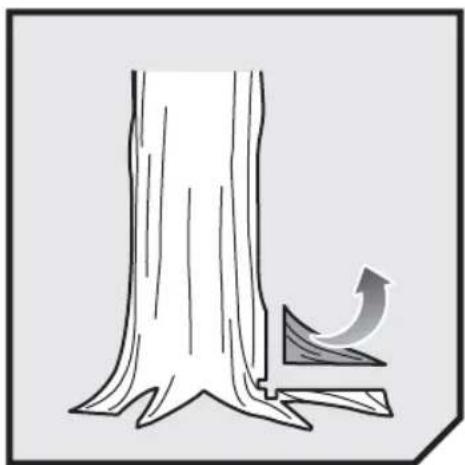
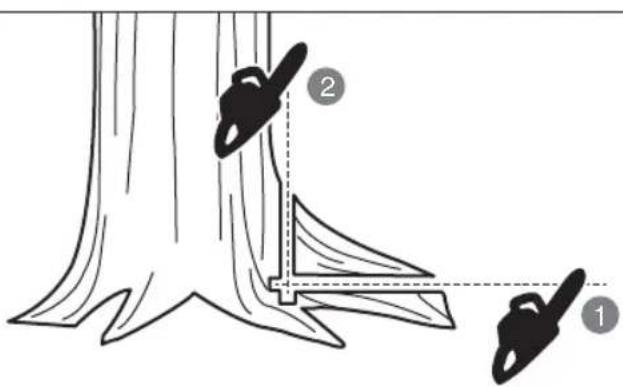
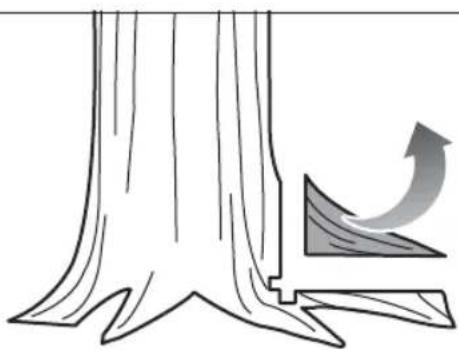
Removing buttress roots
See page 268.
A buttress root is a large root extending from the trunk of the tree above the ground. Remove large buttress roots prior to felling. Make the horizontal cut into the buttress first, followed by the vertical cut. Remove the resulting loose section from the work area. Follow the correct tree felling procedure after you have removed the large buttress roots.
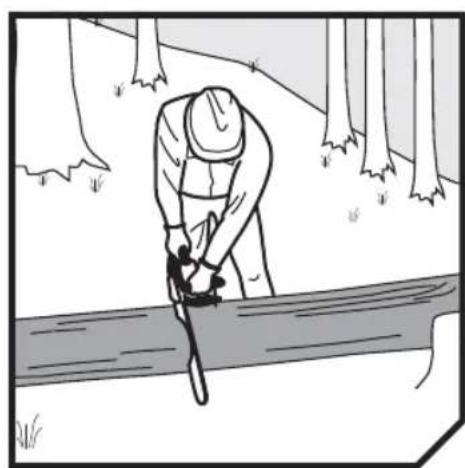
Bucking a log
See page 269.
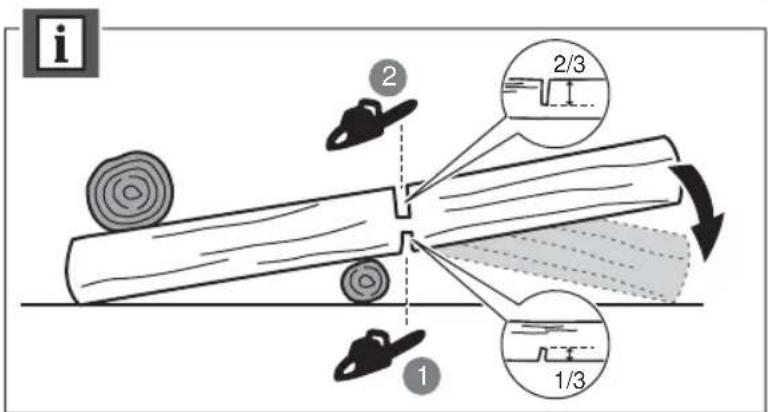
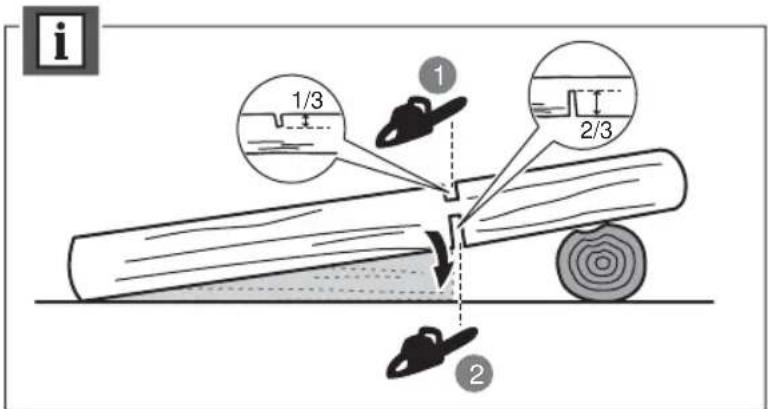
Bucking is cutting a log into lengths. It is important to make sure your footing is firm and your weight is evenly distributed on both feet. When possible, the log should be raised and supported by the use of limbs, logs or chocks. Follow the simple directions for easy cutting. When the log is supported along its entire length, it is cut from the top (overbuck).
When the log is supported on one end, cut 1/3 the diameter from the underside (underbuck). Then make the finished cut by overbucking to meet the first cut.
When the log is supported on both ends, cut 1/3 the diameter from the top (overbuck). Then make the finished cut by underbucking the lower 2/3 to meet the first cut.
When bucking on a slope always stand on the uphill side of the log. When “cutting through”, to maintain complete control release the cutting pressure near the end of the cut without relaxing your grip on the chainsaw handles. Don’t let the chain contact the ground. After completing the cut, wait for the saw chain to stop before you move the chainsaw. Always stop the motor before moving from tree to tree.
Limbing a tree
See page 270.
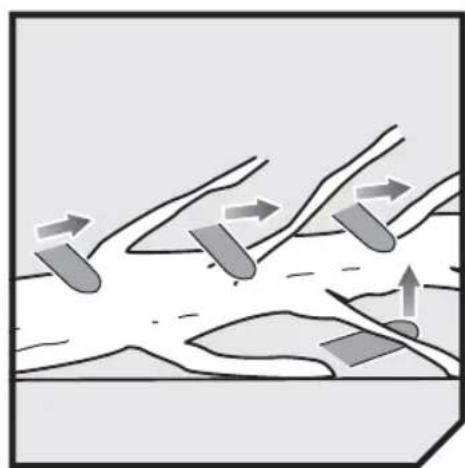
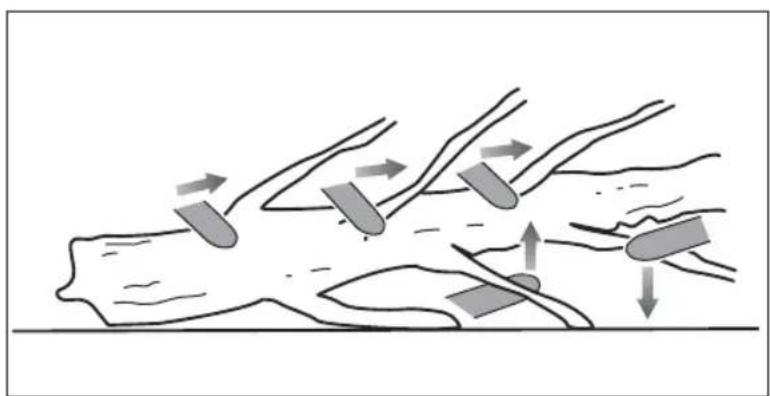
Limbing is removing the branches from a fallen tree. When limbing leave larger lower limbs to support the log off the ground. Remove the small limbs in one cut. Branches under tension should be cut from the bottom up to avoid binding the chainsaw.
Springpoles
See page 270.
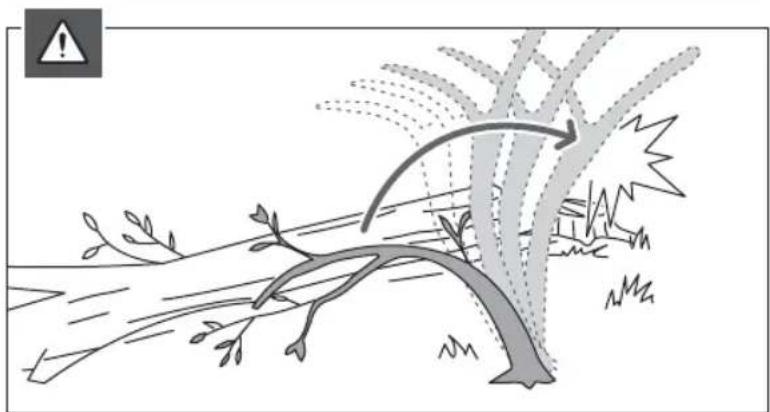
A springpole is any log, branch, rooted stump, or sapling which is bent under tension by other wood so that it springs back if the wood holding it is cut or removed.
On a fallen tree, a rooted stump has a high potential of springing back to the upright position during the bucking cut to separate the log from the stump. Watch out for springpoles—they are dangerous.
WARNING
Springpoles are dangerous and could strike the operator, causing the operator to lose control of the chainsaw. This could result in severe or fatal injury to the operator. This should be done by trained users.
RESIDUAL RISKS
Even when the product is used as prescribed, it is still impossible to completely eliminate certain residual risk factors. The following hazards may arise in use and the operator should pay special attention to avoid the following:
■ Injury caused by vibration
- Always use the right tool for the job, use designated handles and restrict working time and exposure.
■ Damage to hearing due to exposure to noise
- Wear hearing protection and limit exposure.
■ Injury caused by contact with exposed saw teeth of the chain
■ Injury caused by thrown-out pieces of the workpiece (wood chips, splinters)
■ Injury caused by dust and particles
■ Injury to the skin caused by contact with lubricants
■ Parts ejected from the saw chain (cutting/injection hazards)
■ Unforeseen, abrupt movement, or kickback of the guide bar (cutting hazards)
RISK REDUCTION
It has been reported that vibrations from hand-held tools may contribute to a condition called Raynaud's Syndrome in certain individuals. Symptoms may include tingling, numbness and blanching of the fingers, usually apparent upon exposure to cold. Hereditary factors, exposure to cold and dampness, diet, smoking and work practices are all thought to contribute to the development of these symptoms. There are measures that can be taken by the operator to possibly reduce the effects of vibration:
- Keep your body warm in cold weather. When operating the unit wear gloves to keep the hands and wrists warm. It is reported that cold weather is a major factor contributing to Raynaud's Syndrome.
■ After each period of operation, exercise to increase blood circulation.
■ Take frequent work breaks. Limit the amount of exposure per day.
■ Protective gloves available from professional chainsaw retailers are designed specifically for chainsaw use which give protection, good grip and also reduce the effect of handle vibration. These gloves should comply with EN381-7 and must be CE marked.
If you experience any of the symptoms of this condition, immediately discontinue use and see your physician.
WARNING
Injuries may be caused, or aggravated, by prolonged use of a tool. When using any tool for prolonged periods, ensure you take regular breaks.
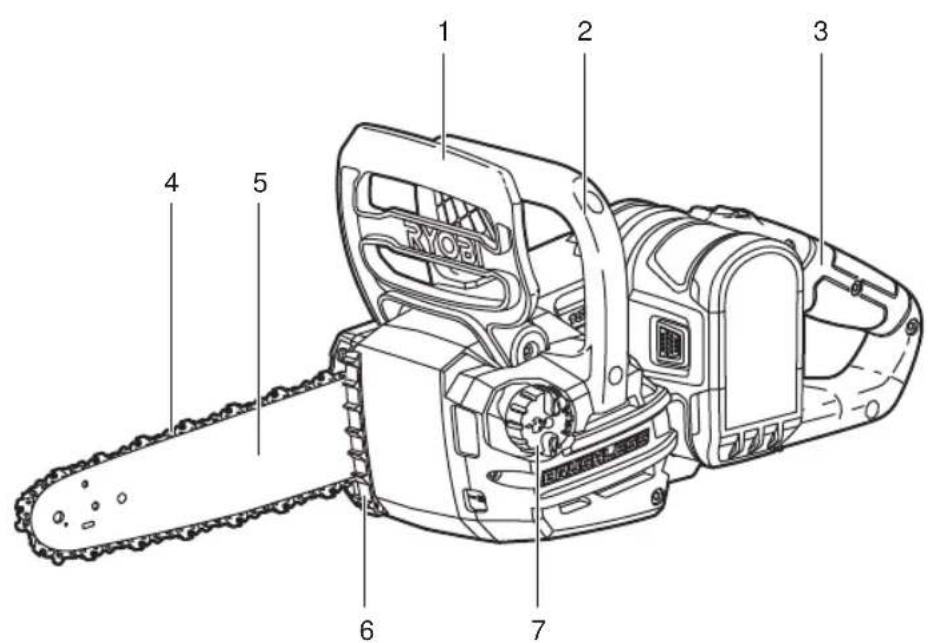
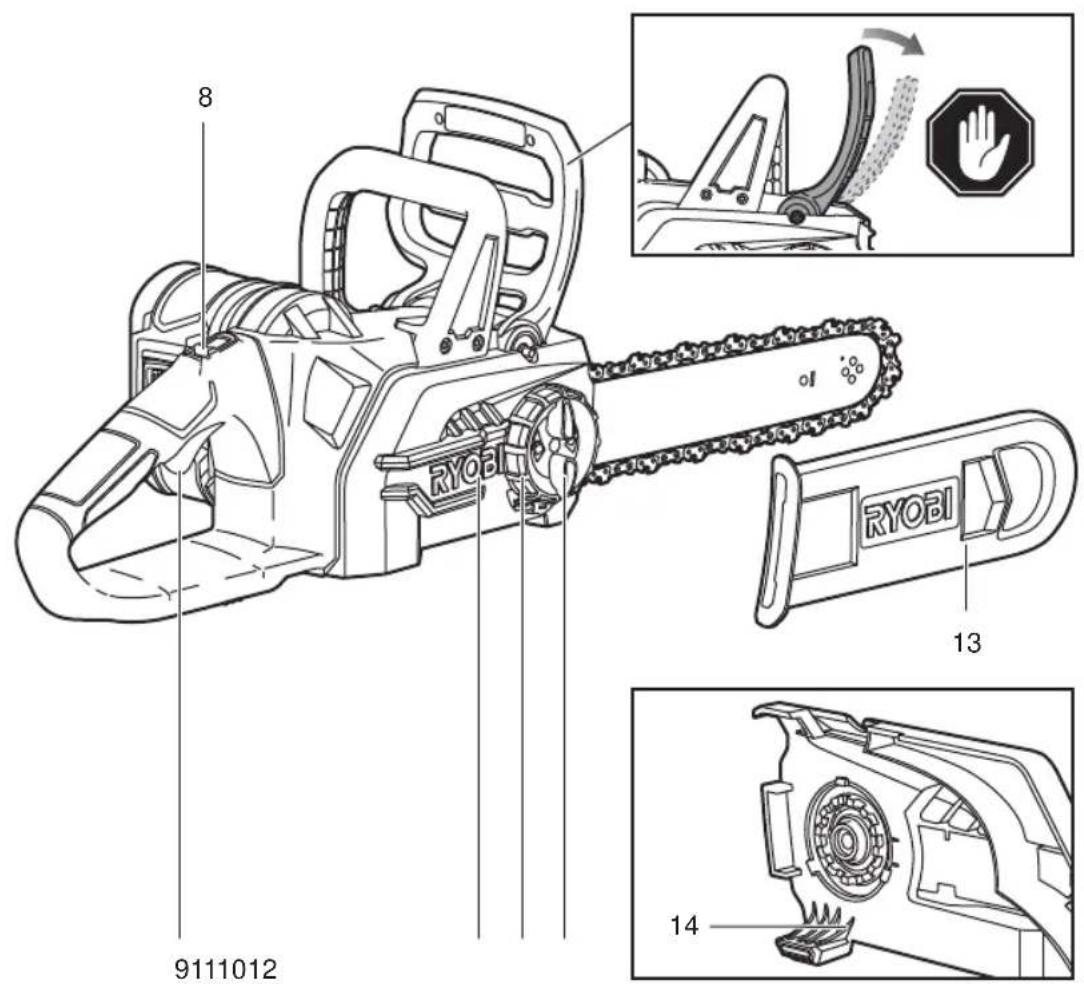
KNOW YOUR PRODUCT
See page 261.
- Front hand guard/Chain brake
- Front handle
- Rear handle
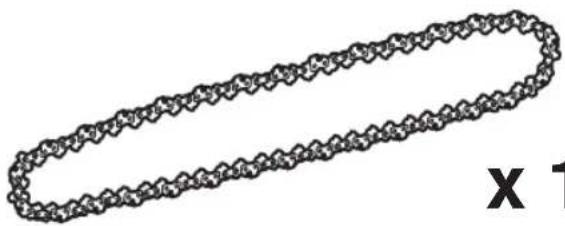
- Chain
- Guide bar
- Spiked bumper
- Chain lubricant cap
- Trigger release
- Switch trigger
- Sprocket cover
- Chain tensioner adjustment ring
- Chain tensioner knob
- Guide bar cover
- Chain catcher
SAFETY DEVICES
Low kickback saw chain
A low-kick-back saw chain helps to reduce the possibility of a kickback event.
The rakers (depth gauges) ahead of each cutter can minimize the force of a kickback reaction by preventing the cutters from digging in too deeply. Only use replacement guide bar and chain combinations recommended by the manufacturer.
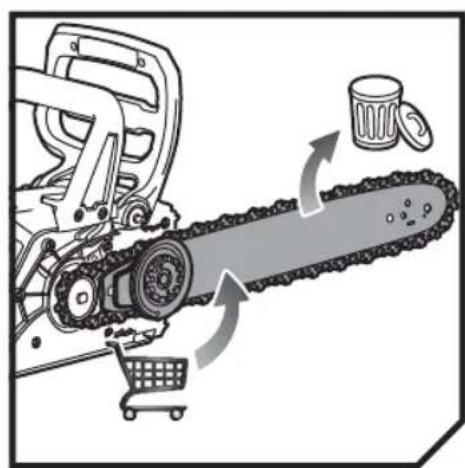
As saw chains are sharpened, they lose some of the low kickback qualities and extra caution is required. For your safety, replace saw chains when cutting performance decreases.
Spiked bumper
The integral bumper spike may be used as a pivot when making a cut. It helps to keep the body of the chainsaw steady while cutting. When cutting, push the machine forward until the spikes dig into the edge of the wood, then by moving the rear handle up or down in the direction of the cutting line it can help ease the physical strain of cutting
Guide bars
Generally, guide bars with small radius tips have somewhat lower potential for kickback. You should use a guide bar and matching chain which is just long enough for the job. Longer bars increase the risk of loss of control during sawing. Regularly check the chain tension. When cutting smaller branches (less than the full length of the guide bar) the chain is more likely to be thrown off if the tension is not correct.
Chain brake
Chain brakes are designed to quickly stop the chain rotating. When the chain brake lever/hand guard is pushed towards the bar, the chain should stop immediately. A chain brake does not prevent kickback. It only lowers the risk of injury should the chain bar contact the operator's body during a kickback event. The chain brake should be tested before each use for correct operation in both the run and brake positions.
Chain catcher
A chain catcher prevents the saw chain from being thrown back towards the operator if the saw chain comes loose or breaks.
ASSEMBLY
WARNING
If any parts are damaged or missing do not operate this product until the parts are replaced. Failure to heed this warning could result in serious personal injury.
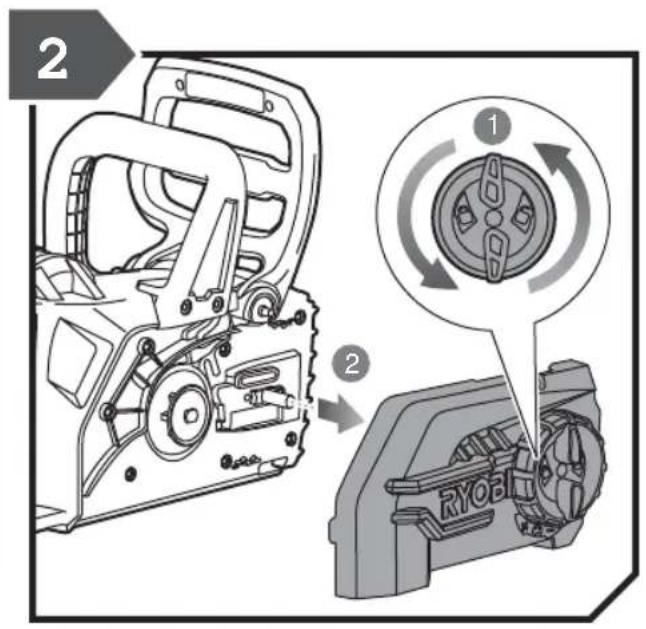
ASSEMBLING SAW CHAIN AND GUIDE BAR
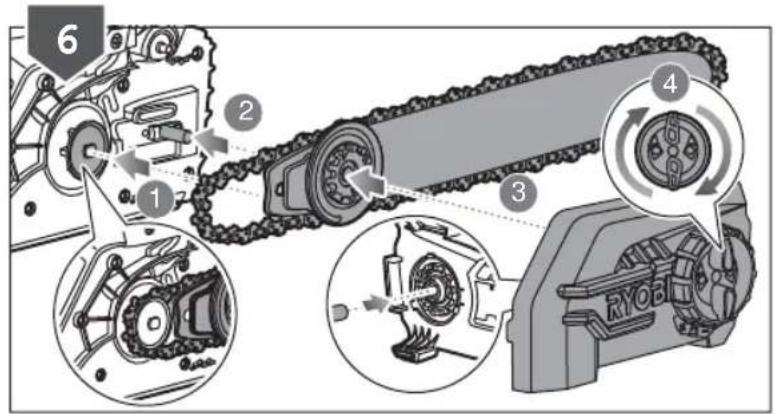
See page 262 - 263.
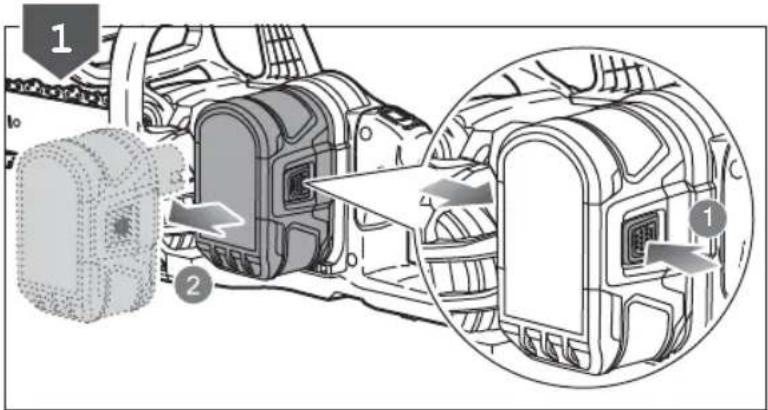
- Make sure to remove the battery pack from the product. Wear protective gloves.
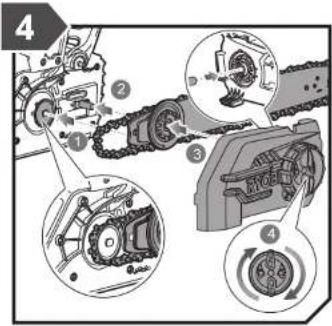
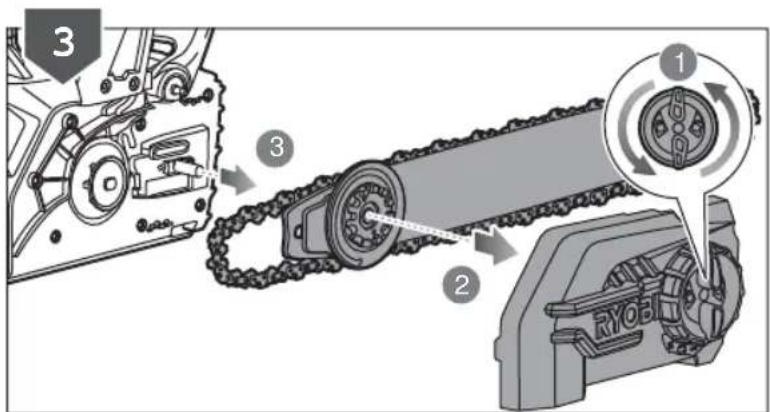
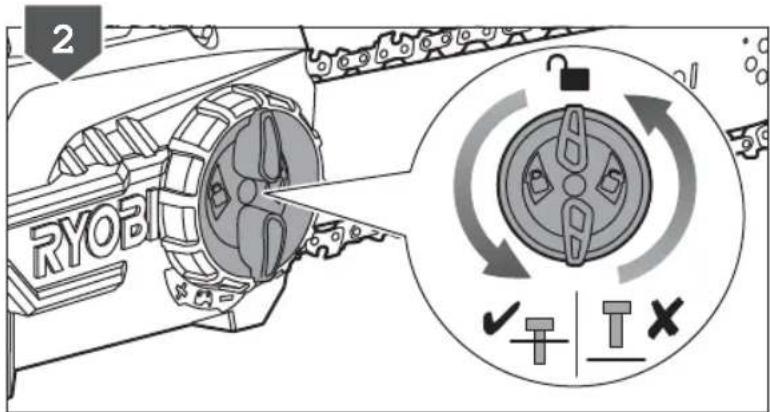
- Unscrew the chain tensioner knob and remove the sprocket cover.
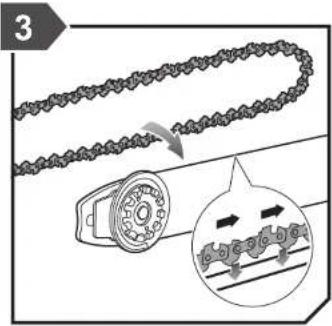
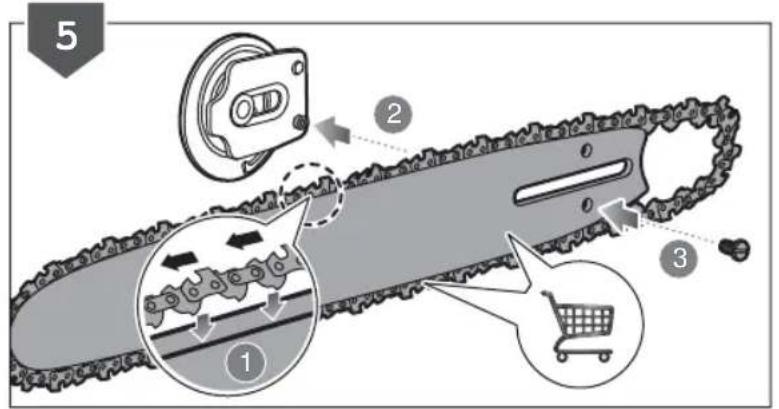
- The saw chain should face in the direction of chain rotation. If they face backwards, turn the loop over.
- Place the chain drive links into the bar groove.
- Position the chain so there is a loop at the back of the bar.
- Hold the chain in position on the bar and place the loop around the drive sprocket. Lower the bar so that the bolt goes through the hole in the attached chain tension assembly. You may need to rotate this assembly so the
bolt and hole align. You may rotate this assembly again to apply some tension to the chain which will help keep it in place.
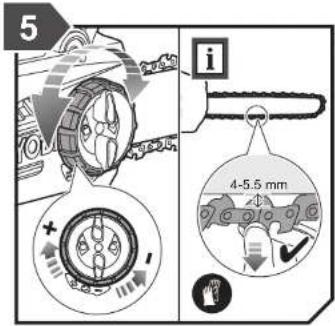
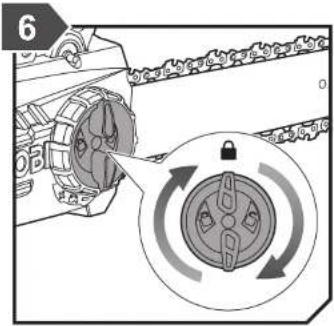
- Replace the sprocket cover and turn the chain tensioner knob until nearly tight, turn the chain tension adjustment ring until the saw chain is properly tensioned. The guide bar must then be pushed upwards, check chain tension again, do not tension the chain too tight.
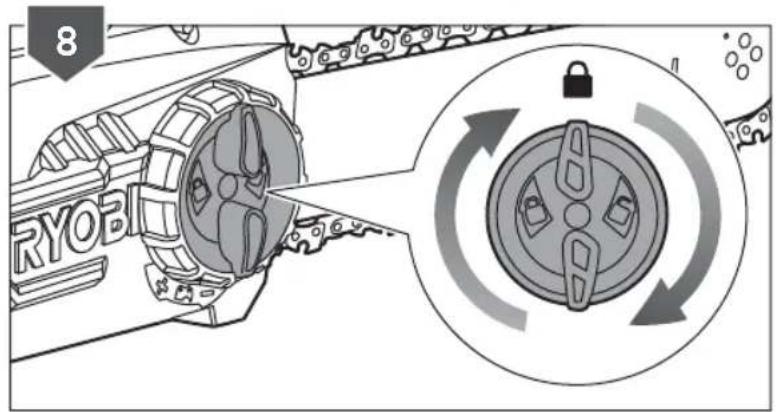
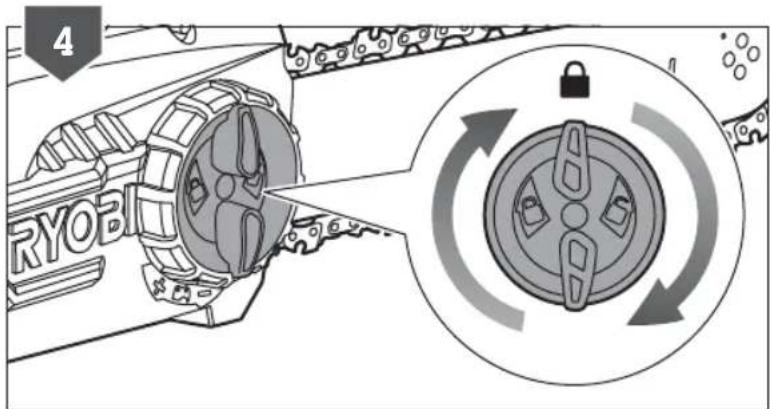
- After the chain is well-tensioned, tighten the knob again.
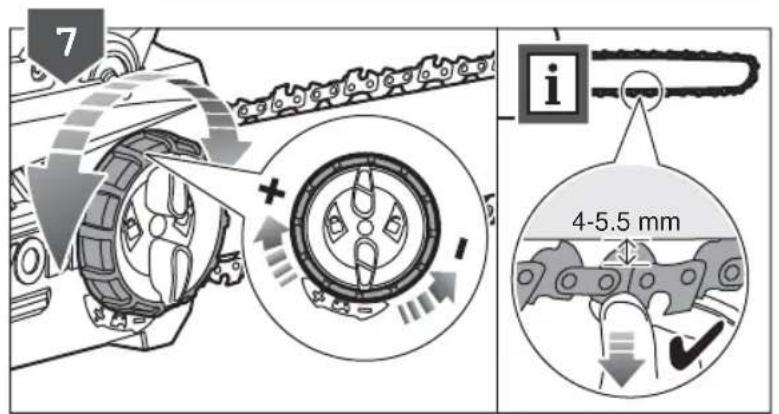
ADJUSTING THE CHAIN TENSION
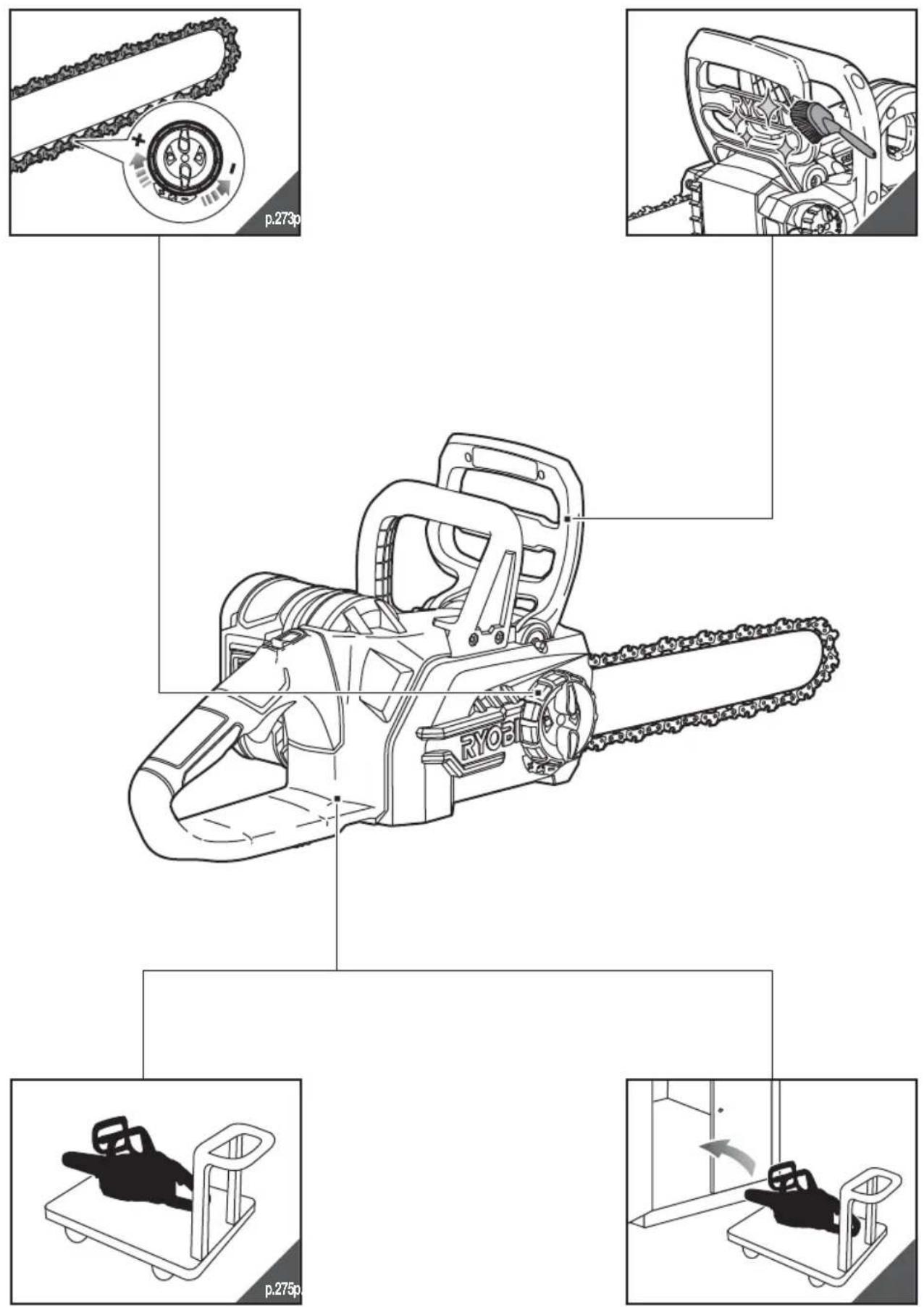
See page 263. See page 273.
- Loosen the chain tensioner knob slightly by turning it counterclockwise.
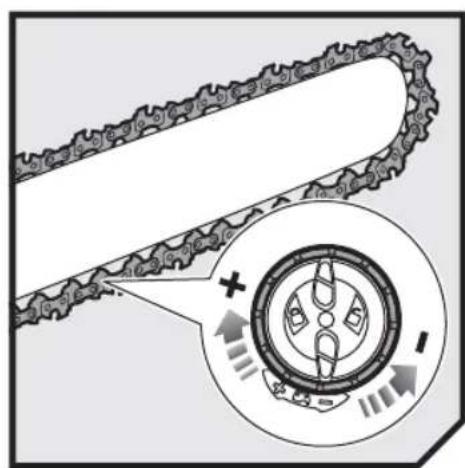
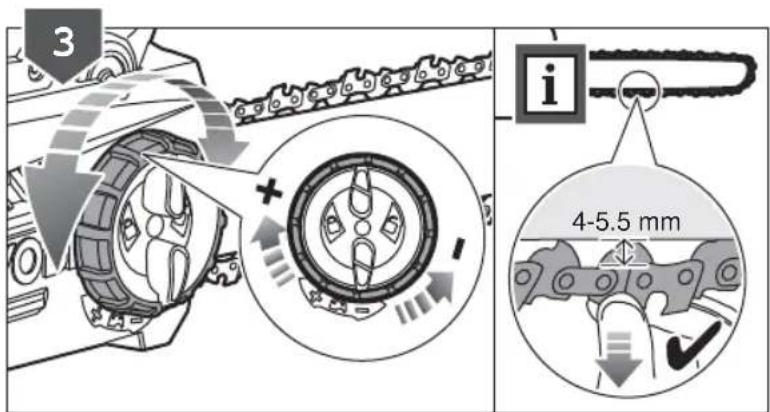
- To increase the chain tension, turn the chain tensioner adjustment ring clockwise and check the chain tension frequently. To reduce the chain tension, turn the chain tensioner adjustment ring counterclockwise and check the chain tension frequently.
- The chain tension is correct when the gap between the cutter in the chain and the bar is between 4 mm - 5.5 mm. Pull the chain in the middle of the lower side of the bar downwards (away from the bar) and measure the distance between the bar and the chain cutters.
- Tighten the chain tensioner knob by turning it clockwise.
OPERATION
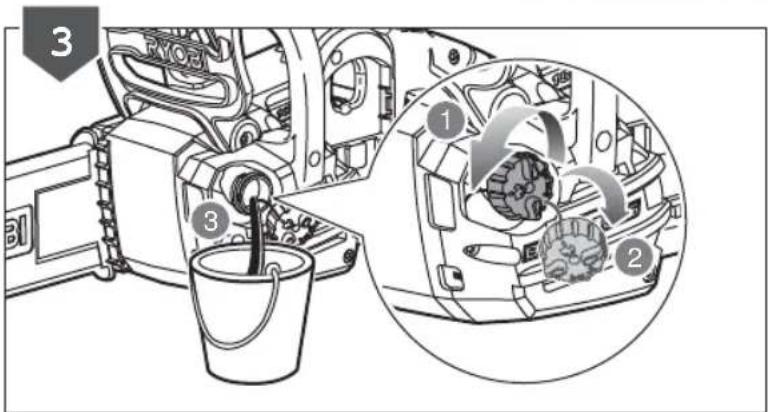
ADDING CHAIN LUBRICATING OIL
See page 262.
WARNING
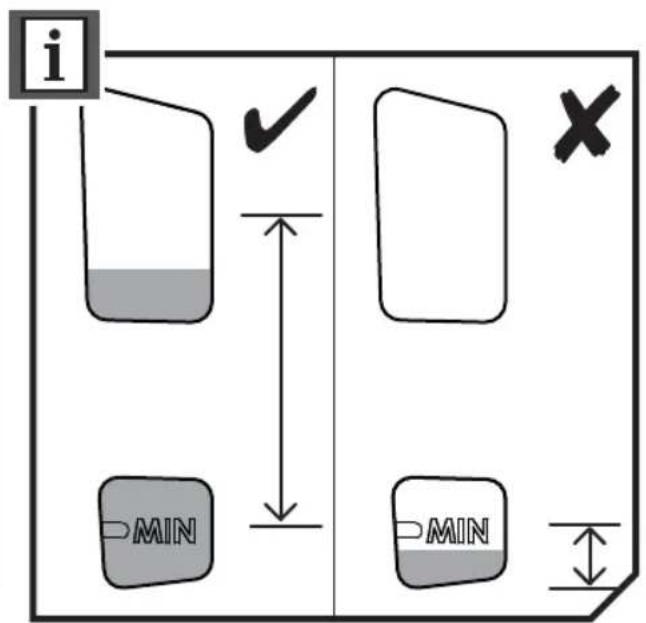
Never work without chain lubricant. If the saw chain is running without lubricant, guide bar and saw chain can be damaged. It is therefore essential to check the oil level in the oil level gauge frequently and every time before starting to use the chain saw.
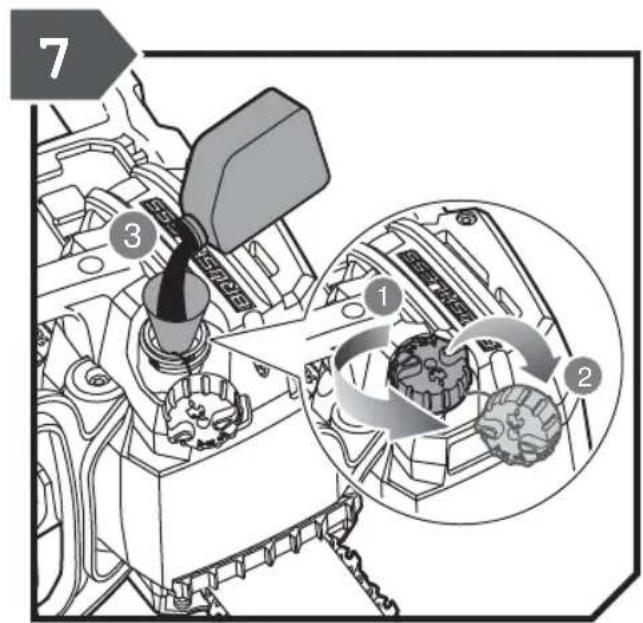
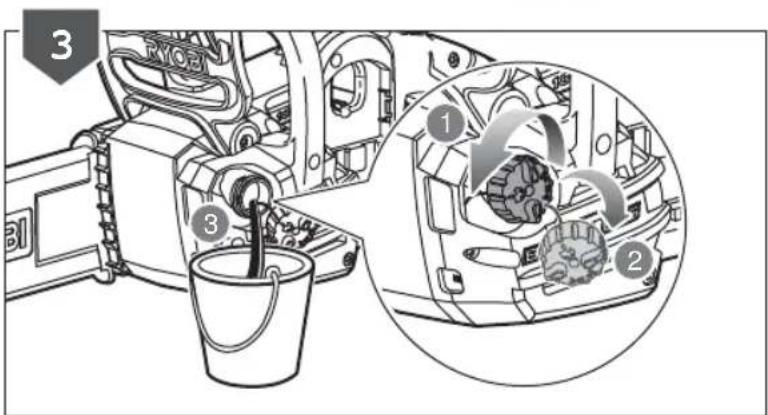
- Clear surface around the oil cap to prevent contamination.
- Unscrew and remove the cap from the oil tank.
- Pour the oil into the oil tank and monitor the oil level gauge. Ensure that no dirt enters the oil tank while filling.
- Put the oil cap back on and tighten it up. Wipe away any spillage.
- One full oil tank will enable you to use the saw for 20-40 min.
Recommended chain lubricating oil
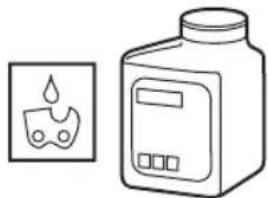
■ The manufacturer recommends you use only Ryobi chainsaw lubricating oil. (Available from your authorised Ryobi service centre)
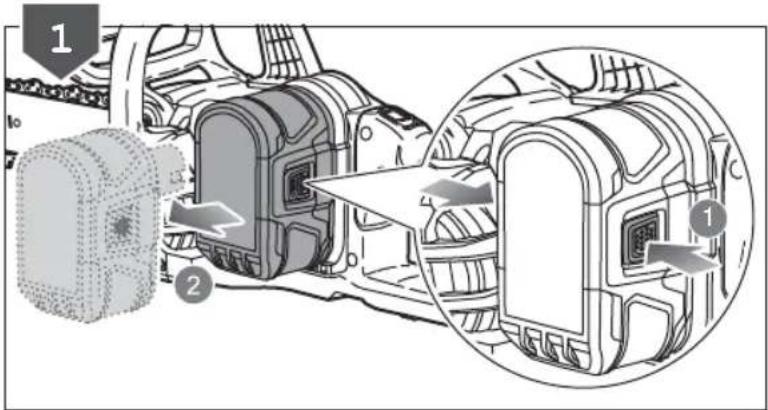
INSTALLING THE BATTERY PACK
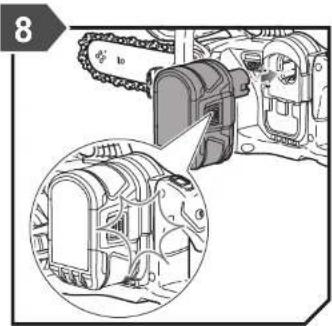
See page 263.
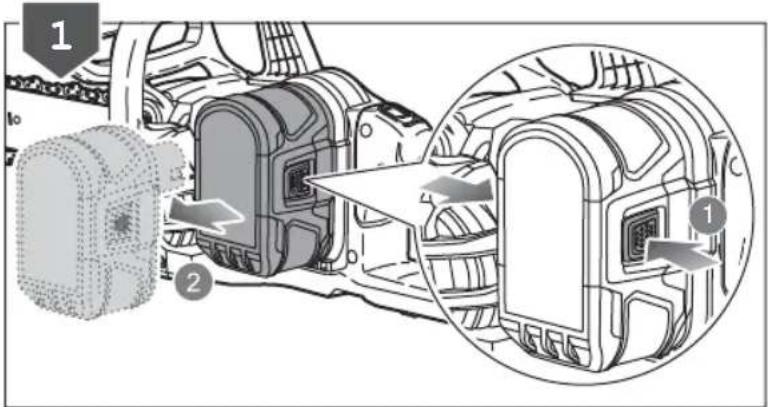
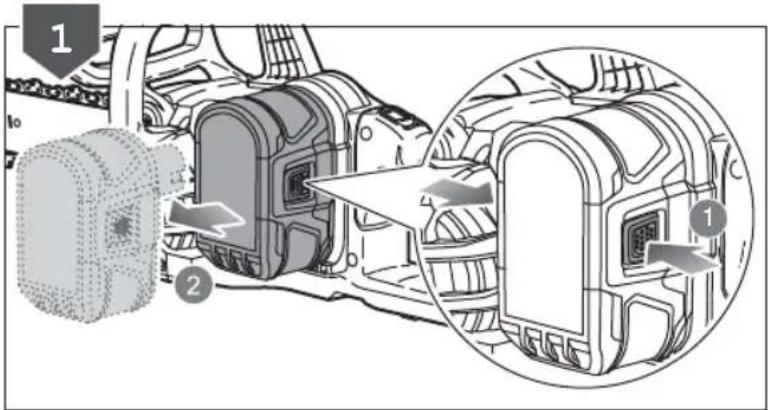
- Place the battery pack in the chainsaw. Align raised ribs on battery pack with grooves in the chain saw's battery port.
- Make sure the latches on the battery pack snap in place and that the battery pack is secured in the chainsaw before beginning operation.
HOLDING THE CHAIN SAW
See page 263.
Always hold the chain saw with your right hand at the rear handle and your left hand at the front handle. Grip both handles with the thumbs and fingers encircling the handles. Ensure that your left hand is holding the front handle so that your thumb is underneath.
STARTING THE CHAIN SAW
See page 263.
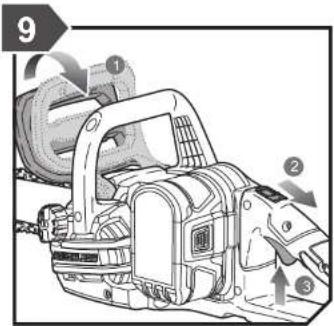
- Before starting for operation, you should install the battery pack in the machine, and make sure chain brake is in run position by pulling chain brake lever / hand guard toward the front handle.
- To start the product: pull the trigger release, and then press the switch trigger.
- Engage the chain brake by rotating your left hand around the front handle. Allow the back of your hand to push the chain brake lever/hand guard toward the bar while the chain is rotating rapidly. Be sure to maintain both hands on the saw handles at all times.
- Reset the chain brake back into the Run position by grasping the top of the chain brake lever / hand guard and pulling toward the front handle until you hear a click.
WARNING
If the chain brake does not stop the chain immediately, or if the chain brake will not stay in the run position without assistance, take the saw to an authorised service centre for repair prior to use.
TRANSPORTATION AND STORAGE
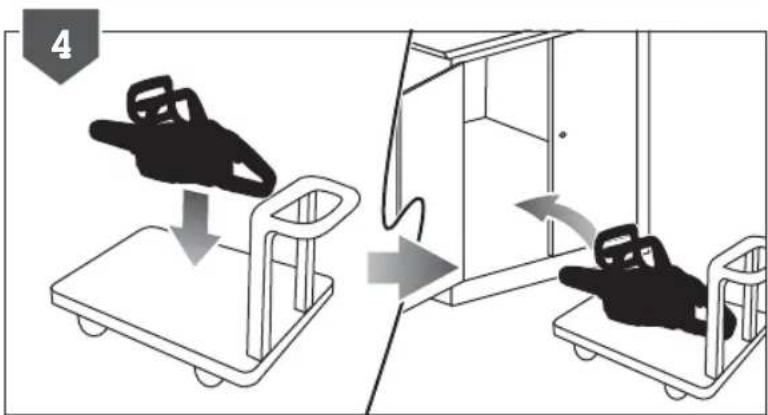
See page 275, 276.
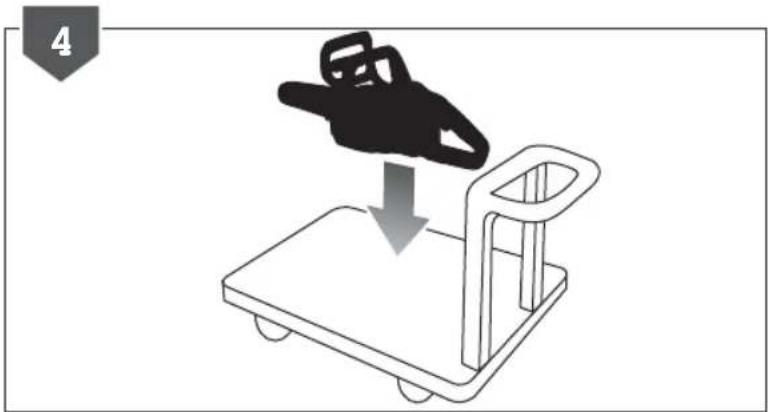
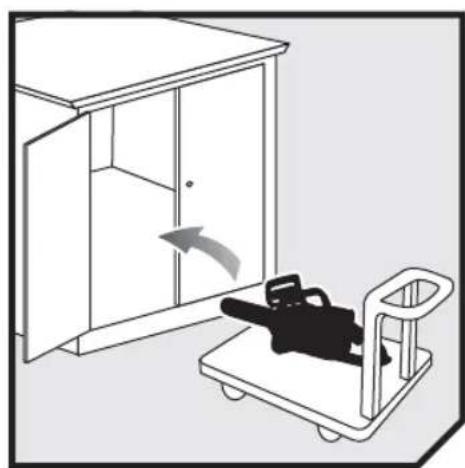
■ Stop the product, remove the battery pack, and allow the product to cool down before storing or transporting.
■ Clean all foreign material from the product. Store it in a cool dry and well-ventilated place that is inaccessible to children. Keep away from corrosive agents, such as garden chemicals and de-icing salts. Do not store outdoors.
■ Fit the guide bar cover before storing the product or during transportation.
■ For transportation, secure the product against movement or falling to prevent injury to persons or damage to the product.
MAINTENANCE
WARNING
Use only original manufacturer's replacement parts, accessories and attachments. Failure to do so can cause possible injury, contribute to poor performance, and may void your warranty.
WARNING
Servicing requires extreme care and knowledge and should be performed only be a qualified service technician. For service, bring the product to an authorised service centre for repair. When servicing, use only original replacement parts.
WARNING
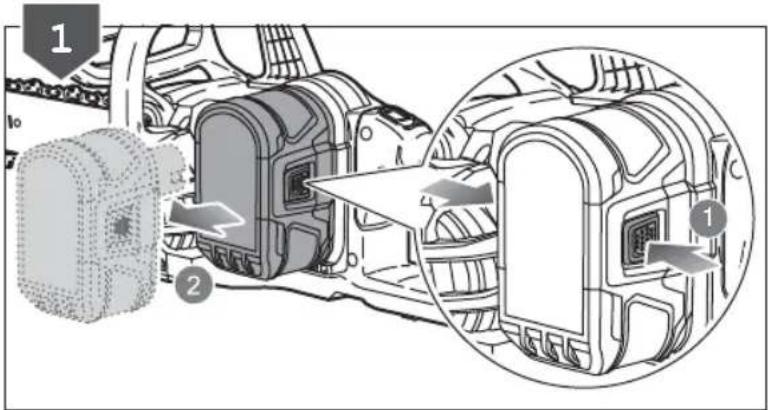
Remove the battery before adjustment, maintenance or cleaning. Failure to do so could result in serious personal injury.
- You may only make adjustments or repairs described in this manual. For other repairs, contact an authorised service centre.
■ Consequences of improper maintenance may cause the chain brake and other safety features to not function correctly, thus increasing the potential for serious injury. Keep your chainsaw professionally maintained and safe. - Sharpening the chain safely is a skilled task. Therefore the manufacturer strongly recommends that a worn or dull chain is replaced with a new one, available from your authorised Ryobi service centre. The part number is available in the product specification table in this manual.
■ Follow instructions for lubricating and chain tension checking and adjustment.
■ After each use, clean the product with a soft dry cloth. - Check all nuts, bolts and screws at frequent intervals for security to ensure the product is in safe working condition. Any part that is damaged should be properly repaired or replaced by an authorised service centre.
REPLACING GUIDE BAR AND SAW CHAIN
See page 271 - 272.
- Make sure to remove the battery. Wear protective gloves.
- Unscrew the chain tensioner knob by turning it counterclockwise until the sprocket cover comes loose.
- Remove the sprocket cover. Remove the bar and saw chain from product.
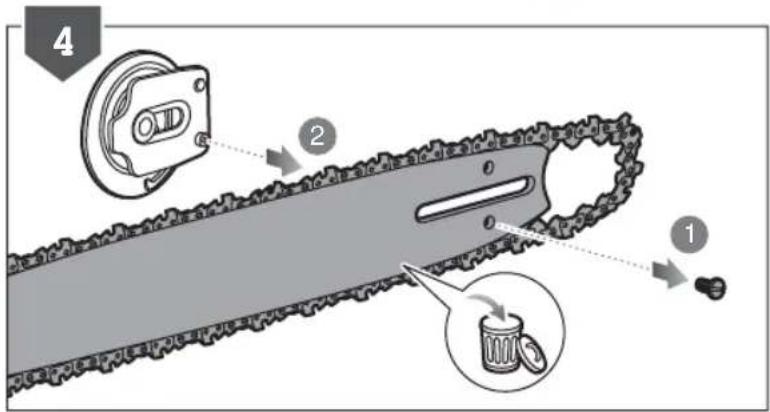
- To replace the bar with a new one, remove the screw of the chain tension assembly. Mount the chain tension assembly on to the new bar and tighten the screw.
- Put the new chain in the correct direction onto the bar and make sure that the drive links are aligned in the bar groove.
- Attach the bar to the chain saw and loop the chain around the drive sprocket.
- Replace the sprocket cover.
- Adjust the chain tension. Refer to the "Adjusting the chain tension" section.
WARNING
A dull or improperly sharpened chain can cause excessive motor speed during cutting which may result in severe motor damage.
WARNING
Improper chain sharpening increases the potential of kickback.
WARNING
Failure to replace or repair a damaged chain can cause serious injury.
WARNING
The saw chain is sharp. Always wear protective gloves when performing maintenance to the chain.
INSPECTING AND CLEANING THE CHAIN BRAKE
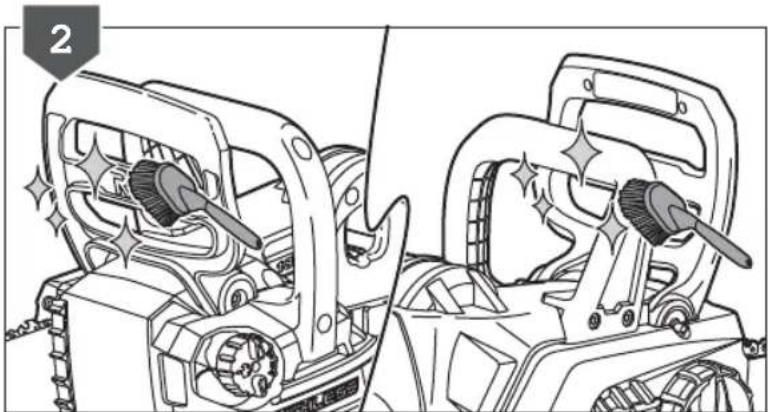
See page 274.
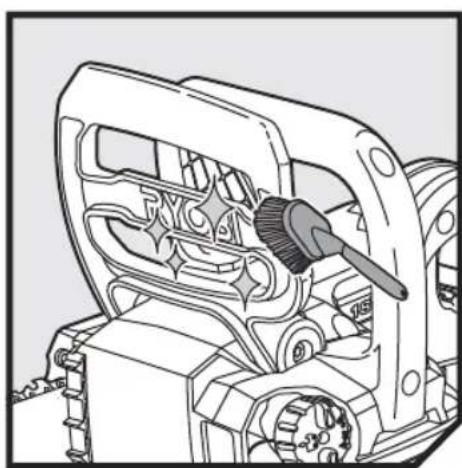
■ Always keep the chain brake mechanism clean by lightly brushing the linkage free from dirt.
■ Always test the chain brake performance after cleaning. Refer to "Operation - Checking and Operating Chain Brake" earlier in this manual for additional information.
MAINTENANCE SCHEDULE
| Daily check | |
| Bar lubrication Before each use | |
| Chain tension Before each use and frequently | |
| Chain sharpness Before each use, visual check | |
| For damaged parts Before each use | |
| For loose fasteners Before each use | |
| Chain brake function Before each use | |
| Inspect and clean | |
| Bar | Before each use |
| Complete saw | After each use |
| Chain brake | Every 5 hours* |
* Hours of operation
SYMBOLS ON THE PRODUCT


Safety alert
Read and understand all instructions before operating the product, follow all warnings and safety instructions.
Wear eye, ear and head protection.
Wear non-slip safety footwear when using the product.





Wear non-slip, heavy duty gloves.
Beware of chain saw kickback and avoid contact with bar tip.
Do not expose to rain or damp condition.
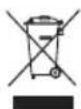
Hold and operate the saw properly with both hands.
Do not operate the saw using only one hand.
Conforms to all regulatory standards in the country in the EU where the product is purchased.
EurAsian Conformity Mark
Ukrainian mark of conformity
Waste electrical products should not be disposed of with household waste. Please recycle where facilities exist. Check with your local authority or retailer for recycling advice.
The guaranteed sound power level is 96 dB
Bar and chain lubricant
Minimum lubricant level
Lock
Unlock
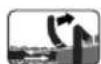
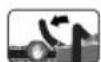
Set the chain brake to the RUN position.
Rotate to adjust chain tension
+ = Tighten the chain
- = Loosen the chain
Set the chain brake to the BRAKE position.
Moving direction of the chain. (Marked under the sprocket cover)
V0 : 10 m/s No-load chain speed is 10 m/s
L max: 300mm Maximum guide bar length is 300 mm
SYMBOLS IN THIS MANUAL

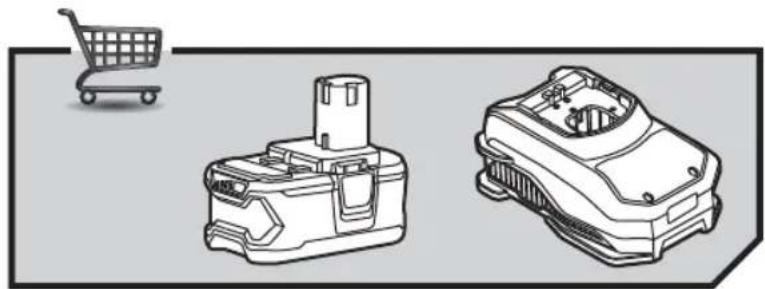
Parts or accessories sold separately

Note

Warning

Wear eye and face protection.

Wear upper body protection.

Wear leg protection.

Stop the product.
The following signal words and meanings are intended to explain the levels of risk associated with this product.
DANGER
Indicates an imminently hazardous situation, which, if not avoided, will result in death or serious injury.
WARNING
Indicates a potentially hazardous situation, which, if not avoided, could result in death or serious injury.
CAUTION
Indicates a potentially hazardous situation, which, if not avoided, may result in minor or moderate injury.
CAUTION
Without safety alert symbol
Indicates a situation that may result in property damage.
SYMBOLES APPLIQUÉS SUR LE PRODUIT

Avertissement

MACHEN SIE SICH MIT IHREM PRODUKT VERTRAUT
Siehe Seite 261.
SYMBOLE AUF DEM PRODUKT

Sicherheitswarnung

ALGEMENE VEILIGHEIDSWAARSCHUWINGEN
WAARSCHUWING
VEILIGHEIDSWAARSCHUWINGEN
VEILIGHEIDSWAARSCHUWINGEN KETTINGZAAG
Beenbeschermers (chaps)
- = Ketting losmaken
Zet de kettingrem op de stand BRAKE (REM).
FASTHOLDNING AF KÆDESAVEN
Se side 263.
SYMBOLER PÅ PRODUKTET


Sikkerheds Varsel
Roteres for at justere
kædespændingen
+ = Stram kæden
- = Løsn kæden
TRANSPORT OCH FÖRVARING
Se sida 275 - 276
SYMBOLER PÅ PRODUKTEN

Säkerhetsvarning

(Märkt under locket)
Kedjehastighet utan belastning: 10 m/s
SYMBOLER I MANUALLEN

KJENN PRODUKTET DITT
Se side 261.
VEDLIKEHOLD AV KJEDESAGEN
Se side 263.
SYMBOLER PÅ PRODUKTET


Sikkerhetsalarm
TÄIENDAVAD ÜLDISED OHUTUSJUHISED
OBOZNÁMTE SA S VAŠÍM PRODUKTOM
Pozrite stranu 261.
-
Predný chránič ruky/brzda ret'aze
-
Predná rukovät'
-
Zadná rukovät
-
Ret'az
-
Vodiaca lišta
-
TImiaci klin
-
Uzáver olejovej nádrže
-
Západka plynovej páčky
-
Spínač
-
Kryt ret'azového kolesa
-
Nastavovací krúžok napnutia reťaze
-
Tlačidlo napnutia ret'aze
-
Kryt vodiacej lišty
-
Zachytávač retaze
BEZPEČNOSTNÉ ZARIADENIA
Kickback is the result of tool misuse and/or incorrect operating procedures or conditions and can be avoided by taking proper precautions as given below:
x 1
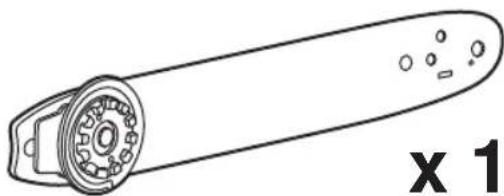
x 1
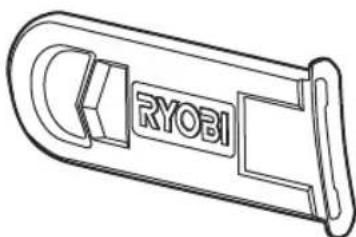
x 1
x 1

x 1
![graph TD A["Incident"] --> B["Target"] B --> C["Racing"] C --> D["Warning"] style A fill:#f9f,stroke:#333 style B fill:#ccf,stroke:#333 style C fill:#cfc,stroke:#333 style D fill:#fcc,stroke:#333](/content/2026/03/541591/images/79bb021a58011f906c1e6fdda066a91608292614bf126be817f3562bfb1e4a83.jpg)
!

2
1
2



| English Français Deutsch Español Italiano Nederlands | |||||
| Product specifi cations | Caractéristiques produit | Produkt-Spezifi kationen | Características del producto | Caratteristiche del prodotto | Productgegevens |
| Cordless Chainsaw | Tronçonneuse sans fil | Akku-Kettensäge | Motosierra inalámbrica | Sega elettrica a batteria | Draadloze kettingzaag |
| Model Modèle Modell Modelo Modello Modello Model | Modello Modello Model | ||||
| Rated voltage | Tension nominale | Nennspannung | Tensión nominal | Voltaggio nominale | Toegekende spanning |
| No-load speed | Vitesse de rotation | Leerlaufgeschwindigkeit | Velocidad sin carga | Velocità senza carico | Snelheid zonder lading |
| Guide bar length | Longueur du guide-chaîne | Länge der Führungsschiene | Longitud de la barra guía | Lunghezza barra di guía | Zwaardlengte |
| Usable cutting length | Longueur de coupe utile | Anwendbare Schnittlänge | Largo de corte | Lunghezza di taglio disponibile | Bruikbare zaaglengte |
| Chain pitch | Gouge de la chaîne | Kettenteilung | Paso de la cadena | Passo catena | Kettingsteek |
| Drive links | Maillons de chaîne | Kettenantriebsglieder | Eslabones de la cadena | Anelli catena | Aandrijfschakels |
| Drive sprocket | Pignon d'entraînement | Kettenrad | Rueda dentada motriz | Ruota dentata di trasmissione | Kettingwiel |
| Chain oil tank capacity | Contenance du réservoir d'huile de chaîne | Kettenöltankkapazität | Capacidad del depósito de aceite de la cadena | Capacità serbatoio olio catena | Kettingolietankcapaciteit |
| Weight (without battery pack, with guide bar, chain and empty tank) | Poids (Sans batterie, avec chaîne, guide-chaîne et réservoir vide) | Gewicht (Ohne Akku, mit Führungsschiene, Kette und leerem Tank) | Peso (Sin batería, con barra guía, cadena y depósito vacío) | Peso (Senza batteria, con barra di guía, catena e serbatoio vuoto) | Gewicht (Zonder accupak, met zwaard, ketting en lege tank) |
| Vibration level (in accordance with EN 60745-1 & EN 60745-2-13) | Niveau de vibration (selon l'Annexe EN 60745-1; EN 60745-2-13) | Vibrationsgrad (gemäß EN 60745-1; EN 60745-2-13) | Nivel de vibración (de acuerdo con EN 60745-1; EN 60745-2-13) | Livello vibrazioni (in accordo con la direttiva EN 60745-1; EN 60745-2-13) | Trillingsniveau (in overeenstemming met EN 60745-1; EN 60745-2-13) |
| Front handle | Poignée avant | Vorderer Handgriff | Mango delantero | Manico anteriore | Voorste handvat |
| Rear handle | Poignée arrière | Hinterer Handgriff | Mango trasero | Manico posteriore | Achterste handvat |
| Uncertainty of measurement | Incertitude de la mesure | Unsicherheit der Messung | Incertidumbre de medición | Incertezza delle misurazioni | Onzekerheid bij meting |
| Noise emission level (in accordance with EN 60745-1 & EN 60745-2-13) | Niveau d'émission sonore (selon l'Annexe EN 60745-1; EN 60745-2-13) | Geräuschemission (gemäß EN 60745-1; EN 60745-2-13) | Nivel de emisión de ruido (de acuerdo con EN 60745-1; EN 60745-2-13) | Livello di emissione rumore (in accordo con la direttiva EN 60745-1; EN 60745-2-13) | Geluidsemissieniveau (in overeenstemming met EN 60745-1; EN 60745-2-13) |
| A-weighted sound pressure level at operator's position | Niveau de pression sonore pondéré-A au niveau de l'opérateur | A-bewerteter Schalldruckpegel an der Position des Anwenders | Nivel de presión acústica ponderado A en la posición del operador | Livello di pressione sonora ponderata A alla posizione dell'operatore | A-gewogen geluidsdrukniiveau bij positie van gebruiker |
| Uncertainty of measurement | Incertitude de la mesure | Unsicherheit der Messung | Incertidumbre de medición | Incertezza delle misurazioni | Onzekerheid bij meting |
| A-weighted sound power level | Niveau de puissance sonore pondéré-A | A-bewerteter Schallleistungspegel | Nivel de potencia acústica ponderada en A | Livello di potenza sonora pesato A | A-gewogen geluidsniveau |
| Uncertainty of measurement | Incertitude de la mesure | Unsicherheit der Messung | Incertidumbre de medición | Incertezza delle misurazioni | Onzekerheid bij meting |


| Português Dansk Svenska Suomi Norsk Русский | ||||||
| Caracteristicas do aparelho | Produktspecifi ka-tioner | Produktspecifi ka-tioner | Tuotteen tekniset tledot | Produktspesifi ka-sjoner | Характеристики изделия | |
| Electroserra recarregável | Ledningsfri kædesav Staddlösa motorsågen | Johdoton moottorisaha | Motorsagen Беспроводная цепная пила | |||
| Modelo Model Modell Malli Modell Модель | OCS1830 | |||||
| Tensão nominal Mærkespænding Spänning Nimellsjännite Nominell spenning Номинальное напряжение 18 Volts | ||||||
| Velocidade sem carga | Tomgangshastighed | Hastighet utan belastning | Nopeus ilman kuormaa | Tomgangshastighet | Холостая скорость 10 m/s | |
| Comprimento da lâmina-guia | Sværdets længde | Klingans längd | Terälevyn piluus | Sagsverdlengde | Длина пильной шины | 300 mm |
| Comprimento de corte útil | Anvendelig skærer længde | Användbar sagningslängd | Leikkuupituus | Brukbar kuttelengde | Используемая режущая длина | 250 mm (10") |
| Passo da corrente | Kædestigning | Kedjedelning | Ketjun jako | Inndeling av kjede | Зубья пильной цепи | 9.525 mm (0.375") |
| Ligações da corrente motriz | Kæde drev lænker | Kedjedriviänkar | Vetolenkit | Drivtann for kjede | Направляющие звенья цепи | 45 |
| Pinhão | Drivhjul | Drivkugge | Vetopyörä | Kjedehjul, drev | Ведущая звездочка | 6 teeth x 0.375" |
| Capacidade do depósito do óleo da corrente | Kædeolietank-kapacitet | Kapacitet för oljebehållaren | Ketjun öljysälliön tilavuus | Kjeldeolje tankkapasitet | Емкость масляного бака пилы | 210 ml |
| Peso (Sem bateria, com barra guia, corrente e depósito vazio) | Vægt (Ingen batteri, med sværd, kæde og tom tank) | Vikt (Utan batteri, med stödarm, kedja och tom tank) | Paino (Ilman akkua, terälevy, ketju ja tyhjä sälliö) | Vekt (Uten batteri, med føringsskinne, kjede og tom tank) | Вес (Без аккумулятора, с пильной шиной, цепью и пустым топливным баком) | 3.2 kg |
| Nivel de vibração (em conformidade com EN 60745-1; EN 60745-2-13) | Vibrationsniveau (iht. EN 60745-1; EN 60745-2-13) | Vibrationsnivå (enligt EN 60745-1; EN 60745-2-13) | Tärinätaso (standardin EN 60745-1; EN 60745-2-13 mukaisesti) | Vibrasjonsnivå (iht. EN 60745-1; EN 60745-2-13) | Уровень вибрации (в соответствии с EN 60745-1; EN 60745-2-13) | |
| Pega frontal | Forhåndtag | Främre handtag | Etukädensija | Fremre håndtak | Передняя ручка | 4.0 m/s2 |
| Pega traseira | Baghåndtag | Bakre handtag | Takakädensija | Bakre håndtak | Задняя ручка | 6.6 m/s2 |
| Incerteza de medições | Målingsusikkerhed | Osäkerhet för mätt Mittausten epätarkkuus | Usikkerhet ved måling | Погрешность измерения | 1.5 m/s2 | |
| Nivel de emissão de ruido (em conformidade com EN 60745-1; EN 60745-2-13) | Stojemissionsniveau (iht. EN 60745-1; EN 60745-2-13) | Bullerutsläppsnivå (enligt EN 60745-1; EN 60745-2-13) | Melutaso (standardin EN 60745-1; EN 60745-2-13 mukaisesti) | Støyutslipsnivå (iht. EN 60745-1; EN 60745-2-13) | Уровень шума (в соответствии с EN 60745-1; EN 60745-2-13) | |
| Nivel de pressão acústica ponderado A na posição do operador | A-vægtet lydtryksniveau ved operatørens position | A-viktad ljudtrycksnivå vid operatørens plats | A-painotettu käyttäjään kohdistuva äänenpainetaso | Støynivåvekting ved operatørens posisjon | Амплитудно-звешенный уровень звукового давления на рабочем месте оператора | 83.1 dB(A) |
| Incerteza de medições | Målingsusikkerhed | Osäkerhet för mätt Mittausten epätarkkuus | Usikkerhet ved måling | Погрешность измерения | 2.5 dB | |
| Nivel de potência sonora ponderada A | A-vægtet lydeffektniveau | A-vägd ljudeffektsnivå | A-painotettu äänenteho | A-vektet lydeffektnivå | Уровень А-взвешенной звуковой мощности | 94.1 dB(A) |
| Incerteza de medições | Målingsusikkerhed | Osäkerhet för mätt Mittausten epätarkkuus | Usikkerhet ved måling | Погрешность измерения | 2.5 dB | |
| Polski Čeština Magyar Română Latviski Lietuviškai Eesti | ||||||
| Parametry techniczne | Technické údaje produktu | Termék műszaki adatał | Specificațiile produsului | Produkta specifikácijas | Gaminio techninės savybės | Toote tehnillsed andmed |
| Bezprzewodowa piła łańcuchowa | Akumulálorová řetězová pila | Akkumuláloros láncfúrész | Fierăstrăul electric fără fi r | Bezvadu kėdes zagis | Akumuliatorinis grandininis pjūklas | Juhtmeta kettsaagi |
| Model Model Típus Model Modelis Modelis Model | ||||||
| Napięcie znamionowe | Jmenovité napětí | Névleges feszültség | Tensiunea nominală | Nominălais spriegums | Nominali jtampa Nimbinge | |
| Prędkość obrotowa bez obciążenia | Rychlost naprázdno Üresjárati fordulatszám | Víteză fără sarcină | Greitis be apkrovimo Greitis be apkrovimo Túhikäigukiirus | |||
| Długość prowadnicy | Délka vodící lišty | Láncvezető hossza | Lungime a barei de ghidare | Sliedes garums | Kreipiamosios juostos ilgis | Juhtlati pikkus |
| Użyteczna długość cięcia | Využitelná řezací délka | Hasznos vágáshossz | Lungime de tăiere utilizabilă | Izmantojamais griešanas garums | Naudojamas pjovimo ilgis | Kasutatav lõike pikkus |
| Przecinak kształtowy łańcucha | Článek řetězu | Fog osztás | Lamele lanțului | Kėdes asmeniši | Pjovimo grandinės dantukas | Keti samm |
| Ogniwa napędowe łańcucha | Pohon řetězu levý | Lánc hajtószemek | Organ de transmitere a mišcăril lanțului | Piedziņas kėdes locekļi | Grandininė pavara | Keti tee vasakul |
| Koło napędowe | Drive sprocket | Lánckerék | Pinion de antrenare | Kėdesrats | Krumpliaratis | Ülekandevõil |
| Pojemność zbiornika oleju łańcuchowego | Kapacita olejové nádrže pro řetěz | Láncolaj tartályának térfogata | Capacitate rezervor ulei de lanț | Kėdes elļas tvertnes tilpums | Grandinės alyvos bakelio türis | Õlipaagi maht |
| Masa (Bez akumulatora, z prowadnicą, łańcuchem i pustym zbiornikiem paliwa) | Hmotnost (Není vložen akumulátor, s vodići lištou, řetězem a prázdnou nádrži) | Tömeg (Akkumulátor nélkül, láncvezetővel, lánccal és üres tartállyal) | Greutate (Fără baterie, cu lamă de ghidare, lanț și rezervor gol) | Svars (Bez akumulatora, ar sliedi, kėdi un tukšu tvertni) | Svoris (Be akumuliatorinės baterijos, su kreiptuvu, grandine ir tuščiu baku) | Mass (Ilma aku pakita, juhtlatiga, ketiga ja tühja paagiga) |
| Poziom wibracji (zgodnie z normą EN 60745-1; EN 60745-2-13) | Úroveň vibrací (v souladu s EN 60745-1; EN 60745-2-13) | Vibrációs szint (az EN 60745-1; EN 60745-2-13 szerint) | Nivel de vibratie (în conformitate cu EN 60745-1; EN 60745-2-13) | Vibracijas līmenis (saskaņa ar EN 60745-1; EN 60745-2-13 standartą) | Vibracijos lygis (pagal EN 60745-1; EN 60745-2-13 standartą) | Vibratsioonitase (vastavalt standardile EN 60745-1; EN 60745-2-13) |
| Uchwyt przedni | Přední rukojet' | Elülső fogantyú | Mâner anterior | Priekšējais rokturis | Priekinė rankena | Eesmine käepide |
| Uchwyt tylny | Zadní rukojet' | Hátsó fogantyú | Mâner posterior | Aizmugurējais rokturis | Galinė rankena | Tagumine käepide |
| Niepewność pomiaru | Nejistota měření | Mérés bizonytalansága | Nesiguranța măsurătorii | Mērījuma nenoteiktība | Matavimo paklaida | Mõõtmismääramatus |
| Poziom emisji hałasu (zgodnie z normą EN 60745-1; EN 60745-2-13) | Hladina emise hluku (v souladu s EN 60745-1; EN 60745-2-13) | Hangkibocsátási szint (az EN 60745-1; EN 60745-2-13 szerint) | Nivel emisie zgomot (în conformitate cu EN 60745-1; EN 60745-2-13) | Trokšņu emisijas līmenis (saskaņa ar EN 60745-1; EN 60745-2-13) | Skleidžiamo triukšmo lygis (pagal EN 60745-1; EN 60745-2-13 standartą) | Helivōimsuse tase (vastavalt standardile EN 60745-1; EN 60745-2-13) |
| Poziom ciśnienia akusytcznego (A) w miejsu operatora | Hladina akustického tlaku vážená funkcí A v poloze obsluhy | A-súlyozott hangnyomásszint a kezelő helyén | Nivel presiune sunet greutate A la poziṭja operatorului | Lietotāja pozīcijā ir ar A nověrtěts skaņas spiediena līmenis | A svorinis triukšmo slėgio lygis operatoriaus padětyje | A-kaalutud helirōhu tase operaatori töökohal |
| Niepewność pomiaru | Nejistota měření | Mérés bizonytalansága | Nesiguranța măsurătorii | Mērījuma nenoteiktība | Matavimo paklaida | Mõõtmismääramatus |
| A-ważony poziom natężenia hałasu | Hladina akustického tlaku vážená funkcí A | A-súlyozott hangleljesítmé-nyszint | Nivel de putere acustică ponderată A | A-līmeņa skaņas jaudas līmenis | A-svertinis akustinis lygis | A-kaalutud helivōimsuse tase |
| Niepewność pomiaru | Nejistota měření | Mérés bizonytalansága | Nesiguranța măsurătorii | Mērījuma nenoteiktība | Matavimo paklaida | Mõõtmismääramatus |
| Hrvatski Slovensko Slovenčina България Українська Turce | ||||||
| Specifi kacije proizvoda | Specifi kacije izdelka | Špecifi kácie produktu | Технически характеристики | Технічні характеристики продукту | Ürün teknik özellikleri | |
| Bežična lančana pila Brežična motorna žaga | Brezčna motorna žaga | Akumulátorová reťazová píla | Безжичният верижен трион | Бездротова ланцюгова пила | Kablosuz Motorlu Testere | |
| Model Model Modelis Модел Модель Model | OCS1830 | |||||
| Nazivni napon | Nazivna napetost | Menovité napätie | Номинален волтаж | Номінальна напруга | Nominal voltaj | 18 Volts |
| Brzina bez opterećenja | Hitrost neobremenjenega motorja | Rýchlost' naprázdno C | Корост в ненатоварен режим | Швидкість без навантаження | Yüksüz hiz 10 m/s | |
| Duljina vodilice lanca | Dolžina meča | Dĺžka vodiacej lišty | Дължина на водещата шина | Довжина напрямної штанги | Kilavuz çubuğu uzunluk | 300 mm |
| Korisna duljina vodilice | Dolžina uporabne površine za žaganje | Využiteľná dĺžka rezania | Използваема дължина на рязане | Корисна ріжуча довжина | Kesme uzunluğu | 250 mm (10") |
| Zubac lanca | Korak verige | Rozstup reťaze | Стъпка на веригата | Інтенсивність пили | Zincir hatvesi | 9.525 mm (0.375") |
| Pogonske veze lanca | Obroč zobnika verige | Vodiace články reťaze | Водещи звена веригата | З'єднання приводу | Zincir tahrik bağlantıları | 45 |
| Pogonski lančanik | Pogonski zobnik | Reťazové koleso | Водещо зъбно колело | Ланцюгове кільце приводу | Zincir tahrik dişlisi | 6 teeth x 0.375" |
| Kapacitet spremnika ulja za lanac | Kapaciteta posode za olje verige | Kapacita olejovej nádrže reťaze | Вместимост на резервоара за верижно масло | Об'єм масляного бака ланцюга | Yağ deposu kapasitesi | 210 ml |
| Težina (Bez baterije, s vodilicom, lancem i praznim spremnikom) | Teža (Brez baterijskega, z mečem, verigo in praznim rezervoarjem) | Hmolnosť (Bez batérie, s vodiacou lištou, reťazou a prázdnou nádržou) | Тегло (Без батерия, с шина, верига и празен резервоар) | Вага (без акумулятора, з направляючою штангою, ланцюгом і порожнім баком) | Ağırlık (batarya hariç; Kilavuz çubuğu, zincir ağırlık; boş depoyla birlikte) | 3.2 kg |
| Razina vibracija (u skladu s EN 60745-1; EN 60745-2-13) | Nivo vibracij (v skladu s standardom EN 60745-1; EN 60745-2-13) | Úroveň vibrácií (podľa normy EN 60745-1; EN 60745-2-13) | Ниво на вибрациите (в съответствие с EN 60745-1; EN 60745-2-13) | Рівень вібрації (відповідно до EN 60745-1; EN 60745-2-13) | Titreşim seviyesi (EN 60745-1; EN 60745-2-13 uyarınca) | |
| Prednja ručka | Sprednji ročaj | Predná rukovát | Предна ръкохватка | Передня ручка | Ön Kulp | 4.0 m/s2 |
| Stražnja ručica | Zadnji ročaj | Zadná rukovát | Задна ръкохватка | Задня ручка | Arka Kulp | 6.6 m/s2 |
| Neodređenost mjerenja | Negotovost meritve | Nespoľahlivosť meraní | Несигурност на измерването | Невизначеність вимірювання | Ölçüm bilinmiyor | 1.5 m/s2 |
| Razina emisija buke (u skladu s EN 60745-1; EN 60745-2-13) | Raven emisij hrupa (v skladu s standardom EN 60745-1; EN 60745-2-13) | Úroveň emisí hluku (podľa normy EN 60745-1; EN 60745-2-13) | Ниво на шумовите емисии (в съответствие с EN 60745-1; EN 60745-2-13) | Рівень шуму (відповідно до EN 60745-1; EN 60745-2-13) | Gürültü emisyon seviyesi (EN 60745-1; EN 60745-2-13 uyarınca) | |
| Ponderirana razina zvučne snage na položaju operatera. | Z A ovrednotena vrednost zvočnega tlaka pri upravljavcu | Vážená A hladina akustického tlaku na pozícií obsluhujúcej osoby | Ниво на шумово налягане с равнище А на мястото на оператора | Рівень звукового тиску за шкалою А для оператора пристрою | Kullanıcı pozisyonundaki A ağırlıklı ses basinci seviyesi | 83.1 dB(A) |
| Neodređenost mjerenja | Negotovost meritve | Nespoľahlivosť meraní | Несигурност на измерването | Невизначеність вимірювання | Ölçüm bilinmiyor | 2.5 dB |
| Ponderirana razina zvučne snage | A-izmerjena raven zvočne moči | Vážená A hladina akustického výkonu | Ниво на силата на шума с равнище А | А-зважений рівень звукової потужності | A ağırlıklı ses gücü seviyesi | 94.1 dB(A) |
| Neodređenost mjerenja | Negotovost meritve | Nespoľahlivosť meraní | Несигурност на измерването | Невизначеність вимірювання | Ölçüm bilinmiyor | 2.5 dB |


| English Français Deutsch Español Italiano Nederlands | |||||
| Battery and charger Batterie et chargeur Akku und Ladegerät Bateria y cargador Batteria e caricatore Accu en oplader | |||||
| Model Modèle Modell Modelo Modello Model | |||||
| Battery pack Batterie Akku Bateria Batteria Accu | |||||
| Not included Non compris | Nicht im Leferumfang enthalten | No incluido | Non incluso | Niet inbegrepen | |
| Weight | Poids | Gewicht | Peso | Peso | Peso |
| Charger | Chargeur | Ladegerät | Cargador | Caricatore | Lader |
| Not included Non compris | Nicht im Leferumfang enthalten | No incluido | Non incluso | Niet inbegrepen | |
| Compatible battery packs | Packs batterie compatibles | Kompatible Akkus | Paquetes de batería compatibles | Gruppo batterie compatibili | Compatibele accupacks |
| Compatible Charger | Chargeur compatible | Kompatibles Ladegerät | Cargador compatible | Caricatore compatibile | Compatibele oplader |
| Replacement Part (Bar and Chain) | Pièce(s) de rechange (Guide-chaîne et chaîne) | Ersatzteile (Schiene und Kette) | Piezas de repuesto (Barra y cadena) | Parti di ricambio (Barra e catena) | Vervangonderdelen (Ketting en zwaard) |
| Manufacturer | Fabricant: | Hersteller | Fabricante | Ditta produttrice | Fabrikant |
| Chain | Chaîne coupante | Kette | Cadena | Catena | Ketting |
| Bar | Guide-chaîne | Schwert | Barra | Barra | Zwaard |


| Português Dansk Svenska Suomi Norsk Русский | ||||||||
| Bateria e carregador | Batteri og oplader | Batteri och batteriladdare | Akku ja laturi Batteri og lader Akkymuляторная батарея и зарядное устройство | |||||
| Modelo Model Modell Malli Modell | Modель | OCS1830 | ||||||
| Bateria Batteri Batteri Akku Batteri | Аккумулятор | |||||||
| Não incluído Medfølger ikke | Medföljer inte | Ei mukana | Ikke inkludert | В комплект не входит | ||||
| Gewicht | Vikt | Vægt | Vekt | Paino | Hmotnost | - | ||
| Carregador | Oplader | Batteriladdare | Laturi | Lader | Зарядное устройство | |||
| Não incluído Medfølger ikke | Medföljer inte | Ei mukana | Ikke inkludert | В комплект не входит | ||||
| Baterias compatíveis | Kompatible batterier | Kompatibla batteripaket | Yhteensopivat akul | Kompatible batteripakker | Совместимая аккумуляторная батарея | RB18L13, RB18L15, RB18L20, RB18L25, RB18L26, RB18L40, RB18L50 | ||
| Carregador compatível | Kompatibel oplader | Kompatibel laddare | Yhteensopiva laturi | Kompatibel lader | Совместимое зарядное устройство | BCL14181H, BCL14183H | ||
| Peças de substituição (Barra e corrente) | Reservedele (Sværd og kæde) | Utbytesdelar (Klinga och kedja) | Varaosat (Terälevy ja ketju) | Erstatningsde- ler (Sagsverd og kjede) | Запасные части (Пильная шина и цепь) | |||
| Fabricante | Producent | Tillverkare | Valmistaja | Produsent | Изготовитель | Ryobi | Oregon | Tri-link |
| Corrente | Kæde | Kedja | Ketju | Kjede | Пильная цепь | RAC227 | 90PX045XTT | CL14345PB |
| Barra | Sværd | Stöd | Terälevy | Skinne | Шина | RAC226 | 591057 | M1431245-1041HL |


| Polski Čeština Magyar Română Latviski Lietuviškai Eesti | ||||||
| Akumulator i ładowarka | Nabiječka a baterie Akkumulátor és töltő | Bateria și încărcătorul | Akumulators un lădėtăjs | Akumuliatorius ir jkroviklis | Aku ja laadija | |
| Model Model Típus Model Modelis Modelis Mudel | ||||||
| Akumulator Baterie Akkumulátor Acumulator | Akumulators Baterija Aku paketiga | |||||
| Brak w zestawie | Není obsaženo | Nem tartozék | Nu este inclus | Nav iekļauts | Nepridedama | Ei ole komplektis |
| Greutate | Waga | Bec | Tömeg | Teža | Težina | Mass |
| Ładowarka | Nabiječka | Töltő | Încărcător | Lădėtăjs | Įkroviklis | Laadija |
| Brak w zestawie | Není obsaženo | Nem tartozék | Nu este inclus | Nav iekļauts | Nepridedama | Ei ole komplektis |
| Pasujące akumulatory | Kompatibilní akumulátory | Kompatibilis akkumulátorok | Acumulatori compatibili | Savietojami akumulatoru komplekti | Suderinami baterijos pakelai | Ühilduvad akupaketid |
| Zgodna ładowarka | Kompatibilní nabiječka | Kompatibilis töltő | Încărcător compatibil | Saderīgs lădėtăjs | Suderinamas įkroviklis | Ühilduv laadija |
| Części zamienne (Prowadnica i łańcuch) | Náhradní díly (Lišta a řetėz) | Cserealkatrészek (Láncvezető és lánc) | Piese de schlmb (Bară și lanț) | Rezerves daļas (Sliede un kēde) | Atsarginės detalės (Juosta ir grandinė) | Asendusosad (Juhtlatt ja kett) |
| Producent | Výrobce | Gyártó | Producător | Ražotājs | Gamintojas | Tootja |
| Łańcuch tnący | Ostrá část řetėzu | Fūrészlánc | Lanțul ferăstrăului | Zāgēšanas kēde | Pjovimo grandinė | Kett |
| Prowadnica | Lišta | Láncvezető | Lamă | Sliede | Apsagas | Juhtlatt |


| Hrvatski Slovensko Slovenčina България | Українська Turce | |||||||
| Baterija i punjač | Baterija in polnilnik | Akumulátor a nabíjačka | Батерия и зарядно устройство | Акумулятор і зарядний пристрій | Pil ve šarj cihazi | |||
| Model Model Modelis Модел Модель | Model | OCS1830 | ||||||
| Baterija Akumulator Baléria Батерия | Акумуляторна | батарея | Pil | |||||
| Nije uključeno Ni priloženo Nie je | súčasťou balenia | Не е включено | Не входить Dahil değildir | |||||
| Masė | Svars | Hmotnosť | Тегло | Bara | Ağırlik | - | ||
| Punjač | Polnilec | Nabíjačka | Зарядно устройство | Зарядний пристрій | Şarj cihazı | |||
| Nije uključeno Ni priloženo Nie je | súčasťou balenia | Не е включено | Не входить Dahil değildir | |||||
| Kompatibilna pakiranja baterija | Združljive baterije | Kompatibilné jednotky akumulátorov | Съвместими батерии | Сумісні акумуляторні блоки | Uyumlu pil takımları | RB18L13, RB18L15, RB18L20, RB18L25, RB18L26, RB18L40, RB18L50 | ||
| Kompatibilni punjači | Združljiv polnilec | Kompatibilná nabíjačka | Съвместимо зарядно устройство | Сумісний зарядний пристрій | Uyumlu šarj cihazı | BCL14181H, BCL14183H | ||
| Zamjena dijelova (Vodilica i lanac) | Nadomestní deli (Meč in veriga) | Náhradné diely (Lišta a reťaz) | Резервни части (Шина и верига) | Запасні частини (штанга і ланцюг) | Yedek Parça (Gövde ve Zincir) | |||
| Proizvodač | Proizvajalec | Výrobca | Производител | Виробник | Üretici | Ryobi | Oregon | Tri-link |
| Lanac | Veriga | Reťaz | Режеща верига | Ланцюг | Zincir | RAC227 | 90PX045XTT | CL14345PB |
| Vodilica | Meč | Lišta | Шина | Штанга | Gövde | RAC226 | 591057 | M1431245-1041HL |


EN Vibration level
WARNING
The declared vibration value has been measured with a standard test method and may be used to compare one tool with another.
The declared vibration value may be used in a preliminary assessment of exposure.
The vibration emission during actual use of power tool can differ from the declared total value depending on the ways in which the tool is used.
Identify safety measures to protect yourself based on an estimation of exposure in the actual conditions of use, taking account of all parts of the operating cycle such as the times when the tool is switched off and when it is running idle in addition to the trigger time.
In addition to any statutory rights resulting from the purchase, this product is covered by a guarantee as stated below.
- The warranty period is 24 months for consumers and commences on the date when the product was purchased. This date has to be documented by an invoice or other proof of purchase. The product is designed and dedicated to consumer and private use only. So there is no warranty provided in case of professional or commercial use.
- There is a possibility to extend for a part of the range of garden tools (AC/DC) the warranty period over the period described above using the registration on the www.ryobitools.eu website. The eligibility of the tools for extension of the warranty period is clearly displayed in stores and / or on packaging / and contained within the product documentation. The end user needs to register his/her newly-acquired tools online within 30 days from the date of purchase. The end user may register for the extended warranty in his country of residence if listed on the online registration form where this option is valid. Furthermore, end users must give their consent to the storage of the data that are required to be entered online, and they have to accept the terms and conditions. The registration confirmation receipt, which is sent out by e-mail, and the original invoice showing the date of purchase will serve as proof of the extended warranty.
- The warranty covers all defects of the product during the warranty period due to defaults in workmanship or material at the purchase date. The warranty is limited to repair and/or replacement and does not include any other obligations including but not limited to incidental or consequential damages. The warranty is not valid if the product has been misused, used contrary to the instruction manual, or being incorrectly connected. This warranty does not apply to:
– any damage to the product that is the result of improper maintenance –any product that has been altered or modified
– any product where original identification (trade mark, serial number) markings have been defaced, altered or removed
-any damage caused by non-observance of the instruction manual
-any non CE product
– any product that has been attempted to be repaired by a non-qualified professional or without prior authorization by Techtronic Industries
– any product connected to improper power supply (amps, voltage, frequency)
— any product used with inappropriate fuel mixture (fuel, oil, percentage of oil)
– any damage caused by external influences (chemical, physical, shocks) or foreign substances
—normal wear and tear spare parts
-inappropriate use, overloading of the tool
-use of non-approved accessories or parts
—Any periodic adjustments to or maintenance cleaning of carburetors
Components (parts and accessories) subject to natural wear and tear, including but not limited to bump knobs, drive belts, clutch, blades of hedge trimmers or lawn mowers, harness, cable throttle, carbon brushes, power cord, tines, felt washers, hitch pins, blower fans, blower and vacuum tubes, vacuum bag and straps, guide bars, saw chains, hoses, connector fittings, spray nozzles, wheels, spray wands, inner reels, outer spools, cutting lines, spark plugs, air filters, gas filters, mulching blades, etc.
- For servicing, the product must be sent or presented to a RYOBI authorized service station listed for each country in the following list of service station addresses. In some countries your local RYOBI dealer undertakes to send the product to the RYOBI service organisation. When sending a product to a RYOBI service station, the product should be safely packed without any dangerous contents such as petrol, marked with sender's address and accompanied by a short description of the fault.
- A repair / replacement under this warranty is free of charge. It does not constitute an extension or a new start of the warranty period. Exchanged parts or tools become our property. In some countries delivery charges or postage will have to be paid by the sender. Your statutory rights arising from the purchase of the tool remain unaffected
- This warranty is valid in the European Community, Switzerland, Iceland, Norway, Liechtenstein, Turkey and Russia. Outside these areas, please contact your authorized RYOBI dealer to determine if another warranty applies.
AUTHORISED SERVICE CENTRE
To find an authorised service centre near you, visit http://uk.ryobitools.eu/header/service-and-support/service-agents.
FR RYOBI® CONDITIONS D'APPLICATION DE LA GARANTIE
EC DECLARATION OF CONFORMITY
Techtronic Industries GmbH
Max-Eyth-Straße 10, 71364 Winnenden, Germany
Herewith we declare that the product
Cordless Chainsaw
Brand: Ryobi
Model number: OCS1830
Serial number range: 46211501000001 - 46211501999999
is in conformity with the following European Directives and harmonised standards 2006/42/EC, 2014/30/EU, 2000/14/EC, 2005/88/EC, 2011/65/EU, EN 60745-
1:2009+A11:2010, EN 60745-2-13:2009+A1:2010, EN ISO 3744:2010, EN
55014-1:2006+A1:2009+A2:2011, EN 55014-2:2015, EN 50581:2012
Measured sound power level: 93.5 dB(A)
Guaranteed sound power level: 96 dB(A)
Conformity assessment method to Annex V Directive 2000/14/EC amended by 2005/88/EC.
Notified body, 0197 TÜV Rheinland LGA Products GmbH; Tillystraße 2 D - 90431 Nürnberg, Germany has carried out EC type approval, and the certificate No. is. BM 50367223 0001.
Andrew John Eyre (BEng, CEng, MIET)
Vice President, Regulatory & Safety
Authorised to compile the technical file:
Alexander Krug, Managing Director
Techtronic Industries GmbH
Max-Eyth-Straße 10, 71364 Winnenden, Germany


Max-Eyth-Straße 10, 71364 Winnenden, Germany
Max-Eyth-Straße 10, 71364 Winnenden, Germany

DÉCLARATION DE CONFORMITÉ EC
Techtronic Industries GmbH
Max-Eyth-Straße 10, 71364 Winnenden, Germany
Max-Eyth-Straße 10, 71364 Winnenden, Germany

Max-Eyth-Straße 10, 71364 Winnenden, Germany
Max-Eyth-Straße 10, 71364 Winnenden, Germany

Max-Eyth-Straße 10, 71364 Winnenden, Germany
Max-Eyth-Straße 10, 71364 Winnenden, Germany
Max-Eyth-Straße 10, 71364 Winnenden, Germany
Max-Eyth-Straße 10, 71364 Winnenden, Germany
NL EC CONFORMITEITSVERKLARING
Techtronic Industries GmbH
Max-Eyth-Straße 10, 71364 Winnenden, Germany
Max-Eyth-Straße 10, 71364 Winnenden, Germany
DA EC OVERENSSTEMMELSESERKLÆRING
Techtronic Industries GmbH
Max-Eyth-Straße 10, 71364 Winnenden, Germany
Vi erklærer hermed, at produktet
Akku-Motorsav
Brand: Ryobi
Modelnummer: OCS1830
Serienummerområde: 46211501000001 - 46211501999999
Max-Eyth-Straße 10, 71364 Winnenden, Germany


EC-KONFORMITETSDEKLARATION
Techtronic Industries GmbH
Max-Eyth-Straße 10, 71364 Winnenden, Germany
Max-Eyth-Straße 10, 71364 Winnenden, Germany


EC-SAMSVARSERKLÆRING
Techtronic Industries GmbH
Max-Eyth-Straße 10, 71364 Winnenden, Germany
Max-Eyth-Straße 10, 71364 Winnenden, Germany

EC-SÄÄNNÖSTEN NOUDATTAMINEN
Techtronic Industries GmbH
Max-Eyth-Straße 10, 71364 Winnenden, Germany
Max-Eyth-Straße 10, 71364 Winnenden, Germany


Max-Eyth-Straße 10, 71364 Winnenden, Germany
Max-Eyth-Straße 10, 71364 Winnenden, Germany


PL DEKLARACJA ZGODNOŚCI EC
Techtronic Industries GmbH
Max-Eyth-Straße 10, 71364 Winnenden, Germany
Max-Eyth-Straße 10, 71364 Winnenden, Germany
HU EC MEGFELELŐSÉGI NYILATKOZAT
Techtronic Industries GmbH
Max-Eyth-Straße 10, 71364 Winnenden, Germany
Max-Eyth-Straße 10, 71364 Winnenden, Germany
CS PROHLÁŠENÍ O SHODĚ EC
Techtronic Industries GmbH
Max-Eyth-Straße 10, 71364 Winnenden, Germany
Max-Eyth-Straße 10, 71364 Winnenden, Germany
RO DECLARATIE DE CONFORMITATE EC
Techtronic Industries GmbH
Max-Eyth-Straße 10, 71364 Winnenden, Germany
Alexander Krug, Director General
Techtronic Industries GmbH
Max-Eyth-Straße 10, 71364 Winnenden, Germany


EC ATBILSTĪBAS DEKLARĀCIJA
Techtronic Industries GmbH
Max-Eyth-Straße 10, 71364 Winnenden, Germany
Max-Eyth-Straße 10, 71364 Winnenden, Germany


EC VASTAVUSDEKLARATSIOON
Techtronic Industries GmbH
Max-Eyth-Straße 10, 71364 Winnenden, Germany
Kinnitame, et see toode
Aku-Kettsaag
Mark: Ryobi
Mudeli number: OCS1830
Seerianumbri vahemik: 46211501000001 - 46211501999999
Max-Eyth-Straße 10, 71364 Winnenden, Germany

EC ATITIKTIES DEKLARACIJA
Techtronic Industries GmbH
Max-Eyth-Straße 10, 71364 Winnenden, Germany
Max-Eyth-Straße 10, 71364 Winnenden, Germany

EC IZJAVA O USKLAĐENOSTI
Techtronic Industries GmbH
Max-Eyth-Straße 10, 71364 Winnenden, Germany
Max-Eyth-Straße 10, 71364 Winnenden, Germany


IZJAVA EC O SKLADNOSTI
Techtronic Industries GmbH
Max-Eyth-Straße 10, 71364 Winnenden, Germany
Max-Eyth-Straße 10, 71364 Winnenden, Germany

Max-Eyth-Straße 10, 71364 Winnenden, Germany
Max-Eyth-Straße 10, 71364 Winnenden, Germany

PREHLÁSENIE O ZHODE EC
Techtronic Industries GmbH
Max-Eyth-Straße 10, 71364 Winnenden, Germany
Max-Eyth-Straße 10, 71364 Winnenden, Germany

Max-Eyth-Straße 10, 71364 Winnenden, Germany
Max-Eyth-Straße 10, 71364 Winnenden, Germany


EC UYGUNLUK BEYANI
Techtronic Industries GmbH
Max-Eyth-Straße 10, 71364 Winnenden, Germany
Max-Eyth-Straße 10, 71364 Winnenden, Germany


RYOBI®
Techtronic Industries GmbH
Max-Eyth-Straße 10,
71364 Winnenden, Germany




- INTENDED USE
- WARNING
- GENERAL SAFETY WARNINGS
- WORK AREA SAFETY
- ELECTRICAL SAFETY
- PERSONAL SAFETY
- POWER TOOL USE AND CARE
- BATTERY TOOL USE AND CARE
- SERVICE
- ADDITIONAL GENERAL SAFETY WARNINGS
- CHAINSAW SAFETY WARNINGS
- CAUSES AND OPERATOR PREVENTION OF KICKBACK
- ADDITIONAL CHAINSAW SAFETY WARNINGS
- PUSH AND PULL
- SAW JAMMED IN THE CUT
- PERSONAL PROTECTIVE EQUIPMENT
- SAFETY HELMET
- HEARING PROTECTION
- EYE AND FACE PROTECTION
- GLOVES
- LEG PROTECTION (CHAPS)
- CHAINSAW SAFETY BOOTS
- CHAINSAW JACKETS FOR UPPER BODY PROTECTION
- INSTRUCTIONS CONCERNING THE PROPER TECHNIQUES FOR BASIC FELLING, LIMBING, AND CROSS-CUTTING
- UNDERSTANDING THE FORCES WITHIN THE WOOD
- FELLING A TREE
- NOTCHING UNDERCUT
- FELLING BACK CUT
- REMOVING BUTTRESS ROOTS
- BUCKING A LOG
- LIMBING A TREE
- SPRINGPOLES
- RESIDUAL RISKS
- RISK REDUCTION
- KNOW YOUR PRODUCT
- SAFETY DEVICES
- LOW KICKBACK SAW CHAIN
- SPIKED BUMPER
- GUIDE BARS
- CHAIN BRAKE
- CHAIN CATCHER
- ASSEMBLY
- ASSEMBLING SAW CHAIN AND GUIDE BAR
- ADJUSTING THE CHAIN TENSION
- OPERATION
- ADDING CHAIN LUBRICATING OIL
- RECOMMENDED CHAIN LUBRICATING OIL
- INSTALLING THE BATTERY PACK
- HOLDING THE CHAIN SAW
- STARTING THE CHAIN SAW
- TRANSPORTATION AND STORAGE
- MAINTENANCE
- REPLACING GUIDE BAR AND SAW CHAIN
- INSPECTING AND CLEANING THE CHAIN BRAKE
- SYMBOLS ON THE PRODUCT
- SYMBOLS IN THIS MANUAL
- DANGER
- CAUTION
- SYMBOLES APPLIQUÉS SUR LE PRODUIT
- MACHEN SIE SICH MIT IHREM PRODUKT VERTRAUT
- SYMBOLE AUF DEM PRODUKT
- ALGEMENE VEILIGHEIDSWAARSCHUWINGEN
- WAARSCHUWING
- VEILIGHEIDSWAARSCHUWINGEN
- VEILIGHEIDSWAARSCHUWINGEN KETTINGZAAG
- BEENBESCHERMERS (CHAPS)
- FASTHOLDNING AF KÆDESAVEN
- SYMBOLER PÅ PRODUKTET
- TRANSPORT OCH FÖRVARING
- SYMBOLER PÅ PRODUKTEN
- SYMBOLER I MANUALLEN
- KJENN PRODUKTET DITT
- VEDLIKEHOLD AV KJEDESAGEN
- TÄIENDAVAD ÜLDISED OHUTUSJUHISED
- OBOZNÁMTE SA S VAŠÍM PRODUKTOM
- BEZPEČNOSTNÉ ZARIADENIA
- EN VIBRATION LEVEL
- AUTHORISED SERVICE CENTRE
- FR RYOBI® CONDITIONS D'APPLICATION DE LA GARANTIE
- EC DECLARATION OF CONFORMITY
- DÉCLARATION DE CONFORMITÉ EC
- NL EC CONFORMITEITSVERKLARING
- DA EC OVERENSSTEMMELSESERKLÆRING
- EC-KONFORMITETSDEKLARATION
- EC-SAMSVARSERKLÆRING
- EC-SÄÄNNÖSTEN NOUDATTAMINEN
- PL DEKLARACJA ZGODNOŚCI EC
- HU EC MEGFELELŐSÉGI NYILATKOZAT
- CS PROHLÁŠENÍ O SHODĚ EC
- RO DECLARATIE DE CONFORMITATE EC
- EC ATBILSTĪBAS DEKLARĀCIJA
- EC VASTAVUSDEKLARATSIOON
- EC ATITIKTIES DEKLARACIJA
- EC IZJAVA O USKLAĐENOSTI
- IZJAVA EC O SKLADNOSTI
- PREHLÁSENIE O ZHODE EC
- EC UYGUNLUK BEYANI
Brand : RYOBI
Model : One+ RCS18X3050F
Category : Electric saw