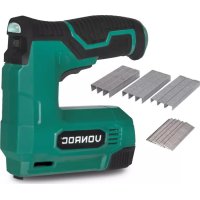
ET503DC - Cordless electric stapler Vonroc - Free user manual and instructions
Find the device manual for free ET503DC Vonroc in PDF.



| Product Type | Cordless Electric Staple Gun |
| Brand | Vonroc |
| Model | ET503DC |
| Weight | 0.66 kg |
| Power Supply | Integrated lithium-ion battery, charges via USB cable (5 V DC, 500-1500 mA) |
| Charging Time | 2 to 3 hours |
| Fastener Type | Staples and brads |
| Fastener Length | 6 to 10 mm |
| Firing Rate | 30 shots/min |
| Sound Pressure Level (Lpa) | 82.2 ± 3 dB(A) |
| Sound Power Level (Lwa) | 93.2 ± 3 dB(A) |
| Vibration Level | 2.537 ± 1.5 m/s² |
| Intended Use | Fastening of fabrics, wood, wire mesh, cardboard, leather; upholstery, packaging, shoe repair |
| Safety | Safety pin, 0/1 switch, safety goggles required |
| Maintenance | Regular cleaning with a soft cloth, soapy water; avoid solvents |
| Warranty | Legal warranty, covers defects in parts and workmanship |
| Repairability | Repair by a qualified technician, identical spare parts |
| Included Accessories | USB charging cable (Micro B) |
| Power Adapter | Not included (5 V DC, 500-1500 mA) |
| Operating Conditions | Indoor use only, do not expose to rain or moisture |
Frequently Asked Questions - ET503DC Vonroc
User questions about ET503DC Vonroc
0 question about this device. Answer the ones you know or ask your own.
Ask a new question about this device
Download the instructions for your Cordless electric stapler in PDF format for free! Find your manual ET503DC - Vonroc and take your electronic device back in hand. On this page are published all the documents necessary for the use of your device. ET503DC by Vonroc.
USER MANUAL ET503DC Vonroc
1. SAFETY INSTRUCTIONS
Read the enclosed safety warnings, the additional safety warnings and the instructions. Failure to follow the safety warnings and the instructions may result in electric shock, fire and/or serious injury. Save the safety warnings and the instructions for future reference.
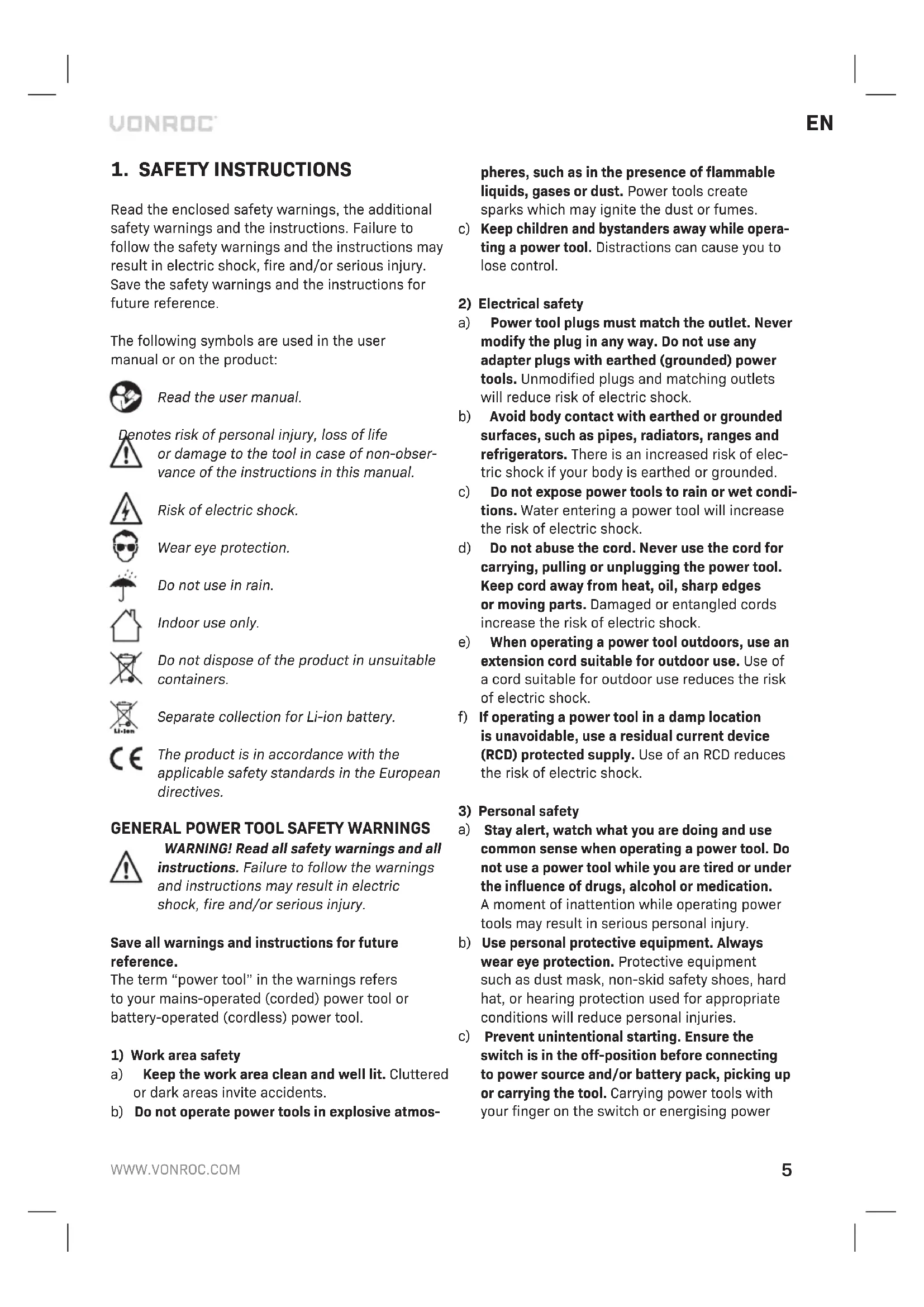
The following symbols are used in the user manual or on the product:

Read the user manual.
Denotes risk of personal injury, loss of life or damage to the tool in case of non-observation of the instructions in this manual.

Risk of electric shock.

Wear eye protection.

Do not use in rain.

Indoor use only.

Do not dispose of the product in unsuitable containers.

Separate collection for Li-ion battery.

The product is in accordance with the applicable safety standards in the European directives.
GENERAL POWER TOOL SAFETY WARNINGS

WARNING! Read all safety warnings and all instructions. Failure to follow the warnings and instructions may result in electric shock, fire and/or serious injury.
Save all warnings and instructions for future reference.
The term "power tool" in the warnings refers to your mains-operated (corded) power tool or battery-operated (cordless) power tool.
1) Work area safety
a) Keep the work area clean and well lit. Cluttered or dark areas invite accidents.
b) Do not operate power tools in explosive atmos
pheres, such as in the presence of flammable liquids, gases or dust. Power tools create sparks which may ignite the dust or fumes.
c) Keep children and bystanders away while operating a power tool. Distractions can cause you to lose control.
2) Electrical safety
a) Power tool plugs must match the outlet. Never modify the plug in any way. Do not use any adapter plugs with earthed (grounded) power tools. Unmodified plugs and matching outlets will reduce risk of electric shock.
b) Avoid body contact with earthed or grounded surfaces, such as pipes, radiators, ranges and refrigerators. There is an increased risk of electric shock if your body is earthed or grounded.
c) Do not expose power tools to rain or wet conditions. Water entering a power tool will increase the risk of electric shock.
d) Do not abuse the cord. Never use the cord for carrying, pulling or unplugging the power tool. Keep cord away from heat, oil, sharp edges or moving parts. Damaged or entangled cords increase the risk of electric shock.
e) When operating a power tool outdoors, use an extension cord suitable for outdoor use. Use of a cord suitable for outdoor use reduces the risk of electric shock.
f) If operating a power tool in a damp location is unavoidable, use a residual current device (RCD) protected supply. Use of an RCD reduces the risk of electric shock.
3) Personal safety
a) Stay alert, watch what you are doing and use common sense when operating a power tool. Do not use a power tool while you are tired or under the influence of drugs, alcohol or medication. A moment of inattention while operating power tools may result in serious personal injury.
b) Use personal protective equipment. Always wear eye protection. Protective equipment such as dust mask, non-skid safety shoes, hard hat, or hearing protection used for appropriate conditions will reduce personal injuries.
c) Prevent unintentional starting. Ensure the switch is in the off-position before connecting to power source and/or battery pack, picking up or carrying the tool. Carrying power tools with your finger on the switch or energising power
tools that have the switch on invites accidents.
d) Remove any adjusting key or wrench before turning the power tool on. A wrench or a key left attached to a rotating part of the power tool may result in personal injury.
e) Do not overreach. Keep proper footing and balance at all times. This enables better control of the power tool in unexpected situations.
f) Dress properly. Do not wear loose clothing or jewellery. Keep your hair, clothing and gloves away from moving parts. Loose clothes, jewellery or long hair can be caught in moving parts.
g) If devices are provided for the connection of dust extraction and collection facilities, ensure these are connected and properly used. Use of dust collection can reduce dust related hazards.
h) Do not let familiarity gained from frequent use of tools allow you to become complacent and ignore tool safety principles. A careless action can cause severe injury within a fraction of a second.
4) Power tool use and care
a) Do not force the power tool. Use the correct power tool for your application. The correct power tool will do the job better and safer at the rate for which it was designed.
b) Do not use the power tool if the switch does not turn it on and off. Any power tool that cannot be controlled with the switch is dangerous and must be repaired.
c) Disconnect the plug from the power source and/or the battery pack from the power tool before making any adjustments, changing accessories, or storing power tools. Such preventive safety measures reduce the risk of starting the power tool accidentally.
d) Store idle power tools out of the reach of children and do not allow persons unfamiliar with the power tool or these instructions to operate the power tool. Power tools are dangerous in the hands of untrained users.
e) Maintain power tools. Check for misalignment or binding of moving parts, breakage of parts and any other condition that may affect the power tool's operation. If damaged, have the power tool repaired before use. Many accidents are caused by poorly maintained power tools.
f) Keep cutting tools sharp and clean. Properly maintained cutting tools with sharp cutting edges are less likely to bind and are easier to control.
g) Use the power tool, accessories and tool bits
etc. in accordance with these instructions, taking into account the working conditions and the work to be performed. Use of the power tool for operations different from those intended could result in a hazardous situation.
h) Keep handles and grasping surfaces dry, clean and free from oil and grease. Slippery handles and grasping surfaces do not allow for safe handling and control of the tool in unexpected situations.
5) Battery tool use and care
a) Recharge only with the charger specified by the manufacturer. A charger that is suitable for one type of battery pack may create a risk of fire when used with another battery pack.
b) Use power tools only with specifically designated battery packs. Use of any other battery packs may create a risk of injury and fire.
c) When battery pack is not in use, keep it away from other metal objects, like paper clips, coins, keys, nails, screws or other small metal objects that can make a connection from one terminal to another. Shorting the battery terminals together may cause burns or a fire.
d) Under abusive conditions, liquid may be ejected from the battery; avoid contact. If contact accidentally occurs, flush with water. If liquid contacts eyes, additionally seek medical help. Liquid ejected from the battery may cause irritation or burns.
e) Do not use a battery pack or tool that is damaged or modified. Damaged or modified batteries may exhibit unpredictable behaviour resulting in fire, explosion or risk of injury.
f) Do not expose a battery pack or tool to fire or excessive temperature. Exposure to fire or temperature above 130°C may cause explosion. NOTE The temperature, 130°C can be replaced by the temperature, 265°F .
g) Follow all charging instructions and do not charge the battery pack or tool outside the temperature range specified in the instructions. Charging improperly or at temperatures outside the specified range may damage the battery and increase the risk of fire.
6) Service
a) Have your power tool serviced by a qualified repair person using only identical replacement parts. This will ensure that the safety of the
power tool is maintained.
b) Never service damaged battery packs. Service of battery packs should only be performed by the manufacturer or authorized service providers.
SPECIFIC SAFETY INSTRUCTIONS
Always assume that the tool contains fasteners. Careless handling of the tacker can result in unexpected firing of fasteners and personal injury.
- Do not point the tool towards yourself or anyone nearby. Unexpected triggering could discharge the fastener causing an injury.
- Do not actuate the tool unless the tool is placed firmly against the workpiece. If the tool is not in contact with the workpiece, the fastener may be deflected away from your target.
- Disconnect the tool from the power source when the fastener jams in the tool. While removing a jammed fastener, the tacker may be accidentally activated if it is plugged in.
- Use caution while removing a jammed fastener. The mechanism may be under compression and the fastener may be forcefully discharged while attempting to free a jammed condition.
- Do not use this tacker for fastening electrical cables. It is not designed for electric cable installation and may damage the insulation of electric cables thereby causing electric shock or fire hazards.
Before using the tacker
Check the following points:
Always wear eye protection when using the tool.
- Maintain the tool with care.
- Check for misalignment or binding of moving parts, breakage of parts, and any other condition that may affect the tools operation. If damaged, have the tool serviced before using.
- Check if the slide cartridge has been fastened properly.
- Do not use the tool in a humid environment.
- Do not use the tool on materials containing asbestos.
- Secure the workpiece firmly. Use clamps or a vice to firmly hold the workpiece. This results in a safer grip than with your hand.
Always ensure that the cable is behind the device.
Using the tool
- Do not use the tool if the switch does not move in "0" or "1" position.
Always hold the tool with two hands while starting.
Always keep the cord away from the moving parts of the machine. - Keep your hands away from the work piece.
- In the case of jamming by a nail or staple, switch the machine immediately in lock position and remove the plug from the mains.
- Never aim the tool at people or animals.
- Use only staples or nails fit for this tool.
Make sure not to damage any leads when using the tool.
FOR THE CHARGER
Intended use
This tacker has an integrated lithium-ion battery, which you can charge with the included USB charging cable (USB-mains adapter not included).
a) The appliance is not to be used by persons (including children) with reduced physical, sensory or mental capabilities, or lack of experience and knowledge, unless they have been given supervision or instruction.
b) Children being supervised not to play with the appliance.
c) Do not recharge non-rechargeable batteries!
d) During charging, batteries must be placed in a well ventilated area!
e) Integrated batteries may only be removed for disposal by qualified personnel. Opening the housing shell can destroy the power tool. To remove the battery from the power tool, press the On/Off switch (4) until the battery is fully discharged. Unscrew the screws on the housing and remove the housing shell in order to remove the battery. To prevent a short circuit, disconnect the connectors on the battery one at a time and then isolate the poles. Even when fully discharged, the battery still contains a residual capacity, which can be released in case of a short circuit.
2. MACHINE INFORMATION
Intended use
The tacker enables you to fasten various materials, such as fabric, wood, gauze, cardboard and leather. Therefore, the tool is suitable to upholster furniture, to wrap objects or to repair shoes.
TECHNICAL SPECIFICATIONS
| Model No. ET503DC | |
| Recommended chargeradapter | 5V D.C. USB500mA to 1500mA |
| Type plug side A USB type A | |
| Type plug side B USB type Micro B | |
| Number of staples/nails 30/min. | |
| Staples 6 up to 10 mm | |
| Nails 6 up to 10 mm | |
| Weight ca. 0.66 kg | |
| Sound pressure level Lpa | 82.2+3 dB(A) |
| Sound power level Lwa | 93.2+3 dB(A) |
| Vibration | 2.537+1.5 m/s2 |
Vibration level
The vibration emission level stated in this instruction manual has been measured in accordance with a standardized test given in EN60745; it may be used to compare one tool with another and as a preliminary assessment of exposure to vibration when using the tool for the applications mentioned.
- Using the tool for different applications, or with different or poorly maintained accessories, may significantly increase the exposure level.
- The times when the tool is switched off or when it is running but not actually doing the job, may significantly reduce the exposure level.
Protect yourself against the effects of vibration by maintaining the tool and its accessories, keeping your hands warm, and organizing your work patterns.
DESCRIPTION
The numbers in the text refer to the diagrams on pages 2 - 3.
- Reload lever
- Cartridge shaft
- Switch
- "0/1" switch
- Top
- Safety pin
- Cartridge filling level window
- Charger cable
- Charging socket
- Battery indication light
3. OPERATION
Charging the device (Fig. A)
- Plug the charger cable (8) (included) into an adapter (not included).
Plug the charger cable (8) into the machine. (Fig. E)
Plug the charger plug into an electrical outlet and wait for a while. The charger indication light (10) will lighten up and show the charging status.
| LED | Charger status |
| Red | Battery charging in progress. |
| Green | Battery charging finished, battery fully charged. |
After the battery is fully charged remove the charger plug from the outlet and remove the small plug from the device.
Fully charging the battery may take up to 2-3 hours.
If the red LED charging indicator starts glowing during operation, this indicates that the battery will soon be empty.
Application (Fig. B)
For this tool, use one of the following length for staples or nails:
Staples: 6 up to 10mm
- Nails: 6 up to 10mm
Loading the nails or staples (Fig. C)
- Choose the correct nail or staple for the job.
- Hold the tacker with bottom upwards.
- Open de cartridge shaft (2) by slightly pressing the reload lever (1).
Pull the reload lever backwards to open the cartridge shaft (2).
For nails:
- Place the nails upside down against the left side of the cartridge shaft (2). The left side also shows a nail-symbol on the cartridge shaft, see fig.D.
For staples:
- Place the staples upside down in the cartridge shaft (2).
- Push the reload lever to fully close the cartridge shaft.

Before loading the tacker, make sure the machine is in "0" position.

Never load staples and nail at the same time.
Checking the cartridge shaft
The cartridge filling level window (7) indicates the amount of staples/nails inside the cartridge shaft.
Using the tacker

After every load test the machine on a piece of scrape.
- Press the "0/1" switch (4) to "1" to unlock the machine.
- Press the "0/1" switch (4) to "0" to lock the machine.
NOTE: When not in use, press the "0/1" switch to "0" to lock the machine.
NOTE: Always store in Lock on "0" position.
Placing the tool
- Place the tool on workpiece at the spot where the staple or nail should be located.
- Press the tool down firmly by pressing the machine on the top (5) with one hand.
- Use your other hand to operate the switch (3).
- By pressing the machine down firmly you lift the safety of the machine.

Warning! The safety of the machine will be lifted when pressure is applied to the safety pin (6) on the bottom of the machine. Always make sure the tacker mouth is in direct contact with the material when pressing the switch.
Stapling
- Press the switch (3).
The tool will cause a re bound because of the impact it operates with. Keep this in mind. For long nails and staples this can cause wrong stapling or nailing. When backpressure is applied wrong stapling or nailing can be avoided.
4. MAINTENANCE

Make sure that the machine is not live when carrying out maintenance work on the motor.
This machine has been designed to operate over a long period of time with a minimum of maintenance. Continuous satisfactory operation depends upon proper machine care and regular cleaning.
Malfunction
Should the machine fail to function correctly, a number of possible causes and the appropriate solutions are given below:
In case a staple or nail is jammed in the tool, follow the procedure below:
- Place the machine in "0" position (4).
- Open the cartridge shaft (2) by pulling the reload lever (1) and let the jammed nails/staples fall out.
- Reload the machine, see chapter "Loading the nails or staples" for instructions.
- Test the machine on a piece of scrap.
Cleaning
Regularly clean the device's casing with a soft cloth, preferably after each use. Keep the fan slits free of dust and dirt. Remove tough dirt using a soft cloth, dampened with soapy water. Do not use solvents such as benzene, alcohol, ammonia, etc., which might damage the plastic parts.
ENVIRONMENT

Faulty and/or discarded electrical or electronic apparatus have to be collected at the appropriate recycling locations.
Only for EC countries
Do not dispose of power tools into domestic waste. According to the European Guideline 2012/19/ EC for Waste Electrical and Electronic Equipment and its implementation into national right, power tools that are no longer usable must be collected separately and disposed of in an environmentally friendly way.
WARRANTY
VONROC products are developed to the highest quality standards and are guaranteed free of defects in both materials and workmanship for the period lawfully stipulated starting from the date of original purchase. Should the product develop any failure during this period due to defective material and/or workmanship then contact VONROC directly.
The following circumstances are excluded from this guarantee:
- Repairs and or alterations have been made or attempted to the machine by unauthorized service centers;
Normal wear and tear;
The tool has been abused, misused or improperly maintained; - Non-original spare parts have been used.
This constitutes the sole warranty made by company either expressed or implied. There are no other warranties expressed or implied which extend beyond the face thereof, herein, including the implied warranties of merchantability and fitness for a particular purpose. In no event shall VONROC be liable for any incidental or consequential damages. The dealers remedies shall be limited to repair or replacement of nonconforming units or parts.
The product and the user manual are subject to change. Specifications can be changed without further notice.
2. INFORMATIONS RELATIVES A LA MACHINE
Utilisation prevue
- SAFETY INSTRUCTIONS
- GENERAL POWER TOOL SAFETY WARNINGS
- SAVE ALL WARNINGS AND INSTRUCTIONS FOR FUTURE REFERENCE
- WORK AREA SAFETY
- ELECTRICAL SAFETY
- PERSONAL SAFETY
- SPECIFIC SAFETY INSTRUCTIONS
- BEFORE USING THE TACKER
- USING THE TOOL
- FOR THE CHARGER
- INTENDED USE
- MACHINE INFORMATION
- VIBRATION LEVEL
- DESCRIPTION
- OPERATION
- CHARGING THE DEVICE (FIG. A)
- APPLICATION (FIG. B)
- LOADING THE NAILS OR STAPLES (FIG. C)
- FOR NAILS
- FOR STAPLES
- CHECKING THE CARTRIDGE SHAFT
- USING THE TACKER
- PLACING THE TOOL
- STAPLING
- MAINTENANCE
- MALFUNCTION
- CLEANING
- ENVIRONMENT
- ONLY FOR EC COUNTRIES
- WARRANTY
- INFORMATIONS RELATIVES A LA MACHINE
- UTILISATION PREVUE
Brand : Vonroc
Model : ET503DC
Category : Cordless electric stapler