
5MA46910GB - Microwave BLAUPUNKT - Free user manual and instructions
Find the device manual for free 5MA46910GB BLAUPUNKT in PDF.



| Product type | Built-in combination microwave oven |
| Brand | Blaupunkt |
| Model | 5MA46910GB |
| Dimensions (W x D x H) | 595 x 586 x 454 mm |
| Net weight | 36 kg |
| Power supply | 230 V ~ 50 Hz, 15 A |
| Maximum power | 3350 W |
| Microwave power | 900 W (5 levels: 100, 300, 450, 700, 900 W) |
| Oven capacity | 44 L |
| Turntable diameter | 360 mm |
| Main functions | Microwave, 3D hot air, grill, fan grill, pizza, microwave + heat combination, 13 automatic programs, 2 defrost programs, quick preheat, timer, memory |
| Cooking types | Microwave only, combination (microwave + hot air/grill/pizza), grill only, 3D hot air, pizza |
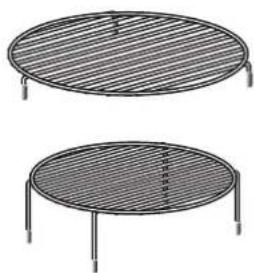
| Included accessories | Turntable, low rack, high rack |
| Safety | Child safety, automatic stop at end of cooking, locked door |
| Care and cleaning | Clean with soapy water and soft cloth; do not use abrasive cleaners or metal scrapers. Clean door seal regularly. |
| Spare parts and repairability | Repairs reserved for approved professional; turntable and racks available as spare parts. |
| General information | Instructions available in multiple languages; household use only; do not use without food. |
Frequently Asked Questions - 5MA46910GB BLAUPUNKT
User questions about 5MA46910GB BLAUPUNKT
0 question about this device. Answer the ones you know or ask your own.
Ask a new question about this device
Download the instructions for your Microwave in PDF format for free! Find your manual 5MA46910GB - BLAUPUNKT and take your electronic device back in hand. On this page are published all the documents necessary for the use of your device. 5MA46910GB by BLAUPUNKT.
USER MANUAL 5MA46910GB BLAUPUNKT
Integrated compact oven 5MA46910GB
Integrated compact oven 5MA46910GB
Built-in compact oven 5MA46910GB
Turntable
Caution!
Important safety information....25
Causes of damage 29
Installation....29
Your new appliance....31
Control panel 31
Touch keys and display 31
Function selector 31
Parameter selector....31
Cooling fan 31
Accessories 32
Before using the appliance for the first time 32
Setting the clock 32
Heating up the oven 32
Cleaning the accessories 32
Setting the oven....32
Setting the type of heating and temperature 32
Rapid preheating 33
The microwave.... 33
Notes regarding ovenware 33
Microwave power settings 33
Setting the microwave 34
MicroCombi operation 34
Setting Microwave Combi operation 34
Automatic programmes 34
Setting a programme....34
Defrosting programmes 35
Setting the time-setting options....35
Setting the timer 35
Setting the cooking time 36
Setting the clock....36
Childproof lock 36
Switching on the childproof lock 36
Switching off the childproof lock 36
Childproof lock with automatic programmes.... 36
Quick Start 36
Care and cleaning.... 37
Cleaning agents.... 37
Technical data.... 37
Malfunction table 38
Acrylamide in foodstuffs 38
Energy and environment tips....39
Saving energy.... 39
Environmentally-friendly disposal 39
Expert Cooking Guide....39
Defrosting, heating up and cooking with the microwave ..... 39
Microwave tips....42
Cakes and pastries....42
Baking tips....43
Roasting and grilling....44
Tips for roasting and grilling 46
Bakes, gratins, toast with toppings....46
Convenience products, frozen....47

Important safety information
Read these instructions carefully. Only then will you be able to operate your appliance safely and correctly. Retain the instruction manual for future use or for subsequent owners.
Check the appliance for damage after unpacking it. Do not connect the appliance if it has been damaged in transport.
The microwave oven is intended for heating food and beverages. Drying of food or clothing and heating of slippers, sponges, warming pads,
damp cloth and similar may lead to risk of injury, ignition or fire.
Only a licensed professional may connect appliances without plugs. Damage caused by incorrect connection is not covered under warranty.
This appliance is intended for domestic use only. The appliance must only be used for the preparation of food and drink. The appliance must be supervised during operation. Only use this appliance indoors.
This appliance can be used by children aged from 8 years and above and persons with reduced physical, sensory or mental capacity or lack of experience and knowledge if they have been given supervision or instruction concerning use of the appliance in a safe way and understand the hazards involved. Children shall not play with the appliance. Cleaning and user maintenance shall not be made by children without supervision.
The appliances are not intended to be operated by means of an external timer or separate remote-control system.
This appliance is intended to be used in household and similar applications such as:
- staff kitchen areas in shops, offices and other working environments;
- farm houses;
- by clients in hotels, motels and other residential type environments; bed and breakfast type environments.
Risk of fire!
- Combustible items stored in the cooking compartment may catch fire. Never store combustible items in the cooking compartment. Never open the appliance door if there is smoke inside. Switch off the appliance and unplug it from the mains or switch off the circuit breaker in the fuse box.
- When heating food in plastic or paper containers, keep an eye on the oven due to the possibilities of ignition.
- If smoke is observed, switch off or unplug the appliance and keep the door closed in order to stifle any flames.
WARNING: Accessible parts may become hot during use. Young children should be kept away.
WARNING: Do not use harsh abrasive cleaners or sharp metal scrapers to clean the microwave oven door glass since they can scratch the surface, which may result in shattering of the glass.
- Do not select a microwave power or time setting that is higher than necessary. Follow the information provided in this instruction manual. Never use the microwave to dry food. Never defrost or heat food with a low water content, e.g. bread, at too high a microwave power or for too long.
- Cooking oil may catch fire. Never use the microwave to heat cooking oil on its own.
Risk of explosion!
Liquids and other food may explode when in containers that have been tightly sealed. Never heat liquids or other food in containers that have been tightly sealed.
Only use utensils that are suitable for use in microwave ovens.
Risk of serious damage to health!
- The surface of the appliance may become damaged if it is not cleaned properly. Microwave energy may escape. Clean the appliance on a regular basis, and remove any food residue immediately. Always keep the cooking compartment, door seal, door and door stop clean; see also section Care and cleaning.
WARNING: If the door or door seals are damaged, the oven must not be operated until it has been repaired by a competent person.
WARNING: It is hazardous for anyone other than a competent person to carry out any service or repair operation that involves the removal of a cover which gives protection against exposure to microwave energy.
- Microwave energy may escape if the cooking compartment door or the door seal is damaged. Never use the appliance if the cooking compartment door or the door seal is damaged. Contact the after-sales service.
- Microwave energy will escape from appliances that do not have any casing. Never remove the casing. For any maintenance or repair work, contact the after-sales service.
Risk of electric shock!
- Incorrect repairs are dangerous. Repairs may only be carried out and damaged power cables replaced by one of our trained
after-sales technicians. If the appliance is defective, unplug the appliance from the mains or switch off the circuit breaker in the fuse box. Contact the after-sales service.
- The cable insulation on electrical appliances may melt when touching hot parts of the appliance. Never bring electrical appliance cables into contact with hot parts of the appliance.
- Penetrating moisture may cause an electric shock. Do not use any high-pressure cleaners or steam cleaners.
- A defective appliance may cause electric shock. Never switch on a defective appliance. Unplug the appliance from the mains or switch off the circuit breaker in the fuse box. Contact the after-sales service.
- The appliance is a high-voltage appliance. Never remove the casing.
WARNING: Ensure that the appliance is switched off before replacing the lamp to avoid the possibility of electric shock.
Risk of burns!
- During use the appliance becomes hot. Care should be taken to avoid touching heating elements inside the oven. ■ Accessories and ovenware become very hot. Always use oven gloves to remove accessories or ovenware from the cooking compartment.
- Alcoholic vapours may catch fire in the hot cooking compartment. Never prepare food containing large quantities of drinks with a high alcohol content. Only use small quantities of drinks with a high alcohol content. Open the appliance door with care.
- Foods with peel or skin may burst or explode during, or even after, heating. Never cook eggs in their shells or reheat hard-boiled eggs. Never cook shellfish or crustaceans. Always prick the yoke when baking or poaching eggs. The skin of foods that have a peel or skin, such as apples, tomatoes, potatoes and sausages, may burst. Before heating, prick the peel or skin.
- The contents of feeding bottles and baby food jars shall be stirred or shaken and the temperature checked before consumption, in order to avoid burns.
- Heated food gives off heat. The ovenware may become hot. Always use oven gloves to remove ovenware or accessories from the cooking compartment.
WARNING: Liquids and other foods must not be heated in sealed containers since they are liable to explode. Always observe the instructions on the packaging. Always use oven gloves to remove dishes from the cooking compartment.
Risk of scalding!
- When you open the appliance door, hot steam may escape. Open the appliance door with care. Keep children at a safe distance.
- Microwave heating of beverages can result in delayed eruptive boiling, therefore care must be taken when handling the container. This means that the liquid reaches boiling temperature without the usual steam bubbles rising to the surface. Even if the container only vibrates a little, the hot liquid may suddenly boil over and spatter. When heating, always place a spoon in the container. This will prevent delayed boiling.
Risk of injury!
- Scratched glass in the appliance door may develop into a crack. Do not use a glass scraper, or sharp or abrasive cleaning aids or detergents.
- Unsuitable ovenware may crack. Porcelain or ceramic ovenware can have small perforations in the handles or lids. These perforations conceal a cavity below. Any moisture that penetrates this cavity could cause the ovenware to crack. Only use microwave-safe ovenware.
Causes of damage
Caution!
- Creation of sparks: Metal – e.g. a spoon in a glass – must be kept at least 2cm from the oven walls and the inside of the door. Sparks could irreparably damage the glass on the inside of the door. Water in the hot cooking compartment: Never pour water into the hot cooking compartment. This will cause steam. The temperature change can cause damage. Moist food: Do not store moist food in the closed cooking compartment for long periods. Do not use the appliance to store food. This can lead to corrosion.
- Cooling with the appliance door open: Only leave the cooking compartment to cool with the door closed. Do not trap anything in the appliance door. Even if the door is only slightly ajar, the fronts of adjacent units may be damaged over time.
- Heavily soiled seal: If the seal is very dirty, the appliance door will no longer close properly during operation. The fronts of adjacent units could be damaged. Always keep the seal clean.
- Operating the microwave without food: Operating the appliance without food in the cooking compartment may lead to overloading. Never switch on the appliance unless there is food in the cooking compartment. An exception to this rule
is a short crockery test (see the section "Microwave, suitable crockery").
- Using the appliance door for standing on or placing objects on: Do not stand or place anything on the open appliance door. Do not place ovenware or accessories on the appliance door.
- Transporting the appliance: Do not carry or hold the appliance by the door handle. The door handle cannot support the weight of the appliance and could break.
- Microwave popcorn: Never set the microwave power too high. Use a power setting no higher than 600 watts. Always place the popcorn bag on a glass plate. The disc may jump if overloaded.
- Liquid that has boiled over must not be allowed to run through the turntable drive into the interior of the appliance. Monitor the cooking process. Choose a shorter cooking time initially, and increase the cooking time as required.
- The oven should be cleaned regularly and any food deposits removed since they may explode, even after microwave heating has ended.
- Failure to maintain the oven in a clean condition could lead to deterioration of the surface that could adversely affect the life of the appliance and possibly result in a hazardous situation.
Installation
Fitted units
■ This appliance is only intended to be fully fitted in a kitchen. - This appliance is not designed to be used as a tabletop appliance or inside a cupboard. ■ The fitted cabinet must not have a back wall behind the appliance. - A gap of at least 35 mm must be maintained between the wall and the base or back panel of the unit above. - The fitted cabinet must have a ventilation opening of 250 cm² on the front. To achieve this, cut back the base panel or fit a ventilation grille.
■ Ventilation slots and intakes must not be covered. - The safe operation of this appliance can only be guaranteed if it has been installed in accordance with these installation instructions. - The fitter is liable for any damage resulting from incorrect installation. - The units into which the appliance is fitted must be heat-resistant up to 90 °C.
Installation dimensions
Ventilation openings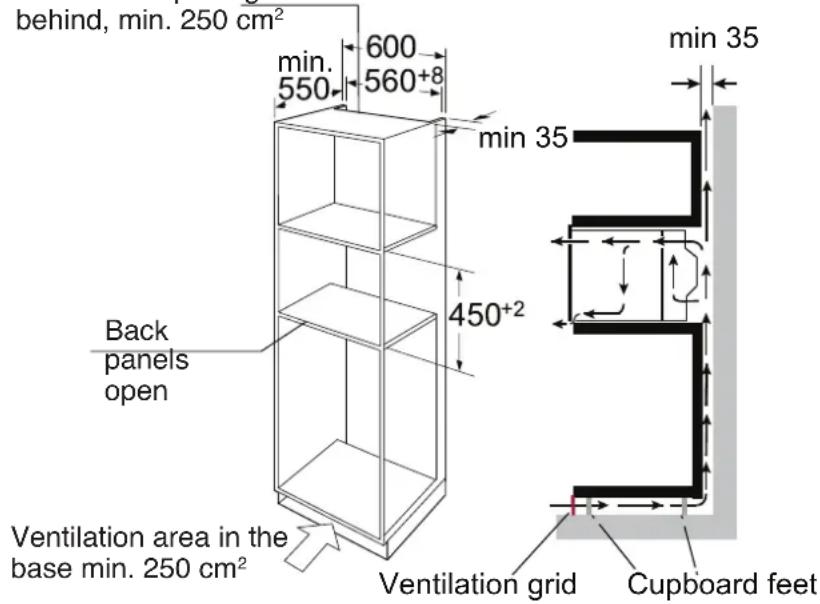
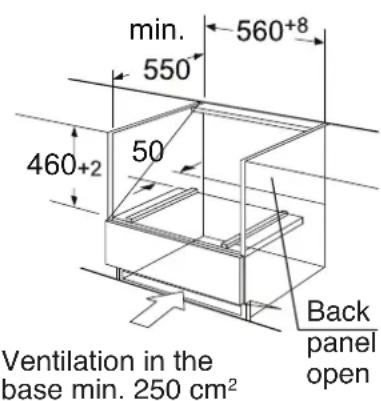
Note: There should be a gap above the oven.
Building in
- Do not hold or carry the appliance by the door handle. The door handle cannot hold the weight of the appliance and may break off.
- Carefully push the microwave into the box, making sure that it is in the centre.
- Open the door and fasten the microwave with the screws that were supplied.
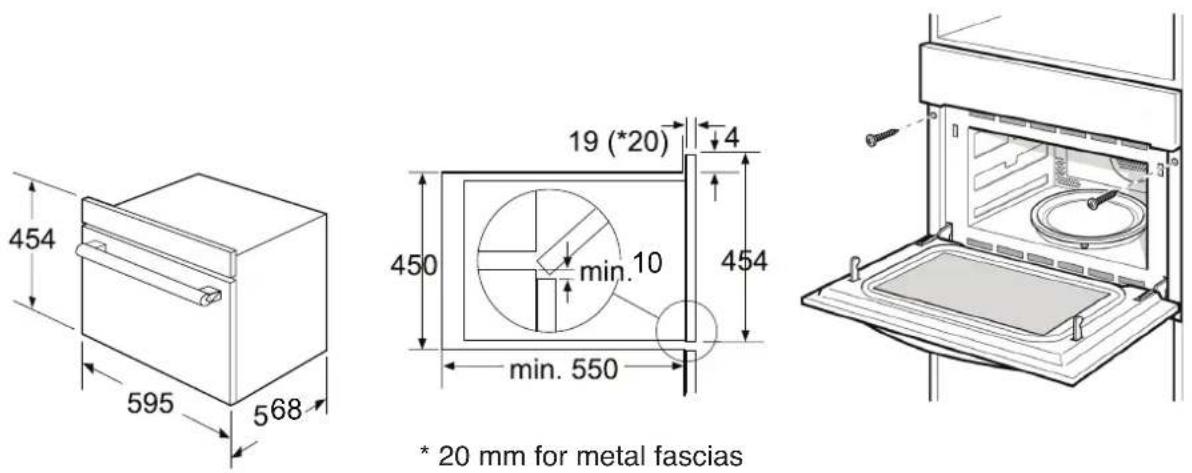
Fully insert the appliance and centre it. Do not kink the connecting cable. Screw the appliance into place.
The gap between the worktop and the appliance must not be closed by additional battens.
Important Information
Electrical connection
The appliance is fitted with a plug and must only be connected to a properly installed earthed socket.
Only a qualified electrician who takes the appropriate regulations into account may install the socket or replace the connecting cable. If the plug is no longer accessible following installation, an all-pole isolating switch must be present on the installation side with a contact gap of at least 3 mm. Contact protection must be ensured by the installation.
Fuse protection: see instructions for use - technical data.
Your new appliance
Use this section to familiarise yourself with your new appliance. The control panel and the individual operating controls are
explained. You will find information on the cooking compartment and the accessories.
Control panel
Touch keys and display
The touch keys are used to set the various additional functions.
On the display, you can read the values that you have set.
| Symbol | Function |
| Microwave 3D | |
| Hot air | |
| Grill with fan | |
| Grill | |
| Pizza setting | |
| M | Memory |
| Parameter adjustment | |
| Temperature/Weight | |
| A | Auto-programs |
| Defrost | |
| Touch and hold:Childproof LockTouch briefly:Rapid preheating | |
| Clock | |
| Start | |
| Touch briefly:StopTouch twice:Cancel |
Function and screen display
Use the function keys to set the type of heating.
| Function | Use |
| 3D Hot air | For baking sponge cakes in baking tins, flans and cheesecakes as well as cakes, pizza and small baked items on the baking tray.50°C can maintain the taste of food after heat preservation of 1-2 hours. |
| Grill with fan | Poultry goes brown and crispy.Baked casseroles and grilled dishes work out best using this setting. |
| Pizza setting | For frozen convenience products and dishes which require a lot of heat from underneath. |
| — Grill | Select between the levels high, medium or low. This is ideal if you wish to grill several steaks, sausages, pieces of fish or slices of bread. |
| Microwave+Hot air | Use this function to roast meals quickly. And at the same time use the function of 3D Hot air |
| Microwave+Grill Fan | Poultry goes brown and crispy.Baked casseroles and grilled dishes work out best using this setting.And use the function to roast meals evenly. |
| Function | Use | |
| Microwave+Pizza | Use this function to roast meals quickly. And at the same time use the function of Pizza setting. | |
| Microwave+Grill | Use this function to cook meals quickly and at the same time give the meal a brown crust. | |
| Defrost | 2 defrosting programmes 13 cooking programmesThe type of heating and cooking time are set by weight. | |
| Auto-programs | Defrost, reheat and cooking. | |
| Microwave | ||
Parameter adjustment
Use the adjusting keys to set the parameters.
| parameter | function |
| Auto menu | Select 13 automatic programmes.From P 01 to P 1.3 |
| Temperature | Select the temperature of cooking(°C). + : 50,100,105,110... 230 - : 100,105,110... 230 + : 100,105,110... 230 + + - : 50,100,105,110... 230 - + - : 100,105,110... 230 + + - : 100,105,110... 230 |
| Weight | Set the weight of cooking. |
| Time | Se the of cooking. ttime |
| Microwave | Select microwave power.100W,300W450W,700W and 900W |
Cooling fan
Your appliance has a cooling fan. The cooling fan switches on during operation. The hot air escapes above the door.
The cooling fan continues to run for a certain time after operation.
Caution!
Do not cover the ventilation slots. Otherwise, the appliance will overheat.
Notes
- The appliance remains cool during microwave operation. The cooling fan will still switch on. The fan may run on even when microwave operation has ended.
- Condensation may appear on the door window, interior walls and floor. This is normal and does not adversely affect microwave operation. Wipe away the condensation after cooking.
Accessories
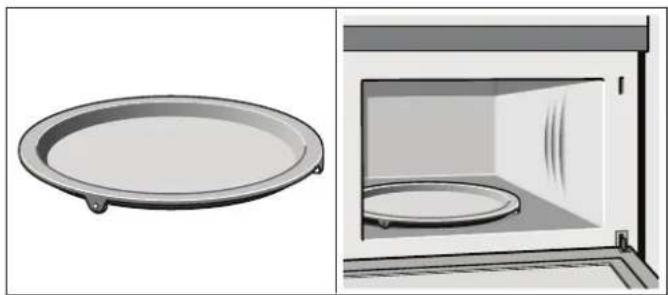
Turntable
As a surface for the wire rack.
Food which particularly requires a lot of heat from underneath can be prepared directly on the turntable.
The turntable can turn clockwise or anti-clockwise.
Place the turntable on the drive in the centre of the cooking compartment. Ensure that it is properly fitted.
■ Never use the microwave without the turntable. ■ The turntable can withstand max. 5kg. - The turntable must turn when using all types of heating.
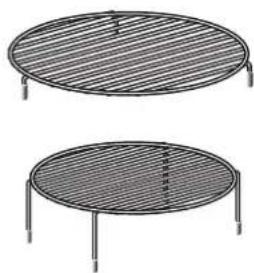
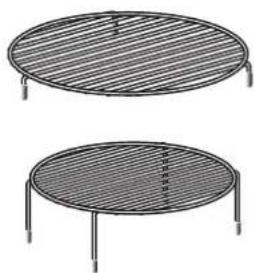
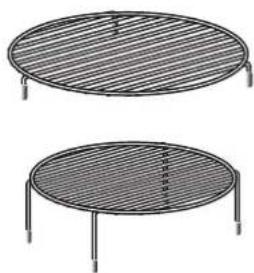
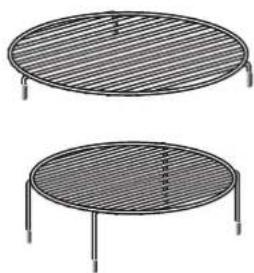
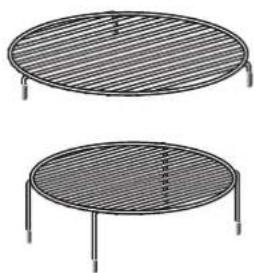
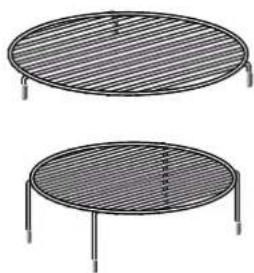
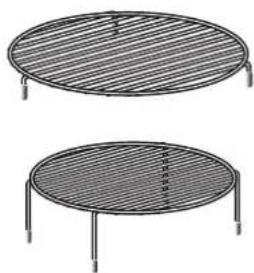
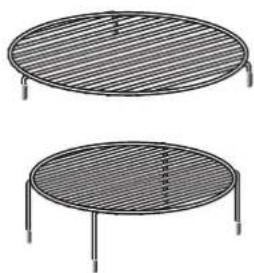
Lower wire rack
For the microwave and for baking and roasting in the oven.
Higher wire rack
For grilling, e.g. steaks, sausages and for toasting bread.
As a support for shallow dishes.
Note:
Type and quantity of accessories is subject to actual demand.
Before using the appliance for the first time
Here you will find everything you need to do before using your oven to prepare food for the first time. First read the section on Safety information.
Setting the clock
Once the appliance is connected, "00:00" will blink, buzzer will ring once. Set the clock.
- Touch the "- +" key between 00:00 and 23:59
- Touch the ⏻ key. The time is set.
Heating up the oven
To remove the new cooker smell, heat up the oven when it is empty and closed. One hour with Hot air at 230°C is ideal. Ensure that no packaging remnants have been left in the cooking compartment.
- Touch the ⏻ key to set hot air function.
- Touch the "– +" key to set the temperature to 230°C.
- Touch the Ⓤ key. Touch the "– +" key to set the cooking time to 60 minutes.
- Touch the key key. The oven begins to heat up.
Cleaning the accessories
Before you use the accessories for the first time, clean them thoroughly with hot soapy water and a soft dish cloth.
Setting the oven
There are various ways in which you can set your oven. Here we will explain how you can select the desired type of heating and temperature or grill setting. You can also select the oven cooking time for your dish. Please refer to the section on Setting the time-setting options.
Setting the type of heating and temperature
Example: Ⓐ Hot air at 200°C for 25 minutes.
- Touch the Ⓞ key to set hot air function.
- The default temperature 180°C will blink. Touch the "– +" key to set the temperature to 200°C.
- Touch the ⏻ key. Touch the "– +" key to set the cooking time to 25 minutes.
- Touch the Ⓗ key. The oven begins to heat up.
Opening the oven door during operation
Operation is suspended. After closing the door, touch the key. Operation continues.
Pausing operation
Touch the ☐ key to pause operation. Then touch the Ⓧ key to continue operation.
Changing the cooking time
This can be done at any time. Touch the ⏻ key. Touch the “- +” key to change the cooking time.
Changing the temperature
This can be done at any time.
Touch the c for the new temperature setting. Touch the “- +” key to set the temperature. Cancelling operation
Touch the ☐ key twice to cancel operation.
Rapid Preheating
With rapid preheating, your oven reaches the set temperature particularly quickly.
Rapid Preheating is available for the following types of heating:
3D Hot air, Grill ■ with fan ■ + ≈, Microwave+Hot air, Microwave+Grill, Fan Pizza setting ■ + ≈, Microwave+Pizza
To ensure an oven cooking result, only put your food in the cooking compartment when the preheating phase is complete.
- Setting the type of heating and temperature.
- Touch the Ⓜ key.
The Ⓞ symbol lights up in the display.
- Touch the Ⓗ key.
The oven begins to heat up.
The preheating process is complete.
A signal sounds. The Ⓜ symbol in the display blinks. Put your dish in the oven.
Cancelling rapid preheating.
During setting the rapid preheating function, touch the Ⓞ to cancel the function.
During rapid preheating, touch the ☐ or ☑ to cancel the function. You can also open the door to cancel the function.
Note: 1. The rapid preheating function only works if you have already chosen one of the modes above. During preheating, the microwave function is switched off.
- Only when you hear the alarm and the preheating icon is blinking can you open the door and put food inside.
The microwave.
Microwaves are converted to heat in foodstuffs. The microwave can be used solo, i.e. on its own, or in combination with a different type of heating. You will find information about ovenware and how to set the microwave.
Note:
In the Expert Cooking Guide, you will find examples for defrosting, heating and cooking with the microwave oven.
Note:
The step quantities for the adjustment time of the coding switch are as follow:
0-1 min : 1 second
1-5 min : 10 seconds
5-15 min : 30 seconds
15-60 min : 1 minute
60 min : 5 minutes
Notes regarding ovenware
Suitable ovenware
Suitable dishes are heat-resistant ovenware made of glass, glass ceramic, porcelain, ceramic or heat-resistant plastic. These materials allow microwaves to pass through.
You can also use serving dishes. This saves you having to transfer food from one dish to another. You should only use ovenware with decorative gold or silver trim if the manufacturer guarantees that they are suitable for use in microwaves.
Unsuitable ovenware
Metal ovenware is unsuitable. Metal does not allow microwaves to pass through. Food in covered metal containers will remain cold.
Caution!
Creation of sparks: metal – e.g. a spoon in a glass – must be kept at least 2cm from the oven walls and the inside of the door. Sparks could destroy the glass on the inside of the door.
Ovenware test
Do not switch on the microwave unless there is food inside. The following ovenware test is the only exception to this rule. Perform the following test if you are unsure whether your ovenware is suitable for use in the microwave:
- Heat the empty ovenware at maximum power for 1/2 to 1 minute.
- Check the temperature occasionally during that time.
The ovenware should still be cold or warm to the touch.
The ovenware is unsuitable if it becomes hot or sparks are generated.
Microwave power settings
Use the key to set the desired microwave power.
| 100W | -Defrosting sensitive/delicate foods-Defrosting irregularly-shaped foods-Softening ice cream-Allowingdough to rise |
| 300 W | -Defrosting-Meltingchocolate and butter |
| 450 W | -cooking rise, soup |
| 700 W | -Reheating-cookingmushrooms, shellfish-cookingdishes containing eggs and cheese |
| 900 W | -Boilingwater, reheating-cooking chicken, fish, vegetables |
Notes
■ When you touch a key, the selected power lights up. - The microwave power can be set to 900 watts for a maximum of 30 minutes. With all other power settings a maximum cooking time of 1 hour 30 minutes is possible.
Setting the microwave
Example: Microwave power setting 300 W, cooking time 17 minutes
- Touch the microwave key. The default microwave power 900W will appear and the default cooking time will blink.
- Touch the microwave key, the default microwave power will blink. Touch the "- +" key to adjust the microwave power to 300W.
- Touch the time key, the default cooking time will blink. Touch the "- +" key to adjust the cooking time to 17 minutes.
- Touch the start key.
Operation begins. The cooking time starts counting down in the display.
The cooking time has elapsed.
A signal sounds. Microwave operation has finished.
Opening the oven door during operation
Operation is suspended. After closing the door, touch the play key. Operation continues.
Changing the cooking time
This can be done at any time. Touch the stop key. Touch the "- +" key to change the cooking time.
Changing the microwave power setting
This can be done at any time.
Touch the microwave key for the new microwave power setting. Touch the "- +" key to set the microwave power.
Pausing operation
Touch the ☐ key briefly. The oven is paused. Touch the ☑ key again to continue operation.
Cancelling operation
Touch the ☐ key twice to cancel operation.
Notes
- When you touch the microwave key, the highest microwave power setting always lights up as the suggested setting.
- If you open the appliance door during cooking, the fan may continue to run.
MicroCombi operation
This involves simultaneous operation of the grill and the microwave. Using the microwave makes your dishes ready more quickly, but they are still nicely browned.
You can switch on all microwave power settings. Exception: 900 watts
Setting Microwave Combi operation
Example: microwave 100 W, 17 minutes and hot air ⓣ190°C.
- Touch the Ⓞkey to set hot air function.
- The default temperature 180 °C will blink. Touch „− +“ key to set the temperature to 190°C.
- Touch the ≈ key to enter ⚠ mode. The default microwave power 300W will blink, and then touch „− +“ key key to set the microwave power to 100W.
- Touch the ⏻ key. Touch the “- +” key to set the cooking time to 17 minutes.
- Touch the _key.
Appliance operation begins. The cooking time starts counting down.
The cooking time has elapsed.
A signal sounds. Combination mode has finished.
Opening the oven door during cooking
Operation is suspended. After closing the door, touch the key briefly. The programme will then continue.
Pausing operation
Touch the ☐ key briefly. The oven is paused. Touch the ▶ key again to continue operation.
Changing the cooking time
This can be done at any time. Touch the ⓣ key. Touch the “- +” key to change the cooking time.
Changing the microwave power setting
This can be done at any time.
Touch the ≈ for the new microwave power setting. Touch the “- +” key to set the microwave power.
Changing the temperature
This can be done at any time.
Touch the c for the new temperature setting. Touch the “− +” key to set the temperature.
Cancelling operation
Touch the ☐ key twice to cancel operation.
Automatic programmes
The automatic programmes enable you to prepare food very easily. You select the programme and enter the weight of your food. The automatic programme makes the optimum setting. You can choose from 13 programmes.
Always place the food in the cold cooking compartment.
Setting a programme
When you have selected a programme, set the oven. The temperature selector must be in the off position.
Example: Programme 3 with a weight of 1 kilogramme.
- Touch the A key. The first programme number appears in the display.
- Touch the “− +” key or A key to select the programme number P03.
- Touch the ☐ key.
- Touch the “− +” key to set the weight; the cooking time will be shown.
- Touch the key. The programme starts. You can see the cooking time counting down.
Auto Menu
| Programme no. Category Item | |
| P 01** Vegetables Fresh vegetables | |
| P 02* Side dishes Potatoes-peeled/ | cooked |
| P 03* Side dishes Potatoes-roasted | |
| P 04 Poultry/Fish Chicken pieces | |
| P 05* Bakery Cake | |
| P 06* Bakery Apple pie | |
| P 07* Bakery | quiche |
| P 08** Reheat Drink/soup | |
| P 09** Reheat Plated meal | |
| P 10** Reheat Sauce/stew/dish | |
| P 11* Convenience Frozen-Pizza | |
| P 12* Convenience Frozen-Oven chips | |
| P 13* | Convenience Frozen-Lasagna |
Notes
- The programmes with a * are preheated. During preheating, the cooking time pauses and the preheating symbol is on. After preheating, you will hear an alarm and the preheating symbol will blink. ■ The programmes with ** only use the microwave function.
Programme has ended
A signal sounds. The oven stops heating.
Changing the programme
Once you have started the programme, the programme number and weight cannot be changed.
Cancelling the programme
Touch the ☐ key twice to cancel operation.
Changing the cooking time
If using automatic programmes, you cannot change the cooking time.
Defrosting programmes
You can use the 2 defrosting programmes to defrost meat, poultry and bread.
- Touch the * key. The first programme number appears in the display.
- Touch „- +“ or *# key to select the programme number.
- Touch the ☐ key.
- Touch the “− +” key to set the weight; the cooking time will be shown.
- Touch the Ⓑ key. The programme starts. You can see the cooking time counting down.
Notes
■ Preparing food
Use food that has been frozen at -18°C and stored in portion-sized quantities that are as thin as possible. Take the food to be defrosted out of all packaging and weigh it. You need to know the weight to set the programme.
Liquid will be produced when defrosting meat or poultry. Drain off this liquid when turning meat and poultry and under no circumstances use it for other purposes or allow it to come into contact with other foods.
■ Ovenware
Place the food in a microwaveable shallow dish, e.g. a china or glass plate, but do not cover.
When defrosting chicken and chicken portions (d 01), an audible signal will sound on two occasions to indicate that the food should be turned.
■ Resting time
The defrosted food should be left to stand for an additional 10 to 30 minutes until it reaches an even temperature. Large pieces of meat require a longer standing time than smaller pieces. Flat pieces of meat and items made from minced meat should be separated from each other before leaving to stand. After this time, you can continue to prepare the food, even though thick pieces of meat may still be frozen in the middle. The giblets can be removed from poultry at this point.
| Programme no. Defrost Weight range in kg | |
| d 01* meat, poultry and fish | 0.20 - 1.00 |
| d 02* bread, cake and fruit | 0.10 - 0.50 |
| *During defrosting, place the food on the Lowerwirerack | |
Setting the time-setting options
Your oven has various time-setting options. You can use the ⏻ key to call up the menu and switch between the individual functions. A time-setting option that has already been set can be changed directly with the “- +” key.
Setting the timer
You can use the timer as a kitchen timer. It runs independently of the oven. The timer has its own audible signal. In this way, you can tell whether it is the timer or a cooking time which has elapsed.
- In waiting state. Touch the Ⓤ key to enter kitchen timer. "00:00" will display.
- Touch the “− +” key to adjust the timer time. The maximum time is 5 hours.
- Touch the ▶ key to start the timer.
The timer duration has elapsed.
A signal sounds.
Cancelling the timer duration
Touch the ☐ key to cancel the timer duration.
Setting the cooking time
The cooking time for your meal can be set on the oven. When the cooking time has elapsed, the oven switches itself off automatically. This means that you do not have to interrupt other work to switch off the oven. The cooking time cannot be accidentally exceeded.
The oven starts. The cooking time counts down in the display.
The cooking time has elapsed.
An audible signal sounds. The oven stops heating.
Setting the clock
Once the appliance is connected, "00:00" will blink, buzzer will ring once. Set the clock.
Touch the “- +” key
between 00:00 and 23:59
- Touch the Ⓤ key.
The time is set.
Changing the clock
- Touch and hold the Ⓜ key for 3 seconds in waiting state. The actual time disappears and then the time will blink in the display.
- Touch the “− +” key to set the new time and touch the ⓣ key to confirm the setting.
Childproof lock
The oven has a childproof lock to prevent children switching it on accidentally.
The oven will not react to any settings. The timer and clock can also be set when the childproof lock has been switched on.
Switching on the childproof lock
Requirement: No cooking time should be set and the function selector is in the off position.
Touch and hold the Ⓦ/☐ key for approx. 3 seconds.
The symbol 🔒 appears in the display. The childproof lock is activated.
Switching off the childproof lock
Touch and hold the Ⓜ/☐ key for approx. 3 seconds.
The symbol 🔒 on the display goes out. The childproof lock is deactivated.
Childproof lock with other cooking operations
When other cooking programmes have been set, the childproof lock is not operational.
Memory Function
Setting the memory function Using the memory function
- When finish cooking setting but don't touch key, touch key to enter memory cooking mode. The cooking time and current memory segment will display alternately in the screen. Others retain original setting.
- Touch Mkey once again to choose memory N1-N3 procedure. The screen will display N1, N2, N3 alternately. When finish choice, stop pressing.
- Touch key to start memory cooking. If no need, touch key to cancel and the screen return to display cooking time.
- If the current memory segment was already memory cooking, the previous memories will be covered when you memory at this segment again.
- In waiting state, touch Mkey, the screen will display the cooking program you have set. The cooking time and memory segment will display alternately. If no memory segment you have set, it will display the current memory segment.
- Touch Mkey again to choose memory N1-N3 procedure. The screen will display N1, N2, N3.
- Touch the clock key to start memory cooking.
Quick Start
- In waiting state, touch the circled D key to start 30 seconds' cooking with 900W microwave power.
During cooking (except Auto Cook and Defrost), each added touch of the circled D key can increase 30 seconds cooking time up to the corresponding MAX cooking time.
Care and cleaning
With careful care and cleaning your microwave oven will retain its looks and remain in good order. We will explain here how you should care for and clean your appliance correctly.

Risk of electric shock!
Penetrating moisture may cause an electric shock. Do not use any high-pressure cleaners or steam cleaners.

Risk of burns!
Never clean the appliance immediately after switching off. Let the appliance cool down.

Risk of serious damage to health!
Microwave energy may escape if the cooking compartment door or the door seal is damaged. Never use the appliance if the cooking compartment door or the door seal is damaged. Contact the after-sales service.
Notes
- Slight differences in colour on the front of the appliance are caused by the use of different materials, such as glass, plastic and metal. Shadows on the door panel which look like streaks are caused by reflections made by the oven light.
- Unpleasant odours, e.g. after fish has been prepared, can be removed very easily. Add a few drops of lemon juice to a cup of water. Place a spoon into the container as well, to prevent delayed boiling. Heat the water for 1 to 2 minutes at maximum microwave power.
Cleaning agents
To ensure that the different surfaces are not damaged by using the wrong cleaning agent, observe the information in the table. Do not use
■ sharp or abrasive cleaning agents, ■ metal or glass scrapers to clean the glass in the appliance door. ■ metal or glass scrapers to clean the door seal, ■ hard scouring pads and sponges, - cleaning agents with high concentrations of alcohol. Wash new sponge cloths thoroughly before use.
Allow all surfaces to dry thoroughly before using the appliance again.
| Area Cleaning agents | |
| Appliance front Hot soapy water:Clean with a dish cloth and dry with a soft cloth. Do not use glass cleaners or metal or glass scrapers for cleaning. | |
| Appliance front with stainless steel | Hot soapy water:Clean with a dish cloth and dry with a soft cloth. Remove flecks of limescale, grease, starch and albumin (e.g. egg white) immediately. Corrosion can form under such residues. Special stainless steel cleaning agents can be obtained from the after-sales service or from specialist shops. Do not use glass cleaners or metal or glass scrapers for cleaning. |
| Cooking compartment | Hot soapy water or a vinegar solution:Clean with a dish cloth and dry with a soft cloth.If the oven is very dirty: Do not use oven spray or other aggressive oven cleaners or abrasive materials. Scouring pads, rough sponges and pan cleaners are also unsuitable. These items scratch the surface Allow the interior surfaces to dry thoroughly. |
| Recess in cooking compartment | Damp cloth:Ensure that no water seeps through the turntable drive into the appliance interior. |
| Wire racks Hot soapy water:Clean using stainless steel cleaning agent or in the dishwasher. | |
| Door panels Glass cleaner:Clean with a dish cloth. Do not use a glass scraper. | |
| Seal Hot soapy water:Clean with a dish cloth, do not scour.Do not use a metal or glass scraper for cleaning. | |
Technical data
| Rated Voltage 230 V, 50 Hz | |
| Maximum Power 3350 W | |
| Rated Output Power(Microwave) 900W | |
| Rated Current 15A | |
| Oven Capacity | 44L |
| Turntable Diameter | 360mm |
| External Dimensions Without handle | 595(W) × 586(D) × 454(H)mm |
| Net Weight Approx. 36kg | |
Malfunction table
Malfunctions often have simple explanations. Please refer to the malfunction table before calling the after-sales service.
If a meal does not turn out exactly as you wanted, refer to the Expert Cooking Guide section, where you will find plenty of cooking tips and tricks.

Risk of electric shock!
Incorrect repairs are dangerous. Repairs may only be carried out by one of our trained after-sales engineers.
Malfunction table
Problem Possible cause Remedy/information
| The appliance does not work. Faulty circuit breaker. Look in the fuse box and check that the circuit breaker for the appliance is in working order. | ||
| Plug not plugged in. Plug in the plug. | ||
| Power cut Check whether the kitchen light works. | ||
| The appliance does not work. appears in the display panel. | Childproof lock is active. Deactivate the childproof lock (see section: Childproof lock). | |
| 0:00 is in the display panel. Power cut Reset the clock. | ||
| The microwave does not switch on. | Door not fully closed. | Check whether food residue or debris is trapped in the door. |
| It takes longer than before for the food to heat up in the microwave | The selected microwave power level is too low. | Select a higher power level. |
| A larger amount than usual has been placed in the appliance. | Double the amount = almost double the cooking time. | |
| The food was colder than usual. Stir or turn the food during cooking. | ||
| Turntable grates or grinds. Dirt or debris in the area around the turntable drive. | Clean the rollers under the turntable and the recess in the oven floor thoroughly. | |
| A particular operating mode or power level cannot be set. | The temperature, power level or combined setting is not possible for this operating mode. | Choose permitted settings. |
| E1 appears in the display panel. | The thermal safety switch-off function has been activated. | Call the after-sales service. |
| E4 appears in the display panel. | The thermal safety switch-off function has been | Call the after-sales service. |
| E11 appears in the display panel. | Moisture in the control panel. | Allow the control panel to dry. |
| E17 appears in the display panel. | Rapid heating has failed. | Call the after-sales service. |
Acrylamide in foodstuffs
Which foods are affected?
Acrylamide is mainly produced in grain and potato products that are heated to high temperatures, such as potato crisps, chips,
toast, bread rolls, bread, fine baked goods (biscuits, gingerbread, cookies).
| Tips for keeping acrylamide to a minimum when preparing food | |
| General | Keep cooking times to a minimum. Cook meals until they are golden brown, but not too dark. Large, thick pieces of food contain less acrylamide. |
| Baking biscuitsOven chips | Max. 200°C in Top/bottom heating or max. 180°C in 3D hot air or hot air mode. Max. 190°C in Top/bottom heating or max. 170°C in 3D hot air or hot air mode. Egg white and egg yolk reduce the formation of acrylamide. Distribute thinly and evenly over the baking tray. Cook at least 400g at once on a baking tray so that the chips do not dry out. |
Energy and environment tips
Here you can find tips on how to save energy when baking and roasting and how to dispose of your appliance properly.
Saving energy
- Only preheat the oven if this is specified in the recipe or in the operating instruction tables.
- Use dark, black lacquered or enamelled baking tins. They absorb the heat particularly well.
- Open the oven door as infrequently as possible while you are cooking, baking or roasting.
- It is best to bake several cakes one after the other. The oven is still warm. This reduces the baking time for the second cake. You can also place two loaf tins next to each other.
- For longer cooking times, you can switch the oven off 10 minutes before the end of the cooking time and use the residual heat to finish cooking.
Environmentally-friendly disposal
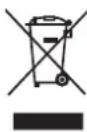
Dispose of packaging in an environmentally-friendly manner. This appliance complies with European Directive 2002/96/EC on Waste Electrical and Electronic Equipment (WEEE). The directive gives a framework for the collection and recycling of old appliances, which is valid across the EU.
Expert Cooking Guide
Here you will find a selection of recipes and the ideal settings for them. We will show you which type of heating and which temperature or microwave power setting is best for your meal. You can find information about suitable accessories and the height at which they should be inserted. There are also tips about ovenware and preparation methods.
Notes
- The values in the table always apply to food placed into the cooking compartment when it is cold and empty. Only preheat the appliance if the table specifies that you should do so. Before using the appliance, remove all accessories from the cooking compartment that you will not be using.
- Do not line the accessories with greaseproof paper until after they have been preheated.
- The times specified in the tables are only guidelines. They will depend on the quality and composition of the food.
- Use the accessories supplied. Additional accessories may be obtained from specialist retailers or from the after-sales service. ■ Always use an oven cloth or oven gloves when taking accessories or ovenware out of the cooking compartment.
Defrosting, heating up and cooking with the microwave
The following tables provide you with numerous options and settings for the microwave.
The times specified in the tables are only guidelines. They may vary according to the ovenware used, the quality, temperature and consistency of the food.
Time ranges are often specified in the tables. Set the shortest time first and then extend the time if necessary.
It may be that you have different quantities from those specified in the tables. A rule of thumb can be applied: Double amount - just under double the cooking time, half amount - half the cooking time.
Defrosting
Notes
- Place the frozen food in an open container on the lower wire rack.
- Delicate parts such as the legs and wings of chicken or fatty outer layers of roasts can be covered with small pieces of aluminium foil. The foil must not touch the cooking compartment walls. You can remove the foil half way through the defrosting time.
- Turn or stir the food once or twice during the defrosting time. Large pieces of food should be turned several times. When turning, remove any liquid that has resulted from defrosting.
- Leave defrosted items to stand at room temperature for a further 10 to 60 minutes so that the temperature can stabilise. The giblets can be removed from poultry at this point.
Place the food directly on the turntable.
| Defrost Weight Microwave power setting in watts, cooking time in minutes | Notes | ||
| Whole pieces of meat (beef, veal or pork - on the bone or boned) | 800 g | 300 W, 15 mins + 100 W, 10-20 mins | Turn several times |
| 1 kg | 300 W, 20 mins + 100 W, 15-25 mins | ||
| 1.5 kg | 300 W, 30 mins + 100 W, 20-30 mins | ||
| Meat in pieces or slices of beef, veal or pork | 200 g | 300 W, 3 mins + 100 W, 10-15 mins | Separate any defrosted parts when turning |
| 500 g | 300 W, 5 mins + 100 W, 15-20 mins | ||
| 800 g | 300 W, 8 mins + 100 W, 15-20 mins | ||
| Minced meat, mixed 200 g 100 W, 10-15 mins Freeze food flat if possible | Turn several times, remove any defrosted meat | ||
| Poultry or poultry portions | 600 g | 300 W, 8 mins + 100 W, 10-15 min | Turn during cooking. |
| 1.2 kg | 300 W, 15 mins + 100 W, 25-30 mins | ||
| Defrost | Weight Microwave power setting in watts, cooking time in minutes | Notes | |
| Fish fillet, fish steak or slices | 400 g | 300 W, 5 mins + 100 W, 10-15 mins | Separate any defrosted parts |
| Whole fish 300 g 300 W, 3 mins + 100 W, 10-15 mins -600 g 300 W, 8 mins + 100 W, 10-15 mins | |||
| Vegetables, e.g.peas 300 g 300 W, 10-15 mins Stir carefully during defrosting.600 g 300 W, 10 mins + 100 W, 10-15 mins | |||
| Fruit, e.g.raspberries 300 g 300 W, 7-10 mins Stir carefully during defrosting and500 g 300 W, 8 mins + 100 W, 5-10 mins separate any defrosted parts | |||
| Butter, defrosting 125 g 300 W, 1 mins + 100 W, 2-4 mins Remove all packaging250 g 30 W, 1 min + 100 W, 2-4 mins0 | |||
| Loaf of bread 500 g 300 W, 6 mins + 100 W, 5-10 mins Turn during cooking. | |||
| 1 kg 300 W, 12 mins + 100 W, 15-25 mins | |||
| Cakes, dry, e.g.sponge cake 500 g | 0 W, 15-20 mins | Only for cakes without icing, cream or crème pâtissière, separate the pieces of cake | |
| 750 g | 300 W, 5 mins + 100 W, 10-15 mins | ||
| Cakes, moist, e.g. fruit flan, cheesecake | 500 g | 300 W, 5 mins + 100 W, 10-15 mins | Only for cakes without icing, cream or gelatine |
| 750 g | 300 W, 7 mins + 100 W, 10-15 mins | ||
Defrosting, heating up or cooking frozen food
Notes
Take ready meals out of the packaging. They will heat up more quickly and evenly in microwaveable ovenware. The different components of the meal may not require the same amount of time to heat up. - Food which lies flat will cook more quickly than food which is piled high. You should therefore distribute the food so that it is as flat as possible in the ovenware. Different foodstuffs should not be placed in layers on top of one another.
Always cover the food. If you do not have a suitable cover for your ovenware, use a plate or special microwave foil. Stir or turn the food 2 or 3 times during cooking. After heating, allow the food to stand for a further 2 to 5 minutes so that it can achieve an even temperature. Always use an oven cloth or oven gloves when removing plates from the oven. This will help the food retain its own distinct taste, so it will require less seasoning.
| Defrosting, heating up or cooking frozen food | Weight | Microwave power setting in watts, cooking time in minutes | Notes | |
| Menu, plated meal, ready meal | 300-400 g | 700 W, 10-15 mins | Take meal out of packaging; cover food to heat | |
| Soup 400-500 g | 700 W, 8-10 mins | Ovenware with lid | ||
| Stews 500 g | 700 W, 10-15 mins | Ovenware with lid | ||
| 1 kg | 700 W, 20-25 mins | |||
| Slices or pieces of meat in sauce, e.g.goulash | 500 g | 700 W, 15-20 mins | Ovenware with lid | |
| 1 kg | 700 W, 25-30 mins | |||
| Fish, e.g.fillet steaks | 400 g | 700 W, 10-15 mins | Covered | |
| 800 g | 700 W, 18-20 mins | |||
| Side dishes, e.g. rice, pasta | 250 g | 700 W, 2-5 mins | Ovenware with lid; add liquid | |
| 500 g | 700 W, 8-10 mins | |||
| Vegetables, e.g. peas, broccoli, carrots | 300 g | 700 W, 8-10 mins | Ovenware with lid; add 1tbsp of water | |
| 600 g | 700 W, 15-20 mins | |||
| Creamed spinach | 450 g | 700 W, 11-16 mins | Cook without additional water | |
Heating food

Risk of scalding!
There is a possibility of delayed boiling when a liquid is heated. This means that the liquid reaches boiling temperature without the usual steam bubbles rising to the surface. Even if the container only moves a little, the hot liquid can suddenly boil over and spatter. When heating liquids, always place a spoon in the container. This will prevent delayed boiling.
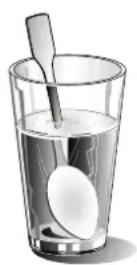
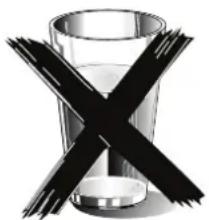
Caution!
Metal e.g. a spoon in a glass must be kept at least 2cm from the oven walls and the inside of the door. Sparks could irreparably damage the glass on the inside of the door.
Notes
Take ready meals out of the packaging. They will heat up more quickly and evenly in microwaveable ovenware. The different components of the meal may not require the same amount of time to heat up.
Always cover the food. If you do not have a suitable cover for your container, use a plate or special microwave foil. Stir or turn the food several times during the heating time. Check the temperature. After heating, allow the food to stand for a further 2 to 5 minutes so that it can achieve an even temperature. Always use an oven cloth or oven gloves when removing plates from the oven. Place the food directly on the turntable.
| Heating food Weight Notes Microwave power setting in watts, cooking time in minutes | |||
| Menu, plated meal, ready meal 350-500 g 700 W, 5-10 mins Take meal out of packaging, cover food to heat | |||
| Drinks 150 ml 900 W, 1-2 mins Caution! | |||
| 300 ml 900 W, 2-3 mins | Place a spoon in the glass. Do not overheat alcoholic drinks. Check during heating | ||
| 500 ml 900 W, 3-4 mins | |||
| Baby food, e.g.baby bottle 50 ml 300 W, approx. 1 min | Place baby bottles on the cooking compartment floor without the teat or lid. Shake or stir well after heating. You must check the temperature | ||
| 100 ml 300 W, 1-2 mins | |||
| 200 ml 300 W, 2-3 mins | |||
| Soup1 cup | 175 g | 900 W, 2-3 mins | - |
| 2 cups | 175 g each900 W, 4-5 mins | ||
| 4 cups | 175 g each900 W, 5-6 mins | ||
| Slices or pieces of meat in sauce, e.g.goulash | 500 g | 700 W, 10-15 mins | Covered |
| Stew | 400 g | 700 W, 5-10 mins | Ovenware with lid |
| 800 g | 700 W, 10-15 mins | ||
| Vegetables | 150 g | 700 W, 2-3 mins | Add a little liquid |
| 300 g | 700 W, 3-5 mins | ||
Cooking food
Notes
- Food which lies flat will cook more quickly than food which is piled high. You should therefore distribute the food so that it is as flat as possible in the ovenware. Different foodstuffs should not be placed in layers on top of one another. ■ Place the food directly on the turntable.
- Cook the food in ovenware with a lid. If you do not have a suitable lid for your ovenware, use a plate or special microwave foil. This will help the food retain its own distinct taste, so it will require less seasoning. ■ After cooking, allow the food to stand for a further 2 to 5 minutes so that it can achieve an even temperature. ■ Always use an oven cloth or oven gloves when removing plates from the oven.
| Cooking food | Weight | Microwave power in watts, Cooking time in minutes | Notes |
| Whole chicken, fresh, no giblets | 1.5 kg | 700 W, 30-35 mins | Turn halfway through the cooking time |
| Fish fillet, fresh | 400 g | 700 W, 5-10 mins | - |
| Fresh vegetables | 250 g | 700 W, 5-10 mins | Cut into equal-sized pieces; add 1to 2tbsp water per 100g; stir during cooking |
| 500 g | 700 W, 10-15 mins | ||
| Potatoes | 250 g | 700 W, 8-10 mins | Cut into equal-sized pieces; add 1to 2tbsp water per 100g; stir during cooking |
| 500 g | 700 W, 11-14 mins | ||
| 750 g | 700 W, 15-22 mins | ||
| Rice | 125 g | 700 W, 7-9 mins+ 300 W, 15-20 mins | Add double the quantity of liquid and use deep ovenware with a lid |
| 250 g | 700 W, 10-12 mins + 300 W, 20-25 mins | ||
| Sweet foods, e.g.blanc-mange (instant) | 500 ml | 700 W, 7-9 mins | Stir 2 to 3times with an egg whisk while heating |
| Fruit, compote | 500 g | 700 W, 9-12 mins | - |
Popcorn for the microwave
Notes
- Use heat-resistant, flat glass ovenware, e.g. the lid of an ovenproof dish, a glass plate or a glass tray (Pyrex). ■ Always place the ovenware on the wire rack.
- Do not use porcelain or overly curved plates.
■ Make the settings as described in the table. You can adjust the timings according to product and amount. - So that the popcorn doesn't burn, briefly take the popcorn bag out of the oven after 1 minute and 30 seconds and shake it. Take care as the bag will be hot!
Risk of scalding!
- Open the popcorn bag carefully as hot steam may be released. ■ Never set the microwave to full power.
| Weight | Accessories | Microwave power in watts, Cooking time in minutes | |
| Popcorn for the microwave | 1 bag, 100g | Ovenware | 700 W, 3-5 mins |
Microwave tips
| You cannot find any information about the settings for the quantity of food you have prepared. | Increase or reduce the cooking times using the following rule of thumb:Double the amount = almost double the cooking timeHalf the amount = half the cooking time |
| The food has become too dry. | Next time, set a shorter cooking time or select a lower microwave power setting. Cover the food and add more liquid. |
| When the time has elapsed, the food is not defrosted, hot or cooked. | Set a longer time. Large quantities and food which is piled high require longer times. |
| When the time has elapsed, the food is overheated at the edge but not done in the middle.cooked. | Stir it during the cooking time and next time, select a lower microwave power setting and a longer cooking time. |
| After defrosting, the poultry or meat is defrosted on the outside but not defrosted in the middle. | Next time, select a lower microwave power setting. If you are defrosting a large quantity, turn it several times. |
Cakes and pastries
About the tables
Notes
The times given apply to food placed in a cold oven. The temperature and baking time depend on the consistency and amount of the mixture. This is why temperature ranges are given in the tables. Begin with the lower temperature and, if necessary, use a higher setting the next time, since a lower temperature results in more even browning.
Additional information can be found in the Baking tips section following the tables. Always place the cake tin in the centre of the lower wire rack. But the food with ** should be placed in the turntable.
Baking tins
Note: It is best to use dark-coloured metal baking tins.
| Baking in tins | Accessories | Type of heating | Temperature °C | Microwave power in watts | Cooking time in minutes |
| Sponge cake, simple Ring tin/cake tin 170-180 100 40-50 | |||||
| Sponge cake, delicate(e.g.sandcake)* | Ring tin/cake tin | 150-170 | - | 70-90 | |
| Sponge flan base Flan-base cake tin 160-180 - 30-40 | |||||
| Delicate fruit flan, sponge 170-180 spring form 35-45 ring tin | |||||
| Sponge base, 2eggs Flan-base cake tin 160-170 - 20-25 | |||||
| Sponge flan, 6eggs Dark springform cake tin 170-180 - 35-45 | |||||
| Shortcrust pastry base with crust Dark springform cake tin 170-190 - 30-40 | |||||
| Fruit tart/cheesecake with pastry base* | Dark springform cake tin 170-190 35-45 100 | ||||
| Swiss flan** Dark springform cake tin 190-200 - 45-55 | |||||
| Ring cake | Ring cake tin | 170-180 | 40-50 | ||
| Pizza, thin base, light topping** | Round pizza tray | 220-230 | - | 15-25 | |
| Savoury cakes** | Dark springform cake tin 200-220 - 50-60 | ||||
| Nut cake | Dark springform cake tin 170-180 100 35-45 | ||||
| Yeast dough with dry topping | Round pizza tray | 160-180 - 50-60 | |||
* Allow cake to cool in the oven for approx. 20 minutes. ** The food should be placed in the turntable.
| Baking in tins | Accessories | Type of heating | Temperature °C | Microwave in watts | power | Cooking time in minutes |
| Yeast dough with moist topping | Round pizza tray 170-190 -55-65 | |||||
| Plaited loaf with 500 g flour | Round pizza tray 170-190 - 35-45 | |||||
| Stollen with 500 g flour | Round pizza tray 160-180 - 60-70 | |||||
| Strudel, sweet | Round pizza tray 190-210 100 35-45 |
* Allow cake to cool in the oven for approx. 20 minutes.
| Small baked items | Accessories | Type of heating | Temperature in°C | Cooking time in minutes |
| Biscuits Round pizza tray 150-170 25-35 | ⊗ | |||
| Macaroons Round pizza tray 110-130 35-45 | ⊗ | |||
| Meringue Round pizza tray 100 80-100 | ⊗ | |||
| Muffins | Muffin tray on wire rack | ⊗ | 160-180 35-40 | |
| Choux pastry | Round pizza tray 200-220 35-45 | ⊗ | ||
| Puff pastry | Round pizza tray 190-200 35-45 | ⊗ | ||
| Leavened cake | Round pizza tray 200-220 25-35 | ⊗ | ||
| Bread and bread rolls | Accessories | Type of heating | Temperature in°C | Cooking time in minutes |
| Sourdough bread with 1.2kg flour | Round pizza tray | 210-230 | 50-60 | |
| Flatbread | Round pizza tray | 220-230 | 25-35 | |
| Bread rolls | Round pizza tray | 210-230 | 25-35 | |
| Rolls made with sweet yeast dough | Round pizza tray | 200-220 | 15-25 |
Baking tips
| You want to bake according to your own recipe. | Use similar items in the baking tables as a guide. |
| Use baking tins made of silicone, glass, plastic or ceramic materials. | The baking tin must be heat-resistant up to 250°C. Cakes in these baking tins will be less brown. When using the microwave, the cooking time will be shorter than the time shown in the table. |
| How to establish whether sponge cake is baked through. | Approximately 10minutes before the end of the baking time specified in the recipe, poke the cake with a cocktail stick at its highest point. If the cocktail stick comes out clean, the cake is ready. |
| The cake collapses. | Use less liquid next time or set the oven temperature 10degrees lower and extend the baking time. Observe the specified mixing times in the recipe. |
| The cake has risen in the middle but is lower around the edge. | Only grease the base of the springform cake tin. After baking, loosen the cake carefully with a knife. |
| The cake is too dark. | Select a lower temperature and bake the cake for a little longer. |
| The cake is too dry. | When it is done, make small holes in the cake using a toothpick. Then drizzle fruit juice or an alcoholic beverage over it. Next time, select a temperature 10degrees higher and reduce the baking time. |
| The bread or cake (e.g.cheesecake) looks good, but is soggy on the inside (sticky, streaked with water). | Use slightly less fluid next time and bake for slightly longer at a lower temperature. When baking cakes with a moist topping, bake the base first, cover with almonds or bread crumbs and then add the topping. Please follow the recipe and follow the baking times. |
| The cake cannot be turned out of the dish when it is turned upside down. | After baking, allow the cake to cool for a further 5 to 10minutes, then it will be easier to turn out of the tin. If it still sticks, carefully loosen the cake around the edges using a knife. Turn the cake tin upside down again and cover it several times with a cold, wet cloth. Next time, grease the tin well and sprinkle some bread crumbs into it. |
| You have measured the temperature of the oven using your own meat thermometer and found there is a discrepancy. | The oven temperature is measured by the manufacturer after a specified period of time using a test rack in the centre of the cooking compartment. Ovenware and accessories affect the temperature measurement, so there will always be some discrepancy when you measure the temperature yourself. |
| Sparks are generated between the tin and the wire rack. | Check that the tin is clean on the outside. Change the position of the tin in the cooking compartment. If this does not help, continue baking but without the microwave. The baking time will then be longer. |
Roasting and grilling
About the tables
The temperature and roasting time depend on the type and amount of food being cooked. This is why temperature ranges are given in the tables. Begin with the lower temperature and, if necessary, use a higher setting the next time.
For more information, see the section entitled Tips for grilling and roasting which follows the tables.
Ovenware
You may use any heat-resistant ovenware which is suitable for use in a microwave. Metal roasting dishes are not suitable for roasting with microwaves.
The ovenware can become very hot. Use oven gloves to take the ovenware out of the oven.
Place hot glass ovenware on a dry kitchen towel after they have been removed from the oven. The glass could crack if placed on a cold or wet surface.
Tips for roasting
Notes
■ Use a deep roasting dish for roasting meat and poultry. Check that your ovenware fits in the cooking compartment. It should not be too big. ■ Meat:
Cover approximately two thirds of the ovenware base with liquid. Add slightly more liquid for pot roasts. Turn pieces of meat halfway through the cooking time. When the roast is ready, turn off the oven and allow it to rest for an additional 10 minutes. This allows better distribution of the meat juices.
Poultry:
Turn the pieces of meat after 2/3 of the cooking time has elapsed.
Tips for grilling
Notes
■ Always keep the oven door closed when grilling and do not preheat. As far as possible, the pieces of food you are grilling should be of equal thickness. Steaks should be at least 2 to 3 cm thick. This will allow them to brown evenly and remain succulent and juicy. Do not add salt to steaks until they have been grilled. Use tongs to turn the pieces of food you are grilling. If you pierce the meat with a fork, the juices will run out and it will become dry. Dark meat, e.g. beef, browns more quickly than lighter-coloured meat such as veal or pork. When grilling light-coloured meat or fish, these often only brown slightly on the surface, although they are cooked and juicy on the inside. The grill element switches off and on again automatically. This is normal. The grill setting determines how frequently this will happen.
Beef
Notes
- Turn pot-roasted beef after 1/3 and 2/3 of the cooking time. Finally, allow to stand for approx. a further 10 minutes. Turn tenderloins and sirloins halfway through the cooking time. Finally, allow to stand for approx. a further 10 minutes. Turn steaks after 2/3 of the cooking time.
| Beef | Accessories | Type of heating | Temperature in °C, grill setting | Microwave power in watts | Cooking time in minutes |
| Pot-roasted beef, Ovenware with lid approx.1kg* | |||||
| Fillet of beef, medium, Ovenware without lid approx.1kg* | 100 | ||||
| Sirloin, medium, Ovenware without lid approx.1kg* | |||||
| Steak, medium, 3cm thick** | Higher wire rack | — | 3 | - | each side: 10-15 |
| * Lower wire rack** Higher wire rack | |||||
Veal
Note: Turn joints and knuckle of veal halfway through the cooking time. Finally, allow to stand for approx. a further 10 minutes.
| Veal | Accessories | Type of heating | Temperature °C | Microwave power in watts | Cooking time in minutes |
| Joint of veal, approx.1kg* | Ovenware with lid | 180-200 - 110-130 | |||
| Knuckle of veal, approx.1.5kg* | Ovenware with lid | 200-220 | - | 120-130 | |
| * Lower wire rack | |||||
Pork
Notes
- Turn lean joints of pork and rindless joints halfway through the cooking time. Finally, allow to stand for approx. a further 10 minutes.
- Place the joint in the ovenware rind-side up. Score the rind. Do not turn the joint. Finally, allow to stand for approx. a further 10 minutes.
- Do not turn pork fillets or pork chops. Finally, allow to stand for approx. a further 5 minutes. ■ Turn the neck of pork after 2/3 of the cooking time.
| Pork | Accessories | Type of heating | Temperature in °C, grill setting | Microwave power in watts | Cooking time in minutes |
| Joint without rind (e.g. neck), approx.750g* | Ovenware with lid | 220-230 | 100 40-50 | ||
| Joint with rind (e.g. shoulder) approx.1.5kg* | Ovenware without lid | 190-210 | - | 130-150 | |
| Fillet of pork, approx.500g* | Ovenware with lid | 220-230 | 100 25-30 | ||
| Joint of pork, lean, approx.1kg* | Ovenware with lid | 210-230 | 100 60-80 | ||
| Smoked pork on the bone, approx.1kg* | Ovenware without lid - | - | 300 | 45-50 | |
| Neck of pork, 2cm thick** 3 - 1st side: approx.15-20 — | 2nd side: approx.10-15 | ||||
| * Lower wire rack** Higher wire rack | |||||
Lamb
Note: Turn the leg of lamb halfway through the cooking time.
| Lamb | Accessories | Type of heating | Temperature °C | Microwave power in watts | Cooking time in minutes |
| Saddle of lamb on the bone, approx.1kg* | Ovenware without lid | 210-230 - 40-50 | |||
| Leg of lamb, boned, medium, approx.1.5kg* | Ovenware with lid | 190-210 | 90-95 | ||
| * lower wire rack | |||||
Miscellaneous
Notes
■ Finally, allow the meat loaf to stand for approx. a further 10 minutes. ■ Turn the sausages after 2/3 of the cooking time.
| Miscellaneous | Accessories | Type of heating | Temperature in °C, grill setting | Microwave power in watts | Cooking time in minutes |
| Meat loaf, approx.1kg* | Ovenware without lid | 180-200 | 700W + - | 100W | |
| 4to6 sausages for grilling - | — | 3 - | each side:10-15 | ||
| approx.150g each** | |||||
| * lower wire rack | |||||
| **higher wire rack | |||||
Poultry
Notes
- Place whole chickens and chicken breasts breast-side down. Turn after 2/3 of the cooking time. ■ Place poulard breast-side down. Turn after 30 minutes and set the microwave power to 180 watts.
- Place half chickens and chicken portions skin-side up. Do not turn. ■ Turn the duck and goose breast skin-side up. Do not turn. ■ Turn goose thighs halfway through the cooking time. Prick the skin.
- Place turkey breast and thighs skin-side down. Turn after 2/3 of the cooking time.
| Poultry | Accessories | Type of heating | Temperature in °C, grill setting | Microwave power in watts | Cooking time in minutes |
| Chicken, whole, approx.1.2kg* | Ovenware with lid | 220-230 | 300 | 35-45 | |
| Poulard, whole, approx.1.6kg* | Ovenware with lid | 220-230 | 300 | 30 | |
| 100 | 20-30 | ||||
| Chicken, halves,500g each* | Ovenware without lid | 180-200 | 300 | 30-35 | |
| Chicken portions, approx.800g* | Ovenware without lid | 210-230 | 300 | 20-30 | |
| Chicken breast with skin and bones, 2pieces, approx.350-450g* | Ovenware without lid | 190-210 | 100 | 30-40 | |
| Duck breast with skin, 2pieces, 300-400g each** | Ovenware without lid | — | 3 | 20-30 100 | |
| Goose breast, 2pieces, 500g each* | Ovenware without lid 210-230 | 100 | 25-30 | ||
| Goose legs,4 pieces, approx.1.5kg* | Ovenware without lid 210-230 | 100 | 30-40 | ||
| Turkey breast, approx.1kg* | 200-220 - 90 | 100 | 40 | ||
| Turkey drumsticks, approx.1.3kg* | Ovenware with lid | 200-220 | 100 | 50-60 | |
| * lower wire rack**higher wire rack | |||||
Fish
Notes
- For grilling, place the whole fish, e.g. trout, onto the middle of the higher wire rack. ■ Grease the wire rack with oil beforehand.
| Fish | Accessories | Type of heating | Temperature °C | Cooking time in minutes |
| Fish steak, e.g.salmon, 3cm thick, grilled | Higher wire rack | — | 3 | 20-25 |
| Whole fish, 2–3 pieces, 300g each, grilled | Higher wire rack | — | 3 | 20-30 |
Tips for roasting and grilling
| The table does not contain information for the weight of the joint. | For small roasts, select a higher temperature and a shorter cooking time. For larger roasts, select a lower temperature and a longer cooking time. |
| How to tell when the roast is ready. | Use a meat thermometer (available from specialist shops) or carry out a “spoon test”. Press down on the roast with a spoon. If it feels firm, it is ready. If the spoon can be pressed in, it needs to be cooked for a little longer. |
| The roast looks good but the juices are burnt. | Next time, use a smaller roasting dish or add more liquid. |
| The roast looks good but the juices are too clear and watery. | Next time, use a larger roasting dish and add less liquid. |
| The roast is not well-done enough. | Carve the roast. Prepare the gravy in the roasting dish and place the slices of roast meat in the gravy. Finish cooking the meat using the microwave only. |
Bakes, gratins, toast with toppings
Notes
■ The values in the table apply to food placed in a cold oven. - For bakes, potato gratins and lasagne, use a microwaveable, heat-resistant ovenproof dish 4 to 5cm deep.
| Bakes, gratins, toasts | Accessories | Type of heating | Temperature in °C, grill setting | Microwave power in watts | Cooking time in minutes |
| Bake, sweet, approx.1.5kg* | Ovenware without lid | 140-160 300 | 25-35 | ||
| Savoury bake, made with cooked ingredients, approx.1kg* | Ovenware without lid | 150-160 | 700 | 20-25 | |
| Lasagne, fresh* | Ovenware without lid | 200-220 300 | 25-35 | ||
| Potato gratin made from raw ingredients, approx.1.1kg* | Ovenware without lid | 180-200 | 700 | 25-30 | |
| Toast with topping, 4slices** | — | 3 | - | 8-10 | |
| * lower wire rack ** higher wire rack | |||||
- Place the bake on the lower wire rack.
- Leave bakes and gratins to cook in the oven for a further 5 minutes after switching off.
- Cheese on toast: Pre-toast slices of bread.
Convenience products, frozen
Notes
- Observe the instructions on the packaging.
■ The values in the table apply to food placed in a cold oven. - Do not lay chips, croquettes or potato röstis on top of each other. Turn half way through the cooking time. - Place the food directly on the turntable.
| Convenience products | Accessories | Type of heating | Temperature °C | Microwave power in watts | Cooking time in minutes | |
| Pizza with thin base* | 220-230 - 10-15 | Turntable | ||||
| Pizza with deep-pan base | - | Turntable | 700 | 3 | ||
| 220-230 | - | 13-18 | ||||
| Mini pizza* | 220-230 - 10-15 | Turntable | ||||
| Pizza baguette* | - | Turntable | 700 | 2 | ||
| 220-230 | - | 13-18 | ||||
| Chips | 220-230 | Turntable | 8-13 | |||
| Croquettes* | 210-220 | Turntable | - | 13-18 | ||
| Rösti, stuffed potato pockets | 200-220 - 25 | Turntable | ||||
| Part-cooked rolls or baguette | Lower wire rack | 170-180 - 13-18 | ||||
| Fish fingers | 210-230 - 10-20 | Turntable | ||||
| Chicken goujons, nuggets | 200-220 - 15-20 | Turntable | ||||
| Lasagne, approx. | 400 g** | Lower wire rack | 220-230 | 700 | 12-17 | |
* Preheat the cooking compartment for 5 minutes. ** Place the food in suitable, heat-resistant ovenware.

Turntable
Warning!
Turntable
Caution!
Turntable
Warning!
Turntable
Be careful!
Turntable
Attention!
Turntable
Caution!
Metal, e.g. a spoon in a glass, must be at least 2 cm away from the oven walls and the inside of the door. Sparks can irreparably damage the glass on the inside of the door.
Notes
Touch keys and display
Turntable
Warnings!



- TURNTABLE
- CAUTION
- IMPORTANT SAFETY INFORMATION
- RISK OF FIRE
- RISK OF EXPLOSION
- RISK OF SERIOUS DAMAGE TO HEALTH
- RISK OF ELECTRIC SHOCK
- RISK OF BURNS
- RISK OF SCALDING
- RISK OF INJURY
- CAUSES OF DAMAGE
- INSTALLATION
- FITTED UNITS
- INSTALLATION DIMENSIONS
- BUILDING IN
- IMPORTANT INFORMATION
- ELECTRICAL CONNECTION
- YOUR NEW APPLIANCE
- COOLING FAN
- NOTES
- ACCESSORIES
- LOWER WIRE RACK
- HIGHER WIRE RACK
- NOTE
- BEFORE USING THE APPLIANCE FOR THE FIRST TIME
- SETTING THE CLOCK
- HEATING UP THE OVEN
- CLEANING THE ACCESSORIES
- SETTING THE OVEN
- SETTING THE TYPE OF HEATING AND TEMPERATURE
- OPENING THE OVEN DOOR DURING OPERATION
- PAUSING OPERATION
- CHANGING THE COOKING TIME
- CHANGING THE TEMPERATURE
- RAPID PREHEATING
- THE PREHEATING PROCESS IS COMPLETE
- CANCELLING RAPID PREHEATING
- THE MICROWAVE
- NOTES REGARDING OVENWARE
- SUITABLE OVENWARE
- UNSUITABLE OVENWARE
- OVENWARE TEST
- MICROWAVE POWER SETTINGS
- SETTING THE MICROWAVE
- THE COOKING TIME HAS ELAPSED
- CHANGING THE MICROWAVE POWER SETTING
- CANCELLING OPERATION
- MICROCOMBI OPERATION
- SETTING MICROWAVE COMBI OPERATION
- AUTOMATIC PROGRAMMES
- SETTING A PROGRAMME
- AUTO MENU
- PROGRAMME HAS ENDED
- CHANGING THE PROGRAMME
- DEFROSTING PROGRAMMES
- PREPARING FOOD
- OVENWARE
- RESTING TIME
- SETTING THE TIME-SETTING OPTIONS
- SETTING THE TIMER
- THE TIMER DURATION HAS ELAPSED
- CANCELLING THE TIMER DURATION
- SETTING THE COOKING TIME
- CHANGING THE CLOCK
- CHILDPROOF LOCK
- SWITCHING ON THE CHILDPROOF LOCK
- SWITCHING OFF THE CHILDPROOF LOCK
- CHILDPROOF LOCK WITH OTHER COOKING OPERATIONS
- MEMORY FUNCTION
- SETTING THE MEMORY FUNCTION USING THE MEMORY FUNCTION
- QUICK START
- CARE AND CLEANING
- CLEANING AGENTS
- MALFUNCTION TABLE
- ACRYLAMIDE IN FOODSTUFFS
- ENERGY AND ENVIRONMENT TIPS
- SAVING ENERGY
- ENVIRONMENTALLY-FRIENDLY DISPOSAL
- EXPERT COOKING GUIDE
- DEFROSTING, HEATING UP AND COOKING WITH THE MICROWAVE
- DEFROSTING
- DEFROSTING, HEATING UP OR COOKING FROZEN FOOD
- HEATING FOOD
- COOKING FOOD
- POPCORN FOR THE MICROWAVE
- CAKES AND PASTRIES
- ABOUT THE TABLES
- BAKING TINS
- ROASTING AND GRILLING
- TIPS FOR ROASTING
- TIPS FOR GRILLING
- BEEF
- VEAL
- PORK
- LAMB
- MISCELLANEOUS
- POULTRY
- FISH
- CONVENIENCE PRODUCTS, FROZEN
- WARNING
- BE CAREFUL
- ATTENTION
- TOUCH KEYS AND DISPLAY
- WARNINGS
Brand : BLAUPUNKT
Model : 5MA46910GB
Category : Microwave