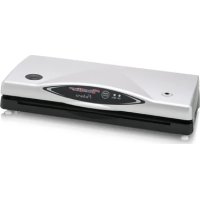
Futura - Vacuum packaging machines Magic Vac - Free user manual and instructions
Find the device manual for free Futura Magic Vac in PDF.



| Product Type | Vacuum Sealer |
| Brand | Magic Vac |
| Model | Futura |
| Power Supply | 230 V ~ 50 Hz (170 W); also available in 115 V ~ 60 Hz, 220 V ~ 60 Hz, 100 V ~ 50/60 Hz |
| Power | 170 W |
| Main Functions | Automatic vacuum sealing, automatic and manual sealing (MAN SEAL button), manual stop via valve, use with pre-cut bags or rolls, Executive and Family containers, glass jars, bottle stopper |
| Compatible Bag Width | 20 cm and 30 cm |
| Packaging Cycle | Approximately 50 seconds duration, 2 minutes pause between cycles |
| Thermal Protection | Automatic shutdown in case of overheating; let it cool for 15 minutes |
| Maintenance and Cleaning | Removable bottom part, dishwasher safe (top part); gaskets cleaned with sponge and mild soap; external surfaces cleaned with damp sponge and mild soap |
| Safety | Do not use near hot surfaces; do not immerse in water; do not touch the sealing bar during operation; unplug after use |
| Compatible Accessories | Original MAGIC VAC bags and accessories (rolls, containers, universal lids, bottle stopper, lid adapter) |
| Warranty | Unauthorized repairs void the warranty |
| Repairability | Repairs by authorized personnel only; do not open or modify the appliance |
| Protection Rating | Not protected against liquid penetration |
| General Information | Manufactured according to safety standards; electromagnetic compatibility tested |
Frequently Asked Questions - Futura Magic Vac
User questions about Futura Magic Vac
0 question about this device. Answer the ones you know or ask your own.
Ask a new question about this device
Download the instructions for your Vacuum packaging machines in PDF format for free! Find your manual Futura - Magic Vac and take your electronic device back in hand. On this page are published all the documents necessary for the use of your device. Futura by Magic Vac.
USER MANUAL Futura Magic Vac
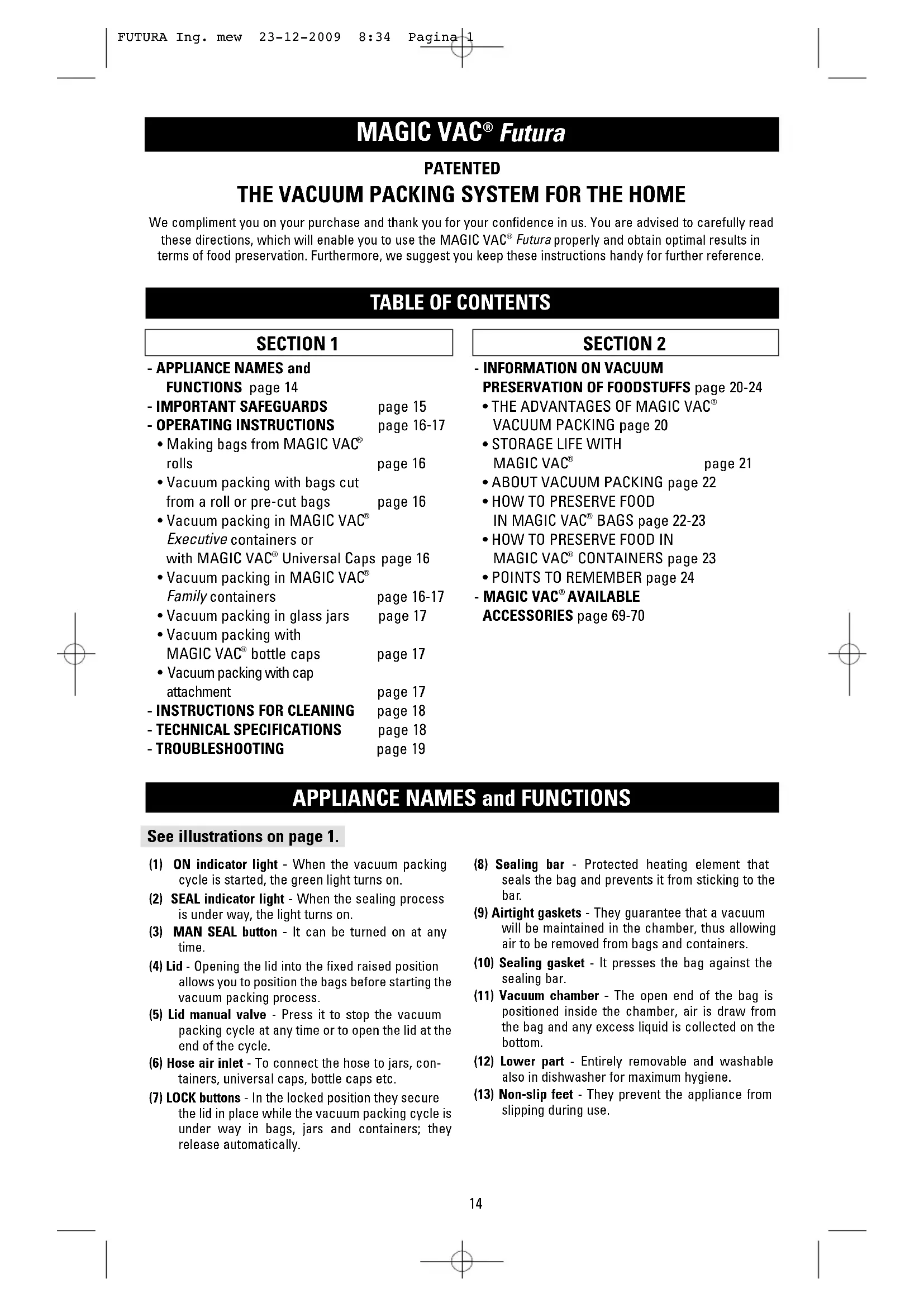
We compliment you on your purchase and thank you for your confidence in us. You are advised to carefully read these directions, which will enable you to use the MAGIC VAC® Futura properly and obtain optimal results in terms of food preservation. Furthermore, we suggest you keep these instructions handy for further reference.
TABLE OF CONTENTS
SECTION 1
-APPLIANCE NAMES and FUNCTIONS page 14
-IMPORTANT SAFEGUARDS page 15
-OPERATING INSTRUCTIONS page 16-17
-
Making bags from MAGIC VAC rolls
page 16
Vacuum packing with bags cut from a roll or pre-cut bags page 16
Vacuum packing in MAGIC VAC Executive containers or with MAGIC VAC Universal Caps page 16
Vacuum packing in MAGIC VAC Family containers page 16-17
Vacuum packing in glass jars page 17
Vacuum packing with MAGIC VAC bottle caps page 17
Vacuum packing with cap attachment page 17 -
INSTRUCTIONS FOR CLEANING page 18
- TECHNICAL SPECIFICATIONS page 18
- TROUBLESHOOTING page 19
SECTION 2
-
INFORMATION ON VACUUM PRESERVATION OF FOODSTUFFS page 20-24
-
THE ADVANTAGES OF MAGIC V VACUUM PACKING page 20
STORAGE LIFE WITH MAGIC VAC® page 21
ABOUT VACUUM PACKING page 22
HOW TO PRESERVE FOOD IN MAGIC VAC® BAGS page 22-23
HOW TO PRESERVE FOOD IN MAGIC VAC CONTAINERS page 23 - POINTS TO REMEMBER page 24
-MAGIC VAC AVAILABLE ACCESSORIES page 69-70
APPLIANCE NAMES and FUNCTIONS
See illustrations on page 1.
(1) ON indicator light - When the vacuum packing cycle is started, the green light turns on.
(2) SEAL indicator light - When the sealing process is under way, the light turns on.
(3) MAN SEAL button - It can be turned on at any time.
(4) Lid - Opening the lid into the fixed raised position allows you to position the bags before starting the vacuum packing process.
(5) Lid manual valve - Press it to stop the vacuum packing cycle at any time or to open the lid at the end of the cycle.
(6) Hose air inlet - To connect the hose to jars, containers, universal caps, bottle caps etc.
(7) LOCK buttons - In the locked position they secure the lid in place while the vacuum packing cycle is under way in bags, jars and containers; they release automatically.
(8) Sealing bar - Protected heating element that seals the bag and prevents it from sticking to the bar.
(9) Airtight gaskets - They guarantee that a vacuum will be maintained in the chamber, thus allowing air to be removed from bags and containers.
(10) Sealing gasket - It presses the bag against the sealing bar.
(11) Vacuum chamber - The open end of the bag is positioned inside the chamber, air is drawn from the bag and any excess liquid is collected on the bottom.
(12) Lower part - Entirely removable and washable also in dishwasher for maximum hygiene.
(13) Non-slip feet - They prevent the appliance from slipping during use.

IMPORTANT SAFEGUARDS
The manufacturer takes every step necessary to ensure utmost product quality and safety. However, as for all electrical appliances, you should follow some basic safety rules to avoid creating a hazard for people, animals and/or property.
- Before using the appliance for the first time, and periodically throughout its life, check the power supply cord for any damage; if you detect any damage, do not plug it in. Take the appliance immediately to an authorised service centre or your dealer.
- Carefully read the directions before using your MAGIC VAC® Futura and keep them handy for future reference.
- The appliance is not designed for continuous operation. Do not carry out more than one complete cycle every 2 minutes. The operating cycle is 50 seconds approx and after then there's the break until 2 minutes. In extreme ambient conditions, an intensive use of the appliance may trigger the automatic thermal protection devices. In such a case allow the appliance to cool down sufficiently to enable resetting of the protection devices.
- Do not use the appliance on or in proximity to hot surfaces.
- The casing of this unit is not protected against the penetration of liquids.
- Do not draw liquids into the vacuum chamber. Should this happen, immediately dry the vacuum chamber.
- Do not immerse the appliance in water and do not use it if the cord or plug are wet; should they get wet during use, immediately pull out the plug wearing dry rubber gloves. Do not remove or touch the appliance under water until you have pulled out the plug. Do not use the appliance after its removal from water (take it immediately to an authorised service centre or your dealer).
-
To avoid burns, do not touch the sealing bar while using the appliance.
-
Never use adapters for power supplies different from the one indicated on the bottom of the unit (plate details).
Always unplug the appliance after you finish using it. - Do not open or tamper with the appliance. Servicing may be performed by authorised personnel only. Any unauthorised repairs will invalidate the warranty.
The Manufacturer, the Retailer and the Importer are responsible for safety, reliability and performance only if: a) the unit is used following the instructions for use; b) the electrical system of the premises where the appliance is used is in conformity with current laws. - This appliance is not intended for use by persons (including children) with reduced physical, sensory or mental capabilities, or lack of experience and knowledge, unless they have been given supervision or instruction concerning use of the appliance by a person responsible for their safety.
Children should be supervised to ensure that they do not play with the appliance. - No lids or use containers that have cracks or is damaged!
Use only original MAGIC VAC® bags and accessories SAVE THESE INSTRUCTIONS!
OPERATING INSTRUCTIONS
Warning: DO NOT LEAVE THE LID WITH LOCKS ENGAGED WHEN THE UNIT IS NOT IN USE.
Before use, always thoroughly clean your appliance and any accessories coming in contact with food (containers, caps, jars etc.) as directed in the "INSTRUCTIONS FOR CLEANING" paragraph.
1 Positioning the appliance
Position the appliance in a dry place on a level surface, making sure that the work area in front of the appliance itself is clear of obstacles and there is enough room to accommodate the bags with the food to be packed. Plug the power cord into a power socket corresponding to the voltage of the appliance (see technical details) N.B.: the indicator light ON (1) does not come on when the power cord is plugged into the power socket.
Note: If you are using pre-cut bags, go directly to step 4 below.
2 Tips on using bags
MAGIC VAC® bags are available in two widths: 20 and 30~cm . Choose the bag size suited for the food you intend to preserve. Check that the bag you are going to use is at least 8cm longer than the food to be packaged, taking into account an additional 2cm for each time the bag will be subsequently reused.
3 Making bags from MAGIC VAC® rolls
- Unroll a bag of suitable length and cut it using the MAGIC Cutter (14) as shown in Fig. A, moving it from rim to rim. Now you can seal an open side of the cut bag as follows:
- Lift the lid (4) and turn it in the open position.
- Seal either of the two open ends of the bag by positioning it on the sealing gasket (10) with the smooth side facing down (fig. B).
Warning: be careful not to let the bag hang over into the vacuum chamber (11) or on the sealing gasket (9).
- Close the lid (4) by pushing down on the front corners of the lid with your thumbs, then push the LOCK buttons (7) into the locked position (fig. C). The green ON light turns on and the unit will automatically start the packing cycle and will stop at the end of the cycle, when the SEAL red light (2) goes off.
- Press down on the rounded recessed area of the manual valve (5) to release the lid (fig. D).
- Lift the appliance lid putting the fingers under the central projecting part and remove the bag.
- Check the quality of the seal obtained, which should appear as a regular, wrinkle-free crosswise strip with no internal ridges in the bag (fig. E).
4 Vacuum packing with bags cut from a roll or pre-cut bags
- Lift the lid (4) and turn it in the open position.
- Place food in the bag without creasing it excessively or stretching surfaces. Eliminate any liquids or food residues from the area inside the bag that will be sealed.
- Place the bag and its contents in front of the appliance and place the open end inside the vacuum
chamber (11) with the smooth side facing down (fig. F).
- Close the lid (4) by pushing down on the front corners of the lid with your thumbs, then push the LOCK buttons (7) into the locked position (fig. C). The green ON light turns on and the unit will automatically start the packing cycle and will stop at the end of the cycle, when the SEAL red light (2) goes off.
- Press down on the rounded recessed area of the manual valve (5) to release the lid (fig. H).
- Lift the appliance lid putting the fingers under the central projecting part and remove the bag.
- Check the quality of the seal obtained, which should appear as a regular, wrinkle-free crosswise strip with no internal ridges in the bag. (fig. 1)
- You can interrupt a packaging cycle already in progress at any time by means of the manual valve (5), keeping it pressed until the machine turns off.
5 How to use the MAN SEAL button (3)
Pressing this button causes the SEAL light (2) to go on and the sealing process starts immediately. This allows you to prevent delicate, fragile foods from being crushed (e.g. biscuits, etc.) (fig. L).
6 Vacuum packing in MAGIC VAC ^® Executive containers or in containers sealed with MAGIC VAC Universal Caps with new knob
MAGIC VAC Executive containers and the MAGIC VAC Universal Caps with star-shaped knob (see fig. M) make vacuum packing easier, because the connection hose can be directly introduced into the knob central hole (see fig. N).
MAGIC VAC Universal Caps, available in two diameters (100 mm and 125 mm), are to be used on jars for preserving food and bowls and receptacles made of tempered glass. The Universal Caps work just like the Caps for MAGIC VAC Executive containers.
WARNING: When using Universal Caps do not use plastic or glass containers that are not suitable since they could implode under the vacuum pressure of the appliance and cause injury.
- Fill the container leaving at least 3cm of room between the contents and upper rim. Place the lid on the container and turn the knob to the "VACUUM" position (fig. M).
- Connect the container lid knob to the appliance air inlet (6) by means of the connection hose (15) (fig. N).
- Lock the lid (4) by pushing the LOCK buttons (7); the machine will carry out a vacuum packing cycle and turn off automatically on its completion.
- Remove the hose from the container lid knob.
- Turn the knob to the "CLOSED" position.
- To open the containers turn the knob to the "OPEN" position, you should hear a hissing of air as it enters the container. This sound guarantees that the contents have been packed in a vacuum.
7 Vacuum packing in MAGIC VAC ^ Family containers
Multipurpose containers ideal for storage of frequently
OPERATING INSTRUCTIONS
Warning: DO NOT LEAVE THE LID WITH LOCKS ENGAGED WHEN THE UNIT IS NOT IN USE.
used products such as dry and fragile foods; powder foodstuffs; fresh, pureed or strained fruit and vegetables. Their transparency and design makes them attractive to display on kitchen shelves while ensuring that their contents are clearly visible.
- Fill the container leaving at least 3cm of room between the contents and upper rim and position the cap on the container.
- Connect the container lid to the air inlet (6) of the appliance (fig. 0) by means of the connection hose (15).
- Lock the lid (4) by pushing the LOCK buttons (7); the machine will carry out a vacuum packing cycle and turn off automatically on its completion.
- Remove the hose from the container lid.
- Press the central button (16) to open the containers (fig. 0).
8 Vacuum packing in glass jars sealed with metal caps (Leifheit type)
Use the large-sized cap attachment to pack foods in large-mouthed glass jars with a metal cap. A small-sized cap attachment is also available for narrow-mouthed jars sealed with metal caps.
- Fill the container leaving at least 3cm of room between the contents and upper rim.
- Connect the cap attachment (17) to the air inlet (6) of the appliance by means of the connection hose (15). Place the cap attachment directly on the jar with the metal cap only (18) and press down, making sure it fits correctly. (fig. P)
- Lock the lid (4) by pushing the LOCK buttons (7); the machine will carry out a vacuum packing cycle and turn off automatically on its completion. Make sure that the cap attachment holds firmly by keeping it pressed with your hand.
-
Disconnect the hose from the cap attachment. Remove the cap attachment from the jar.
-
Apply the ring (19) supplied with the jar and screw it down all the way (fig. P).
- To open a glass jar vacuum-sealed with a metal cap, use the cap opener provided (the side with writing should be turned up). Position the cap opener as shown in figure Q and gently pry open the cap until the vacuum is released. Remove the metal cap. This accessory allows you to reuse the cap.
9 Vacuum packing with MAGIC VAC bottle caps
The MAGIC VAC® Bottle Cap may be used to seal partly filled bottles of wine or non-fizzy beverages. Using the Bottle Cap will allow you to create a vacuum inside the bottle so as to slow down oxidisation and preserve the freshness and flavour of its contents for a longer time.
- By means of the connection hose (15) connect the air inlet (6) of the appliance to the MAGIC VAC® Bottle Cap (20) (fig. R). Press the Cap firmly into the bottle.
- Lock the lid (4) by pushing the LOCK buttons (7); the machine will carry out a vacuum packing cycle and turn off automatically on its completion.
- Disconnect the hose from both the Bottle Cap and the appliance immediately.
- To open a bottle sealed with the MAGIC VAC® Bottle Cap, simply pull the cap out of the bottle. You will hear the air rushing into the bottle.
10 Vacuum packing with the cap attachment in MAGIC VAC Executive containers or in containers sealed with MAGIC VAC Universal Caps with the previous model of knob
To use the Cap Attachment in MAGIC VAC Executive containers or in containers sealed with MAGIC VAC Universal Caps with the previous model of knob, read the instructions supplied in our web page www.flaemnuova.it
INSTRUCTIONS FOR CLEANING
IMPORTANT: Always unplug the appliance before cleaning the MAGIC VAC.
- Carefully wash your hands before proceeding to clean the appliance and its accessories.
- Both before and after use, clean the exposed surfaces of the MAGIC VAC using a sponge moistened with a mild, non-abrasive dishwashing detergent. If any liquids accidentally get inside the appliance, do not connect it to the mains electricity supply and do not use it; contact your nearest dealer or authorised service centre.
- The appliance is provided with a lower part (12) which is entirely removable and washable also on the dishwasher top rack (fig. S). Before washing the lower part, remove both gasket (9) (fig. T) and
sealing gasket (10) (fig. U). Clean both gaskets using a sponge moistened with a mild washing up liquid and leave them to completely dry before positioning them again.
Once cleaning and drying are over, carefully fit both gaskets back in their places. Then reinsert the lower part (12) in the port provided on the lid (4).
- Thoroughly wash the MAGIC VAC® accessories (containers, caps, jars, etc.) like you would wash any kitchen utensils, allowing them to dry completely. If you wash the accessories in a dishwasher, be sure to place them on the top rack.
- Please refer to the instructions on the accessory pack.
TECHNICAL SPECIFICATIONS
Voltage 230V~|50Hz 170W 115V~60Hz 1.5A 220V~60Hz 100V~50/60Hz
Marked

Approvals P0104ED

ET
Dimensions 39 (L) x 15 (D) x 8 (H) cm
Weight 2.3kg
Product approved by the F.I.C (Italian Federation of Chefs)
The performance of MAGIC VAC® systems has been tested by the (Italian Association of Food Technology) see page 20.
Electromagnetic compatibility
The MAGIC VAC® Futura has been engineered to meet current electromagnetic compatibility requirements. However if you suspect that the appliance is interfering with the operation of your TV, radio or other electrical appliance, try relocating the unit until the interference ceases. Alternatively try plugging the appliance into a different power socket.

Disposal: In conformity with Directive 2002/96/EC, the symbol shown on the appliance to be disposed of indicates that this is considered as waste and must therefore undergo "sorted waste collection". The user must therefore take (or have taken) the above waste to a pre-sorted waste collection centre set up by the local authorities, or else give it back to the dealer when purchasing a new appliance of the same type. Pre-sorted waste collection and the subsequent treatment, recovery and disposal operations favour the production of appliances made of recycled materials and limit the negative effects of any incorrect waste management on the environment and public health. The unlawful disposal of the product by the user could result in administrative fines as provided by the laws transposing Directive 2002/96/EC of the European member state in which the product is disposed of.
TROUBLESHOOTING
The MAGIC VAC® does not work
- Make sure the MAGIC VAC has been plugged in properly. Check the electric socket by plugging another appliance into it.
- The MAGIC VAC® will stop automatically if overheated. Allow it to cool down for 15 minutes and try again.
- Check for faults in the power cord or the plug. Should you detect a fault, do not use the appliance.
The MAGIC VAC® fails to apply the first seal on the bag cut from the roll
- Make sure the bag cut from the roll is properly positioned as described in the paragraph: "Making bags from MAGIC VAC® rolls"
The MAGIC VAC® does not create a complete vacuum in the bags
To seal the bag properly, you must make sure that the open end remains completely inside the Vacuum Chamber.
Make sure that the Sealing Bar, the Sealing Gaskets and Airtight Gaskets are free of impurities. After cleaning them, put them properly back in place.
- The MAGIC VAC® bag might have a hole in it. To check it, seal the bag with air on the inside. Dip the bag in water and apply pressure. The appearance of bubbles means that there is a leak.
Reseal or use another bag.
The MAGIC VAC® does not seal the bag properly
- If the Sealing Bar overheats and melts the bag, you may have to raise the Lid and allow the Sealing Bar to cool down for a few minutes.
- The MAGIC VAC® is built in conformity with current safety standards. Overheating will cause it to turn off automatically. Allow the appliance to cool down for 15 minutes and try again.
The MAGIC VAC® bag does not maintain a vacuum after being sealed
Leaks along the seam may be caused by creases, crumbs, grease or liquids. Reopen the bag, clean the upper inside part of the bag and remove any foreign material from the Sealing Bar before resealing it.
- Check that the bag has no holes in it which have caused air to leak in. Use paper napkins to protect any sharp edges on the contents of the bag.
The MAGIC VAC® does not create a vacuum in the containers
- By means of the Connection Hose, connect the container lid (or the Cap Attachment if necessary) to the Air Inlet of the appliance.
- Leave enough room (at least 3cm ) between the contents and the top of the jar or container.
- If liquids come out during the vacuum-packing process, remember that they must first be chilled in a refrigerator, not left at room temperature.
- Check that the rim of the jar or container and the universal lid are not damaged in the sealing area. Wipe the rim and cap clean with a cloth moistened with lukewarm water and repeat the vacuum-packing process.
- Make sure that the gasket of the container cap or the universal cap is set properly in place and is not damaged.
MAGIC VAC® Executive containers or MAGIC VAC® Universal Caps do not maintain a vacuum
- Make sure that the arrow on the knob of the container cap is positioned on "VACUUM" before creating a vacuum in the container and it is positioned on "CLOSED" after a vacuum is formed.
- Make sure that the O-ring beneath the knob of the container cap or the universal cap is set properly in place.
MAGIC VAC® Family containers do not maintain a vacuum
- Make sure that the gasket beneath the central button (16) of the container cap is set properly in place and is not damaged.
THE ADVANTAGES OF MAGIC VAC® VACUUM PACKING
This manual is the product of collaboration between the Flaem Nuova Research and Development Division and Prof. Luciano Piergiovanni, Chair of "Agri-food product conditioning and distribution technologies" at Milan University.
Vacuum packing will revolutionise the way in which you buy and keep food. By keeping food under vacuum (i.e. without air), the shelf-life of foods is greatly extended, whether it is kept in the larder, fridge or freezer. Air can make food rancid and stale, it can cause it to ferment, dry out, and it may even cause freezer burns. Vacuum packing keeps your food fresher and more flavourful for longer.
Now you can pack fresh food bought from the market, or food picked from your vegetable garden, in handy portions for future use, even in large quantities. Food bought already vacuum-packed, like cheese and meat, will retain its flavour and freshness once opened, without problems of moisture and mould, if it is vacuum-packed after use in MAGIC VAC® bags and containers. Meat, fish and vegetables can be frozen without the risk of frost burns and will keep their freshness and quality.
Foodstuffs like coffee, rice, flour and nuts will last much longer if they are vacuum packed. Fresh or perishable foods must in any case be frozen or kept in the fridge.
The original quality of the food must be of the very highest order, in terms of freshness and environmental hygiene, when you decide to vacuum pack it.
There are in fact no preservation methods which will transform a poor product into a good one.
Always keep your MAGIC VAC® bags and containers handy and you will quickly appreciate the many advantages and ease of use that MAGIC VAC® offers when it comes to preserving the quality of food.
Consult the "Food preservation times with MAGIC VAC" chart to see how vacuum packing can extend the life of any food without in any way altering or impairing its taste, smell, appearance, hygiene and nutritional value.
STORAGE LIFE WITH MAGIC VAC
| Preservation times at atmospheric pressure | Preservation times with MAGIC VAC® | |
| Refrigerated foods (5 ± 2 °C) | ||
| Red meat 3-4 days 8-9 days | ||
| White meat 2-3 days 6-9 days | ||
| Whole fish 1-3 days 4-5 days | ||
| Game 2-3 days 5-7 days | ||
| Cooked pork products 7-15 days | 25-40 days | |
| Sliced pork meats 4-6 days 20-25 days | ||
| Soft cheese 5-7 days 14-20 days | ||
| Hard and semi-hard cheese 15-20 days 25-60 days | ||
| Vegetables 1-3 days 7-10 days | ||
| Fruit 5-7 days 14-20 days | ||
| Cooked and refrigerated foods (5 ± 2 °C) | ||
| Purees and vegetable soups 2-3 days 8-10 days | ||
| Pasta and risotto 2-3 days 6-8 days | ||
| Boiled and roast meats | 3-5 days 10-15 days | |
| Desserts with fillings (cream and fruit) | 2-3 days 6-8 days | |
| Frying oil | 10-15 days 25-40 days$ | |
| Frozen foods (-18 ± 2 °C) | ||
| Meat | 4-6 months | 15-20 months |
| Fish | 3-4 months | 10-12 months |
| Vegetables 8-10 months | 18-24 months | |
| Food at ambient temperature (25 ± 2 °C) | ||
| Bread | 1-2 days 6-8 days | |
| Packed biscuits | 4-6 months | 12 months |
| Pasta | 5-6 months | 12 months |
| Rice 5-6 months | 12 months | |
| Flour | 4-5 months | 12 months |
| Dry fruit | 3-4 months | 12 months |
| Ground coffee | 2-3 months | 12 months |
| Powder tea 5-6 months | 12 months | |
| Freeze-dried products | 1-2 months | 12 months |
| Powdered milk | 1-2 months | 12 months |
Approximate values which in any case depend on pack integrity and on original food quality characteristics. These values also refer to packaging obtained with machine- "original" bags/rolls, containers and accessories combination. The times shown on the chart cannot be guaranteed with use of bags/rolls, containers and accessories of other brands. The manufacturer therefore disclaims liability.
IMPORTANT: Keep perishable foods in the freezer or fridge. Vacuum packing extends the life of food, but does not turn it into a "preserve", i.e. a stable product at ambient temperature.
ABOUT VACUUM PACKING
The deterioration of food is caused by chemical reactions that occur in food which is exposed to the air, temperature, moisture, the action of enzymes, the growth of micro-organisms or contamination by insects.
Vacuum packing reduces the absolute pressure of the air inside the package or container, by removing the oxygen and eliminating volatile compounds. The oxygen in the air causes food to deteriorate, firstly through a process of oxidation, causing the loss of nutritional values, flavour and all the food's qualities. Air also promotes the growth of most micro-organisms and causes the frost burns which occur on frozen food.
Vacuum packing extends the shelf life of many fresh foods, by reducing oxidation and preventing the proliferation of microbes (bacteria and mould). However, many fresh foods contain sufficient moisture to encourage the growth of micro-organisms that can grow with or without air. To prevent the deterioration of such foods, they must be preserved at low temperatures.
Micro-organisms like mould, yeast and bacteria are present everywhere, but they can cause problems only in certain conditions.
For example, mould will not grow in environments with a low oxygen content, or in the absence of moisture or humidity. To grow, yeast requires moisture, sugar and a moderate temperature, but it can grow in the presence or absence of air. Refrigeration slows the growth of yeast and freezing blocks it completely. Bacteria can multiply with or without air, depending on their type.
Clostridium Botulinum is a very dangerous type of bacteria which can develop in environments which do not contain acids, are without oxygen and are exposed to temperatures in excess of 4^ for long periods of time. Foodstuffs vulnerable to attack by Clostridium
Botulinum are those with low acidity (like red meat, poultry, fish, seafood, olives in brine, eggs, mushrooms and vegetables) and medium acidity foods like virtually all vegetables and many fruits (ripe tomatoes, onions, red pepper, figs and cucumbers). To prevent contamination by this bacterium, it is essential to observe the basic rules of hygiene and, to prevent its harmful proliferation in preserved foods, they must be refrigerated for short periods and/or frozen for long-life preservation. However, such foods must be eaten immediately after heating.
Important: you must consume immediately any food which has been heated while still sealed in MAGIC VAC® bags. Leaving the food to cool slowly at room temperature in the sealed vacuum bag may cause several harmful micro-organisms to multiply, in just a few hours, to values that are health-threatening.
Several enzymes found in foods cause increasingly noticeable changes in colour, structure and flavour; such changes depend on the preservation time, temperature and, above all, the presence of air. To halt the action of enzymes, vegetables must be blanched briefly using steam or a microwave oven. Food which contains a high percentage of acidity, like most fruits, do not require blanching. The absence of air created by the vacuum will in any case slow down or prevent the action of these enzymes.
Insect larvae are frequently found in many low water content or dried foods which have not been vacuum packed or frozen, and they can develop during preservation and thus contaminate the food. Some products like flour and grain might contain larvae, but using MAGIC VAC® vacuum packing will stop them developing into insects.
HOW TO PRESERVE FOOD IN MAGIC VAC® BAGS
Vacuum packing for the freezer
First of all, use the freshest possible food. The MAGIC VAC® system will allow you to retain all the freshness of the food only if it is properly preserved. Some foods have a soft consistency which could be damaged by vacuum packing the product when fresh. To prepare delicate foods like meat, fish, berries, bread, etc., it is advisable to pre-freeze them first. In the first twenty-four hours there is no risk of freezer burns, so you can vacuum pack the products frozen the previous day in MAGIC VAC® bags, and then keep them in the freezer for long periods so as to preserve all the nutritional values and flavour of the product you have packed.
When vacuum packing soups, stews or other liquid food, pre-freeze it in a pan or high-strength dish. When the food becomes solid, vacuum pack it, add a label and replace in your freezer.
To vacuum pack vegetables, peel them and then blanche them briefly in boiling water or a microwave oven until they are warm but still firm. Then vacuum pack them in convenient portions.
If the food is not pre-frozen, leave an extra 5cm in the length of the bag to allow for expansion due to freezing. With regard to meat and fish, it is advisable to place the food on a paper towel and vacuum pack it with the towel in the bag. This will absorb any moisture in the food.
To preserve food like focaccia, crèpes and small hamburgers, stack them on top of each other, placing greaseproof paper or film between each piece. This will make it easier to remove some of the food, repackage the rest and replace it immediately in the freezer.
Vacuum packing for the fridge
For busy households, food can be prepared in advance, then vacuum packed and kept in the fridge for use at different times, ready to be heated as and when necessary.
Vacuum packing for the larder
Even foods that can keep at room temperature (like, for example, coffee, flour, pasta, sugar, etc.) can benefit from vacuum packing. If these products are to remain unused for several days, such as when you go away on holiday, it is advisable to protect all foods by vacuum packing. They will keep better and moisture, mould and insects will not attack and ruin them.
Defrosting MAGIC VAC® bags
To defrost vacuum packed food such as meat, fish, fruit, vegetables or other delicate foodstuffs, place it on the lowest shelf in the fridge to defrost slowly; bread and focaccia should be left at room temperature, while soups or other liquid foods should be immersed in hot water still in the vacuum bags until they reach the right temperature. When you leave food at room temperature or heat it in a bain-marie, make sure you cut one corner of the bag to let the steam escape. When the food has been defrosted, it must be consumed immediately. Do not re-freeze it
Repackaging pre-packed food
Many foodstuffs, like cheese and meat, are sold prepacked in factory-prepared vacuum bags. To retain the flavour and freshness of these foods, repackage them in MAGIC VAC® bags after the factory package has been opened.
Pre-packed foods must always be consumed by the use-by date shown on the original package. They must also be handled with the greatest care and hygiene when repackaging.
Useful tips...
- For food with tapered ends or sharp edges, like bones and spaghetti, pad the edges with paper towels to prevent perforating the bag.
- Fragile and delicate foodstuffs like strawberries, crackers or biscuits should be preserved in MAGIC VAC® containers.
- There are many non-food products which can be vacuum packed, such as camping equipment including matches, first aid kits and clean, dry clothes. You can even preserve the emergency triangle in the car. Silverware and collections can also be vacuum packed to protect the items against oxidation, etc.
HOW TO PRESERVE FOOD IN MAGIC VAC CONTAINERS
Warning: Do not use plastic or glass containers that are not suitable since they could implore under the vacuum pressure of MAGIC VAC and cause injury.
Freezing in containers
To freeze food in plastic containers use only MAGIC VAC® containers or, in the case of glass receptacles, used tempered glass suitable for freezer temperatures.
Vacuum packing food in containers
Vacuum packing in containers is ideal for products that you use frequently. Dried foodstuffs like pasta, rice, flour, sugar, crisps, savouries or biscuits, and pet food, will maintain all their shape and freshness.
Salad foods and vegetables can be cleaned for the whole week and kept in a MAGIC VAC container. They will remain firm and fresh. To absorb excess moisture, fold a paper towel and place it on the bottom of the container.
Warning: Liquids must be cooled before vacuum packing. Hot liquids will expand and leak from the container during depressurising.
Food in powder or granule form can be covered with a paper towel before vacuum packing. This will prevent
the powder or granules from getting into the vacuum paths or being deposited in the Vacuum Cap seal. Oil used once for frying can be filtered, cooled, vacuum sealed in a MAGIC VAC container and kept in the fridge. This will enable you to use the oil again at least once, since it has been preserved in an airless and cold environment, thereby retaining its characteristics. Larder items like flour, rice and cake mixes stay fresh for longer if they are vacuum packed. Nuts and condiments retain their flavour and will not become rancid.
Marinating
To marinate meat, poultry or fish, use the square "quick marinating" Executive container (AC01073) and follow the instructions regarding how to use the container itself. The food will be marinated in 20 minutes as if it had been marinated all night!
Tips for preserving food in jars
To preserve food in jars, use lids which have been checked and are free from defects. To create and maintain a good vacuum, the seals of the lids must be in perfect condition. To keep the lids in good condition, immerse them in boiling water for three minutes and then rub the dry seal with a drop of oil. This will restore the necessary elasticity to the seals of the lids.
POINTS TO REMEMBER
In order to optimise the preservation of foods and ensure perfect hygiene, a number of important rules must be followed:
- Make sure you wash your hands thoroughly and clean all the implements and surfaces you will be using to cut and vacuum pack the food.
- If possible, wear gloves when handling the food.
- Once perishable food has been packed, place it in the fridge or freeze it immediately, maintaining a constant fridge or freezer temperature. Do not leave the food for a long time at room temperature.
- Place the containers of vacuum packed food carefully in the fridge or freezer so that the food will cool rapidly to a low temperature.
After opening tinned food or food that has been factory vacuum packed, it can be vacuum packed again. Follow the instructions to cool the food after opening and put it away as soon as it has been vacuum packed. - Pre-packed foods must in any case be consumed by the use-by date shown on the original package.
-
Once you have warmed up or defrosted perishable food, it must be eaten. Do not eat perishable food if it has been left at room temperature for many hours. This is especially important if the food has been prepared with a dense sauce, in a vacuum pack or in other low-oxygen content environments.
-
Do not defrost food in boiling water or using other heat sources, unless the food in question is liquid (soups, juices, etc.).
Vacuum packing extends the life of dried food. Food which has a high fat content becomes rancid due to oxygen and heat. Vacuum packing extends the life of food like nuts, coconuts, or cereal products. Store in a cool, dark place. - Vacuum packing will not extend the life of fruit and vegetables such as bananas, apples, potatoes and several vegetables, unless it has been peeled prior to vacuum packing.
- Soft foods and food with a delicate structure (like fish, berries, etc.) must be pre-frozen for one night before they can be vacuum packed and placed in the freezer.
Vegetables like broccoli, cauliflower and cabbage give off gas when they are vacuum packed fresh for storage in the freezer. To prepare these foods for vacuum packing, heat and freeze them.
To ensure correct and safe vacuum packing, use only original MAGIC VAC® bags, containers and accessories.
All rights reserved. Partial or total reproduction prohibited.
Given the constant technological progress being made in this sector, FLAEM NUOVA reserves the right to make technical and functional changes to the product without prior notice.
MAGIC VAC® Futura
BREVÉ
LE SYSTÉME DE CONDITIONNEMENT SOUS VIDE POUR LA MAISON
Dimensions 39 (L) x 15 (P) x 8 (H) cm
Poids 2,3 Kg
ProduitapprovéparlaF.I.C(Federazione Italiana Cuochi)
Consultar as ilustracoes da网页 1.
AS COISAS A RECORDAR
For additional information on these products please contact your Dealer or visit our website www.magicvac.com
Food storage naturally!
Conservation naturelle des aliments!
Fabbricante / Manufacturer:
FLAEMNUOVA


- TABLE OF CONTENTS
- SECTION 1
- SECTION 2
- APPLIANCE NAMES and FUNCTIONS
- See illustrations on page 1.
- IMPORTANT SAFEGUARDS
- Use only original MAGIC VAC® bags and accessories SAVE THESE INSTRUCTIONS!
- OPERATING INSTRUCTIONS
- Warning: DO NOT LEAVE THE LID WITH LOCKS ENGAGED WHEN THE UNIT IS NOT IN USE.
- Positioning the appliance
- Tips on using bags
- Making bags from MAGIC VAC® rolls
- Warning: be careful not to let the bag hang over into the vacuum chamber (11) or on the sealing gasket (9).
- Vacuum packing with bags cut from a roll or pre-cut bags
- How to use the MAN SEAL button (3)
- Vacuum packing in MAGIC VAC ® Executive containers or in containers sealed with MAGIC VAC Universal Caps with new knob
- WARNING: When using Universal Caps do not use plastic or glass containers that are not suitable since they could implode under the vacuum pressure of the appliance and cause injury.
- Vacuum packing in MAGIC VAC ° Family containers
- Vacuum packing in glass jars sealed with metal caps (Leifheit type)
- Vacuum packing with MAGIC VAC bottle caps
- Vacuum packing with the cap attachment in MAGIC VAC Executive containers or in containers sealed with MAGIC VAC Universal Caps with the previous model of knob
- INSTRUCTIONS FOR CLEANING
- IMPORTANT: Always unplug the appliance before cleaning the MAGIC VAC.
- TECHNICAL SPECIFICATIONS
- Electromagnetic compatibility
- TROUBLESHOOTING
- The MAGIC VAC® does not work
- The MAGIC VAC® fails to apply the first seal on the bag cut from the roll
- The MAGIC VAC® does not create a complete vacuum in the bags
- The MAGIC VAC® does not seal the bag properly
- The MAGIC VAC® bag does not maintain a vacuum after being sealed
- The MAGIC VAC® does not create a vacuum in the containers
- MAGIC VAC® Executive containers or MAGIC VAC® Universal Caps do not maintain a vacuum
- MAGIC VAC® Family containers do not maintain a vacuum
- THE ADVANTAGES OF MAGIC VAC® VACUUM PACKING
- ABOUT VACUUM PACKING
- HOW TO PRESERVE FOOD IN MAGIC VAC® BAGS
- Vacuum packing for the freezer
- Vacuum packing for the fridge
- Vacuum packing for the larder
- Defrosting MAGIC VAC® bags
- Repackaging pre-packed food
- Useful tips...
- HOW TO PRESERVE FOOD IN MAGIC VAC CONTAINERS
- Freezing in containers
- Vacuum packing food in containers
- Marinating
- Tips for preserving food in jars
- POINTS TO REMEMBER
- MAGIC VAC® Futura
- BREVÉ
- LE SYSTÉME DE CONDITIONNEMENT SOUS VIDE POUR LA MAISON
- Consultar as ilustracoes da网页 1.
- AS COISAS A RECORDAR
Brand : Magic Vac
Model : Futura
Category : Vacuum packaging machines