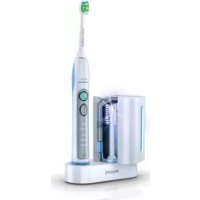
USER MANUAL Sonicare FlexCare+ HX6973 PHILIPS
FlexCare+ 900+ series Rechargeable sonic toothbrush

PHILIPS sonicare
1
English 6
Deutsch 21
Espanol 40
Français 57
Italiano 75
Nederlands 92
Portugues 110
Elambda 128
Introduction
Congratulations on your purchase and welcome to Philips! To fully benefit from the support that Philips offers, register your product at www.philips.com/welcome.
Important
Read this user manual carefully before you use the appliance and save it for future reference.
Danger
- Keep the charger away from water. Do not place or store it over or near water contained in a bathtub, washbasin, sink etc. Do not immerse the charger in water or any other liquid. After cleaning, make sure the charger is completely dry before you connect it to the mains.
Warning
- The mains cord cannot be replaced. If the mains cord is damaged, discard the charger.
- Always have the charger replaced with one of the original type in order to avoid a hazard.
-
Do not use the charger outdoors or near heated surfaces.
-
If the appliance is damaged in any way (brush head, toothbrush handle or charger), stop using it. This appliance contains no serviceable parts. If the appliance is damaged, contact the Consumer Care Centre in your country (see chapter 'Guarantee and support').
-
This appliance can be used by children aged from 8 years and above and by persons with reduced physical, sensory or mental capabilities or lack of experience and knowledge if they have been given supervision or instruction concerning use of the appliance in a safe way and if they understand the hazards involved. Children shall not play with the appliance. Cleaning and user maintenance shall not be made by children unless they are older than 8 and supervised.
Caution
- Do not clean the brush head, the handle, the charger, the charger cover and/or the sanitizer in the dishwasher.
English
-
If you have had oral or gum surgery in the previous 2 months, consult your dentist before you use the toothbrush.
-
Consult your dentist if excessive bleeding occurs after using this toothbrush or if bleeding continues to occur after 1 week of use. Also consult your dentist if you experience discomfort or pain when you use the Philips Sonicare.
-
The Philips Sonicare toothbrush complies with the safety standards for electromagnetic devices. If you have a pacemaker or other implanted device, contact your physician or the device manufacturer of the implanted device prior to use.
-
If you have medical concerns, consult your doctor before you use the Philips Sonicare.
-
This appliance has only been designed for cleaning teeth, gums and tongue. Do not use it for any other purpose. Stop using the appliance and contact your doctor if you experience any discomfort or pain.
-
The Philips Sonicare toothbrush is a personal care device and is not intended for use on multiple patients in a dental practice or institution.
- Stop using a brush head with crushed or bent bristles. Replace the brush head every 3 months or sooner if signs of wear appear.
- Do not use other brush heads than the ones recommended by the manufacturer.
- If your toothpaste contains peroxide, baking soda or bicarbonate (common in whitening toothpastes), thoroughly clean the brush head with soap and water after each use. This prevents possible cracking of the plastic.
-
Do not insert objects into the air openings of the sanitizer or block these air openings by placing it on a soft surface or in a position or location where objects will block these openings (examples of objects: magazine, tissue paper and hair).
-
The UV light bulb is hot during and immediately after the sanitizing cycle. Do not touch the UV light bulb when it is hot.
- Do not operate the sanitizer without the protective screen in place to avoid contact with a hot bulb.
- If the sanitizer has been used for 3 consecutive UV clean cycles (i.e. 3 times in a row), switch it off for at least 30 minutes before you start another UV clean cycle.
- Discontinue use of the sanitizer if the UV light bulb remains on when the door is open. UV light can be harmful to the human eye and skin. Keep the sanitizer out of the reach of children at all times.
Electromagnetic fields (EMF)
This Philips appliance complies with all applicable standards and regulations regarding exposure to electromagnetic fields.
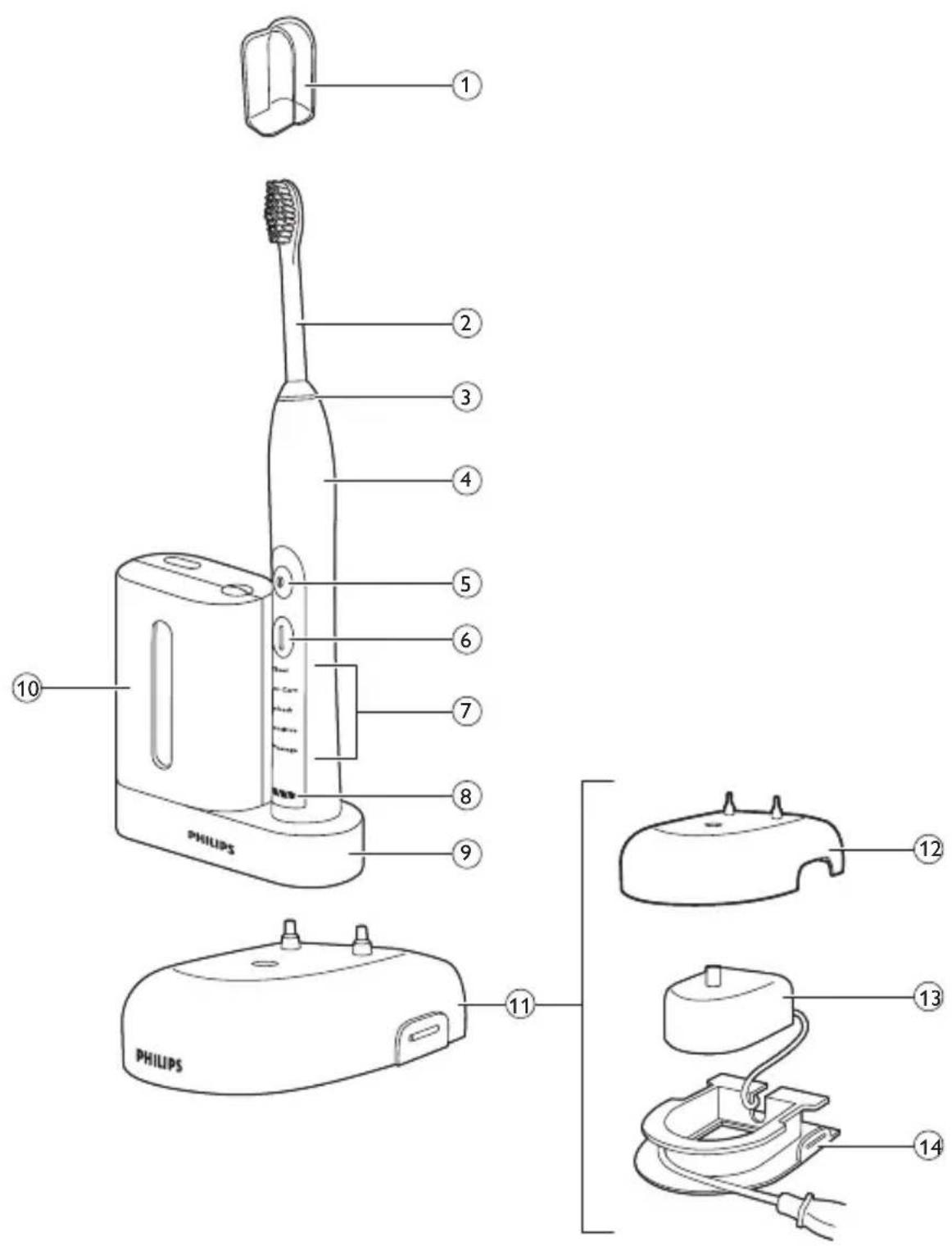
General description (Fig. 1)
1 Hygienic travel cap
2 Brush head with unique identifier
3 Handle
4 Power on/off button
5 Intensity level indicator
6 Intensity level button (+ and -)
7 Brushing modes
8 Mode button
9 Battery level indicator
10 UV sanitiser base with integrated charger and cord wrap (specific types only)
- Not shown: UV light bulb
- Not shown: Sanitizer drip tray
- Not shown: Protective screen for UV light bulb
11 Mains cord with plug
12 Charger cover with brush head holders (select models)
13 Travel charger
The content of the box may vary based on the model purchased.
Preparing for use
Changing the colour code ring (for select models)
Sonicare brush heads come with interchangeable colour code rings to identify your brush head.
To change the colour code ring:
1 Pull the colour code ring from the bottom of the brush head.
2 Install a new ring by slipping one edge of the new ring over the bottom of the brush head.
Attaching the brush head
- Align the brush head so the bristles point in the same direction as the front of the handle. (Fig. 2)
2 Firmly press the brush head down onto the metal shaft until it stops.
Note: There is a small gap between the brush head and the handle.
Charging the appliance
1 Put the plug of the charger or sanitizer in a wall socket.
2 Place the handle on the charger or sanitiser.
12 English
The flashing light of the battery level indicator indicates that the toothbrush is charging. (Fig. 3)
1 solid green LED indicates that the toothbrush is 34 - 66% charged.
2 solid green LEDs indicate that the toothbrush is 67 - 94% charged.
- 3 solid green LEDs indicate that the toothbrush is fully charged.
Note: If the battery charge of your Philips Sonicare is low, you hear 3 beeps and 1 LED of the recharge gauge flashes yellow for 30 seconds after completing the brushing cycle.
Note: To keep the battery fully charged at all times, you may keep your Philips Sonicare on the charger when not in use. Once the Philips Sonicare is fully charged, the charger draws minimal energy from the wall socket.
Note: It takes at least 24 hours to fully charge the battery.
Using the appliance
Brushing instructions
1 Wet the bristles (Fig. 4) and apply a small amount of toothpaste (Fig. 5). (Fig. 4)
2 Place the toothbrush bristles against the teeth at a slight angle (45 degrees), pressing firmly to make the bristles reach the gumline or slightly beneath the gumline. A change in vibration (and a slight change in sound) alerts you when you apply too much pressure while brushing. (Fig. 6)
Note: Keep the center of the brush in contact with the teeth at all times.
3 Press the power on/off button to switch on the Philips Sonicare. (Fig. 7)
4 Apply light pressure to maximize Philips Sonicare's effectiveness and let the Philips Sonicare toothbrush do the brushing for you. Do not scrub.
5 Gently move the brush head slowly across the teeth in a small back and forth motion so the longer bristles reach between your teeth (Fig. 8). Continue this motion throughout the brushing cycle.
6 To clean the inside surfaces of the front teeth, tilt the brush handle semi-upright and make several vertical overlapping brushing strokes on each tooth (Fig. 9).
7 Begin brushing in section 1 (outside upper teeth) and brush for 30 seconds (45 seconds in Deep Clean mode) before you move to section 2 (inside upper teeth). Continue brushing in section 3 (outside lower teeth) and brush for 30 seconds (45 seconds in Deep Clean mode) before you move to section 4 (inside lower teeth (Fig. 10)).
Note: To make sure you brush evenly throughout the mouth, divide your mouth into 4 sections using the Quadpacer feature (see chapter 'Features').
Note:After you have completed the brushing cycle, you can spend additional time brushing the chewing surfaces of your teeth and areas where staining occurs. (Fig. 11) You can also brush your tongue, with the toothbrush turned on or off, as you prefer.
Your Philips Sonicare is safe to use on:
- Braces (brush heads wear out sooner when used on braces).
- Dental restorations (fillings, crowns, veneers).
Brushing modes
Philips Sonicare automatically starts in the default Clean mode.
1 Prior to switching on the Philips Sonicare, press the mode button to toggle between modes.
- The selected brushing mode illuminates.
- Once a brushing mode has been selected, it remains active until another brushing mode is selected.
Note: When the toothbrush is switched on, you cannot toggle between modes.
The following brushing modes are available:
Clean Complete whole mouth cleaning (2 minutes).
English
Gum Care Complete whole mouth cleaning (2 minutes) plus gentle cleaning for problem areas and along the gumline (1 minute).
Refresh (select models) Touch-up for a quick clean (1 minute).
Sensitive Gentle cleaning for sensitive gums and teeth (2 minutes).
Massage (select models) Gentle gum stimulation (2 minutes).
White 2 minutes of Clean mode, with an additional 30 seconds of White mode to focus on your visible front teeth.
Note: When Sonicare is used in clinical studies, the default 2-minute Clean mode must be selected. The handle has to be fully charged. Deactivate the Easy-start feature. For areas where excess staining occurs, an additional 30 seconds of brushing time can be spent to help remove stains.
Features
Easy-start
The Easy-start feature gently increases power over the first 14 brushings to help you get used to brushing with the Philips Sonicare toothbrush. This Philips Sonicare toothbrush comes with the Easy-start feature activated.
Activating or deactivating the Easy-start feature
1 Attach the brush head to the handle.
2 Place the handle in the plugged-in charger.
- To deactivate Easy-start:
Press and hold the power on/off and mode button for 5 seconds. You hear 1 beep to indicate that the Easy-start feature has been deactivated.
Press and hold the power on/off and mode button for 5 seconds. You hear 2 beeps to indicate that the Easy-start feature has been activated.
Note: Using the Easy-start feature beyond the initial ramp-up period is not recommended and reduces Philips Sonicare effectiveness in removing plaque.
Note: Easy-start feature is only active in Clean Mode.
Smartimer
The Smartimer indicates that your brushing cycle is complete by automatically turning off the toothbrush at the end of the brushing cycle.
Dental professionals recommend brushing no less than 2 minutes twice a day.
Quadpacer
- The Quadpacer is an interval timer that has a short beep and pause to remind you to brush the 4 sections of your mouth. Depending on the brushing mode you have selected, the Quadpacer beeps at different intervals during the brushing cycle. See 'Brushing modes' in chapter 'Using the appliance'.
The Quadpacer feature on this model has been activated. To deactivate or reactivate the Quadpacer feature:
1 Place the handle with a brush head attached on the plugged-in charger.
2 Press and hold the mode button until:
a You hear 1 beep to indicate that the Quadpacer has been deactivated.
b You hear 2 beeps to indicate that the Quadpacer has been activated.
Cord wrap on deluxe charger (specific types only)
If your type includes the deluxe charger cover and base, the travel charger is pre-installed inside the cover. If you want to shorten the mains cord, you can store excess cord in the cord wrap feature built into the charger base.
16 English
1 To separate the charger cover from the charger base, press the two grey snap bars on the charger base and pull the white charger cover upwards.
2 Wrap excess power cord around the grey charger base as shown in the picture. Be sure to wrap the cord on the inside of the two snap levers.
3 When you have stored the excess cord, guide the mains cord through the small groove in the rear of the grey charger base.
4 To reattach the charger cover, press it down over the charger base until it snaps into place.
Tip: For extra convenience during travel, you can remove the travel charger and use it without the charger cover and charger base.
Cord wrap on sanitiser with integrated charger (specific types only)
If your type includes the sanitiser, you can store excess cord in the cord wrap feature built into the bottom of the sanitiser.
Sanitising (specific types only)
- With the UV sanitizer you can clean your brush head after every use (Fig. 12).
Unplug the sanitizer, discontinue use and call Consumer Care if:
- The UV light bulb remains on when the door is open.
- The window is broken or missing from the sanitizer.
- The sanitizer gives off smoke or a burning smell while it is operating.
Note: UV light can be harmful to the human eye and skin. This device should be kept out of reach of children at all times.
1 After brushing, rinse the brush head and shake off excess water.
Warning: Do not place the travel cap on the brush head during sanitization.
2 Place your finger in the door recess on top of the sanitizer and pull open the door (Fig. 13).
3 Place the brush head on one of the 2 pegs in the sanitizer with the bristles facing the light bulb (Fig. 14).
Note: Only clean Philips Sonicare snap-on brush heads in the sanitizer.
Note: Do not clean Philips Sonicare for Kids brush heads in the sanitiser.
4 Make sure the sanitizer is plugged into a live outlet of appropriate voltage.
5 Close the door and press the green power on/off button once to select the UV clean cycle.
Note: You can only turn on the sanitizer if the door is properly closed.
Note: The sanitizer stops if you open the door during the sanitizing cycle.
Note: The sanitizer cycle runs for 10 minutes and then automatically shuts off.
- The sanitizer is in operation when the light glows through the window.
Cleaning
Warning: Do not clean the brush head, handle, travel charger or the UV sanitizer in the dishwasher.
Toothbrush handle
1 Remove the brush head and rinse the metal shaft area with warm water. Make sure you remove any residual toothpaste (Fig. 15).
Caution: Do not push on the rubber seal on the metal shaft with sharp objects, as this may cause damage.
2 Wipe the entire surface of the handle with a damp cloth.
Brush head
1 Rinse the brush head and bristles after each use (Fig. 16).
2 Remove the brush head from the handle and rinse the brush head connection with warm water at least once a week.
Sanitiser (specific types only)
Warning: Do not immerse the sanitiser in water or rinse it under the faucet.
Warning: Do not clean the sanitiser when the UV light bulb is hot.
For optimal effectiveness, it is recommended to clean your sanitiser weekly.
1 Unplug the sanitiser.
2 Pull the drip tray straight out. Rinse the drip tray and wipe it clean with a damp cloth (Fig. 17).
3 Clean all interior surfaces with a damp cloth.
4 Remove the protective screen in front of the UV light bulb (Fig. 18).
To remove the screen, grasp the edges next to the snaps, gently squeeze and pull out the protective screen.
5 Remove the UV light bulb.
To remove the light bulb, grasp it and pull it out of the metal clasp.
6 Clean the protective screen and the UV light bulb with a damp cloth.
7 Reinsert the UV light bulb.
To reinsert the light bulb, align the bottom of the light bulb with the metal clasp and push the bulb into the clasp.
8 Reinsert the protective screen.
To reinsert the screen, align the pegs on the screen with the slots on the reflective surface near the UV light bulb. Push the screen straight into the slots on the sanitiser.
Storage
If you are not going to use the product for a long time, unplug it, clean it (see chapter 'Cleaning') and store it in a cool and dry place away from direct sunlight. You can use the integrated cord wrap to store excess cord of the UV sanitizer in an organized manner.
Replacement
Brush head
- Replace Philips Sonicare brush heads every 3 months to achieve optimal results.
- Use only Philips Sonicare replacement brush heads.
UV light bulb
Replacement UV bulbs are available through the Philips Consumer Care Centre in your country.
Recycling
- This symbol means that this product shall not be disposed of with normal household waste (2012/19/EU) (Fig. 22).
- This symbol means that this product contains a built-in rechargeable battery which shall not be disposed of with normal household waste (Fig. 23) (2006/66/EC). We strongly advise you to take your product to an official collection point or a Philips service center to have a professional remove the rechargeable battery.
- Follow your country's rules for the separate collection of electrical and electronic products and rechargeable batteries. Correct disposal helps prevent negative consequences for the environment and human health.
Removing the rechargeable battery
Warning: PLEASE NOTE THAT THIS PROCESS IS NOT REVERSIBLE.
- To remove the rechargeable battery, you need a flat-head (standard) screwdriver. Observe basic safety precautions when you follow the procedure outlined below. Be sure to protect your eyes, hands, fingers, and the surface on which you work.
1 To deplete the rechargeable battery of any charge, remove the handle from the charger, turn on the Philips Sonicare and let it run until it stops. Repeat this step until you can no longer switch on the Philips Sonicare.
20 English
2 Insert a screwdriver into the slot located at the bottom of the handle and turn counterclockwise to release the bottom cap (Fig. 19).
3 Hold the handle upside down and push down on the shaft to release the internal components of the handle (Fig. 20).
4 Insert the screwdriver under the circuit board, next to the battery connections, and twist to break the connections. Remove the circuit board and pry the battery from the plastic carrier (Fig. 21). The rechargeable battery can now be recycled and the rest of the product discarded appropriately.
Warranty and support
If you need information or support, please visit www.philips.com/support or read the international warranty leaflet.
Warranty restrictions
The terms of the international warranty do not cover the following:
- Brush heads.
- Damage caused by use of unauthorized replacement parts.
- Damage caused by misuse, abuse, neglect, alterations or unauthorized repair.
- Normal wear and tear, including chips, scratches, abrasions, discoloration or fading.
Einführung
www.philips.com/Sonicare
©2017 Koninklijke Philips N.V. (KPNV). All rights reserved. Philips and the Philips shield are trademarks of KPNV. Sonicare and the Sonicare logo are trademarks of Philips Oral Healthcare, LLC and/or KPNV.
4235.020.3302.4 (31/8/2017)

75% recycled paper
75% papier recyclé