AC1310 - Industrial Automation IFM - Free user manual and instructions
Find the device manual for free AC1310 IFM in PDF.



| Product Type | AS-i Controller for Industrial Automation |
| Brand | IFM |
| Model | AC1310 |
| Number of AS-i Masters | 2 (AS-i version 2.1) |
| Power Supply | 24 V DC (20...30 V SELV/PELV) |
| Ethernet Interface | 10/100 Mbps, RJ45, TCP/IP, UDP, HTTP, FTP, Telnet, E-mail client |
| Programming Interface | RS232C, 4800 to 115200 baud, max. distance 20 m |
| Display | Screen with adjustable contrast |
| LED Indicators | PWR/COM, PROJ, CONF/PF, Ethernet Address State, Transmission Activity |
| Mounting | On 35 mm profile rail, IP20, in electrical cabinet |
| Dimensions (approx.) | 120 x 80 x 60 mm (estimate) |
| Weight (approx.) | 300 g (estimate) |
| Operating Temperature | 0 to 60 °C (estimate) |
| Supported Protocols | Modbus/TCP, AS-i |
| Main Functions | AS-i control, signal preprocessing, Ethernet gateway, integrated PLC programming |
| Maintenance and Cleaning | Clean with a dry cloth, avoid solvents; keep ventilation free |
| Safety | Disconnect power before any connection; connect FE to ground; use a specific AS-i power supply |
| Spare Parts and Repairability | Contact IFM after-sales service; no consumer spare parts |
| General Information | AS-i controller with display, suitable for visualization and communication with higher-level systems |
Frequently Asked Questions - AC1310 IFM
User questions about AC1310 IFM
0 question about this device. Answer the ones you know or ask your own.
Ask a new question about this device
Download the instructions for your Industrial Automation in PDF format for free! Find your manual AC1310 - IFM and take your electronic device back in hand. On this page are published all the documents necessary for the use of your device. AC1310 by IFM.
USER MANUAL AC1310 IFM
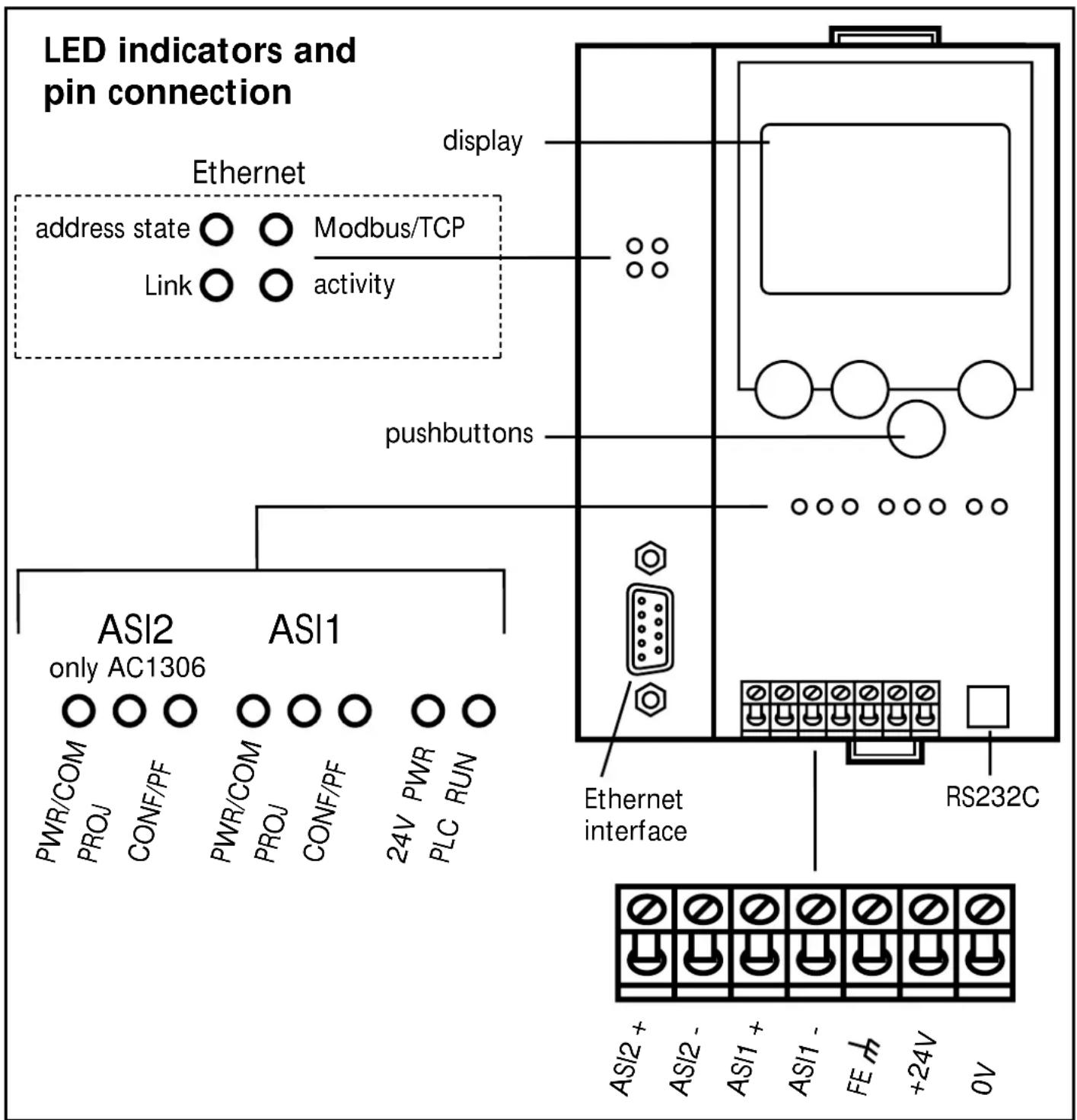
Ethernet Status LEDs
- LED address state:
LED Link to Ethernet: Controller
istmiteinemEther
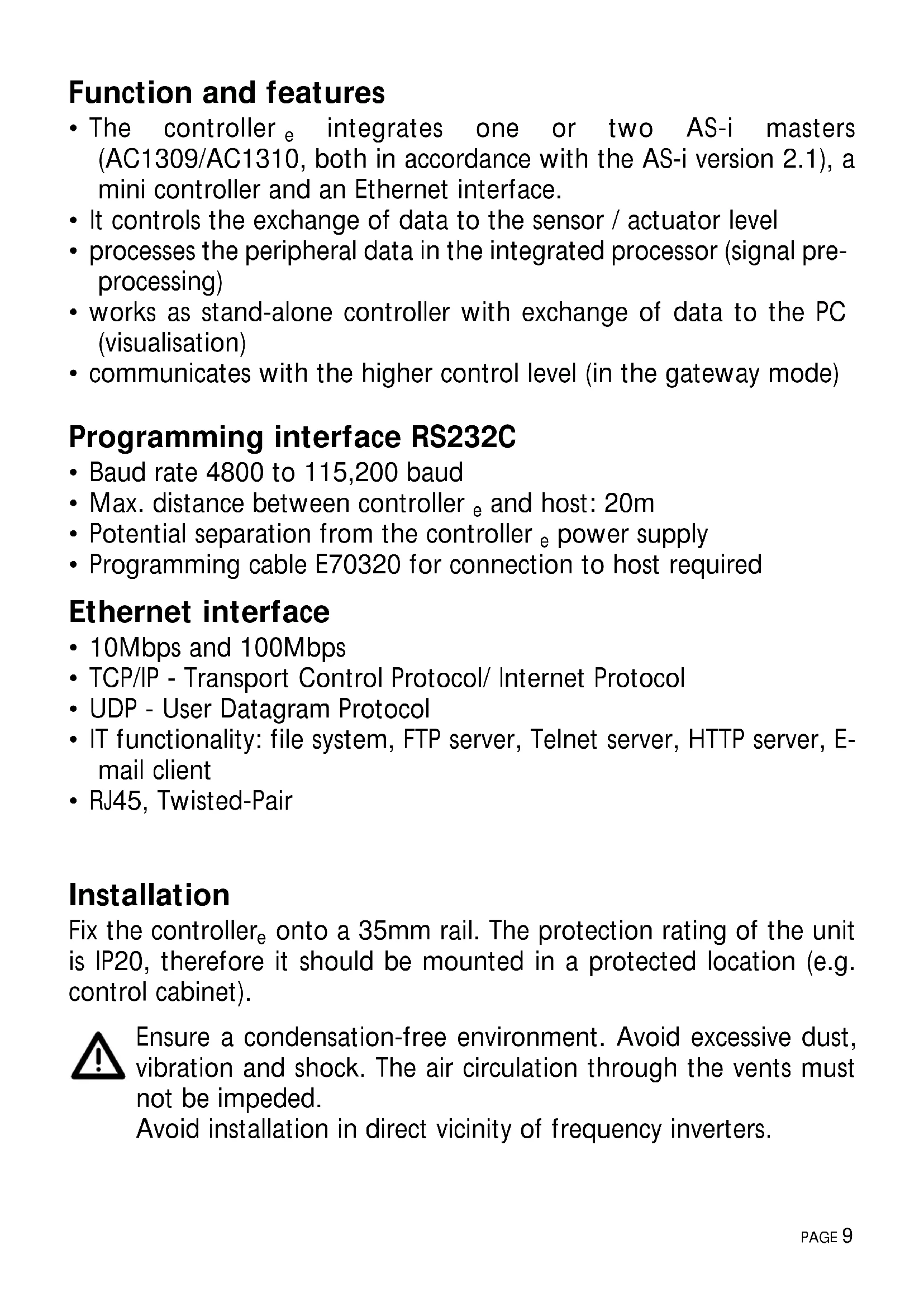
Function and features
- The controller integrates one or two AS-i masters (AC1309/AC1310, both in accordance with the AS-i version 2.1), a mini controller and an Ethernet interface.
- It controls the exchange of data to the sensor / actuator level
- processes the peripheral data in the integrated processor (signal preprocessing)
- works as stand-alone controller with exchange of data to the PC (visualisation)
- communicates with the higher control level (in the gateway mode)
Programming interface RS232C
- Baud rate 4800 to 115,200 baud
- Max. distance between controller _e and host: 20m
- Potential separation from the controller e power supply
- Programming cable E70320 for connection to host required
Ethernet interface
10Mbps and 100Mbps
- TCP/IP - Transport Control Protocol/ Internet Protocol
- UDP - User Datagram Protocol
- IT functionality: file system, FTP server, Telnet server, HTTP server, E-mail client
RJ45, Twisted-Pair
Installation
Fix the controller onto a 35mm rail. The protection rating of the unit is IP20, therefore it should be mounted in a protected location (e.g. control cabinet).

Ensure a condensation-free environment. Avoid excessive dust, vibration and shock. The air circulation through the vents must not be impeded.
Avoid installation in direct vicinity of frequency inverters.
Electrical connection

Disconnect the installation from power. Connect the unit as indicated on the terminals. Never connect the minus potentials to each other or the minus potentials to the FE connection. Ensure an electrically save ground connection between AS-i controller (terminal FE) and ground of the unit.
Supply the controller with a 24V DC voltage (20 ... 30V PELV), e.g. from the 24V power supply DN2011 of ifm electronic. The connection is made to the terminals +24V and 0V.
Operating and indicating elements
Information concerning the state of the master (AC1305)/masters /AC1306) and the connected system is given via three diagnostic LEDs on the controllere.
- LED PWR/COM lights: AS-i voltage present, at least one slave was detected
- LED PWR/COM flashes: AS-i voltage present, but no slave was detected correctly
- LED PROJ lights: Projection mode active, the configuration monitoring is deactivated
- LED PROJ flashes: Projection mode active, changeover to protected mode not possible as a slave with the address 0 is connected
- LED CONF/PF lights: Projected and current configuration do not match
- LED CONF/PF flashes: Periphery fault on at least one connected slave
Ethernet Status LEDs
- LED address state: green flashing 1Hz: The IP address is freely selectable red flashing 1Hz: invalid MAC ID (internal fault Ethernet interface) red flashing 2Hz: no valid Ethernet configuration loaded
red flashing 4Hz: internal fault Ethernet interface
red flashing: double IP address recognised
LED Modbus/TCP connections: cyclical data exchange via Mod
bus/TCP protocol
LED Link to Ethernet: controller e is connected to an
Ethernet system
LED Transmission activity: flashing green for every data
package transferred
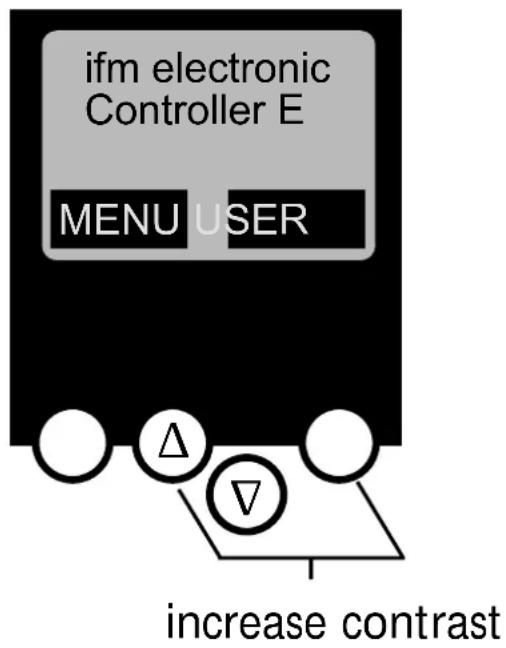
Contrast setting
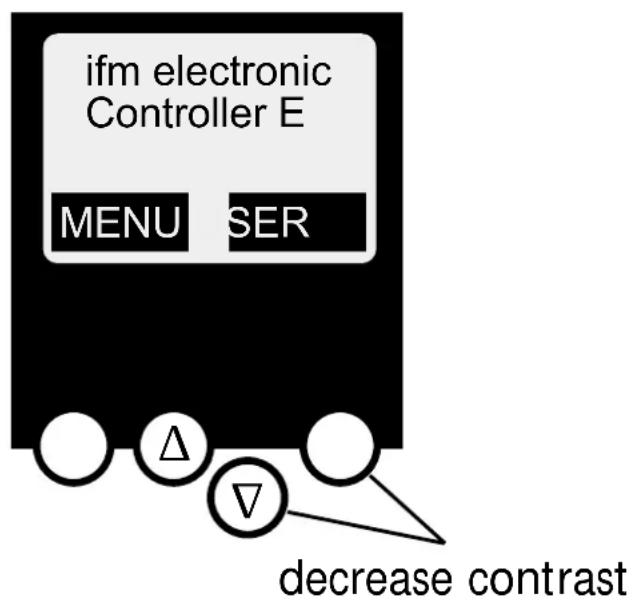
The contrast can be directly changed by simultaneously pressing the right button and the -button (too bright) or the -button (too dark).
Operation
To operate an AS-i system a special AS-i power supply is required (e.g. AC1216). The AS-i power supply supplies the yellow AS-i cable with energy and implements a data decoupling to the voltage regulator of the power supply. Standard switched-mode power supplies would consider the AS-i data signals as interference signals and suppress them.

Disconnect the power supply before connecting the controllere.

The AS-i system is operated ungrounded. AS-i + and AS-i - are to be symmetrical to the ground potential of the installation. Ensure a low resistance connection of the symmetry point of the AS-i power supply (terminal shield) to the ground of the installation.
Menu overview
Open the main menu by pressing the left button "MENU" in the start display.
To navigate within a menu point press the button or .
Press the buttons simultaneously to switch between the German and English menu.
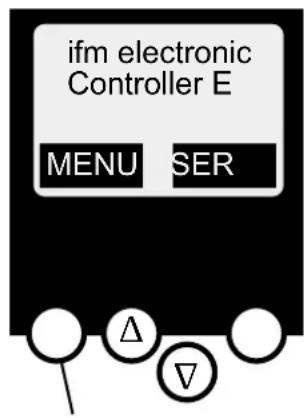
Menu button
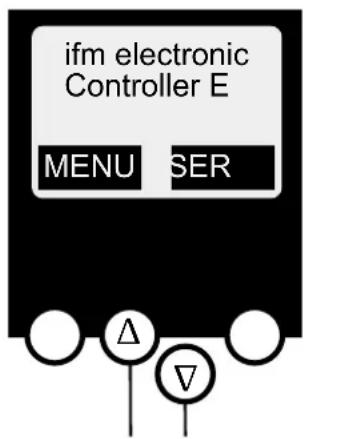
navigation buttons
Menu navigation
O Slave lists (Checking of the addresses of the connected AS-i slaves)
List of the detected AS-i slaves (LDS)
List of the projected AS-i slaves (LPS)
List of the activated AS-i slaves (LAS)
List of the AS-i slaves with periphery fault (LPF)
O Address slave (Programming of the correct addresses in the connected AS-i slaves)
Readdressing of an AS-i slave connected to the controllere
Automatic addressing of new AS-i slaves to the next free address (easy startup)
O Quick setup (Summary of the menu points required for a basic configuration)
Reading of the current AS-i configuration (config all)
Setting of the fieldbus connection (optional)
O System setup (Setting of the controller e device)
Baud rate of the serial programming interface
IP address of the Ethernet programming interface (optional)
Input of the password to enable changes in the system configuration
Update of the controller e firmware (special programming software required)
O System info (Device information)
Hardware and firmware version numbers of this controllere
Serial number of this controller
Current / maximum PLC cycle time
O PLC setup
Start or stop of the PLC in the controller
O PLC info (Display of the user program name, author, date)
O Master setup (AS-i master flags)
Reading of the current AS-i configuration (config all)
Changeover to the projection mode: configuration of the AS-i system
Changeover to the protected mode: standard mode (the master monitors the configuration)
Deactivation of the automatic AS-i slave addressing in the protected mode
Deactivation of the AS-i reset when exiting the projection mode
Display of the config error counter of the connected AS-i system
Reset of the config error counter
Display of the percentage fault rate of the connected AS-i system
O Slave setup (Details about the connected AS-i slaves)
Digital or analogue inputs/outputs of the connected AS-i slaves
Current and projected parameters of the connected AS-i slaves
Current and projected I/O and ID codes of the connected AS-i slaves
Message faults in the communication to the connected AS-i slaves
O Fieldbus setup(The different fieldbus interfaces are optional)
input of the IP address of the controller e in the higher-level system
Further inputs depending on the higher-level fieldbus
O Fieldbus data (optional)
Display of the data cyclically transmitted via the fieldbus
LED Modbus/TCP connections:
LED Link to Ethernet: Controller
Brand : IFM
Model : AC1310
Category : Industrial Automation