JMW2427LL - Oven JENN-AIR - Free user manual and instructions
Find the device manual for free JMW2427LL JENN-AIR in PDF.



| Product Type | Microwave and Combi Oven (Double Cavity) |
| Brand | Jenn-Air |
| Model | JMW2427LL |
| Power Supply | 240 V, 60 Hz, 30 A |
| Main Functions | Microwave cooking, convection cooking, grilling, convection roasting, steam cooking, speed cooking, keep warm, defrost, reheat, bread proofing, Sabbath mode |
| Microwave Oven Capacity | Approx. 1.7 cu ft (not specified, reasonable estimate) |
| Microwave Power | 1000 W (common estimate) |
| Number of Racks | 6 rack positions, including one sliding extendable rack |
| Control Type | Interactive touch screen with rotary knob and touch keys |
| Connectivity | Built-in Wi-Fi (on some models) |
| Turntable | Yes, removable, can be disabled |
| Included Accessories | Turntable, convection rack, baking rack, crisper pan with handle, broiler pan, temperature probe |
| Cleaning | Self-clean cycle, manual general cleaning |
| Safety | Control lock (shape sequence), Sabbath mode, automatic shut-off |
| Customization Options | Temperature calibration, brightness adjustment, clock theme, language (French/English), temperature units |
| Oven Light | Controllable oven light |
| Oven Vents | Upper vent, lower vent, do not obstruct |
| Repairability | Spare parts available via customer service (model and serial number on rating plate) |
| Appliance Weight | Approx. 120 lb (54 kg) (estimate for a built-in combi oven) |
| Dimensions (H x W x D) | 51 1/4 in x 29 7/8 in x 24 3/4 in (130.2 x 75.9 x 62.9 cm) (common estimate for this type) |
Frequently Asked Questions - JMW2427LL JENN-AIR
User questions about JMW2427LL JENN-AIR
0 question about this device. Answer the ones you know or ask your own.
Ask a new question about this device
Download the instructions for your Oven in PDF format for free! Find your manual JMW2427LL - JENN-AIR and take your electronic device back in hand. On this page are published all the documents necessary for the use of your device. JMW2427LL by JENN-AIR.
USER MANUAL JMW2427LL JENN-AIR
Microwave/Oven Combination Control Guide
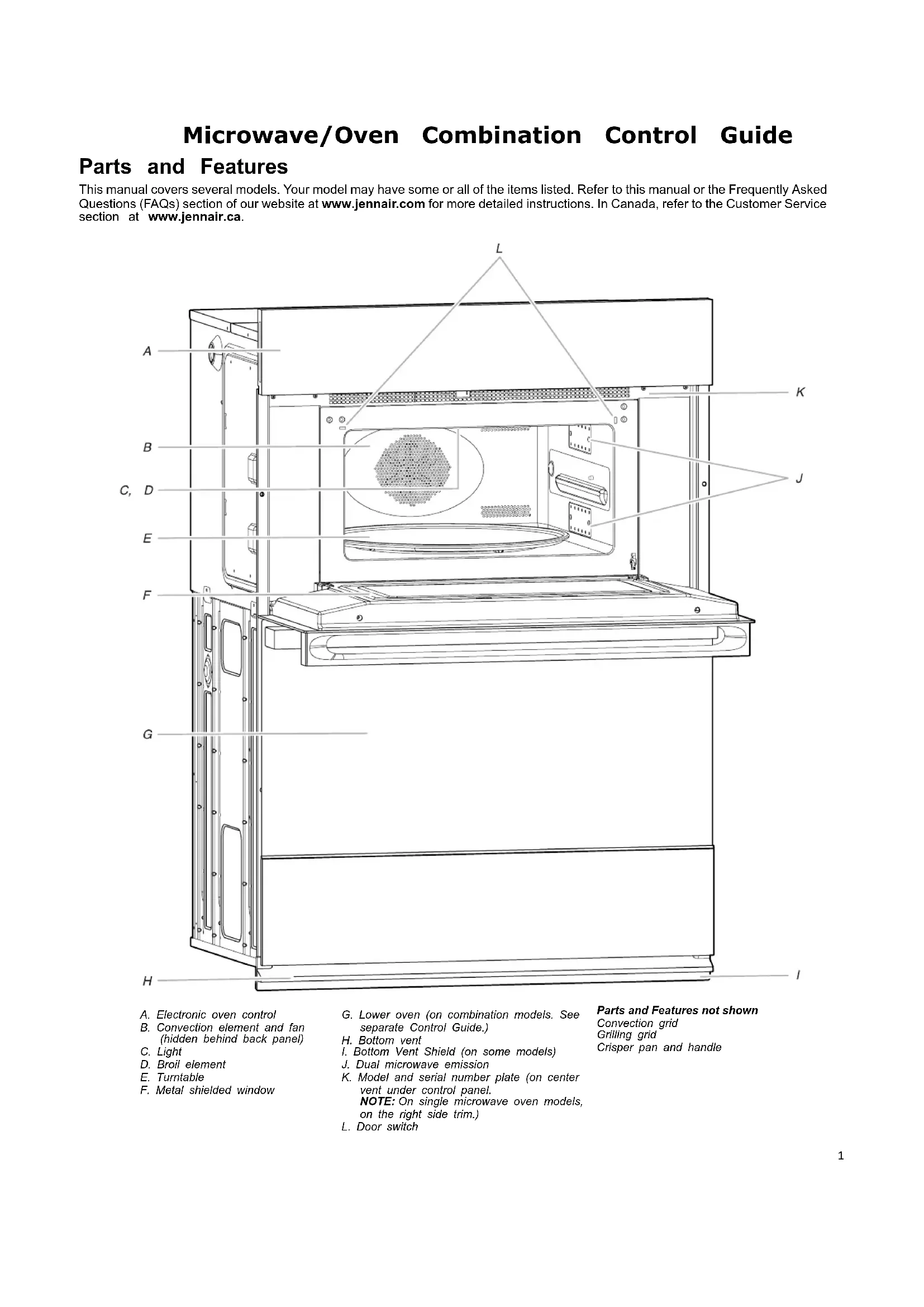
Parts and Features
This manual covers several models. Your model may have some or all of the items listed. Refer to this manual or the Frequently Asked Questions (FAQs) section of our website at www.jennair.com for more detailed instructions. In Canada, refer to the Customer Service section at www.jennair.ca.
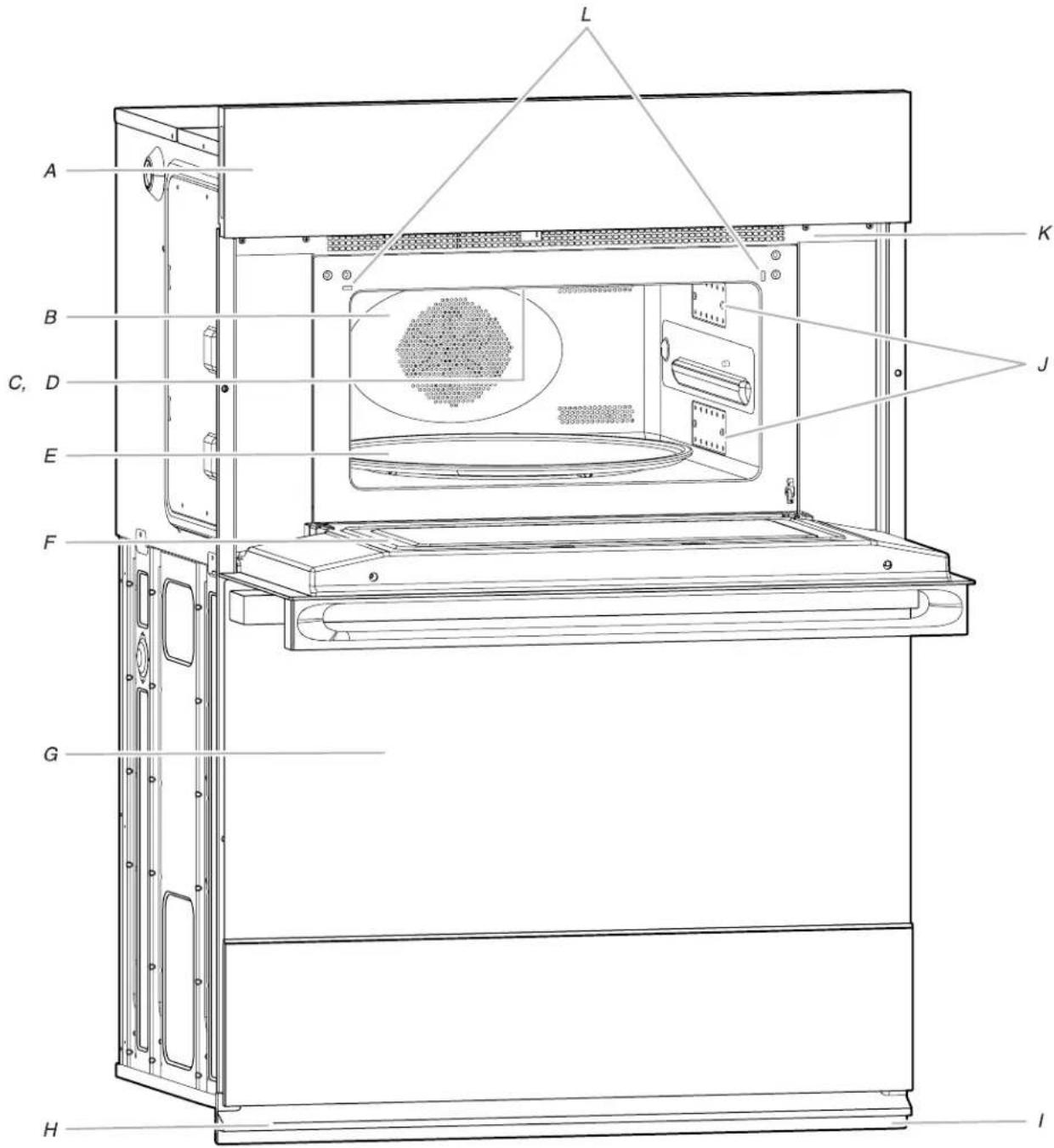
A. Electronic oven control
B. Convection element and fan (hidden behind back panel)
C. Light
D. Broil element
E. Turntable
F. Metal shielded window
G. Lower oven (on combination models. See separate Control Guide.)
H. Bottom vent
I. Bottom Vent Shield (on some models)
J. Dual microwave emission
K. Model and serial number plate (on center vent under control panel.
NOTE: On single microwave oven models, on the right side trim.)
L. Door switch
Parts and Features not shown
Convection grid
Grilling grid
Crisper pan and handle
Turntable
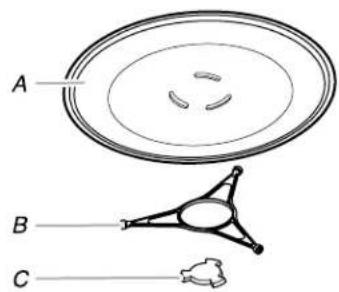
A. Turntable
B. Support and rollers
C. Hub
The turntable rotates in both directions to help cook food more evenly. Do not operate the microwave oven without having the turntable in place. Refer to the Quick Start Guide for ordering information.
The raised, curved lines in the center of the turntable bottom between the 3 spokes of the hub. The hub turns the turntable during microwave oven use. The rollers on the support should inside the turntable bottom ridge.
NOTE: The microwave-cooling fan may continue to run for several minutes after the cooking cycle has been completed. The microwave cooking does not continue beyond the end of cooking cycle.
To Turn On/Off:
For best microwave performance, it is recommended to always leave the turntable on. If necessary, the turntable can be turned Off (except during an auto function).
This is helpful when cooking with a dish that is larger than turntable.
- From the Microwave Cooking Mode menu, touch TURNTABLE to turn the rotation On or Off.
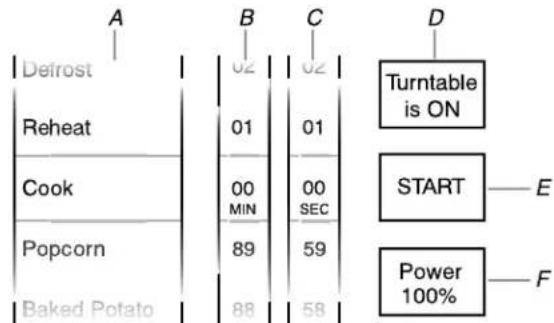
A. Cooking mode
B. Time - minute selection
C. Time - second selection
D. Turntable On/Off menu
E. Start cooking cycle
F. Power level selection
Convection Grid
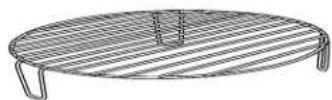
The convection grid provides optimal heat circulation for convection cooking (on some models). It is recommended for convection cooking and for grilling thick pieces of meat such as bone-in chicken.
■ The grid will become hot. Always use oven mitts or pot holder when handling.
■ To avoid damage to the microwave oven, do not allow the gri to touch the inside cavity walls, ceiling, or floor.
■ Always use the turntable.
■ To avoid damage to the microwave oven, do not store the grie in the oven.
■ Two-level cooking is not recommended.
■ For best results, do not place popcorn bags on the grid.
■The grid is designed specifically for this oven. For best cooking results, do not attempt to use any other grid in this oven.
Coated Crisper Pan and Handle
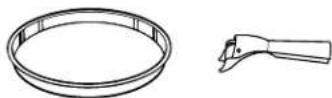
The crisper pan, with its nonstick surface and detachable handle, has been specifically designed for microwave use and is ideal for pan-frying (pan-browning) foods in the microwave oven.
■ The crisper pan will become hot. Always use the handle and oven mitts or pot holders when handling. Place gripping end on the edge of pan, squeeze handle, and lift pan.
■ Do not allow the crisper pan or handle to touch the inside cavity walls, ceiling, or floor.
■ Use the turntable as a support for the crisper pan.
■ Do not place hot crisper pan on heat-sensitive surfaces. Damage may occur.
■ To avoid damage to the microwave oven, do not use another metal object with the crisper pan.
■ The crisper pan is designed specifically for this oven. Do not use it in any other oven.
■ Use only wooden or plastic cooking utensils to help avoid scratches.
Microwave Oven Control
This manual covers several models. Your model may have some or all of the items listed. Refer to this manual or the Frequently Asked Questions (FAQs) section of our website at www.jennair.com for more detailed instructions. In Canada, refer to the Customer Service section at www.jennair.ca.
The microwave oven's controls are accessed through its control panel and interactive touch display.
NOTE: Due to the sensitivity of the control panel, we have provided special instructions for cleaning the panel as well as the touch panel.
See "General Cleaning" section in the Owner's Manual for cleaning instructions.
Combination Oven Models
![graph TD A["Power"] --> B["Microwave Control"] B --> C["Add 30 Inc."] C --> D["Microwave"] E["Block"] --> F["Lunar Oven"] F --> G["Overs Light"] G --> H["Overs Control"] H --> I["Check"]](/content/2026/03/522797/images/bbfe5dc1a6be7834ac777f73502f671a3f86f4e779b216cb6b93aa86a21c3e07.jpg)
A. Power
B. Microwave cancel
C. Add 30 Sec.
D. Microwave
E. Display
F. Lower oven
G. Oven light
H. Oven cancel
I. Clean
Touch Panel
The touch panel houses the control menu and function controlsWhen the oven(s) is in use (active mode), the display shows the The touch pads are very sensitive and require only a light to open temperature, heat source(s) and timer if set.
activate.
For more information about the individual controls, see their respective sections in this manual.
Welcome Guide
This appears on your display the first time the microwave is powered up. The Welcome Guide allows you to set up your microwave oven.
After every selection, a tone will sound.
- A new welcome screen will appear, please read it and touch NEXT.
- Select your language.
- Select the clock by scrolling to the correct time in the hours and minutes column. You can then select AM/PM or 24 hour clock (military time). Touch NEXT.
- Choose to have daylight savings time AUTO SYNC (turn on), or DO NOT ADJUST (turn off). Touch NEXT.
- Enter current date (MM/DD/YYYY) by scrolling to the column to set the MONTH, DAY, and YEAR. Touch NEXT.
- Select the units of temperature. You can choose Fahrenheit or Celsius. Touch NEXT.
- Select the Clock Theme by scrolling to the desired setting. Touch NEXT.
NOTE: This is the background for the center touch display.
- If you selected CLOCK ONLY, touch SAVE to complete the setup.
or
If you selected a picture for the Clock Theme, select the desired image and touch SAVE.
Display
When the oven(s) is in use (active mode), the display shows the oven temperature, heat source(s) and timer if set.
After approximately 2 minutes of inactivity, the display will go into standby (sleep) mode, and the backlight of the display will dim. When the oven is in operation, the display will remain active.
During programming, the display shows menus and the appropriate selections for the respective cooking function.
Display Screen
- The touch display screen is used to make menu selections, adjust settings and input commands.
![graph TD A["Deirost"] --> B["Reheat"] B --> C["Cook"] C --> D["Popcorn"] D --> E["Baked Potato"] A --> F["A"] B --> G["B"] C --> H["C"] D --> I["D"] F --> J["Turntable is ON"] G --> K["START"] H --> L["Power 100%"] I --> M["F"]](/content/2026/03/522797/images/49d1ac649e901d956b0433d15c8e4456754d846e0ef76b1465e4c633d94c82cc.jpg)
A. Cooking mode
B. Time - minute selection
C. Time - second selection
D. Turntable on/off menu
E. Start cooking cycle
F. Power level selection
Menu selections and input adjustments are made in the center portion of the screen, and the command inputs (Back, More, Star etc.) are made using the bottom buttons. Screen titles and descriptions are displayed in the top portion of the screen. A light to medium pressure touch of the fingertip will activate the menu selection.
Display Navigation
If the oven is off, touch the Power keypad to activate the mThe. Tools selection key allows you access to functions and From the home screen, all automatic cooking programs can be customization options within the Electronic Oven Control. These activated, all manual cooking programs can be set, options can also allow you to set the clock, change the oven temperature adjusted, and instructions, preparation, and tips can be accessed between Fahrenheit and Celsius, turn the audible signals and
Menu Demonstration
The following demonstrates a sequence showing how to bake potato from the "Built-in Foods" menu.
- Touch START or MICROWAVE (on combination oven models).
- From the Cooking Mode Menu, scroll to select Baked Potato.
- Use the tumbler to select one of the preset quantities (4 maximum).
-
(Optional) To adjust doneness, touch DONENESS, read the on-screen information, and then touch DONENESS again. Select More Done, suggested, or Less Done, and then Touch SET.
-
Touch START.
Drop-down Message Demonstration
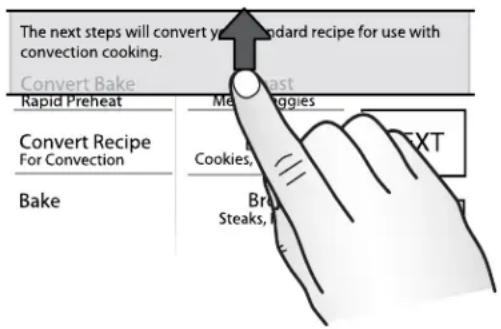
There are some menus that prompt a drop-down message to appear. Once the message is read, you can dismiss the menu by touching the directional arrow and swiping up.
Kitchen Timer
The Kitchen Timer can be set in hours, minutes, and seconds.
NOTE: The Kitchen Timer does not start or stop the oven.
Tones/Sounds
Tones are audible signals, indicating the following:
■ Valid keypad touch
■ Function has been entered
■ Preheat cycle has been completed
■ Invalid keypad touch
■ End of a cooking cycle
■ When timer reaches zero
■ Includes using the Kitchen Timer for functions other than cooking.
■ First oven element activation in a cooking mode.
Tools
m. Tools selection key allows you access to functions and beustomization options within the Electronic Oven Control. These toolise allow you to set the clock, change the oven temperature between Fahrenheit and Celsius, turn the audible signals and
prompts on and off, and adjust the oven calibration, change the language, and more. The Sabbath mode is also set using the Tools selection key.
| a | |
| MODE AVAILABLE SELECTIONS | |
| Sabbath | ■ Sets Sabbath mode |
| Demo Mode | ■ On■ Off (Default) |
| Temp Units | ■ Celsius■ Fahrenheit (Default) |
| Language | ■ Français■ English (Default) |
| Display On/Off | ■ Display Off■ Display Dimmed (Default) |
| Clock On/Off | ■ Clock Off■ Clock On (Default) |
| Brightness | ■ Max■ High■ Med (Default)■ Low■ Dim |
| Sound | ■ Key Press■ Timer & Alert (Default)■ Power On & Off |
| nu by | |
| Clock Theme | ■ Textures■ Celebration■ Culinary■ Clock Only■ Animation (Default)■ Spring■ Summer■ Fall■ Winter |
| ds. | |
| Time & Date | ■ Daylight Saving■ Clock Style■ Set Clock (Default)■ Set Date |
| Self Clean | ■ Starts the Self Clean Cycle |
| Button Lock | ■ Press Lock to lock controls |
| Number Entry | ■ Number Pad■ Scroll (Default) |
| Probe | ■ Use for Probe Cooking Mode |
| Temp Calib. | ■ +35°F to -35°F■ +20°C to -20°C |
| Touch Calib. | ■ Use to calibrate touch screen |
| MODE AVAILABLE SELECTIONS | |
| Service Info. | ■ Model Number and Serial Number |
| Legal Info. | ■ License Information |
| Restore Defaults | ■ Restores Factory Defaults |
Button Lock
The Button Lock shuts down the control panel keypads to an unintended use of the oven(s). The Button Lock will remain after a power failure if it was set before the power failure. When the control is locked, only the Power keypad will function
The Button Lock is preset unlocked but can be locked.
To Activate the Button Lock:
- From the Tools menu, touch BUTTON LOCK.
- Touch LOCK to activate the Button Lock mode.
NOTE: The touch screen will return to idle mode and a locked message will be displayed.
To Deactivate the Button Lock:
- Touch the Power keypad, and then follow the on-screen directions.
NOTE: The oven will generate a random sequence of sh that must be touched in the order prompted on the scre
Oven Temperature Control
IMPORTANT: Do not use a thermometer to measure the oven temperature. Elements will cycle on and off as needed to make a consistent temperature but may run slightly hot or cool at point in time due to this cycling. Opening the oven door will cycling of the elements and impact the temperature.
The oven provides accurate temperatures and has been thoroughly tested at the factory. However, it may cook faster slower than your previous oven, causing baking or browning differences. If necessary, the temperature calibration can be adjusted in either Fahrenheit or Celsius.
On double ovens, the upper oven and the lower oven can be calibrated independently.
A minus sign means the oven will be cooler by the display amount. The absence of a minus sign means the oven will warmer by the displayed amount. Use the following chart as guide.
NOTE: The oven display will continue to show the original s temperature and will not reflect the calibration offset. For exa if set to 350° (177°C) and calibrated to -20, the display will continue to show 350° (177°C).
| ADJUSTMENT °F(AUTOMATIC °C CHANGE) | COOKS FOOD |
| 10°F (6°C) ...a little more | |
| 20°F (12°C) ...moderately more | |
| 30°F (18°C) ...much more | |
| 0°F (0°C) ...default setting | |
| -10°F (-6°C) ...a little less | |
| -20°F (-12°C) ...moderately less | |
| -30°F (-18°C) ...much less |
Sabbath Mode
The Sabbath mode sets the oven(s) to remain on in a bake set until turned off. A timed Sabbath Mode can also be set to keep oven on for only part of the Sabbath.
When the Sabbath mode is set, the allowed keypads are the Power keypad and the Cancel keypads.
When the oven door is opened or closed, the oven light will not turn on or off, and the heating elements will not turn on or off immediately.
The power failure less than 1 second occurs when the Sabbath mode is set, the oven(s) will remain in Sabbath mode and continue cooking.
For a power failure that lasts greater than a few seconds, the oven(s) will return to an idle state and Sabbath mode will no longer be active. For double ovens, the upper and lower oven temperatures and cook timers can be set independently. If a cool timer is set, the countdown will not appear. The timer will appeal frozen at the set time. control
To Activate:
- Touch the Power keypad, and then touch TOOLS.
- From the Mode menu, select "Sabbath" and touch NEXT.
- Touch ON, and then touch SETUP.
NOTE: The programmed status of the oven(s) will be
s displayed.
-
Touch CHANGE.
-
For single ovens, go to Step 6. For double ovens, select the desired oven, and then touch NEXT.
Select the desired oven temperature and touch NEXT.
- (Optional) Set Bake Time (00:00) and touch SET. any or.
Touch SKIP TIMER.
- For single ovens, touch START. For double ovens, touch
START to begin Sabbath mode, or touch CHANGE to edit the
or current programming or to program the other oven.
To Deactivate:
Sabbath mode can be deactivated on all cavities, once activated, by touching the Power keypad.
For single ovens, Sabbath mode can also be deactivated by touching Cancel.
For double ovens, if both ovens are running, touching Cancel for one oven will turn off Sabbath mode for both ovens and will turn off the selected oven. The other oven will return to a regular Ba
Delayed Sabbath Bake:
| WARNING |
| Food Poisoning HazardDo not let food sit for more than one hour before cooking.Doing so can result in food poisoning or sickness. |
For double ovens, the upper and lower oven temperatures and cook timers can be set independently.
If a cook timer is set, the countdown will not appear. The timer appear frozen at the set time.
To Activate:
- Touch the Power keypad, and then touch TOOLS.
-
From the Mode menu, select "Sabbath" and touch NEXT.
-
Touch ON, and then touch SETUP. NOTE: The programmed status of the oven(s) will be displayed.
- Touch CHANGE.
- For single ovens, go to Step 6. For double ovens, select the desired oven, and then touch NEXT.
- Select the desired oven temperature and touch NEXT.
- (Optional) Set Bake Time (00:00) and touch SET. or Touch SKIP TIMER.
- Touch DELAY and set both the "Cooking Starts at" time. NOTE: If a bake time is set in the previous steps, the "Cooking ends at" will be calculated based on the bake time. If the timer is not set, the Sabbath Mode will continue until canceled.
- Touch SET.
- Review the settings and touch START to begin the baking cycle. NOTE: Once the timer ends; opening and closing the oven door will deactivate the Sabbath mode.
Change Temperature
The oven temperatures can be changed while running Sabbath Mode by touching the -25° F ( -5° C) or +25° F ( +5° C). Touching these buttons will not result in any changes to the screen and no sound will play.
As an example, touching the +25°F (+5°C) button 3 times will result in an oven cavity temperature increase of +75°F (+15°C); however, the initial oven cavity set temperature will remain on the screen.
NOTE: On double oven models, the oven cavity temperature may be set individually.
Main Menu
From the Main Menu, all automatic cooking programs can be activated; all manual cooking can be programmed; settings can be adjusted; and instructions, preparation, and tips can be accessed.
This manual covers different models. The oven you have purchased may have some or all of the items listed. The loc and appearances of the features shown here may not match those of your model.
Tools Menu
Your microwave provides you with the ability to control several the default settings and access information through the on-scre display. These include: Clock, Sound, Appearance, Language, Temperature Units, Service, and Restore Defaults.
This manual covers different models. The oven you have purchased may have some or all of the items listed. The lo and appearances of the features shown here may not match those of your model.
To Access Tools Menu:
- Touch TOOLS.
- From the Tools Menu, scroll to the desired Tools choice.
- Touch the quickset pad that corresponds to the desired choice.
| MODE AVAILABLE SELECTIONS | |
| Sabbath | ■ Sets Sabbath Mode |
| Demo Mode | ■ On■ Off (Default) |
| Temp Units | ■ Celsius■ Fahrenheit (Default) |
| MODE AVAILABLE SELECTIONS | |
| Language | ■ Français■ English (Default) |
| Display On/Off | ■ Display Off■ Display Dimmed (Default) |
| Clock On/Off | ■ Clock Off■ Clock On (Default) |
| Brightness | ■ Max■ High■ Med (Default)■ Low■ Dim |
| Sound | ■ Key Press■ Timer & Alert (Default)■ Power On & Off |
| Clock Theme | ■ Textures■ Celebration■ Culinary■ Clock Only■ Animation (Default)■ Spring■ Summer■ Fall■ Winter |
| n thing and no | |
| will °C); | |
| on the | |
| may | |
| Time & Date | ■ Daylight Saving■ Clock Style■ Set Clock (Default)■ Set Date |
| n be sed. | |
| Button Lock | ■ Press Lock to lock controls |
| cations | ■ Number Pad■ Scroll (Default) |
| Number Entry | |
| Touch Calib. | ■ Use to calibrate touch screen |
| Service Info. | ■ Model Number and Serial Number |
| en | |
| Legal Info. | ■ License Information |
| Restore Defaults | ■ Restores Factory Defaults |
Service Information
- From the Tools Menu, scroll until Service Info appears.
- Touch TIPS.
- The service phone number, website, model number, and serial number are displayed on the screen.
- Refer to the Quick Start Guide for contact information.
- From the Tools Menu, scroll until Restore Factory Defaults appears.
- Touch TIPS, read the drop-down message, and then swipe the message arrow up.
- Touch RESET to Restore Factory Defaults.
- The following settings will be lost: Language, Temperature Units, Clock Settings, Date and Screen Appearance. The Welcome Guide will appear to help you reset these settings. See the "Welcome Guide" section for additional information.
Kitchen Timer
This is an independent timer not associated with the cook time. IMPORTANT: To avoid permanent damage to the oven bottom NOTE: The Kitchen Timer appears as a drop-down display. Finish, do not line the oven bottom with any type of foil or liner. dismiss the timer message, swipe the message arrow up. The For best cooking results, do not cover entire rack with foil timer will continue to count down even though it is not visible. because air must be able to move freely.
- Touch TIMER (KITCHEN TIMER for dedicated microwave ovens) anytime needed.
- Enter the desired time (00:00:00) using the tumbler.
- Touch Back next to Cancel Timer or touch START.
- To adjust TIMER / KITCHEN TIMER, touch the countdown timer, use the tumbler to set the new desired hour, minute, and seconds, and then touch SET. or
- To cancel timer, touch the countdown timer, and then touch OFF. This will cancel the TIMER / KITCHEN TIMER and return you to the Cooking mode menu.
- When the Kitchen Timer is complete, a tone will sound, then reminder tones will sound every minute.
Button Lock
The Button Lock allows all the buttons to be locked. To Activate the Button Lock:
- From the Tools menu, touch BUTTON LOCK.
- Touch BUTTON LOCK to activate the Button Lock mode. NOTE: The touch screen will return to idle mode, and a control locked message will be displayed.
To Deactivate the Button Lock:
- Touch the Power pad, and then follow the on-screen directions.
NOTE: The oven will generate a random sequence of shapes that must be touched in the order prompted on the screen. - The controller will unlock and return to the cooking modes menu once the shapes are touched in the needed sequence.
NOTE: The Button Lock tool must set every time you wish to use this feature.
Wi-Fi Connectivity (On some models)
Your oven may have built-in Wi-Fi connectivity, but for it to work you will have to connect it to your home wireless network. For
information about setting up the connectivity, turning it on and receiving important notifications and taking advantage of available
features, refer to the Oven Wi-Fi Connected Quick Start Guide For that came with your oven. inter
Once the setup process has been completed for the Wi-Fi, you have access to features that will give you new freedom in cooking. Your available features may vary depending on firmware update
NOTE: Wi-Fi connectivity may be interrupted or lost during a microwave cooking function. The Wi-Fi will reconnect once the F0 microwave cooking function has ended.
Oven Use
Odors and smoke are normal when the oven is used the first few times or when it is heavily soiled.
During oven use, the heating elements will not remain on but with cycle on and off throughout oven operation.
IMPORTANT: The health of some birds is extremely sensitive to the fumes given off. Exposure to the fumes may result in death certain birds. Always move birds to another closed and well-ventilated room.
If the oven door is opened during a cooking mode and left open for approximately 60 seconds, the cooling fan will switch to a higher speed. You may experience higher noise during this time. When the oven door is closed, the fan will switch back to its lower speed after approximately 60 seconds.
Aluminum Foil
IMPORTANT: To avoid permanent damage to the oven bottom finish, do not line the oven bottom with any type of foil or liner.
For best cooking results, do not cover entire rack with foil because air must be able to move freely.
■ To catch spills, place foil on rack below dish. Make sure foil at least 1/2" (1.3 cm) larger than the dish and that it is turned up at the edges.
Position Racks and Bakeware
IMPORTANT: To avoid permanent damage to the porcelain finish, do not place food or bakeware directly on the oven door or bottom.
Racks
■ Position racks before turning on the oven.
■ Do not position racks with bakeware on them.
■ Make sure racks are level.
To move a rack, pull it out to the stop position, raise the front and lift out. Use the following illustration and charts as guides.
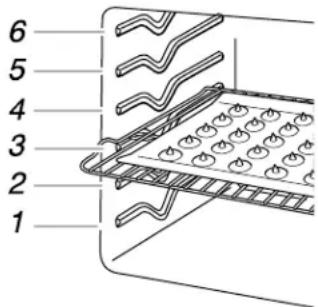
Rack and Bakeware Positions
Rack Positions - Upper and Lower Oven Broiling
work =FOOD RACK POSITION
d Most broiling 6
For hamburger patties to have a well-seared exterior and a rare interior, use a flat rack in position 6. Side 1 should cook for approximately 3 minutes. Side 2 should cook for approximately 3 to 4 minutes. Expect a moderate degree of smoke when broiling. Traditional Cooking
Large roasts, turkeys, angel 1 or 2 food cakes, bundt cakes, quick breads, pies
st few
Yeast breads, casseroles, 2 meat, poultry
Cookies, biscuits, muffins,akes
2 or 3 when single-rack baking; 2 and 5 when multi-rack baking
Convection Cooking
| OVEN | SETTING | NUMBER OF RACKS USED | RACK POSITION (S) |
| Rapid Bake | Preheat | 1 | 3 |
| Rapid Convection | Preheat Bake | 1 | 3 |
| Convection | Bake | 1 1, 2 or 3 | |
| Convection | Bake | 2 2 and 5 | |
| Convection | Bake | 3 1, 3 and 5 | |
| Convection | Roast | 1 1 and 2 | |
| Convection | Broil | 1 4, 5 and 6 |
Baking Cakes on 2 Racks
For best results when baking cakes on 2 racks, use the Bake function and racks in positions 2 and 5. Place the cakes on the racks as shown. Keep at least 2" (5 cm) of space between the front of the racks and the front of the cakes.
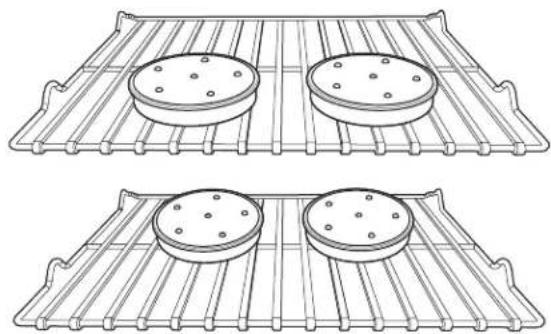
Baking Cookies on 2 Racks
For best results when baking cookies on 2 racks, use the Convect Bake function and place racks in positions 2 and 5.
Bakeware
To cook food evenly, hot air must be able to circulate. For best results, allow 2" (5 cm) of space around bakeware and oven 1 waste the rack in completely so that it is closed and engaged with the following chart as a guide. Use the following chart as a guide.
| NUMBER OF PAN(S) POSITION ON RACK |
| 1 Center of rack |
| 2 Side by side or slightly staggered |
| 3 or 4 See the rack position graphics in this section for pan placement recommendations. |
Roll-Out Extension Rack
The roll-out extension rack allows easy access to position food in the oven, and remove food from the oven. It can be used in ra positions 1 through 6.
Open Position
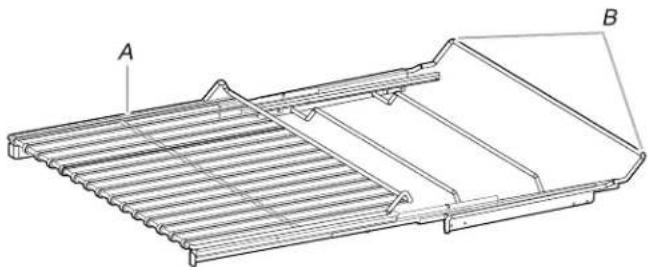
A. Roll-out extension rack
B. Sliding shelf
Closed and Engaged Position
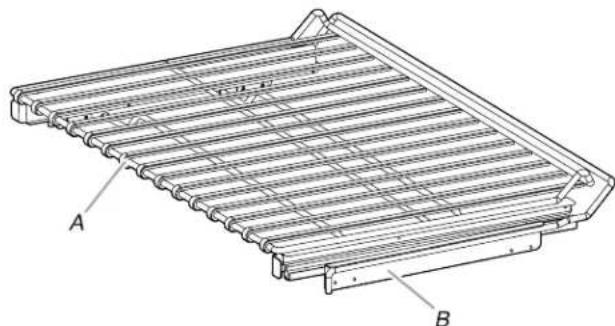
A. Roll-out extension rack
B. Sliding shelf
To Best Remove Roll-Out Extension Rack:
-
wide the rack in completely so that it is closed and engaged with the sliding shelf.
-
Using 2 hands, lift up on the front edge of the rack and push the sliding shelf to the back wall of the oven so that the front edge of the sliding shelf sits on the rack guides. The front edge of the rack and the sliding shelf should be higher than the back edge.
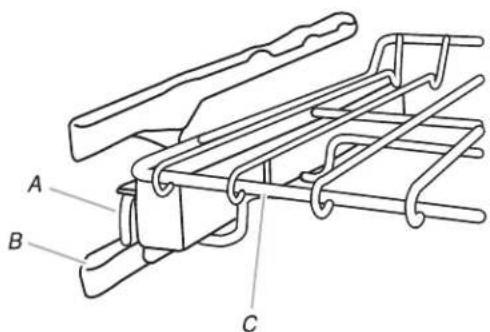
A. Sliding shelf
B. Rack guide
C. Roll-out extension rack
- Pull the rack and the sliding shelf out.
To Replace Roll-Out Extension Rack:
- Using 2 hands, grasp the front of the closed rack and the sliding shelf. Place the closed rack and the sliding shelf on the rack guide.
- Using 2 hands, lift up on the front edge of the rack and the sliding shelf together.
- Slowly push the rack and the sliding shelf to the back of the oven until the back edge of the rack pulls over the end of the rack guide.
To avoid damage to the sliding shelves, do not place more than 25 lbs (11.4 kg) on the rack.
Do not clean the roll-out extension rack in a dishwasher. It may remove the rack's lubricant and affect its ability to slide.
See the "General Cleaning" section from Owner's Manual for more information.
Bakeware
The bakeware material affects cooking results. Follow manufacturer's recommendations and use the bakeware size recommended in the recipe. Use the following chart as a guide.
BAKEWARE/RESULTS RECOMMENDATIONS
| Light-colored aluminum■ Light golden crusts■ Even browning | ■ Use temperature and time recommended in recipe. |
| Dark aluminum and other bakeware with dark, dull and/or nonstick finish■ Brown, crisp crusts | ■ May need to reduce bakir temperatures slightly.■ Use suggested baking time.■ For pies, breads, and casseroles, use temperature recommended in recipe.■ Place rack in center of oven. |
| Insulated cookie sheets or baking pans■ Little or no bottom browning | ■ Follow rack recommendations in the “Position Racks and Bakeware” section.■ May need to increase baking time. |
| Stainless steel■ Light, golden crusts■ Uneven browning | ■ May need to increase baking time. |
| Stoneware/Baking stone■ Crisp crusts | ■ Follow manufacturer’s instructions. |
| Ovenproof glassware or ceramic■ Brown, crisp crusts | ■ May need to reduce bakir temperatures slightly. |
Oven Vents
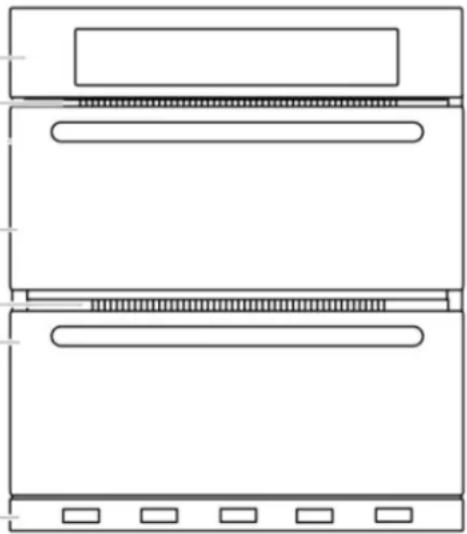
A. Control panel
B. Oven vent
C. Upper oven
D. Oven vent
E. Lower oven
F. Bottom vent
The oven vents should not be blocked or covered since they allow the inlet of fresh air into the cooling system and allows the vent of heated air. Blocking or covering vents will cause poor air circulation, affecting cooking, cleaning, and cooling results.
Preheating and Oven Temperature
Preheating
When beginning a Bake or Convect Bake cycle, the oven begins preheating after Start is pressed. The oven will take approximately 12 to 18 minutes to reach 350°F (177°C) with all of the oven r provided with your oven inside the oven cavity. Higher temperatures will take longer to preheat. The preheat cycle rapidly increases the oven temperature. The actual oven temperature will go above your set temperature to offset the heat lost when your oven door is opened to insert food. This ensures that when you place your food in the oven, the oven will begin at the proper temperature. Insert your food when the preheat tone sounds. Do not open the door during preheat until the tone sounds.
NOTE: If the cook timer is set and the oven door is opened due to preheating, the timer will automatically start.
Oven Temperature
While in use, the oven elements will cycle on and off as needed maintain a consistent temperature. They may run slightly hot or cool at any point in time due to this cycling. Opening the oven while in use will release the hot air and cool the oven which could impact the cooking time and performance. It is recommended to use the oven light to monitor cooking progress.
Baking and Roasting
IMPORTANT: The convection fan and convection element may operate during the Bake function to enhance performance and heat distribution.
The oven will take approximately 12 to 18 minutes to reach (177°C) with all oven racks inside the oven cavity. The preheat cycle rapidly increases the temperature inside the oven cavity. Higher temperatures will take longer to preheat. Factors that impact preheat times include room temperature, oven temperature, and the number of racks. Unused oven racks can be removed prior to preheating your oven to help reduce preheat time. The actual oven temperature will go above the set temperature to offset the heat lost when the oven door is open to insert food. This ensures that the oven will begin at the preheat temperature when you place food in the oven. Insert food when the preheat tone sounds. Do not open the door during preheat until the tone sounds.
During baking or roasting, the bake and broil elements will on and off in intervals to maintain the oven temperature.
Depending on the model, if the oven door is opened during or roasting, the heating elements (bake and broil) will turn off approximately 30 seconds after the door is opened. They will on again approximately 30 seconds after the door is closed.
Broiling
Broiling uses direct radiant heat to cook food.
The element cycles on and off in intervals to maintain the oven temperature.
NOTE: No preheating is required for the Broiling function.
IMPORTANT: Close the door to ensure proper broiling temperature.
If the oven door is opened during broiling, the broil element turn off in approximately 30 seconds. When the oven door is closed, the element will come back on approximately 30 seconds later.
■ For best results, use a broiler pan and grid. It is designed drain juices and help avoid spatter and smoke.
■ For proper draining, do not cover the grid with foil. The be of the broiler pan may be lined with aluminum foil for eas cleaning.
- Trim excess fat to reduce spattering. Slit the remaining fat the edges to avoid curling.
■ Pull out oven rack to stop position before turning or remove food. Use tongs to turn food to avoid the loss of juices. Thin cuts of fish, poultry or meat may not need to be tur
■ After broiling, remove the pan from the oven when removing the food. Drippings will bake on the pan if left in the heat oven, making cleaning more difficult.
Convection
In a convection oven, the fan-circulated hot air distributes heat more evenly. This movement of hot air helps maintain a constant temperature throughout the oven, cooking foods more evenly, while sealing in moisture.
Most foods, using convect baking mode, can be cooked by lowering cooking temperatures 25°F (14°C). The cooking time is be shortened significantly when using Convect Roast, especially for large turkeys and roasts.
■ It is important not to cover foods with lids or aluminum foil that surface areas remain exposed to the circulating air, allowing browning and crisping.
- Keep heat loss to a minimum by opening the oven door when necessary. It is recommended to use the oven light monitor progress.
-
Choose cookie sheets without sides and roasting pans with lower sides to allow air to move freely around the food.
■ Test baked goods for doneness a few minutes before the minimum cooking time using a method such as a toothpick. -
Use a meat thermometer or the temperature probe to determine the doneness of meats and poultry. Check the temperature of pork and poultry in 2 or 3 places.
Convect Bake
an be Convection Bake uses convection element and fan.
■ Use the convection grid. Place on turntable.
onelde oven mitts as the door and grids will become hot.
To Use Convect Bake:
eat Touch POWER or MICROWAVE (on combination oven models).
2 From the Cooking mode menu, select Convect Bake.
3. Using the tumbler, select the microwave oven temperature, and then touch START.
4. (Optional) When a Microwave Timer is set, the WHEN DONE option will appear. This option allows you to select the microwave oven behavior at the end of the current cooking cycle. You can select between Keep Warm, Hold Temp, and MW Off. Keep Warm will run the microwave oven at 10% power for 60 minutes, Hold Temp maintains the selected cooking cycle after the timer expires, and MW Off deactivates the microwave cooking cycle when the timer expires.
NOTE: The default temperature is 325° F ( 163° C). If enabled, end-of-cycle tones will sound.
- (Optional) After the cooking cycle ends, touch ADD 30 SEC. This will automatically add 30 seconds to the cook time.
- Touch MICROWAVE CANCEL to turn off the oven.
Convect Roast
The Roast function uses the convection element with or without microwave power. The Roast function requires that a time and temperature (and microwaves if desired) be entered. The highest microwave power level that can be used is 30%.
Use the convection grid. Place on turntable.
Use oven mitts as the door and grids will become hot.
To Use Convect Roast:
-
Touch POWER or MICROWAVE (on combination oven ving models).
2erFrom the Cooking mode menu, select Convect Roast. 3ed. Using the tumbler, select the oven temperature.
NOTE: The default temperature is 325°F (163°C), and the rated default microwave power level is 0%. -
Touch START.
or
- To adjust the power level, touch POWER, select a new power at level, touch SET (the set range is between 0% and 30%), an sixteen touch START.
- To enter a cook time, touch MW TIMER after the cooking cycle has started, use the tumbler to select a cook time (00:00:00), and then touch START. The maximum length is 11:59:00.
can If enabled, end-of-cycle tones will sound.
- When a Microwave Timer is set, the WHEN DONE option will appear. This option allows you to select the microwave oven oil behavior at the end of the current cooking cycle. You can select between Keep Warm, Hold Temp, and MW Off. Keep Warm will run the microwave oven at 10% power for only 60 minutes, Hold Temp maintains the selected cooking cycle to after the timer expires, and MW Off deactivates the microwave cooking cycle when the timer expires.
When the stop time is reached, the oven will Hold Temp by default or behave as set in the When Done menu.
- (Optional) After the cooking cycle ends, touch ADD 30 SEC. This will automatically add 30 seconds to the cook time.
- Touch MICROWAVE CANCEL to turn off the oven.
Convection Broil
During convection broiling, the broil element will cycle on and off in intervals to maintain oven temperature, while the fan circulates the hot air. 1. From the Mode menu, select Broil & Grill. 2. Select Manual and then touch NEXT. NOTE: The default power level is 8%
The temperature is preset at 550°F (288°C), but can be changed to a different temperature. Cooking times will vary depending on the rack position and temperature, and may need to be adjusted (Optional) To adjust the power level, touch Power 0% and
If the oven door is opened during convection broiling, the fan turns off immediately and turns on as soon as the door is closed. Broll elements will turn off approximately 30 seconds after the door is opened. They will turn on again approximately 30 seconds after the door is closed.
NOTE: It is normal for the convection fan to run during non-convection cycles as well as during preheat. NOTE: The microwave-cooling fan may continue to run for several minutes after the cooking cycle has been completed. The
To Convection Broil:
For ideal performance allow the oven to preheat for 5 minutes (no
preheat tone will sound). Position food on the unheated grid the broiler pan, and then place it in the center of the oven with the longest side parallel to the door.
Broil & Grill
The Grill function uses the broil element and microwaves to your food.
■ Microwave oven cavity and door will become very hot during the Grill cycle. Use oven mitts.
■ The grilling grid and convection grid will become very hot. oven mitts to grasp and remove the grid from the microw oven.
■ For large pieces like chicken, use the crisper pan beneath convection grid or grilling grid to catch drippings.
■ For best results, apply light amount of cooking oil to grillir or convection grid.
■ When the broil element is in use, the cooling fan turns on stays on for up to 10 minutes after the cycle is over.
Use the following chart as a guide.
Grill Chart
FOOD QUANTITY
Manual*
Chicken pieces - bone-in 1-2 pieces
*Manual Grill requires that a cook time be entered.
To Use Programmed Broil & Grill:
NOTE: For combination units, touch the MICROWAVE to acc the microwave menu.
- From the Mode menu, select Broil & Grill.
- Select Chicken Pieces and then touch NEXT.
- Scroll to select the serving size and then touch NEXT.
-
(Optional) To adjust the doneness, touch DONENESS, read the on-screen information, and then touch Doneness. Select More Done, Suggested, or Less Done, and then touch SET.
-
Read the on-screen recommendations and then touch START.
-
Touch Microwave Cancel to turn off the oven.
-
(Optional) After the cooking cycle ends, touch the ADD 30 SEC button. This will automatically add 30 seconds to the cook time.
NOTE: The microwave-cooling fan may continue to run for several minutes after the cooking cycle has been completed. The microwave cooking does not continue beyond the end of cooking cycle.
To Use Manual Broil & Grill:
- off From the Mode menu, select Broil & Grill.
ates 2. Select Manual and then touch NEXT.
NOTE: The default power level is 0%.
On Enter a Cook Time (—:—). The maximum length is 89:59. sted(Optional) To adjust the power level, touch Power 0% and scroll to select a range between 0-40%, then touch SET.
5 Touch START.
-
Broll (Optional) After the cooking cycle ends, touch the ADD 30 sec. SEE button. This will automatically add 30 seconds to the cook time.
-
Touch Microwave Cancel to turn off the oven.
NOTE: The microwave-cooling fan may continue to run for several minutes after the cooking cycle has been completed. The microwave cooking does not continue beyond the end of cooking cycle.
Proofing Bread
Proofing bread prepares dough for baking by activating the yeast. Proofing twice is recommended unless the recipe directs otherwise.
To Drill Proof:
For best performance, ensure your oven cavity temperature is below 120°F (49°C) before placing dough in oven cavity. Before first proofing, place dough in a lightly greased bowl and cover loosely with plastic wrap coated with shortening or cooking spray. Place on a rack in rack position 2. See "Positioning Racks and Bakeware" for diagram. Close door.
1the Touch PROOF. Display will show 100°F (38°C).
- Touch START.
ing gleet dough rise until nearly doubled in size. Check at 20 to 25 minutes. Proofing time may vary depending on dough type and quantity.
- Touch CANCEL for the selected oven when finished proofing. Before second proofing, shape dough, place in baking pan(s) and cover loosely. Follow the same placement and control steps above. Before baking, remove waxed paper or plastic wrap.
Temperature Probe
The temperature probe accurately measures the internal temperature of meat, poultry and casseroles with liquid and should be used in determining the doneness of meat and poultry. The temperature probe should only be used with Bake, Convect Bake, or Convect Roast.
Always unplug and remove the temperature probe from the oven when removing food.
To Use:
Before using, insert the probe into the food item. For meats, the probe tip should be located in the center of the thickest part of meat and not into the fat or touching a bone. Place food in oven and connect the temperature probe to the jack. Keep probe as far away from heat source as possible. Close oven door.
NOTE: The temperature probe must be inserted into the food item before the mode is selected.
- Touch the Power keypad or select "Probe Cook" from the Cooking Mode menu.
- Scroll to the desired cooking mode.
- Scroll to the desired oven temperature.
- Scroll to the desired food temperature.
5. Touch START.
or
Touch DELAY to delay the baking cycle. Refer to the "Timed Cooking" section for setting delayed start and stop times.
Timed Cooking
WARNING
Food Poisoning Hazard
Do not let food sit for more than one hour before cooking.
Doing so can result in food poisoning or sickness.
Cook Time and Delay Start allow the oven(s) to be set to turn at a certain time of day, cook for a set length of time, and/or off automatically. Delay Start should not be used for food such breads and cakes because they may not bake properly.
To Set an Oven Time:
The Oven Timer will turn the selected oven off when the has expired. The maximum length is 11:59:00.
- Touch the desired cooking mode and scroll to the desired oven temperature, then touch START.
- Touch OVEN TIMER next to the displayed cooking mode and temperature.
-
Scroll to the desired length of time for the Oven Timer.
-
Touch START.
or
Touch WHEN DONE to select the behavior of the oven after the Oven Timer has completed. Choose between HOLD TEMP (default), KEEP WARM, and OVEN OFF. Touch SET. When the OVEN TIMER has completed, the When Done behavior will begin and a message of "TIMER ENDED AT XX:XX" (the time of day) is displayed. If enabled, end-of-cycle tones will sound and then tones will sound every minute.
- Touch CANCEL for the selected oven, or open and close the oven door, to clear the display and/or stop reminder tones.
To Set a Delay Start Time and Stop Time:
Before setting, make sure the clock is set to the correct time day. For double ovens, be sure to select the desired oven by proceeding.
-
Touch the desired cooking mode and scroll to the desired oven temperature.
NOTE: Delay Start may be used with the Bread Proof function, but the temperature is not adjustable. -
Touch DELAY.
-
Scroll to the desired "Cooking start at" time. NOTE: The start and end times are rounded to the near quarter hour (00:00, 00:15, 00:30 or 00:45)
-
Scroll to the desired "Cooking ends at" time.
5. Touch SET.
or
Touch START NOW to immediately begin the cooking timer. The difference between the "Cooking start at" time and the "Cooking ends at" time is used as the cooking timer. When the start time is reached, the oven will automatically turn on. The minute time countdown will appear on the oven display. When the Oven Timer has completed, the When Done behavior will begin and a message of "TIMER ENDED AT XX:XX" (the time of day) is displayed.
or after enabled, end-of-cycle tones will sound, and then reminder tones will sound every minute.
- Touch CANCEL for the selected oven to cancel the current cycle and return to the main menu.
If the oven door is opened and closed after the cycle ends, the display will be cleared and the reminded tones will stop, but she oven will continue to operate in the end of cycle behavior selected (Keep Warm is the default behavior).
Combo Microwave Use
set time A magnetron in the oven produces microwaves that reflect off the metal floor, walls, and ceiling and pass through the turntable and appropriate cookware to the food. Microwaves are attracted to and absorbed by fat, sugar, and water molecules in the food, causing them to move, producing friction and heat which cooks the food.
■ To avoid damage to the microwave oven, do not lean on or allow children to swing on the microwave oven door.
■ To avoid damage to the microwave oven, do not operate microwave oven when it is empty.
■ The turntable must be in place and correct side up when microwave oven is in use. Do not use if turntable is chipped broken. Refer to the Quick Start Guide for ordering information.
■ Baby bottles and baby food jars should not be heated in microwave oven.
■ Clothes, flowers, fruit, herbs, wood, gourds, paper, including brown paper bags and newspaper, should not be dried in microwave oven.
■ Paraffin wax will not melt in the microwave oven because it does not absorb microwaves.
Use oven mitts or pot holders when removing containers from microwave oven.
■ Do not overcook potatoes. At the end of the recommended cook time, potatoes should be slightly firm. Let potatoes stand for 5 minutes. They will finish cooking while standing.
■ Do not cook or reheat whole eggs inside the shell. Steam buildup in whole eggs may cause them to burst. Cover poached eggs and allow a standing time.
Food Characteristics
When microwave cooking, the amount, size and shape, starting temperature, composition, and density of the food affect cooking results.
Amount of Food
The more food heated at once, the longer the cook time needed. Check for doneness and add small increments of time if necessary.
Size and Shape
Smaller pieces of food will cook more quickly than larger pieces, and uniformly shaped foods cook more evenly than irregularly shaped food.
Starting Temperature
Room temperature foods will heat faster than refrigerated food and refrigerated foods will heat faster than frozen foods.
Composition and Density
Foods high in fat and sugar will reach a higher temperature, will heat faster than other foods. Heavy, dense foods, such as meat and potatoes, require a longer cook time than the same of a light, porous food, such as cake.
Cooking Guidelines
Covering
Covering food helps retain moisture, shorten cook time, and reduce spattering. Use the lid supplied with cookware. If a lid not available, wax paper, paper towels or plastic wrap approve for microwave ovens may be used. Plastic wrap should be tu back at one corner to provide an opening to vent steam. Condensation on the door and cavity surfaces is normal during heavy cooking.
Stirring and Turning
Stirring and turning redistribute heat evenly to avoid overcooking the outer edges of food. Stir from outside to center. If possible turn food over from bottom to top.
Arranging
If heating irregularly shaped or different sized foods, arrange t thinner parts and smaller sized items toward the center. If co several items of the same size and shape, place them in a pattern, leaving the center of the ring empty.
Piercing
Before heating, use a fork or small knife to pierce or prick for that have a skin or membrane, such as potatoes, egg yolks, chicken livers, hot dogs, and sausage. Prick in several places allow steam to vent.
Shielding
Use small, flat pieces of aluminum foil to cover the thin pieces irregularly shaped foods, bones, and foods such as chicken wings, leg tips, and fish tail. See "Aluminum Foil and Metal"
Standing Time
Food will continue to cook by the natural conduction of heat after the microwave cooking cycle ends. The length of standing time depends on the volume and density of the food.
Turntable On/Off
For best performance, the turntable should be on during microwave cooking.
If using oversized cookware that does not turn freely on the turntable, turn the turntable off. See the "Turntable" section for additional information.
When microwave cooking with the turntable off, food should be turned halfway through the cooking process.
Cookware and Dinnerware
d § ookware and dinnerware must fit on the turntable. Always use oven mitts or pot holders when handling because any dish may become hot from heat transferred from the food. Do not use cookware and dinnerware with gold or silver trim. Use the
following chart as a guide, and then test before using.
e MATERIAL RECOMMENDATIONS
| Aluminum Foil, Metal | See “Aluminum Foil and Metal” section. |
| Browning Dish | Bottom must be at least 3/16" (5 mm) above the turntable. Follow manufacturer's recommendations. |
| d is | |
| e Ceramic Glass, Glass | Acceptable for use. |
| g China, Earthenware | Follow manufacturer's recommendations. |
| Melamine Follow | manufacturer's recommendations. |
| ng Paper: Towels, Dinnerware, Napkins | Use non-recycled and those approved by the manufacturer for microwave oven use. |
| the Plastic: Wraps, Bags, Covers, Dinnerware, Containers | Use those approved by the manufacturer for microwave oven use. |
| Pottery, Clay | Follow manufacturer's recommendations. |
| Sicilone | Follow manufacturer's recommendations. |
| Bakeware | |
| Straw, Wicker, Wooden | Do not use in microwave oven. |
| Containers | |
| Styrofoam ® † | Do not use in microwave oven. |
| first. | |
| Wax Paper | Acceptable for use. |
To Test Cookware or Dinnerware for Microwave Use:
- Place cookware or dinnerware in microwave oven with 1 cup (250 mL) of water beside it.
- Cook at 100% cooking power for 1 minute.
Do not use cookware or dinnerware if it becomes hot and the water stays cool.
b Aluminum Foil and Metal
Always use oven mitts or pot holders when removing dishes from the microwave oven.
Aluminum foil and some metal can be used in the microwave oven. If not used properly, arcing (a blue flash of light) can occur and cause damage to the microwave oven.
OK for Use
Grids and bakeware supplied with the microwave oven (on some models), aluminum foil for shielding, and approved meat thermometers may be used with the following guidelines:
■ To avoid damage to the microwave oven, do not allow aluminum foil or metal to touch the inside cavity walls, ceiling, or floor.
■ Always use the turntable.
■ To avoid damage to the microwave oven, do not allow with another metal object during microwave cooking.
Do Not Use
Metal cookware and bakeware, gold, silver, pewter, non-appro meat thermometers, skewers, twist ties, foil liners such as sandwich wrappers, staples, and objects with gold or silver t a metallic glaze should not be used in the microwave oven.
Microwave Cooking Power
Many recipes for microwave cooking specify which cooking to use by percent, name or number. For example, 70%=7=Medium-High.
Use the following chart as a general guide for the suggested cooking power of specific foods.
Microwave Cooking Power Chart
| PERCENT/NAME | NUMBER USE | |
| 100%, High (default setting) | 10 Quick heating convenience foods and foods with high water content, such as soups, beverages, and most vegetables. | |
| 90% 9 Cooking small, tender pieces of meat, ground meat, poultry pieces, and fish fillets. Heating cream soups. | ||
| 80% 8 Heating rice, pasta or casseroles. Cooking and heating food that need a cook power lower than high. For example, whole fish and meat loaf. | ||
| 70%, Medium-High | 7 Reheating a single serving of food. | |
| 60% 6 Cooking sensitive foods such as cheese and egg dishes, pudding and custards. Cooking non-stirrable casseroles, such as lasagna. | ||
| 50%, Medium | 5 Cooking ham, whole poultry and pot roasts. Simmering stews. | |
| 40% 4 Melting chocolate. Heating bread, rolls, and pastries. | ||
| 30%, Medium-Low, Defrost | 30 Defrosting bread, fish, meats, poultry, and precooked foods. | |
| 20% 2 Softening butter, cheese, and ice cream. | ||
| 10%, Low 1 Taking chill out of fruit. | ||
NOTE: A percentage of 0% is also acceptable. This will not up.
Cook Sensor
During the Sensor Cook function, a sensor automatically adjusts for the cook time and power level.
The microwave oven display will show the time countdown once and the sensor identifies the cooking duration.
If the microwave oven door is opened during a sensor function, the microwave oven will turn off and any additional operations will be canceled.
For Best Cooking Performance:
Before using a sensor cook function, make sure power has been supplied to the microwave oven for at least 2 minutes, the room temperature is not above 95°F (35°C), and the outside of the cooking container and the microwave oven cavity are dry.
My Creations
My Creations allows the customization of cooking processes. When My Creations is selected from the main menu a list of existing creations is presented along with the ability to create more.
- From the Cooking Mode menu, scroll until "My Creations" is shown.
-
Select between Create New, Use Saved, or Delete/Edit. NOTE: The first time MY CREATIONS is used, only "Create New" will be displayed.
-
Touch the Create New pad, and then touch NEXT.
-
Select the desired Cook mode. Choose between Convect Roast, Convect Bake, Steam Cook, Defrost, Reheat, Cook, Keep Warm, Soften, Melt, Boil & Simmer, Broil & Grill, and Browning Pan.
-
Enter a Cook Time (−:−:−). NOTE: The maximum total length of time of all three available stages is 12:00:00.
-
Touch POWER to adjust cooking power, touch the desired cooking power, and then touch SET. or
-
If the "Convect Bake" or "Convect Roast" mode is chosen, choose a cook temperature between 170° and 450°F (77°C and 232°C), touch NEXT, enter a Cook Time (—:—), and then touch SET and go to step 9. NOTE: In the "Convect Bake" mode, the Power Level selection is unavailable.
-
Touch NEXT.
-
Review your settings. If any extra stage is needed, touch the Stage you wish to set, and then touch ADD. NOTE: Each stage set shows the following information: Mode, Power/Temperature, and Cook Time. It is possible to have 3 stages.
-
Enter the information into each stage, and then touch SAVE.
-
Use the tumbler to select the shortcut menu where the creation will be stored.
-
Touch SAVE or OVERWRITE. Overwrite will appear if there is a creation previously stored in the chosen shortcut menu.
To Use Saved
- Use the tumbler to select Use Saved from the menu selection and then touch NEXT.
- Select the cooking creation you desire to use, and then touch START.
NOTE: You may be prompted to open and close the door before the creation can begin cooking.
To Delete
- Use the tumbler to select Delete / Edit from the menu selection, and then touch NEXT.
- Using the tumbler, select the creation you wish to delete.
3. Touch DELETE.
To Edit
-
Use the tumbler to select Delete / Edit from the menu selection and then touch NEXT.
-
Using the tumbler, select the creation you wish to edit then touch EDIT.
-
Use the tumbler to select the stage to be modified and then touch EDIT.
NOTE: If a stage is empty, you can touch ADD to add an action to that stage.
-
Select the desired Cook mode. Choose between Convect Roast, Convect Bake, Steam Cook, Defrost, Reheat, Cook, Keep Warm, Soften, Melt, Boil & Simmer, Broil & Grill, and Browning Pan.
-
Enter a Cook Time (−:−:−). NOTE: The maximum total length of all three available stages is 12:00:00.
-
Touch POWER to adjust cooking power, select the desired cooking power, and then touch SET. or
If the "Convect Bake" or "Convect Roast" mode is chosen, choose a cook temperature between 170° and 450°F (77°C and 232°C), touch NEXT, enter a Cook Time (-:-) , and then touch SET and go to step 8.
-
Touch NEXT.
-
Review your settings. If any extra stage is needed, touch the Stage you wish to set, and then touch ADD.
NOTE: Each stage set shows the following information: Mode, Power/Temperature, and Cook Time. It is possible to have 3 stages.
-
Enter the information into each stage and then touch SAVE.
-
Use the tumbler to select the shortcut menu where the creation will be stored.
-
Touch SAVE or OVERWRITE. Overwrite will appear if there is a creation previously stored in the chosen shortcut menu.
Cooking Functions
- Touch the POWER button or touch the MICROWAVE button (on combination oven models).
- Select the desired Cook mode. Choose between Convect Roast, Convect Bake, Convert Recipe for Convection, Steam Cook, SpeedCook, My Creation, Auto Cook, Defrost, Reheat, Auto Cook Beef Roast Cook, Popcorn, Baked Potato, Beverage, Keep Warm, Soften, Melt, Boil & Simmer, Broil & Grill, and Browning Pan
- Enter a Cook Time (—:—:—). The maximum length is 01:29:59. NOTE: The Cook Time selection is not available for sensor cooking modes.
- To adjust the cooking power level, touch POWER, select your desired power, and then touch SET. The available ranges are shown in the following table.
| MODE RANGE | |
| Convect Roast 170–450°F (77–232°C) | |
| Default 325°F (163°C) @ 0%Power | |
| Power: 0–30% (Default 0%) | |
| Convect Bake 170–450°F (77–232°C) | |
| Default 325°F (163°C) | |
| Convert Recipe For Convection | Roast |
| Bake (Default) | |
| MODE RANGE | |
| 170-450°F (77-232°C) | |
| Default 325°F (163°C) | |
| Steam Cook Manual (Default @ 100% Power) | |
| SpeedCook Foods Breads de, 3 | Casserole |
| Convenience Foods (Default) | |
| E. | Dessert |
| re is | Fish |
| Meats | |
| Poultry | |
| n | Vegetables |
| My Creation Create New (Default) | |
| Auto Cook Beef Roasten, | Bread |
| Cookies | |
| Frozen Entrée | |
| Hot Cereal (Default) | |
| Scrambled Eggs | |
| Defrost | Bread |
| Fish | |
| Juice | |
| Meats | |
| Manual (Default @ 20% Power) | |
| Poultry | |
| Seafood | |
| MODE RANGE | |
| Reheat Manual (Default @ 100% Power) | |
| Cook 00:01-89:59 | |
| Popcorn 1.75 ~ 3.5 oz Bag | |
| Baked Potato 4 Potatoes | |
| Beverage 2 Cups (16 oz) | |
| Keep Warm 00:01-89:59 (Default 60:00 @ 10% Power) | |
| Soften Manual (Default @ 20% Power) | |
| Melt Manual (Default @ 30% Power) | |
| Boil & Simmer Manual (Default @ 100% Power) | |
| MODE RANGE | |
| Broil & Grill Manual (Default @ 0% Power) | |
| Chicken Pieces | |
| Browning Pan | Manual (Default @ 100% Power) |
| Bacon | |
| Boneless Breasts | |
| French Fries | |
| Hamburger Patty | |
| Pizza Roll | |
| Potato Nuggets | |
| Rising Crust Pizza | |
| Thin Crust Pizza | |
- Touch START. The display will count down the cook time. When the stop time is reached, the oven will shut off automatically.
If enabled, end-of-cycle tones will sound.
- Touch MICROWAVE CANCEL (CANCEL MICROWAVE on combination oven models), or open the door to clear the display.
NOTE: The microwave-cooling fan may continue to run for several minutes after the cooking cycle has been completed. The microwave cooking does not continue beyond the end of cooking cycle.
Auto Convection Conversion
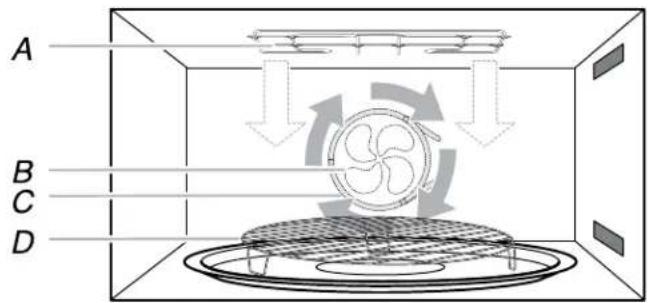
A. Broil element
B. Convection fan
C. Convection element
D. Grilling grid or convection grid
Convection cooking uses the convection element, the broil element and the fan. Hot air is circulated throughout the oven cavity by the fan. The constantly moving air surrounds the food 1 heat the outer portion quickly.
■ The convect function may be used to cook small amounts of food on a single grid.
■ Always use the grilling grid or convection grid placed on turntable.
■ To avoid damage to the microwave oven, do not cover turntable, grilling grid or convection grid, or baking tray with aluminum foil.
■ Do not use light plastic containers, plastic wrap, or paper products. All heatproof cookware or metal utensils can be in convection cooking. Round pizza pans are excellent for convection cooking.
■ When the broil element is in use, the cooling fan turns on stays on for up to 10 minutes after the cycle is over.
■ Use convection cooking for items such as soufflés, breads, cookies, angel food cakes, pizza, and most meats and fish
Auto Convection Conversion is a function that converts a start thermal bake cook time and temperature into an ideal cook time and temperature for convection cooking.
Convection temperatures and times differ from those of standard cooking. The oven will automatically reduce standard recipe temperatures and times for convection cooking.
The conversion may not be exact because foods are grouped general categories.
Use the following chart as a guide.
Convection Chart
SETTING FOODS
Bake Casseroles and baked goods
Roast Meats and vegetables
To Use Recipe Conversion:
- If preheat is not required, place food in oven or on convection grid on the turntable, and close the door.
- Touch POWER or MICROWAVE (on combination oven models).
-
From the Cooking mode menu, select the Convert Recipe (for convection).
-
Select between Roast or Bake to convert a traditional recipe to a convection method of cooking. Touch NEXT.
-
Enter the standard cooking temperature between 170°F and 450°F (77°C and 232°C).
-
Touch NEXT.
-
Select the original recipe Bake/Roast time and touch SET. or
-
Touch SKIP TIMER to move to the next step.
-
Touch START. If preheat is required, place food in oven or on convection grid on turntable after preheat tone sounds. The display will count down the cook time. When the stop time is reached, the oven will display "Cooking Ended" and transition to hold temperature, which maintains the oven temperature. If enabled, end-of-cycles tones will sound.
-
(Optional) After the cooking cycle ends, touch the ADD 30 SEC button. This will automatically add 30 seconds to the cook time.
-
Touch MICROWAVE CANCEL to turn off the microwave
Defrost
The Defrost feature can be used, or the microwave oven can manually set to defrost by using 20% cook power.
■ For optimal results, food should be 0° F (-18°C) or colder defrosting.
■ Unwrap foods and remove lids (from fruit juice) before defrosting.
■ Shallow packages will defrost more quickly than deep blocks.
- Separate food pieces as soon as possible during or at the of the cycle for more even defrosting.
■ Foods left outside the freezer for more than 20 minutes or frozen ready-made food should not be defro using the Custom Defrost feature, but should be defrosted manually.
■ Use small pieces of aluminum foil to shield parts of food such uses chicken wings, leg tips, and fish tails. See “Aluminum Foil and Metal” first.
■ Times and cooking powers have been preprogrammed for an adefrosting a number of food types. For each food category, a precise amount of food can be entered or preprogrammed quantities can be selected.
SpeedCook Foods
time SpeedCook function uses the broil element, convection element and fan, and microwaves. All cycle on and off in interval
and Bakeware and the interior oven surfaces, including the door, will become hot.
■ Always use an instant read thermometer to determine indoneness of meat and poultry.
■ Use microwave-safe and ovenproof bakeware.
■ Do not use covers or containers made of foil, paper, waxed paper, or plastic not recommended for use in a conventional oven.
■ When roasting, meats and poultry may spatter. Plastic oven bags designed for conventional oven use can be used for easier cleanup. Follow manufacturer's recommendations.
■ When using the grilling grid or convection grid, place it directly on the turntable.
■ Arrange pieces of food in a single layer on the crisper pan or baking dish.
Before SpeedCooking, put food in the oven and close the door. Preheating is not necessary.
To Use SpeedCook Foods:
NOTE: For combination units, touch the MICROWAVE to access the microwave menu.
- From the Mode menu, select SPEEDCOOK FOODS.
- Scroll to the desired food category and touch NEXT.
-
Scroll to the desired food and touch NEXT. NOTE: Some cooking selections may ask for additional information, such as food weight or pan size. If this occurs, make the proper selection and touch NEXT.
-
Read and follow the on-screen cooking instructions.
-
Touch START to begin cooking cycle. or Touch DONENESS and scroll to select between More Done, Suggested, or Less Done and touch SET to return to the previous screen, and then touch START to begin the cooking cycle.
-
Touch MICROWAVE CANCEL to turn off the oven.
SETTING QUANTITY
| Meats | |||||
| oven. | |||||
| Bone-in | pork | chops | 0.4-1.5 | lb (0.2-0.7 kg) | |
| Boneless | beef | roast | 1.5-5.0 | lb (0.7-2.3 kg) | |
| n be | |||||
| Boneless | ham | 1.0-4.5 lb (0.5-2.0 kg) | |||
| when | |||||
| Boneless | pork | chops | 0.3-1.6 lb (0.1-0.7 kg) | ||
| Boneless | pork | roast | 1.0-5.0 | lb (0.5-2.3 kg) | |
| ks Meatloaf | 1.5-2.0 lb (0.7-0.9 kg) | ||||
| e and Meatballs | 20 pieces | ||||
| Swiss | steak | 1.0-2.0 lb (0.5-0.9 kg) | |||
| osted | |||||
| SETTING QUANTITY | |||||
| Poultry | |||||
| Frozen Chicken Tenders 5-20 pieces | |||||
| Chicken breast 0.2-2.0 lb (0.1-0.9 kg) | |||||
| Chicken nuggets 6-24 pieces | |||||
| Chicken pieces - with skin 0.5-2.0 lb (0.2-0.9 kg) | |||||
| Frozen fried chicken 4-8 pieces | |||||
| Turkey breast 3.0 lb (1.4 kg) | |||||
| Whole chicken 3.0-5.5 lb (1.4-2.5 kg) | |||||
| Bone-in chicken pieces 0.5-2.0 lb (0.2-0.9 kg) | |||||
| Frozen chicken wings 0.5-1.5 lb (0.2-0.7 kg) | |||||
| Fish | |||||
| Fish fillets 0.4-1.2 lb (0.2-0.5 kg) | |||||
| Frozen fish sticks 4-16 pieces | |||||
| Frozen fish, battered 2-8 pieces | |||||
| Breads | |||||
| Refrigerated biscuits - large, 8 pieces1 pan | |||||
| Refrigerated biscuits - small, 10 pieces1 pan | |||||
| Cinnamon rolls - large, 1 pan 5 pieces | |||||
| Cinnamon rolls - small, 1 pan 8 pieces | |||||
| Crescent rolls - 1 pan 8 pieces | |||||
| Frozen bread sticks - 1 pan 6 pieces | |||||
| Garlic/cheese bread - 1 loaf 8 oz (226.8 g) | |||||
| Vegetables | |||||
| Baked potatoes 1-8 potatoes | |||||
| French fries 3-12 oz (85.0-340.2 g) | |||||
| Frozen onion rings 4-16 oz (113.4-453.6 g) | |||||
| Frozen potato nuggets 3-12 oz (85.0-340.2 g) | |||||
| Frozen potato skins 1-4 servings | |||||
| Frozen potato wedges 1-4 servings | |||||
| Roasted vegetables 2-8 cups (500-2,000 mL) | |||||
| Sweet potatoes 1-6 potatoes | |||||
| Desserts | |||||
| Brownies -(8" x 8" [20.3 x 20.3 cm] or9" x 13" [22.9 x 33 cm] pān) | |||||
| Cake, bundt cake - | |||||
| Cookie dough - 1 pan 8 cookies | |||||
| SETTING QUANTITY | |
| Casserole | |
| Freshly made casserole - _ (8" x 8" [20.3 x 20.3 cm] or 9" x 13" [22.9 x 33 cm] pan) | |
| Freshly made lasagna - _ (8" x 8" [20.3 x 20.3 cm] pan) | |
| Frozen lasagna | 10.0-60.0 oz (284 g-1.7 g) |
| Convenience Food | |
| Bagel bites | 9 pieces |
| Cheese sticks | 4-16 pieces |
| Frozen egg rolls | 1-8 pieces |
| Frozen french toast | 1-4 pieces |
| Frozen sausage links | 2-10 pieces |
| Frozen sausage patties | 2-8 pieces |
| Frozen waffles 1-4 pieces | |
| Hot dogs | 2-10 pieces |
| Jalapeno poppers | 5-20 pieces |
| Nachos - 1 pan | - |
| Pizza - reheat | 1-4 slices |
Cook
To Use Manual Cook:
NOTE: For combination units, touch the MICROWAVE to access the microwave menu.
- From the Mode menu, select Cook (Default Mode). NOTE: The default power setting is 100%.
- Scroll to enter a Cook Time (—:-). The maximum length is 89:59.
-
(Optional) To adjust the power level, touch "Power 100%", scroll to select the desired power level, and then touch SET. The range is between 10% and 100%.
-
Touch START. When the stop time is reached, the oven will shut off automatically. NOTE: The microwave-cooling fan may continue to run for several minutes after the cooking cycle has been completed. The microwave cooking does not continue beyond the end of cooking cycle.
-
(Optional) After the cooking cycle ends, touch the ADD 30 SEC button. This will automatically add 30 seconds to the cook time.
-
Touch Microwave Cancel to turn off the oven.
Popcorn
Pop only 1 package at a time.
Listen for popping to slow to 1 pop every 1 or 2 seconds, and stop the cycle.
To Use Popcorn Mode:
- From the Mode menu, select Popcorn.
-
(Optional) To adjust the doneness, touch DONENESS, read the onscreen information, and then touch DONENESS. Select More Done, Suggested, or Less Done, and then touch SET.
-
Touch START.
-
Touch Microwave Cancel to turn off the oven.
When the stop time is reached, the oven will shut off automatically.
NOTE: The microwave-cooling fan may continue to run for minutes after the cooking cycle has been completed. The microwave cooking does not continue beyond the end of cycle.
Beverage
Use a microwave safe container.
Do not cover.
To Use Beverage Mode:
NOTE: For combination units, touch the MICROWAVE to the microwave menu.
- From the Mode menu, select BEVERAGE.
- Select quantity.
- (Optional) To adjust the doneness, touch DONENESS, read the on-screen information, and then touch DONENESS. Select More Done, Suggested, or Less Done, and then touch SET.
- Touch START.
- Touch Microwave Cancel to turn off the oven.
When the stop time is reached, the oven will shut off automatically.
NOTE: The microwave-cooling fan may continue to run for several minutes after the cooking cycle has been completed. The microwave cooking does not continue beyond the end of cooking cycle.
Steam
Steam is a sensor cooking function that uses microwaves to steam food. Use Steam for foods such as vegetables, fish, potatoes.
■ Times and cooking powers have been preprogrammed for steaming a number of food types.
■ Use a microwave-safe steamer.
Use the following chart as a guide.
Steam Cooking Chart
| FOOD QUANTITY | |
| Manual* | - |
| Asparagus 8–16 oz | |
| Broccoli 2–6 cups | |
| Carrots 2–6 cups | |
| Cauliflower 2–6 cups | |
| Corn on the Cob 2–4 ears | |
| Fish Fillets 0.5–1.5 lbs | |
| Frzn. Vegetables 2–6 cups | |
| Green Beans 2–6 cups | |
| Potatoes | 2–6 cups |
| Shrimp | 5–8 oz |
| Spinach | 4–8 cups |
| Summer Squash 2–6 cups | |
*Manual Steam requires that a cook time be entered.
(Optional) Modify the food doneness by touching the Doneness pad. Select More Done, Suggested, or Less Done, then touch SET, review the cook settings, and then touch START.
Melt
The Melt function may be used to melt your food. Times and cooking powers have been preprogrammed for a number of food types. Use the following chart as a guide.
Melt Chart
| FOOD QUANTITY | |
| Manual* | - |
| Butter | 1/2 Stick |
| 1 Stick | |
| 11/2 Sticks | |
| 2 Sticks | |
| Cheese 8 oz | |
| 16 oz | |
| Chocolate | 1–12 oz |
| Margarine | 1/2 Stick |
| everal | 1 Stick |
| king | 11/2 Sticks |
| 2 Sticks | |
| Marshmallows | 5 oz |
| 10 oz | |
*Manual Melt requires that a cook time be entered.
(Optional) Modify the food doneness by touching the Doneness pad. Select More Done, Suggested, or Less Done, then touch SET, review the cook settings, and then touch START.
Reheat
Times and cooking powers have been preprogrammed for reheating a number of food types.
Use the following chart as a guide.
Custom Reheat Chart
| FOOD QUANTITY | |
| Manual* | Default power level 100%. |
| Casserole | 1-4 cups (250 mL-1 L) |
| Place in microwave-safe container. Cover with plastic wrap and vent. Stir and let stand 2-3 minutes after reheating. | |
| Dinner Plate | 8-16 oz (227-454 g) |
| Place food on plate. Cover with plastic wrap and vent. Let stand 2-3 minutes after reheating. | |
| Pizza Slices | 1-3 slices (3 oz [85 g] each) |
| lace on a paper towel. | |
FOOD QUANTITY
| Sauce | 1-4 cups (250 mL-1 L) |
| Place in microwave-safe container. Cover with plastic wrap and vent. Stir and let stand 2-3 minutes after reheating. | |
| Soup | 1-4 cups (250 mL-1 L) |
| Place in microwave-safe container. Cover with plastic wrap and vent. Stir and let stand 2-3 minutes after reheating. | |
*Manual Reheat requires that a cook time be entered.
To Use Programmed Reheat:
For Combination Ovens, begin by touching the MICROWAVE button.
- Scroll to REHEAT in the cooking mode menu.
- Scroll to the desired food category and touch NEXT. If you choose DINNER PLATE, skip to step 4.
- Scroll to select one of the preset quantities, and then touch NEXT.
-
Touch START. or Touch DONENESS and scroll to select between More Done, Suggested, or Less Done and touch SET to return to the previous screen, and then touch START to begin the cooking cycle.
-
Touch MICROWAVE CANCEL to turn off the oven.
To Use Manual Reheat:
For Combination Ovens, begin by touching the MICROWAVE button.
- Scroll to REHEAT in the cooking mode menu.
- Scroll to MANUAL food category and then touch NEXT.
- Scroll the MIN and SEC tumbler to set the desired amount of cook time. NOTE: The default power setting is 100%.
-
(Optional) The default Turntable is ON. To change the Turntable setting, touch TURNTABLE IS ON. The button will display TURNTABLE IS OFF. Repeat the process to turn the turntable back on. NOTE: Once the cooking cycle has completed, the turntable will return to the default of ON.
-
(Optional) To adjust the power level, touch Power 100%, then scroll to the desired power level and touch SET. The range is between 10-100%.
-
Touch START to begin cooking cycle.
-
Touch MICROWAVE CANCEL to turn off the oven.
Soften
The Soften function may be used to soften your food. Time cooking powers have been preprogrammed for a number of types.
Use the following chart as a guide.
Soften Chart
| FOOD QUANTITY | |
| Manual* | - |
| Butter 1/2 Stick | |
| 1 Stick | |
| 11/2 Sticks | |
| FOOD QUANTITY | |
| 2 Sticks | |
| Cream Cheese 3 oz | |
| 8 oz | |
| Ice Cream 16 oz | |
| 32 oz | |
| 64 oz | |
| Margarine 1/2 Stick | |
| 1 Stick | |
| 11/2 Sticks | |
| 2 Sticks | |
*Manual Soften requires that a cook time be entered. (Optional) Modify the food doneness by touching the Doneness pad. Select More Done, Suggested, or Less Done, then touch SET, review the cook settings, and then touch START.
Boil & Simmer
Boil & Simmer is a sensor function, and uses only microwaves to simmer your food.
■ Follow recommended water and food amounts that appear on the display.
■ For best cooking results, do not use plastic wrap as a cover during the Boil & Simmer cycle.
■ Do not remove the lid while the dish is still in the oven, as rush of steam will disrupt the sensor readings.
■ Use a microwave-safe dish with a loose-fitting lid.
Use the following chart as a guide.
Boil & Simmer Chart
| FOOD QUANTITY | |
| Dry fettuccine, dry spaghetti 2-8 oz(57-227 g) | |
| Dry macaroni,dry penne, dry rotini 1/2-2 cups(118-473 mL) | |
| Linguine, ravioli, tortellini 9 or 18 oz(255 or 510 g) | |
| Long or short grain white rice 1/2-2 cups(118-473 mL) |
■ Use the Manual Simmer function for foods such as soups, casseroles, stews, and other liquid food.
■aManual Boil & Simmer requires that a cook time be entered.
To Use Programmed Boil & Simmer:
To begin the function on combination ovens, touch MICROWAVE.
1. Scroll to Boil & Simmer in the cooking mode menu.
2. Scroll to select the desired food type and touch NEXT.
3. Scroll to select one of the preset quantities and thentouch NEXT.
4. (Optional) To adjust the doneness, touch DONENESS, read the on-screen information, and then touch DONENESS. Select More Done, Suggested, or Less Done, and then touch SET.
- Touch START.
NOTE: When cooking pasta, the oven will pause for adding pasta to the water. Then the oven will restart. If enabled, end-of-cycle tones will sound.
-
(Optional) After the cooking cycle ends, touch the ADD 30 SEC button. This will automatically add 30 seconds to the cook time.
-
Touch Microwave Cancel to turn off the oven.
To Use Manual Boil & Simmer:
To begin the function on combination ovens, touch MICROWAVE
- Scroll to Boil & Simmer in the cooking mode menu.
- Scroll to Manual and touch NEXT.
- Enter a Cook Time (—:—). The maximum length is 89:59. NOTE: In the Boil & Simmer mode, the microwave controls power. After water is brought to a boil, the food will simmer for the length of the Cook Time.
- Touch START. Once the boiling point is reached, the display will count down the cook time. If enabled, end-of-cycle tones will sound.
- (Optional) After the cooking cycle ends, touch the ADD 30 SEC button. This will automatically add 3 seconds to the cook time.
- Touch Microwave Cancel to turn off the oven.
Manual Simmer Chart
FOOD INSTRUCTIONS
| Pasta* Add 1 tablespoon (15 mL) oil to water. Place the dish containing water in oven. Enter 1 second of simmer time. The water will heat t a boil and then the oven will turn off. Place the pasta in the water and cover the dish. Repeat steps 1–4 under “To Use Manual Simmer,” then enter the actual simmer time desired. |
| Rice and Vegetables | Place water and food in dish. Place dish in oven. Set simmer time. |
| Soup and liquid foods | Place food in dish and place dish oven. Set simmer time. |
*Use a dish large enough to completely cover food with water.
(Optional) Modify the food doneness by touching the Doneness pad. Select More Done, Suggested, or Less Done, then touch SET, review the cook settings, and then touch START.
Keep Warm
WARNING
Food Poisoning Hazard
Do not let food sit for more than one hour before cooking.
Doing so can result in food poisoning or sickness.
or
Hot cooked food can be kept warm in the microwave oven.
Keep Warm™ setting can be used by itself or can be preprogrammed to follow a cooking cycle.
■ Cover plates of food.
■ Cover foods that were covered while being cooked.
■ For best results, do not cover baked goods such as pastries, pies, turnovers, etc.
To Use Keep Warm:
- Touch POWER or MICROWAVE (on combination oven models).
- From the Cooking mode menu, touch KEEP WARM. NOTE: The default power level is 10%.
- Select a Keep Warm time (—:—:—). The maximum length is 01:29:59.
- Touch START. The oven display will count down the cook time.
AVE. When the stop time is reached, the microwave oven will shut off automatically.
If enabled, end-of-cycle tones will sound.
- Touch MICROWAVE CANCEL to turn off the oven.
NOTE: The microwave-cooling fan may continue to run for several minutes after the cooking cycle has been completed. The microwave cooking does not continue beyond the end of cooking cycle.
Browning Pan
The Browning Pan feature uses the crisper pan, the broil element and microwaves to crisp and brown foods. While microwaves heat food from above, they also heat the pan from below to brown a crisp the food.
Browning Pan can be used to saute meats and vegetables, pan fry bacon and eggs, and to crisp and brown pizza and french fr Some Browning Pan cycles are programmed to preheat the empty pan for 3 minutes before cooking begins. When the preheating cycle is complete, the microwave oven will stop and prompt you add the food to the crisper pan. The microwave oven may promy you to turn over the food during the cycle.
■ Always use the crisper pan.
■ See the "Coated Crisper Pan and Handle" section before using.
■ Microwave oven cavity and door will become very hot during broil element use. The use of oven mitts is recommended.
■ The crisper pan will become very hot. Use the handle to gras and remove the pan from the oven. Do not place hot crisper pan directly on heat-sensitive surfaces. Damage may occur.
■ To avoid damage to plastic utensils, do not use them with the in crisper pan as it becomes very hot and could melt the utensil
■ Do not use metal utensils, as they can scratch the pan.
■ For best cooking results, do not use the pan in any other microwave oven or in a thermal oven.
■ For best cooking results, do not place the crisper pan on the grilling grid or convection grid. Always use the turntable as a support for the pan.
■ For best results, coat pan lightly with cooking oil to make removing food and cleaning easier.
Use the following chart as a guide when using the browning function.
Preprogrammed Browning Pan
Times and cooking powers have been preprogrammed for browning several food types.
Browning Pan Cooking Chart
FOOD QUANTITY
| Manual* | |
| Bacon 2–4 slices | |
| Poultry breast, boneless | 1–3 pieces |
| French fries | 1–3 servings |
FOOD QUANTITY
Hamburger patties 1–4 patties
Pizza roll 1–4 servings
Potato nuggets 1–4 servings
Pizza, frozen, rising crust 6 to 12" (15–30.5 cm)
Pizza, frozen, thin crust 6 to 12" (15–30.5 cm)
*Manual Browning requires that a cook time be entered.
To Use Programmed Browning Pan:
- Touch POWER or MICROWAVE (on combination oven models).
- From the Cooking mode menu, touch BROWNING PAN.
- Select the food type, and then touch NEXT.
- Use the tumbler to select one of the preset quantities, and then touch NEXT to start cooking to the recommended doneness. or
- Modify the food doneness by touching a Doneness pad. Choose Select More Done, Suggested, or Less Done, and then touch SET.
- Touch START. When the stop time is reached, the microwave oven will shut off automatically.
NOTE: The microwave-cooling fan may continue to run for several minutes after the cooking cycle has been completed. The microwave cooking does not continue beyond the end of cooking cycle.
If enabled, end-of-cycle tones will sound.
- (Optional) After the cooking cycle ends, select Keep Warm from the Cooking mode menu, and then touch START. This will start a new cooking cycle that will keep food warm. The microwave will run at 10% power for a default of 60 minutes, but can be set for up to 01:29:59. See the "Keep Warm" section for additional information.
- (Optional) After the cooking cycle ends, touch ADD 30 SEC. This will automatically add 30 seconds to the cook time.
- Touch MICROWAVE CANCEL to turn off the oven.
To Use Manual Browning Pan:
- Touch POWER or MICROWAVE (on combination oven models).
- From the Cooking mode menu, touch BROWNING PAN.
- Touch NEXT.
- To enter a cook time, use the tumbler to select a cook time (00:00:00), and then touch START. The maximum length is 01:29:59.
NOTE: In the Browning Pan mode, the microwave controls power. High Power is needed to heat the pan.
- Touch START. The display will count down the cook time. When the stop time is reached, the oven will shut off automatically.
NOTE: The microwave-cooling fan may continue to run for several minutes after the cooking cycle has been completed. The microwave cooking does not continue beyond the end of cooking cycle.
If enabled, end-of-cycle tones will sound. - (Optional) After the cooking cycle ends, select Keep Warm from the Cooking mode menu, and then touch START. This will start a new cooking cycle that will keep food warm. The microwave will run at 10% power for a default of 60 minutes, but can be set for up to 01:29:59. See the "Keep Warm" section for additional information.
- (Optional) After the cooking cycle ends, touch ADD 30 SEC. This will automatically add 30 seconds to the cook time.
- Touch MICROWAVE CANCEL to turn off the oven.
Activation/désactivation :
B. Support coulissant
B. Support coulissant
A. Support coulissant
B. Guide de grille
ALIMENT INSTRUCTIONS
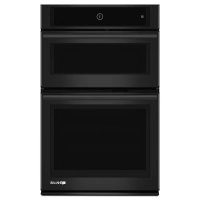
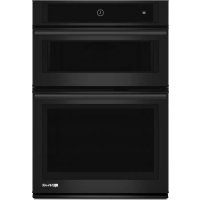
- MICROWAVE/OVEN COMBINATION CONTROL GUIDE
- PARTS AND FEATURES
- TURNTABLE
- TO TURN ON/OFF
- CONVECTION GRID
- COATED CRISPER PAN AND HANDLE
- MICROWAVE OVEN CONTROL
- COMBINATION OVEN MODELS
- TOUCH PANEL
- WELCOME GUIDE
- DISPLAY
- DISPLAY SCREEN
- DISPLAY NAVIGATION
- MENU DEMONSTRATION
- KITCHEN TIMER
- TONES/SOUNDS
- TOOLS
- BUTTON LOCK
- TO ACTIVATE THE BUTTON LOCK
- TO DEACTIVATE THE BUTTON LOCK
- OVEN TEMPERATURE CONTROL
- SABBATH MODE
- TO ACTIVATE
- TO DEACTIVATE
- CHANGE TEMPERATURE
- MAIN MENU
- TOOLS MENU
- TO ACCESS TOOLS MENU
- SERVICE INFORMATION
- WI-FI CONNECTIVITY (ON SOME MODELS)
- OVEN USE
- ALUMINUM FOIL
- POSITION RACKS AND BAKEWARE
- BAKING CAKES ON 2 RACKS
- BAKING COOKIES ON 2 RACKS
- BAKEWARE
- ROLL-OUT EXTENSION RACK
- OPEN POSITION
- CLOSED AND ENGAGED POSITION
- TO BEST REMOVE ROLL-OUT EXTENSION RACK
- TO REPLACE ROLL-OUT EXTENSION RACK
- OVEN VENTS
- PREHEATING AND OVEN TEMPERATURE
- PREHEATING
- OVEN TEMPERATURE
- BAKING AND ROASTING
- BROILING
- CONVECTION
- CONVECT BAKE
- TO USE CONVECT BAKE
- CONVECT ROAST
- TO USE CONVECT ROAST
- CONVECTION BROIL
- TO CONVECTION BROIL
- BROIL & GRILL
- FOOD QUANTITY
- MANUAL
- TO USE PROGRAMMED BROIL & GRILL
- TO USE MANUAL BROIL & GRILL
- PROOFING BREAD
- TO DRILL PROOF
- TEMPERATURE PROBE
- TO USE
- TOUCH START
- TIMED COOKING
- WARNING
- FOOD POISONING HAZARD
- TO SET AN OVEN TIME
- TO SET A DELAY START TIME AND STOP TIME
- TOUCH SET
- COMBO MICROWAVE USE
- FOOD CHARACTERISTICS
- AMOUNT OF FOOD
- SIZE AND SHAPE
- STARTING TEMPERATURE
- COMPOSITION AND DENSITY
- COOKING GUIDELINES
- COVERING
- STIRRING AND TURNING
- ARRANGING
- PIERCING
- SHIELDING
- STANDING TIME
- TURNTABLE ON/OFF
- COOKWARE AND DINNERWARE
- TO TEST COOKWARE OR DINNERWARE FOR MICROWAVE USE
- B ALUMINUM FOIL AND METAL
- OK FOR USE
- DO NOT USE
- MICROWAVE COOKING POWER
- COOK SENSOR
- FOR BEST COOKING PERFORMANCE
- MY CREATIONS
- TO USE SAVED
- TO DELETE
- TOUCH DELETE
- TO EDIT
- COOKING FUNCTIONS
- AUTO CONVECTION CONVERSION
- CONVECTION CHART
- SETTING FOODS
- TO USE RECIPE CONVERSION
- DEFROST
- SPEEDCOOK FOODS
- TO USE SPEEDCOOK FOODS
- COOK
- TO USE MANUAL COOK
- POPCORN
- TO USE POPCORN MODE
- BEVERAGE
- TO USE BEVERAGE MODE
- STEAM
- MELT
- REHEAT
- TO USE PROGRAMMED REHEAT
- TO USE MANUAL REHEAT
- SOFTEN
- BOIL & SIMMER
- TO USE PROGRAMMED BOIL & SIMMER
- TO USE MANUAL BOIL & SIMMER
- MANUAL SIMMER CHART
- KEEP WARM
- TO USE KEEP WARM
- BROWNING PAN
- PREPROGRAMMED BROWNING PAN
- BROWNING PAN COOKING CHART
- TO USE PROGRAMMED BROWNING PAN
- TO USE MANUAL BROWNING PAN
- ACTIVATION/DÉSACTIVATION
Brand : JENN-AIR
Model : JMW2427LL
Category : Oven