ManualGo.com
DWE357 - Saw DEWALT - Free user manual and instructions
Find the device manual for free DWE357 DEWALT in PDF.

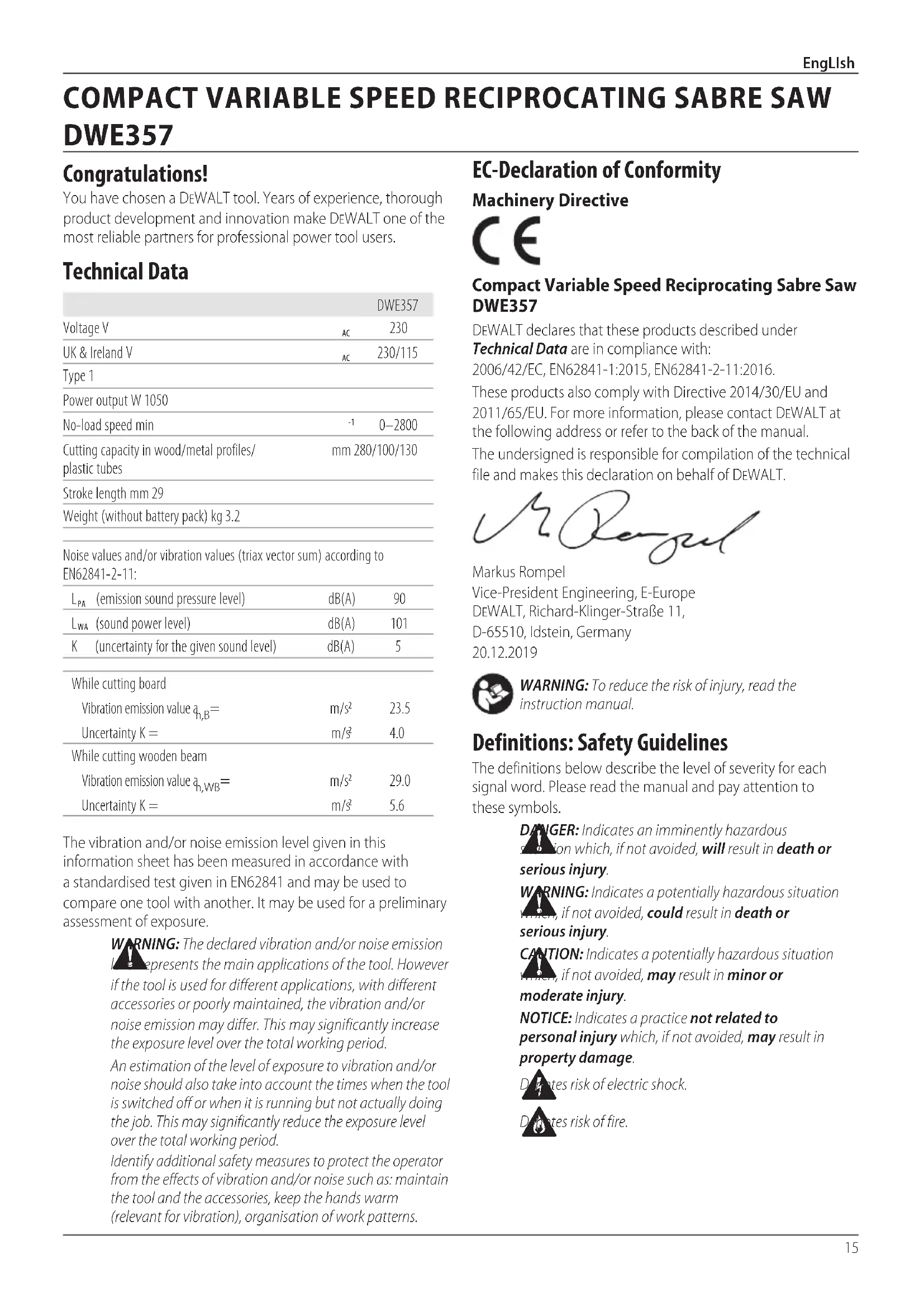


Download the instructions for your Saw in PDF format for free! Find your manual DWE357 - DEWALT and take your electronic device back in hand. On this page are published all the documents necessary for the use of your device. DWE357 by DEWALT.
USER MANUAL DWE357 DEWALT
29,0 Usikkerhed K = m/s
WARNING: To reduce the risk of injury, read the
instructionmanual. Definitions: Safety Guidelines The definitions below describe the level of severity for each signal word. Please read the manual and pay attention to thesesymbols.
DANGER: Indicates an imminently hazardous
situation which, if not avoided, will result in death or seriousinjury.
WARNING: Indicates a potentially hazardous situation
which, if not avoided, could result in death or seriousinjury.
CAUTION: Indicates a potentially hazardous situation which, if not avoided, may result in minor or moderateinjury. NOTICE: Indicates a practice not related to personal injury which, if not avoided, may result in propertydamage.
Denotes risk of electricshock.
Denotes risk offire. The vibration and/or noise emission level given in this information sheet has been measured in accordance with a standardised test given in EN62841 and may be used to compare one tool with another. It may be used for a preliminary assessment ofexposure.
WARNING: The declared vibration and/or noise emission
level represents the main applications of the tool. However if the tool is used for different applications, with different accessories or poorly maintained, the vibration and/or noise emission may differ. This may significantly increase the exposure level over the total workingperiod. An estimation of the level of exposure to vibration and/or noise should also take into account the times when the tool is switched off or when it is running but not actually doing the job. This may significantly reduce the exposure level over the total workingperiod. Identify additional safety measures to protect the operator from the effects of vibration and/or noise such as: maintain the tool and the accessories, keep the hands warm (relevant for vibration), organisation of workpatterns. English (original instructions) Congratulations! You have chosen a DeWALT tool. Years of experience, thorough product development and innovation make DeWALT one of the most reliable partners for professional power toolusers. Technical Data
COMPACT VARIABLE SPEED RECIPROCATING SABRE SAW
DWE357 EC-Declaration of Conformity Machinery Directive Compact Variable Speed Reciprocating Sabre Saw DWE357 DeWALT declares that these products described under Technical Data are in compliance with: 2006/42/EC, EN62841-1:2015, EN62841-2-11:2016. These products also comply with Directive 2014/30/EU and 2011/65/EU. For more information, please contact DeWALT at the following address or refer to the back of themanual. The undersigned is responsible for compilation of the technical file and makes this declaration on behalf ofDeWALT. Markus Rompel Vice-President Engineering, E-Europe DeWALT, Richard-Klinger-Straße 11, D-65510, Idstein, Germany
0–2800 Cutting capacity in wood/metal profiles/ plastic tubes mm 280/100/130 Stroke length mm 29 Weight (without battery pack) kg 3.2 Noise values and/or vibration values (triax vector sum) according to EN62841-2-11:
(emission sound pressure level) dB(A) 90
(sound power level) dB(A) 101 K (uncertainty for the given sound level) dB(A) 5 While cutting board Vibration emission value a h,B = m/s
While cutting wooden beam Vibration emission value a h,W
EngLIsh c ) Prevent unintentional starting. Ensure the switch is in the off-position before connecting to power source and/or battery pack, picking up or carrying the tool. Carrying power tools with your finger on the switch or energising power tools that have the switch on invitesaccidents. d ) Remove any adjusting key or wrench before turning the power tool on. A wrench or a key left attached to a rotating part of the power tool may result in personalinjury. e ) Do not overreach. Keep proper footing and balance at all times. This enables better control of the power tool in unexpectedsituations. f ) Dress properly. Do not wear loose clothing or jewellery. Keep your hair and clothing away from moving parts. Loose clothes, jewellery or long hair can be caught in movingparts. g ) If devices are provided for the connection of dust extraction and collection facilities, ensure these are connected and properly used. Use of dust collection can reduce dust-relatedhazards. h ) Do not let familiarity gained from frequent use of tools allow you to become complacent and ignore tool safety principles. A careless action can cause severe injury within a fraction of asecond.
4) Power Tool Use and Care
a ) Do not force the power tool. Use the correct power tool for your application. The correct power tool will do the job better and safer at the rate for which it wasdesigned. b ) Do not use the power tool if the switch does not turn it on and off. Any power tool that cannot be controlled with the switch is dangerous and must berepaired. c ) Disconnect the plug from the power source and/ or remove the battery pack, if detachable, from the power tool before making any adjustments, changing accessories, or storing power tools. Such preventive safety measures reduce the risk of starting the power toolaccidentally. d ) Store idle power tools out of the reach of children and do not allow persons unfamiliar with the power tool or these instructions to operate the power tool. Power tools are dangerous in the hands of untrainedusers. e ) Maintain power tools and accessories. Check for misalignment or binding of moving parts, breakage of parts and any other condition that may affect the power tool’s operation. If damaged, have the power tool repaired before use. Many accidents are caused by poorly maintained powertools. f ) Keep cutting tools sharp and clean. Properly maintained cutting tools with sharp cutting edges are less likely to bind and are easier tocontrol. g ) Use the power tool, accessories and tool bits etc. in accordance with these instructions, taking into account the working conditions and the work to be performed. Use of the power tool for operations different from those intended could result in a hazardoussituation.
WARNING: Read all safety warnings, instructions,
illustrations and specifications provided with this power tool. Failure to follow all instructions listed below may result in electric shock, fire and/or seriousinjury.
SAVE ALL WARNINGS AND INSTRUCTIONS
FOR FUTUREREFERENCE The term “power tool” in the warnings refers to your mains- operated (corded) power tool or battery-operated (cordless) powertool.
a ) Keep work area clean and well lit. Cluttered or dark areas inviteaccidents. b ) Do not operate power tools in explosive atmospheres, such as in the presence of flammable liquids, gases or dust. Power tools create sparks which may ignite the dust orfumes. c ) Keep children and bystanders away while operating a power tool. Distractions can cause you to losecontrol.
2) Electrical Safety
a ) Power tool plugs must match the outlet. Never modify the plug in any way. Do not use any adapter plugs with earthed (grounded) power tools. Unmodified plugs and matching outlets will reduce risk of electricshock. b ) Avoid body contact with earthed or grounded surfaces, such as pipes, radiators, ranges and refrigerators. There is an increased risk of electric shock if your body is earthed orgrounded. c ) Do not expose power tools to rain or wet conditions. Water entering a power tool will increase the risk of electricshock. d ) Do not abuse the cord. Never use the cord for carrying, pulling or unplugging the power tool. Keep cord away from heat, oil, sharp edges or moving parts. Damaged or entangled cords increase the risk of electricshock. e ) When operating a power tool outdoors, use an extension cord suitable for outdoor use. Use of a cord suitable for outdoor use reduces the risk of electricshock. f ) If operating a power tool in a damp location is unavoidable, use a residual current device (RCD) protected supply. Use of an RCD reduces the risk of electricshock.
a ) Stay alert, watch what you are doing and use common sense when operating a power tool. Do not use a power tool while you are tired or under the influence of drugs, alcohol or medication. A moment of inattention while operating power tools may result in serious personalinjury. b ) Use personal protective equipment. Always wear eye protection. Protective equipment such as a dust mask, non-skid safety shoes, hard hat or hearing protection used for appropriate conditions will reduce personalinjuries. Batteries Chargers/Charge Times (Minutes) Cat #
Weight *Date code 201811475B or later **Date code 201536 or later17 EngLIsh Package Contents The package contains: 1 Reciprocating Sabre Saw 1 Kitbox 1 Instruction manual Electrical Safety The electric motor has been designed for one voltage only. Always check that the power supply corresponds to the voltage on the ratingplate. Your DeWALT tool is double insulated in accordance with EN62841; therefore no earth wire isrequired. If the supply cord is damaged, it must be replaced only by DeWALT or an authorised serviceorganisation. Mains Plug Replacement (U.K. & Ireland Only) If a new mains plug needs to be fitted:
- Safely dispose of the oldplug.
- Connect the brown lead to the live terminal in theplug.
- Connect the blue lead to the neutralterminal.
WARNING: No connection is to be made to the
earthterminal. Follow the fitting instructions supplied with good quality plugs. Recommended fuse: 13A. Using an Extension Cable If an extension cable is required, use an approved 3–core extension cable suitable for the power input of this tool (see Technical Data).The minimum conductor size is 1.5 mm
; the maximum length is 30m. When using a cable reel, always unwind the cablecompletely.
WARNING: We recommend the use of a residual current
device with a residual current rating of 30mA orless. Residual Risks In spite of the application of the relevant safety regulations and the implementation of safety devices, certain residual risks cannot be avoided. These are:
- Impairment ofhearing.
- Risk of personal injury due to flyingparticles.
- Risk of burns due to accessories becoming hot duringoperation.
- Risk of personal injury due to prolongeduse.
SAVE THESE INSTRUCTIONS
Checking and Changing the Saw Blade
- Only use saw blades conforming to the specifications contained in these operatinginstructions.
- Only sharp saw blades in perfect working condition should be used; cracked or bent saw blades should be discarded and replaced atonce.
- Ensure that the saw blade is securelyfixed. Additional Safety Instructions for Reciprocating Sabre Saws
- ALWAYS wear a dust mask. Exposure to dust particles can cause breathing difficulty and possibleinjury.
- Never switch on the tool when the saw blade is jammed in the workpiece or in contact with thematerial.
- Keep hands away from moving parts. Never place your hands near the cuttingarea.
- Use extra caution when cutting overhead and pay particular attention to overhead wires which may be hidden from view. Anticipate the path of falling branches and debris ahead oftime.
- Do not operate this tool for long periods of time. Vibration caused by the operating action of this tool may cause permanent injury to fingers, hands, and arms. Use gloves to provide extra cushion, take frequent rest periods, and limit daily time ofuse. Switching On and Off
- After switching off, never attempt to stop the saw blade with yourfingers.
- Never put the saw down on a table or work bench unless switched off. The saw blade will keep running briefly after the tool has been switchedoff. When Sawing
- When using saw blades specially designed for cutting wood remove all nails and metal objects from the workpiece before startingwork.
- Wherever possible, use clamps and vices to fasten the workpiecesecurely.
- Do not attempt to saw extremely smallworkpieces.
- Do not bend too far forward. Make sure that you always stand firmly, particularly on scaffolding andladders.
- Always hold the saw with bothhands.
- For cutting curves and pockets, use an adapted sawblade. Safety Instructions for Reciprocating Saws
- Hold the power tool by insulated gripping surfaces, when performing an operation where the cutting accessory may contact hidden wiring or its own cord. Cutting accessory contacting a "live" wire may make exposed metal parts of the power tool "live" and could give the operator an electricshock.
- Use clamps or another practical way to secure and support the workpiece to a stable platform. Holding the workpiece by hand or against your body leaves it unstable and may lead to loss ofcontrol. h ) Keep handles and grasping surfaces dry, clean and free from oil and grease. Slippery handles and grasping surfaces do not allow for safe handling and control of the tool in unexpectedsituations.
a ) Have your power tool serviced by a qualified repair person using only identical replacement parts. This will ensure that the safety of the power tool ismaintained.18 ENGLISH Variable Speed Trigger Switch (Fig. A) The variable speed trigger switch
will give you added versatility. The further the trigger is depressed the higher the speed of thesaw.
CAUTION: Use of very slow speed is recommended only for beginning a cut. Prolonged use at very slow speed may damage yoursaw. Proper Hand Position (Fig. A, E–I)
WARNING: To reduce the risk of serious personal injury,
WARNING: To reduce the risk of serious personal
injury, ALWAYS hold securely in anticipation of a suddenreaction. Proper hand position requires one hand on the hand grip
with the other hand on the main handle
WARNING: Always observe the safety instructions and
applicableregulations.
WARNING: To reduce the risk of serious personal
injury, turn tool off and disconnect tool from power source before making any adjustments or removing/ installing attachments or accessories. An accidental start-up can causeinjury. Blade Installation and Removal (Fig. B–D) Different blade lengths are available. Use the appropriate blade for the application. The blade should be longer than 89mm and should extend past the shoe and the thickness of the workpiece during the cut. Do not use jigsaw blades with thistool.
WARNING: Cut hazard. Blade breakage may occur if the
blade does not extend past the shoe and the workpiece during the cut (Fig. B). Increased risk of personal injury, as well as damage to the shoe and workpiece mayresult. To Install Blade into Saw
3. Push blade clamp release leverdown.
NOTE: The blade can be installed in four positions as shown in Figure D. The blade can be installed upside-down to assist in flush-to cutting as shown in Figure G. To Remove Blade from Saw
CAUTION: Burn hazard. Do not touch the blade immediately after use. Contact with the blade may result in personalinjury.
source before making any adjustments or removing/ installing attachments or accessories. An accidental start-up can causeinjury.
ASSEMBLY AND ADJUSTMENTS
WARNING: To reduce the risk of serious personal
injury, turn tool off and disconnect tool from power Description (Fig. A)
WARNING: Never modify the power tool or any part of it.
Damage or personal injury couldresult.
Blade clamp release lever
Hand grip Intended Use Your DWE357 compact variable speed reciprocating sabre saw is designed for professional cutting of wood, metal, plastic anddrywall. DO NOT use under wet conditions or in presence of flammable liquids or gases. These reciprocating saws are professional power tools. DO NOT let children come into contact with the tool. Supervision is required when inexperienced operators use thistool.
- Young children and the infirm. This appliance is not intended for use by young children or infirm persons without supervision.
- This product is not intended for use by persons (including children) suffering from diminished physical, sensory or mental abilities; lack of experience, knowledge or skills unless they are supervised by a person responsible for their safety. Children should never be left alone with thisproduct. Date Code Position (Fig. A) The date code
, which also includes the year of manufacture, is printed into thehousing. Example: 2020 XX XX Year of Manufacture Markings on Tool The following pictograms are shown on the tool: Read instruction manual before use. Wear ear protection. Wear eye protection.
- Check for damage to the tool, parts or accessories which may have occurred duringtransport.
- Take the time to thoroughly read and understand this manual prior tooperation.19 EngLIsh Optional Accessories
WARNING: Since accessories, other than those offered
by DeWALT, have not been tested with this product, use of such accessories with this tool could be hazardous. To reduce the risk of injury, only DeWALT recommended accessories should be used with thisproduct. Consult your dealer for further information on the appropriateaccessories. Cleaning
WARNING: Blow dirt and dust out of the main housing
with dry air as often as dirt is seen collecting in and around the air vents. Wear approved eye protection and approved dust mask when performing thisprocedure.
WARNING: Never use solvents or other harsh chemicals
for cleaning the non-metallic parts of the tool. These chemicals may weaken the materials used in these parts. Use a cloth dampened only with water and mild soap. Never let any liquid get inside the tool; never immerse any part of the tool into aliquid. Lubrication Your power tool requires no additionallubrication. MAINTENANCE Your power tool has been designed to operate over a long period of time with a minimum of maintenance. Continuous satisfactory operation depends upon proper tool care and regularcleaning.
WARNING: To reduce the risk of serious personal
injury, turn tool off and disconnect tool from power source before making any adjustments or removing/ installing attachments or accessories. An accidental start-up can causeinjury. Metal Cutting (Fig. I) Your saw has different metal cutting capacities depending upon type of blade used and the metal to be cut. Use a finer blade for ferrous metals and a coarse blade for non-ferrous materials. In thin gauge sheet metals it is best to clamp wood to both sides of sheet. This will ensure a clean cut without excess vibration or tearing of metal. Always remember not to force cutting blade as this reduces blade life and causes costly bladebreakage. nOtE: It is generally recommended that when cutting metals you should spread a thin film of oil or other lubricant along the line ahead of the saw cut for easier operation and longer bladelife. Flush-To Cutting (Fig. G) The compact design of the saw motor housing and spindle housing permits extremely close cutting to floors, corners and other difficult areas. Cutting with Blade in Horizontal Position (Fig. E) Your DWE357 is equipped with a horizontal blade clamp. Installing a blade in the horizontal orientation allows cutting close to floors, walls or ceilings where limited clearance is available. Ensure that the shoe is pressed against the framing to avoidkickback. Cutting (Fig. E–I)
bystanders must wear approved eyeprotection.
WARNING: Exercise extra caution when cutting towards
operator. Always hold saw firmly with both hands whilecutting. Before cutting any type of material, be sure it is firmly anchored or clamped to prevent slipping. Place blade lightly against work to be cut, switch on saw motor and allow it to obtain maximum speed before applying pressure. Whenever possible, the saw shoe must be held firmly against the material being cut (Fig.F). This will prevent the saw from jumping or vibrating and minimise blade breakage. Any cuts that put pressure on the blade such as angle or scroll cuts increase potential for vibration, kickback, and bladebreakage.
WARNING: Use extra caution when cutting overhead and
pay particular attention to overhead wires that may be hidden from view. Anticipate the path of falling branches and debris ahead oftime.
WARNING: Inspect work site for hidden gas pipes, water
pipes, or electrical wires before making blind or plunge cuts. Failure to do so may result in explosion, property damage, electric shock, and/or serious personalinjury. Shoe
CAUTION: Cut hazard. To prevent loss of control, never use tool withoutshoe. The DWE357 comes with a fixed shoe that is notadjustable. Pocket/Plunge Cutting – Wood Only (Fig.H) The initial step in pocket cutting is to measure the surface area to be cut and mark clearly with a pencil, chalk or scriber. Use the appropriate blade for the application. The blade should be longer than 90mm and should extend past the shoe and the thickness of the workpiece during the cut. Insert blade in bladeclamp. Next, tip the saw backward until the back edge of the shoe is resting on the work surface and the blade clears the work surface (position 1, Fig. H). Now switch motor on, and allow saw to come up to speed. Grip saw firmly with both hands and begin a slow, deliberate upward swing with the handle of the saw, keeping the bottom of the shoe firmly in contact with the workpiece (position 2, Fig. H). Blade will begin to feed into material. Always be sure blade is completely through material before continuing with pocketcut. nOtE: In areas where blade visibility is limited, use the edge of the saw shoe as a guide. Lines for any given cut should be extended beyond edge of cut to bemade.20 ENGLISH Protecting the Environment Separate collection. Products marked with this symbol must not be disposed of with normal householdwaste. Products contain materials that can be recovered or recycled reducing the demand for raw materials. Please recycle electrical products according to local provisions. Further information is available at www.2helpU.com.21 EspañOL ADVERTENCIA: para reducir el riesgo de lesiones, lea el manual deinstrucciones. Definiciones: normas de seguridad Las siguientes definiciones describen el nivel de gravedad de las señales. Lea el manual y preste atención a estossímbolos.
29,0 Incertidumbre K = m/s
29,0 Incertitude K = m/s
29,0 Incertezza K = m/s
BEWAAR ALLE WAARSCHUWINGEN
29,0 Usikkerhet K = m/s
29,0 Uncertainty K = m/s