
RMO-S551 - External hard drive SONY - Free user manual and instructions
Find the device manual for free RMO-S551 SONY in PDF.

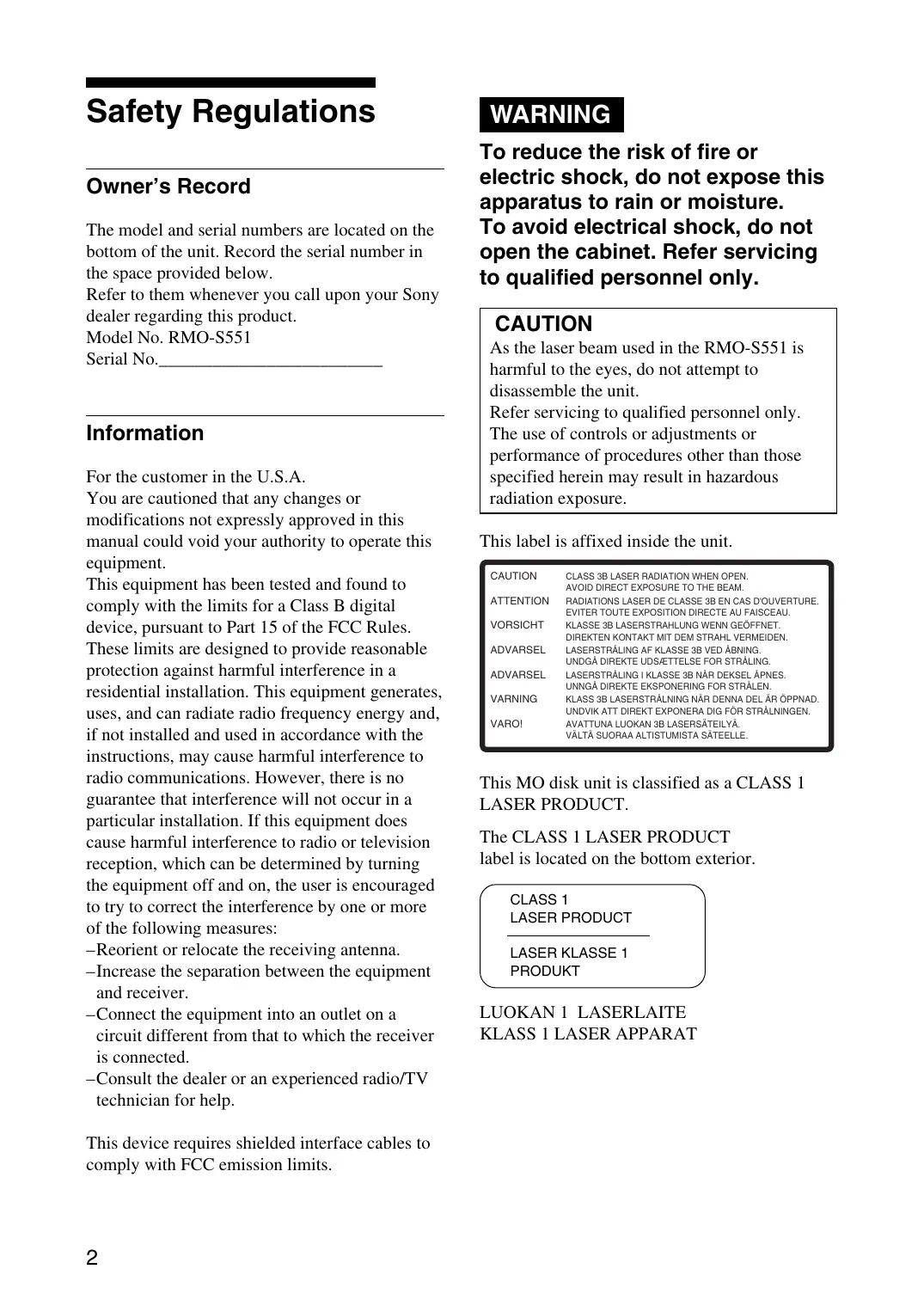


| Product Type | External hard drive (magneto-optical drive) |
| Brand | Sony |
| Model | RMO-S551 |
| Maximum capacity per disc | 5.2 GB (2048 bytes/sector) |
| Compatible disc types | Sony 5.25-inch magneto-optical discs: 650 MB to 5.2 GB, R/W, WO and R formats |
| Interface | SCSI-2 (Small Computer System Interface-2) |
| Rotation speed | 3300 rpm (discs ≥ 2.6 GB) / 3600 rpm (discs < 2.6 GB) |
| Average seek time | 25 ms |
| Cache memory | 4 MB (write cache enable/disable) |
| Continuous transfer speed | 1.97 – 5.07 MB/s depending on sector format |
| Power supply | 100 – 240 V AC, 50/60 Hz |
| Power consumption | 0.60 – 0.35 A max. |
| Dimensions (W × H × D) | 211 × 70 × 293 mm |
| Weight | 4.9 kg |
| Operating temperature | 5 to 40 °C |
| Operating humidity | 10 to 85 % RH (non-condensing) |
| Laser | Semiconductor A1GaInP, 685 nm, max. output 30 mW |
| Supplied accessories | Power cord, emergency ejection tool, instruction manual, blank MO disc (EDM-5200B), formatting utility |
| Maintenance | Clean the cabinet with a soft dry cloth; use Sony MOA-D51 cleaning kit for discs |
| Safety | Do not expose to rain or moisture; use approved power cord; do not open the cabinet |
| Additional information | User manual available for free download at notice-facile.com |
Frequently Asked Questions - RMO-S551 SONY
User questions about RMO-S551 SONY
0 question about this device. Answer the ones you know or ask your own.
Ask a new question about this device
Download the instructions for your External hard drive in PDF format for free! Find your manual RMO-S551 - SONY and take your electronic device back in hand. On this page are published all the documents necessary for the use of your device. RMO-S551 by SONY.
USER MANUAL RMO-S551 SONY
MO Disk Unit RMO-S551
User's Guide
Mode d'emploi
Bedienungsanleitung
Guía del usuario
The model and serial numbers are located on the bottom of the unit. Record the serial number in the space provided below.
Refer to them whenever you call upon your Sony dealer regarding this product.
Model No. RMO-S551
Serial No.
Information
For the customer in the U.S.A.
You are cautioned that any changes or modifications not expressly approved in this manual could void your authority to operate this equipment.
This equipment has been tested and found to comply with the limits for a Class B digital device, pursuant to Part 15 of the FCC Rules. These limits are designed to provide reasonable protection against harmful interference in a residential installation. This equipment generates, uses, and can radiate radio frequency energy and, if not installed and used in accordance with the instructions, may cause harmful interference to radio communications. However, there is no guarantee that interference will not occur in a particular installation. If this equipment does cause harmful interference to radio or television reception, which can be determined by turning the equipment off and on, the user is encouraged to try to correct the interference by one or more of the following measures:
–Reorient or relocate the receiving antenna.
–Increase the separation between the equipment and receiver.
-Connect the equipment into an outlet on a circuit different from that to which the receiver is connected.
-Consult the dealer or an experienced radio/TV technician for help.
This device requires shielded interface cables to comply with FCC emission limits.
WARNING
To reduce the risk of fire or electric shock, do not expose this apparatus to rain or moisture.
To avoid electrical shock, do not open the cabinet. Refer servicing to qualified personnel only.
CAUTION
As the laser beam used in the RMO-S551 is harmful to the eyes, do not attempt to disassemble the unit.
Refer servicing to qualified personnel only. The use of controls or adjustments or performance of procedures other than those specified herein may result in hazardous radiation exposure.
This label is affixed inside the unit.
| CAUTION | CLASS 3B LASER RADIATION WHEN OPEN.AVOID DIRECT EXPOSURE TO THE BEAM. |
| ATTENTION | RADIATIONS LASER DE CLASSE 3B EN CAS D'OUVERTURE.EVITER TOUTE EXPOSITION DIRECTE AU FAISCEAU. |
| VORSICHT | KLASSE 3B LASERSTRAHLUNG WENN GEÖFFNET.DIREKTEN KONTAKT MIT DEM STRAHL VERMEIDEN. |
| ADVARSEL | LASERSTRÅLING AF KLASSE 3B VED ÅBNING.UNDGÅ DIREKTE UDSÄTTELSE FOR STRÅLING. |
| ADVARSEL | LASERSTRÅLING I KLASSE 3B NÅR DEKSEL ÅPNES.UNNGÅ DIREKTE EKSPONERING FOR STRÅLEN. |
| VARNING | KLASS 3B LASERSTRÅLNING NÅR DENNA DEL ÄR ÖPPNAD.UNDVIK ATT DIREKT EXPONERA DIG FÖR STRÅLNINGEN. |
| VARO! | AVATTUNA LUOKAN 3B LASERSÅTEILYÄ.VÄLTÄ SUORAA ALTISTUMISTA SÄTEELLE. |
This MO disk unit is classified as a CLASS 1 LASER PRODUCT.
The CLASS 1 LASER PRODUCT label is located on the bottom exterior.
CLASS 1 LASER PRODUCT
LASER KLASSE 1 PRODUKT
LUOKAN 1 LASERLAITE KLASS 1 LASER APPARAT
NOTICE
Use the power cord set approved by the appropriate testing organization for the specific countries where this unit is to be used.
CAUTION
The mains plug on this equipment must be used to disconnect mains power. Please ensure that the socket outlet is installed near the equipment and shall be easily accessible.
Disposal of Old Electrical & Electronic Equipment (Applicable in the European Union and other European countries with separate collection systems)

This symbol on the product or on its packaging indicates that this product shall not be treated as household waste. Instead it shall be handed over to the applicable collection point for the recycling of electrical and electronic equipment. By ensuring this product is disposed of correctly, you will help prevent potential negative consequences for the environment and human health, which could otherwise be caused by inappropriate waste handling of this product. The recycling of materials will help to conserve natural resources. For more detailed information about recycling of this product, please contact your local Civic Office, your household waste disposal service or the shop where you purchased the product.
According to the EU Directives related to product safety, EMC and R&TTE the manufacturer of this product is Sony Corporation, 6-7-35 Kitashinagawa Shinagawa-ku Tokyo, 141-0001 Japan. The Authorised Representative is Sony Deutschland GmbH, Hedelfinger Strasse 61,70327 Stuttgart, Germany. For any service or guarantee matters please refer to the addresses given in separate service or guarantee documents.
Table of Contents
Using this Guide...... 4
Chapter 1 Introduction
Overview 5
Features 5
Compatible Disks ...... 6
System Configuration 6
Location and Function of Parts ...... 7
Chapter 2 Getting Started
Component and Accessory Check List .. 8
Connecting the Disk Unit 9
Setting the SCSI ID 9
Setting the Disk Unit's Functions ...... 10
Chapter 3 Using the Disk Unit
Inserting a Disk Cartridge .... 11
Ejecting a Disk Cartridge.... 12
Chapter 4 Precautions
On the Disk Unit 13
Safety Considerations .... 13
Damage Prevention 13
Other Points Requiring Attention ...... 14
On the Disk Cartridges 14
Protecting Your Data 15
Cleaning 15
Cleaning a Disk 15
Appendix
Specifications 16
Disk Unit 16
Optional Accessories 17
Using this Guide
This guide covers the use and operation of the RMO-S551 Magneto-Optical Disk Unit (called the “disk unit” thereafter). Do not attempt to use the disk unit without first carefully reading this guide. When finished, keep it handy for future reference.
The guide is divided into the following sections.
Chapter 1 Introduction
This chapter contains a general overview of the RMO-S551 disk unit, touching upon its features, system configuration, and the location and function of its parts.
Chapter 2 Getting Started
This chapter explains how to connect the disk unit to the host computer and other SCSI peripheral devices. It also explains how to set the disk unit's functions and the SCSI ID. Refer to this chapter when setting up the disk unit.
Chapter 3 Using the Disk Unit
In this chapter, you learn how to turn on the disk unit, and how to insert and eject a disk cartridge. Refer to this chapter when you are ready to actually begin using the disk unit.
Chapter 4 Precautions
This chapter contains precautions regarding the use and operation of the disk unit and magneto-optical disk cartridges.
It also discusses cleaning of disks.
Be sure to refer to this chapter before using the disk unit.
Appendix
The Appendix contains an explanation of the disk unit's main specifications.
Notes
- The manufacturer disclaims all responsibility for any losses incurred through malfunction or use of this product.
- The manufacturer does not warrant the security of data stored using this product. To guard accidental data loss, frequent backup of important data is highly recommended.
- Reproduction of the contents of this manual, in whole or in part, is prohibited.
• Macintosh is a registered trademark of Apple Computer, Inc. - Microsoft and Windows are registered trademarks of Microsoft Corporation.
Chapter 1 Introduction
Overview
Features
The RMO-S551 Magneto-Optical Disk Unit has the following features:
- Magneto-optical technology enables repeated writing and erasing of data on the disk.
- The disk unit automatically senses the type of disk being inserted, enabling the free use of both 650 Mbytes (594 Mbytes), 1.3 Gbytes (1.2 Gbytes), 2.6 Gbytes (2.3 Gbytes), and 5.2 Gbytes (4.8 Gbytes, 4.1 Gbytes) disks indifferently.
- A maximum of 5.2 Gbytes (2,048 bytes/sector), 4.8 Gbytes (1,024 bytes/sector), or 4.1 Gbytes (512 bytes/sector) of data can be written on the two sides of a 5.25-inch magneto-optical disk. This is equivalent to about 2900–3700 times the capacity of a conventional 3.5-inch floppy disk (2HD).
-
Any disk conforming to the internationally accepted CCS (continuous/composite servo) or CCW (continuous composite write-once) format can be used in this disk unit.
-
This disk unit employs SCSI-2 (Small Computer System Interface-2).
- The 3,300 min -1 (3,300 rpm) high-speed spindle motor enables data transfer rates of 2.48 – 5.07 Mbytes/s (2,048 bytes/sector), 2.31 – 4.79 Mbytes/s (1,024 bytes/sector), or 1.97 – 4.06 Mbytes/s (512 bytes/sector).
- With disk capacities under 2.6 Gbytes (2.3 Gbytes), the spindle motor rotates at 3600min-1 (rpm).
- The low-profile, light-weight optical pick-up yields average seek times of 25ms.
- Use of a highly reliable error correction code (ECC) system keeps the error rate as low as 10-12 .
- Optimum operation environment is provided through use of a large, 4MB buffer and optimized cache control algorithm. (Write cache can be enabled or disabled. For details, see “Setting the Disk Unit’s Functions” on page 10.)
Compatible Disks
The RMO-S551 can use the following Sony 5.25-inch MO Disks:
| Standard | Sector format | Type* | Capacity | Sony equivalent |
| ISO/IEC 15286 | 2048 bytes/sector | R/W | About 5.2 G bytes | EDM-5200B |
| ISO/IEC 15286 | 1024 bytes/sector | R/W | About 4.8 G bytes | EDM-4800B |
| ISO/IEC 15286 | 512 bytes/sector | R/W | About 4.1 G bytes | EDM-4100B |
| ISO/IEC 14517 | 1024 bytes/sector | R/W | About 2.6 G bytes | EDM-2600B |
| ISO/IEC 14517 | 512 bytes/sector | R/W | About 2.3 G bytes | EDM-2300B |
| ISO/IEC 13549 | 1024 bytes/sector | R | About 1.3 G bytes | EDM-1300B |
| ISO/IEC 13549 | 512 bytes/sector | R | About 1.2 G bytes | EDM-1200B |
| ISO/IEC 10089 | 1024 bytes/sector | R | About 650 M bytes | EDM-650B |
| ISO/IEC 10089 | 512 bytes/sector | R | About 600 M bytes | EDM-600B |
| ISO/IEC 15286 | 2048 bytes/sector | WO | About 5.2 G bytes | CWO-5200B |
| ISO/IEC 15286 | 1024 bytes/sector | WO | About 4.8 G bytes | CWO-4800B |
| ISO/IEC 15286 | 512 bytes/sector | WO | About 4.1 G bytes | CWO-4100B |
| ISO/IEC 14517 | 1024 bytes/sector | WO | About 2.6 G bytes | CWO-2600B |
| ISO/IEC 14517 | 512 bytes/sector | WO | About 2.3 G bytes | CWO-2300B |
| ISO/IEC 13549 | 1024 bytes/sector | R | About 1.3 G bytes | CWO-1300B |
| ISO/IEC 13549 | 512 bytes/sector | R | About 1.2 G bytes | CWO-1200B |
| ISO/IEC 11560 | 1024 bytes/sector | R | About 650 M bytes | CWO-650B |
| ISO/IEC 11560 | 512 bytes/sector | R | About 600 M bytes | CWO-600B |
*R/W:Rewritable, R/W:Rewritable(MO), WO:Write Once, R:Read Only
System Configuration
The disk unit should be used with a host computer equipped with SCSI.
A maximum of seven peripheral devices can be linked in a daisy chain on the SCSI bus, and controlled with SCSI-2 commands.
![graph TD A["Host computer"] --> B["RMO-S551 disk unit"] A --> C["SCSI cable"] C --> D["SCSI peripheral devices"] B --> E["White block"] B --> F["White block"] C --> G["White block"] C --> H["White block"] C --> I["White block"] C --> J["White block"]](/content/2019/11/50676/images/97b601290ae016e91d424276a2e21a13120513b6fcf5d4a0864fcf1431b7b8f6.jpg)
Location and Function of Parts
Front Panel
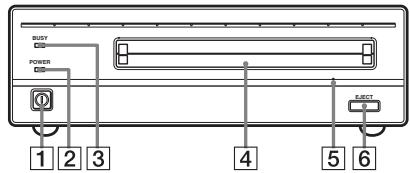
1 POWER switch
Push the button to turn the power on and off. The power is on when the button is in the depressed position, and off when fully protruding.
2 POWER indicator
The green lamp lights up when the power is turned on.
3 BUSY indicator
As this disk is inserted and the drive becomes ready for read/write operation, the BUSY indicator turns green. The orange lamp lights up when the disk unit is accessing or writing data. This lamp flashes on and off at about 2-second intervals when the unit overheats, regardless of whether or not a disk is being accessed.
4 Disk insertion slot
Insert the disk cartridge into this slot. Refer to the section “Inserting a Disk Cartridge” on page 11 for more information.
5 Emergency eject hole
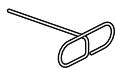
If the disk cartridge cannot be ejected using the EJECT button 6, turn off the power and insert the supplied emergency eject tool into this hole to trip the emergency eject mechanism. Refer to the section “What to do if the disk does not eject” on page 12 for further details.
6 EJECT button
Press this button to eject the disk cartridge from the disk unit. The EJECT button is disabled with the function switch or software settings prohibit ejection. When the write cache is enabled, it may take a few moments (up to 45 seconds) for the disk to eject because data in the cache must first be written to the disk.
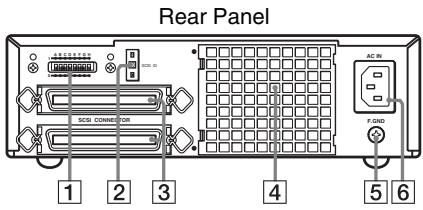
1 Function switches
Use this switches to set the disk unit's functions in accordance with the host computer and software being used. Refer to the section "Setting the Disk Unit's Functions" on page 10 for more information.
2 SCSI ID switch
Use these switches to set the SCSI ID. Push the “−” button to lower the ID number; push the “+” button to raise the ID number. Refer to the section“Setting the SCSI ID”on page 9 for more information.
3 SCSI connectors
Plug SCSI cables (sold separately) linking the host computer and other SCSI peripherals into these connectors.
Note
If the disk unit is the last device on the SCSI chain, set function switch F to “1” to turn on the internal terminator. When it is not the last device, make sure that the terminator is off (switch F is set to “0”).
4 Air duct
The air for cooling the disk unit flows through this duct, so be careful not to block its surface or impede the outflow.
5 F.GND (frame ground) terminal
Connect the ground terminals of other devices to the disk unit's frame ground.
6 AC IN (AC power) connector
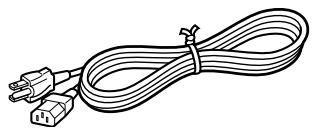
Connect the supplied AC power cord to this connector.
Chapter 2 Getting Started
Before setting up your RMO-S551 Magneto-Optical Disk Unit, check to see that you have all the required components and accessories. Then, connect the disk unit to the host computer and any other SCSI peripherals you may be using.
After checking to see that all the connections have been properly made, set the SCSI ID using the SCSI ID switch and the disk unit's functions using the function switches.
Component and Accessory Check List
Upon opening the carton, check to see that you have all of the components and accessories listed below. Contact your dealer immediately if you find any missing or damaged items.
• RMO-S551 Magneto-Optical Disk Unit
- AC power cord
- Emergency eject tool
- User's Guide
- Guide to Safe Use (Safety Precautions)
• 1 Blank MO disk (EDM-5200B)
Note
Please refer to the installation manual included in the device driver's package for instructions when using this device with a Macintosh® computer or a computer running under Windows® system. For questions concerning the device drivers, please contact the device driver manufacturer as indicated in the device driver package.
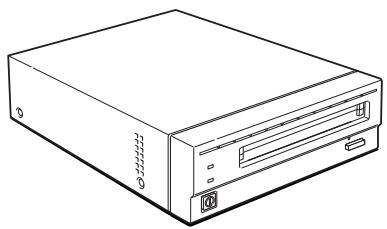
RMO-S551
Magneto-Optical Disk Unit

Emergency eject tool
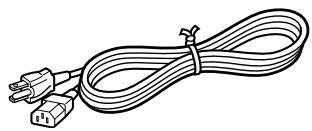
AC Power cord
Connecting the Disk Unit
You can hook up a maximum of seven SCSI peripheral devices to a single host computer through its SCSI bus.
Use the following Sony SCSI cable to connect the disk unit.
Notes
- Before connecting the disk unit, be sure to turn off the disk unit and all other devices on the SCSI chain.
- If the disk unit is the last device on the SCSI chain, set the function switch F on the rear panel to “1” to turn on the internal terminator. When it is not the last device, make sure that the terminator is off (function switch F is set to “0”).
- The total length of the SCSI cables connected to a SCSI chain must not exceed six meters (19 feet 8 1/4 inches).

Setting the SCSI ID
The factory default setting for the SCSI ID is “0.” If necessary, this ID number can be changed using the SCSI ID switch on the rear panel. Be sure to turn off the power before making any changes.
Pushing the “+” button raises the ID number; pushing the “-” button lowers the ID number.
Notes
- The disk unit will not operate properly unless the SCSI ID has been set correctly.
- Make sure to select a SCSI ID that has not been assigned to another SCSI device.

Setting the Disk Unit's Functions
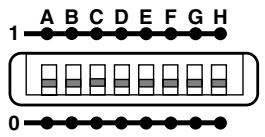
Use function switches (A - H) on the rear panel to select the disk unit's functions in accordance with the host computer and software you are using. Be sure to turn off the power before setting the switches.
This disk unit is equipped with a write cache. When the write cache is enabled, never turn off the disk unit power without making sure that all data has been written to the disk from cache memory. Data will be lost if you turn off the power before all data in cache memory has been written to the disk.
Before powering off the disk unit, be sure to eject the disk. Ejecting the disk writes data from cache memory to the disk.
Note
Even though the drive will flush data periodically to the disk, data may be lost in the case of a power failure.
Function Switch Settings
| Switch | Function | 1 | 0 |
| A | Parity check | SCSI parity check is disabled. | SCSI parity check is enabled. |
| B | Device type | Peripheral device type 00H (Direct Access Device) | Peripheral device type 07H (Optical Memory Device) |
| C | Write cache control | Disable write cache. | Enable write cache. |
| D | Fast SCSI control | Fast SCSI compatible | Not Fast SCSI compatible |
| E | Force verify | All write operations are verified. (with a verify pass) | All write operations are normal operations. (without a verify pass) |
| F | Terminator | The internal terminator is on. | The internal terminator is off. |
| G | Auto spin up | Inserting a disk does not causes the spindle motor to rotate. | Inserting a disk causes the spindle motor to rotate. |
| H | Manual eject | Disk cartridge cannot be ejected by pressing the EJECT button. | Disk cartridge can be ejected by pressing the EJECT button |
: Factory setting
Chapter 3 Using the Disk Unit
Inserting a Disk Cartridge
Use the following Sony 5.25-inch MO disks in your RMO-S551 disk unit.
• EDM-5200B (2,048 bytes/sector, 5.2 Gbytes)
• EDM-4800B (1,024 bytes/sector, 4.8 Gbytes)
• EDM-4100B (512 bytes/sector, 4.1 Gbytes)
• EDM-2600B (1,024 bytes/sector, 2.6 Gbytes)
• EDM-2300B (512 bytes/sector, 2.3 Gbytes)
• CWO-5200B (2,048 bytes/sector, 5.2 Gbytes)
• CWO-4800B (1,024 bytes/sector, 4.8 Gbytes)
• CWO-4100B (512 bytes/sector, 4.1 Gbytes)
• CWO-2600B (1,024 bytes/sector, 2.6 Gbytes)
• CWO-2300B (512 bytes/sector, 2.3 Gbytes)
1 Press the POWER switch located on the left side of the front panel.
This turns on the disk unit and causes the POWER indicator to light up.

Press the POWER switch
2 Start up the host computer. Refer to the manual supplied with the host computer for the start up procedure.
3 Insert a disk cartridge with the side you want to use facing upwards.
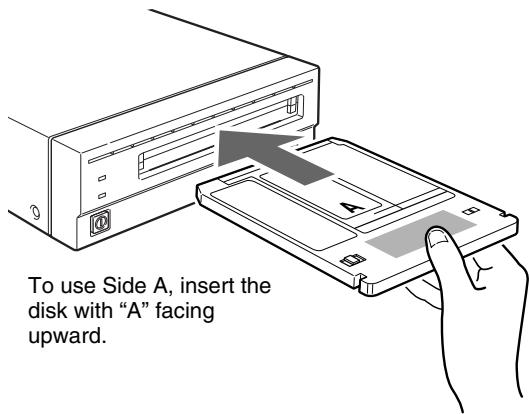
4 Access or write data on the disk using software commands on the host computer. The BUSY indicator lights up while the unit is accessing the disk.
■ What to do if the disk unit stops operating
When the temperature in the disk unit exceeds the preset level, the BUSY indicator starts flashing on and off at about 2-seconds intervals, regardless of whether or not a disk is being accessed, and the disk unit stops operating.
If this happens, you should improve the ventilation of a setting area.
If the disk unit still refuses to operate, unplug the unit and contact your dealer.
Ejecting a Disk Cartridge
Eject the disk cartridge either by using software commands or by pressing the EJECT button.

Note
Do not attempt to eject a disk cartridge while the BUSY indicator is lit orange (except when it is flashing at about 2-second intervals due to overheating). Ejecting the disk while it is being accessed may cause data write errors or may result in loss of data.
Also, it may take a few moments (up to 45 seconds) for the disk to eject when the write cache is enabled, because data in the cache must first be written to the disk.
■ What to do if the disk does not eject
The disk cartridge may not come out, even when you press the EJECT button or use a software command, under the following conditions:
- The eject function has been disabled using the function switch or a software command;
- The host computer is not functioning properly;
- The disk unit has been turned off (due to a power failure, etc.); or
- Something is wrong with your disk unit itself.
When you cannot eject the disk cartridge using the EJECT button or software commands, remove it as follows.
1 Turn off the disk unit if the power is still on.
2 Insert the emergency eject tool (or a paper clip) straight into the emergency eject hole to trip the manual ejection mechanism.

This should cause the disk cartridge to eject.
Caution
The tip of the emergency eject tool is sharp. When handling the tool, please be careful to avoid injury.
On the Disk Unit
Safety Considerations
■ Power supply
- Be sure to use 100 - 240V AC.
- Do not share the AC outlet with any other power-consuming equipment such as copying machines or shredders.
■ AC power cord
- Be careful not to place or drop heavy object on the power cord, or subject it to anything that may damage it.
- When unplugging the cord from an AC outlet, be sure to grasp the plug itself. Pulling on the cord may cause damage to the internal wiring.
- Unplug the unit when not using it for long period of time.
■ Handling the emergency eject tool
The tip of the emergency eject tool is sharp. When handling the tool, please be careful to avoid injury. Do not use the tool for any purpose other than ejecting disks.
Damage Prevention
■ Do not subject the disk unit to shock or vibration
Dropping the unit or subjecting it to strong impact may damage the disk unit.
■ Setting position
The disk unit is designed to be used in the horizontal position. Do not position it at an angle.
■ Location requirements
Careful consideration should be given to the following in selecting a site to install or store your disk unit.
Avoid the following conditions:
- High humidity
• High temperatures - Direct sunlight
• Dust - Strong vibration
- Wide temperature fluctuations
Ventilation
Care should be exercised to prevent the internal mechanisms of the disk unit from overheating. Be careful not to clog or block the vent, or place the unit in an area with poor ventilation. The disk unit may stop operating altogether if the internal temperature becomes too high.
Condensation
Avoid subjecting the disk unit to extremes in temperature. If, for example, the disk unit is moved suddenly from a very cold location to a warm one, moisture from condensation may form within the unit due to the quick rise in ambient temperature. If a sudden change in the temperature cannot be avoided, wait for an hour or more before using the disk unit. Inserting a disk cartridge into the mechanism when moisture is present may cause damage to both the disk and the disk unit. Remove the disk cartridge immediately if you suspect any condensation problems. The moisture should evaporate quickly if the disk unit is left on without a disk inserted.
■ Moving the disk unit
Be sure to remove the disk cartridge when the disk unit is not being used. Also never move or transport the unit with the disk cartridge still inserted.
While in operation, the disk rotates at a high speed. Moving the disk unit at such a time may disturb the spinning disk and cause it to be damaged. Always remove the disk cartridge before moving your disk unit.
■ If problems occur
If any problems occur, turn off the power and unplug the disk unit, contact your dealer.
Other Points Requiring Attention
■ Electrical noise
The high-frequency signal generated by the disk unit may cause interference or static on other electrical appliances such as radios, televisions and audio tuners. If this should occur, move the disk unit a little farther away from the affected appliance.
■ Maintenance
Clean the cabinet with a dry soft cloth, or with a soft cloth lightly moistened with a mild detergent solution. Do not use any type of solvent, such as alcohol or benzine, which may damage the finish.
On the Disk Cartridges
- Do not drop the disk cartridge or subject it to any violent shocks or vibration.
- Do not disassemble the disk cartridge. It is a precision component and has been carefully adjusted at the factory prior to shipment.
- Do not open the disk cartridge's shutter manually or touch the disk inside. The shutter is designed to open automatically when the cartridge is inserted into the disk unit.
- Do not use the cartridge under ambient conditions of high humidity or wide temperature fluctuations. Moisture from condensation may make it impossible to read or write data.
- Avoid inserting and ejecting the disk cartridge more than is necessary.
- Always eject and remove the disk cartridge from the disk unit after using it.
■ Storing disk cartridges
- Store the disk cartridges in their cases.
- Do not leave the cartridges exposed to direct sunlight or excessive heat, like on the dashboard or in the glove compartment of an automobile. Do not store the disk cartridges under the following conditions.
– Excessive dust and debris
– Exposure to direct sunlight - Near a heat source
– High humidity
Protecting Your Data
The magneto-optical disk cartridges are equipped with a DATA PROTECT switch (red tab) to prevent accidental erasure of data on the disk or inadvertent writing of unwanted data. Slide this switch in the direction of the arrow as illustrated below to enable the write protect function.
You can still read the data contained on the disk, but will not be allowed to write on or erase the disk. Return the switch to its original position to disable the write protect.
Make it a practice to leave the write protection enabled when you do not foresee the need to write on the disk.
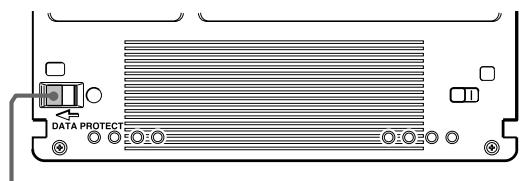
DATA PROTECT switch
Cleaning
Cleaning a Disk
Dust and stains may accumulate on MO disks when they are used for a long period of time. To avoid resultant data read/write errors, use an optional disk cleaner. To maintain the high performance and prolong the useful life of your MO disk, cleaning at least once every three months is recommended.
■ Disk cleaning accessories
Use the following Sony disk cleaning kit or disk cleaner (sold separately).
• MOA-D51 Disk Cleaning Kit Do not use any other type of disk cleaner as it may cause data read/write errors due to the differences in disk surface characteristics. For cleaning instructions, refer to the manual supplied with each cleaning accessory
Attention
In the disk unit, preventive measures are taken to guard against dust. It is unnecessary to clean the optical lens of your disk unit. Using a lens cleaning cartridge may damage the disk unit.
Specifications
Disk Unit
Performance
Capacity
Per disk
5.2 Gbytes (ZCAV 2,048 bytes/sector)
4.8 Gbytes (ZCAV 1,024 bytes/sector)
4.1 Gbytes (ZCAV 512 bytes/sector)
2.6 Gbytes (ZCAV 1,024 bytes/sector)
2.3 Gbytes (ZCAV 512 bytes/sector)
Rotation speed
3,300 min -1 (3,300 rpm)
3,600 min -1 (3,600 rpm)
User data transfer rate
Continuous transfer rate
2.48 - 5.07 Mbytes/s
(2,048 bytes/sector)
2.31 - 4.79 Mbytes/s
(1,024 bytes/sector)
1.97 - 4.06 Mbytes/s
(512 bytes/sector)
Burst transfer rate
10 Mbytes/s (using Fast SCSI)
Host interface
SCSI-2 (Small Computer System Interface-2)
ANSI X3.131-1994
■ Operating environment
Installation
Horizontal ( ±5° )
Temperature
Operating
5°C to 40°C (41 °F to 104 °F)
(gradient 10°C/h or 18°F/h)
Non-operating
-30°C to 60°C (-22°F to 140°F)
Relative humidity
Operating
10 % to 85 % (no condensation)
Non-operating
10 % to 90 %
■ Laser
Type
Semiconductor AlGaInP laser
Wavelength
685 nm ± 10 nm
Maximum output
30 mW
■ Power supply and others
Power supply
100 – 240 V AC ±10%, 50/60 Hz ±5%
Current drain
0.60 - 0.35 A max
Maximum external dimensions (excluding
protruding parts and air duct)
211 × 70 × 293 mm (W / H / D)
(8 3/8 × 2 7/8 × 11 5/8 inches)
Weight
4.9 kg (10.9 lb.)
Accessories
AC power cord (1)
Emergency eject tool(1)
User's Guide (1)
MO Disk (1)
Formatting Utility (1)
Design and specifications are subject to change without notice.
Optional Accessories
MO disks
EDM-5200B (2,048 bytes/sector, 5.2 Gbytes) EDM-4800B (1,024 bytes/sector, 4.8 Gbytes) EDM-4100B (512 bytes/sector, 4.1Gbytes) EDM-2600B (1,024 bytes/sector, 2.6 Gbytes) EDM-2300B (512 bytes/sector, 2.3 Gbytes)
Continuous composite write-once disks
CWO-5200B (2,048 bytes/sector, 5.2 Gbytes)
CWO-4800B (1,024 bytes/sector, 4.8 Gbytes)
CWO-4100B (512 bytes/sector, 4.1 Gbytes)
CWO-2600B (1,024 bytes/sector, 2.6 Gbytes)
CWO-2300B (512 bytes/sector, 2.3 Gbytes)
Disk Cleaning Kit MOA-D51
Règles de sécurité
AVERTISSEMENT
Remarque
LASER KLASSE 1 PRODUKT
Netzkable
Continuous Composite Write-Once Disks
Pulse el interruptor POWER.
(2.048 bytes/sector)
2,31-4,06 Mbytes/s
(1.024 bytes/sector)
1,97-4,06 Mbytes/s
(512 bytes/sector)
Interfaccia computer
SCSI-2 (Small Computer System Interface-2)
ANSI X3.131-1994
CLASS 3B LASER RADIATION WHEN OPEN.
AVOID DIRECT EXPOSURE TO THE BEAM.
ATTENTION
RADIATIONS LASER DE CLASSE 3B EN CAS D'OUVERTURE.
EVITER TOUTE EXPOSITION DIRECTE AU FAISCEAU.
VORSICHT
KLASSE 3B LASERSTRAHLUNG WENN GEÖFFNET
DIREKTEN KONTAKT MIT DEM STRAHL VERMEIDEN.
ADVARSEL
LASERSTRÅLING AF KLASSE 3B VED ÅBNING
UNDGÅ DIREKTE UDSÆTTELSE FOR STRÅLING.
ADVARSEL
LASERSTRÅLING I KLASSE 3B NÅR DEKSEL ÅPNES.
UNNGÅ DIREKTE EKSPONERING FOR STRÅLEN.
WARNING
KLASS 3B LASERSTRÅLNING NÄR DENNA DEL ÄR ÖPPNAD.
UNDVIK ATT DIREKT EXPONERA DIG FÖR STRÅLNINGEN.
VARO!
AVATTUNA LUOKAN 3B LASERSÄTEILYÄ.
VÄLTÄ SUORAA ALTISTUMISTA SÄTEELLE.
MO 盘装置为1类激光产品。
“1类激光产品”标签贴在驱动器的底部。
CLASS 1
LASER PRODUCT
LASER KLASSE 1
PRODUKT
注意
RMO-S551 磁光盘装置

紧急退盘工具
AC 电源线
磁光盘装置的连接
按压电源开关 POWER 开关
RMO-S551 MO 存儲裝置
緊急退出工具

AC電源線
連接存儲裝置
CWO-4100B (512 bytes/區, 4.1 Gytes)
CWO-2600B (1,024 bytes/區, 2.6 Gytes)
CWO-2300B (512 bytes/區, 2.3 Gytes)
碟片清潔工具
MOA-D51
목차
이 설명서의 사용방법 110
제1장 처음에
개요 111
주요 특징 111
대응 디스크 112
시스템 구성 112
각 부의 위치와 기능 113
제2장 조작을 시작한다
AC 전원 코드
디스크 장치를 접속한다
POWER 스위치를 누른다.
- MO DISK UNIT RMO-S551
- INFORMATION
- WARNING
- CAUTION
- NOTICE
- DISPOSAL OF OLD ELECTRICAL & ELECTRONIC EQUIPMENT (APPLICABLE IN THE EUROPEAN UNION AND OTHER EUROPEAN COUNTRIES WITH SEPARATE COLLECTION SYSTEMS)
- TABLE OF CONTENTS
- CHAPTER 1 INTRODUCTION
- CHAPTER 2 GETTING STARTED
- CHAPTER 3 USING THE DISK UNIT
- CHAPTER 4 PRECAUTIONS
- APPENDIX
- USING THIS GUIDE
- NOTES
- OVERVIEW
- FEATURES
- COMPATIBLE DISKS
- SYSTEM CONFIGURATION
- LOCATION AND FUNCTION OF PARTS
- 1 POWER SWITCH
- 2 POWER INDICATOR
- 3 BUSY INDICATOR
- 4 DISK INSERTION SLOT
- 5 EMERGENCY EJECT HOLE
- 6 EJECT BUTTON
- 1 FUNCTION SWITCHES
- 2 SCSI ID SWITCH
- 3 SCSI CONNECTORS
- NOTE
- 4 AIR DUCT
- 5 F.GND (FRAME GROUND) TERMINAL
- 6 AC IN (AC POWER) CONNECTOR
- COMPONENT AND ACCESSORY CHECK LIST
- CONNECTING THE DISK UNIT
- SETTING THE SCSI ID
- SETTING THE DISK UNIT'S FUNCTIONS
- INSERTING A DISK CARTRIDGE
- WHAT TO DO IF THE DISK UNIT STOPS OPERATING
- EJECTING A DISK CARTRIDGE
- WHAT TO DO IF THE DISK DOES NOT EJECT
- ON THE DISK UNIT
- SAFETY CONSIDERATIONS
- POWER SUPPLY
- AC POWER CORD
- HANDLING THE EMERGENCY EJECT TOOL
- DAMAGE PREVENTION
- DO NOT SUBJECT THE DISK UNIT TO SHOCK OR VIBRATION
- SETTING POSITION
- LOCATION REQUIREMENTS
- VENTILATION
- CONDENSATION
- MOVING THE DISK UNIT
- IF PROBLEMS OCCUR
- OTHER POINTS REQUIRING ATTENTION
- ELECTRICAL NOISE
- MAINTENANCE
- ON THE DISK CARTRIDGES
- STORING DISK CARTRIDGES
- PROTECTING YOUR DATA
- CLEANING
- CLEANING A DISK
- DISK CLEANING ACCESSORIES
- ATTENTION
- SPECIFICATIONS
- DISK UNIT
- PERFORMANCE
- OPERATING ENVIRONMENT
- LASER
- POWER SUPPLY AND OTHERS
- OPTIONAL ACCESSORIES
- RÈGLES DE SÉCURITÉ
- AVERTISSEMENT
- REMARQUE
- 注意
- 磁光盘装置的连接
- 連接存儲裝置
- 목차
- 제1장 처음에
- 제2장 조작을 시작한다
- 디스크 장치를 접속한다
Brand : SONY
Model : RMO-S551
Category : External hard drive