DI 72 SI (EU) - Dishwasher INDESIT - Free user manual and instructions
Find the device manual for free DI 72 SI (EU) INDESIT in PDF.



User questions about DI 72 SI (EU) INDESIT
0 question about this device. Answer the ones you know or ask your own.
Ask a new question about this device
Download the instructions for your Dishwasher in PDF format for free! Find your manual DI 72 SI (EU) - INDESIT and take your electronic device back in hand. On this page are published all the documents necessary for the use of your device. DI 72 SI (EU) by INDESIT.
USER MANUAL DI 72 SI (EU) INDESIT
Installation and use
Lava-vasseille
Instructions for installation and use
Lave-vasseille 21
text_image
E G F H I J L K
Cestello superiore

natural_image
Close-up of a kitchen sink with a white funnel and metal bowl (no visible text or symbols)natural_image
Technical line drawing of a mechanical component with concentric layers and mounting holes (no text or symbols)natural_image
Illustration of a stylized building with abstract patterns and no visible text or symbolsnatural_image
Cross-sectional view of a mechanical or electrical component with coiled wires and internal components (no visible text or symbols)cestello superiore
natural_image
Top-down view of a stainless steel kitchen with multiple circular cutlery pieces arranged in rows (no visible text or symbols)natural_image
Close-up of a mechanical component with two circular components and threaded connectors (no visible text or symbols)cestello superiore
natural_image
Top-down view of a kitchen tray with various food items including sliced onions, bread rolls, and a plate (no text or labels visible)natural_image
Person assembling a wire cage with two labeled parts (1 and 2), no visible text or symbols on the diagram itself.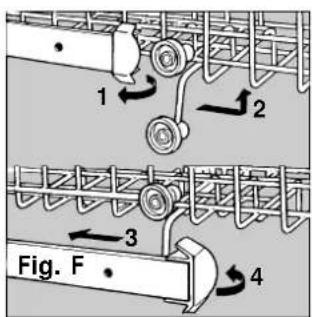
text_image
1 2 3 4 Fig. F.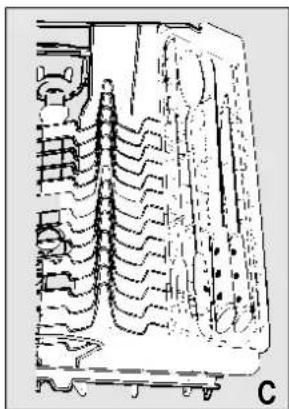
natural_image
Technical line drawing of a mechanical assembly or housing with layered components (no text or symbols)natural_image
Close-up of a metallic mechanical component with a handle and central circular feature (no visible text or symbols)natural_image
Diagram of a mechanical component with labeled parts A and B, showing a top view of a knob-like structure (no text or symbols present)text_image
Technical diagram showing a medical or industrial device with tubing and a control panel, labeled with component A.Safety Is a Good Habit to Get Into
NOTICE
Carefully read the instructions contained in this manual, as they provide important information which is essential to safe and proper installation, use and maintenance of the appliance.

This appliance complies with the following EEC directives:
- 73/23/EEC of 19/02/73 (Low Voltage) and subsequent modifications;
-
89/336/EEC of 03/05/89 (Electromagnetic Compatibility) and subsequent modifications.
-
Carefully dispose of the packing material.
- After removing the packing, check to make sure that the appliance is not damaged. If in doubt, contact a qualified professional.
- The dishwasher must only be used by adults for the washing of household dishes and cooking utensils.
- Fundamental rules to follow when using the appliance:
- Never touch the dishwasher when barefoot or with wet hands or feet;
- We discourage the use of extension cords and multiple sockets;
- During installation, the power supply cord must not be excessively or dangerously bent or flattened;
- If the appliance is not operating properly or maintenance
must be performed, disconnect the appliance from the power supply.
- Keep detergents out of the reach of children, who must also be kept away from the dishwasher when it is open.
- This appliance cannot be installed outdoors, not even if the area in which it is installed is covered by a roof; it is also very dangerous to leave it exposed to the rain and elements.
- Do not touch the heating element during or after a wash cycle.
- Do not lean or sit on the door when it is open, as this could overturn the dishwasher.
- If the appliance malfunctions, turn off water supply to the appliance and disconnect the plug from the wall socket. Then, consult the section entitled, "Troubleshooting." If you cannot resolve the problem, contact a service centre.
- Appliances which are no longer being used must be made inoperable by cutting the power supply cord and removing the door lock.
To maintain the EFFICIENCY and SAFETY of this appliance, we recommend:
- call only the Service Centers authorized by the manufacturer
● always use original Spare Parts
Close-up View (control panel)
text_image
A B G N E F DC

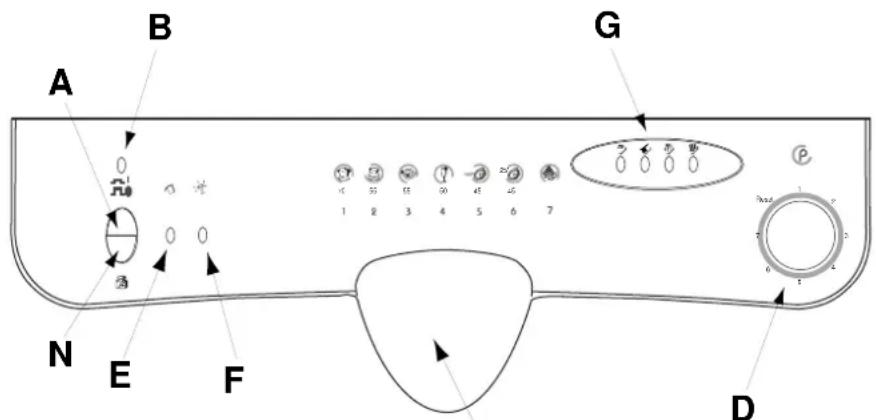
ON - OFF Button
ON - OFF Light
Handle For Opening Door
Knob For Selecting Cycles

Low Salt Indicator Light
Low Rinse Aid Indicator Light
Cycle phase indicator lights
"1/2 Load" Button
Close-up View (Interior)
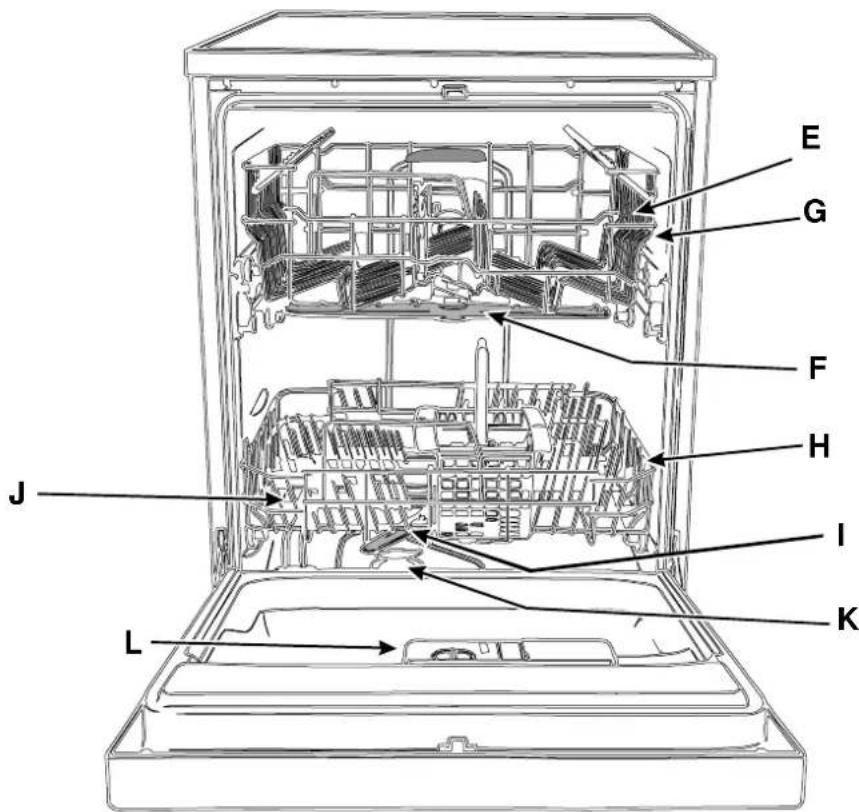
text_image
E G F H I K J L
Upper Rack

Top Sprayer Arm

Rack Height Adjustor

Lower Rack

Bottom Sprayer Arm

Salt Container Cap

Washing Filter

Detergent and Rinse Aid Dispenser
Technical characteristics
| Width cm. 60 |
| Depth cm. 60 |
| Height cm. 85 |
| Capacity 12 standard place settings |
| Mains water pressure 20 KPa÷ 1MPa (0,2 ÷ 10 bar) |
| Power voltage See data plate |
| Total absorber power See data plate |
| Fuse See data plate |
Salt .....
Salt
The hardness of the water varies from place to place. If hard water is used in the dishwasher, deposits will form on the dishes and utensils.
The appliance is equipped with a special softener that uses a salt specifically designed to eliminate lime and minerals from the water.
Loading the Salt into the Softener
Always use salt intended for use with dishwashers.
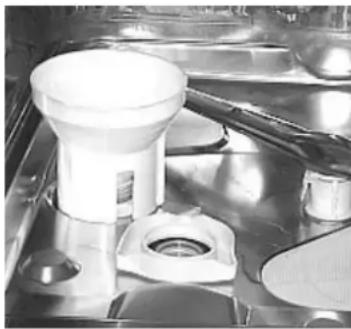
The salt container is located beneath the lower rack and should be filled as follows:
- Remove the lower rack and then unscrew and remove the cap from the salt container;
- If you are filling the container for the first time, fill it with water;
- Place the end of the funnel (supplied) into the hole and introduce about 2 kg of salt. It is normal for a small amount of water to come out of the salt container.
- Carefully screw the cap back on.
The salt container must be filled when the "low salt" indicator light (located on the control panel) comes on.
Warning: To prevent rust from forming, we advise you to load the salt before starting a wash cycle.
natural_image
Close-up of a kitchen sink with a white funnel and metal bowl (no visible text or symbols)Adjusting Salt Consumption
The dishwasher is designed to allow for adjusting the
amount of salt consumed based on the harness of the water used. This is intended to optimize and customize the level of salt consumption so that it remains at a minimum.
Your Local Water Board can supply the degree of hardness of the water
in your area.
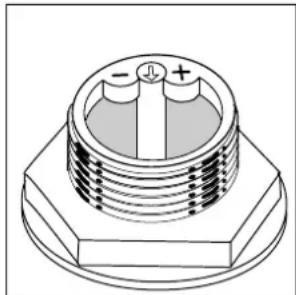
To adjust salt consumption, proceed as follows:
natural_image
Technical line drawing of a mechanical component with threaded base and mounting holes (no text or symbols)1) Unscrew the cap from the salt container. 2) There is a ring on the container with an arrow on it (see figure to the side), if necessary, rotate the ring in the anticlockwise direction from the "_" setting towards the "+" sign, based on the hardness of the water being used.
It is recommended that adjustments be made in accordance with the following schema:
| Water Hardness | |||||
| Clarke degrees | °dH m | mol/l | Selector position | Salt consumption (grams/-cycle) | Autonomy (cycles\2-kg) |
| 0, 14 0 | 17 0, 1 | 7 / 0 / | |||
| 14, 36 18 | 44 1,8 | 4,4 "-" 20 | 60 | ||
| 36, 71 45 | 89 4,5 | 8,9 | MED | 40 40 | |
| >71 | >89 | >8,9 | "+" | 60 | 25 |
Detergent and Rinse Aid ....
Detergent
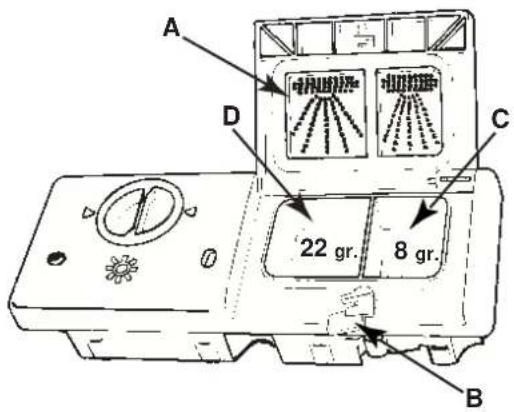
Detergent specifically intended for use with dishwashers must be used. The dispenser must be refilled before the start of each wash cycle following the instructions provided in the "Wash Cycle Table." The detergent dispenser is located on the inside panel of the door.
Loading the detergent
To open lid "A", press button "B". The cleaning detergent should be introduced into the two containers "C" and "D" up to the rim.
After pouring in the detergent, replace the lid, pressing down until it clicks.
text_image
A D C 22 gr. 8 gr. BDishwasher detergent in tablets is now available on the market, in which case you should place one tablet into container "D" and replace the lid.
If you use powder or liquid detergent, you can also fit the 2 plugs provided in the two special housings in lid "A", before closing the latter. This way, your dishes will come out cleaner.
Notice: To facilitate closing the cover, remove any excess detergent on the edges of the dispenser.
Rinse Aid
This product makes dishes sparkle and helps them to dry without spotting. The dispenser is located on the inside panel of the door and should be filled after every 80 wash cycles (or when the rinse aid indicator light comes on for those models with this feature).
Loading the Rinse Aid
To open the dispenser, turn the "C" cap in the anti-clockwise direction and then pour in the rinse aid, making sure not to overfill. The amount of rinse aid used for each cycle can be regulated by turning the "F" dose adjustor, located beneath the "C" cap, with a screwdriver. There are 6 different settings; the normal dosage setting is 4.
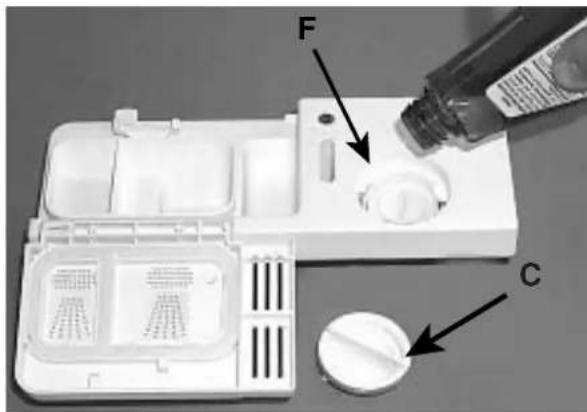
text_image
F CImportant:
Proper dosage of the rinse aid improves drying. If drops of water remain on the dishes or spotting occurs, the dosage adjustor should be turned to a higher setting. If the dishes have white streaks, turn the dosage adjustor to a lower setting.
Loading the Dishwasher
Before placing the dishes in the dishwasher, remove the larger food particles to prevent the filter from becoming clogged, which results in reduced performance.
If the pots and pans have baked-on food that is extremely hard to remove, we recommend that they be allowed to soak before they are washed. This will eliminate the need for extra wash cycles.
Pull out the racks to facilitate loading the dishwasher.
How to Use the Lower Rack
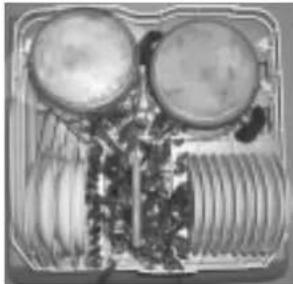
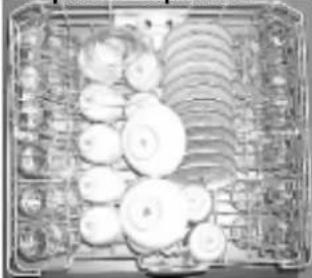
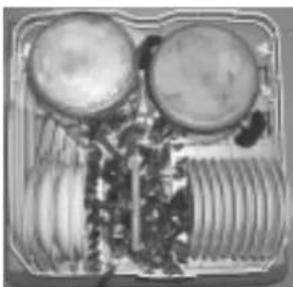
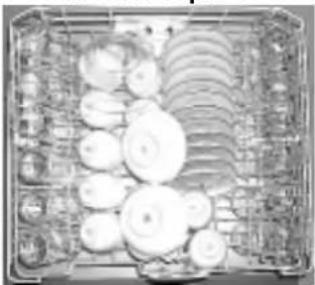
We recommend that you place the most difficult to clean items on the bottom rack: pots, pans, lids, serving dishes and bowls, as shown in the figure to the right.
It is preferable to place serving dishes and lids on the sides of the racks in order to avoid blocking the rotation of the top spray arm.
- Pots, serving bowls, etc. must always be placed top down.
- Deep pots should be slanted to allow the water to flow out.
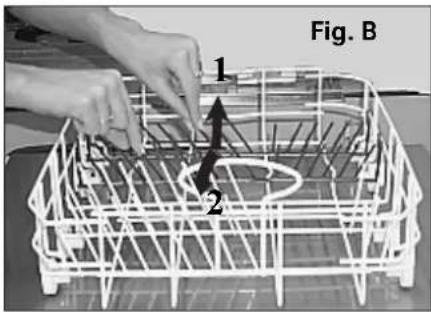
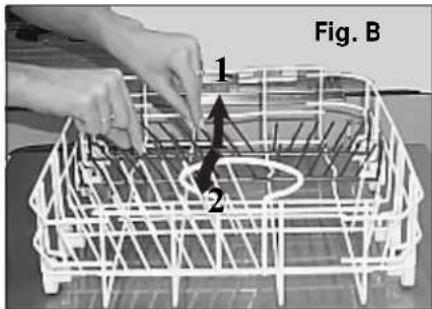
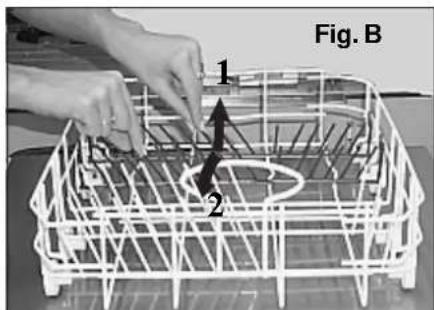
- The bottom rack features fold down tine rows (see figure B) so that larger or more pots and pans can be loaded.
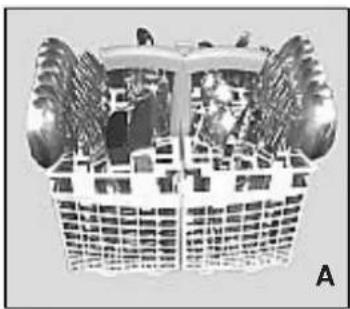
-The silverware basket can be doubled (see figure A) so that only one section may be used when the silverware load is light. This also makes space for additional pots
and pans, and it can also be placed in the upper rack.
- Silverware should be placed in the silverware basket with the handles at the bottom; If the rack has side baskets, the spoons should be loaded individually into the appropriate slots.
natural_image
Illustration of a basket filled with various items, possibly industrial machinery or industrial equipment, with no visible text or symbols.How to Use the Upper Rack
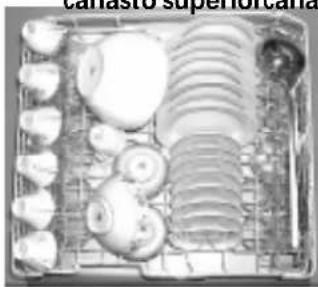
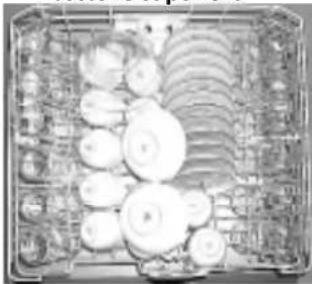
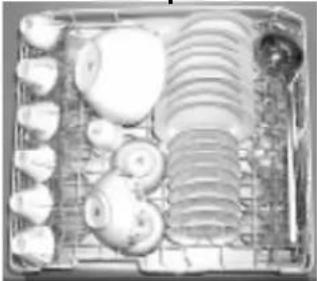
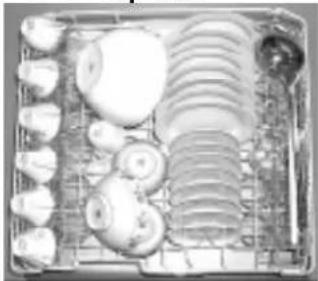
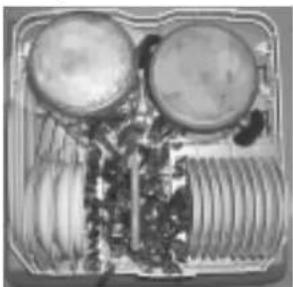
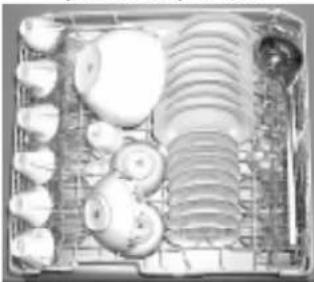
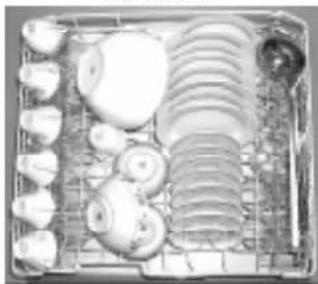
The upper rack is designed to hold more delicate and lighter dishware, such as glasses, coffee and tea cups and saucers, as well as plates, small bowls and shallow pans (as long as they are not too dirty).
- Position the dishes and cookware so that they do not get moved by the spray of water.
How to adjust the Upper rack ...
The top rack can be adjusted using the two rack heights (top and bottom). To adjust the rack, open up the tabs that lock the guides and pull out the rack. Arrange the rack with the back wheels in either the top or bottom position and then insert it along the guides until the front wheels are on as well. Close the tabs to lock the rack in place (see Fig. F).
Bottom Rack
natural_image
Close-up of coiled metal pipes or wires in a container (no text or symbols visible)Top Rack
natural_image
Top-down view of a metal tray containing sliced white food items (no text or symbols visible)Load for 12 Standard Settings
Bottom Rack
natural_image
Close-up of a mechanical component with two circular components and threaded connectors (no visible text or symbols)Top Rack
natural_image
Top-down view of a kitchen tray with various food items including sliced onions, sliced radish, and a dish (no visible text or labels)Normal Daily Load
natural_image
Hand placing a white wire cage into a tray, labeled Fig. B (no text or symbols on the diagram itself)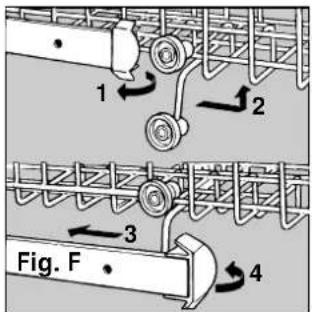
text_image
1 2 3 4 Fig. F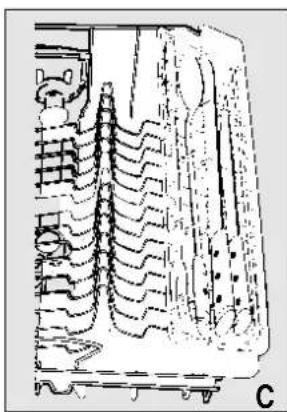
natural_image
Technical line drawing of a mechanical assembly or component (no visible text or symbols)How to adjust the Upper rack ...
The top rack can be adjusted using the two rack heights (top and bottom). To adjust the rack, open up the tabs that lock the guides and pull out the rack. Arrange the rack with the back wheels in either the top or bottom position and then insert it along the guides until the front wheels are on as well. Close the tabs to lock the rack in place (see Fig. F).
Turning on the Appliance
Starting a wash cycle....
After having completed all of the installation steps in the preceding paragraphs, turn on the water to the unit and press the ON-OFF button (A) located on the control panel. The "B" indicator light will come on. At this point, the appliance is on and ready to be programmed.
Starting and selecting the cycle.
Turn the cycle selector knob "D" until the reference notch on the knob corresponds with the number or the symbol for the cycle you wish to set (consult the wash cycle table contained in this manual, especially when first using the appliance).
After a few seconds, the indicator light "G" concerning the cycle starting phase comes on, indicating that the wash cycle has begun and we do not recommend you change it. If this is absolutely necessary, please read the paragraph entitled "Cancelling or modifying a wash cycle in progress".
Cycle phase indicator lights
The dishwasher is provided with 4 indicator lights "G" which come on in sequence as the appliance is performing that specific phase of the wash cycle.
These phases are, from left to right:


pre-wash, wash, rinses, drying
Cancelling or modifying a wash cycle in progress.....
Premise: You can cancel the wash cycle in progress, if it has only just started.
To modify a wash cycle in progress, turn knob "D" until it reaches the RESET position. After approximately 4 seconds, the indicator light "G" concerning the cycle phase under way comes off and all the settings are cancelled.
To select a new wash cycle, repeat the instructions contained in the paragraph entitled "Starting and selecting the cycle"
If you forget to load some of the dishes...
The wash cycle can be interrupted by pressing the ON-OFF. You can then load additional dishes and turn the appliance back on. The cycle will start where it left off.
At the end of the wash cycle....
The end of the wash cycle is indicated by the flashing of the drying phase indicator light "G".
Turn knob "D" until it reaches the RESET position Turn off the water tap and open the appliance door. Wait a few minutes before removing the dishes: this way you won't have to handle them while they're still hot and they will dry better.
Wash Cycle Adjustment Button
"1/2 LOAD" Button
This button (see "Close-up View - Control Panel", letter "N") makes it possible to wash dishes using only the upper rack if there are not enough dishes for a full load. This will allow you to save on water and electrical energy.
It can be used before setting any of the wash cycles.
Please keep in mind that the amount of detergent should also be cut in half.
Wash Cycle Table
| CycleCycle selection instructions | Cycle description | Detergent for pre-wash + wash | Rinse Aid | |
| 1) Heavy Duty | Very dirty dishes and pans (not to be used for delicate items). | Pre-wash with hot water at 45°C. Extended wash at 70°C. 2 rinses with cold water. Rinse with hot water at 70°C. Drying. | 8+22 g.* | |
| 2) Daily wash | Normally dirty pans and dishes. Standard daily cycle. | 2 pre-washes with cold water. Extended wash at 55°C. Rinse with hot water at 70°C. Drying. | 8+22 g.* | |
| 3) After dinner | Normally dirty pans and dishes with no dry residue. | Cold pre-wash. Extended wash at 55°C. Rinse with hot water at 70°C. Drying. | 8+22 g.* | |
| 4) Glassware | Economic and fast cycle to be used for more delicate items which are sensitive to high temperatures. Run cycle immediately after use. | Wash at 50°C. Lukewarm rinse. Rinse with hot water at 70°C. Drying. | 22 g.* | |
| 5) Rapid Wash Drying | Economic and fast cycle to be used for slightly dirty dishes. Run cycle immediately after use. | Short wash at 45°C. Hot rinse at 70°C. Drying | 22 g.* | |
| 6) Rapid Wash 25' | Economic and fast cycle to be used for slightly dirty dishes. Run cycle immediately after use. No drying. | Short wash at 45°C. Cold rinse. | 22 g. | |
| 7) Soak | Preliminary wash cycle for dishes and pans awaiting completion of the load with the dishes from the next meal. | Short cold wash to prevent food from drying onto the dishes. |
Energy Saving Tips
- It is important to try and run the dishwasher when it is fully loaded in order to save on energy. In order to prevent odors from forming and food from caking onto the dishes, you can run the hold cycle.
-
Choose the right wash cycle: the choice of cycle depends on the type of dishware, cookware and utensils being washed and how dirty they are.
-
Use the right amount of detergent: if you use too much detergent, the result will not be cleaner dishes, but, rather, a greater negative impact on the environment.
- There is no utility in rinsing dishes, cookware and utensils before placing them in the dishwasher.
How to Keep Your Dishwasher in Shape
After Every Wash
After every wash, turn off the water supply to the appliance and leave the door slightly ajar so that moisture and odors are not trapped inside.
Remove the Plug
Before cleaning or performing maintenance, always remove the plug from the socket. Do not run risks.
No Solvents or Abrasive Cleaning Products
To clean the exterior and rubber parts of the dishwasher, do not use solvents or abrasive cleaning products. Rather, use only a cloth and warm soapy water.
To remove spots or stains from the surface of the interior, use a cloth dampened with water and a little white vinegar, or a cleaning product made specifically for dishwashers.
When You Go on Holiday
When you go on holiday, it is recommended that you run a wash cycle with the dishwasher empty and then remove the plug from the socket, turn off the water supply and leave the door of the appliance slightly ajar. This will help the seals last longer and prevent odors from forming within the appliance.
Moving the Appliance
If the appliance must be moved, try to keep it in the vertical position. If absolutely necessary, it can be positioned on its back.
Seals
One of the factors that cause odors to form in the dishwasher is food that remains trapped in the seals. Periodic cleaning with a damp sponge will prevent this from occurring.
Cleaning and Special Maintenance
Filter Assembly
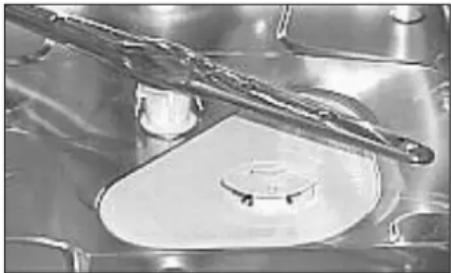
For best performance and results, the filter assembly must be cleaned.
The filter efficiently removes food particles from the wash water, allowing it
to be recirculated during the cycle. For this reason, it is a good idea to remove the larger food particles trapped in the filter after each wash cycle by rinsing the
natural_image
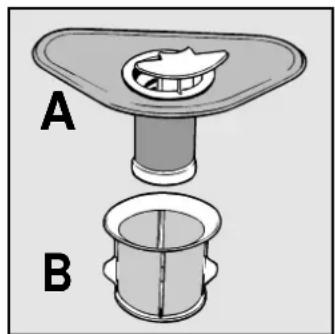
Close-up of a metallic mechanical component with a central circular base and a metal rod inserted (no visible text or symbols)"A" semi-circular filter and cup under running water. To remove the filter assembly, pull on the cup handle in the upward direction. The entire filter assembly (made up of the "A" semicircular filter and the "B" fine filter) should be cleaned at least once a month.
To clean the filter and the fine filter, use a cleaning brush.
Then, reassemble the filter parts as shown in the figures below and reinsert the entire assembly in the dishwasher, positioning in its seat and pressing downward.
The dishwasher must never be used without the filters. Improper replacement of the filters
may reduce the performance level of the appliance and damage dishes and utensils.
natural_image
Diagram of a mechanical component with labeled parts A and B, showing a star-shaped top component and a cylindrical base (no text or symbols beyond labels)Cleaning the Sprayer Arms
It may happen that food particle become encrusted on the sprayer arms and block the holes (see "Close up view (interior)", letters F-I). Check the sprayer arms periodically and clean them when needed.
Troubleshooting
It may occur that the dishwasher does not function or does not function properly. Before calling for assistance, let us see what can be done first: have you forgot to press one of the buttons or to perform an essential operation?
The Dishwasher Does Not Start
Have you checked whether:
- the plug is pushed into the socket correctly;
- the power is on in the house;
- the door is closed properly;
- the ON-OFF switch is on "ON";
- the water supply is turned on.
The Dishwasher Does Not Load Water
Have you checked whether:
- the water is turned on and the hose is connected properly;
- the water supply to the house is on and has sufficient pressure;
- the water supply hose is crimped or bent;
- the filter for the water supply hose is clogged.
The Dishes Are Not Clean
Have you put the right amount of detergent into the dispenser?
Is the wash cycle suitable for the dishes you have placed inside the appliance?
Are the filter and microfilter clean?
Can the sprayer arms turn freely?
The Dishwasher Does Not Drain
Have you checked whether:
- the drain hose is crimped or bent.
Lime Deposits or a White Film Form on the Dishes
Have you checked whether:
- the lid to the salt container is closed properly;
- the rinse aid dosage is correct.
Error messages
The dishwasher is equipped with a safety system which is able to detect any operating anomalies. These anomalies are signalled by the rapid flashing of one of the indicator lights "G".
Only when the rinses phase indicator light is flashing should you cancel the wash cycle as described in the paragraph entitled " Cancelling or modifying a wash cycle in progress", then check whether there is any water in the mains supply and that the water tap has been turned on. Start the wash cycle again and if the message persists then call for technical assistance, indicating which message appeared.
If the indicator light for a different phase form the rinses one flashes rapidly, turn the appliance off, turn off the water supply and call for technical assistance, stating which indicator light was flashing.
If, despite all these checks, the dishwasher still does not function and/or the problem persists, contact the nearest authorised service centre and provide them with the following information:
- the nature of the problem;
- the model type number (Mod. ...) and the serial number (S/N ...), which are indicated on the plate located on the side of the inner part of the door.
Never call on unauthorised technicians and refuse to allow parts to be installed that are not original spare parts.
Installation
Positioning the Appliance
Position the appliance in the desired location. The back should rest against the wall behind it, and the sides, along the adjacent cabinets or wall. The dishwasher is equipped with water supply and drain hoses that can be positioned to the right or the left to facilitate proper installation.
Levelling the Appliance
Once the appliance is positioned, adjust the feet (screwing them in or out) to adjust the height of the dishwasher, making it level. In any case, the appliance should not be inclined more than 2^ .
If the appliance is level, it will help ensure proper performance.
This dishwasher model can be built-in under the one worktop, and it therefore comes provided with an assembly kit complete with an instructions sheet.
Cold Water Connection
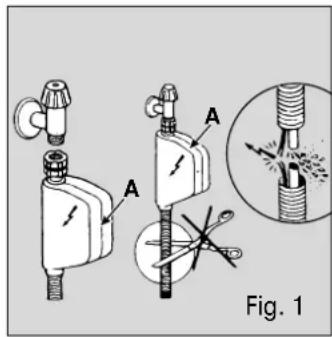
Connect the cold water supply hose to a threaded 3/4 (gas) connector and make sure that it is fastened tightly in place (see figure1).
If the water pipes are new or have not been used for an extended period of time, let the water run to make sure that the water is clear and free of impurities. If this precaution is not taken, there is a risk that the water inlet can get blocked and damage the appliance.
Hot Water Connection
The water supply to the appliance can also be connected to the house's hot water line (centralised system, heating system), as long as it does not exceed a temperature of 60^ C.
In this case, the wash cycle time will be shortened by about 15 minutes and the wash efficiency slightly reduced.
The connection must be made to the hot water line following the same procedures as those for the connection to the cold water line.
Anti-Flooding Protection
The dishwasher is equipped with a system that stops the supply of water in the event of a problem with the water supply hose, or leaks within the unit, in order to prevent damage to your home. If for any reason the box containing the electrical components happens to get damaged, remove the plug for the appliance from the socket immediately. In order to guarantee that the anti-flooding feature operates properly, the "A" box with the water supply hose must be attached to the water supply tap as shown in Fig.1. No other type of connection is acceptable.
The water supply hose must not, under any circumstances, be cut, as it contains electrical parts which are live. If the length of the hose is not adequate to make a proper connection, the hose must be replaced with one which is long enough. This hose is available upon request from specialised retailers and service centres.
text_image
Fig. 1Drain Hose Connection
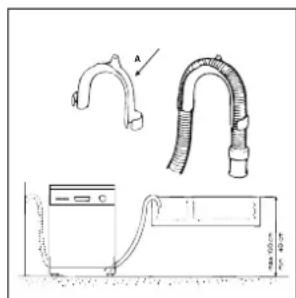
Insert the drain hose into a drain pipe with a minimum diameter of 4 cm., or let it run into the sink, making sure to avoid bending or crimping it. Use the special plastic support that comes with the appliance (see figure to the right). The free end of the hose must be at a height between 40 and 100 cm. and must not be immersed in water.
natural_image
Technical line drawing of a washing machine with attached tubing and a fan (no text or symbols)Attention: The special plastic hose support must be solidly fastened to the wall to prevent the drain hose from moving and allowing water to spill outside the drain.
Electrical Connection
After making sure that the voltage and frequency values for the current in the home correspond to those on the rating plate (located on the stainless steel inner door of the appliance) and that the electrical system is sized for the maximum voltage on the rating plate, insert the plug into an electrical socket which is earthed properly (the earthing of the appliance is a safety requirement mandated by law). If the electrical socket to which the appliance must be connected is not appropriate for the plug, replace the plug, rather than using adaptorors or the like as they could cause overheating and burns.
Should the electricity supply cable be damaged, we recommend that you only contact authorised Technical Service Centres for the replacement.
text_image
A B G N E F DC

Bouton ON - OFF

Voyant ON - OFF

text_image
E G F H I J L K
Panier supérieur

Gicleur supérieur

natural_image
Close-up of a kitchen appliance with a white funnel and metal bowl (no visible text or symbols)natural_image
Technical line drawing of a mechanical component with threaded base and hexagonal base (no text or symbols)natural_image
3D architectural rendering of a modern building complex with curved roof structures (no visible text or symbols)natural_image
Cross-sectional view of a mechanical component with threaded ends and internal cavities (no visible text or symbols)panier supérieur
natural_image
Top-down view of a stainless steel kitchen with multiple circular cutlery and a rack (no visible text or symbols)Chargement 12 couverts standard
panier inférieur
natural_image
Close-up of a mechanical component with two circular components and threaded shafts (no visible text or symbols)panier supérieur
natural_image
Top-down view of a kitchen tray with various food items including sliced onions, rolled dough, and a fork (no text or labels visible)Chargement type usage quotidien
natural_image
Person assembling a wire cage with a labeled diagram (Fig. B), no text or symbols on the diagram itself.natural_image
Technical line drawing of a mechanical component with layered structure (no text or symbols)Mise en service
natural_image
Close-up of a metallic mechanical component with a handle and central slot (no visible text or symbols)natural_image
Diagram of a mechanical component with labeled parts A and B, showing a top view and side view (no text or symbols present)natural_image
Technical line drawing of a washing machine with coiled tubing and a separate air conditioner unit (no text or symbols)text_image
A B G N E F DC

ON/OFF-Taste
text_image
E G F H I J L K
Oberkorb

Oberer Sprüharm

natural_image
Close-up of a kitchen utensil with a white funnel and metal bowl (no visible text or symbols)natural_image
Technical line drawing of a mechanical component with threaded base and hexagonal base (no text or symbols)text_image
Diagram of a device with labeled parts F and C, showing a tool interacting with a component.Wichtig:
natural_image
Illustration of a stylized cityscape with buildings and decorative wings, no visible text or symbolsnatural_image
Close-up of coiled metal components with visible copper wire (no text or symbols)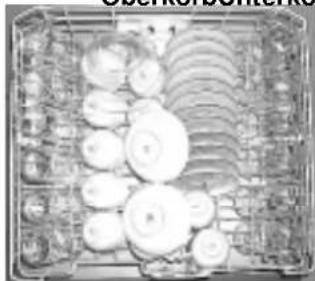
natural_image
Plastic tray with sliced white food items arranged in rows (no visible text or symbols)12 Maßgedecke
Unterkorb
natural_image
Close-up of a mechanical component with two circular features and threaded ends (no visible text or symbols)Oberkorb
natural_image
Top-down view of a kitchen tray with various food items including sliced vegetables, eggplants, and rings (no text or labels visible)natural_image
Technical line drawing of a mechanical component with layered structure and mounting base (no text or symbols)natural_image
Diagram of a mechanical device with a lever and handle, showing internal components without any text or symbols.natural_image
Diagram of a mechanical component with labeled parts A and B, showing a top view of a knob-like structure and a side view of a cylindrical component (no text or symbols present)natural_image
Technical line drawing of a gas washing machine with tubing and control panel (no text or symbols)text_image
E G F H I J L K
Bovenste korf

Bovenste sproeiarm

regelen hoogte korf

Onderste korf

Onderste sproeiarm

Deksel zoutreservoir

Filter

Doseerbakje afwas- en glansmiddel
Technische eigenschappen
natural_image
Close-up of a kitchen sink with a white plastic grater and metal bowl (no visible text or symbols)natural_image
Technical line drawing of a mechanical component with threaded base and hexagonal base (no text or symbols)| Hardheid van het water. | |||||
| ^ FH ^ dH | mmol/l | Keuze positie. | Zout-gebruik.(gram./-ciclo) | Autono-mie(cycles\2-kg) | |
| 0,100, | 170,1,7/0/ | ||||
| 10,2518, | 441,8,4,4 | - | 2060 | ||
| 25,5045, | 894,5,8,9 | MED | 4040 | ||
| >50 | >89 | >8,9 | + | 6025 | |
natural_image
3D architectural rendering of a modern building with symmetrical roof and window-like structure (no visible text or symbols)natural_image
Close-up of coiled metal pipes in a container (no text or symbols visible)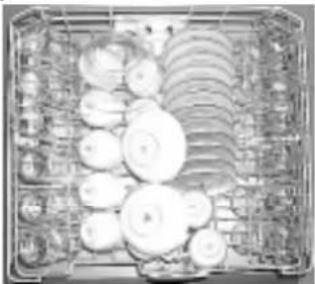
natural_image
Top-down view of a metal tray containing sliced white food items (no text or symbols visible)natural_image
Close-up of a mechanical component with two circular components and threaded ends (no visible text or symbols)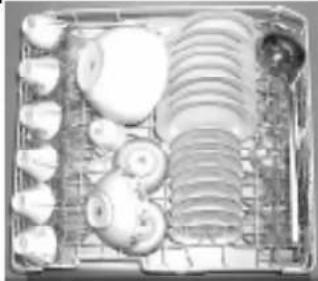
natural_image
Top-down view of a kitchen tray with various kitchen utensils and dish items (no visible text or labels)Dagelijkse lading
text_image
Fig. B 1 2natural_image
Technical line drawing of a mechanical component with layered structure (no text or symbols)natural_image
Line drawing of a kitchen sink with a handle and valve (no text or symbols)natural_image
Diagram of a mechanical component with labeled parts A and B, showing a top view of a knob-like component and a side view of a cylindrical container (no text or symbols present)De vaatwasser mag nooit
natural_image
Technical line drawing of a washing machine with tubing and a fan (no text or symbols)text_image
E G F H I J L K
Canasto superior

Rociador superior

natural_image
Technical line drawing of a mechanical component with concentric layers and mounting base (no text or symbols)natural_image
Close-up of a cleaning machine component with labeled parts (F, C) and tool, no readable text or symbols beyond labelsImportante:
natural_image
Illustration of a modern building with large wings and a central structure, labeled 'A' at bottom right (no text or symbols on buildings)natural_image
Top-down view of a mechanical component with coiled springs and internal components (no visible text or symbols)canasto superior
natural_image
Top-down view of a stainless steel kitchen counter with multiple circular cutlery (no visible text or labels)natural_image
Close-up of a mechanical component with cylindrical and threaded parts (no visible text or symbols)canasto superior
natural_image
Top-down view of a kitchen appliance with sliced onions, bread rolls, and a tray (no text or symbols visible)natural_image
Technical line drawing of a mechanical component with layered structure and mounting features (no text or symbols)natural_image
Simple line drawing of a mechanical device inside a container (no text or symbols)natural_image
Diagram of a mechanical component with labeled parts A and B, showing a top view of a knob-like structure and a side view of a cylindrical component (no text or symbols present)text_image
A A Fig.1text_image
Technical diagram showing air ducts, tubing, and air conditioner unit with labeled componentstext_image
E G F H I J L K
Cesto superior

natural_image
Close-up of a mechanical component with a white funnel and metallic parts (no visible text or symbols)natural_image
Technical line drawing of a mechanical component with threaded base and mounting base (no text or symbols)| Dureza da água | |||||
| ^ F H ^ dH | mmol/l | Posição selector | Consumo sal (gramas-/ciclo) | Auto-nomia (ciclos- 2 kg) | |
| 0,100 | 170,1,7/0/ | ||||
| 10,2518 | 441,8,4,4 | - | 2060 | ||
| 25,5045 | 894,5 | 3,9 MED | 4040 | ||
| >50 | >89 | >8,9 | + | 6025 | |
natural_image
3D architectural rendering of a modern building with symmetrical roof and window-like structure (no visible text or symbols)Come utilizar o cesto superior
natural_image
Cross-sectional view of a mechanical component with coiled springs and internal tubing (no text or symbols visible)canasto superior

natural_image
Top-down view of a metal tray containing sliced food items (no visible text or symbols)natural_image
Close-up of a mechanical component with two circular features and threaded ends (no visible text or symbols)canasto superiorcanasto inferior