Talat - Board game Huch! & Friends - Free user manual and instructions
Find the device manual for free Talat Huch! & Friends in PDF.



| Product type | Board game |
| Brand | Huch! & Friends |
| Model | Talat |
| Number of players | 3 (2 with variant) |
| Recommended age | From 8 years (estimated) |
| Game duration | 20-30 minutes (estimated) |
| Box contents | 3 game boards, 27 wooden towers (9 grey, 9 black, 9 white), 1 rulebook |
| Product dimensions (packaged) | Approximately 30 x 30 x 6 cm (estimated) |
| Product weight | Approximately 500 g (estimated) |
| Power supply | None (non-electronic game) |
| Main functions | Movement and capture of towers on a triangular board, priority rules based on tower size and shape |
| Game mechanics | Placement, movement in straight line or diagonal, capture by larger tower or using the David & Goliath rule |
| Care and cleaning | Clean with a dry or slightly damp cloth. Do not use chemicals. |
| Safety | Contains small parts (towers). Choking hazard for children under 3 years. Do not leave parts within reach of young children. |
| Spare parts and repairability | Individual towers and boards can be replaced by contacting the manufacturer. Spare parts are not available in retail. |
| General information | Author: Bruce Whitehill. Graphic design: HUCH! & friends. Manufacturer: Huch! & Friends. Instructions available in several languages. |
Frequently Asked Questions - Talat Huch! & Friends
User questions about Talat Huch! & Friends
0 question about this device. Answer the ones you know or ask your own.
Ask a new question about this device
Download the instructions for your Board game in PDF format for free! Find your manual Talat - Huch! & Friends and take your electronic device back in hand. On this page are published all the documents necessary for the use of your device. Talat by Huch! & Friends.
USER MANUAL Talat Huch! & Friends
Autor: Bruce Whitehill
Grafik Design: HUCH! & friends
text_image
Calat The Power of ThreeContents
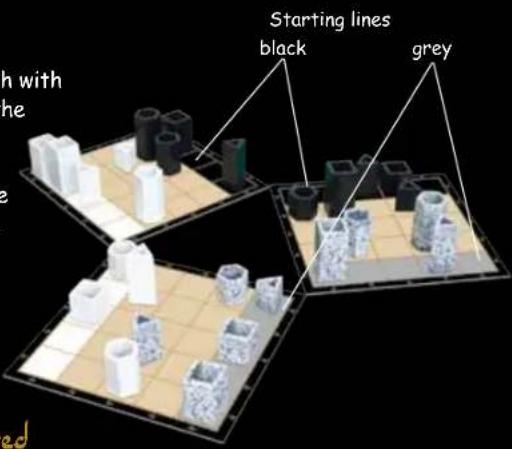
3 game boards, each with
2 starting lines in the players' colours
27 towers
(9 per player, in one of 3 colours: black, white, and grey)
text_image
with he e Starting lines black grey edGetting started
Each player receives 9 towers of his own colour. The game boards are arranged into a triangle so that each player can comfortably reach the starting lines of his two game boards. The oldest player begins. When playing more than one game, the winner of the last game always begins the new one.
Note: If you play Talat as a two-player game, the same basic rules apply, along with the additional rules on page 6.
Order of play
- Setup
- Moving and capturing
- End of game
1. Setup
Players take turns placing one of their 9 towers on the starting spaces of their own starting lines until all towers have been placed. Once all the towers have been placed, each player should have one free space left on one of his starting lines.
Note: Each space may be occupied by one tower only. You have to decide which tower you want to place onto which game board. Once
a tower has been placed on the board, it may not be moved again during the setup phase!
2. Moving and capturing
MOVING
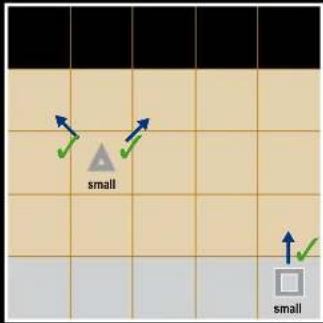
On his turn, a player may move any one of his own towers one space forward, straight ahead or diagonally, to an unoccupied space.
text_image
small small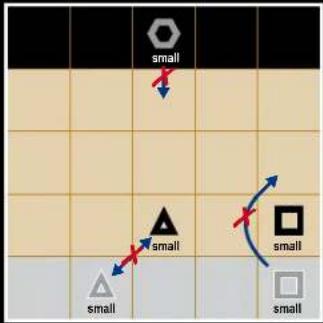
text_image
small small small small small smallNote: You must move on your turn; you are not allowed to pass. You are not allowed to move a tower backwards or jump over another tower. Since you may move only one of your own towers per turn, you may play on only one game board per turn. You do not have to move all your towers from your starting line.
If you move a tower onto an opposing player's starting line, the tower remains in that space unless captured or capturing sideways (see below).
CAPTURING
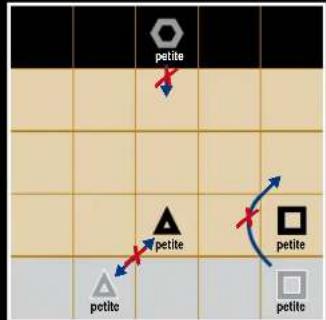
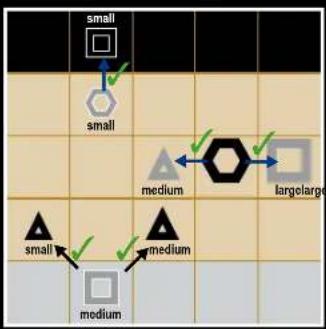
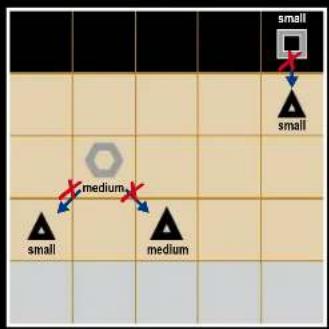
You can capture an opposing tower if it is standing either directly or diagonally in front of one of your towers, or is on either side of it, depending on their sizes and shapes, as explained below:
- A tower can capture any tower that is one level smaller. Therefore, the largest towers can capture any medium sized tower, but not the smallest towers. A medium-sized tower can capture any small tower.
- If two towers are the same height, the tower with more sides can capture the tower with fewer sides. Therefore, towers with six sides can capture towers with four sides or three sides, and four-sided towers can capture three-sided ones.
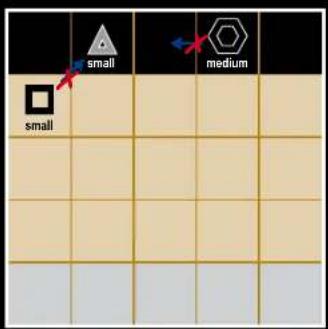
- Thus, a tower cannot capture another tower of the same height with the same number of sides.
- The David-and-Goliath rule: The small three-sided tower can capture the largest six-sided tower.
When you capture a tower, place the captured tower in front of you. Your tower remains on the space that had been occupied by the captured tower.
flowchart
graph TD
    A["small"] --> B["hexagon"]
    B --> C["medium"]
    C --> D["hexagon"]
    D --> E["large"]
    F["small"] --> G["medium"]
    G --> H["hexagon"]
    H --> I["medium"]
    I --> J["hexagon"]
    K["medium"] --> L["hexagon"]
    L --> M["medium"]
    M --> N["hexagon"]
text_image
small small medium mediumCapturing is possible Capturing is not possible
text_image
small medium small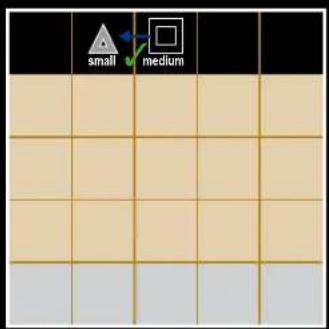
text_image
small mediumThe three-sided tower is safe Black can capture Grey
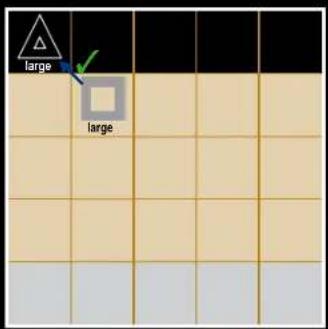
text_image
large large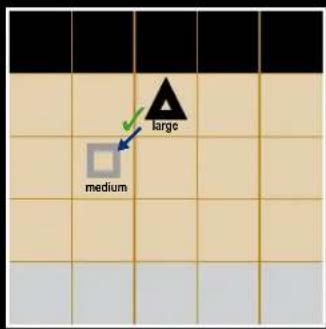
text_image
medium largeGrey can capture Black Black can capture Grey
Note:
You do not have to capture an opponent's tower. You are not allowed to capture one of your own towers. A tower on a player's starting line can still capture or be captured if it is next to an opponent's tower.
3. End of game
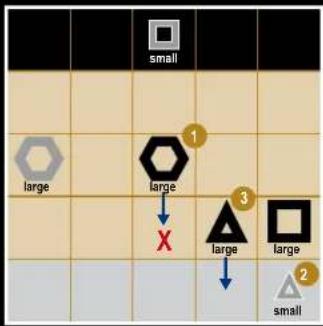
When no more captures are possible on a board, the board is "frozen" and players are no longer allowed to move their towers on that board. (That means, of course, that towers you had hoped to move into your opponent's starting spaces to score may be stopped short of their goal.) When two of the three boards are frozen, the game is over.
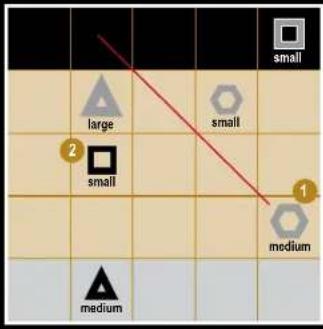
text_image
small large small 2 small 1 medium mediumThe board is frozen. Towers 1 and 2 are too far apart for tower 1 to capture tower 2, even if the two move toward each other.
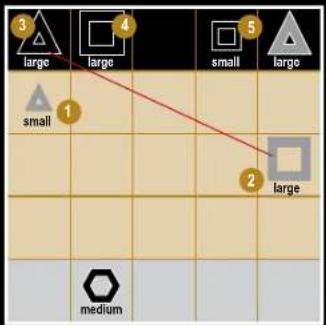
text_image
3 large 4 large 5 small large small 1 2 large mediumThe board is frozen. Tower 2 can no longer capture tower 3, since the tower is too far away. Tower 3 and tower 4 cannot capture tower 1, since the tower is two levels smaller.
text_image
small large large X large large smallTower 1 could theoretically still be captured by tower 2 (David-and-Goliath rule). In order for that to happen, tower 3 would have to move to the space shown by the blue arrow. If tower 1 moves forward to the X, the board is still not frozen, since 1 could theoretically move forward again along the diagonal to the space next to 2. Since the board is not frozen, tower 1 can, instead, move straight forward (not diagonally) into grey's starting area to score. Then the board would be frozen.
Note: If it is still theoretically possible for a tower to be captured on a board, play can continue on that board, even if it means that towers are only moving and not capturing.
Scoring
Every captured tower, irrespective of its shape or size, is worth 5 points. Every tower that ends up on an opponent's starting line is worth an additional 3 points. The player with the most points wins. In the event of a tie, towers are compared. Whoever has captured a tower that ranks higher than those of the other tying player(s), wins the tie. If players are still tied, everybody's a winner!
Calat for two
The game proceeds as described above with the following changes:
Setup
First, the towers of an imaginary third player, the „Zihin" (Arabic for "spirit") are placed on the game board by both players. Taking turns, both players place any one of the Zihin towers on one of the two starting lines of the same colour until 8 Zihin towers have been placed on the game board. The ninth Zihin tower is taken out of the game! In turn, each player now places his own towers, one by one, on one of his own two starting lines, just as in the standard game.
Moving and capturing
The player who places the last tower on the game board begins. Then you take turns. Moving and capturing is just the same as in the three-player game.
On your turn, you have the choice of moving a tower or capturing:
- on the board between you and the Zihin, using your own tower;
- on the board between the Zihin and your opponent, using a Zihin tower;
- on the board between you and your opponent, using your own tower.
Note: Captured towers are placed in front of the player who has captured them, regardless if they were captured with his own tower or with a Zihin tower.
You may not capture your own towers with Zihin towers.
Scoring
Scoring is the same as in the standard game. An additional three points are awarded for each Zihin tower on the opponent's starting line.
Author: Bruce Whitehill
Graphic design: HUCH! & friends
Translation: Birgit Irgang, Bruce & Sybille Whitehill
Acknowledgements: The author wishes to thank his wife Sybille for her advice, playtesting and translation of the game instructions into German.
Manufacturer:
text_image
petlite petlite