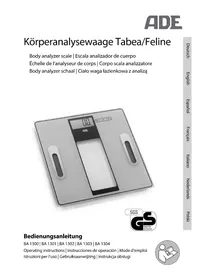
Feline BA 1302 - Scale ADE - Free user manual and instructions
Find the device manual for free Feline BA 1302 ADE in PDF.


| Product type | Body analysis scale |
| Brand | ADE |
| Model | Feline BA 1302 |
| Dimensions | 302 x 302 x 17 mm |
| Maximum capacity | 180 kg |
| Precision | 2 % ± 100 g |
| Graduation (weight and bone mass) | 100 g |
| Graduation (water, muscle mass, body fat) | 0.1 % |
| Power supply | 1 CR2032 battery, 3 V (included) |
| Number of memory cells | 12 |
| Measurement units | kg, lb, st:lb |
| Main functions | Weighing, body fat analysis, body water, muscle mass, bone mass, basal metabolism |
| Age for analysis | 10 to 100 years |
| Height for analysis | 100 to 250 cm |
| Weighing surface | Glass |
| Safety | Do not use by pregnant women, pacemaker wearers, dialysis patients, people with edema or implants; children from 8 years under supervision; do not step on with wet feet; do not overload |
| Cleaning | Wipe with a slightly damp soft cloth; do not immerse; disinfect occasionally |
| Warranty | 3 years (free repair or exchange) |
| Package contents | Bathroom scale, CR2032 battery, user manual |
| Electromagnetic compatibility | EMC Directive 2004/108/EC |
| Disposal | Do not dispose of with household waste; recycle according to local regulations |
Frequently Asked Questions - Feline BA 1302 ADE
User questions about Feline BA 1302 ADE
0 question about this device. Answer the ones you know or ask your own.
Ask a new question about this device
Download the instructions for your Scale in PDF format for free! Find your manual Feline BA 1302 - ADE and take your electronic device back in hand. On this page are published all the documents necessary for the use of your device. Feline BA 1302 by ADE.
USER MANUAL Feline BA 1302 ADE
natural_image
Digital ADE digital balance scale with two side panels and a digital display showing 8.00 g (no text or symbols on the device itself)
natural_image
Icon of a person using a laptop inside a circle (no text or symbols)You have chosen to purchase a high-quality product from the brand ADE, which combines intelligent functions with an exceptional design.
This set of body analyser scales enables you to measure and get to know yourself and your body better.
The many years of experience of the brand ADE ensures a high technical standard and proven quality.
We wish you much enjoyment while weighing yourself and discovering your values!
Your ADE Team
General Information
About this manual

This operating manual describes how to safely use and care for your scales. Keep this operating manual in a safe place in case you would like to refer to it later. If you pass these scales on to someone else, pass on this manual as well. Failure to observe the recommendations in this operating manual can lead to injuries or damage to your scales.
Explanation of symbols

This symbol, combined with the word DANGER, warns against serious injury.

This symbol, combined with the word WARNING, warns against moderate and mild injuries.

This symbol, combined with the word NOTE, warns against material damage.
This symbol signifies additional information and general advice.
Table of Contents
General Information....16
Table of Contents ......17
Intended Use....18
Safety 18
At a glance (scope of delivery) 20
Scope of delivery....20
Start-up 21
This is how your body analyser scales work 21
Measuring your weight....22
Entering personal data....23
Body analysis....23
Changing the battery 26
Cleaning....26
Fault/Remedy....27
Technical Data 28
Declaration of Conformity 28
Guarantee 29
Disposal 29
The bathroom scales is designed for the weighing of people in the home. It is not suitable for use in clinics, medical practices, etc.
Likewise, the body analysis function is designed only for private use. The scales are not suitable for use in the professional sporting sphere.
The maximum carrying capacity of 180 kg must not be exceeded.
Do not use these scales if you ...
- ... are pregnant,
- ... have a cardiac pacemaker,
... are a dialysis patient, - ... suffer from oedema,
- ... have implants, e.g. artificial limbs, metal plates, etc.
If in doubt, consult your GP.
Safety
These scales can be used by children 8 years of age and above, as well as by persons with reduced physical, sensory, or mental capacities or lacking experience and knowledge, if they are supervised or have been instructed in the safe use of the scales and understand the dangers that may arise.
- Children must not play with the scales.
- Cleaning and user maintenance must not be carried out by children, unless they are 8 years of age or older and are being supervised.
- Batteries, when swallowed, can be life-threatening. For this reason, the scales and battery should be kept in a place out of reach of children. If a battery is swallowed, medical assistance must be sought immediately.
DANGER for children
- Keep children away from packaging material. Risk of choking if swallowed. Also beware that children do not pull the packaging material over their heads.
RISK of fire/burning and/or explosion
- There is a risk of explosion if batteries are replaced incorrectly. Replace the battery using only the same or an equivalent type of battery. Pay attention to the "Technical Data".
- Batteries must not be recharged, reactivated by other means, dismantled, thrown into fire, or short-circuited.
- Avoid contact with skin, eyes, and mucosa. If you come into contact with battery acid, flush the affected site immediately with plenty of clean water and see a doctor promptly.
WARNING against risk of injury
- Do not step onto the outer edge of any one side of the scales. Risk of tipping!
- Do not step onto the scales with wet feet or when its surface is damp. Risk of slipping!
- The weighing surface is made of glass. If you fall down, there is a risk of the glass breaking and thus a risk of injury from glass splinters.
BEWARE of material damage
- Place the scales on a stable, even surface.
- Do not overload the scales. Pay attention to the "Technical Data". Place yourself on the scales exclusively for weighing purposes.
- Protect the scales from sharp jolts and vibrations.
- Remove the battery from the scales once it has been used or when you are no longer using the scales. You will thus avoid damage that may result from the leakage of battery acid.
- Pay attention to the correct polarity (+/-) when exchanging the battery.
- Do not subject the battery to any extreme conditions, by – for example – storing it on radiators or under direct sunlight. Increased risk of leakage!
- Clean the battery and device contacts, as needed, before inserting the battery.
- Do not make any modifications to the scales. Only allow repairs to be carried out at a specialist workshop. Repairs carried out incorrectly can considerably endanger the user.
- There are feet on the underside of the scales. Since floor surfaces are made from various materials and are treated with diverse care products, the possibility cannot be completely excluded that some of these substances contain constituents that attack and soften the feet of the device. If necessary, place an anti-slip underlay beneath the scales.
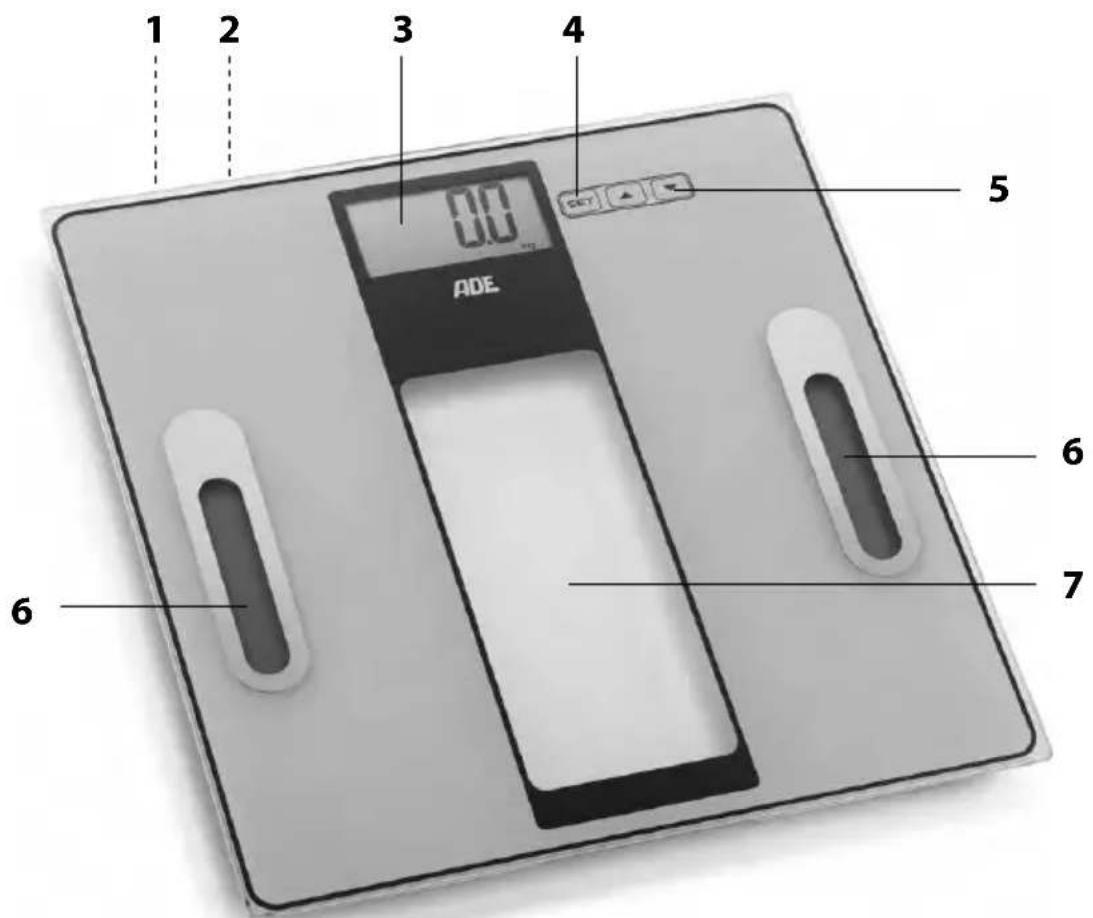
1 Battery compartment (reverse side)
2 kg lb st button (reverse side): Changing the unit of measurement
3 Display
4 SET button: Call up setting mode, store entries, call up stored measurement data
5 Buttons ▲▼Select memory cell, reduce data, increase data
6 Sensor
7 Weighing surface
Scope of delivery
- Bathroom Scales
- Battery Type CR2032, 3= (already inserted)
- Bedienungsanleitung
Symbols on the scales
Auto-on
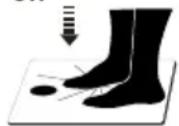
The scales automatically switch on when you step onto the weighing surface with a little force.

WARNING: When the weighing surface is damp, there is a risk of slipping.
Start-up
Removing the iso-strips
When the scales are delivered, the battery is already inserted and fitted with iso-strips to prevent it from discharging ahead of time. In order to start up the scales, you must remove the iso-strips.
The battery compartment is located on the underside of the device.
- With a little force, press on the arrow on the battery compartment cover and push it upwards and off.
- Pull out the iso-strips.
- Push the battery compartment cover back into place.
Choosing the unit of measurement
When the scales are delivered, the unit of measurement is set to "kg" as standard. However, the measurement result can also be displayed in the English units of measurement, "lb" (pound) or "st:lb" (stone:pound).
- Press the kg lb st button next to the battery compartment on the reverse side of the scales repeatedly. Pay attention to the display indicator.
Positioning the scales
- Place the scales on an even, firm, and dry surface. Do not place the scales on carpet.
This is how your body analyser scales work
Your new body analyser scales work using so-called BIA-technology (Bioelectric Impedance Analysis) This involves an undetectable, completely harmless and weak current flowing through your body.
The measurement takes place via sensors that are mounted on the weighing surface.
- The current flows relatively unhindered through the fluid contained in muscle mass.
- In fat mass, the resistance is greater. This resistance is measured.
Together with your personal data (sex, weight, age, and height), the scales calculate the following information about your body composition:
- Weight
- Body fat proportion in %
- Body water in %
- Muscle mass %
- Bone mass (kg), and your daily
- Basal metabolism in Kcal (energy demand)
The scales are equipped with 12 memory cells in total.
Measurement errors
Measurement or calculation errors may arise for the following groups of people during the body analysis:
People who ....
... spend 10 hours or more per week playing sport,
... are professional athletes, body builders, and endurance athletes,
... are over 70 years old.
... are less than 10 years old.
The “normal weighing function” (see next chapter) is not affected by these considerations.
Measuring your weight

For normal weighing – without body analysis – you do not have to input any data.
-
With a little force, step once briefly onto the weighing surface.
"0.0" and the set unit of measurement, e.g. "kg", will be shown on the display. -
Position yourself on the scales. Remain standing still and do not hold on to anything.
The measured weight will be displayed shortly thereafter.
A few seconds after you step off the weighing surface, the scales will switch off automatically.
- Press SET.
On the display, a flashing memory cell number (1-12) will be shown.
-
Using the ▲ or the ▼ button, select the desired memory cell.
-
Press SET.
Using the ▲ or the ▼ button, choose your sex: for male, or for female.
- Press SET.
On the display, the preset value for height (e.g. "165" for cm) will flash.
-
Using the ▲ or the ▼ button, enter your height.
-
Press SET.
On the display, the preset value for age (preset: 25) will flash.
-
Using the ▲ or the ▼ button, enter your age.
-
Finally, press SET. You have thus entered the required data.
On the display, a memory cell number will flash again and you can proceed, as previously described, and enter the data of another person.
Or wait a few seconds until "0.0" is shown on the display and you can undertake your body analysis.
If you do nothing else, the scales will automatically switch off after a few seconds.

- If you hold down the or the button, the forward and backward flow of the displayed data will occur more quickly.
- Entered data can only be overwritten by making a new entry.
Body analysis
- Body analysis is only possible if your data has been entered (see previous chapter).
-
See the chapter "Weighing Tips".
-
Briefly press SET, in order to switch the scales on.
- Using the ▲ or the ▼ button, select the memory cell in which you have recorded your personal body data.
The data is briefly displayed, then "0.0" and the selected unit of measurement, e.g. "kg".
- Position yourself barefoot on the scales. Remain standing still and do not hold on to anything.
– In doing so, ensure each foot is placed on a sensor.
- There must be no contact between your feet, your legs, your calves, or your thighs. Otherwise, the measurement will be imprecise.
The measured weight will be displayed shortly thereafter. The indicator "o" then runs across the display; the body analysis is being carried out. Remain standing still.
Your measured values will then be shown to you repeatedly on the display:
Symbol Meaning
- Your body weight in the set unit of measurement
- Your body fat proportion in % with simultaneous evaluation indicator:
$$ \text { _ } i = \text { too little body fat } $$
$$ \text { iii } = \text { slender } $$
$$ \text { iii } = \text { normal } $$
$$ \text { iii } = \text { too much body fat } $$
$$ \text { iii } = \text { obese } $$
- ≈ Your body water in %
- Your muscle mass in %
- Your bone mass in kg
- KCAL Your basal metabolism in kcal
Calling up stored values
After an analysis has been performed, you can display the values of your last measurements at any time.
- Press SET and select your memory cell.
The memory cell indicator stops flashing after a few seconds and the indicator "0.0" appears on the display, as well as the unit of measurement, e.g. "kg". - By pressing ▲ or ▼ once, select the automatic display or, by repeatedly pressing ▲ or ▼, select the manual display of the last set of measurements.
- Press SET in order to switch the scales back into analysis mode.
Weighing tips
- Weighing for the body analysis can only be carried out barefoot. In doing so, your feet should only be lightly moistened. Completely dry feet can lead to false results, since the electrical conductivity will then poor.
- During the measuring process, stand still and do not hold onto anything.
- Do not weigh yourself directly after unusual physical exertion.
- Do not weigh yourself immediately after standing up. Wait approximately fifteen minutes. In this time, the water is able to distribute through your body.
- Always attempt to weigh yourself at the same time, in order to obtain comparable values.
Notes on the ascertained values
The proportion of body fat gives the amount of fat as a percentage of the total weight of the body. A blanket recommendation for this value does not exist, since this depends significantly on sex (because of different physiques) and age.
Body fat is vital for day-to-day body function. It protects organs, cushions joints, regulates body temperature, stores vitamins, and serves the body as an energy store.
For women, a body fat proportion between 10% and 13% is essential; for men, between 2% and 5% with the exception of competitive sportsmen.
The proportion of body fat is not an unambiguous indicator of health. Excessive body weight and a too-high proportion of body fat are being linked with the appearance of many diseases of affluence such as diabetes, cardiovascular illnesses, etc.
Physical inactivity and poor diet are often triggers for these diseases. There is a clear causal connection between excess weight and physical inactivity.
A considerable part of the human body consists of water. This body water is variably distributed throughout the whole body. Lean muscle tissue contains about 75% water, blood around 83% water, body fat approx. 25% water and bones have a water proportion of about 22%.
- In men approx. 60% of body mass consists of water.
- In women, that value lies around 55% (determined by a higher proportion of body fat).
Of this total body water approx. two thirds is stored in the cells and is therefore called intracellular water. The other third is extracellular water.
For muscle mass there are no universal standard values.
| Women | |||||
| Age Body fat Body water | |||||
| Slender Normal | Slightly overweight | Overweight Normal | |||
| 10-16 < 18 | % 18-28 % | 29-35 % > | 35 % 57-67 % | ||
| 17-39 < 20 | % 20-32 % | 33-38 % > | 38 % 47-57 % | ||
| 40-55 < 23 | % 23-35 % | 36-41 % >41 % | 42-52 % | ||
| 56-85 < 24 | % 24-36 % | 37-42 % >42 % | 37-47 % | ||
| Men | |||||
| Age Body fat Body water | |||||
| Slender Normal | Slightly overweight | Overweight Normal | |||
| 10-16 < 10 | % 10-18 % | 19-23 % > | 23 % 58-72 % | ||
| 17-39 < 12 | % 12-20 % | 21-25 % > | 25 % 53-67 % | ||
| 40-55 < 13 | % 13-21 % | 22-26 % > | 26 % 47-61 % | ||
| 56-85 < 14 | % 14-22 % | 23-27 % > | 27 % 42-56 % | ||
Changing the battery
A battery change is necessary when "Lo" or nothing at all is shown on the display.
When changing the battery, bear the following in mind:
- The data that has been ascertained and entered up to that point remains stored on the scales.
- Only use the type of battery that is specified in the "Technical Data".
- Pay attention to the correct polarity (+/-) when inserting the battery. The plus pole (+) must point upwards.
- Dispose of the old battery in an environmentally responsible way (see "Disposal").
Cleaning

NOTE on material damage
- Do not immerse the scales in water or other liquids.
- Do not under any circumstances use harsh, scraping, or abrasive cleaning agents or the like to clean the scales. If you do, the surface could be scratched.
- Wipe down the scales as needed using a lightly dampened, soft cloth.
- Disinfect the weighing surface and the sensors from time to time using a suitable disinfecting agent (available at specialist retailers and pharmacies).
Fault/Remedy
| Fault Possible Cause | |
| No function | Battery empty or inserted the wrong way around? |
| The scales appear to be displaying false weighing results | Are the scales standing on a firm, even surface?Is a device that can cause electromagnetic disturbances located in the vicinity of the scales?Remove the battery from the scales and wait a moment. Reinsert the battery. The data stored up to this point will be retained. |
| “Err” is shown on the display | The maximum capacity of the scales (180 kg) has been exceeded. |
| “Lo” is shown on the display | The battery is empty (see “Changing the battery”). |
| “ErrL” is shown on the display | The fat proportion % is too low: Below 4% nothing can be displayed |
| “ErrH” is shown on the display | The fat proportion % is too high: Above 60% nothing can be displayed. |
| “C” is shown on the display | The weighing/measurement process was faulty: The scales are not standing stably or you are not standing still on the weighing surface during weighing. |
Model: Body Analyser Scales BA 1300
Battery: 1x CR2032/3 V
Rated current: < 3 mA
Measuring range: max. 180 kg
Variance: 2% +/- 100 g
Indicator intervals
Weight and bone mass: 100 g
Body water, muscle mass, and 0.1%
body fat:
Memory cells: 12
Age input: 10-100 years
Height: 100-250 cm
Dimensions of scales: approx. 302 x 302 x 17 mm
Distributor: Waagen-Schmitt GmbH
(no service address) Hammer Steindamm 27-29
D-22089 Hamburg
Our products are constantly being developed and improved.
For this reason, design and technical modifications are possible at any time.
Declaration of Conformity
These scales have been manufactured in accordance with the harmonised European standards. It conforms to the provisions of the EC directives cited below:
- EMC Directive 2004/108/EC regarding electromagnetic compatibility
- RoHS Directive 2011/65/EC
in the currently valid versions.
This declaration loses its validity if modifications are made to the scale without our approval.
Hamburg, January 2014
Waagen-Schmitt GmbH
Hammer Steindamm 27-29
D-22089 Hamburg
CE
Guarantee
The company Waagen-Schmitt GmbH guarantees for 3 years from the purchase date the cost-free rectification of defects on the basis of material or fabrication errors through repair or exchange.
In the event of a guarantee claim, please return the scales with the proof of purchase (stipulating the reason for claim) to your dealer.
Disposal
Disposing of the packaging

Dispose of the packaging with similar materials. Put cardboard with waste paper, films with recyclable materials.
Disposing of the scales
Dispose of the scales in accordance with the regulations that apply in your country.
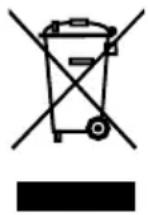
Devices must not be disposed of in normal household waste.
At the end of its life, the scales must be disposed of in an appropriate way. In this way, valuable materials contained in the device will be recycled and the burden on the environment avoided. Hand in the old device at a collection point for electronic waste or at a recycling depot.
For more information, contact your local waste disposal firm or your local administrative body.

Recyclable and disposable batteries do not belong in household waste.
All batteries must be handed in at a collection point in your community, suburb, or at the retailer. Such batteries can thus be disposed of in an environmentally friendly way.
Batteries that contain harmful substances are labelled as follows: Cd for cadmium, Pb for lead.
¡Estimado cliente!
Storing/Oplossing....83
- General Information
- About this manual
- Explanation of symbols
- Table of Contents
- Safety
- DANGER for children
- RISK of fire/burning and/or explosion
- WARNING against risk of injury
- BEWARE of material damage
- Scope of delivery
- Symbols on the scales
- Start-up
- Removing the iso-strips
- Choosing the unit of measurement
- Positioning the scales
- This is how your body analyser scales work
- Measurement errors
- Measuring your weight
- Body analysis
- Symbol Meaning
- Calling up stored values
- Weighing tips
- Notes on the ascertained values
- Changing the battery
- Cleaning
- NOTE on material damage
- Fault/Remedy
- Declaration of Conformity
- Guarantee
- Disposal
- Disposing of the packaging
- Disposing of the scales
- Devices must not be disposed of in normal household waste.
- Recyclable and disposable batteries do not belong in household waste.
- ¡Estimado cliente!
Brand : ADE
Model : Feline BA 1302
Category : Scale