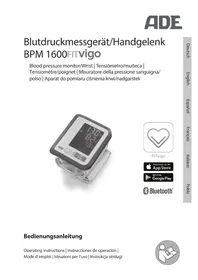
FITvigo BPM 1600 - Sphygmomanometer ADE - Free user manual and instructions
Find the device manual for free FITvigo BPM 1600 ADE in PDF.


| Product type | Wrist blood pressure monitor |
| Dimensions | 80 × 73 × 13 mm |
| Weight | Approx. 110 g |
| Power supply | Lithium-ion battery 3.7 V / 420 mAh, rechargeable via USB |
| Measurement method | Oscillometric, cuff inflation |
| Blood pressure measurement range | 0‑300 mmHg (0‑40 kPa) |
| Blood pressure accuracy | ± 3 mmHg between 5 and 40 °C |
| Pulse measurement range | 40‑199 beats/min |
| Pulse accuracy | ± 5% |
| Internal memory | 60 measurements |
| Connectivity | Bluetooth® 4.2 (2402‑2480 MHz, range 10 m) |
| Mobile application | FITvigo (iOS/Android) |
| Main functions | Systolic/diastolic blood pressure measurement, pulse, arrhythmia detection (IHB), WHO classification, date/time, automatic shut-off |
| Operating conditions | Temperature 5‑40 °C, atmospheric pressure 86‑106 kPa |
| Care and cleaning | Clean with a slightly damp soft cloth; disinfect the cuff with a suitable disinfectant |
| Safety | Applied part type BF; non-removable battery; do not disassemble; avoid strong electric fields; do not use on wounds or arms with arteriovenous shunt |
| Spare parts and repairability | Battery not replaceable by user; repairs only by customer service or specialized workshop; expected lifespan 3 years |
| Protection rating | IP22 (protected against solid foreign objects ≥12 mm and vertical dripping) |
| Warranty | 2 years from date of purchase (material or manufacturing defects) |
| Package contents | Blood pressure monitor, USB cable, instruction manual |
Frequently Asked Questions - FITvigo BPM 1600 ADE
User questions about FITvigo BPM 1600 ADE
0 question about this device. Answer the ones you know or ask your own.
Ask a new question about this device
Download the instructions for your Sphygmomanometer in PDF format for free! Find your manual FITvigo BPM 1600 - ADE and take your electronic device back in hand. On this page are published all the documents necessary for the use of your device. FITvigo BPM 1600 by ADE.
USER MANUAL FITvigo BPM 1600 ADE
22089 Hamburg, Germany
22089 Hamburg, Germany
You have chosen to purchase a product from the FITvigo program from ADE: Activity trackers, bathroom and body analyser scales, as well as blood pressure monitors are equipped with a Bluetooth® function in order to transfer all data to the FITvigo app. FITvigo is free and, alongside clear progress monitoring, offers additional motivation and stimulation for more well-being. At the same time, the many years of experience of the brand ADE guarantee the high quality of the product and the app.
We hope you enjoy your FITvigo product.
Your ADE Team
General Information
About this manual

This manual describes the safe handling and maintenance of the item.
Please keep this user guide for future reference. If you pass this item on to someone else, pass on this manual as well.
Failure to observe the recommendations in this operating manual can lead to injuries or damage to your product.
Explanation of symbols
The following symbols may appear in this manual:
This symbol, combined with the word DANGER, warns against serious injury.

This symbol, combined with the word WARNING, warns against moderate and mild injuries.

This symbol, combined with the word NOTE, warns against material damage.
This symbol signifies additional information and general advice.

Follow the manual

The product complies with Medical Device Directive 93/42/EEC (see chapter "Declaration of Conformity").

Manufacturer
Date of manufacture
SN
Serial number

For indoor use only

Type BF applied part

Contains RF transmitter

Class II equipment

Direct current
Disposal in accordance with EC Directive on Waste Electrical and Electronic Equipment (WEEE)
Table of Contents
General Information 22
Intended Use 25
Safety 25
What the Blood Pressure Monitor provides. 27
Scope of Delivery. 27
Overview 28
Display Indications 29
Start-up 30
Measuring Blood Pressure. 31
Using Data Transfer/FITvigo App. 34
Using measured Values stored on the Device. 34
General Information on Blood Pressure 35
Cleaning 37
Storage 37
Fault/Remedy 38
Technical Data 39
Declaration of Conformity 40
Guarantee 40
Disposal 41
Intended Use
This device is used for blood pressure/pulse measurement on the wrist of adults.
The device is intended for private use and is not suitable for commercial application in medical practices, clinics, etc.
The service life of the blood pressure monitor is up to 3 years when used as intended.
Safety
Children must not play with the item.
- The device contains a lithium-ion battery. Avoid dismantling, throwing into fire or short-circuiting the battery. Risk of explosion! Protect the built-in battery from excessive heat. The battery is firmly installed in the device and cannot and must not be replaced or removed. Improper removal of the battery may result in a risk of explosion. If the battery is defective, contact the service centre or a specialist workshop.
- Turn the device on only when the cuff is fastened on the wrist. Otherwise, the cuff will be damaged.
DANGER for Children
- Keep children away from packaging material. Risk of choking if swallowed. Also pay attention that children do not pull the packaging material over their heads.
BEWARE of material damage
- Protect the blood pressure monitor from strong impacts, vibrations, direct sunlight, as well as dirt and moisture.
- Do not make any modifications to the item. Have repairs carried out only by our service centre or a specialist workshop. Repairs carried out incorrectly can considerably endanger the user.
WARNING of health-related restrictions
-
In the following cases, interruption and impairment of the blood circulation may occur, due to which the patient may be injured:
-
Too many successive measurements.
-
Application and inflation of the cuff on a wrist with an AV shunt.
-
Inflation of the cuff on the wrist on the side, where a mastectomy was carried out.
-
Do not place the cuff on a wound as this may cause further injury.
-
Frequent use over a short period of time may cause impairment of the blood circulation.
- Sensitive persons such as pregnant women, patients with late toxicosis, electronic medical implants, patients with atrial fibrillation (AF), ventricular extrasystoles, or peripheral arterial occlusive disease should consult their physician before using the device.
Electric shock hazard
Measurements can be faulty in the vicinity of strong electric fields. Therefore, do not carry out measurements near high-voltage lines, microwave devices, TV sets, and mobile phones.
Important information on "measurements"
- The values measured by you are for your own information and are not substitutes for medical examination.
- Do not take any therapeutic steps on the basis of measurements you've made yourself.
- Do not change the dosage of a medication prescribed by your physician based on a measurement and discuss the measured values with your physician.
- Measure your blood pressure 3 times a day for a week and before taking medication to ensure a comparability of the values.
- Have a rest for about 5 minutes before each measurement. You should also wait 5 minutes between 2 measurements.
- Initially take at least one measurement on each arm and compare the values. Use the arm with the higher measurement results for all future measurements.
-
If the blood flow in the arm is restricted due to chronic or acute vascular diseases (e.g., vessel constrictions), the accuracy of measurement will be restricted.
-
Inaccurate measurements may result in case of:
-
Cardiovascular diseases,
- Very low blood pressure,
- Circulation and rhythm disturbances.
In such cases, consult your physician before using the blood pressure monitor.
- User memory for 60 measurements on the device; unrestricted management of measurement results in the app
Data transfer to the FITvigo app vbluetooth - Measurement of blood pressure data (systolic and diastolic) on the wrist
Measurement of pulse rate - Indication of irregularities of the heartbeat (arrhythmia warning)
Measurement during inflation - Oscillometric measurement process, i.e. through the oscillation of the pulsing blood
- Classification of measured values according to pre-defined values compliant with the WHO*
-
Indication of date and time
Automatic power-off
Battery status indicator -
See also the chapter "Standard Blood Pressure Classification" below in this manual
Scope of Delivery
Blood pressure monitor
USB connection cable
- Operating instructions
- You can download the "FITvigo" app for free from the internet, see "Install App".
- Remove the protective film from the display.
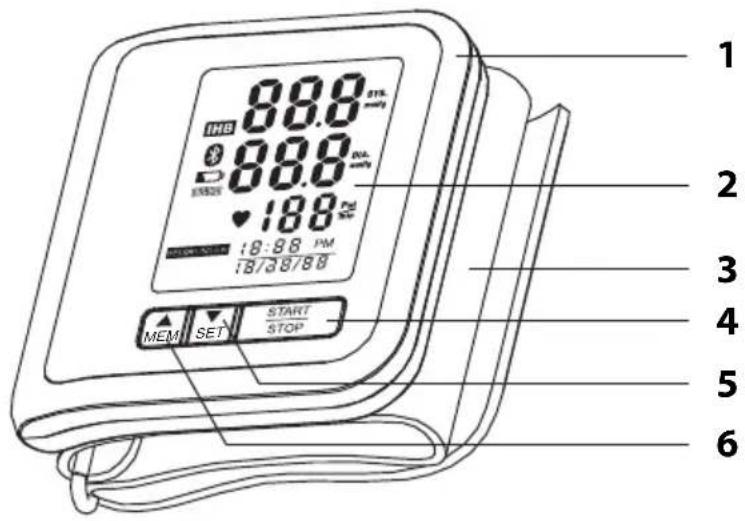
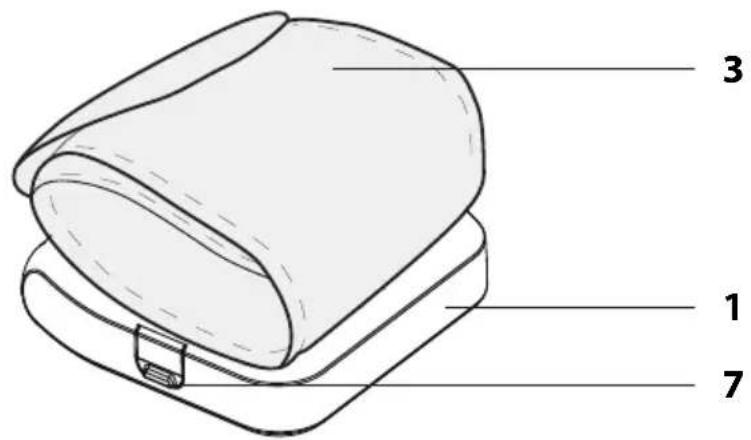
1 Housing
2 Display
3 Cuff
4 START-, STOP-andBluetooth® button
5 SET button for settings and for decreasing values
6 MEM button for storing and for increasing values
7 USB connector
Not depicted: USB connection cable
- Pull the protective film off the display.
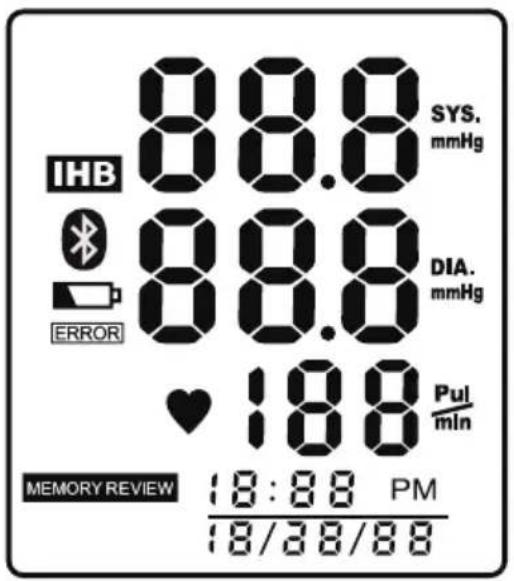
Symbol Function Description
| IHB | IHB indicator (arrhythmia) | Heartbeat monitoring for irregular heartbeat |
| Bluetooth® symbol | Successful Bluetooth® connection | |
| Battery low The battery is low and needs to be charged | ||
| Failure An error has occurred | ||
| Pulse recognition | Displays your heartbeat, as long as it is recognised | |
| Memory Review | Data storage Data saved successfully | |
| SYS. mmHg | Systolic blood pressure | Upper blood pressure value with unit of measurement |
| DIA. mmHg | Diastolic blood pressure | Lower blood pressure value with unit of measurement |
| Pulse min | Pulse Pulse beats/minute | |
| 18:88 PM Time and Date Hour/Minute (Month/Day/Year) | ||
Charging the battery
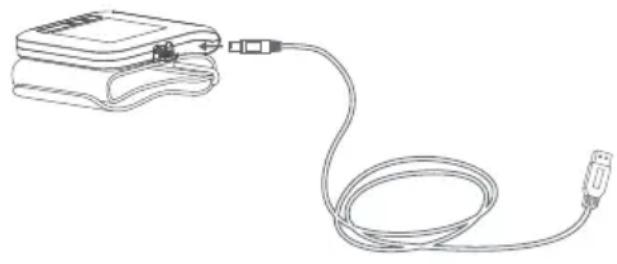
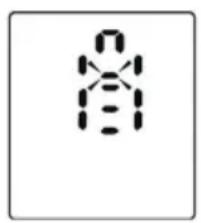
- To enable the display, briefly press and hold the two grey MEM and SET buttons.
- Connect the supplied USB cable to the USB connector of the blood pressure monitor and to the USB port of a computer (PC, tablet, notebook) or a USB charging device.
Observe the contacts of the USB connector and the charging icon on the display.
Do not use the device while it is charging.
As soon as the battery icon on the display no longer flashes, the battery is fully charged and the blood pressure monitor is ready for use.
Set time and date
- Press and hold the SET button until the hour indicator flashes on the display.
- Set the current hour-time using the / MEM button. The time is set using the 12-hour system: The afternoon hours are displayed with "PM".
- Press the /SET button to store the set hour-time.
- Proceed as described in order to set the following values in succession: Hours > Minutes > Month > Day > Year.
- Finally, press /SET.
As soon as "done" appears on the display, the process is complete.
The device switches off after approx. 60 seconds. Please leave it switched off.
Install app
- Make sure your smartphone is connected to the internet.
- Download the "FITvigo" app in the Apple App Store (iOS) or Google Play Store (Android).
- Depending on the settings of your smartphone, additional costs may be incurred for the internet connection or data transfer.
We recommend downloading over a wireless network. - You can also use the blood pressure monitor with all functions without the app.
Connect the device to the app (pairing)
- Activate Bluetooth® on your smartphone.
- Start the app and follow the instructions. Pay attention to the information and explanations displayed.
The blood pressure monitor will be connected to the FITvigo app after a short while.
Measuring Blood Pressure
Before you measure
In order to obtain meaningful values and as correct measurement results as possible, please note the following:
Measure your blood pressure several times a day, preferably at the same time.
- Always carry out the measurements under the same conditions, and always use the same arm, in order to get comparable results.
- Measure in a relaxed condition and try to relax 5 minutes before measuring.
- Avoid physical work approximately one hour before measuring.
-
Do not smoke or drink alcohol before measuring your blood pressure.
Measure your blood pressure at normal body temperature. -
If the result of a measurement deviates greatly from the usual measurement results, carry out another measurement. However, in any case wait approximately five minutes before repeating the measurement.
- Do not inflate the cuff on the same arm where another medical measurement device has already been placed as this may result in temporary malfunction of this device.
- Please also refer to the section "General Information on Blood Pressure".
Apply the blood pressure monitor
-
If your physician has diagnosed a weak blood circulation in one of your wrists, use the other wrist.
-
If applicable, remove your watch, bracelets etc. from the wrist you want to place the blood pressure monitor on. If necessary also loosely pull up your sleeve.
-
Stick your hand through the open cuff so that the blood pressure monitor points to the inside of your open hand (upwards).
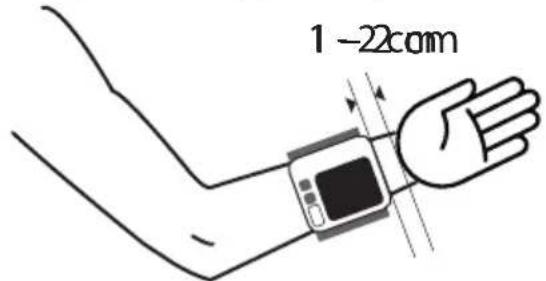
-
Place the edge of the cuff 1 - 2cm below the hand edge, as shown in the figure.
-
With your hand open, fasten the cuff around your wrist so that there is no additional space between the cuff and your skin.
If the cuff is not tight enough, there will be inaccurate measurement results.
Take posture
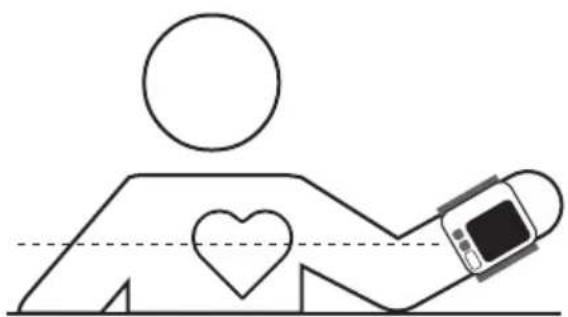
The measurement is carried out while sitting. During the measurement:
- Sit comfortably before measuring blood pressure. Lean back and rest your arms.
- Place your feet flat on the floor.
- Bend the arm with the blood pressure monitor till the cuff is at heart level.
- Do not move and do not speak.
In any case, make sure that the cuff is at the level of your heart during the measurement.
Start measurement
Inflation of the cuff results in a short constriction of the wrist. This can feel a little unpleasant, but is generally absolutely safe. The measurement process takes only a short while.
- To start the measurement, press the START/STOP button.
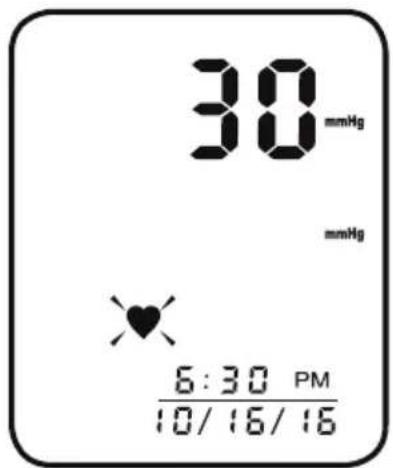
The cuff is filled with air; shortly thereafter the pulse rate will be displayed.
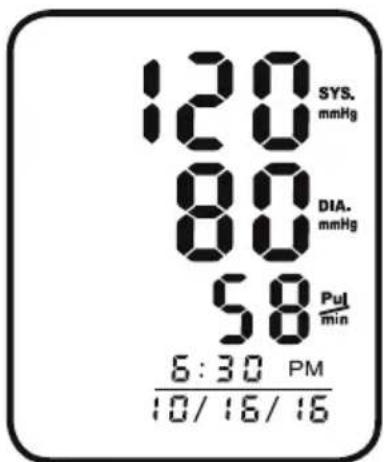
The measurement result will be displayed a few seconds later.
If you have paired the blood pressure monitor to the app, the measured data will then be transferred to the FitVigo app via Bluetooth®, see next chapter.
- Remove the cuff once it has been automatically deflated.
- To turn off the blood pressure monitor, press the START/STOP button. Otherwise, the device will turn off automatically in a minute.
Information on the measurement results can be found in the chapter "General Information on Blood Pressure".
If the blood pressure monitor is successfully connected to your smartphone, the measurement data will be automatically transferred to the app via Bluetooth®.
Note the displayed symbols:

ERROR
Flashes: Data is being transmitted
Permanent display + "done": Data transfer successful
Data transfer failed. The current measurement data are temporarily stored on the blood pressure monitor and will be transferred to your smartphone together with the next measurement.
Abide by the following points in order to prevent possible transmission problems:
- The distance between the blood pressure monitor and your smartphone should not exceed 10m .
- There should be no obstacles between the blood pressure monitor and the smartphone.
- Other electronic devices (especially those witBluetooth® transfer or sending) should be at least 1 meter away from the blood pressure monitor.
- Make sure that Bluetooth® is enabled on your smartphone.
Using measured Values stored on the Device
Access stored measured values
Max. 60 measurements are stored on the device. In the app, however, the storage capacity is theoretically unlimited.
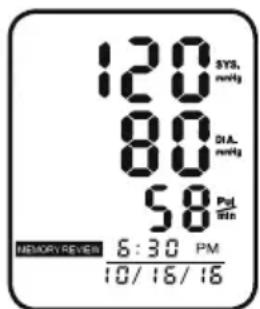
- Press the MEM button while the device is off. The display shows the result of the last measurement.
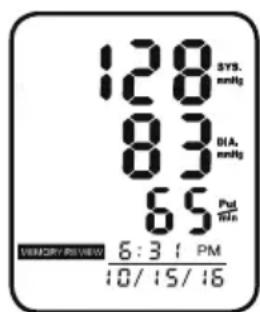
- Use the MEM or /SE button to scroll forward or backward through the stored data.
The latest record is always displayed first.
Each new measurement is preceded by the previous measurement and stored in memory location # 1. If all memory locations are occupied, the last value with the number 60 will be deleted automatically.
Deleting stored values
- Access the stored measured values (MEMORY REVIEW)
- Press the / MEM and SET buttons simultaneously, until "dEL" and "done" are shown on the display.
All measured values stored on the device are deleted.
To cancel the deletion and exit the MEMORY REVIEWess the START/STOP button
General Information on Blood Pressure
Systolic and diastolic blood pressure
Blood pressure usually refers to the systemic blood pressure. It is the pressure produced by the cardiac muscle and exerted by blood against the artery walls.
The blood pressure is indicated as a pair of numbers and and consists of
- the systolic blood pressure; and
- the diastolic blood pressure.
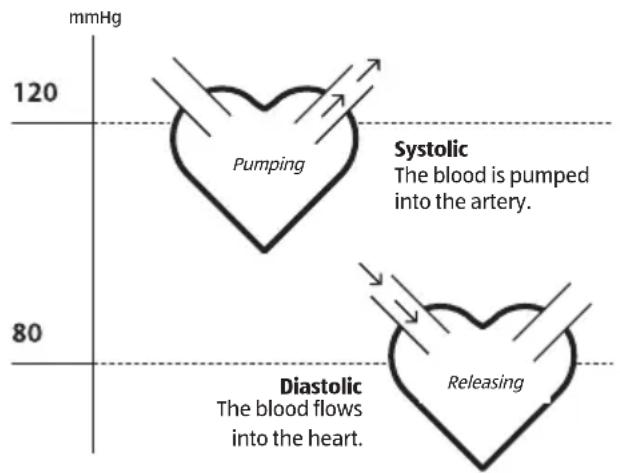
The result of a blood pressure measurement can be commonly referred to as, e.g., "120 to 80".
-
The first number (120) is the systolic blood pressure. It is the highest value produced when the cardiac muscle pumps the blood into the arteries. This is the tension and ejection phase of the heart.
-
The second number (80) represents the diastolic blood pressure. It is the lowest value produced in between the two strokes, the so-called relaxation and filling phase of the heart.
Advantages of self-measurement
Even just the sight of a physician dressed in white can cause a higher blood pressure, especially in anxious people. It is also difficult to draw medical conclusions from a single blood pressure measurement.
It can therefore be useful to carry out the measurements at home in a calm atmosphere and to record the measurements over a longer period of time. This will give you an impression of your actual blood pressure.
The values measured by you are for your own information and are no substitutes for medical examination.
Do not take any therapeutic steps based on the measurements you've made yourself.
Do not change the dosage of a medication prescribed by your physician based on a measurement and discuss the measured values with your physician.
Standard blood pressure classification
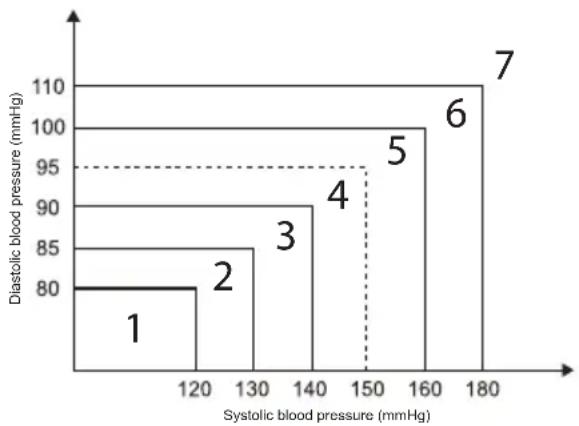
The blood pressure classification published by the World Health Organization (WHO) and the International Society of Hypertension (ISH) in 1999 looks as shown below.
1 = Optimal blood pressure
2 = Normal blood pressure
3 = High normal blood pressure
4 = Dividing line (dashed)
5 = Mild hypertension (Grade 1)
6 = Moderate hypertension (Grade 2)
7 = Severe hypertension (Grade 3)
| Blood pressure in mmHg | Low N | Normal | High-normal | Mild hypertension | Moderate hypertension | Severe hypertension |
| SYS < 1 | 00 101 - | 129 130 - | 139 140 - | 59 160 - 179 ≥ 1 | 80 | |
| DIA < 6 | 0 61 - 84 | 85 - 89 90 | - 99 100 - | 109 ≥ 110 |
Irregular heartbeat
This blood pressure monitor has an intelligent IHB (Irregular Heart-Beat Detector) which is used to detect irregular heartbeats. With every measurement, the IHB charts your heartbeat intervals and calculates the standard deviation.
If the calculated value is greater than or equal to 15, the IHB symbol IHB appears on the display together with the measurement result.
Pay attention to the following:
- The IHB symbol indicates that during the measurement a pulse irregularity was detected in conjunction with an irregular heartbeat.
- You are advised to seek medical advice. Note that the device does not replace the examination of the cardiovascular system, but can detect irregular pulse at an early stage.
Cleaning

NOTE on material damage
- Do not immerse the device in water or other liquids.
-
Under no circumstances use hard, scratching, or abrasive cleaning agents or the like in order to clean the device. If you do, the surface could be scratched.
-
Wipe the blood pressure monitor and the accessories as needed with a slightly wet cloth.
- Disinfect the cuff with some disinfectant (commercially available) from time to time.
Storage
- Ideally, keep the device and the accessories in the original packing.
- Never place heavy objects on top of the device and/or accessories.
Fault/Remedy
| Fault Possible Cause | |
| No function | • Is the battery completely charged? |
| The blood pressure monitor apparently shows wrong measurement results. | • Repeat the measurement in five minutes. |
| Display "E1". | • The cuff is loose. Fasten the cuff and repeat the measurement. |
| Display "E2". | • The cuff is too tight. Re-fasten the cuff and repeat the measurement. |
| Display "E3". | • Relax for a moment and repeat the measurement. |
| Display "E10" or "E11". | • Movements can affect the measurement. Relax for a moment and repeat the measurement. |
| Display "E20". | • Ease your wrist completely and repeat the measurement. |
| Display "E21". | • Apparently wrong measurement. Repeat the measurement. |
| Display "Eexx". | • A calibration error has occurred. Repeat the measurement. If the problem persists, please contact the dealer where you bought the device. |
| + "Lo" is shown on the display. | • The battery is empty and must be charged; see "Charging the Battery". |
| "Eighthown on the display. Data transmission has failed. | • Has bluetooth® been activated on your smartphone? • Is the FITvigo app active? • Was the distance between the blood pressure monitor and smartphone too large? Max. distance: 10 m. |
Further information on the FITvigo app can be found online at www.fitvigo.de
Do you need help or do you have additional questions?
Then please send us an email at: support@fitvigo.de
Model: Blood pressure monitor/Wrist BPM 1600
Software Version: V01
Battery: 3.7V / 420mAh lithium-ion battery
Charging via USB interface
Rated current: ≤ 400mA
Measurement mode: Oscillographic test method
Measuring range: Blood pressure: 0 - 40kPa (0 300mmHg)
Pulse value: (40 - 199) pulse beats/minute
Accuracy of blood pressure: At 5^ - 40^ : within ± 0.4kPa (3 mmHg)
At 0^ - 45^ (but outside of 5^ - 40^ ):
within ± 0.7kPa (5 mmHg); Pulse rate: ± 5%
Operating conditions: Temperature: 5^ - 40^
Relative humidity: ≤ 85%
Air pressure: 86 - 106 kPa
Storage and Transport
Conditions:
Temperature: -20^ - + 60^
Relative humidity: 10 - 93%
Air pressure: 50 - 106kPa
Blood pressure monitor
dimensions:
Weight: approx. 110 g
Dimensions: approx. 80 × 73 × 13 mm
Mode of operation: Continuous operation
Protection class: Type BF applied part
IP class IP 22
Protected against foreign bodies ≥ 12mm
and against vertically dripping water
Device classification: Battery operation: ME device with internal power
supply via USB connection
Bluetooth®: Bluetooth® Module No.: AW2540MV1
Frequency: 2402 MHz to 2480 MHz
Maximum transmission power: -1 dBm
Supply voltage: 2V - 3.6V
Range: 10 metres
The Bluetooth® word mark and logos are registered trademarks owned by Bluetooth® SIG, Inc. and any use of such marks by ADE GmbH & Co. KG is under license. Android, Google Play and the Google Play logo are trademarks of Google Inc.

ADE (GmbH & Co. KG)
Hammer Steindamm 27-29
22089 Hamburg, Germany
Our products are constantly being developed and improved.
For this reason, design and technical modifications are possible at any time.
Declaration of Conformity
ADE (GmbH & Co. KG) hereby declares in sole responsibility that the BPM 1600 blood pressure monitor was manufactured according to the harmonised European standards and EU Directives 93/42/EWG, 2014/30/EU, 2014/35/EU, and 2014/53/EU, as amended from time to time.
The full text of the EU Declaration of Conformity is available via the following Internet address: www.fitvigo.de/support/doc
The declaration loses its validity if modifications have been made to the device without our approval.
Hamburg, july 2018
ADE (GmbH & Co. KG)
Hammer Steindamm 27-29
0044
22089 Hamburg, Germany
The CE marking certifies conformity with the essential requirements of Medical Device Directive 93/42/EEC.
Guarantee
The company ADE (GmbH & Co. KG) guarantees for 2 years from the purchase date the cost-free rectification of defects on the basis of material or fabrication errors through repair or exchange.
In the event of a guarantee claim, please return the product with the proof of purchase (stipulating the reason for claim) to your dealer.
Disposing of the packaging

Dispose of the packaging with similar materials. Put cardboard with waste paper, foil with recyclable materials.
Disposing of the product
Dispose of the product in accordance with the regulations that apply in your country.
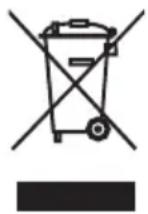
Devices must not be disposed of in normal household waste
At the end of its life, the product must be disposed of in an appropriate way. In this way, valuable materials contained in the device will be recycled and the burden on the environment avoided. Hand in the old device at a collection point for electronic waste or at a recycling depot.
For more information, contact your local waste disposal firm or your local administrative body.
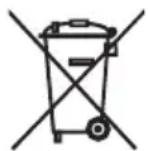
Recyclable and disposable batteries do not belong in household waste
All batteries must be handed in at a collection point in your community, suburb, or at the retailer. Such batteries can thus be disposed of in an environmentally friendly way.
Attention!
This device contains a battery that is permanently installed for safety reasons and cannot be removed without destroying the housing. Improper dismantling entails a safety risk. Therefore, you should return the device unopened to the collection point, and the device and the battery should be disposed of properly. Information on collection points receiving used equipment free of charge can be obtained from your local authority or municipal administration.
;Estimada/o cliente!
Humidité relative: ≤ 85%
- General Information
- About this manual
- Explanation of symbols
- Table of Contents
- Intended Use
- Safety
- DANGER for Children
- BEWARE of material damage
- WARNING of health-related restrictions
- Electric shock hazard
- Important information on "measurements"
- Scope of Delivery
- Symbol Function Description
- Charging the battery
- Do not use the device while it is charging.
- Set time and date
- Install app
- Connect the device to the app (pairing)
- Measuring Blood Pressure
- Before you measure
- Apply the blood pressure monitor
- Take posture
- Start measurement
- Using measured Values stored on the Device
- Access stored measured values
- Deleting stored values
- General Information on Blood Pressure
- Systolic and diastolic blood pressure
- Advantages of self-measurement
- Standard blood pressure classification
- Irregular heartbeat
- Cleaning
- NOTE on material damage
- Storage
- Fault/Remedy
- Declaration of Conformity
- Guarantee
- Disposing of the packaging
- Disposing of the product
- Devices must not be disposed of in normal household waste
- Recyclable and disposable batteries do not belong in household waste
- Attention!
- ;Estimada/o cliente!
Brand : ADE
Model : FITvigo BPM 1600
Category : Sphygmomanometer