BPM220 - Blood pressure monitor Cresta - Free user manual and instructions
Find the device manual for free BPM220 Cresta in PDF.



User questions about BPM220 Cresta
0 question about this device. Answer the ones you know or ask your own.
Ask a new question about this device
Download the instructions for your Blood pressure monitor in PDF format for free! Find your manual BPM220 - Cresta and take your electronic device back in hand. On this page are published all the documents necessary for the use of your device. BPM220 by Cresta.
USER MANUAL BPM220 Cresta
info@cresta-international.com
www.cresta-care.com
Tel: +31 20 6932932
INHOUDSOPGAVE
INTRODUCTIE
VEILIGHEIDSVOORSCHRIFTEN
OVER UW BLOEDDRUK
VOORZORGSSMAATREGELEN VOOR GEBRUK
FUNCTIES VAN HET PRODUCT
BESCHRIJVING ONDERDELEN
BATTERIJEN PLAATSEN OF VERVANGEN
We thank you for buying our C-CARE digital wrist type blood pressure monitor BPM220. It shows your confidence in our brand and our products. Please be assured you have bought a high quality product which you will enjoy using for many years to come.
Please read this instruction manual thoroughly before first use, even if you are familiar with this type of product. It gives you tips for optimal use.
If you require technical support and or have questions about the functioning of the product please send an e-mail to our after sales service; the address is listed here under. We will give you a fast reply.
CRESTA INTERNATIONAL B.V.
ROLBRUGWEG 4
NL-1332 AS ALMERE
info@cresta-international.com
www.cresta-care.com
Tel: +31 20 6932932
FEATURES OF THE PRODUCT
PARTS IDENTIFICATION
INSERT OR REPLACE BATTERIES
TIME AND SYSTEM SETUP
UNIT CONVERSION mmHg/kPa
WHO BLOOD PRESSURE CLASSIFICATION DISPLAY
ATTACHING THE BLOOD PRESSURE MONITOR
HOW TO TAKE PROPER MEASUREMENTS
HOW TO MEASURE BLOOD PRESSURE
CARE AND MAINTENANCE
SPECIFICATIONS
TROUBLESHOOTING
This Blood pressure monitor uses the oscillometric method of blood pressure measurement. The blood pressure monitor is intended for use by medical professionals or at home to monitor and display the diastolic-, the systolic blood pressure and the pulse rate on adults, with a cuff around the left wrist according to the instruction in "ATTACHING THE BLOODPRESSURE MONITOR". The expected lifetime of the product is over 5 years. The product complies with the electromagnetic compatibility requirement of EN60601-1-2, safety standards of EN60601-1 and performance of IEC80601-2-30 as specified in EEC directive 93/42/EEC.
NOTES ON SAFETY
The warning signs and sample icons shown here are listed for your safe and correct use of the unit, so as to prevent injuries or damages to the device.
The icons and meanings are as follows:
Examples of signs
The icon indicates prohibitions - what you should not do. Matters involving actual prohibitions are indicated by text or pictures in or near . The left icon refers to "general prohibitions".
The icon indicates something that is compulsory - what must always be observed. Matters involving actual compulsory actions are indicated by text or pictures in or nec. The left icon refers to "general compulsion".
The icon indicates something can't be disassembled or do not disassemble. Matters involving actual compulsory actions are indicated by text or pictures in or near .The left icon refers to "General prohibition".

Type BF Applied part

Attention and read before use

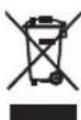
Marking of electrical and electronic equipment in accordance with Article 11(2) of Directive 2002/96/EC (WEEE)

Warning
The patient should follow doctor's instructions and should not perform selfjudgment and self-treatment by the measuring result. Self-diagnosis of measured results and treatment are dangerous. The device should not be used to judge illness, first aid and continuously monitor measuring.
This device cannot be used during patient's transport and surgical care. It can be used in households or fixed places only.
Please press "ON/OFF" button to stop the product's operation when you feel uncomfortable with the wrist or if the air is inflating abnormally without stop.
Do not let a child below 12 years old and people who can't express one's intention use this appliance. When it is used by children of 12-18 years old, they should be supervised by an adult. This may cause an accident or trouble.
Do not use the unit for another purpose than measuring blood pressure. This may cause an accident or trouble.
Please do not use a mobile phone around the device. Please do not use the device around the magnetic field.
Do not disassemble, repair, or remodel the main unit or the cuff of the blood pressure monitor. This will cause the unit to function erroneously.
TIPS FOR PRACTICAL USE
For any patient, do not measure more than 3 times continuously, there should be at least about 5 minutes of interval rest between any two measurements, otherwise it will cause extravasated blood.
Do not measure your blood pressure over 6 times each day.
Do not apply the wrist cuff over a wound as this can cause further injury.
Do measure on the arm which is on the side of a mastectomy, otherwise it could cause injury.
Observe the air pressure value from the LCD display.
When measuring, it should not exceed 299 mmHg, otherwise press the "ON/O button to stop the measurement.
Do not use force to bend the wrist cuff
Do not knock or drop the main unit.
Always use the specified accessories in the manual, the use of other parts not approved by the manufacturer may cause faults or injuries.
For service information, parts list etc., please contact our service department
+31206932932
ABOUT BLOOD PRESSURE
What is blood pressure?
Blood pressure is the force exerted by blood against the walls of the arteries. The Systolic pressure occurs when the heart contracts. The Diastolic pressure occurs when the heart expands and refills. Blood pressure is measured in millimeters of mercury (mmHg). One's natural blood pressure is represented by the fundamental pressure, which is measured first thing in the morning while one is still at rest and before eating.
What is hypertension and how is it controlled?
Hypertension, an abnormal high arterial blood pressure, if left unattended, can cause many health problems including a stroke and a heart attack. Hypertension can be controlled by altering your lifestyle, avoiding stress and with medication under a doctor's supervision. To prevent hypertension or keep it under control: Do not smoke, exercise regularly, reduce salt and fat intake, have regular physical checkups and maintain a proper weight and control this.
Blood pressure measured at a clinic or doctor's office may cause apprehension and produce an elevated reading, 25 to 30mmHg higher than that measured at home. Home measurement reduces the effects of outside influences on the blood pressure readings, supplements the doctor's readings and provides a more accurate, complete blood pressure history.
WHO blood pressure classification
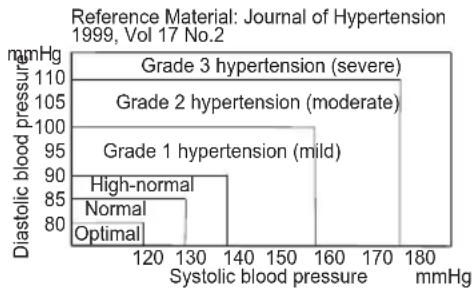
Standards for assessment of high blood pressure, without regard to age, have been established by the World Health Organization (WHO), and shown in chart below.
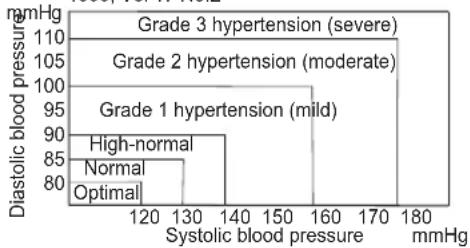
Reference Material: Journal of Hypertension 1999, Vol 17, No.2
Blood pressure variations
An individual's blood pressure varies greatly on a daily and seasonal basis. It may vary by 30 to 50mmHg due to various conditions during the day. In hypertensive individuals, variations are even more pronounced.
Normally, the blood pressure rises while at work or play and falls to its lowest levels during the sleep. So, do not be overly concerned by the results of one measurement.
Take measurements at the same time every day using the procedure described in this manual, and know your normal blood pressure. Many readings give a more comprehensive blood pressure history.
Be sure to note the date and time when recording your blood pressure. Consult your doctor to interpret your blood pressure data.
-
If you are taking medication, first consult with your doctor to determine the most appropriate time to measure your blood pressure. NEVER change a prescribed medication without first consulting with your doctor.
-
For people with an irregular-, or unstable peripheral circulation problems due to diabetes, liver disease, hardening of the arteries, etc., there may be fluctuation in blood pressure values measured at the upper arm versus at the wrist.
- Measurements may be impaired if this device is used near televisions, microwave ovens, X-ray equipment, mobile phone equipment or other devices with strong electrical fields. To prevent such interference, use the monitor at a sufficient distance from such devices or turn them off.
- Before using, wash your hands.
- Do not measure on the arm which simultaneously used monitoring ME Equipment, otherwise it could cause loss of function.
- Consult your doctor if the unexpected readings are obtained, also please refer to "Trouble shooting" in this manual.
- The reading is probably a little lower than measured in the hospital due to the steady mood at home.
- Cuff pressure range 0-299mmHg
FEATURES OF THE PRODUCT
Memory can store 90 measurements.
Large and clear LCD display.
WHO blood pressure classification display.
- Easy to use, press a button to automatically measure, record the measurement values and measurement time.
- Automatically turns off (within 1 minute) to save power.
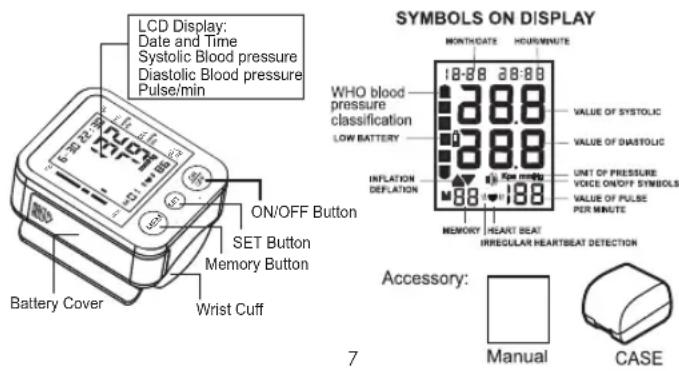
PARTS IDENTIFICATION
INSERT OR REPLACE BATTERIES
- Remove the battery cover.
- Insert new batteries into the battery compartment as shown, taking care that the polarities (+) and (-) are correct.
- Close the battery cover. Use only LR03, AAA batteries.
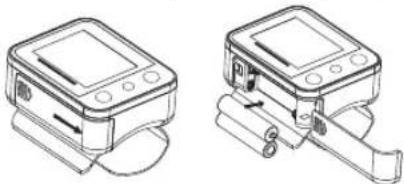
Dispose of empty batteries to the authorized collecting party subject to the regulation of each individual territory.
CAUTION
Insert the batteries as shown in the battery compartment. If not, the device will not work. When LOW BATTERY mark - blinks in the display, replace all batteries with new ones. Do not mix old and new batteries. If may shorten the battery life, or cause the device to malfunction. LOW BATTERY mark does not appear when the batteries run out. Please ensure to distinguish positive polar "+" and negative polar "-" of batteries when replacing batteries. Batteries, which have fluid on the surface or are modified, cannot be inserted into the product. Battery short circuit must be prevented.
Battery life varies with the ambient temperature and may be shortened at low temperatures. The batteries may leak and cause a malfunction. Use the specified batteries only. The batteries provided with the device are for testing the monitor performance and may have a shorter lifecycle. Used batteries may leak and damage the main unit. If you are not going to use the unit for a long period of time (approximately three months or more), remove the batteries. Replace worn batteries with their polarities in the correct direction.
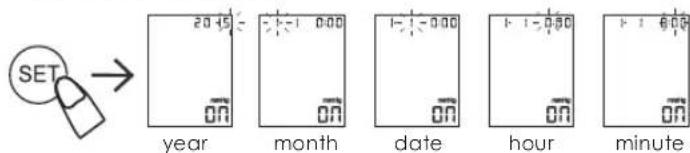
TIME AND OF SYSTEM SETUP
- Press "SET" key to turn on.
- Press and hold the "SET" key until the year number displays and flashes in the LCD display to enter setting mode.
- Press the "MEM" key to adjust the year, then press the "SET" key again to save your setting and enter the month setting mode.
- Press the "MEM" key to adjust the month. Following the same steps to adjust date/hour/minute.
UNIT CONVERSION mmHg/kPa DISPLAY
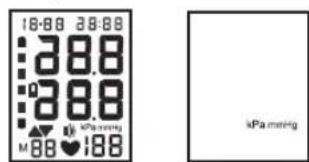
The default setting of the monitor is mm Hg. Also kPa (kPa) can be set. Boost continued to press the ON/OFF button exceeding five seconds. The units will be chosen by the above shows mmHg/kPa after decontrol. After the normal boot unit values are shown as blood pressure. Also select memory unit value changes.
WHO BLOOD PRESSURE CLASSIFICATION DISPLAY
Diastolic blood pressure Reference material: journal of hypertension 1999.
vol 17 No.2
Grade 3 hypertension (severe) Grade
2 hypertension (moderate) Grade
1 hypertension (mild)
High-normal
Normal
Optimal
ATTACHING THE BLOOD PRESSURE MONITOR
- Wrap the wrist cuff around the wrist, about 2 - 3 cm above the hand. Place the cuff direct to the skin, as clothing may cause a faint pulse, and result in a measurement error.
2.Secure the wrist cuff with Velcro Strip in such a way that it lies comfortably and is not too tight. Lay the arm on the table with the hand palm upwards. Move the arm upward, so that the monitor is at the same level as the heart.
How to take proper measurements
For the best accuracy in blood pressure measurement: PATIENT position in NORMAL USE, including:
1) take a comfortable seat
2) put your arm on the table, hand palm upward.
3) place your feet flat on the floor.
4) keep back and arm supported.
5) raise your arm so that the monitor is at the level of your heart. Remain still and keep quiet during the measurement.
Relax as much as possible and do not talk during the measurement process. Measure your blood pressure at about the same time every day. Do not measure right after a physical exercise or a bath. Take a rest for twenty to thirty minutes before taking the measurement.
The readings can be affected under the below conditions: Within an hour after dinner, after having wine, coffee, tea, sports, bathing, talking, being nervous, being in an unsteady mood, bending forward, moving, room temperature dramatically changing during measuring, in moving vehicles, long time continuous measuring.
HOW TO MEASURE BLOOD PRESSURE
- Set up the wrist cuff to your wrist as previous described in section
"ATTACHING THE BLOOD PRESSURE MONITOR"
- Press the "ON/OFF" button, all icons appear two seconds on the display, then it will switch to measurement and will display "0" or the last measurement record.
- Start the measurement, the cuff in the strap will automatically inflate. The mark () will flash on LCD till the measurement is completed. The LCD display will show the measurement results.
READ MEMORY
Press the "MEM" button, to read out the latest measurements. Press "MEM" for the latest results (UP) or the "SET" button for the memory (DOWN) Power Measurement closure or after the end of the state you can press the "MEM" button to read out the latest measurement of memory.
DELETE MEMORY
Press the "MEM" button for five seconds, the LCD will display "No". The memory has been deleted.
CARE AND MAINTENANCE
To keep your digital blood pressure monitor in the best condition and to protect the unit from damage, please follow the directions listed below:
- Keep the monitor in the storage case when not in use. Do not fold the cuff to tightly.
The fabric fastener could touch the inner surface of the cuff and damage it. Clean the monitor and cuff with a soft dry cloth. Do not use any abrasive or volatile cleaners.
CAUTION
- Do not submerge the device or any of the components in water.
- Do not subject the monitor to extreme hot - or cold temperatures, humidity or direct sunlight.
- Store the device and the components in a clean, safe location.
- Do not subject the monitor to strong shocks, such as dropping the unit on the floor.
- Remove the batteries if the unit will not be used for three months or longer. Always replace all the batteries with new ones at the same time. This product is designed for use over an extended period of time.
SPECIFICATIONS
| Measuring Method | Oscillometric Measurement |
| Indication | Digital LCD display |
| Measuring Range | Pressure: 30~280 mmHg Pulse: 40~199 Beat/min |
| Accuracy | Static Pressure: ± 3mmHg Pulse: ± 5% |
| Memory | 90 Memories |
| Power supply | 2x 1.5V Batteries (LR03 or AAA) use alkaline battery, measure above 200 times |
| Operating condition: | +5℃-+1℃ 15%RH~93%RH Atmospheric pressure: 70kPa~106kPa |
| Storage condition: | -20℃+55 .10%RH~93%RH Atmospheric pressure:50kPa~106kPa |
| Dimensions | Approx.: 62(W)X78(H)X31(D)mm |
| Weight: | Approx.: 130g, excluding batteries |
| Classification | Type BF |
| Wrist cuff | 13,5~19,5 cm |
- Specifications may be changed without notice in the event of improvement being made.
1.Type of protection against electric shock:Internally POWERED EQUIPMENT.
2.Degree or protection against electric shock: TYPE BF APPLIED PART.
3.Mode of operation: CONTINUOUS OPERATION. - Equipment not suitable for category AP&APG equipment use in presence.
STATEMENT
The system might not meet its performance specifications if stored or used outside the temperature and humidity as mentioned below:
Operating conditions: +5^ +40^ . 15%RH~93%RH 70kPa~106kPa
Storage conditions: -20^ +55^ . 0% RH 93% RH
TROUBLESHOOTING
If you have trouble in using the unit please check the following points first.
| ERROR DISPLAY | POSSIBLE CAUSE | HOW TO CORRECT |
| Nothing is displayed when you push the POWER button or the battery icon flashes | No battery installation | Insert batteries |
| Battery worn out | Replace new batteries | |
| The polarities of batteries placed wrongly | Insert battery in the correct polarities | |
| E1: can't normally Increase pressure | Check your cuff if any air leakage | Replace the cuff with new one |
| E3: inflate pressure too high | Re-measure or send back to the dealer for re-calibrate pressure |
| E2E4: have shaking while measurement | Hand or body shaking while measurement | keeping static and correct gesture to measure again |
| Battery icon on | Battery low power | Replace battery and measure again |
| The systolic pressure Value or diastolic Pressure value too high | 1.The arm cuff was held lower than your heart | keeping correct position and gesture to measure again |
| 2.The arm cuff was not attached properly | ||
| 3.You moved your body or spoke during measurement | ||
| The systolic pressure Value or diastolic Pressure value too low | 1.The arm cuff was held higher than your heart | |
| 2-you moved your body or Spoke during measurement |
Appendix 1 Guidance and Manufacturer Declaration Tables
| Guidance and manufacturer's declaration - electromagnetic emissions | ||
| The Model BPM220 Series Electronic Blood Pressure Monitor is intended for use in the electromagnetic environment specified below. The customer or the user of the Model BPM220 Series Electronic Blood Pressure Monitor should assure that it is used in such an environment. | ||
| Emissions | Compliance | Electromagnetic environment-guidance |
| RF emissions CISPR 11 | Group 1 | The Model BPM220nC Blood Pressure Monitor uses RF energy only for its internal function. Therefore, its RF emissions are very low and are not likely to cause any interference in nearby electronic equipment. |
| RF emissions CISPR 11 | Class B | The Model BPM220nC Blood Pressure Monitor is used in home and it's powered by DC 3V |
| Harmonic emissions IEC 61000-3-2 | N. A. | |
| Voltage fluctuations/ flicker emissions IEC 61000-3-3 | N. A. | |
| Guidance and manufacturer's declaration - electromagnetic Immunity | |||
| The Model BBT220 Electronic Blood Pressure Monitor is intended for use in the electromagnetic environment specified below. The customer or the user of the Model BPM220 Series Electronic Blood Pressure Monitor should assure that it is used in such an environment. | |||
| Immunity test | IEC 60601 test level | Compliance level | Electromagnetic environment-guidance |
| Electrostatic discharge (ESD)IEC 61000-4-2 | ±8 kV contact ±2 kV, ±4 kV, ±8 kV, ±15KV air | ±8 kV contact ±2 kV, ±4 kV, ±8 kV, ±15 KV air | Floors should be wood, concrete or ceramic tile. If floors are covered with synthetic material, the relative humidity should be at least 30 %. |
| Power frequency (50/60 Hz) magnetic field IEC 61000-4-8 | 30 A/m, 50/60Hz | 30 A/m, 50/60Hz | Power frequency magnetic fields should be at levels characteristic of a typical location in a typical commercial or hospital environment. |
| NOTE U1is the a.c. mains voltage prior to application of the test level | |||
| Guidance and manufacturer's declaration - electromagnetic immunity | |||
| The Model BPM220 Electronic Blood Pressure Monitor is intended for use in the electromagnetic environment specified below. The customer or the user of the Model BPM220 Series Electronic Blood Pressure Monitor should assure that it is used in such an environment. | |||
| Immunity test | IEC 60601 test level | Compliance level | Electromagnetic environment - guidance |
| Conducted RF IEC 61000-4-6 | 3 Vrms 150 kHz to 80 MHz 6 Vrms 150 kHz to 80 MHz outside ISM bandsa | N/A | Portable and mobile RF communications equipment should be used no closer to any part of the Model BPM220 Series Electronic Blood Pressure Monitor, including cables, than the recommended separation distance calculated from the equation applicable to the frequency of the transmitter. |
| Radiated RF IEC 61000-4-3 | 10 V/m 80 MHz to 2.7 GHz | 10 V/m | Recommended separation distance d=[3.5/V1]√P d=[3.5/E1]√P 80MHz to 800MHz d=[7/E1]√P 800MHz to 2.7GHz where P is the maximum output power rating of the transmitter in watts (W) according to the transmitter manufacturer and d is the recommended separation distance in metres(m). Field strengths from fixed RF transmitters, as determined by an electromagnetic site survey, should be less than the compliance level in each frequency range. Interference may occur in the vicinity of equipment marked with the following symbol: |
| NOTE 1 At 80 MHz and 800 MHz, the higher frequency range applies. NOTE 2 These guidelines may not apply in all situations. Electromagnetic propagation is affected by absorption and reflection from structures, objects and people. | |||
a The ISM (industrial, scientific and medical) bands between 0,15 MHz and 80 MHz are 6,765 MHz to 6,795 MHz; 13,553 MHz to 13,567 MHz; 26,957 MHz to 27,283 MHz; and 40,66 MHz to 40,70 MHz. The amateur radio bands between 0,15 MHz and 80 MHz are 1,8 MHz to 2,0 MHz, 3,5 MHz to 4,0 MHz, 5,3 MHz to 5,4 MHz, 7 MHz to 7,3 MHz, 10,1 MHz to 10,15 MHz, 14 MHz to 14,2 MHz, 18,07 MHz to 18,17 MHz, 21,0 MHz to 21,4 MHz, 24,89 MHz to 24,99 MHz, 28,0 MHz to 29,7 MHz and 50,0 MHz to 54,0 MHz.
b The compliance levels in the ISM frequency bands between 150 kHz and 80 MHz and in the frequency range 80 MHz to 2.7 GHz are intended to decrease the likelihood that mobile/portable communications equipment could cause interference if it is inadvertently brought into patient areas. For this reason, an additional factor of 10/3 has been incorporated into the formulae used in calculating the recommended separation distance for transmitters in these frequency ranges.
c Field strengths from fixed transmitters, such as base stations for radio (cellular/cordless) telephones and land mobile radios, amateur radio, AM and FM radio broadcast and TV broadcast cannot be predicted theoretically with accuracy. To assess the electromagnetic environment due to fixed RF transmitters, an electromagnetic site survey should be considered. If the measured field strength in the location in which the Model BPM220 Series Electronic Blood Pressure Monitor is used exceeds the applicable RF compliance level above, the Model BPM220 Series Electronic Blood Pressure Monitor should be observed to verify normal operation. If abnormal performance is observed, additional measures may be necessary, such as re-orienting or relocating the Model BPM220 Series Electronic Blood Pressure Monitor.
d Over the frequency range 150kHz to 80MHz , field strengths should be less than 3V / m .
Recommended separation distances between portable and mobile RF communications equipment and the MobiusA220 Series Electronic Blood Pressure Monitor
The Model BPM220 Series Electronic Blood Pressure Monitor is intended for use in an electromagnetic environment in which radiated RF disturbances are controlled. The customer or the user of the Model BPM220 Series Electronic Blood Pressure Monitor can help prevent electromagnetic interference by maintaining a minimum distance between portable and mobile RF communications equipment (transmitters) and the Model BPM220 Series Electronic Blood Pressure Monitor as recommended below, according to the maximum output power of the communications equipment.
| Rated maximum output of transmitter W | Separation distance according to frequency of transmitter m | ||
| 150 kHz to 80 MHz d = [3.5/V1]√P | 80 MHz to 800 MHz d = [3.5/E1]√P | 800 MHz to 2.7 GHz d = [7/E1]√P | |
| 0.01 | 0.12 | 0.12 | 0.23 |
| 0.1 | 0.38 | 0.38 | 0.73 |
| 1 | 1.2 | 1.2 | 2.3 |
| 10 | 3.8 | 3.8 | 7.3 |
| 100 | 12 | 12 | 23 |
For transmitters rated at a maximum output power not listed above the recommended separation distance d in metres (m) can be estimated using the equation applicable to the frequency of the transmitter, where P is the maximum output power rating of the transmitter in watts (W) according to the transmitter manufacturer.
NOTE 1 At 80MHz and 800MHz , the separation distance for the higher frequency range applies.
NOTE 2 These guidelines may not apply in all situations. Electromagnetic propagation is affected by absorption and reflection from structures, objects and people.
Regarding EMC Statement
a) a statement to the effect that this equipment needs to be installed and put into service in accordance with the information provided in the ACCOMPAN DOCUMENTS; and
b) a statement to the effect that wireless communications equipment such as wireless home network devices, mobile phones, cordless telephones and the base stations, walkie talkies can affect this equipment and should be kept at least a distanced away from the equipment. The distanced is calculated by the MANUFACTURER from the 800 MHZ to 2.5 GHz column of Table 5 or Table of IEC 60601-1-2:2007, as appropriate.

The crossed out "wheeled bin" icon on the product reminds you of your obligation that when you dispose of the appliance, it should be separately collected. Contact your local authority for information concerning the correct disposal of your old appliance.

0413


Printing errors and modifications provided
INHALTEINLEITUNG
SICHERHEITSHINWEISE
INFORMATIONENÜBER BLUTDRUCK
VOR DEM MESSEN
EIGENSCAHFTEN
BESTANDTEILE
EINLEGEN ODER WECHSELN DER BATTERIEN
FONCTIONS DU PRODUIT
IDENTIFICATION DES PIECES INSERER OU
REEMPLACER LES PILES CONFIGURATION DE
LA DATE ET DE L'HEURE CHANGEMENT
D'UNITE (mmHg/kPa)
AFFICHAGE DE LA CLASSIFICATION DE LA TENSION ARTÉRIELLE SELON L'OMS
FIXER LE TENSIOMÉTURE
COMMENT PRENDRE UNE MESURE CORRECTEMENT
COMMENT MESURER LA TENSION ARTÉRIELLE
ENTRETIEN ET NETTOYAGE
CHARACTERISTIQUES
DéPANNAGE

0413


FONCTIONS DU PRODUIT
Hypertension de grade 3 (grave)
Main Site: No.25 1st Industry Zone, Fenghuang Road, Xikeng Village, Henggang Town, Longgang District, Shenzhen, Guangdong China
Additional site1: 2-4 Floor, No.5 Shanzhuang Rd., Xikeng Village,
Henggang Town, Longgang District, Shenzhen City, Guangdong Province, China

Lotus NL B.V.
Address: Koningin Julianaplein 10, 1e Verd, 2595AA, The Hague, Netherlands.
Tel: +31645171879 (English), +31626669008 (Dutch)