
KG347E.9 - Saw KRESS - Free user manual and instructions
Find the device manual for free KG347E.9 KRESS in PDF.



| Product Type | Cordless Chainsaw |
| Brand | Kress |
| Model | KG347E.9 |
| Power Supply | 40 V Lithium-Ion Battery (2×20 V max.) |
| Guide Bar Length | 40 cm |
| Cutting Speed | 18 m/s |
| Oil Tank Capacity | 160 ml |
| Chain Pitch | 0.95 cm (3/8") |
| Number of Drive Links | 56 |
| Chain Gauge | 1.1 mm |
| Weight (tool only) | 4.2 kg |
| Recommended Battery | KAB04 4.0 Ah |
| Recommended Charger | KAC04 4.0 A |
| Sound Power Level | 101.2 dB(A) |
| Vibrations (ah) | 8.4 m/s² |
| Main Functions | Felling trees, cutting logs, branches, planks; longitudinal and cross cuts |
| Safety | Chain brake, front hand guard, start lock, automatic stop |
| Maintenance | Automatic lubrication, regular cleaning of guide bar and chain, adjustable chain tension |
| Spare Parts (Chain) | ES: 3/8LP.043 56E 90X / Oregon: 90PX056 |
| Spare Parts (Guide Bar) | ES: ES164SDEA041 / Oregon: 164MLEA041 |
| General Information | Compliant with directives 2006/42/EC, 2014/30/EU, 2011/65/EU; sound pressure level 89.5 dB(A) |
Frequently Asked Questions - KG347E.9 KRESS
User questions about KG347E.9 KRESS
0 question about this device. Answer the ones you know or ask your own.
Ask a new question about this device
Download the instructions for your Saw in PDF format for free! Find your manual KG347E.9 - KRESS and take your electronic device back in hand. On this page are published all the documents necessary for the use of your device. KG347E.9 by KRESS.
USER MANUAL KG347E.9 KRESS
Introduction. 7
Safety Instructions. 8
Component List. 13
Specifications. 13
Assembly 14
Operation. 15
Maintenance. 17
Environmental Protection. 18
Troubleshooting 19
Declaration of Conformity 19
INTRODUCTION
Dear Customer,
Thank you for buying this Kress product. We are dedicated to developing high quality products to meet your lawn & garden requirements.
The Kress brand is synonymous with premium quality service. Over the years of your products life, if you have any questions or concerns about your product, please contact your location of purchase or our Customer Service Team for assistance.
We are confident you will enjoy working with your Kress product for years to come.
INTENDED USE OF CHAINSAW
The Chainsaw is intended for sawing of trees, tree trunks, branches, wooden beams, planks, etc. Cuts can be sawed with or across the grain. This product is not suitable for sawing mineral materials.
ORIGINAL INSTRUCTIONS PRODUCT SAFETY GENERAL POWER TOOL SAFETY WARNINGS

WARNING Read all safety warnings, instructions, illustrations and specifications provided with this power
tool. Failure to follow all instructions listed below may result in electric shock, fire and/or serious injury.
Save all warnings and instructions for future reference.
The term "power tool" in the warnings refers to your mains-operated (corded) power tool or battery-operated (cordless) power tool.
1. WORK AREA SAFETY
a) Keep work area clean and well lit. Cluttered or dark areas invite accidents.
b) Do not operate power tools in explosive atmospheres, such as in the presence of flammable liquids, gases or dust. Power tools create sparks which may ignite the dust or fumes.
c) Keep children and bystanders away while operating a power tool. Distractions can cause you to lose control.
2. ELECTRICAL SAFETY
a) Power tool plugs must match the outlet. Never modify the plug in any way. Do not use any adapter plugs with earthed (grounded) power tools. Unmodified plugs and matching outlets will reduce risk of electric shock.
b) Avoid body contact with earthed or grounded surfaces, such as pipes, radiators, ranges and refrigerators. There is an increased risk of electric shock if your body is earthed or grounded.
c) Do not expose power tools to rain or wet conditions. Water entering a power tool will increase the risk of electric shock.
d) Do not abuse the cord. Never use the cord for carrying, pulling or unplugging the power tool. Keep cord away from heat, oil, sharp edges or moving parts. Damaged or entangled cords increase the risk of electric shock.
e) When operating a power tool outdoors, use an extension cord suitable for outdoor use. Use of a cord suitable for outdoor use reduces the risk of electric shock.
f) If operating a power tool in a damp location is unavoidable, use a residual current device (RCD) protected supply. Use of an RCD reduces the risk of electric shock.
3. PERSONAL SAFETY
a) Stay alert, watch what you are doing and use common sense when operating a power tool. Do not use a power tool while you are
tired or under the influence of drugs, alcohol or medication. A moment of inattention while operating power tools may result in serious personal injury.
b) Use personal protective equipment. Always wear eye protection. Protective equipment such as dust mask, non-skid safety shoes, hard hat, or hearing protection used for appropriate conditions will reduce personal injuries.
c) Prevent unintentional starting. Ensure the switch is in the off-position before connecting to power source and/or battery pack, picking up or carrying the tool. Carrying power tools with your finger on the switch or energising power tools that have the switch on invites accidents.
d) Remove any adjusting key or wrench before turning the power tool on. A wrench or a key left attached to a rotating part of the power tool may result in personal injury.
e) Do not overreach. Keep proper footing and balance at all times. This enables better control of the power tool in unexpected situations.
f) Dress properly. Do not wear loose clothing or jewellery. Keep your hair, clothing and gloves away from moving parts. Loose clothes, jewellery or long hair can be caught in moving parts.
g) If devices are provided for the connection of dust extraction and collection facilities, ensure these are connected and properly used. Use of dust collection can reduce dust-related hazards.
h) Do not let familiarity gained from frequent use of tools allow you to become complacent and ignore tool safety principles. A careless action can cause severe injury within a fraction of a second.
4) Power tool use and care
a) Do not force the power tool. Use the correct power tool for your application. The correct power tool will do the job better and safer at the rate for which it was designed.
b) Do not use the power tool if the switch does not turn it on and off. Any power tool that cannot be controlled with the switch is dangerous and must be repaired.
c) Disconnect the plug from the power source and/or remove the battery pack, if detachable, from the power tool before making any adjustments, changing accessories, or storing power tools. Such preventive safety measures reduce the risk of starting the power tool accidentally.
d) Store idle power tools out of the reach of children and do not allow persons unfamiliar with the power tool or these instructions to operate the power tool. Power tools are dangerous in the hands of untrained users.
e) Maintain power tools and accessories. Check for misalignment or binding of moving parts, breakage of parts and any other condition that may affect the power tool's operation. If
damaged, have the power tool repaired before use. Many accidents are caused by poorly maintained power tools.
f) Keep cutting tools sharp and clean. Properly maintained cutting tools with sharp cutting edges are less likely to bind and are easier to control.
g) Use the power tool, accessories and tool bits etc. in accordance with these instructions, taking into account the working conditions and the work to be performed. Use of the power tool for operations different from those intended could result in a hazardous situation.
h) Keep handles and grasping surfaces dry, clean and free from oil and grease. Slippery handles and grasping surfaces do not allow for safe handling and control of the tool in unexpected situations.
5) Battery tool use and care
a) Recharge only with the charger specified by the manufacturer. A charger that is suitable for one type of battery pack may create a risk of fire when used with another battery pack.
b) Use power tools only with specifically designated battery packs. Use of any other battery packs may create a risk of injury and fire.
c) When battery pack is not in use, keep it away from other metal objects, like paper clips, coins, keys, nails, screws or other small metal objects, that can make a connection from one terminal to another. Shorting the battery terminals together may cause burns or a fire.
d) Under abusive conditions, liquid may be ejected from the battery; avoid contact. If contact accidentally occurs, flush with water. If liquid contacts eyes, additionally seek medical help. Liquid ejected from the battery may cause irritation or burns.
e) Do not use a battery pack or tool that is damaged or modified. Damaged or modified batteries may exhibit unpredictable behaviour resulting in fire, explosion or risk of injury.
f) Do not expose a battery pack or tool to fire or excessive temperature. Exposure to fire or temperature above 130ircC may cause explosion.
g) Follow all charging instructions and do not charge the battery pack or tool outside the temperature range specified in the instructions. Charging improperly or at temperatures outside the specified range may damage the battery and increase the risk of fire.
- SERVICE
a) Have your power tool serviced by a qualified repair person using only identical replacement parts. This will ensure that the safety of the power tool is maintained.
b) Never service damaged battery packs. Service of battery packs should only be performed by the manufacturer or authorized service providers.
1) GENERAL CHAIN SAW
SAFETYWARNINGS:
a) Keep all parts of the body away from the saw chain when the chain saw is operating. Before you start the chain saw, make sure the saw chain is not contacting anything. A moment of inattention while operating chain saws may cause entanglement of your clothing or body with the saw chain.
b) Always hold the chain saw with your right hand on the rear handle and your left hand on the front handle. Holding the chain saw with a reversed hand configuration increases the risk of personal injury and should never be done.
c) Hold the chain saw by insulated gripping surfaces only, because the saw chain may contact hidden wiring. Saw chains contacting a "live" wire may make exposed metal parts of the chain saw "live" and could give the operator an electric shock.
d) Wear safety glasses protection. Further protective equipment for hearing, head, hands, legs and feet is recommended. Adequate protective clothing will reduce personal injury by flying debris or accidental contact with the saw chain.
e) Do not operate a chain saw in a tree, on a ladder, from a rooftop, or any unstable support. Operation of a chain saw in this manner could result in serious personal injury.
f) Always keep proper footing and operate the chain saw only when standing on fixed, secure and level surface. Slippery or unstable surfaces may cause a loss of balance or control of the chain saw.
g) When cutting a limb that is under tension, be alert for spring back. When the tension in the wood fibres is released, the spring loaded limb may strike the operator and/or throw the chain saw out of control.
h) Use extreme caution when cutting brush and saplings. The slender material may catch the saw chain and be whipped toward you or pull you off balance.
i) Carry the chain saw by the front handle with the chain saw switched off and away from your body. When transporting or storing the chain saw, always fit the guide bar cover. Proper handling of the chain saw will reduce the likelihood of accidental contact with the moving saw chain.
j) Follow instructions for lubricating, chain tensioning and changing the bar and chain. Improperly tensioned or lubricated chain may either break or increase the chance for kickback.
k) Cut wood only. Do not use chain saw for purposes not intended. For example: do not use chain saw for cutting metal, plastic, masonry or non-wood building materials. Use of the chain saw for operations different than intended could result in a hazardous situation.
I) Do not attempt to fell a tree until you have an understanding of the risks and how to avoid them. Serious injury could occur to the operator
or bystanders while felling a tree.
m) Follow all instructions when clearing jammed material, storing or servicing the chain saw. Make sure the switch is off and the battery pack is removed. Unexpected actuation of the chain saw while clearing jammed material or servicing may result in serious personal injury.
n) Recommendation that the first-time user should, as a minimum, practise cutting logs on a saw-horse or cradle.
o) Recommendation to have sharpening and maintenance of the saw chain performed by authorised service centres.
2) CAUSES AND OPERATOR PREVENTION OF KICKBACK:
Kickback may occur when the nose or tip of the guide bar touches an object, or when the wood closes in and pinches the saw chain in the cut. Tip contact in some cases may cause a sudden reverse reaction, kicking the guide bar up and back towards the operator.
Pinching the saw chain along the top of the guide bar may push the guide bar rapidly back towards the operator.
Either of these reactions may cause you to lose control of the saw which could result in serious personal injury. Do not rely exclusively upon the safety devices built into your saw. As a chain saw user, you should take several steps to keep your cutting jobs free from accident or injury. Kickback is the result of chain saw misuse and/or incorrect operating procedures or conditions and can be avoided by taking proper precautions as given below:
a) Maintain a firm grip, with thumbs and fingers encircling the chain saw handles, with both hands on the saw and position your body and arm to allow you to resist kickback forces. Kickback forces can be controlled by the operator, if proper precautions are taken. Do not let go of the chain saw.
b) Do not overreach and do not cut above shoulder height. This helps prevent unintended tip contact and enables better control of the chain saw in unexpected situations.
c) Only use replacement bars and chains specified by the manufacturer. Incorrect replacement guide bars and saw chains may cause chain breakage and/or kickback.
d) Follow the manufacturer's sharpening and maintenance instructions for the saw chain. Decreasing the depth gauge height can lead to increased kickback.
Even with the intended use of the appliance there is always a residual risk, which can not prevented. According to the type and construction of the appliance the following potential hazards might apply:
- Contact with exposed saw teeth of the saw chain (cutting hazards)
- Access to the rotating saw chain (cutting hazards)
- Unforeseen, abrupt movement of the guide bar (cutting hazards)
- Flung out of parts from the saw chain (Cutting / injection hazards)
- Flung out of parts of the work piece
- Skin contact with the oil
- Loss of hearing, if no required ear protection used during work
SAFETY WARNINGS FOR BATTERY PACK
a) Do not dismantle, open or shred cells or battery pack.
b) Do not short-circuit a battery pack. Do not store battery packs haphazardly in a box or drawer where they may short-circuit each other or be short-circuited by conductive materials. When battery pack is not in use, keep it away from other metal objects, like paper clips, coins, keys, nails, screws or other small metal objects, that can make a connection from one terminal to another. Shorting the battery terminals together may cause burns or a fire.
c) Do not expose battery pack to heat or fire. Avoid storage in direct sunlight.
d) Do not subject battery pack to mechanical shock.
e) In the event of battery leaking, do not allow the liquid to come into contact with the skin or eyes. If contact has been made, wash the affected area with copious amounts of water and seek medical advice.
f) Keep battery pack clean and dry.
g) Wipe the battery pack terminals with a clean dry cloth if they become dirty.
h) Battery pack needs to be charged before use. Always refer to this instruction and use the correct charging procedure.
i) Do not maintain battery pack on charge when not in use.
j) After extended periods of storage, it may be necessary to charge and discharge the battery pack several times to obtain maximum performance.
k) Recharge only with the charger specified by Kress. Do not use any charger other than that specifically provided for use with the equipment.
I) Do not use any battery pack which is not designed for use with the equipment.
m) Keep battery pack out of the reach of children.
n) Retain the original product literature for future reference.
o) Remove the battery from the equipment when not in use.
p) Dispose of properly.
q) Do not mix cells of different manufacture, capacity, size or type within a device.
r) Keep the battery away from microwaves and high pressure.
SAVE THESE INSTRUCTIONS
Instructions concerning the proper techniques for basic felling, limbing, and cross-cutting 1. Felling a tree
When bucking and felling operations are being performed by two or more persons at the same time, the felling operations should be separated from the bucking operation by a distance of at least twice the height of the tree being felled. Trees should not be felled in a manner that would endanger any person, strike any utility line or cause any property damage. If the tree does make contact with any utility line, the company should be notified immediately.
The Chainsaw operator should keep on the uphill side of the terrain as the tree is likely to roll or slide downhill after it is felled.
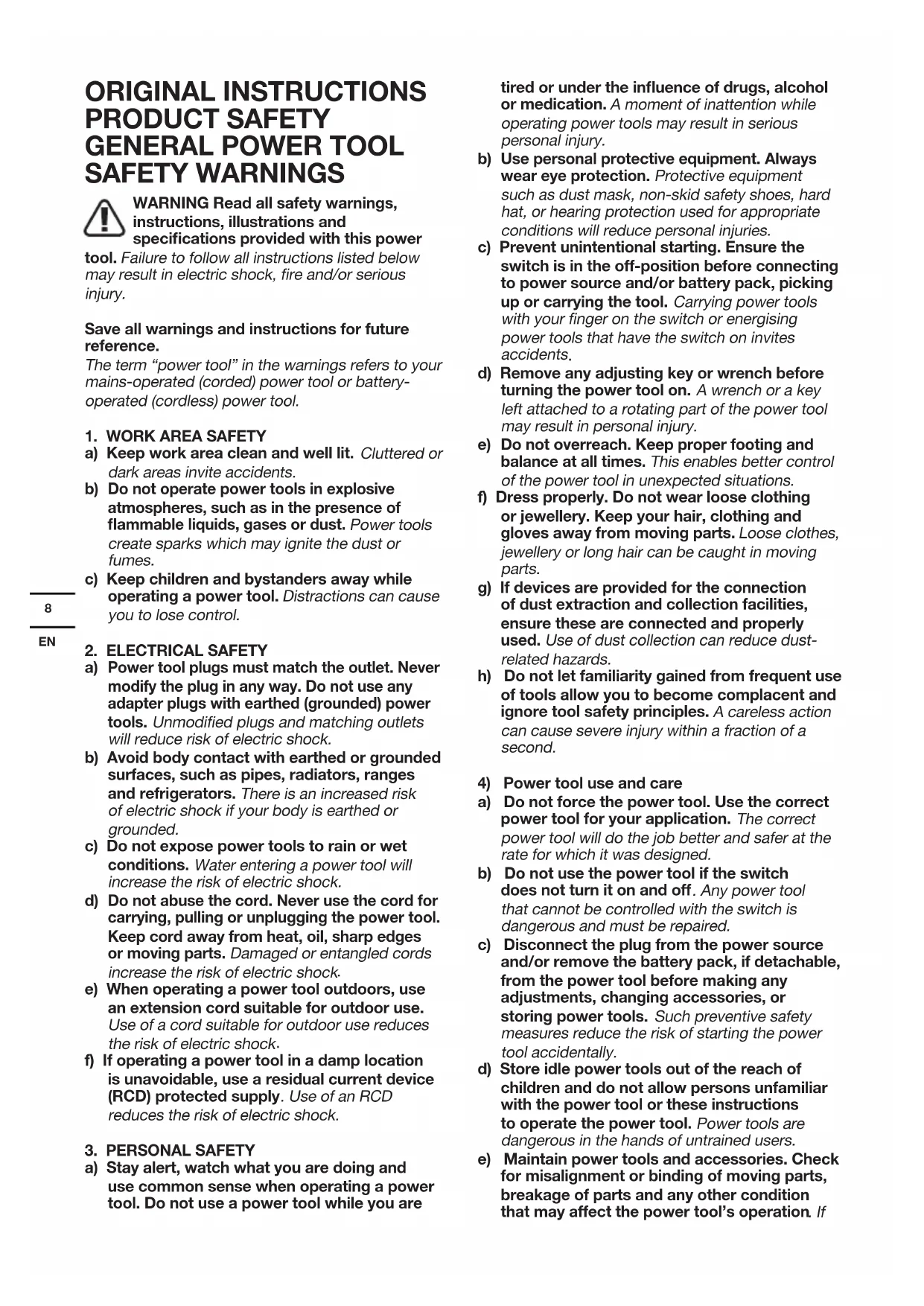
An escape path should be planned and cleared as necessary before cuts are started. The escape path should extend back and diagonally to the rear of the expected line of fall as illustrated in Figure 1.
Before felling is started, consider the natural lean of the tree, the location of larger branches and the wind direction to judge which way the tree will fall.
Remove dirt, stones, loose bark, nails, staples and wire from the tree.
2. Notching undercut
Make the notch 1/3 the diameter of the tree, perpendicular to the direction of falls as illustrated in Figure 1. Make the lower horizontal notching cut (W) first. This will help to avoid pinching either the saw chain or the guide bar when the second notch (X) is being made.
3. Felling back cut
Make the felling back cut (Y) at least 50mm higher than the horizontal notching cut as illustrated in Figure 1. Keep the felling back cut parallel to the horizontal notching cut. Make the felling back cut so enough wood is left to act as a hinge. The hinge wood keeps the tree from twisting and falling in the wrong direction. Do not cut through the hinge.
As the felling gets close to the hinge, the tree should begin to fall. If there is any chance that the tree may not fall in desired direction or it may rock back and bind the saw chain, stop cutting before the felling back cut is complete and use wedges of wood, plastic or aluminium (Z) to open the cut and drop the tree along the desired line of fall
When the tree begins to fall remove the Chainsaw from the cut, stop the motor, put the Chainsaw down, then use the retreat path planned ② Be
alert for overhead limbs falling and watch your footing. (See Figure 1)
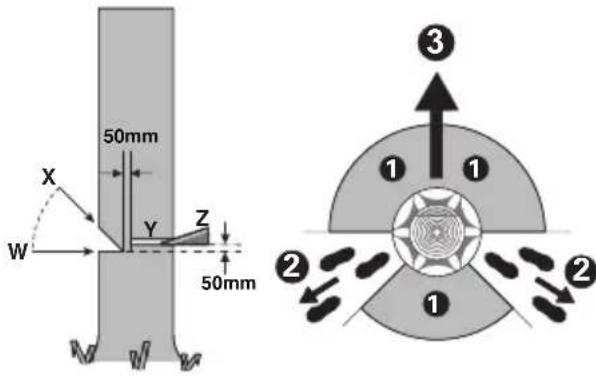
Figure 1
4. Limbing a tree
Limbing is removing the branches from a fallen tree. When limbing leave larger lower limbs to support the log off the ground. Remove the small limbs in one cut as illustrated in Figure 2. Branches under tension should be cut from the bottom up to avoid binding the Chainsaw.

Figure 2
5. Bucking a log
Bucking is cutting a log into lengths. It is important to make sure your footing is firm and your weight is evenly distributed on both feet. When possible, the log should be raised and supported by the use of limbs, logs or chocks. Follow the simple directions for easy cutting.
When the log is supported along its entire length as illustrated in Figure 3, it is cut from the top (overbuck), avoid contacting ground as this will greatly reduce the chain sharpness.
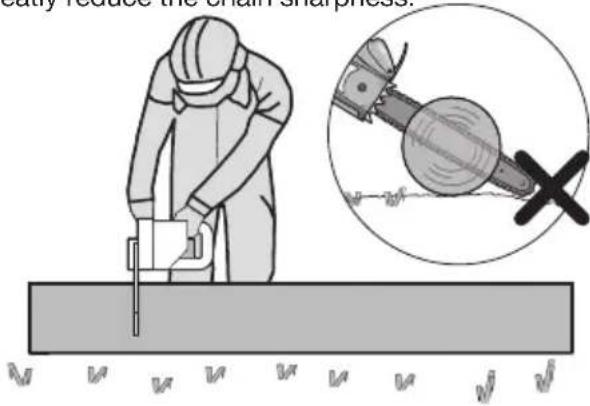
Figure 3
When the log is supported on one end, as illustrated in Figure 4, cut 1/3 the diameter from the underside (underbuck) (1). Then make the finished cut by overbucking (2) to meet the first cut.

Figure 4
When the log is supported on both ends, as illustrated in Figure 5, cut 1/3 the diameter from the top (overbuck) (1). Then make the finished cut by underbucking (2) the lower 2/3 to meet the first cut.

Figure 5
When bucking on a slope always stand on the uphill side of the log, as illustrated in Figure 6. When "cutting through", to maintain complete control release the cutting pressure near the end of the cut without relaxing your grip on the Chainsaw handles. Don't let the chain contact the ground. After completing the cut, wait for the saw chain to stop before you move the Chainsaw. Always stop the motor before moving from tree to tree.

Figure 6
SYMBOLS
| To reduce the risk of injury, user must read instruction manual |
| WARNING |
| Wear ear protection |
| Wear eye protection |
| Wear dust mask |
| Always use chain saw two-handed |
| Beware of chain saw kickback and avoid contact with bar tip |
| Do not expose to rain |
| Wear head protection |
| Wear protective gloves |
| Wear protective footwear |
| Waste electrical products must not be disposed of with household waste. Please recycle where facilities exist. Check with your local authorities or retailer for recycling advice. |
| Li-lon battery This product has been marked with a symbol relating to 'separate collection' for all battery packs and battery pack. It will then be recycled or dismantled in order to reduce the impact on the environment. Battery packs can be hazardous for the environment and for human health since they contain hazardous substances. |
| Do not burn |
| Batteries may enter water cycle if disposed improperly, which can be hazardous for ecosystem. Do not dispose of waste batteries as unsorted municipal waste. |
| Unlock |
| Lock |
COMPONENT LIST
| 1. REAR HANDLE |
| 2. ON/OFF SWITCH |
| 3. POWER INDICATOR LIGHT |
| 4. FRONT HANDLE |
| 5. CHAIN BRAKE LEVER (HAND GUARD) |
| 6. CHAIN |
| 7. GUIDE BAR |
| 8. CHAIN TENSIONING KNOB |
| 9. CHAIN COVER |
| 10. REAR HAND GUARD |
| 11. BATTERY PACK* |
| 12. BATTERY PACK RELEASE BUTTON* |
| 13. LOCK-OUT BUTTON |
| 14. OIL LEVEL WINDOW |
| 15. OIL FILLER CAP |
| 16. BUMPER SPIKE |
| 17. BAR AND CHAIN STORAGE/ TRANSPORTATION COVER (SHEATH) |
| 18. DRIVE SPROCKET |
| 19. BAR PAD |
| 20. FASTENING BAR BOLT |
| 21. BAR LOCATING TABS |
| 22. OIL OUTLET |
| 23. CHAIN DIRECTION SYMBOL |
| 24. BAR TENSIONING PLATE (SEE FIG. A2) |
- Not all the accessories illustrated or described are included in standard delivery.
TECHNICAL DATA
Type KG347E KG347E.X (3 - designation of machinery, representative of Chainsaw)
| KG347E KG347E.X ** | |
| Voltage 40V Max. (2x20=Max.) *** | |
| Bar length 40 cm | |
| Chain speed 18 m/s | |
| Oil tank capacity 160 ml | |
| Chain pitch 0.95 cm | |
| Number of chain drive links | 56 |
| Chain gauge 1.1 mm | |
| Replacement chain | ES: 3/8LP.043 56E 90X/Oregon: 90PX056 |
| Replacement bar | ES: ES164SDEA041/Oregon: 164MLEA041 |
| Battery type Lithium-lon | |
| Machine Weight (bare tool) | 4.2 kg |
X = 1 - 999 A-Z, M1-M9 there are only used for different customers, there are no safe relevant changes between these models.
*** Voltage measured without workload. Initial battery voltage reaches maximum of 20 volts. Nominal voltage is 18 volts.
| Category | Type Capacity | |
| 20V Battery KAB04 | 4.0 Ah | |
| 20V Charger | KAC04 | 4.0 A |
We recommend that you purchase your accessories listed in the above list from the same store that sold you the tool. Refer to the accessory packaging for further details. Store personnel can assist you and offer advice.
NOISE INFORMATION
| A weighted sound pressure | LpA= 85.9 dB(A) |
| A weighted sound power | LwA= 101.2 dB(A) |
| KpA & KwA | 3 dB(A) |
| Wear ear protection |
VIBRATION INFORMATION
Vibration total values (triax vector sum) determined according to EN 62841:
Vibration emission value ah = 4.8 m/s2
Uncertainty K = 1.5m / s2
The declared vibration total value and the declared noise emission value have been measured in accordance with a standard test method and may be used for comparing one tool with another. The declared vibration total value and the declared noise emission value may also be used in a preliminary assessment of exposure.

WARNING: The vibration and noise emissions during actual use of the power tool can differ
from the declared value depending on the ways in which the tool is used especially what kind of workpiece is processed dependant on the following examples and other variations on how the tool is used:
How the tool is used and the materials being cut or drilled.
The tool being in good condition and well maintained. The use of the correct accessory for the tool and ensuring it is sharp and in good condition.
The tightness of the grip on the handles and if any anti vibration and noise accessories are used.
And the tool is being used as intended by its design and these instructions.
This tool may cause hand-arm vibration syndrome if its use is not adequately managed.

WARNING: To be accurate, an estimation of exposure level in the actual conditions of use
should also take account of all parts of the operating cycle such as the times when the tool is switched off and when it is running idle but not actually doing the job. This may significantly reduce the exposure level over the total working period.
Helping to minimise your vibration and noise exposure risk.
Always use sharp chisels, drills and blades. Maintain this tool in accordance with these instructions and keep well lubricated (where appropriate).
If the tool is to be used regularly then invest in anti vibration and noise accessories.
Plan your work schedule to spread any high vibration tool use across a number of days.
ASSEMBLY

WARNING! Do not install the battery pack before it has been completely assembled.
Always use gloves when handling the chain.
CHAIN AND GUIDE BAR ASSEMBLY
- Unpack all parts carefully. Remove the chain cover by turning the chain tensioning knob in a counterclockwise direction. (See Fig. A1)
- Place the Chainsaw on a solid, level surface.
- Use only genuineKress chains or those recommended for Guide Bar.
- Slide the chain in the slot around the guide bar. Ensure the chain is in correct running direction by comparing it to the chain icon on the guide bar, or referring to the chain direction symbol found on the saw body. Ensure the bar tensioning plate is facing outward. (See Fig. A2)
- Fit the chain onto the drive sprocket, so that the fastening bar bolt and the two bar locating tabs on the bar pad fit into the keyway of the opening on the guide bar. (See Fig. B1, B2)
- Assure all parts are seated properly and hold chain and guide bar in a level position. Make sure the drive links are fully seated in the drive sprocket (See Fig. C1), avoiding a kink as shown in Fig. C2. If kink occurs, pick up on the chain at the guide bar just ahead of the kink and then pull the kink out.
NOTE: Chain should rotate freely and be free of kinks.
- Fit the chain cover and tighten the chain cover by turning the chain tensioning knob clockwise until it is tight. (See Fig. D)
- The chain will stretch while cutting and lose proper tension. When the chain becomes loose, completely unscrew the chain tensioning knob or turn the knob around three (3) full turns in a counter-clockwise direction, then retighten the chain tensioning knob to properly reset the chain tension by repeating Steps 6-7 listed above.

WARNING: The chain is not yet tensioned. Tensioning the chain applies as described under "TENSIONING CHAIN". The chain
now needs to be inspected to make sure it is properly tensioned.
TENSIONING CHAIN (See Fig. E1, E2)
NOTE: New saw chains will stretch. Check the chain tension frequently when first used and tighten when the chain becomes loose around the guide bar.

WARNING:
- Removing the battery pack before adjusting saw chain tension.
Cutting edges on chain are sharp. Use protective gloves when handling chain. - Maintain proper chain tension always. A loose chain will increase the risk of kickback. A loose chain may jump out of guide bar groove. This may injure operator and damage chain. A loose chain
will cause chain, bar, and sprocket to wear rapidly.
- Place the Chainsaw on any suitable flat surface.
- Turn the chain tensioning knob clockwise until it is hand tight.
NOTE: The tension is automatically increased while the chain tensioning knob is being turned in a clockwise direction. The built-in ratchet mechanism prevents the chain tension from loosening.
- Tilt the saw forward (See E1) where the guide bar tip is pushed in an downward direction. This will remove slack from the chain.
- Fully tighten the chain tensioning knob by turning it clockwise.
- Double check the tension set by the automatic chain tensioning knob. The correct chain tension is reached when the chain can be raised approx. Half the drivelink depth from the guide bar in the center. This should be done by using one hand to raise the chain against the weight of the machine. (See Fig. E2)
NOTE: The chain is properly tensioned when it can be lifted off of the Guide Bar and the drivelink is within the rail of the Guide Bar.
NOTE: The chain will stretch while cutting and lose proper tension. When the chain becomes loose, completely unscrew the chain tensioning knob or turn the knob around three full turns in a counter-clockwise direction, then retighten the chain tensioning knob to properly reset the chain tension by repeating Steps 1-4 listed above.
LUBRICATION (See Fig. F)

IMPORTANT: The Chainsaw is not filled with oil. It is essential to fill with oil before use. Never operate the Chainsaw without chain
oil or at an empty oil tank level, as this will result in extensive damage to the product.
NOTE: Chain life and cutting capacity depend on optimum lubrication. Therefore, the chain is automatically oiled during operation.
Filling oil tank:

WARNING: Removing the battery pack before filling the oil tank.
- Set Chainsaw on any suitable surface with oil filler cap facing upward.
- Clean area around the oil filler cap with cloth and unscrew the cap by turning it counter clockwise.
- Add bar and chain oil until tank is full.
- Avoid dirt or debris entering oil tank, refit oil filler cap and tighten by turning clockwise until hand tight.

IMPORTANT: To allow venting of the oil tank, small breather channels are provided between the oil filler cap and the strainer, to nt leakage, and ensure machine is left in a ntal position when not in use.
It is important to use bar and chain lubricant (not provided) that is formulated to perform over a wide temperature range with no dilution required. This can be found at the location where you
purchased this saw or your local hardware store. Do not use dirty, used or otherwise contaminated oils. Damage may occur to the bar or chain.Use of non approved oil will void the warranty.
Do not swallow. If swallowed, call a physician immediately. Keep out of reach of children. Store away from heat or open flame.
Checking the Automatic Oiler
Proper functioning of the automatic oiler can be checked by running the Chainsaw and pointing the tip of the guide chain bar towards a piece of cardboard or paper on the ground. If an increasing oil pattern develops on the cardboard, the automatic oiler is operating fine. If there is no oil pattern, despite a full oil reservoir, contact Kress customer service agent or Kress approved service agent.

CAUTION: Do not touch the ground with the chain. Ensure safety clearance of 40cm
OPERATION
WARNING! The charger and battery pack are specially designed to work together so do not attempt to use any other devices. Never insert
or allow metallic objects into your charger or battery pack connections because of an electrical failure and hazard will occur.
NOTE: Your battery pack is UNCHARGED and you must charge once before use.
The battery charger supplied is matched to the Li-ion battery installed in the machine. Do not use another battery charger.
2. CHECKING THE BATTERY CHARGE CONDITION (See Fig. G)
The battery level can be known from the battery indicator light by pressing the button beside the lights. NOTE: Fig. G only applies for the battery pack with battery indicator light.
3. CHARGING YOUR BATTERY PACK (See Fig. H)
The Li-ion battery is protected against deep discharging. When the battery is empty, the machine is switched off by means of a protective circuit. Each battery must be fully charged before the first use. In a warm environment or after heavy use, the battery pack may become too hot to permit charging. Allow time for the battery to cool down before recharging. NOTE: Always fully charge the two batteries at same time. More details can be found in charger's manual.
4. TO REMOVE OR INSTALL BATTERY PACK (See Fig. I)
Depress the battery pack release button to remove the 2 battery packs from your tool. After recharging, insert the 2 battery packs into the battery ports. A
simple push and slight pressure will be sufficient until a click is heard. Check to see if the battery is fully secured.
NOTE:
- When removing the battery pack, hold it firmly to avoid dropping and injury.
- This machine will only run when 2 batteries are installed. It is recommended to use the same two batteries and charge the two batteries at the same time.
- When you use two batteries with different power, the machine will only run to the lower common denominator.
5. POWER INDICATOR LIGHT (See Fig. J)
IMPORTANT:
When only one light is illuminated, your battery is overly discharged, even though the machine may still be capable to work. Continuing to operate your machine with the battery in this discharged condition may reduce the life and performance of your battery.
When no light are illuminated, at least one battery is not fully installed or battery may be defective, please double check the batteries are fully seated into position.
BATTERY STATUS
- Before starting or after use, press the button beside the power indicator light on the machine to check the battery capacity.
- During operation, the battery capacity will be indicated automatically by the battery power indicator. The indicator constantly senses and displays the battery condition as follows.
- For the machine with 2 battery packs with different power, the power indicator light displays the battery condition with the lower one of the two batteries.
| Battery indicator light status | Battery condition |
| Five green lights 1are 2illuminated. | The two batteries are in a highly charged condition. |
| Two, three or four green lights are illuminated. | The two batteries have a remaining charge. The more lights are illuminated, the more battery capacity. |
| Only one green light is illuminated. | The battery level of at least one battery pack is very low. Please check and charge the battery pack. |
| No light is illuminated. | At least one battery is not fully installed or battery may be defective. |
| Only one light is flashing twice per cycle. | At least one battery is over discharged (please refer to the battery charge condition), please recharge the two batteries at once before use again or storage. |
| Only one light is flashing three times per cycle. | At least one battery is hot, wait for them cool down before start again. |
| Only one light is flashing four times per cycle. | The machine is over load. Remove tool from cutting area and try again. |
6. SWITCHING ON AND OFF (SEE FIG. K)
ATTENTION: Check the battery packs before using your cordless tool. Only use the battery pack listed in the accessories section.
For switching on the tool, press the lock-out button, then fully press the on/off switch and hold in this position. The lock-out button can now be released. For switching off, release the on/off switch.
NOTE: The chain brake must be activated in order for the saw to be switched on.
7. CHAIN BRAKE LEVER (See Fig. L)
The chain brake lever is a safety mechanism activated through the front hand guard, when kickback occurs. Chain stops immediately.
The following function check should be carried out at regular intervals. Pull the front hand guard towards the operator (position 1 to deactivate chain brake. To activate the chain brake, push front hand guard forwards (position 2
NOTE: If the saw is unable to start, even though it is assembled properly and working with fully charged battery packs, then you should check if the chain brake lever is in the correct position (position ①).
8. CUTTING
IMPORTANT: Is the oil tank filled? Check the Oil Level Window prior to starting and regularly during operation (See Fig. M). Refill oil when oil level is low. A full oil tank will last approx. 12 minutes of cutting depending on sawing intensity and stops.
Check recent replaced chain tension about every 10 minutes during operation.
(1) Installing the battery pack into the machine.
(2) Make sure section of log to be cut is not laying on the ground. This will keep the chain from touching the ground as it cuts through the log.
Touching the ground while the chain is moving is dangerous and will dull the chain.
(3) Use both hands to grip saw. Always use left hand to grip front handle and right hand to grip rear handle. Use a firm grip. Thumbs and fingers must wrap around saw handles. (See Fig. N)
(4) Make sure your footing is firm. Keep feet-shoulder width apart. Distribute your weight evenly on both
feet.
(5) When ready to make a cut, push the lock-out button completely in with the right thumb and squeeze the trigger. This will turn saw on. Releasing the trigger will turn the saw off. Make sure the saw is running at full speed before starting a cut.
(6) When starting a cut, slowly place moving chain against the wood. The wood should be as close to the saw body as possible. Hold saw firmly in place to avoid possible bouncing or skating (sideways movement) of saw.
(7) Guide the saw using light pressure and do not put excessive force on the saw, letting the saw do its work. The motor will overload and can burn out. It will do the job better and safer at the rate for which it was intended.
(8) Remove the saw from a cut with the saw running at full speed. Stop the saw by releasing the on/off switch. Make sure the chain has stopped before setting the saw down.
(9) Keep practicing on scrap logs in a secure working area until you are comfortable, using a fluid motion and a steady cutting rate.
Kickback Safety Devices On This Saw
This saw has a low-kickback chain and reduced kickback Guide Bar. Both items reduce the chance of kickback. However, kickback can still occur with this saw.
The following steps will reduce the risk of kickback.
- Use both hands to grip saw while saw is running. Use firm grip. Thumbs and fingers must wrap around saw handles.
- Keep all safety items in place on saw. Make sure they work properly.
- Do not overreach or cut above shoulder height.
- Keep solid footing and balance at all times.
- Stand slightly to the left side of saw. This keeps your body from being in direct line with chain.
- Do not let Guide Bar nose touch anything when chain is moving.
- Never try cutting through two logs at same time. Only cut one log at a time.
- Do not bury the Guide Bar nose or try plunge cut (boring into wood using guide bar nose).
- Watch for shifting of wood or other forces that may pinch chain.
- Use extreme caution when reentering a previous cut.
- Use only the low-kickback chain and guide bar that were supplied with this Chainsaw or recommended.
- Never use a dull or loose chain. Keep chain sharp with proper tension.
How to use Saw Safely
- Use the Chainsaw only with secure footing.
- Hold the Chainsaw at the right-hand side of your body (See Fig. O).
- The chain must be running at full speed before it makes contact with the wood.
- Use the bumper spikes to secure the saw onto the
wood before starting to cut.
- Use the Bumper Spikes as a leverage point while cutting. (See Fig. P)
- Do not operate the Chainsaw with arms fully extended, attempt to saw areas which are difficult to reach, or stand on a ladder while sawing (See Fig. Q).
Never use the Chainsaw above shoulder height
Cutting wood under tension (See Fig. R)
WARNING: When cutting a limb that is under tension, use extreme caution. Be alert for wood springing back. When wood tension is released, limb could spring back and strike operator causing severe injury or death.
When sawing logs supported on both ends, start the cut from above(Y) about 1/3 of the diameter into the log (overbuck) and then finish the cut (Z) from below, in order to avoid contact of the Chainsaw with the ground. When sawing logs supported on only one end, start the cut from below (Y) about 1/3 of the diameter into the log (underbuck) and finish the cut from above (Z) in order to avoid log splitting or jamming of the Chainsaw.
SAW MAINTENANCE
Follow maintenance instructions in this manual. Proper cleaning of saw and chain and Guide Bar maintenance can reduce chances of kickback. Inspect and maintain saw after each use. This will increase the service life of your saw.
NOTE: Even with proper sharpening, risk of kickback can increase with each sharpening.
MAINTENANCE AND STORAGE OF CHAINSAW
1. Remove the battery pack
- When not in use
Before moving from one place to another
Before servicing -
Before changing accessories or attachments, such as saw chain and guard
-
Inspect Chainsaw before and after each use. Check saw closely if guard or other part has been damaged. Check for any damage that may affect operator safety or operation of saw. Check for alignment or binding of moving parts. Check for broken or damaged parts. Do not use Chainsaw if damage affects safety or operation. Have damage repaired by authorized service center.
3. Maintain Chainsaw with care.
- Never expose saw to rain or direct moisture.
- Keep chain sharp, clean, and lubricated for better and safer performance.
- Follow steps outlined in this manual to sharpen chain.
-
Keep handles dry, clean, and free of oil and grease.
-
Keep all screws and nuts tight.
-
When servicing, use only identical replacement parts.
-
When not in use, always store Chainsaw
-
in a high or locked place, out of children's reach
in a dry place
with bar and chain cover in place
Bar Maintenance
To maximize bar life, the following bar maintenance is recommended.
The bar rails that carry the chain should be cleaned before storing the tool or if the bar or chain appear to be dirty.
The rails should be cleaned every time the chain is removed.
To clean the Bar rails:
- Remove chain cover and bar and chain. (see section ASSEMBLY)
- Using a wire brush, screwdriver or similar tool, clear the residue from the inner groove of the bar.
- Make sure to clean oil passages thoroughly
Conditions which require chain and guide bar maintenance:
- Saw cuts to one side or at an angle.
- Saw has to be forced through the cut.
- Inadequate supply of oil to the bar and chain.
Check the condition of the guide bar each time the chain is sharpened. A worn guide bar will damage the chain and make cutting difficult.
After each use, remove the battery pack, clean all sawdust from the guide bar and sprocket hole.
When rail top is uneven, use a flat file to restore square edges and sides.

Worn Groove Correct Groove
Replace the guide bar when the groove is worn, the guide bar is bent or cracked, or when excess heating or burring of the rails occurs. If replacement is necessary, use only the guide bar specified for your saw in the repair parts list or on the decal located on the Chainsaw.
Replacing Bar & Chain
Replace chain when cutters are too worn to sharpen or when chain stops. Only use replacement chain noted in this manual.
Inspect guide bar before sharpening chain. A worn or damaged guide bar is unsafe. A worn or damaged guide bar will damage chain. It will also make cutting harder.
Fit the bar tensioning plate tab into the new bar by tightening the screw clockwise. The tab protrusion (a) must be fitted into the bar hole. (See Fig. S)
SHARPENING SAW CHAIN
WARNING: Remove the battery pack before servicing. Severe injury or death could occur from electrical shock or body contact with moving chain.
Cutting edges on chain are sharp. Use protective gloves when handling chain.
Keep chain sharp. Your saw will cut faster and more safely. A dull chain will cause undue sprocket, Guide Bar, chain, and motor wear. If you must force chain into wood and cutting creates only sawdust with few large chips, chain is dull.
Lubricate Sprocket
WARNING: Wear heavy duty gloves when performing any maintenance or service to this tool. Always remove the battery pack before performing any service or maintenance on this tool.
NOTE: It is not necessary to remove the chain or bar when lubricating the guide bar sprocket.
- Clean the bar and sprocket
- Using a grease gun, insert the tip of the gun into the lubrication hole and inject grease until it appears at the outside edge of the sprocket tip. (See Fig. T)
- To rotate the sprocket pull the chain by hand until the ungreased side of the sprocket is in line with the grease hole. Repeat the lubrication procedure.
FOR BATTERY TOOLS
The ambient temperature range for the use and storage of tool and battery is 0ircC - 45ircC
The recommended ambient temperature range for the charging system during charging is 0ircC - 40ircC
ENVIRONMENTAL PROTECTION
Waste electrical products must not be disposed of with household waste. Please recycle where facilities exist. Check with your local authorities or retailer for recycling advice.
TROUBLESHOOTING TABLE
The following table gives checks and actions that you can perform if your machine does not operate correctly. If these do not identify/remedy the problem, contact your service agent.
WARNING: Switch off and remove plug from power source before investigating fault.
| Symptom Possible Cause Remedy | ||
| Chainsaw fails to operate | Low battery charge. Chain brake not in the proper position. | Charge both the battery packs. Check to see if the chain brake is in position ①. Refer to CHAIN BRAKE for details. |
| Chainsaw operates intermittently | Over heating Applying too much pressure while cutting. Loose connection. Internal wiring defective. On/Off switch defective. | Place the machine in a cool, ventilated place to cool it down. Applying relatively less pressure while cutting. Contact service agent. Contact service agent. Contact service agent. |
| Dry chain No oil | in reservoir. Vent in oil filler cap clogged. Oil passage clogged. | Refill oil. Clean cap. Clean oil passage outlet. |
| Kickback Brake/Run Down Brake | Brake does not stop chain | Contact service agent |
| Chain/chain bar over-heats. | No oil in reservoir. Vent in oil filler cap clogged. Oil passage clogged. Chain is over tensioned. Dull chain. | Refill oil. Clean cap. Clean oil passage outlet. Adjust chain tension. Sharpen chain or replace. |
| Chainsaw rips, vibrates, does not saw properly. | Chain tension too loose. Dull chain. Chain worn out. Chain teeth are facing in the wrong direction. | Adjust chain tension. Sharpen chain or replace. Replace chain. Reassemble with chain in correct direction. |
DECLARATION OF CONFORMITY
We,
Positec Germany GmbH
Postfach 32 02 16, 50796 Cologne, Germany
Declare that the product Description Battery-powered chainsaw Type KG347E KG347E.X (3 - designation of machinery, representative of Chainsaw) Function Cutting wood
Complies with the following Directives: 2006/42/EC, 2014/30/EU 2011/65/EU&(EU)2015/863 2000/14/EC amended by 2005/88/EC
The notified body involved
Name: Intertek Deutschland GmbH (Notified body 0905)
Address: Stangenstraße 1, 70771 LEINFELDEN-ECHTERDINGEN
Certification No.: 20SHW2092-02
2000/14/EC amended by 2005/88/EC: Conformity Assessment Procedure as per Annex V Measured Sound Power Level 101.2 dB(A) Declared Guaranteed Sound Power Level 104 dB(A)
Standards conform to EN 62841-1, EN 62841-4-1, EN ISO 3744, EN 55014-1, EN 55014-2
The person authorized to compile the technical file, Name: Marcel Filz Address: Positec Germany GmbH Postfach 32 02 16,50796 Cologne,Germany

2021/10/28
Allen Ding
Deputy Chief Engineer, Testing & Certification
Positec Technology (China) Co., Ltd.
18, Dongwang Road, Suzhou Industrial Park, Jiangsu 215123, P. R. China
INHALTSVERZEICHNIS
INFORMATIONS RELATIVES AU BRUIT
INFORMATIONS RELATIVE AUX VIBRATIONS
2021/10/28
Allen Ding
Vice capo ingegnere, testing e certificazione
Positec Technology (China) Co., Ltd.
18, Dongwang Road, Suzhou Industrial Park, Jiangsu 215123, P. R. China
INDICE
18, Dongwang Road, Suzhou Industrial
Park, Jiangsu 215123, P. R. China
INHOUDSOPGAVE
WAARSCHUWING: Voor de
18, Dongwang Road, Suzhou Industrial
Park, Jiangsu 215123, P. R. China
CONFORMITEITVERKLARING
Wij,
Positec Germany GmbH
Postfach 32 02 16, 50796 Cologne, Germany
Gentag denne procedure for smoring.
TIL BATTERIREDSKABER
18, Dongwang Road, Suzhou Industrial
Park, Jiangsu 215123, P. R. China
COIDEPKAHNE
BVeJeHne. 111
TexHnK 6e3OpacHoCTn. 112
Cnncok KomnoHeHOB. 118
XapakTepeNCTnKu. 118
C6opka npa6ota. 120
Pabota. 121
Texnueckoe 06cnyxnbHne. 124
Ta6nua yctpaHEnHa HncnpaBHOCTe. 125
OxpaHa OkpykaiooCpebl. 125
ДeКларачиСоOTВeTcTBИ. 126
BBEDEHNE
YBaXaEmbI NOKyNaTeMb!
a) He pa36npaIte, He oTKpbIbAIte qYeKN nn 6aTapeHbI 6JIOK.
b) He 3aMbIkaIte aKKymyIaTOpHyIO 6aTapeIO. He xpaHnte 6ecnopJIoO aKKymyIaTOpbl B KOp06Ke Hnn JaNke, rDe OH N MOrTy 3aMbIkaTbc dpyr c dpYROM HNN 6bITb 3aKopooyHbI pNoBOnaMM MaTePnaJaMn.
Korda aakymyIaTOp He nCnoJIb3yeTcra, depknte ero noaJIbwe OT dpYnx MeaJIInueckNX npEdMeTob, TaKnx KaK cKpeKN, MOHeTbl, KIOUCh, rBO3dN, BnHTbl NII dpyrNe MeKLKe MeTaJIInueckne npEdMeTbl, KOToPbIe MOrYT 3aMKHyTb KoHTaKTbl. 3aMbIkaHne KOHTaKTOB aKKymyJIaTopa MoXeT npNBecTu K OXOram NII NOxApy.
c) He noDBepraIte akKymyIaTOpHyIO 6aTapeIO BO3dEiCTBnIO TeNla Hnn OrHry. N36eraIte nonadHnnpAmbix cOnHeuHbIX LyueH.
d) He noDBepraIte akKymyIaTophyIoo 6aTapeIO mExAHnueckm yIapam.
e) B cnyuae npotekna 6aTapeH He donyckaIte KOHTaKta XnDkoCTn C KoxKe Hn rna3am. Ecnn XnDkoCTb KOHTaKTnpoBana C TeIOM, npomOnTe NopaxKeHHbI yAcToK 06NlbHbIM KOnHueCTBOM BObl I 6paTHTEcb 3a MeduHhCKo NpOoubIO.
f)ДерхиTe aKKymyIaTOp B uHcTOTE n cyxom COCTOHH.
g)ПopotпгеКлемьakкумларTopнбатaperнчсToCyxOuTKaHbIO,eCIN OHN3arpy3HHInCb.
h) Ipeed nCnoJb3OBAHHeM 6aTapee ee Heo6xOdHMo 3apAHTb. Bcerda o6paauTeEc b K 3ToI HHCTpyKcHn H nCNoJIb3yIte npabNlbHyIO npoueDpy 3apAKn.
i) He xpaHnTe akKymyIaTOp B 3apAHyom ycTpoIcTBe, KOrda OH He HcNoIb3YeTCa.
j) NocJe npoJoxKntBbIX nepHODOB XpaHeHnM oXeT nOpTe6oBaTbcra HeckOJIbKO pa3 3apAaNTb H pa3pAaNTb aKKyMaJIaTOphyIO 6aTapeIO, qTo6bl nOpUHTb MaKcHMaJIbHyIO npOn3BoDInTeNbHOCTb.
k) Ipepe3apjXaIte TOnbKO 3apJHbIM yCTpoiCTBOM, Oo6peHHbIM Kress. He nCnoJIb3yIe 3apJHoe yCTpoiCTBO, OTnUHoe OT TORO, KOToPoE cneuaJIbHO npedHa3NaYeHo dJa NcNoJIb3OBaHHa C o6OpyIOBaHHem.
I) He nCnoB3yIte 6aTapeHbI 6LoK, KOTOpbI Hne npedHa3HaueH dIg IcNoIb3oBaHnca c o6OpydoBaHHeM.
m) XpaHnTe aKKyMylrTop B HeoctynHom dIa dete MecTe.
n) CoxpaHnte opHrMaHaJIbHyIO JntepaTpy no npOdyKTam dJa daIbHeuero MCNoJIb30BaHHa.
o) N3BJIeKInTe aKKyMylAToP n3 06OpydoBaHn, ecn OH He nCnoJb3yeTc.
p) YTNIN3npyIte HApIeXkaIIM 06pa3OM.
q) He nCnoJIb3yIte C yCTpoIcTBOM 3JIeMeHTbl pa3HOrO npOn3BOdCTBa, EMKoCTn, pa3Mepa nn Tnna.
r)ДерхиTe 6aTapeIO nOaIbwe OT MKNpOBoJHOBbIX NeueN BBICOKOr OaBJIeHn.
COXPAHNTE 3TV HNCTPYKUNO
Yka3aHn, kacaiounec npaBnIbHbIX MeToIOB BbIpy6Kn, 6pe3Kn cybeb nnonepeuHoi pacnIIOBKn
1. BanaepeBbeB
EcnBbKa n paCnNkA DepeBbeB npOn3BOOnTc
OHObPeMeHNO DByMn 60Jee pa6oTHNKaMn,
To MeXy pa6OuHMn, npOn3BOJaUIMn
BaKny n paCnNkY,doJIxHo BblDepXNBaTbcR
pacCToAHHe,paBHoe MInHMym yDBoEHHO
BbICote cnnlNbAeMbIX DepeBbeB. PnB aKne
DepeBBeB BHMaTeNbHO CNeIITe 3a TeM, YTO6bl
dpyrHe Nua He NoDBePraHncb OnaCHOtN,
He NobpeXdaIINCb NHTaIOUne 3JeKtpnueckne
npOBoKn n He BO3HnKaJa BO3MOXHOCb HaHeceHN
MaTepeNaHbHorO yUep6a.Ecn CnIINaBaEmoe
DepeBO BCTyNTB KOHTaKT C 3JeKtpnueckoN
pOBoKn, To HeMeJleHNo I3BeCTnTe O6 3Tom
3HeproChabXaIoUee PpeIppnTne.
Pn BbIOJIHeHn pa60 Na cKIOHax OepaTOp
IeHNo IINbl DOJXeH BceIa HAXOITbcra Bblwe
CIIINBaEMo DEpeBa, NocKOBky CIIJIeHHOe
DEpeBO BepoTHee Bcero 6yDet CKaTBaTbcra IINI
COCKaJIb3blBaTb NO cKIOHy BHN3.
Ipeed BaikoJ DepeBa DoJKeH 6bItb 3aIIaHnpOBaH NyTb OTXoJa N npn Heo6xOdMocTN CneJeT IOnrTOBtB n OcBO6OuNTb erO. PyTb OTXoJa DoJKeH BcTeN B CTOpOHy N BBepx OT OxKnDaemoi JINHH NaeHnja DepeBBeB. (CM.pnc.1)
Ipepe nobanko DepeBa CneDyeT npHnrytB BO BHMaHne erocTeCTBeHHbHaKNoH,NOLOKeHne erocmbix KpyNbIX BeTBeHn HappaBJeHne Betpa, YTO6bl npabNbHo OceHHTb BO3MOxHoe HAppaBJeHne erO naDeHn.
C DepeBa CneIyEt IpeIbapnteIbHo ydaIITb rpr3b, KaMHN, OTCaBwYIO Kopy, rBO3dN, MeTaIINueckne ckobli npoBOJOKy.
2.Пpon3BveIte3aceky
PpOnnIte noI npMbIM yrIOM co cTOpOHbl
naDeHnA DepeBa 3aNNB Eero CTBone Ha
rny6nHy, paBHyIO 1/3 dNaMeTpca CTBona. BHaayane
BbINOJIHnTe HxKnI rOpN3oHTaJIbHbI 3aIII. 3To
No3BOJNT n36eKaTb 3aXaTna PnIbHOJ cENn IIN
HaIpaBraIOSeI uHHbI NIIbI pRbBINOJIHeHN
BTOPOrO 3aIIIna. (CM.pnc.1).
3. BbINOJIHeHn NOBaIouHOro 3aIIJla
Pon3BeNTe NOBANOHyb 3aNN MHNMyM 50 MM Bblwe rOpN3OHTaNbHOro 3aNNa. NOBANOHyb 3aNN CNeDyET BblONHrTb NapaJIeNbHO rOpN3OHTaNbHOMy 3aNNy. PpONNIte NOBANOHyb 3aNN TOJbKO TAK fly6OKO, yTO6bl OCTaIacb BePTNKaNBHa
IpeBecHaj nepembyka, KOtopa MoIgna 6bl CnyxNtB
IapHnpom. 3Ta nepembyka IOnXHa npeIoTBpaTHTb
BO3MOXHOCTb IOBOPoTA DepeBa H erO NaDeHnA B
He npabInbHom Ha npabNeHN. He nepenInnBaIte
3Ty nepembyky. (CM. pnc.1)
Пп пьблжжн NOBANOCHOrO 3aNilna K пермьчke DepeBO NaHHaet BaNtbcr. EcIn CTaHET BnDNo, YTO DepeBO MoKTe UyacTb B HexeJaemOM HaPaBHeHn NII NaJx He KaKIOHNTcR Ha3aI N 3aXaTb NINbHyU cEnb, IpePBNTe BblONJIeHne NOBaIOHOrO 3aNilna N IcNoJIb3yIte ДЯл OTKpbITNa 3aNilna N OKOHYaTeNbHOI NOBANKN DepeBa B JxelaemOM HaPaBHeHn KInHbЯИЗ DepeBa, ПЛЯСТМACСы ИИ N aIbOMHHNЯ.
Ecni DepeBo NaHcHT naTaB, ydaInte UenHyu nnny n3 3aIInla, BbIKIOUHTe N OTIOXHTe ee B CTOpOHy, POKINbTe ONaChyIO 3OHy NO 3aIIaHnpoBaHHOMy nyTn OTxOJa. CJIeNTe 3a ynaBUnMn BHN3 BETBAMn H He 3aHHTecb O HNX.


4. YdaJIeHne BcTBeI
Iod ydaJIeHHeM BeTBeI IOpa3yMeBaETcIx
CnIIINBAHne c Uyke NOBaJIeHHOrO DepeBa Ipn
YdaJIeHm BcTeBn BHaUaJIe OCTaBbTe Ha MeCTe
CaMbIe KpyNbIe N3 HIX, KOtOpBle HApRaBHeHbI BHN3
HHa KOtOpBle ONIPAeTcI NOBaJIeHHoe DepeBO.
YdaJIte MeHbIWe BeTKn OJHIM 3aHJLOM, KaK 3TO
Poka3aHO Ha pucyHke. BeTKn, HaxoJaUncEci PoI
HaNPJXKeHMe, DOJXHbI OTnIIINBaTbcr CHN3y BVEpx,
YTO6bl NCKJIIOHTb BO3MOXHOCTb 3aXaTHra PInlbHOJ
ZeII. (CM.pic.2)
pnc.2

5. Pa3pe3aHne CTbOla DepeBa Ha qactn
ПОД 3ТИМ NOHIMaeTcpaCININBAHHe CTBOJa NOBaJIeHHOrO DepeBa NoДиHe HaЧАrN.CIeДИTe 3a 6e3OpanacHOCTbIO CTOnKN I paBHomepHbIM paCnpedeJIeHNem Beca TeHa HoBe HOrN.EcNt BO3MOxHo, CNeIyET CO3dA Tb ONOpY Jlra CTBOJa DepeBa C NOMOUsb BoTBei, BaJOK NIIKINHbeB. BbINOJIHЯIte npocTbIe yKa3aHnIЯ ДЯлЯгКOro paCININIBaHnIy.
Ecnn CTBOJ DepeBa 6ydt paBHOMepHo yIoxKe H NO BcEi DnHe, NaHHTe pacNnKy CBepx.y. (Cm. pnc.3)

Ecnn CTBOJ DepeBa JIeKHT Ha OJHOM KOHcE, npoNNITE BHaayane 1/3 dnaMeTp a CTBOJa C HnXHei CTOpOHbl, a 3aTeM npoNNITE OCTaTOK CBepxY HaI MecToM HnXHrero 3aIINa. (Cm. pnc. 4)

EcnntBoJ DepeBa JeknHa 06oN KOncaX, nponnTe Bhaane 1/3 DnaMeTpa CTBona C BepxHei CToPOHbI, a 3aTeM nponnTe 2/3 CHn3y Ha MeCe Te BepxHero 3aIINa. (Cm. pnc. 5)
pnc.5
Pn BbINHeHn paCnIOuHbIX pa6oT HaCKIOHe cToIe Bcerda Bblwe CTBOna DepeBa.ДЯ coXpaHEnHa NJIHO KONTPOJBO BPeMn «IpONINBAHn» yMeHbAaTe B KOHcE IpONnApnKIMHo yCInHe, He ocNa6nJa KpeNoCTb 3axBaTa pyKOrTOK cENHO nIIbl. BHImaTeNbHo cIeIITe
3a TeM, YTObI NINbHa cENb He KacaIacb 3eMn.
Pocne 3aBepseHna pacnna nepei ydaIeHneM
cENHO NINbI DOXNTecb NOHOBKN
NINbHO UeHN. BcerDa BbIKIOuayTe DBNrAteNb
cENHO NINbI pRn NEpexOe OT OJHO TpeBa K
dpyromy. (CM.pnc.6)

UCIOBhIE 0603HAUHn
PNEOCTEPEXHEN:3NaueHne Bn6paun
PnФaKTnueCKOM NcNoJIb3OBaHIN
3JIeKTPoHnCTpyMeHTaMOXeTOTNIuTaBcraOT 3aRbIeHHOrO3HaYeHnB3aBNCmOCTNOTTOK,KaHcHTpyMeHTNCNoJb3yETc:
Kak nCnoB3yeTcHnCTpyMeHT, n KaKne MaTePnaIbI NOBBePraIOTcpe3Ke nn CBePJIeHNIO. XopoOee cocToHHe INHCTpyMeHTa ero XopoOee 06cnyKnBaHne.
IcnoJb3OBAHne npabNbHoro akceccyapa nIa NHCTpyMeHTa N oBecnepeHne erO octpoTbI N XopoWero COCTOAHn.
Kpenocb yndeppkaHn pykOyToK nncnoB3oBaHne aHTNB6paCIOHHbIX akceccyapOB.
IcnoJb3yeTcI INHCTpyMeHT B COOTBeTcTBn C erO npEHa3HaueHHeM N 3TuMn INHCTpyKUmaMn.
3TOT NHCtpymeHT MoKET Bbl3BaTb TpeMop pyk npn erO HnPaBnJbHOM HCNoJb3OBaHH.

PNEOCTEPEXKHE:YTo6bl6bITbTOUHO, OueHka yPoBnBa03dIeCTBnBpeaIbHbIX
YCIOBnX NCIOBb3OBaHn DOJXHa TaKKe YUHTbIBaTb BCE qactn pa6oeryo uKJa, TaKne KaK BpeM, KOrda HNCTpyMeNT BbIKNoUeyen KOra OH pa6OtaeT Ha XOIOCTOM XOyH He BblNOJIHReT pa6Oty. 3TO MOKeT 3HaHTeNbHO CHN3NTb yPoBeHb BO3JeICTBnA 3a BeCb pa6Ouyn nepnoi.
IOMORAET MHNIMN3HPOBaTb PNCK BO3HNKHOBeHnA TpeMopa pyk.
BCErIa nCnoJb3yIte ocTpblpe3uI, CBepna ne pexyuine nnckn.
06cnyknaIte 3TOt INHCTpyMeHT B COOTBeTCTBUN C 3TNIMN INHCTpyKUJAMN IN XOPOW O CMA3bBAJIte (PnHEO6XoDUMOCTN)
PnpeyraHOM nCNoIb3ObaHHn HnHCTpyMeHTa - npno6peTne aHTNBn6paunOHhle akceccyapbl.
PnAnHyTe BaW pa6OuH rpaФNK TaK, YTO6bl pacpeJeNTb NcNoJIb3OBAHne INHCTpyMeHTa C Hn6oJbWeBn6paUneHa HeckOnbKO dHeN.
C6OPKA

OCTOPOXHO! He yctHaBnBaIte
6aTapeHbI 6nokdo nonHoro
3aBepeHnC6opKn.
Bcerda nCnoIb3yIte nepuatkn npn pa6ote c ceNbIO.
MOHTAX ZENN NINJIbHOI SHHHbl
- OctopoxHo pacnakyTe BCE yactn. Chmnte KoxyX ueN, NOBepHyB pyuKy peYIpOBKn HaTaeHnI NIIbHOJ eNn IpOTNB YacOBn CTpeKN. (CMoTpne pnc. A1)
2.Полжnteбeнзоилhy ha poBHyIO,ycToiHyBuI ONoBepxHocTbIO. - NcnoIb3yIte TOnbKO opnHHaJIbHbIe cenN Kress nIu ceni, peKoMeHDoBaHHbIe dIra nnlbHOJ uINHbl.
- BCTaBbTe ueNB Ba3 BOKpyr HappaBlyoUeien HINbIy. Y6eHNTecb, yTO ueNB HaxOJNTcB NpabNtBHom HappaBLeHn DnBxKeHn, CpaBHB erO co 3HaYKom ueHn Ha HappaBJIooJe WnHe, INI NOcMoTpeB Ha 3HaQK HappaBLeHn CEHN HA CTaHKe NNbl. Y6eHNTecb, yTO NaHeNb HaTaeHnue HINbI o6paueHa HApjxy. (CMOTpntepnC.A2)
- Hanehbe Tcnb Ha BeDyUyO 3Be3Oouky TaK, YTObI BoNT KpePnEHHa N DaBa yCTaHOBOUYbIX BbICTyNa UHHbHa PnaHKe COBnAaN Co WNoHOuHbIM Na3OM OTBepCTNa Ha HapBaBIAIOuei UHHb. (CMoTpnte pnc. B1, B2)
- Y6eHNTecb, yTO BCE dTeaJIy UcTaHOBHebl npabNtHo, n ydepxnBaIte cenb HappaBnIOUyIO uHHy B rOpN3OHTaNbHOM NOLOXKeHN. Y6eHNTecb, yTO pINBOHbIe 3BeHbI a NOnHOCTbIO BCTaBNeHbIB 3Be3DOUky pInBOda (cmOTpnte pnc.C1), 6e3 n3r6a, KaK nOKa3aHO Ha pnc.C2. Ecnn BO3HnKaeT n3r6, Bo3bMITE ue Nb Ha HAppaBnIOUeJ uHHe nepei n3r6oM I NOTAHNTe yTO6bl BBIpOBHr8 eRo. IPNMEYAHHE: Cenb doJxHa cBo6oHb BpaataBcR n3r6OB He doJxHo 6blb.
- YctaHOBNTe KoxyX cENn n 3aTAHNTe, NOBepHyB pyKy peYnnpOBKn HaTaeHn nnbHoN cENn no yacobO B CTpeJIke Do yIopa. (CMOTpnte pnc. D)
- Κεπb 6yπet pactrIIBaTbc B0 BpeM pa6oTbI nnoTepeRET npaBnIbHoe HATxKeHne. KOrda HATxKeHne cENn TepReTc, NOHOCbTO BblkpyTnte pyKU peRynipOBKn HAxKeHn nnBHO u cENn NnN noBepHnte pyKU Ha TpN (3) noNbIX o6opota B HApBaJIeHNn IpOTNB YacOBO CTpeKN, 3aTeM 3aTaNHTe pyKU peRynipOBKn HATxKeHn NNbHO u cENu YTO6bl npaBnIbHO yCTaHOBNTb HATxKeHne cENn, NOBTopNB 7aN 6-7, nepeueNCHeHHble bIwe.

OCTOPOXHO! Lcnb eue He HaTaryta.
HaTaeKeHne cenn npOn3BODntcKaK
onncahOBpa3dene «HaTaeXeHne cenn». Tenepb HxNHO npoBepntb cenb, yTo6bl y6eHnTbcra 7TO HaTaeXeHne cenn ycTaHOBJeHo npaBnIbHO.
HATXKEHNE LEN (cmoTpTe pnc. E1, E2)
PIMMEAHHE: HoBle NINbHbIe cEN6byT pactaRnBaTbc. NocToHHo npOBepaTe HATXKeHne cENPi nepBOM nCNoB3OBAHmN 3aTaNBaTe, KOrda cENb pAcTraNBaETcB OKpyr HanpaBnaUoSei uHbl.

OCTOPOXHO!
H3BleueHHe 6aTapeHoro 6Ioka nepepepylnpOBKO HaTJKeHn nnlbHoN cenn.
- Pěkúшné KpOMKn Ha zuenn ocTpblé.
HcnoJIb3yIte 3aunTHbIe nepuATkn KOrda
6epete zenbl.
Bcerda noidepKbAte npabHbHoe HaTaeHne cen. Ocna6leHHa cenb yBeHHBaet pnc OTaun. Ocna6leHHa cenb MOxET BbInactb H3 Na3a HanpaBnIOuei WnHbl. 3TO MOxET npNBecTN K HaHeceHHIO nobpeXdHm pa6OeMy n NobpeXdeHHIO cenn. Ocna6leHHa cenb npNBedeT K 6bIcTpoMу n3Hocy cenH, WnHbl N 3Be3doQKn.
- NomeCTte 6eH30nJy Ha nlockyo NOBepxHOCTb.
- Повернite руку Perулирови NaTЯженяпьhoи ZeHn no Yacoboi cTppeKe Do ynpa.
PIMMEUHNE:HaTHe n aBToMaTuYeCKn yBeJIuNbAeTcR, KOrDa pyUky peYIuPoBKn HaTJKeHn IINbHOI cEiN NOBOpaUBaIOT IIO YacOBn CTpeJIke. BCTpoEHbI XpAnOBoM MExAHn3M IpeDoTbPaUaET OcIa6JIeHne HaTJKeHn cEII.
- HakoHnte niny Bnepei (cM. E1), KOrda HaKoHeuHK HAnpaBnaIOUeI uINbI BbITaKNBaETCB HAnpaBneHn BN3. 3To I03BOJNT yCTpaHHTb IpOBncAHne cENI.
4.ПонhoeТьюЗатунerte руку PerуларовиНатяженяпльbosи срп no yacobov cTepeJIke.
5.перровьтЕнгхeHne aBToMaTueckn yctaHOBHeHoe pyKoI peryInpOBKn HataxHnnaHbHo nHn. IpaBnHoe HataxHneU cENI DoCTnHyTO, KOrda cEnb NOHNMAeTCn Pn6n3ntelbHO Ha NOnOBnHy rJy6nbl npBOHO 3BeHa OT HApBaJIIOSei WnHb B ceHTpe. 3TO DOJXHO 6bITb CdeJaHO OHDnpyKoI, YTObI NOdHraTb cEnb IpOTNB Beca ycTpOcTBa.(CMOTpuTe pnc.E2)
PIMMEUHHe:HaTaeHHeBcenn yCTaHObIeHo HaJIeXaIIm O6pa3OM, KOrda ee MOxHO IOHNrCb HApBaJIIOuSei ShHbI, IN pINBOJHoe 3BeHO HaxOJITcB HApBaJIIOuSei ShHbI.
PIMMEUHNE: 6yET pactrNBtbcra BO BpeMpa6oTbI NOTepaET npabnBHOe HaTaeHne. KOrda HataxeHne cenn ocna6het, nONHOCTbIO OTKpyTnte pyky perynipOBKn HAatxeHnue cenn nn NobepHnte ee Ha TPNO6Opota npOTNB YacOBn CTpeKn, 3aTEM 3aHOBO 3aTaNHe puyKy perynipOBKn HAatxeHnue cenn, YTObI npabNtHo HanaNTb HaTaeHne cenn, NOBtOpNB WArn 1-4, nepeuNCHeHbIe Bblwe.
CMA3KA (cmoTpnte pnc. F)

BAXKHO: Lénhá PILa He 3aONHeHa Cma30YhbIM MacJOM. OyeHb BaxKHO
3aNoHNHTb MacNo Ipepe NcNoJb3OBAHHem.
Hnkorga He pa6oTaHe c 6eH3oHnIo8 6ez Cma3OuHOro Macna dIra ueHN Hn NyCTbIM MacJnHbIM 6aKOM, TaK KaK 3TO npNBedet K 3HaHTeJIbHomy NOBpeXdEHHU yCTpoiCTBa. INPMEUAHHE: Cpok 3KcnPyataunu ceHN npexyua CNOC6HOCTb 3aBncrT O CMA3KN. P03ToMy, Zenb aBTOMaTHueCKN CMa3bIBaeTcR BO Bpempa6oTbl.

3anolHeHne MacnHoro 6aKa: OCTOPOXHO! YdaIHTe 6atapeHbI 6loK nepeTd Tem, KaK HanoHHTb MacJHbI 6aK.
- YcTaHOBnTe 6eH30nHy Ha noDxOJaIyIO NobepxHoCTb, yTo6bl KpbIuKa MacNo3aIpaBOuHOn TOpIOBnHbI CMOTpeNa BBepx.
- OuncnttB 30Hy BOKpyr KpbIuKIMacNo3aIpaBOUHOI rOpIOBnHbTKaHbO NOTBnHTiTc KpbIuKy, NOBepeHyB ee npoTbU yacOBo CTpeJKN.
- 3aIbaiTe cMa3OuHoe MacNo IJra CEHN IINHbI noka 6ak He 6yJeT 3aOpJHeH.
- CneIte 3a Tem, yTo6bI rpr3b I Mycop He nonanB MaCnAHyB 6aK, NoMeCTnTe KpbIuKy MacNo3a npaBoUHOr TOpIOBnHbI N 3aTaNHe, NOBepHyB No YacOBoN CTpeJIke Do yNopa.

BAXKHO:YtO6bI oBeCpeuTb BeHTnlaHIO
MaCnaHoro 6aKa, Mekdy KpbIkwOmaCn03anpaBOuHOr TropIOBnHbI NΦJIbTpOM
PpeDyucMoTeHbHe6oBbIeBeHTnlaCIOHHbIe KaHaJIb, YTo6bl PpeOToBpaTNTb yTeUky y6eIITecb UTO yCTpOJCTBO HAXoDNTcB B TROP3OHTaJIbHOM IIOLOXHEN, KOrda OHa He NCIOJIb3yeTCra.
3To BaKHo, 4To Hao NcNoIb3oBaTb CMa3Ky dIa IHH n cenei (He BXoIIT B KOMnJIeKT), KOtopra pa3pa6OtaHa dIra pa6OtbI B WnPoKOM dHaana3OHe TempeaTyp 6e3 pa36abJeHna.
Ero moxho haHTB TOM MecTe, rIe Bbl Kynnnn 3Tu nnly nnn MeCTHom mara3nHe TexHnuecknx TObApOB. He nCnoNb3yInTe rpa3HbIe, Otpa60taHHbIe nnn Hnblm o6pa3oM 3arpy3HeHHbIe Macna. 3To BpeNT uHne nnn cenn.NcNoIb3OBAHnHe He peKOMeHIOBaHHoro Macna npNBedeT K aHHyIaIu rapaHTnN.
He rnoTaHte. Ecn nporNoTnH, HemeJeHHO bbl3OBHTe Bpaa. XpaHntb B MecTax, HedoCTynhbIX dIy detei. XpaHntb Bdann OTNCTOuHHKOB TENJa N OTKpbIToro ORHa.
OCTOPOXHO! 3aprHoe yctpoCTBO n 6batapeHbI 6nOK cneuaJIbHO pa3pa6oTaHbI IJRA COBMecTHOH pa60TbI, NO3TOMV He
nItaTeBcNOpb3OBAbKaKne-1n6oDpyrue yctpoiCTBa.HNKOrHa He BcTaBnIe MeTaNlNeecKe npedMeTbB 3apAHHoe yctpoiCTBO HIN CoEHNHeHn 6atapeHoro 6loka n3-3a Bo3HKnHOBeHn pNCKOB IN ONaCHOCTCBa3aHHbIX C 3JIeKTPnueCTBOM.
PIMMEUHNE:Baaw 6aTapeHbI 6Jok pa3pJKeH, nepeI nCnoJIb3OBAHHeM Heo6xOdImo 3apJNTb OdnH pa3.
3apraHoe ycTpoNCTBO KOToPoE nIeT B KOMnJIeKTe, COOTBeTCTByET NOHHO-INTNeBOi 6aTaapee, ycTaHOBHeHoi B ycTpoNCTBe. He nCNoJb3ynte DpyrOe 3apraHoe ycTpoNCTBO.
2.IPPOBEPKA UPOBHЯ 3APЯДA BATAPEN (CMOTpHTe pnc. G)
YpoBHe 3apJa 6aTape MoXHo y3HaTb nO INHnKaTOpHOI NaMne 6aTape, HaxaTneM Ha KHOKNy PpOM C IaMNoi.
PIMMEUHNE:PCyHOK G PnmuMeHReTc TToIbKO IJIa 6aTapen co CBeTOBbIM INHdNkAToPOM 3apraIa 6aTapen.
3. 3APRAKBAUERO BATAPEHORO BLOKA (cmoTpTe pnc.H)
HOnHo-lntHeBa 6aTape 3aUuIeHa OT rny6oKoI pa3pIKn. KOrda aKKyMylAToP pa3pJxKeH, ycTpoIcTB0 OTKIOUaETcN NOMOUI cENI 3aIHTb. KaXdA 6aTape IOnXHa 6bITb NlHOCTbO 3apJxHa nepeI nepBbIM NcONlb3OBaHNEM.
Ipnpa6oTeBTeTnIoNcpeEnnIINocNe HHTeHCNBHO NcNoB3OBAHn,bTaape MoKeT CTaTb CnIshKOM TOpayeI DnIaPAnKn. DaIte 6bTaapee OcTbITb NepeI 3apAnKoI.
PIMMEUHNE:Bcerda nonHoCTbIO 3apXaIte DBe 6aTapeIN B OJHO ITO JKe BpeM. BoJIbe HΦOpMaUNMOJHO NOLYuHTb B INHCTpyKcN K 3apAHNOMy yCTPOICTBy.
4. YTO6bI H3BLeUb HIN NOCTABNTb BATAPEHbI BLOK (cmoTpnte pnc.l)
HaxMnte KhoNky OTCoeDnHeHnna 6batapeHoro 6noka, yTo6bl n3Bneyb 2 6batapeHbIX 6noka n3 BaIero ycTpoiCTBa. Nocne 3apAdkn, BcTaBbTe 2 6batapeB CnOtbl dny 6batape. NpOToJIKNHTe HanaBNTe noka He ycbluHnte uenok. PpOBepbTe yTo6bl 6bIina xopoWo 3aФNKcnpoBaHa.
ПРИМЕЧАНЕ:
- Ппн ИЗБл uehen 6aTapeHoro 6LoKa ДерхиTe erO KpeNko, YTO6bl I36eXkaTb naDeHnI N TpaBM.
- 060upydoBaHne 6yJeT pa6oTaTb Toblko
ppn ycNoBm yCTaHOBKn DByx 6aTapei.
PekomeHdyETcNcNoIb3OBA Tb OdINHaKOBbIe
dBe 6aTapeu n 3apJXKaTb DBe 6aTapeu
ODHOBpeMeHHo.
Korda Bbl nCnoNb3yeTe DBe 6aTapeHc pa3Hoi MOuHocTbIO, O6OpyUoBaHne 6yJeT pa60TaTb TOnbKO Do HAnMeHbWeRo 6uero 3HaMeHaTeJI.
5. JAMPOUKA NHДNKATOPA ПИТAHЯ (CMOTPNE pnc. J)
BAXHO:
Korda ropnt TOnbKO Onda lamnOuKa, 6aTapeype3MepHo pa3pJKeHa, XOTy yCTpoNCTBO no-npexHemy MoXeT pa6oTaTb. IpoDOnkay pa6oTaTb c 6aTapeeB pa3pJKeHHOM coCToAHm, Bbl yMeNbwaete cpoK cnyx6bl n npOn3BoNTeIbHocTb 6aTapEn.
Korda lamnockn He ropaT, MHHMym Onda 6atapea noHocTBIO He yCTaHOBLeHa Hn HncnpaBHa, noXayncta, npOBepbTe 4To6bl 6atapen 6bln npabnlbHo yCTaHOBHebl.
COCTORHNE BATAPEN
BHMaHHe: PpOBePbTe 6aTapeHbI 6JIOK nepeHaayalom NcNoIb3OBaHHa
akkymnyTopHOro yctpoNCTBa. NcNoIb3yIte Tolbko 6aTapeiHbI 6IOK yka3aHHbI B nepeYHe KOMnJIeKTyUOuX.
ДляВКЛIOUeHЯ yCTpoiCTBa,HaXMMTe Ha KHonKy pa36IOKnPOBKn, 3aTeM NOIHOCtBu HaxMMTe NepeKJIQUaTeNb BKN./BbIKN. H ydePkHBaIte B 3tOM NOLOXeHH. KhONky 6IoknPOBKn Tenepb MOxHO OTnycTNTb. Для BBkLIOUeHЯ,OTnycTNe TpeKJIQUaTeNb BKN./BbIKN. IPNIMEYAHHE: ZeHHoT TopMo3 DoJxKeH 6blTb aKTHBnPOBaH dIy BKJIIOUeHЯ nIIbl.
7. TOPMO3H0PbIyARZEN (cMoTpntepn.c.L)
Topmo3Hoi pbUar CEHN - 3TO MExaHn3M
6e30nacHocTn, KOtOpBn AKTNBnpyeTcyepe3
pepeHIOI ppeOxpaHnTeNbHyo HAcNaDky, KOrDa
BO3HnKaet OTdau. LcNb cpa3y xe ocTaHaBnBaETcR.
PpOBepKa COOTBeTcByIoue FyHKuN DOnXHa
npOBODnTcpeYrJnPHo. NToHnTE pepeHIOI
pepeOxApaHnTeNbHyo HAcNaDky B CToPOHy pa6oTHnKa
(NoLoXeHne ①), YTo6bl BbIKNoHTb ceHNO TOpMO3.
YTo6bl aKtNBnPoBaTb CEHOH TopMO3, HaDaBnTe
Ha nepeHIOI ppeOxApaHnTeNbHyo HAcNaDky No
Ha npabLeHIO BpePe (noLoXeHne ②).
PIMMEUHNE: Ecnn nna He 3anyckaetc, daxe KOrda OHa cO6paHa npabunbHo n pa6oTaET C PONHOCTbIO 3apJxKeHHbIMN 6aTapeINHBIMN 6IOKAMN, Bam cNeDyET npOBepNTb, HaxOuNTcN TOpMO3HO pblvar ceNN B npabunbHom NIOXeHN (NIOXeHne ①).
8.PACININBAHNE

BAXKHO: HanoJIHeH JI MaCLaHbI 6aK? IpoBepaTe OKHO yPoBHa Macla nepeD 3anycKom n peryIapHo BO BpeM pa6oTbl
(cmoTpne pnc. M). DoneTe macNo kOrda ypoBemb Macna Hn3Kn. NOnHoro macJHoro 6aka XBatae npImepHo Ha 12 MnHyT paCnJIbBAHH B 3aBNCMHOCTH OT mHTeHCNBHOCTM n OCTaHOBOK.
PpOBepaTe HaTKeHne cenn KaKdIe 10 MmHyr Bo BpeMa pa6oTbI.
(1) YctahOBka 6aTapeHOrO 6noka B yCTpoIcTBO.
(2) Y6eINTecb, yTo 6peBHO nIpaacnHa He IeXHT Ha 3emJe. 3To npEoTbPaTNT KOtAKT cenC 3emNe BO BpEm PaCnINBaHn 6peBHa. KOtAKT C 3eMne Bo BpeM dBHXeHn r ePi OnaceH n 3aTyNt cenb.
(3)ДерхиTe ПИлу Дым рукам.ДерхиTeпeredню руку Левий рукои 3адню ручК -правов руков.ДерхиTe крелko.Пальамн Heo6xOДIMо Крелko obXbaTnTb pykn ПИлbl. (Сmotрпe рс. N)
(4) Y6eIntecb, yTo Bbl KpeKIO cTOnTe Ha Horax. Depxnte HOrn Ha WnpHHe pNee.PacppeIeNTc CBOB Bec paBHOMepHo Ha oBe Horn.
(5)KordaBb6ydeTe roTOBb CcEnaTb pa3pe3, HaxMMTE KHOKNy 6bOKnPOBKn 6oJbShm nablceM npaBOI pykn I HaadABNTe Ha cnYcKOBoI pbUar. TaK Bbl BKIOuHTe Nnly. BbIKIOuHTb NnIy MoXHO OTNycTINB cNycKOBoI pbUar. Y6eINTEcb, UTo Nnla pa6OtaET Ha noJHOn CKOpocTN, PpeXJe Yem HaunHaTb pe3aTb.
(6)KordaHaunhaepe3aTb,MeJneHNO NomeCTnTe DnXyUocr cenb K DepeBy. DepeBo DoJxHo 6bIb MaKcImaJIbHO 6n3KO K nIne. Kpenko IepXnTe nnIy, YTO6bln36ExaTb BO3MOxHbIX npoxaHn INn cKoJIbXeHnra (6OKOBoe DnXKeHne) nIIbl.
(7) HanpaBnIte Nny JnerKIM DaBHeHem He npImeHnTe Ype3MepHyO CnNy, No3BOJy nIne BbINOHNrTb CBOIO pa60Ty. DBrTaTeNb nepe3aRpyxKeH mOe TcOpetb. OHa 6yDeT BblONHrTb pa60Tu NyUwe n 6e3OnacHee npnCKoPoCTn, dIy KOTopoN OHa 6blNa npedHa3NaYeHa.
(8) YdaHnte nnly ot pa3pe3a, KOrda OHa pa6oTaet Ha nonHoNCKopocTn. OctahOBHTe pa6Oty nnbl, OTnyCTNB nepeKlIOuATenb BKn./BbIK. 6eINTEcb, yTO ueNb ocTaHOBNacb, nepeD TeM KaK NIOXNTb nnIy.
(9)ПpoIoJxJaTe npaKTnKOBaTbCЯHa HeIpnroOHyIx 6peBhax B 6e3oNacHoi pa6oye 30He, noka BbI He npNBbIKHnTe, nCNoJIb3yЯ ПlaBHbIe DBNXeHnI n CtaBnBHyIO ckopoCt b pacnna.
PpeoXpaHntBhbIe ycTpoIcTba OTOTdauHa daHHoI nIIe
3Ta NIIa NMeet cIeB C Hn3Ko OToaueH N HappaBIAOuO uO uHy co ChNXeHHO OToaueH.Obe DeTaN CHNXaOT BepoAHTHOCTb OToaUn. He CMOTpHa 3TO,OTdauA BCE ue BO3MOxHa.
Cneyuoune warn cn3aT pnc oTdaun
-ДерхиTe ПИУ ДуМя руКамИ КогДа пИla pa6oTaET.ДерхиTe крENko.ПальамИ Heo6xOДIMо крENko 06xbaTntb pyKINIIbl
-ДерхиTe BCE 3auntHbIe DeTaIIHa MecTax.
Y6eIITecb, UTO OHN pabNJIbHo pa6oTaHOT.
He ocyuieCTBnIe paCnHa BbICote Bbiue ypoBnI neu.
Bcerda Kpenko cToIe Ha Horax n depxntepaBHOBecne.
CToTe HEMHOrO JIeBee OT NINbI. TaKIM O6pa30M BaSe TeNo He HaxoDntcHa OdHoi IHHN C cEpbIO.
He donyckaIte, yTo6bI KOHeU HnPaBnaIOuei shHHb IOTpaRnBaIcra Do Yero-Jnbo, KOrDa cenb DBNXkETc.
- Hnkorda He nbTaTecb paCnnncb DBA 6peBHa cpa3y. Pnnte no OndHomy 6peBHy 3a pa3.
He norpykaTe KOHeu HnpaBnaIooe uHbI He nbTaTecb Bpe3aTbcra (pacnnnBaTb DepeBO nCNoB3y KoHeu HnpaBnaIOoE uHbI)
CneIte 3a CmeIeHnEM dpeBecnbl IIN pyrnx oBeKTOB, KOtOpbIe MOrY T 3aUeMNTb cenb.
- BynbTe npedeIbHO ocToPOXHbI, KOrda norgykaete NnNy B yxe CdeIaHHbI paCnnl.
- IcnoIb3yIte TOnbKO cENn HAnpaBIAUeN 1HINbI C Hn3Ko OToaYe, KOToPbIe 6bln NOCTaBLeHbI C 6eH3OInNoi nn 6bln peKOMeHNIOBaHbl.
Hnkorda He nCnoB3yIte Tynyo nnocna6nEHnyu cenb.CneInte,uyo6bl6blana3aToyeHa C COOTBeTCTByUOUM HataXKeHMe.
Kak 6e30nacHo mCNoJb30BaTb nHly
- IcnoJb3yIte 6eH3OuNlTy TOnbKO ecnUyCToYuBO CTOnTe Ha Horax.
2.ДерхиTe 6eH3oNnIy cnpaBa oT ce6a (CMOTpuTe pnc.O). - Κεπόν Σολχηραβοταθή ḌΑ ΑΝΟΗ ΚΚΟΡΟΤΗ, Πρεχά ηεμ ΜΟΗ BCTΥηαετ B KOHTΑKT C έρεΒεκυνόιου.
- IcnoJb3yIte 3y6b amOpTu3aTopa, yTo6bl 3aФИКсИрОВaTb nIpy Ha DepeBe NepeD NaHauAnOM pe3Kn.
- IcnoIb3yIte 3y6b amOpTu3aTopa B KaueCTBe pyuara BO3JeNCTBnB BO BpeM pe3Kn. (CMoTpTe pnc.P)
6.He noIb3yItecb 6eH30nIOc n NOHOCtBIO BbITaHYtBMn pyKaMN, He nbTaIteCB NIIHTB B TpydNOocTyNbIX MecTax, He cToIe Ha IecTHNue BO BpeMpa6oTbI (CMOTpIte pnc. Q). HkOrda He mCnoJIb3yIte 6eH30nHy dJa pa6oTb Ha BBicote Bblwe yPOBnI nnEur.
PacnJIpeBa noJ haTjXKeHneM (cmoTpTe pnc.R)
OCTOPOXHO! Korga obpe3aete Betky, KOtopa NaXoHNTcnoHaTAXKeHNem, 6ydbTe npedelbNO octopoxhbl. Bybte roTOBbl K TOMy, yTo Betka MoKet OTCKoHTb. Korga Hapjxehne dpeBeCNbI Ocna6eBaET, Betka MOKet OTCKoHTb Ha3ad N HaHeCTn ydap pa60THNKy, yTo npHBedeT K cepbe3HbIM TpaBMam HIN CmeptN.
Pn paCnnnBaan 6peBHa KoTOpoe PndepKnBaetc Ha o6oNX KOHua, HauHnte
pa3pe3 cBepy (Y) npimepno Ha 1/3 dnaMeTpa
6peBHa, 3aTeM 3aKOHynte pa3pe3 (Z) cHn3y,
BO n36exahne KOHTaKTa NNbI C 3eMne. Pn
pacnnlubAHn 6peBHa KOTOpoe NODepxNBaeTcra
Tolbko Ha ONDOM KOHce, NaHIne pa3pe3 cHn3y (Y)
npimepno Ha 1/3 dnaMeTpa 6peBHa n 3aBepshte
pa3pe3 cBepy (Z) BO n36exahne pacueneHHn
6peBHa nn 3aueMJeHHa 6EH30nNbl.
3KcPlyATAUЯ ПиblI
CneNyTe DaHHbIM HNCTpyKUmaM No 3KcNlyaTaun.
YnCTKa Nnbl, Zennu O6cnykBaHne
Ha npabJIOUeI uINb MoKeT UMeHbWHTb pNCKn
OTdau.NpOBepaTe N o6cnykBaIte NnLy nocle
KaJDoRo IcNoB3OBAHna. 3To NOMoKe T pOdoNTb
cPOK 3KcNpyatauua BaSei Nnbl.
IPUMECAHNE: Daxe npn npabInbHoN 3aToUke,
pNCK OTdauMoKeT yBeInuNbBaTbcra C KaXdoN
3aToUckoN.
OBCLYJKBAHNE IN XPAHEHNE NJIbl
- YdaJInte 6aTapeHbI 6JOK
Korda He nCnoJb3yeTc - Ipeep TpaHcnpTnpoBkoI n3 OJHO MecTa B dpyroe
- Pered o6cnykBaHneM
- Pered 3aMeHoi KOMnIeKTyIOxuX uacte, TaKnx KaK cIeB nII 3aUNTa
2.OcmaTpuBaIte nINbHyU cIeB nepei n IocJIe kaxdoTo nCnOJb3OBaHn. TuaTeIbHo OcMOTpIte NIny B CInyae NOBpeKJeHn 3aunTbI INn Dpynx Yacte.IpoBepBe Ha npEIMet IIO6bIX IOBpeXDeHn, KOTOpBle MOrYT IOBnraTb Ha 6e3oNaChOCt b paOTHnKa INn pa6Ory nINb.IpoBepBe cINxPOHn3aCnIO INn cKpeIIeHne DnNkUxxCraCTe.IpoBepBe Ha HAnuye NOnOMaHHbIX INn NOBpeKJeHHbIX qacte.H He nCnoJb3yIte NIny B CInyae ecn HEnoJaKn MOrY T NOBnAaTb Ha 6e3oNaChOCt b INn pa6Ory nINb.IyCTpaHnIte NOnOMKn TOlbKO B aBTOpN3npOBaHHom cepBnCHOM cHTpe. - AkkypaTHO ocuueCTBnaIte o6cnyXnBaITe 6eH30nJIbI
HnKorda He noDbepraTe Nny Bo3deIcTBIOdoXy nnu Ype3MePHoB BlaXHOCTN.
-ДеркnteцьзаToeHHoH,uNcToH n Cma3aHHoIДЯбOJIeпpoDyKTHBHOI N 6e3OnacHoI pa6Obl.
CneyuTe waramB daHHoH uHCTpyKcunn IJra TOrO, yTo6bl 3aTouHTb cenb.
-ДерхиTepyкnCyxIMn,YHCTbIMn,6e3CJIeIOB MacnaIxupa.
CneIte YTo6bl BCE Wypynb I 60JIbI 6blnn 3aTAYtbl.
4.Пи поинкe,ИСПОЛьзунTe TOЛьКо ИДЕНТИЧьIE DeTALNДЯЗAMHeI. - Kornda He noJb3yItecb, Bcerda xpaHnte 6eh30nny
B BbICOKOM INI 3aKpbITOM MecTe, BHe 30HbIOCTyNa IJRA DeTei
B CYXOM MeCTe
c o6epyTbIMn CenbIO uHoi
06cIyXnBaHne shNbI
YTo6bl npOanntb cpoK 3Kcnnyatauun uHHbl, cnEpyet coBnOaTb cneDyIOuue peKoMeHdaunno 06cnykuaHHIO uHHbl.
Peykn uHHbl, KOToBbIe depKaT cenb IOnXhbl 6blb OunuHeHbI nepeI xpaHeHem ycTroNCTBa nn ecnn uHa nn cenb rpr3HbI.
Peyn HxNHO uNCTNb KaXdbi pa3, KOrda CHMaTe Lepb.
YTo6bl OunchTb peKn hnHbl.
- YdaIte Koxy x ceni, uHH u cenb. (cMoTpTe pa3dien KOMNOHOBKA)
- IcnoIb3yra npoBolOnHyIO uTeKy, OTBeptKy nHaIaIOrnHbI INHCTpyMeHT, ydaJIte OcaOk N3 BHYTpEHHHx Na3OB UINHbl.
- Y6eIntecb B TOM, YTO MacJIoNpOBoIDHbI KHaHAn TuaTeJIbHO OuHSeH
CntyaunB KOTopbIX Tpe6yeTc8 06cnykBaHne cenN HappaBlaIOUeJ WHHbl:
- Пидапаet pa3pe3 Ha OДHy CTOPOHy ИИ NOI yrJOM.
- Hyxho npKnaIbIbTaB cnIy, yTO coBepuNTb pacnI.
- HenpaBnBHaNoa Macna Ha uHy u cenb PpOBepaTe coCToHHe HApBaBlaIOuSeu u HnHbI KaXdb pa3 KOrDa ToUHTe cEnb. N3HoWeHHa HApBaBnIOuAa UINHa NobpeDnt cEnb N 3aTpUdHNT pe3Ky.
NocneKaKJOrO nCNoJIb3OBAHnI, n3BNeKnTe 6aTapeHbIb 6nok, ouHCTnTe HapBaJIIOUyIO uHHy IOTBePCTne cENHOrO KOleca oT ONlNOK
EcnBepx peKn HEPOBHbI, nCNoJIb3yIte NIOCKN HaIIbHK, YTO6bl BOCCTaHOBNTb KBaIpaTHbIe KpaI n CTOpOHbl.

ИзHoшеHHаKaHaBkaIcnpaBnaKaHaBka
3aMeHnTe HnPaBnIooUo WnHy KOrDa n3bI n3HOWeHbI,ecnI WnHa NOrHyTa NnTpeChyNa, KOrDa npOxCoDnT nepeRpeB NnN NOBnIOCTc 3a3y6pnHbI Ha peKax. Pn Heo6xOIMocTn 3aMeHbI,ncNoB3yIe ToIbKO HnPaBnIOUne WnHbI,yKa3aHHBe B CnNCKe DeTaNeppeMOHTa DnBaWee Nnbl NnHa HakNeKax, paCnoLoXeHHbIX Ha 6eH30nIIe.
3aMeHa uHbI n cenn
3aMeHnte cenb, ecn 3y6bЯ cInuKOM m3HoWeHbI, yTo6bl Nx MoXHO 6bIIO 3aTOUHTb,
HIN KOrda ueb ocTaHaBnBaetc. HcnoIb3yIte ToIbKO ueb dJa 3aMeHbI npedIOxKeHHyU B DaHHoN HHCTpyKcH.
OcmoTpHe HnpaBnaIooyIO uHHy nepei
TEM KAK 3aTouHTb cenb. N3HOWeHHa Hn
NOBpeXdEHHa HnpaBnIooa SHHa
He6e3oNaChA. N3HOWeHHa Hn NOBpeXdEHHa
HnpaBnIooa SHHa npNBedet K NOBpeXdEHNO
cenn. TaKx e OHa 3aTpynHT pe3ky.
BCTaBBte yuKN KpeENXHO naneHn uHNbIB HOByIO uHHy, 3aTaNHyB BNHT no YacobO B CTpeJIke.
BCTaBBte BbICTynbHa naHeIN (a) B Na3bl uHHbl.
(CmToPHe pnc.S)
3ATOYKA NINlbHON LEN

OCTOPOXHO!
N3BnKeHte 6aTapeHbI 6Jok nepe
06cnyxNBaHnem.TaXeJa TpaBMa nn
cMeptb Moryt Bo3HnKHyTb B pe3yIbTaTe ydapa TOKOM HIN KOHTaKTa TeLa C DBNXuEeCz eNbI0. PexyuNe KpOMKn Ha zenn ocTpble. NcnoIb3yIte 3aunTHbIe nepuATkn KOrda 6epete zenb.
Дерхит eпь 3аTOUeHHо. BaWA nIIa 6удET pe3aTb 6bICTpee n 60JIe 6e3OanCHO. TynЯ сeNB npINBeTeK Upe3MepHOMy N3HOCY cENHO KОLECA, HAnpaBnIooJeuShNbI, cENN n DBNrAteJЯ. EcIn Bbl DoJxHbI pIKNkaIbIBaTb Cnny YTO6bI paCnINITb dReBecHy n npn pe3Ke NOBIAOTc TOnbKO OINIKN I HeCKoNbKO KpyNHbIX UeNOK, 3HauNT YTO cENb TynaJ.

Cma3ka ueHHoro kOleca
OCTOPOXHO!
OndeBaIte npouHbIe 3aunTHbIe nepuATkn npn npoBeHn nIObOTo o6cnyXnBaHn. Bcerda n3BneKaIte 6aTapeHbI 6bnok, nepeI nIO6m 06cnyXnBaHnem IIO6 noUHHKoJ daHHoro yCTpoIcTbA.
ПРМЕЧАНЕ:
He o63aTeNbHO cHMaTb cIb nn HnHy npn cMa3Ke cenHoro Koneca HanpaBnaIOe nnHbl.
- OuHCTIte WInHy nCenHoe Koneco.
2.ИспьзуcaMa3OчнБиПиСТоЛeТ,ВСТаББTe HaKоHeuHnK ПИСТОЛeТaВ OTВерСТеДЯ Cma3KNI BBOДNTe Cma3Ky DoTex NOP,pOKa OHa He NOЯВITcHаBHeWHem Kpae ZeHOrO KOJeca.(CMOTpuTe pnc.T)
3.Для noBopoTa ueHoro KoIeCa TAHnTe ueb pykoJdoTexnop, noka He cMa3aHHa CToPOHa ueHoro KoIeCa He OKaXeTcHa OdHoi LHNnCOTBepCTHeM DnA CMa3Kn. NOBtOpHTe npoueDpy cMa3Kn.
OXPAHA OKPYKAIIOUeN CPEIbl

OTXOdbI 3NeKTpToExHnuecko npOdykUHN He cneNyET yTnIN3npoBaTb C 6blTOBbIMN OTXoDAmN.
OHH DOnJXHb6blTb DoCTaBneHb B MeCThbl YeHTpyTuIN3aunn nna HauNexkaue nepepa60TKn.
ДлЯ AKKUMYЛЯTOPHbIXMHCTPymeHTOB
Дианазон Temперату OkpyжюшсpeдblДлИСПОЛБЗOBAHNYИХpaHENHAHCTPyMeHTa nakKумлтopa-0°C-45°C.
PekomeHnyembI dnaana3oH TeMnepaTyp OkpykaUoSei CpeBIs IJNA CNCTeMbI 3apAKn BO BpemzapAkn - 0ircC - 40ircC
TABJIUCA YCTPAHEHNA HENCINPABHOCTEIN
B daHHO Ta6JIne npBVeIeHbI pIy npOBepOK n DeICTBn, KOToPbI Bbl MoXeTe BblONHITb, ecN yCTpoIcTBO pa6OaET He npaBUNbHo. EcN 3TO He onpeIeJIeT/pe7aet npo6IeMy, CBxNTecb C cepBnCHbIM aReHTOM.
OCTOPOXHO! BbIKIIOUHTe N H3BNeKHTe 6aTapeHbI 6JOK nepeD Tem KaK dHaNRHOCTNPOBaTb OUn6Ky.
18, Dongwang Road, Suzhou Industrial
Park, Jiangsu 215123, P. R. China
Mapku AkkymyIaTOpHaI zenHaI nHa
Mоделу KG347E KG347E.X(3-06o3haeHne
CoOTBeTCTByET nonOKeHnA M NipeKtNB,
2006/42/EC, 2014/30/EU
2011/65/EU&(EU)2015/863
2000/14/EC n3MeHeHa 2005/88/EC
YnoHMOeHHbOpraH,IMeOuN OTHoWeHne


- INTRODUCTION
- INTENDED USE OF CHAINSAW
- ORIGINAL INSTRUCTIONS PRODUCT SAFETY GENERAL POWER TOOL SAFETY WARNINGS
- WORK AREA SAFETY
- ELECTRICAL SAFETY
- PERSONAL SAFETY
- 4) Power tool use and care
- 1) GENERAL CHAIN SAW
- SAFETYWARNINGS:
- 2) CAUSES AND OPERATOR PREVENTION OF KICKBACK:
- SAFETY WARNINGS FOR BATTERY PACK
- SAVE THESE INSTRUCTIONS
- Instructions concerning the proper techniques for basic felling, limbing, and cross-cutting 1. Felling a tree
- Notching undercut
- Felling back cut
- Limbing a tree
- Bucking a log
- COMPONENT LIST
- TECHNICAL DATA
- NOISE INFORMATION
- VIBRATION INFORMATION
- This tool may cause hand-arm vibration syndrome if its use is not adequately managed.
- ASSEMBLY
- CHAIN AND GUIDE BAR ASSEMBLY
- NOTE: Chain should rotate freely and be free of kinks.
- TENSIONING CHAIN (See Fig. E1, E2)
- WARNING:
- LUBRICATION (See Fig. F)
- Filling oil tank:
- Checking the Automatic Oiler
- OPERATION
- CHECKING THE BATTERY CHARGE CONDITION (See Fig. G)
- CHARGING YOUR BATTERY PACK (See Fig. H)
- TO REMOVE OR INSTALL BATTERY PACK (See Fig. I)
- NOTE:
- POWER INDICATOR LIGHT (See Fig. J)
- IMPORTANT:
- BATTERY STATUS
- SWITCHING ON AND OFF (SEE FIG. K)
- CHAIN BRAKE LEVER (See Fig. L)
- CUTTING
- Kickback Safety Devices On This Saw
- How to use Saw Safely
- Never use the Chainsaw above shoulder height
- Cutting wood under tension (See Fig. R)
- SAW MAINTENANCE
- MAINTENANCE AND STORAGE OF CHAINSAW
- Remove the battery pack
- Maintain Chainsaw with care.
- Bar Maintenance
- To clean the Bar rails:
- Conditions which require chain and guide bar maintenance:
- Replacing Bar & Chain
- SHARPENING SAW CHAIN
- Lubricate Sprocket
- FOR BATTERY TOOLS
- ENVIRONMENTAL PROTECTION
- TROUBLESHOOTING TABLE
- DECLARATION OF CONFORMITY
- INHALTSVERZEICHNIS
- INFORMATIONS RELATIVES AU BRUIT
- INFORMATIONS RELATIVE AUX VIBRATIONS
- INDICE
- INHOUDSOPGAVE
- WAARSCHUWING: Voor de
- CONFORMITEITVERKLARING
- TIL BATTERIREDSKABER
- COIDEPKAHNE
- BBEDEHNE
- COXPAHNTE 3TV HNCTPYKUNO
- Yka3aHn, kacaiounec npaBnIbHbIX MeToIOB BbIpy6Kn, 6pe3Kn cybeb nnonepeuHoi pacnIIOBKn
- BanaepeBbeB
- 2.Пpon3BveIte3aceky
- BbINOJIHeHn NOBaIouHOro 3aIIJla
- YdaJIeHne BcTBeI
- Pa3pe3aHne CTbOla DepeBa Ha qactn
- PNEOCTEPEXHEN:3NaueHne Bn6paun
- PnФaKTnueCKOM NcNoJIb3OBaHIN
- 3TOT NHCtpymeHT MoKET Bbl3BaTb TpeMop pyk npn erO HnPaBnJbHOM HCNoJb3OBaHH.
- PNEOCTEPEXKHE:YTo6bl6bITbTOUHO, OueHka yPoBnBa03dIeCTBnBpeaIbHbIX
- C6OPKA
- OCTOPOXHO! He yctHaBnBaIte
- MOHTAX ZENN NINJIbHOI SHHHbl
- OCTOPOXHO! Lcnb eue He HaTaryta.
- HATXKEHNE LEN (cmoTpTe pnc. E1, E2)
- OCTOPOXHO!
- CMA3KA (cmoTpnte pnc. F)
- BAXKHO: Lénhá PILa He 3aONHeHa Cma30YhbIM MacJOM. OyeHb BaxKHO
- 3aNoHNHTb MacNo Ipepe NcNoJb3OBAHHem.
- 3anolHeHne MacnHoro 6aKa: OCTOPOXHO! YdaIHTe 6atapeHbI 6loK nepeTd Tem, KaK HanoHHTb MacJHbI 6aK.
- BAXKHO:YtO6bI oBeCpeuTb BeHTnlaHIO
- 2.IPPOBEPKA UPOBHЯ 3APЯДA BATAPEN (CMOTpHTe pnc. G)
- 3APRAKBAUERO BATAPEHORO BLOKA (cmoTpTe pnc.H)
- YTO6bI H3BLeUb HIN NOCTABNTb BATAPEHbI BLOK (cmoTpnte pnc.l)
- ПРИМЕЧАНЕ:
- JAMPOUKA NHДNKATOPA ПИТAHЯ (CMOTPNE pnc. J)
- BAXHO:
- COCTORHNE BATAPEN
- BHMaHHe: PpOBePbTe 6aTapeHbI 6JIOK nepeHaayalom NcNoIb3OBaHHa
- TOPMO3H0PbIyARZEN (cMoTpntepn.c.L)
- 8.PACININBAHNE
- BAXKHO: HanoJIHeH JI MaCLaHbI 6aK? IpoBepaTe OKHO yPoBHa Macla nepeD 3anycKom n peryIapHo BO BpeM pa6oTbl
- PpeoXpaHntBhbIe ycTpoIcTba OTOTdauHa daHHoI nIIe
- Kak 6e30nacHo mCNoJb30BaTb nHly
- PacnJIpeBa noJ haTjXKeHneM (cmoTpTe pnc.R)
- 3KcPlyATAUЯ ПиblI
- OBCLYJKBAHNE IN XPAHEHNE NJIbl
- 06cIyXnBaHne shNbI
- YTo6bl OunchTb peKn hnHbl.
- CntyaunB KOTopbIX Tpe6yeTc8 06cnykBaHne cenN HappaBlaIOUeJ WHHbl:
- 3aMeHa uHbI n cenn
- 3ATOYKA NINlbHON LEN
- Cma3ka ueHHoro kOleca
- ПРМЕЧАНЕ:
- OXPAHA OKPYKAIIOUeN CPEIbl
- ДлЯ AKKUMYЛЯTOPHbIXMHCTPymeHTOB
- TABJIUCA YCTPAHEHNA HENCINPABHOCTEIN
Brand : KRESS
Model : KG347E.9
Category : Saw